




JEE Main 2023 Physics April 13 Shift 2 Question Paper is available here for download. Candidates can download official JEE Main 2023 Physics Question Paper PDF with Solution and Answer Key for April 13 Shift 2 using the link below. JEE Main Physics Question Paper is divided into two sections, Section A with 20 MCQs and Section B with 10 numerical type questions. Candidates are required to answer all questions from Section A and any 5 questions from section B.
JEE Main 2023 Physics Question Paper April 13 Shift 2 PDF
| JEE Main 2023 April 13 Shift 2 Physics Question Paper with Solution PDF |  Download Download |
Check Solution |

JEE Main 2023 Physics Questions with Solutions
Section – A
Question 1:
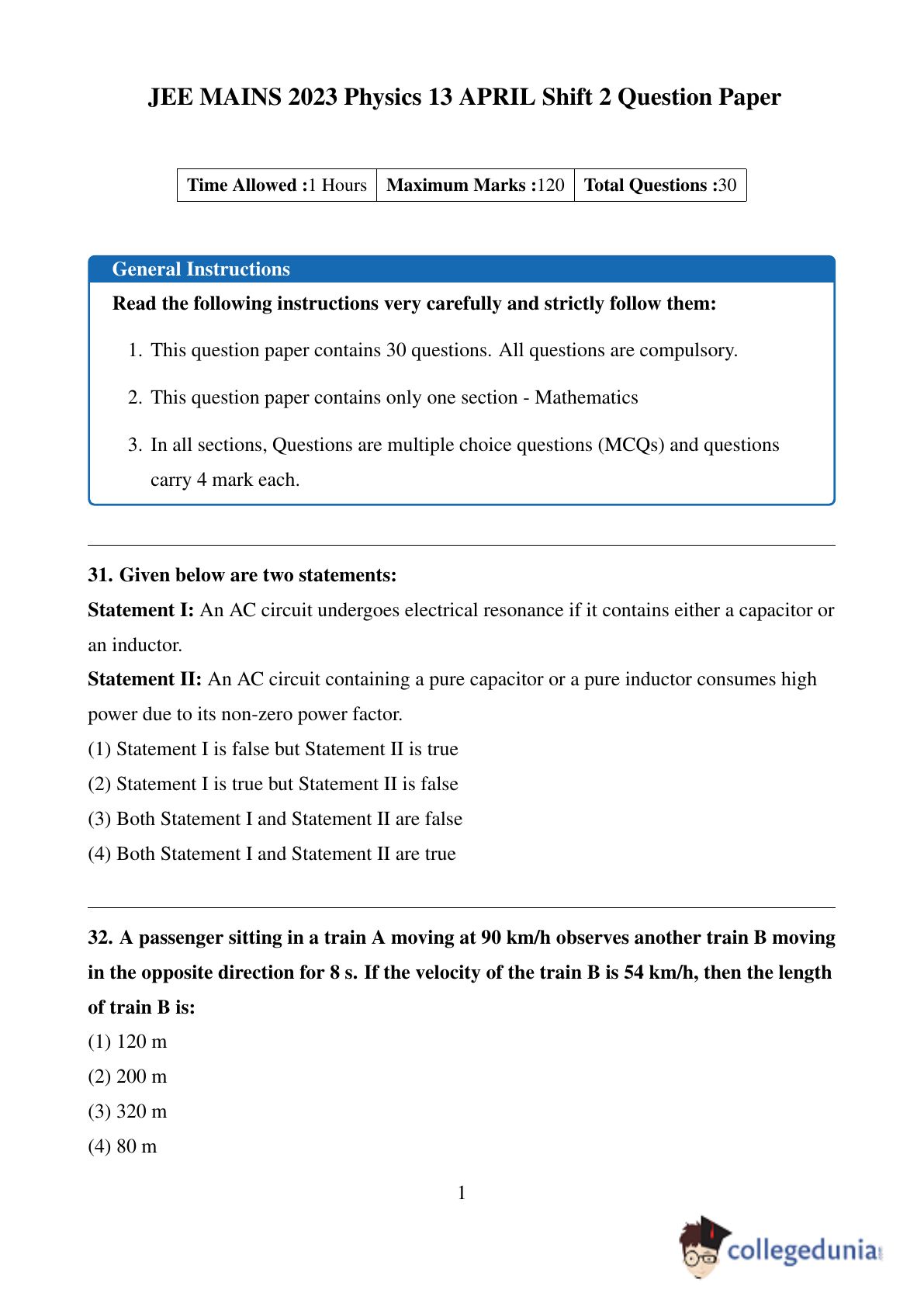
Given below are two statements:
Statement I: An AC circuit undergoes electrical resonance if it contains either a capacitor or an inductor.
Statement II: An AC circuit containing a pure capacitor or a pure inductor consumes high power due to its non-zero power factor.
View Solution
A passenger sitting in a train A moving at 90 km/h observes another train B moving in the opposite direction for 8 s. If the velocity of the train B is 54 km/h, then the length of train B is:
View Solution
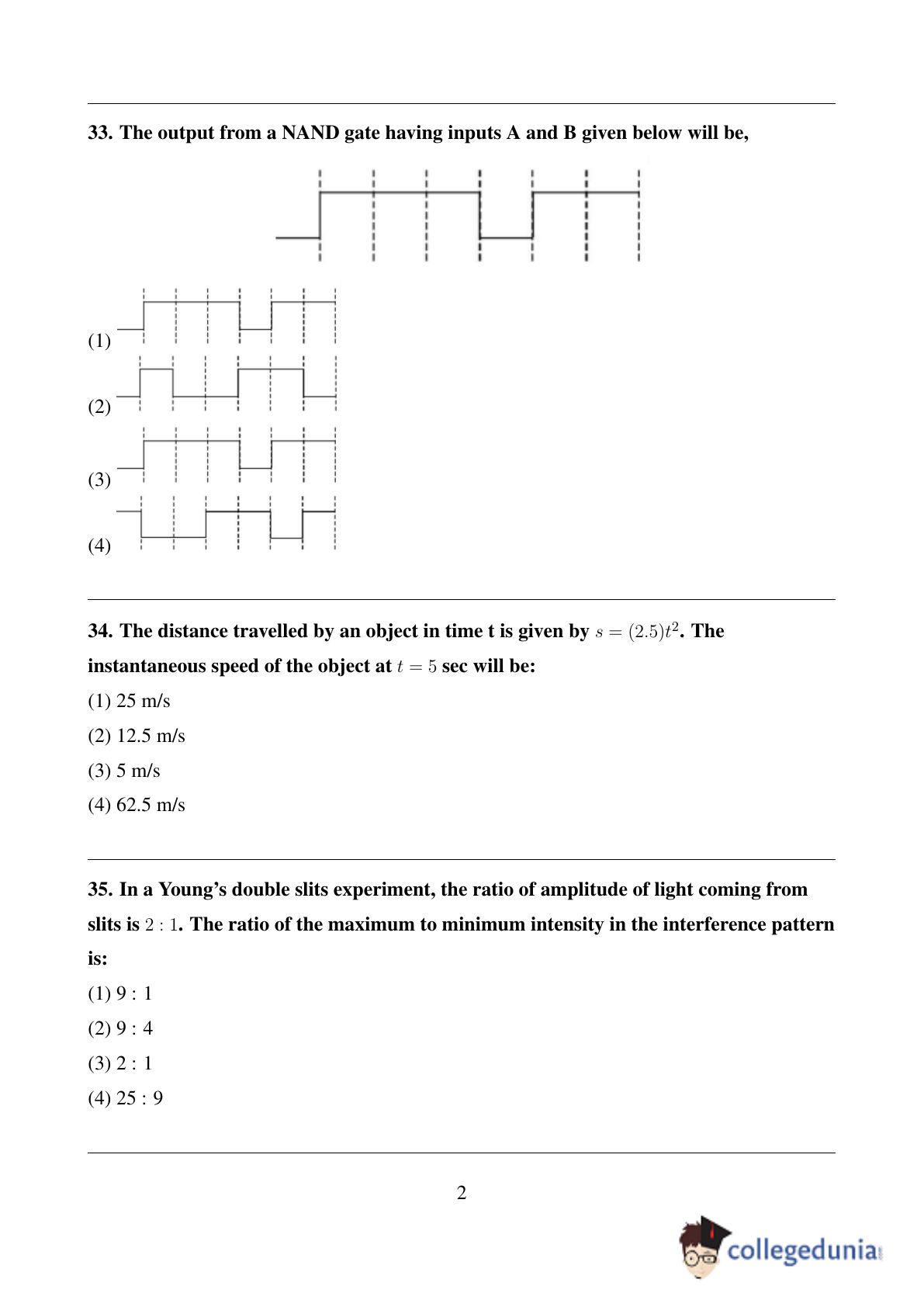
The output from a NAND gate having inputs A and B given below will be,

- (1)
![]()
- (2)
![]()
- (3)
![]()
- (4)
![]()


View Solution
The distance travelled by an object in time t is given by \( s = (2.5)t^2 \). The instantaneous speed of the object at \( t = 5 \) sec will be:
View Solution
The distance travelled is given by \( s = 2.5t^2 \).
The speed \( v \) is the rate of change of distance with respect to time, which can be found by differentiating the distance equation with respect to time:
\[ v = \frac{ds}{dt} = 5t \]
At \( t = 5 \) sec,
\[ v = 5 \times 5 = 25 \, m/s \]
Thus, the instantaneous speed at \( t = 5 \) sec is 25 m/s. Quick Tip: Remember, instantaneous speed is the first derivative of the position function with respect to time.
In a Young's double slits experiment, the ratio of amplitude of light coming from slits is \( 2 : 1 \). The ratio of the maximum to minimum intensity in the interference pattern is:
View Solution
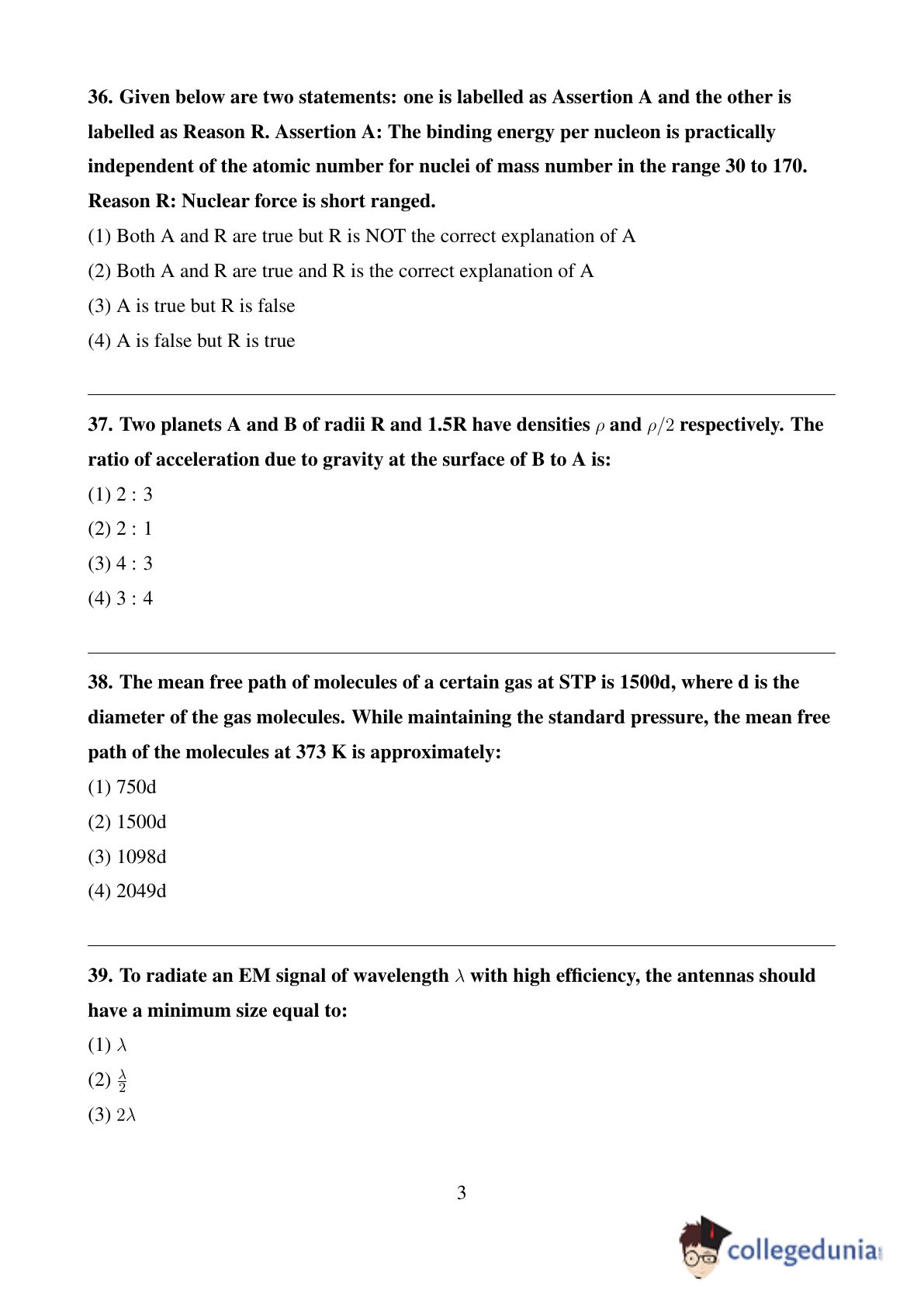
Given below are two statements: one is labelled as Assertion A and the other is labelled as Reason R.
Assertion A: The binding energy per nucleon is practically independent of the atomic number for nuclei of mass number in the range 30 to 170.
Reason R: Nuclear force is short ranged.
View Solution
Two planets A and B of radii R and 1.5R have densities \( \rho \) and \( \rho/2 \) respectively. The ratio of acceleration due to gravity at the surface of B to A is:
View Solution
The mean free path of molecules of a certain gas at STP is 1500d, where d is the diameter of the gas molecules. While maintaining the standard pressure, the mean free path of the molecules at 373 K is approximately:
View Solution
To radiate an EM signal of wavelength \( \lambda \) with high efficiency, the antennas should have a minimum size equal to:
View Solution
To radiate EM signals efficiently, the minimum length of the antenna should be a quarter of the wavelength, i.e., \( \frac{\lambda}{4} \). Quick Tip: For efficient radiation, antennas are designed with dimensions related to the wavelength of the signal.
A particle executes SHM of amplitude A. The distance from the mean position when its kinetic energy is equal to its potential energy is:
View Solution
In an electromagnetic wave, at an instant and at a particular position, the electric field is along the negative z axis and magnetic field is along the positive x-axis. Then the direction of propagation of electromagnetic wave is:
View Solution
Given below are two statements:
Statement I: Out of microwaves, infrared rays and ultraviolet rays, ultraviolet rays are the most effective for the emission of electrons from a metallic surface.
Statement II: Above the threshold frequency, the maximum kinetic energy of photoelectrons is inversely proportional to the frequency of the incident light.
View Solution
Given below are two statements:
Statement I: For a planet, if the ratio of mass of the planet to its radius increases, the escape velocity from the planet also increases.
Statement II: Escape velocity is independent of the radius of the planet.
View Solution
A vehicle of mass 200 kg is moving along a levelled curved road of radius 70 m with angular velocity of 0.2 rad/s. The centripetal force acting on the vehicle is:
View Solution
A 10 \(\mu\)C charge is divided into two parts and placed at 1 cm distance so that the repulsive force between them is maximum. The charges of the two parts are:
View Solution
In the equation \( [ x + \frac{a}{y} ] [ Y - b ] = RT \), where \( X \) is pressure, \( Y \) is volume, \( R \) is universal gas constant and \( T \) is temperature. The physical quantity equivalent to the ratio \( \frac{a}{b} \) is:
View Solution
An electron is moving along the positive x-axis. If the uniform magnetic field is applied parallel to the negative z-axis, then
View Solution
Given below are two statements: one is labelled as Assertion A and the other is labelled as Reason R
Assertion A: A spherical body of radius \( (5 \pm 0.1) \) mm having a particular density is falling through a liquid of constant density. The percentage error in the calculation of its terminal velocity is 4%.
Reason R: The terminal velocity of the spherical body falling through the liquid is inversely proportional to its radius.
View Solution
The initial pressure and volume of an ideal gas are \(P_1\) and \(V_1\). The final pressure of the gas when the gas is suddenly compressed to volume \( \frac{V_1}{4} \) will be:
View Solution
In the network shown below, the charge accumulated in the capacitor in steady state will be:
View Solution
Section – B
Question 21:
In an experiment with sonometer when a mass of 180 g is attached to the string, it vibrates with fundamental frequency of 30 Hz. When a mass \(m\) is attached, the string vibrates with fundamental frequency of 50 Hz. The value of \(m\) is \underline{\hspace{3cm g
View Solution
Fundamental frequency \( f \) of a vibrating string is given by: \[ f = \frac{1}{2L} \sqrt{\frac{T}{\mu}} \]
Where \(L\) is the length, \(T\) is the tension, and \(\mu\) is the mass per unit length of the string.
For the first condition: \[ f_1 = 30 \, Hz, \quad m_1 = 180 \, g \] \[ f_2 = 50 \, Hz, \quad m_2 = m \, g \]
Using the formula for frequency and ratio of frequencies: \[ \frac{f_2}{f_1} = \sqrt{\frac{m_2}{m_1}} \] \[ \frac{50}{30} = \sqrt{\frac{m}{180}} \]
Squaring both sides and solving for \(m\), we get: \[ \frac{25}{9} = \frac{m}{180} \quad \Rightarrow \quad m = 25 \, g \] Quick Tip: Use the relationship between frequency and mass to solve for unknown masses in vibrating strings.
\textbf{Two plates A and B have thermal conductivities \(84 \, \text{W/m·K}\) and \(126 \, \text{W/m·K}\) respectively. They have the same surface area and same thickness. They are placed in contact along their surfaces. If the temperatures of the outer surfaces of A and B are kept at \(100^\circ \text{C}\) and \(0^\circ \text{C}\) respectively, then the temperature of the surface of contact in steady state is \underline{\hspace{3cm}} \(^\circ \text{C}\).}
View Solution
In the circuit shown below, the energy stored in the capacitor is \(3 \, \mu J\). The value of \(n\) is ______________.
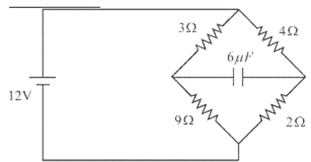
View Solution
A light rope is wound around a hollow cylinder of mass \(5 \, kg\) and radius \(70 \, cm\). The rope is pulled with a force of \(52.5 \, N\). The angular acceleration of the cylinder will be \underline{\hspace{3cm rad/s\(^2\)
View Solution
A straight wire AB of mass \(40 \, g\) and length \(50 \, cm\) is suspended by a pair of flexible leads in uniform magnetic field of magnitude \(0.40 \, T\). The magnitude of the current required in the wire to remove the tension in the supporting leads is \underline{\hspace{3cm A. (Take \(g = 10 \, m/s^2\))
View Solution
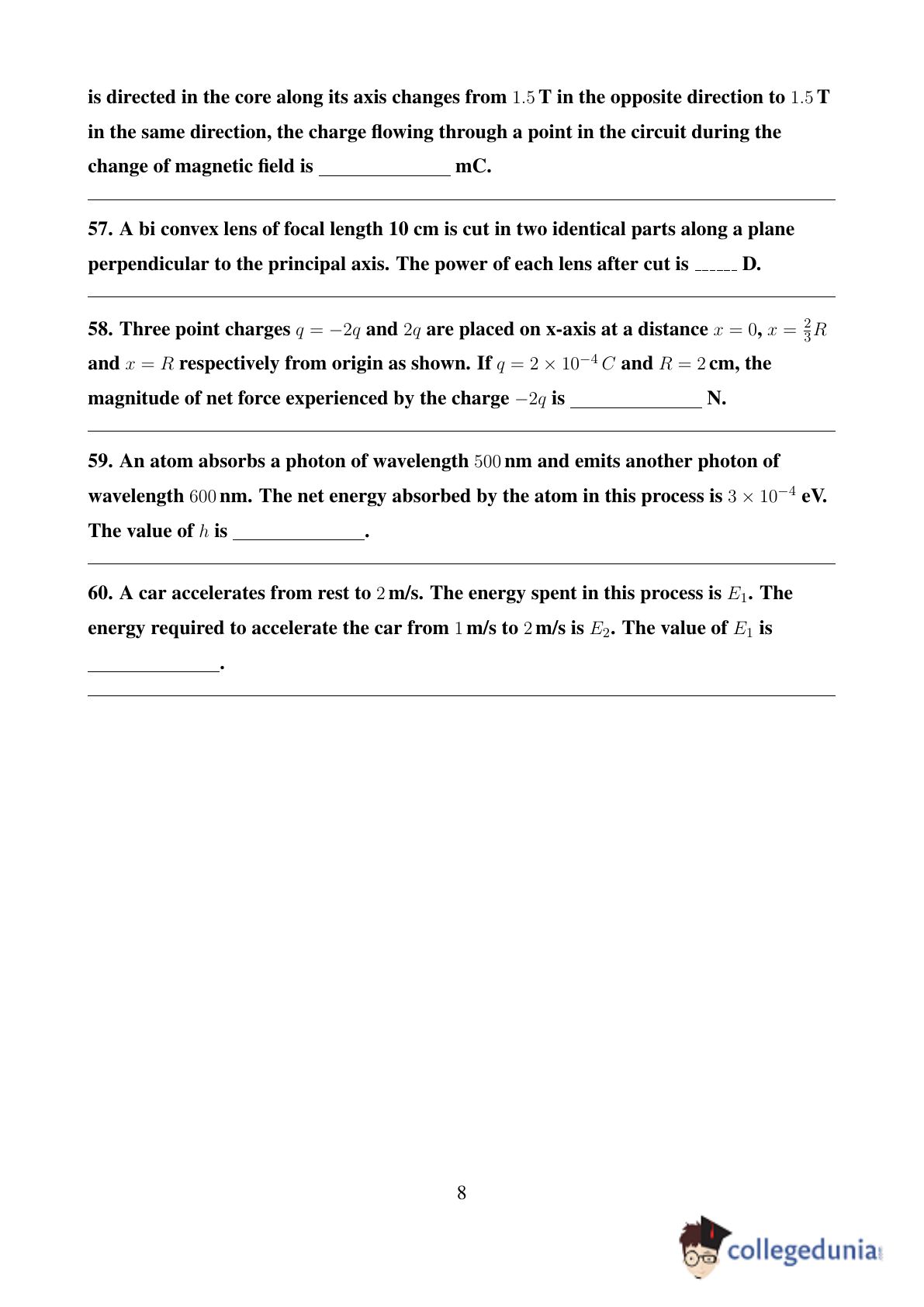
An insulated copper wire of 100 turns is wrapped around a wooden cylindrical core of the cross-sectional area \(24 \, cm^2\). The two ends of the wire are connected to a resistor. The total resistance in the circuit is \(12 \, \Omega\). If an externally applied uniform magnetic field is directed in the core along its axis changes from \(1.5 \, T\) in the opposite direction to \(1.5 \, T\) in the same direction, the charge flowing through a point in the circuit during the change of magnetic field is _____________ mC.
View Solution
Question 27:
A bi convex lens of focal length 10 cm is cut in two identical parts along a plane perpendicular to the principal axis. The power of each lens after cut is _______ D.
View Solution
Solution: When a biconvex lens is cut into two identical parts along a plane perpendicular to the principal axis, each half behaves as a plano-convex lens. The focal length of each plano-convex lens will be twice the focal length of the original biconvex lens.
Given, focal length of biconvex lens, f = 10 cm
Focal length of each plano-convex lens, f' = 2f = 2 x 10 = 20 cm
Power of each lens after cut, P' = 1⁄f' (in meters)
P' = 1⁄0.2 = 5 D
Now, the actual power of the biconvex lens is P = 1⁄f = 1⁄0.1 = 10 D
Since, a biconvex lens cut perpendicularly to the principal axis yields two plano-convex lenses and the focal length gets doubled in each case, hence, the power gets halved. Therefore, the power of each lens after cut is 10 D.
Quick Tip: When a lens is cut perpendicular to the principal axis, the focal length doubles, and the power becomes half.
Three point charges \(q = -2q\) and \(2q\) are placed on x-axis at a distance \(x = 0\), \(x = \frac{2}{3} R\) and \(x = R\) respectively from origin as shown. If \(q = 2 \times 10^{-4} \, C\) and \(R = 2 \, cm\), the magnitude of net force experienced by the charge \(-2q\) is \underline{\hspace{3cm N.
View Solution
An atom absorbs a photon of wavelength \(500 \, nm\) and emits another photon of wavelength \(600 \, nm\). The net energy absorbed by the atom in this process is \(3 \times 10^{-4}\) eV. The value of \(h\) is \underline{\hspace{3cm.
View Solution
A car accelerates from rest to \(2 \, m/s\). The energy spent in this process is \(E_1\). The energy required to accelerate the car from \(1 \, m/s\) to \(2 \, m/s\) is \(E_2\). The value of \(E_1\) is \underline{\hspace{3cm.
View Solution
JEE Main 2023 Physics Paper Analysis April 13 Shift 2
JEE Main 2023 Physics Paper Analysis for the exam scheduled on April 13 Shift 2 is available here. Candidates can check subject-wise paper analysis for the exam scheduled on April 13 Shift 2 here along with the topics with the highest weightage.
JEE Main 2023 Physics Question Paper Pattern
| Feature | Question Paper Pattern |
|---|---|
| Examination Mode | Computer-based Test |
| Exam Language | 13 languages (English, Hindi, Assamese, Bengali, Gujarati, Kannada, Malayalam, Marathi, Odia, Punjabi, Tamil, Telugu, and Urdu) |
| Exam Duration | 3 hours |
| Sectional Time Limit | None |
| Physics Marks | 100 marks |
| Total Number of Questions Asked | 20 MCQs + 10 Numerical Type Questions |
| Total Number of Questions to be Answered | 20 MCQs + 5 Numerical Type Questions |
| Marking Scheme | +4 for each correct answer |
| Negative Marking | -1 for each incorrect answer |
Also Check:



Comments