




JEE Main 2023 10 April Shift 2 Question Paper is out. NTA conducted JEE Main 2023 10 April Shift 2 from 3 PM to 6 PM. Candidates can download the official JEE Main 2023 Question Paper PDF with Solution and Answer Key for 10 April Shift 2 using the link below.
Also Check: JEE Main 2024 Question Paper with Solution PDF Download
JEE Main 2023 10 April Shift 2 Question Paper with Solution and Answer Key PDF
| JEE Main 2023 10th April Shift 2 Question Paper with Solution PDF |  Download Download |
Check Solution |

Mathematics
Section-A
Question 1:
If the coefficients of \( x \) and \( x^2 \) in \( (1 + x)^p(1 - x)^q \) are 4 and -5 respectively, then \( 2p + 3q \) is equal to:
View Solution
Step 1: Expand \( (1 + x)^p(1 - x)^q \)
The expansion of \( (1 + x)^p \) and \( (1 - x)^q \) is given by: \[ (1 + x)^p = 1 + px + \frac{p(p-1)}{2!}x^2 + \dots \] \[ (1 - x)^q = 1 - qx + \frac{q(q-1)}{2!}x^2 - \dots \]
Step 2: Multiply the expansions
Now, multiply the two expansions: \[ (1 + x)^p(1 - x)^q = \left( 1 + px + \frac{p(p-1)}{2!}x^2 + \dots \right) \times \left( 1 - qx + \frac{q(q-1)}{2!}x^2 - \dots \right) \]
To get the coefficient of \( x \), we need to add the product of terms that result in \( x \): \[ Coefficient of x = p - q \]
Similarly, for \( x^2 \): \[ Coefficient of x^2 = \frac{p(p-1)}{2!} + \frac{q(q-1)}{2!} \]
Step 3: Using given values
We are given that the coefficients of \( x \) and \( x^2 \) are 4 and -5, respectively: \[ p - q = 4 \quad (1) \] \[ \frac{p(p-1)}{2!} + \frac{q(q-1)}{2!} = -5 \quad (2) \]
Step 4: Solving the system of equations
From equation (1): \[ p = q + 4 \]
Substitute \( p = q + 4 \) into equation (2): \[ \frac{(q + 4)(q + 3)}{2} + \frac{q(q - 1)}{2} = -5 \]
Solving this yields \( p = 15 \) and \( q = 11 \).
Step 5: Calculate \( 2p + 3q \)
Now, we calculate: \[ 2p + 3q = 2(15) + 3(11) = 30 + 33 = 63 \]
Thus, \( 2p + 3q = 63 \). Quick Tip: When dealing with coefficients of terms in binomial expansions, use the binomial expansion formulas for both expressions, multiply them, and equate the coefficients for the desired powers of \( x \).
Let \( A = \{2, 3, 4\} \) and \( B = \{8, 9, 12\} \). Then the number of elements in the relation \( R = \{((a_1, b_1), (a_2, b_2)) \in (A \times B, A \times B) : a_1 divides b_2 and a_2 divides b_1 \} \) is:
View Solution
Let time image of the point \( P(1, 2, 6) \) in the plane passing through the points A(1, 2, 0), B(1, 4, 1), and C(0, 5, 1) be \( Q(\alpha, \beta, \gamma) \). Then \( \alpha^2 + \beta^2 + \gamma^2 \) is equal to:
View Solution
The statement \( \sim [p \vee (\sim (p \land q))] \) is equivalent to:
View Solution
Let \( S = \left\{ x \in \left( -\frac{\pi}{2}, \frac{\pi}{2} \right) : 9^{1 - \tan^2 x} + 9^{\tan^2 x} = 10 \right\} \) \[ b = \sum_{x \in S} \tan^2 \left( \frac{x}{3} \right), then \left( \beta - 14 \right)^2 is equal to: \]
View Solution
If the points P and Q are respectively the circumcenter and the orthocenter of a \( \triangle ABC \), the \( \overrightarrow{PA} + \overrightarrow{PB} + \overrightarrow{PC} \) is equal to:
View Solution
Let A be the point (1, 2) and B be any point on the curve \( x^2 + y^2 = 16 \). If the centre of the locus of the point P, which divides the line segment AB in the ratio 3:2 is the point C (\( \alpha, \beta \)), then the length of the line segment AC is:
View Solution
Let \( m \) be the mean and \( \sigma \) be the standard deviation of the distribution:

where \( \sum f_i = 62 \). If \( [x] \) denotes the greatest integer \( \leq x \), then \( [\mu^2 + \sigma^2] \) is equal to:
View Solution
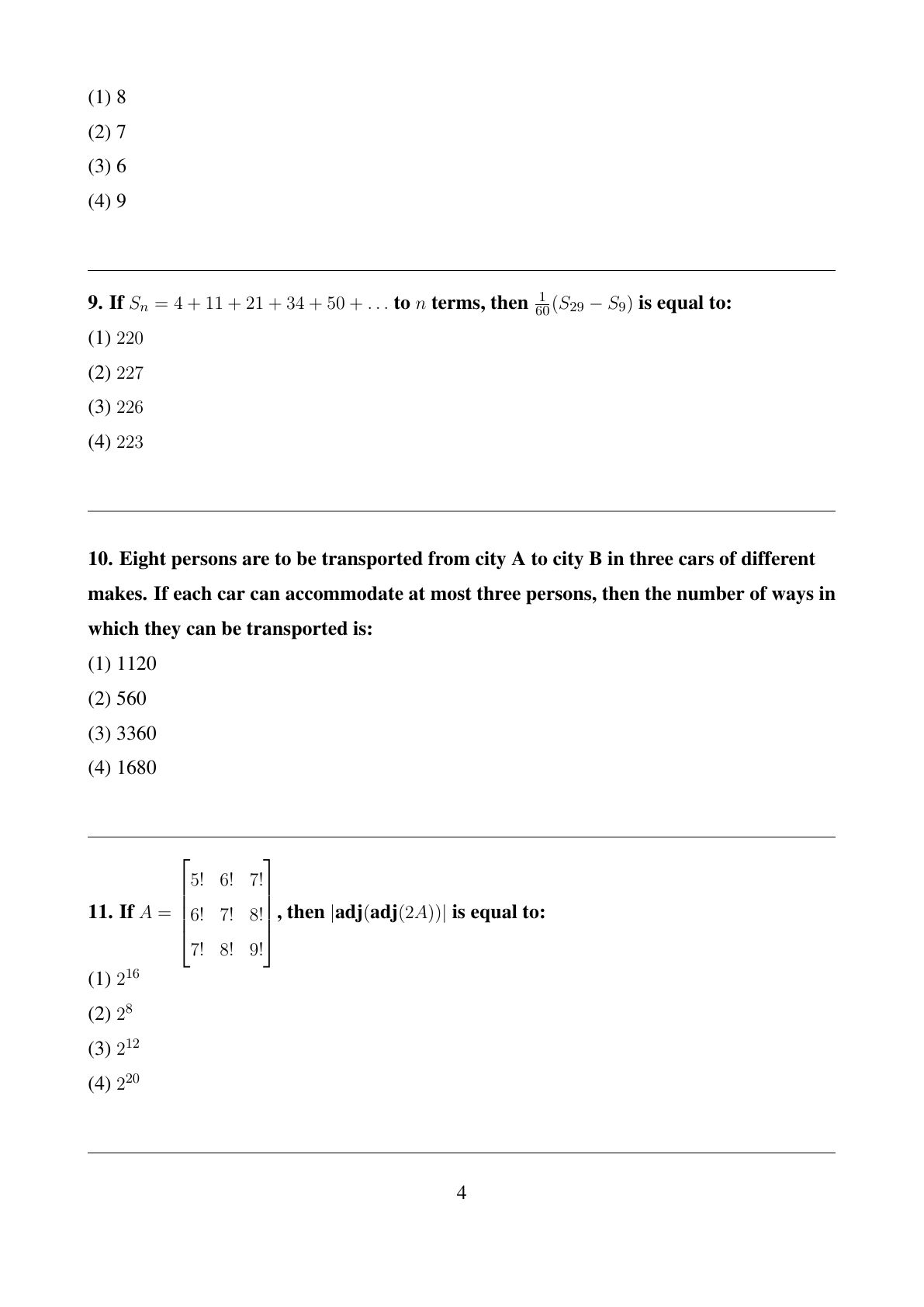
If \( S_n = 4 + 11 + 21 + 34 + 50 + \dots \) to \( n \) terms, then \( \frac{1}{60} (S_{29} - S_9) \) is equal to:
View Solution
The given sequence is 4, 11, 21, 34, 50, ...
The differences are 7, 10, 13, 16, ...
The second differences are 3, 3, 3, ...
Since the second differences are constant, the sequence is quadratic.
Let \(T_n = an^2 + bn + c\).
\(T_1 = a + b + c = 4\)
\(T_2 = 4a + 2b + c = 11\)
\(T_3 = 9a + 3b + c = 21\)
Solving these equations, we get \(a = \frac{3}{2}\), \(b = \frac{5}{2}\), \(c = 0\).
Thus, \(T_n = \frac{3n^2 + 5n}{2}\).
\(S_n = \sum_{k=1}^n T_k = \frac{1}{2}\sum_{k=1}^n (3k^2 + 5k)\)
\(S_n = \frac{1}{2}\left(3\sum_{k=1}^n k^2 + 5\sum_{k=1}^n k\right)\)
\(S_n = \frac{1}{2}\left(3\frac{n(n+1)(2n+1)}{6} + 5\frac{n(n+1)}{2}\right)\)
\(S_n = \frac{n(n+1)(n+3)}{2}\)
\(S_{29} = \frac{29(30)(32)}{2} = 13920\)
\(S_9 = \frac{9(10)(12)}{2} = 540\)
\(S_{29} - S_9 = 13920 - 540 = 13380\)
\(\frac{1}{60}(S_{29} - S_9) = \frac{13380}{60} = 223\)
Answer: 223. Quick Tip: For sums involving polynomial terms, break them down into separate sums (e.g., sum of squares and sum of integers) and apply known formulas. Simplify carefully and compute each term step-by-step.
Eight persons are to be transported from city A to city B in three cars of different makes. If each car can accommodate at most three persons, then the number of ways in which they can be transported is:
View Solution
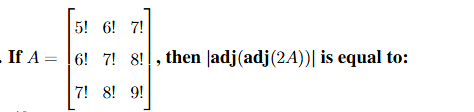
View Solution
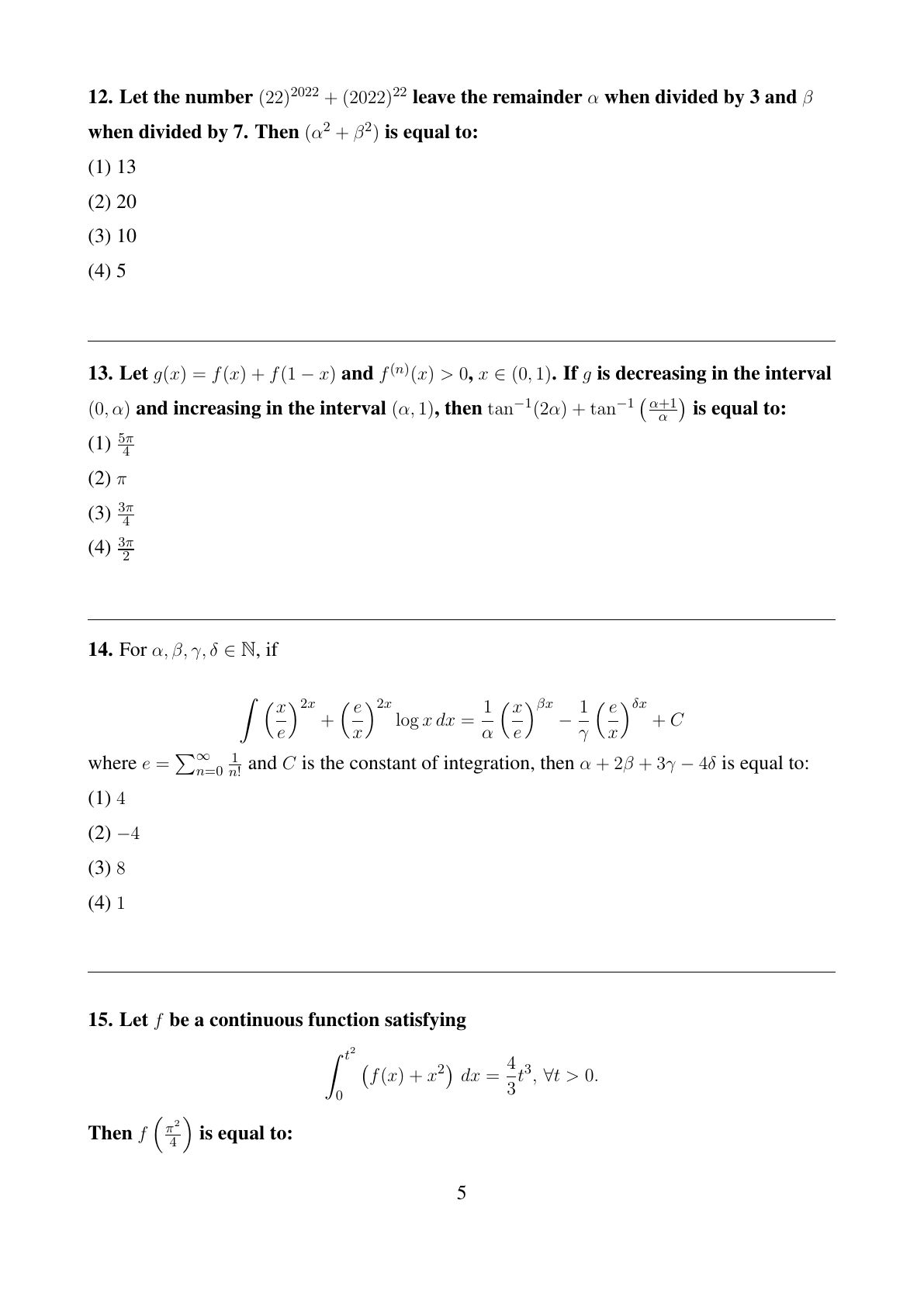
Let the number \( (22)^{2022} + (2022)^{22} \) leave the remainder \( \alpha \) when divided by 3 and \( \beta \) when divided by 7. Then \( (\alpha^2 + \beta^2) \) is equal to:
View Solution
Let \( g(x) = f(x) + f(1-x) \) and \( f^{(n)}(x) > 0 \), \( x \in (0, 1) \). If \( g \) is decreasing in the interval \( (0, \alpha) \) and increasing in the interval \( (\alpha, 1) \), then \( \tan^{-1}(2 \alpha) + \tan^{-1} \left( \frac{\alpha + 1}{\alpha} \right) \) is equal to:
View Solution
For \( \alpha, \beta, \gamma, \delta \in \mathbb{N} \), if
\[ \int \left( \frac{x}{e} \right)^{2x} + \left( \frac{e}{x} \right)^{2x} \log x \, dx = \frac{1}{\alpha} \left( \frac{x}{e} \right)^{\beta x} - \frac{1}{\gamma} \left( \frac{e}{x} \right)^{\delta x} + C \]
where \( e = \sum_{n=0}^{\infty} \frac{1}{n!} \) and \( C \) is the constant of integration, then \( \alpha + 2\beta + 3\gamma - 4\delta \) is equal to:
View Solution
Let \( f \) be a continuous function satisfying \[ \int_0^{t^2} \left( f(x) + x^2 \right) \, dx = \frac{4}{3} t^3, \, \forall t > 0. \]
Then \( f \left( \frac{\pi^2}{4} \right) \) is equal to:
View Solution
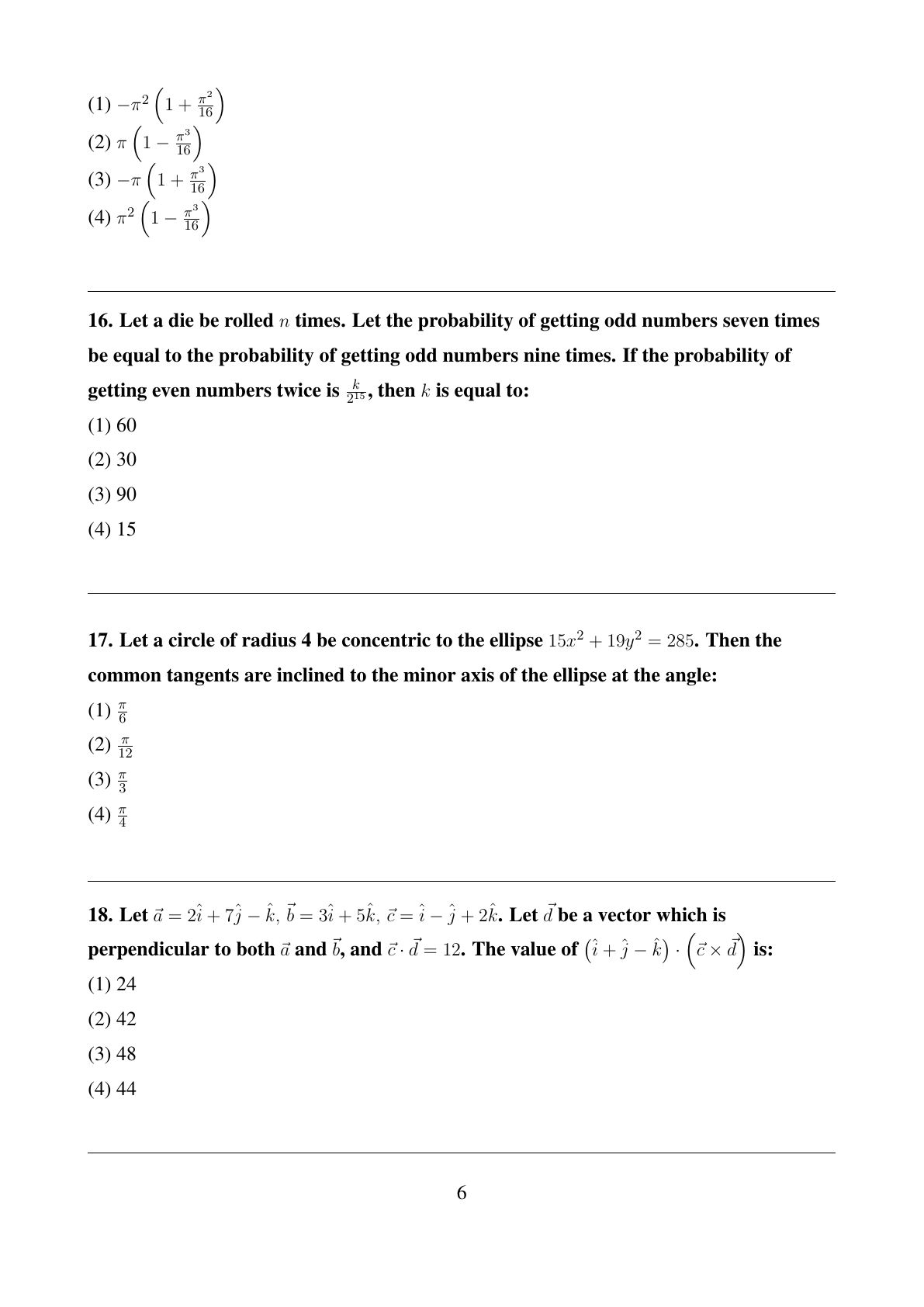
Let a die be rolled \( n \) times. Let the probability of getting odd numbers seven times be equal to the probability of getting odd numbers nine times. If the probability of getting even numbers twice is \( \frac{k}{2^{15}} \), then \( k \) is equal to:
View Solution
Let a circle of radius 4 be concentric to the ellipse \( 15x^2 + 19y^2 = 285 \). Then the common tangents are inclined to the minor axis of the ellipse at the angle:
View Solution
Let \( \vec{a} = 2\hat{i} + 7\hat{j} - \hat{k}, \, \vec{b} = 3\hat{i} + 5\hat{k}, \, \vec{c} = \hat{i} - \hat{j} + 2\hat{k} \). Let \( \vec{d} \) be a vector which is perpendicular to both \( \vec{a} \) and \( \vec{b} \), and \( \vec{c} \cdot \vec{d} = 12 \). The value of \( \left( \hat{i} + \hat{j} - \hat{k} \right) \cdot \left( \vec{c} \times \vec{d} \right) \) is:
View Solution
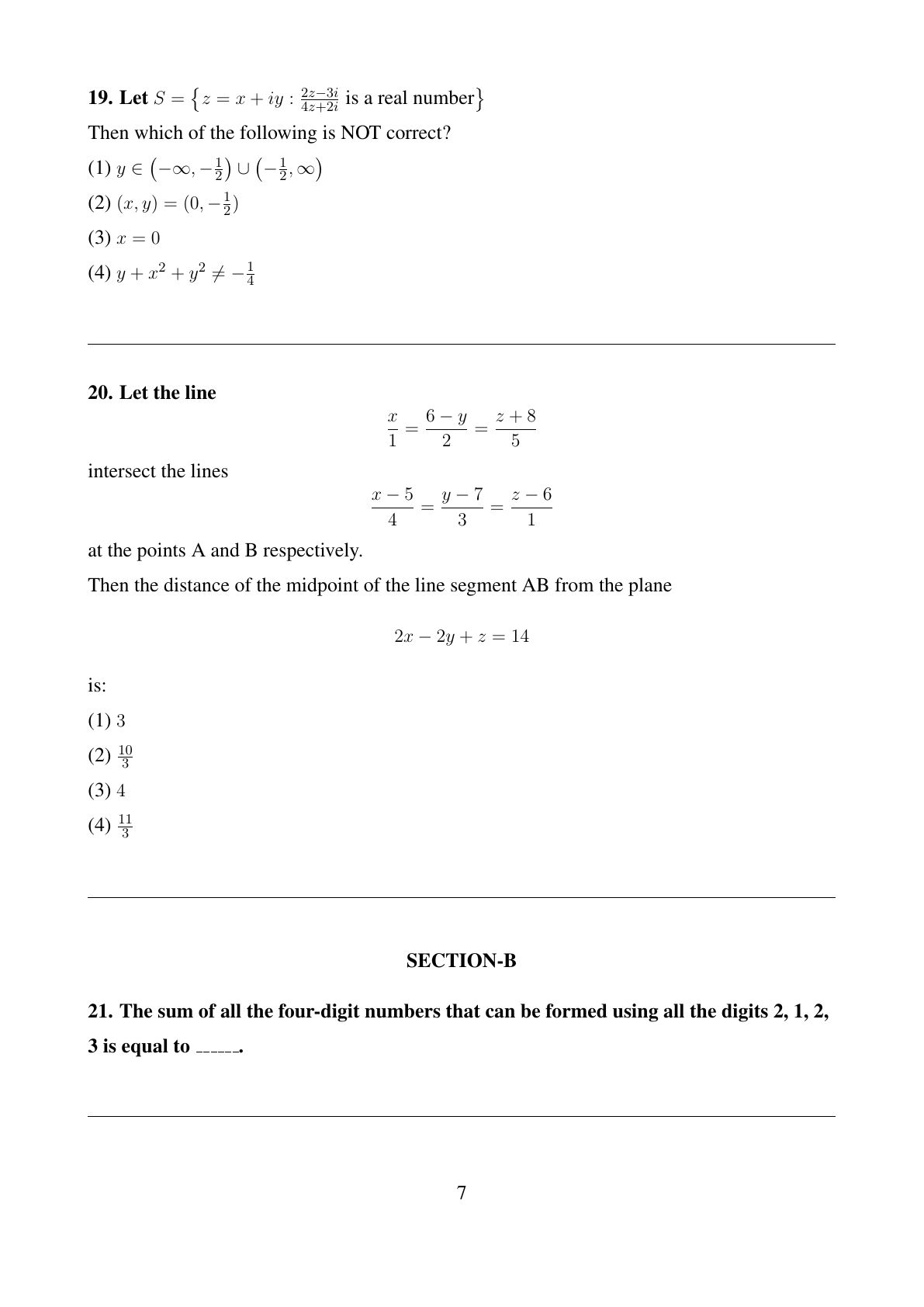
Let \( S = \left\{ z = x + iy : \frac{2z - 3i}{4z + 2i} is a real number \right\} \)
\text{Then which of the following is NOT correct?
View Solution
Let the line \[ \frac{x}{1} = \frac{6 - y}{2} = \frac{z + 8}{5} \]
intersect the lines \[ \frac{x - 5}{4} = \frac{y - 7}{3} = \frac{z + 2}{1} \quad and \quad \frac{x + 3}{6} = \frac{3 - y}{3} = \frac{z - 6}{1} \]
at the points A and B respectively. Then the distance of the mid-point of the line segment AB from the plane \( 2x - 2y + z = 14 \) is:
View Solution
Section-B
Question 21:
The sum of all the four-digit numbers that can be formed using all the digits 2, 1, 2, 3 is equal to ______.
View Solution
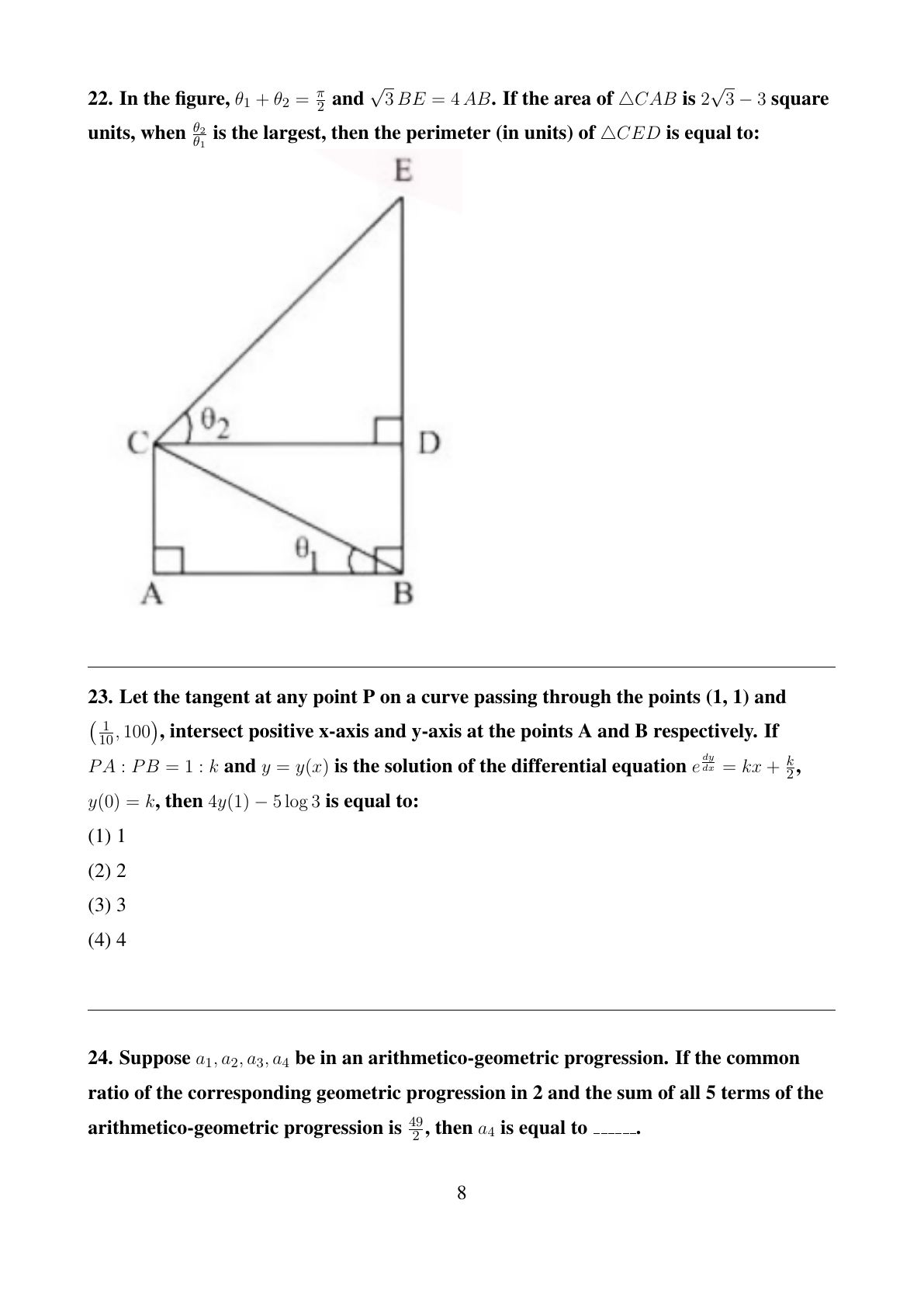
In the figure, \( \theta_1 + \theta_2 = \frac{\pi}{2} \) and \( \sqrt{3} \, BE = 4 \, AB \). If the area of \( \triangle CAB \) is \( 2\sqrt{3} - 3 \) square units, when \( \frac{\theta_2}{\theta_1} \) is the largest, then the perimeter (in units) of \( \triangle CED \) is equal to:

View Solution
Let the tangent at any point P on a curve passing through the points (1, 1) and \( \left( \frac{1}{10}, 100 \right) \), intersect positive x-axis and y-axis at the points A and B respectively. If \( PA : PB = 1 : k \) and \( y = y(x) \) is the solution of the differential equation \( e^{\frac{dy}{dx}} = kx + \frac{k}{2} \), \( y(0) = k \), then \( 4y(1) - 5 \log 3 \) is equal to:
View Solution
Suppose \( a_1, a_2, a_3, a_4 \) be in an arithmetico-geometric progression. If the common ratio of the corresponding geometric progression in 2 and the sum of all 5 terms of the arithmetico-geometric progression is \( \frac{49}{2} \), then \( a_4 \) is equal to ______.
View Solution
If the area of the region \( \{(x, y) : |x^2 - 2| \leq x \} \) is \( A \), then \( 6A + 16\sqrt{2} \) is equal to ____.
View Solution
Let the foot of perpendicular from the point A(4, 3, 1) on the plane \( P : x - y + 2z + 3 = 0 \) be N. If B(5, \( \alpha \), \( \beta \)) is a point on plane P such that the area of triangle ABN is \( 3\sqrt{2} \), then \( \alpha^2 + \beta^2 + \alpha \beta \) is equal to:
View Solution
Let \( S \) be the set of values of \( \lambda \), for which the system of equations \[ 6\lambda x - 3y + 3z = 4\lambda^2, \quad 2x + 6\lambda y + 4z = 1, \quad 3x + 2y + 3\lambda z = \lambda \]
has no solution. Then \( 12 \sum_{\lambda \in S} |\lambda| \) is equal to:
View Solution
If the domain of the function \( f(x) = \sec^{-1} \left( \frac{2x}{5x + 3} \right) \) \text{ is \( [\alpha, \beta] \cup (\gamma, \delta) \), \text{ then \( |3\alpha + 10(\beta + \gamma) + 21\delta| \) is equal to:
View Solution
The function is given as:
\[ f(x) = \sec^{-1} \left( \frac{2x}{5x + 3} \right) \]
For the domain of \( f(x) \), we need to find when:
\[ \left| \frac{2x}{5x + 3} \right| \geq 1 \]
This leads to two conditions:
1. \( \frac{2x}{5x + 3} \geq 1 \)
2. \( \frac{2x}{5x + 3} \leq -1 \)
Let's solve each inequality:
For the first inequality:
\[ \frac{2x}{5x + 3} \geq 1 \quad \Rightarrow \quad 2x \geq 5x + 3 \quad \Rightarrow \quad -3x \geq 3 \quad \Rightarrow \quad x \leq -1 \]
For the second inequality:
\[ \frac{2x}{5x + 3} \leq -1 \quad \Rightarrow \quad 2x \leq -5x - 3 \quad \Rightarrow \quad 7x \leq -3 \quad \Rightarrow \quad x \leq -\frac{3}{7} \]
Thus, the domain of the function is:
\[ [-1, -\frac{3}{5}] \cup (-\frac{3}{5}, -\frac{3}{7}] \]
Let:
\[ \alpha = -1, \quad \beta = -\frac{3}{5}, \quad \gamma = -\frac{3}{5}, \quad \delta = -\frac{3}{7} \]
Now, calculate \( 3\alpha + 10(\beta + \gamma) + 21\delta \):
\[ 3\alpha + 10(\beta + \gamma) + 21\delta = 3(-1) + 10\left( -\frac{3}{5} + -\frac{3}{5} \right) + 21\left( -\frac{3}{7} \right) \] \[ = -3 + 10\left( -\frac{6}{5} \right) + 21\left( -\frac{3}{7} \right) \] \[ = -3 + \left( -\frac{60}{5} \right) + \left( -\frac{63}{7} \right) \] \[ = -3 - 12 - 9 = -24 \]
Thus, \( |3\alpha + 10(\beta + \gamma) + 21\delta| = 24 \). Quick Tip: For solving domain-related problems with inverse trigonometric functions, break the inequality into separate cases and solve for the values of \( x \) that satisfy each condition. Always ensure to check the absolute value condition.
Let the quadratic curve passing through the point \( (-1, 0) \) and touching the line \( y = x \) at \( (1, 1) \) be \( y = f(x) \). Then the x-intercept of the normal to the curve at the point \( (\alpha, \alpha + 1) \) in the first quadrant is:
View Solution
Let the equations of two adjacent sides of a parallelogram ABCD be \( 2x - 3y = -23 \) and \( 5x + 4y = 23 \). \text{If the equation of its one diagonal AC is \( 3x + 7y = 23 \) \text{ and the distance of A from the other diagonal is \( d \), then 50d2 is equal to:
View Solution
Physics
Section-A
Question 31:
Given below are two statements:
Statement I: Rotation of the earth shows effect on the value of acceleration due to gravity (g)
Statement II: The effect of rotation of the earth on the value of 'g' at the equator is minimum and that at the pole is maximum.
In the light of the above statements, choose the correct answer from the options given below.
View Solution
The ratio of intensities at two points P and Q on the screen in a Young's double slit experiment where phase difference between two waves of same amplitude are \( \frac{\pi}{3} \) and \( \frac{\pi}{2} \), respectively, are:
View Solution
The time period of a satellite, revolving above Earth's surface at a height equal to \( R \) will be (Given \( g = \pi^2 \, m/s^2, R = radius of earth \)):
View Solution
In a metallic conductor, under the effect of applied electric field, the free electrons of the conductor:
View Solution
A message signal of frequency 3kHz is used to modulate a carrier signal of frequency 1.5 MHz. The bandwidth of the amplitude modulated wave is:
View Solution
In an experiment with vernier calipers of least count 0.1 mm, when two jaws are joined together the zero of the vernier scale lies right to the zero of the main scale and 6th division of vernier scale coincides with the main scale division. While measuring the diameter of a spherical bob, the zero of the vernier scale lies in between 3 cm and 3.3 cm marks, and 4th division of vernier scale coincides with the main scale division. The diameter of the bob is measured as:
View Solution
Two projectiles are projected at \( 30^\circ \) and \( 60^\circ \) with the horizontal the same speed. The ratio of the maximum height attained by the two projectiles respectively is:
View Solution
Given below are two statements: one is labelled as Assertion A and the other one is labelled as Reason R.
Assertion A: An electric fan continues to rotate for some time after the current is switched off.
Reason R: Fan continues to rotate due to inertia of motion.
In the light of the above statements, choose the most appropriate answer from the options given below.
View Solution
The distance between two plates of a capacitor is \( d \) and its capacitance is \( C_1 \), when air is the medium between the plates. If a metal sheet of thickness \( \frac{2d}{3} \) and of the same area as the plate is introduced between the plates, the capacitance of the capacitor becomes \( C_2 \). The ratio \( \frac{C_2}{C_1} \) is:
View Solution
The amplitude of magnetic field in an electromagnetic wave propagating along y-axis is \( 6.0 \times 10^{-7} \, T \). The maximum value of electric field in the electromagnetic wave is:
View Solution
Question 41:
If each diode has a forward bias resistance of 25 \(\Omega\) in the below circuit,
View Solution
A gas mixture consists of 2 moles of oxygen and 4 moles of neon at temperature \( T \). Neglecting all vibrational modes, the total internal energy of the system will be:
View Solution
For a periodic motion represented by the equation \( y = \sin \omega t + \cos \omega t \), the amplitude of the motion is:
View Solution
A person travels \( x \) distance with velocity \( v_1 \) and then \( x \) distance with velocity \( v_2 \) in the same direction. The average velocity of the person is \( v \), then the relation between \( v \), \( v_1 \), and \( v_2 \) will be:
View Solution
The half-life of a radioactive substance is \( T \). The time taken for disintegrating \( \frac{7}{8} \) part of its original mass will be:
View Solution
A gas is compressed adiabatically, which one of the following statements is NOT true.
View Solution
Given below are two statements:
Statement I: For diamagnetic substance, \( -1 \leq X < 0 \), where \( X \) is the magnetic susceptibility.
Statement II: Diamagnetic substances when placed in an external magnetic field, tend to move from stronger to weaker part of the field.
In the light of the above statements, choose the correct answer from the options given below.
View Solution
Young's moduli of the material of wires A and B are in the ratio 1:4, while its area of cross sections are in the ratio 1:3. If the same amount of load is applied to both the wires, the amount of elongation produced in the wires A and B will be in the ratio of:
[Assume length of wires A and B are same]
View Solution
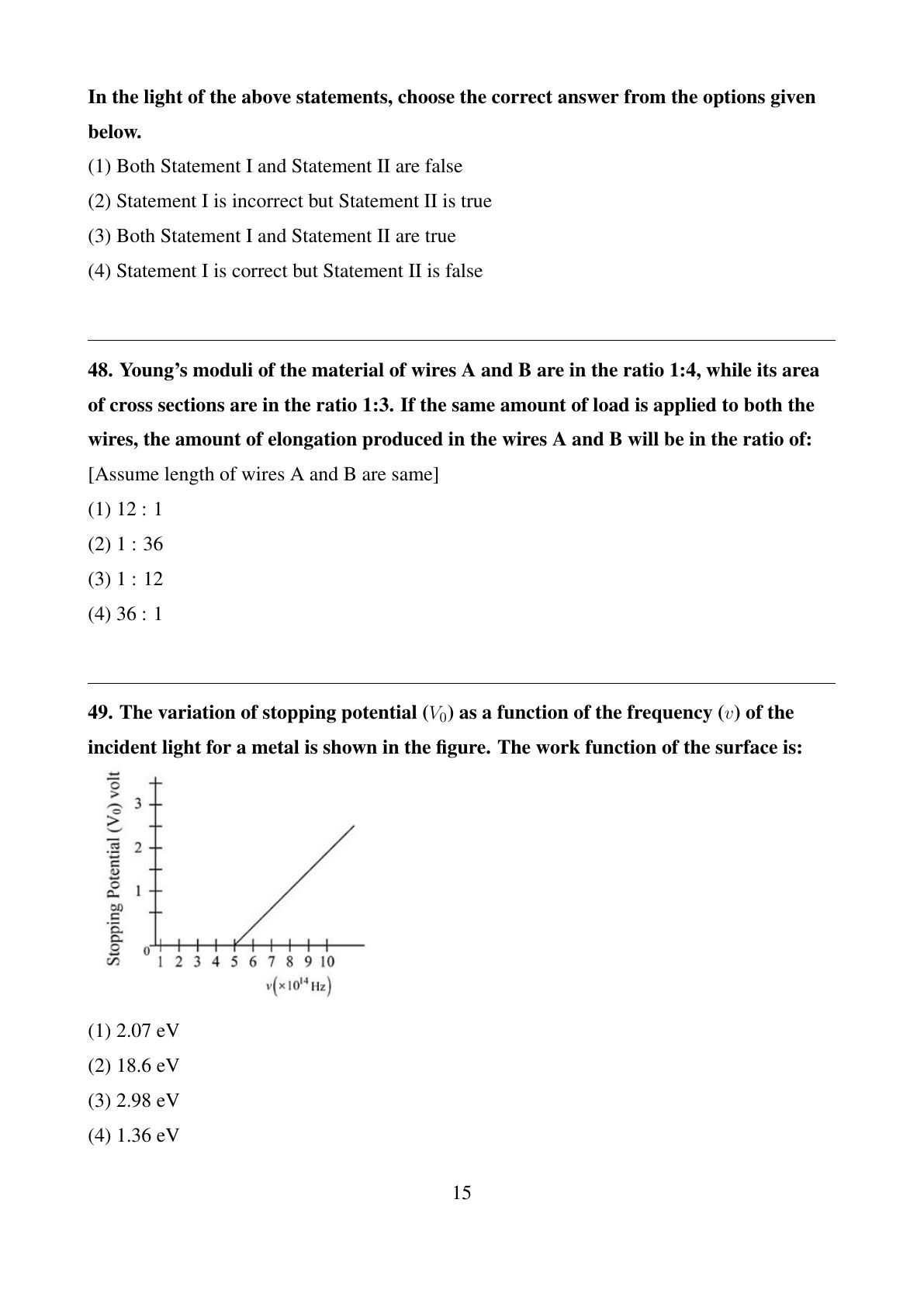
The variation of stopping potential (\( V_0 \)) as a function of the frequency (\( v \)) of the incident light for a metal is shown in the figure. The work function of the surface is:

View Solution
Section-B
Question 50:
A bar magnet is released from rest along the axis of a very long vertical copper tube. After some time, the magnet will:
View Solution
If 917 Å be the lowest wavelength of Lyman series, then the lowest wavelength of Balmer series will be __________ Å.
View Solution
A square loop of side 2.0 cm is placed inside a long solenoid that has 50 turns per centimeter and carries a sinusoidally varying current of amplitude 2.5 A and angular frequency \( 700 \, rad/s^{-1} \). The central axes of the loop and solenoid coincide. The amplitude of the emf induced in the loop is \( x \times 10^{-4} \) V. The value of \( x \) is:
View Solution
A rectangular parallelepiped is measured as 1 cm × 1 cm × 100 cm. If its specific resistance is \( 3 \times 10^{-7} \, \Omega \)-cm, then the resistance between its two opposite rectangular faces will be: _____ \( \times 10^{-7} \, \Omega \).
View Solution
A force of \( -P \hat{k} \) acts on the origin of the coordinate system. The torque about the point \( (2, -3) \) is \( P (a \hat{i} + b \hat{j}) \). The ratio of \( \frac{a}{b} \) is \( \frac{x}{2} \). The value of \( x \) is:
View Solution
A straight wire carrying a current of 14 A is bent into a semicircular arc of radius 2.2 cm as shown in the figure. The magnetic field produced by the current at the centre \( O \) of the arc is _______ \( \times 10^{-4} \, T \).

View Solution
Figure below shows a liquid being pushed out of the tube by a piston having area of cross section 2.0 cm\(^2\). The area of cross section at the outlet is 10 mm\(^2\). If the piston is pushed at a speed of 4 cm/s\(^-1\), the speed of the outgoing fluid is ______ cm/s\(^-1\).

View Solution
A rectangular block of mass 5 kg attached to a horizontal spiral spring executes simple harmonic motion of amplitude 1 m and time period 3.14 s. The maximum force exerted by the spring on the block is _______ N.
View Solution
An electron revolves around an infinite cylindrical wire having uniform linear charge density \( 2 \times 10^{-8} \, C/m^{-1} \) in a circular path under the influence of an attractive electrostatic field as shown in the figure. The velocity of the electron with which it is revolving is _______ \( \times 10^6 \, m/s^{-1} \). Given mass of the electron \( = 9 \times 10^{-31} \, kg \)

View Solution
A point object, 'O' is placed in front of two thin symmetrical coaxial convex lenses \( L_1 \) and \( L_2 \) with focal lengths of 24 cm and 9 cm respectively. The distance between the two lenses is 10 cm, and the object is placed 6 cm away from lens \( L_1 \) as shown in the figure. The distance between the object and the image formed by the system of two lenses is ________ cm.

View Solution
If the maximum load carried by an elevator is 1400 kg (600 kg - Passengers + 800 kg - elevator), which is moving up with a uniform speed of 3 m s\(^{-1}\) and the frictional force acting on it is 2000 N, then the maximum power used by the motor is ____ kW (g = 10 m/s\(^2\)).
View Solution
Chemistry
Section-A
Question 61:
The correct relationships between unit cell edge length 'a' and radius of sphere 'r' for face-centred and body-centred cubic structures respectively are:
The reaction used for preparation of soap from fat is:
View Solution
Match List I with List II

Choose the correct answer from the options given below:
View Solution
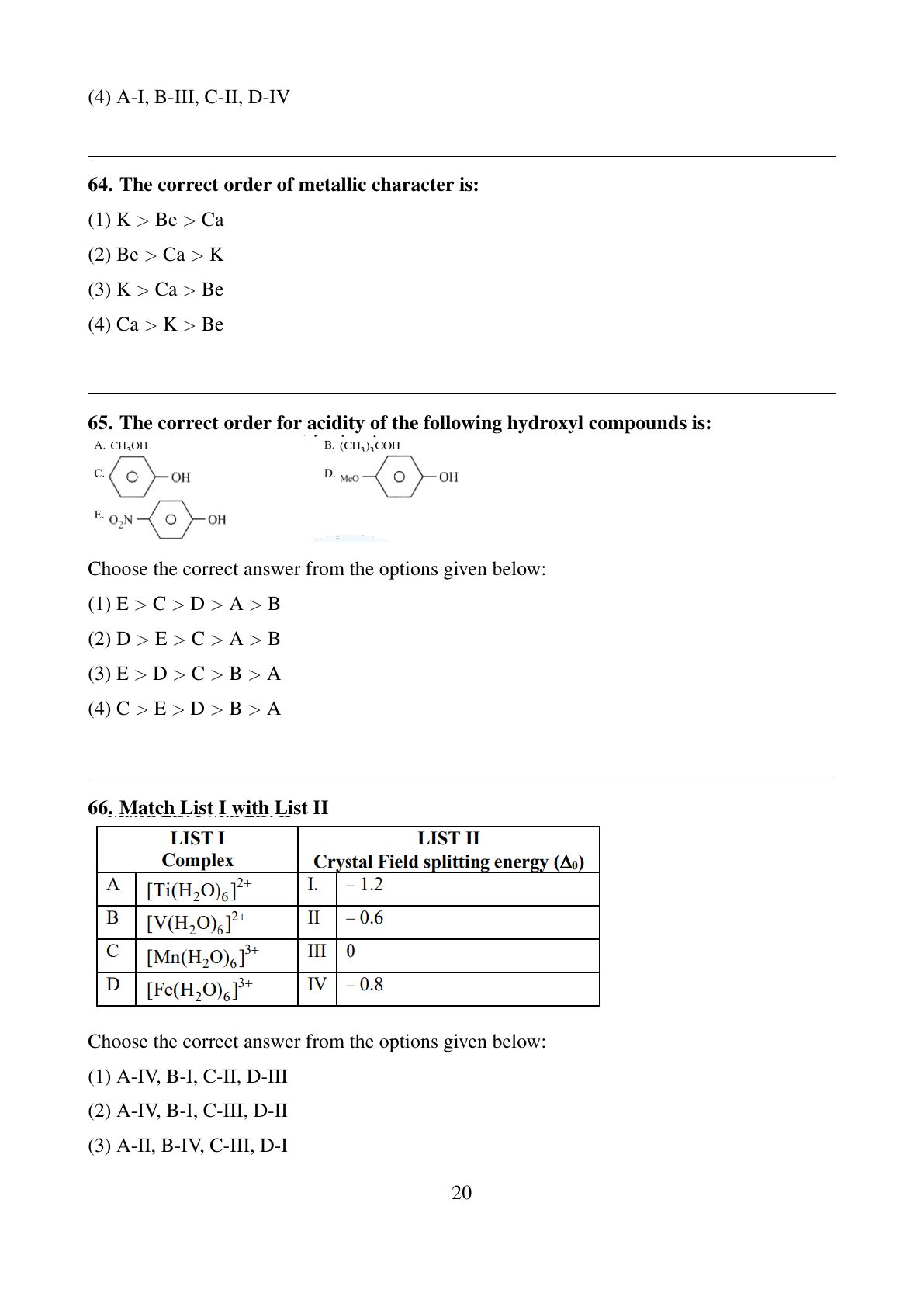
The correct order of metallic character is:
View Solution
The correct order for acidity of the following hydroxyl compounds is:

Choose the correct answer from the options given below:
View Solution
Match List I with List II

Choose the correct answer from the options given below:
View Solution
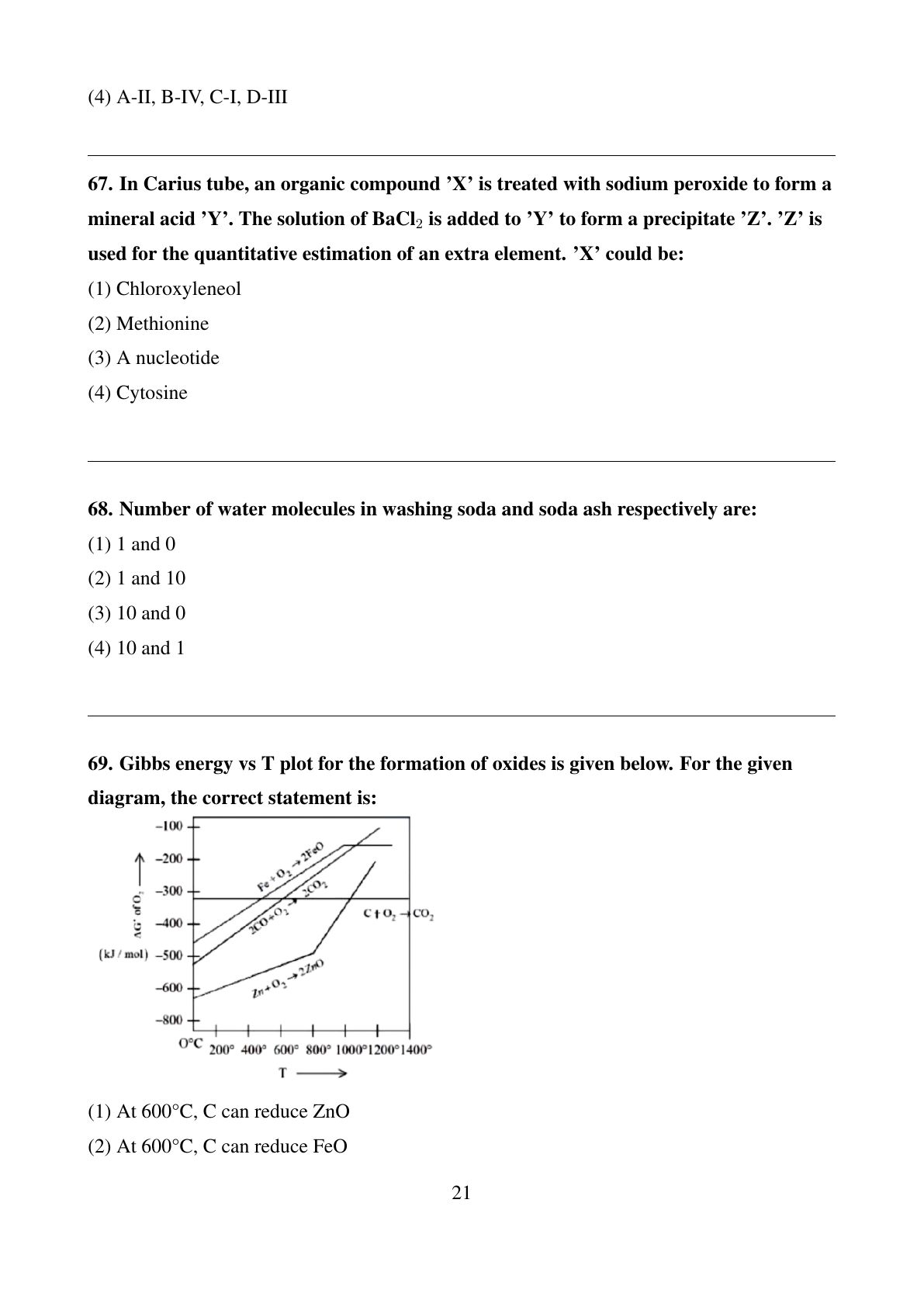
In Carius tube, an organic compound 'X' is treated with sodium peroxide to form a mineral acid 'Y'. The solution of BaCl\(_2\) is added to 'Y' to form a precipitate 'Z'. 'Z' is used for the quantitative estimation of an extra element. 'X' could be:
View Solution
Number of water molecules in washing soda and soda ash respectively are:
View Solution
Gibbs energy vs T plot for the formation of oxides is given below. For the given diagram, the correct statement is:

View Solution
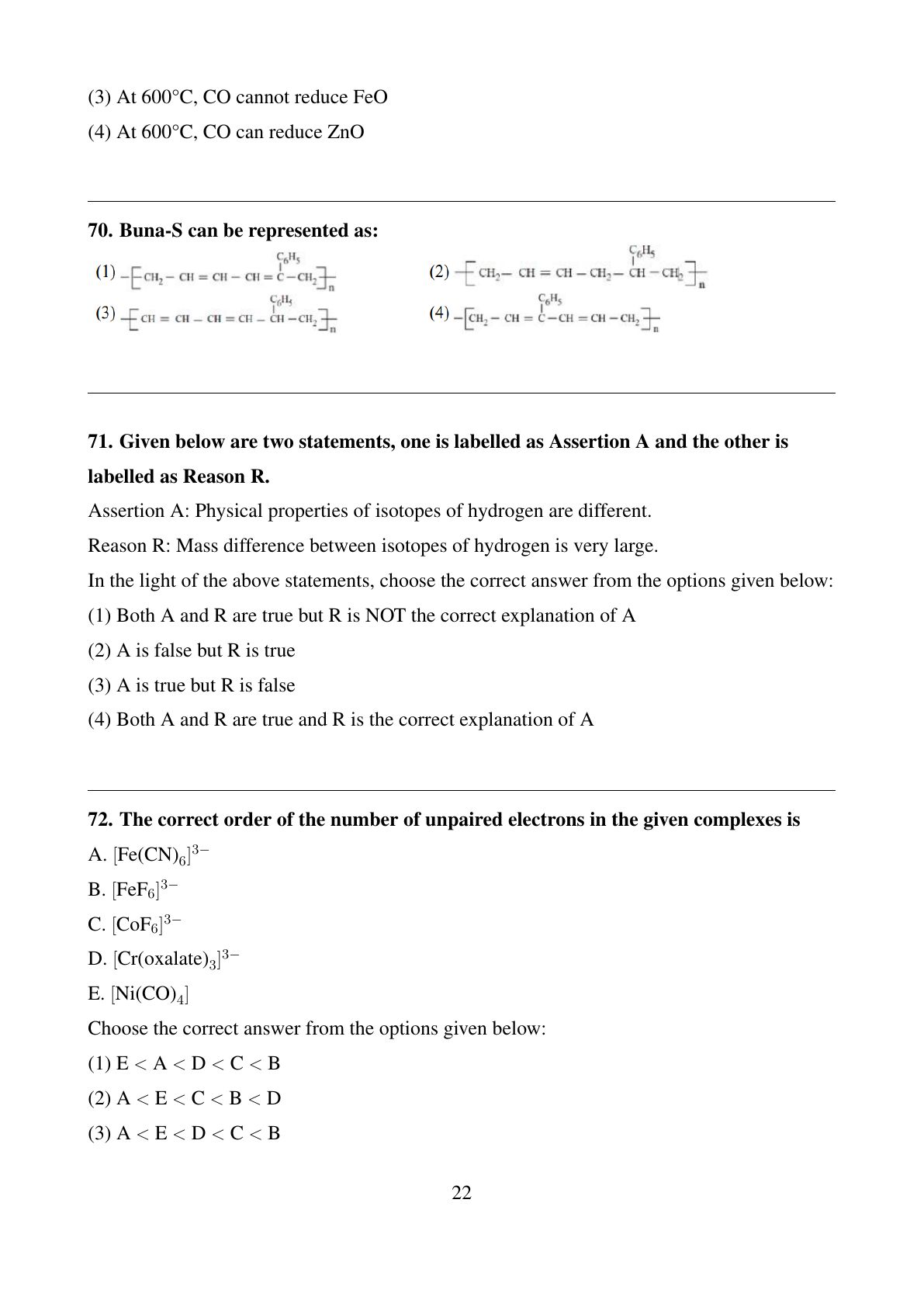
Buna-S can be represented as:
View Solution
Given below are two statements, one is labelled as Assertion A and the other is labelled as Reason R.
Assertion A: Physical properties of isotopes of hydrogen are different.
Reason R: Mass difference between isotopes of hydrogen is very large.
In the light of the above statements, choose the correct answer from the options given below:
View Solution
The correct order of the number of unpaired electrons in the given complexes is
A. \([ Fe(CN)_6 ]^{3-}\)
B. \([ FeF_6 ]^{3-}\)
C. \([ CoF_6 ]^{3-}\)
D. \([ Cr(oxalate)_3 ]^{3-}\)
E. \([ Ni(CO)_4 ]\)
Choose the correct answer from the options given below:
View Solution
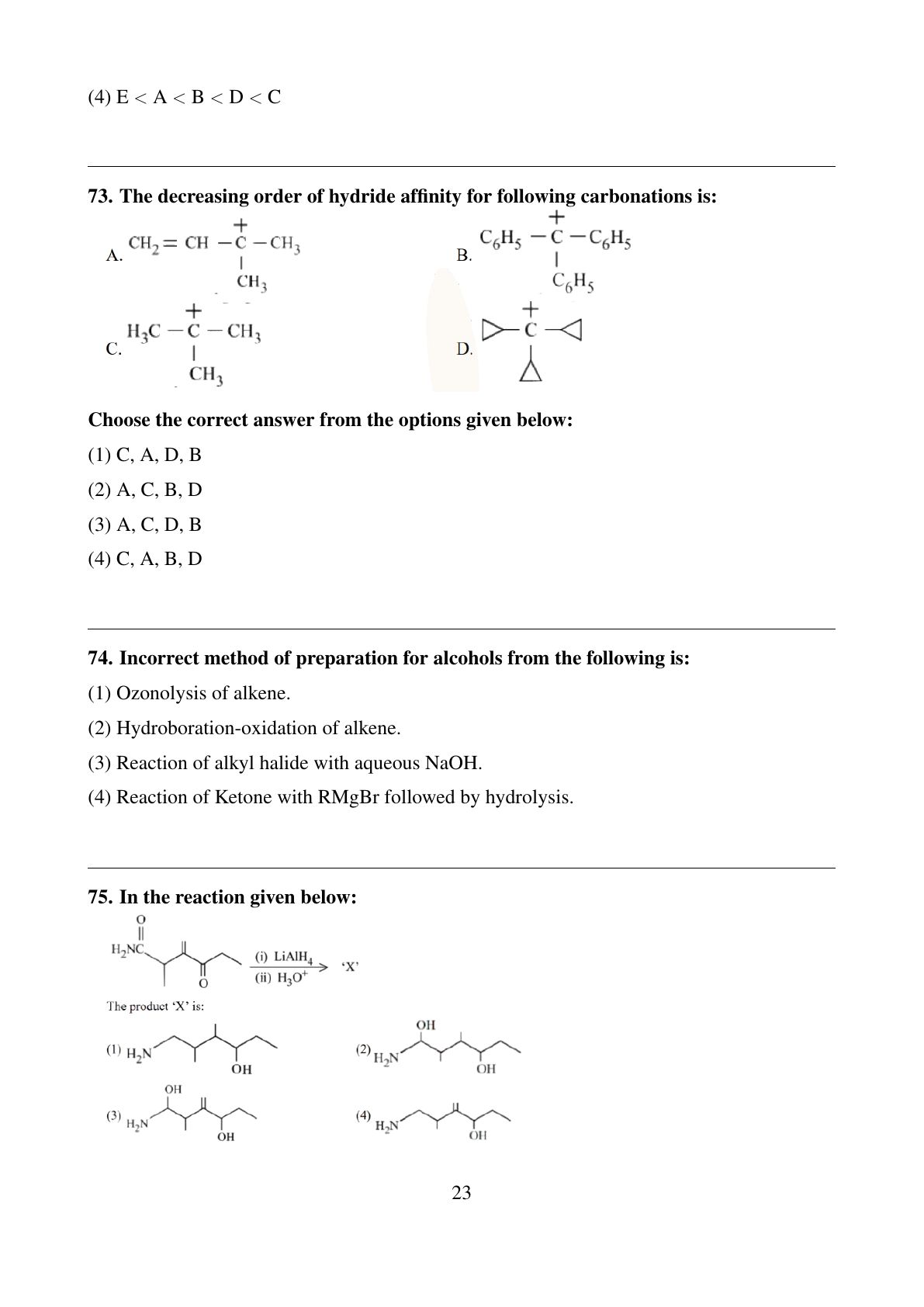
The decreasing order of hydride affinity for following carbonations is:

Choose the correct answer from the options given below:
View Solution
Incorrect method of preparation for alcohols from the following is:
View Solution
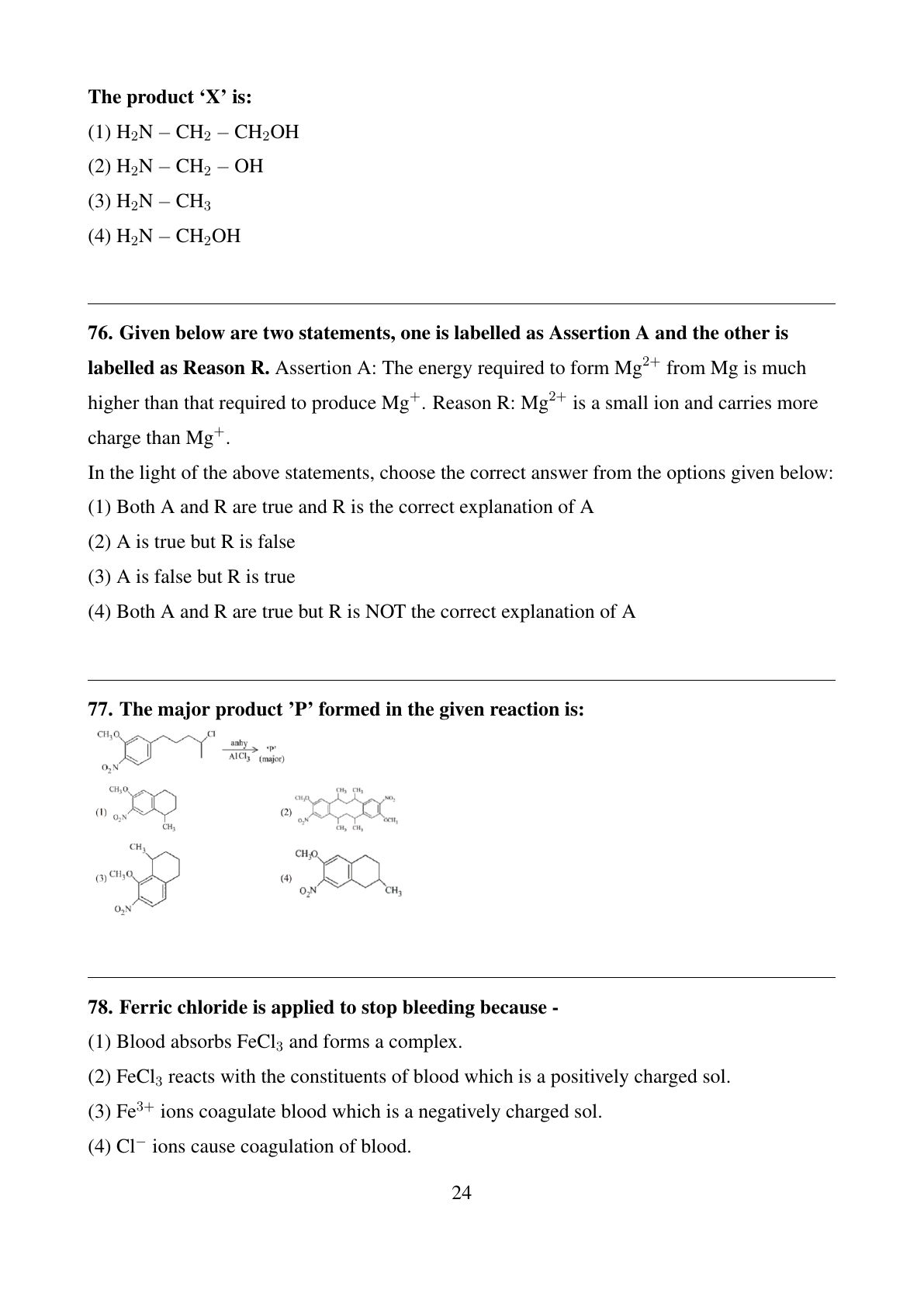
In the reaction given below:

The product ‘X’ is:
View Solution
Given below are two statements, one is labelled as Assertion A and the other is labelled as Reason R.
Assertion A: The energy required to form \( Mg^{2+} \) from Mg is much higher than that required to produce \( Mg^+ \).
Reason R: \( Mg^{2+} \) is a small ion and carries more charge than \( Mg^+ \).
In the light of the above statements, choose the correct answer from the options given below:
View Solution
The major product 'P' formed in the given reaction is:

View Solution
Ferric chloride is applied to stop bleeding because -
View Solution
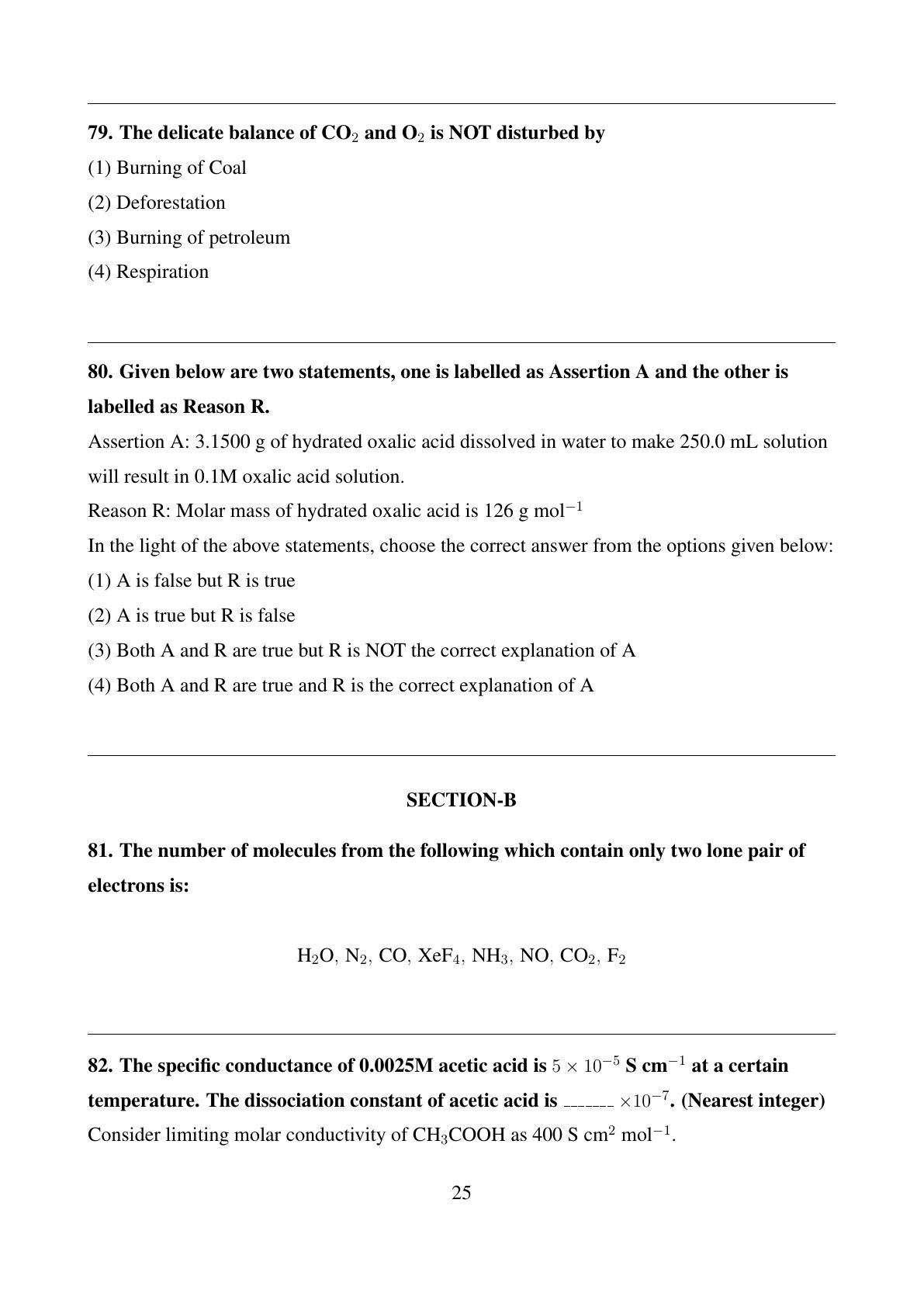
The delicate balance of CO\(_2\) and O\(_2\) is NOT disturbed by
View Solution
Given below are two statements, one is labelled as Assertion A and the other is labelled as Reason R.
Assertion A: 3.1500 g of hydrated oxalic acid dissolved in water to make 250.0 mL solution will result in 0.1M oxalic acid solution.
Reason R: Molar mass of hydrated oxalic acid is 126 g mol\(^{-1}\)
In the light of the above statements, choose the correct answer from the options given below:
View Solution
The number of molecules from the following which contain only two lone pair of electrons is:
\[ H_2O, \, N_2, \, CO, \, XeF_4, \, NH_3, \, NO, \, CO_2, \, F_2 \]
View Solution
The specific conductance of 0.0025M acetic acid is \( 5 \times 10^{-5} \) S cm\(^{-1}\) at a certain temperature. The dissociation constant of acetic acid is _______ \(\times 10^{-7}\). (Nearest integer)
Consider limiting molar conductivity of CH\(_3\)COOH as 400 S cm\(^2\) mol\(^{-1}\).
View Solution
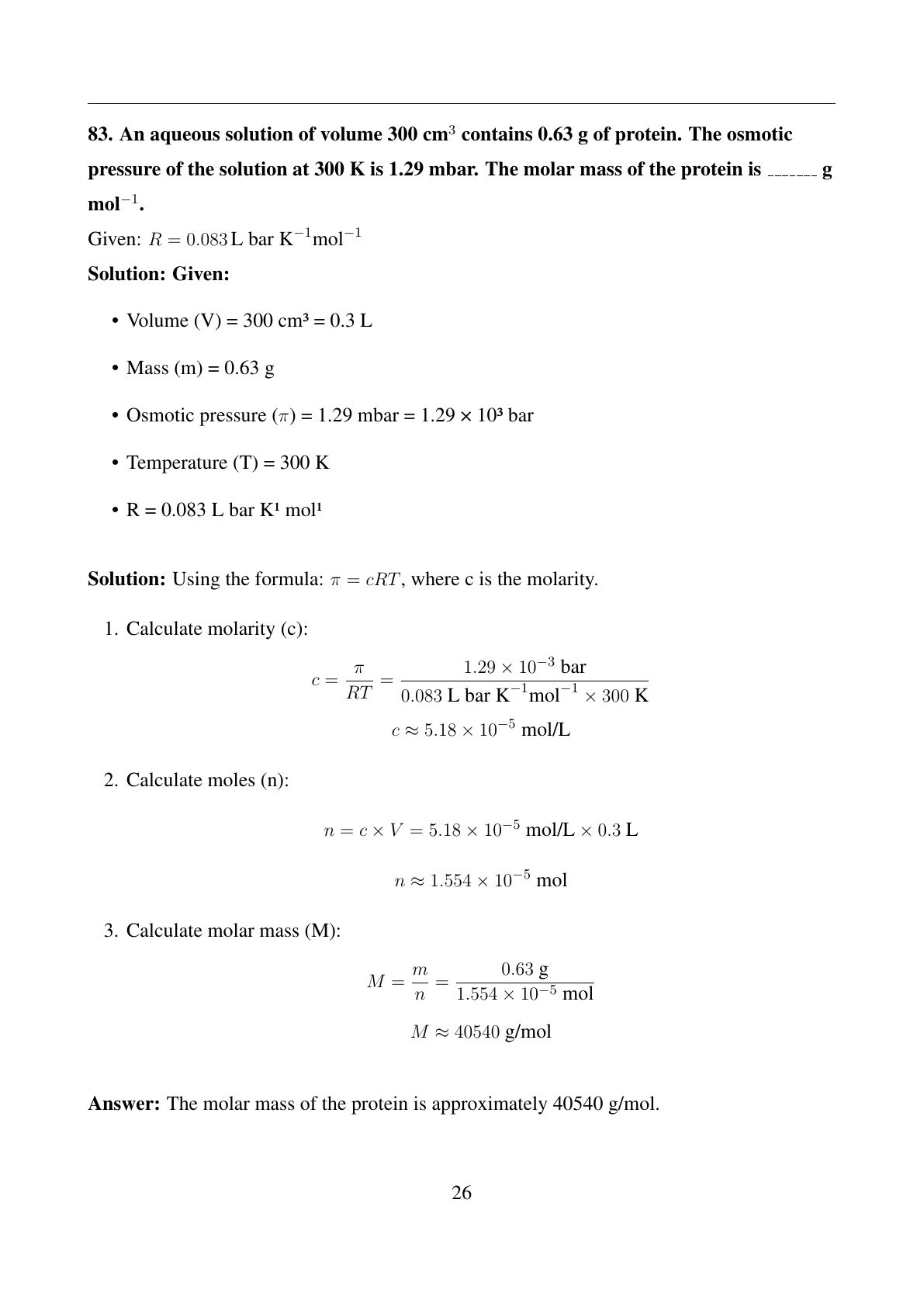
An aqueous solution of volume 300 cm\(^3\) contains 0.63 g of protein. The osmotic pressure of the solution at 300 K is 1.29 mbar. The molar mass of the protein is _______ g mol\(^{-1}\).
Given: \( R = 0.083 \, L bar K^{-1} mol^{-1} \)
View Solution
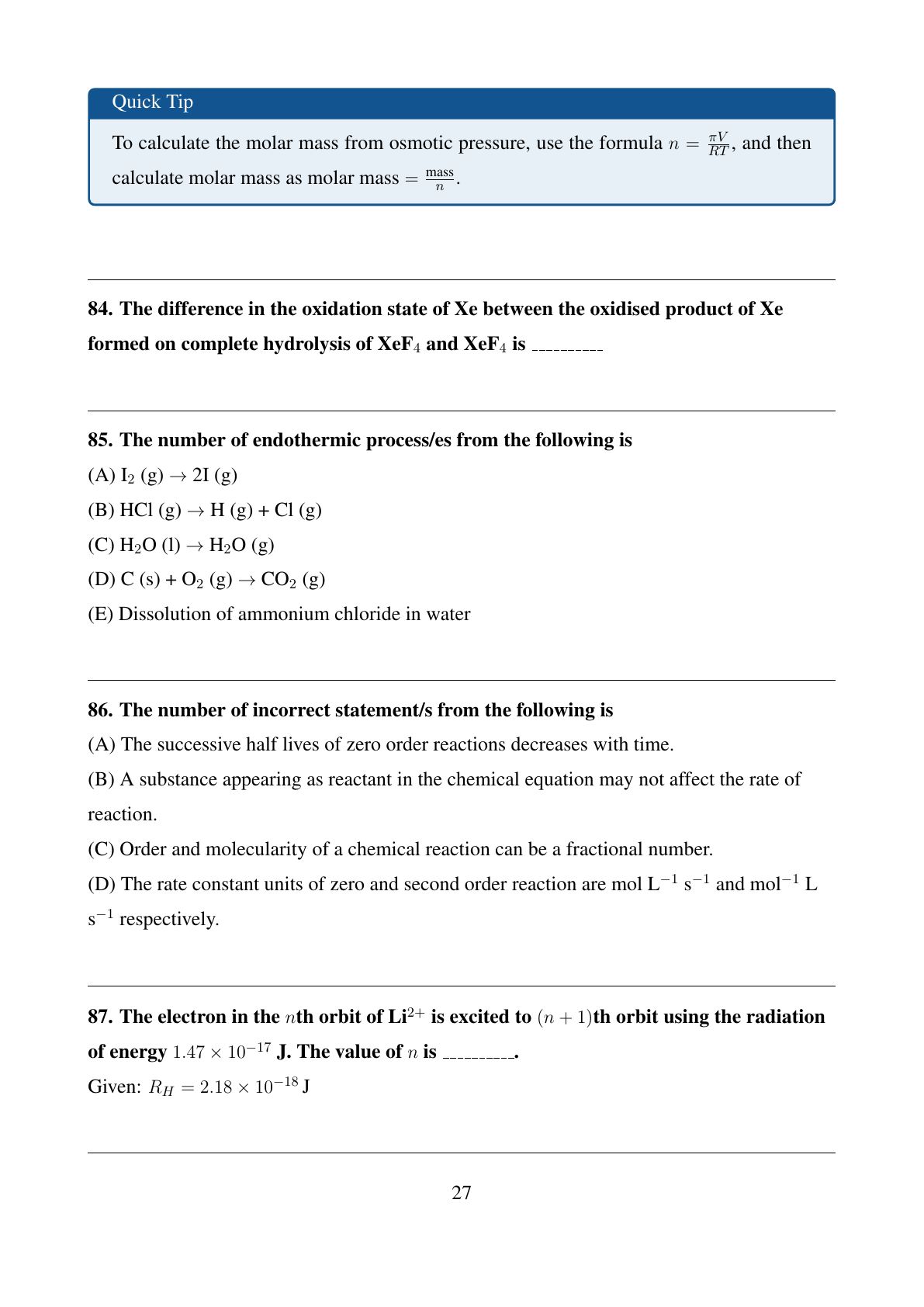
The difference in the oxidation state of Xe between the oxidised product of Xe formed on complete hydrolysis of XeF\(_4\) and XeF\(_4\) is __________
View Solution
The number of endothermic process/es from the following is
View Solution
The number of incorrect statement/s from the following is
View Solution
The electron in the \(n\)th orbit of Li\(^{2+}\) is excited to \((n + 1)\)th orbit using the radiation of energy \( 1.47 \times 10^{-17} \) J. The value of \(n\) is __________.
% Given
Given: \( R_H = 2.18 \times 10^{-18} \, J \)
View Solution
For a metal ion, the calculated magnetic moment is 4.90 BM. This metal ion has _______ number of unpaired electrons.
View Solution
In alkaline medium, the reduction of permanganate anion involves a gain of ____ electrons.
View Solution
Question 90:

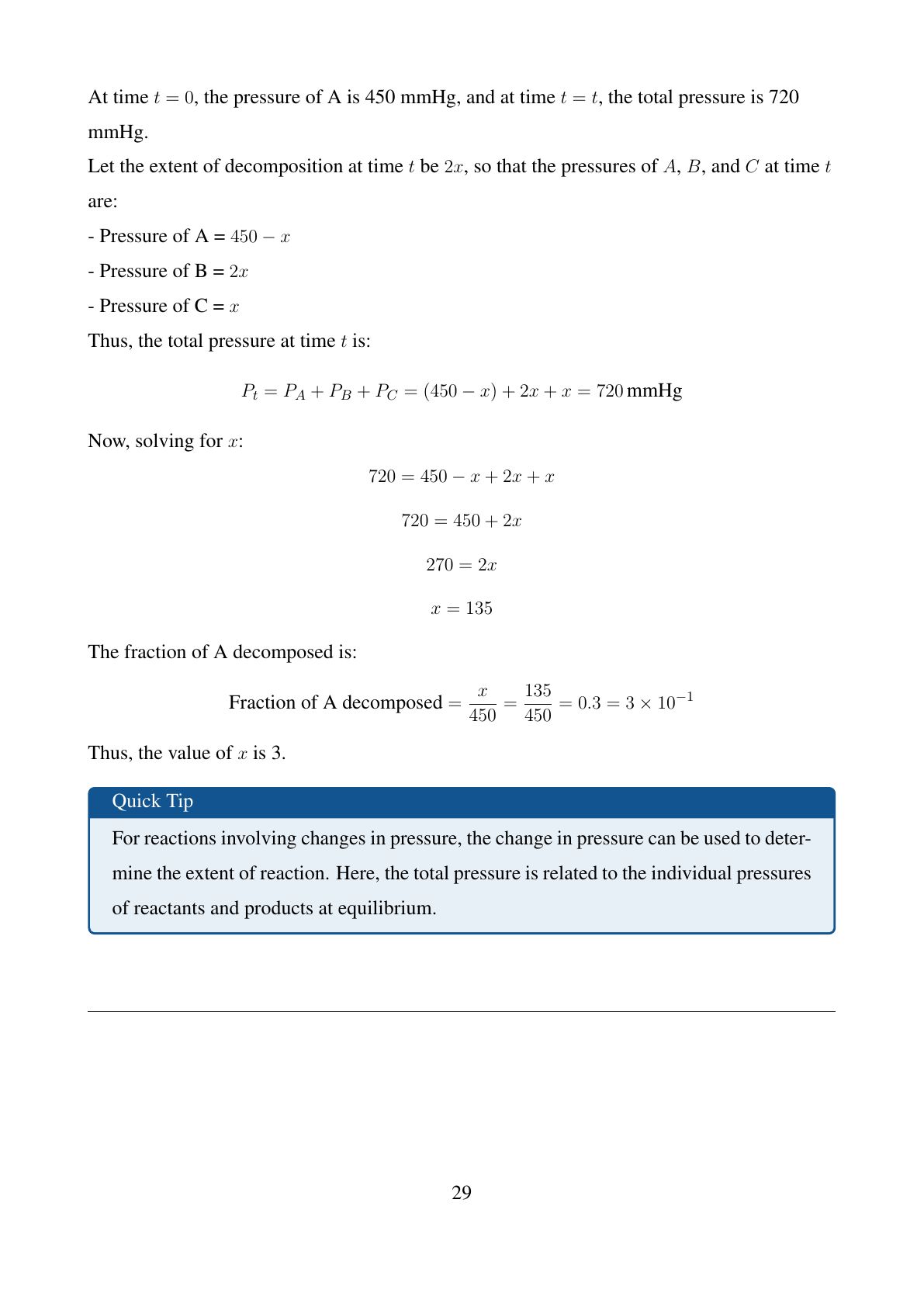
For the given reaction, if the initial pressure is 450 mmHg and the pressure at time t is 720 mmHg at a constant temperature T and constant volume V. The fraction of A(g) decomposed under these conditions is \( x \times 10^{-1} \). The value of x is _______ (nearest integer)


Also Check:
JEE Main 10 April 2023 Shift 2 Question Paper with Answer Key: Coaching Institute PDF
| Coaching Institutes | Question Paper with Answer Key PDF |
|---|---|
| Aakash BYJUs | Check Here |
| Resonance | Physics Chemistry Mathematics |
| Vedantu | Check Here |
| Narayana College | Physics Chemistry Mathematics |
JEE Main 2023 Paper Analysis April 10 Shift 2
JEE Main 2023 Paper Analysis for the exam conducted on April 10 Shift 2 is available. Candidates can check subject-wise paper analysis for the exam conducted on April 10 Shift 2 here along with the topics with the highest weightage.
Also Check:
JEE Main 2023 Question Paper Session 2 (April)
JEE Main 2023 Question Paper Session 1 (January)
JEE Main aspirants can practice and check their exam prep level by attempting the question papers from the January Session. The table below shows JEE Main 2023 Question Paper PDF for Session 1 to practice.
JEE Main Previous Year Question Paper
| JEE Main 2022 Question Paper | JEE Main 2021 Question Paper | JEE Main 2020 Question Paper |
| JEE Main 2019 Question Paper | JEE Main 2018 Question Paper | JEE Main 2017 Question Paper |



Comments