




JEE Main 2023 Feb 1 Shift 1 Question Paper PDF is available here. NTA conducted JEE Main 2023 Feb 1 Shift 1 from 9 AM to 12 PM for B.E./B.Tech paper. Candidates can download the JEE Main 2023 Question Paper PDF with Solution and Answer Key for Feb 1 Shift 1 using the link below.
Related Links:
- Download JEE Main Previous Year Question Papers PDF with Solutions
- Download JEE Main 2025 Question Paper for all Shifts
JEE Main 2023 Question Paper Feb 1 Shift 1- Download PDF
| JEE Main 2023 1 Feb Shift 1 Question Paper with Solution PDF |  Download Download |
Check Solution |


Also Check: JEE Main 2024 Question Paper with Solution PDF Download
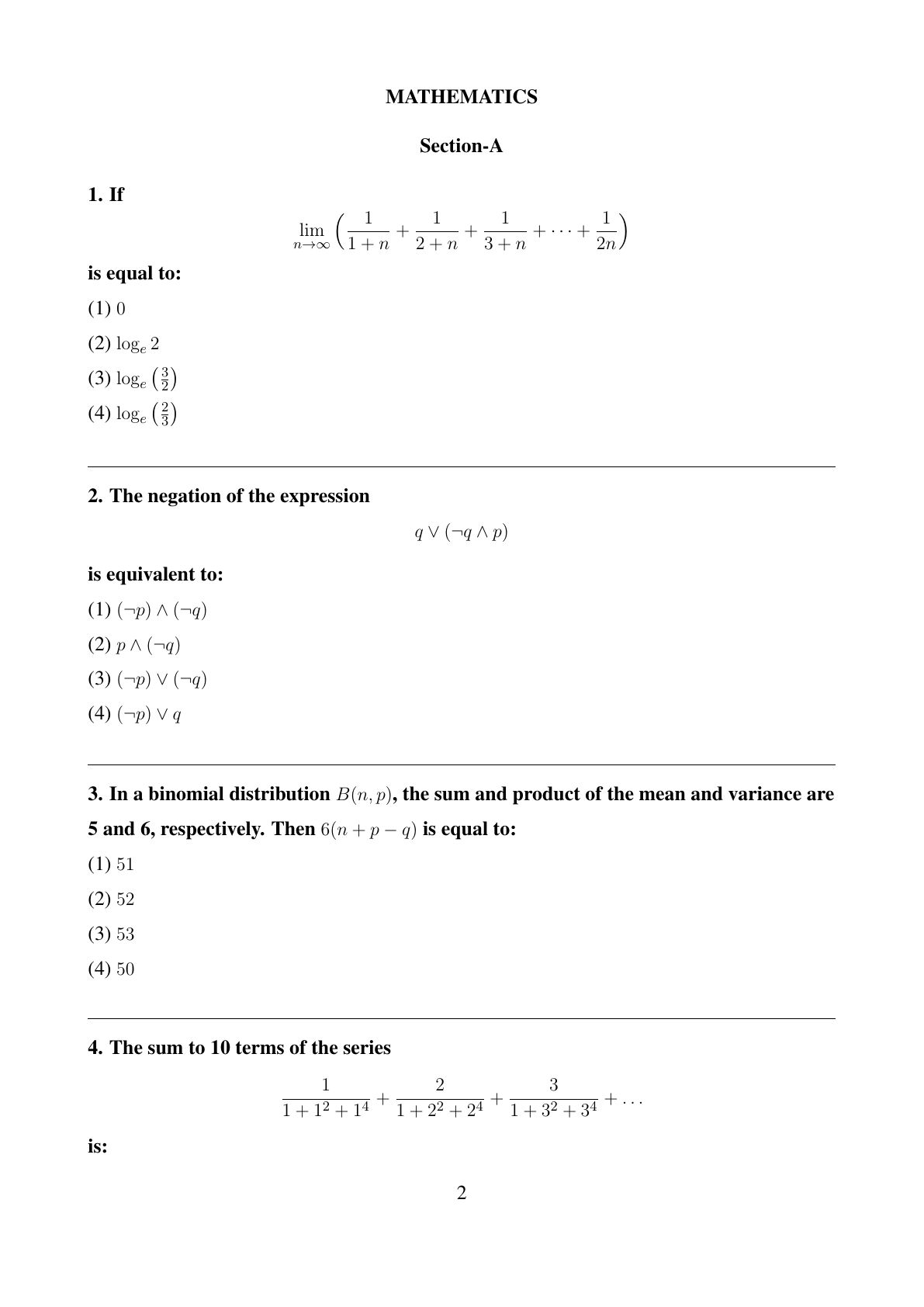
If \[ \lim_{n \to \infty} \left( \frac{1}{1+n} + \frac{1}{2+n} + \frac{1}{3+n} + \dots + \frac{1}{2n} \right) \]
is equal to:
View Solution
The negation of the expression \[ q \vee (\neg q \wedge p) \]
is equivalent to:
View Solution
In a binomial distribution \( B(n, p) \), the sum and product of the mean and variance are 5 and 6, respectively. Then \( 6(n + p - q) \) is equal to:
View Solution
The sum to 10 terms of the series \[ \frac{1}{1+1^2+1^4} + \frac{2}{1+2^2+2^4} + \frac{3}{1+3^2+3^4} + \dots \]
is:
View Solution
The value of \[ \frac{1}{1!50!} + \frac{1}{3!48!} + \frac{1}{5!46!} + \dots + \frac{1}{49!2!} + \frac{1}{51!1!} \]
is:
View Solution
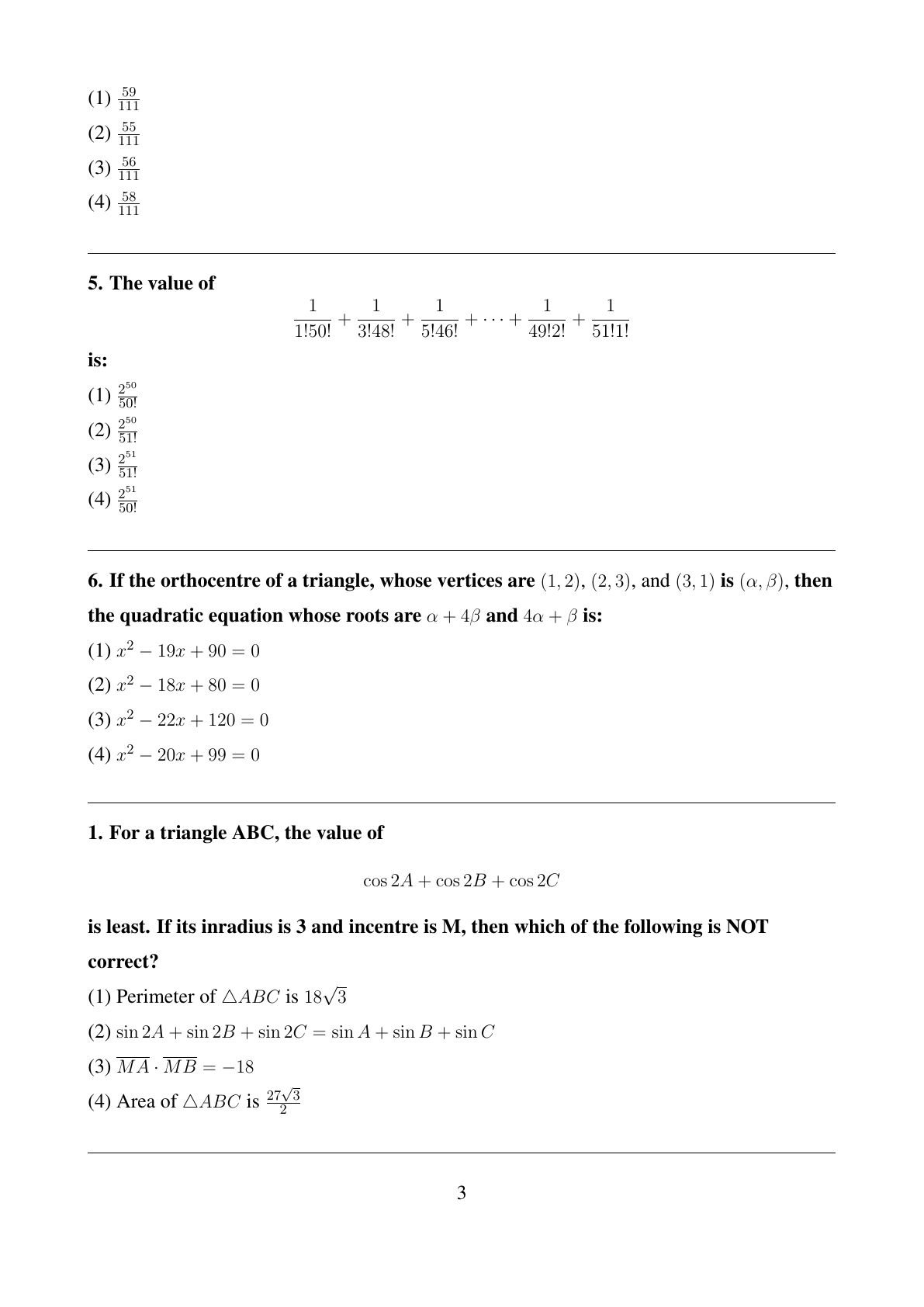
If the orthocentre of a triangle, whose vertices are \( (1,2) \), \( (2,3) \), and \( (3,1) \) is \( (\alpha, \beta) \),
then the quadratic equation whose roots are \( \alpha + 4\beta \)
and \( 4\alpha + \beta \) is:
View Solution
For a triangle ABC, the value of \[ \cos 2A + \cos 2B + \cos 2C \]
is least. If its inradius is 3 and incentre is M, then which of the following is NOT correct?
View Solution
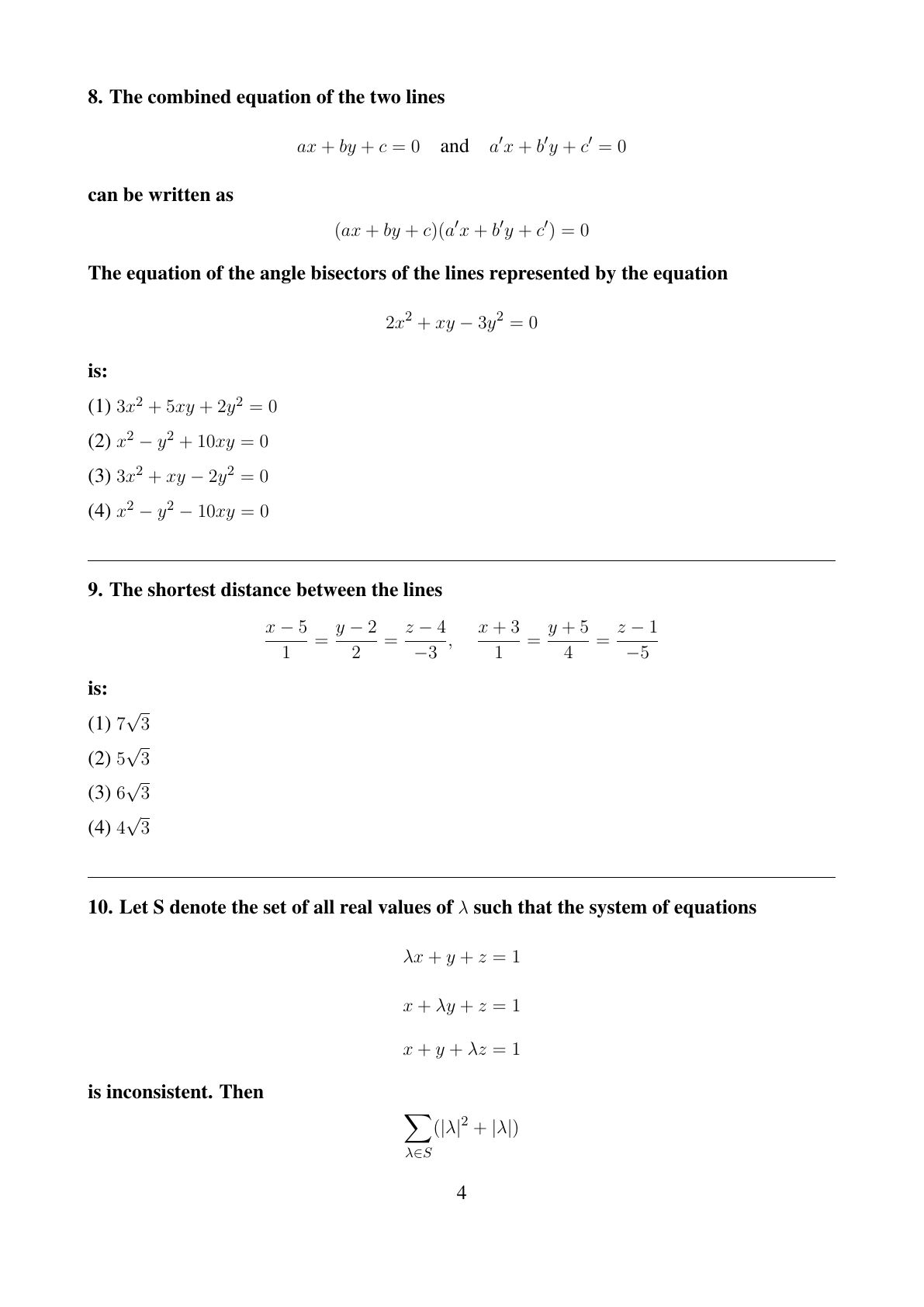
The combined equation of the two lines \[ ax + by + c = 0 \quad and \quad a'x + b'y + c' = 0 \]
can be written as \[ (ax + by + c)(a'x + b'y + c') = 0 \]
The equation of the angle bisectors of the lines represented by the equation \[ 2x^2 + xy - 3y^2 = 0 \]
is:
View Solution
The shortest distance between the lines \[ \frac{x-5}{1} = \frac{y-2}{2} = \frac{z-4}{-3}, \quad \frac{x+3}{1} = \frac{y+5}{4} = \frac{z-1}{-5} \]
is:
View Solution
Let S denote the set of all real values of \( \lambda \) such that the system of equations \[ \lambda x + y + z = 1 \] \[ x + \lambda y + z = 1 \] \[ x + y + \lambda z = 1 \]
is inconsistent. Then \[ \sum_{\lambda \in S} (|\lambda|^2 + |\lambda|) \]
is equal to:
View Solution
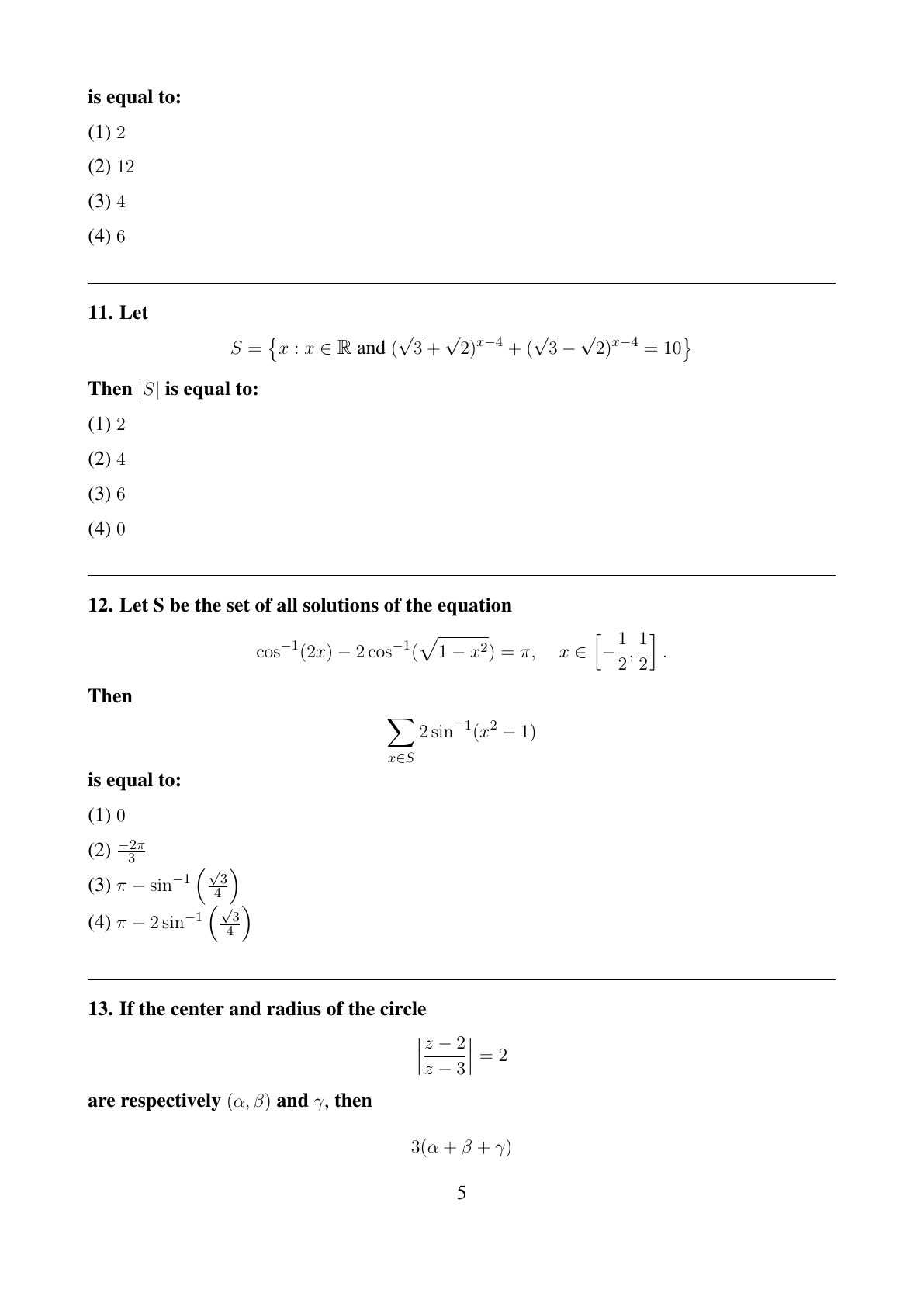
Let \[ S = \left\{ x : x \in \mathbb{R} and (\sqrt{3} + \sqrt{2})^{x-4} + (\sqrt{3} - \sqrt{2})^{x-4} = 10 \right\} \]
Then \( |S| \) is equal to:
View Solution
Let S be the set of all solutions of the equation \[ \cos^{-1} (2x) - 2\cos^{-1} (\sqrt{1 - x^2}) = \pi, \quad x \in \left[ -\frac{1}{2}, \frac{1}{2} \right]. \]
Then \[ \sum_{x \in S} 2 \sin^{-1} (x^2 - 1) \]
is equal to:
View Solution
If the center and radius of the circle \[ \left| \frac{z - 2}{z - 3} \right| = 2 \]
are respectively \( (\alpha, \beta) \) and \( \gamma \), then \[ 3(\alpha + \beta + \gamma) \]
is equal to:
View Solution
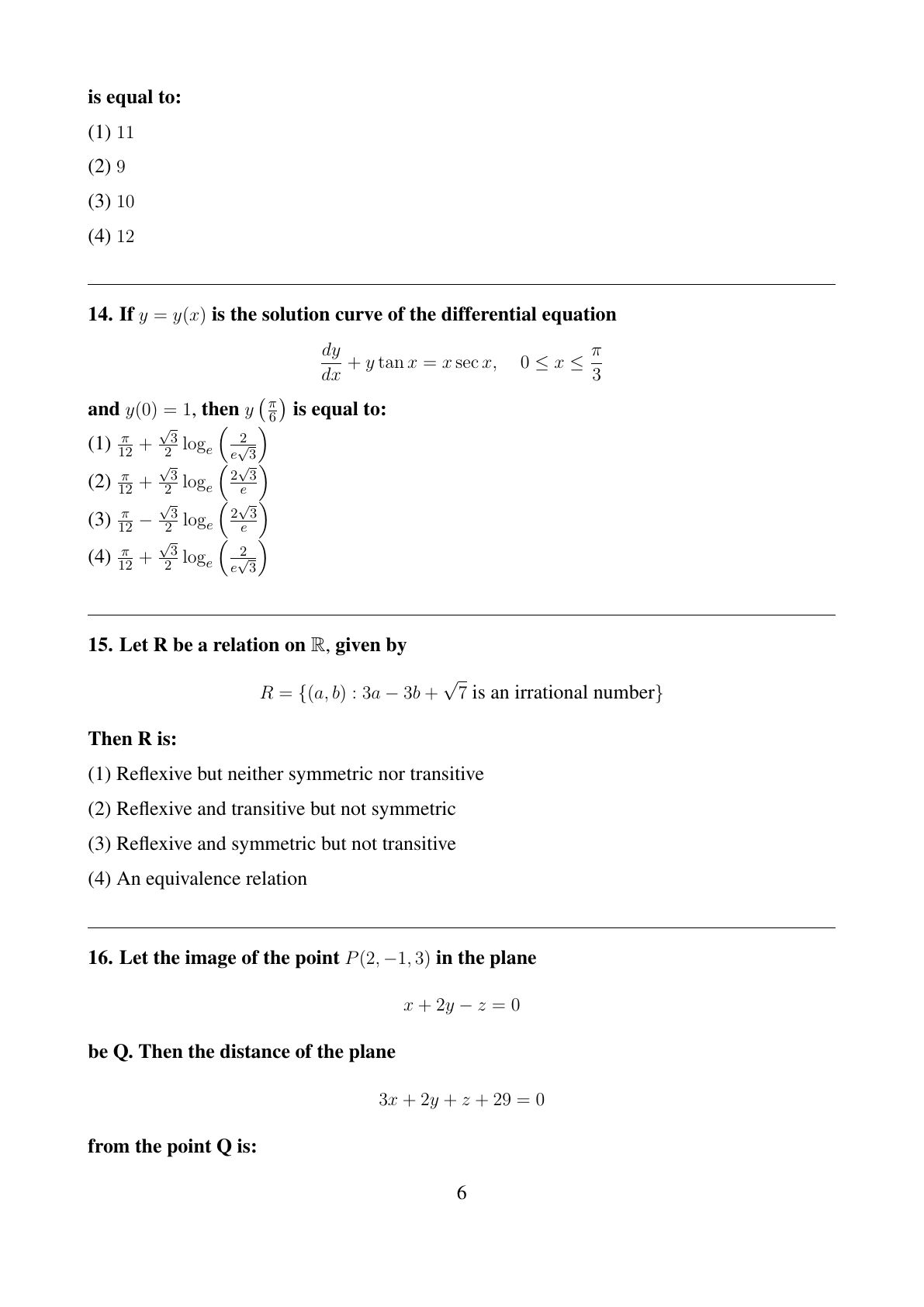
If \( y = y(x) \) is the solution curve of the differential equation \[ \frac{dy}{dx} + y \tan x = x \sec x, \quad 0 \leq x \leq \frac{\pi}{3} \]
and \( y(0) = 1 \), then \( y \left( \frac{\pi}{6} \right) \) is equal to:
View Solution
Let R be a relation on \( \mathbb{R} \), given by \[ R = \{ (a, b) : 3a - 3b + \sqrt{7} is an irrational number \} \]
Then R is:
View Solution
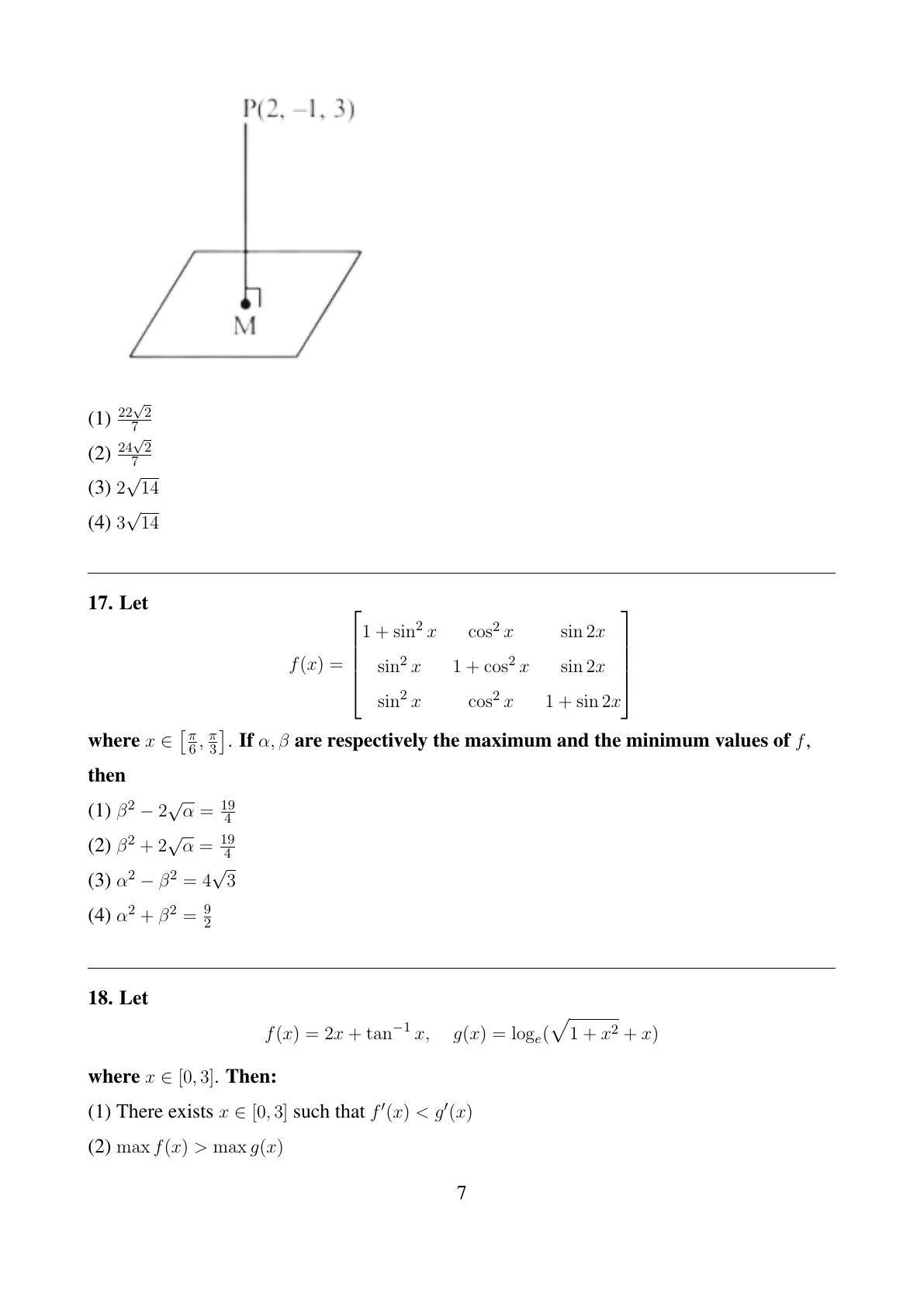
Let the image of the point \( P(2, -1, 3) \) in the plane \[ x + 2y - z = 0 \]
be Q. Then the distance of the plane \[ 3x + 2y + z + 29 = 0 \]
from the point Q is:

View Solution
Let \[ f(x) = \begin{bmatrix} 1 + \sin^2 x & \cos^2 x & \sin 2x
\sin^2 x & 1 + \cos^2 x & \sin 2x
\sin^2 x & \cos^2 x & 1 + \sin 2x \end{bmatrix} \]
where \( x \in \left[ \frac{\pi}{6}, \frac{\pi}{3} \right] \).
If \( \alpha, \beta \) are respectively the maximum and the minimum values of \( f \), then
View Solution
Let \[ f(x) = 2x + \tan^{-1} x, \quad g(x) = \log_e (\sqrt{1 + x^2} + x) \]
where \( x \in [0, 3] \). Then:
View Solution
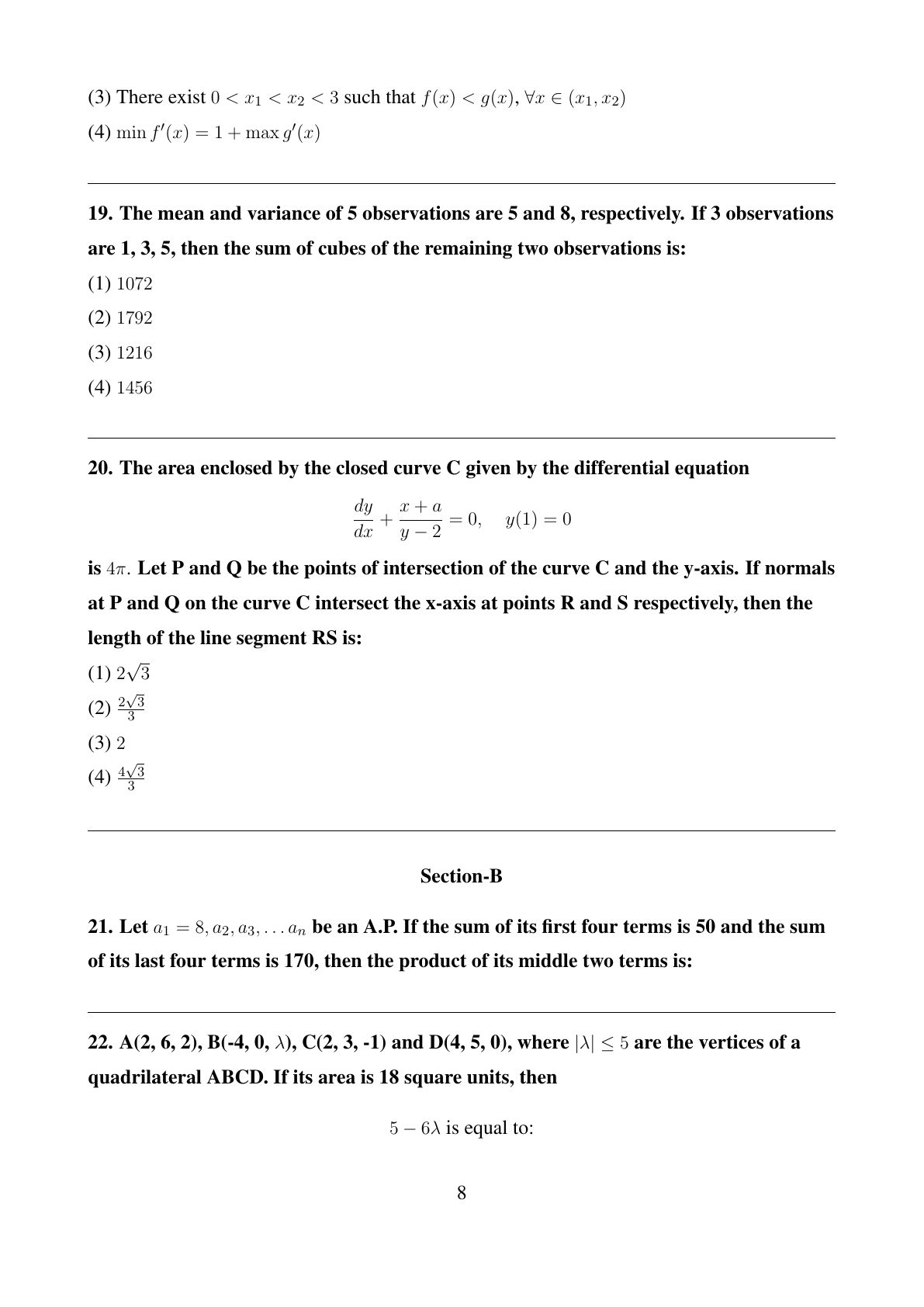
The mean and variance of 5 observations are 5 and 8, respectively. If 3 observations are 1, 3, 5, then the sum of cubes of the remaining two observations is:
View Solution
The area enclosed by the closed curve C given by the differential equation \[ \frac{dy}{dx} + \frac{x + a}{y - 2} = 0, \quad y(1) = 0 \]
is \( 4\pi \).
Let P and Q be the points of intersection of the curve C and the y-axis. If normals at P and Q on the curve C intersect the x-axis at points R and S respectively, then the length of the line segment RS is:
View Solution
Let \( a_1 = 8, a_2, a_3, \dots a_n \) be an A.P. If the sum of its first four terms is 50 and the sum of its last four terms is 170, then the product of its middle two terms is:
View Solution
A(2, 6, 2), B(-4, 0, \( \lambda \)), C(2, 3, -1) and D(4, 5, 0), where \( |\lambda| \leq 5 \)
are the vertices of a quadrilateral ABCD. If its area is 18 square units, then \[ 5 - 6\lambda is equal to: \]
View Solution
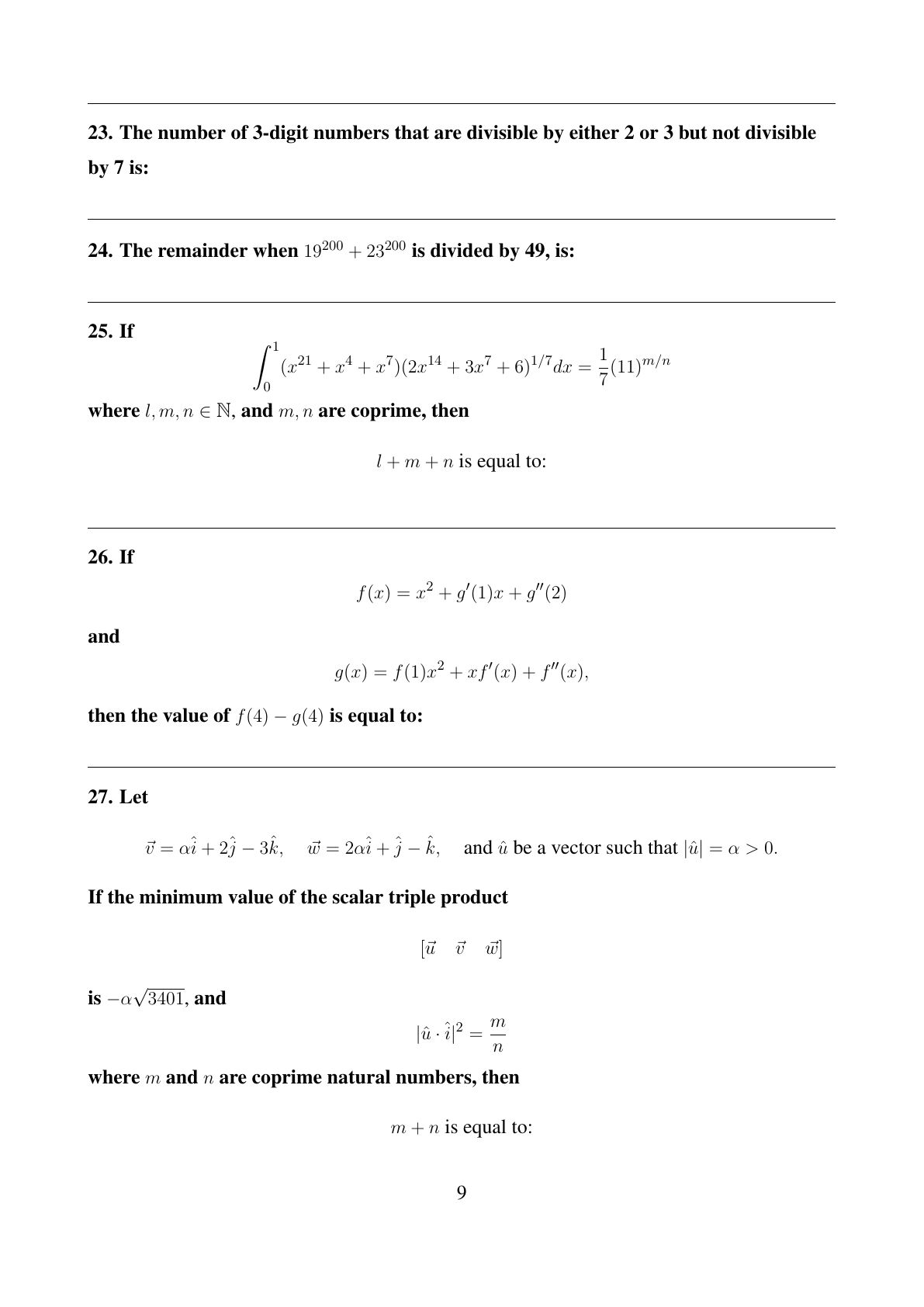
The number of 3-digit numbers that are divisible by either 2 or 3 but not divisible by 7 is:
View Solution
The remainder when \( 19^{200} + 23^{200} \) is divided by 49, is:
View Solution
If \[ \int_{0}^{1} (x^{21} + x^4 + x^7)(2x^{14} + 3x^7 + 6)^{1/7} dx = \frac{1}{7} (11)^{m/n} \]
where \( l, m, n \in \mathbb{N} \), and \( m, n \) are coprime, then \[ l + m + n is equal to: \]
View Solution
If \[ f(x) = x^2 + g'(1)x + g''(2) \]
and \[ g(x) = f(1)x^2 + xf'(x) + f''(x), \]
then the value of \( f(4) - g(4) \) is equal to:
View Solution
Let \[ \vec{v} = \alpha \hat{i} + 2 \hat{j} - 3 \hat{k}, \quad \vec{w} = 2\alpha \hat{i} + \hat{j} - \hat{k}, \quad and \hat{u} be a vector such that |\hat{u}| = \alpha > 0. \]
If the minimum value of the scalar triple product \[ [\vec{u} \quad \vec{v} \quad \vec{w}] \]
is \( -\alpha \sqrt{3401} \),
and \[ |\hat{u} \cdot \hat{i}|^2 = \frac{m}{n} \]
where \( m \) and \( n \) are coprime natural numbers, then \[ m + n is equal to: \]
View Solution
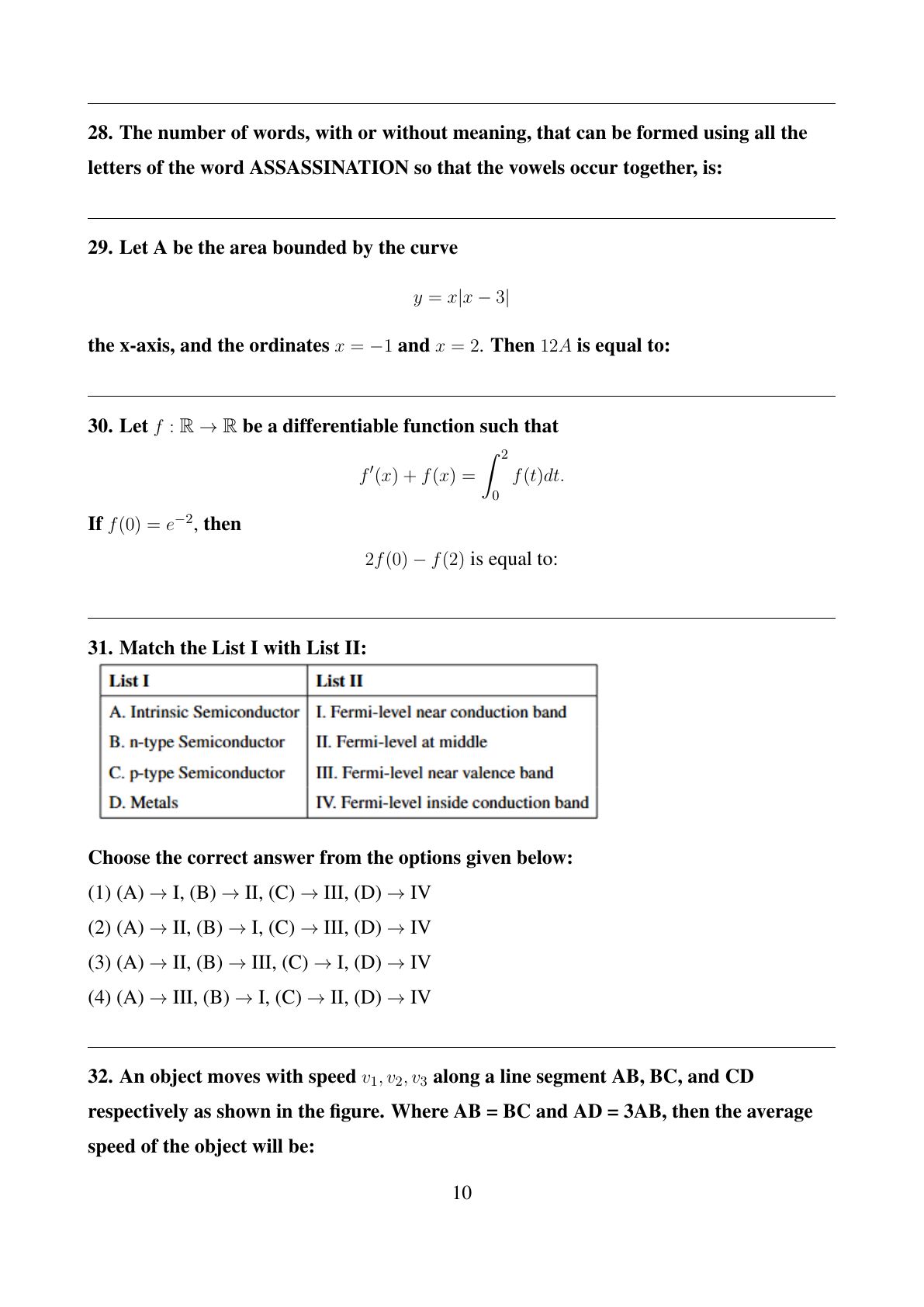
The number of words, with or without meaning, that can be formed using all the letters of the word ASSASSINATION so that the vowels occur together, is:
View Solution
Let A be the area bounded by the curve \[ y = x |x - 3| \]
the x-axis, and the ordinates \( x = -1 \) and \( x = 2 \).
Then \( 12A \) is equal to:
View Solution
Let \( f: \mathbb{R} \to \mathbb{R} \) be a differentiable function such that \[ f'(x) + f(x) = \int_{0}^{2} f(t) dt. \]
If \( f(0) = e^{-2} \), then \[ 2f(0) - f(2) is equal to: \]
View Solution
Match the List I with List II:

Choose the correct answer from the options given below:
View Solution
An object moves with speed \( v_1, v_2, v_3 \) along a line segment AB, BC, and CD respectively as shown in the figure. Where AB = BC and AD = 3AB, then the average speed of the object will be:
View Solution
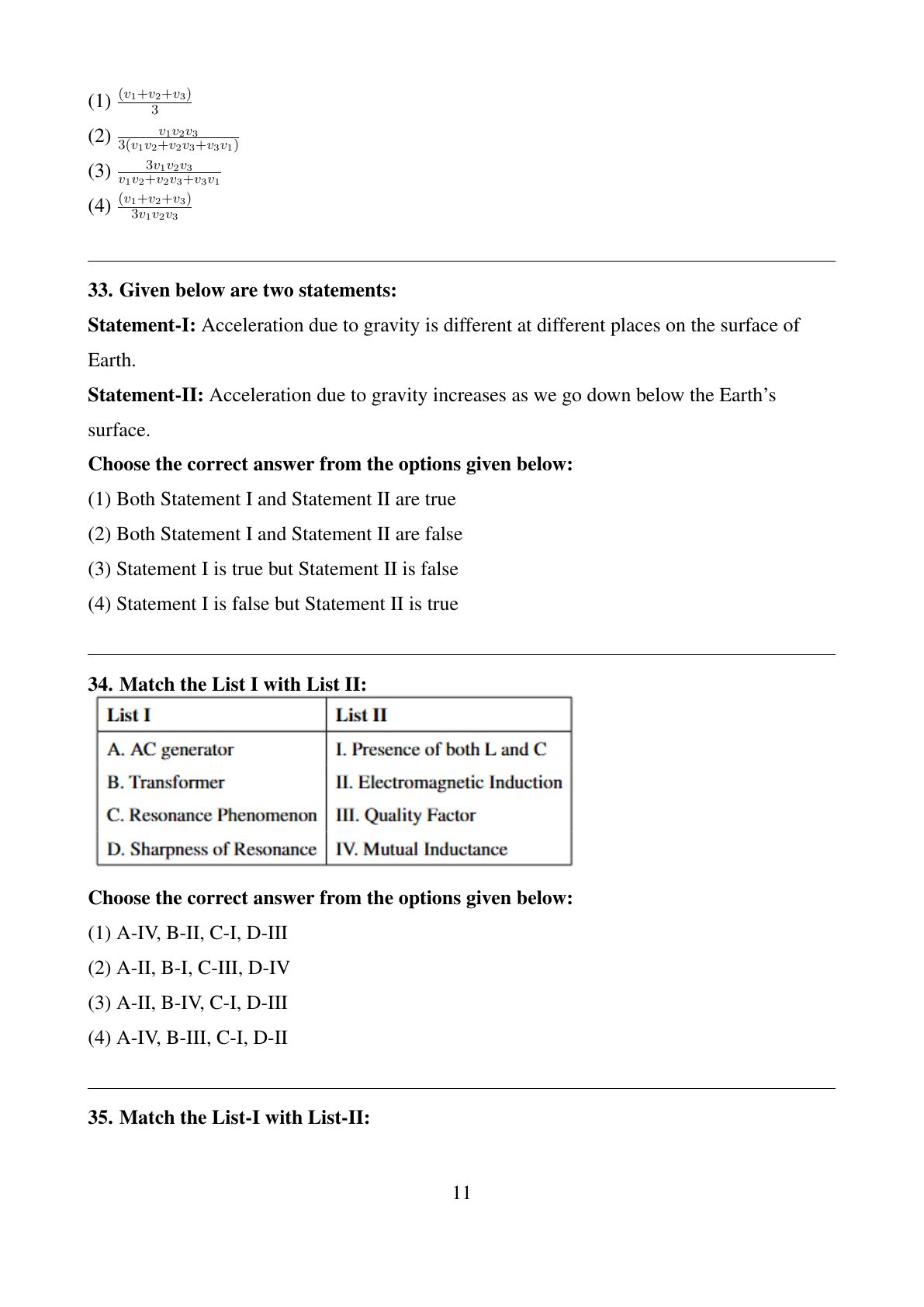
Given below are two statements:
Statement-I: Acceleration due to gravity is different at different places on the surface of Earth.
Statement-II: Acceleration due to gravity increases as we go down below the Earth's surface.
Choose the correct answer from the options given below:
View Solution
Match the List I with List II:

Choose the correct answer from the options given below:
View Solution
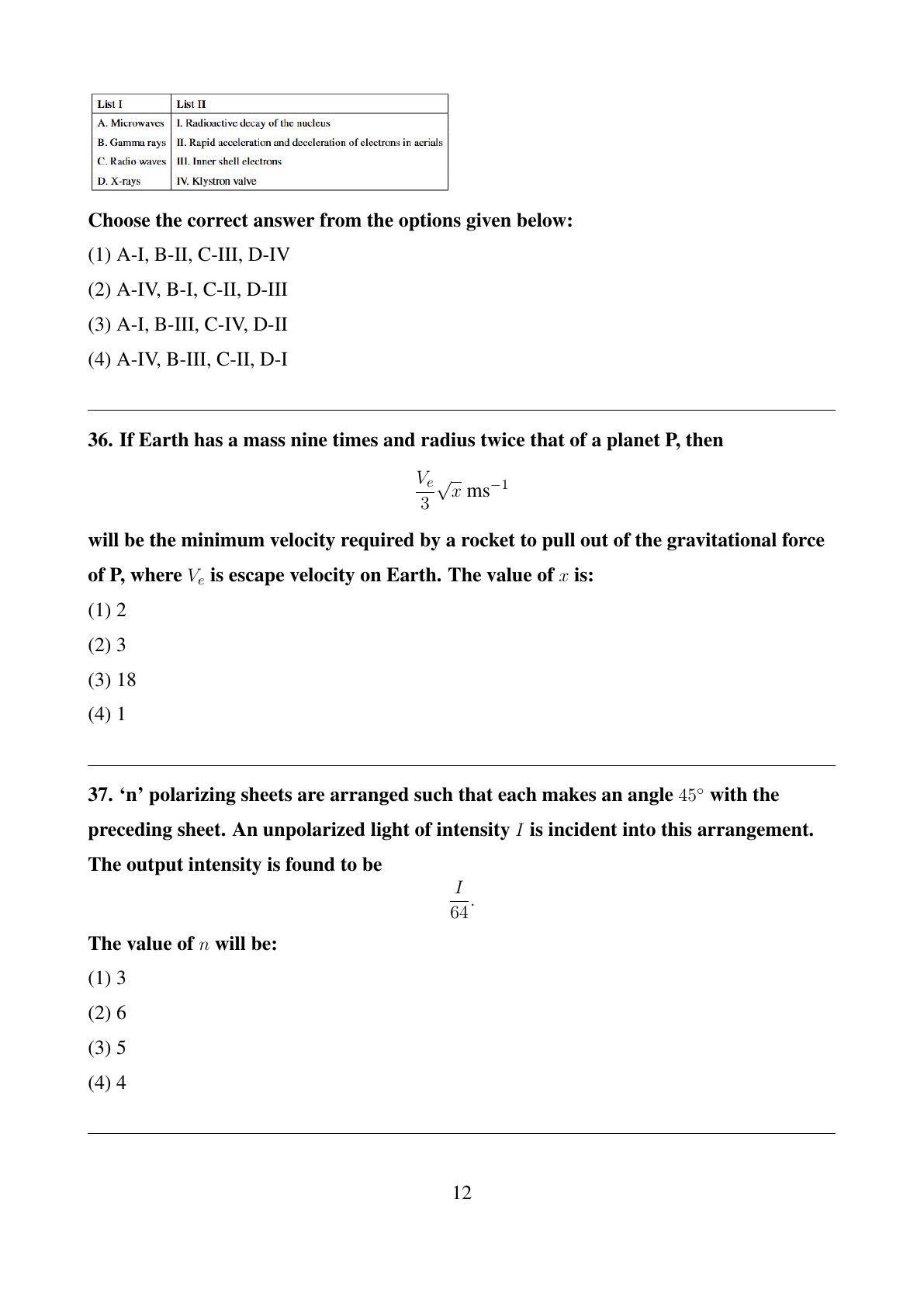
Match the List-I with List-II:

Choose the correct answer from the options given below:
View Solution
If Earth has a mass nine times and radius twice that of a planet P, then \[ \frac{V_e}{3} \sqrt{x} ms^{-1} \]
will be the minimum velocity required by a rocket to pull out of the gravitational force of P, where \( V_e \) is escape velocity on Earth. The value of \( x \) is:
View Solution
‘n’ polarizing sheets are arranged such that each makes an angle \( 45^\circ \) with the preceding sheet. An unpolarized light of intensity \( I \) is incident into this arrangement. The output intensity is found to be \[ \frac{I}{64}. \]
The value of \( n \) will be:
View Solution
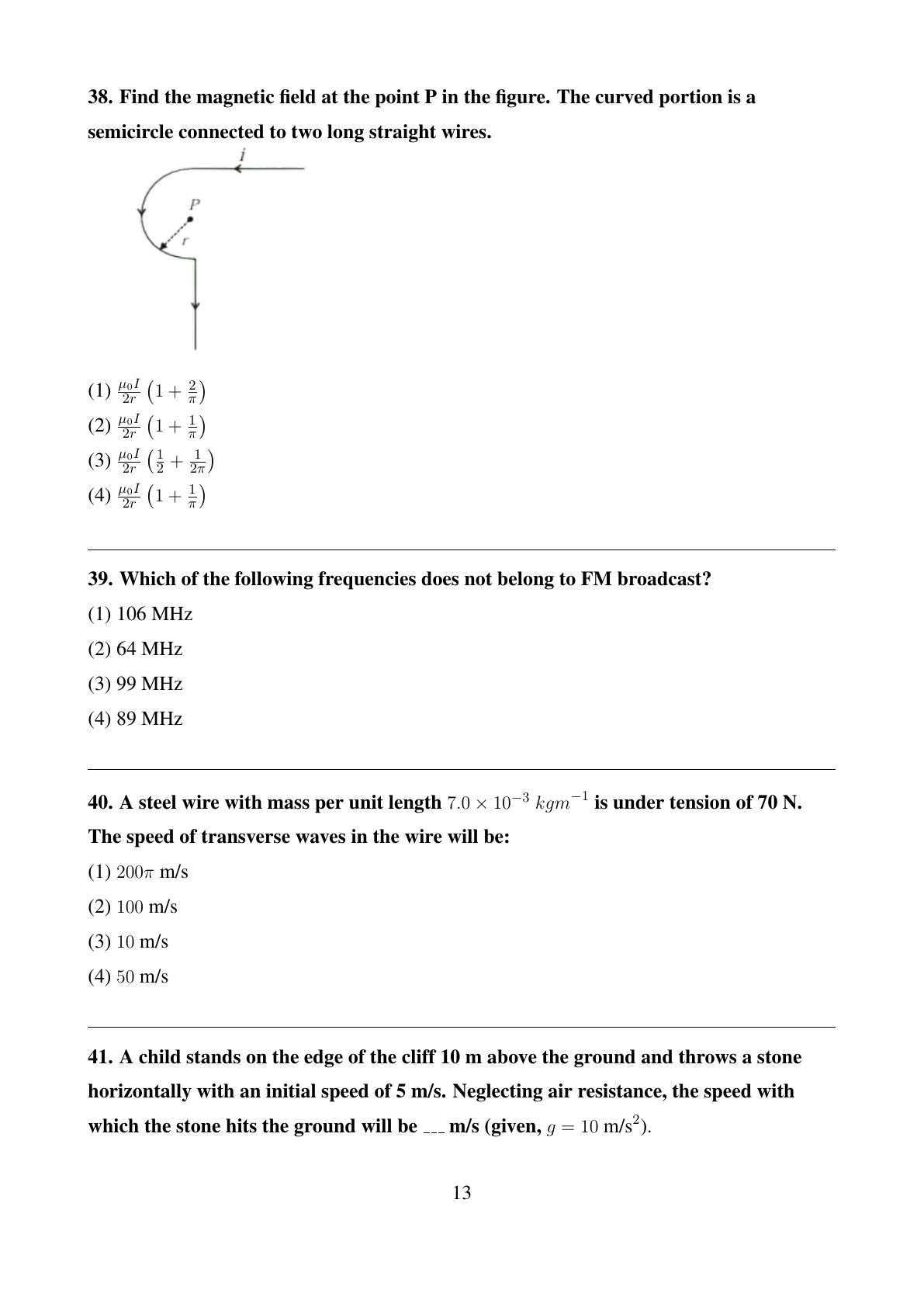
Find the magnetic field at the point P in the figure. The curved portion is a semicircle connected to two long straight wires.

View Solution
Which of the following frequencies does not belong to FM broadcast?
View Solution
A steel wire with mass per unit length \( 7.0 \times 10^{-3} \) \({kg m}^{-1}\) is under tension of 70 N. The speed of transverse waves in the wire will be:
View Solution
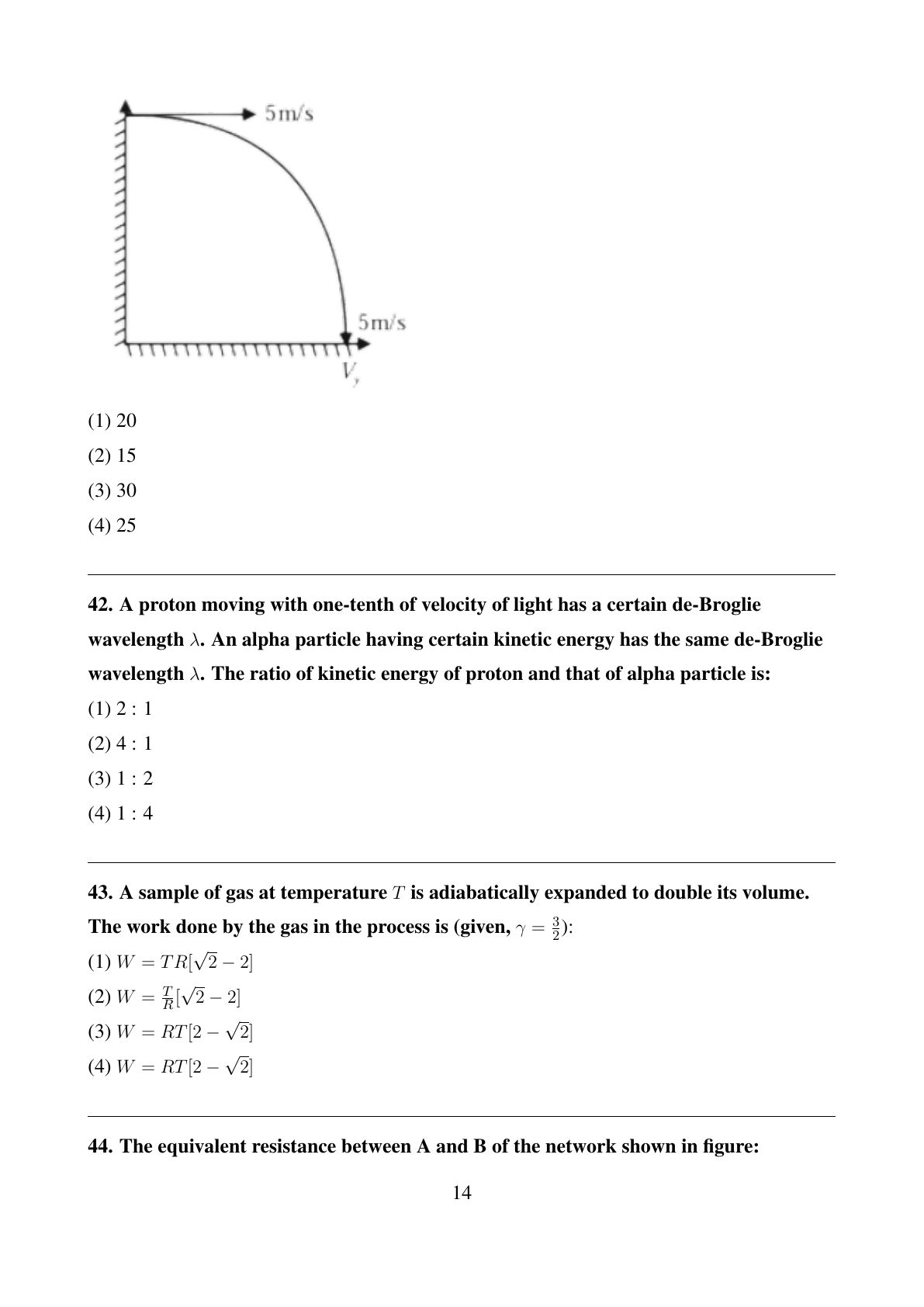
A child stands on the edge of the cliff 10 m above the ground and throws a stone horizontally with an initial speed of 5 m/s. Neglecting air resistance, the speed with which the stone hits the ground will be ___\ m/s (given, \( g = 10 m/s^2 \)).

View Solution
A proton moving with one-tenth of velocity of light has a certain de-Broglie wavelength \( \lambda \). An alpha particle having certain kinetic energy has the same de-Broglie wavelength \( \lambda \). The ratio of kinetic energy of proton and that of alpha particle is:
View Solution
A sample of gas at temperature \( T \) is adiabatically expanded to double its volume. The work done by the gas in the process is (given, \( \gamma = \frac{3}{2} \)):
View Solution
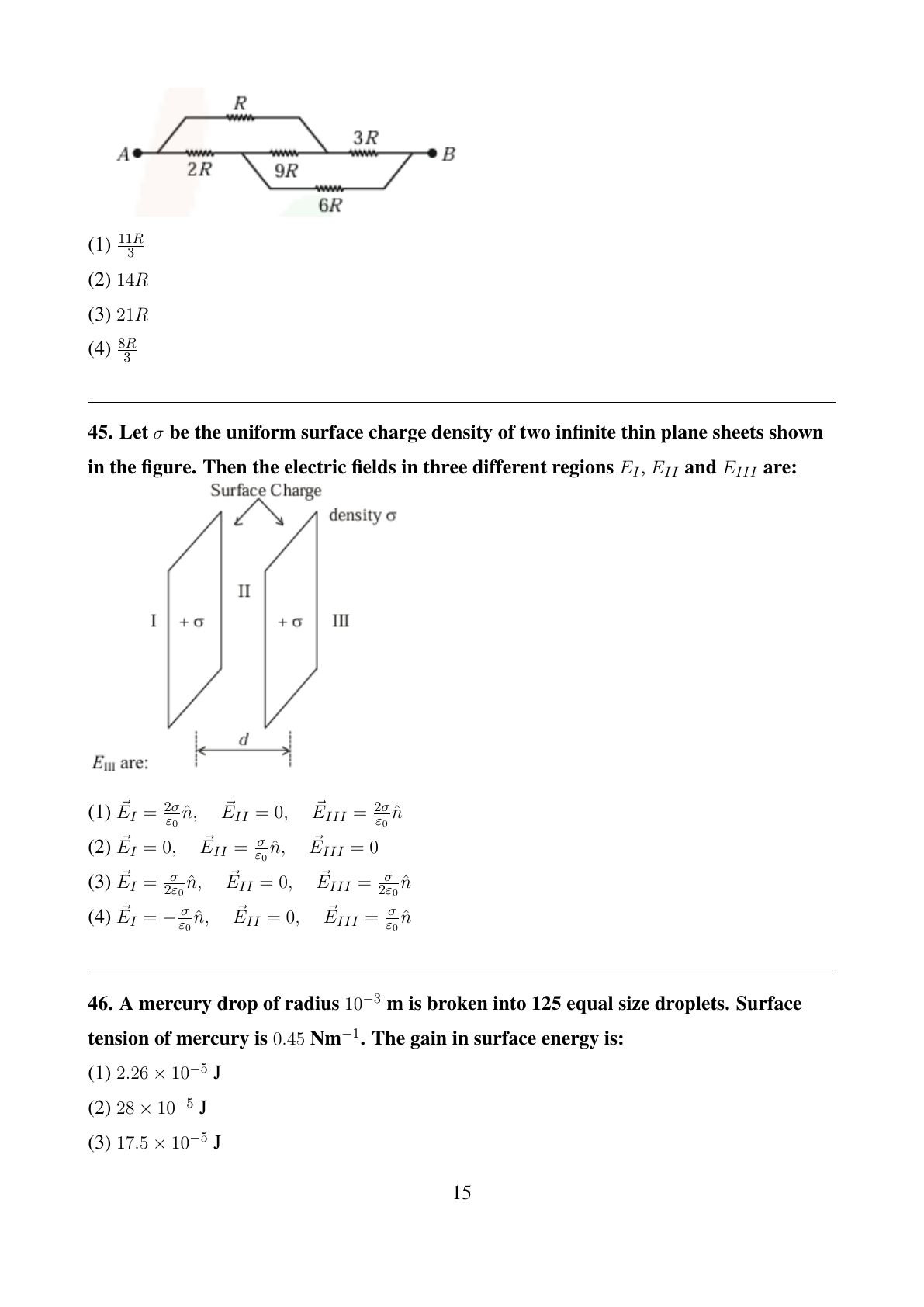
The equivalent resistance between A and B of the network shown in figure:

View Solution
Let \( \sigma \) be the uniform surface charge density of two infinite thin plane sheets shown in the figure. Then the electric fields in three different regions \( E_I \), \( E_{II} \) and \( E_{III} \) are:

View Solution
A mercury drop of radius \( 10^{-3} \) m is broken into 125 equal size droplets. Surface tension of mercury is \( 0.45 \) Nm\(^{-1}\). The gain in surface energy is:
View Solution
The mass of proton, neutron and helium nucleus are respectively \( 1.0073 \) u, \( 1.0087 \) u and \( 4.0015 \) u. The binding energy of helium nucleus is:
View Solution
The equation of state for some gases is given by: \[ \left( P + \frac{a}{V^2} \right) (V - b) = RT \]
The physical quantity, which has the same dimensional formula as \( \frac{b^2}{a} \), will be:
View Solution
The average kinetic energy of a molecule of the gas is:
View Solution
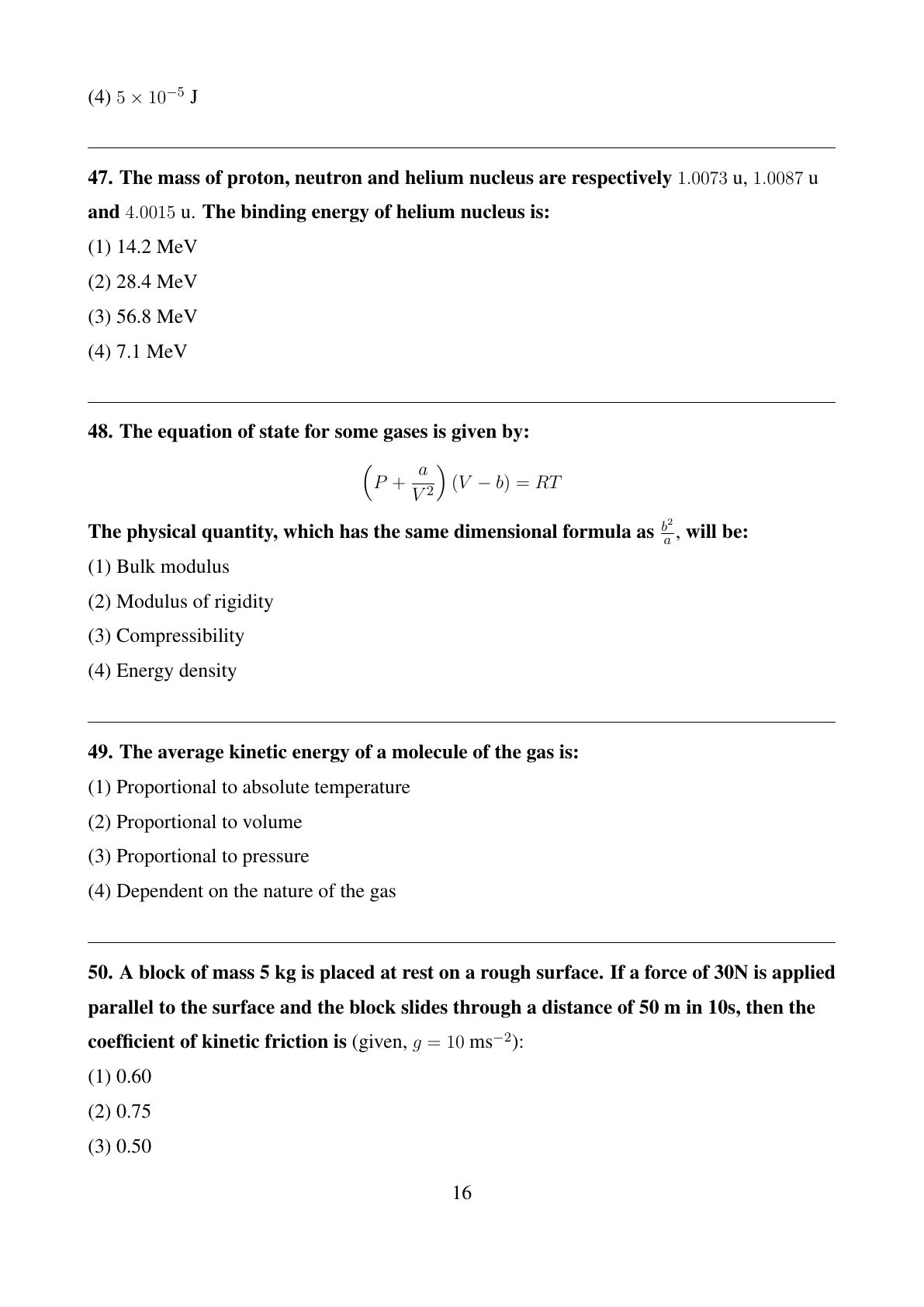
A block of mass 5 kg is placed at rest on a rough surface. If a force of 30N is applied parallel to the surface and the block slides through a distance of 50 m in 10s, then the coefficient of kinetic friction is (given, \( g = 10 \) ms\(^{-2}\)):
View Solution
A charge particle of 2 μC accelerated by a potential difference of 100V enters a region of uniform magnetic field of magnitude 4 mT at right angle to the direction of field. The charge particle completes semicircle of radius 3 cm inside magnetic field. The mass of the charge particle is ___\ × \( 10^{-18} \) kg.
View Solution
In an experiment to find emf of a cell using potentiometer, the length of null point for a cell of emf 1.5 V is found to be 60 cm. If this cell is replaced by another cell of emf E, the length-of null point increases by 40 cm. The value of E is \( \frac{x}{10} \) V. The value of x is _________.
View Solution
A small particle moves to position \(5\hat{i} - 2\hat{j} + \hat{k}\) from its initial position \(2\hat{i} + 3\hat{j} - 4\hat{k}\) under the action of force \(5\hat{i} + 2\hat{j} + 7\hat{k}\) N. The value of work done will be ____\ J.
View Solution
A light of energy 12.75 eV is incident on a hydrogen atom in its ground state. The atom absorbs the radiation and reaches to one of its excited states. The angular momentum of the atom in the excited state is \( \frac{x}{\pi} \times 10^{-17} \) eVs. The value of x is __________.
View Solution
A certain pressure \( P \) is applied to 1 litre of water and 2 litre of a liquid separately. Water gets compressed to 0.01% whereas the liquid gets compressed to 0.03%. The ratio of Bulk modulus of water to that of the liquid is \(\frac{3}{x}\). The value of \( x \) is _______.
View Solution
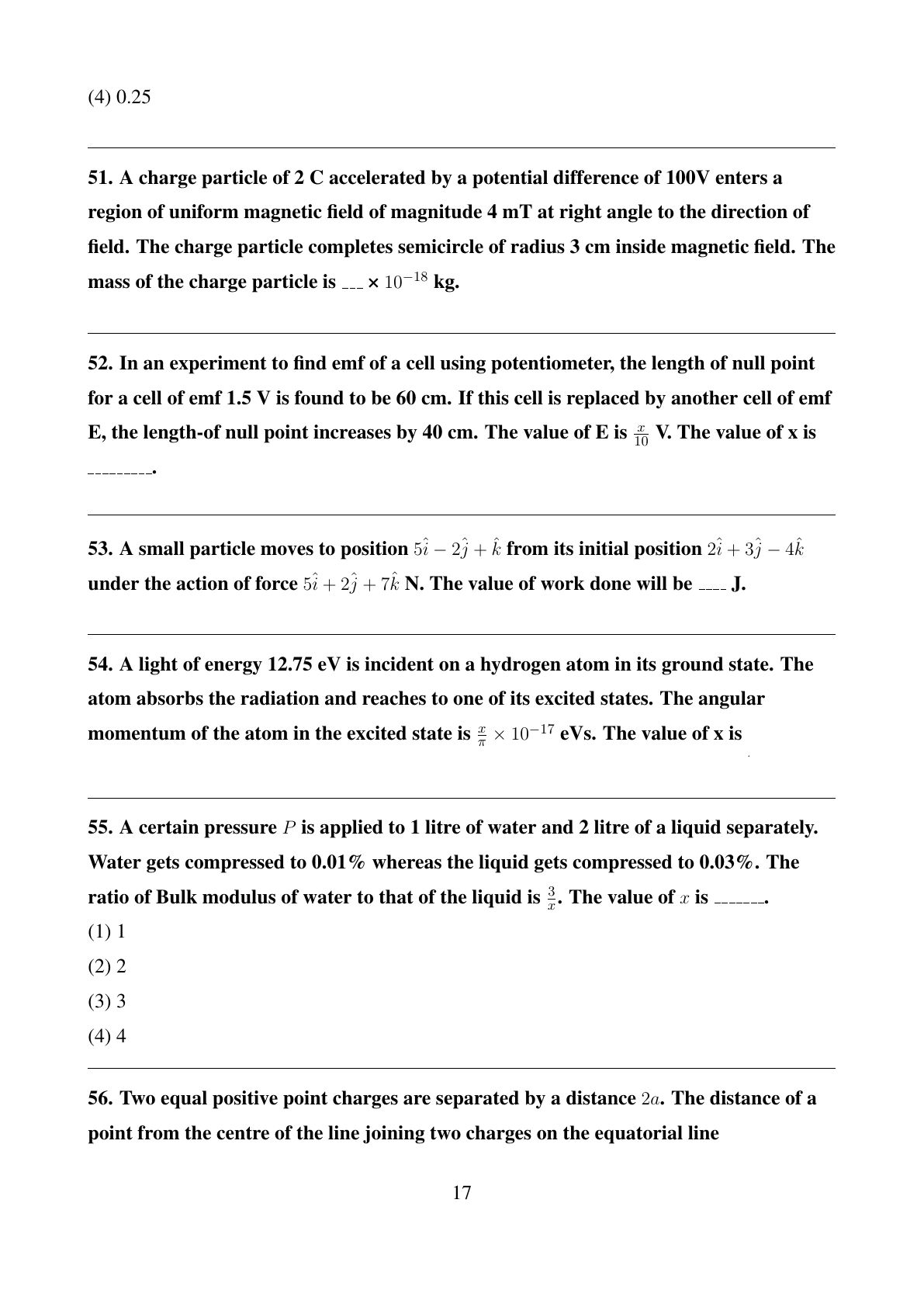
Two equal positive point charges are separated by a distance \( 2a \). The distance of a point from the centre of the line joining two charges on the equatorial line (perpendicular bisector) at which force experienced by a test charge \( q_0 \) becomes maximum is \( \frac{a}{\sqrt{x}} \). The value of \( x \) is _______.
- (1) 1
- (2) 2
- (3) 3
- (4) 4
![]()


View Solution
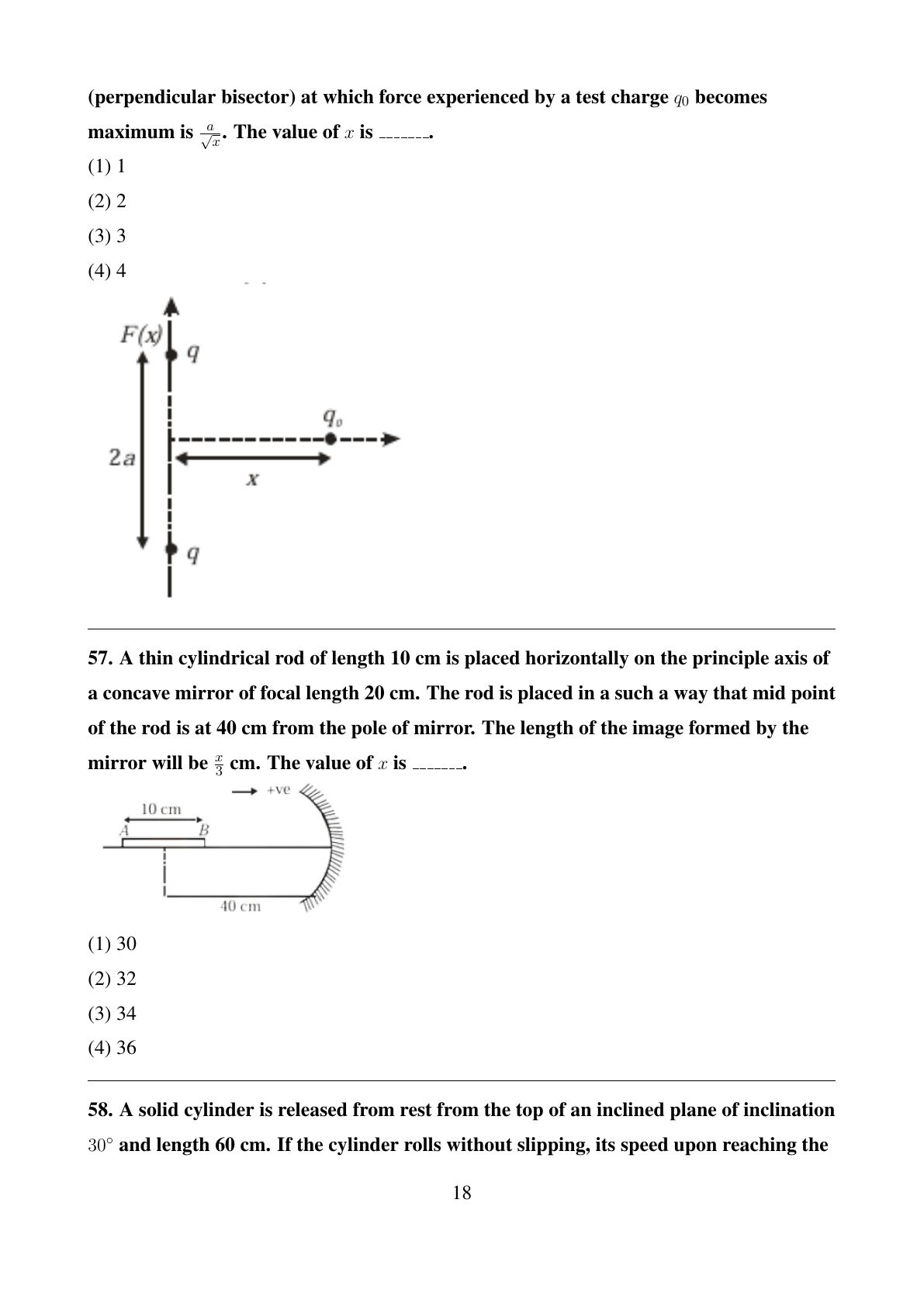
A thin cylindrical rod of length 10 cm is placed horizontally on the principle axis of a concave mirror of focal length 20 cm. The rod is placed in a such a way that mid point of the rod is at 40 cm from the pole of mirror. The length of the image formed by the mirror will be \( \frac{x}{3} \) cm. The value of \( x \) is _______.

View Solution
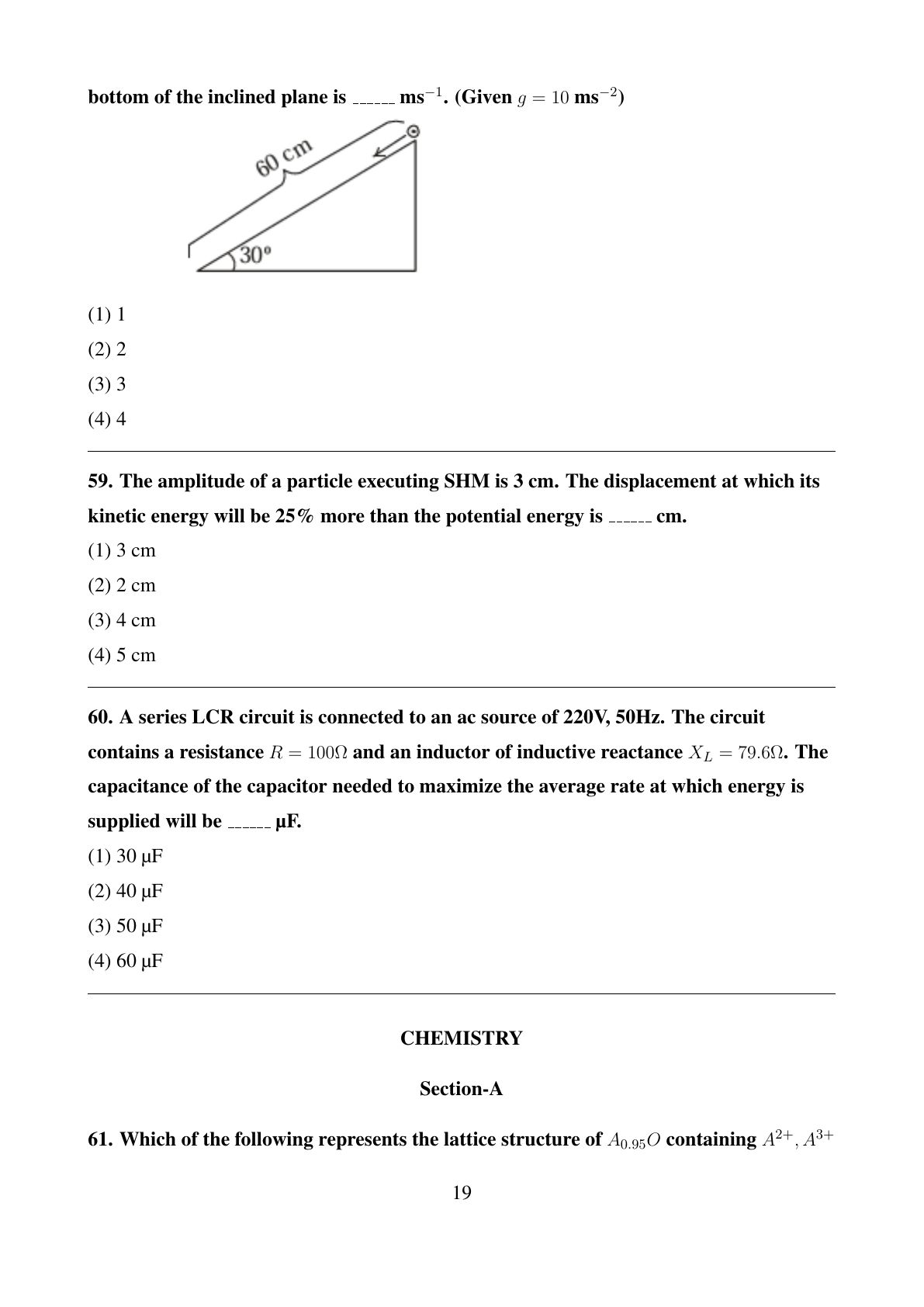
A solid cylinder is released from rest from the top of an inclined plane of inclination \( 30^\circ \) and length 60 cm. If the cylinder rolls without slipping, its speed upon reaching the bottom of the inclined plane is ______ ms\(^{-1}\). (Given \( g = 10 \) ms\(^{-2}\))

View Solution
The amplitude of a particle executing SHM is 3 cm. The displacement at which its kinetic energy will be 25% more than the potential energy is ______ cm.
View Solution
A series LCR circuit is connected to an ac source of 220V, 50Hz. The circuit contains a resistance \( R = 100\Omega \) and an inductor of inductive reactance \( X_L = 79.6 \Omega \). The capacitance of the capacitor needed to maximize the average rate at which energy is supplied will be ______ µF.
View Solution
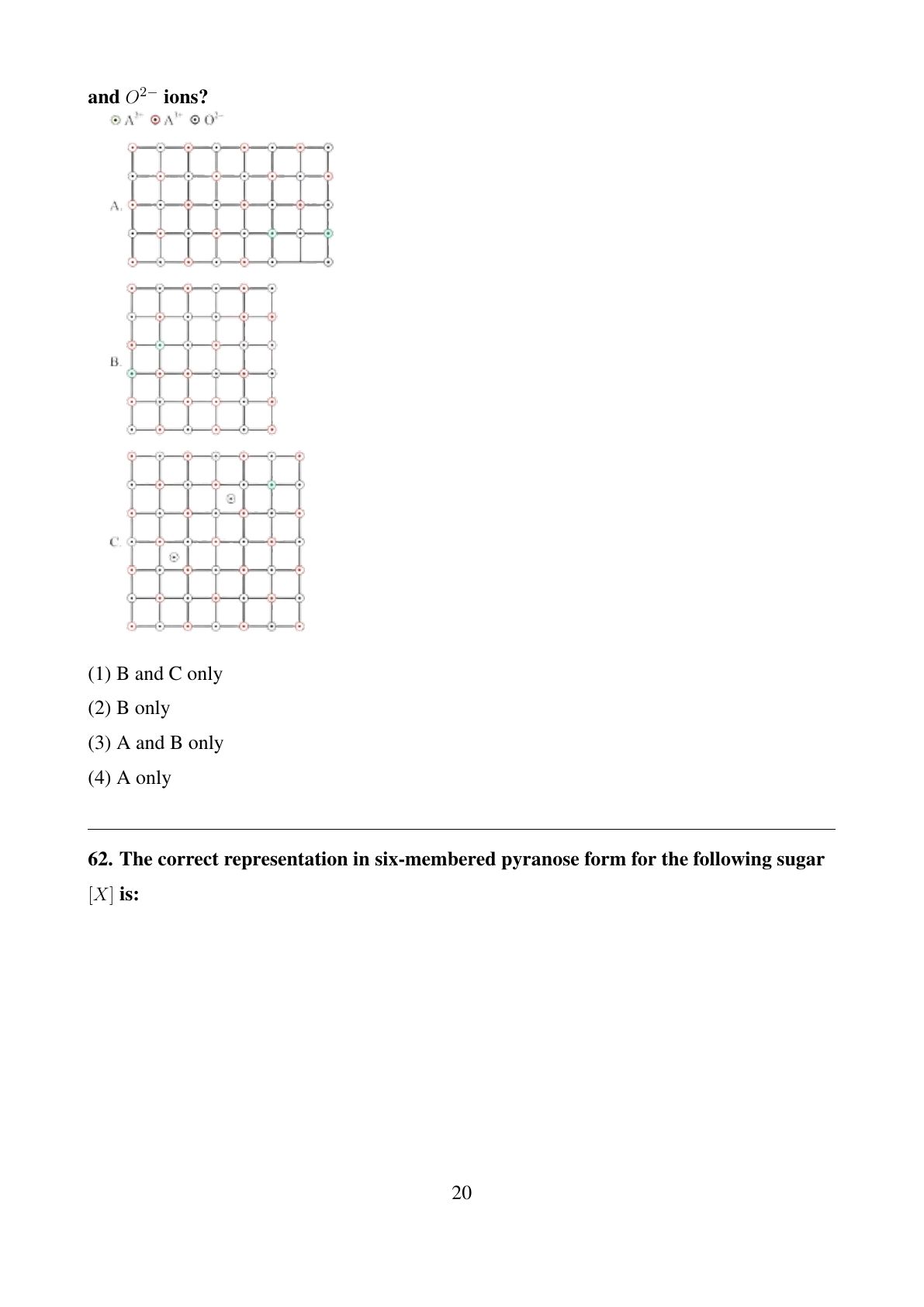
Which of the following represents the lattice structure of \( A_{0.95}O \) containing \( A^{2+}, A^{3+} \) and \( O^{2-} \) ions?

View Solution
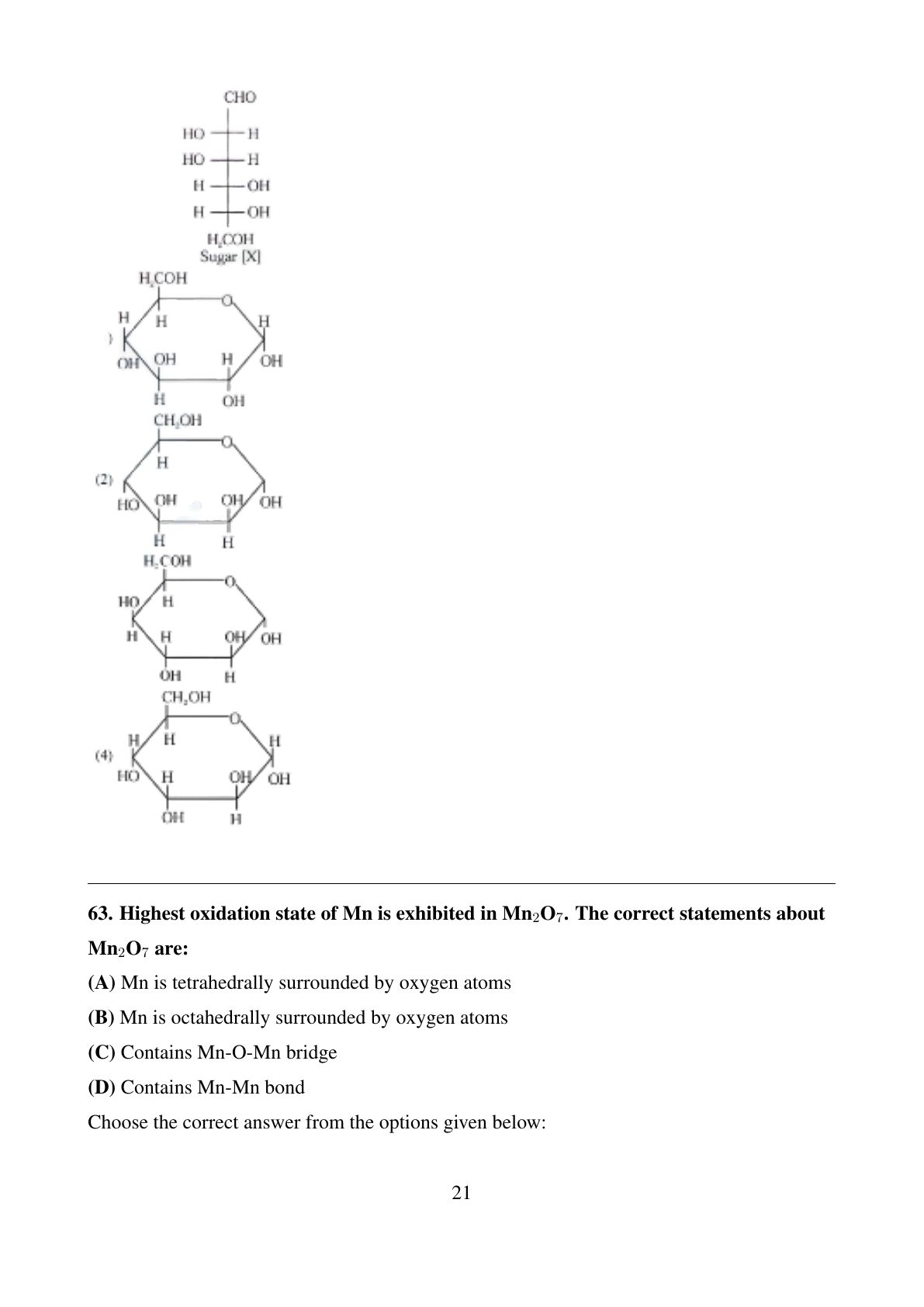
The correct representation in six-membered pyranose form for the following sugar \( [X] \) is:

View Solution
Highest oxidation state of Mn is exhibited in Mn\(_2\)O\(_7\). The correct statements about Mn\(_2\)O\(_7\) are:
(A) Mn is tetrahedrally surrounded by oxygen atoms
(B) Mn is octahedrally surrounded by oxygen atoms
(C) Contains Mn-O-Mn bridge
(D) Contains Mn-Mn bond
Choose the correct answer from the options given below:
View Solution
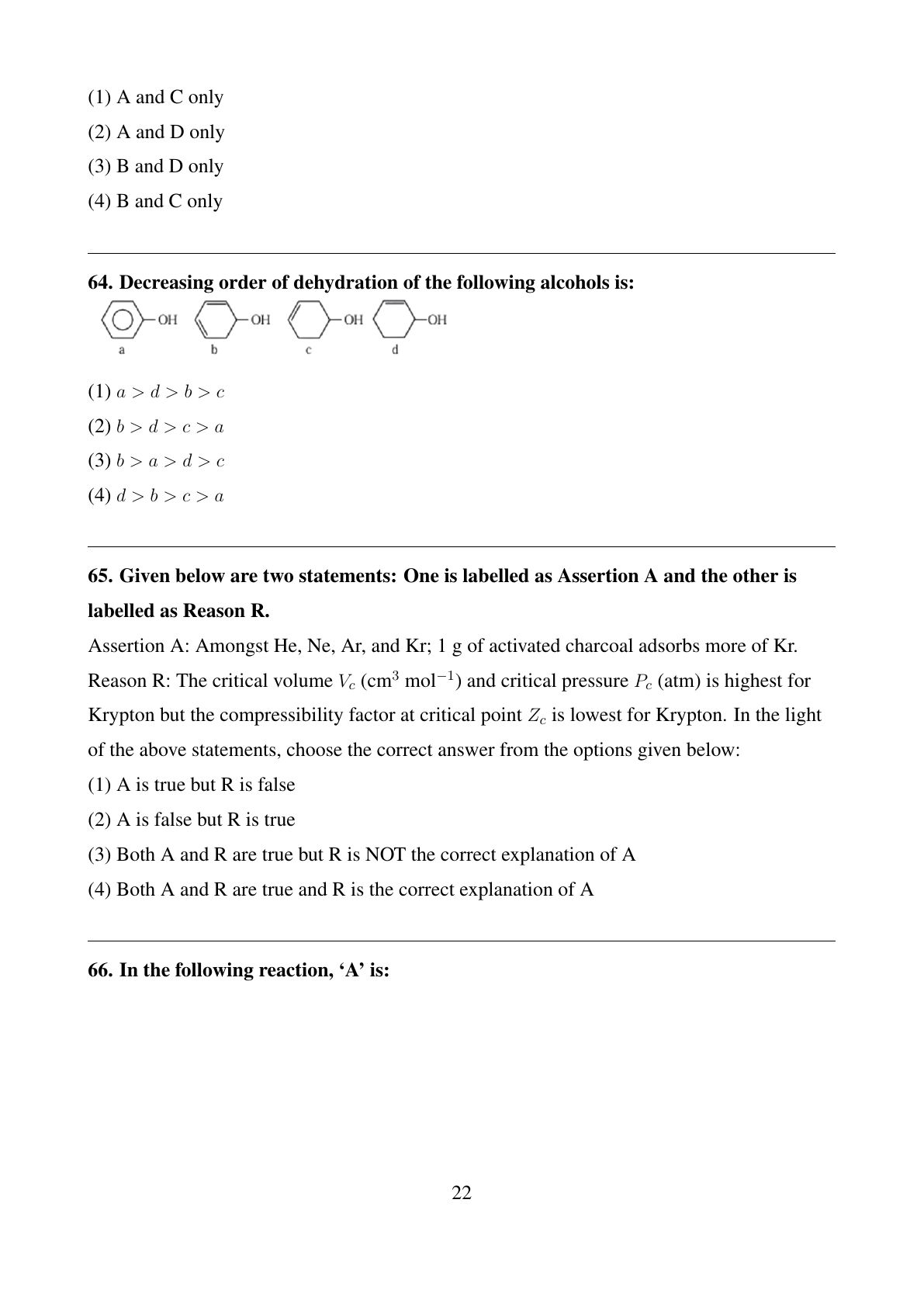
Decreasing order of dehydration of the following alcohols is:

View Solution
Given below are two statements: One is labelled as Assertion A and the other is labelled as Reason R.
Assertion A: Amongst He, Ne, Ar, and Kr; 1 g of activated charcoal adsorbs more of Kr.
Reason R: The critical volume \( V_c \) (cm\(^3\) mol\(^{-1}\)) and critical pressure \( P_c \) (atm) is highest for Krypton but the compressibility factor at critical point \( Z_c \) is lowest for Krypton.
In the light of the above statements, choose the correct answer from the options given below:
View Solution
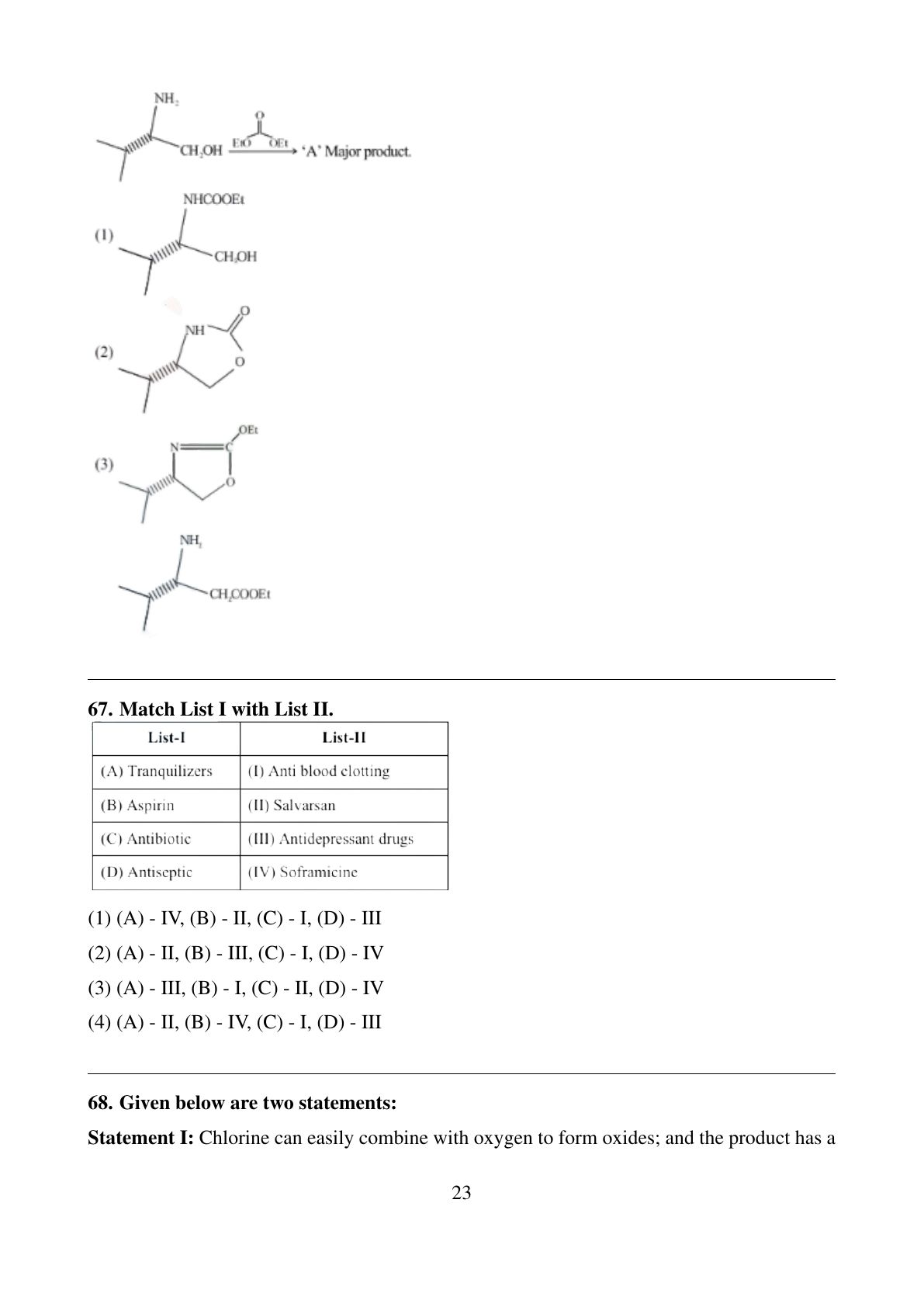
In the following reaction, ‘A’ is:

View Solution
Match List I with List II.

View Solution
Given below are two statements:
Statement I: Chlorine can easily combine with oxygen to form oxides; and the product has a tendency to explode.
Statement II: Chemical reactivity of an element can be determined by its reaction with oxygen and halogens.
In the light of the above statements, choose the correct answer from the options given below:
View Solution
Resonance in carbonate ion \( (CO_3^{2-}) \) is:

View Solution
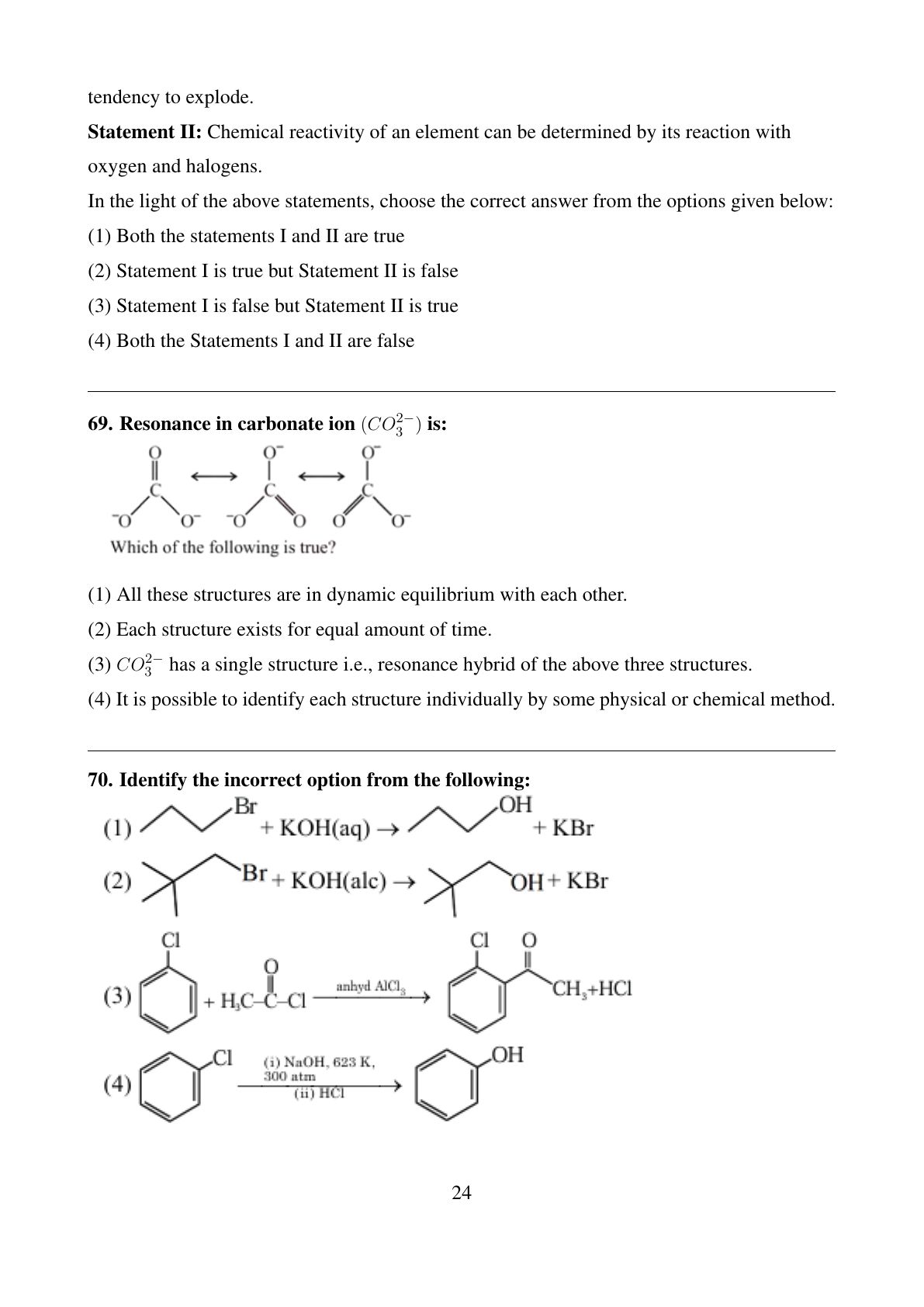
Identify the incorrect option from the following:
%option

View Solution
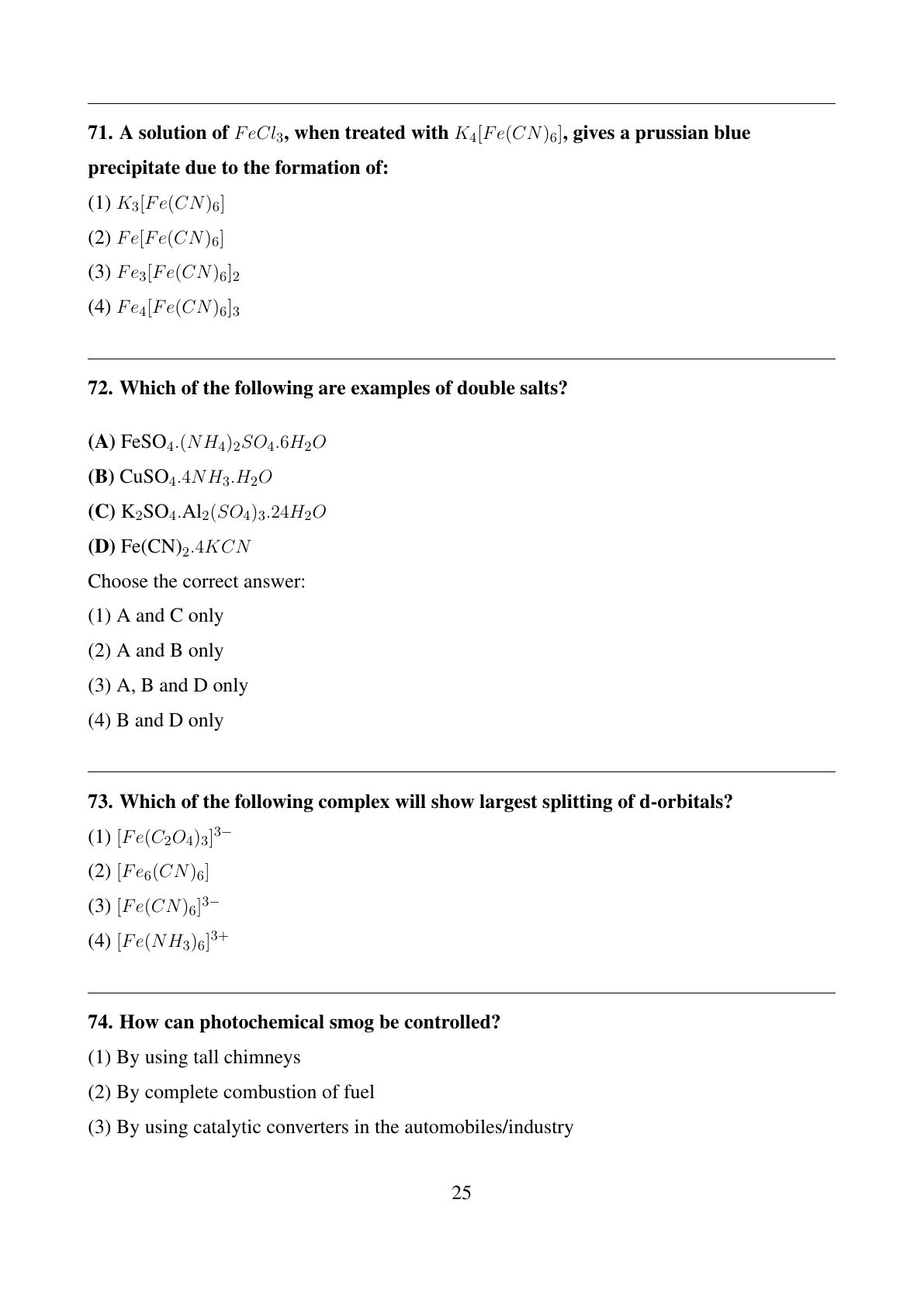
A solution of \( FeCl_3 \), when treated with \( K_4[Fe(CN)_6] \), gives a prussian blue precipitate due to the formation of:
View Solution
Which of the following are examples of double salts?
(A) \( FeSO_4.(NH_4)_2SO_4.6H_2O \)
(B) \( CuSO_4.4NH_3.H_2O \)
(C) \( K_2SO_4.Al_2(SO_4)_3.24H_2O \)
(D) \( Fe(CN)_2.4KCN \)
Choose the correct answer:
View Solution
Which of the following complex will show largest splitting of d-orbitals?
View Solution
How can photochemical smog be controlled?
View Solution
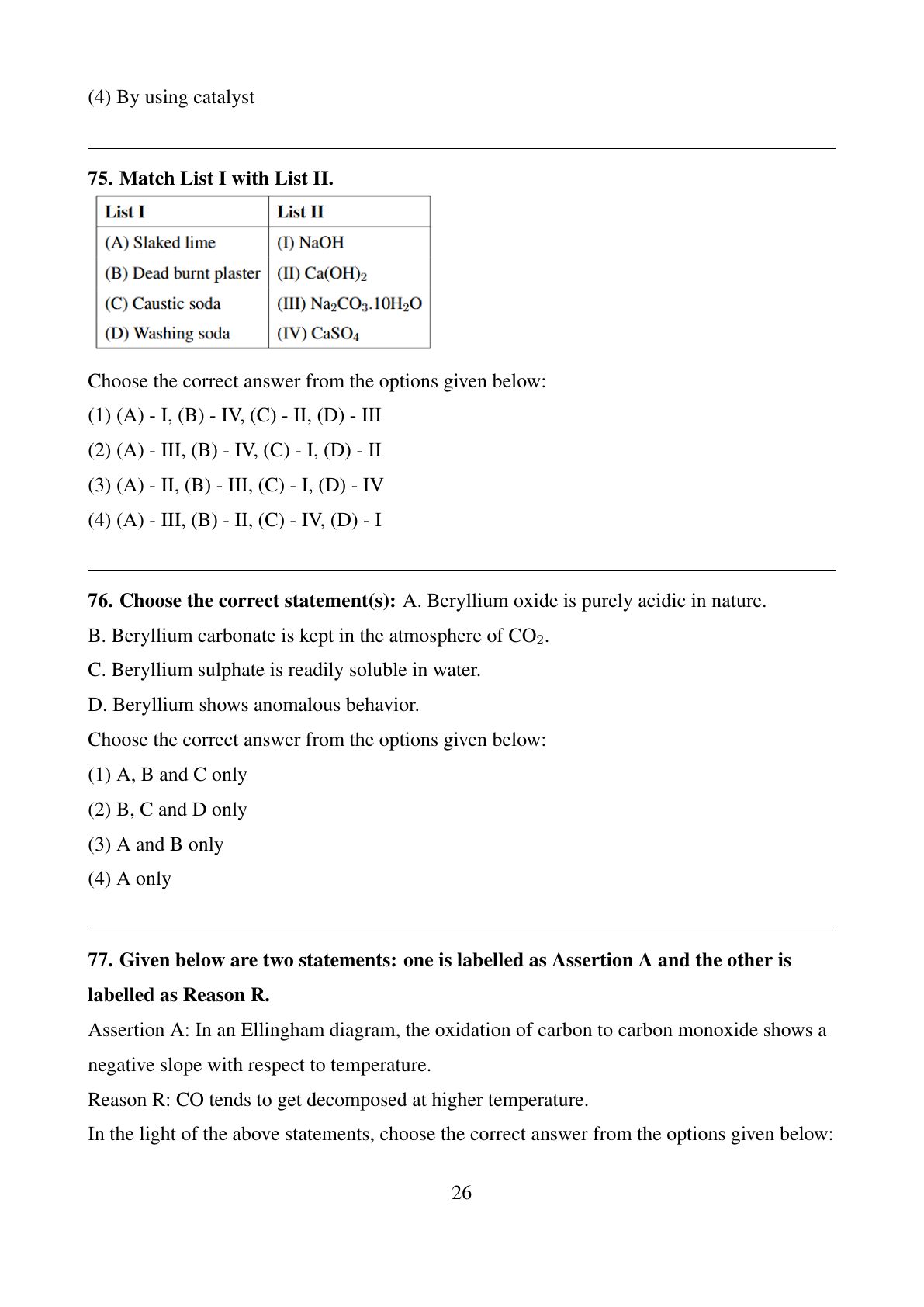
Match List I with List II.

Choose the correct answer from the options given below:
View Solution
Choose the correct statement(s):
A. Beryllium oxide is purely acidic in nature.
B. Beryllium carbonate is kept in the atmosphere of CO\(_2\).
C. Beryllium sulphate is readily soluble in water.
D. Beryllium shows anomalous behavior.
Choose the correct answer from the options given below:
View Solution
Given below are two statements: one is labelled as Assertion A and the other is labelled as Reason R.
Assertion A: In an Ellingham diagram, the oxidation of carbon to carbon monoxide shows a negative slope with respect to temperature.
Reason R: CO tends to get decomposed at higher temperature.
In the light of the above statements, choose the correct answer from the options given below:
View Solution
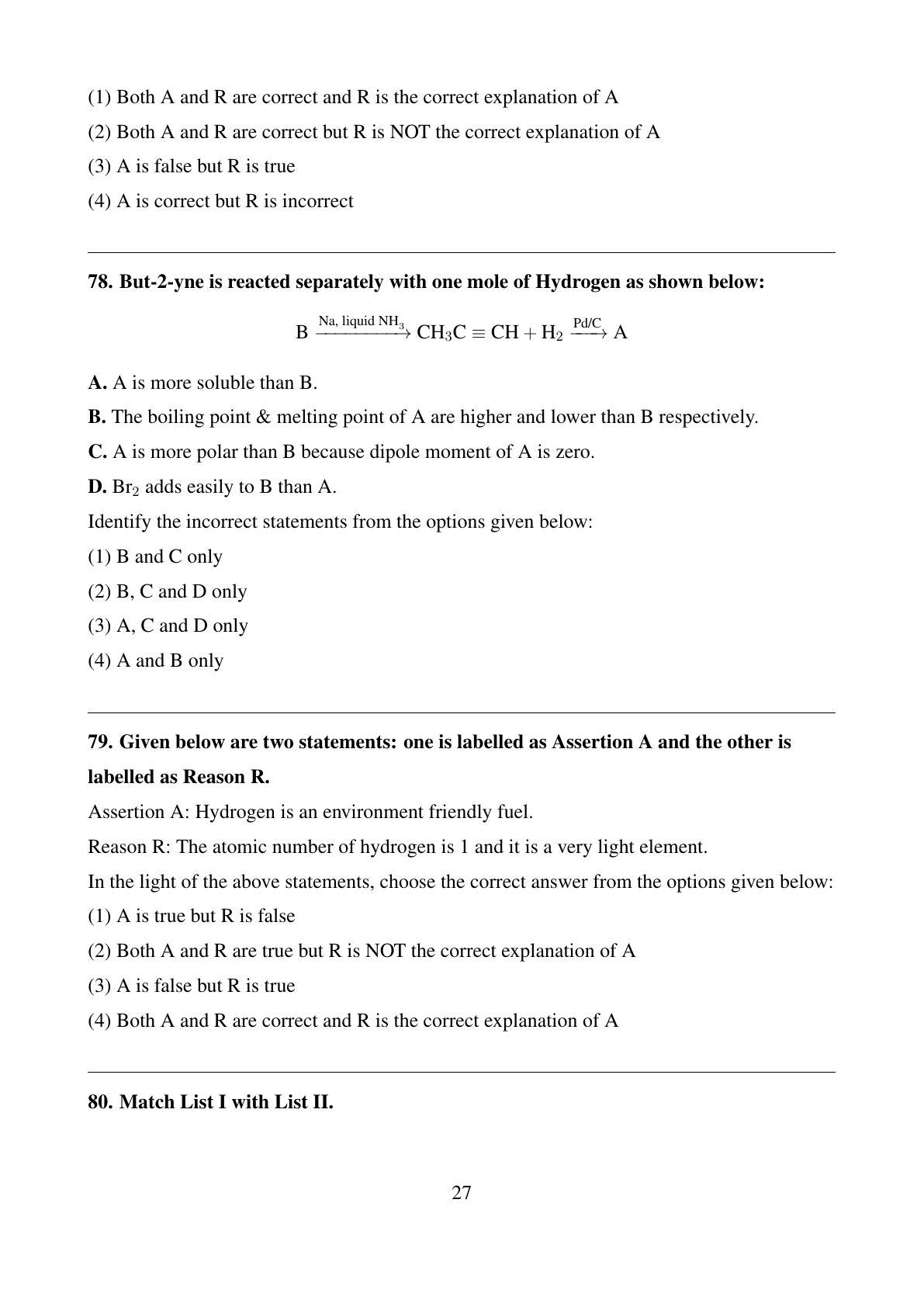
But-2-yne is reacted separately with one mole of Hydrogen as shown below: \[ B \xrightarrow{Na, liquid NH_3} CH_3 C \equiv CH + H_2 \xrightarrow{Pd/C} A \]
A. A is more soluble than B.
B. The boiling point \& melting point of A are higher and lower than B respectively.
C. A is more polar than B because dipole moment of A is zero.
D. \( Br_2 \) adds easily to B than A.
Identify the incorrect statements from the options given below:
View Solution
Given below are two statements: one is labelled as Assertion A and the other is labelled as Reason R.
Assertion A: Hydrogen is an environment friendly fuel.
Reason R: The atomic number of hydrogen is 1 and it is a very light element.
In the light of the above statements, choose the correct answer from the options given below:
View Solution
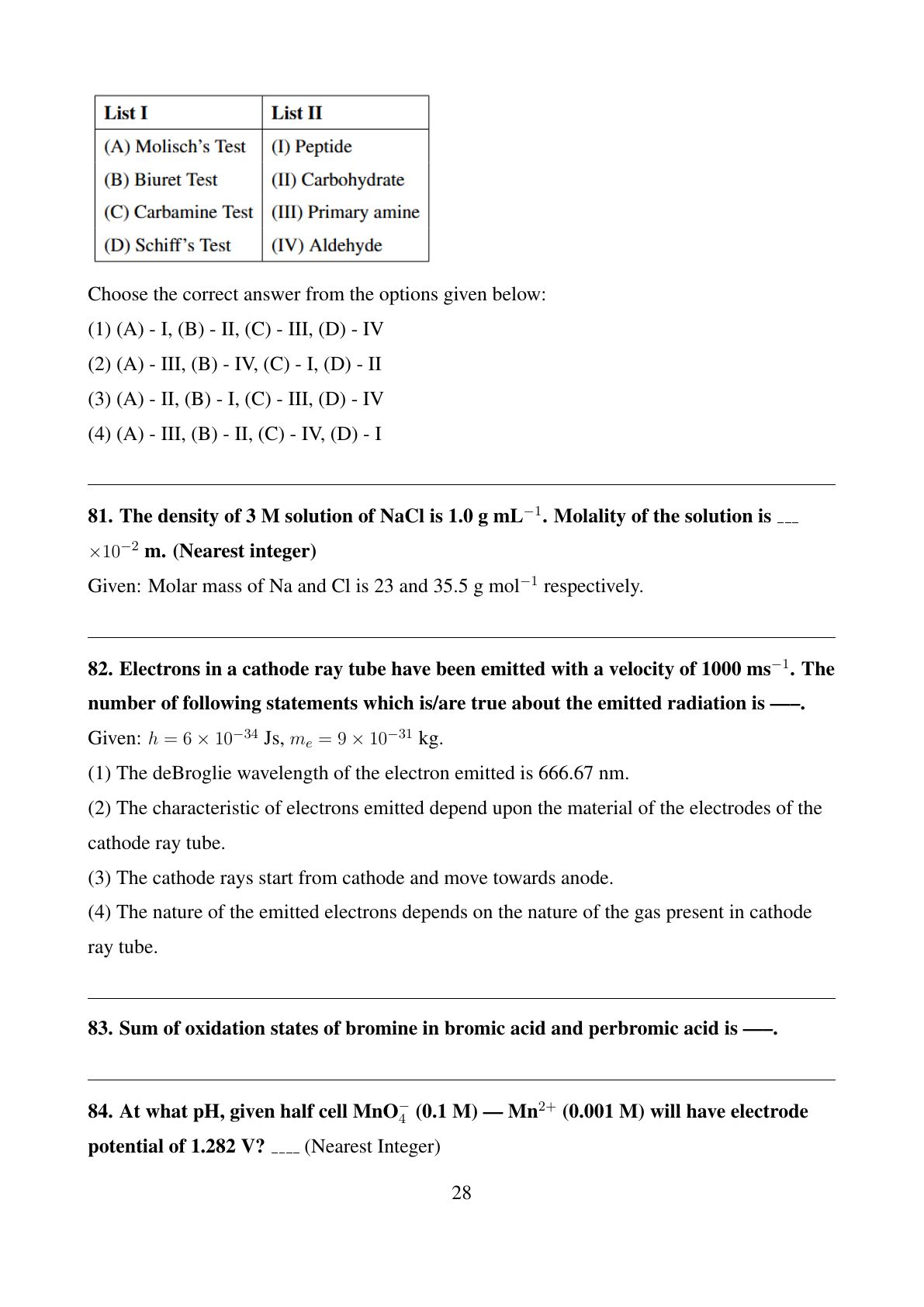
Match List I with List II.

Choose the correct answer from the options given below:
View Solution
The density of 3 M solution of NaCl is 1.0 g mL\(^{-1}\). Molality of the solution is ___\ \( \times 10^{-2} \) m. (Nearest integer)
Given: Molar mass of Na and Cl is 23 and 35.5 g mol\(^{-1}\) respectively.
View Solution
Electrons in a cathode ray tube have been emitted with a velocity of 1000 ms\(^{-1}\). The number of following statements which is/are true about the emitted radiation is -----.
Given: \( h = 6 \times 10^{-34} \) Js, \( m_e = 9 \times 10^{-31} \) kg.
View Solution
Sum of oxidation states of bromine in bromic acid and perbromic acid is -----.
View Solution
At what pH, given half cell MnO\(_4^-\) (0.1 M) | Mn\(^{2+}\) (0.001 M) will have electrode potential of 1.282 V?
____\ (Nearest Integer)
Given \( E^\circ_{MnO_4^-/Mn^{2+}} = 1.54 \, V, \, \frac{2.303RT}{F} = 0.059V \)
View Solution
Number of isomeric compounds with molecular formula C\(_9\)H\(_10\)O which (i) do not dissolve in NaOH (ii) do not dissolve in HCl. (iii) do not give orange precipitate with 2, 4 - DNP (iv) on hydrogenation give identical compound with molecular formula C\(_9\)H\(_12\)O is ____.
View Solution
(i) X(g) \( \rightleftharpoons \) Y(g) + Z(g), \( K_{p1} = 3 \)
(ii) A(g) \( \rightleftharpoons \) 2B(g), \( K_{p2} = 1 \)
If the degree of dissociation and initial concentration of both the reactants X(g) and A(g) are equal, then the ratio of the total pressure at equilibrium \( \left( \frac{P_1}{P_2} \right) \) is equal to x : 1. The value of x is ____\. (Nearest integer)
View Solution
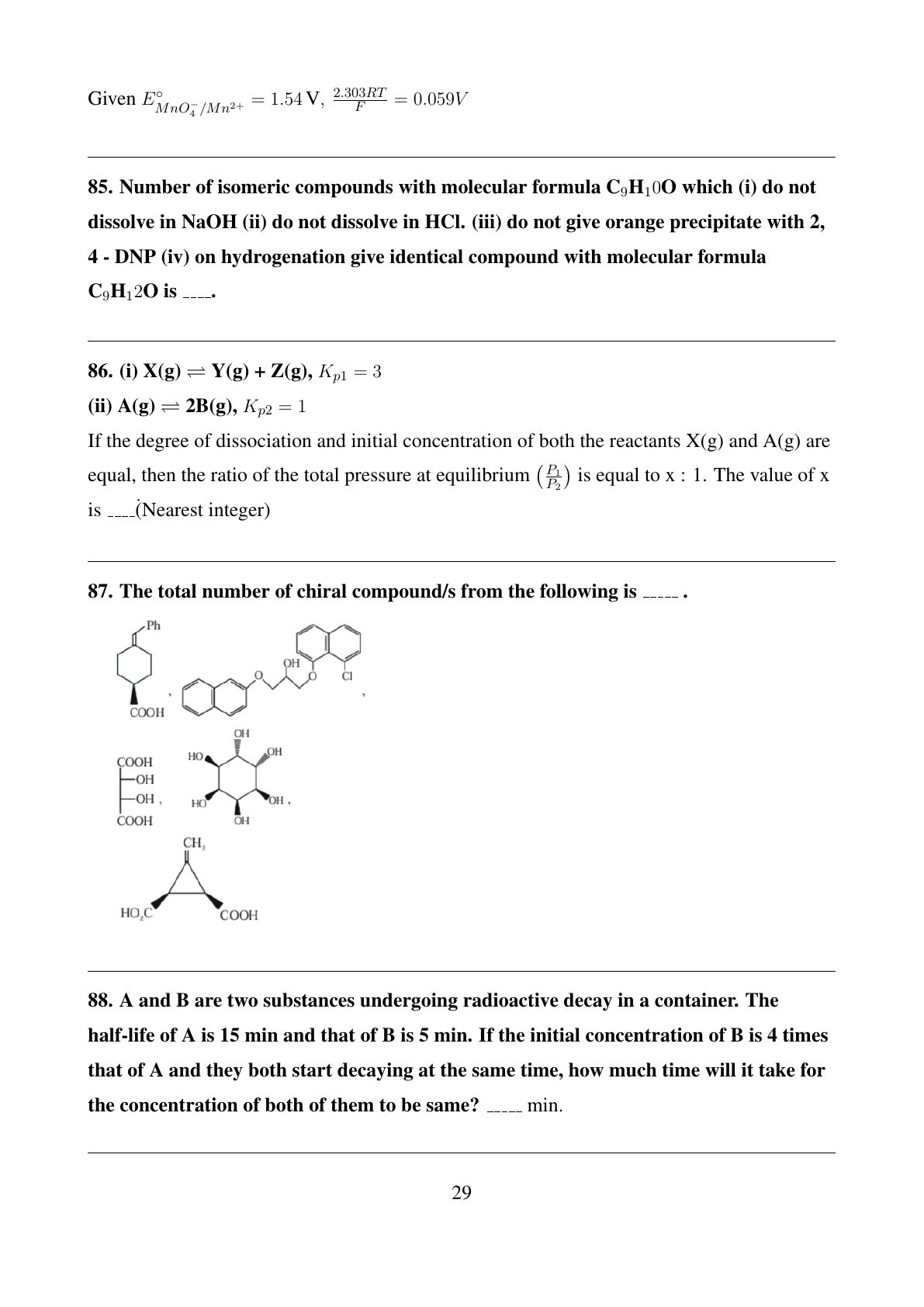
The total number of chiral compound/s from the following is _____\ .

View Solution
A and B are two substances undergoing radioactive decay in a container. The half-life of A is 15 min and that of B is 5 min. If the initial concentration of B is 4 times that of A and they both start decaying at the same time, how much time will it take for the concentration of both of them to be same? _____ min.
View Solution
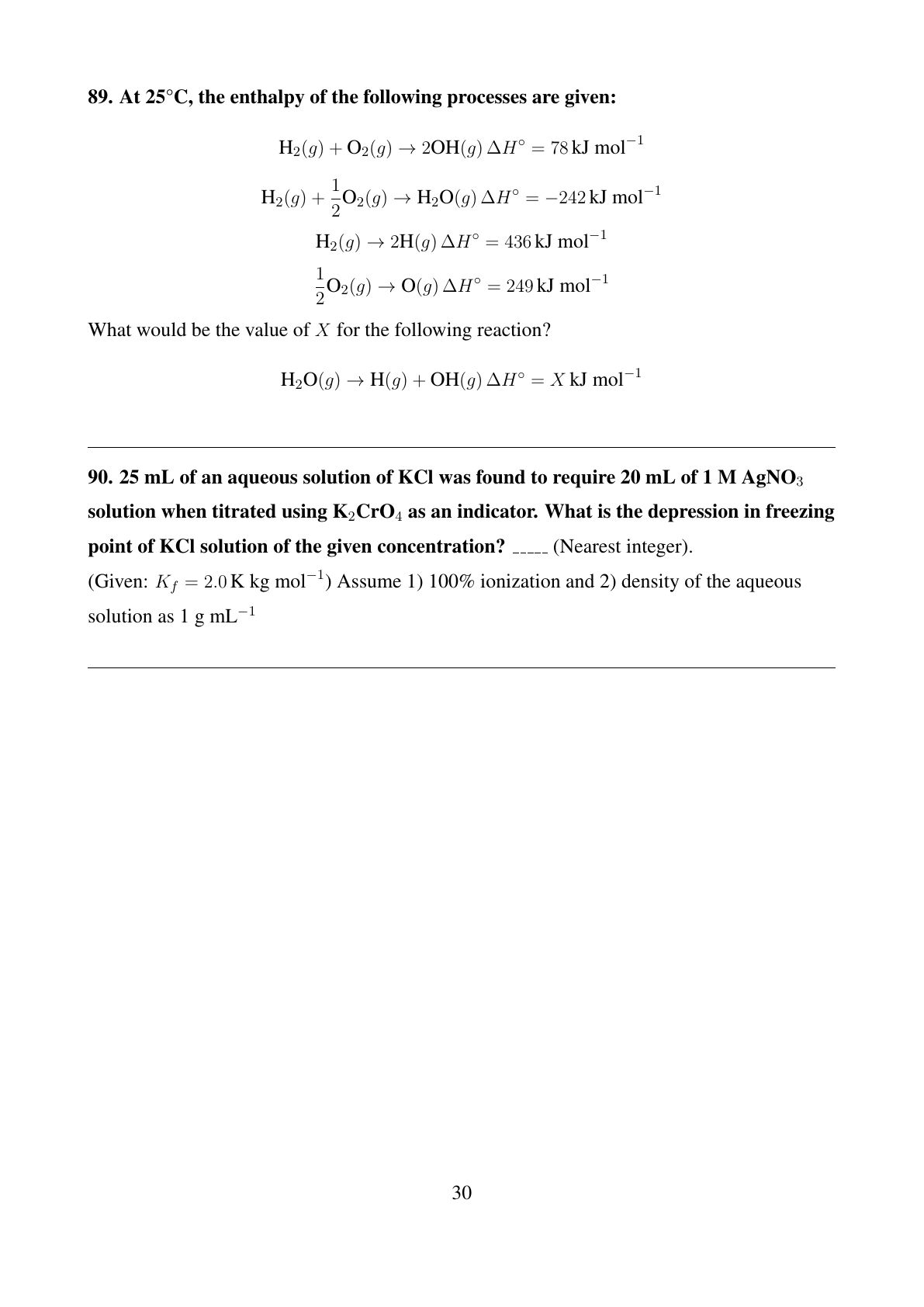
At 25°C, the enthalpy of the following processes are given: \[ H_2(g) + O_2(g) \rightarrow 2OH(g) \, \Delta H^\circ = 78\, kJ mol^{-1} \] \[ H_2(g) + \frac{1}{2} O_2(g) \rightarrow H_2O(g) \, \Delta H^\circ = -242\, kJ mol^{-1} \] \[ H_2(g) \rightarrow 2H(g) \, \Delta H^\circ = 436\, kJ mol^{-1} \] \[ \frac{1}{2} O_2(g) \rightarrow O(g) \, \Delta H^\circ = 249\, kJ mol^{-1} \]
What would be the value of \( X \) for the following reaction? \[ H_2O(g) \rightarrow H(g) + OH(g) \, \Delta H^\circ = X \, kJ mol^{-1} \]
View Solution
25 mL of an aqueous solution of KCl was found to require 20 mL of 1 M AgNO\(_3\) solution when titrated using K\(_2\)CrO\(_4\) as an indicator. What is the depression in freezing point of KCl solution of the given concentration? _____ (Nearest integer).
(Given: \( K_f = 2.0 \, K kg mol^{-1} \))
Assume
1) 100% ionization and
2) density of the aqueous solution as 1 g mL\(^{-1}\)
View Solution
Also Check:
JEE Main 2023 Feb 1 Shift 1 Question Paper by Coaching Institute
| Coaching Institutes | Question Paper with Answer Key PDF |
|---|---|
| Aakash BYJUs | Check Here |
JEE Main 2023 Paper Analysis Feb 1 Shift 1
JEE Main 2023 Paper Analysis for the exam scheduled on February 1 Shift 1 has been updated here. Candidates can check subject-wise paper analysis for the exam scheduled on February 1 Shift 1 here along with the topics with the highest weightage.



Comments