




JEE Main 2023 13 April Shift 2 Question Paper is available here. NTA conducted JEE Main 2023 13 April Shift 2 from 3 PM to 6 PM. Candidates can download the official JEE Main 2023 Question Paper PDF with Solution and Answer Key for 13 April Shift 2 using the link below.
Related Links:
- Download JEE Main Previous Year Question Papers PDF with Solutions
- Download JEE Main 2025 Question Paper for all Shifts
JEE Main 2023 13 April Shift 2 Question Paper with Answer Key PDF
| JEE Main 2023 13 April Shift 1 Question Paper with Solution PDF |  Download Download |
Check Solution |

JEE Main 2023 Mathematics Questions with Solutions
Section – A
Question 1:
The area of the region \{(x,y): x^2 \leq y \leq |x^2 - 4|, y \geq 1\ \text{ is:
View Solution
The given problem asks to find the area of a region bounded by the equations of curves. The expression for the required area involves integrating two functions over the given limits.
The area can be represented as:
\[ Required area = \int_{-2}^{2} \sqrt{y} \, dy + \int_{-2}^{2} \sqrt{4 - y} \, dy = \frac{4}{3} \left[ 4\sqrt{2} - 1 \right] \] Quick Tip: To find the area between curves, set up the integral based on the limits of integration derived from the boundaries of the region. Ensure the expressions under the integral sign are correctly derived from the curves.
If \[ \lim_{x \to 0} \frac{e^{x} - \cos(bx) - cx}{1 - \cos(2x)} = 2, \]
then \( 5a^2 + b^2 \) is equal to:
View Solution
The line, that is coplanar to the line \[ \frac{x+1}{-3} = \frac{y-2}{1} = \frac{z-5}{5}, \]
is:
View Solution
The plane, passing through the points \( (0, -1, 2) \) and \( (-1, 2, 1) \) and parallel to the line passing through \( (5,1,-7) \) and \( (1,-1,-1) \), also passes through the point
View Solution
Let for a triangle ABC, \[ \overrightarrow{AB} = -2\hat{i} + \hat{j} + 3\hat{k}, \quad \overrightarrow{CB} = \hat{i} + \hat{j} + \hat{k}, \quad \overrightarrow{CA} = 4\hat{i} + 3\hat{j} + 4\hat{k} \]
If \( \lambda \) = 0 and the area of triangle ABC is 5 \sqrt{6, then \( CB \) is equal to:
View Solution
Let for \[ A = \begin{pmatrix} 1 & 2 & 3
1 & 2 & 3
1 & 1 & 2 \end{pmatrix}, \quad |A| = 2. \quad If \quad |2 \, adj (2A)| = 32, \quad then \quad 3n + \alpha is equal to: \]
View Solution
The range of \( f(x) = 4 \sin \left( \frac{x^2}{x^2 + 1} \right) \) is:
View Solution
Let \( a_1, a_2, a_3, \dots \) be a G.P. of increasing positive numbers. Let the sum of its 6th and 8th terms be 2 and the product of its 3rd and 5th terms be \( \frac{1}{9} \). Then \( 6a_6 + a_6 a_8 \) is equal to:
View Solution
If the system of equations \[ 2x + y = -5
2x - 5y + z = -9
x + 2y - 5z = 7 \]
has infinitely many solutions, then \( (x + y)^2 + (y + z)^2 \) is equal to:
View Solution
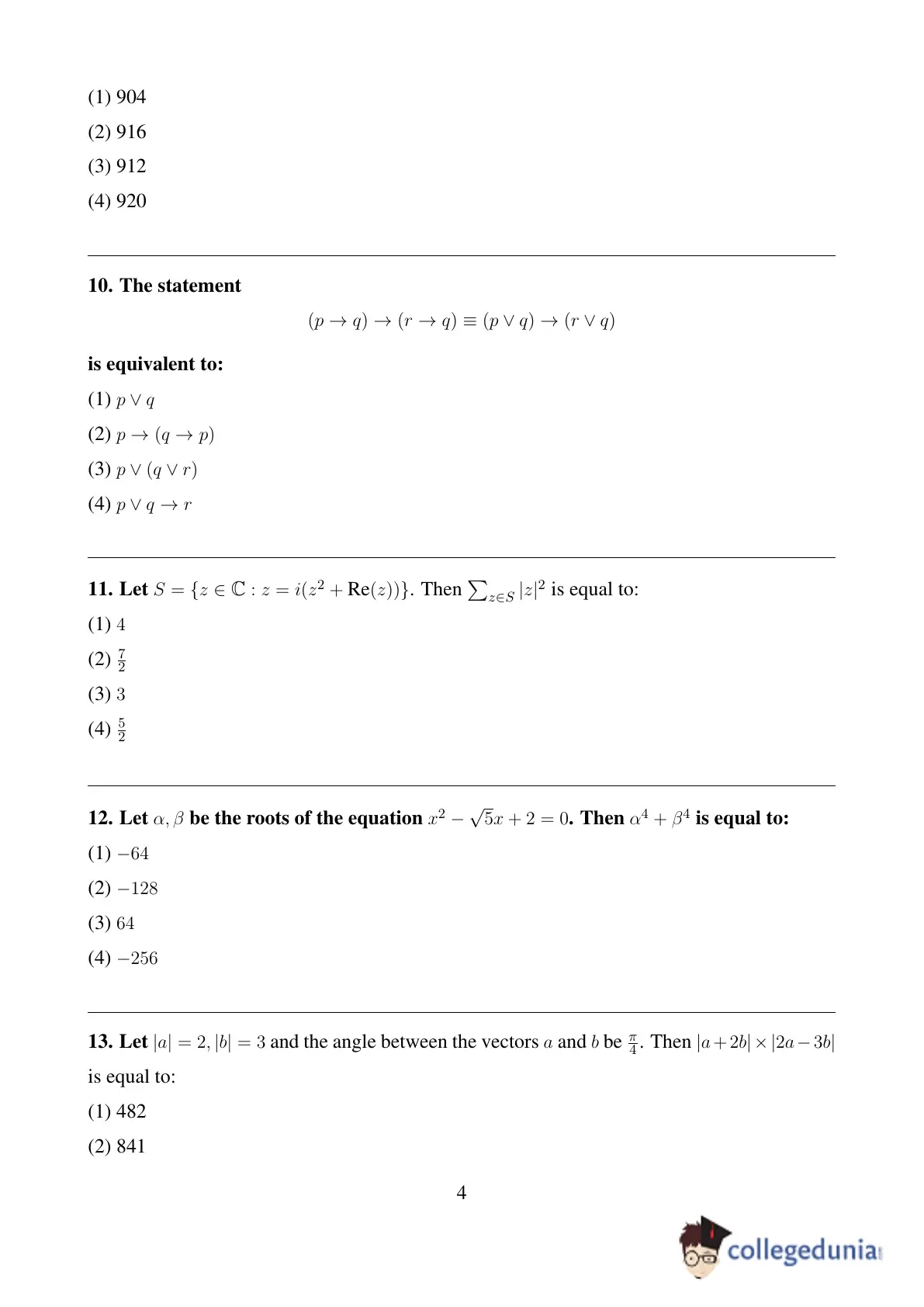
The statement \[ (p \rightarrow q) \rightarrow (r \rightarrow q) \equiv (p \vee q) \rightarrow (r \vee q) \]
is equivalent to:
View Solution
Let \( S = \{ z \in \mathbb{C} : z = i(z^2 + Re(z)) \} \). Then \( \sum_{z \in S} |z|^2 \) is equal to:
View Solution
Let \( \alpha, \beta \) be the roots of the equation \( x^2 - \sqrt{5}x + 2 = 0 \). Then \( \alpha^4 + \beta^4 \) is equal to:
View Solution
Let \( |a| = 2, |b| = 3 \) and the angle between the vectors \( a \) and \( b \) be \( \frac{\pi}{4} \). Then \( |a + 2b| \times |2a - 3b| \) is equal to:
View Solution
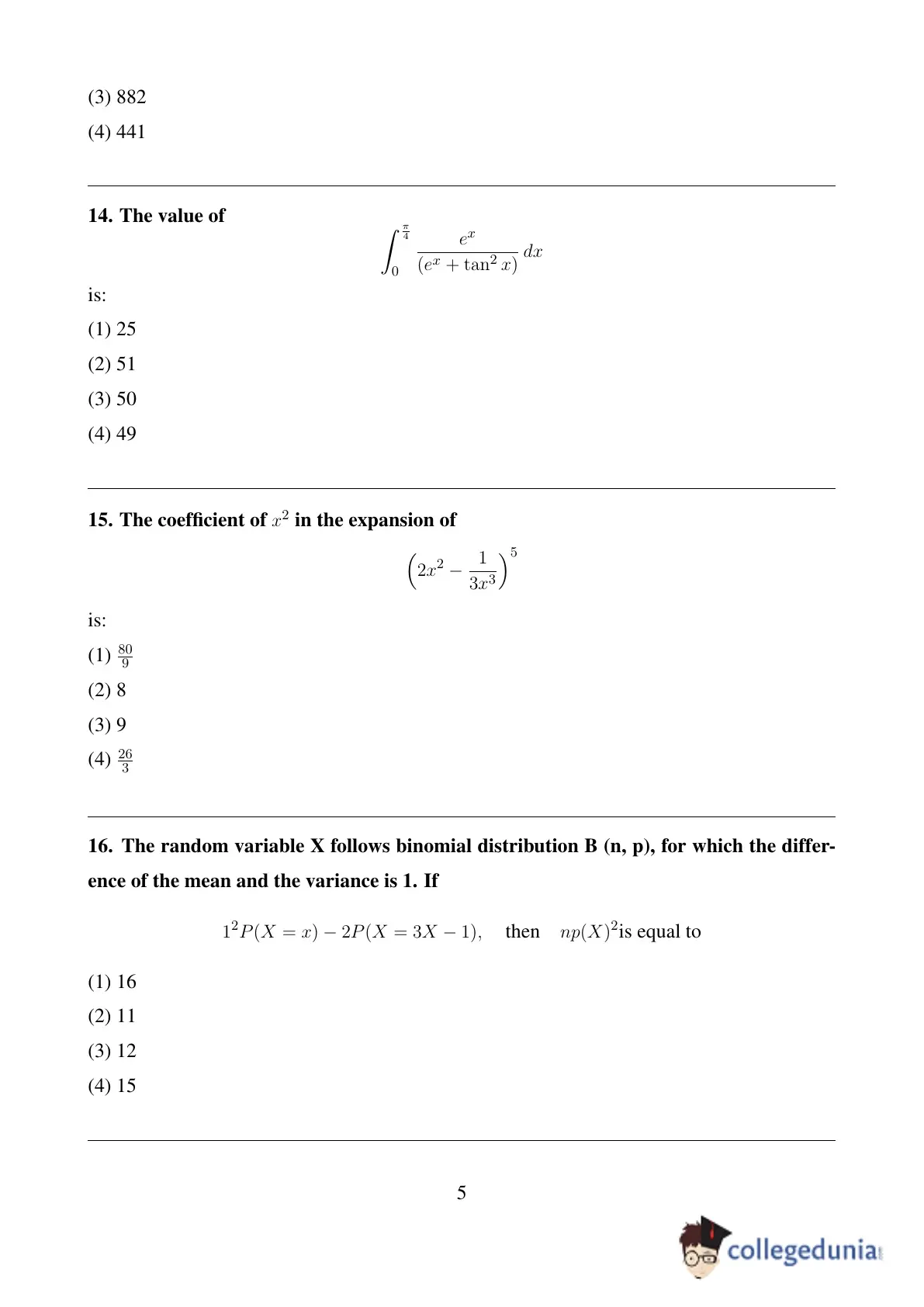
The value of \[ \int_{0}^{\frac{\pi}{4}} \frac{e^x}{(e^x + \tan^2 x)} \, dx \]
is:
View Solution
The coefficient of \( x^2 \) in the expansion of \[ \left( 2x^2 - \frac{1}{3x^3} \right)^5 \]
is:
View Solution
The random variable X follows binomial distribution B (n, p), for which the difference of the mean and the variance is 1. If \[ 1^{2}P(X = x) - 2P(X = 3X - 1), \quad then \quad np(X)^{2} is equal to \]
View Solution
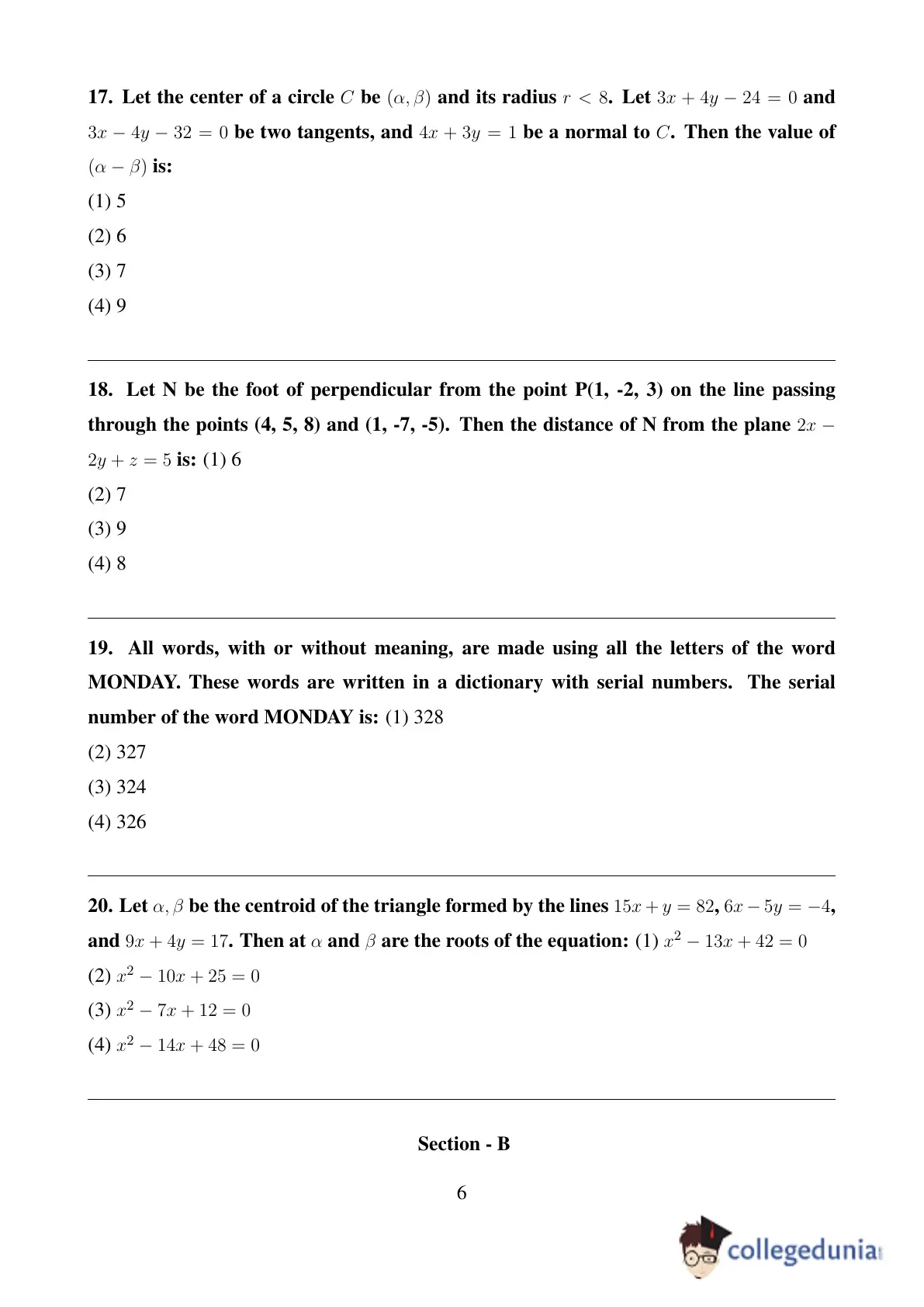
Let the centre of a circle C be (\alpha, \beta) and its radius r < 8. Let \(3x + 4y - 24\) and \(3x - 4y - 32\) be two tangents and \(4x + 3y = 1\) be a normal to C. Then the value of (\alpha - \beta) is equal to:
View Solution
Let N be the foot of perpendicular from the point P(1, -2, 3) on the line passing through the points (4, 5, 8) and (1, -7, -5). Then the distance of N from the plane \( 2x - 2y + z = 5 \) is:
View Solution
All words, with or without meaning, are made using all the letters of the word MONDAY. These words are written in a dictionary with serial numbers. The serial number of the word MONDAY is:
View Solution
Let \( \alpha, \beta \) be the centroid of the triangle formed by the lines \( 15x + y = 82 \), \( 6x - 5y = -4 \), and \( 9x + 4y = 17 \). Then at \( \alpha \) and \( \beta \) are the roots of the equation:
View Solution
Section – B
Question 21:
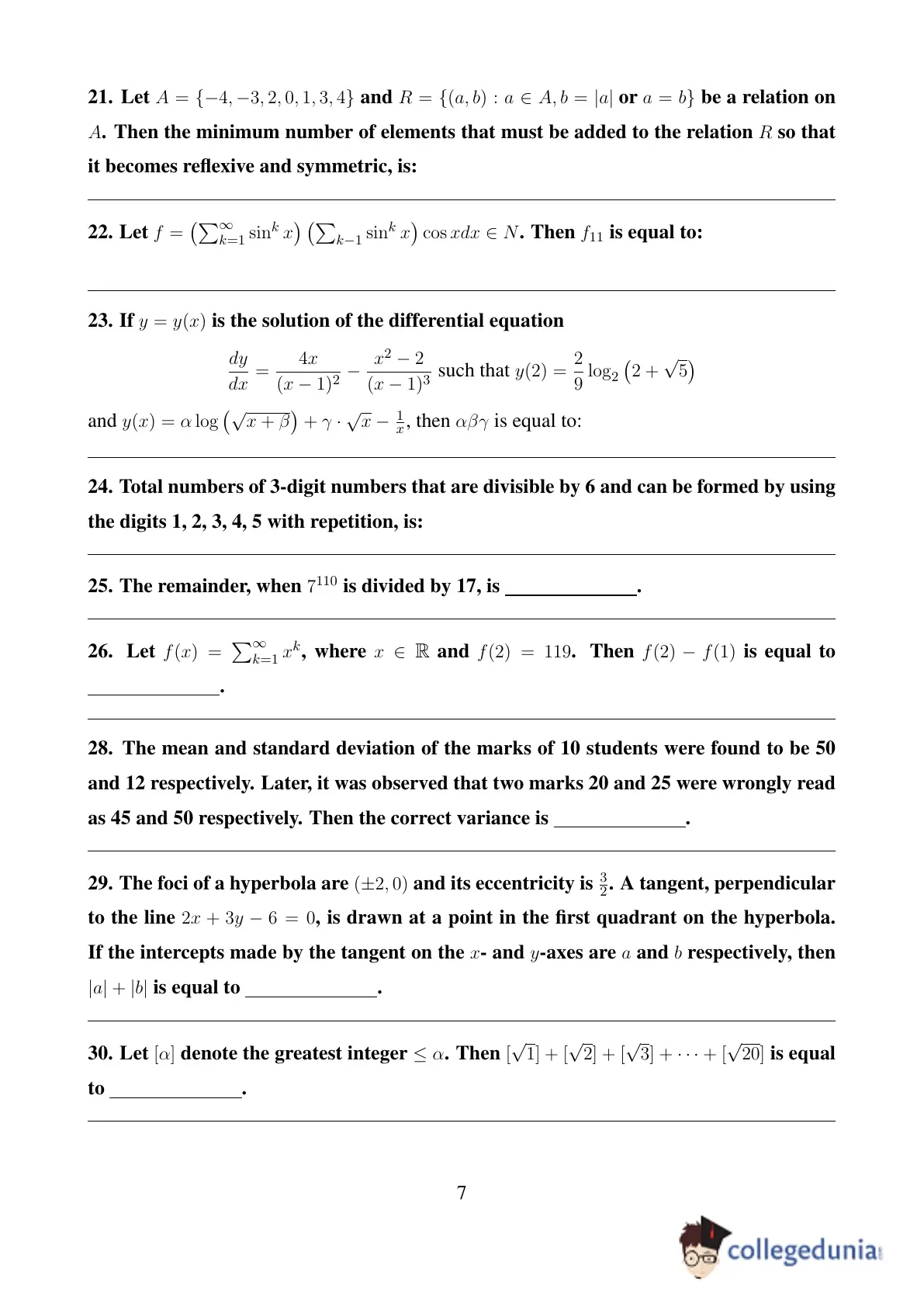
Let \( A = \{-4, -3, 2, 0, 1, 3, 4\} \) and \( R = \{(a, b) : a \in A, b = |a| or a = b\} \) be a relation on \( A \). Then the minimum number of elements that must be added to the relation \( R \) so that it becomes reflexive and symmetric, is:
View Solution
We are given a relation \( R = \{(a, b): a \in A, b = |a| or a = b\} \) on \( A \), where \( A = \{-4, -3, 2, 0, 1, 3, 4\} \).
The relation is initially defined as follows:
\[ R = \{(-4, -4), (-3, 3), (3, -3), (2, 2), (0, 0), (1, 1), (4, 4)\} \]
For \( R \) to be reflexive, we need to ensure that every element in \( A \) is related to itself. The elements \( -4, 3, 1 \) are already related to themselves, so we need to add the following pairs to make the relation reflexive: \[ \{(-3, -3), (2, 2), (0, 0)\} \]
Next, for \( R \) to be symmetric, if \( (a, b) \) is in \( R \), then \( (b, a) \) must also be in \( R \). The pairs that are not symmetric are \( (-4, 3) \) and \( (3, -4) \), so we need to add the pair \( (-3, -3) \).
The total number of pairs added to make the relation reflexive and symmetric is \( 7 \). Quick Tip: For a relation to be reflexive, each element in the set should be related to itself. For a relation to be symmetric, if an element is related to another, the reverse must also hold.
Let \( f = \left( \sum_{k=1}^{\infty} \sin^k x \right) \left( \sum_{k-1} \sin^k x \right) \cos x dx \in N \). Then \( f_{11} \) is equal to:
View Solution
If \( y = y(x) \) is the solution of the differential equation \[ \frac{dy}{dx} = \frac{4x}{(x - 1)^{2}} - \frac{x^2 - 2}{(x - 1)^{3}} such that y(2) = \frac{2}{9} \log_2 \left( 2 + \sqrt{5} \right) \]
and \( y(x) = \alpha \log \left( \sqrt{x + \beta} \right) + \gamma \cdot \sqrt{x} - \frac{1}{x} \), then \( \alpha \beta \gamma \) is equal to:
View Solution
Total numbers of 3-digit numbers that are divisible by 6 and can be formed by using the digits 1, 2, 3, 4, 5 with repetition, is:
View Solution
The remainder, when \(7^{110}\) is divided by 17, is \underline{\hspace{3cm.
View Solution
Let \( f(x) = \sum_{k=1}^{\infty} x^k \), where \( x \in \mathbb{R} \) and \( f(2) = 119 \). Then \( f(2) - f(1) \) is equal to _______________.
View Solution
N/A
For \( x \in (-1, 1) \), the number of solutions of the equation \( \sin x = 2 \tan x \) is equal to_______________.
View Solution
The mean and standard deviation of the marks of 10 students were found to be 50 and 12 respectively. Later, it was observed that two marks 20 and 25 were wrongly read as 45 and 50 respectively. Then the correct variance is \hspace{3cm}.
View Solution
The foci of a hyperbola are \( (\pm 2, 0) \) and its eccentricity is \( \frac{3}{2} \). A tangent, perpendicular to the line \( 2x + 3y - 6 = 0 \), is drawn at a point in the first quadrant on the hyperbola. If the intercepts made by the tangent on the \( x \)- and \( y \)-axes are \( a \) and \( b \) respectively, then \( |a| + |b| \) is equal to \underline{\hspace{3cm.
View Solution
Let \( [\alpha] \) denote the greatest integer \( \leq \alpha \). Then \( [\sqrt{1}] + [\sqrt{2}] + [\sqrt{3}] + \dots + [\sqrt{20}] \) is equal to \underline{\hspace{3cm.
View Solution
Physics
Section – A
Question 31:
Given below are two statements:
Statement I: An AC circuit undergoes electrical resonance if it contains either a capacitor or an inductor.
Statement II: An AC circuit containing a pure capacitor or a pure inductor consumes high power due to its non-zero power factor.
View Solution
A passenger sitting in a train A moving at 90 km/h observes another train B moving in the opposite direction for 8 s. If the velocity of the train B is 54 km/h, then the length of train B is:
View Solution
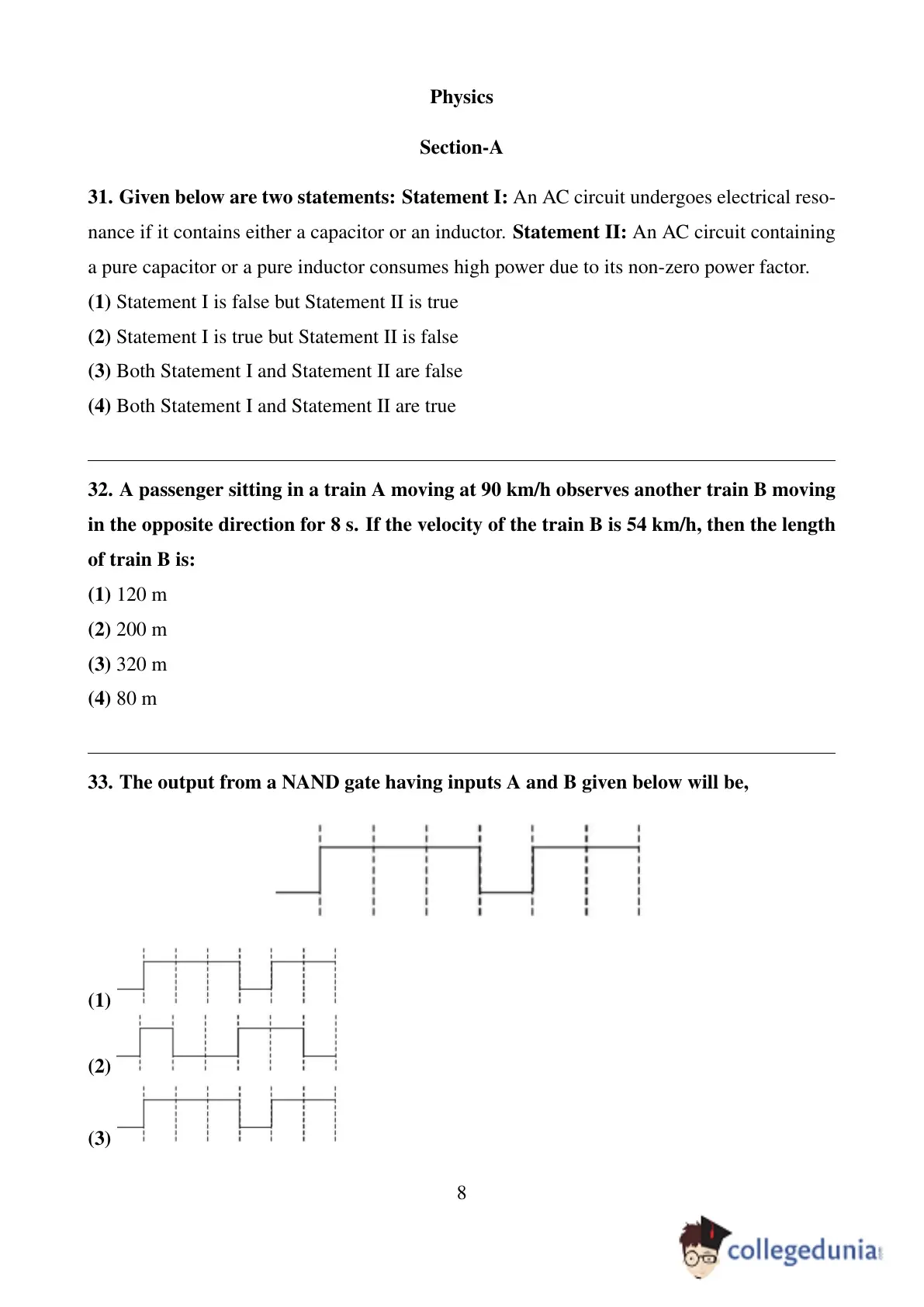
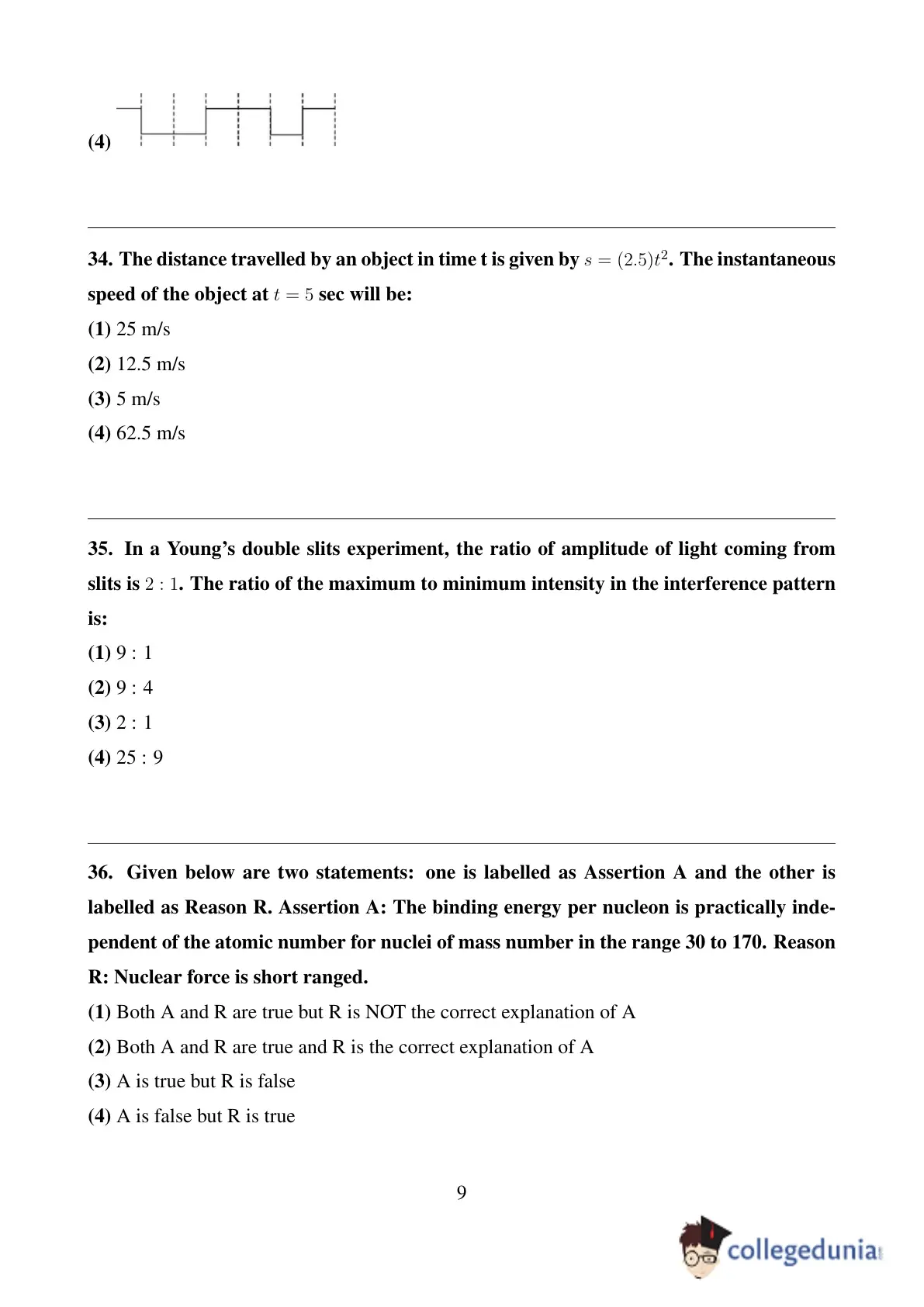
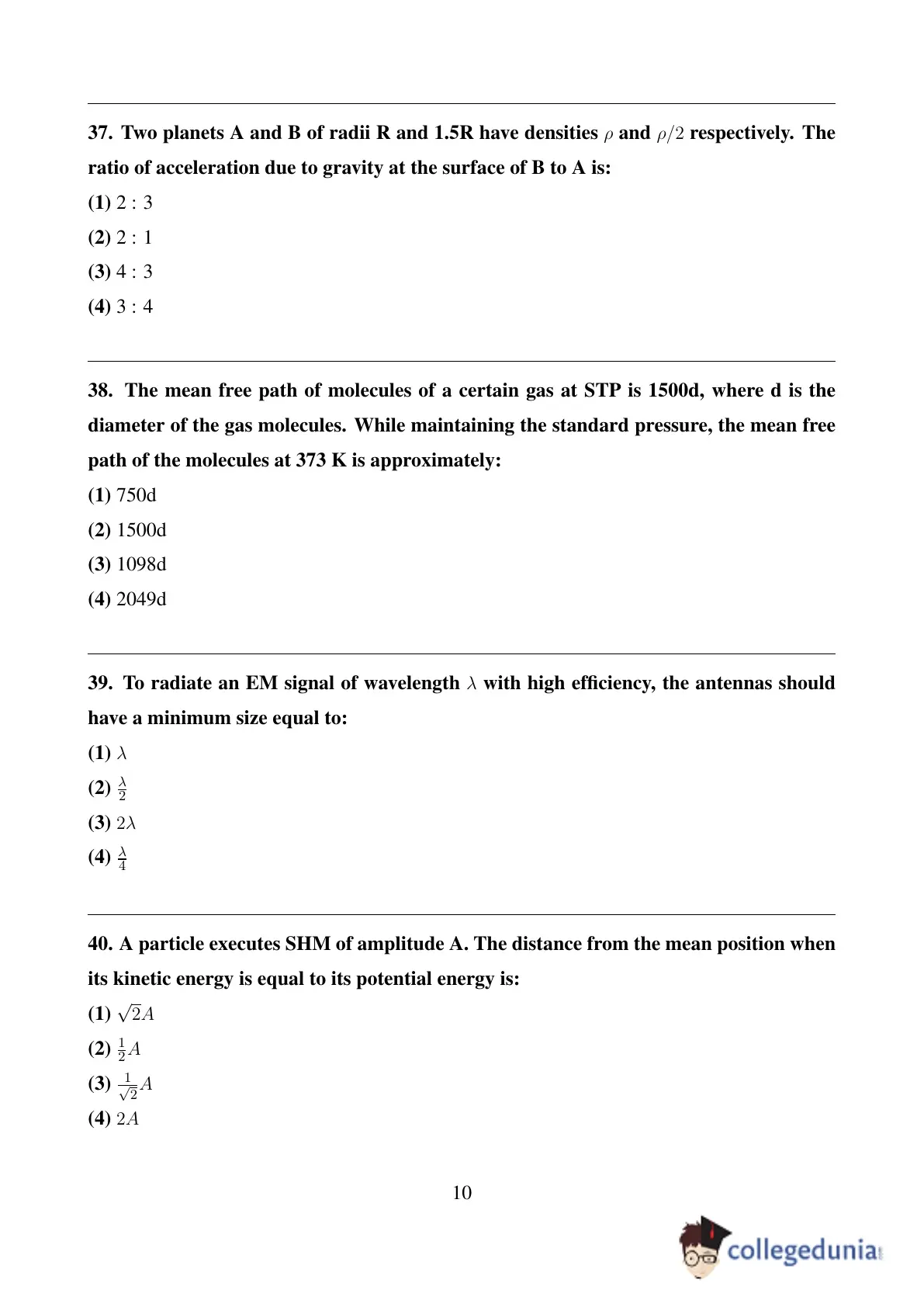
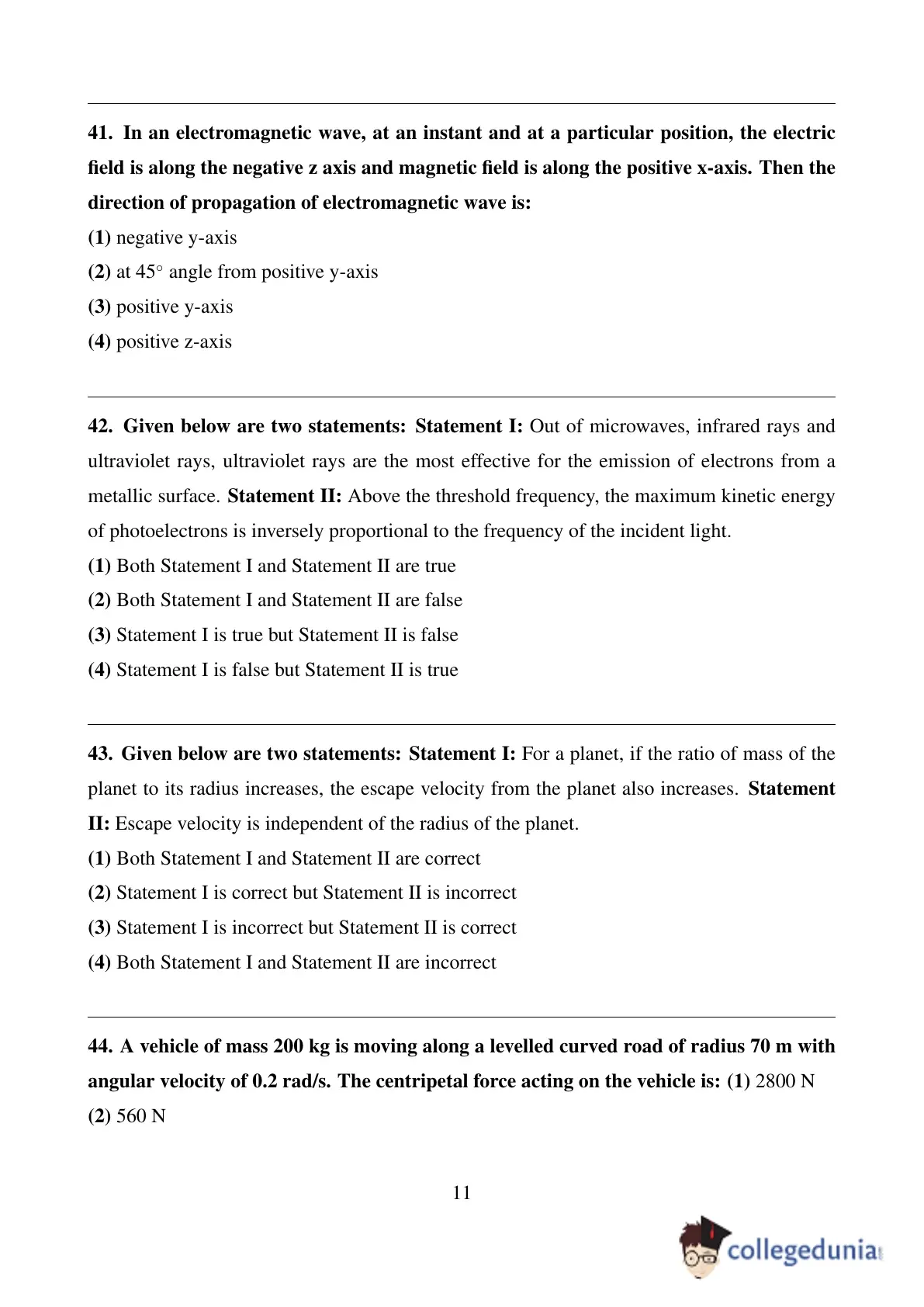
The output from a NAND gate having inputs A and B given below will be,

- (1)
![]()
- (2)
![]()
- (3)
![]()
- (4)
![]()


View Solution
The distance travelled by an object in time t is given by \( s = (2.5)t^2 \). The instantaneous speed of the object at \( t = 5 \) sec will be:
View Solution
The distance travelled is given by \( s = 2.5t^2 \).
The speed \( v \) is the rate of change of distance with respect to time, which can be found by differentiating the distance equation with respect to time:
\[ v = \frac{ds}{dt} = 5t \]
At \( t = 5 \) sec,
\[ v = 5 \times 5 = 25 \, m/s \]
Thus, the instantaneous speed at \( t = 5 \) sec is 25 m/s. Quick Tip: Remember, instantaneous speed is the first derivative of the position function with respect to time.
In a Young's double slits experiment, the ratio of amplitude of light coming from slits is \( 2 : 1 \). The ratio of the maximum to minimum intensity in the interference pattern is:
View Solution
Given below are two statements: one is labelled as Assertion A and the other is labelled as Reason R.
Assertion A: The binding energy per nucleon is practically independent of the atomic number for nuclei of mass number in the range 30 to 170.
Reason R: Nuclear force is short ranged.
View Solution
Two planets A and B of radii R and 1.5R have densities \( \rho \) and \( \rho/2 \) respectively. The ratio of acceleration due to gravity at the surface of B to A is:
View Solution
The mean free path of molecules of a certain gas at STP is 1500d, where d is the diameter of the gas molecules. While maintaining the standard pressure, the mean free path of the molecules at 373 K is approximately:
View Solution
To radiate an EM signal of wavelength \( \lambda \) with high efficiency, the antennas should have a minimum size equal to:
View Solution
To radiate EM signals efficiently, the minimum length of the antenna should be a quarter of the wavelength, i.e., \( \frac{\lambda}{4} \). Quick Tip: For efficient radiation, antennas are designed with dimensions related to the wavelength of the signal.
A particle executes SHM of amplitude A. The distance from the mean position when its kinetic energy is equal to its potential energy is:
View Solution
In an electromagnetic wave, at an instant and at a particular position, the electric field is along the negative z axis and magnetic field is along the positive x-axis. Then the direction of propagation of electromagnetic wave is:
View Solution
Given below are two statements:
Statement I: Out of microwaves, infrared rays and ultraviolet rays, ultraviolet rays are the most effective for the emission of electrons from a metallic surface.
Statement II: Above the threshold frequency, the maximum kinetic energy of photoelectrons is inversely proportional to the frequency of the incident light.
View Solution
Given below are two statements:
Statement I: For a planet, if the ratio of mass of the planet to its radius increases, the escape velocity from the planet also increases.
Statement II: Escape velocity is independent of the radius of the planet.
View Solution
A vehicle of mass 200 kg is moving along a levelled curved road of radius 70 m with angular velocity of 0.2 rad/s. The centripetal force acting on the vehicle is:
View Solution
A 10 \(\mu\)C charge is divided into two parts and placed at 1 cm distance so that the repulsive force between them is maximum. The charges of the two parts are:
View Solution
In the equation \( [ x + \frac{a}{y} ] [ Y - b ] = RT \), where \( X \) is pressure, \( Y \) is volume, \( R \) is universal gas constant and \( T \) is temperature. The physical quantity equivalent to the ratio \( \frac{a}{b} \) is:
View Solution
An electron is moving along the positive x-axis. If the uniform magnetic field is applied parallel to the negative z-axis, then
View Solution
Given below are two statements: one is labelled as Assertion A and the other is labelled as Reason R
Assertion A: A spherical body of radius \( (5 \pm 0.1) \) mm having a particular density is falling through a liquid of constant density. The percentage error in the calculation of its terminal velocity is 4%.
Reason R: The terminal velocity of the spherical body falling through the liquid is inversely proportional to its radius.
View Solution
The initial pressure and volume of an ideal gas are \(P_1\) and \(V_1\). The final pressure of the gas when the gas is suddenly compressed to volume \( \frac{V_1}{4} \) will be:
View Solution
In the network shown below, the charge accumulated in the capacitor in steady state will be:
View Solution
Section – B
Question 51:
In an experiment with sonometer when a mass of 180 g is attached to the string, it vibrates with fundamental frequency of 30 Hz. When a mass \(m\) is attached, the string vibrates with fundamental frequency of 50 Hz. The value of \(m\) is \underline{\hspace{3cm g
View Solution
Fundamental frequency \( f \) of a vibrating string is given by: \[ f = \frac{1}{2L} \sqrt{\frac{T}{\mu}} \]
Where \(L\) is the length, \(T\) is the tension, and \(\mu\) is the mass per unit length of the string.
For the first condition: \[ f_1 = 30 \, Hz, \quad m_1 = 180 \, g \] \[ f_2 = 50 \, Hz, \quad m_2 = m \, g \]
Using the formula for frequency and ratio of frequencies: \[ \frac{f_2}{f_1} = \sqrt{\frac{m_2}{m_1}} \] \[ \frac{50}{30} = \sqrt{\frac{m}{180}} \]
Squaring both sides and solving for \(m\), we get: \[ \frac{25}{9} = \frac{m}{180} \quad \Rightarrow \quad m = 25 \, g \] Quick Tip: Use the relationship between frequency and mass to solve for unknown masses in vibrating strings.
\textbf{Two plates A and B have thermal conductivities \(84 \, \text{W/m·K}\) and \(126 \, \text{W/m·K}\) respectively. They have the same surface area and same thickness. They are placed in contact along their surfaces. If the temperatures of the outer surfaces of A and B are kept at \(100^\circ \text{C}\) and \(0^\circ \text{C}\) respectively, then the temperature of the surface of contact in steady state is \underline{\hspace{3cm}} \(^\circ \text{C}\).}
View Solution
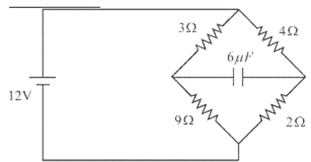
In the circuit shown below, the energy stored in the capacitor is \(3 \, \mu J\). The value of \(n\) is ______________.
View Solution
A light rope is wound around a hollow cylinder of mass \(5 \, kg\) and radius \(70 \, cm\). The rope is pulled with a force of \(52.5 \, N\). The angular acceleration of the cylinder will be \underline{\hspace{3cm rad/s\(^2\)
View Solution
A straight wire AB of mass \(40 \, g\) and length \(50 \, cm\) is suspended by a pair of flexible leads in uniform magnetic field of magnitude \(0.40 \, T\). The magnitude of the current required in the wire to remove the tension in the supporting leads is \underline{\hspace{3cm A. (Take \(g = 10 \, m/s^2\))
View Solution
An insulated copper wire of 100 turns is wrapped around a wooden cylindrical core of the cross-sectional area \(24 \, cm^2\). The two ends of the wire are connected to a resistor. The total resistance in the circuit is \(12 \, \Omega\). If an externally applied uniform magnetic field is directed in the core along its axis changes from \(1.5 \, T\) in the opposite direction to \(1.5 \, T\) in the same direction, the charge flowing through a point in the circuit during the change of magnetic field is _____________ mC.
View Solution
Question 57:
A bi convex lens of focal length 10 cm is cut in two identical parts along a plane perpendicular to the principal axis. The power of each lens after cut is _______ D.
View Solution
Solution: When a biconvex lens is cut into two identical parts along a plane perpendicular to the principal axis, each half behaves as a plano-convex lens. The focal length of each plano-convex lens will be twice the focal length of the original biconvex lens.
Given, focal length of biconvex lens, f = 10 cm
Focal length of each plano-convex lens, f' = 2f = 2 x 10 = 20 cm
Power of each lens after cut, P' = 1⁄f' (in meters)
P' = 1⁄0.2 = 5 D
Now, the actual power of the biconvex lens is P = 1⁄f = 1⁄0.1 = 10 D
Since, a biconvex lens cut perpendicularly to the principal axis yields two plano-convex lenses and the focal length gets doubled in each case, hence, the power gets halved. Therefore, the power of each lens after cut is 10 D.
Quick Tip: When a lens is cut perpendicular to the principal axis, the focal length doubles, and the power becomes half.
Three point charges \(q = -2q\) and \(2q\) are placed on x-axis at a distance \(x = 0\), \(x = \frac{2}{3} R\) and \(x = R\) respectively from origin as shown. If \(q = 2 \times 10^{-4} \, C\) and \(R = 2 \, cm\), the magnitude of net force experienced by the charge \(-2q\) is \underline{\hspace{3cm N.
View Solution
An atom absorbs a photon of wavelength \(500 \, nm\) and emits another photon of wavelength \(600 \, nm\). The net energy absorbed by the atom in this process is \(3 \times 10^{-4}\) eV. The value of \(h\) is \underline{\hspace{3cm.
View Solution
A car accelerates from rest to \(2 \, m/s\). The energy spent in this process is \(E_1\). The energy required to accelerate the car from \(1 \, m/s\) to \(2 \, m/s\) is \(E_2\). The value of \(E_1\) is \underline{\hspace{3cm.
View Solution
Chemistry
Section – A
Question 61:
Which of the following are the Green house gases ?
(A) Water vapour
(B) Ozone
(C) I2
(D) Molecular hydrogen
Choose the most appropriate answer from the options given below :
View Solution
Green house gases are \( CO_2, CH_4, \) water vapour, nitrous oxide, CFCs, and ozone.
Therefore, the correct answer is A and B only. Quick Tip: Greenhouse gases contribute to the greenhouse effect by trapping heat in the Earth's atmosphere.
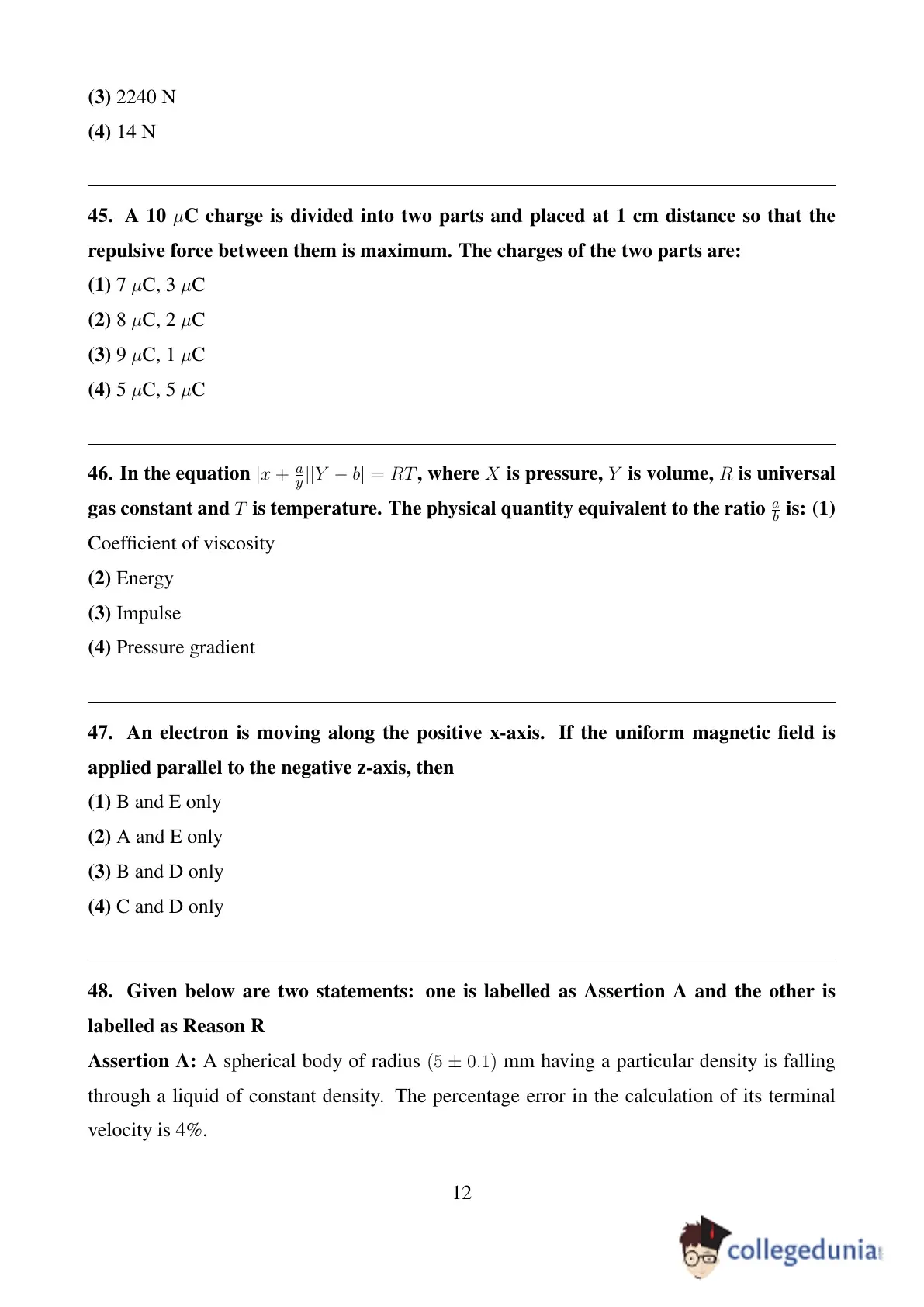
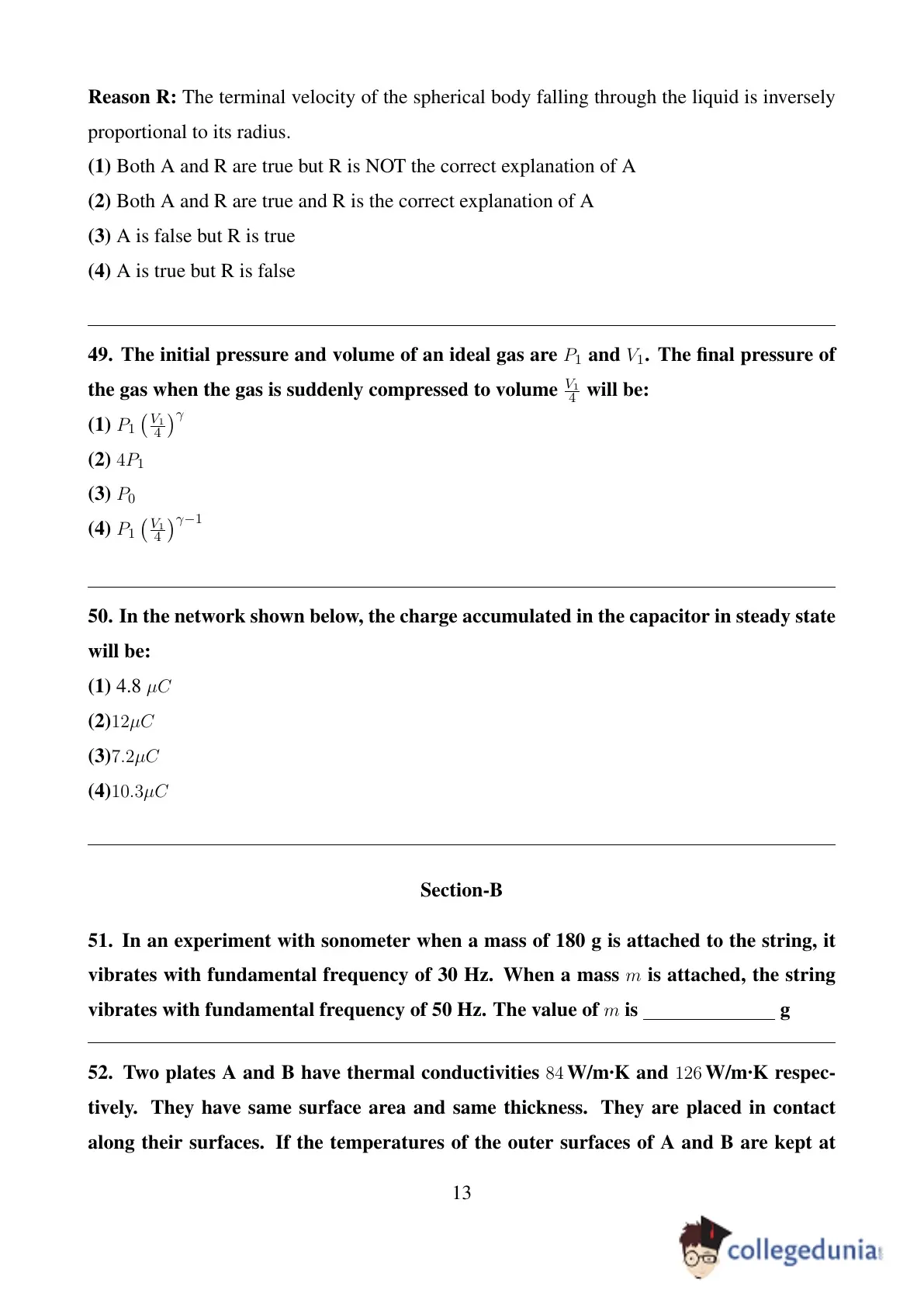
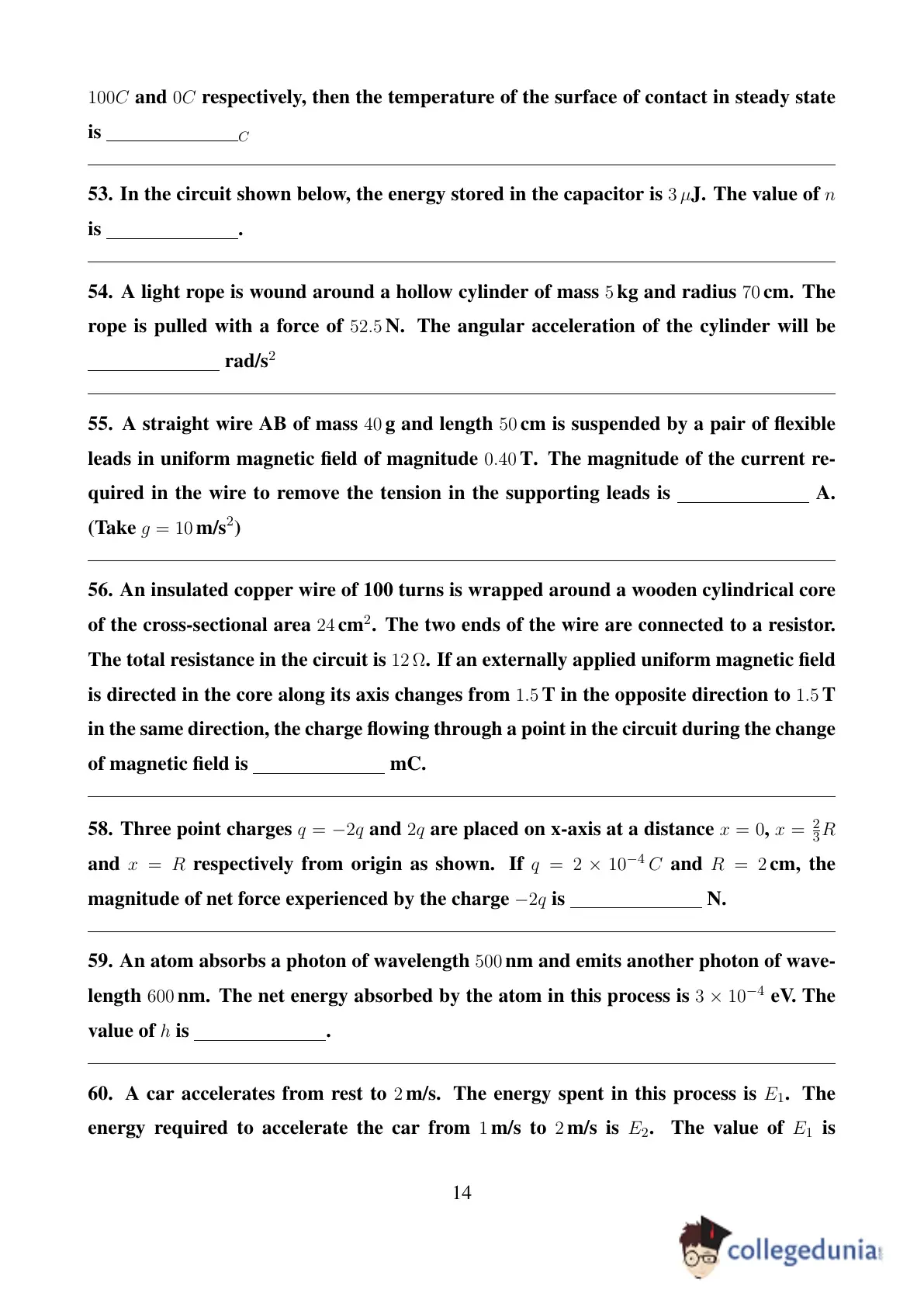
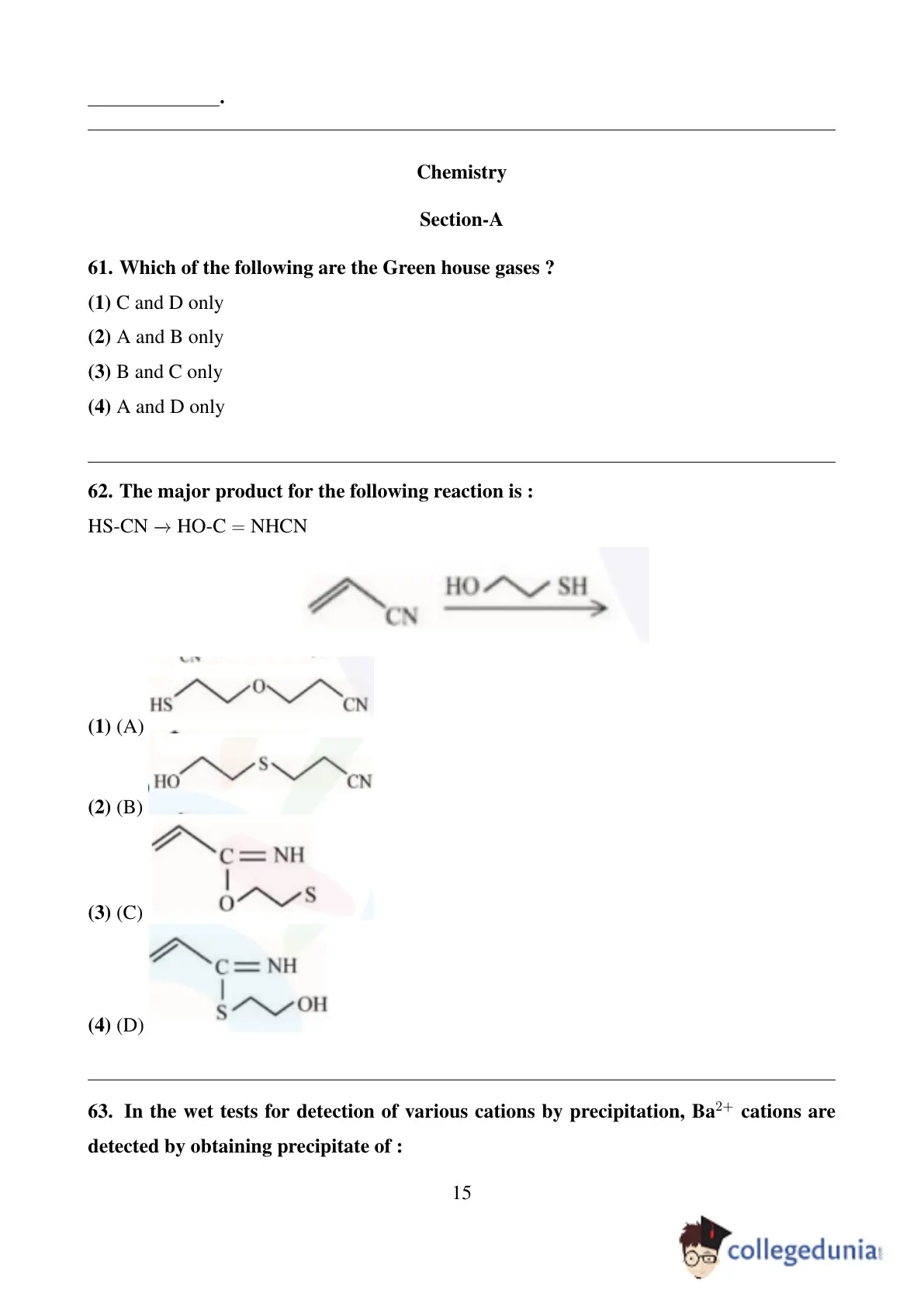
The major product for the following reaction is :
\(HS-CN \xrightarrow{} HO-C = NH CN \)

- (1) (A)
![]()
- (2) (B)
![]()
- (3) (C)
![]()
- (4) (D)
![]()


In the wet tests for detection of various cations by precipitation, Ba\(^{2+}\) cations are detected by obtaining precipitate of :
View Solution
In wet testing, \((NH_4)_2CO_3\) is used as a group reagent for detecting 5th group cations such as \( Ba^{2+}, Ca^{2+}, Sr^{2+} \). The precipitation of barium carbonate, BaCO\(_3\), is used to confirm the presence of \( Ba^{2+} \).
The reaction is: \[ Ba^{2+} + (NH_4)_2CO_3 \rightarrow BaCO_3 \downarrow + NH_4^+ \] Quick Tip: Barium carbonate forms a white precipitate when \( Ba^{2+} \) reacts with \( (NH_4)_2CO_3 \) in water.
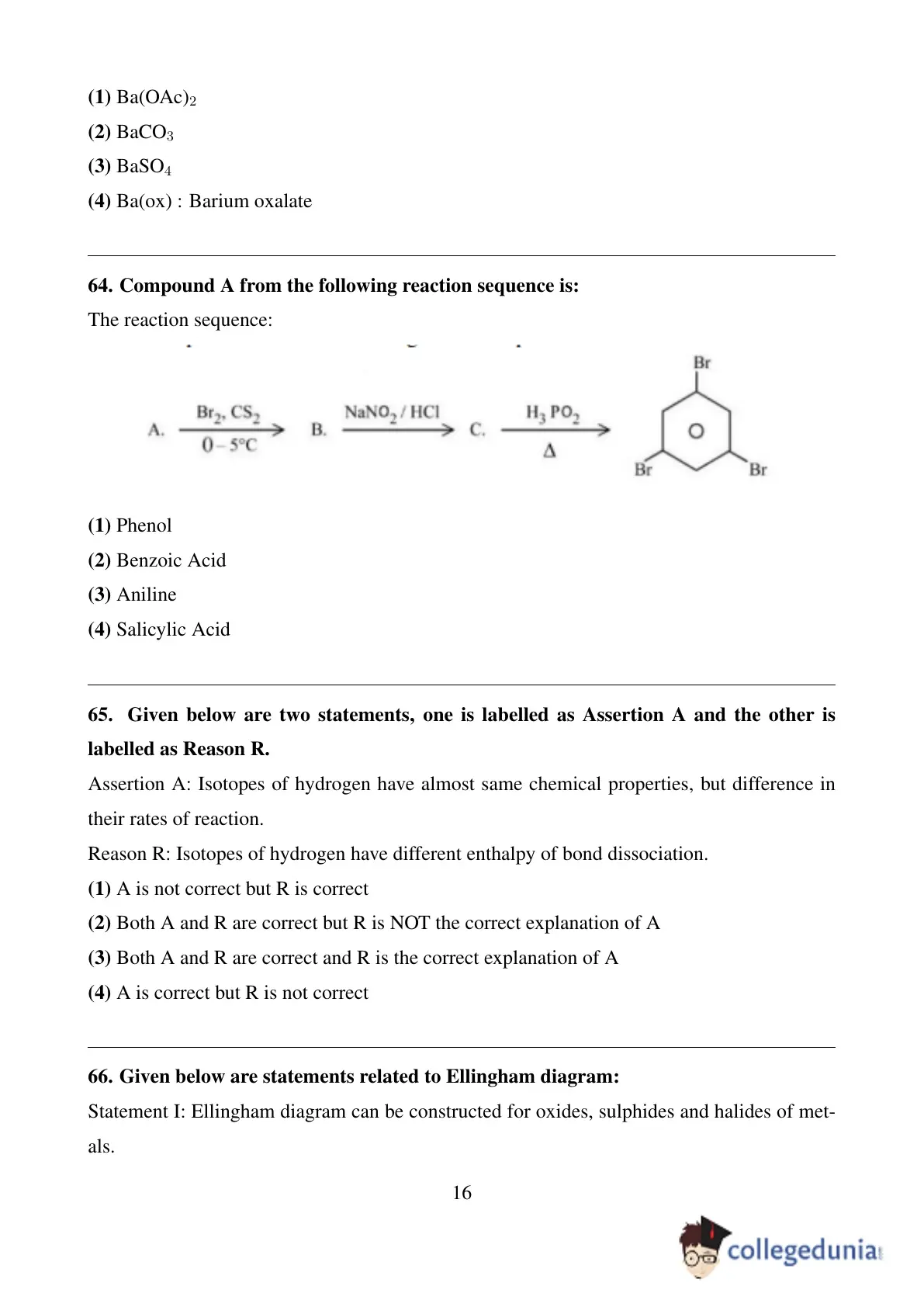
Compound A from the following reaction sequence is:
The reaction sequence:

View Solution
Given below are two statements, one is labelled as Assertion A and the other is labelled as Reason R.
Assertion A: Isotopes of hydrogen have almost same chemical properties, but difference in their rates of reaction.
Reason R: Isotopes of hydrogen have different enthalpy of bond dissociation.
View Solution
Given below are statements related to Ellingham diagram:
Statement I: Ellingham diagram can be constructed for oxides, sulphides and halides of metals.
Statement II: It consists of plots of \( \Delta H_f^\circ \) vs formation of oxides of elements.
View Solution
Better method for preparation of \(BeF_2\), among the following is:
View Solution
Identify the correct order of standard enthalpy of formation of sodium halides.
View Solution
Which of the following complexes will exhibit maximum attraction to an applied magnetic field?
View Solution
The correct group of halide ions which can be oxidized by oxygen in acidic medium is
View Solution
The total number of stereoisomers for the complex [Cr(ox)\(_3\)]\(^{3+}\) (where ox = oxalate) is:
View Solution
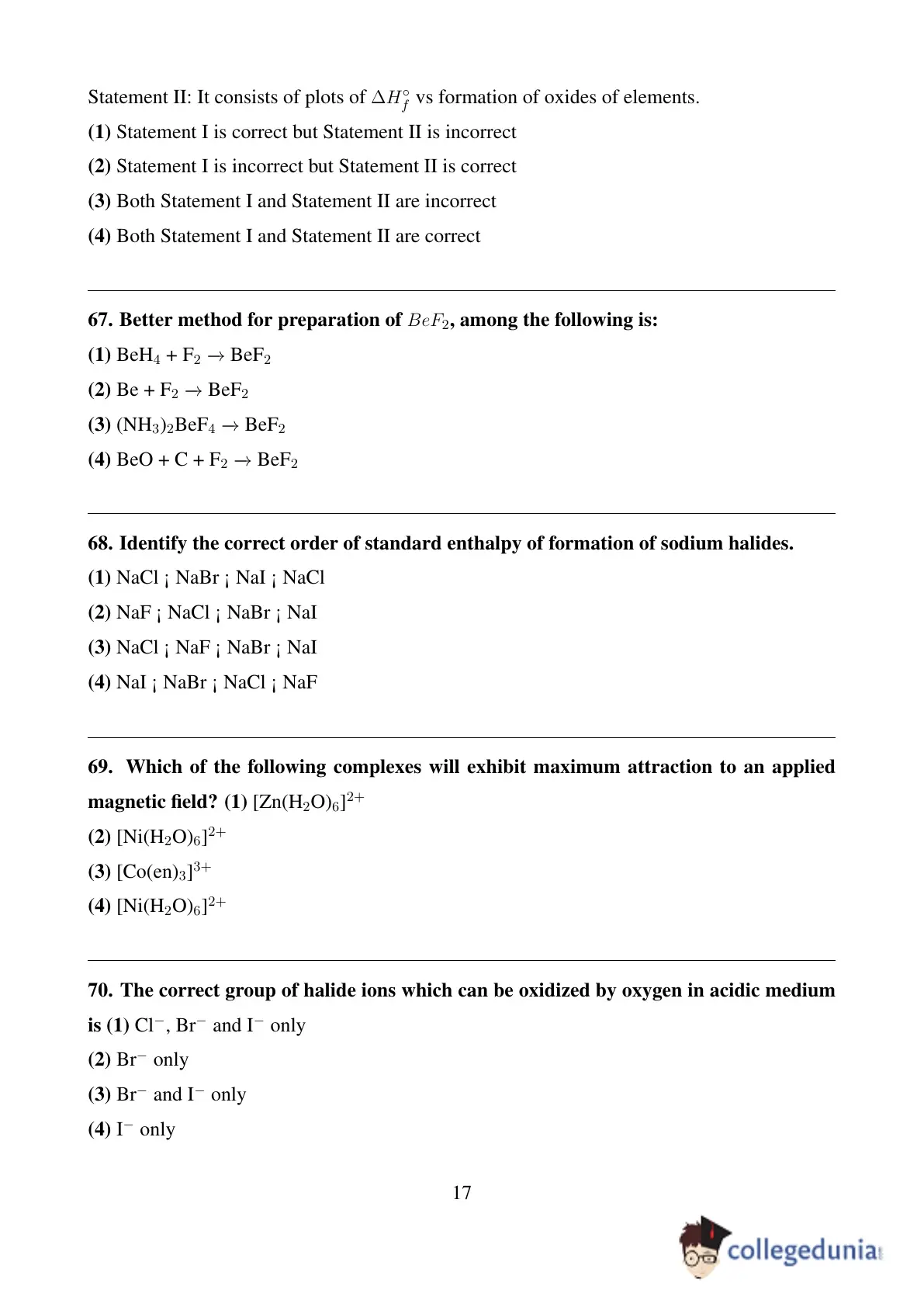
Match List I with List II
I - Bromo propene is reacted with reagents in List I to give product in List II.
LIST I LIST II
Reagent Product
View Solution
The covalency and oxidation state respectively of boron in [BF\(_3\)] are:
View Solution
What happens when methane undergoes combustion in systems A and B respectively?
View Solution
The naturally occurring amino acid that contains only one basic functional group in its chemical structure is:
View Solution
Given below are two statements:
Statement I: SO\(_2\) and H\(_2\)O both possess V-shaped structure.
Statement II: The bond angle of SO\(_2\) is less than that of H\(_2\)O
View Solution
Given below are two statements, one is labelled as Assertion A and the other is labelled as Reason R.
Assertion A: The diameter of colloidal particles in solution should not be much smaller than wavelength of light to show Tyndall effect.
Reason R: The light scatters in all direction when the size of particles is large enough.
View Solution
Match List I with List II
List I List II
(A) Weak intermolecular forces of attraction (I) Hexamethylenediamine + adipic acid
(B) Hydrogen bonding (II) AlEt\(_3\) + TiCl\(_4\)
(C) Heavily branched polymer (III) 2-chloro-1, 3-butadiene
(D) High density polymer (IV) Phenol + formaldehyde
Choose the correct answer from the options given below:
View Solution
Given below are two statements:
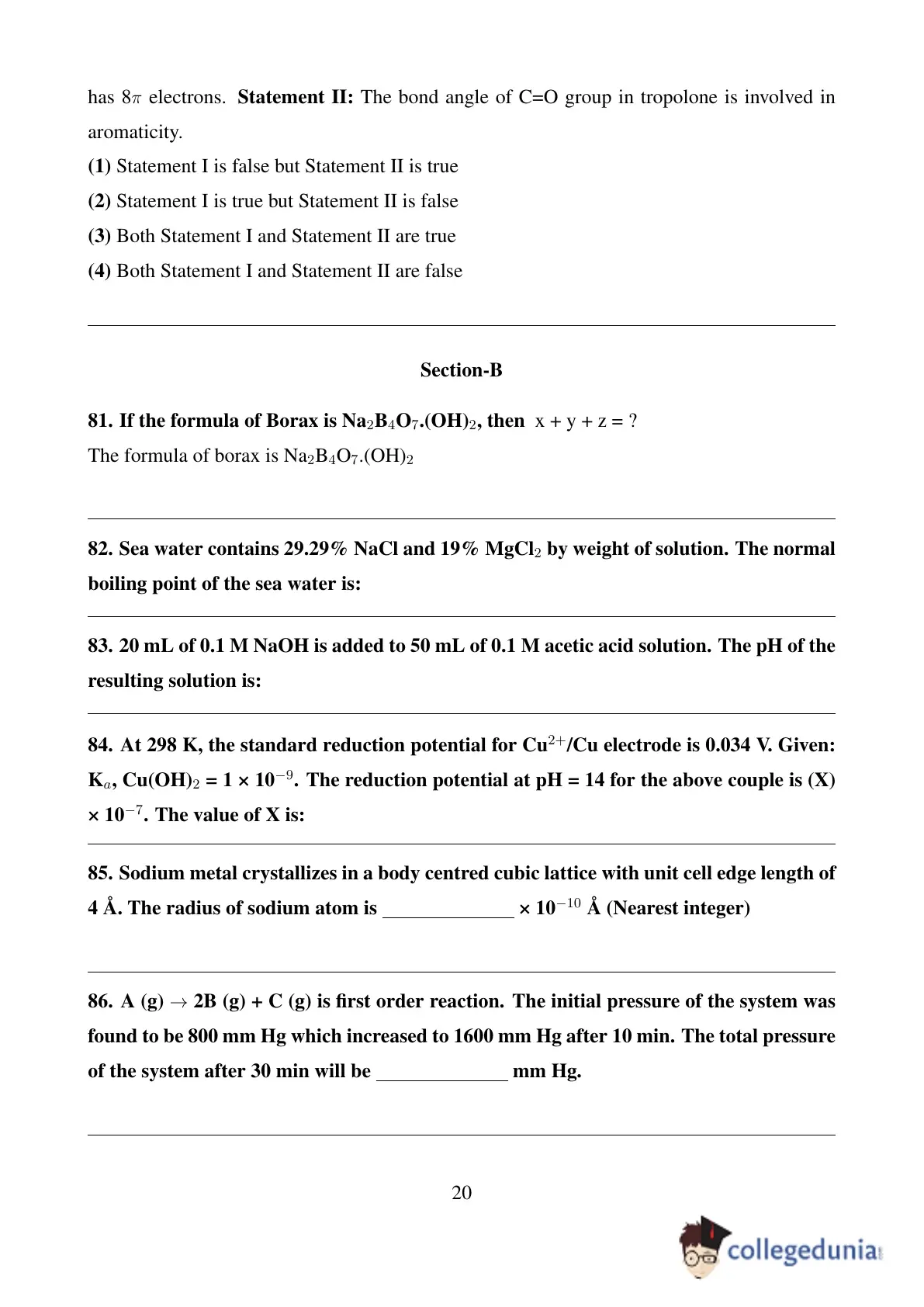
Statement I: Tropolone is an aromatic compound and has 8\(\pi\) electrons.
Statement II: The bond angle of C=O group in tropolone is involved in aromaticity.
View Solution
Given below are two statements, one is labelled as Assertion A and the other is labelled as Reason R.
Assertion A: Order of acidic nature of the following compounds is A \(>\) B \(>\) C.

Reason R: Fluoro is a stronger electron withdrawing group than Chloro group.
In the light of the above statements, choose the correct answer from the options given below:
View Solution
Section – B
Question 81:
If the formula of Borax is Na\(_2\)B\(_4\)O\(_7\).(OH)\(_2\), then x + y + z = ?
The formula of borax is Na\(_2\)B\(_4\)O\(_7\).(OH)\(_2\)
View Solution
Borax has the following formula: Na\(_2\)B\(_4\)O\(_7\).(OH)\(_2\)
This formula contains:
- 2 sodium atoms (Na)
- 4 boron atoms (B)
- 7 oxygen atoms (O)
- 2 hydroxyl groups (OH).
Thus, adding these values gives: \[ 2 + 4 + 7 + 2 = 17 \]
Therefore, \( x + y + z = 17 \). Quick Tip: Ensure you correctly count all atoms and functional groups in molecular formulas for accurate results.
Question 82:
Sea water contains 29.29% NaCl and 19% MgCl\(_2\) by weight of solution. The normal boiling point of the sea water is:
20 mL of 0.1 M NaOH is added to 50 mL of 0.1 M acetic acid solution. The pH of the resulting solution is:
At 298 K, the standard reduction potential for Cu\(^{2+}\)/Cu electrode is 0.034 V. Given: K\(_a\), Cu(OH)\(_2\) = 1 × 10\(^{-9}\). The reduction potential at pH = 14 for the above couple is (X) × 10\(^{-7}\). The value of X is:
Sodium metal crystallizes in a body centred cubic lattice with unit cell edge length of 4 Å. The radius of sodium atom is \hspace{3cm} × 10\(^{-10}\) Å (Nearest integer)
A (g) \(\rightarrow\) 2B (g) + C (g) is first order reaction. The initial pressure of the system was found to be 800 mm Hg which increased to 1600 mm Hg after 10 min. The total pressure of the system after 30 min will be \underline{\hspace{3cm mm Hg.
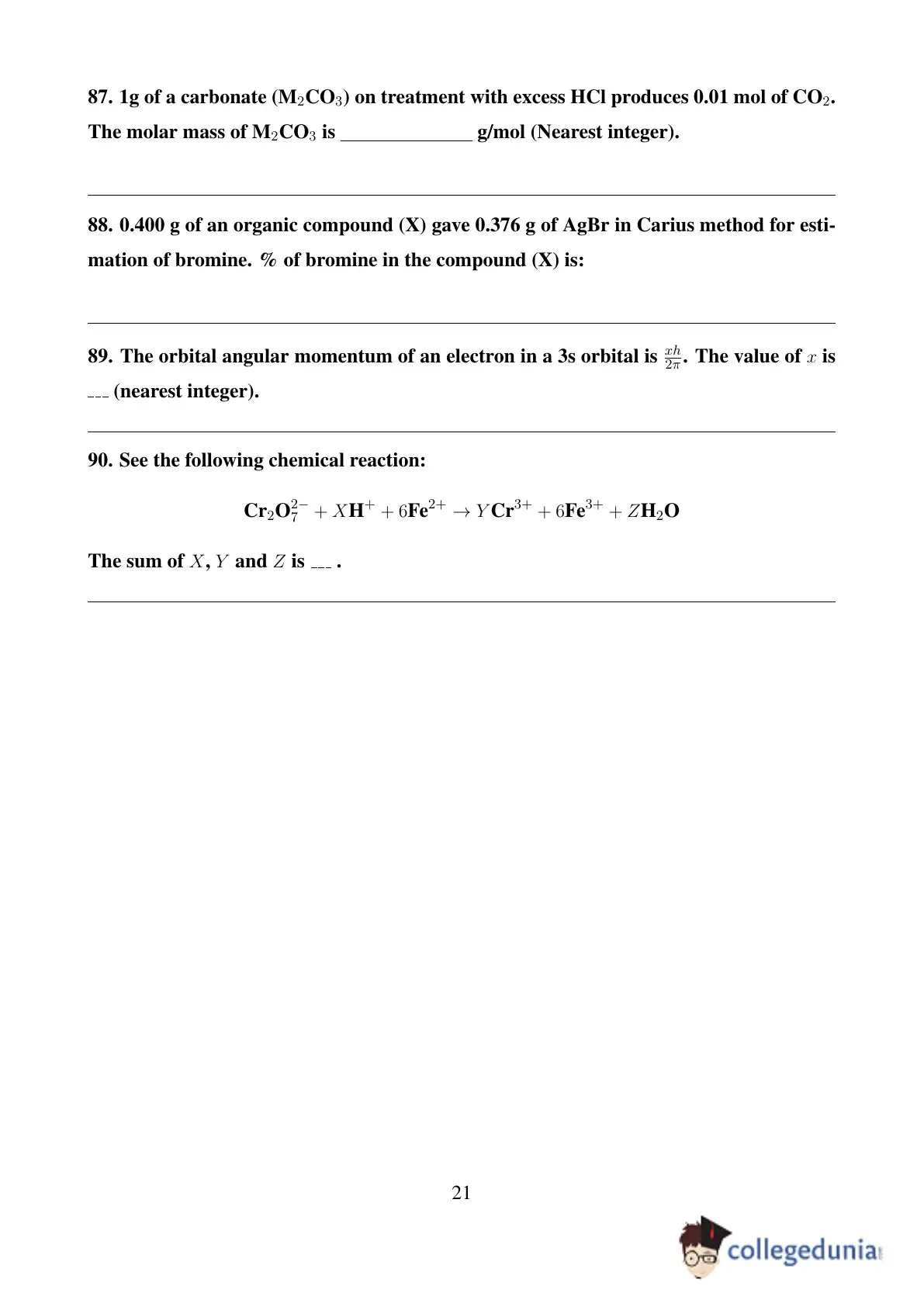
1g of a carbonate (M\(_2\)CO\(_3\)) on treatment with excess HCl produces 0.01 mol of CO\(_2\). The molar mass of M\(_2\)CO\(_3\) is \underline{\hspace{3cm g/mol (Nearest integer).
0.400 g of an organic compound (X) gave 0.376 g of AgBr in Carius method for estimation of bromine. % of bromine in the compound (X) is:
The orbital angular momentum of an electron in a 3s orbital is \( \frac{x h}{2\pi} \). The value of \( x \) is ___ (nearest integer).
View Solution
See the following chemical reaction: \[ Cr_2O_7^{2-} + XH^+ + 6Fe^{2+} \rightarrow YCr^{3+} + 6Fe^{3+} + ZH_2O \]
The sum of \( X \), \( Y \) and \( Z \) is ___ .
View Solution
First, balance the chemical equation: \[ Cr_2O_7^{2-} + 14H^+ + 6Fe^{2+} \rightarrow 2Cr^{3+} + 6Fe^{3+} + 7H_2O \]
From the balanced equation, we can identify the coefficients: \[ X = 14, \quad Y = 2, \quad Z = 7 \]
The sum of \( X \), \( Y \), and \( Z \) is: \[ X + Y + Z = 14 + 2 + 7 = 23 \] Quick Tip: When balancing redox reactions, first balance the elements other than oxygen and hydrogen, then balance oxygen by adding water molecules, and finally balance hydrogen by adding H+ ions. Then, balance the charges by adding electrons.
Also Check:
JEE Main 13 April 2023 Shift 2 Question Paper with Answer Key: Coaching Institute PDF
| Coaching Institutes | Question Paper with Answer Key PDF |
|---|---|
| Aakash BYJUs | Check Here |
| Vedantu | Check Here |
JEE Main 2023 Paper Analysis April 13 Shift 2
JEE Main 2023 Paper Analysis for the exam conducted on April 13 Shift 2 is available here. Candidates can check subject-wise paper analysis for the exam conducted on April 13 Shift 2 here along with the topics with the highest weightage.
Also Check:
JEE Main 2023 Question Paper Session 2 (April)
JEE Main 2023 Question Paper Session 1 (January)
JEE Main Previous Year Question Paper
| JEE Main 2022 Question Paper | JEE Main 2021 Question Paper | JEE Main 2020 Question Paper |
| JEE Main 2019 Question Paper | JEE Main 2018 Question Paper | JEE Main 2017 Question Paper |



Comments