




JEE Main 2023 April 6 Shift 1 Question Paper is available here with answer key and solution pdf. NTA conducted the first shift on April 6, 2023, from 9:00 AM to 12:00 PM. The JEE Main 2023 Paper 1 (B.E./B.Tech) question paper includes the following:
- 90 questions in a 3-hour CBT Mode: 30 each from Mathematics, Physics and Chemistry (75 to be attempted)
- Section A: 20 multiple choice questions (MCQs) per subject, 4 marks each
- Section B: 10 numerical value questions per subject, attempt any 5, 4 marks each (integer answer)
- Marking: +4 for a correct answer, -1 for an incorrect answer, 0 for an unattempted question
JEE Main 2023 April 6 Shift 1 Question Paper with Solution PDF
| NTA Official PDF | CD PDF | CD PDF with Solutions |
|---|---|---|
| Download official PDF 4.87 MB | Download Collegedunia PDF 1.12 MB | Download solutions PDF 1.28 MB |
Also Check:
JEE Main 2023 April 6 Shift 1 Questions with Solutions
Mathematics - Section A (Q1 - Q20)
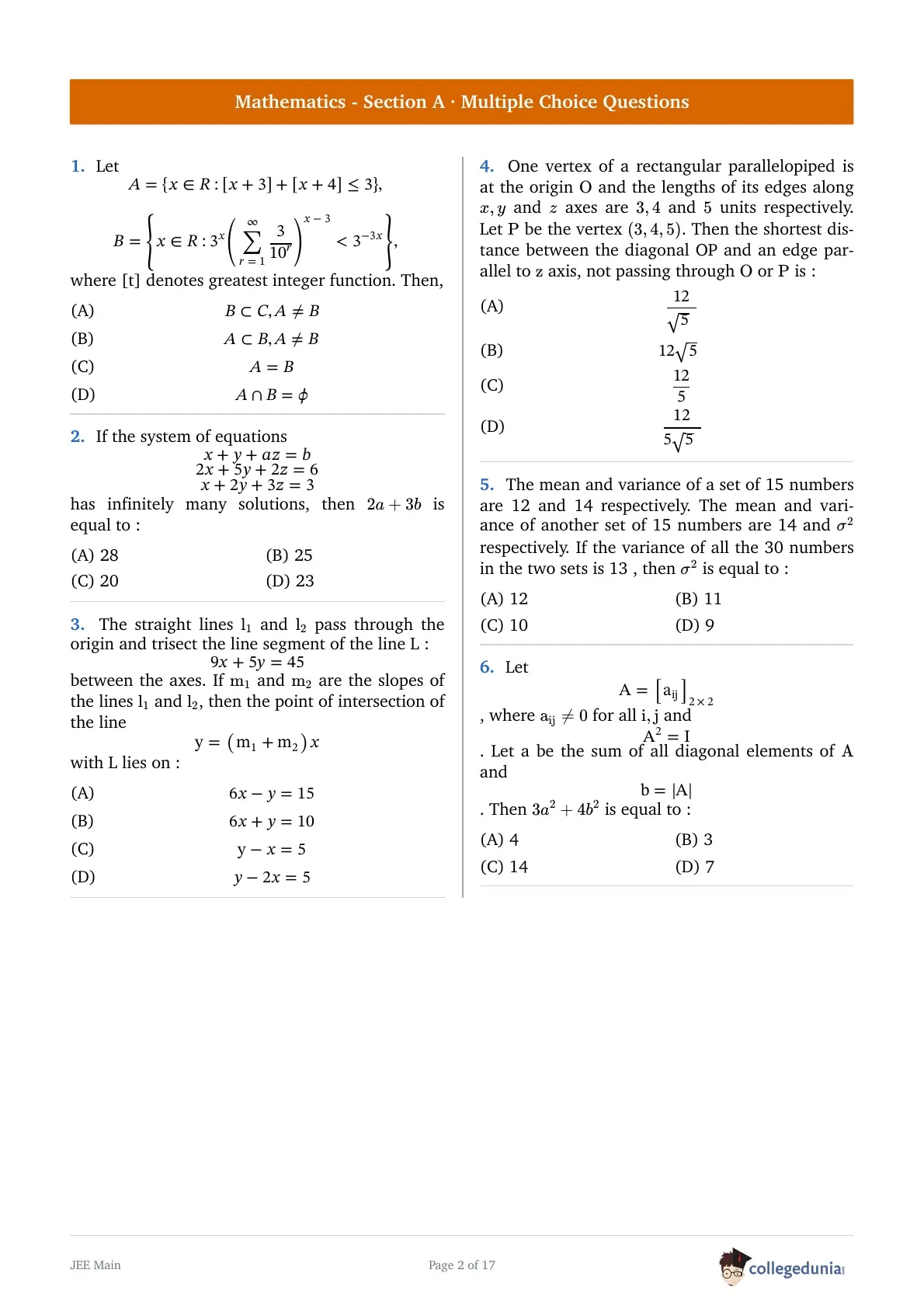
Let \(A = \{x \in \mathbb{R}: |x+3| + |x+4| \le 3\}\),} \[ B = \left\{ x \in \mathbb{R} : 3 \cdot \sum_{r=1}^{\infty} \frac{3^{x-3}}{10^r} < 3^{-3x} \right\}, \] where \([x]\) denotes the greatest integer function. Then,
If the system of equations
x + y + az = b
2x + 5y + 2z = 6
x + 2y + 3z = 3
Has infinitely many solutions, then 2a + 3b is equal to
The straight lines l1 and l2 pass through the origin and trisect the line segment of the line L: 9x + 5y = 45 between the axes. If m1 and m2 are the slopes of the lines l1 and l2, then the point of intersection of the line y = (m1 + m2)x with L lies on
One vertex of a rectangular parallelepiped is at the origin O and the lengths of its edges along x, y and z axes are 3, 4 and 5 units respectively. Let P be the vertex (3, 4, 5). Then the shortest distance between the diagonal OP and an edge parallel to z axis, not passing through O or P is :
Mean of first 15 numbers is 12 and variance is 14. Mean of next 15 numbers is 14 and variance is a. If variance of all 30 numbers is 13, then a is equal to
Let \(A=\) [\(a_{ij}\)]\(_{2\times2}\) be a matrix and \(A^2 = I\) where \(a_{ij} \neq0\). If a sum of diagonal elements and b=det(A), then \(3a^2+4b^2\) is
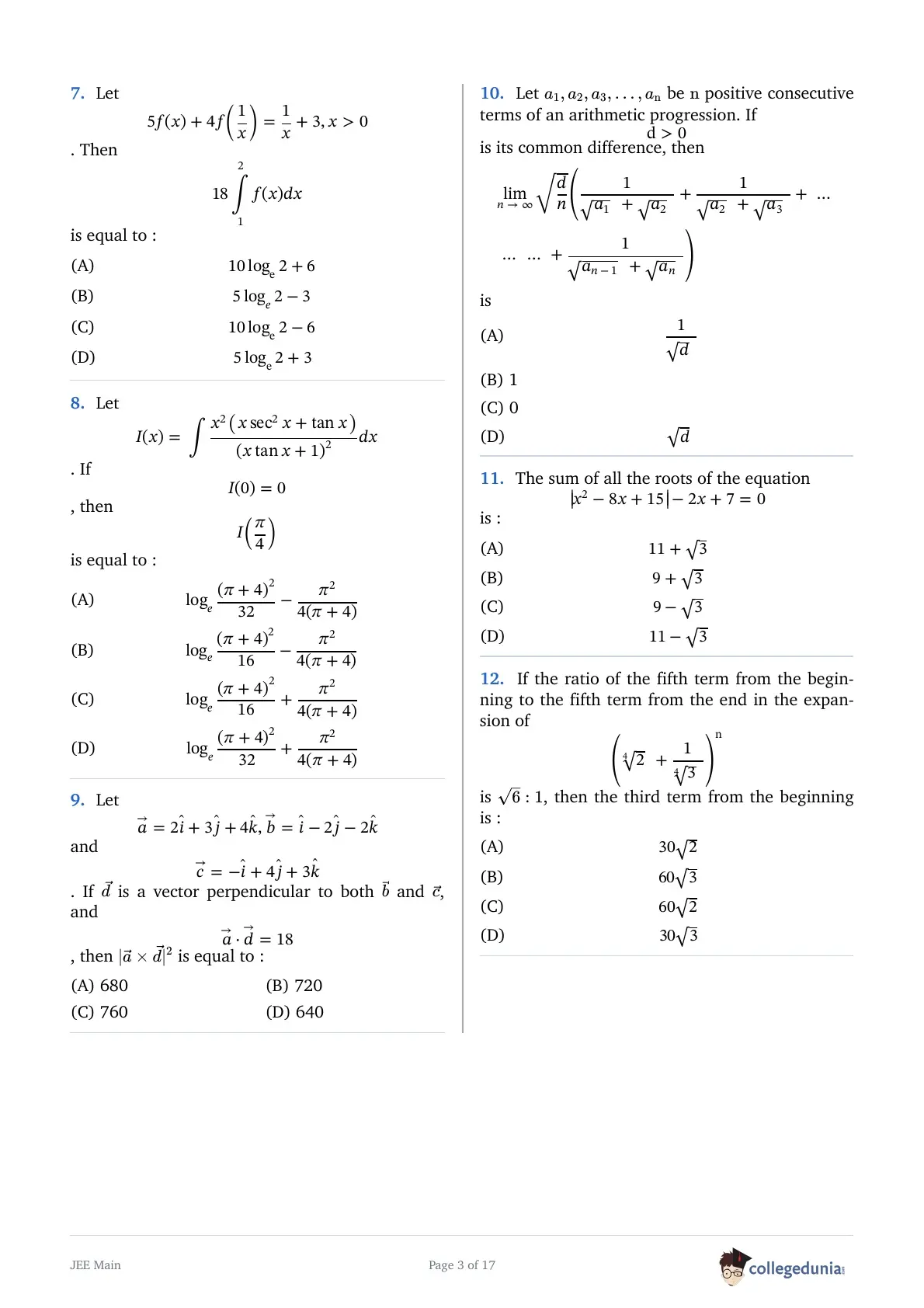
If 5f(x) + 4f (\(\frac{1}{x}\)) = \(\frac{1}{x}\)+ 3, then \(18\int_{1}^{2}\) f(x)dx is:
Let \(I(x) = \int \frac{x^2\left(x\sec^2 x + \tan x\right)}{(x\tan x + 1)^2}\,dx\). If \(I(0) = 0\), then \(I\left(\frac{\pi}{4}\right)\) is equal to :
Let \(\vec{a}\) = 2\(\widehat{i}\)+3\(\widehat{j}\)+4\(\widehat{k}\), \(\vec{b}\) = \(\widehat{i}\)-2\(\widehat{j}\)-2\(\widehat{k}\), \(\vec{c}\) = -\(\widehat{i}\)+4\(\widehat{j}\)+3\(\widehat{k}\) and \(\vec{d}\) is a vector perpendicular to \(\vec{b}\) and \(\vec{c}\), \(\vec{a}\).\(\vec{d}\) = 18, then find |\(\vec{a}\)x\(\vec{d}\)|2
If \(a_1,a_2,.......a_n\) are in arithmetic progression with common difference \(d>n\), then find limit \(\lim_{n \to \infty}\sqrt{\frac{d}{n}}(\frac{1}{\sqrt{a_1}+\sqrt{a_2}})+\frac{1}{\sqrt{a_2}+\sqrt{a_3}}+.......+\frac{1}{\sqrt{a_n}+\sqrt{a_{n-1}}})\) is____.
The sum of roots of |x2 - 8x + 15| - 2x + 7 = 0 is:
In the expansion of \((2^\frac{1}{4}+3^{-\frac{1}{4}})^n\), the ratio of \(5^{th}\) term from start and \(5^{th}\) term form end is \(\sqrt 6 : 1\) , then find \(3^{rd}\) term
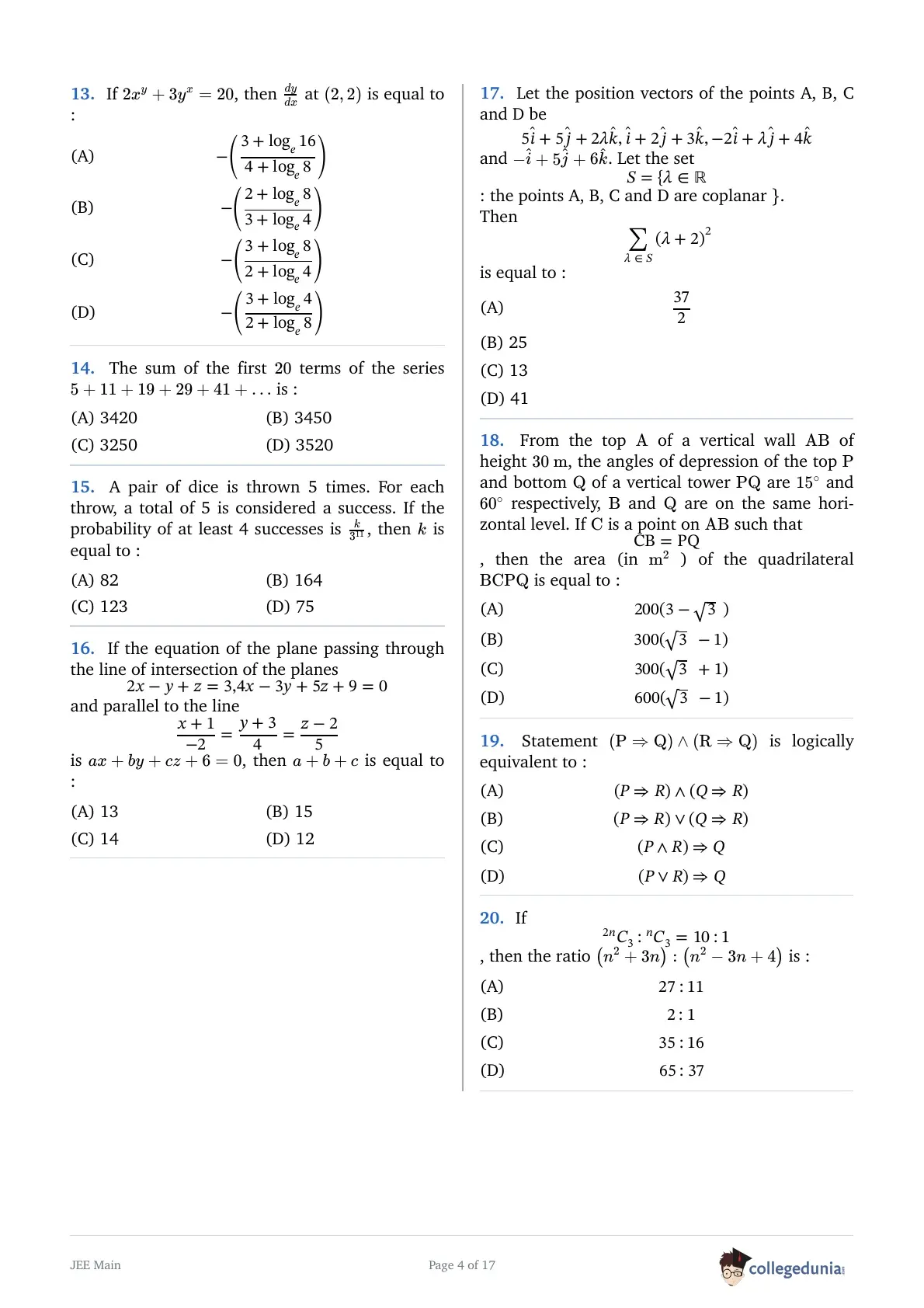
if \(2x^y+3y^x=20\) then \(\frac{dy}{dx}\) at (2,2) is equal to:
The sum of the first 20 terms of the series 5 + 11 + 19 + 29 + 41 + ... is
A pair of dice is rolled 5 times. let getting a total of 5 in a single throw is considered as success. If probability of getting atleast four success is \(\frac{x}{3}\) then x is equal to
If the equation of the plane passing through the line of intersection of the planes 2x – y + z = 3, 4x– 3y +5z + 9 = 0 and parallel to the line \(\frac{x+1}{−2} =\frac{ y+3}{4}= \frac{z−2}{5}\) is ax by+cz+6=0. then a + b + c is equal to
\(5\^{i}+5\hat{j}+2λ\hat{k},\hat{i}+2\hat{j}+3\hat{k},-2\hat{i}+λ\hat{j}+4\hat{k}\) and \(-\hat{i}+5\hat{j}+6\hat{k}.\) Let the set S = {λ∈ \(\mathbb{R}\) : The points A, B, C and D are coplanar}. Then \(\displaystyle\sum_{λ∈S}^{}(λ+2)^2\) is equal to
From the top A of a vertical wall AB of height 30 m, the angles of depression of the top P and bottom Q of a vertical tower PQ are 15\(^\circ\) and 60\(^\circ\) respectively. B and Q are on the same horizontal level. If C is a point on AB such that CB = 15 m, then the area (in m\(^2\)) of the quadrilateral BCPQ is equal to :
Statement (P \(\Rightarrow\) Q) \(\land\) (R \(\Rightarrow\) Q) is logically equivalent to :
If 2nC3 : nC3 = 10, then \(\frac{n^{2}+3n}{n^{2}-3n+4}\) is equal to
Mathematics - Section B (Q21 - Q30)
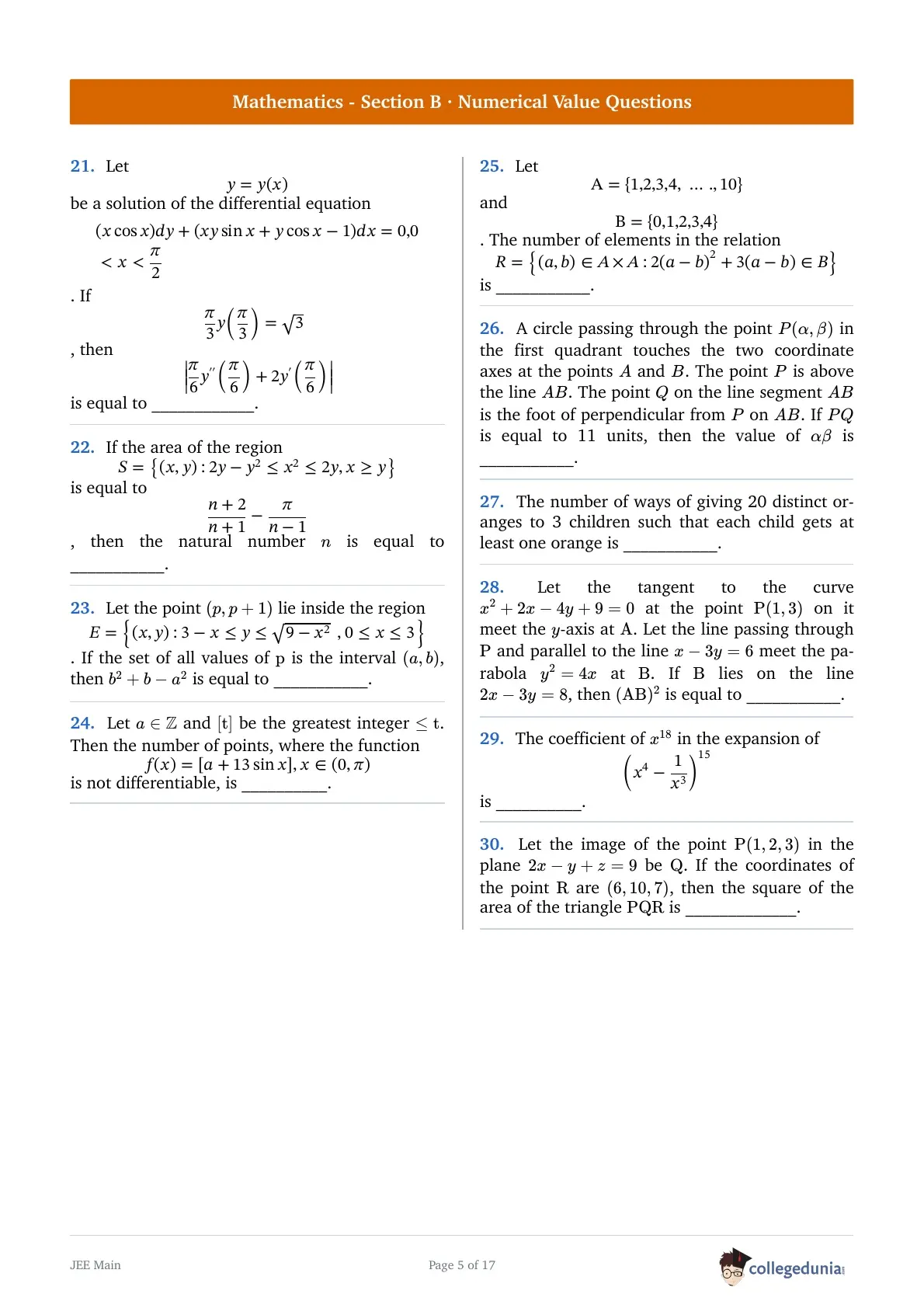
Let y = y(x) be a solution of the differential equation (x cos x)dy +(xy sin x + y cos x – l)dx = 0, 0 < x < \(\frac{π}{2}\). If\(\frac{π}{3}y(\frac{π}{3})=\sqrt3\), then \(| \frac{π}{6 }y“( \frac{π}{6})+2 y'( \frac{π}{6})| \) is equal to______.
If the area of the region \( S={(x,y) : 2y-y^2 ≤ x^2 ≤ 2y, x ≥ y}\) is equal to \(\frac{ n+2}{n+1}−\frac{π}{n−1}\), then the natural number n is equal to _____.
Let the point (p, p+1) lie inside the region \(E = \{(x,y):3-x≤y≤\sqrt{9-x^2}, 0 ≤ x ≤ 3\} \)If the set of all values of p is the interval (a,b). then b2 + b - a2 is equal to_____
Let a∈ Z and [t] be the greatest integer t. Then the number of points, where the function f(x)=[a+13 sin x], x ∈ (0, π) is not differentiable, is ____
Let A = {1, 2, 3, 4,.....10} and B = {0, 1, 2, 3, 4}. The number of elements in the relation R = {(a, b) ∈ A × A: 2(a – b)2 + 3(a – b) ∈ B} is______.
A circle passing through the point P\(( \alpha , \beta )\) in the first quadrant touches the two coordinate axes at the points A and B. The point P is above the line AB. The point Q on the line segment AB is the foot of perpendicular from P on AB. If PQ is equal to 11 units, then value of \(( \alpha \beta )\) is ___
The number of ways of giving 20 distinct oranges to 3 children such that each child gets at least one orange is______
Let the tangent to the curve x2 + 2x – 4y + 9 = 0 at the point P(1, 3) on it meet the y-axis at A. Let the line passing through P and parallel to the line x – 3y = 6 meet the parabola y2 = 4x at B. If B lies on the line 2x – 3y = 8. then (AB)2 is equal to___
The coefficient of \(x^{18}\) in the expansion of \(\left(x^4 - \frac{1}{x^3}\right)^{15}\) is ________
Let the image of the point \(P(1, 2, 3)\) in the plane \(2x - y + z = 9\) be \(Q\). If the coordinates of the point \(R\) are \((6, 10, 7)\), then the square of the area of the triangle \(PQR\) is ___________.
Physics - Section A (Q31 - Q50)
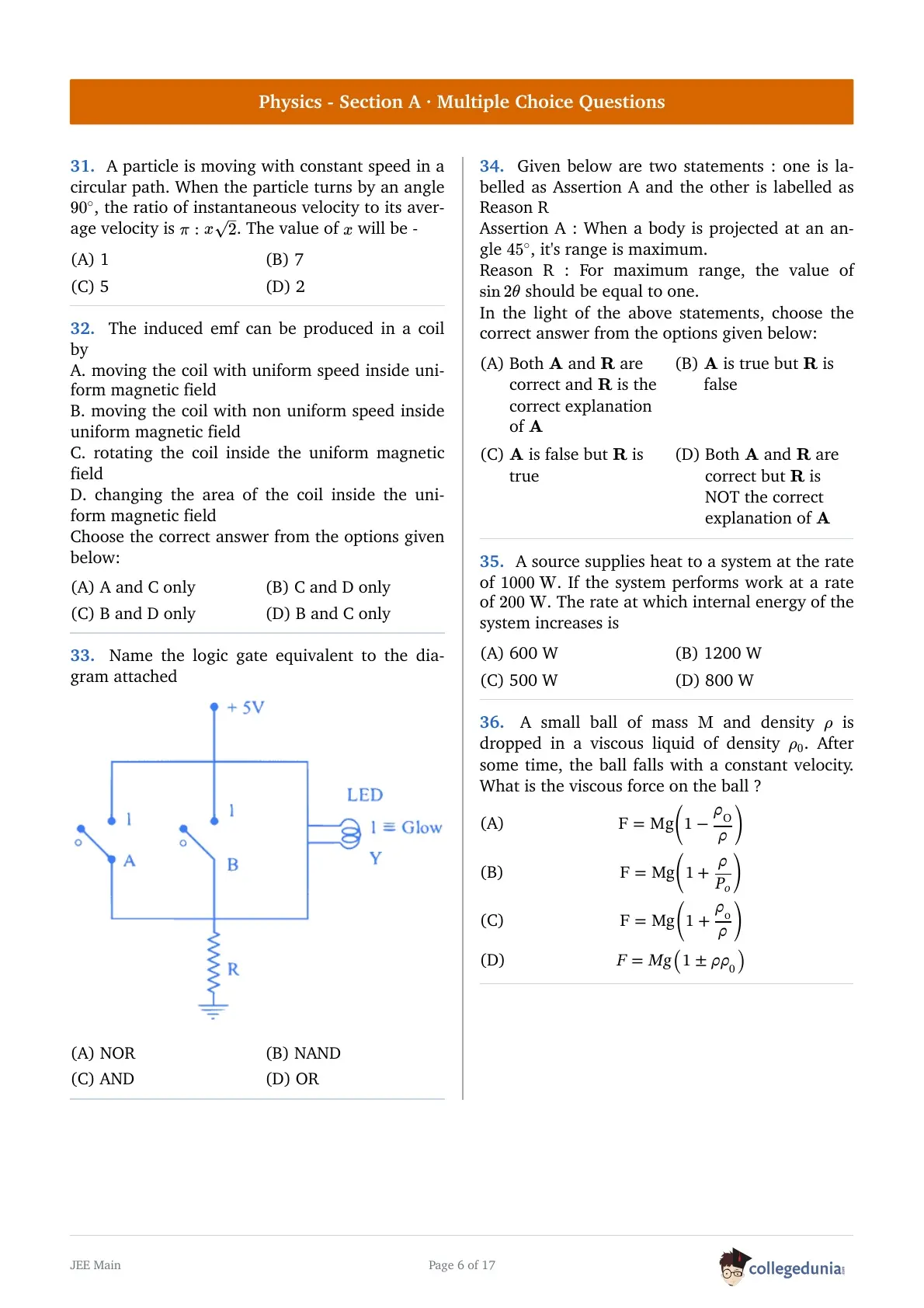
A particle is moving with constant speed in a circular path. When the particle turns by an angle \(90\degree\) , the ratio of instantaneous velocity to its average velocity is \(π : x\sqrt2\). The value of x will be -
The induced emf can be produced in a coil by
A. moving the coil with uniform speed inside uniform magnetic field
B. moving the coil with non uniform speed inside uniform magnetic field
C. rotating the coil inside the uniform magnetic field
D. changing the area of the coil inside the uniform magnetic field
Choose the correct answer from the options given below :
Name the logic gate equivalent to the diagram attached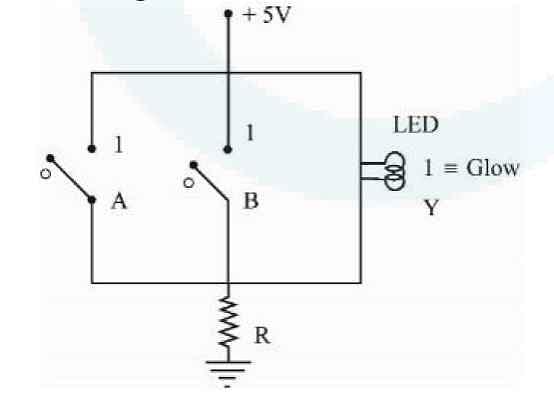
Given below are two statements: one is labelled as Assertion (A) and the other is labelled as Reason (R).
Assertion (A): Range is maximum at θ = 45º.
Reason (R): Range is maximum when sin (2θ) = 1.
In the light of the above statements, choose the correct answer from the options given below:
A source supplies heat to a system at the rate of 1000 W. If the system performs work at a rate of 200 W. The rate at which internal energy of the system increase is
A small ball of mass M and density \(\rho\) is dropped in a viscous liquid of density \(\rho_0\). After some time, the ball falls with a constant velocity. What is the viscous force on the ball ?
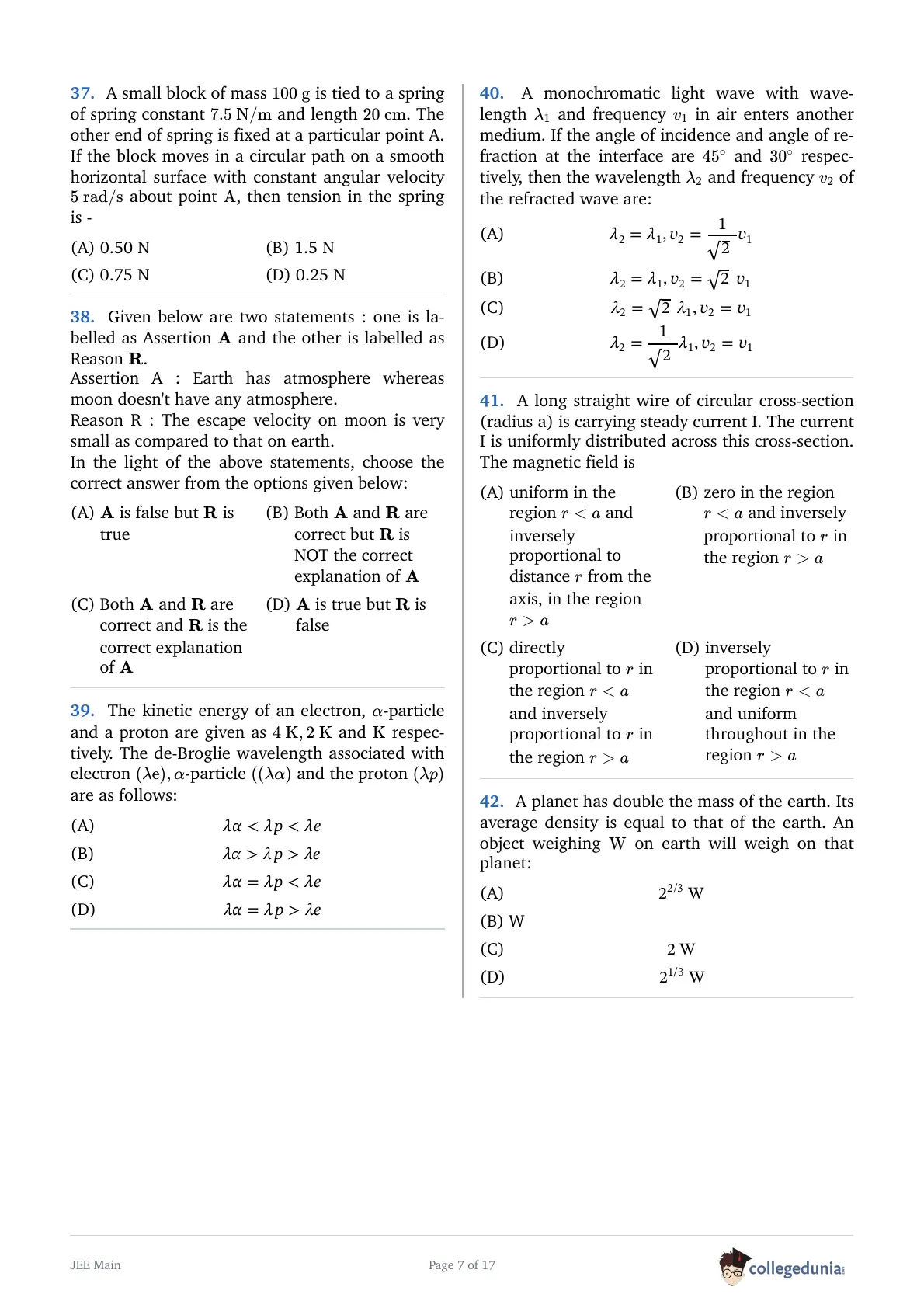
A small block of mass 100 g is tied to a spring of spring constant 7.5 N/m and length 20 cm. The other end of spring is fixed at a particular point A. If the block moves in a circular path on a smooth horizontal surface with constant angular velocity 5 rad/s about point A, then tension in the spring is-
Given below are two statements, one is labelled as Assertion A and the other is labelled as Reason R Assertion (A): Earth has atmosphere and moon doesn’t Reason (R): escape speed on moon is less than that Earth. In the light of the above statements, choose the correct answer from the options given below
The kinetic energy of an electron, α-particle and a proton are given as 4K, 2K and K respectively. The de-Broglie wavelength associated with electron (λe) α-particle (λα) and the proton (λp) are as follows :
A monochromatic light wave with wavelength \(λ_1\) and frequency \(v_1\) in air enters another medium. If the angle of incidence and angle of refraction at the interface are 45° and 30° respectively, then the wavelength \(λ_2\) and frequency \(v_2\) of the refracted wave are :
A long straight wire of circular cross-section (radius a) is carrying steady current I. The current I is uniformly distributed across this cross-section. The magnetic field is
A planet has double the mass of the earth. Its average density is equal to that of the earth. An object weighing W on earth will weigh on that planet:
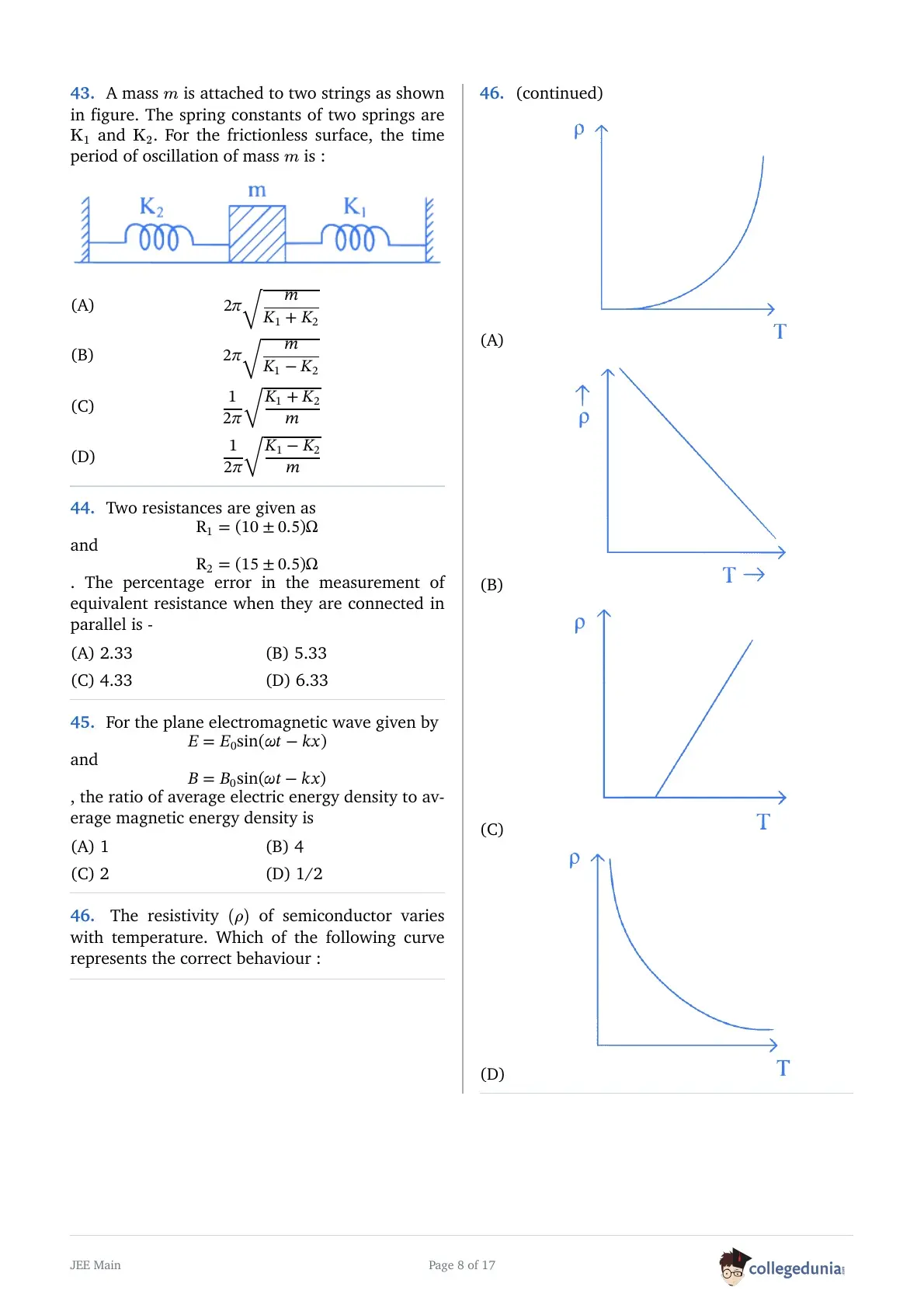
A mass \(m\) is attached to two springs as shown in the figure. The spring constants of the two springs are \(K_1\) and \(K_2\). For the frictionless surface, the time period of oscillation of mass \(m\) is:
Two resistances are given as \(R_1=(10 ±0.5) Ω\) and \(R_2= (15±0.5) Ω\). The percentage error in the measurement of equivalent resistance when they are connected in parallel is -
For the plane electromagnetic wave given by \(E = E_o sin (ωt-kx)\) and \(B = B_o sin ( ωt-kx)\), the ratio of average electric energy density to average magnetic energy density is
The resistivity (\(\rho\)) of semiconductor varies with temperature. Which of the following curve represents the correct behavior
- (1)
![The resistivity ( � ρ) of semiconductor varies with temperature.]()
- (2)
![The resistivity ( � ρ) of semiconductor varies with temperature.]()
- (3)
![The resistivity ( � ρ) of semiconductor varies with temperature.]()
- (4)
![The resistivity ( � ρ) of semiconductor varies with temperature.]()


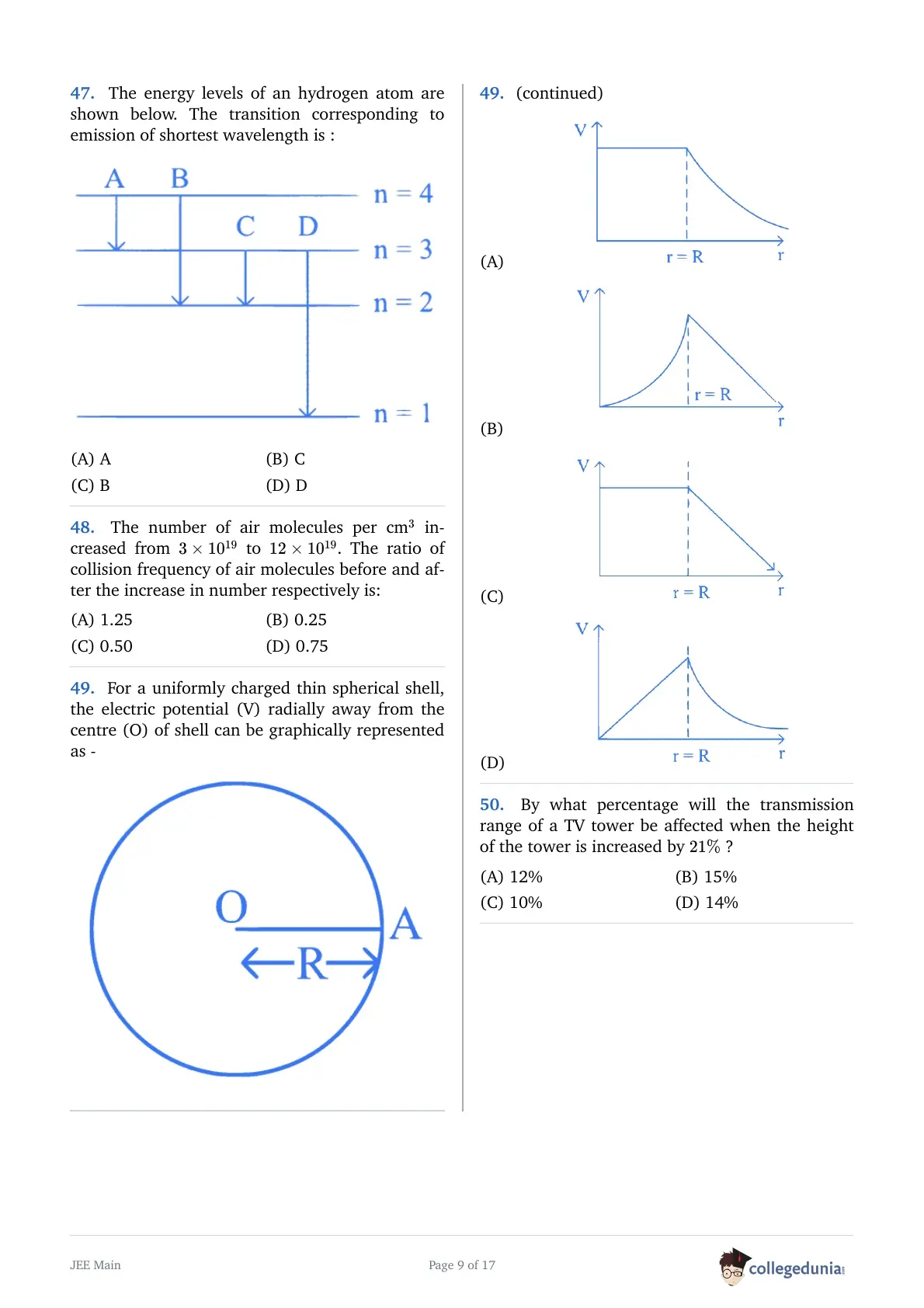
The number of air molecules per cm3 increased from 3 × 10¹⁹ to 12 × 1019. The ratio of collision frequency of air molecules before and after the increase in the number respectively is :
For a uniformly charged thin spherical shell, the electric potential (V) radially away from the entre (O) of shell can be graphically represented as – 
- (1)
![For a uniformly charged thin spherical shell,]()
- (2)
![For a uniformly charged thin spherical shell,]()
- (3)
![For a uniformly charged thin spherical shell,]()
- (4)
![For a uniformly charged thin spherical shell,]()


By what percentage will the transmission range of a TV tower be affected when the height of the tower is increased by 21% ?
Physics - Section B (Q51 - Q60)
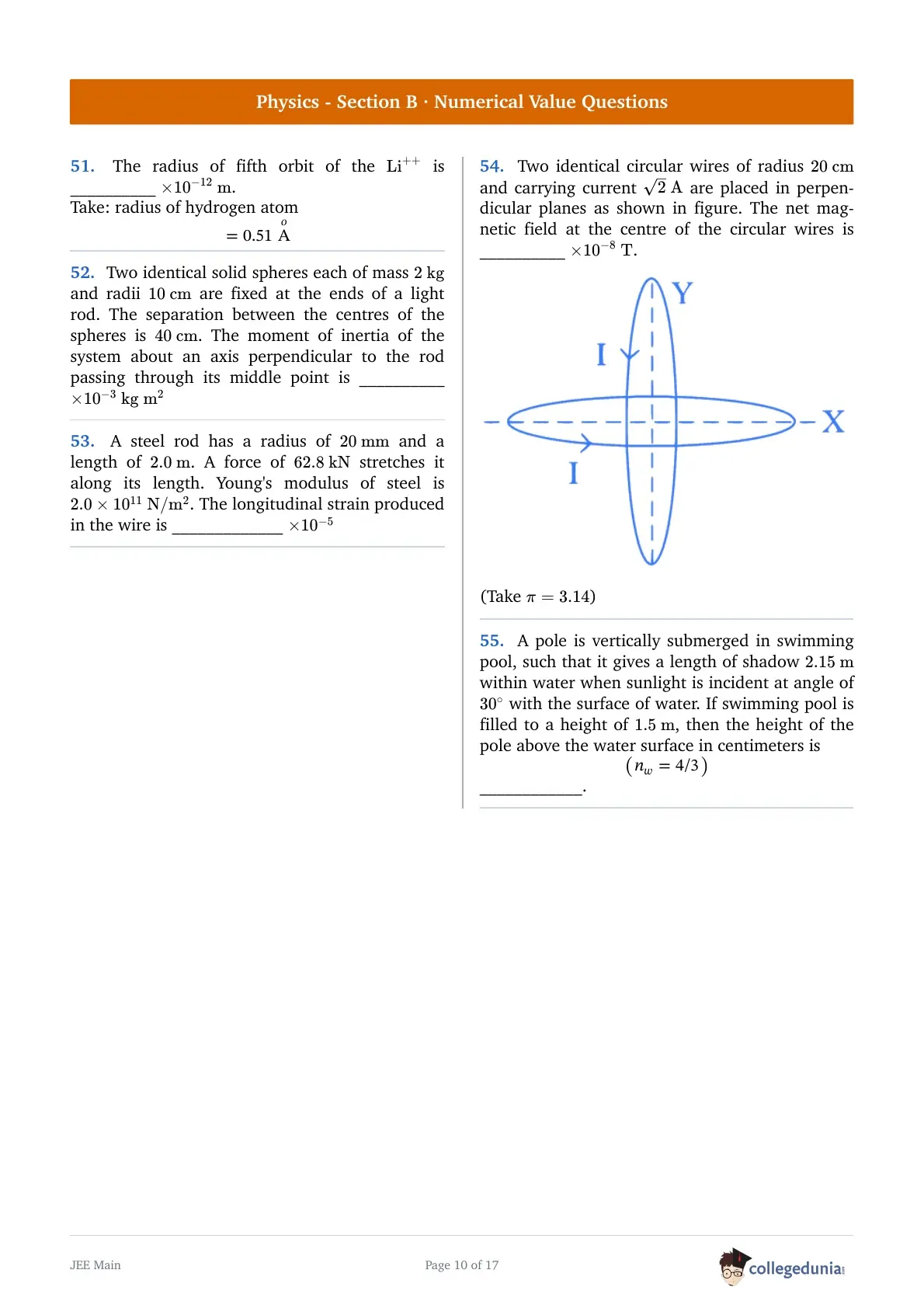
The radius of fifth orbit of the Li++ is __________ × 10^-12 m.
Take : radius of hydrogen atom = 0.51 Å
Two identical solid spheres each of mass 2 kg and radii 10 cm are fixed at the ends of a light rod. The separation between the centres of the spheres is 40 cm. The moment of inertia of the system about an axis perpendicular to the rod passing through its middle point is __________ \(× 10^{-3} \)kg-\(m^2\)
A steel rod bas a radius of 20 mm and a length of 2.0 m. A force of 62.8 kN stretches it along its length. Young's modulus of steel is 2.0 × \(10^{11}\) N/m\(^2\). The longitudinal strain produced in the wire is _______ × \(10^{-5}\)
Two identical circular wires of radius 20 cm and carrying current \(\sqrt2 \)A are placed in perpendicular planes as shown in figure. The net magnetic field at the centre of the circular wires is _________ × 10^{-8} T.

A pole is vertically submerged in swimming pool, such that it gives a length of shadow 2.15 m within water when sunlight is incident at an angle of 30o with the surface of water. If swimming pool is filled to a height of 1.5 m, then the height of the pole above the water surface in centimeters is (n-w = 4/3) ____________
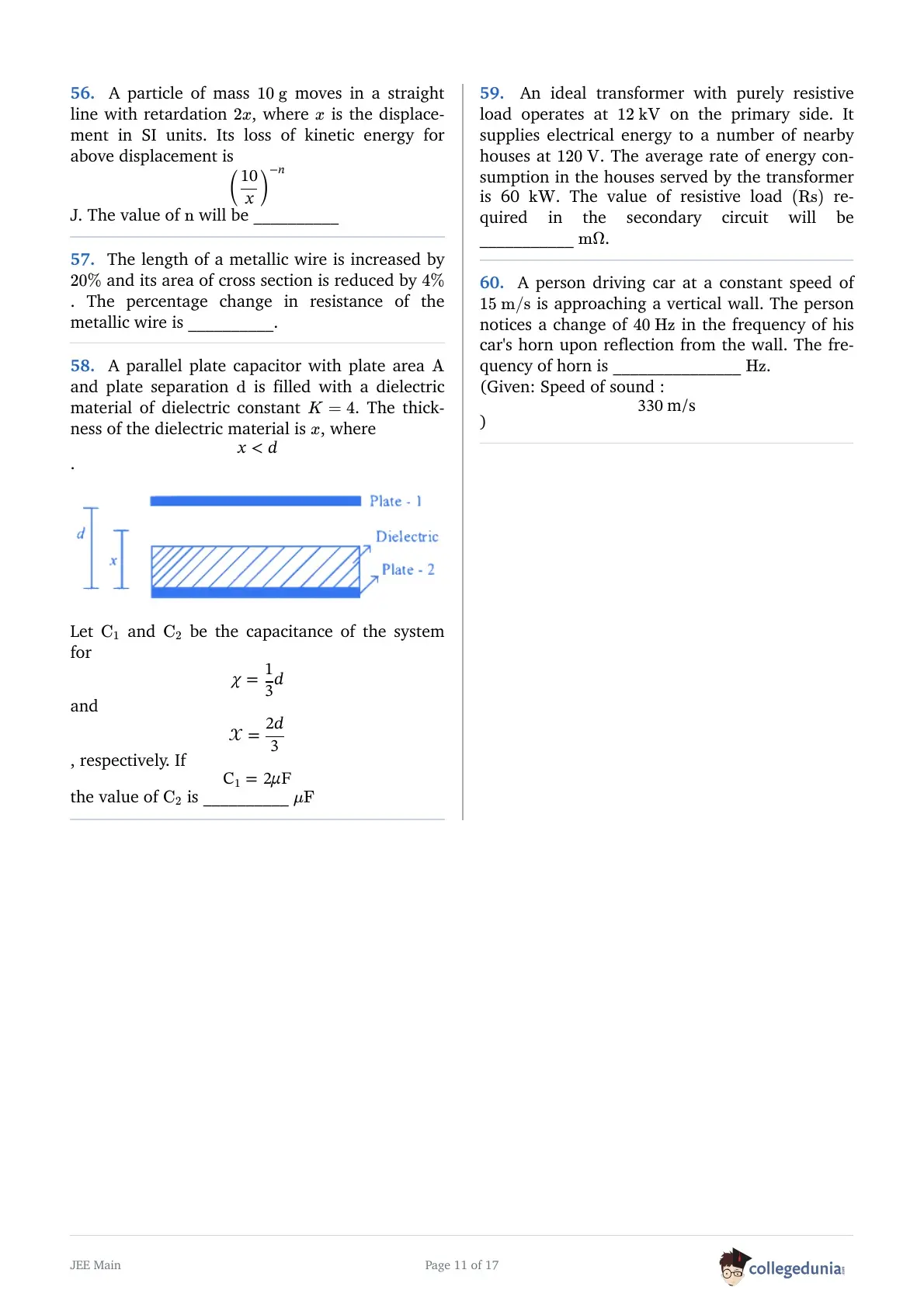
A particle of mass 10 g moves in a straight line with retardation 2x, where x is the displacement in SI units. Its loss of kinetic energy for above displacement is \((10/x)^{-n}\)J. The value of n will be ____________
The length of a metallic wire is increased by 20% and its area of cross section is reduced by 4%. The percentage change in resistance of the metallic wire is ______
A parallel plate capacitor with plate area A and plate separation d is filled with a dielectric material of dielectric constant K = 4. The thickness of the dielectric material is x, where x < d. Let C1 and C2 be the capacitance of the system for \(x =\) \(\frac{1}{3}d\) and \(x=\frac{2}{3}d\), respectively. If C1 = 2μF, the value of C2 is _______ μF.

An ideal transformer with purely resistive load operates at 12 kV on the primary side. It supplies electrical energy to a number of nearby houses at 120 V. The average rate of energy consumption in the houses served by the transformer is 60 kW. The value of resistive load (Rs) required in the secondary circuit will be ________ mΩ.
A person driving car at a constant speed of 15 m/s is approaching a vertical wall. The person notices a change of 40 Hz in the frequency of his car’s horn upon reflection from the wall. The frequency of horn is ____ Hz.
Chemistry - Section A (Q61 - Q80)
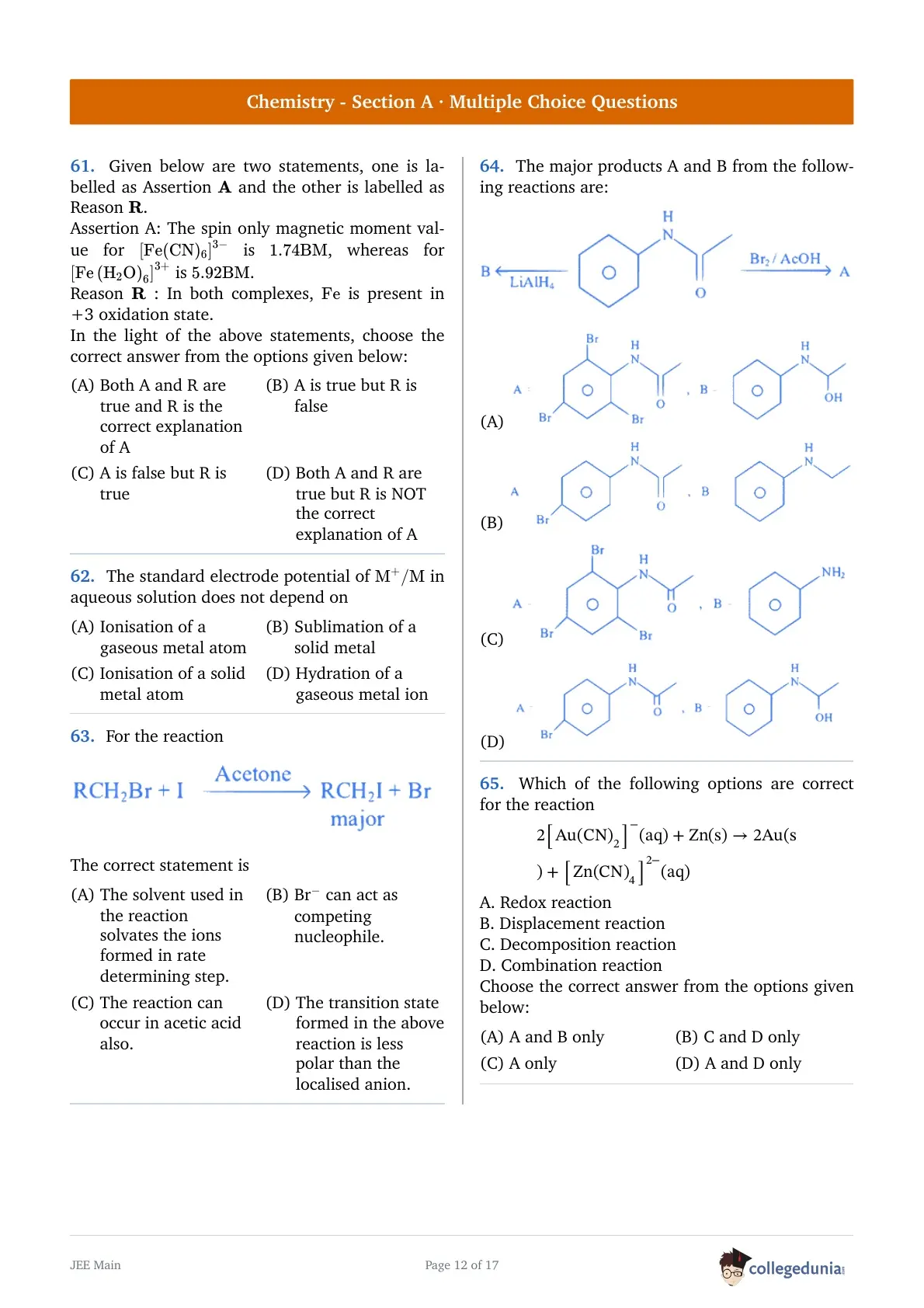
Given below are two statements, one is labelled as Assertion A and the other is labelled as Reason R
Assertion: Magnetic moment of [Fe(H2O)6]3+ is 5.92 BM and that of [Fe(CN)6]3– is 1.73 BM
Reason: Oxidation state of Fe in both the complexes is +3.
In the light of the above statements, choose the correct answer from the options given below
The standard electrode potential of M+/M in aqueous solution does not depend on
CH3CH2-Br \(\overrightarrow{Acetone}^{NaI}\) CH3-CH2-I+NaBr
Which of the following statement is correct ?
the major product A and B from the the following reaction are
- (1)
![]()
- (2)
![]()
- (3)
![]()
- (4)
![]()


2[Au(CN)2]– + Zn \(\to\) [Zn(CN)4]2– + 2Au\(\downarrow\) is which of these
(A) Redox reaction
(B) Displacement reaction
(C) Combination reaction
(D) Decomposition reaction
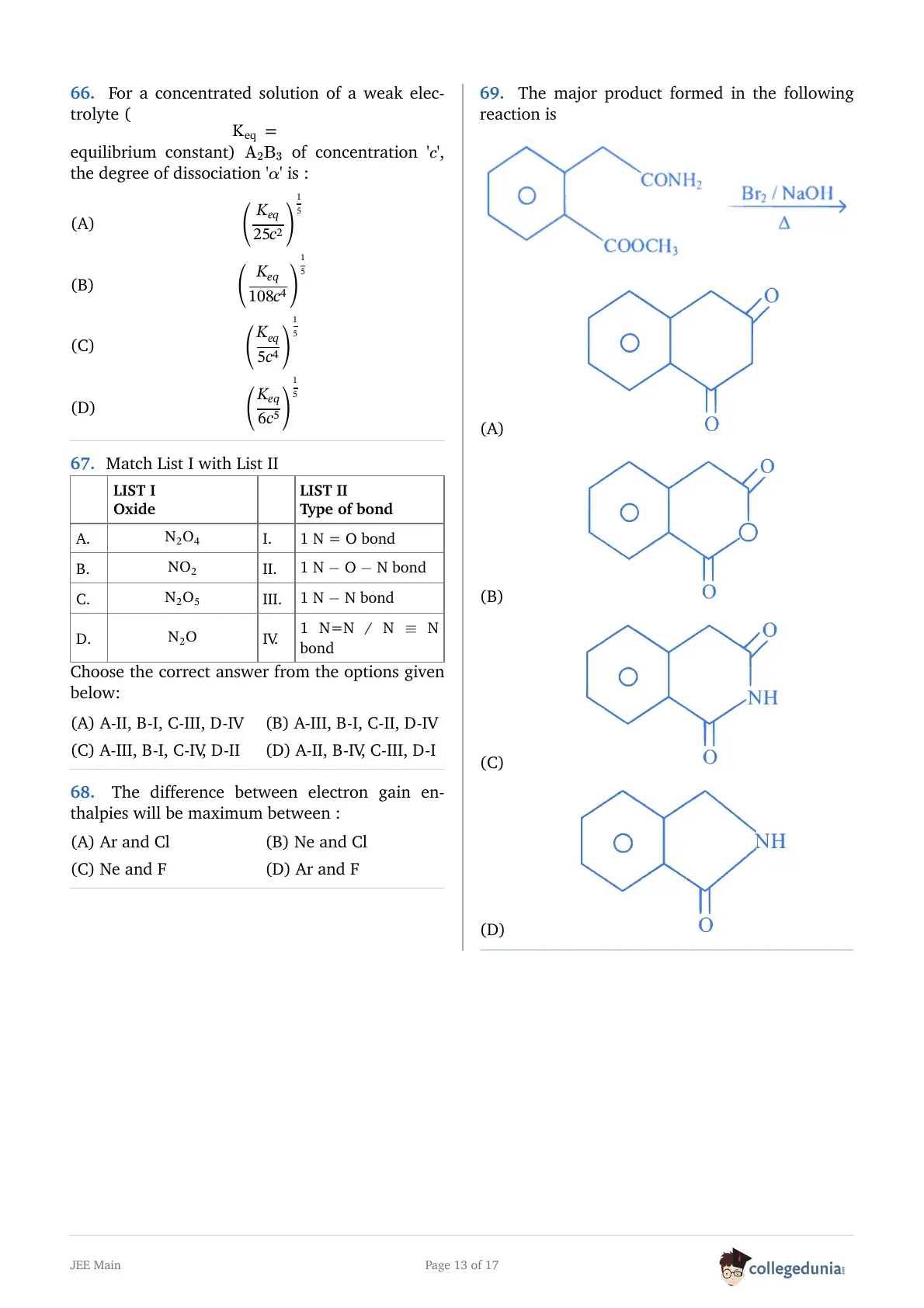
Predict expression from α in terms of \(K_{eq}\) and concentration C :
\(A_2 B_3(aq) \leftrightharpoons 2{A_3} (aq)+3B_{{2-}}(aq)\)
| Column-I | Column-II | ||
| P | N2O5 | (i) | N–N bond |
| Q | N2O | (ii) | N–O–N bond |
| R | N2O4 | (iii) | N=N / N≡N bond |
| S | NO2 | (iv) | N=O bond |
The difference between electron gain enthalpies will be maximum between
The major product formed in the following reaction is
- (1)
![]()
- (2)
![]()
- (3)
![]()
- (4)
![]()


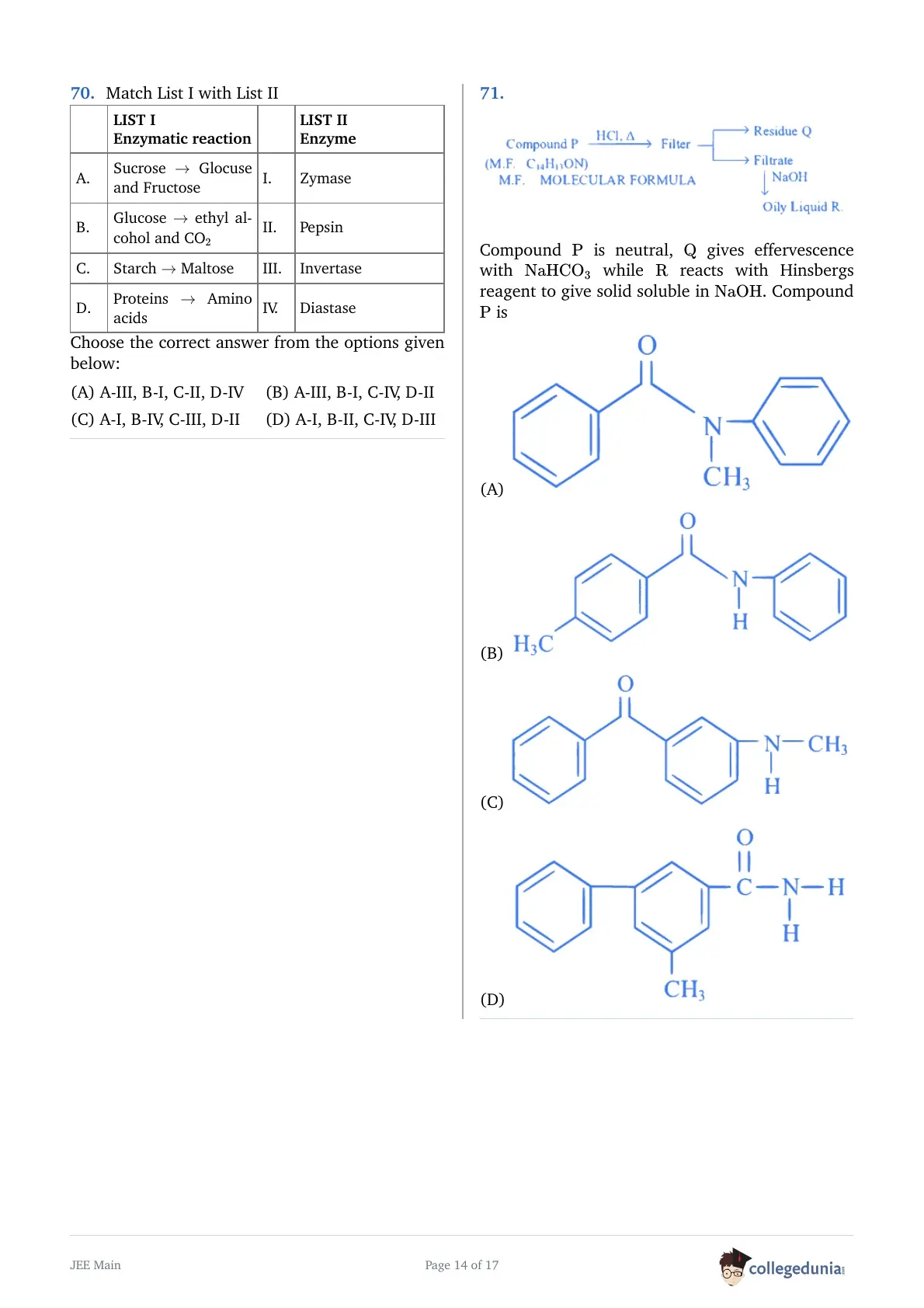
| Column I (Chemical reactions) | Column II (Enzymes used) | ||
| (i) | Glucose → CO2 + Ethanol | a | Pepsin |
| (ii) | Sucrose→Glucose + Fructose | b | Diastase |
| (iii) | Starch →Maltose | c | Zymase |
| (iv) | Protein→Amino acids | d | Invertase |

Compound P is neutral. Q gives effervescence with NaHCO3 while R reacts with Hinsbergs reagent to give solid soluble in NaOH. Compound P is
- (1)
![]()
- (2)
![]()
- (3)
![]()
- (4)
![]()


Which one among the following metals is the weakest reducing agent?
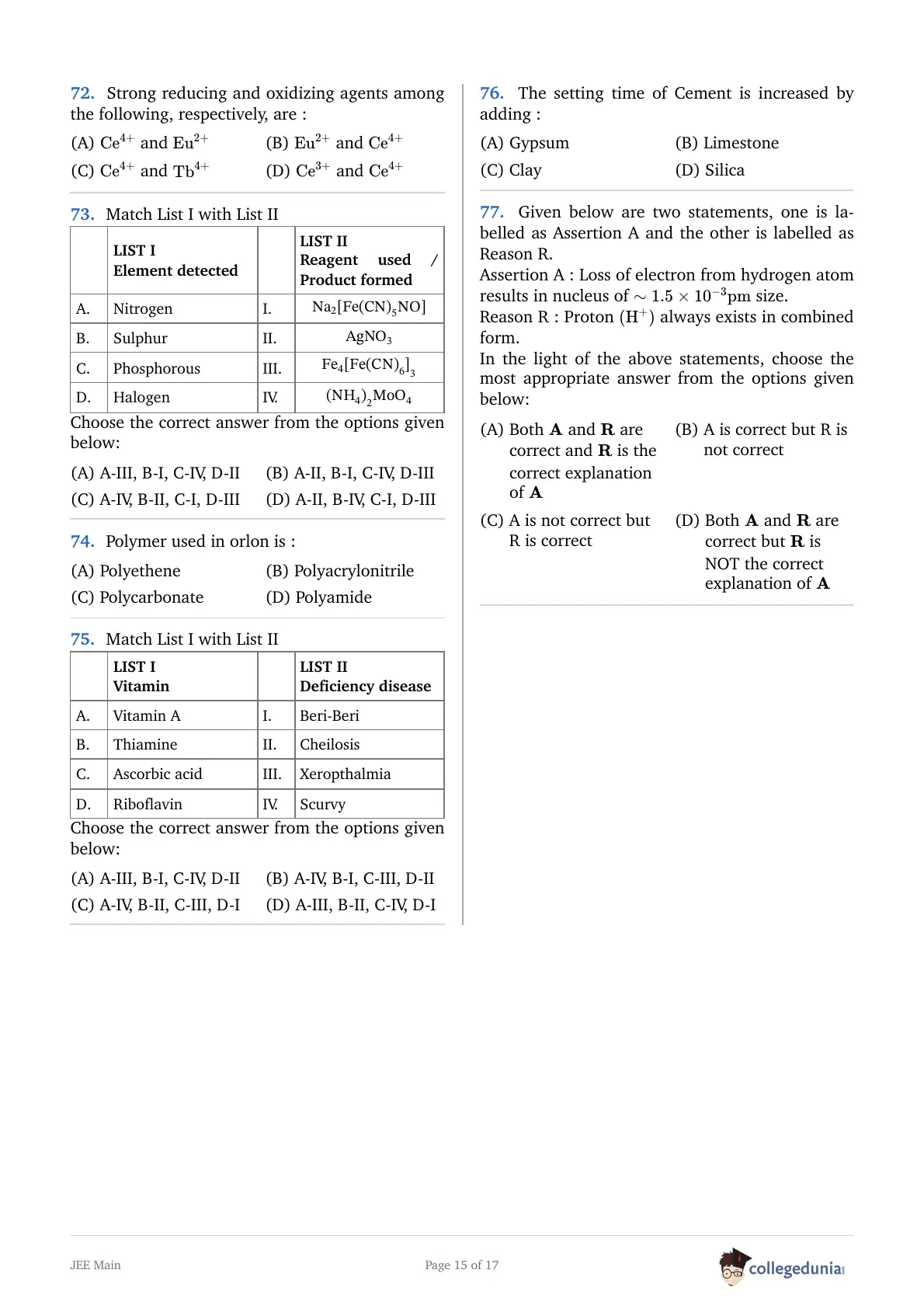
List I Element detected | List II Reagent used/ Product formed | ||
| A | Nitrogen | I | Na2[Fe(CN)5 NO] |
| B | Sulphur | II | AgNO3 |
| C | Phosphorous | III | Fe4[Fe(CN)6]3 |
| D | Halogen | IV | (NH4)2 MoO4 |
Choose the correct answer from the options given below:
Polymer which is named as orlon is:
| Column I | Column II | ||
| (i) | Vitamin A | a | Beri-beri |
| (ii) | Vitamin C (Ascorbic acid) | b | Cheilosis |
| (iii) | Riboflavin | c | Xerophthalmia |
| (iv) | Thiamine | d | Scurvy |
Which compound is added to cement to increase its setting time?
Given below are two statements: one is labelled as Assertion (A) and the other is labelled as Reason (R).
Assertion (A) : Radius of H+ is 1.5 × 10⁻³ pm
Reason (R) : H+ cannot exist independently
In the light of the above statements, write the detailed answer:
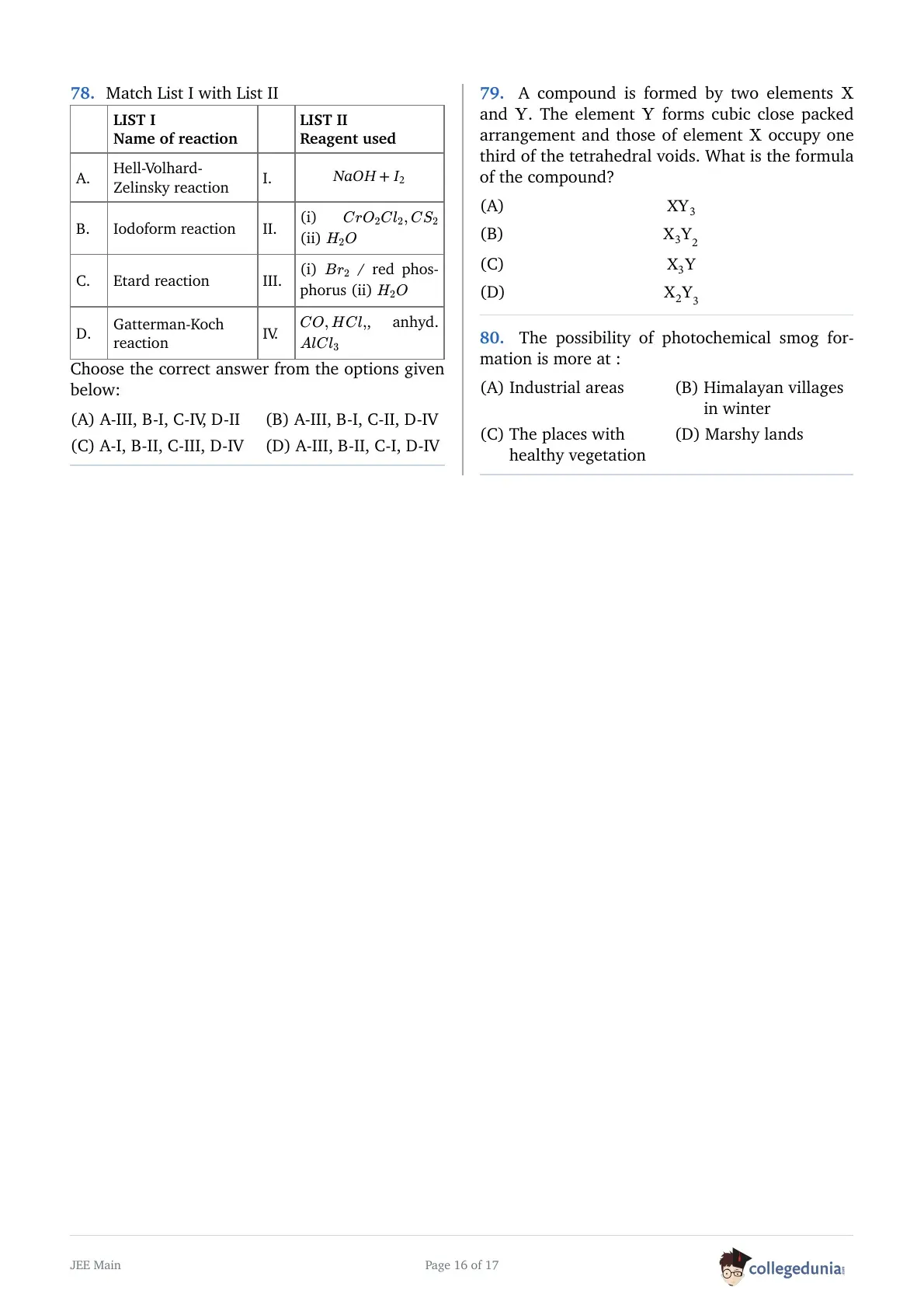
| LIST I Name of reaction | LIST II Reagent used | ||
| A. | Hell-Volhard-Zelinsky reaction | I. | \(\mathrm{NaOH + I_2}\) |
| B. | Iodoform reaction | II. | (i) \(\mathrm{CrO_2Cl_2, CS_2}\) (ii) \(\mathrm{H_2O}\) |
| C. | Etard reaction | III. | (i) \(\mathrm{Br_2}\) / red phosphorus (ii) \(\mathrm{H_2O}\) |
| D. | Gatterman-Koch reaction | IV. | CO, HCl, anhyd. \(\mathrm{AlCl_3}\) |
A binary compound has Y-atoms forming FCC unit cell and another type of X-atoms occupying \(\frac{1}{3}\)rd of tetrahedral voids. Find out the molecular formula of the compound
Photochemical smog found mainly in
Chemistry - Section B (Q81 - Q90)
How many bromo products are formed when ethane is reacted with excess of Br2 on heating?
The wavelength of an electron of kinetic energy \(4.50 \times 10^{-29}\) J is ___________ \(\times 10^{-5}\) m. (Nearest integer)
Given : mass of electron is \(9 \times 10^{-31}\) kg, \(h = 6.6 \times 10^{-34}\) J s
The number of species from the following which have square pyramidal structure is___
\(PF_5, BrF^− _4 4 − , IF_5\) ; \(BrF_5, XeOF_4, ICl ^−_ 4\)
Consider the graph of Gibbs free energy G vs Extent of reaction. The number of statement/s from the following which are true with respect to points (a), (b) and (c) is…
A. Reaction is spontaneous at (a) and (b)
B. Reaction is at equilibrium at point (b) and nonspontaneous at point (c)
C. Reaction is spontaneous at (a) and nonspontaneous at (c)
D. Reaction is non-spontaneous at (a) and (b)
Determine the amount of urea (NH2CONH2) to be added in 1000 g of water to decrease its vapour presssure by 25%.
Given: Molar mass of N. C. O and H are 14. 12. 16 and 1 2 mol-1 respectively.
The value of \(log_{10}K\) for a reaction A ⇋ B is
(Given,
\(\Delta H^{\circ}_{298K}\) = –54.67 kJ \(mol^{-1}\)
\(\Delta H^{\circ}_{298K}\) = 10 kJ \(mol^{-1}\)
and R = 8.314 J \(K^{-1}mol^{-1}\)
2.303 × 8.314 × 298 = 5705)
Number of ambidentate ligands in given complex [M(en)(SCN)4] :
How many moles of \(Ba_3(PO_4)_2\) will be formed by the reaction of \(5\) moles of \(BaCl_2\) and \(3\) moles of \(Na_3(PO_4)\).
Oxidation number of Mo in Ammonophosphomolybdate
For the adsorption of hydrogen on platinum, the activation energy is 30 kJ mol-1 and for the adsorption of hydrogen on nickel, the activation energy is 41.4 kJ mol-1 . The logarithm of the ratio of the rates of chemisorption on equal areas of the metals at 300 K is ……… (Nearest integer) Given: ln 10 = 2. 3 R = 8.3 JK-1 mol-1
JEE Main 2023 Exam Pattern and Marking Scheme
| Particulars | Details |
|---|---|
| Exam Mode | Online (Computer-Based Test) |
| Paper | B.E./B.Tech |
| Medium of Exam | 13 languages: English, Hindi, Gujarati, Bengali, Tamil, Telugu, Kannada, Marathi, Malayalam, Odia, Punjabi, Assamese, Urdu |
| Duration | 3 hours (180 minutes) |
| Type of Questions | Multiple Choice Questions (MCQs) + Numerical Value Questions (attempt any 5 of 10 per subject) |
| Total Marks | 300 marks |
| Subjects | Mathematics, Physics, Chemistry |
| Marking Scheme | +4 for correct answer & -1 for incorrect MCQ and Numerical Value-based Questions |
| Total Questions | 90 Questions (30 per subject), 75 to be attempted |
| Eligibility | Passed or appearing in Class 12 with Physics, Chemistry, and Mathematics |
JEE Main 2023 6 April Shift 1 Question Paper by Coaching Institute
| Coaching Institutes | Question Paper with Answer Key PDF |
|---|---|
| Aakash BYJUs | Check Here |
| Reliable Institute | Physics Chemistry Mathematics |
| Resonance | Check Here |
| Vedantu | Check Here |
| Sri Chaitanya | Check Here |
Also Check:
JEE Main 2023 Session 2 Question Paper
JEE Main 2023 Session 1 Question Paper
JEE Main Previous Year Question Paper
| JEE Main 2022 Question Paper | JEE Main 2021 Question Paper | JEE Main 2020 Question Paper |
| JEE Main 2019 Question Paper | JEE Main 2018 Question Paper | JEE Main 2017 Question Paper |



Comments