



.png?h=35&w=35&mode=stretch)
JEE Main 2023 8 April Shift 1 Question Paper is available here. NTA conducted JEE Main 2023 8 April Shift 1 from 9 AM to 12 PM. Candidates can download the official JEE Main 2023 Question Paper PDF with Solution and Answer Key for 8 April Shift 1 using the link below.
Related Links:
- Download JEE Main Previous Year Question Papers PDF with Solutions
- Download JEE Main 2025 Question Paper for all Shifts
JEE Main 2023 8 April Shift 1 Question Paper with Solutions and Answer Key PDF
| JEE Main 2023 8th April Shift 1 Question Paper with Solution PDF |  Download Download |
Check Solution |
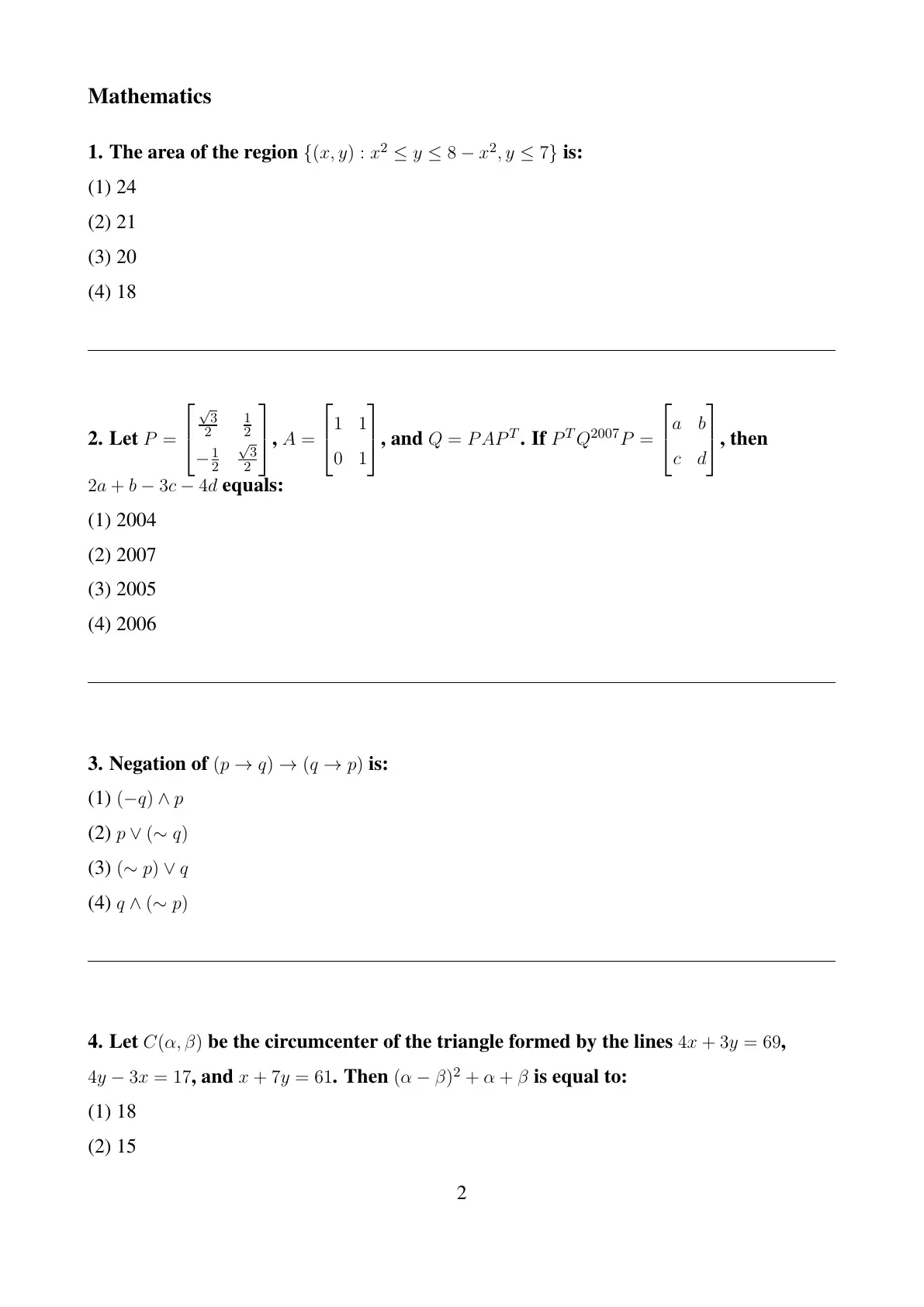
The area of the region \(\{(x, y): x^2 \leq y \leq 8-x^2, y \leq 7\}\) is:
Let \(P = \begin{bmatrix} \frac{\sqrt{3}}{2} & \frac{1}{2}
-\frac{1}{2} & \frac{\sqrt{3}}{2} \end{bmatrix}\), \(A = \begin{bmatrix} 1 & 1
0 & 1 \end{bmatrix}\), and \(Q = PAP^T\). If \(P^TQ^{2007}P = \begin{bmatrix} a & b
c & d \end{bmatrix}\), then \(2a + b - 3c - 4d\) equals:
Negation of \((p \to q) \to (q \to p)\) is:
Let \(C(\alpha, \beta)\) be the circumcenter of the triangle formed by the lines \(4x + 3y = 69\), \(4y - 3x = 17\), and \(x + 7y = 61\). Then \((\alpha - \beta)^2 + \alpha + \beta\) is equal to:
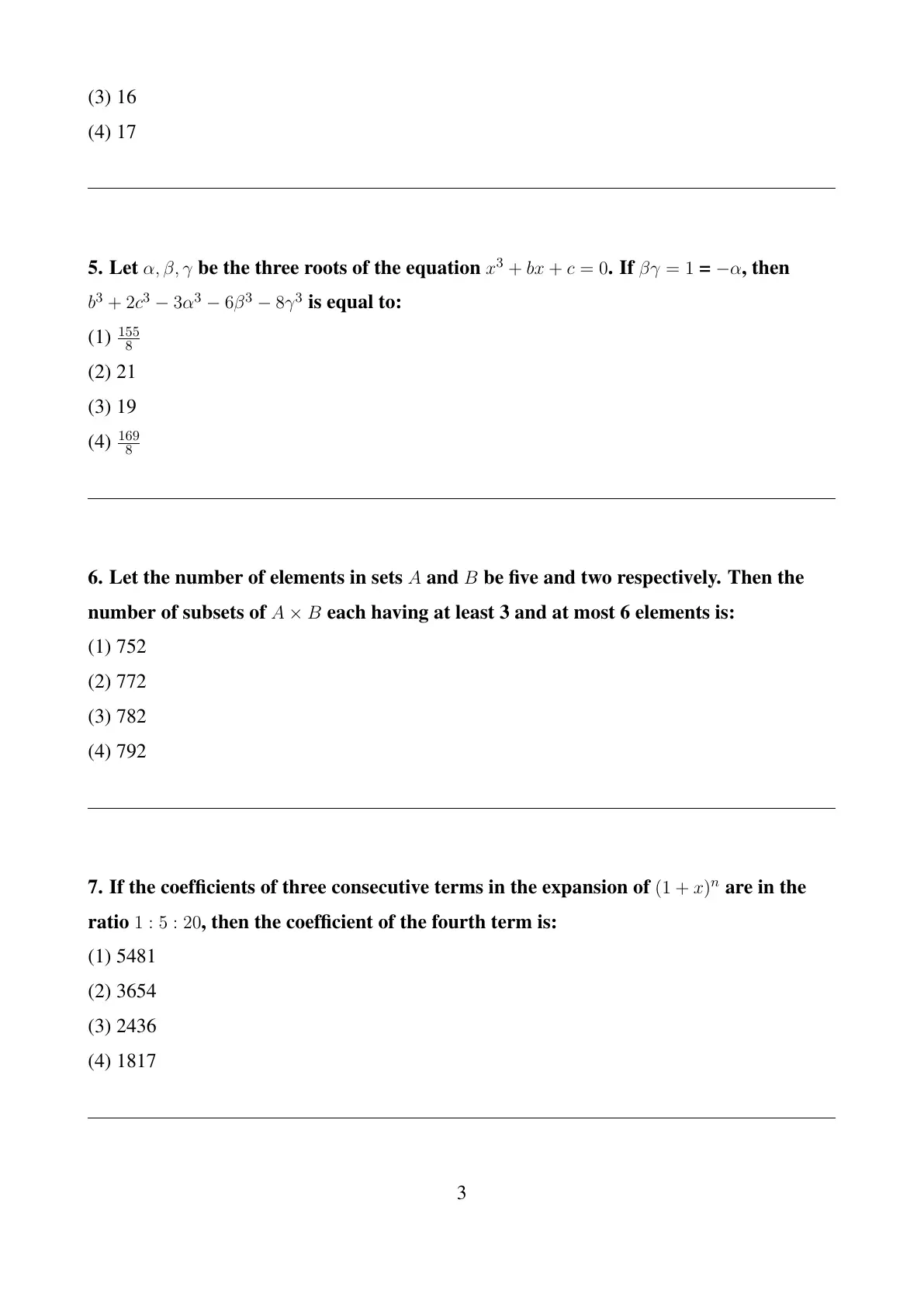
Let \(\alpha, \beta, \gamma\) be the three roots of the equation \(x^3 + bx + c = 0\). If \(\beta\gamma = 1\) = \(-\alpha \), then \(b^3 + 2c^3 - 3\alpha^3 - 6\beta^3 - 8\gamma^3\) is equal to:
Let the number of elements in sets \(A\) and \(B\) be five and two respectively. Then the number of subsets of \(A \times B\) each having at least 3 and at most 6 elements is:
If the coefficients of three consecutive terms in the expansion of \((1 + x)^n\) are in the ratio \(1 : 5 : 20\), then the coefficient of the fourth term is:
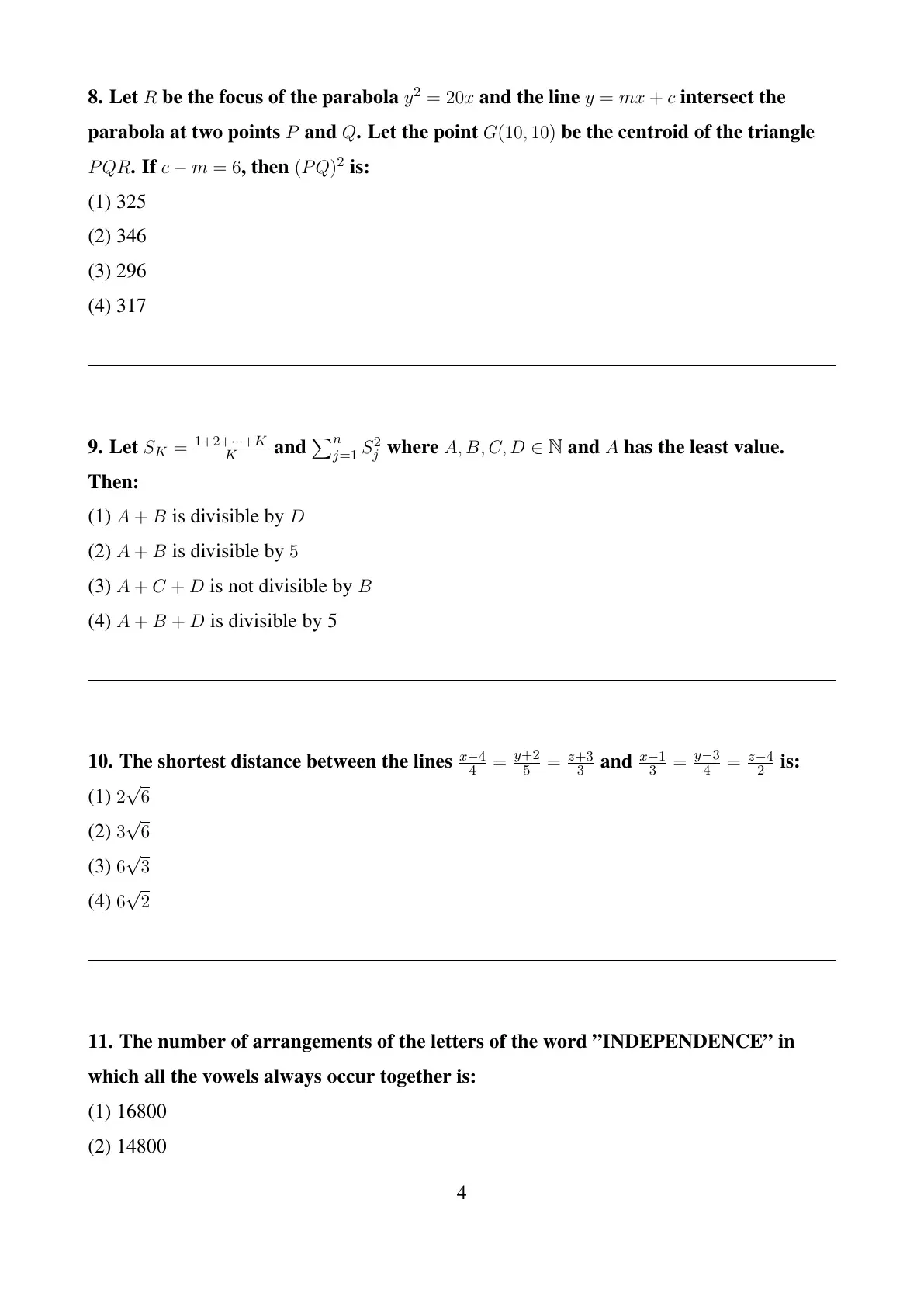
Let \(R\) be the focus of the parabola \(y^2 = 20x\) and the line \(y = mx + c\) intersect the parabola at two points \(P\) and \(Q\). Let the point \(G(10, 10)\) be the centroid of the triangle \(PQR\). If \(c - m = 6\), then \((PQ)^2\) is:
Let \( S_K = \frac{1 + 2 + \dots + K}{K} \) and \( \sum_{j=1}^{n} S_j^2 \) where \( A, B, C, D \in \mathbb{N} \) and \( A \) has the least value. Then:
View Solution
The shortest distance between the lines \(\frac{x-4}{4} = \frac{y+2}{5} = \frac{z+3}{3}\) and \(\frac{x-1}{3} = \frac{y-3}{4} = \frac{z-4}{2}\) is:
The number of arrangements of the letters of the word "INDEPENDENCE" in which all the vowels always occur together is:
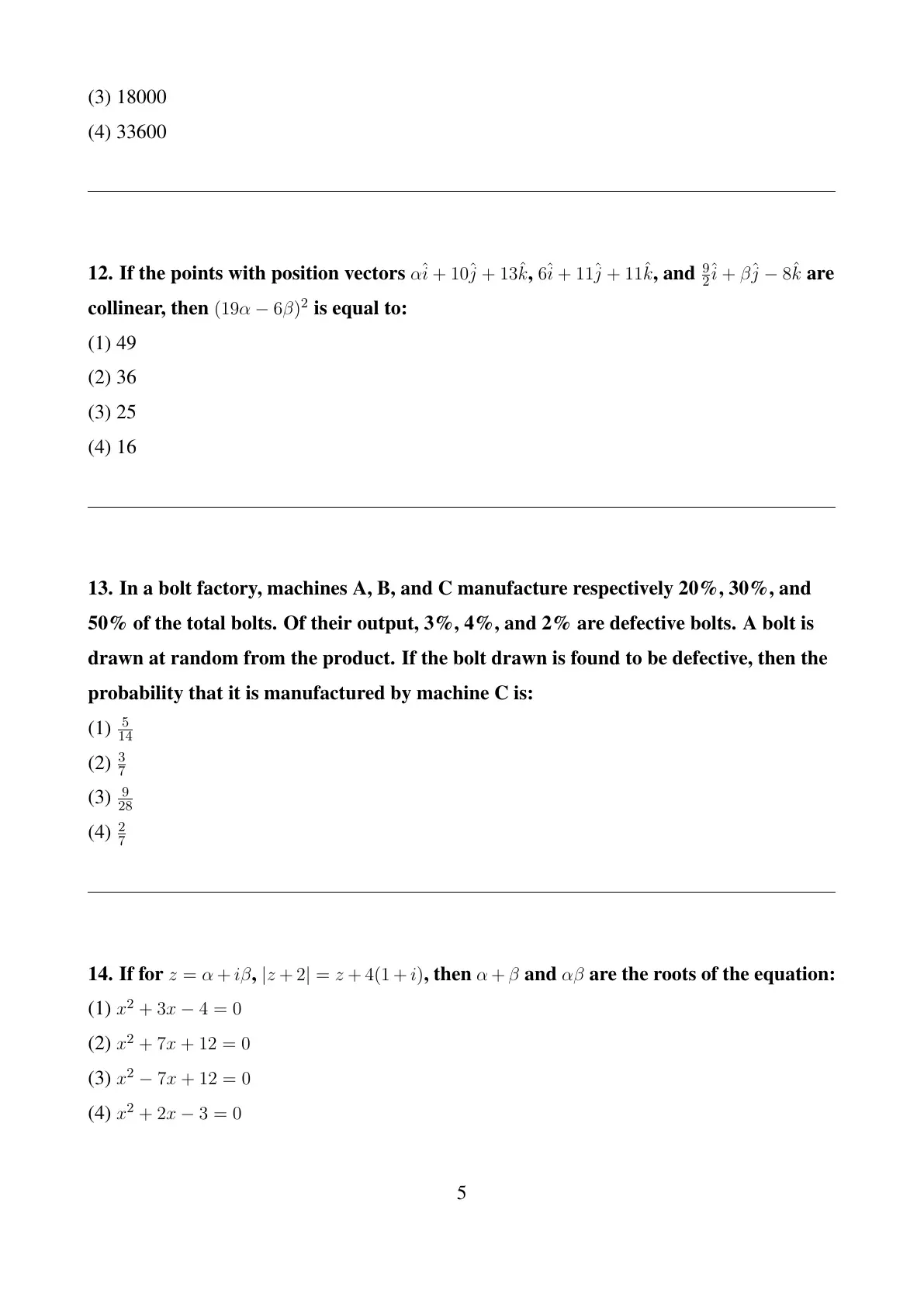
If the points with position vectors \(\alpha \hat{i} + 10\hat{j} + 13\hat{k}\), \(6\hat{i} + 11\hat{j} + 11\hat{k}\), and \(\frac{9}{2}\hat{i} + \beta\hat{j} - 8\hat{k}\) are collinear, then \((19\alpha - 6\beta)^2\) is equal to:
In a bolt factory, machines A, B, and C manufacture respectively 20%, 30%, and 50% of the total bolts. Of their output, 3%, 4%, and 2% are defective bolts. A bolt is drawn at random from the product. If the bolt drawn is found to be defective, then the probability that it is manufactured by machine C is:
If for \(z = \alpha + i\beta\), \(|z + 2| = z + 4(1 + i)\), then \(\alpha + \beta\) and \(\alpha\beta\) are the roots of the equation:
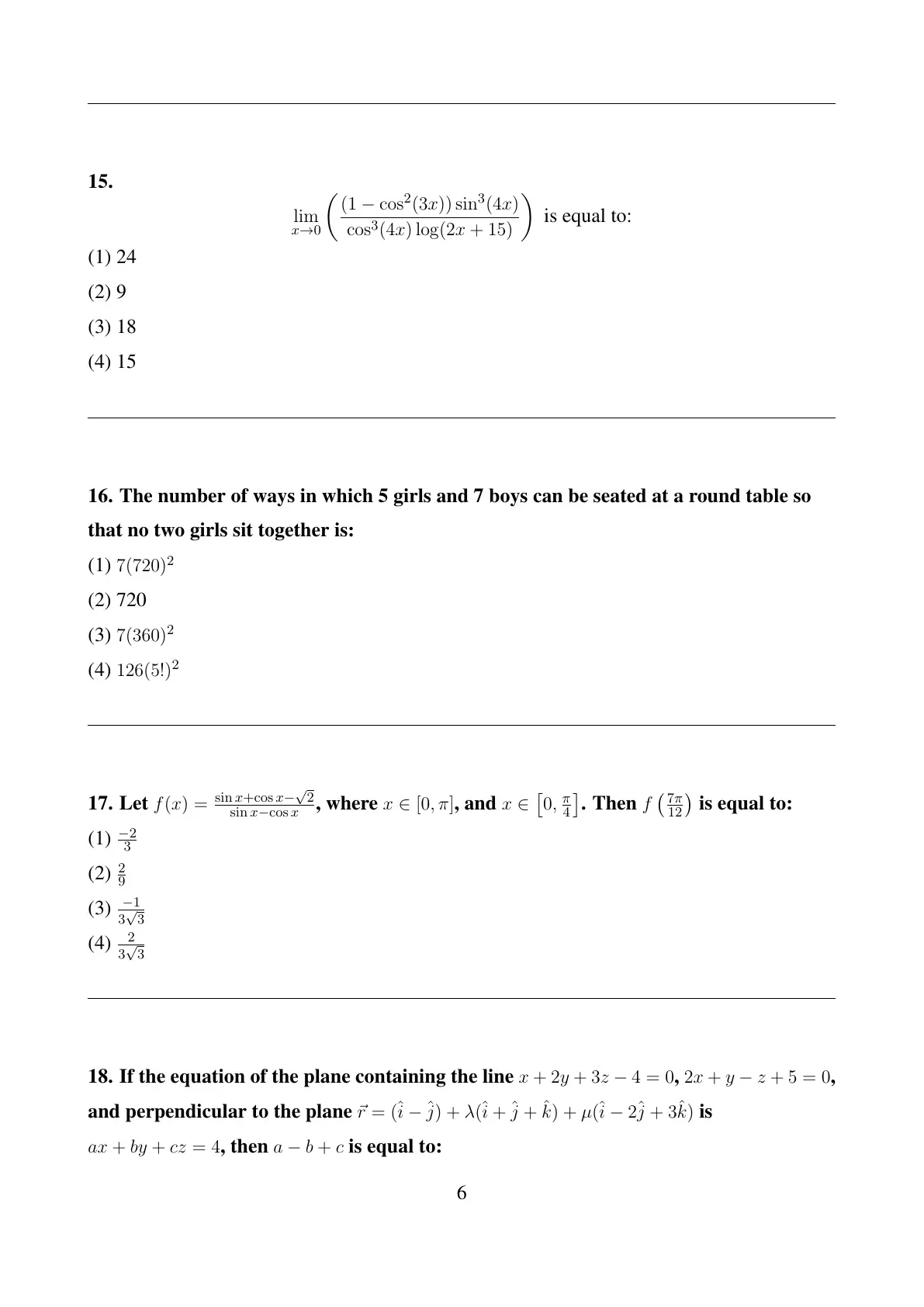
\[ \lim_{x \to 0} \left( \frac{(1 - \cos^2(3x)) \sin^3(4x)}{\cos^3(4x) \log(2x + 15)} \right) is equal to: \]
View Solution
The number of ways in which 5 girls and 7 boys can be seated at a round table so that no two girls sit together is:
Let \( f(x) = \frac{\sin x + \cos x - \sqrt{2}}{\sin x - \cos x} \), where \( x \in \left[0, \pi \right] \), and \( x \in \left[0, \frac{\pi}{4} \right] \). Then \( f\left( \frac{7\pi}{12} \right) \) is equal to:
View Solution
If the equation of the plane containing the line \(x + 2y + 3z - 4 = 0\), \(2x + y - z + 5 = 0\), and perpendicular to the plane \(\vec{r} = (\hat{i} - \hat{j}) + \lambda (\hat{i} + \hat{j} + \hat{k}) + \mu (\hat{i} - 2\hat{j} + 3\hat{k})\) is \(ax + by + cz = 4\), then \(a - b + c\) is equal to:
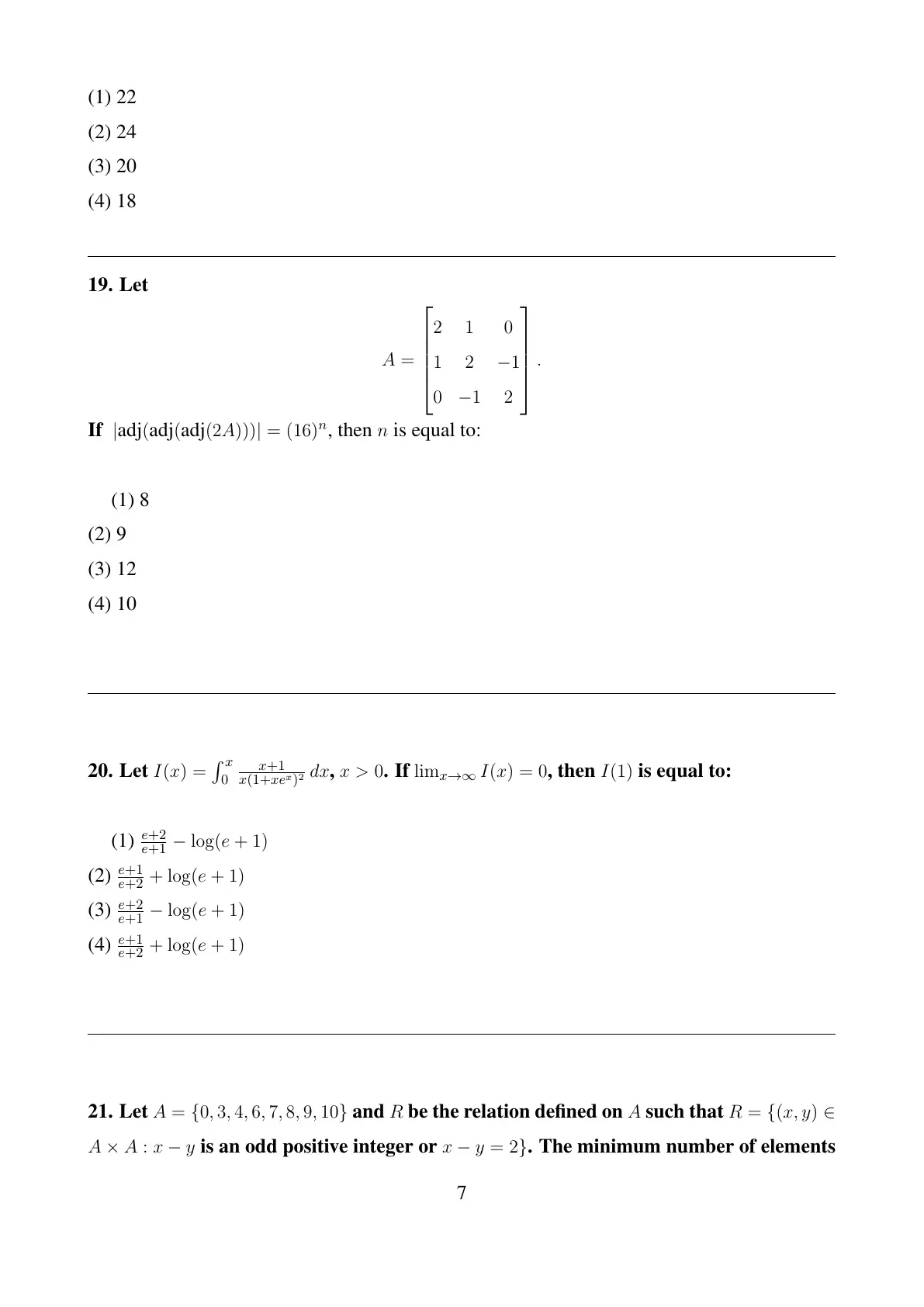
Let \[ A = \begin{bmatrix} 2 & 1 & 0
1 & 2 & -1
0 & -1 & 2 \end{bmatrix}. \]
If \( \left| adj(adj(adj(2A))) \right| = (16)^n \), then \( n \) is equal to:
View Solution
Let \(I(x) = \int_{0}^{x} \frac{x+1}{x(1+x e^x)^2} \, dx\), \(x > 0\). If \(\lim_{x \to \infty} I(x) = 0\), then \(I(1)\) is equal to:
Let \(A = \{0, 3, 4, 6, 7, 8, 9, 10\}\) and \(R\) be the relation defined on \(A\) such that \(R = \{(x, y) \in A \times A : x - y is an odd positive integer or x - y = 2\}\). The minimum number of elements that must be added to \(R\) so that it is a symmetric relation is:
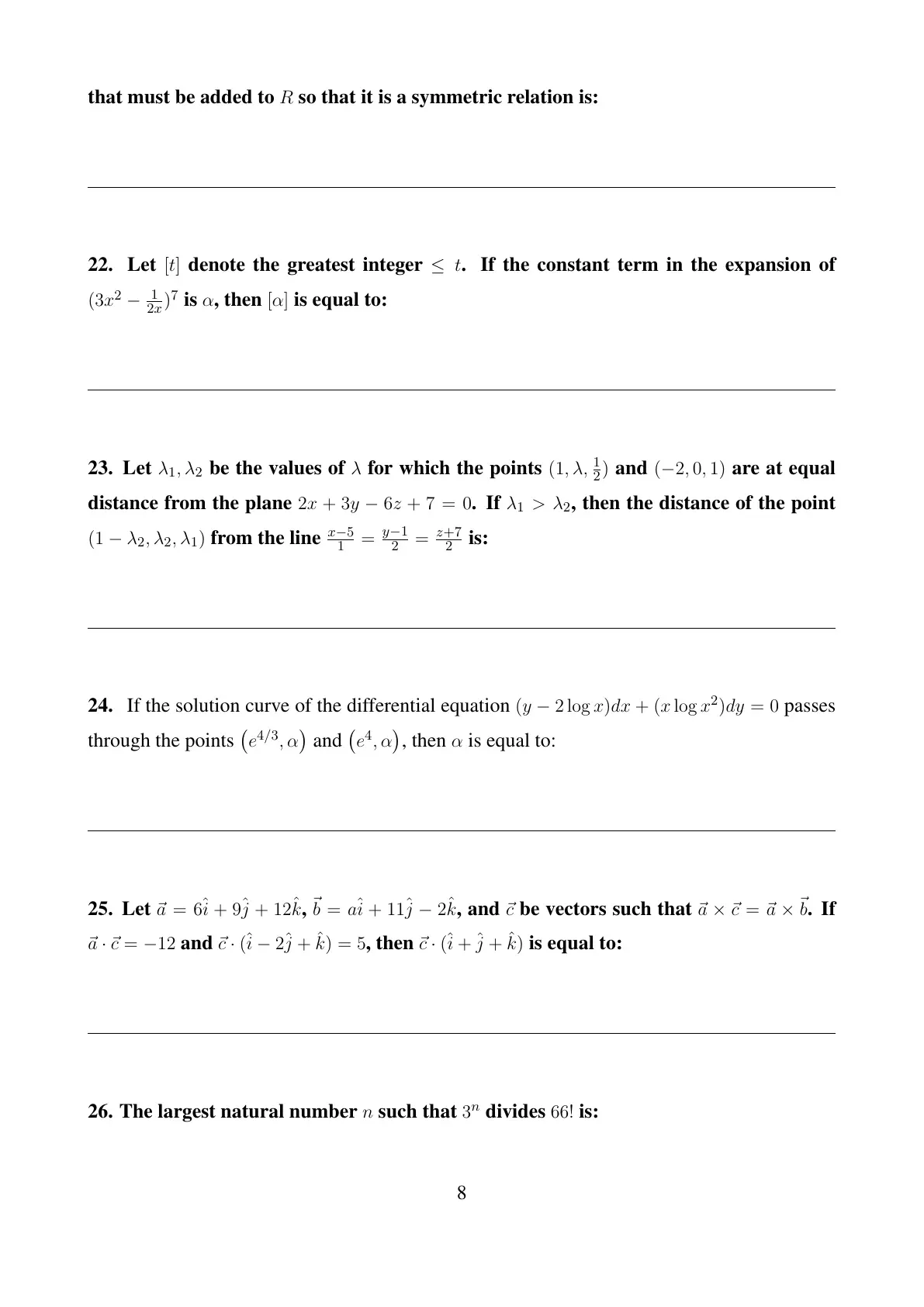
Let \([t]\) denote the greatest integer \(\leq t\). If the constant term in the expansion of \((3x^2 - \frac{1}{2x})^7\) is \(\alpha\), then \([\alpha]\) is equal to:
Let \(\lambda_1, \lambda_2\) be the values of \(\lambda\) for which the points \((1, \lambda, \frac{1}{2})\) and \((-2, 0, 1)\) are at equal distance from the plane \(2x + 3y - 6z + 7 = 0\). If \(\lambda_1 > \lambda_2\), then the distance of the point \((1 - \lambda_2, \lambda_2, \lambda_1)\) from the line \(\frac{x-5}{1} = \frac{y-1}{2} = \frac{z+7}{2}\) is:
If the solution curve of the differential equation \( (y - 2 \log x) dx + (x \log x^2) dy = 0 \) passes through the points \( \left( e^{4/3}, \alpha \right) \) and \( \left( e^4, \alpha \right) \), then \( \alpha \) is equal to:
View Solution
Let \(\vec{a} = 6\hat{i} + 9\hat{j} + 12\hat{k}\), \(\vec{b} = a\hat{i} + 11\hat{j} - 2\hat{k}\), and \(\vec{c}\) be vectors such that \(\vec{a} \times \vec{c} = \vec{a} \times \vec{b}\). If \(\vec{a} \cdot \vec{c} = -12\) and \(\vec{c} \cdot (\hat{i} - 2\hat{j} + \hat{k}) = 5\), then \(\vec{c} \cdot (\hat{i} + \hat{j} + \hat{k})\) is equal to:
The largest natural number \(n\) such that \(3^n\) divides \(66!\) is:
View Solution
Step 1: Use Legendre’s formula.
The largest power of a prime \(p\) dividing \(n!\) is given by: \[ \left\lfloor \frac{n}{p} \right\rfloor + \left\lfloor \frac{n}{p^2} \right\rfloor + \left\lfloor \frac{n}{p^3} \right\rfloor + \dots \]
Step 2: Apply for \(p = 3\) and \(n = 66\).
\[ \left\lfloor \frac{66}{3} \right\rfloor + \left\lfloor \frac{66}{9} \right\rfloor + \left\lfloor \frac{66}{27} \right\rfloor = 22 + 7 + 2 = 31. \]
Final Answer: The largest \(n\) is 31.
Quick Tip: To find the highest power of a prime dividing \(n!\), use successive divisions by powers of the prime.
If \(a_n = \frac{n^3}{n^4 + 147}\), \(n = 1, 2, 3, \dots\), and \(a_n\) is the greatest term in the sequence, then \(a_n\) is equal to:
Let the mean and variance of 8 numbers \(x, y, 10, 12, 6, 12, 4, 8\) be \(9\) and \(9.25\) respectively. If \(x > y\), then \(3x - 2y\) is equal to:
Consider a circle \(C_1 : x^2 + y^2 - 4x - 2y = \alpha - 5\). Let its mirror image in the line \(y = 2x + 1\) be another circle \(C_2 : 5x^2 + 5y^2 - 10x - 10y + 36 = 0\). Let \(r\) be the radius of \(C_2\). Then \(\alpha + r\) is equal to:
View Solution
Let \([t]\) denote the greatest integer \(\leq t\). The \(\int_{\frac{\pi}{6}}^{\frac{5\pi}{6}} \left(8[\csc x] - 5[\cot x]\right) dx\) is equal to:
A cylindrical wire of mass (0.4 ± 0.01)g has length (8 ± 0.04) cm and radius (6 ± 0.03) mm. The maximum error in its density will be:
Options:
The engine of a train moving with speed 10 ms\(^{-1}\) towards a platform sounds a whistle at frequency 400 Hz. The frequency heard by a passenger inside the train is (neglect air speed, speed of sound in air = 330 ms\(^{-1}\)):
Options:
The weight of a body on the earth is 400 N. Then weight of the body when taken to a depth half of the radius of the earth will be:
Options:
A TV transmitting antenna is 98 m high, and the receiving antenna is at ground level. If the radius of the earth is 6400 km, the surface area covered by the transmitting antenna is approximately:
Options:
View Solution
Step 1: Use the formula for surface area covered.
- Maximum distance covered \( d = \sqrt{2Rh_T} \).
- Surface area \( A = \pi d^2 \approx 2\pi Rh_T \).
Step 2: Substitute the values.
\[ A = 2 \cdot 3.14 \cdot 6400 \cdot 98 \cdot 10^{-3}. \] \[ A \approx 3942 \, km^2. \]
Final Answer: Surface area covered = \( 3942 \, km^2 \). Quick Tip: For line-of-sight calculations, use the approximate formula \( d = \sqrt{2Rh} \).
Certain galvanometers have a fixed core made of non-magnetic metallic material. The function of this metallic material is:
Options:
Dimension of \(\frac{1}{\mu_0 \epsilon_0}\) should be equal to:
Options:
Two projectiles A and B are thrown with initial velocities of 40 m/s and 60 m/s at angles 30° and 60° with the horizontal respectively. The ratio of their ranges is (g = 10 m/s\(^2\)):
Options:
In this figure, the resistance of the coil of galvanometer G is 2\(\Omega\). The emf of the cell is 4 V. The ratio of potential difference across \(C_1\) and \(C_2\) is:

Options:
A charge particle moving in magnetic field B has components of velocity along B and perpendicular to B. The path of the charge particle will be:
Options:
Proton (P) and electron (e) will have same de-Broglie wavelength when the ratio of their momentum is (assume \( m_p = 1849 \, m_e \)):
Options:
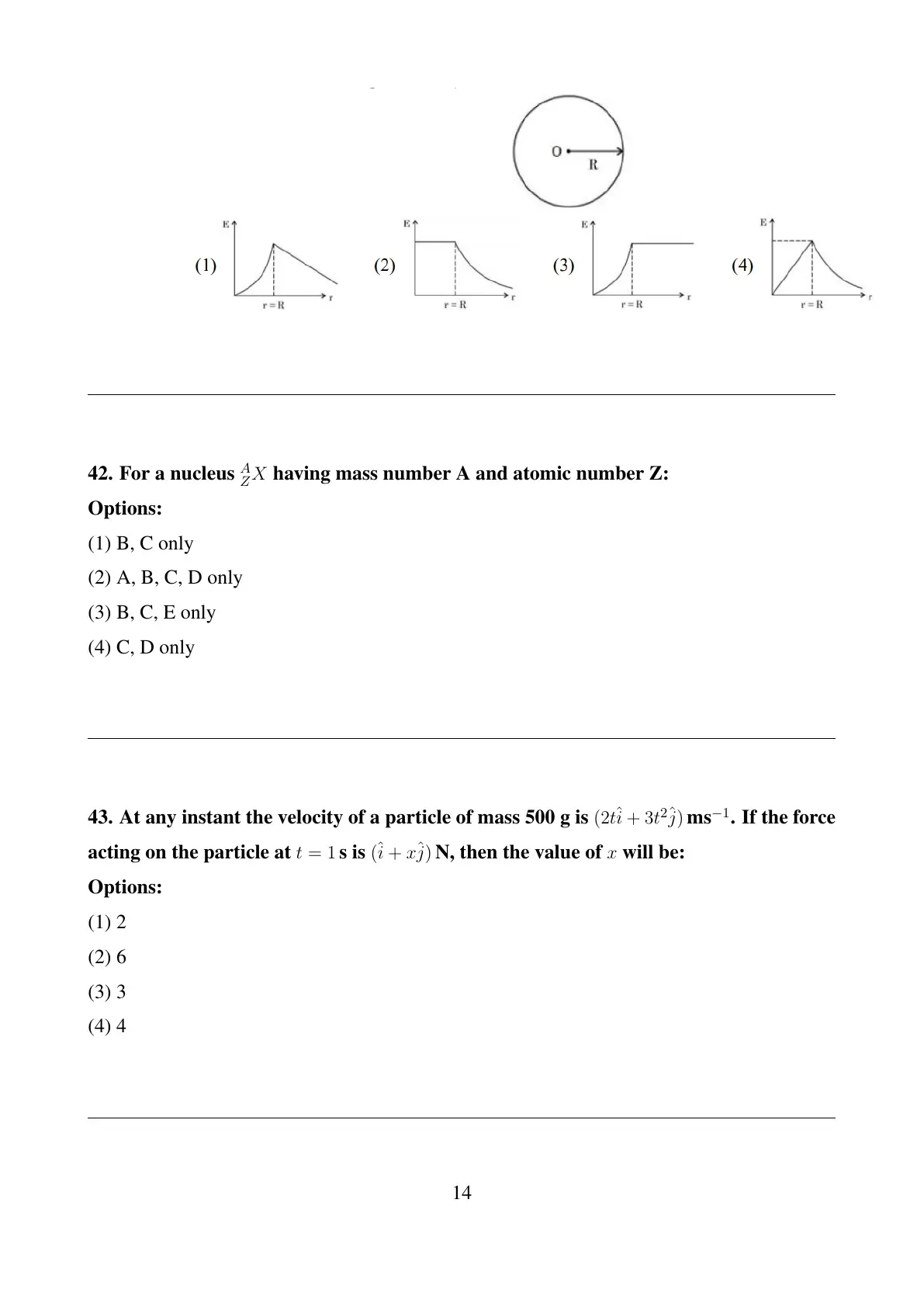
Graphical variation of electric field due to a uniformly charged insulating solid sphere of radius R, with distance r from the center O is represented by:

For a nucleus \( ^A_ZX \) having mass number A and atomic number Z:
Options:
At any instant the velocity of a particle of mass 500 g is \((2t\hat{i} + 3t^2\hat{j})\, ms^{-1}\). If the force acting on the particle at \(t = 1\,s\) is \((\hat{i} + x\hat{j})\,N\), then the value of \(x\) will be:
Options:
Given below are two statements:
Statement I: If \(E\) be the total energy of a satellite moving around the Earth, then its potential energy will be \(\frac{E}{2}\).
Statement II: The kinetic energy of a satellite revolving in an orbit is equal to the half the magnitude of total energy \(E\).
Options:
Two forces having magnitude \(A\) and \(\frac{A}{2}\) are perpendicular to each other. The magnitude of their resultant is:
Options:
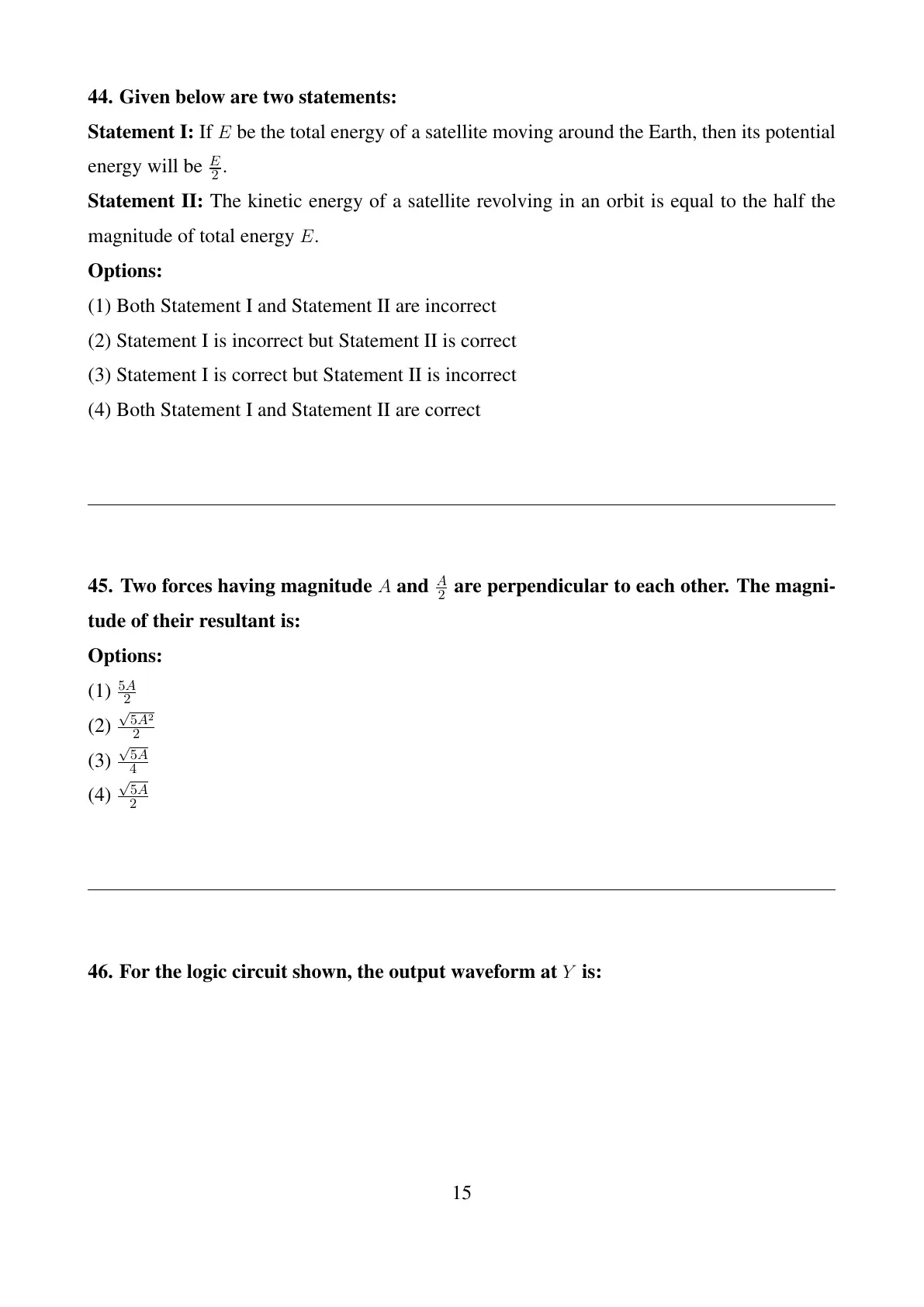
For the logic circuit shown, the output waveform at \(Y\) is:

An aluminium rod with Young's modulus \(Y = 7.0 \times 10^{10}\,N/m^2\) undergoes elastic strain of \(0.04%\). The energy per unit volume stored in the rod in SI unit is:
Options:
Given below are two statements:
Statement I: If heat is added to a system, its temperature must increase.
Statement II: If positive work is done by a system in a thermodynamic process, its volume must increase.
Options:
An air bubble of volume \(1\,cm^3\) rises from the bottom of a lake \(40\,m\) deep to the surface at a temperature of \(12^\circC\). The atmospheric pressure is \(1 \times 10^5\,Pa\), the density of water is \(1000\,kg/m^3\), and \(g = 10\,m/s^2\). The volume of the air bubble when it reaches the surface will be:
Options:
In a reflecting telescope, a secondary mirror is used to:
Options:
View Solution
Step 1: Role of the secondary mirror.
- The secondary mirror in a reflecting telescope redirects light to move the eyepiece outside the tube.
Final Answer: The secondary mirror is used to move the eyepiece outside the telescopic tube.
Quick Tip: Reflecting telescopes eliminate chromatic aberration by using mirrors instead of lenses.
The momentum of a body is increased by 50%. The percentage increase in the kinetic energy of the body is:
A nucleus with mass number 242 and binding energy per nucleon as 7.6 MeV breaks into two fragments each with mass number 121. If each fragment nucleus has binding energy per nucleon as 8.1 MeV, the total gain in binding energy is:
An electric dipole of dipole moment \(6.0 \times 10^{-6}\,C\cdotm\) is placed in a uniform electric field of \(1.5 \times 10^3\,N/C\). The work done in rotating the dipole by \(180^\circ\) in this field will be:
An organ pipe 40 cm long is open at both ends. The speed of sound in air is \(360\,m/s\). The frequency of the second harmonic is:
The moment of inertia of a semicircular ring about an axis, passing through the center and perpendicular to the plane of the ring, is \((1/x)MR^2\), where \(R\) is the radius and \(M\) is the mass of the semicircular ring. The value of \(x\) will be:
Two vertical parallel mirrors A and B are separated by 10 cm. A point object O is placed at a distance of 2 cm from mirror A. The distance of the second nearest image behind mirror A from the mirror A is:

The magnetic intensity at the center of a long current carrying solenoid is found to be \(1.6 \times 10^3\,A/m\). If the number of turns is 8 per cm, then the current flowing through the solenoid is:
A current of 2 A through a wire of cross-sectional area \(25.0\,mm^2\). The number of free electrons in a cubic meter is \(2.0 \times 10^{28}\). The drift velocity of the electrons is \(\_\_\_\_ \times 10^{-6}\,m/s\) (given, charge on electron \(= 1.6 \times 10^{-19}\,C\)):
An oscillating LC circuit consists of a \(75\,mH\) inductor and a \(1.2\,\muF\) capacitor. If the maximum charge to the capacitor is \(2.7\,\muC\). The maximum current in the circuit will be:
An air bubble of diameter \(6\,mm\) rises steadily through a solution of density \(1750\,kg/m^3\) at the rate of \(0.35\,cm/s\). The coefficient of viscosity of the solution (neglect density of air) is \(\_\_\_\_\,Pas\) (given, \(g = 10\,m/s^2\)):
The reaction \[ \frac{1}{2} H_2(g) + AgCl(s) \leftrightharpoons H^+(aq) + Cl^-(aq) + Ag(s) \]
occurs in which of the given galvanic cells?
View Solution
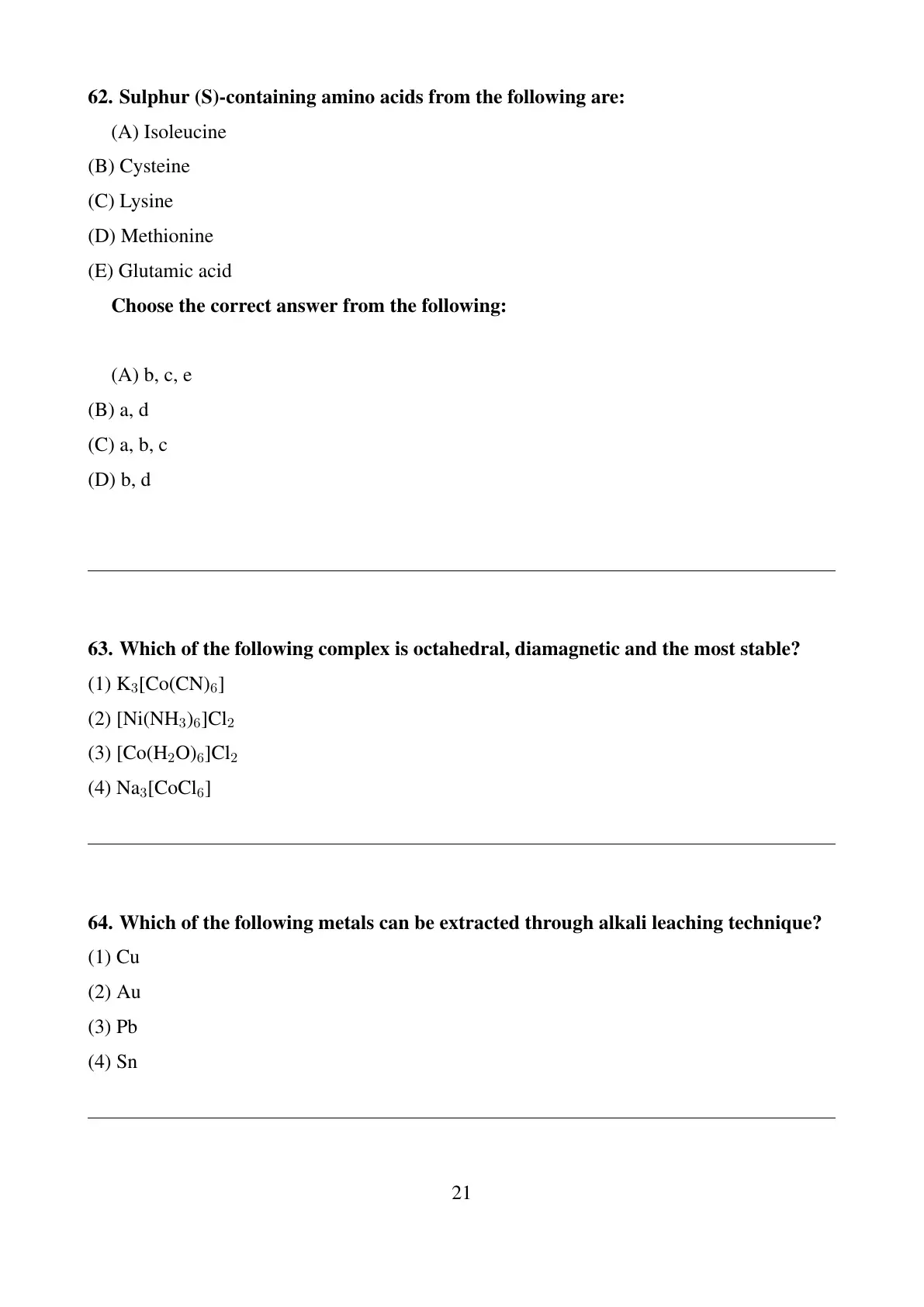
Sulphur (S)-containing amino acids from the following are:
View Solution
Which of the following complex is octahedral, diamagnetic and the most stable?
View Solution
Which of the following metals can be extracted through alkali leaching technique?
View Solution
Alkali leaching technique: This technique is used to extract metals that are amphoteric in nature. Amphoteric metals can react with both acids and bases.
Amphoteric nature of Sn: Tin (Sn) is amphoteric, meaning it reacts with alkali solutions (such as NaOH) to form soluble complexes. For example:
\[ SnO + 2NaOH \to Na_2SnO_2 + H_2O \]
Comparison with other metals:
Copper (Cu): Copper is not amphoteric; it does not react with alkalis.
Gold (Au): Gold is a noble metal and does not exhibit amphoteric behavior.
Lead (Pb): While lead exhibits slight amphoteric behavior, it is not commonly extracted through alkali leaching.
Thus, Sn is the only metal from the options that can be extracted via alkali leaching due to its amphoteric nature. Quick Tip: Amphoteric metals like Sn and Al can react with both acids and bases, making them suitable for alkali leaching processes.
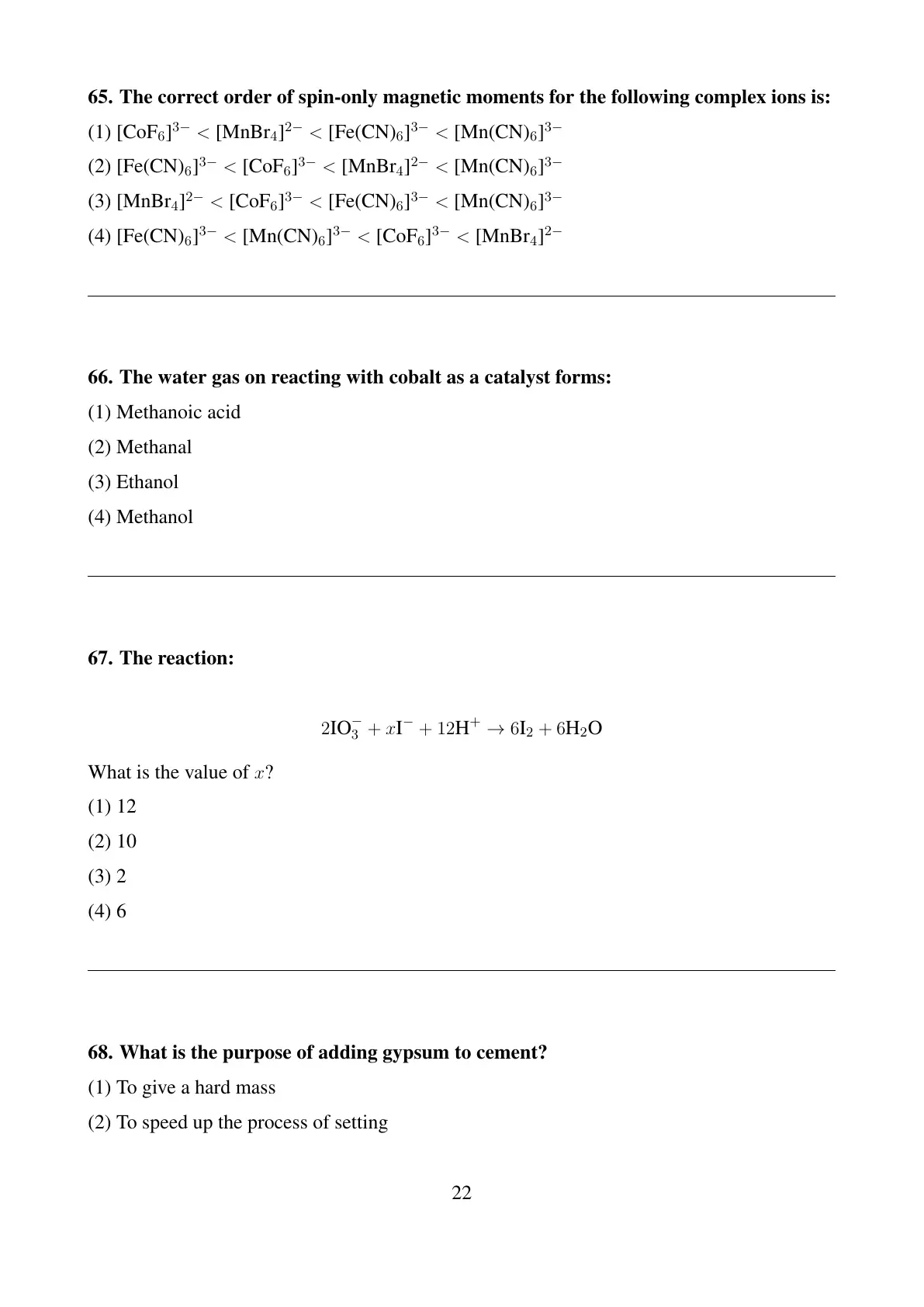
The correct order of spin-only magnetic moments for the following complex ions is:
View Solution
The water gas on reacting with cobalt as a catalyst forms:
View Solution
The reaction between water gas (a mixture of CO and H\(_2\)) and a catalyst produces methanol (CH\(_3\)OH). The reaction is as follows: \[ CO + 2H_2 \xrightarrow{ZnO, Cr\(_2\)O\(_3\), 700K} CH_3OH \]
Reactants: CO and H\(_2\) are essential components of water gas.
Catalyst: ZnO and Cr\(_2\)O\(_3\) act as catalysts at a temperature of 700 K to speed up the reaction.
Product: Methanol is formed as the primary product due to the reaction of CO with H\(_2\). Quick Tip: Water gas reactions involve catalysts like ZnO or Cr\(_2\)O\(_3\) for selective synthesis of methanol at high temperatures.
The reaction:
\[ 2IO_3^- + xI^- + 12H^+ \to 6I_2 + 6H_2O \]
What is the value of \(x\)?
View Solution
To balance the given redox reaction:
The oxidation number of I in IO\(_3^-\) is +5, while in I\(_2\), it is 0.
The n-factor for IO\(_3^-\) is 5 because each IO\(_3^-\) gains 5 electrons to become I\(_2\).
I\(^-\) is oxidized to I\(_2\), so its n-factor is 1.
To determine the value of \(x\), we use the molar ratio of IO\(_3^-\) to I\(^-\), which is 1:5: \[ IO_3^- + 6H^+ + 5I^- \to 3I_2 + 3H_2O \]
To obtain 6 moles of I\(_2\), the equation is multiplied by 2: \[ 2IO_3^- + 12H^+ + 10I^- \to 6I_2 + 6H_2O \]
Thus, \(x = 10\). Quick Tip: In redox reactions, balance the number of electrons gained and lost using the n-factor of the reacting species.
What is the purpose of adding gypsum to cement?
View Solution
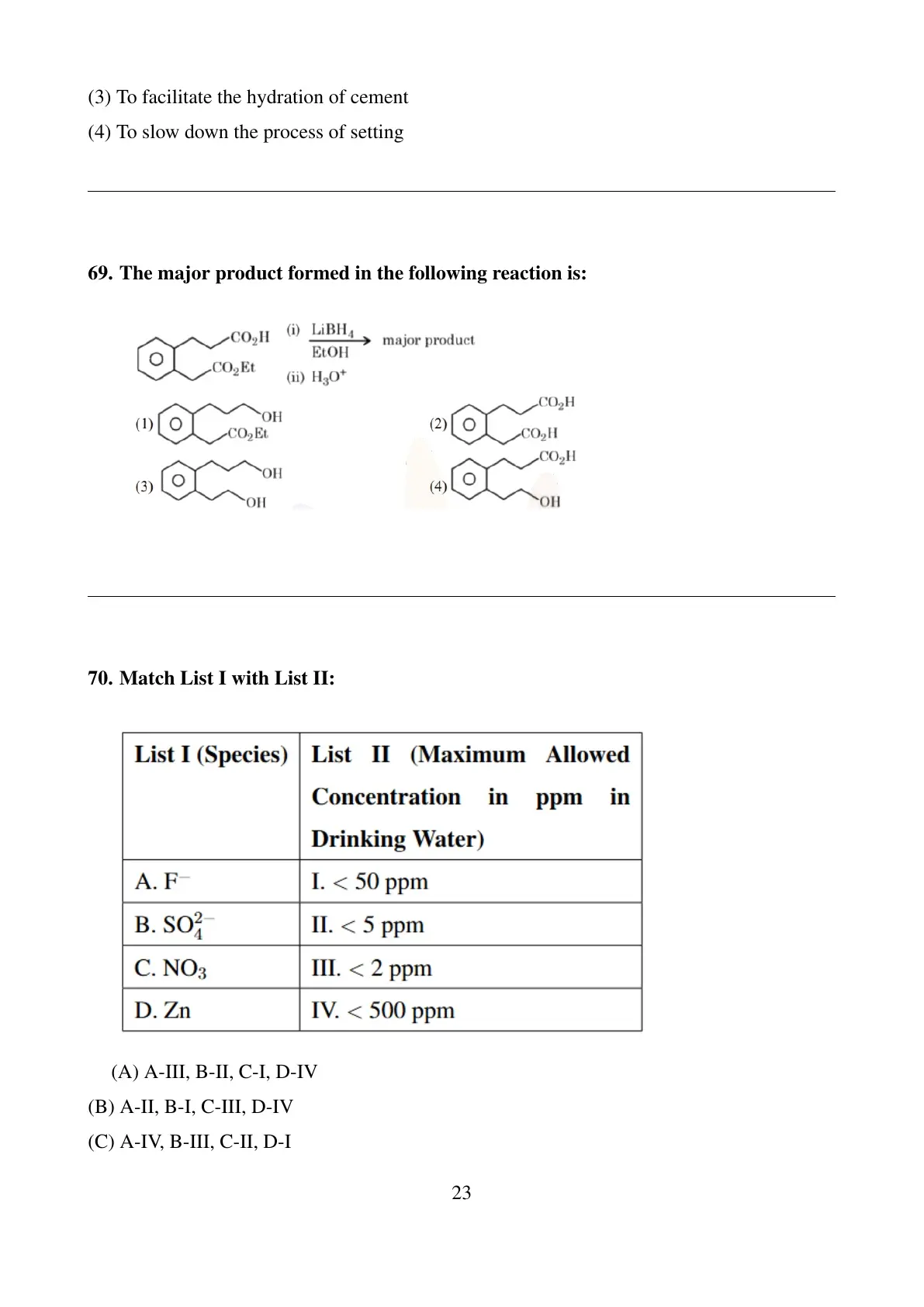
The major product formed in the following reaction is:

View Solution
Match List I with List II:

View Solution
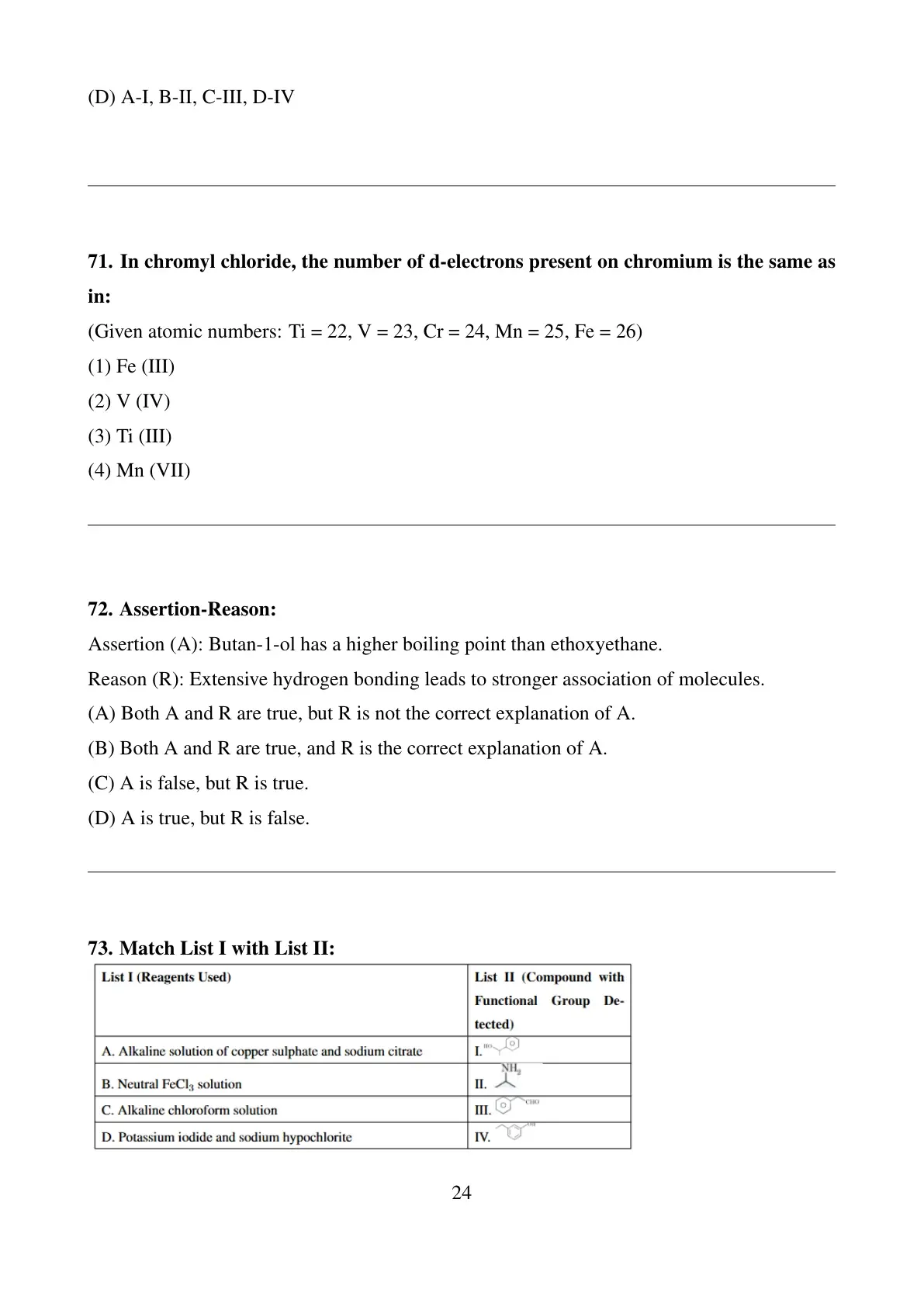
In chromyl chloride, the number of d-electrons present on chromium is the same as in:
(Given atomic numbers: Ti = 22, V = 23, Cr = 24, Mn = 25, Fe = 26)
View Solution
Assertion-Reason:
Assertion (A): Butan-1-ol has a higher boiling point than ethoxyethane.
Reason (R): Extensive hydrogen bonding leads to stronger association of molecules.
View Solution
Match List I with List II:

View Solution
Match List I with List II:

View Solution
Match List I with List II:

View Solution
The correct order of electronegativity for given elements is:
View Solution
Given below are two statements:
Statement I: Lithium and Magnesium do not form superoxide.
Statement II: The ionic radius of Li\(^+\) is larger than the ionic radius of Mg\(^{2+}\).
View Solution
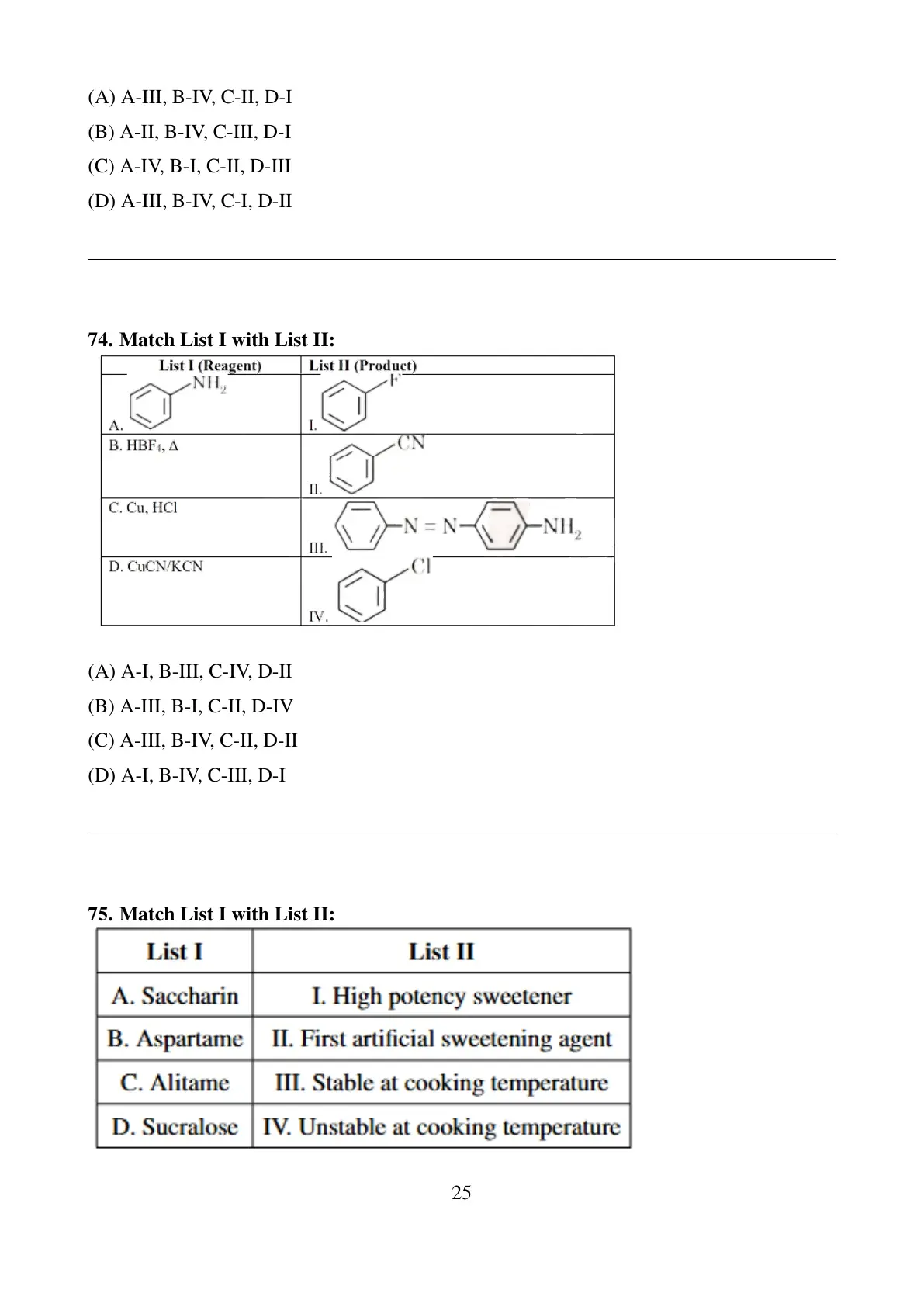
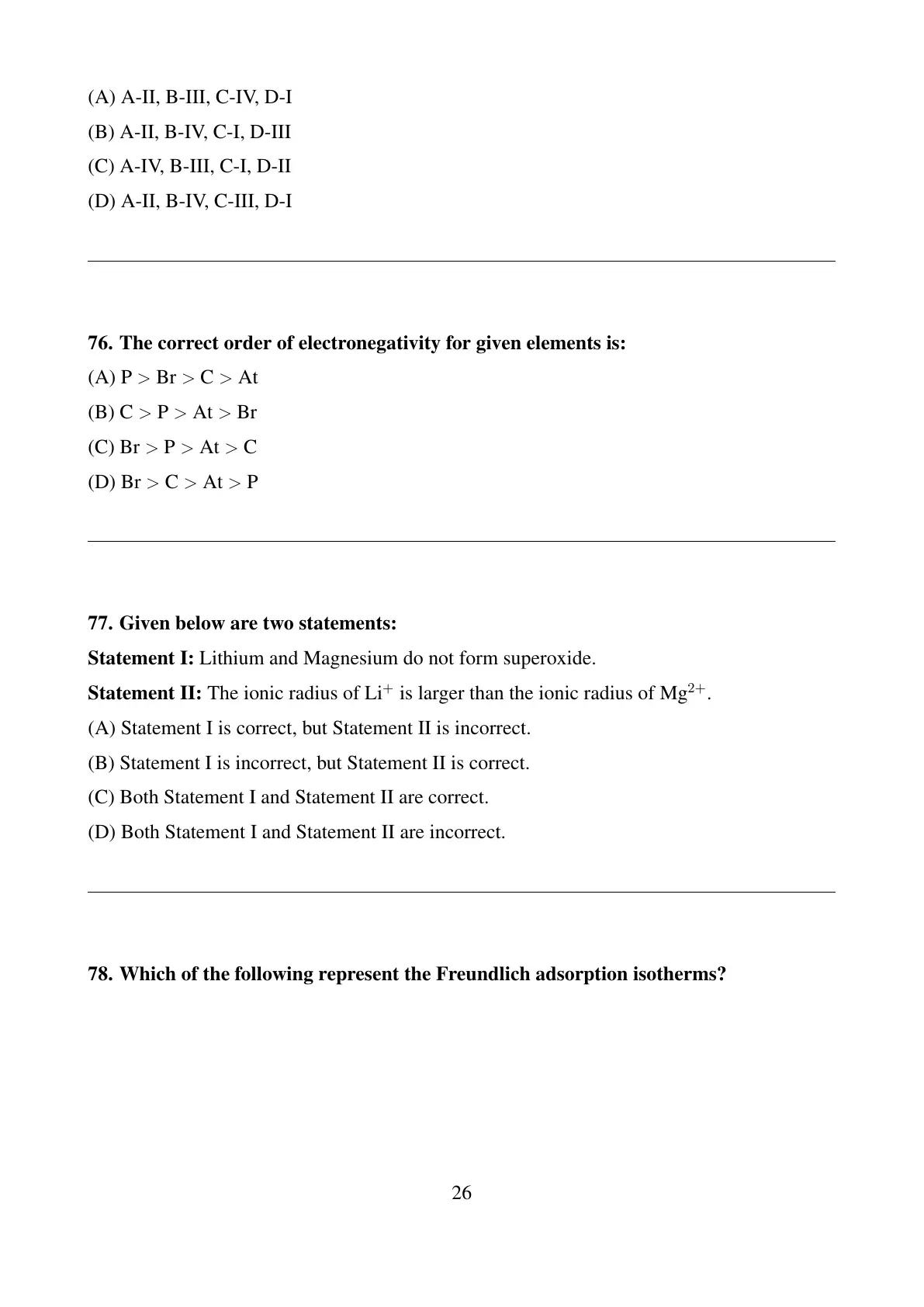
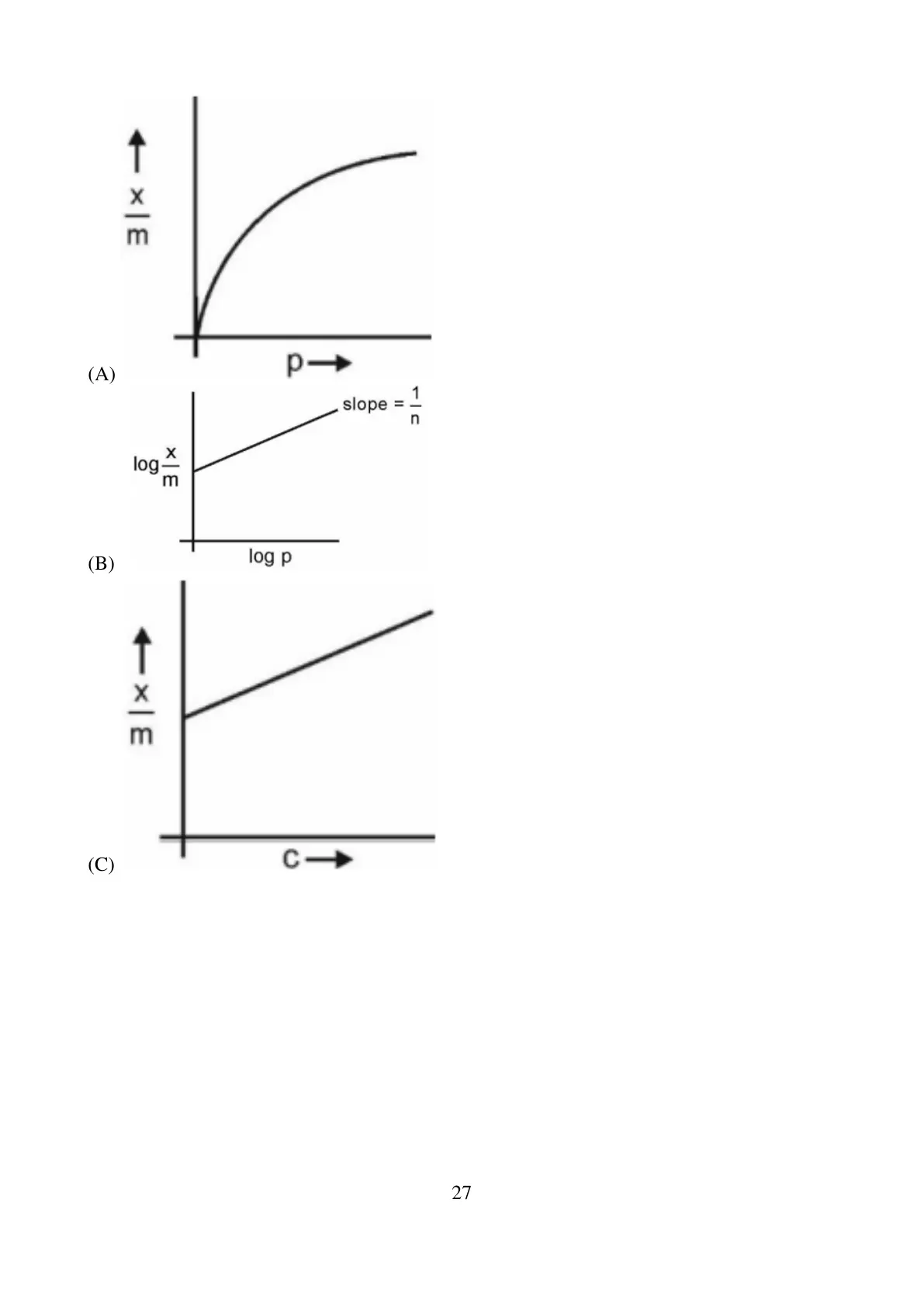
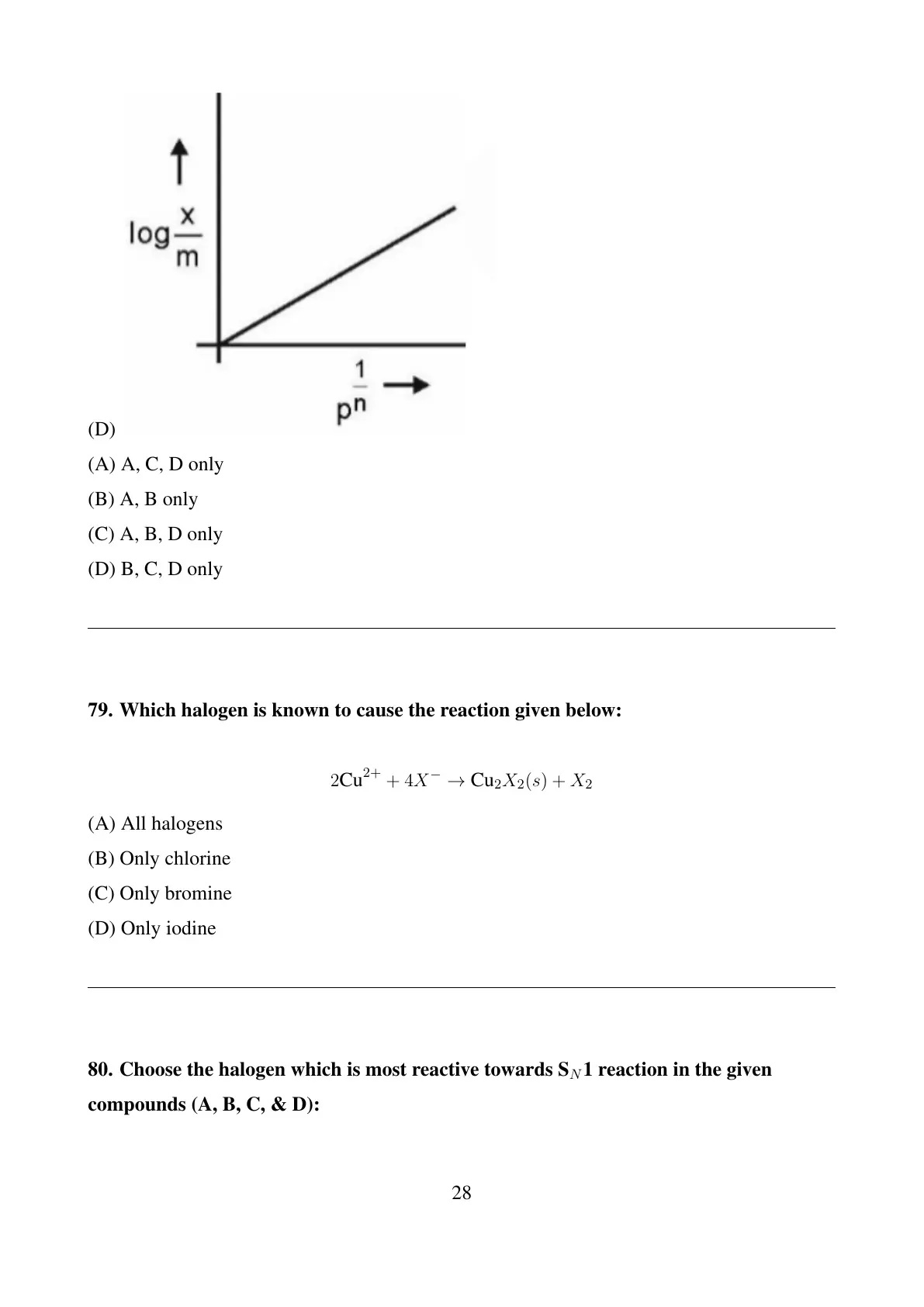
Which of the following represent the Freundlich adsorption isotherms?
- (A)
![]()
- (B)
![]()
- (C)
![]()
- (D)
![]()
- (A) A, C, D only
- (B) A, B only
- (C) A, B, D only
- (D) B, C, D only


View Solution
Which halogen is known to cause the reaction given below:
\[ 2Cu^{2+} + 4X^- \to Cu_2X_2(s) + X_2 \]
View Solution
The reaction given involves the reduction of Cu\(^{2+}\) ions to Cu\(^+\), forming Cu\(_2\)I\(_2\) as a precipitate and iodine gas (I\(_2\)). Among the halogens, only iodine has the required reducing strength to cause this reaction: \[ 2Cu^{2+} + 4I^- \to Cu_2I_2 + I_2 \] Quick Tip: Iodide ions are strong enough to reduce Cu\(^{2+}\) to Cu\(^+\), forming Cu\(_2\)I\(_2\) as a solid precipitate.
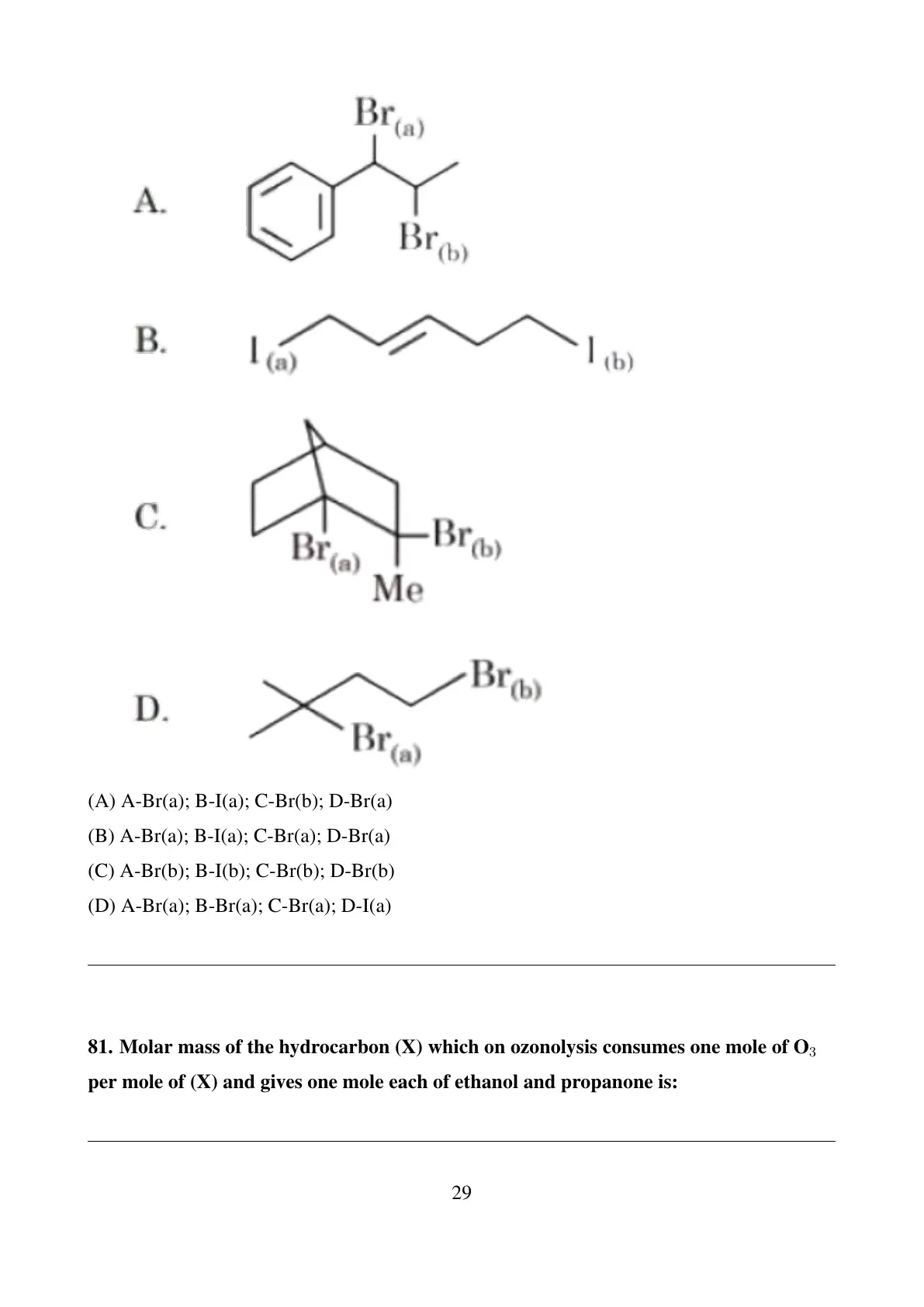
Choose the halogen which is most reactive towards S\(_N\)1 reaction in the given compounds (A, B, C, \& D):

View Solution
Molar mass of the hydrocarbon (X) which on ozonolysis consumes one mole of O\(_3\) per mole of (X) and gives one mole each of ethanol and propanone is:
View Solution
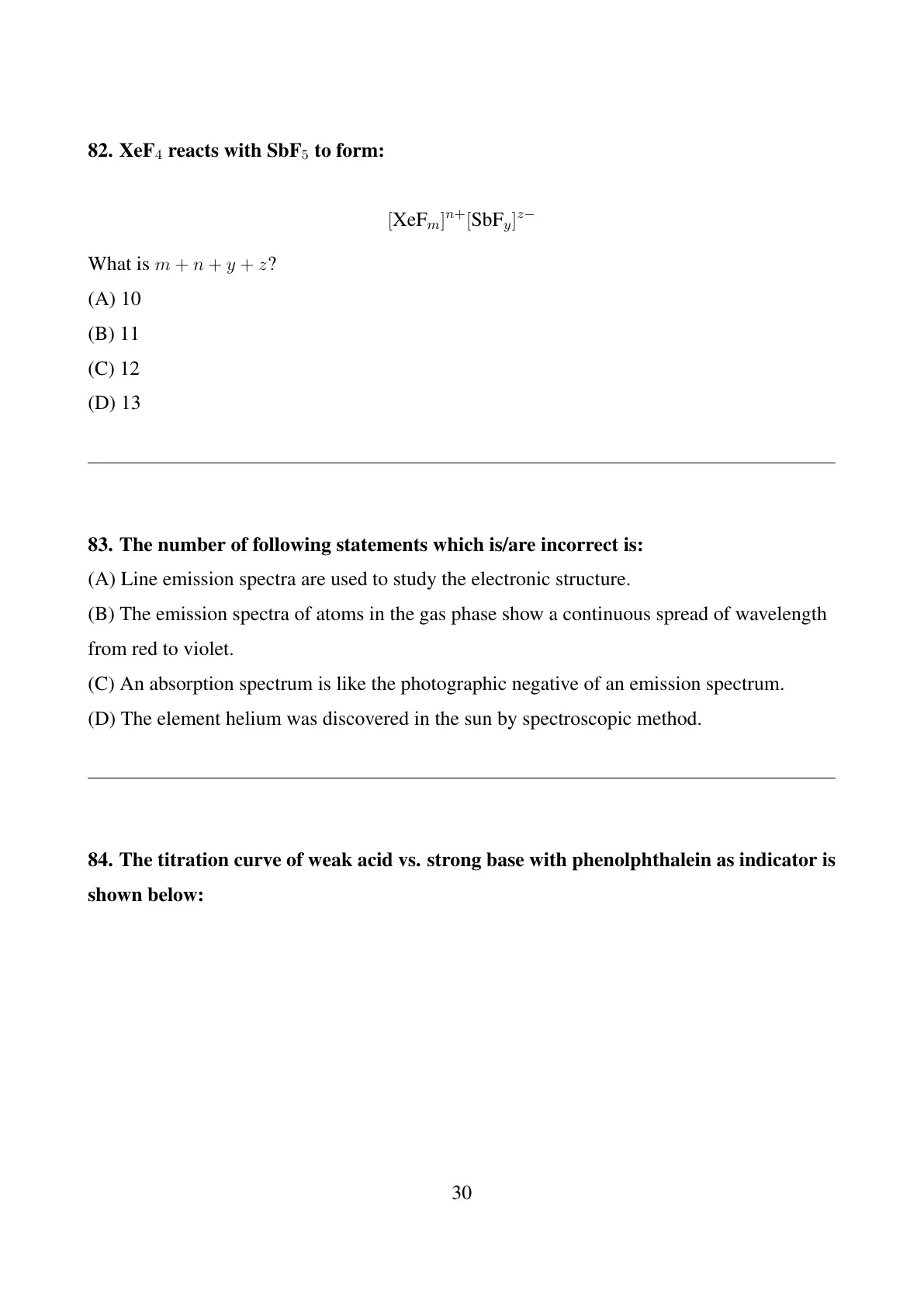
XeF\(_4\) reacts with SbF\(_5\) to form:
\[ [XeF_m]^{n+}[SbF_y]^{z-} \]
What is \(m+n+y+z\)?
The number of following statements which is/are incorrect is:
View Solution
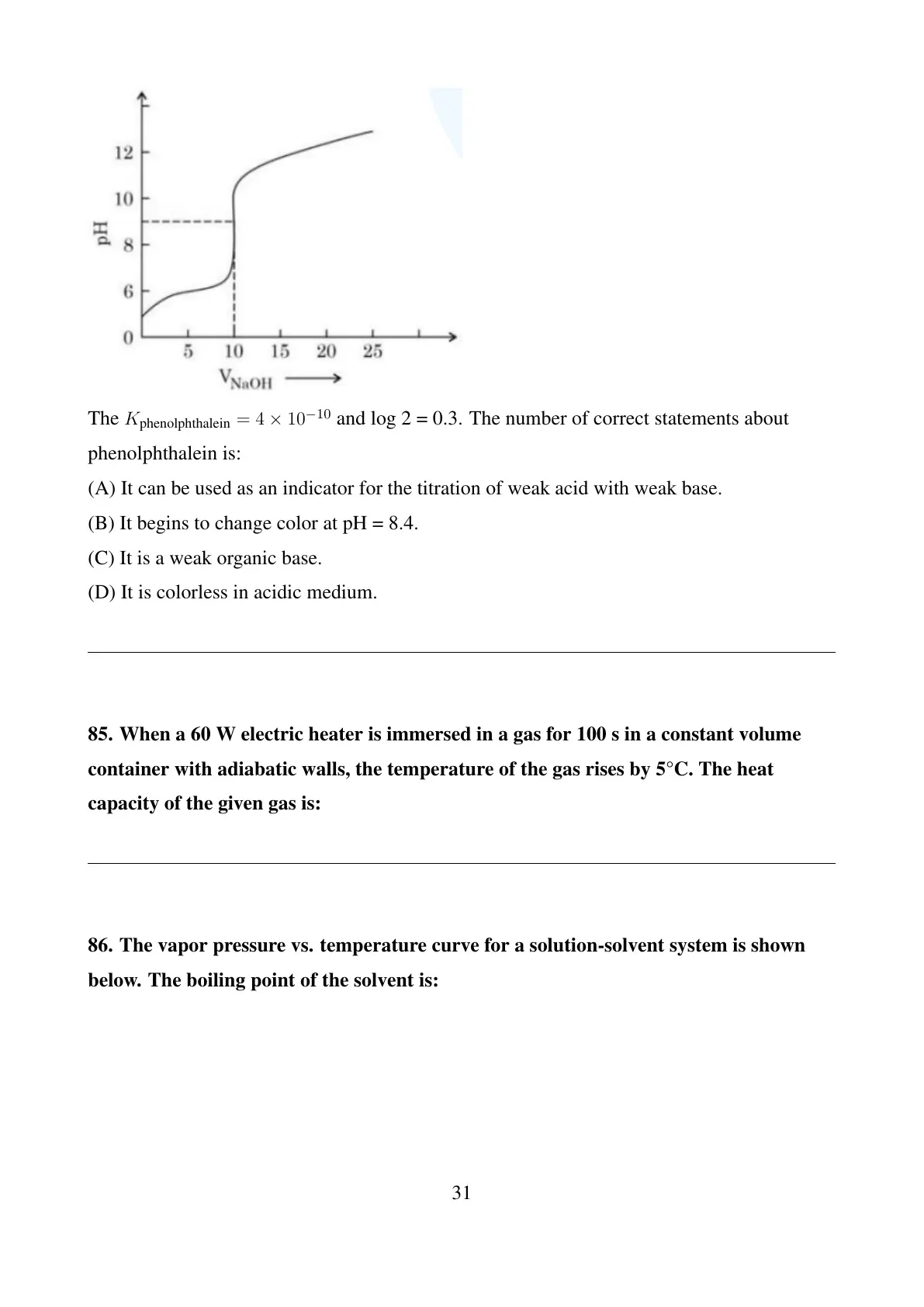
The titration curve of weak acid vs. strong base with phenolphthalein as indicator is shown below:

The \(K_{phenolphthalein} = 4 \times 10^{-10}\) and log 2 = 0.3. The number of correct statements about phenolphthalein is:
View Solution
When a 60 W electric heater is immersed in a gas for 100 s in a constant volume container with adiabatic walls, the temperature of the gas rises by 5°C. The heat capacity of the given gas is:
View Solution
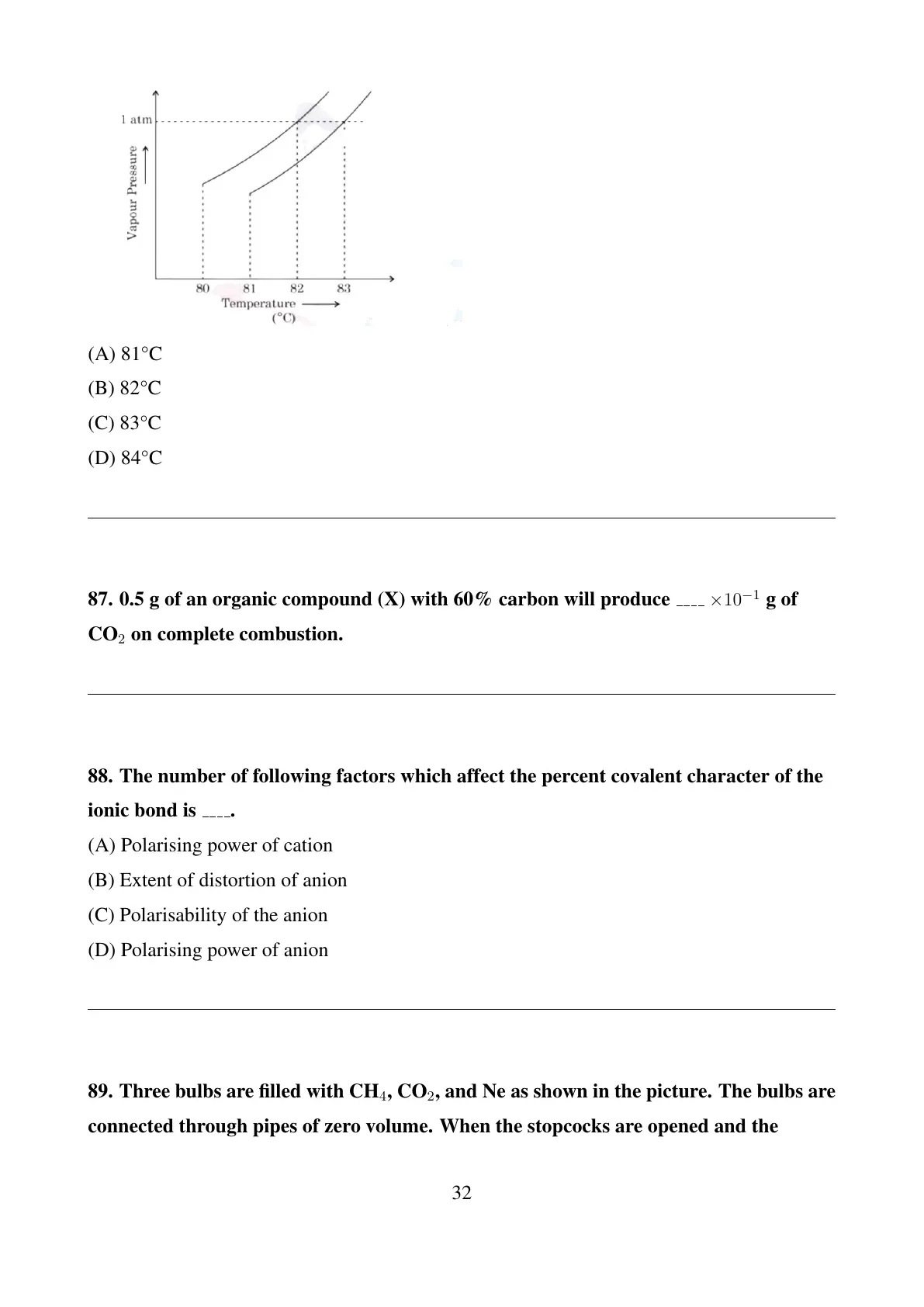
The vapor pressure vs. temperature curve for a solution-solvent system is shown below. The boiling point of the solvent is:

View Solution
0.5 g of an organic compound (X) with 60% carbon will produce ____ \(\times 10^{-1}\) g of CO\(_2\) on complete combustion.
View Solution
The number of following factors which affect the percent covalent character of the ionic bond is ____.
View Solution
The percent covalent character in an ionic bond is influenced by:
(A) Polarising power of the cation: A small, highly charged cation can polarise the anion's electron cloud, increasing covalent character.
% Option
(B) Extent of distortion of the anion: A larger, more easily distortable anion increases covalent character.
% Option
(C) Polarisability of the anion: A more polarisable anion (e.g., I\(^-\)) results in a higher covalent character.
The polarising power of the anion does not contribute to covalent character.
Quick Tip: Fajans' rule explains the percent covalent character of ionic bonds: small, highly charged cations and large, polarisable anions increase covalent character.
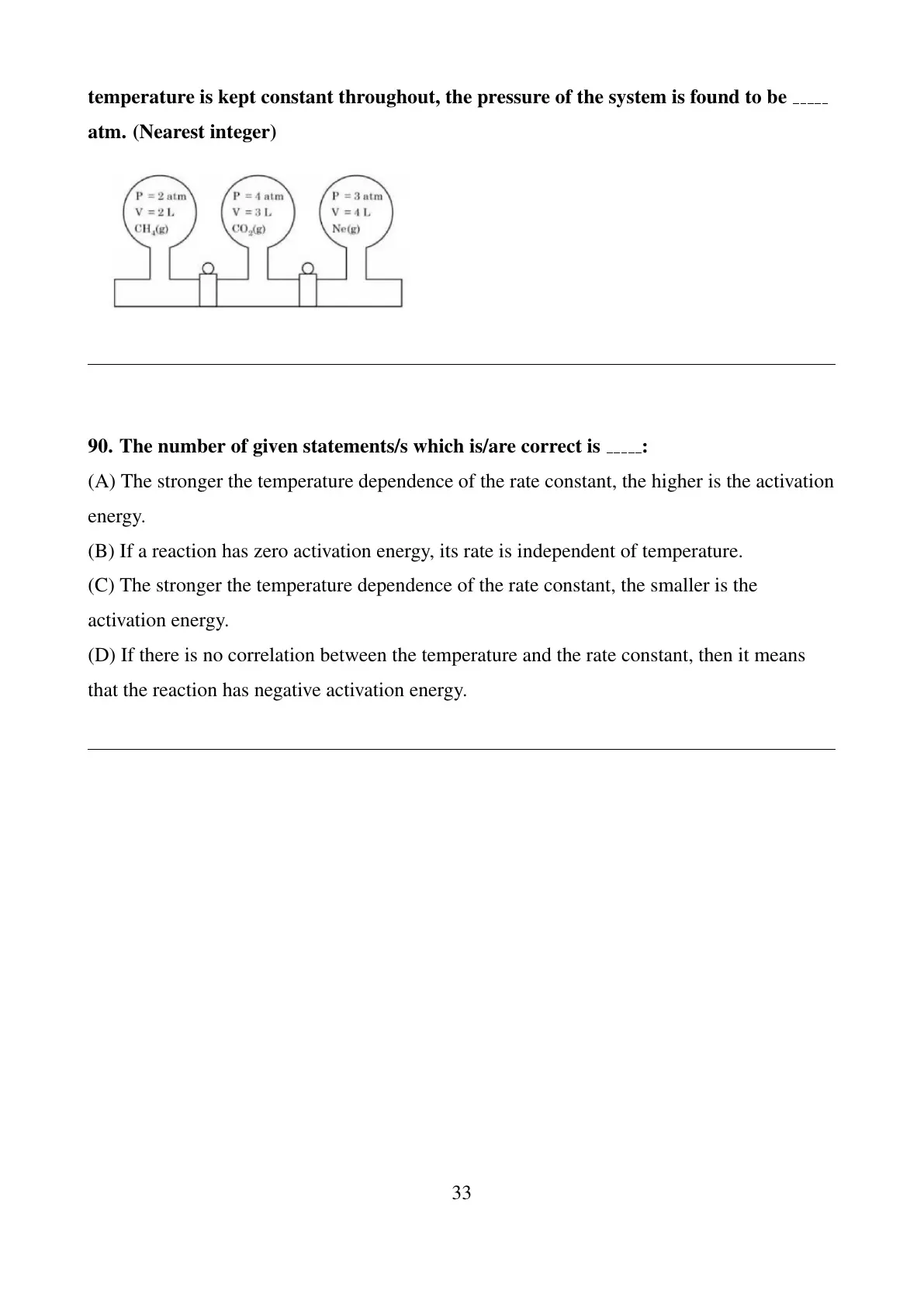
Three bulbs are filled with CH\(_4\), CO\(_2\), and Ne as shown in the picture. The bulbs are connected through pipes of zero volume. When the stopcocks are opened and the temperature is kept constant throughout, the pressure of the system is found to be _____ atm. (Nearest integer)

View Solution
The number of given statements/s which is/are correct is _____:
View Solution
Also Check:
JEE Main 2023 8 April Shift 1 Question Paper by Coaching Institute
| Coaching Institutes | Question Paper with Answer Key PDF |
|---|---|
| Aakash BYJUs | Check Here |
| Reliable Institute | Physics Chemistry Mathematics |
| Resonance | Physics Chemistry Mathematics |
| Vedantu | Check Here |
| Narayana College | Physics Chemistry Mathematics |
JEE Main 2023 Paper Analysis April 8 Shift 1
JEE Main 2023 Paper Analysis for the exam on April 8 Shift 1 is available here. Candidates can check subject-wise paper analysis for the exam on April 8 Shift 1 here along with the topics with the highest weightage.
Also Check:
JEE Main 2023 Question Paper Session 2 (April)
JEE Main 2023 Question Paper Session 1 (January)
JEE Main aspirants can practice and check their exam prep level by attempting the question papers from the January Session. The table below shows JEE Main 2023 Question Paper PDF for Session 1 to practice.
JEE Main Previous Year Question Paper
| JEE Main 2022 Question Paper | JEE Main 2021 Question Paper | JEE Main 2020 Question Paper |
| JEE Main 2019 Question Paper | JEE Main 2018 Question Paper | JEE Main 2017 Question Paper |



Comments