



.png?h=35&w=35&mode=stretch)
JEE Main 2023 Jan 25 Shift 1 Question Paper is available here. NTA successfully conducted JEE Main 2023 Jan 25 Shift 1 from 9 AM to 12 PM for B.E./B.Tech paper. Based on the initial student reactions, Mathematics section was found to be the most tough one where as Physics questions were reported to be direct and easy to attempt. Surprisingly, students found Chemistry to be a tricky section to answer. The overall difficulty of the exam was reported to be moderately difficult. Candidates can now download the JEE Main 2023 Question Paper PDF with Solution and JEE Main 2023 Answer Key for Jan 25 Shift 1 using the link below.
Related Links:
- Download JEE Main Previous Year Question Papers PDF with Solutions
- Download JEE Main 2025 Question Paper for all Shifts
JEE Main 2023 Question Paper Jan 25 Shift 1- Download PDF
| JEE Main 2023 25 Jan Shift 1 Question Paper with Solution PDF |  Download Download |
Check Solution |

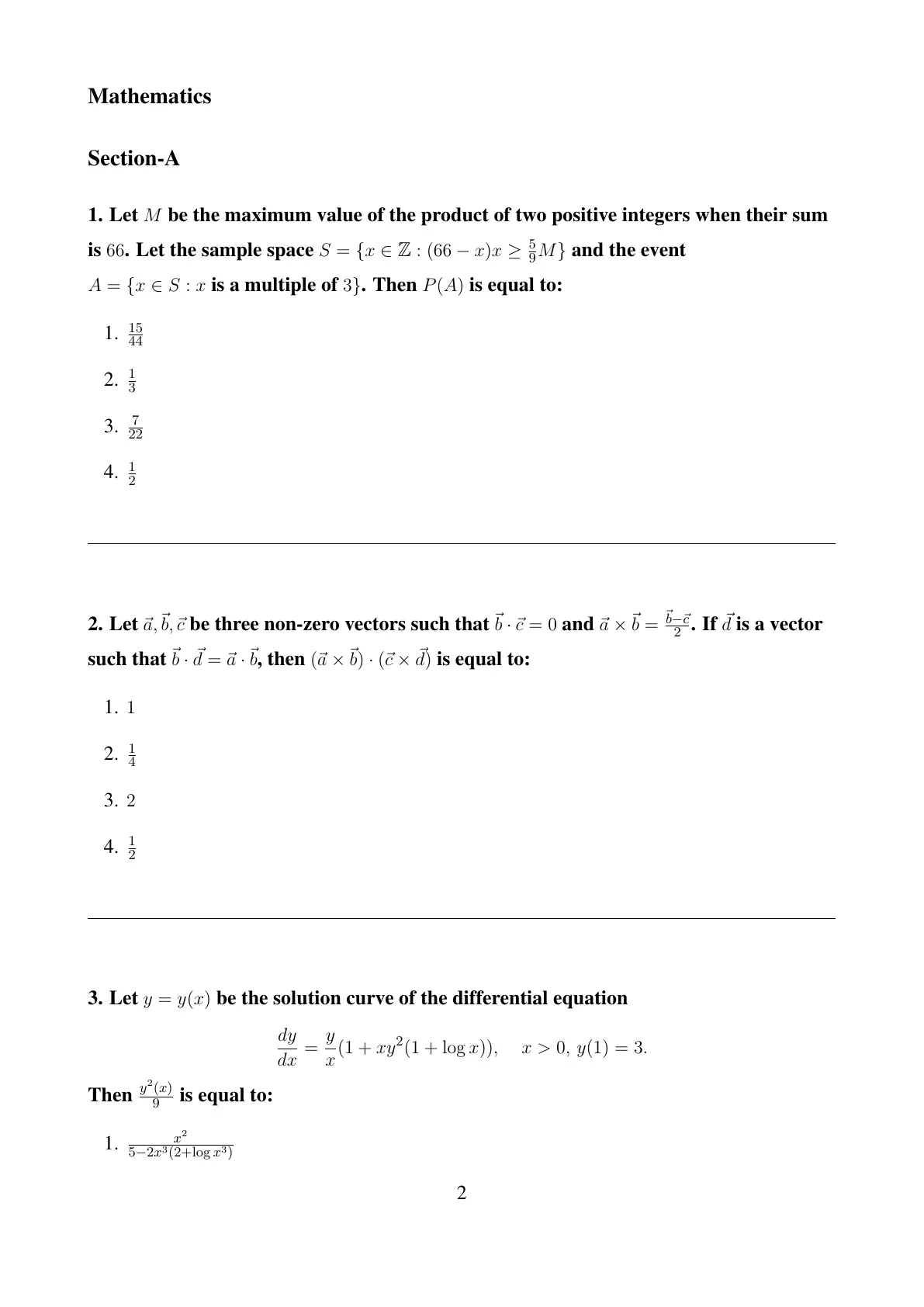
Let \(M\) be the maximum value of the product of two positive integers when their sum is \(66\). Let the sample space \(S = \{x \in \mathbb{Z} : (66 - x)x \geq \frac{5}{9}M\}\) and the event \(A = \{x \in S : x is a multiple of 3\}\). Then \(P(A)\) is equal to:
View Solution
Let \(\vec{a}, \vec{b}, \vec{c}\) be three non-zero vectors such that \(\vec{b} \cdot \vec{c} = 0\) and \(\vec{a} \times \vec{b} = \frac{\vec{b} - \vec{c}}{2}\). If \(\vec{d}\) is a vector such that \(\vec{b} \cdot \vec{d} = \vec{a} \cdot \vec{b}\), then \((\vec{a} \times \vec{b}) \cdot (\vec{c} \times \vec{d})\) is equal to:
View Solution
Let \(y = y(x)\) be the solution curve of the differential equation \[ \frac{dy}{dx} = \frac{y}{x}(1 + xy^2(1 + \log x)), \quad x > 0, \, y(1) = 3. \]
Then \(\frac{y^2(x){9}\) is equal to:
View Solution
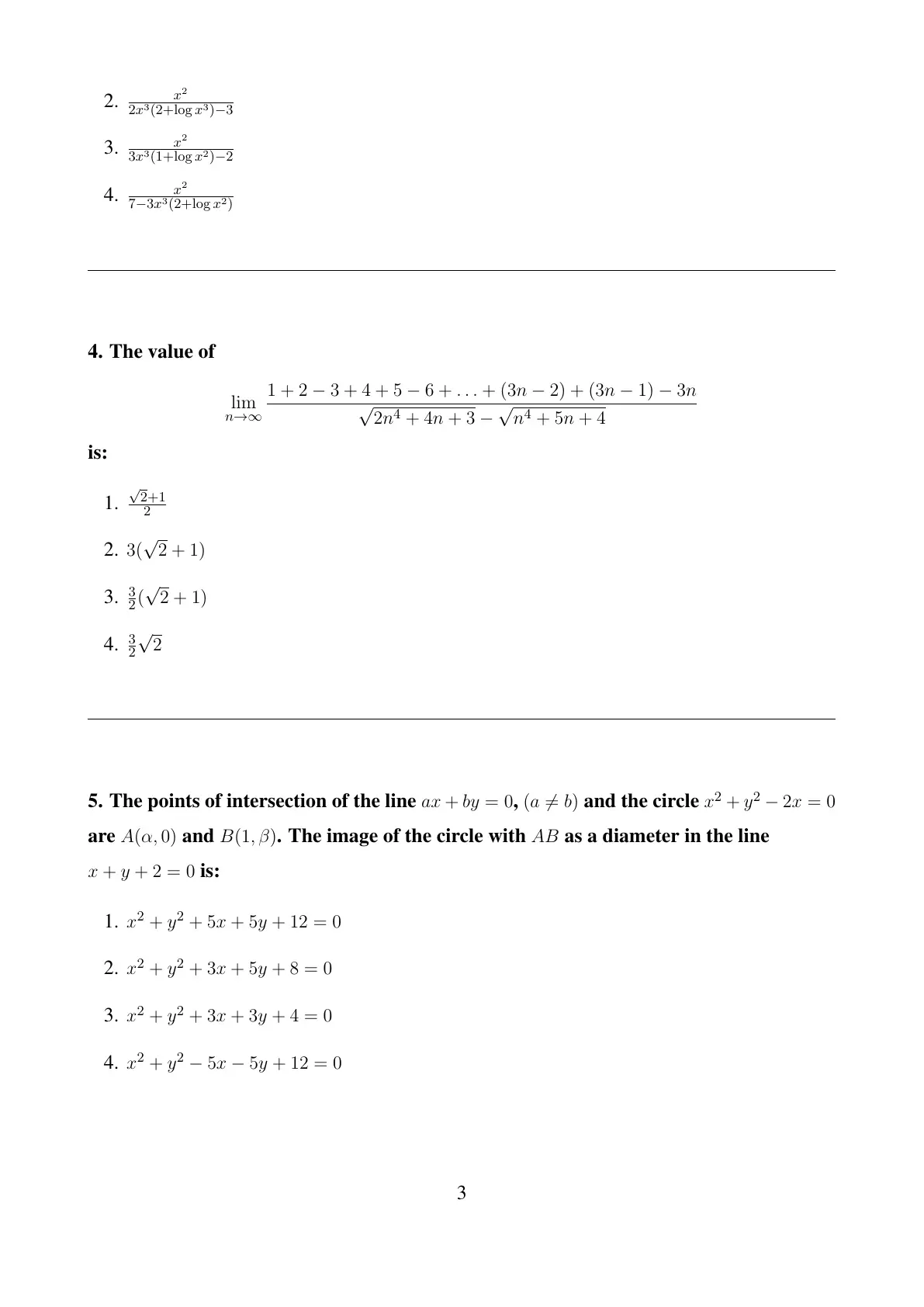
The value of \[ \lim_{n \to \infty} \frac{1 + 2 - 3 + 4 + 5 - 6 + \ldots + (3n - 2) + (3n - 1) - 3n}{\sqrt{2n^4 + 4n + 3} - \sqrt{n^4 + 5n + 4}} \]
is:
View Solution
The points of intersection of the line \(ax + by = 0\), \((a \neq b)\) and the circle \(x^2 + y^2 - 2x = 0\) are \(A(\alpha, 0)\) and \(B(1, \beta)\). The image of the circle with \(AB\) as a diameter in the line \(x + y + 2 = 0\) is:
View Solution
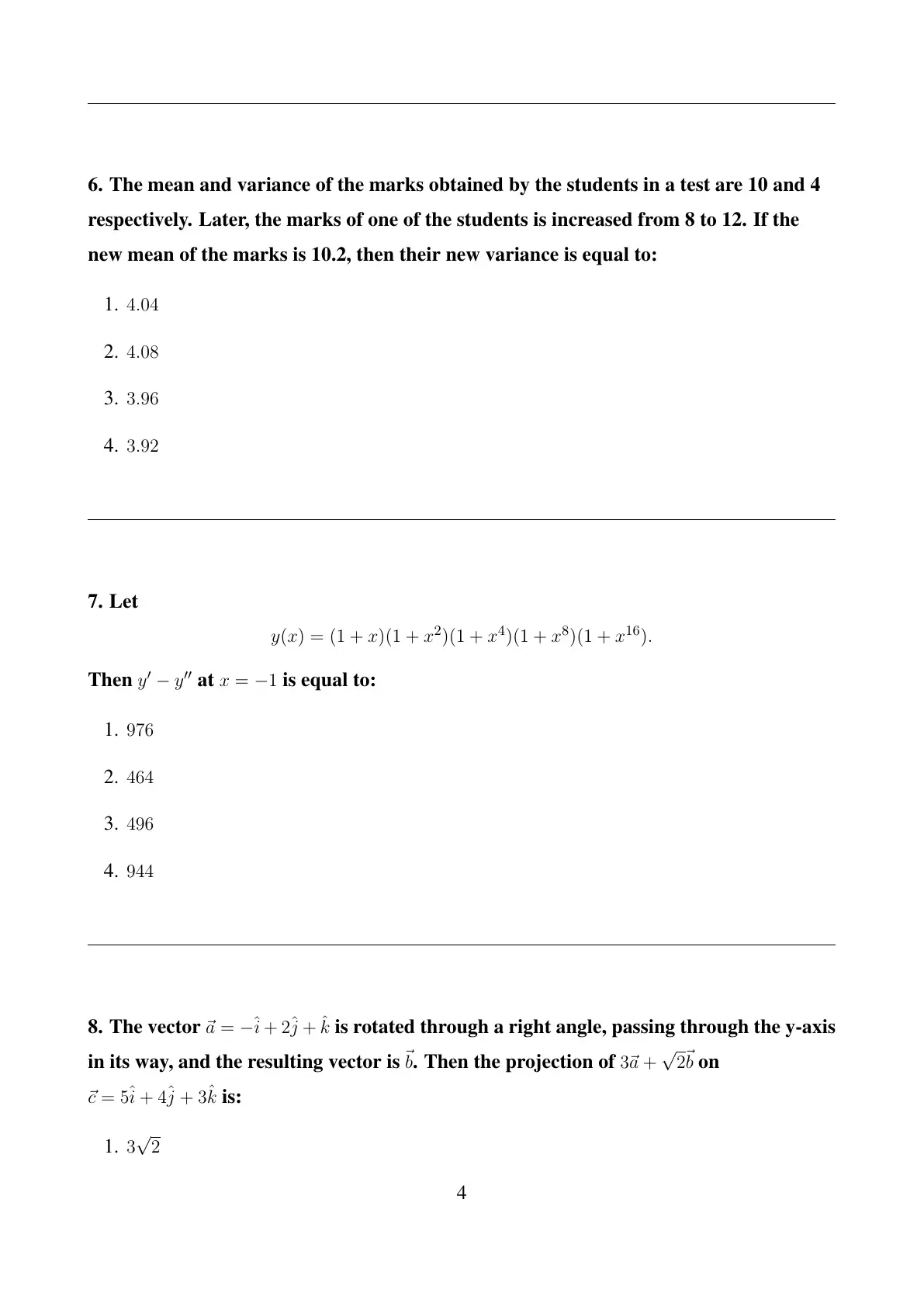
The mean and variance of the marks obtained by the students in a test are 10 and 4 respectively. Later, the marks of one of the students is increased from 8 to 12. If the new mean of the marks is 10.2, then their new variance is equal to:
View Solution
Let \[ y(x) = (1 + x)(1 + x^2)(1 + x^4)(1 + x^8)(1 + x^{16}). \]
Then \(y' - y''\) at \(x = -1\) is equal to:
View Solution
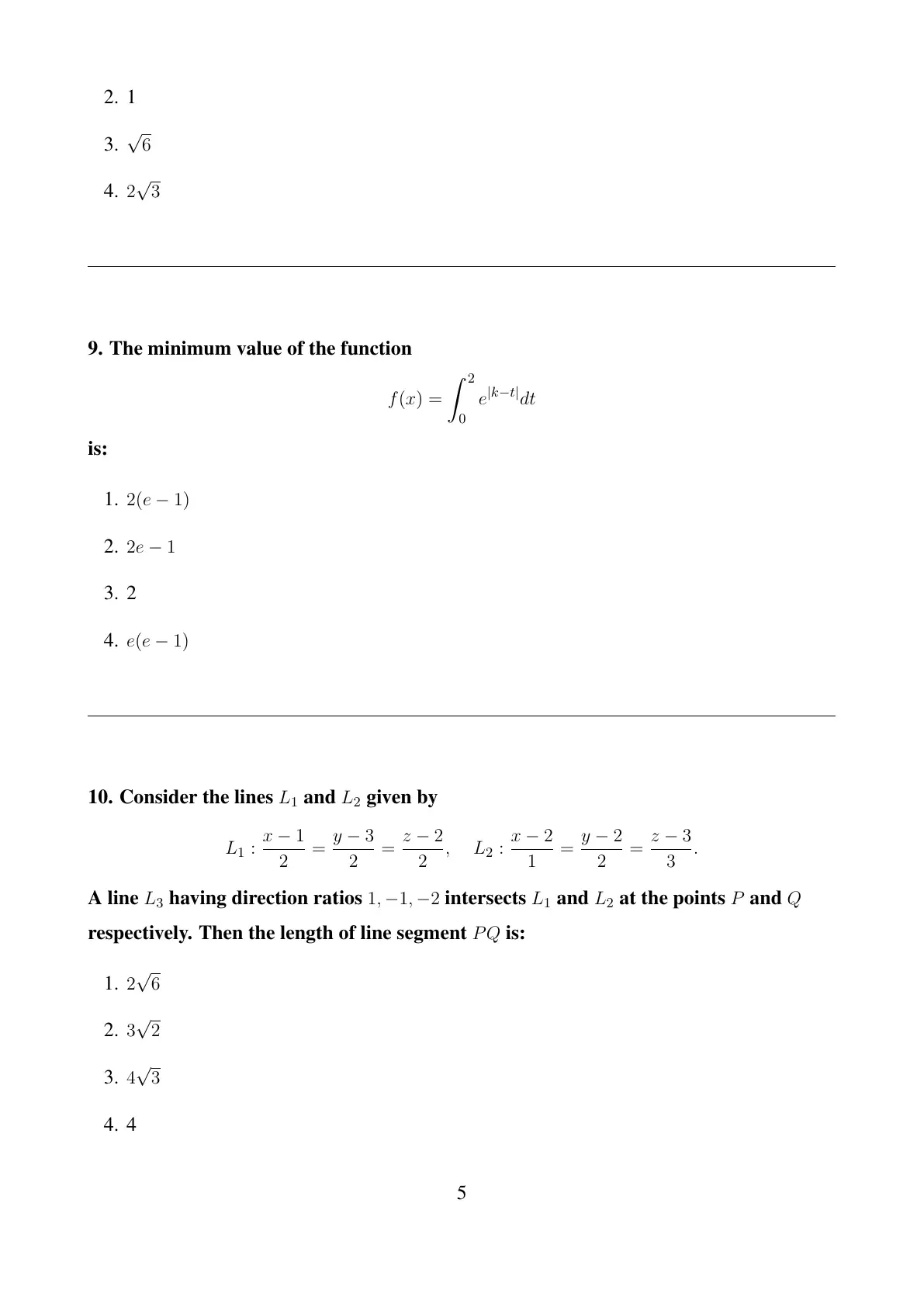
The vector \(\vec{a} = -\hat{i} + 2\hat{j} + \hat{k}\) is rotated through a right angle, passing through the y-axis in its way, and the resulting vector is \(\vec{b}\). Then the projection of \(3\vec{a} + \sqrt{2}\vec{b}\) on \(\vec{c} = 5\hat{i} + 4\hat{j} + 3\hat{k}\) is:
View Solution
The minimum value of the function \[ f(x) = \int_{0}^{2} e^{|k-t|} dt \]
is:
View Solution
Consider the lines \(L_1\) and \(L_2\) given by \[ L_1: \frac{x-1}{2} = \frac{y-3}{2} = \frac{z-2}{2}, \quad L_2: \frac{x-2}{1} = \frac{y-2}{2} = \frac{z-3}{3}. \]
A line \(L_3\) having direction ratios \(1, -1, -2\) intersects \(L_1\) and \(L_2\) at the points \(P\) and \(Q\) respectively. Then the length of line segment \(PQ\) is:
View Solution
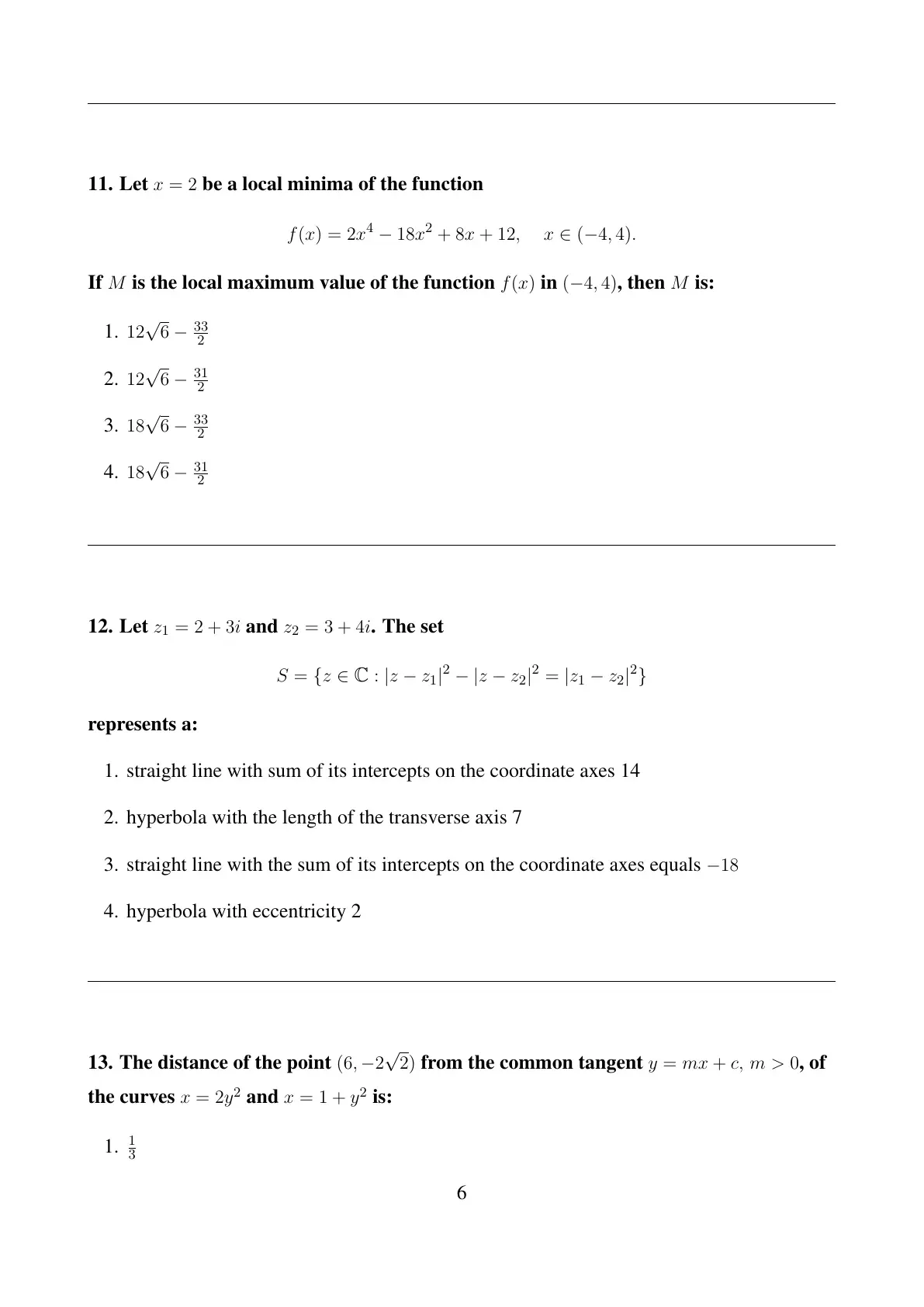
Let \(x = 2\) be a local minima of the function \[ f(x) = 2x^4 - 18x^2 + 8x + 12, \quad x \in (-4, 4). \]
If \(M\) is the local maximum value of the function \(f(x)\) in \((-4, 4)\), then \(M\) is:
View Solution
Let \(z_1 = 2 + 3i\) and \(z_2 = 3 + 4i\). The set \[ S = \{ z \in \mathbb{C} : |z - z_1|^2 - |z - z_2|^2 = |z_1 - z_2|^2 \} \]
represents a:
View Solution
The distance of the point \((6, -2\sqrt{2})\) from the common tangent \(y = mx + c, \, m > 0\), of the curves \(x = 2y^2\) and \(x = 1 + y^2\) is:
View Solution
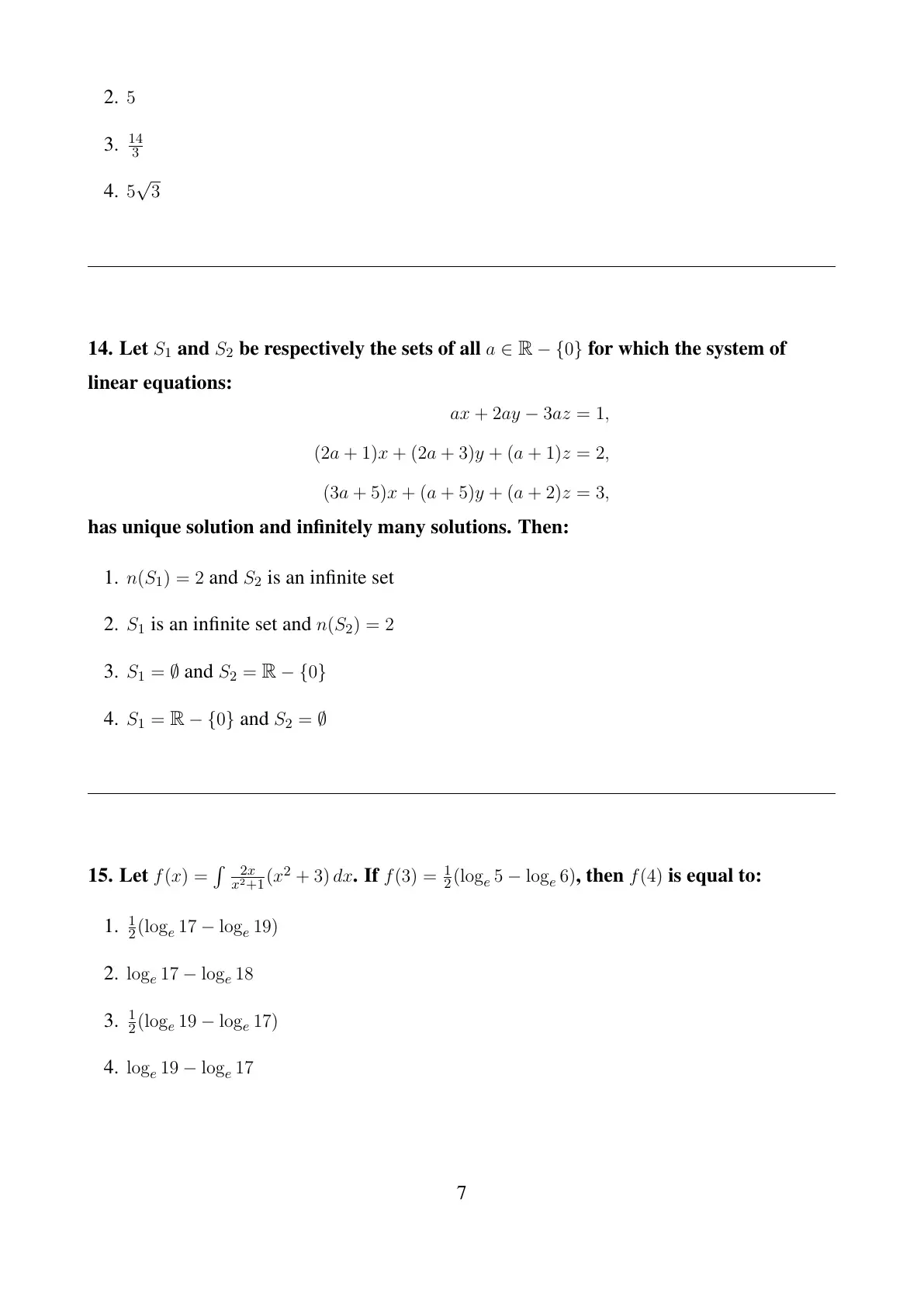
Let \(S_1\) and \(S_2\) be respectively the sets of all \(a \in \mathbb{R} - \{0\}\) for which the system of linear equations: \[ \begin{aligned} ax + 2ay - 3az &= 1,
(2a + 1)x + (2a + 3)y + (a + 1)z &= 2,
(3a + 5)x + (a + 5)y + (a + 2)z &= 3, \end{aligned} \]
has unique solution and infinitely many solutions. Then:
View Solution
Let \(f(x) = \int \frac{2x}{x^2 + 1}(x^2 + 3) \, dx\). If \(f(3) = \frac{1}{2}(\log_e 5 - \log_e 6)\), then \(f(4)\) is equal to:
View Solution
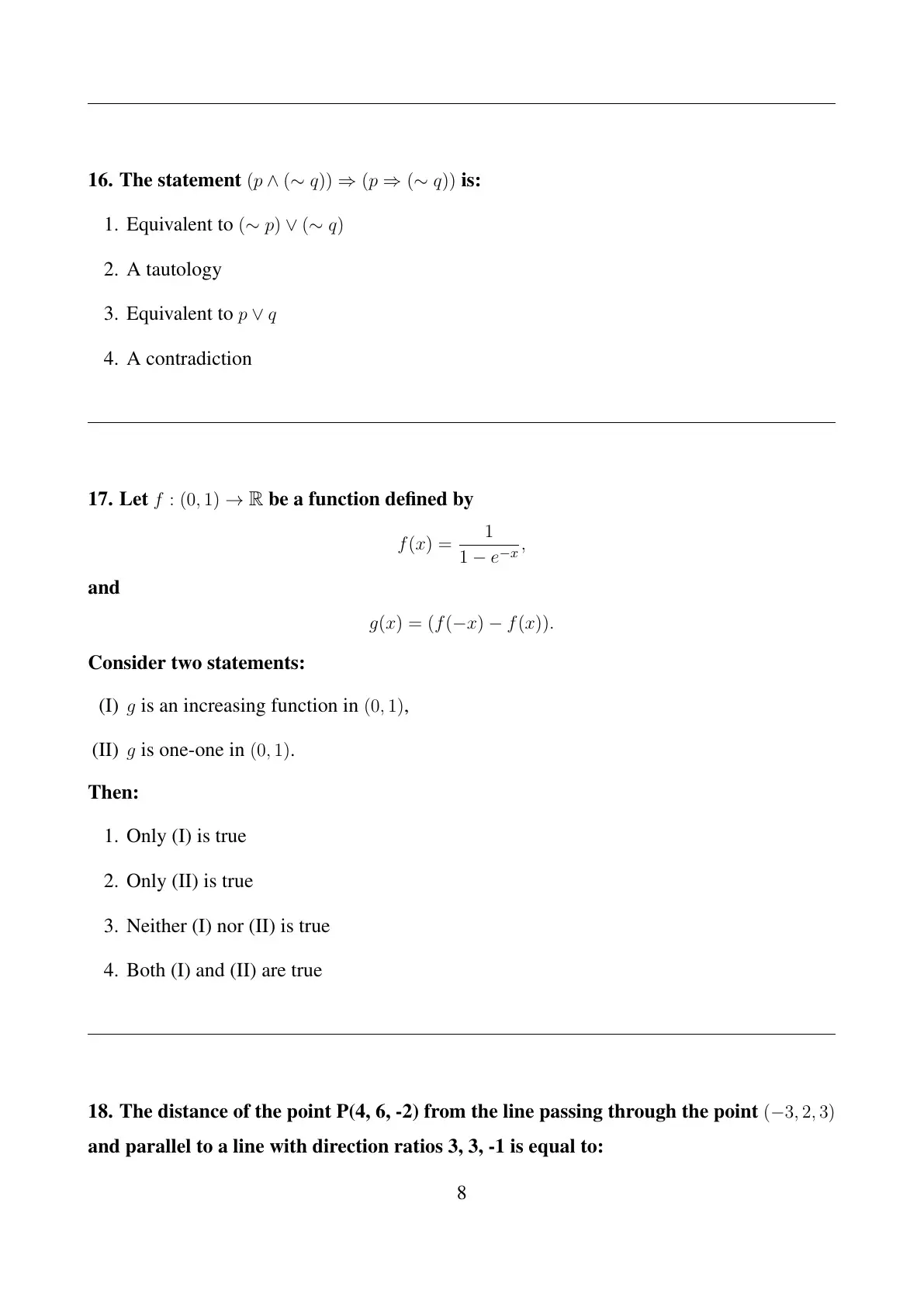
The statement \( (p \land (\sim q)) \Rightarrow (p \Rightarrow (\sim q)) \) is:
View Solution
Let \(f : (0, 1) \to \mathbb{R}\) be a function defined by \[ f(x) = \frac{1}{1 - e^{-x}}, \]
and \[ g(x) = (f(-x) - f(x)). \]
Consider two statements:
[(I)] \(g\) is an increasing function in \((0, 1)\),
[(II)] \(g\) is one-one in \((0, 1)\).
Then:
View Solution
The distance of the point P(4, 6, -2) from the line passing through the point \((-3, 2, 3)\) and parallel to a line with direction ratios 3, 3, -1 is equal to:
View Solution
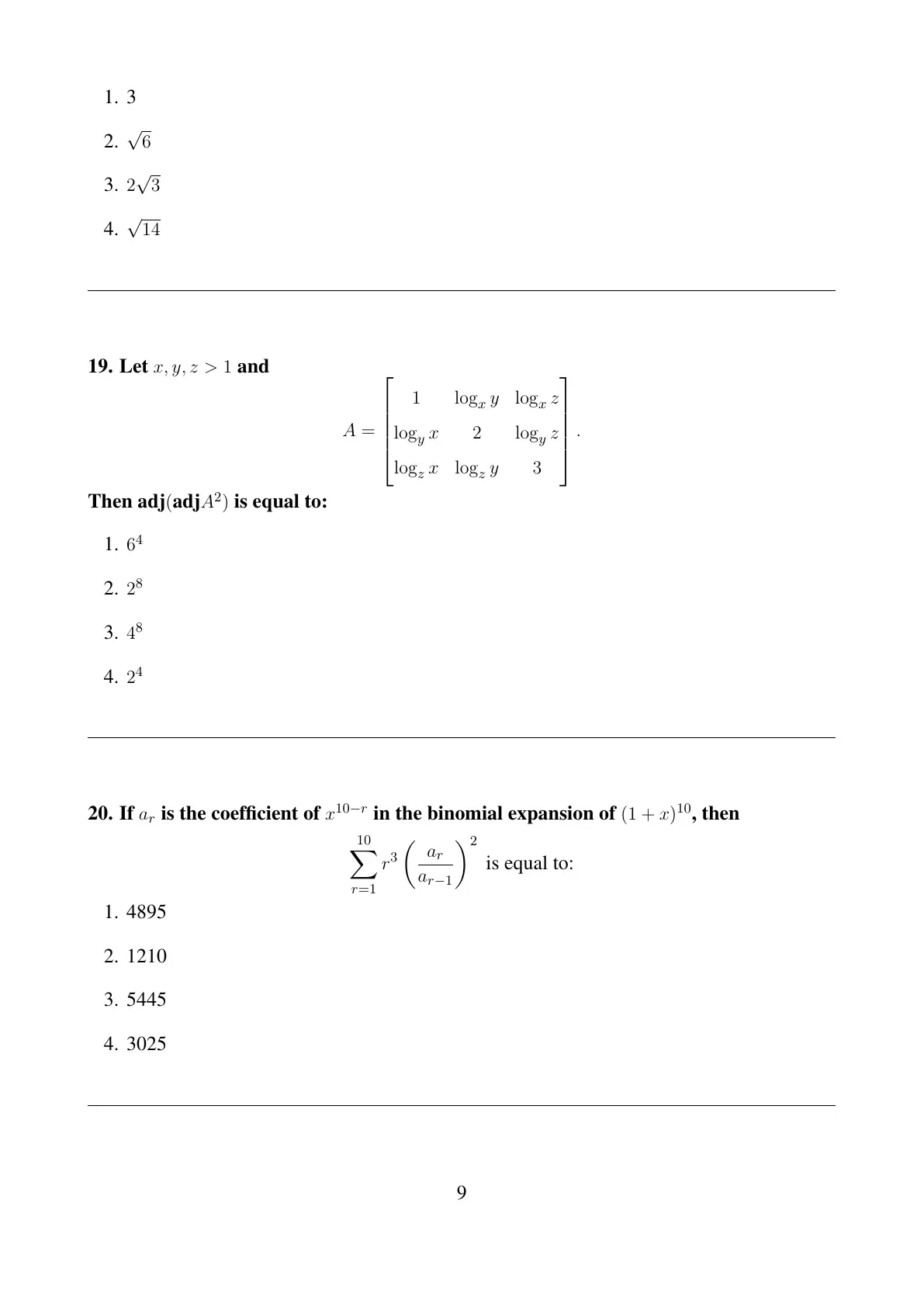
Let \(x, y, z > 1\) and \[ A = \begin{bmatrix} 1 & \log_x y & \log_x z
\log_y x & 2 & \log_y z
\log_z x & \log_z y & 3 \end{bmatrix}. \]
Then \(adj(adj A^2)\) is equal to:
View Solution
If \(a_r\) is the coefficient of \(x^{10-r}\) in the binomial expansion of \((1 + x)^{10}\), then \[ \sum_{r=1}^{10} r^3 \left( \frac{a_r}{a_{r-1}} \right)^2 is equal to: \]
View Solution
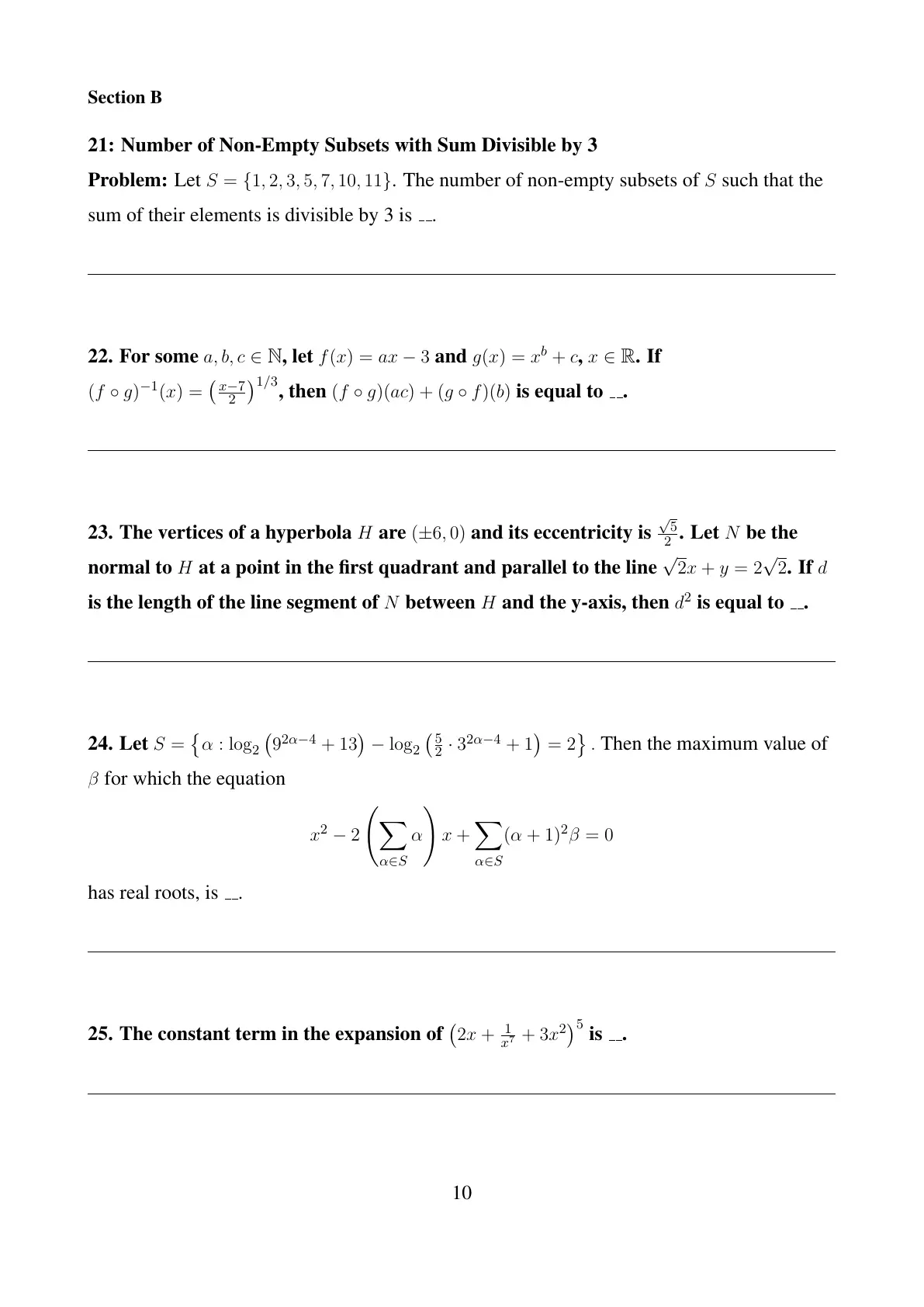
Number of Non-Empty Subsets with Sum Divisible by 3
Problem: Let \( S = \{1, 2, 3, 5, 7, 10, 11\} \). The number of non-empty subsets of \( S \) such that the sum of their elements is divisible by 3 is __.
View Solution
For some \( a, b, c \in \mathbb{N} \), let \( f(x) = ax - 3 \) and \( g(x) = x^b + c \), \( x \in \mathbb{R} \). If \( (f \circ g)^{-1}(x) = \left(\frac{x - 7}{2}\right)^{1/3} \), then \( (f \circ g)(ac) + (g \circ f)(b) \) is equal to __.
View Solution
The vertices of a hyperbola \( H \) are \( (\pm 6, 0) \) and its eccentricity is \( \frac{\sqrt{5}}{2} \). Let \( N \) be the normal to \( H \) at a point in the first quadrant and parallel to the line \( \sqrt{2}x + y = 2\sqrt{2} \). If \( d \) is the length of the line segment of \( N \) between \( H \) and the y-axis, then \( d^2 \) is equal to __.
View Solution
Let \( S = \left\{\alpha : \log_2 \left(9^{2\alpha-4} + 13\right) - \log_2 \left(\frac{5}{2} \cdot 3^{2\alpha-4} + 1\right) = 2 \right\}. \)
Then the maximum value of \( \beta \) for which the equation \[ x^2 - 2\left(\sum_{\alpha \in S} \alpha\right)x + \sum_{\alpha \in S} (\alpha + 1)^2 \beta = 0 \]
has real roots, is __.
View Solution
The constant term in the expansion of \( \left(2x + \frac{1}{x^7} + 3x^2\right)^5 \) is __.
View Solution
Let \( A_1, A_2, A_3 \) be the three A.P. with the same common difference \( d \) and having their first terms as \( A, A+1, A+2 \), respectively. Let \( a, b, c \) be the 7th, 9th, and 17th terms of \( A_1, A_2, A_3 \), respectively, such that \[ \begin{vmatrix} a & 7 & 1
2b & 17 & 1
c & 17 & 1 \end{vmatrix} + 70 = 0. \]
If \( a = 29 \), then the sum of the first 20 terms of an AP whose first term is \( c - a - b \) and common difference is \( \frac{d}{12} \), is equal to __.
View Solution
If the sum of all the solutions of \[ \tan^{-1}\left(\frac{2x}{1-x^2}\right) + \cot^{-1}\left(\frac{1-x^2}{2x}\right) = \frac{\pi}{3}, \]
where \( -1 < x < 1, x \neq 0 \), is \( \alpha - \frac{4}{\sqrt{3}} \), then \( \alpha \) is equal to __.
View Solution
Let the equation of the plane passing through the line \[ x - 2y - z - 5 = 0 \quad and \quad x + y + 3z - 5 = 0, \]
and parallel to the line \[ x + y + 2z - 7 = 0 \quad and \quad 2x + 3y + z - 2 = 0, \]
be \( ax + by + cz = 65 \). Then the distance of the point \( (a, b, c) \) from the plane \( 2x + 2y - z + 16 = 0 \) is __.
View Solution
Let \( x \) and \( y \) be distinct integers where \( 1 \leq x \leq 25 \) and \( 1 \leq y \leq 25 \). Then, the number of ways of choosing \( x \) and \( y \), such that \( x + y \) is divisible by 5, is __.
View Solution
It the area enclosed by the parabolas \( P_1: 2y = 5x^2 \) and \( P_2: x^2 - y + 6 = 0 \) is equal to the area enclosed by \( P_1 \) and \( y = \alpha x, \alpha > 0 \), then \( \alpha^3 \) is equal to __.
Physics
Electron beam used in an electron microscope, when accelerated by a voltage of 20 kV, has a de-Broglie wavelength of \(\lambda_0\). If the voltage is increased to 40 kV, then the de-Broglie wavelength associated with the electron beam would be:
View Solution
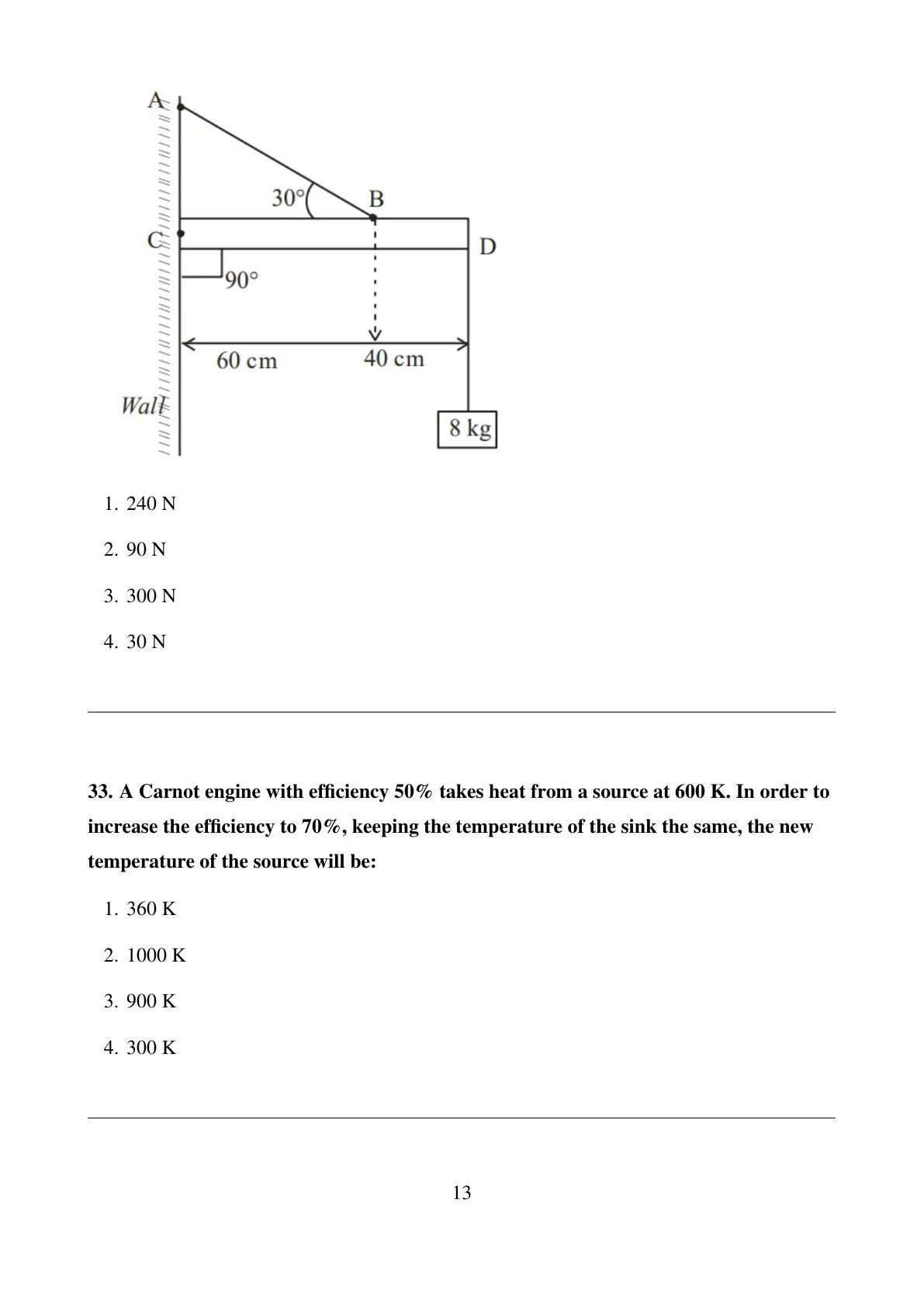
An object of mass 8 kg is hanging from one end of a uniform rod CD of mass 2 kg and length 1 m pivoted at its end C on a vertical wall. It is supported by a cable AB such that the system is in equilibrium. The tension in the cable is:

View Solution
A Carnot engine with efficiency 50% takes heat from a source at 600 K. In order to increase the efficiency to 70%, keeping the temperature of the sink the same, the new temperature of the source will be:
View Solution
T is the time period of a simple pendulum on the Earth's surface. Its time period becomes \(x \, T\) when taken to a height \(R\) (equal to Earth's radius) above the Earth's surface. Then, the value of \(x\) will be:
View Solution
Assume that the Earth is a solid sphere of uniform density and a tunnel is dug along its diameter. When a particle is released in this tunnel, it executes a simple harmonic motion. The mass of the particle is 100 g. The time period of the motion of the particle will be (approximately):
View Solution
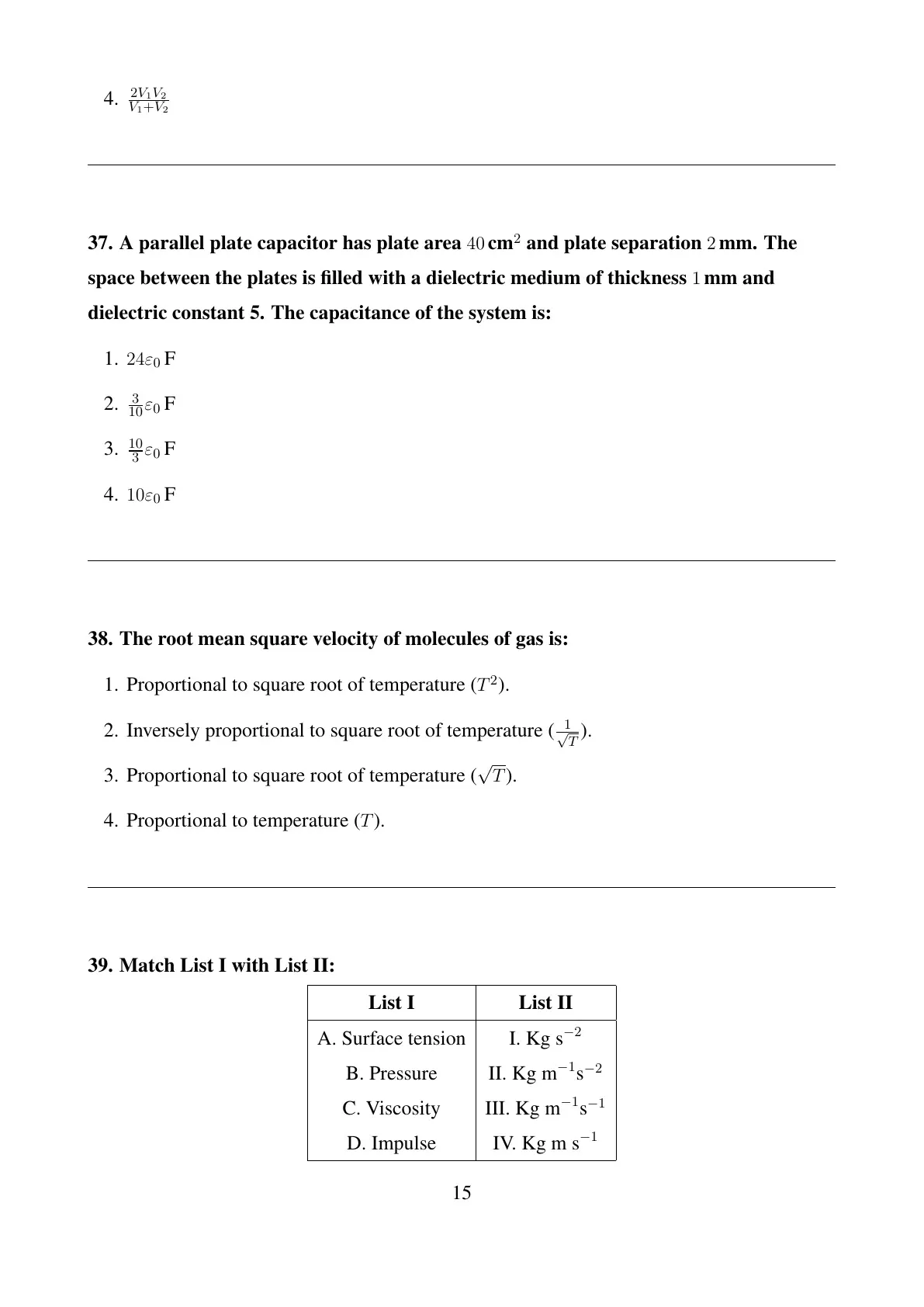
A car travels a distance of 'x' with speed \(V_1\) and then the same distance 'x' with speed \(V_2\) in the same direction. The average speed of the car is:
View Solution
A parallel plate capacitor has plate area \(40 \, cm^2\) and plate separation \(2 \, mm\). The space between the plates is filled with a dielectric medium of thickness \(1 \, mm\) and dielectric constant 5. The capacitance of the system is:
View Solution
The root mean square velocity of molecules of gas is:
View Solution
Match List I with List II:

Choose the correct answer from the options given
below :
View Solution
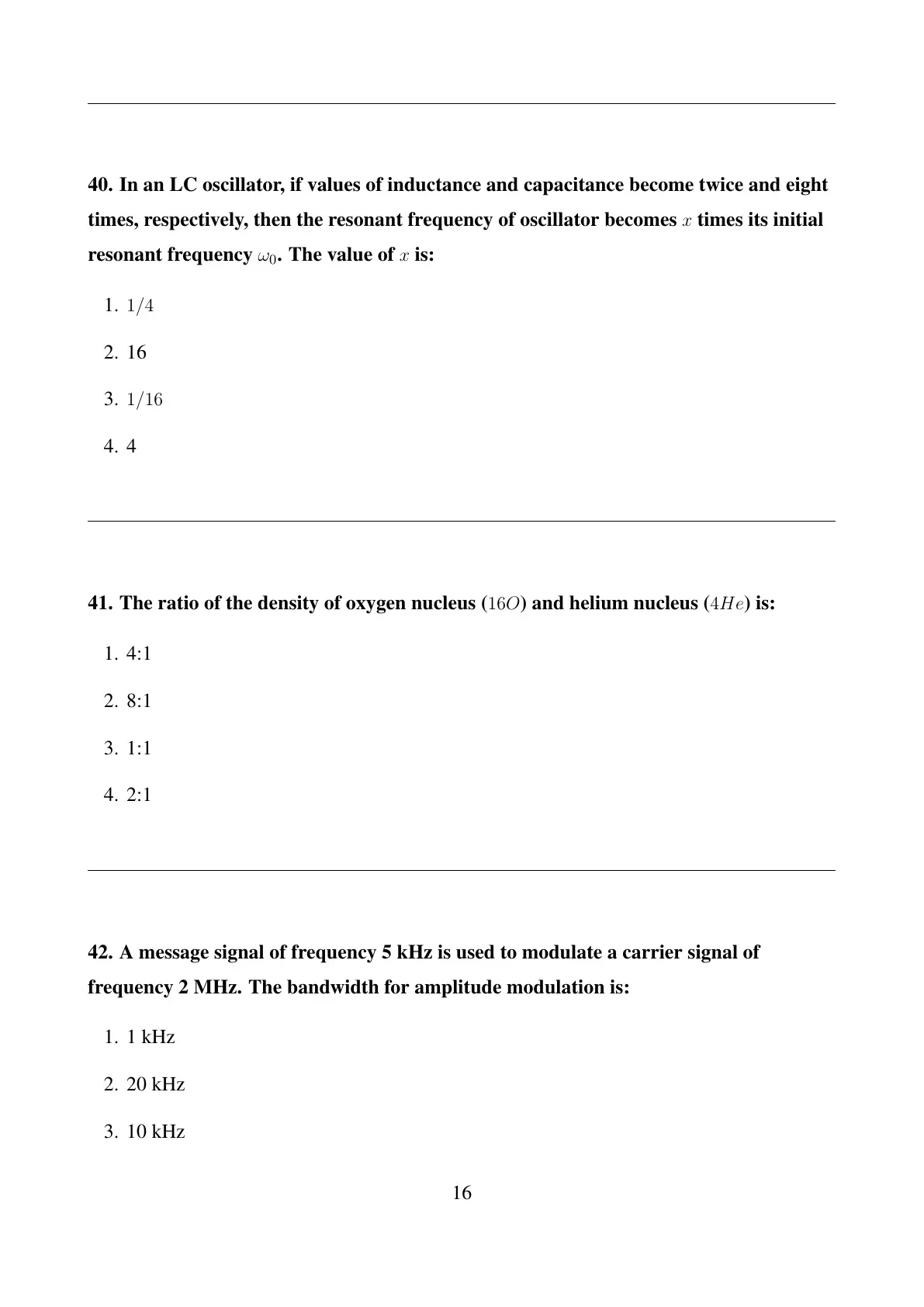
In an LC oscillator, if values of inductance and capacitance become twice and eight times, respectively, then the resonant frequency of oscillator becomes \(x\) times its initial resonant frequency \(\omega_0\). The value of \(x\) is:
View Solution
The ratio of the density of oxygen nucleus 16O and helium nucleus 4He is:
View Solution
A message signal of frequency 5 kHz is used to modulate a carrier signal of frequency 2 MHz. The bandwidth for amplitude modulation is:
View Solution
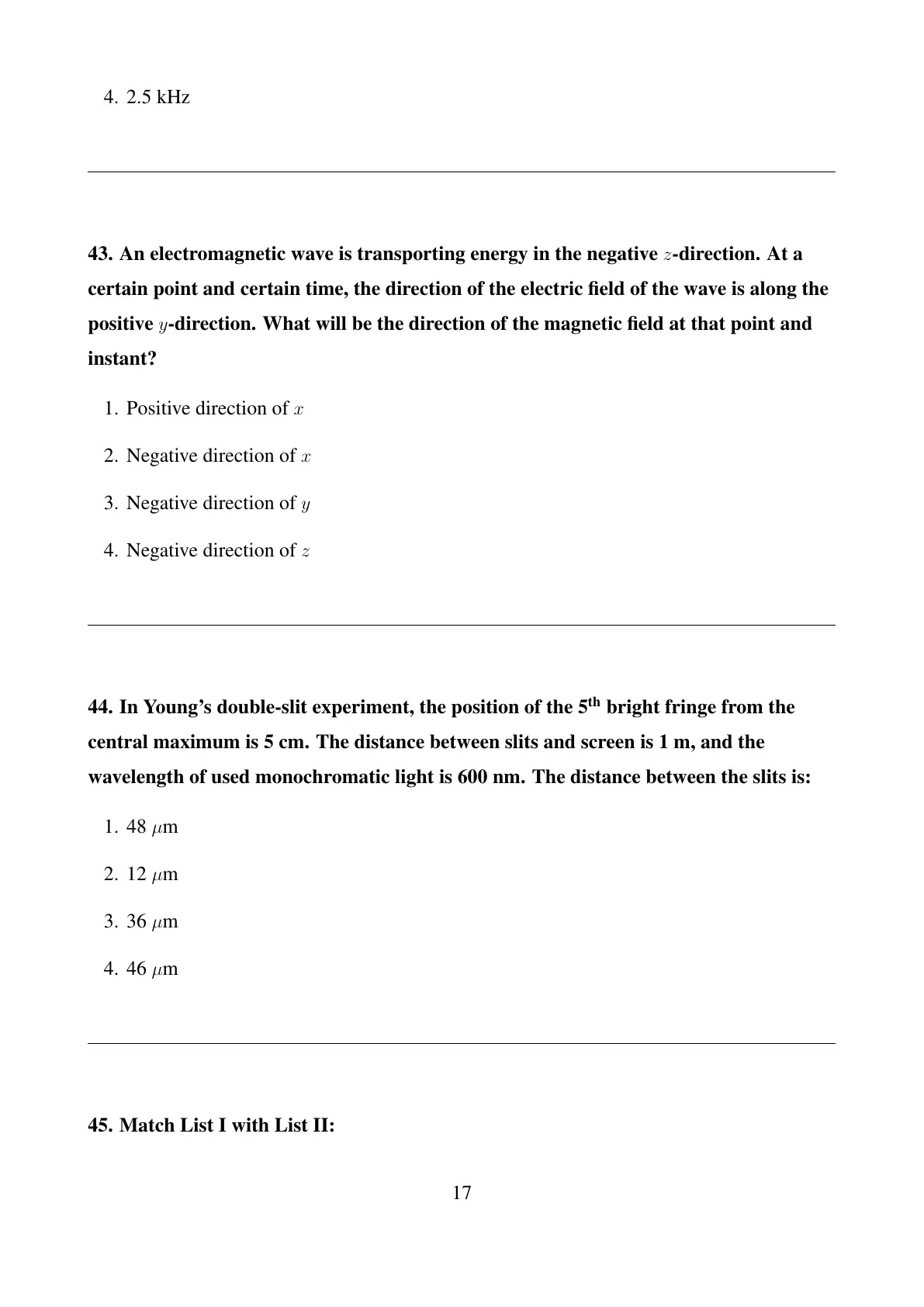
An electromagnetic wave is transporting energy in the negative \(z\)-direction. At a certain point and certain time, the direction of the electric field of the wave is along the positive \(y\)-direction. What will be the direction of the magnetic field at that point and instant?
View Solution
In Young's double-slit experiment, the position of the 5th bright fringe from the central maximum is 5 cm. The distance between slits and screen is 1 m, and the wavelength of used monochromatic light is 600 nm. The distance between the slits is:
View Solution
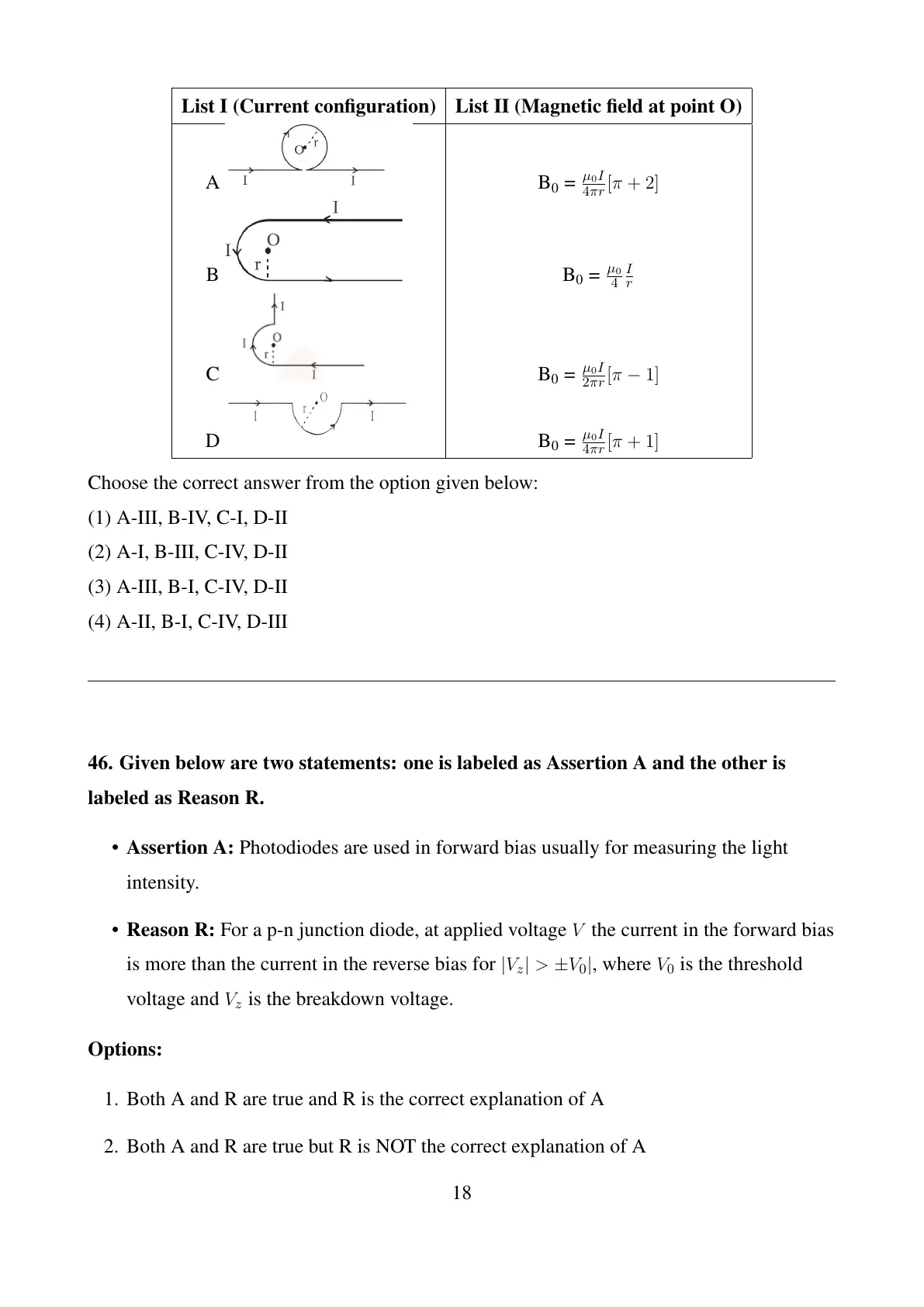
Match List I with List II:

Choose the correct answer from the option given
below:
View Solution
Given below are two statements: one is labeled as Assertion A and the other is labeled as Reason R.
Assertion A: Photodiodes are used in forward bias usually for measuring the light intensity.
Reason R: For a p-n junction diode, at applied voltage \(V\) the current in the forward bias is more than the current in the reverse bias for \(|V_z| > \pm V_0|\), where \(V_0\) is the threshold voltage and \(V_z\) is the breakdown voltage.
Options:
View Solution
A solenoid of 1200 turns is wound uniformly in a single layer on a glass tube 2 m long and 0.2 m in diameter. The magnetic intensity at the center of the solenoid when a current of 2 A flows through it is:
View Solution
A uniform metallic wire carries a current 2 A. When a 3.4 V battery is connected across it, the mass of the wire is \(8.92 \times 10^{-3} \, kg\), density is \(8.92 \times 10^3 \, kg/m^3\), and resistivity is \(1.7 \times 10^{-8} \, \Omega \, m\). The length of the wire is:
View Solution
A bowl filled with very hot soup cools from \(98^\circ C\) to \(86^\circ C\) in 2 minutes when the room temperature is \(22^\circ C\). How long will it take to cool from \(75^\circ C\) to \(69^\circ C\)?
View Solution
A car is moving with a constant speed of \(20 \, m/s\) in a circular horizontal track of radius \(40 \, m\). A bob is suspended from the roof of the car by a massless string. The angle made by the string with the vertical will be:
View Solution
A ray of light is incident from air on a glass plate having thickness \(\sqrt{5} \, cm\) and refractive index \(\sqrt{2}\). The angle of incidence of a ray is equal to the critical angle for glass-air interface. The lateral displacement of the ray when it passes through the plate is \(\, <10^{-2} \, cm\):
(Given \(\sin 15^\circ = 0.26\))
View Solution
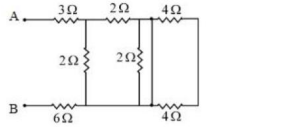
In the given circuit, the equivalent resistance between the terminal A and B is \(\_\_\_\_\) \(\Omega\).
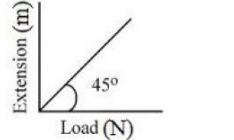
As shown in the figure, in an experiment to determine Young's modulus of a wire, the extension-load curve is plotted. The curve is a straight line passing through the origin and makes an angle of \(45^\circ\) with the load axis. The length of the wire is \(62.8 \, cm\) and its diameter is \(4 \, mm\). The Young's modulus is found to be \(x \times 10^{10} \, Nm^{-2}\). The value of \(x\) is:
An object of mass \(m\) initially at rest on a smooth horizontal plane starts moving under the action of force \(F = 2N\). In the process of its linear motion, the angle \(\theta\) between the direction of force and horizontal varies as \(\theta = kx\), where \(k\) is a constant and \(x\) is the distance covered by the object from its initial position. The expression of kinetic energy of the object will be \(E = \frac{n}{k} \sin \theta\). The value of \(n\) is:
View Solution
The wavelength of the radiation emitted is \(\lambda_0\) when an electron jumps from the second excited state to the first excited state of the hydrogen atom. If the electron jumps from the third excited state to the second orbit of the hydrogen atom, the wavelength of the radiation emitted will be \(\frac{20}{x} \lambda_0\). The value of \(x\) is:
View Solution
\(I_{CM}\) is the moment of inertia of a circular disc about an axis (CM) passing through its center and perpendicular to the plane of the disc. \(I_{AB}\) is its moment of inertia about an axis \(AB\) perpendicular to the plane and parallel to axis CM at a distance \(\frac{2}{3} R\) from the center, where \(R\) is the radius of the disc. The ratio of \(I_{AB}\) and \(I_{CM}\) is \(x : 9\). The value of \(x\) is:

The distance between two consecutive points with phase difference of \(60^\circ\) in a wave of frequency 500 Hz is 6.0 m. The velocity with which the wave is traveling is \(\_\_\_\) km/s:
A uniform electric field of \(10 \, N/C\) is created between two parallel charged plates (as shown in figure). An electron enters the field symmetrically between the plates with a kinetic energy of \(5 \, eV\). The length of each plate is \(10 \, cm\). The angle (\(\theta\)) of deviation of the path of the electron as it comes out of the field is ____ (in degrees).
An LCR series circuit of capacitance \(62.5 \, nF\) and resistance of \(50 \, \Omega\) is connected to an A.C. source of frequency \(2.0 \, kHz\). For maximum value of amplitude of current in the circuit, the value of inductance is ____ mH.
If \(\vec{P} = 3 \hat{i} + \sqrt{3} \hat{j} + 2 \hat{k}\) and \(\vec{Q} = 4 \hat{i} + \sqrt{3} \hat{j} + 2.5 \hat{k}\), the unit vector in the direction of \(\vec{P} \times \vec{Q}\) is \(\frac{1}{x} \left(\sqrt{3} \hat{i} + \hat{j} - 2 \sqrt{3} \hat{k}\right)\). The value of \(x\) is:
Chemistry
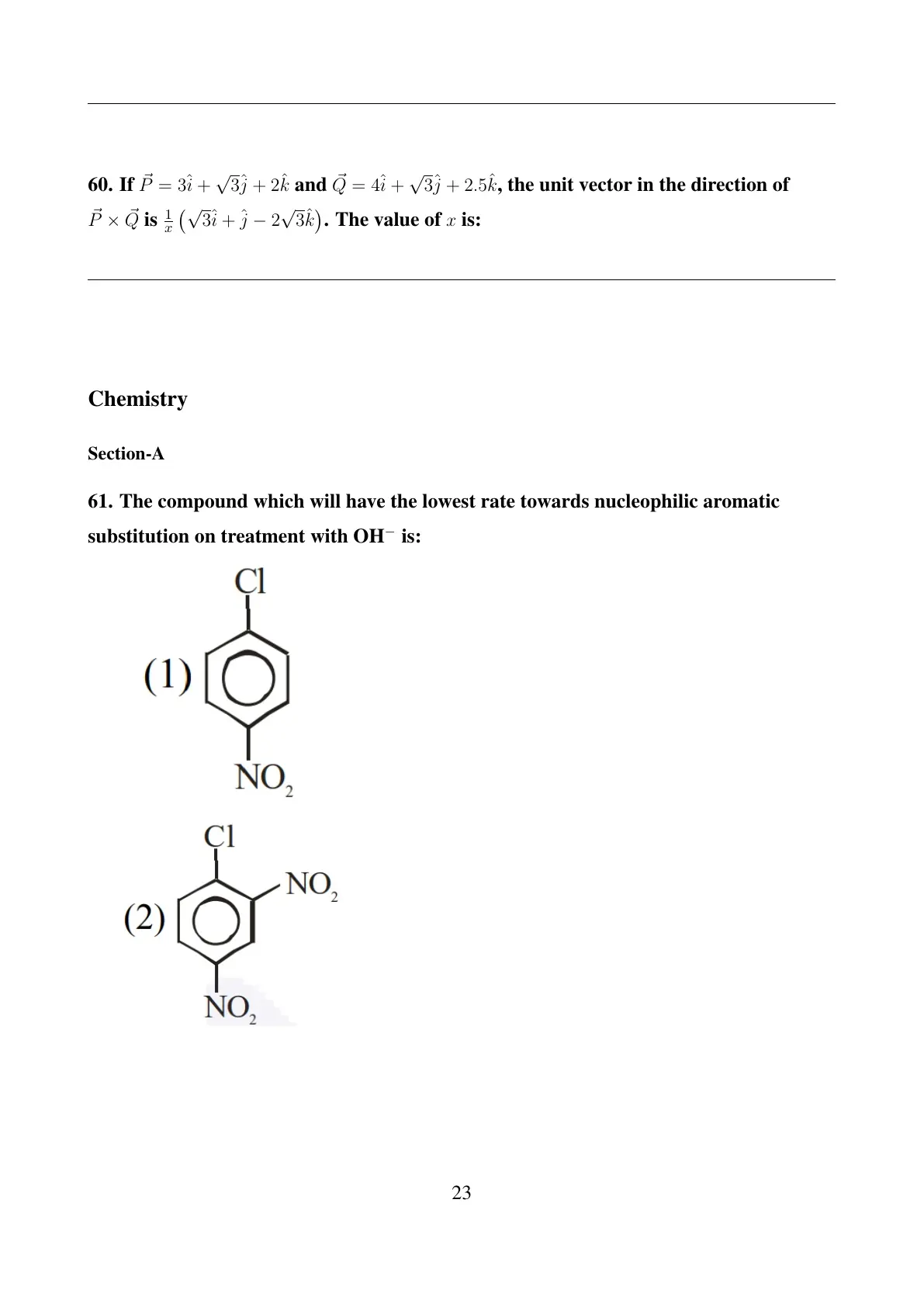
The compound which will have the lowest rate towards nucleophilic aromatic substitution on treatment with OH\(^-\) is:


View Solution
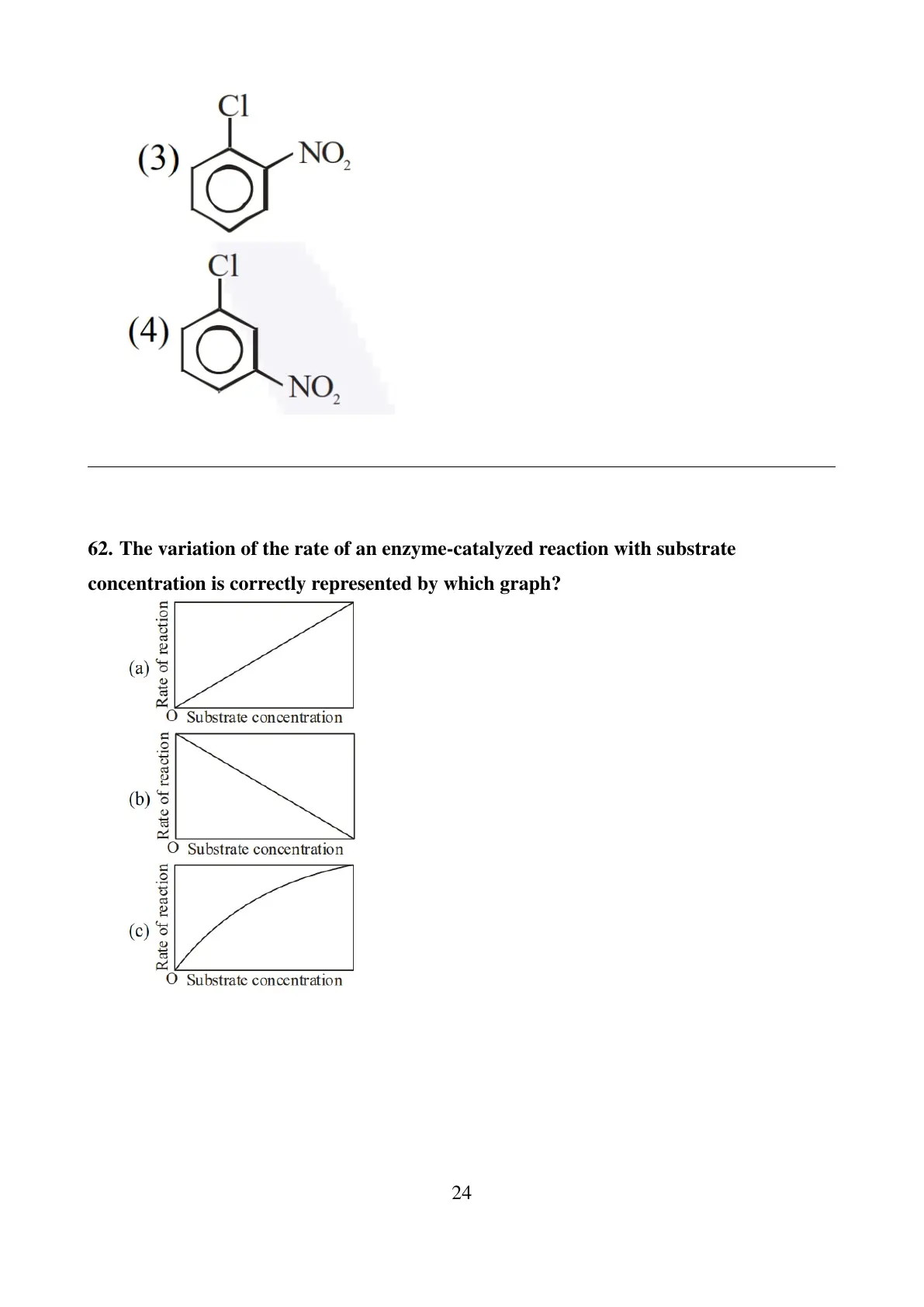
The variation of the rate of an enzyme-catalyzed reaction with substrate concentration is correctly represented by which graph?


Options:
1. a
2. b.
3. c.
4. d.
View Solution
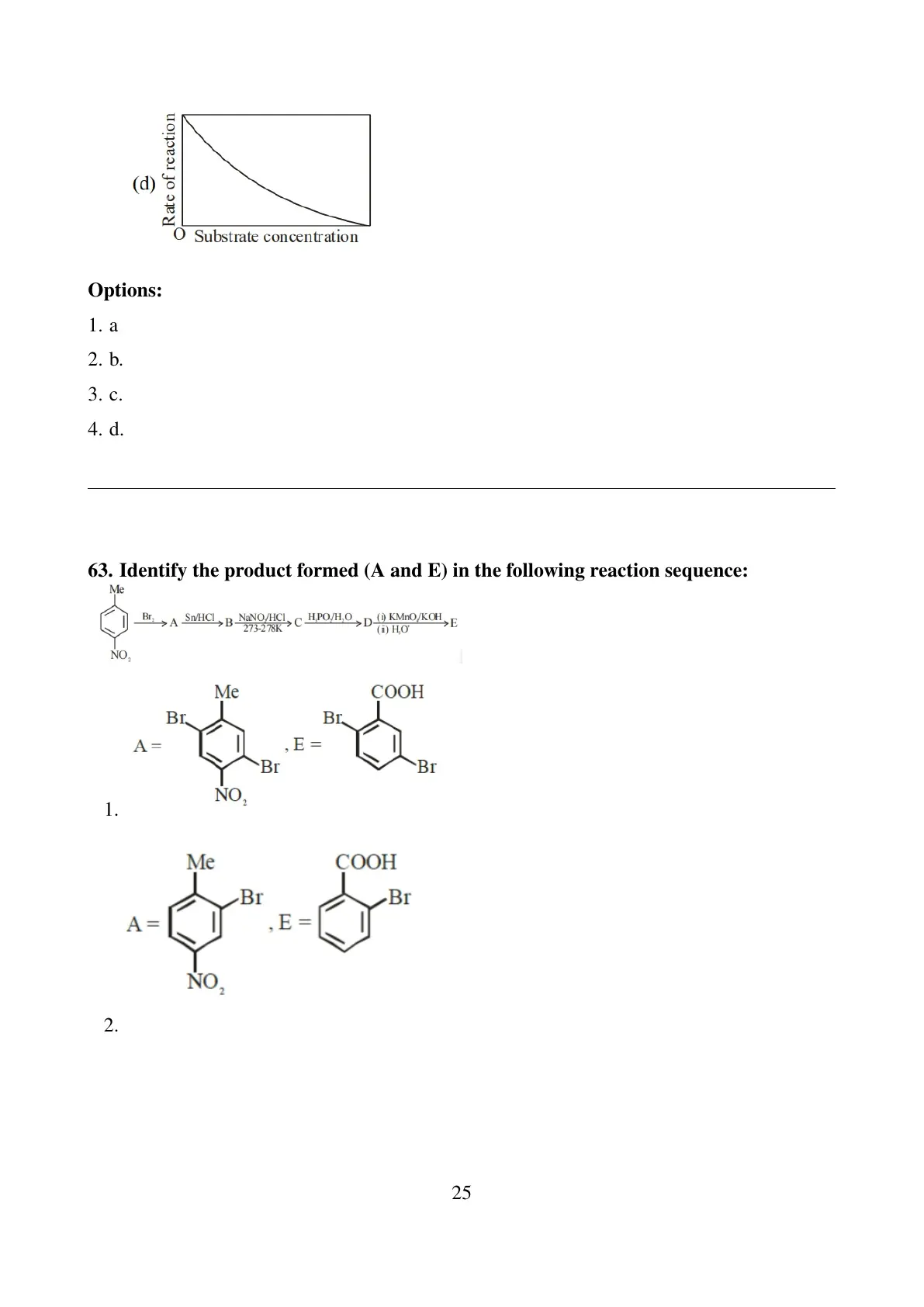
Identify the product formed (A and E) in the following reaction sequence:

\
- (A)
![]() \
\ - (B)
![]() \
\ - (C)
![]() \
\ - (D)
![]()
 \
\ \
\ \
\
View Solution
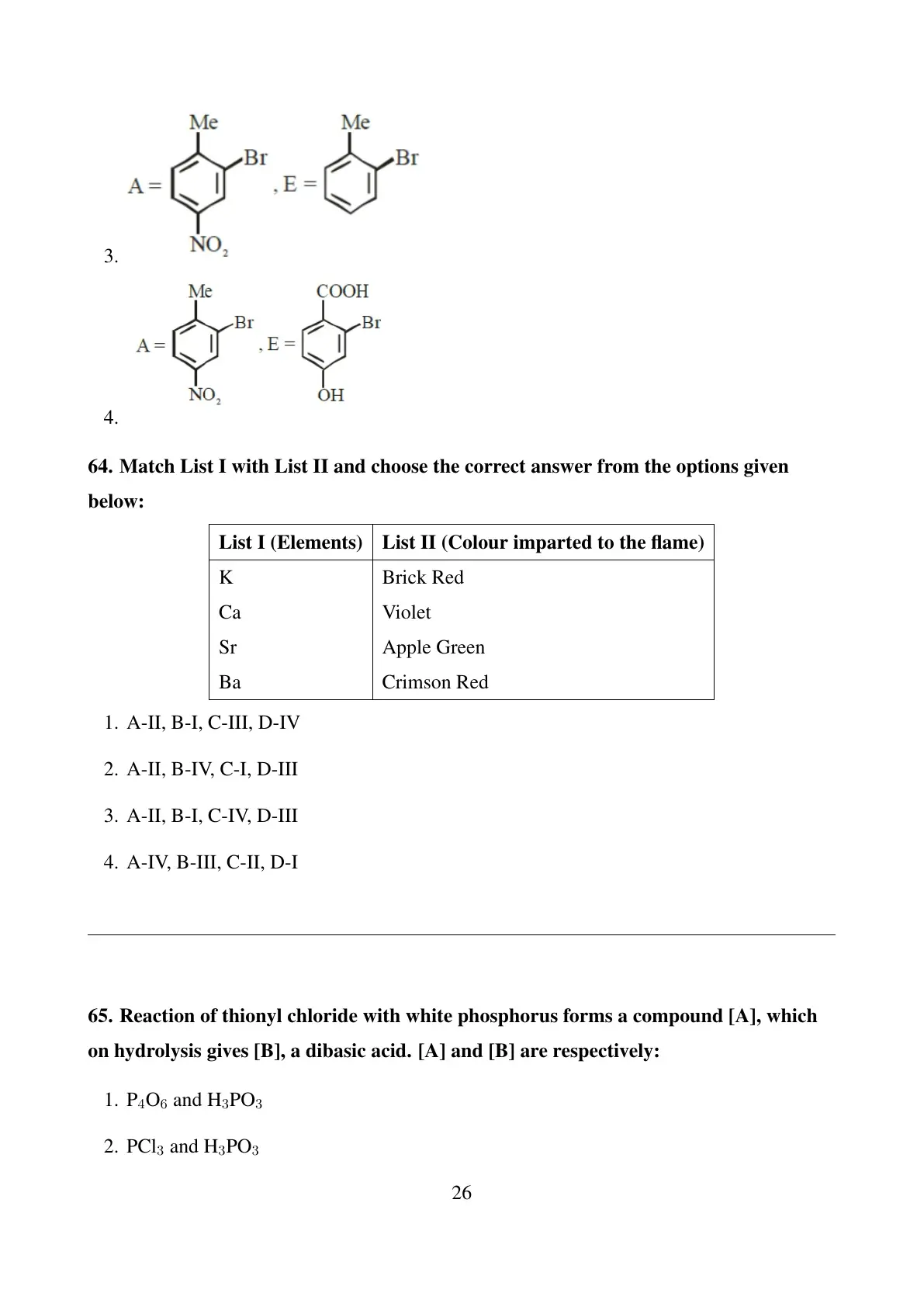
Match List I with List II and choose the correct answer from the options given below:

View Solution
Reaction of thionyl chloride with white phosphorus forms a compound \textbf{[A]}, which on hydrolysis gives \textbf{[B]}, a dibasic acid. \textbf{[A]} and \textbf{[B]} are respectively:
View Solution
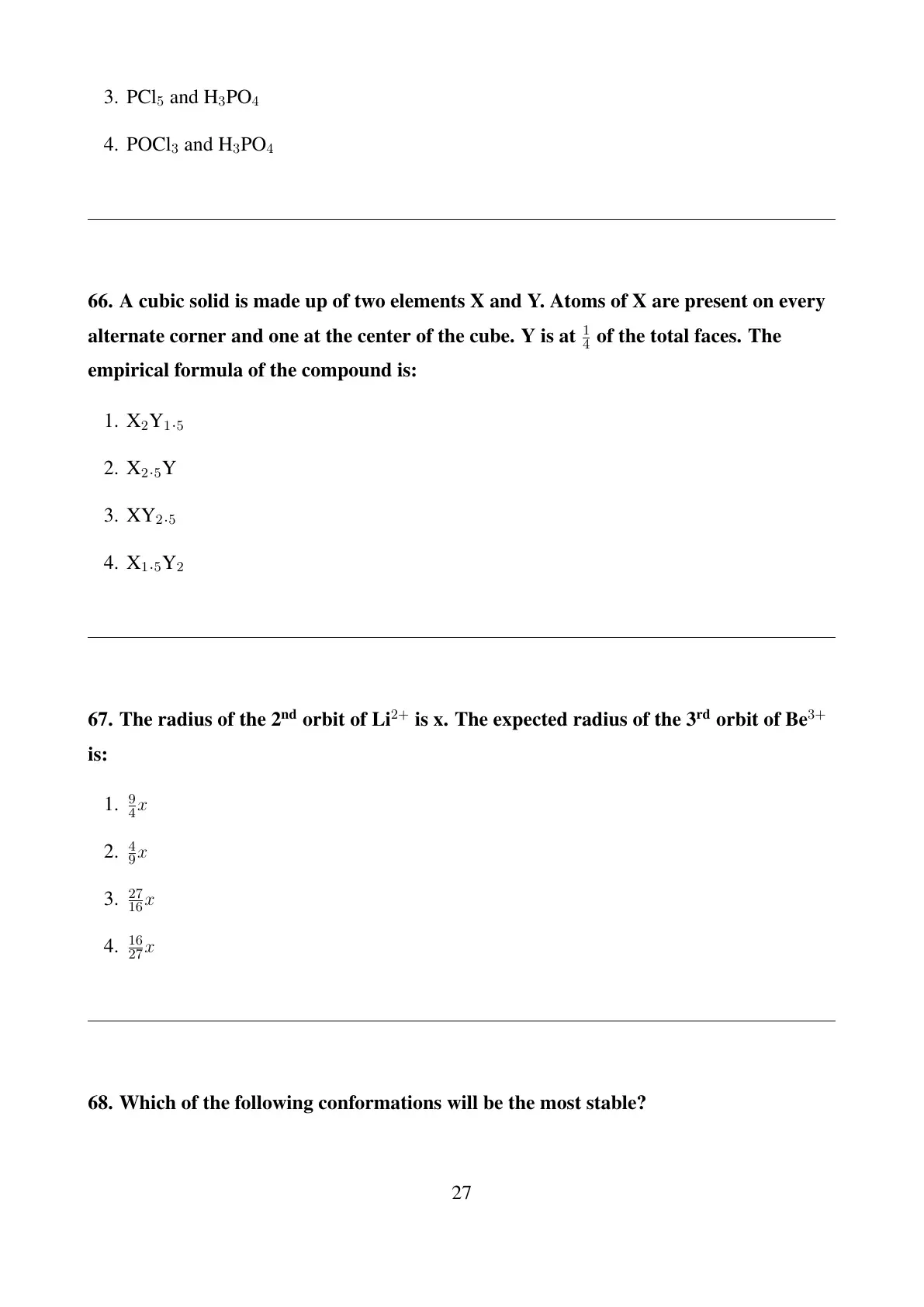
A cubic solid is made up of two elements X and Y. Atoms of X are present on every alternate corner and one at the center of the cube. Y is at \(\frac{1}{4}\) of the total faces. The empirical formula of the compound is:
View Solution
The radius of the 2\(^{nd}\) orbit of Li\(^{2+}\) is x. The expected radius of the 3\(^{rd}\) orbit of Be\(^{3+}\) is:
View Solution
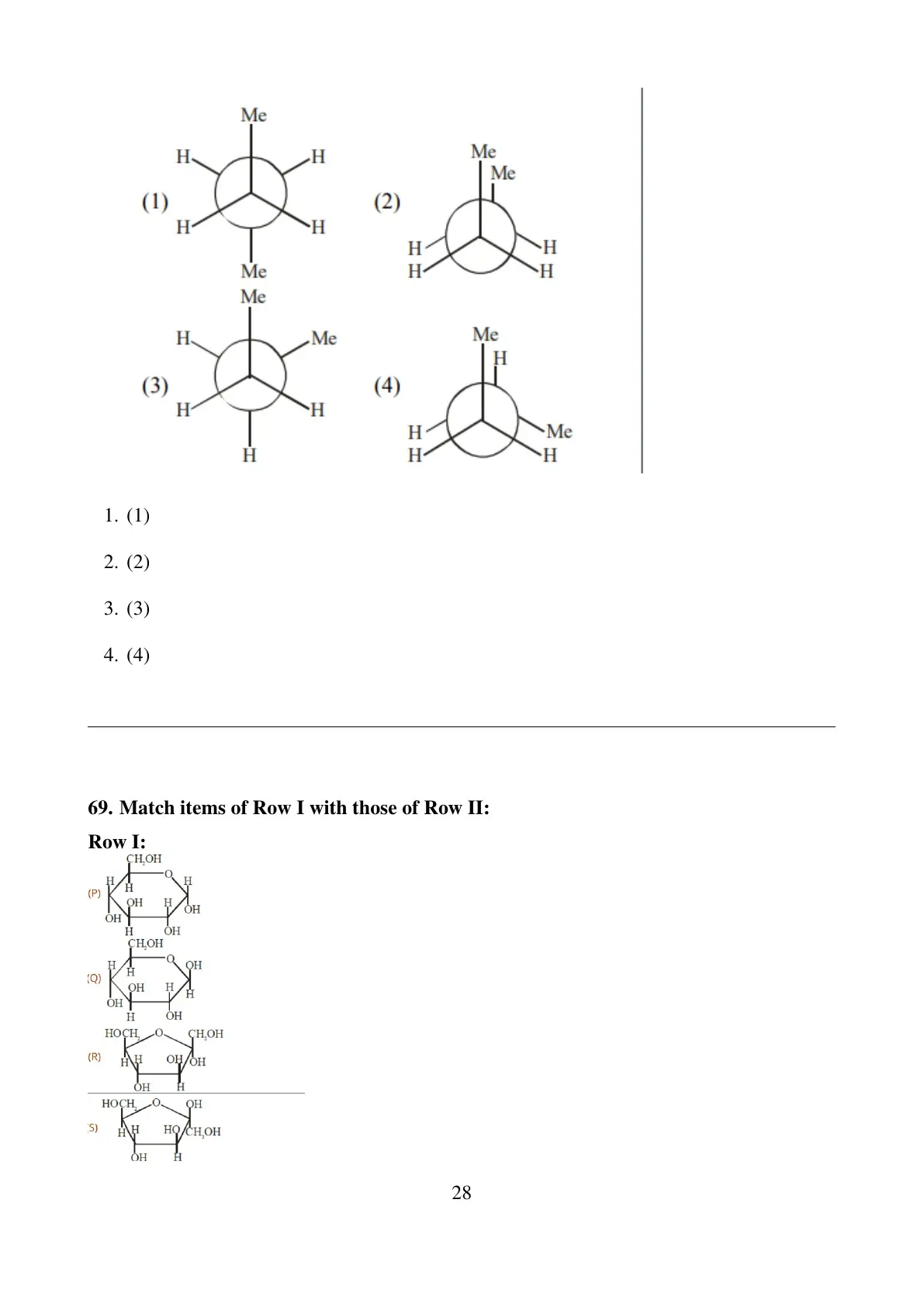
Which of the following conformations will be the most stable?

View Solution
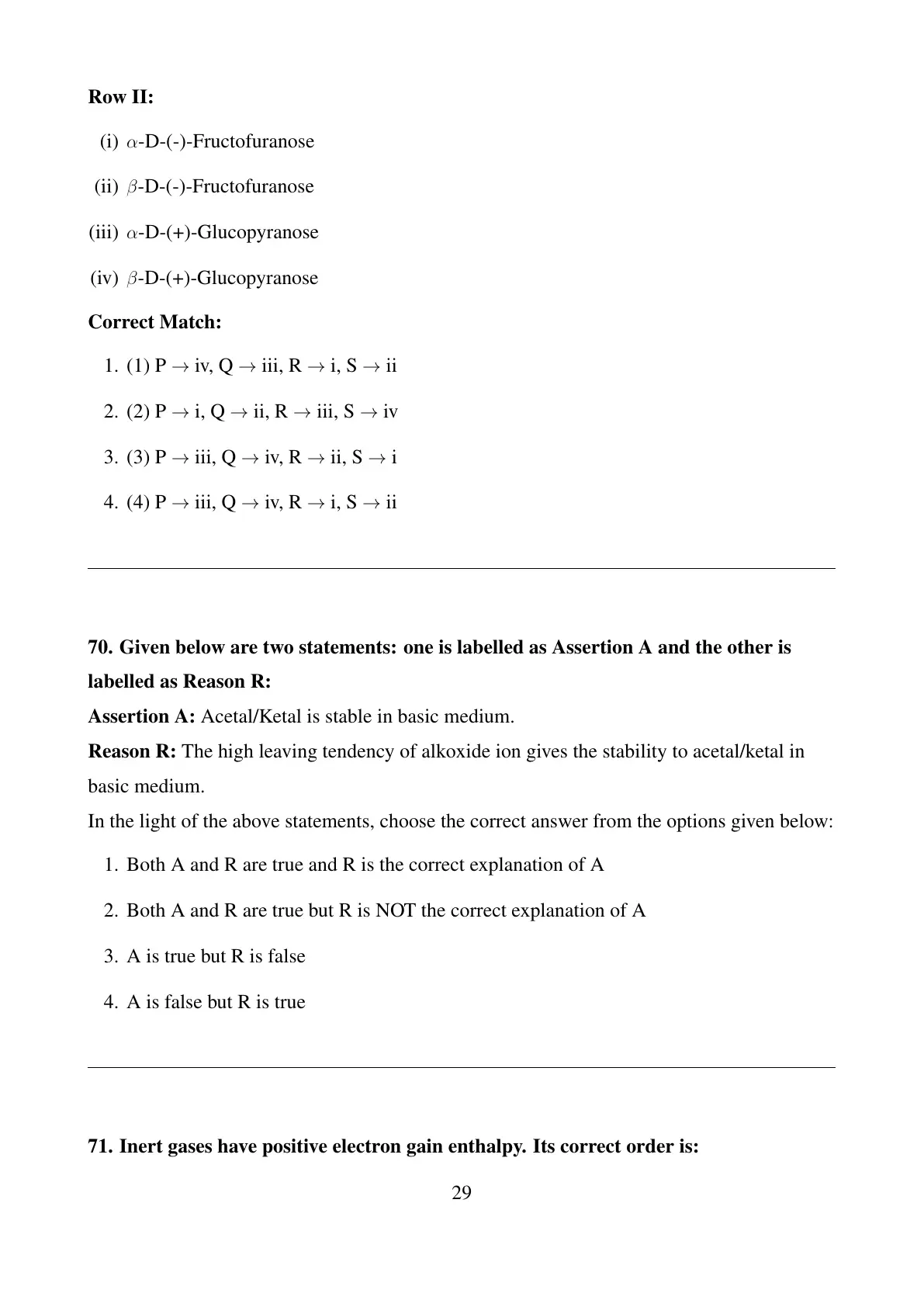
Match items of Row I with those of Row II:
Row I:


Row II:
View Solution
- (P): $\alpha$-D-(+)-Glucopyranose (iii): This structure has the -OH group at C1 in the $\alpha$-position (below the plane) in the six-membered pyranose ring.\\ - (Q): $\beta$-D-(+)-Glucopyranose (iv): This structure has the -OH group at C1 in the $\beta$-position (above the plane) in the six-membered pyranose ring.\\ - (R): $\alpha$-D-(-)-Fructofuranose (i): This structure is a five-membered fructofuranose ring with the $\alpha$-configuration (OH group at C2 below the plane).\\ - (S): $\beta$-D-(-)-Fructofuranose (ii): This structure is a five-membered fructofuranose ring with the $\beta$-configuration (OH group at C2 above the plane).\\ Thus, the correct matching is: \[ \text{P $\to$ iii, Q $\to$ iv, R $\to$ i, S $\to$ ii.} \] 1. Glucose exists in both pyranose ($\text{six-membered}$) and furanose ($\text{five-membered}$) forms. Pyranose forms are more stable.\\ 2. $\alpha$ and $\beta$ forms differ in the configuration of the hydroxyl group at the anomeric carbon (C1 for glucose and C2 for fructose).\\ 3. Fructose predominantly forms five-membered furanose rings due to its keto group.\\Given below are two statements: one is labelled as Assertion A and the other is labelled as Reason R:
Assertion A: Acetal/Ketal is stable in basic medium.
Reason R: The high leaving tendency of alkoxide ion gives the stability to acetal/ketal in basic medium.
In the light of the above statements, choose the correct answer from the options given below:
Inert gases have positive electron gain enthalpy. Its correct order is:
View Solution
Which one of the following reactions does not occur during the extraction of copper?
View Solution
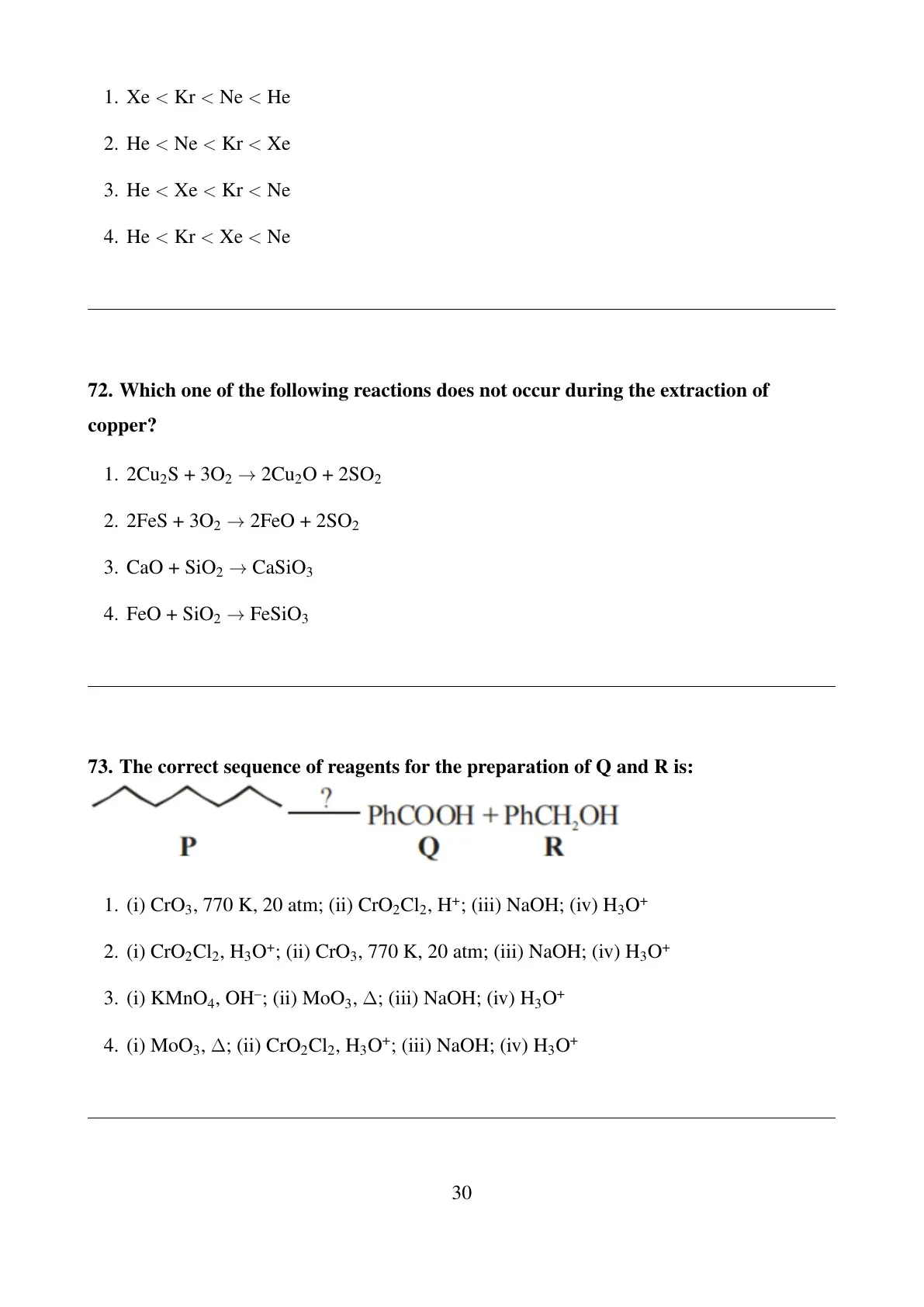
The correct sequence of reagents for the preparation of Q and R is:

View Solution
The reaction sequence involves:Step 1: Oxidation of benzene to benzoquinone using CrO$_3$ at 770 K and 20 atm.
Step 2: Formation of phenol by further oxidation with CrO$_2$Cl$_2$ in acidic medium.
Step 3: Neutralization with NaOH to form phenoxide ion.
Step 4: Acidification with H$_3$O$^+$ to yield phenol. In the preparation of phenol from benzene, the use of CrO$_3$ and CrO$_2$Cl$_2$ ensures selective oxidation steps. Acidic and basic conditions aid in subsequent transformations.
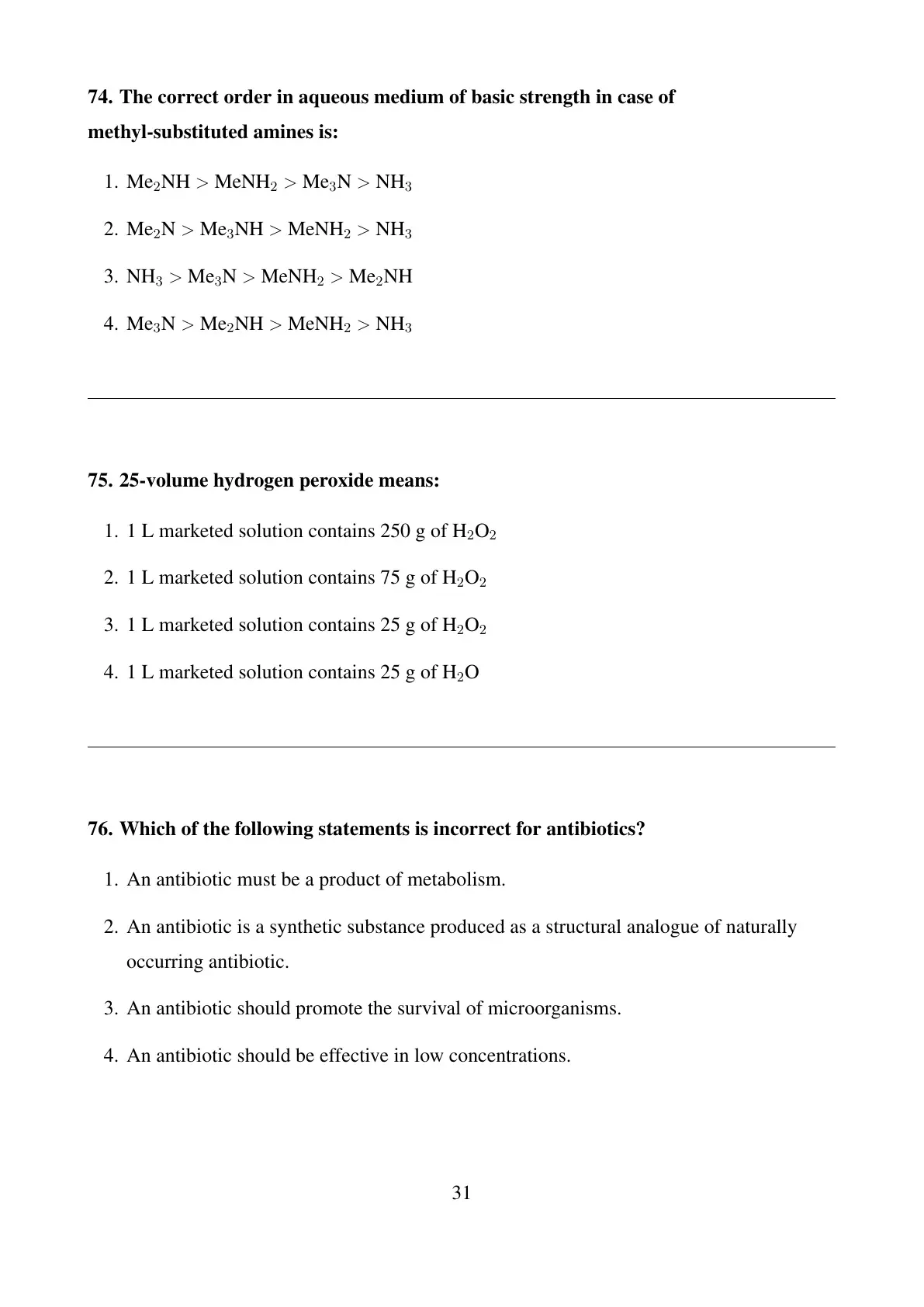
The correct order in aqueous medium of basic strength in case of methyl-substituted amines is:
View Solution
25-volume hydrogen peroxide means:
View Solution
Which of the following statements is incorrect for antibiotics?
View Solution
Compound A reacts with NH\(_3\)Cl and forms B and C. Compound B reacts with H\(_2\)O and CO\(_2\) to form C. The compounds A, B, and C are:
View Solution
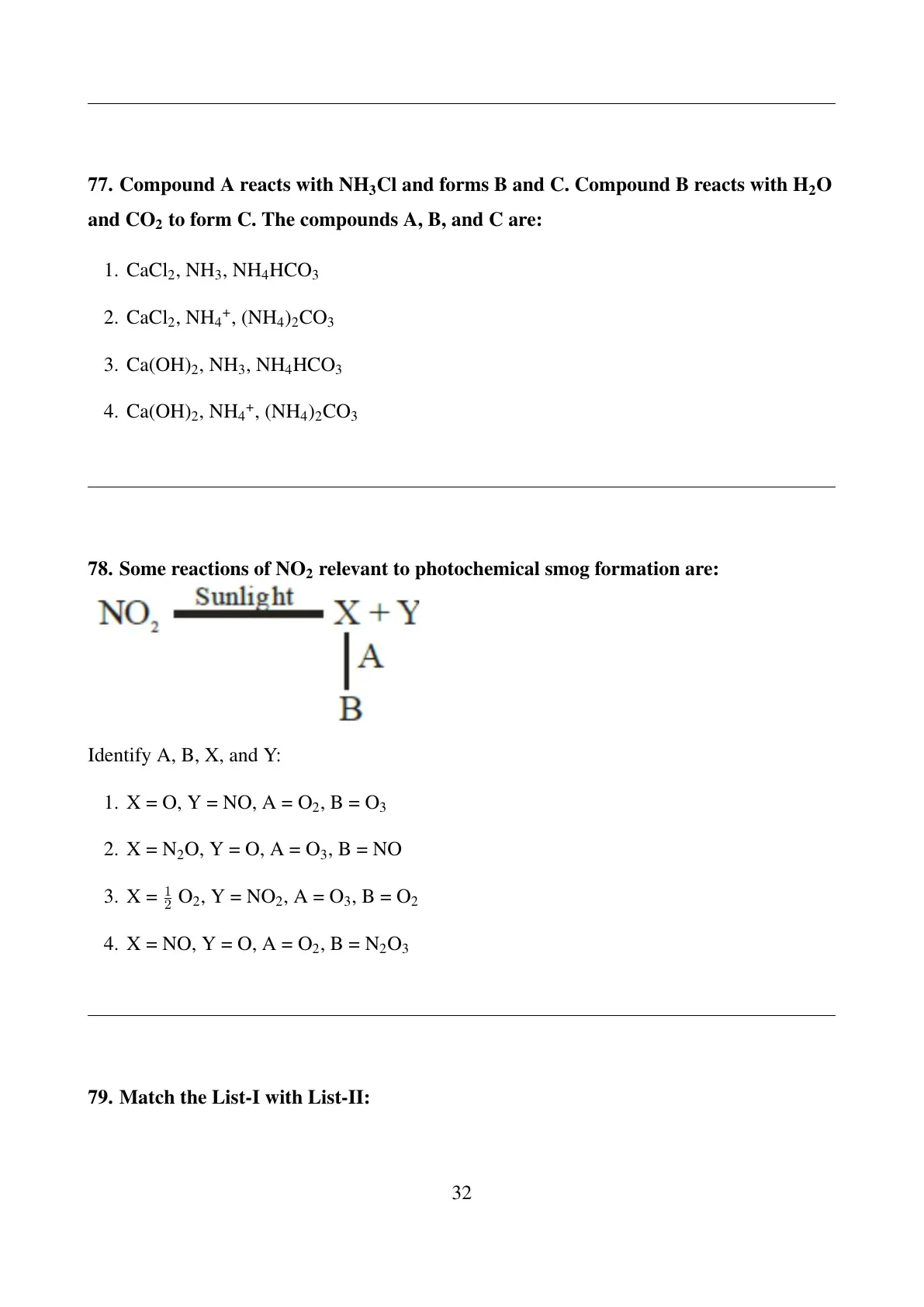
Some reactions of NO\(_2\) relevant to photochemical smog formation are:

Identify A, B, X, and Y:
View Solution
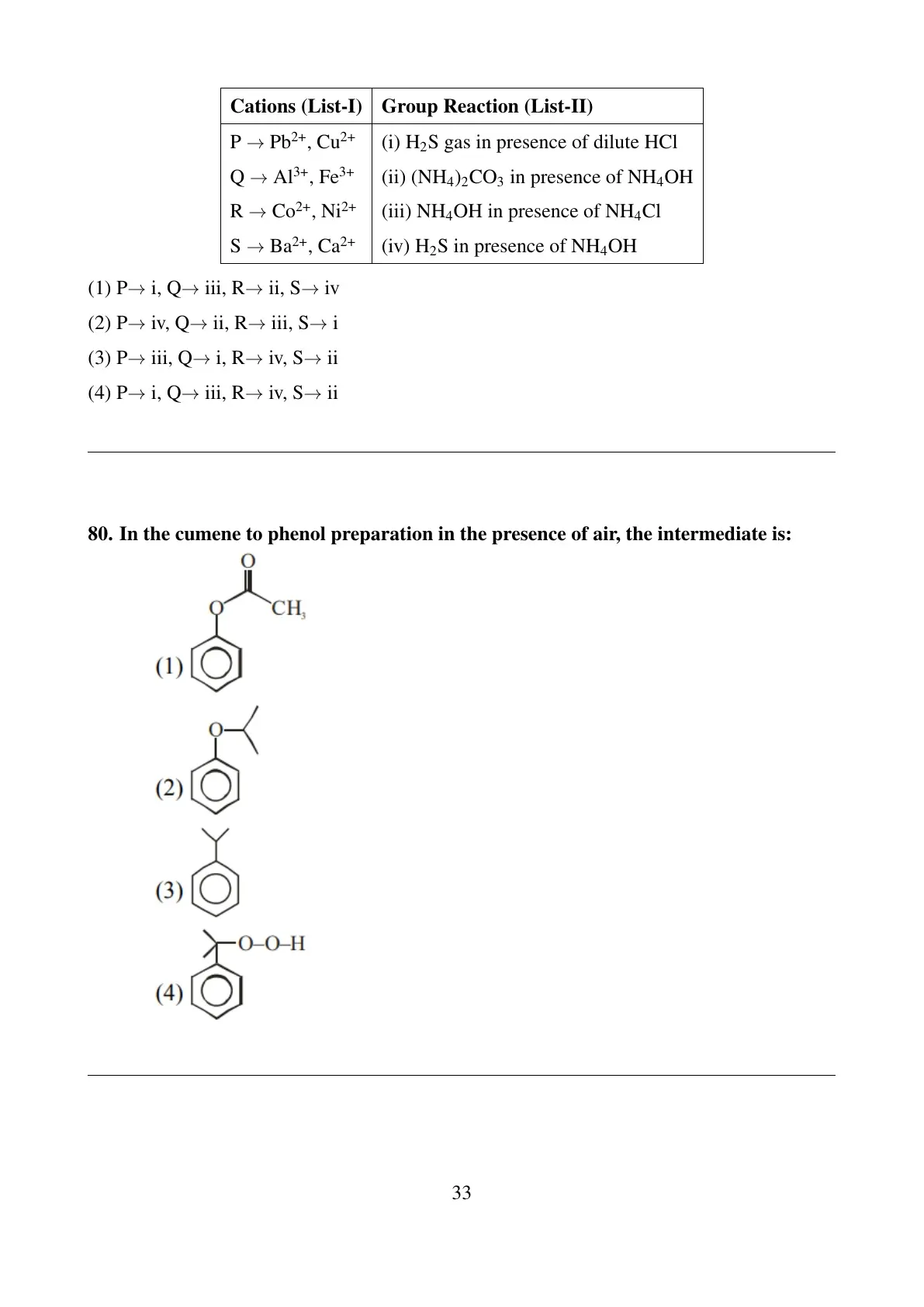
Match the List-I with List-II:

View Solution
In the cumene to phenol preparation in the presence of air, the intermediate is:

View Solution
An athlete is given 100 g of glucose (C\(_6\)H\(_12\)O\(_6\)) for energy, which is equivalent to 1800 kJ of energy. If 50% of this energy is utilized for activities, the weight of extra water needed to perspire is ______ g. (Nearest integer)
Given: Enthalpy of evaporation of water = 45 kJ/mol; molar masses: C = 12 g/mol, H = 1 g/mol, O = 16 g/mol.
View Solution
A litre of buffer solution contains 0.1 mole of each NH\(_3\) and NH\(_4\)Cl. On addition of 0.02 mole of HCl, the pH of the solution is found to be ______ \(\times 10^{-3}\) (Nearest integer).
Given: pK\(_b\)(NH\(_3\)) = 4.745; \(\log 2 = 0.301\); \(\log 3 = 0.477\); T = 298 K.
View Solution
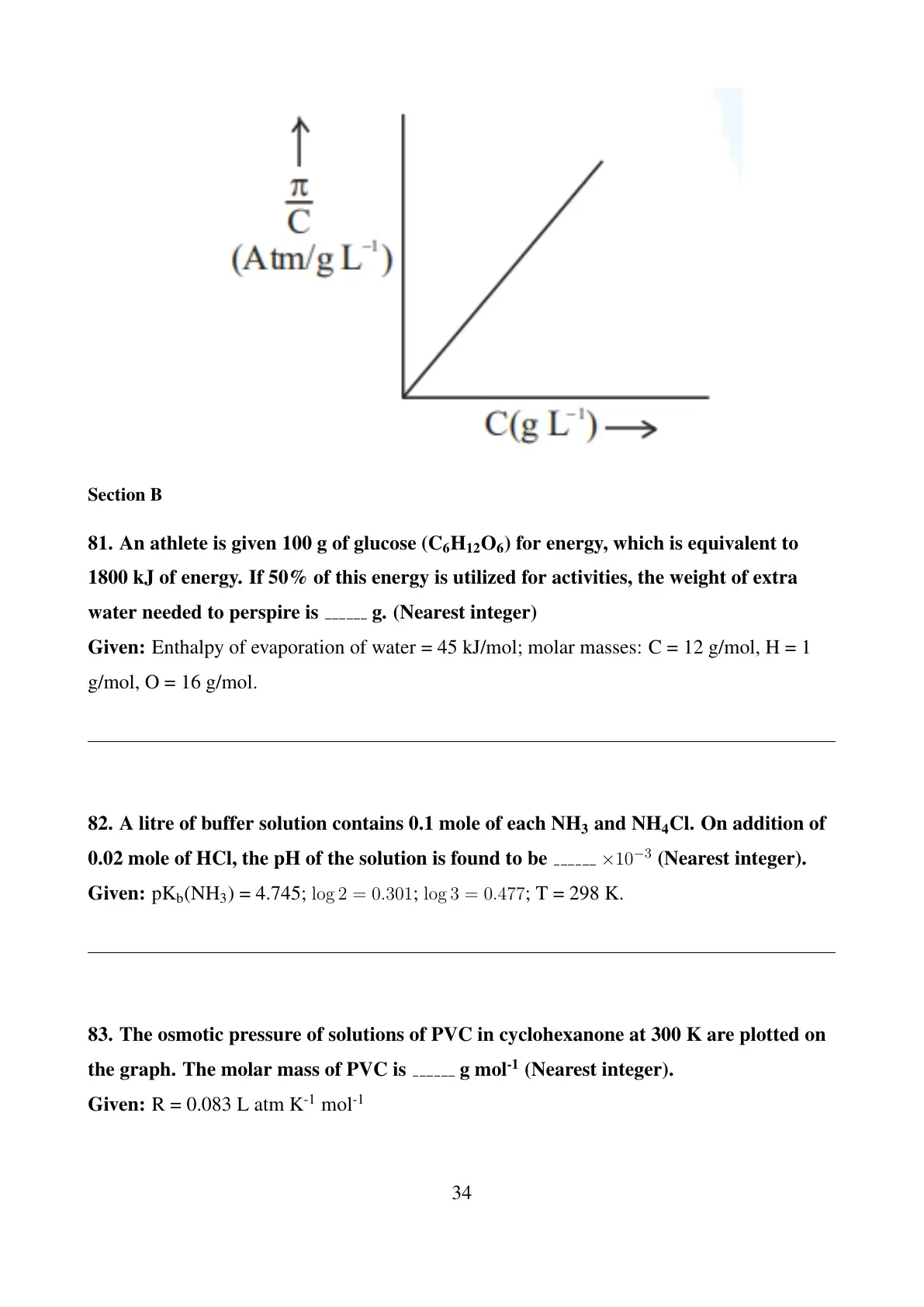
The osmotic pressure of solutions of PVC in cyclohexanone at 300 K are plotted on the graph. The molar mass of PVC is ______ g mol\(^{-1}\) (Nearest integer).

Given: R = 0.083 L atm K\(^{-1}\) mol\(^{-1}\)
View Solution
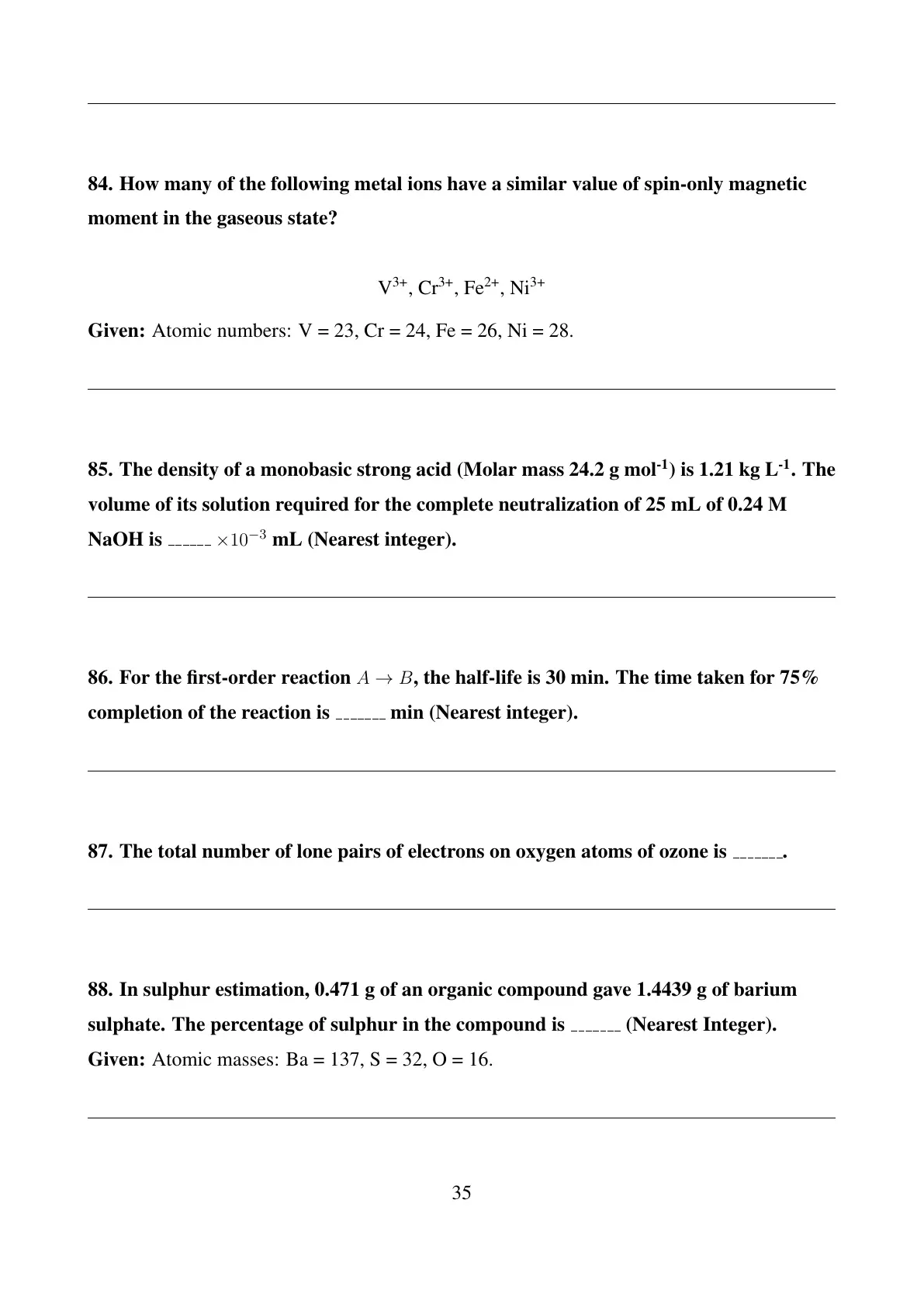
How many of the following metal ions have a similar value of spin-only magnetic moment in the gaseous state?
\[ V\(^{3+\), Cr\(^{3+}\), Fe\(^{2+}\), Ni\(^{3+}\)} \]
Given: Atomic numbers: V = 23, Cr = 24, Fe = 26, Ni = 28.
View Solution
The density of a monobasic strong acid (Molar mass 24.2 g mol\(^{-1}\)) is 1.21 kg L\(^{-1}\). The volume of its solution required for the complete neutralization of 25 mL of 0.24 M NaOH is ______ \(\times 10^{-3}\) mL (Nearest integer).
View Solution
For the first-order reaction \(A \rightarrow B\), the half-life is 30 min. The time taken for 75% completion of the reaction is _______ min (Nearest integer).
View Solution
The total number of lone pairs of electrons on oxygen atoms of ozone is _______.
View Solution
In sulphur estimation, 0.471 g of an organic compound gave 1.4439 g of barium sulphate. The percentage of sulphur in the compound is _______ (Nearest Integer).
Given: Atomic masses: Ba = 137, S = 32, O = 16.
View Solution
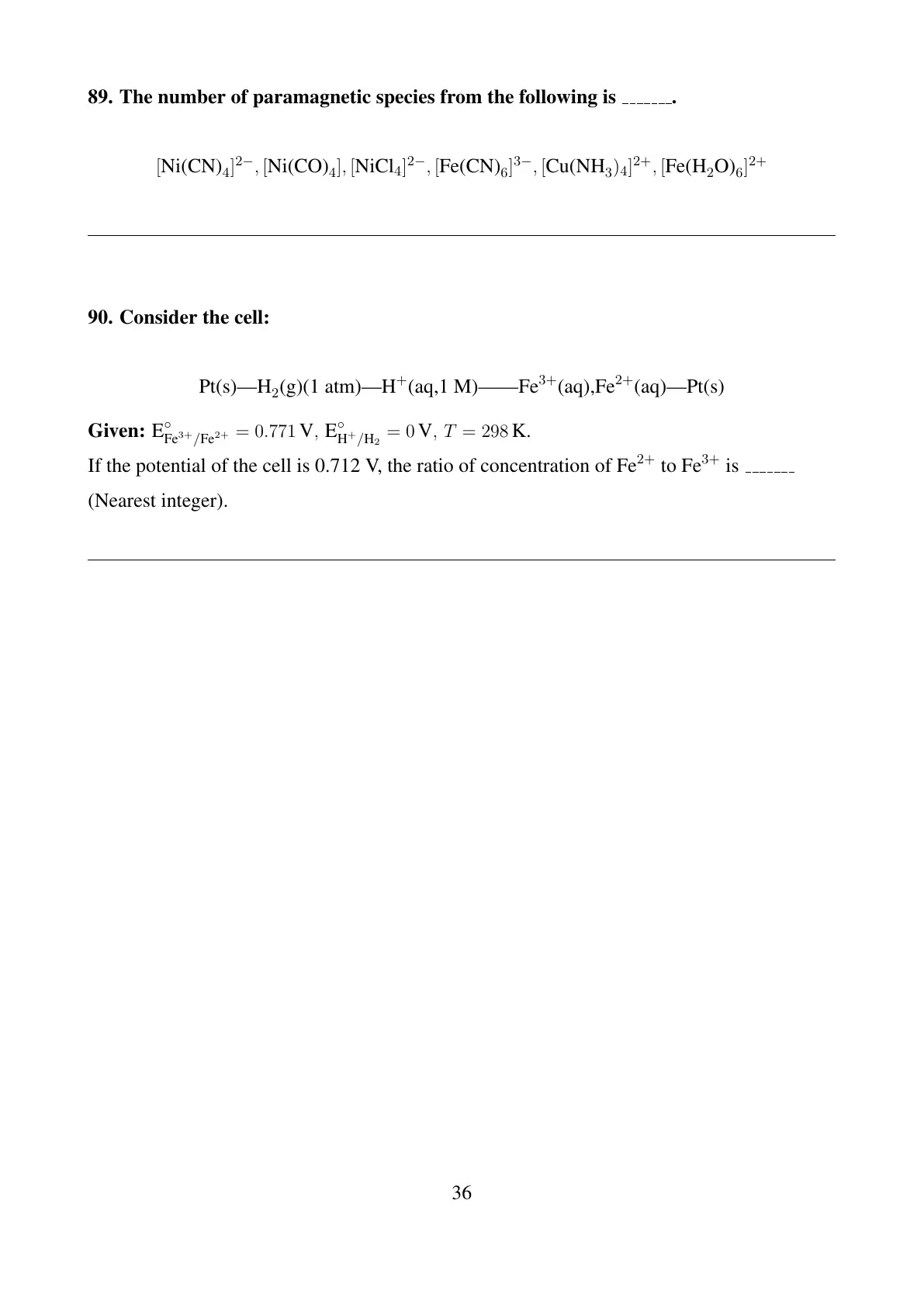
The number of paramagnetic species from the following is _______.
\[ [Ni(CN)_4]^{2-}, [Ni(CO)_4], [NiCl_4]^{2-}, [Fe(CN)_6]^{3-}, [Cu(NH_3)_4]^{2+}, [Fe(H_2O)_6]^{2+} \]
View Solution
Consider the cell:
\[ Pt(s)|H_2(g)(1 atm)|H^{+}(aq,1 M)||Fe^{3+}(aq),Fe^{2+}(aq)|Pt(s) \]
Given: \(E^\circ_{Fe^{3+}/Fe^{2+}} = 0.771 \, V, \, E^\circ_{H^+/H_2} = 0 \, V, \, T = 298 \, K\).
If the potential of the cell is 0.712 V, the ratio of concentration of \(Fe^{2+}\) to \(Fe^{3+}\) is _______ (Nearest integer).
View Solution
Also Check:
JEE Main 2023 Jan 25 Shift 1 Question Paper by Coaching Institute
| Coaching Institutes | Question Paper with Answer Key PDF |
|---|---|
| Aakash BYJUs | Check Here |
| Vedantu | Check Here |
JEE Main 2023 Paper Analysis Jan 25 Shift 1
JEE Main 2023 Paper Analysis for the exam conducted on January 25 Shift 1 is updated here. Candidates can check subject-wise paper analysis for the exam scheduled on January 25 Shift 1 here along with the topics with the highest weightage.
| JEE Main 2023 Paper Analysis Jan 25 Shift 1 | Check Here |



Comments