




JEE Main 2023 January 25 Shift 2 Question Paper is available here with answer key and solution pdf. NTA conducted the second shift on January 25, 2023, from 3:00 PM to 6:00 PM. The JEE Main 2023 Paper 1 (B.E./B.Tech) question paper includes the following:
- 90 questions in a 3-hour CBT Mode: 30 each from Mathematics, Physics and Chemistry (75 to be attempted)
- Section A: 20 multiple choice questions (MCQs) per subject, 4 marks each
- Section B: 10 numerical value questions per subject, attempt any 5, 4 marks each (integer answer)
- Marking: +4 for a correct answer, -1 for an incorrect answer, 0 for an unattempted question
JEE Main 2023 January 25 Shift 2 Question Paper with Solution PDF
| NTA Official PDF | CD PDF | CD PDF with Solutions |
|---|---|---|
| Download official PDF 5.00 MB | Download Collegedunia PDF 1.01 MB | Download solutions PDF 0.70 MB |
Also Check:
JEE Main 2023 January 25 Shift 2 Questions with Solutions
Mathematics - Section A (Q1 - Q20)
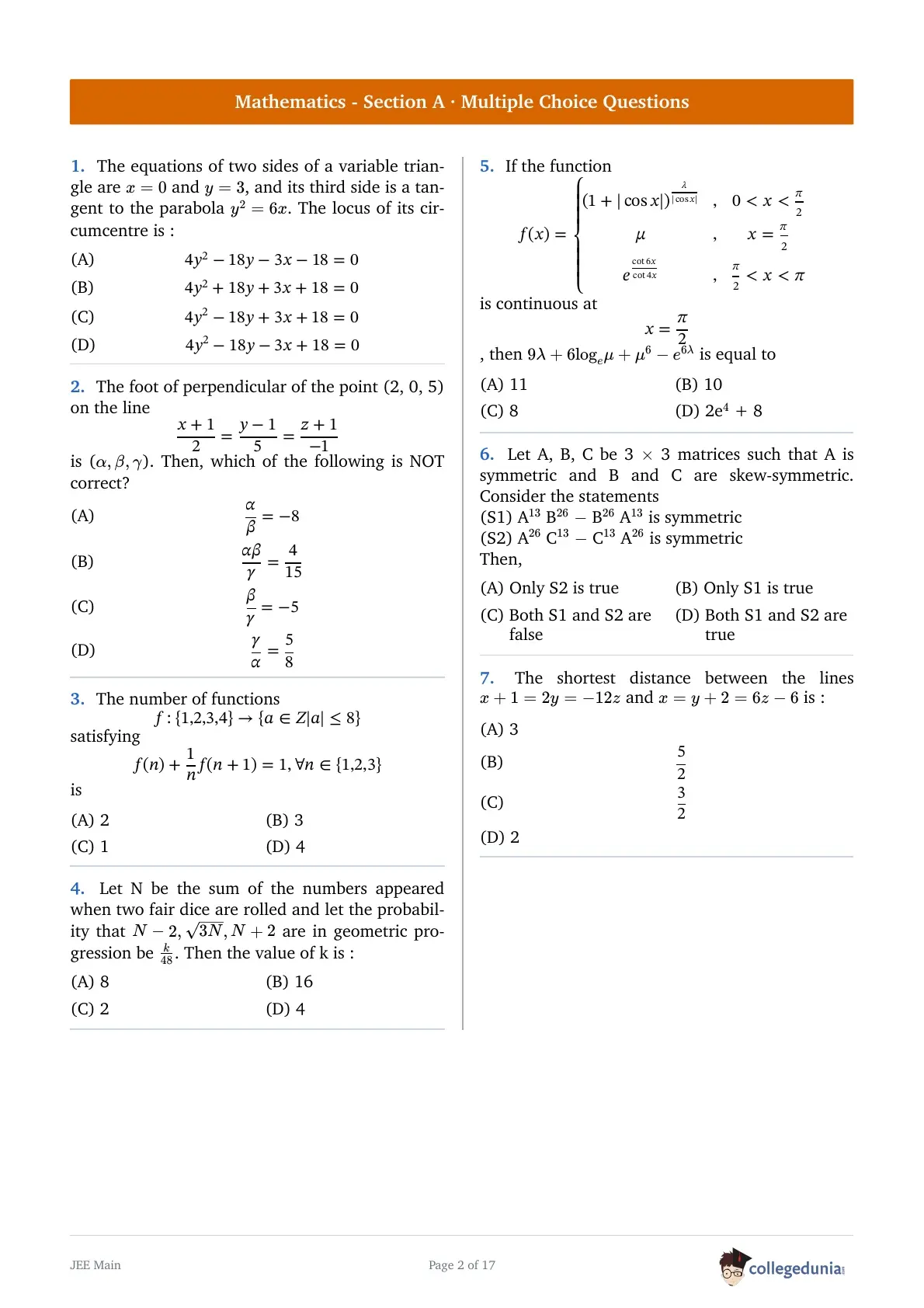
The equations of two sides of a variable triangle are \(x-0\) and \(y=3\), and its third side is a tangent to the parabola \(y^2=6 x\). The locus of its circumcentre is:
The foot of perpendicular of the point \((2,0,5)\) on the line \(\frac{x+1}{2}=\frac{y-1}{5}-\frac{z+1}{-1}\) is \((a, \beta, \gamma)\). Then which of the following is NOT correct?
The number of functions \(f:\{1,2,3,4\} \rightarrow\{ a \in: Z|a| \leq 8\}\) satisfying \(f(n)+\frac{1}{n} f( n +1)=1, \forall n \in\{1,2,3\}\) is
Let \(N\) be the sum of the numbers appeared when two fair dice are rolled and let the probability that \(N-2, \sqrt{3 N}, N+2\) are in geometric progression be \(\frac{k}{48}\), Then the value of \(k\) is
If the function \(f(x)=\begin{cases}(1+|\cos x|) \frac{\lambda}{|\cos x|} & , 0 < x < \frac{\pi}{2} \\\mu & , \quad x=\frac{\pi}{2} \\\frac{\cot 6 x}{e^{\cot 4 x}} & \frac{\pi}{2}< x< \pi\end{cases}\)is continuous at \(x=\frac{\pi}{2}, then 9 \lambda+6 \log _{ e } \mu+\mu^6- e ^{6 \lambda}\) is equal to
Let A,B,C be 3×3 matrices such that A is symmetric and B and C are skew symmetric. Consider the statements:
(S1) A13B26 − B26A13 is symmetric.
(S2) A26C13 − C13A26 is symmetric.Then:
The shortest distance between the lines \(x+1=2 y=-12 z\) and \(x=y+2=6 z-6\) is
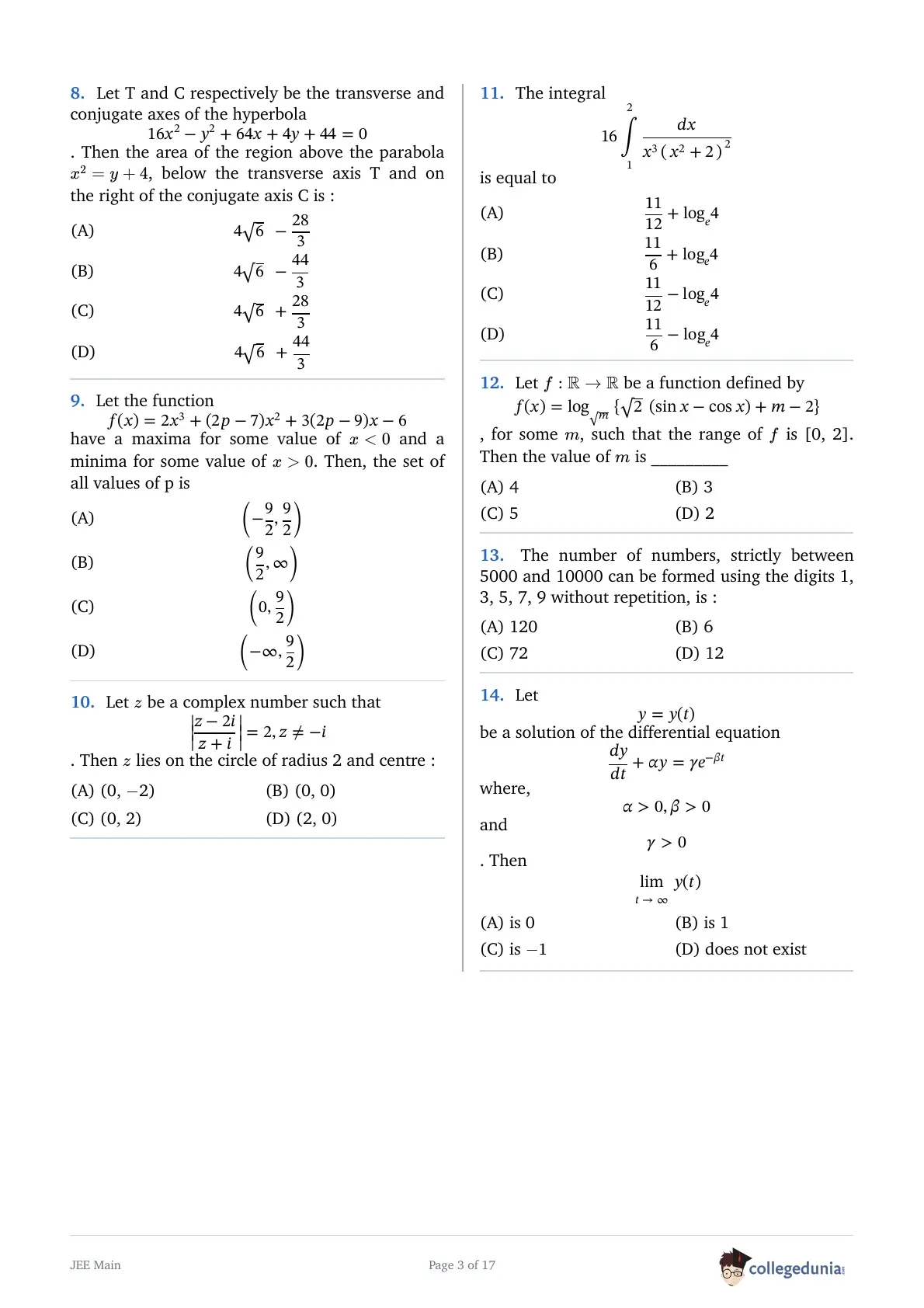
Let \(T\) and \(C\) respectively be the transverse and conjugate axes of the hyperbola \(16 x^2-y^2+64 x+4 y\) \(+44=0\). Then the area of the region above the parabola \(x^2=y+4\), below the transverse axis \(T\) and on the right of the coujugate axis \(C\) is:
Let the function \(f(x)=2 x^3+(2 p-7) x^2+3(2 p-9) x-6\) have a maxima for some value of \(x<0\) and a minima for some value of \(x>0\) Then, the set of all values of \(p\) is
Let \(z\) be a complex number such that \(\left|\frac{z-2 i}{z+i}\right|=2 z \neq-i\) Then \(z\) lies on the circle of radius 2 and centre
The integral \(16 \int\limits_1^2 \frac{d x}{x^3\left(x^2+2\right)^2}\) is equal to
Let \(f: R \rightarrow R\) be a function defined by\(f(x)=\log _{\sqrt{m}}\{\sqrt{2}(\sin x-\cos x)+m-2\}\), for some \(m\), such that the range of \(f\) is \([0,2]\) Then the value of \(m\) is_____
The number of numbers, strictly between 5000 and 10000 can be formed using the digits 1,3,5,7,9 without repetition, is
Let \(y=y(t)\) be a solution of the differential equation\(\frac{d y}{d t}+\alpha y=\gamma e^{-\beta t}\) where, \(\alpha > 0, \beta>0\) and \(\gamma > 0\). Then \(\displaystyle\lim _{t \rightarrow \infty} y(t)\)
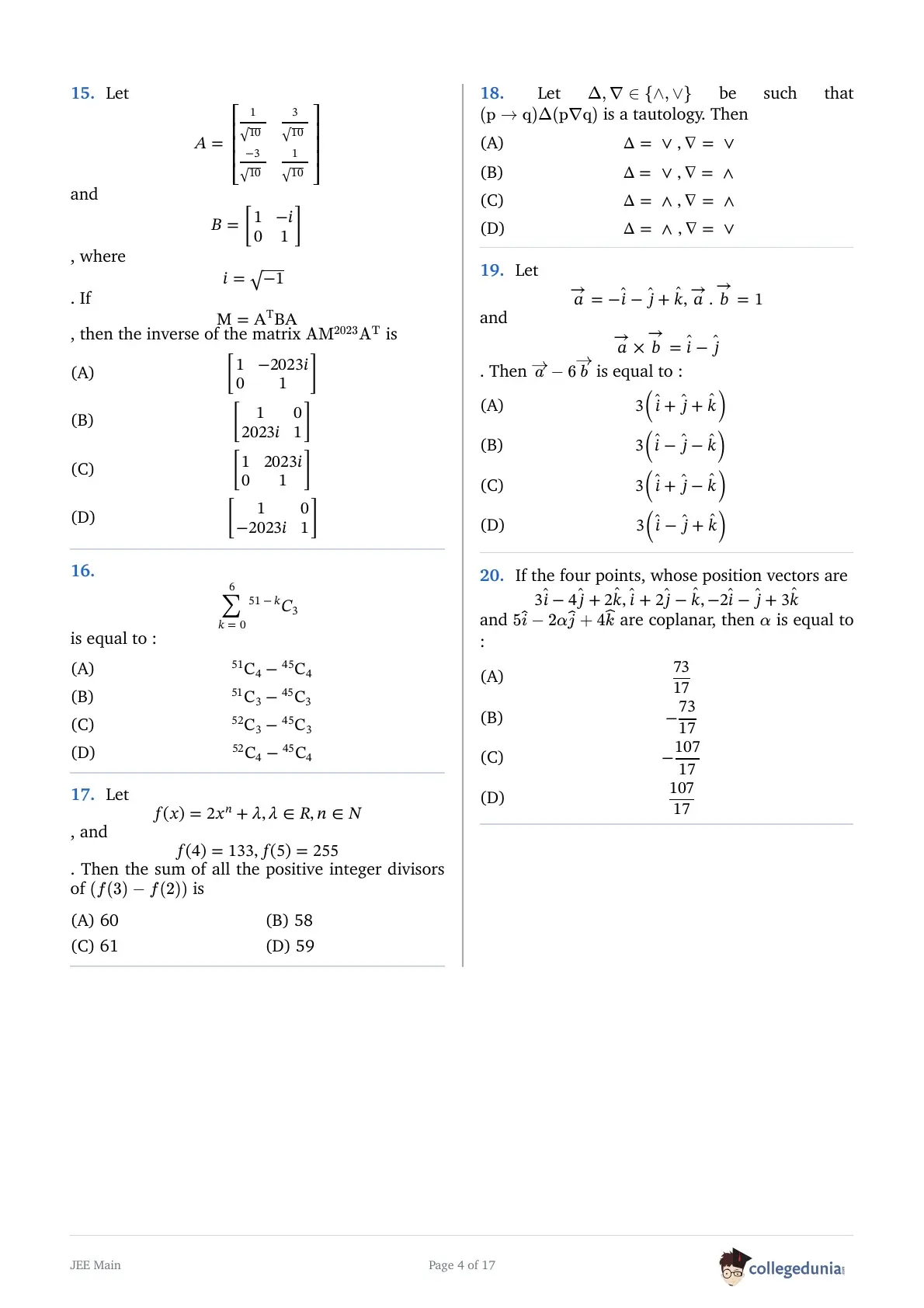
Let \(A=\left[\begin{array}{cc}\frac{1}{\sqrt{10}} & \frac{3}{\sqrt{10}} \\ \frac{-3}{\sqrt{10}} & \frac{1}{\sqrt{10}}\end{array}\right]\) and \(B=\left[\begin{array}{cc}1 & -i \\ 0 & 1\end{array}\right]\), where \(i=\sqrt{-1}\) If \(M = A ^{ T } B A\), then the inverse of the matrix \(AM ^{2023} A ^{ T }\) is
\(\displaystyle\sum_{k=0}^6{ }^{51-k} C_3\) is equal to
Let \( f(x) = 2x^n + \lambda \), where \( \lambda \in \mathbb{R} \) and \( n \in \mathbb{N} \) . Given that \( f(4) = 133 \) and \( f(5) = 255 \), What is the sum of all the positive integer divisors of \( f(3) - f(2) \)?
Let \(\Delta, \nabla \in\{\Lambda, V\}\) be such that \(( p \rightarrow q ) \Delta( p \nabla q )\) is a tautology. Then
Let \(\vec{a}=-\hat{i}-\hat{j}+\hat{k}, \vec{a} \cdot \vec{b}=1\) and \(\vec{a} \times \vec{b}=\hat{i}-\hat{j}\). Then \(\vec{a}-6 \vec{b}\) is equal to
If the four points, whose position vectors are \(3 \hat{i}-4 j+2 \hat{k}, l+2 j-\hat{k}_4-2 \hat{k}-j+3 \hat{k}\) and \(5 \hat{i}-2 \alpha \hat{j}+4 \hat{k}\) are coplanar, then a is equal to
Mathematics - Section B (Q21 - Q30)
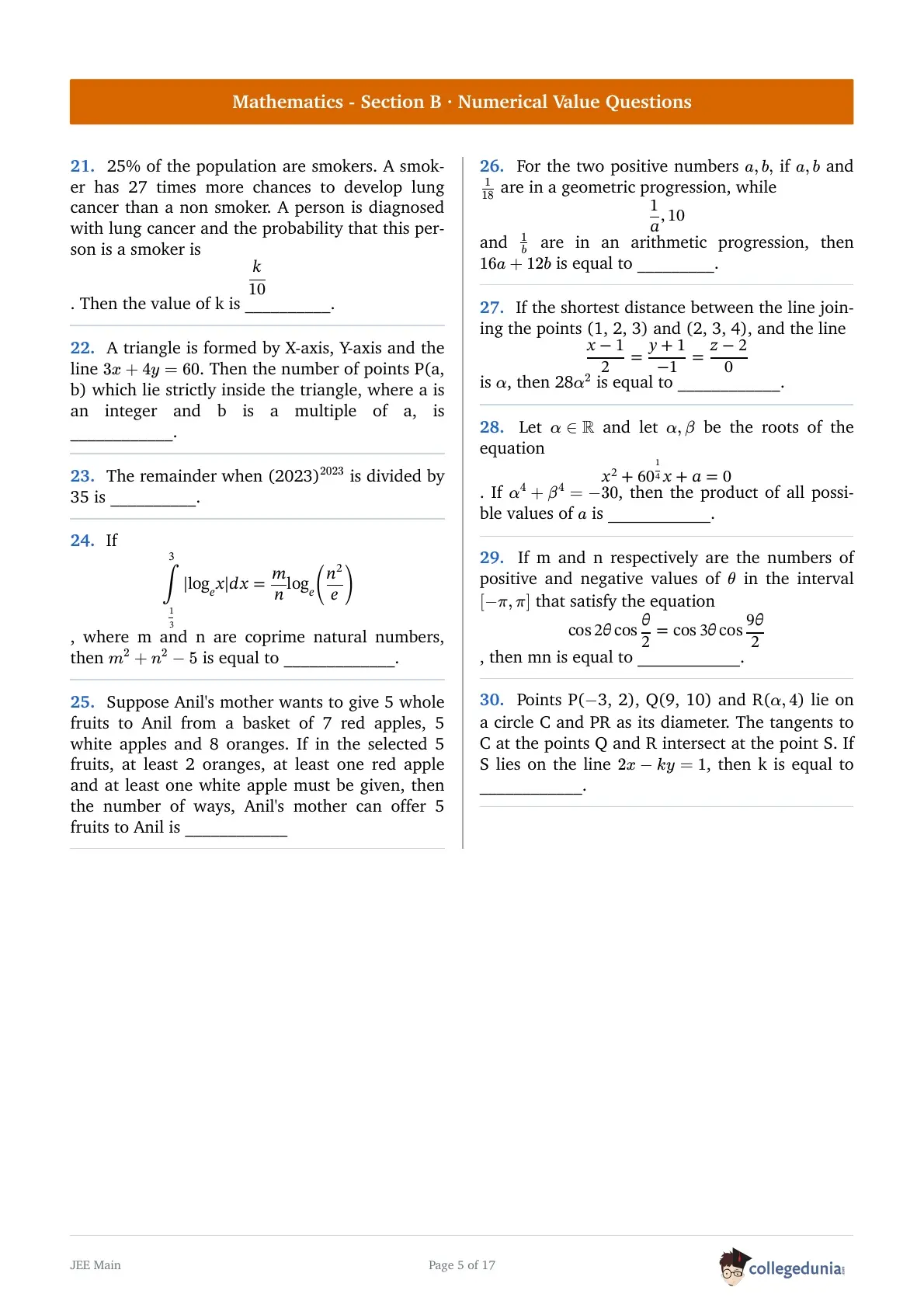
\(25 \%\) of the population are smokers A smoker has 27 times more chances to develop lung cancer than a non smoker A person is diagnosed with lung cancer and the probability that this person is a smoker is \(\frac{k}{10}\), Then the value of \(k\) is____
A triangle is formed by \(X\)-axis, \(Y\)-axis and the line \(3 x+4 y=60\) Then the number of points \(P ( n , b )\) which lie strictly inside the triangle, where a is an integer and \(b\) is a multiple of a, is ____
The remainder when \((2023)^{2023}\) is divided by \(35\) is _____
If \(\int\limits_{\frac{1}{3}}^{3}\left|\log _e x\right| d x=\frac{m}{n} \log e\left(\frac{n^2}{v}\right)\), where \(m\) and \(n\) are coprime natural numbers, then \(m^2+n^2-5\) is equal to _____
Suppose Anil's mother wants to give 5 whole fruits to Anil from a basket of 7 red apples, 5 white apples and 8 oranges If in the selected 5 fruits, at least 2 oranges, at least one red apple and at least one white apple must be given, then the number of ways, Anil's mother can ofter 5 fruits to Anil is______
For the two positive numbers \(a, b\), if \(a, b\) and \(\frac{1}{18}\) are in a geometric progression, while \(\frac{1}{a}, 10\) and \(\frac{1}{b}\) are in an arithmetic progression, then \(16 a+12 b\) is equal to
If the shortest distance between the line joining the points \((1,2,3)\) and \((2,3,4)\), and the line \(\frac{x-1}{2}=\frac{y+1}{-1}=\frac{z-2}{0}\) is \(\alpha\), then \(28 \alpha^2\) is equal to
Let \(a \in R\) and let \(\alpha, \beta\) be the roots of the equation \(x^2+60^{\frac{1}{4}} x+a=0\). If \(\alpha^4+\beta^4=-30\), then the product of all possible values of \(a\) is_____
If \(m\) and \(n\) respectively are the numbers of positive and negative values of \(\theta\) in the interval \([-\pi, \pi]\) that satisfy the equation \(\cos 2 \theta \cos \frac{\theta}{2}=\cos 3 \theta \cos \frac{99}{2}\), then \(m n\) is equal to__
Points \(P(-3,2), Q(9,10)\) and \(R(\alpha, 4)\) lie on a circle \(C\) with \(P R\) as its diameter. The tangents to \(C\) at the points \(Q\) and \(R\) intersect at the point \(S\). If \(S\) lies on the line \(2 x-k y-1\), then \(k\) is equal to_____
Physics - Section A (Q31 - Q50)
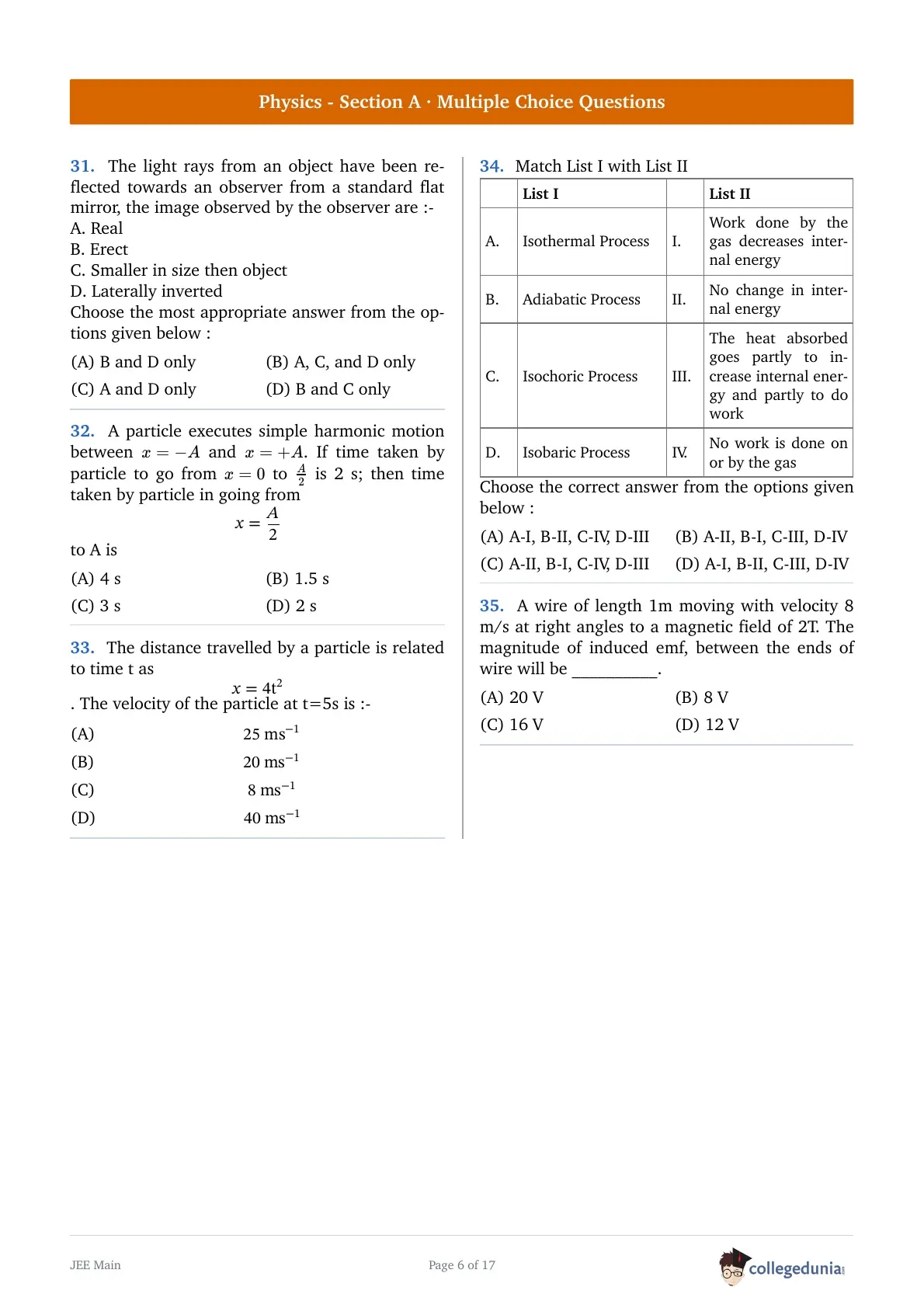
The light rays from an object have been reflected towards an observer from a standard flat mirror, the image observed by the observer are:-
A. Real
B. Erect
C. Smaller in size then object
D. Laterally inverted
Choose the most appropriate answer from the options given below:
A particle executes simple harmonic motion between \(x=- A\) and \(x=+ A\). If time taken by particle to go from \(x=0\) to \(\frac{A}{2}\) is 2 s; then time taken by particle in going from \(x=\frac{A}{2}\) to \(A\) is
The distance travelled by a particle is related to time \(t\) as \(x=4 t^2\) The velocity of the particle at \(t-5 s\) is:-
| LIST I | LIST II | ||
| A | Isothermal Process | I | Work done by the gas decreases internal energy |
| B | Adiabatic Process | II | No change in internal energy |
| C | Isochoric Process | III | The heat absorbed goes partly to increase internal energy and partly to do work |
| D | Isobaric Process | IV | No work is done on or by the gas |
A wire of length \(1 m\) moving with velocity \(8 m / s\) at right angles to a magnetic field of \(2 T\) The magnitude of induced emf, between the ends of wire will be ______
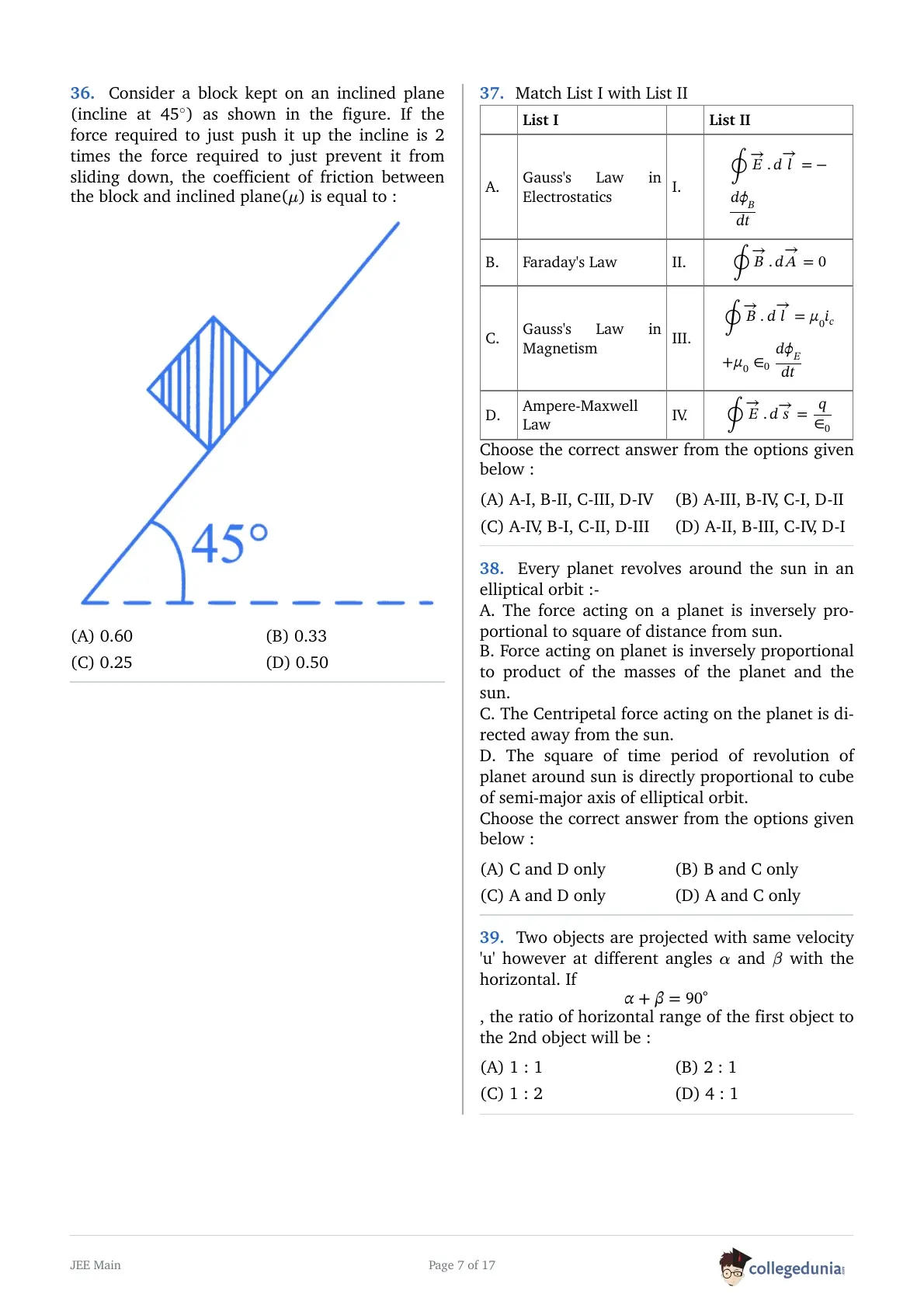
Consider a block kept on an inclined plane (inclined at \(45^{\circ}\) ) as shown in the figure If the force required to just push it up the incline is 2 times the force required to just prevent it from sliding down, the coefficient of friction between the block and inclined plane \((\mu)\) is equal to :
| LIST I | LIST II | ||
| A | Gauss's Law in Electrostatics | I | \(\oint \vec{E} \cdot d \vec{l}=-\frac{d \phi_B}{d t}\) |
| B | Faraday's Law | II | \(\oint \vec{B} \cdot d \vec{A}=0\) |
| C | Gauss's Law in Magnetism | III | \(\oint \vec{B} \cdot d \vec{l}=\mu_0 i_c+\mu_0 \in_0 \frac{d \phi_E}{d t}\) |
| D | Ampere-Maxwell Law | IV | \(\oint \vec{E} \cdot d \vec{s}=\frac{q}{\epsilon_0}\) |
Every planet revolves around the sun in an elliptical orbit:-
A. The force acting on a planet is inversely proportional to square of distance from sun
B. Force acting on planet is inversely proportional to product of the masses of the planet and the sun
C. The Centripetal force acting on the planet is directed away from the sun
D. The square of time period of revolution of planet around sun is directly proportional to cube of semi-major axis of elliptical orbit
Choose the correct answer from the options given below:
Two objects are projected with same velocity ' \(u\) ' however at different angles \(\propto\) and \(\beta\) with the horizontal If \(\alpha+\beta=90^{\circ}\), the ratio of horizontal range of the first object to the 2nd object will be :
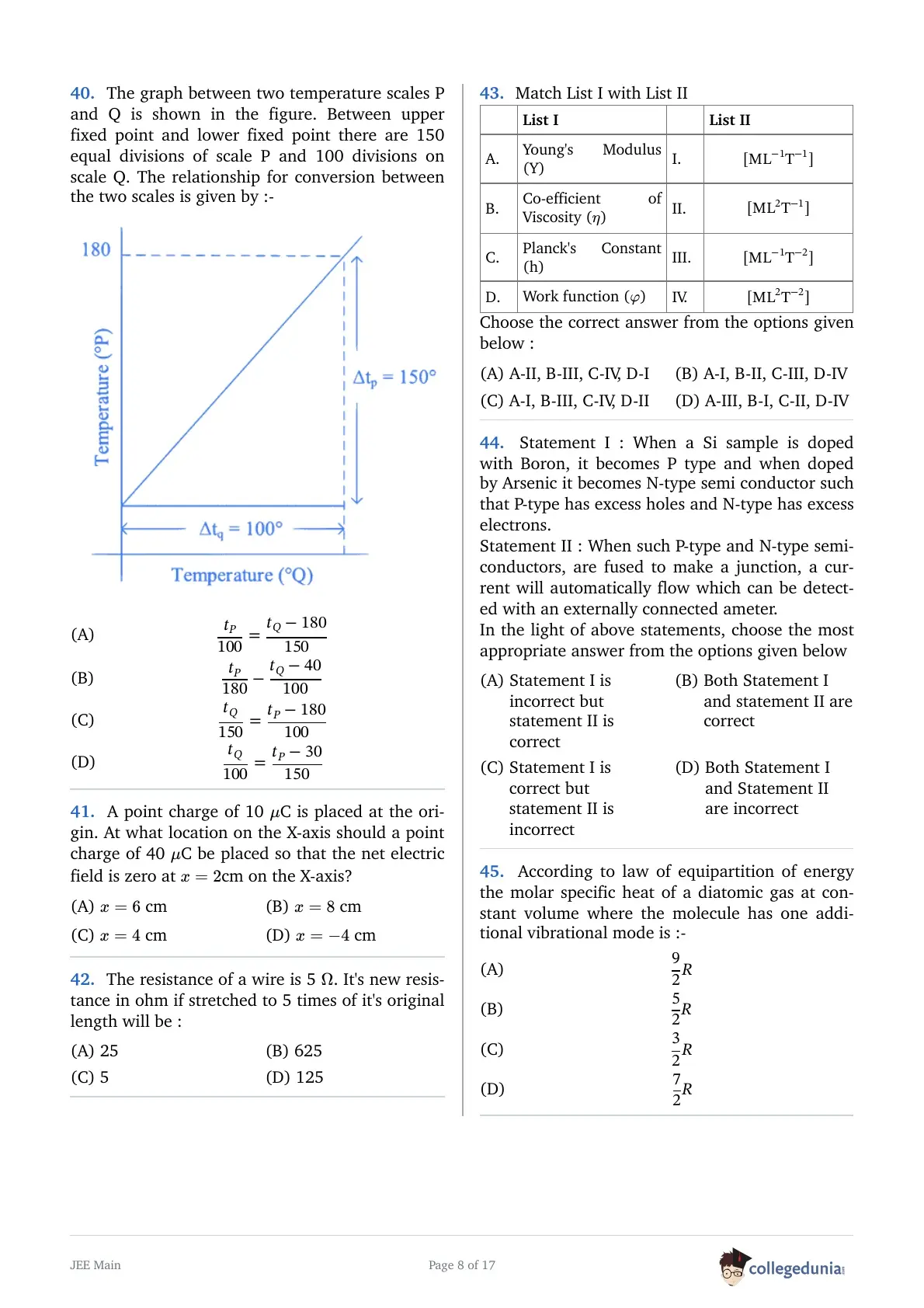
A point charge of \(10\, \mu C\) is placed at the origin At what location on the \(X\)-axis should a point charge of \(40 \, \mu C\) be placed so that the net electric field is zero at \(x=2 \, cm\) on the \(X\)-axis?
The resistance of a wire is \(5 \Omega\). It's new resistance in ohm if stretched to 5 times of it's original length will be:
| List I | List II | ||
| A. | Young's Modulus (Y) | I. | [M L-1 T-1 ] |
| B. | Co-efficient of Viscosity (η) | II. | [M L2 T-1 ] |
| C. | Planck's Constant (h) | III. | [M L-1 T-2 ] |
| D. | Work Function (ϕ) | IV. | [M L2 T-2 ] |
Statement I: When a Si sample is doped with Boron, it becomes P type and when doped by Arsenic it becomes N-type semi conductor such that P-type has excess holes and N-type has excess electrons.
Statement II: When such P-type and N-type semi-conductors, are fused to make a junction, a current will automatically flow which can be detected with an externally connected ammeter.
In the light of above statements, choose the most appropriate answer from the options given below
According to law of equipartition of energy the molar specific heat of a diatomic gas at constant volume where the molecule has one additional vibrational mode is:-
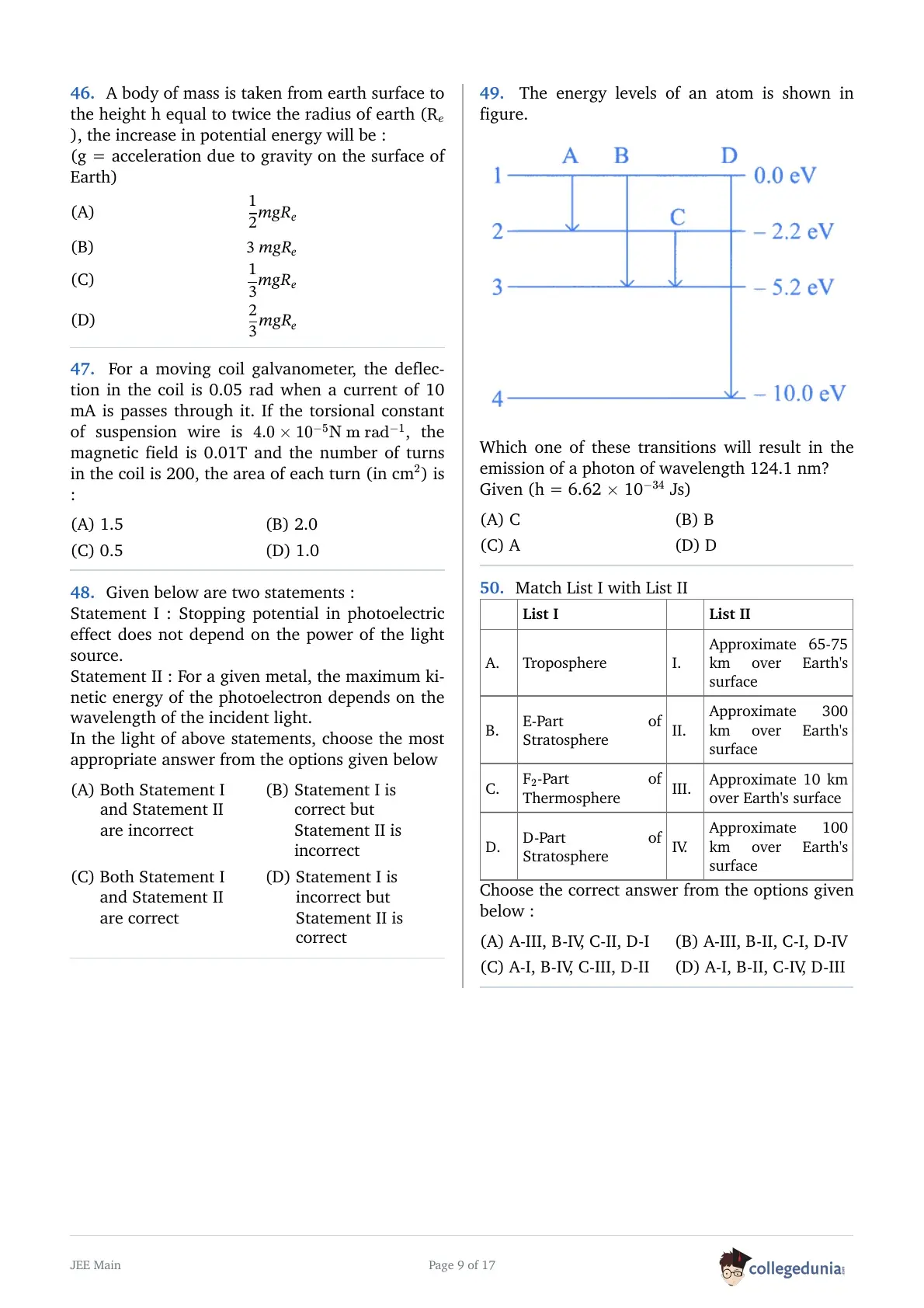
A body of mass is taken from earth surface to the height \(h\) equal to twice the radius of earth \(\left(R_e\right)\) the inerease in potential energy will be:( \(g\) = acceleration due to gravity on the surface of Earth)
For a moving coil galvanometer, the deflection in the coil is \(005\) rad when a current of \(10 \,mA\) is field is \(0,01 \,T\) and the number of turns in the coil is \(200\) , the area of each tum (in \(cm ^2\) ) is :
Given below are two statements :
Statement I: Stopping potential in photoelectric effect does not depend on the power of the light source
Statement II: For a given metal, the maximum kinetic energy of the photoelectron depends on the wavelength of the incident light.
In the light of above statements, choose the most appropriate answer from the options given below
The energy levels of an atom is shown in figure:
Which one of these transitions will result in the emission of a photon of wavelength \(1241\, nm\) ? Given \(\left( h =6.62 \times 10^{-34} Js \right)\)
| List I | List II | ||
| A. | Troposphere | I. | Approximate 65-75 km over Earth’s surface |
| B. | E- Part of Stratosphere | II. | Approximate 300 km over Earth’s surface |
| C. | F2- Part of Thermosphere | III. | Approximate 10 km over Earth’s surface |
| D. | D- Part of Stratosphere | IV. | Approximate 100 km over Earth’s surface |
Physics - Section B (Q51 - Q60)
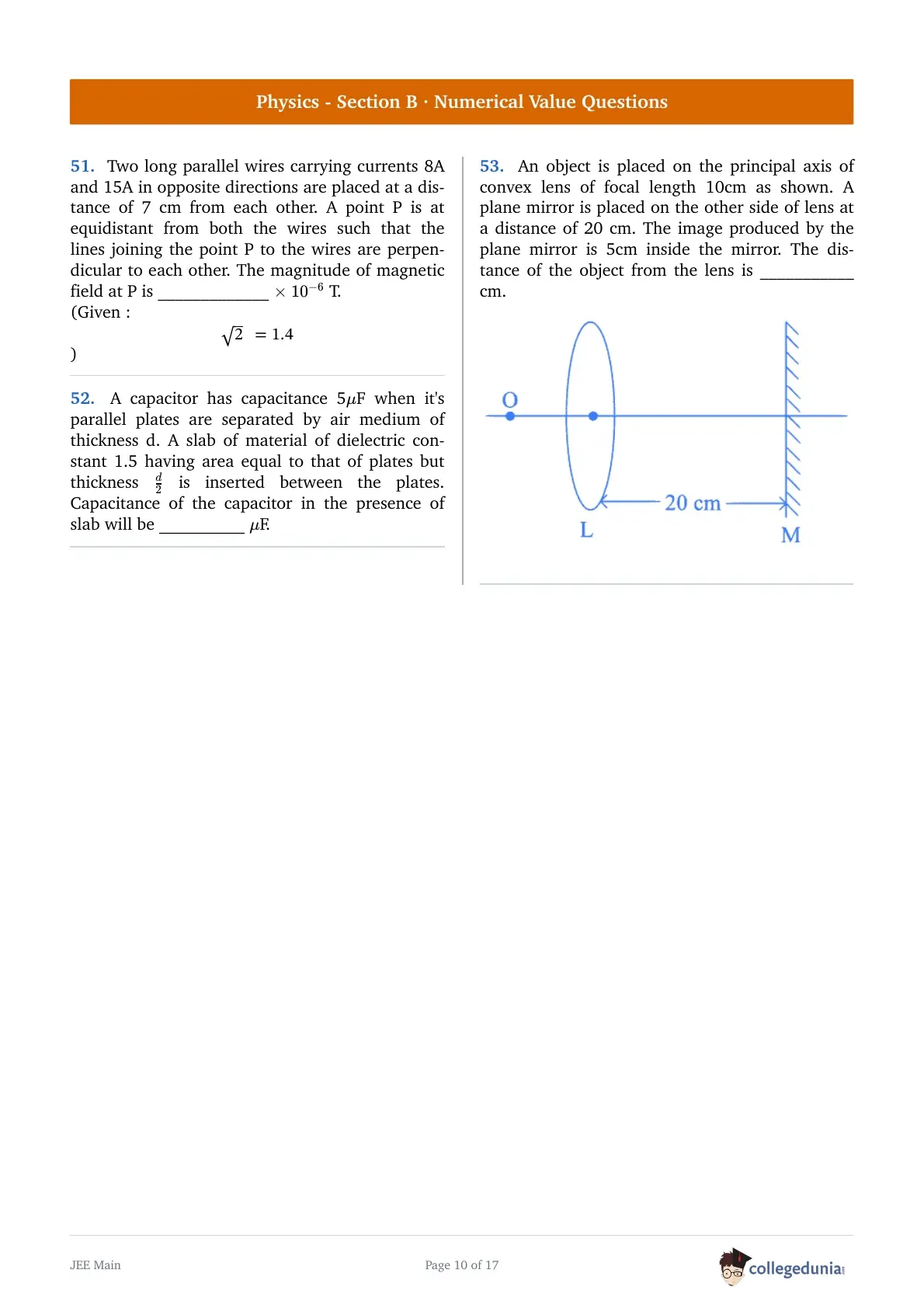
Two long parallel wires carrying currents \(8 A\) and \(15 A\) in opposite directions are placed at a distance of \(7 cm\) from each other A point \(P\) is at equidistant from both the wires such that the lines joining the point \(P\) to the wires are perpendicular to each other The magnitude of magnetic field at \(P\) is___\(\times 10^{-6} T\)(Given : \(\sqrt{2}=1.4\) )
A capacitor has capacitance \(5 \mu F\) when it's parallel plates are separated by air medium of thickness d A slab of material of dielectric constant \(15\) having area equal to that of plates but thickness \(\frac{d}{2}\) is inserted between the plates Capacitance of the capacitor in the presence of slab will be ___\(\mu F\)
An object is placed on the principal axis of convex lens of focal length \(10 cm\) as shown A plane mirror is placed on the other side of lens at a distance of \(20 cm\) The image produced by the plane mirror is \(5 cm\) inside the mirror The distance of the object from the lens is ___\(cm\)

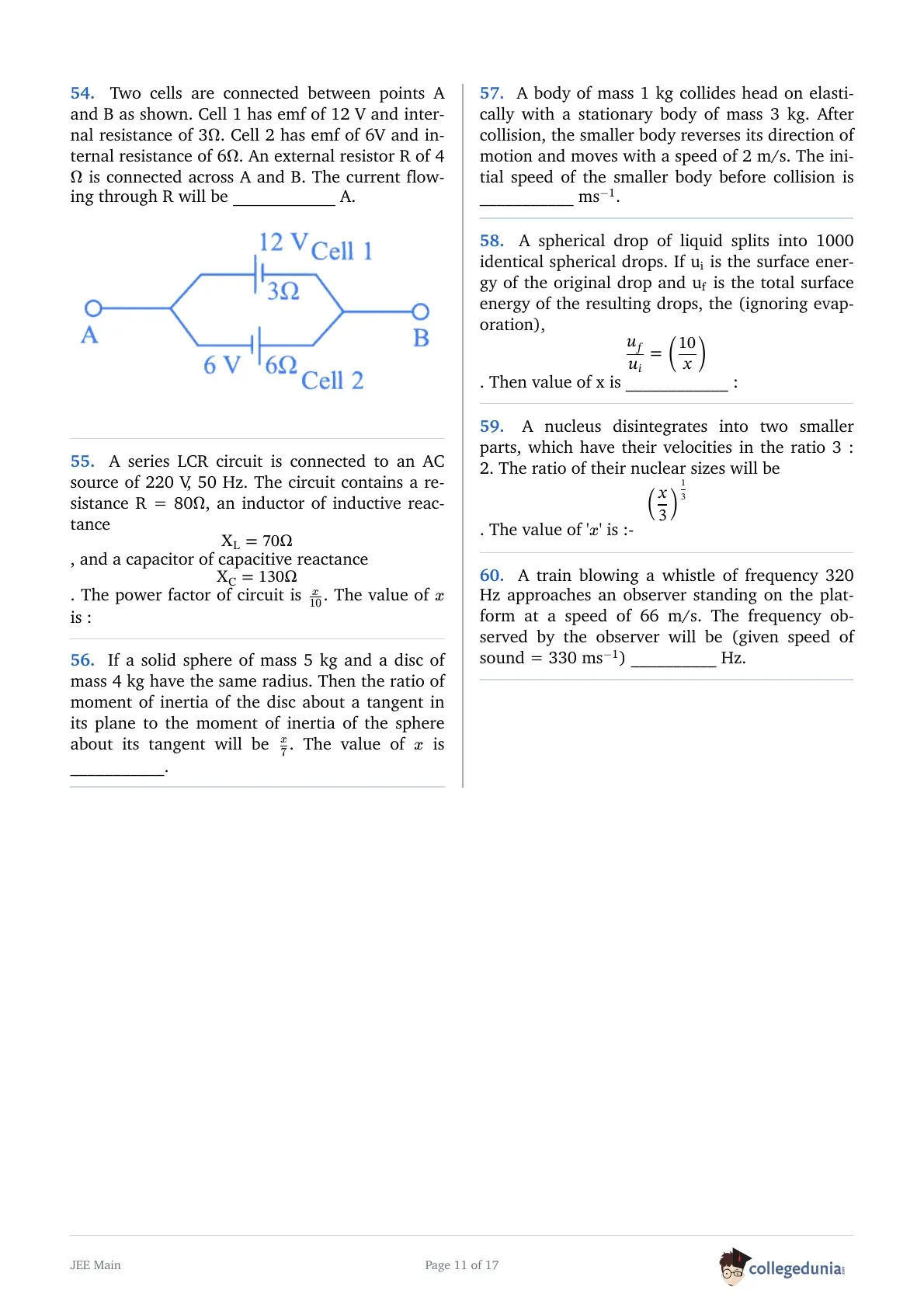
Two cells are connected between points \(A\) and \(B\) as shown Cell 1 has emf of \(12 V\) and internal resistance of \(3 \Omega\) Cell 2 has emf of \(6 V\) and internal resistance of \(6 \Omega\) An external resistor \(R\) of \(4 \Omega\) is connected across \(A\) and \(B\) The current flowing through \(R\) will be ___A
A series LCR circuit is connected to an \(AC\) source of \(220 V , 50 Hz\) The circuit contains a resistance \(R =80 \Omega\), an inductor of inductive reactance \(X _{ L }=70 \Omega\), and a capacitor of capacitive reactance \(X _{ C }=130 \Omega\) The power factor of circuit is \(\frac{x}{10}\) The value of \(x\) is :
If a solid sphere of mass \(5 kg\) and a disc of mass \(4 kg\) have the same radius Then the ratio of moment of inertia of the disc about a tangent in its plane to the moment of inertia of the sphere about its tangent will be \(\frac{x}{7}\) The the value of \(x\) is ___
A body of mass \(1 kg\) collides head on elastically with a stationary body of mass \(3 kg\) After collision, the smaller body reverses its direction of motion and moves with a speed of \(2 m / s\) The initial speed of the smaller body before collision is ___ \(ms ^{-1}\)
A spherical drop of liquid splits into 1000 identical spherical drops If \(u _{ i }\) is the surfice energy of the original drop and \(u_f\) is the total surface energy of the resulting drops, the (ignoring evaporation), \(\frac{u_f}{u_i}=\left(\frac{10}{x}\right)\) Then value of \(x\) is ___
A nucleus disintegrates into two smaller parts, which have their velocities in the ratio \(3: 2\) The ratio of their nuclear sizes will be \(\left(\frac{x}{3}\right)^{\frac{1}{3}}\) The value of ' \(x\) ' is:-
A train blowing a whistle of frequency \(320 Hz\) approaches an observer standing on the platform at a speed of \(66 m / s\) .The frequency observed by the observer will be ____ Hz,
(Given speed of sound \(=330 ms ^{-}\) 1)
Chemistry - Section A (Q61 - Q80)


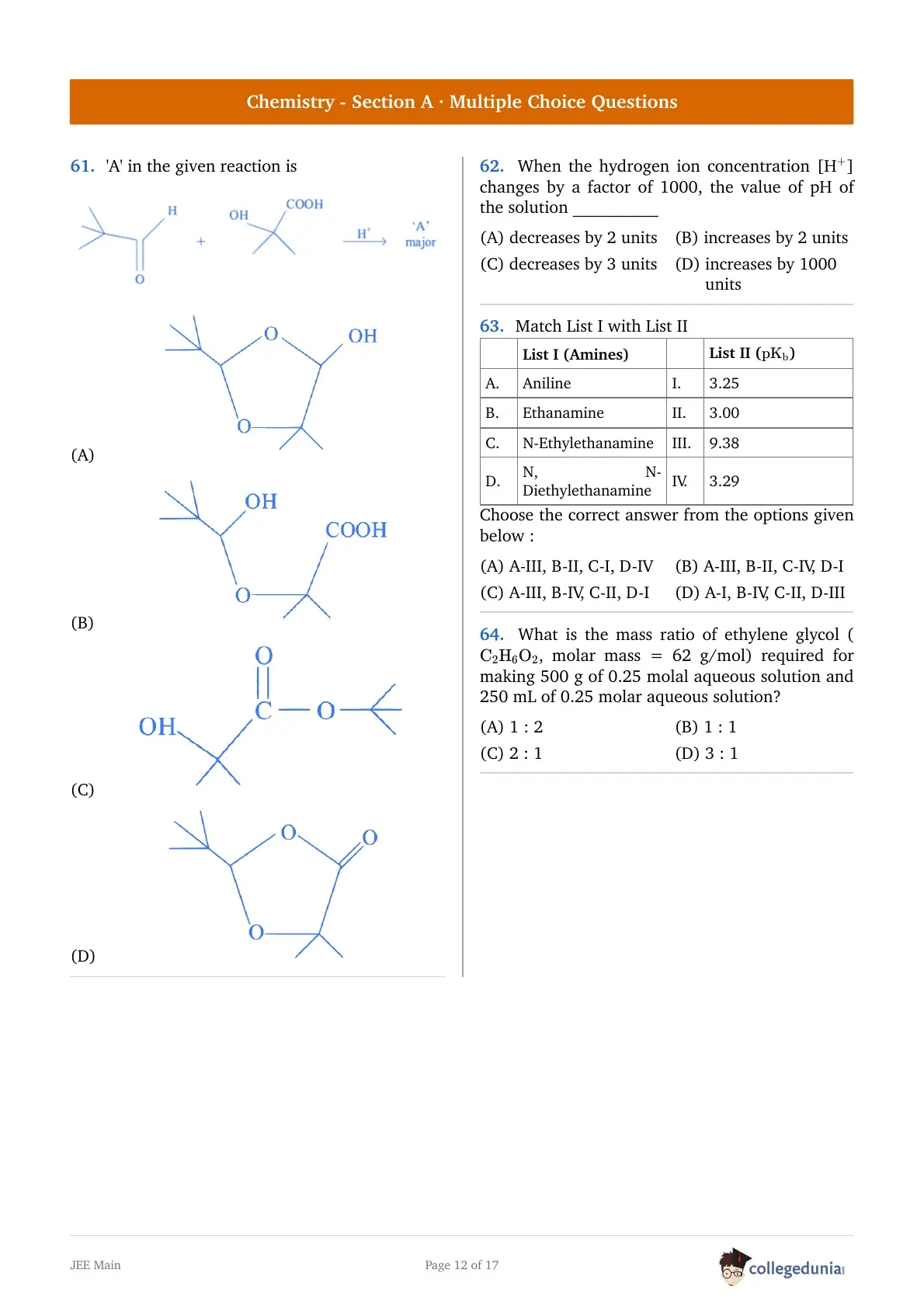
When the hydrogen ion concentration \(\left[ H ^{+}\right]\)changes by a factor of \(1000\) , the value of \(pH\) of the solution_____
| LIST I (Amines) | LIST II (pKb) | ||
| A | Aniline | I | 3.25 |
| B | Ethanamine | II | 3.00 |
| C | N-Ethylethanamine | III | 9.38 |
| D | N, N-Diethylethanamine | IV | 3.29 |
What is the mass ratio of ethylene glycol \((C _2H _6O_2\), molar mass \(62\ g/mol)\) required for making \(500\ g\) of \(0.25\) molal aqueous solution and \(250\ ml\) of \(0.25\) molal aqueous solution?
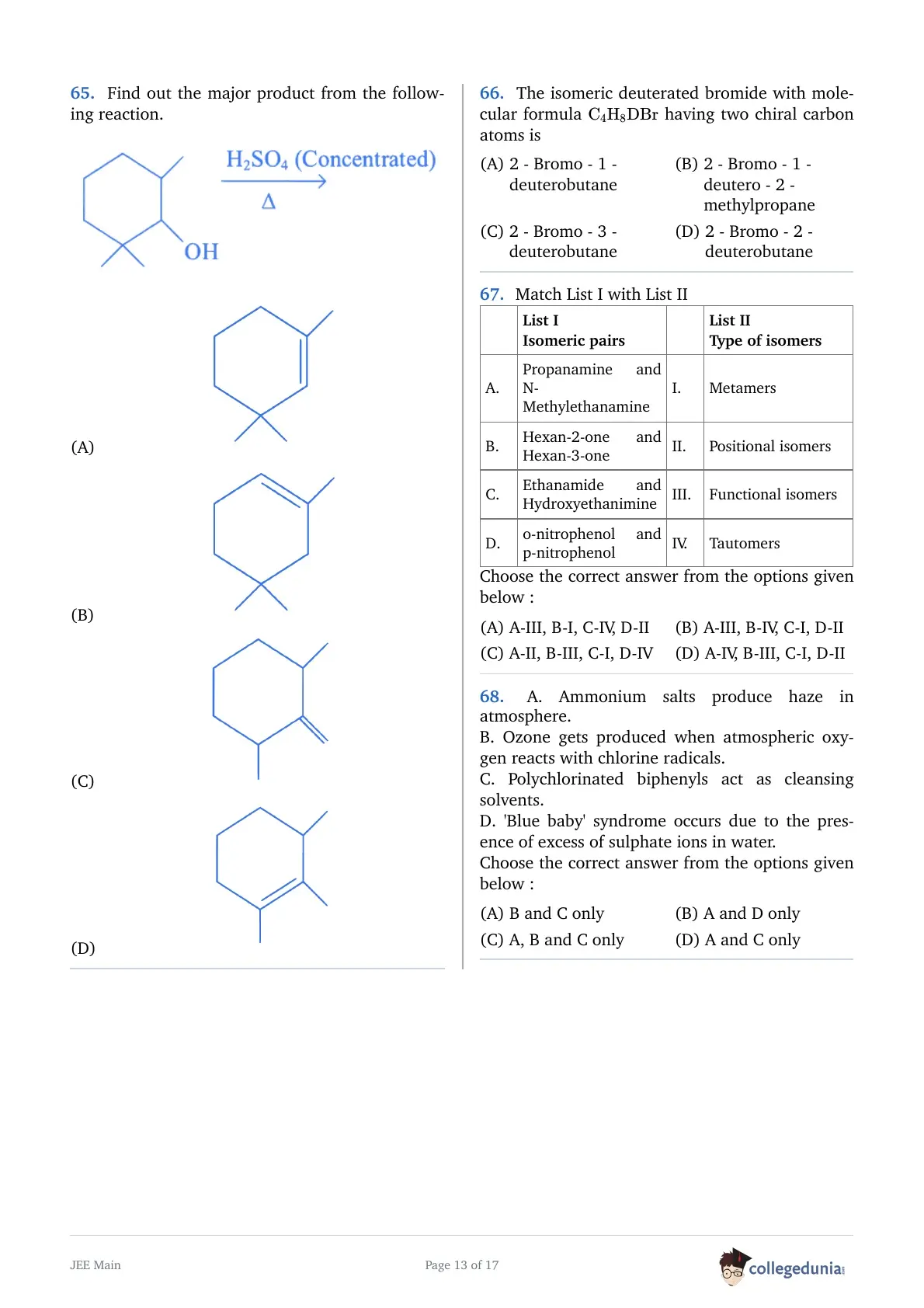
Find out the major product from the following reaction
- (1)
![]()
- (2)
![]()
- (3)
![]()
- (4)
![]()


The isomeric deuterated bromide with molecular formula \(C _4 H _8 DBr\) having two chiral carbon atoms is
| LIST I Isomeric pairs | LIST II Type of isomers | ||
| A | Propanamine and N-Methylethanamine | I | Metamers |
| B | Hexan-2-one and Hexan-3-one | II | Positional isomers |
| C | Ethanamide and Hydroxyethanimine | II | Functional isomers |
| D | o-nitrophenol and p-nitrophenol | IV | Tautomers |
A. Ammonium salts produce haze in atmosphere
B. Ozone gets produced when atmospheric oxygen reacts with chlorine radicals
C. Polychlorinated biphenyls act as cleansing solvents
D. 'Blue baby' syndrome occurs due to the presence of excess of sulphate ions in water
Choose the correct answer from the options given below:
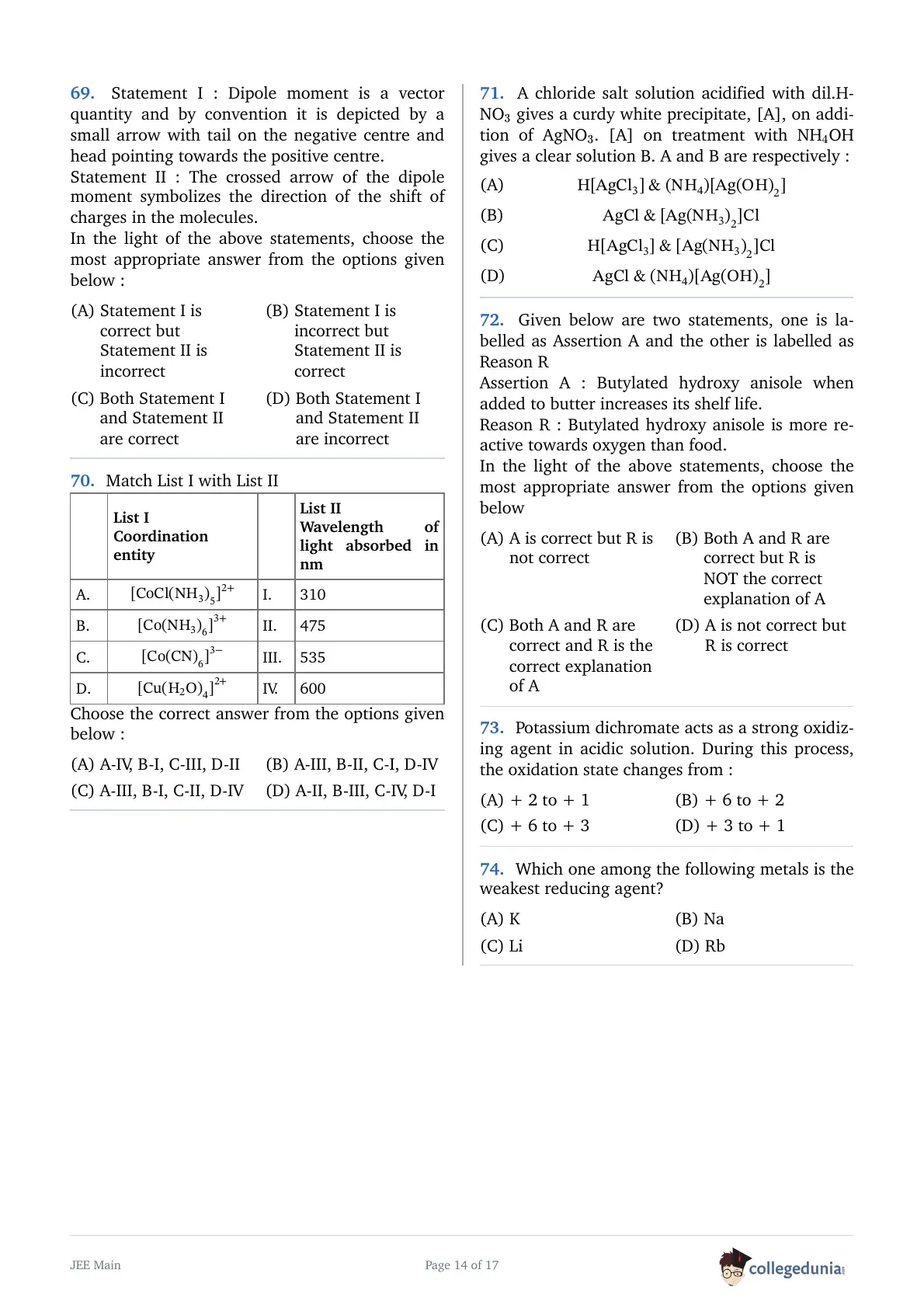
Statement I : Dipole moment is a vector quantity and by convention it is depicted by a small arrow with tail on the negative centre and head pointing towards the positive centre
Statement II : The crossed arrow of the dipole moment symbolizes the direction of the shift of charges in the molecules.
In the light of the above statements, choose the most appropriate answer from the options given below:
| List-I Coordination entity | List-II Wavelength of light absorbed in nm | ||
| A. | \([CoCl(NH_3)_5]^{2+}\) | I. | 310 |
| B. | \([Co(NH_3)_6]^{3+}\) | II. | 475 |
| C. | \([Co(CN)_6]^{3−}\) | III. | 535 |
| D. | \([Cu(H_2O)_4]^{2+}\) | IV. | 600 |
A chloride salt solution acidified with dil \(HNO _3\) gives a curdy white precipitate, \([A]\), on addition of \(AgNO _3 - [A]\) on treatment with \(NH _4 OH\) gives a clear solution, \(B\)\(A\) and \(B\) are respectively
Given below are two statements, one is labelled as Assertion \(A\) and the other is labelled as Reason R
Assertion A : Butylated hydroxy anisole when added to butter increases its shelf life
Reason R : Butylated hydroxy anisole is more reactive towards oxygen than food
In the light of the above statements,choose the most appropriate answer from the options given below
Potassium dichromate acts as a strong oxidizing agent in acidic solution During this process, the oxidation state changes from
Which one among the following metals is the weakest reducing agent?
Given below are two statements, one is labelled as Assertion \(A\) and the other is labelled as Reason \(R\)
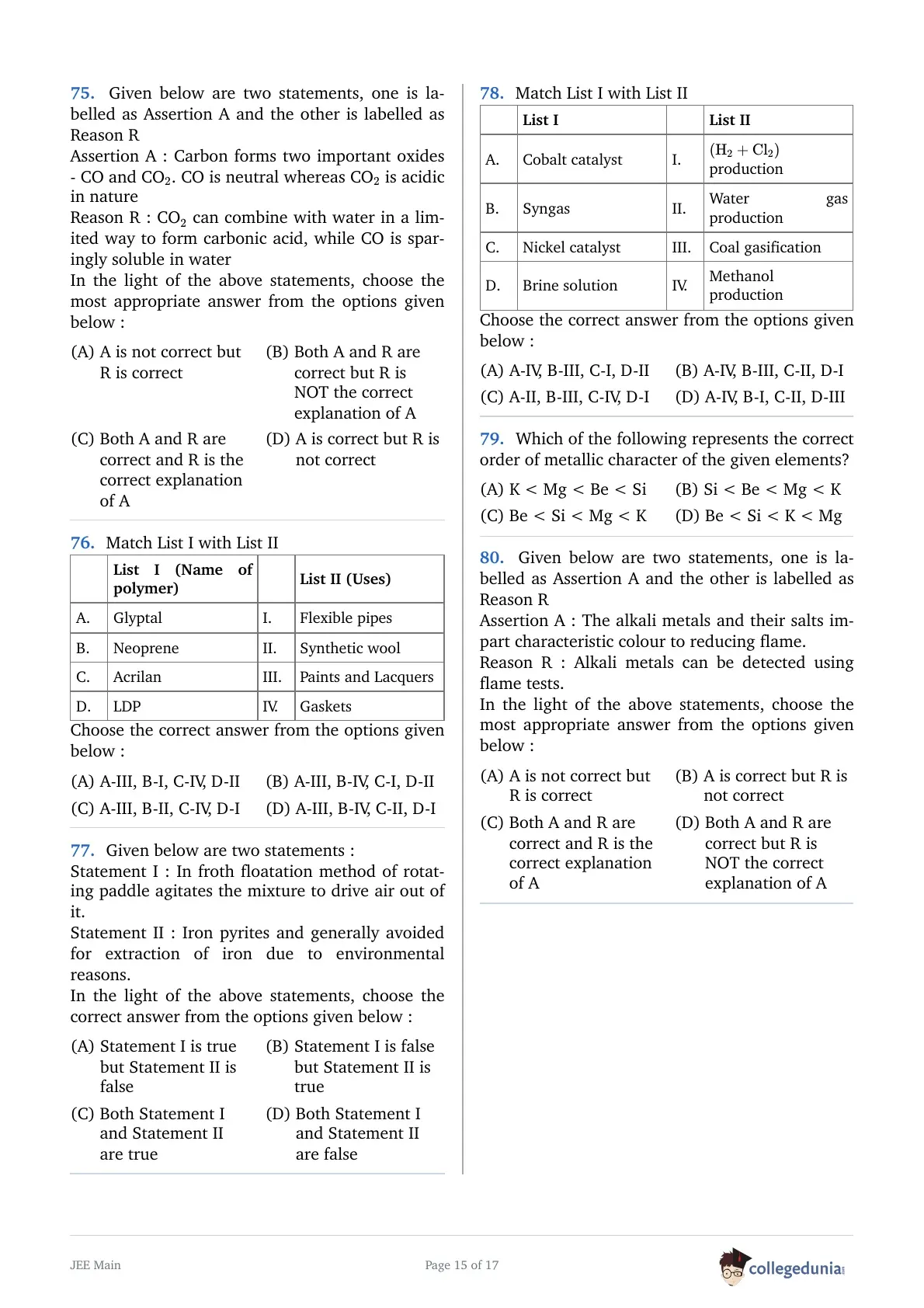
Assertion A: Carbon forms two important oxides - \(CO\) and \(CO _2 .CO\) is neutral whereas \(CO _2\) is acidic in nature
Reason R : \(CO _2\) can combine with water in a limited way to form carbonic acid, while \(CO\) is sparingly soluble in water
In the light of the above statements, choose the most appropriate answer from the options given below
| LIST I (Name of polymer) | LIST II (Uses) | ||
| A | Glyptal | I | Flexible pipes |
| B | Neoprene | II | Synthetic wool |
| C | Acrilan | III | Paints and Lacquers |
| D | LDP | IV | Gaskets |
Given below are two statements:
Statement I : In froth floatation method a rotating paddle agitates the mixture to drive air out of it.
Statement II : Iron pyrites are generally avoided for extraction of iron due to environmental reasons.
In the light of the above statements, choose the correct answer from the options given below:
| LIST I | LIST II | ||
| A | Cobalt catalyst | I | \((H_2+Cl_2)\) production |
| B | Syngas | II | Water gas production |
| C | Nickel catalyst | III | Coal gasification |
| D | Brine solution | IV | Methanol production |
Which of the following represents the correct order of metallic character of the given elements?
Given below are two statements, one is labelled as Assertion \(A\) and the other is labeled as Reason \(R\)
Assertion A : The alkali metals and their salts impart characteristic colour to reducing flame
Reason R : Alkali metals can be detected using flame tests
In the light of the above statements, choose the most appropriate answer from the options given below
Chemistry - Section B (Q81 - Q90)
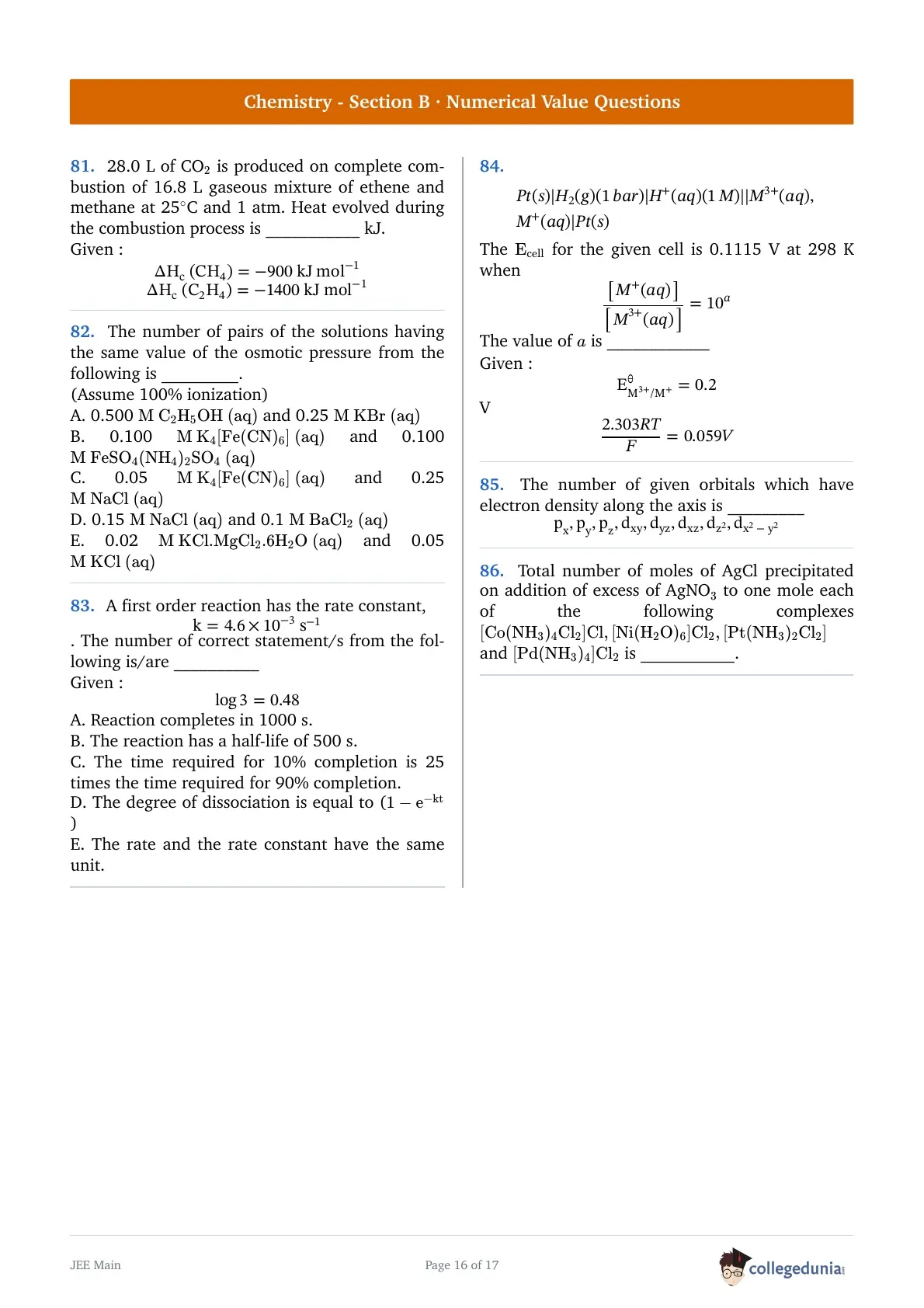
\(28.0\, L\) of \(CO _2\) is produced on complete combustion of \(168 \, L\) gaseous mixture of ethene and methane at \(25^{\circ} C\) and \(1 \, atm\) Heat evolved during the combustion process is ______\(kJ\) Given : \(\Delta H _{ c }\left( CH _4\right)=-900 \, kJ\, mol ^{-1}\) \(\Delta H _{ c }\left( C _2 H _4\right)=-1400\, kJ \, mol ^{-1}\)
The number of pairs of the solutions having the same value of the osmotic pressure from the following is ______ (Assume \(100\%\) ionization)
A. \(0.500 \,M \,C _2 H _5 OH\) (aq) and \(0.25 \,M\, KBr\) (aq)
B. \(0.100 \,M \,K _4\left[ Fe ( CN )_6\right]\) (aq) and \(0.100\, M\, FeSO _4\left( NH _4\right)_2 SO _4\) (aq)
C. \(0.05\, M \,K _4\left[ Fe ( CN )_6\right]\) (aq) and \(0.25\, M\, NaCl ( aq )\)
D. \(0.15\, M\, NaCl ( aq )\) and \(0.1\, M \,BaCl _2\) (aq)
E. \(0.02\, M\, KCl MgCl _2 \cdot 6 H _2 O\) (aq) and \(0.05\, M\, KCl\) (aq)
A first order reaction has the rate constant, \(k =46 \times 10^{-3} s ^{-1}\) The number of correct statement/s from the following is/are _______
Given: \(\log 3=0.48\)
A. Reaction completes in \(1000 \,s\)
B. The reaction has a half-life of \(500 \, s\)
C. The time required for \(10 \%\) completion is 25 times the time required for \(90 \%\) completion
D. The degree of dissociation is equal to \(\left(1-e^{-k t}\right)\)
E. The rate and the rate constant have the same unit
\(Pt(s) | H_{2_{(g)}} (1 bar) | H^{+}_{(aq)}(1M) || M^{3+}_{(aq)}, M^{+}_{(aq)} | Pt(s)\)
The Ecell for the given cell is 0.1115 V at 298 K when \(\frac{[M^+(aq)}{[M^{3+}(aq)]}=10^{a}\)
The value of a is _________
Given: \(E^{\theta}_{M^{3+}/M^+}=0.2\;V\)
\(\frac{2.303RT}{F}=0.059V\)
The number of given orbitals which have electron density along the axis is _____ \(p _x, p _y, p _z, d _{x y}, d _{y z}, d _{x z}, d _z 2, d _x{ }^2-y^2\)
Total number of moles of AgCl precipitated on addition of excess of AgNO3 to one mole each of the following complexes [Co(NH3)4Cl2]Cl, [Ni(H2O)6]Cl2,[Pt(NH3)2Cl2] and [Pd(NH3)4]Cl2 is
Number of compounds giving (i) red colouration with ceric ammonium nitrate and also (ii) positive iodoform test from the following is_____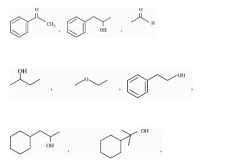
Number of hydrogen atoms per molecule of a hydrocarbon A having \(858 \%\) carbon is_____ (Given: Molar mass of \(A =84 g mol ^{-1}\) )
Based on the given figure, the number of correct statement/s is/are _______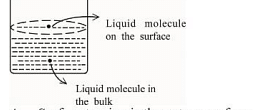
A. Surface tension is the outcome of equal attractive and repulsive forces acting on the liquid molecule in bulk
B. Surface tension is due to uneven forces acting on the molecules present on the surface
C. The molecule in the bulk can never come to the liquid surface
D. The molecules on the surface are responsible for vapour pressure if the system is a closed system
The number of incorrect statement/s from the following is/are ____
A. Water vapours are adsorbed by anhydrous calcium chloride.
B. There is a decrease in surface energy during adsorption.
C. As the adsorption proceeds, \(\Delta H\) becomes more and more negative.
D. Adsorption is accompanied by decrease in entropy of the system.
JEE Main 2023 Exam Pattern and Marking Scheme
| Particulars | Details |
|---|---|
| Exam Mode | Online (Computer-Based Test) |
| Paper | B.E./B.Tech |
| Medium of Exam | 13 languages: English, Hindi, Gujarati, Bengali, Tamil, Telugu, Kannada, Marathi, Malayalam, Odia, Punjabi, Assamese, Urdu |
| Duration | 3 hours (180 minutes) |
| Type of Questions | Multiple Choice Questions (MCQs) + Numerical Value Questions (attempt any 5 of 10 per subject) |
| Total Marks | 300 marks |
| Subjects | Mathematics, Physics, Chemistry |
| Marking Scheme | +4 for correct answer & -1 for incorrect MCQ and Numerical Value-based Questions |
| Total Questions | 90 Questions (30 per subject), 75 to be attempted |
| Eligibility | Passed or appearing in Class 12 with Physics, Chemistry, and Mathematics |
JEE Main 2023 Jan 25 Shift 2 Question Paper by Coaching Institute
| Coaching Institutes | Question Paper with Answer Key PDF |
|---|---|
| Aakash BYJUs | Check Here |
| Vedantu | Check Here |
JEE Main 2023 Paper Analysis Jan 25 Shift 2
JEE Main 2023 Paper Analysis for the B.E/ B.Tech exam conducted on January 25 Shift 2 is updated here. Candidates can check the subject-wise paper analysis for the January 25 Shift 2 exam here along with the topics with the highest weightage.
| JEE Main 2023 Paper Analysis Jan 25 Shift 2 | Check Here |



Comments