




JEE Main 2023 January 30 Shift 2 Question Paper is available here with answer key and solution pdf. NTA conducted the second shift on January 30, 2023, from 3:00 PM to 6:00 PM. The JEE Main 2023 Paper 1 (B.E./B.Tech) question paper includes the following:
- 90 questions in a 3-hour CBT Mode: 30 each from Mathematics, Physics and Chemistry (75 to be attempted)
- Section A: 20 multiple choice questions (MCQs) per subject, 4 marks each
- Section B: 10 numerical value questions per subject, attempt any 5, 4 marks each (integer answer)
- Marking: +4 for a correct answer, -1 for an incorrect answer, 0 for an unattempted question
JEE Main 2023 January 30 Shift 2 Question Paper with Solution PDF
| NTA Official PDF | CD PDF | CD PDF with Solutions |
|---|---|---|
| Download official PDF 4.89 MB | Download Collegedunia PDF 0.82 MB | Download solutions PDF 1.33 MB |
Also Check:
JEE Main 2023 January 30 Shift 2 Questions with Solutions
Mathematics - Section A (Q1 - Q20)
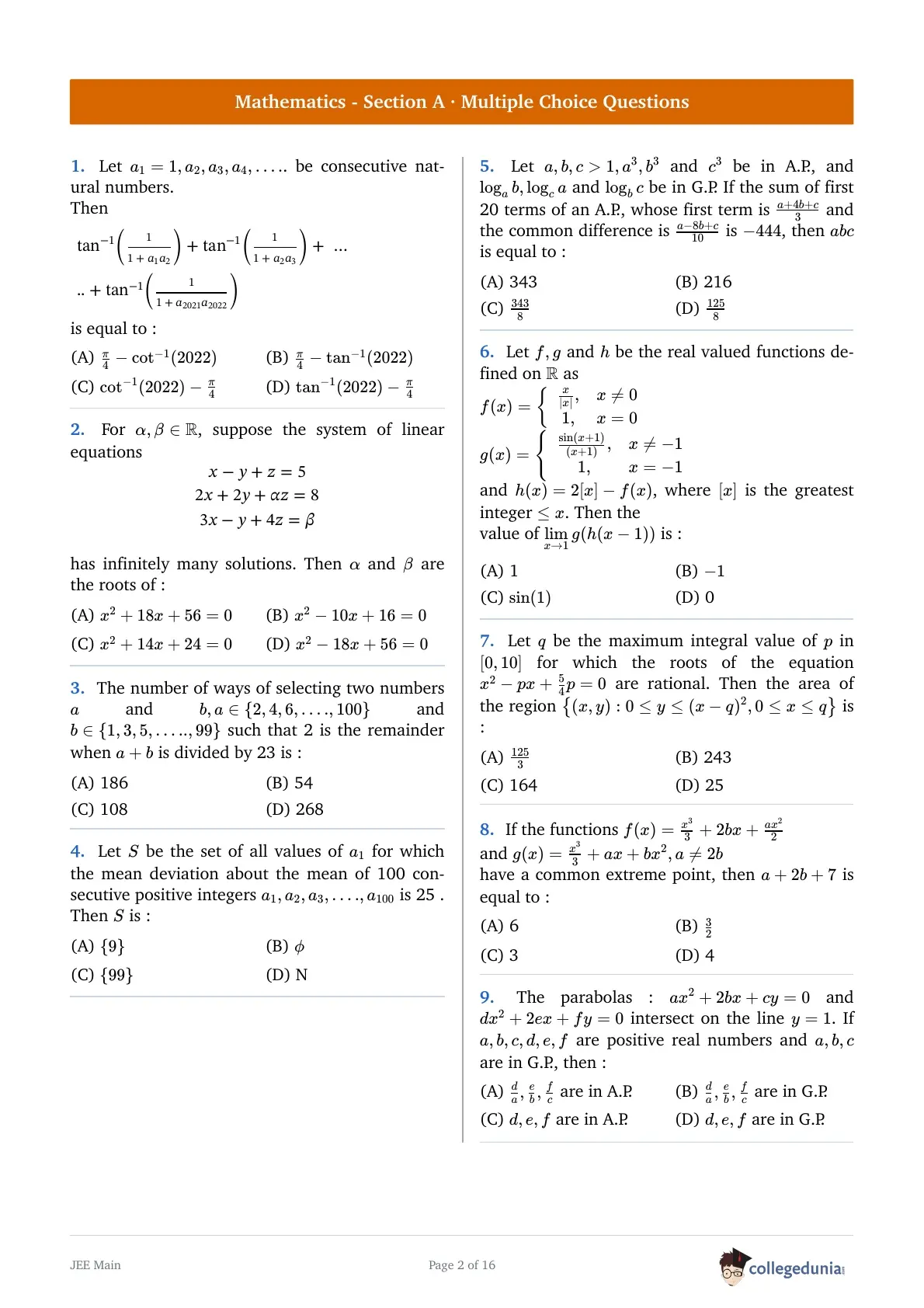
Let \(a_1=1, a_2, a_3, a_4, \ldots \) be consecutive natural numbersThen \(\tan ^{-1}\left(\frac{1}{1+a_1 a_2}\right)+\tan ^{-1}\left(\frac{1}{1+a_2 a_3}\right)+\ldots +\tan ^{-1}\left(\frac{1}{1+a_{2021} a_{2022}}\right)\) is equal to
For \(\alpha, \beta \in R\), suppose the system of linear equations \( x-y+z=5 \) \(2 x+2 y+\alpha z=8 \) \(3 x-y+4 z=\beta\) has infinitely many solutions Then \(\alpha\) and \(\beta\) are the roots of
The number of ways of selecting two numbers \(a\) and \(b, a \in\{2,4,6, \ldots , 100\}\) and \(b \in\{1,3,5, \ldots , 99\}\) such that 2 is the remainder when \(a+b\) is divided by 23 is
Let \(S\) be the set of all values of \(a_1\) for which the mean deviation about the mean of \(100\) consecutive positive integers \(a_1, a_2, a_3, \ldots , a_{100}\) is \(25\) Then \(S\) is
Let \(a, b, c>, a^3, b^3\) and \(c^3\) be in AP, and \(\log _a b, \log _c a\) and \(\log _b c\) be in GP If the sum of first 20 terms of an AP, whose first term is \(\frac{a+4 b+c}{3}\) and the common difference is \(\frac{a-8 b+c}{10}\) is \(-444\), then \(a b c\) is equal to:
Let \(f, g\) and \(h\) be the real valued functions defined on \(R\) as \(f(x)=\begin{cases} \frac{x}{|x|}, & x \neq 0 \\1, & x=0\end{cases}, g(x)=\begin{cases} \frac{\sin (x+1)}{(x+1)}, & x \neq-1 \\1, & x=-1\end{cases}\) and \(h(x)=2[x]-f(x)\), where \([x]\) is the greatest integer \(\leq x\) Then the value of \(\displaystyle\lim _{x \rightarrow 1} g(h(x-1))\) is
Let \(q\) be the maximum integral value of \(p\) in \([0,10]\) for which the roots of the equation \(x^2 - px + \frac{5}{4}p = 0\) are rational. Then the area of the region \(\left\{(x,y) : 0 \le y \le (x-q)^2,\ 0 \le x \le q\right\}\) is :
If the functions \(f(x)=\frac{x^3}{3}+2 b x+\frac{a x^2}{2}\) and \(g(x)=\frac{x^3}{3}+a x+b x^2, a \neq 2 b\) have a common extreme point, then \(a+2 b+7\) is equal to:
The parabolas : \(ax^2 + 2bx + cy = 0\) and \(dx^2 + 2ex + fy = 0\) intersect on the line \(y = 1\). If \(a, b, c, d, e, f\) are positive real numbers and \(a, b, c\) are in G.P., then :
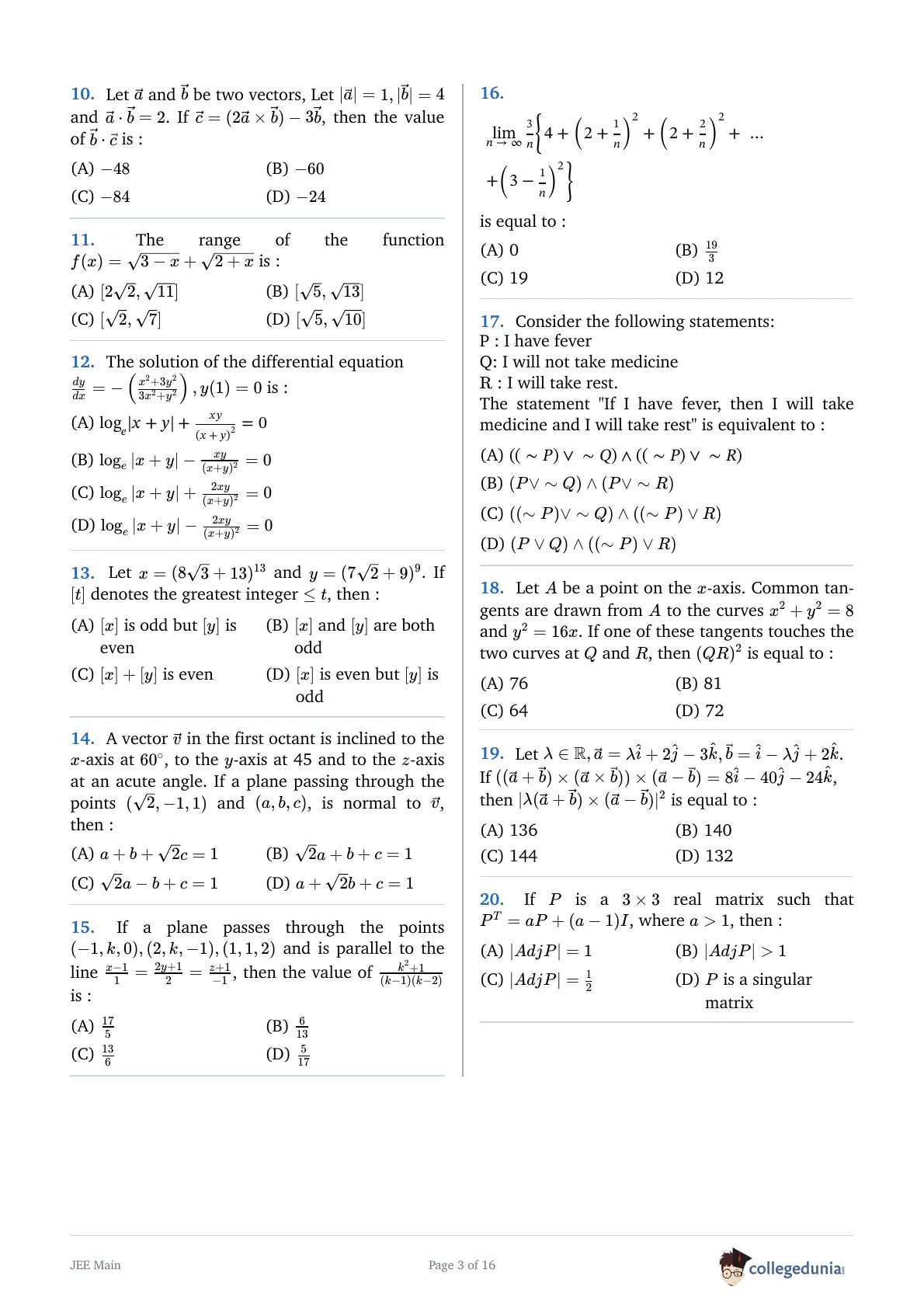
Let \(\vec{a}\) and \(\vec{b}\) be two vectors, Let \(|\vec{a}|=1,|\vec{b}|=4\) and \(\vec{a} \cdot \vec{b}=2\) If \(\vec{c}=(2 \vec{a} \times \vec{b})-3 \vec{b}\), then the value of \(\vec{b} \cdot \vec{c}\) is
The range of the function \(f(x)=\sqrt{3-x}+\sqrt{2+x}\) is:
The solution of the differential equation \(\frac{d y}{d x}=-\left(\frac{x^2+3 y^2}{3 x^2+y^2}\right), y(1)=0\) is
Let \(x=(8 \sqrt{3}+13)^{13}\) and \(y=(7 \sqrt{2}+9)^9\) If \([t]\) denotes the greatest integer \(\leq t\), then
A vector \(\vec{v}\) in the first octant is inclined to the \(x\)-axis at \(60^{\prime}\), to the \(y\)-axis at \(45\) and to the \(z\)-axis at an acute angle If a plane passing through the points \((\sqrt{2},-1,1)\) and \((a, b, c)\), is normal to \(\vec{v}\), then
If a plane passes through the points \((-1, k, 0),(2, k,-1),(1,1,2)\) and is parallel to the line \(\frac{x-1}{1}=\frac{2 y+1}{2}=\frac{z+1}{-1}\), then the value of \(\frac{k^2+1}{(k-1)(k-2)}\) is
\(\lim_{n\to\infty} \frac{3}{n}\left\{4 + \left(2 + \frac{1}{n}\right)^2 + \left(2 + \frac{2}{n}\right)^2 + \dots + \left(3 - \frac{1}{n}\right)^2\right\}\) is equal to :
Consider the following statements:
P : I have fever
Q: I will not take medicine
R : I will take rest
The statement "If I have fever, then I will take medicine and I will take rest" is equivalent to:
Let \(A\) be a point on the \(x\)-axis Common tangents are drawn from \(A\) to the curves \(x^2+y^2=8\) and \(y^2=16 x\) If one of these tangents touches the two curves at \(Q\) and \(R\), then \((Q R)^2\) is equal to
Let \(\lambda \in R , \vec{a}=\lambda \hat{i}+2 \hat{j}-3 \hat{k}, \vec{b}=\hat{i}-\lambda \hat{j}+2 \hat{k}\).If \(((\vec{a}+\vec{b}) \times(\vec{a} \times \vec{b})) \times(\vec{a}-\vec{b})=8 \hat{i}-40 \hat{j}-24 \hat{k}\), then \(|\lambda(\vec{a}+\vec{b}) \times(\vec{a}-\vec{b})|^2\) is equal to
If \(P\) is a \(3 \times 3\) real matrix such that \(P^T=a P+(a-1) I\), where \(a>\), then
Mathematics - Section B (Q21 - Q30)
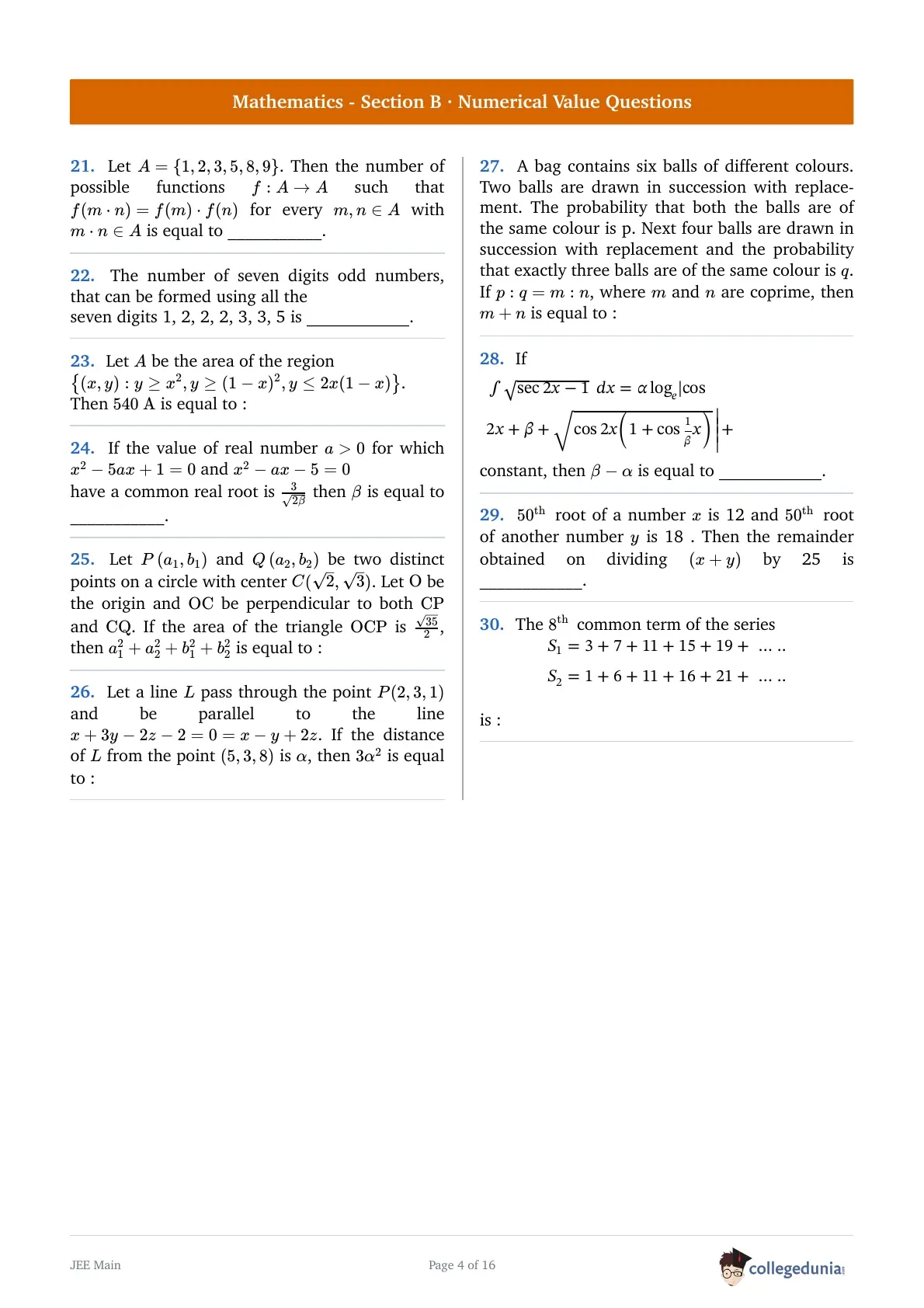
Let S = {1, 2, 3, 4, 5, 6}. Then the number of one-one functions \(f : S → P(S)\), where \(P(S)\) denotes the power set of S, such that \(f(n) ⊂ f(m)\) where \(n < m,\) is:
The number of seven digits odd numbers, that can be formed using all the seven digits \(1,2,2,2,3,3,5\) is_______
Let \(A\) be the area of the region
\(\left\{(x, y): y \geq x^2, y \geq(1-x)^2, y \leq 2 x(1-x)\right\}\).
Then \(540 A\) is equal to ______.
If the value of real number a> 0 for which \(x^2\)-5ax+1-0 and \(x^2-a x-5-0\) have a common real root is \(\frac{3}{\sqrt{2 \beta}}\) then \( \beta\) is equal to_______
Let \(P\left(a_1, b_1\right)\) and \(Q\left(a_2, b_2\right)\) be two distinct points on a circle with center \(C(\sqrt{2}, \sqrt{3})\) Let \(O\) be the origin and \(OC\) be perpendicular to both \(CP\) and \(CQ\). If the area of the triangle \(OCP\) is \(\frac{\sqrt{35}}{2}\), then \(a_1^2+a_2^2+b_1^2+b_2^2\) is equal to ______
Let a line \(L\) pass through the point \(P(2,3,1)\) and be parallel to the line \(x+3 y-2 z-2=0=x-y+2 z\) If the distance of \(L\) from the point \((5,3,8)\) is \(\alpha\), then \(3 \alpha^2\) is equal to_______
A bag contains six balls of different colours. Two balls are drawn in succession with replacement. The probability that both the balls are of the same colour is \(p\). Next four balls are drawn in succession with replacement and the probability that exactly three balls are of the same colour is \(q\). If \(p : q = m : n\), where \(m\) and \(n\) are coprime, then \(m + n\) is equal to :
If \(\int \sqrt{\sec 2 x-1} d x=\alpha \log _e\left|\cos 2 x+\beta+\sqrt{\cos 2 x\left(1+\cos \frac{1}{\beta} x\right)}\right|+\) constant, then \(\beta-\alpha\) is equal to_______
\(50^{\text{th}}\) root of a number \(x\) is 12 and \(50^{\text{th}}\) root of another number \(y\) is 18. Then the remainder obtained on dividing \((x+y)\) by 25 is ____________.
The \(8^{\text {th }}\) common term of the series
\(S_1=3+7+11+15+19+\ldots \ldots\)
\(S_2=1+6+11+16+21+\ldots \) is ______
Physics - Section A (Q31 - Q50)
A vehicle travels \(4 \, km\) with speed of \(3\, km / h\) and another \(4 \, km\) with speed of \(5\, km / h\), then it's average speed is
| List - I | List - II | ||
| A. | Torque | I. | kg m-1 s-2 |
| B. | Energy Density | II. | kg ms-1 |
| C. | Pressure gradient | III. | kg m-2 s-2 |
| D. | Impulse | IV. | kg m2 s-2 |
An object is allowed to fall from a height \(R\) above the earth, where \(R\) is the radius of earth Its velocity when it strikes the earth's surface, ignoring air resistance, will be
A force is applied to a steel wire ' \(A\) ', rigidly clamped at one end As a result elongation in the wire is \(02\, mm\) If same force is applied to another steel wire ' \(B\) ' of double the length and a diameter \(24\) times that of the wire ' \(A\) ', the elongation in the wire ' \(B\) ' will be (wires having uniform circular cross sections)
Find the ratio of de-Broglie wavelength of a proton and a 𝝰 - particle, when accelerated through a potential difference of 2V and 4V respectively.
A machine gun of mass \(10\, kg\) fires \(20 \,g\) bullets at the rate of \(180\) bullets per minute with a speed of \(100 \,m s ^{-1}\) each The recoil velocity of the gun is
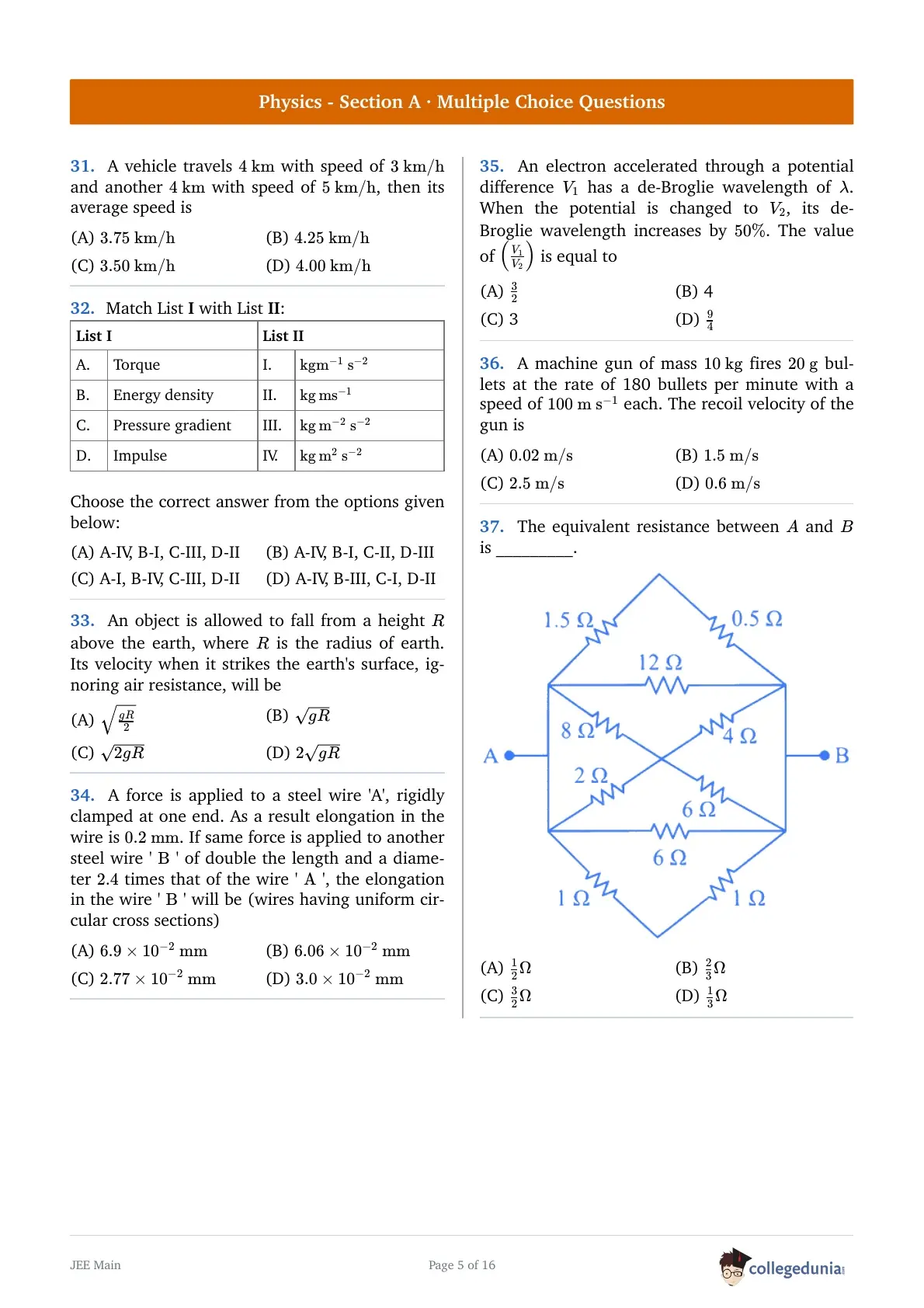
The equivalent resistance between A and B is _________.
In the given circuit, rms value of current \(\left( I _{ rms }\right)\) through the resistor \(R\) is:
A thin prism \(P_1\) with an angle \(6^{\circ}\) and made of glass of refractive index \(154\) is combined with another prism \(P_2\) made from glass of refractive index \(172\) to produce dispersion without average deviation The angle of prism \(P_2\) is
A point source of \(100 \,W\) emits light with \(5 \%\) efficiency At a distance of \(5\, m\) from the source, the intensity produced by the electric field component is:
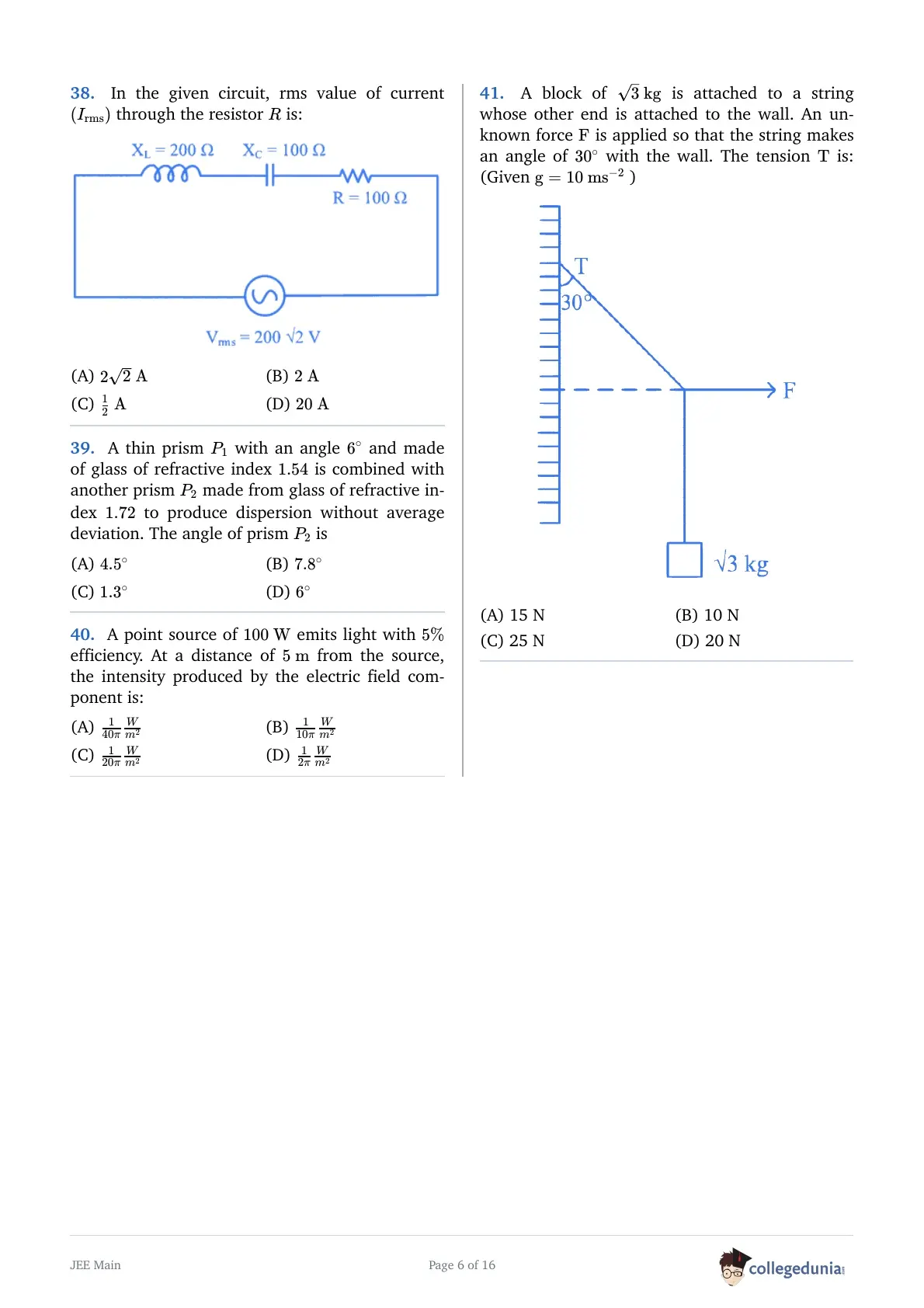
A block of \(\sqrt{3} kg\) is attached to a string whose other end is attached to the wall An unknown force \(F\) is applied so that the string makes an angle of \(30^{\circ}\) with the wall The tension \(T\) is:(Given \(g =10 \,ms ^{-2}\) )
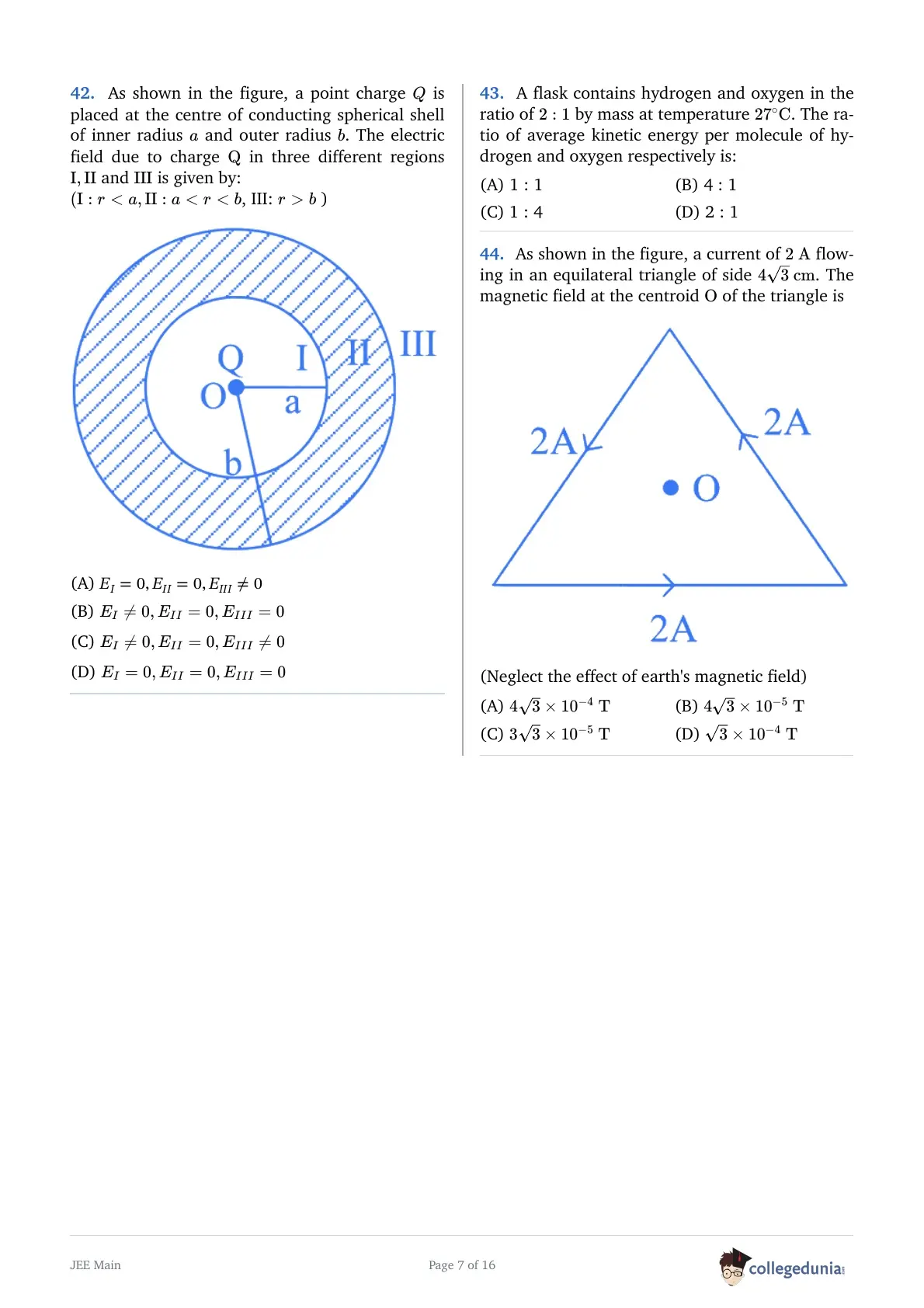
As shown in the figure, a point charge \(Q\) is placed at the centre of conducting spherical shell of inner radius \(a\) and outer radius \(b\). The electric field due to charge \(Q\) in three different regions I, II and III is given by: (I: r \(<\) a, II: \(a \)<\( r \)<\( b\), III: \(r\)>\(b)\)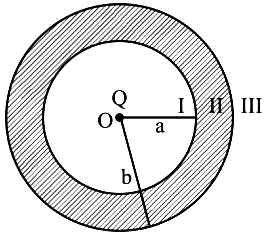
A flask contains hydrogen and oxygen in the ratio of \(2:1\) by mass at temperature \(27^\circ\mathrm{C}\). The ratio of average kinetic energy per molecule of hydrogen and oxygen respectively is:
As shown in the figure, a current of \(2 A\) flowing in an equilateral triangle of side \(4 \sqrt{3} cm\) The magnetic field at the centroid \(O\) of the triangle is
(Neglect the effect of earth's magnetic field)
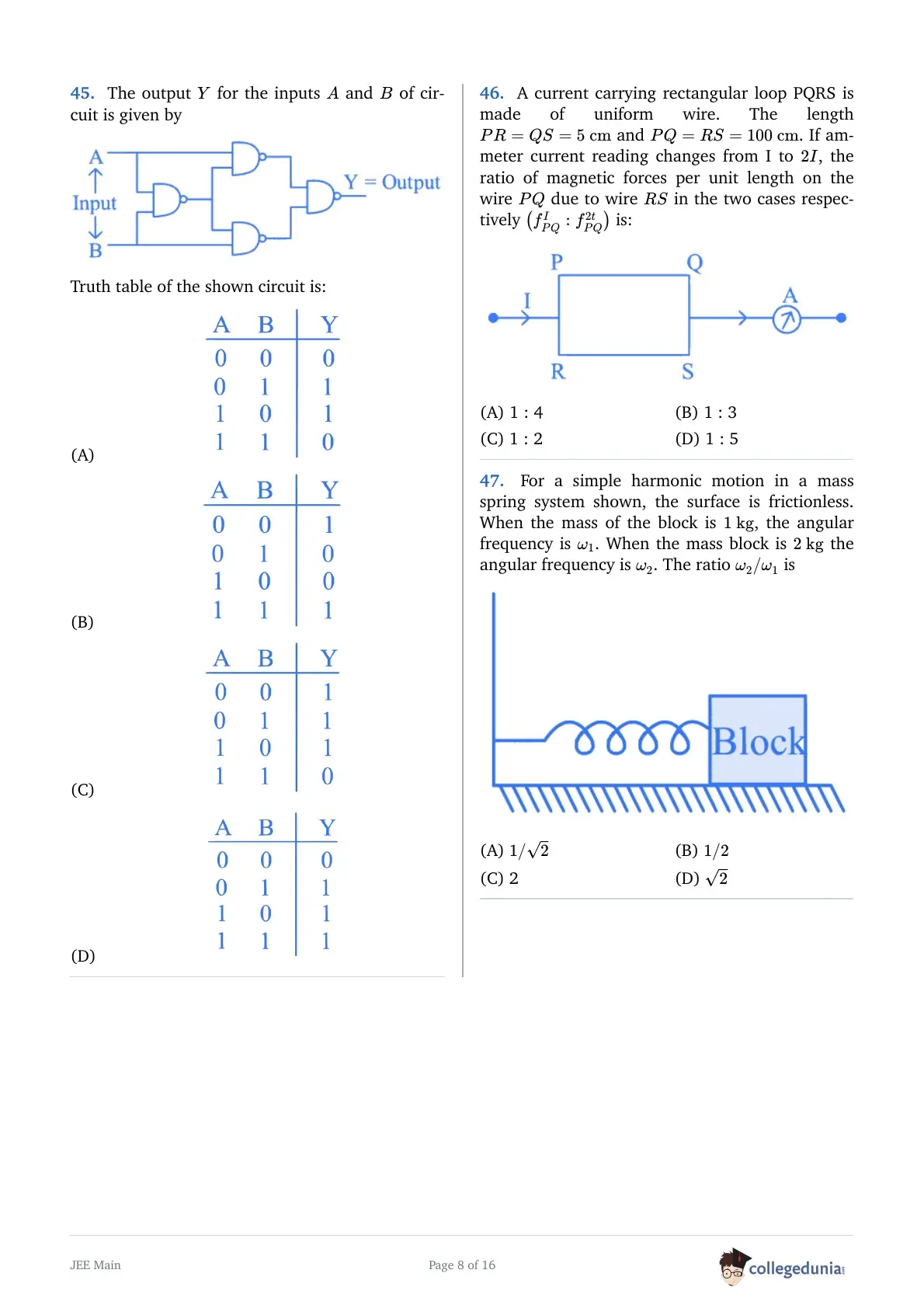
The output \(Y\) for the inputs \(A\) and \(B\) of circuit is given by

A current carrying rectangular loop \(P Q R S\) is made of uniform wire The length \(P R=Q S=5 \,cm\) and \(P Q=R S=100\, cm\) If ammeter current reading changes from \(I\) to \(2 I\), the ratio of magnetic forces per unit length on the wire \(P Q\) due to wire \(R S\) in the two cases respectively \(\left(f_{P Q}^I: f_{P Q}^{2 I}\right)\) is:
For a simple harmonic motion in a mass spring system shown, the surface is frictionless When the mass of the block is \(1\, kg\), the angular frequency is \(\omega_1\) When the mass block is \(2 \,kg\) the angular frequency is \(\omega_2\) The ratio \(\omega_2 / \omega_1\) is
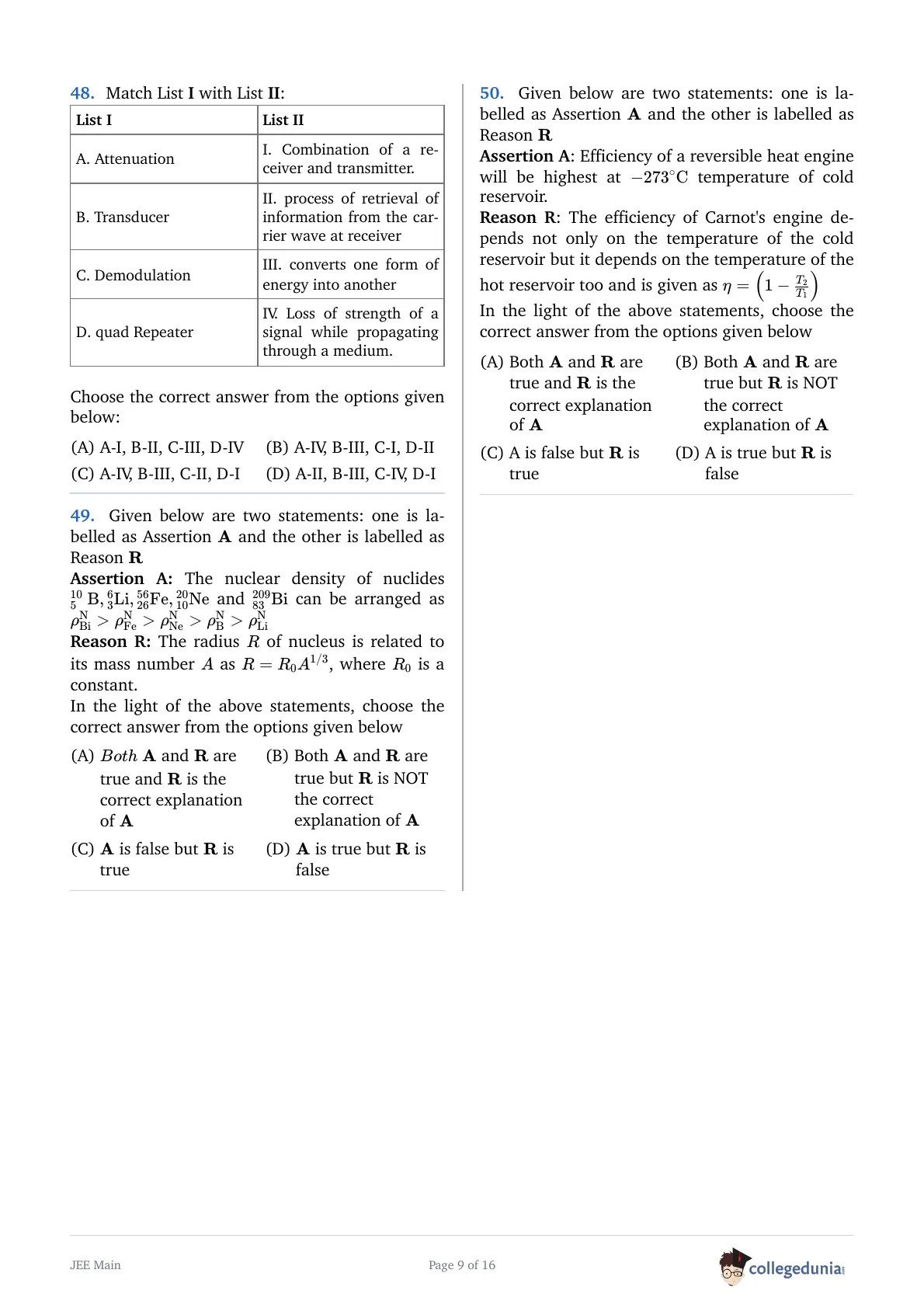
| List I | List II | ||
| A. | Attenuation | I. | Combination of a receiver and transmitter |
| B. | Transducer | II. | Process of retrieval of information from the carrier wave at received |
| C. | Demodulation | III. | Converts one form of energy into another |
| D. | Repeater | IV. | Loss of strength of a signal while propagating through a medium |
Given below are two statements: one is labelled as Assertion \(A\) and the other is labelled as Reason \(R\)
Assertion (A): The nuclear density of nuclides \({ }_5^{10} B ,{ }_3^6 Li ,{ }_{26}^{56} Fe ,{ }_{10}^{20} Ne\) and \({ }_{83}^{209} Bi\) can be arranged as \(\rho_{ Bi }^N>\rho_{ Fe }^N>\rho_{ Ne }^N>\rho_{ B }^N>\rho_{ Li }^N\).
Reason R: The radius \(R\) of nucleus is related to its mass number \(A\) as \(R=R_0 A^{1 / 3}\), where \(R_0\) is a constant.
In the light of the above statements, choose the correct answer from the options given below
Given below are two statements : one is labelled as Assertion A and the other is labelled as Reason \(R\)
Assertion A: Efficiency of a reversible heat engine will be highest at \(-273^{\circ} C\) temperature of cold reservoir
Reason R: The efficiency of Carnot's engine depends not only on temperature of cold reservoir but it depends on the temperature of hot reservoir too and is given as \(n =\left(1-\frac{T_2}{T_1}\right)\)
In the light of the above statements, choose the correct answer from the options given below
Physics - Section B (Q51 - Q60)
In an ac generator, a rectangular coil of \(100\) turns each having area \(14 \times 10^{-2} m ^2\) is rotated at \(360\, rev / min\) about an axis perpendicular to a uniform magnetic field of magnitude \(3.0 T\) The maximum value of the emf produced will be ________ \(V\)
(Take \(\pi =\frac{22}{7}\))
A faulty thermometer reads \(5^{\circ} C\) in melting ice and \(95^{\circ} C\) in stream.The correct temperature on absolute scale will be_______ \(K\) (when the faulty thermometer reads \(41^{\circ} C\)).
In a Young's double slit experiment, the intensities at two points, for the path respectively If \(I_0\) denotes the intensity produced by each one of the individual slits, then \(\frac{I_1+I_2}{I_0}=\)_______
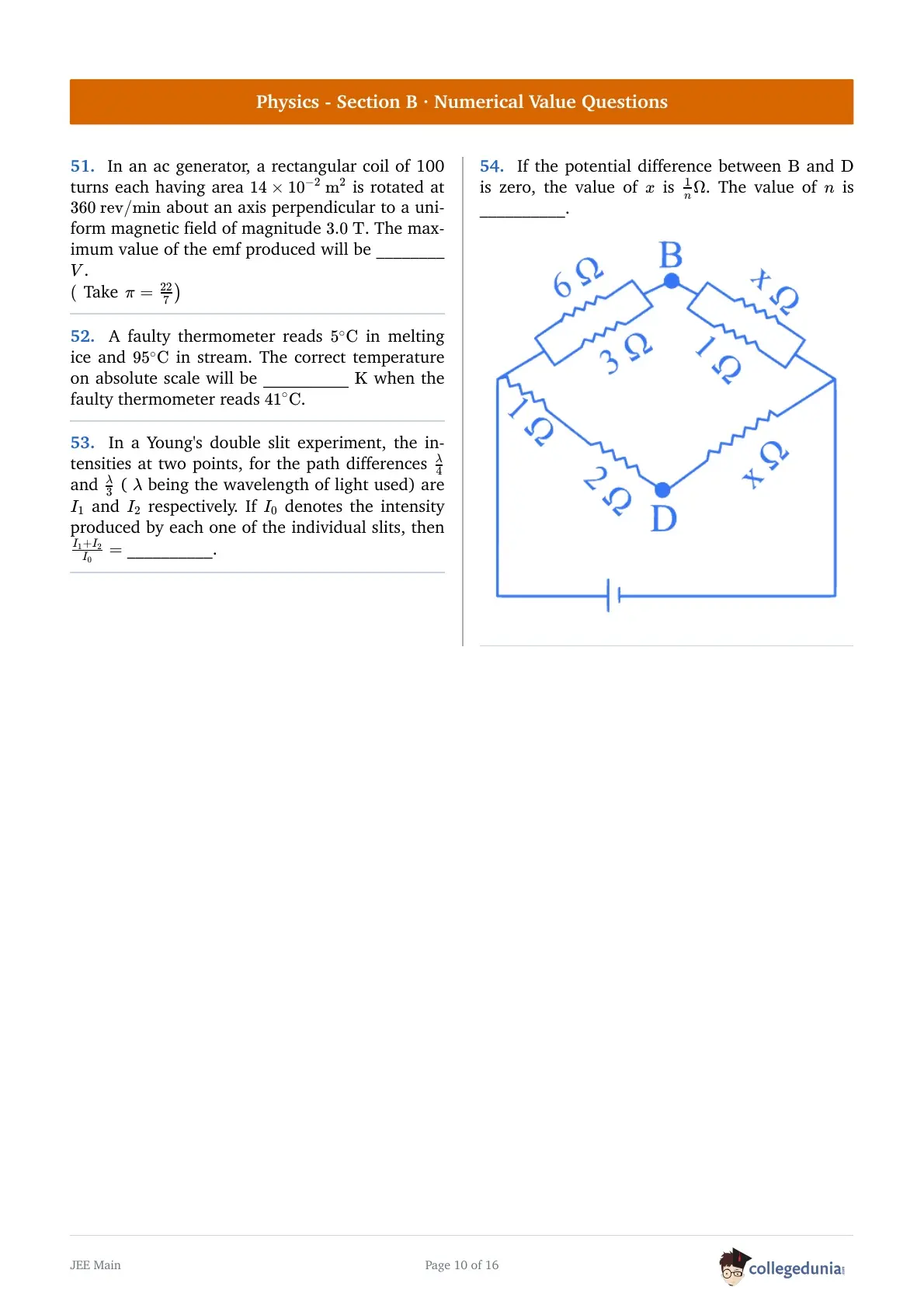
If the potential difference between \(B\) and \(D\) is zero, the value of \(x\) is \(\frac{1}{n} \Omega\) The value of \(n\) is ______
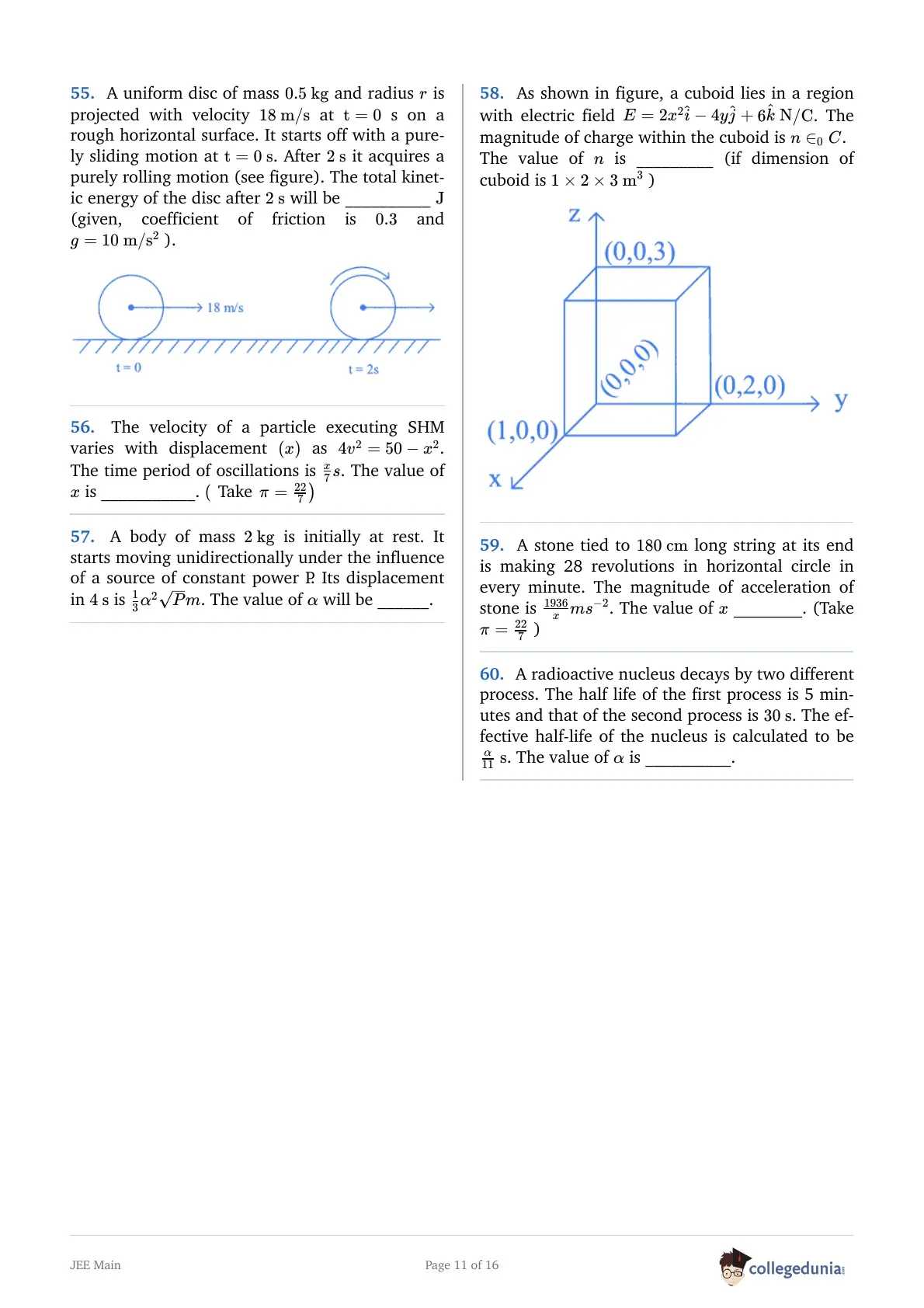
A uniform disc of mass \(0.5\, kg\) and radius \(r\) is projected with velocity \(18 \,m / s\) at \(t=0\) s on a rough horizontal surface It starts off with a purely sliding motion at \(t=0\, s\) After \(2\, s\) it acquires a purely rolling motion (see figure) The total kinetic energy of the disc after \(2 \,s\) will be ______ \(J\) (given, coefficient of friction is \(0.3\) and g=10m/s2)
The velocity of a particle executing SHM varies with displacement \((x)\) as \(4 v^2=50-x^2\) The time period of oscillations is \(\frac{x}{7} s\) The value of \(x\) is _______(Take \(\pi =\frac{22}{7}\))
A body of mass \(2\, kg\) is initially at rest It starts moving unidirectionally under the influence of a source of constant power P Its displacement in \(4 s\) is \(\frac{1}{3} \alpha^2 \sqrt{P} m\) The value of \(\alpha\) will be_______
As shown in figure, a cuboid lies in a region with electric field \(E=2 x^2 \hat{i}-4 y \hat{j}+6 \hat{k} N / C\). The magnitude of charge within the cuboid is \(n \epsilon_0 C\). The value of \(n\) is _____. (if dimension of cuboid is \(1 \times 2 \times 3 m ^3\) )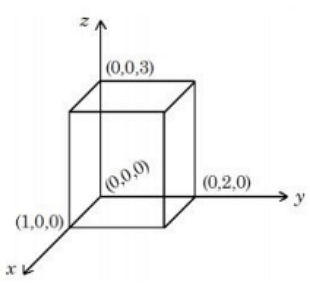
A stone tied to \(180 \,cm\) long string at its end is making \(28\) revolutions in horizontal circle in every minute The magnitude of acceleration of stone is \(\frac{1936}{x} m s^{-2}\) The value of \(x\) _____ ( Take \(\pi=\frac{22}{7}\) )
A radioactive nucleus decays by two different process The half life of the first process is 5 minutes and that of the second process is \(30 s\). The effective half-life of the nucleus is calculated to be \(\frac{\alpha}{11}\) s The value of \(\alpha\) is _______
Chemistry - Section A (Q61 - Q80)
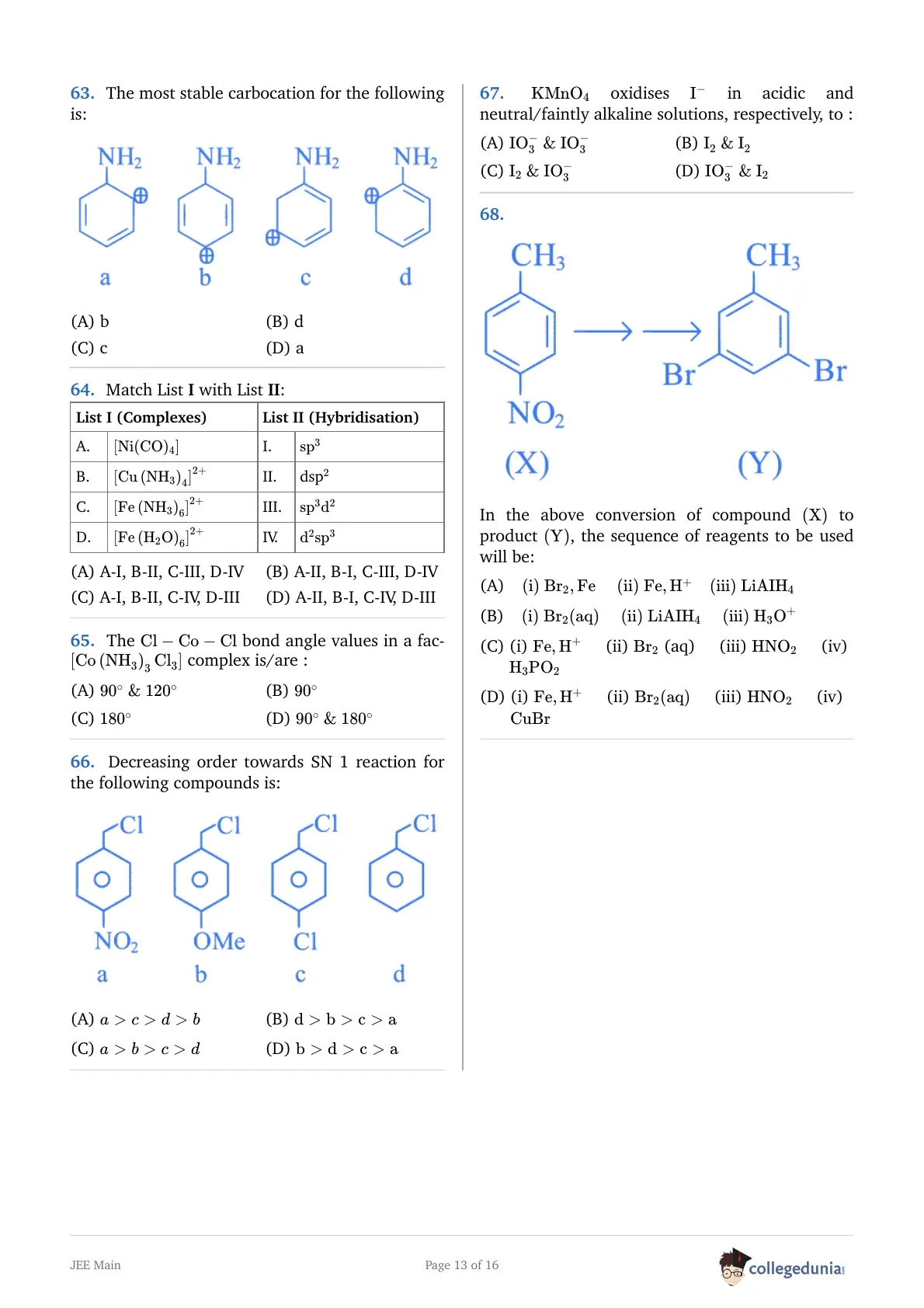
Formulae for Nessler's reagent is:
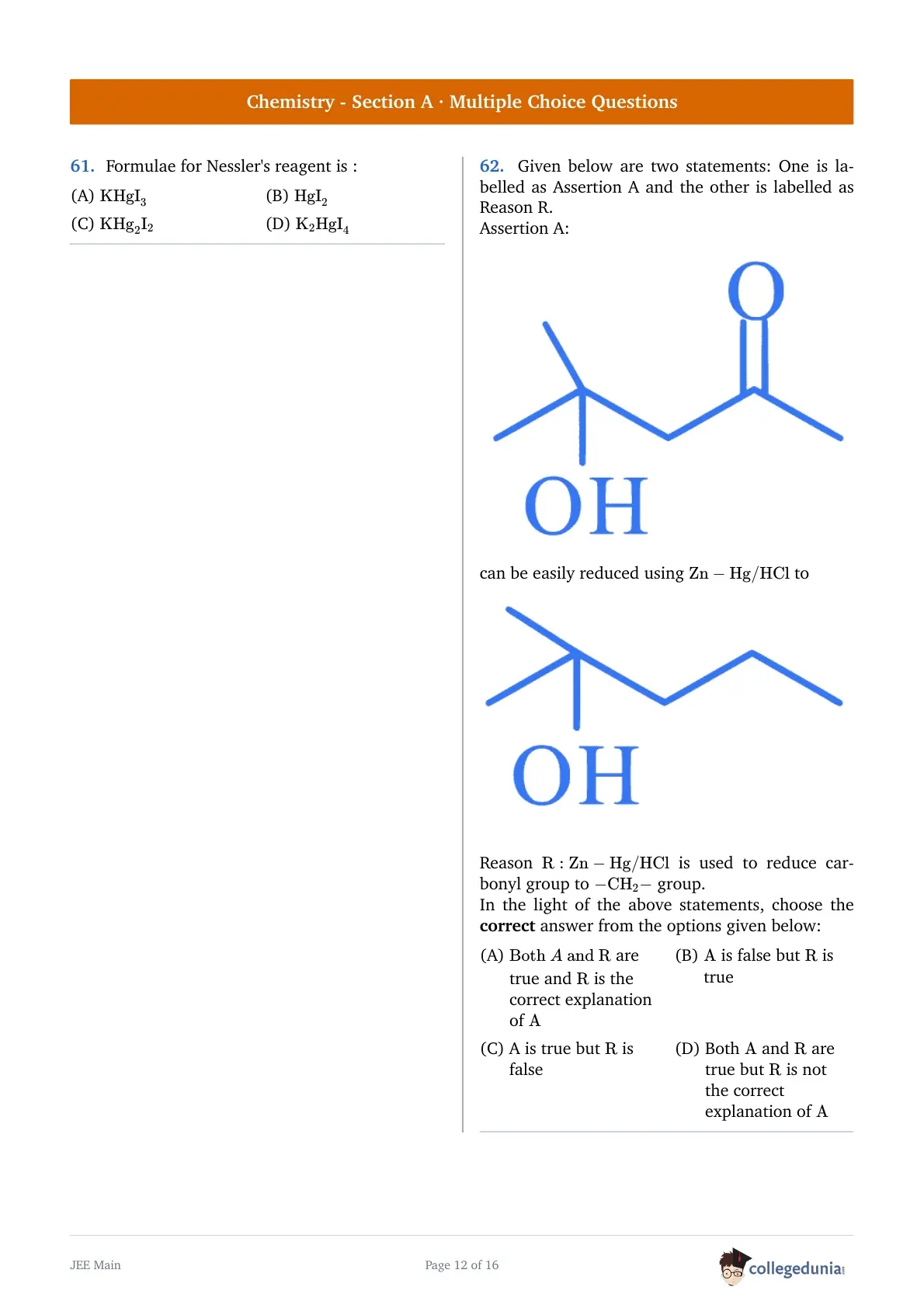
Given below are two statements: One is labelled as Assertion A and the other is labelled as Reason \(R\)
Assertion A :

can be easily reduced using \(Zn - Hg / HCl\) to

Reason R : \( Zn \cdot Hg / HCl\) is used to reduce carbonyl group to \(- CH _2-\) group.
In the light of the above statements, choose the correct answer from the options given below:


| List I (Complex) | List II (Hybridization) | ||
| A. | Ni(CO)4 | I. | sp3 |
| B. | [Cu(NH3)4]2+ | II. | dsp2 |
| C. | [Fe(NH3)6]2+ | III. | sp3d2 |
| D. | [Fe(H2O)6]2+ | IV. | d2sp3 |
The \(Cl - Co - Cl\) bond angle values in a fac- \(\left[ Co \left( NH _3\right)_3 Cl _3\right]\) complex is/are:
Decreasing order towards \(S_N1\) reaction for the following compounds is:

\(KMnO _4\) oxidises \(I ^{-}\)in acidic and neutral/faintly alkaline solution, respectively, to

In the above conversion of compound \(( X )\) to product \(( Y )\), the sequence of reagents to be used will be:
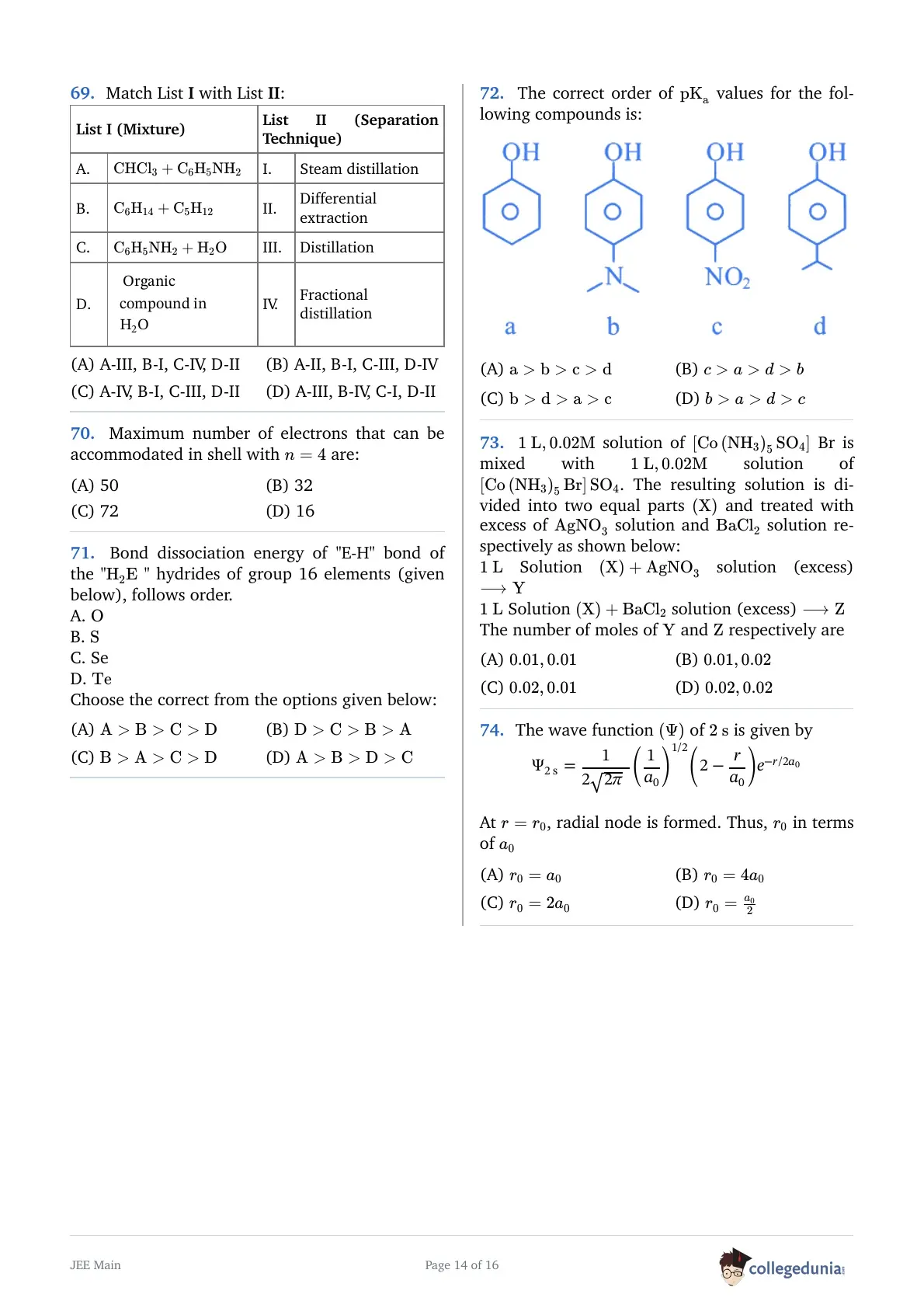
| List I (Mixture) | List II (Separation Technique) | ||
| A | CHCl3+C6H5NH2 | i | Steam distillation |
| B | C6H14+C5H12 | ii | Differential extraction |
| C | C6H5NH2+H2O | iii | Distillation |
| D | Organic compound in H2O | iv | Fractional distillation |
Maximum number of electrons that can be accommodated in shell with \(n=4\) are:
Bond dissociation energy of "E-H" bond of the " \(H _2 E\) " hydrides of group \(16\) elements (given below), follows order.
A. \(O\) B. \(S\) C. \(Se\) D. \(Te\)
Choose the correct from the options given below:
The correct order of \(\mathrm{pK_a}\) values for the following compounds is:

1 L, 0.02 M solution of [Co(NH3)5 SO4]Br is mixed with 1 L, 0.02 M solution of [Co(NH3)5Br]SO4. The resulting solution is divided into two equal parts (X) and treated with excess of AgNO3 solution and BaCl2 solution respectively as shown below:
1 L Solution (X) + AgNO3 solution (excess) → Y
1 L Solution (X) + BaCl2 solution (excess) → Z
The number of moles of Y and Z respectively are
The wave function \((\Psi)\) of \(2 s\) is given by \(\Psi_{2 n }=\frac{1}{2 \sqrt{2 \pi}}\left(\frac{1}{a_0}\right)^{1 / 2}\left(2-\frac{r}{a_0}\right) e^{-\frac{r}{2 a_0}}\) At \(r=r_0\), radial node is formed Thus, \(r_0\) in terms of \(a_0\)
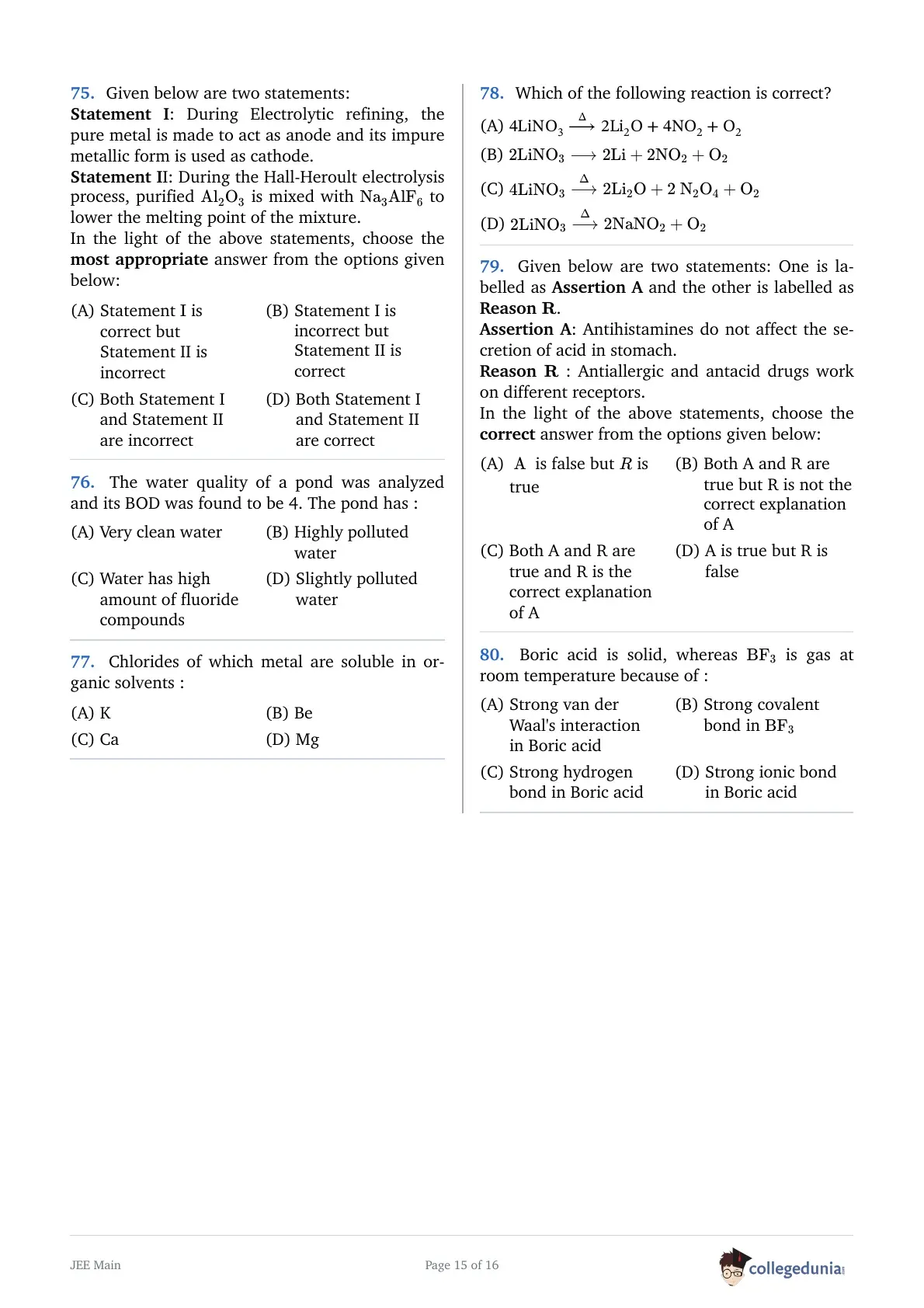
Given below are two statements:
Statement I : During Electrolytic refining, the pure metal is made to act as anode and its impure metallic form is used as cathode
Statement II : During the Hall-Heroult electrolysis process, purified \(Al _2 O _3\) is mixed with \(Na _3 AlF _6\) to lower the melting point of the mixture
In the light of the above statements, choose the most appropriate answer from the options given below:
The water quality of a pond was analysed and its BOD was found to be 4. The pond has
Chlorides of which metal are soluble in organic solvents:
Which of the following reaction is correct?
Given below are two statements: One is labelled as Assertion A and the other is labelled as Reason \(R\)
Assertion A : Antihistamines do not affect the secretion of acid in stomach
Reason R : Antiallergic and antacid drugs work on different receptors
In the light of the above statements, choose the correct answer from the options given below:
Boric acid is solid, whereas \(BF _3\) is gas at room temperature because of
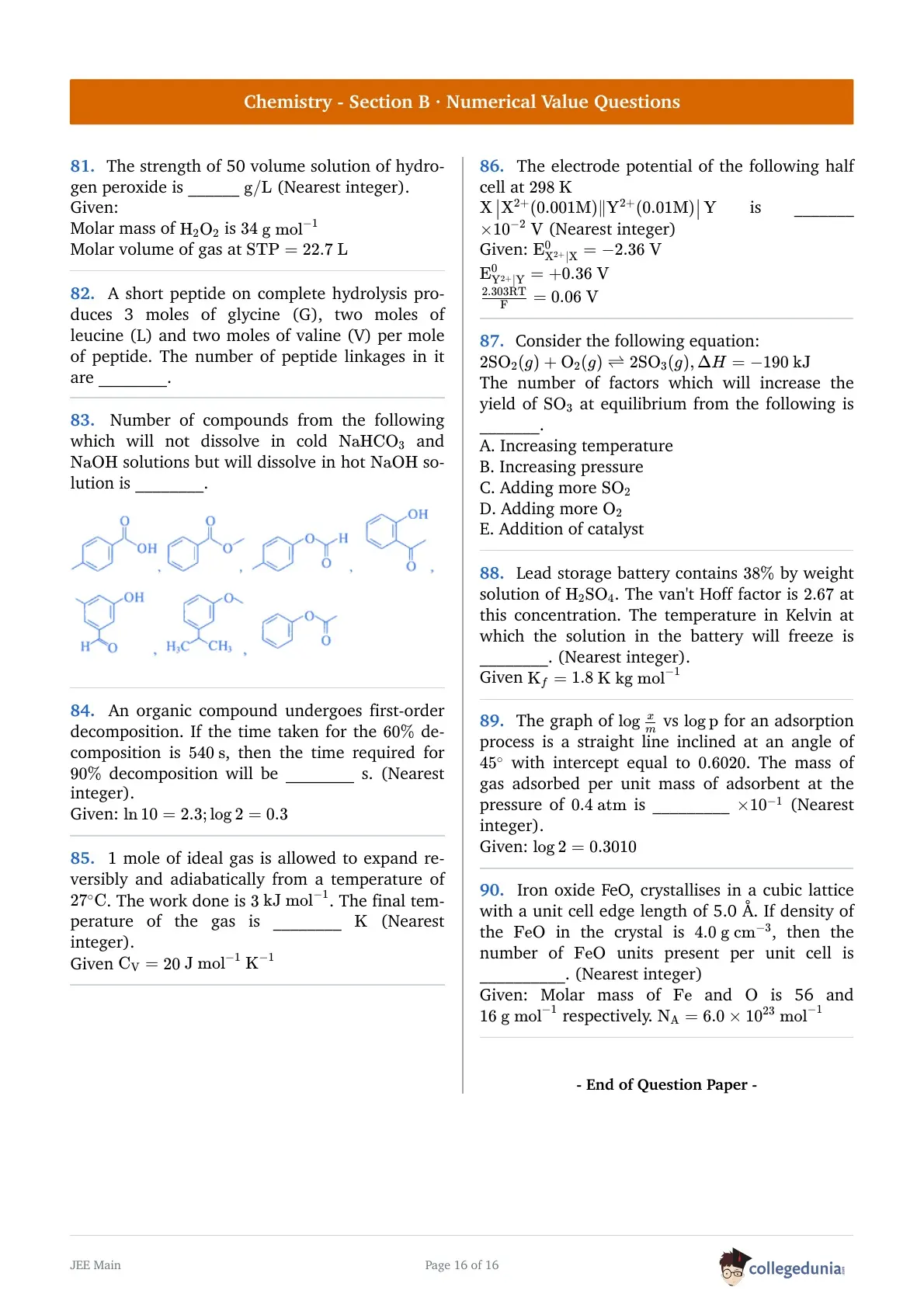
Chemistry - Section B (Q81 - Q90)
The strength of \(50\) volume solution of hydrogen peroxide is _____\(g / L\) (Nearest integer)
Given: Molar mass of \(H _2 O _2\) is \(34\, g \, mol ^{-1}\) Molar volume of gas at \(STP =22.7\, L\)
A short peptide on complete hydrolysis produces 3 moles of glycine (G), two moles of leucine \(( L )\) and two moles of valine \(( V )\) per mole of peptide The number of peptide linkages in it are ______
Number of compounds from the following which will not dissolve in cold \(NaHCO _3\) and \(NaOH\) solutions but will dissolve in hot \(NaOH\) solution is______
An organic compound undergoes first order decomposition If the time taken for the \(60 \%\) decomposition is \(540 \,s\), then the time required for \(90 \%\) decomposition will be is ______ s. (Nearest integer)
(Given: \(\ln 10=2.3 ; \log 2=0.3\))
1 mole of ideal gas is allowed to expand reversibly and adiabatically from a temperature of \(27^{\circ} C\) The work done is \(3\, kJ \,mol ^{-1}\) The final temperature of the gas is _______ \(K\) (Nearest integer).
Given \(C_{ V }=20 \,J\, mol ^{-1} K ^{-1}\)
The electrode potential of the following half cell at \(298\, K\) \(X \left| X ^{2+}(0.001 M ) \| Y ^{2+}(0.01 M )\right| Y\) is _____\(\times 10^{-2} V\) (Nearest integer)
Given: \(E _{ x ^{2 *} \mid x }^0=-2.36\, V\)
\( E _{ Y ^{0-1 Y }}^0=+0.36\, V\)
\(\frac{2303 RT }{ F }=0.06 \,V\)
Consider the following equation: \(2 SO _2(g)+ O _2(g) \rightleftharpoons 2 SO _3(g), \Delta H =-190 \,kJ\). The number of factors which will increase the yield of \(SO _3\) at equilibrium from the following is _______
A. Increasing temperature
B. Increasing pressure
C. Adding more \(SO _2\)
D. Adding more \(O _2\) E Addition of catalyst
Lead storage battery contains \(38 \%\) by weight solution of \(H _2 SO _4\) The van't Hoff factor is \(2.67\) at this concentration The temperature in Kelvin at which the solution in the battery will freeze is ______(Nearest integer) Given \(K _f=1.8\, K \,kg\, mol ^{-1}\)
The graph of \(\log \frac{x}{m}\) vs \(\log p\) for an adsorption process is a straight line inclined at an angle of \(45^{\circ}\) with intercept equal to \(0.6020\) The mass of gas adsorbed per unit mass of adsorbent at the pressure of \(04 \,atm\) is______ \(\times 10^{-1}\) (Nearest integer)
Given: \(\log 2=0.3010\)
Iron oxide \(FeO\), crystallises in a cubic lattice with a unit cell edge length of \(50 \mathring{A}\) If density of the \(FeO\) in the crystal is \(40\, g \,cm ^{-3}\), then the number of \(FeO\) units present per unit cell is ______ (Nearest integer) Given: Molar mass of \(Fe\) and \(O\) is \(56\) and \(16 \, g \, mol ^{-1}\) respectively \(N _{ A }=60 \times 10^{23} mol ^{-1}\)
JEE Main 2023 Exam Pattern and Marking Scheme
| Particulars | Details |
|---|---|
| Exam Mode | Online (Computer-Based Test) |
| Paper | B.E./B.Tech |
| Medium of Exam | 13 languages: English, Hindi, Gujarati, Bengali, Tamil, Telugu, Kannada, Marathi, Malayalam, Odia, Punjabi, Assamese, Urdu |
| Duration | 3 hours (180 minutes) |
| Type of Questions | Multiple Choice Questions (MCQs) + Numerical Value Questions (attempt any 5 of 10 per subject) |
| Total Marks | 300 marks |
| Subjects | Mathematics, Physics, Chemistry |
| Marking Scheme | +4 for correct answer & -1 for incorrect MCQ and Numerical Value-based Questions |
| Total Questions | 90 Questions (30 per subject), 75 to be attempted |
| Eligibility | Passed or appearing in Class 12 with Physics, Chemistry, and Mathematics |
JEE Main 2023 Jan 30 Shift 2 Question Paper by Coaching Institute
| Coaching Institutes | Question Paper with Answer Key PDF |
|---|---|
| Vedantu | Check Here |
JEE Main 2023 Paper Analysis Jan 30 Shift 2
JEE Main 2023 Paper Analysis for the exam scheduled on January 30 Shift 2 has also been updated here. Candidates can check subject-wise paper analysis for the exam scheduled on January 30 Shift 2 here along with the topics with the highest weightage.
Also Check:



Comments