




JEE Main 2023 January 31 Shift 2 Question Paper is available here with answer key and solution pdf. NTA conducted the second shift on January 31, 2023, from 3:00 PM to 6:00 PM. The JEE Main 2023 Paper 1 (B.E./B.Tech) question paper includes the following:
- 90 questions in a 3-hour CBT Mode: 30 each from Mathematics, Physics and Chemistry (75 to be attempted)
- Section A: 20 multiple choice questions (MCQs) per subject, 4 marks each
- Section B: 10 numerical value questions per subject, attempt any 5, 4 marks each (integer answer)
- Marking: +4 for a correct answer, -1 for an incorrect answer, 0 for an unattempted question
JEE Main 2023 January 31 Shift 2 Question Paper with Solution PDF
| NTA Official PDF | CD PDF | CD PDF with Solutions |
|---|---|---|
| Download official PDF 4.55 MB | Download Collegedunia PDF 0.67 MB | Download solutions PDF 0.69 MB |
Also Check:
JEE Main 2023 January 31 Shift 2 Questions with Solutions
Mathematics - Section A (Q1 - Q20)
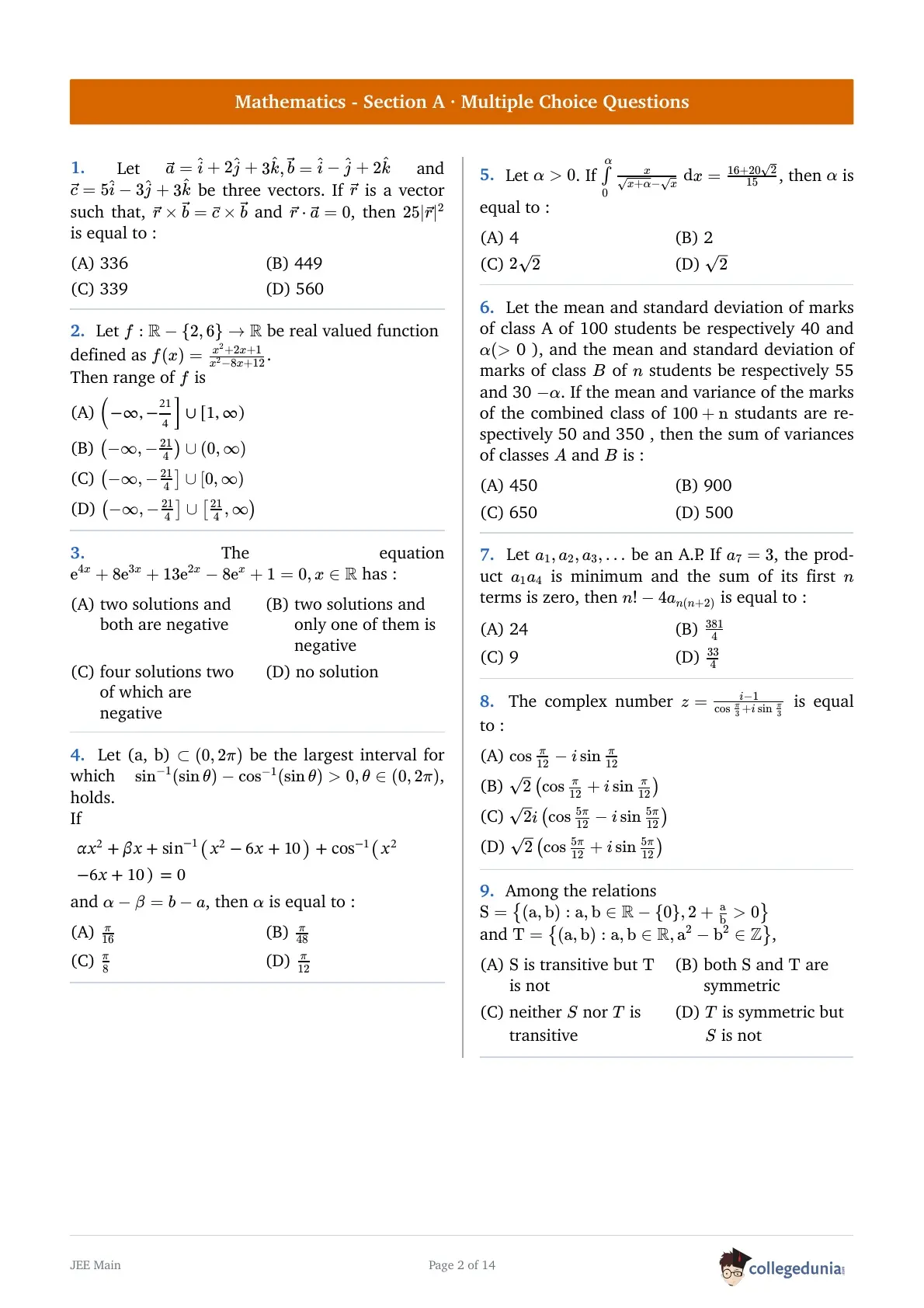
Let: \(\vec{a}=\hat{i}+2 \hat{j}+3 \hat{k}, \vec{b}=\hat{i}-\hat{j}+2 \hat{k}\) and \(\vec{c}=5 \hat{i}-3 \hat{j}+3 \hat{k}\) be there vectors If \(\vec{r}\) is a vector such that, \(\vec{r} \times \vec{b}=\vec{c} \times \vec{b}\) and \(\vec{r} \cdot \vec{a}=0\), then \(25|\vec{r}|^2\) is equal to
Let \(f: R -\{2,6\} \rightarrow R\) be real valued function defined as \(f(x)=\frac{x^2+2 x+1}{x^2-8 x+12}\) Then range of \(f\) is
The equation \(e^{4x} + 8e^{3x} + 13e^{2x} - 8e^{x} + 1 = 0,\ x \in \mathbb{R}\) has :
Let \((a, b) \subset(0,2 \pi)\) be the largest interval for which \(\sin ^{-1}(\sin \theta)-\cos ^{-1}(\sin \theta)>, \theta \in(0,2 \pi)\), holds If \(\alpha x^2+\beta x+\sin ^{-1}\left(x^2-6 x+10\right)+\cos ^{-1}\left(x^2-6 x+10\right)=0\) and \(\alpha-\beta=b-a\), then \(\alpha\) is equal to :
Let \(\alpha>0\) If \(\int\limits_0^\alpha \frac{x}{\sqrt{x+\alpha}-\sqrt{x}} d x=\frac{16+20 \sqrt{2}}{15}\), then \(\alpha\) is equal to :
Let the mean and standard deviation of marks of class A of \(100\) students be respectively \(40\) and \(\alpha\) (> 0 ), and the mean and standard deviation of marks of class B of \(n\) students be respectively \(55\) and 30 \(-\alpha\). If the mean and variance of the marks of the combined class of \(100+ n\) students are respectively \(50\) and \(350\) , then the sum of variances of classes \(A\) and \(B\) is :
Let \(a_1, a_2, a_3, \ldots\) be an AP If \(a_7=3\), the product \(a_1 a_4\) is minimum and the sum of its first \(n\) terms is zero, then \(n !-4 a_{n(n+2)}\) is equal to :
The complex number \(z=\frac{i-1}{\cos \frac{\pi}{3}+i \sin \frac{\pi}{3}}\) is equal to :
Among the relations
\(S=\left\{(a, b): a, b \in R -\{0\}, 2+\frac{a}{b}>\right\}\)
and \(T=\left\{(a, b): a, b \in R , a^2-b^2 \in Z\right\}\),
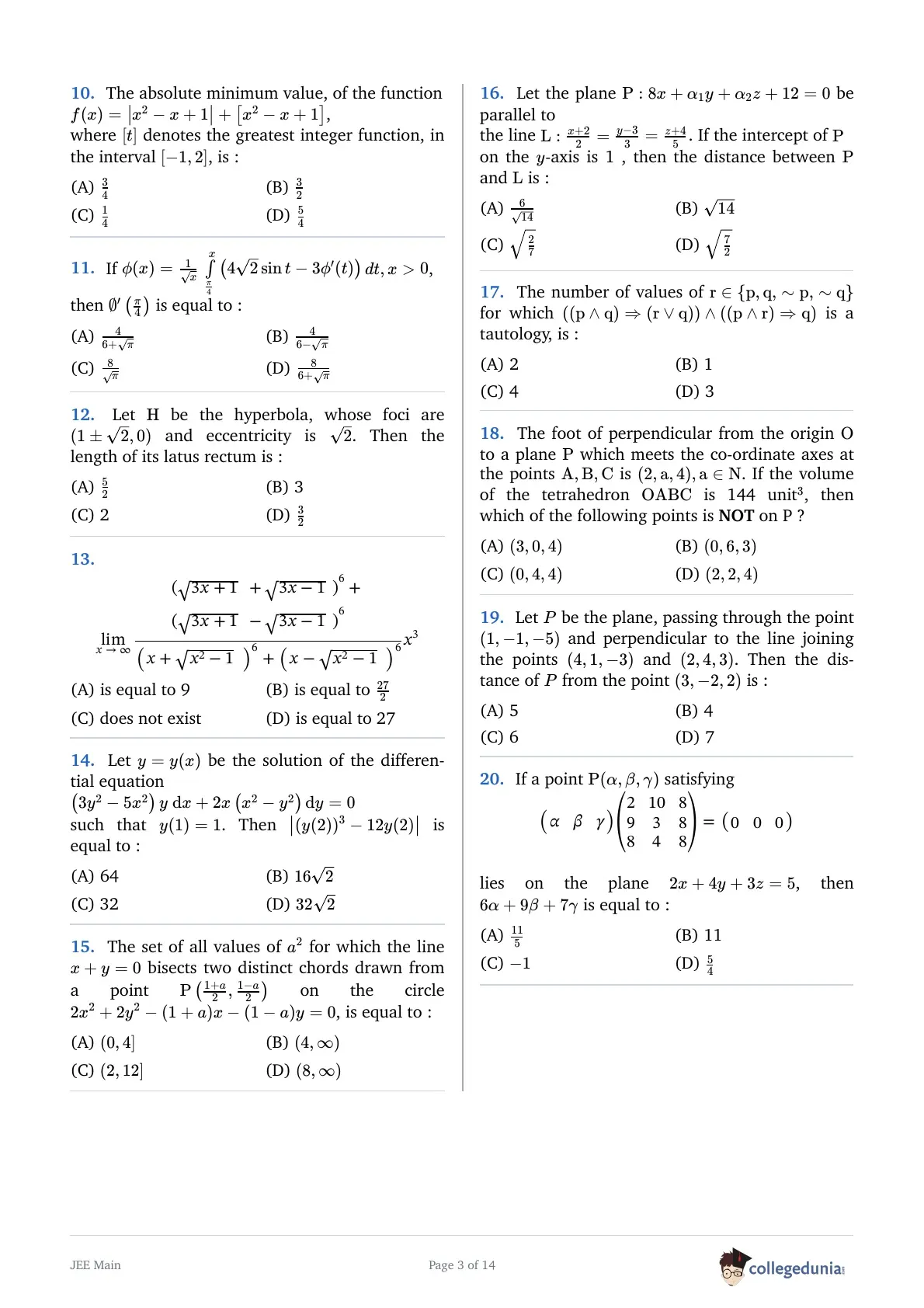
The absolute minimum value, of the function \(f(x)=\left|x^2-x+1\right|+\left[x^2-x+1\right]\), where \([t]\) denotes the greatest integer function, in the interval \([-1,2]\), is:
If \(\phi(x)=\frac{1}{\sqrt{ x }} \int_{\frac{\pi}{4}}^x\left(4 \sqrt{2} \sin t-3 \phi^{\prime}(t)\right) dt , x>\), then \(\emptyset^{\prime}\left(\frac{\pi}{4}\right)\) is equal to :
Let \(H\) be the hyperbola, whose foci are \((1 \pm \sqrt{2}, 0)\) and eccentricity is \(\sqrt{2}\). Then the length of its latus rectum is _____
\(\displaystyle\lim _{x \rightarrow \infty} \frac{(\sqrt{3 x+1}+\sqrt{3 x-1})^6+(\sqrt{3 x+1}-\sqrt{3 x-1})^6}{\left(x+\sqrt{x^2-1}\right)^6+\left(x-\sqrt{x^2-1}\right)^6} x^3\)
Let \(y=y(x)\) be the solution of the differential equation \(\left(3 y^2-5 x^2\right) y d x+2 x\left(x^2-y^2\right) d y=0\) such that \(y(1)=1\) Then \(\left|(y(2))^3-12 y(2)\right|\) is equal to :
The set of all values of \(a^2\) for which the line \(x+y=0\) bisects two distinct chords drawn from a point \(P \left(\frac{1+a}{2}, \frac{1-a}{2}\right)\) on the circle \(2 x^2+2 y^2-(1+a) x-(1-a) y=0\), is equal to :
Let the plane \(P : 8 x+\alpha_1 y+\alpha_2 z+12=0\) be parallel to the line \(L : \frac{x+2}{2}=\frac{y-3}{3}=\frac{z+4}{5}\). If the intercept of \(P\) on the \(y\)-axis is 1 , then the distance between \(P\) and \(L\) is :
The number of values of \(r \in\{p, q, \sim p, \sim q\}\) for which \(((p \wedge q) \Rightarrow(r \vee q)) \wedge((p \wedge r) \Rightarrow q)\) is a tautology, is :
The foot of perpendicular from the origin \(O\) to a plane \(P\) which meets the co-ordinate axes at the points \(A , B , C\) is \((2, a , 4), a \in N\) If the volume of the tetrahedron \(OABC\) is 144 unit \(^3\), then which of the following points is NOT on \(P\) ?
Let \(P\) be the plane, passing through the point \((1,-1,-5)\) and perpendicular to the line joining the points \((4,1,-3)\) and \((2,4,3)\). Then the distance of \(P\) from the point \((3,-2,2)\) is
If a point \(P (\alpha, \beta, \gamma)\) satisfying \((\alpha\,\, \beta\,\, \gamma) \begin{pmatrix} 2 & 10 & 8 \\9 & 3 & 8 \\8 & 4 & 8\end{pmatrix}=(0\,\,0\,\,0) \) lies on the plane \(2 x+4 y+3 z=5\), then \(6 \alpha+9 \beta+7 \gamma\) is equal to :
Mathematics - Section B (Q21 - Q30)
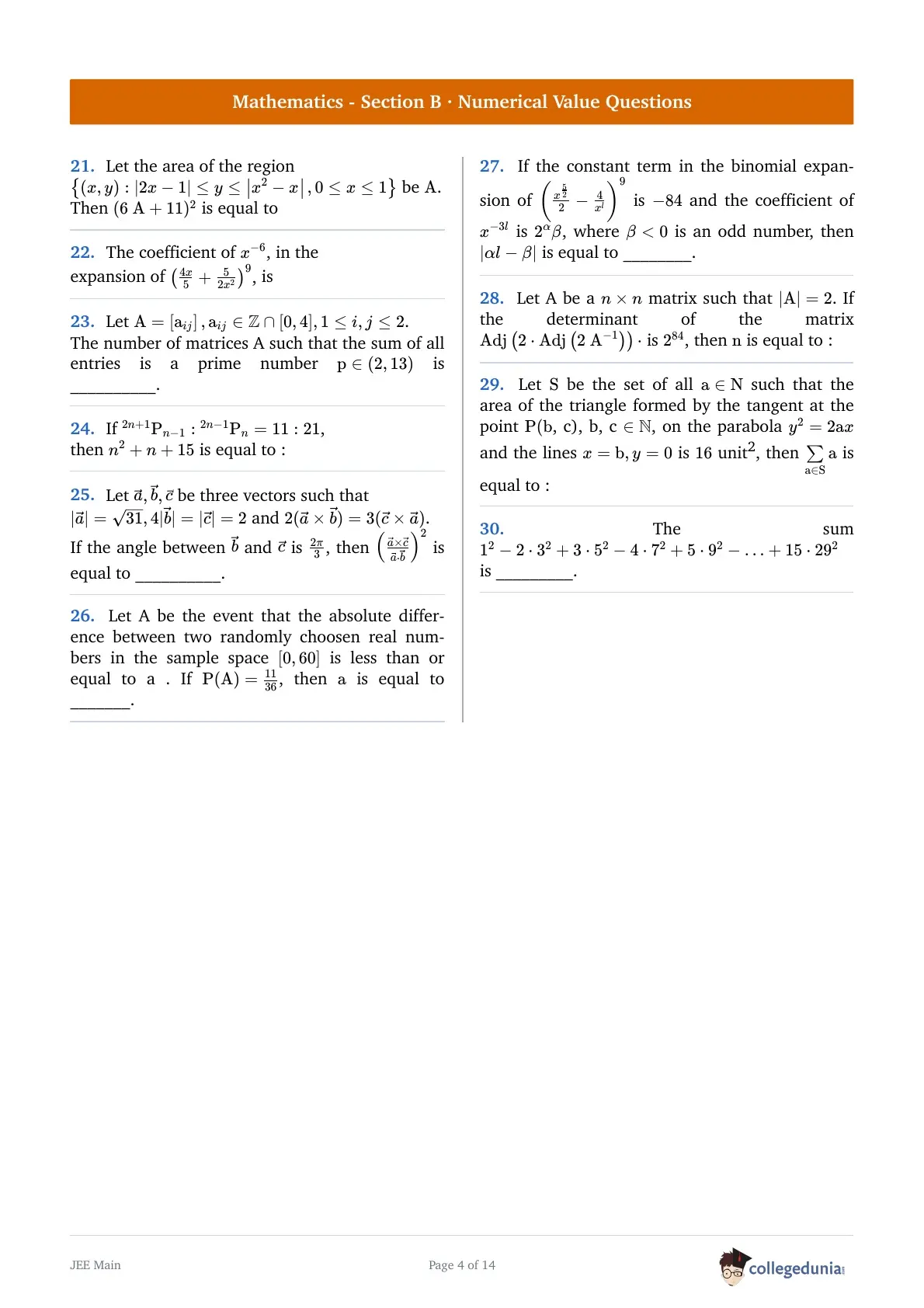
Let the area of the region \(\left\{(x, y):|2 x-1| \leq y \leq\left|x^2-x\right|, 0 \leq x \leq 1\right\}\) be \(A\) Then \((6 A +11)^2\) is equal to ____
The coefficient of \(x^{-6}\), in the expansion of \(\left(\frac{4 x}{5}+\frac{5}{2 x^2}\right)^9\), is______
Let \(A =\left[ a _{i j}\right], a _{i j} \in Z \cap[0,4], 1 \leq i, j \leq 2\) .
The number of matrices \(A\) such that the sum of all entries is a prime number \(p \in(2,13)\) is _____.
If \({ }^{2 n+1} P _{n-1}:{ }^{2 n-1} P _n=11: 21\), then \(n^2+n+15\) is equal to :
Let \(\vec{a}, \vec{b}, \vec{c}\) be three vectors such that \(|\vec{a}|=\sqrt{31}, 4|\vec{b}|=|\vec{c}|=2\) and \(2(\vec{a} \times \vec{b})=3(\vec{c} \times \vec{a})\) If the angle between \(\vec{b}\) and \(\vec{c}\) is \(\frac{2 \pi}{3}\), then \(\left(\frac{\vec{a} \times \vec{c}}{\vec{a} \cdot \vec{b}}\right)^2\) is equal to _____
Let \(A\) be the event that the absolute difference between two randomly choosen real numbers in the sample space \([0,60]\) is less than or equal to a If \(P(A)=\frac{11}{36}\), then a is equal to _____
If the constant term in the binomial expansion of \(\left(\frac{x^{\frac{5}{2}}}{2}-\frac{4}{x^l}\right)^9\) is \(-84\) and the coefficient of \(x^{-3 l}\) is \(2^\alpha \beta\), where \(\beta<\) is an odd number, then \(|\alpha l-\beta|\) is equal to_____
Let A be a \(n \times n\) matrix such that \(| A |=2\) If the determinant of the matrix\(\operatorname{Adj}\left(2 \cdot \operatorname{Adj}\left(2 A ^{-1}\right)\right) \cdot\) is \(2^{84}\), then \(n\) is equal to ____
Let \(S\) be the set of all \(a \in N\) such that the area of the triangle formed by the tangent at the point \(P ( b, c), b, c \in N\), on the parabola \(y^2=2\) ax and the lines \(x=b, y=0\) is \(16\) unit \({ }^2\), then \(\displaystyle\sum_{a \in S} a\) is equal to _____
The sum \(1^2-2 \cdot 3^2+3 \cdot 5^2-4 \cdot 7^2+5 \cdot 9^2-\ldots+15 \cdot 29^2\) is_____
Physics - Section A (Q31 - Q50)
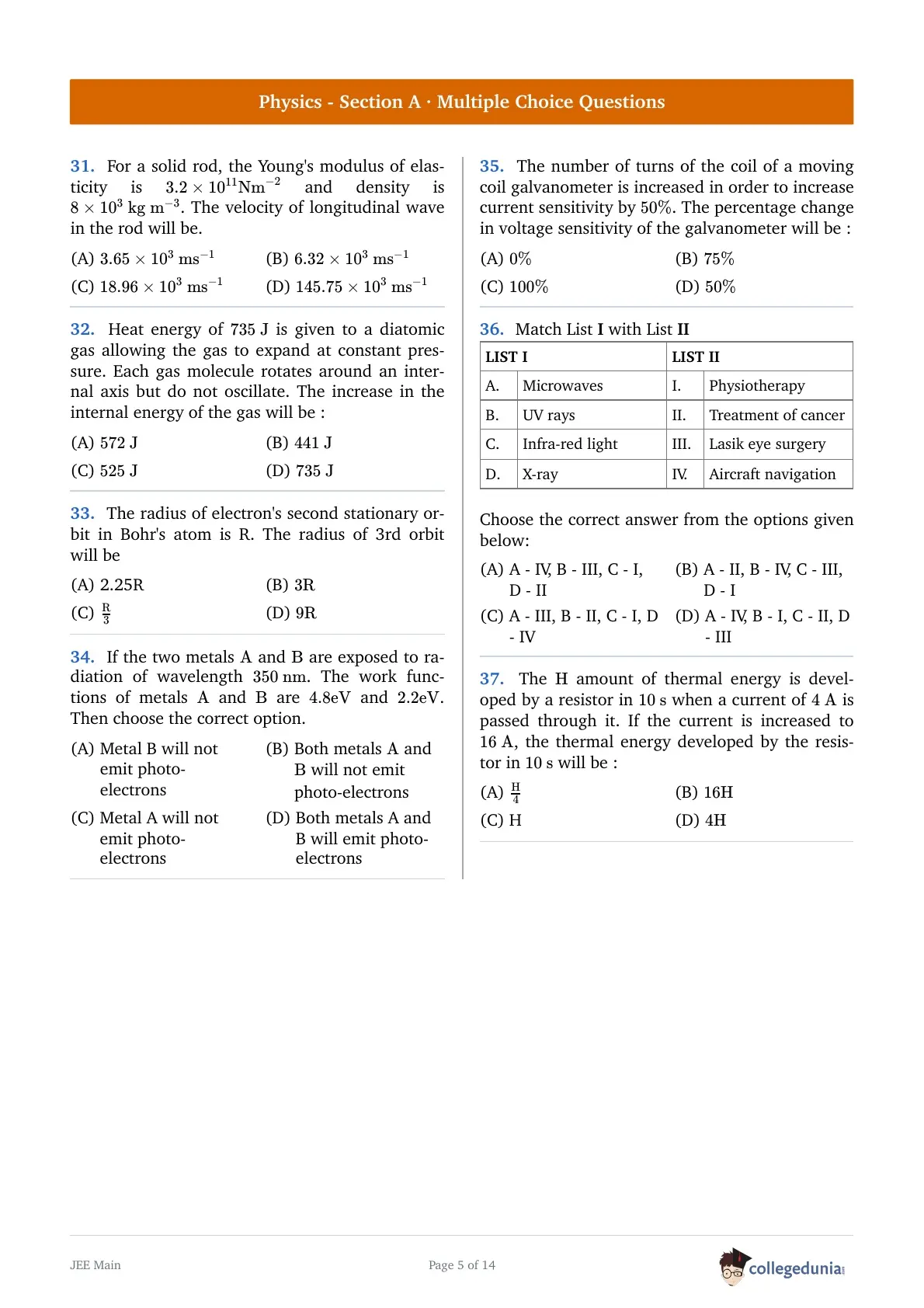
For a solid rod, the Young's modulus of elasticity is \(32 \times 10^{11} Nm ^{-2}\) and density is \(8 \times 10^3 kg m ^{-3}\) The velocity of longitudinal wave in the rod will be
Heat energy of 735J is given to a diatomic gas allowing the gas to expand at constant pressure Each gas molecule rotates around an internal axis but do not oscillate The increase in the intemal energy of the gas will be :
The radius of electron's second stationary orbit in Bohr's atom is \(R\) The radius of 3rd orbit will be
If the two metals \(A\) and \(B\) are exposed to radiation of wavelength \(350 mm\). The work functions of metals \(A\) and \(B\) are \(4.8 eV\) and \(2.2 eV\). Then choose the correct option
The number of turns of the coil of a moving coil galvanometer is increased in order to increase current sensitivity by \(50 \%\) The percentage change in voltage sensitivity of the galvanometer will be:
Match List I with List II
| List I | List II | ||
| A. | Microwaves | I. | Physiotherapy |
| B. | UV rays | II. | Treatment of cancer |
| C. | Infra-red rays | III. | Lasik eye surgery |
| D. | X-rays | IV. | Aircraft navigation |
Choose the correct answer from the options given below:
The \(H\) amount of thermal energy is developed by a resistor in \(10 s\) when a current of \(4 A\) is passed through it If the current is increased to \(16 A\), the themal energy developed by the resistor in \(10 s\) will be:
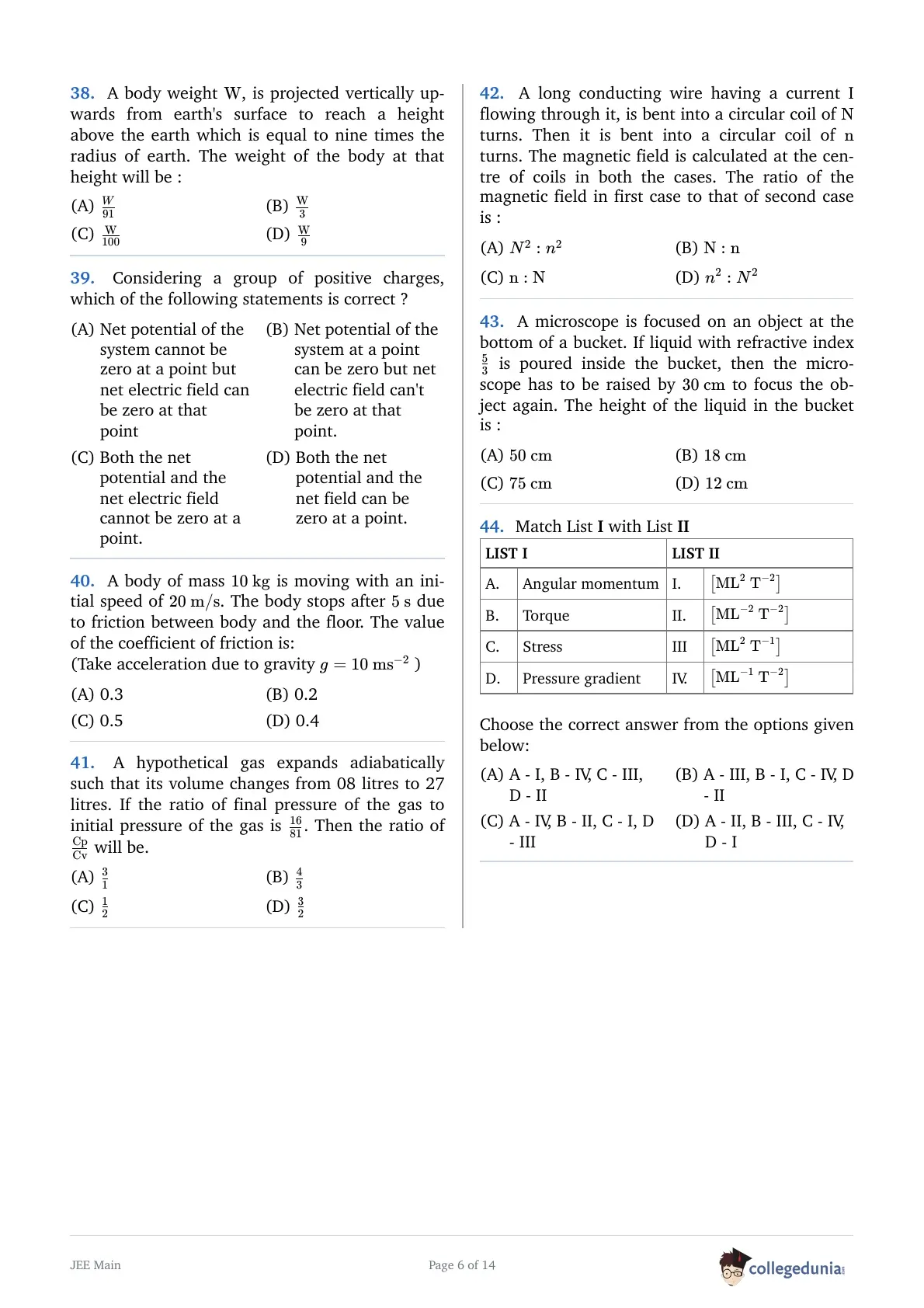
A body weight W, is projected vertically upwards from earth's surface to reach a height above the earth which is equal to nine times the radius of earth The weight of the body at that height will be :
Considering a group of positive charges, which of the following statements is correct ?
A body of mass \(10 kg\) is moving with an initial speed of \(20 m / s\) The body stops after \(5 s\) due to friction between body and the floor The value of the coefficient of friction is: (Take acceleration due to gravity \(g =10 ms ^{-2}\) )
A hypothetical gas expands adiabatically such that its volume changes from 08 litres to 27 litres. If the ratio of final pressure of the gas to initial pressure of the gas is \(\frac{16}{B 1}\). Then the ratio of \(\frac{C p}{C v}\) will be
A long conducting wire having a current I flowing through it, is bent into a circular coil of \(N\) turns .Then it is bent into a circular coil of \(n\) turns. The magnetic field is calculated at the centre of coils in both the cases. The ratio of the magnetic field in first case to that of second case is :
A microscope is focused on an object at the bottom of a bucket If liquid with refractive index \(\frac{5}{3}\) is poured inside the bucket, then microscope have to be raised by \(30\, cm\) to focus the object again The height of the liquid in the bucket is :
Match List I with List II
| List I | List II | ||
| A. | Angular momentum | I. | ML2T−2 |
| B. | Torque | II. | ML−2T−2 |
| C. | Stress | III. | ML2T−1 |
| D. | Pressure gradient | IV. | ML−1T−2 |
Choose the correct answer from the options given below.
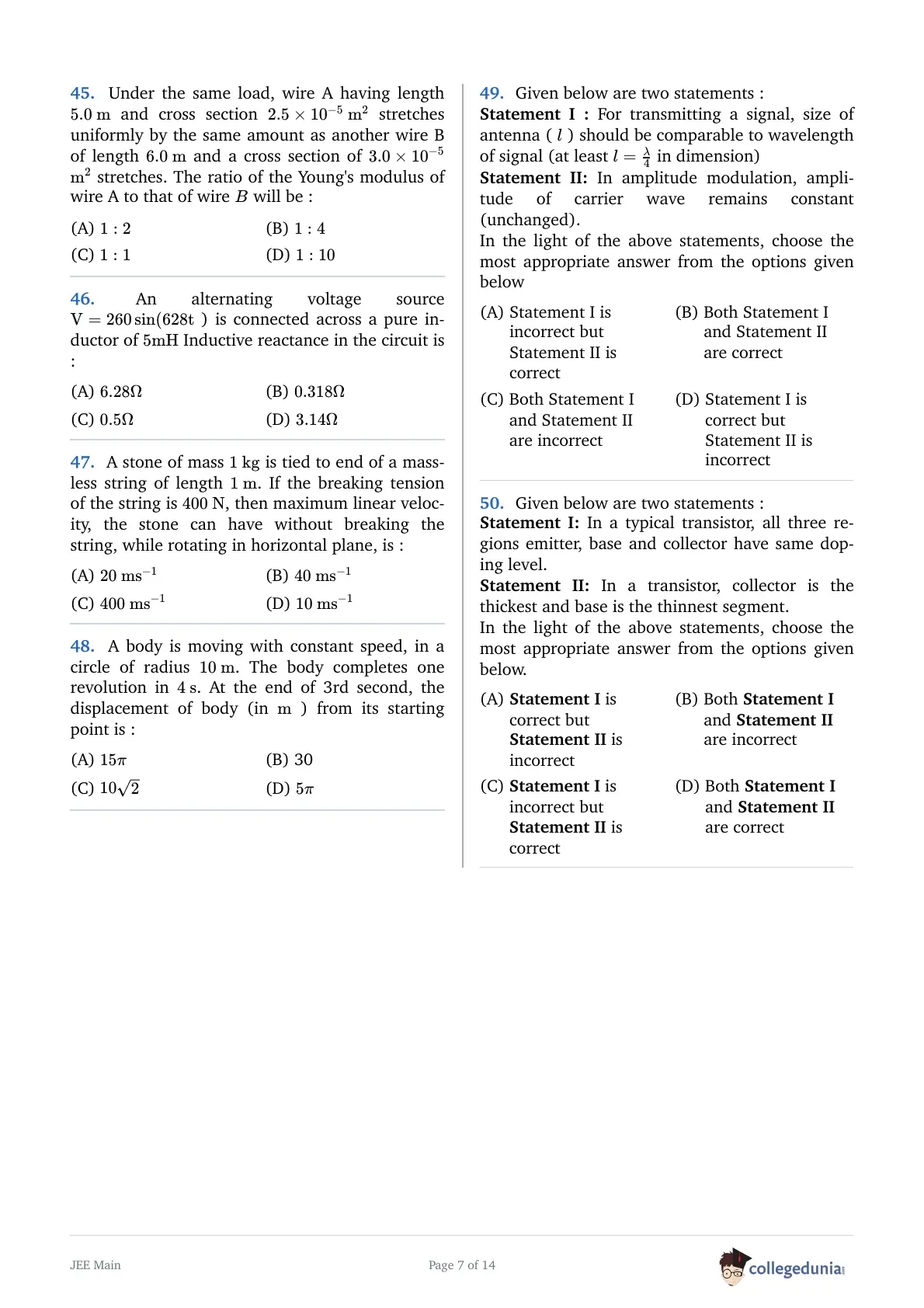
Under the same load, wire A having length \(50 m\) and cross section \(25 \times 10^{-5} m ^2\) stretches uniformly by the same amount as another wire \(B\) of length \(60 m\) and a cross section of \(30 \times 10^{-5}\) \(m ^2\) stretches The ratio of the Young's modulus of wire \(A\) to that of wire \(B\) will be :
An alternating voltage source \(V =260 \sin (628 t )\) is connected across a pure inductor of \(5 mH\) Inductive reactance in the circuit is :
A stone of mass \(1 \, kg\) is tied to end of a massless string of length \(1 m\) If the breaking tension of the string is \(400\, N\), then maximum linear velocity, the stone can have without breaking the string, while rotating in horizontal plane, is :
A body is moving with constant speed, in a circle of radius \(10 m\) .The body completes one revolution in 4 s .At the end of 3 rd second, the displacement of body (in mi) from its starting point is :
Given below are two statements :
Statement I : For transmitting a signal, size of antenna ( \(f\) ) should be comparable to wavelength of signal (at least \(l=\frac{\lambda}{4}\) in dimension)
Statement II : In amplitude modulation, amplitude of carrier wave remains constant (unchanged)
In the light of the above statements, choose the most appropriate answer from the options given below,
Given below are two statements :
Statement I : In a typical transistor, all three regions emitter, base and collector have same doping level.
Statement II : In a transistor, collector is the thickest and base is the thinnest segment.
In the light of the above statements, choose the most appropriate answer from the options given below.
Physics - Section B (Q51 - Q60)
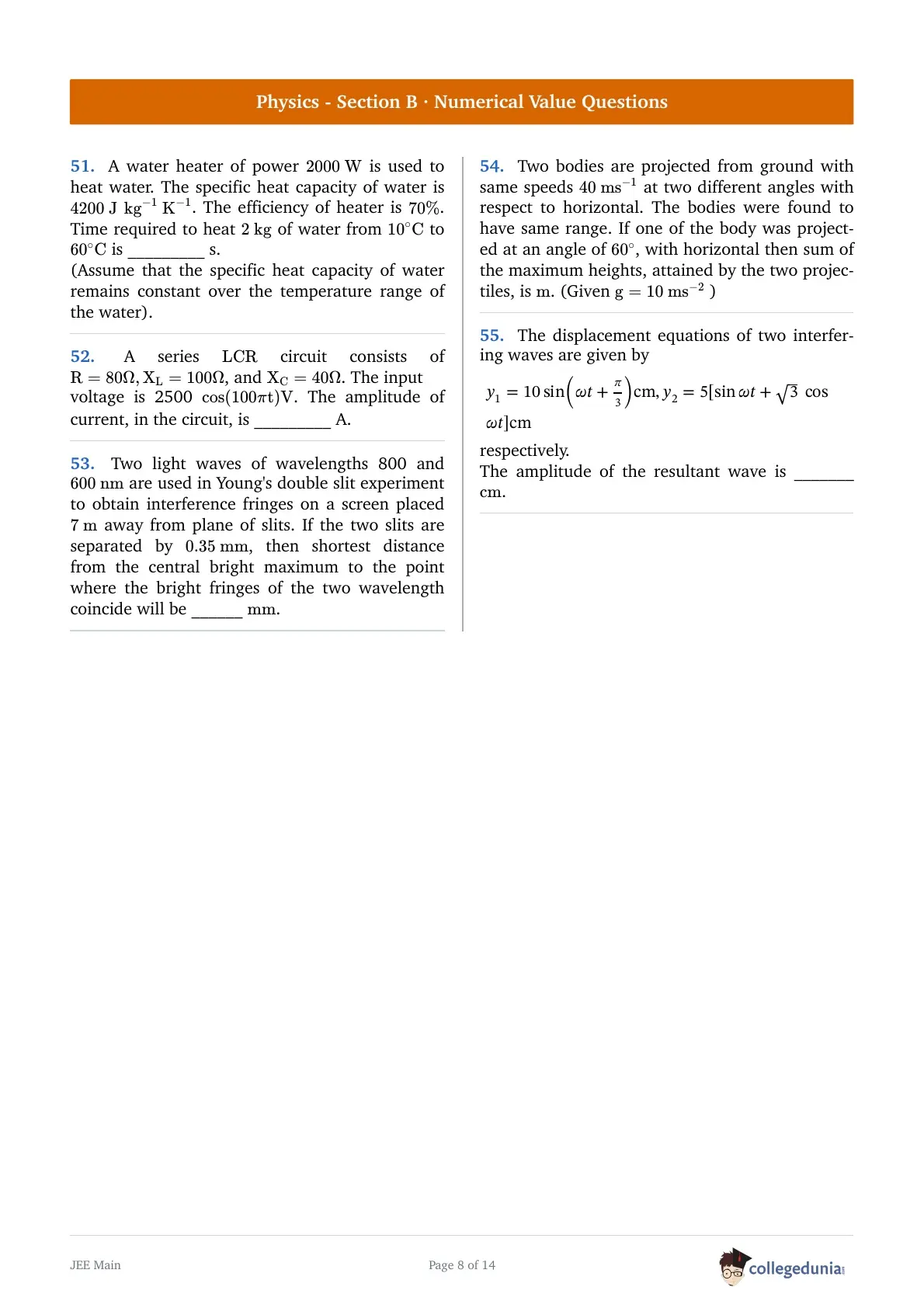
A water heater of power \(2000 W\) is used to heat water. The specific heat capacity of water is \(4200 J\) \(kg ^{-1} K ^{-1}\) .The efficiency of heater is \(70 \%\) .Time required to heat \(2 kg\) of water from \(10^{\circ} C\) to \(60^{\circ} C\) is___\( s\)
(Assume that the specific heat capacity of water remains constant over the temperature range of the water)
A series \(LCR\) circuit consists of \(R =80 \Omega, X _{ L }=100 \Omega\), and \(X _{ C }=40 \Omega\). The input voltage is 2500 \(\cos (100 \pi t ) V\). The amplitude of current, in the circuit, is ___\(A\)
Two light waves of wavelengths 800 and \(600 nm\) are used in Young's double slit experiment to obtain interference fringes on a screen placed \(7 m\) away from plane of slits If the two slits are separated by \(0.35 mm\), then shortest distance from the central bright maximum to the point where the bright fringes of the two wavelength coincide will be ___\(mm\)
Two bodies are projected from ground with same speeds \(40\, ms ^{-1}\) at two different angles with respect to horizontal The bodies were found to have same range If one of the body was projected at an angle of \(60^{\circ}\), with horizontal then sum of the maximum heights, attained by the two projectiles, is ____\(m\) (Given \(g=10 ms ^{-2}\) )
The displacement equations of two interfering waves are given by
\(y_1=10 \sin \left(\omega t+\frac{\pi}{3}\right)\) cm ,
\(y_2=5[\sin \omega t+\sqrt{3} \cos \omega t]\) cm respectively.
The amplitude of the resultant wave is ___ cm
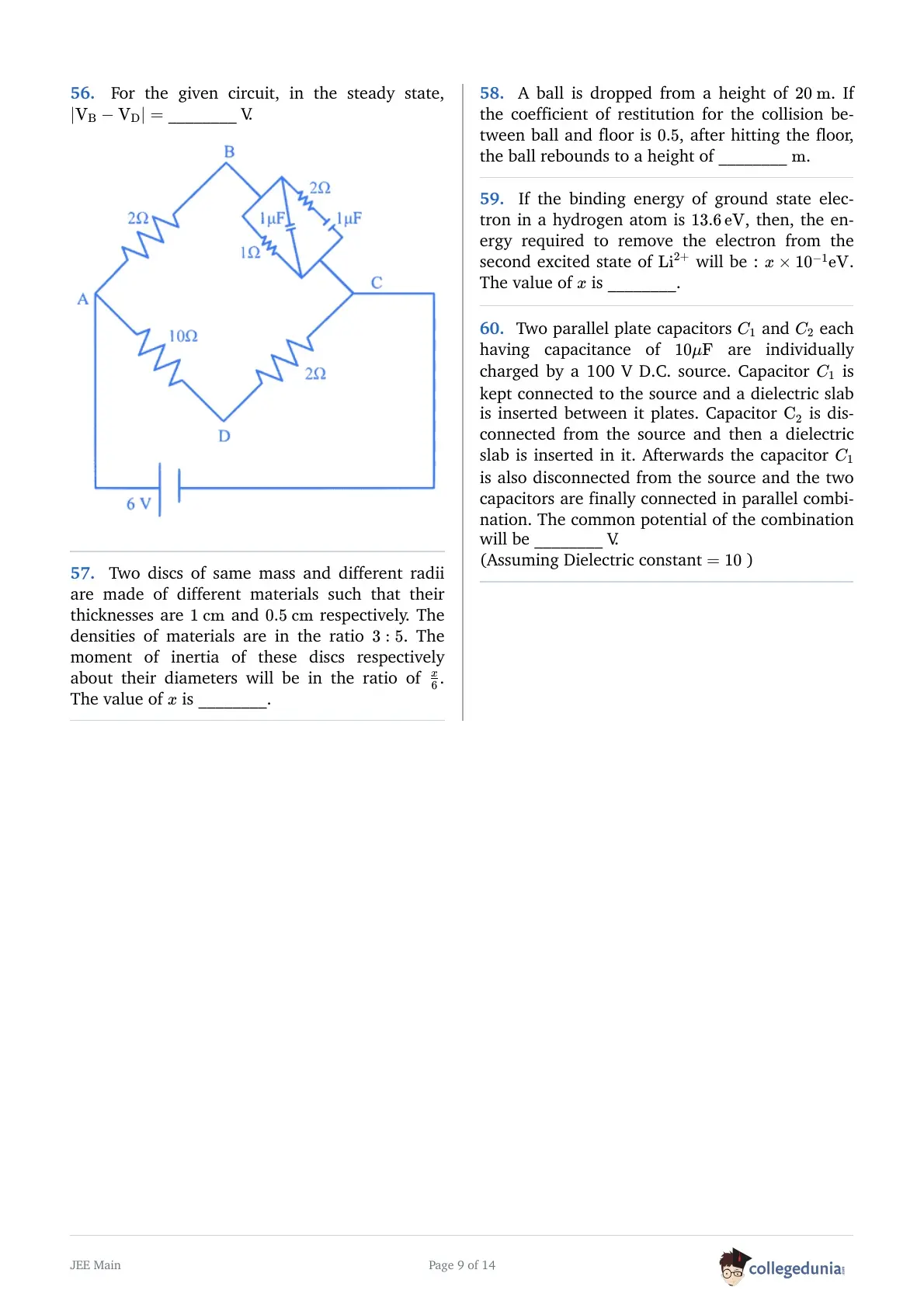
For the given circuit, in the steady state, \(\left| V _{ B ^{-}}- V _{ D }\right|=\)___\(V\)
Two discs of same mass and different radii are made of different materials such that their thicknesses are 1 cm and 0.5 cm respectively. The densities of materials are in the ratio 3:5. The moment of inertia of these discs respectively about their diameters will be in the ratio of \(\frac{x}{6}\). The value of x is ____.
A ball is dropped from a height of \(20 m\) If the coefficient of restitution for the collision between ball and floor is \(0.5\), after hitting the floor, the ball rebounds to a height of ___\(m\)
If the binding energy of ground state electron in a hydrogen atom is \(136 eV\), then, the energy required to remove the electron from the second excited state of \(Li ^{2+}\) will be : \(x \times 10^{-1} eV\). The value of \(x\) is
Two parallel plate capacitors \(C_1\) and \(C_2\) each having capacitance of \(10 \mu F\) are individually charged by a \(100 V D C\) source Capacitor \(C_1\) is kept connected to the source and a dielectric slab is inserted between it plates Capacitor \(C_2\) is disconnected from the source and then a dielectric slab is inserted in it Afterwards the capacitor \(C_1\) is also disconnected from the source and the two capacitors are finally connected in parallel combination The common potential of the combination will be ___\(V\)
(Assuming Dielectric constant \(=10\) )
Chemistry - Section A (Q61 - Q80)
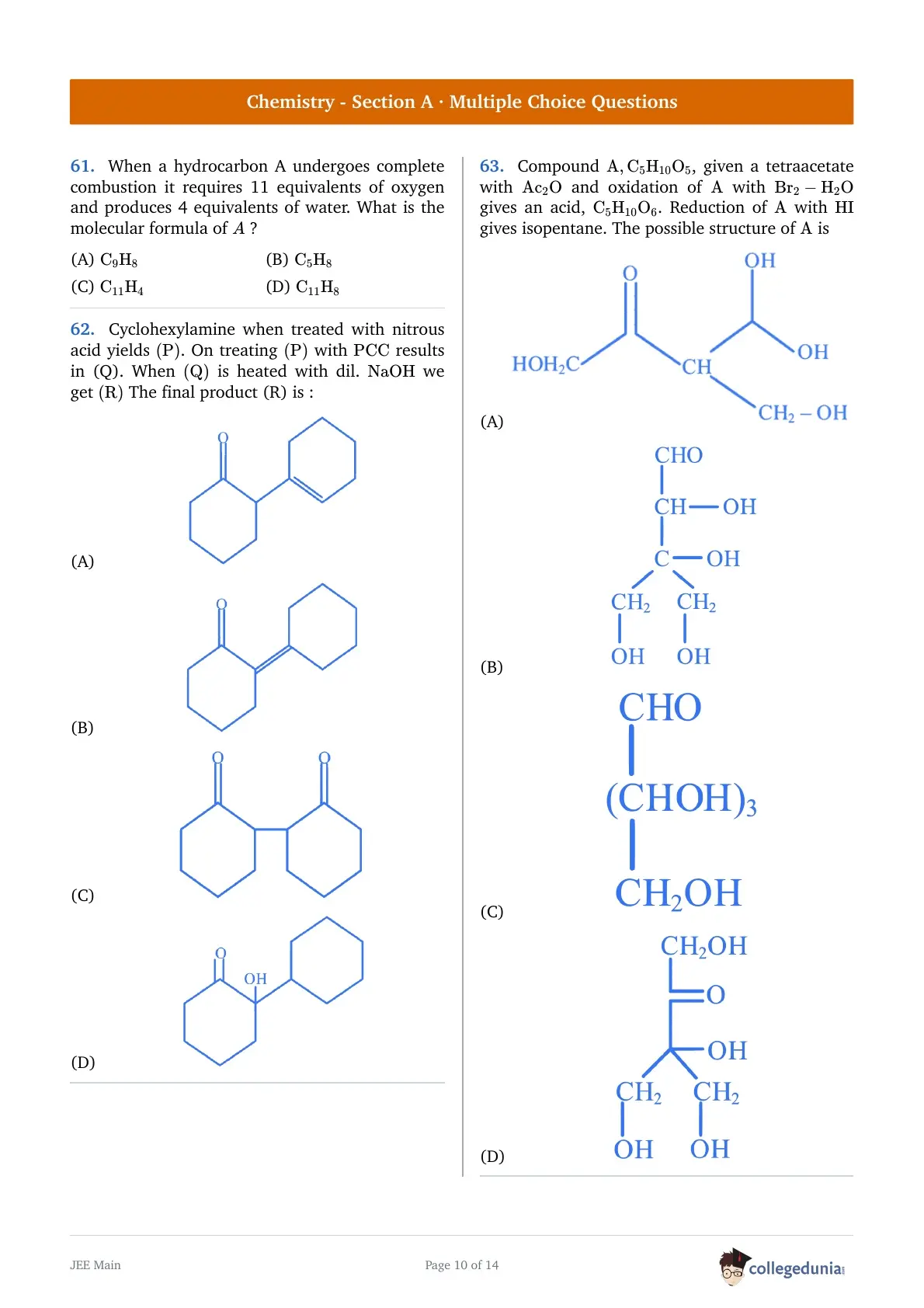
When a hydrocarbon A undergoes complete combustion it requires 11 equivalents of oxygen and produces 4 equivalents of water. What is the molecular formula of \(A\)?
Cyclohexylamine when treated with nitrous acid yields (P) On treating (P) with \(PCC\) results in (Q) When \((Q)\) is heated with dil. \(NaOH\) we get \((R)\) The final product \((R)\) is :
- (1)
![option 1]()
- (2)
![option 2]()
- (3)
![option 3]()
- (4)
![option 4]()


Compound \(A , C _5 H _{10} O _5\), given a tetraacetate with \(AC _2 O\) and oxidation of \(A\) with \(Br _2- H _2 O\) gives an acid, \(C _5 H _{10} O _6\) Reduction of \(A\) with \(HI\) gives isopentane The possible structure of \(A\) is:
- (1)
![opt 1]()
- (2)
![opt 2]()
- (3)
![opt 3]()
- (4)
![opt 4]()


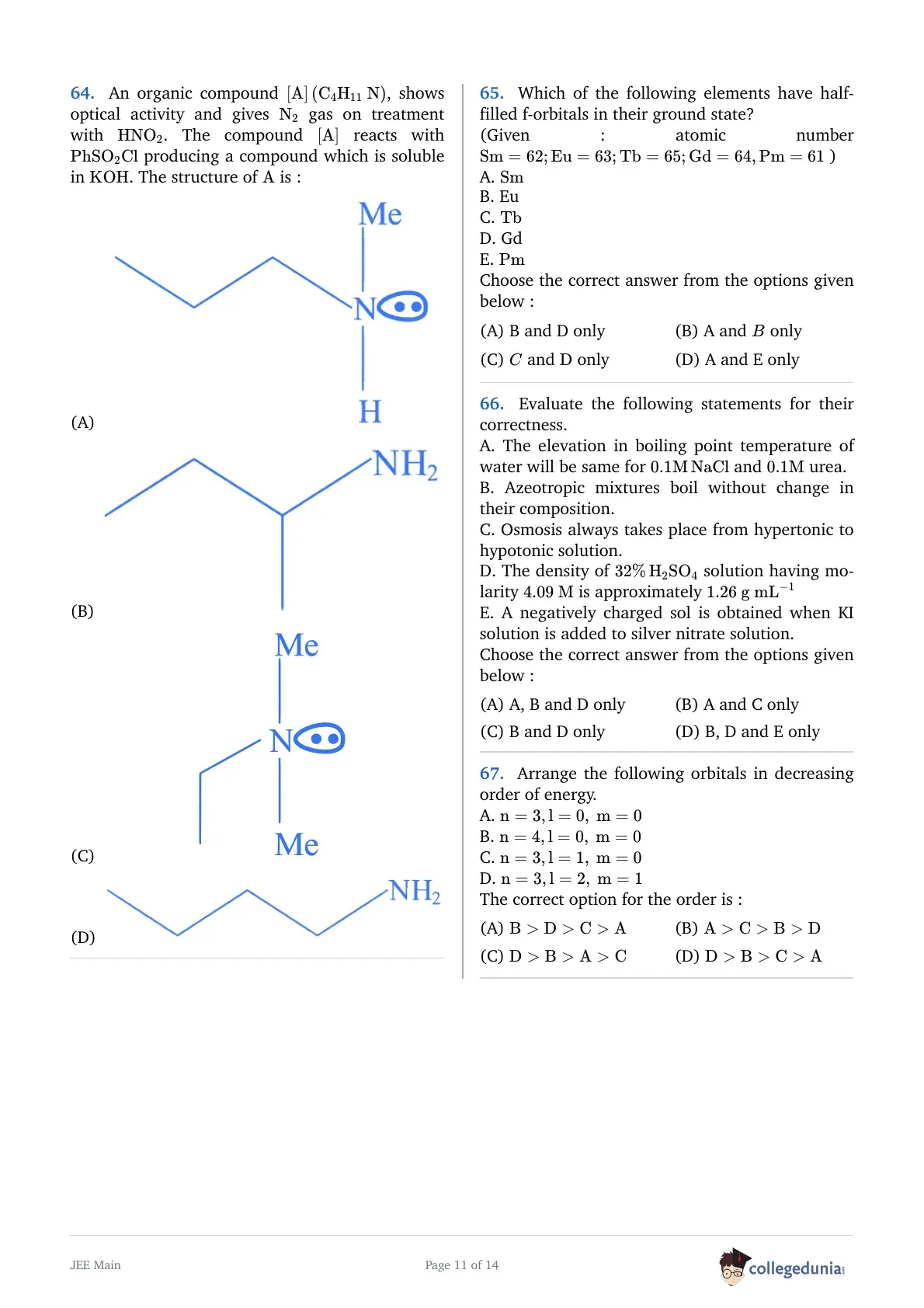
An organic compound \([ A ]\left( C _4 H _{11} N \right)\), shows optical activity and gives \(N _2\) gas on treatment with The structure of \(A\) is :
- (1)
![Option 1]()
- (2)
![Option 2]()
- (3)
![Option 3]()
- (4)
![Option 4]()


Which of the following elements have half-filled f-orbitals in their ground state?
(Given : atomic number \(Sm =62 ; Eu =63 ; Tb =65 ; Gd =64, Pm =61\) )
A. \(Sm\)
B. \(Eu\)
C. \(Tb\)
D. \(Gd\)
E. \(Pm\)
Choose the correct answer from the options given below :
Evaluate the following statements for their correctness
A. The elevation in boiling point temperature of water will be same for \(01 \,M \,NaCl\) and \(01\, M\) urea
B. Azeotropic mixtures boil without change in their composition
C. Osmosis always takes place from hypertonic to hypotonic solution
D. The density of \(32 \% H _2 SO _4\) solution having molarity \(409\, M\) is approximately \(126\, g mL ^{-1}\)
E. A negatively charged sol is obtained when KI solution is added to silver nitrate solution
Choose the correct answer from the options given below :
Arrange the following orbitals in decreasing order of energy
A. \(n=3, l =0, m =0\)
B. \(n =4, l =0, m =0\)
C. \(n =3, l =1, m =0\)
D. \(n =3, l =2, m =1\)
The correct option for the order is :
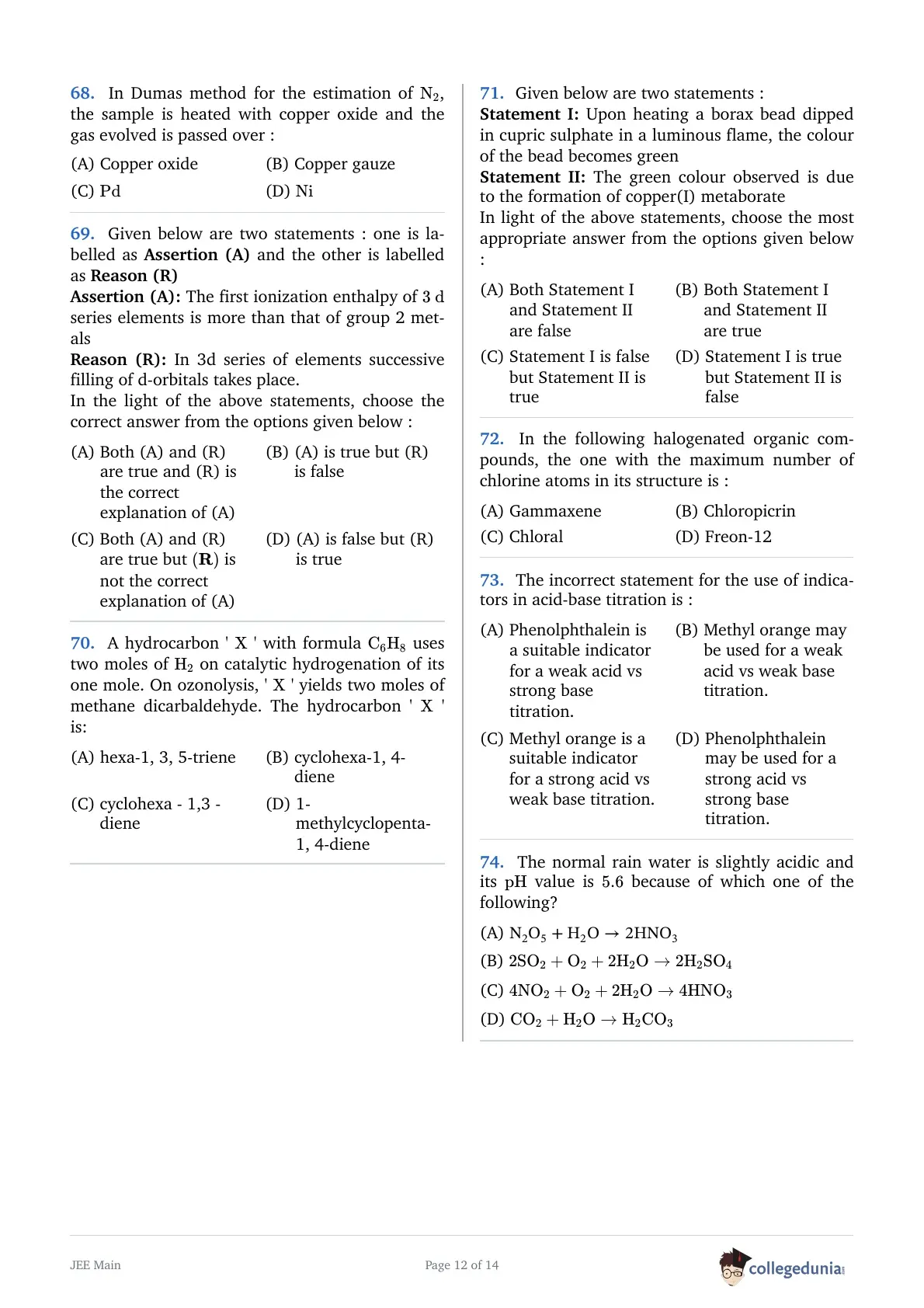
In Dumas method for the estimation of \(N _2\), the sample is heated with copper oxide and the gas evolved is passed over :
Given below are two statements: one is labelled as Assertion (A) and the other is labelled as Reason (R)
Assertion (A): The first ionization enthalpy of \(3d\) series elements is more than that of group 2 metals
Reason (R): In \(3d\) series of elements successive filling of d-orbitals takes place
In the light of the above statements, choose the correct answer from the options given below :
A hydrocarbon ' \(X\) ' with formula \(C _6 H _8\) uses two moles of \(H _2\) on catalytic hydrogenation of its one mole On ozonolysis, ' \(X\) ' yields two moles of methane dicarbaldehyde The hydrocarbon ' \(X\) ' is :
Given below are two statements :
Statement I : Upon heating a borax bead dipped in cupric sulphate in a luminous flame, the colour of the bead becomes green.
Statement II : The green colour observerd is due to the formation of copper(I) metaborate.
In the light of the above statements, choose the most appropriate answer from the options given below :
In the following halogenated organic compounds the one with maximum number of chlorine atoms in its structure is :
Incorrect statement for the use of indicators in acid-base titration is :
The normal rain water is slightly acidic and its \(pH\) value is \(56\) because of which one of the following ?
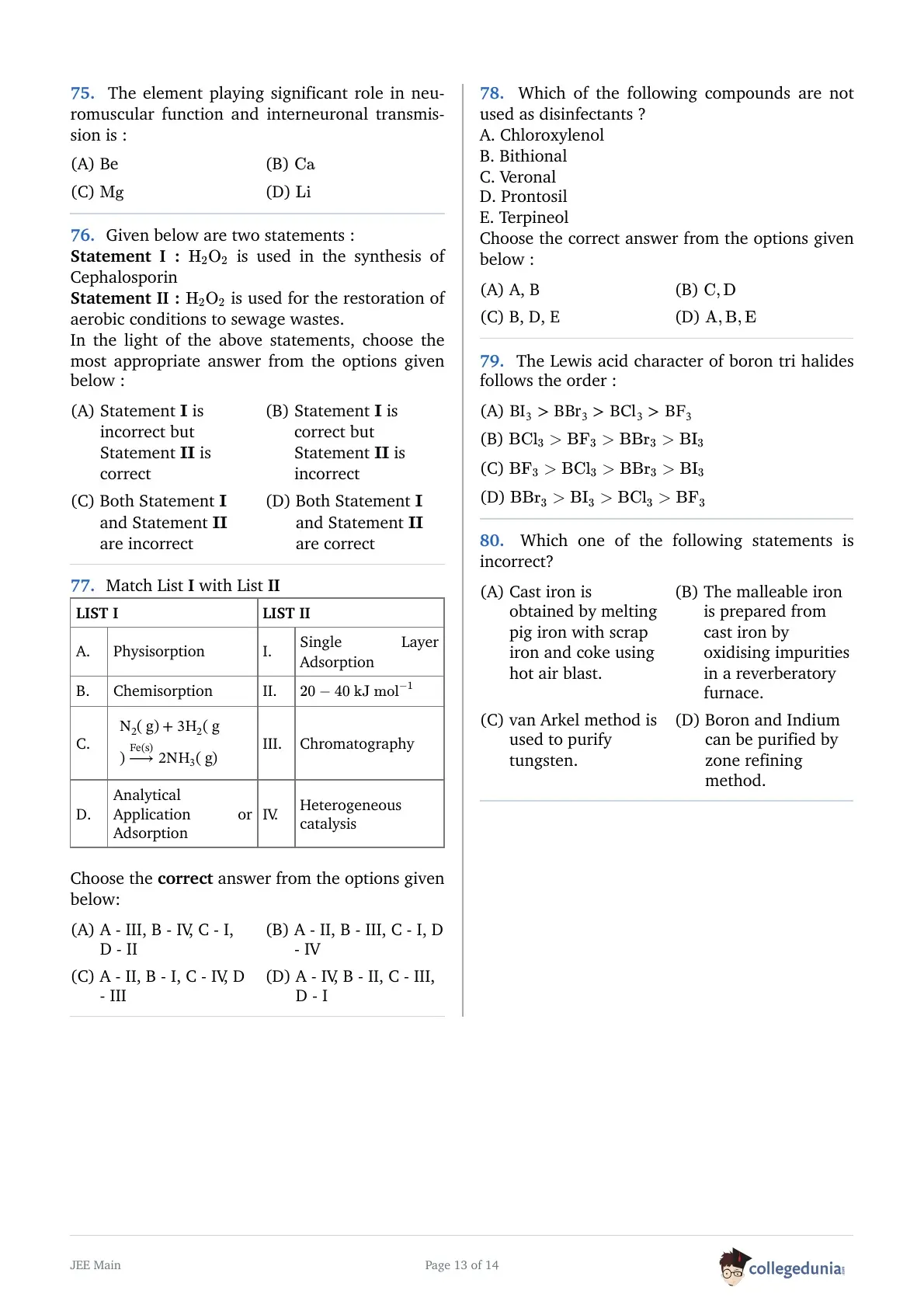
The element playing significant role in neuromuscular function and interneuronal transmission is :
Given below are two statements:
Statement I : H2O2 is used in the synthesis of Cephalosporin
Statement II : H2O2 is used for the restoration of aerobic conditions to sewage wastes.
In the light of the above statements, choose the most appropriate answer from the options given below :
Match List I with List II
| List I | List II | ||
| A | Physisorption | i | Single Layer Adsorption |
| B | Chemisorption | ii | 20−40kJmol−1 |
| C | N2(g)+3H2(g)—⇢Fe(s)—⇢2NH3(g) | iii | Chromatography |
| D | Analytical Application or Adsorption | iv | Heterogeneous catalysis |
Choose the correct answer from the options given below:
Which of the following compounds are not used as disinfectants?
A. Chloroxylenol
B. Bithional
C. Veronal
D. Prontosil
E. Terpineol
Choose the correct answer from the options given below:
The Lewis acid character of boron tri halides follows the order :
Which one of the following statements is incorrect?
Chemistry - Section B (Q81 - Q90)
Assume carbon burns according to following equation :
\(2 C _{( s )}+ O _{2( g )} \rightarrow 2 CO ( g )\)
When \(12 g\) carbon is burnt in \(48 g\) of oxygen, the volume of carbon monoxide produced is___ \(\times 10^{-1} L\) at STP. [nearest integer]
[Given : Assume \(CO\) as ideal gas, Mass of \(C\) is \(12\, g \,mol ^{-1}\), Mass of \(O\) is \(16 \,g \,mol ^{-1}\) and molar volume of an ideal gas at STP is \(22.7\, L\, mol ^{-1}\) ]
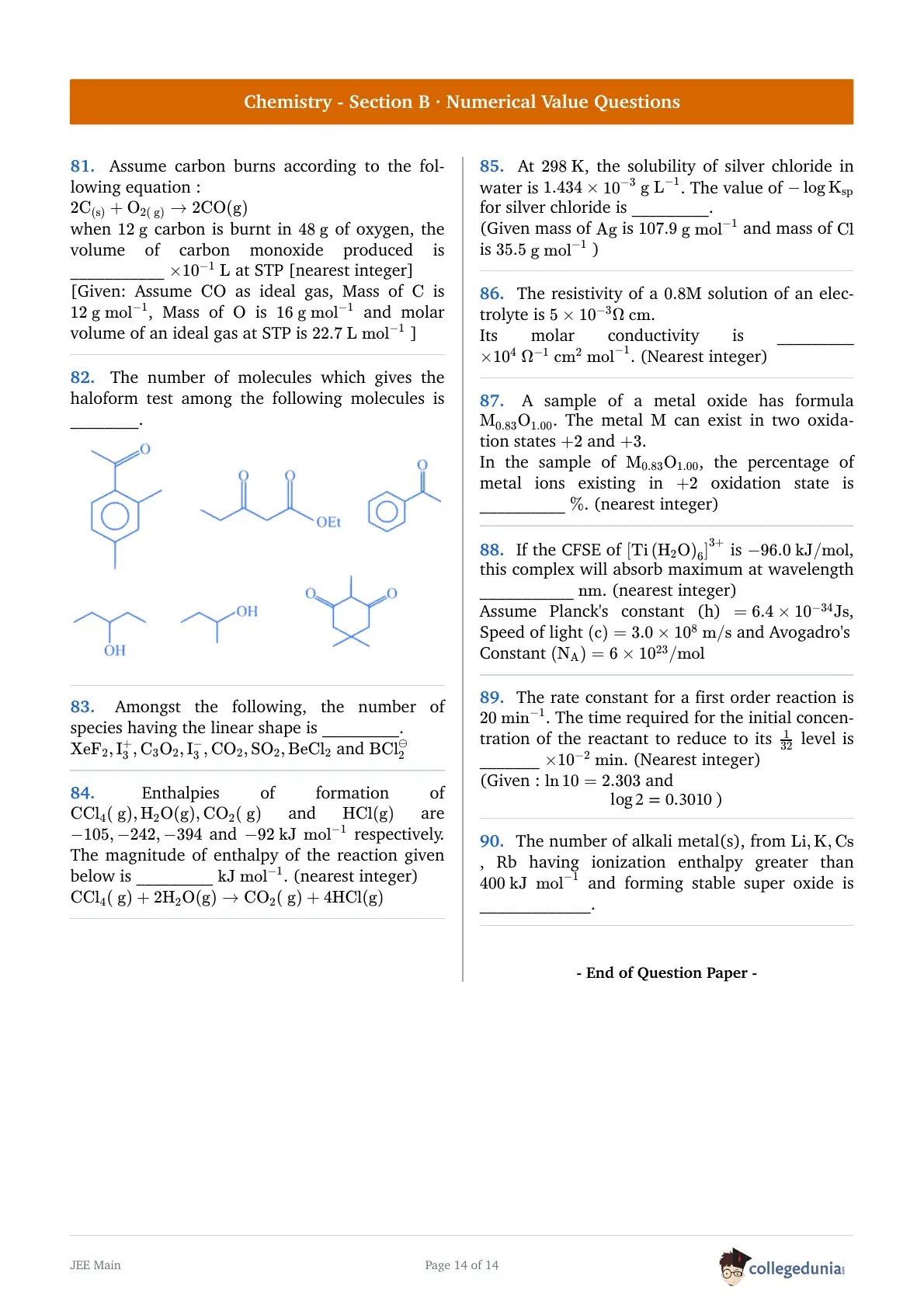
The number of molecules which gives haloform test among the following molecules is
Amongst the following, the number of species having the linear shape is \(XeF _2, I _3^{+}, C _3 O _2, I _3^{-}, CO _2, SO _2, BeCl _2 \text { and } BCl _2^{\ominus}\)
Enthalpies of formation of \(CCl _4( g ), H _2 O ( g ), CO _2( g )\) and \(HCl ( g )\) are \(-105,-242,-394\) and \(-92\, kJ\) mol \(^{-1}\) respectively The magnitude of enthalpy of the reaction given below is ___\(kJ \, mol ^{-1}\) (nearest integer) \(CCl _4( g )+2 H _2 O ( g ) \rightarrow CO _2( g )+4 HCl ( g )\)
At \(298\, K\), the solubility of silver chloride in water is \(1434 \times 10^{-3} \,g\, L ^{-1}\). The value of \(-\log K _{sp}\) for silver chloride is ____.
(Given: Mass of \(Ag\) is \(1079\, g\, mol ^{-1}\)and mass of \(Cl\) is \(355 \,g \,mol ^{-1}\) )
The resistivity of a \(0.8 M\) solution of an electrolyte is \(5 \times 10^{-3} \Omega cm\) Its molar conductivity is ____ \(\times 10^4\, \Omega^{-1}\, cm ^2 \,mol ^{-1}\)
A sample of a metal oxide has formula \(M _{0.83} O _{1.00}\) The metal \(M\) can exist in two oxidation states \(+2\) and \(+3\) In the sample of \(M _{0.83} O _{1.00}\), the percentage of metal ions existing in \(+2\) oxidation state is___\( \%\) (nearest integer)
If the CFSE of \(\left[ Ti \left( H _2 O \right)_6\right]^{3+}\) is \(-960 kJ / mol\), this complex will absorb maximum at wavelength ___\(nm\) (nearest integer) Assume Planck's constant \(( h )=64 \times 10^{-34} Js\), Speed of light \(( c )=30 \times 10^8 m / s\) and Avogadro's Constant \(\left( N _{ A }\right)=6 \times 10^{23} / mol\)
The rate constant for a first order reaction is \(20 \min ^{-1}\) The time required for the initial concentration of the reactant to reduce to its \(\frac{1}{32}\) level is ___\(\times 10^{-2} \min\) (Nearest integer)
(Given: \(\ln 10=2.303\) \(\log 2=0.3010\) )
The number of alkali metal(s), from Li, K, Cs, \(Rb\) having ionization enthalpy greater than \(400\, kJ\) \(mol ^{-1}\) and forming stable super oxide is
JEE Main 2023 Exam Pattern and Marking Scheme
| Particulars | Details |
|---|---|
| Exam Mode | Online (Computer-Based Test) |
| Paper | B.E./B.Tech |
| Medium of Exam | 13 languages: English, Hindi, Gujarati, Bengali, Tamil, Telugu, Kannada, Marathi, Malayalam, Odia, Punjabi, Assamese, Urdu |
| Duration | 3 hours (180 minutes) |
| Type of Questions | Multiple Choice Questions (MCQs) + Numerical Value Questions (attempt any 5 of 10 per subject) |
| Total Marks | 300 marks |
| Subjects | Mathematics, Physics, Chemistry |
| Marking Scheme | +4 for correct answer & -1 for incorrect MCQ and Numerical Value-based Questions |
| Total Questions | 90 Questions (30 per subject), 75 to be attempted |
| Eligibility | Passed or appearing in Class 12 with Physics, Chemistry, and Mathematics |
JEE Main 2023 Jan 31 Shift 2 Question Paper by Coaching Institute
| Coaching Institutes | Question Paper with Answer Key PDF |
|---|---|
| Vedantu | Check Here |
JEE Main 2023 Paper Analysis Jan 31 Shift 2
JEE Main 2023 Paper Analysis for the exam scheduled on January 31 Shift 2 is updated here. Candidates can check subject-wise paper analysis for the exam scheduled on January 31 Shift 2 here along with the topics with the highest weightage.
Also Check:



Comments