




In JEE Mains, the Periodic Table & Representative Elements carry a weightage of about 6-8% of the overall Chemistry exam and 2-3 questions in the exam. It contains concepts like periodic trends (atomic size, ionization energy, electronegativity), element classification, and properties of s-block and p-block elements.
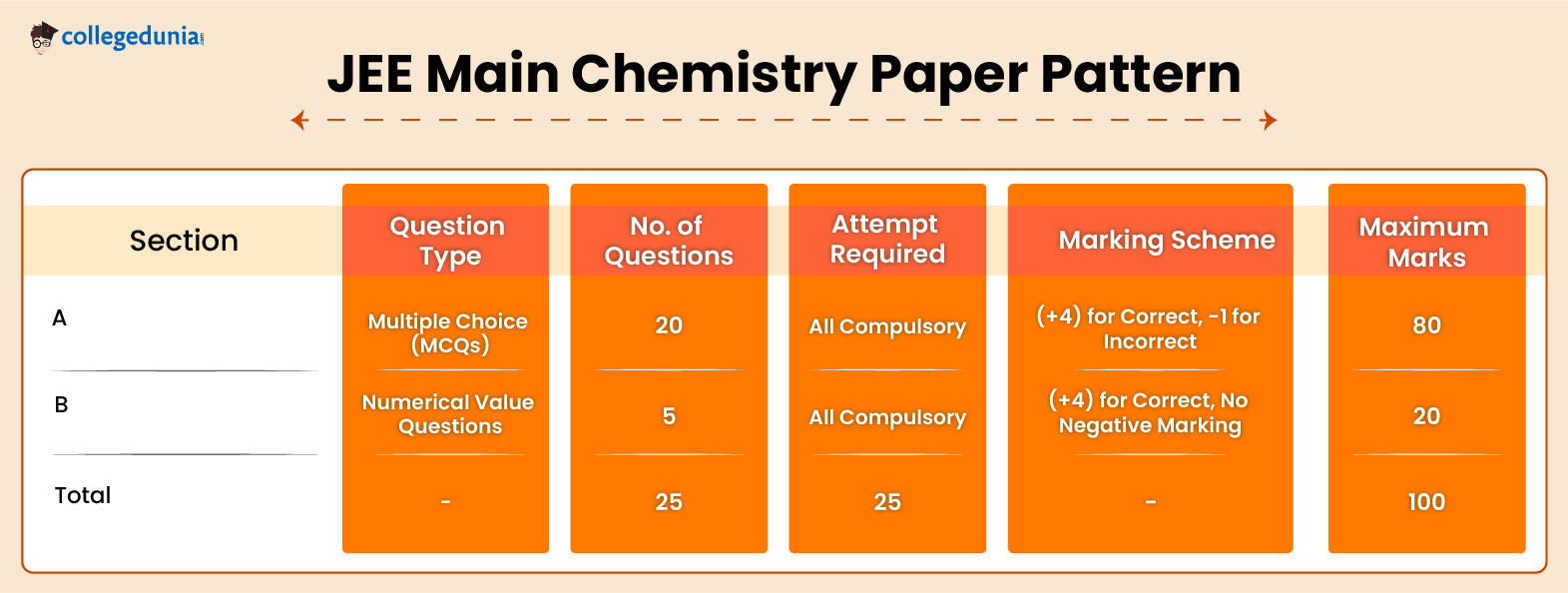
The difficulty level of the Periodic Table & Representative Elements usually ranges from easy to moderate. The most asked topics and questions from Periodic Table & Representative Elements in JEE Main and JEE Advanced are periodic trends, properties of elements, and the classification of elements. JEE Main Chemistry paper consists of 25 questions, 20 MCQ-type questions, and 5 Numerical Value Questions, with a marking scheme of +4 marks for correct answers and -1 mark for incorrect answers.
Must Read Articles
- Download JEE Main Last 10 year PYQ for Free
- Download JEE Main 2025 Shift 1 Question Paper with Detailed Solutions
Listed below is the list of Periodic Table and Representative Elements questions with detailed solutions asked in JEE Main.
Question 1.
The element that does not belong to the same period of the remaining elements (modern periodic table) is: [JEE Main 2025]
A. Palladium
B. Iridium
C. Osmium
D. Platinum
Question 2.

Question 3.

Question 4.
Which of the following Statements are NOT true about the periodic table?
A. The properties of elements are a function of atomic weights.
B. The properties of elements are a function of atomic numbers.
C. Elements having similar outer electronic configuration are arranged in the same period.
D. An element's location reflects the quantum numbers of the last filled orbital.
E. The number of elements in a period is the same as the number of atomic orbitals available in the energy level that is being filled.
[JEE Main 2025]
A. A, C, and E Only
B. D and E Only
C. A and E Only
D. B, C, and E Only
Question 5.
Which of the following electronegativity order is incorrect? [JEE Main 2025]
A. Al < Mg < B < N
B. Al < Si < C < N
C. Mg < Be < B < N
D. S < Cl < O < F
Question 6.
Match List-I with the List-II
| List-I Tetrahedral Complex |
List-II Electronic configuration |
|---|---|
| (A) TiCl4 | (I) e2, t20 |
| (B) [FeO4] 2− | (II) e2, t23 |
| (C) [FeCl4] − | (III) e4, t23 |
| (D) [CoCl4] 2− | (IV) e0, t22 |
Choose the correct answer from the options given below: [JEE Main 2024]
A. (A)-(I), (B)-(III), (C)-(IV), (D)-(II)
B. (A)-(IV), (B)-(III), (C)-(I), (D)-(II)
C. (A)-(III), (B)-(IV), (C)-(II), (D)-(I)
D. (A)-(III), (B)-(I), (C)-(IV), (D)-(II)
Question 7.
The correct statements from the following are:
(A) The decreasing order of atomic radii of group 13 elements is Tl > In > Ga > Al
(B) Down the group 13 electronegativity decreases from top to bottom.
(C) Al dissolves in dil. HCl and liberate H2, but conc. HNO3 renders Al passive by forming a protective oxide layer on the surface.
(D) All elements of group 13 exhibits highly stable +1 oxidation state.
(E) Hybridisation of Al in [Al(H2O)6] 3+ ion is sp3d2.
Choose the correct answer from the options given below: [JEE Main 2024]
A. (C) and (E) only
B. (A), (C) and (E) only
C. (A), (B), (C) and (E) only
D. (A) and (C) only
Question 8.
Given below are two statements:
Statement I: The metallic radius of Na is 1.86 Å and the ionic radius of Na+ is lesser than 1.86 Å.
Statement II: Ions are always smaller in size than the corresponding elements.
In the light of the above statements, choose the correct answer from the options given below: [JEE Main 2024]
A. Statement I is correct but Statement II is false
B. Both Statement I and Statement II are true
C. Both Statement I and Statement II are false
D. Statement I is incorrect but Statement II is true
Question 9.
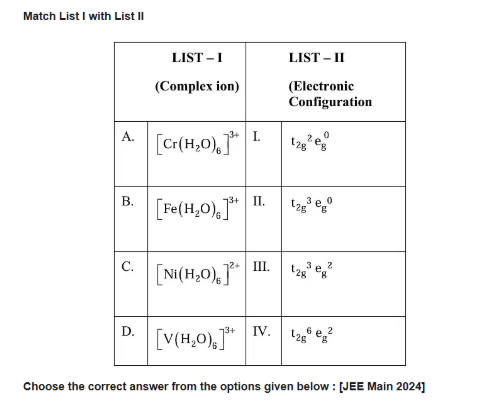
A. A – III, B – II, C – IV, D – I
B. A – IV, B – I, C – II, D – III
C. A – IV, B – III, C – I, D – II
D. A – II, B – III, C – IV, D – I
Question 10.
What is the group number of unununnium? [JEE Main 2024]
A. 11
B. 12
C. 6
D. 14
Question 11.
Color of PbI2
[JEE Main 2024]
Question 12.
Select the option of the correct property Paramagnetic & Diamagnetic
[Ni(CO)4], [Ni(Cl)4]2−
[JEE Main 2024]
Question 13.
Magnetic behavior of Ni2+ with strong ligand [JEE Main 2024]
Question 14.
Match List -I with List-II
| LIST-I (Atomic number) | LIST-II (Block of periodic table) |
|---|---|
| (A) 37 (K) | I. p-block |
| (B) 78 (Pt) | II. d-block |
| (C) 52 (Te) | III. f-block |
| (D) 65 (Tb) | IV. s-block |
Choose the correct answer from the options given below: [JEE Main 2023]
- A. A - IV, B - II, C - I, D - III
- B. A - IV, B - III, C - II, D - I
- C. A - I, B - III, C - IV, D - II
- D. A - II, B - IV, C - I, D - III
Question 15.
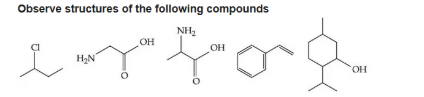
The total number of structures/compounds which possess asymmetric carbon atoms is _____. [JEE Main 2022]
JEE Main Chemistry Paper Pattern
JEE Main Chemistry Chapter - Wise Weightage
The JEE Main 2025 Chemistry Chapter is divided into 3 sections i.e. Inorganic Chemistry, Organic Chemistry, and Physical Chemistry.
The major topics in Inorganic Chemistry are, Transition Elements, Coordination Compounds, and Periodic Table and p-Block Elements account for 9.9% (3-4 questions). Whereas, Atomic Structure, Chemical Bonding, and Environmental Chemistry account for 6.6% each, or about 2 questions.
In Organic Chemistry, the Biomolecules, Carbohydrates, and Carboxylic Acids chapters hold 6.6% weightage each. Aromatic Compounds and Hydrocarbons sections have 3.3%, so organic chemistry is an important subject.
The Physical Chemistry chapters of Chemical Kinetics and Electrochemistry hold 3.3% each or 1 question each. They are compulsory but have less weightage as compared to inorganic and organic chemistry.
JEE Main 2025 Chemistry Chapter-Wise Weightage
| Chapter | Approximate Weightage (%) | Number of Questions |
|---|---|---|
| Transition Elements and Coordination Compounds | 9.9% | 3-4 |
| Periodic Table and p-Block Elements | 9.9% | 3-4 |
| Atomic Structure | 6.6% | 2 |
| Nuclear and Environmental Chemistry | 6.6% | 2 |
| Chemical Bonding and Molecular Structure | 6.6% | 2 |
| Chemical and Ionic Equilibrium | 6.6% | 2 |
| Thermodynamics and the Gaseous State | 6.6% | 2 |
| Biomolecules | 6.6% | 2 |
| Carbohydrates, Amino Acids, and Polymers | 6.6% | 2 |
| Carboxylic Acids and their Derivatives | 6.6% | 2 |
| Aromatic Compounds | 6.6% | 2 |
| General Organic Chemistry | 3.3% | 1 |
| Stereochemistry | 3.3% | 1 |
| Hydrocarbons | 3.3% | 1 |
| Alkyl Halides | 3.3% | 1 |
| Solutions and Colligative Properties | 3.3% | 1 |
| Electrochemistry | 3.3% | 1 |
| Chemical Kinetics | 3.3% | 1 |
| Redox Reactions | 3.3% | 1 |
| Mole Concept | 3.3% | 1 |
| Solid State and Surface Chemistry | 3.3% | 1 |
| Transition Elements | 3.3% | 1 |
| Coordination Compounds | 3.3% | 1 |
| General Principles of Metallurgy | 3.3% | 1 |
- Inorganic Chemistry holds the strong section of 35% of the questions in the JEE Main Chemistry Paper.
- Organic Chemistry holds the approx of 20-25% of the total weightage.
- Physical Chemistry is about 15-20% of the total questions.
JEE Main Last 5 Year Chemistry Papers Pdf
JEE Main 2024 Chemistry Question Paper Session 1
| Exam Date | Question Paper | Solution PDF |
|---|---|---|
| JEE Main 2024 Feb 1 Shift 2 Chemistry Question Paper | Download | Check Solution |
| JEE Main 2024 Feb 1 Shift 1 Chemistry Question Paper | Download | Check Solution |
| JEE Main 2024 Jan 31 Shift 2 Chemistry Question Paper | Download | Check Solution |
| JEE Main 2024 Jan 31 Shift 1 Chemistry Question Paper | Download | Check Solution |
| JEE Main 2024 Jan 30 Shift 2 Chemistry Question Paper | Download | Check Solution |
| JEE Main 2024 Jan 30 Shift 1 Chemistry Question Paper | Download | Check Solution |
| JEE Main 2024 Jan 29 Shift 2 Chemistry Question Paper | Download | Check Solution |
| JEE Main 2024 Jan 29 Shift 1 Chemistry Question Paper | Download | Check Solution |
| JEE Main 2024 Jan 27 Shift 2 Chemistry Question Paper | Download | Check Solution |
| JEE Main 2024 Jan 27 Shift 1 Chemistry Question Paper | Download | Check Solution |
JEE Main 2024 Chemistry Question Paper Session 2
| Exam Date and Shift | Question Paper | Solution PDF |
|---|---|---|
| JEE Main 2024 April 4 Shift 1 Chemistry Question Paper | Download | Check Solution |
| JEE Main 2024 April 4 Shift 2 Chemistry Question Paper | Download | Check Solution |
| JEE Main 2024 April 5 Shift 1 Chemistry Question Paper | Download | Check Solution |
| JEE Main 2024 April 5 Shift 2 Chemistry Question Paper | Download | Check Solution |
| JEE Main 2024 April 6 Shift 1 Chemistry Question Paper | Download | Check Solution |
| JEE Main 2024 April 6 Shift 2 Chemistry Question Paper | Download | Check Solution |
| JEE Main 2024 April 8 Shift 1 Chemistry Question Paper | Download | Check Solution |
| JEE Main 2024 April 8 Shift 2 Chemistry Question Paper | Download | Check Solution |
| JEE Main 2024 April 9 Shift 1 Chemistry Question Paper | Download | Check Solution |
| JEE Main 2024 April 9 Shift 2 Chemistry Question Paper | Download | Check Solution |
JEE Main 2023 Chemistry Question Paper Session 2
| Exam Date | Chemistry Question Paper 2023 |
|---|---|
| Chemistry 6 April Shift 1 Question Paper | Check Here |
| Chemistry 6 April Shift 2 Question Paper | Check Here |
| Chemistry 8 April Shift 1 Question Paper | Check Here |
| Chemistry 8 April Shift 2 Question Paper | Check Here |
| Chemistry 10 April Shift 1 Question Paper | Check Here |
| Chemistry 10 April Shift 2 Question Paper | Check Here |
| Chemistry 11 April Shift 1 Question Paper | Check Here |
| Chemistry 11 April Shift 2 Question Paper | Check Here |
| Chemistry 12 April Shift 1 Question Paper | Check Here |
| Chemistry 13 April Shift 1 Question Paper | Check Here |
| Chemistry 13 April Shift 2 Question Paper | Check Here |
| Chemistry 15 April Shift 1 Question Paper | Check Here |
JEE Main 2023 Chemistry Question Paper Session 1
| Exam Date and Shift | Chemistry Question Paper 2023 |
|---|---|
| Chemistry 24 January Shift 1 Question Paper | Check Here |
| 2023 Chemistry 24 January Shift 2 Question Paper | Check Here |
| Chemistry 25 January Shift 1 Question Paper | Check Here |
| Chemistry 25 January Shift 2 Question Paper | Check Here |
| Chemistry 29 January Shift 1 Question Paper | Check Here |
| Chemistry 29 January Shift 2 Question Paper | Check Here |
| Chemistry 30 January Shift 1 Question Paper | Check Here |
| Chemistry 30 January Shift 2 Question Paper | Check Here |
| Chemistry 31 January Shift 1 Question Paper | Check Here |
| Chemistry 31 January Shift 2 Question Paper | Check Here |
| Chemistry 1 February Shift 1 Question Paper | Check Here |
| Chemistry 1 February Shift 2 Question Paper | Check Here |
JEE Main 2022 Chemistry Question Paper with Solution PDF- Phase 2
| Exam Date | Shift/ Slot | Question Paper PDF |
|---|---|---|
| July 25 | Shift 1 | Check Here |
| July 25 | Shift 2 | Check Here |
| July 26 | Shift 1 | Check Here |
| July 26 | Shift 2 | Check Here |
| July 27 | Shift 1 | Check Here |
| July 27 | Shift 2 | Check Here |
| July 28 | Shift 1 | Check Here |
| July 28 | Shift 2 | Check Here |
| July 29 | Shift 1 | Check Here |
| July 29 | Shift 2 | Check Here |
JEE Main 2022 Chemistry Question Paper with Solution PDF- Phase 1
| Exam Date | Shift/ Slot | Question Paper PDF |
|---|---|---|
| June 29 | Shift 1 | Check Here |
| June 29 | Shift 2 | Check Here |
| June 28 | Shift 1 | Check Here |
| June 28 | Shift 2 | Check Here |
| June 27 | Shift 1 | Check Here |
| June 27 | Shift 2 | Check Here |
| June 26 | Shift 1 | Check Here |
| June 26 | Shift 2 | Check Here |
| June 25 | Shift 1 | Check Here |
| June 25 | Shift 2 | Check Here |
| June 24 | Shift 1 | Check Here |
| June 24 | Shift 2 | Check Here |
JEE Main 2021 Chemistry Question Paper with Solution (Session 4- August)- Download PDF
| Exam Date | Shift/ Slot | Question Paper PDF |
|---|---|---|
| August 26 | Shift 1 | Check Here |
| August 26 | Shift 2 | Check Here |
| August 27 | Shift 1 | Check Here |
| August 27 | Shift 2 | Check Here |
| August 31 | Shift 1 | Check Here |
| August 31 | Shift 2 | Check Here |
| September 1 | Shift 2 | Check Here |
JEE Main 2021 Chemistry Question Paper with Solution (Session 3- July)- Download PDF
| Exam Date | Shift/ Slot | Question Paper PDF |
|---|---|---|
| July 22 | Shift 2 | Check Here |
| July 25 | Shift 1 | Check Here |
| July 25 | Shift 2 | Check Here |
| July 27 | Shift 1 | Check Here |
| August 3 | Shift 1 | Check Here |
| August 3 | Shift 2 | Check Here |
| August 4 | Shift 1 | Check Here |
| August 4 | Shift 2 | Check Here |
JEE Main 2021 Chemistry Question Paper with Solution (Session 2- March)- Download PDF
| Exam Date | Shift/ Slot | Question Paper PDF |
|---|---|---|
| March 16 | Shift 1 | Check Here |
| March 16 | Shift 2 | Check Here |
| March 17 | Shift 1 | Check Here |
| March 17 | Shift 2 | Check Here |
| March 18 | Shift 1 | Check Here |
| March 18 | Shift 2 | Check Here |
JEE Main 2021 Chemistry Question Paper with Solution (Session 1- February)- Download PDF
| Exam Date | Shift/ Slot | Question Paper PDF |
|---|---|---|
| February 24 | Shift 1 | Check Here |
| February 24 | Shift 2 | Check Here |
| February 25 | Shift 1 | Check Here |
| February 25 | Shift 2 | Check Here |
| February 26 | Shift 1 | Check Here |
| February 26 | Shift 2 | Check Here |
JEE Main 2020 Chemistry Question Paper with Solutions (Session 2- September)- Download PDF
| Exam Date | Shift/ Slot | JEE Main Question Paper PDF |
|---|---|---|
| September 2 | Shift 1 | Check Here |
| September 2 | Shift 2 | Check Here |
| September 3 | Shift 1 | Check Here |
| September 3 | Shift 2 | Check Here |
| September 4 | Shift 1 | Check Here |
| September 4 | Shift 2 | Check Here |
| September 5 | Shift 1 | Check Here |
| September 5 | Shift 2 | Check Here |
| September 6 | Shift 1 | Check Here |
| September 6 | Shift 2 | Check Here |
JEE Main 2020 Chemistry Question Paper with Solutions (Session 1- January)- Download PDF
| Exam Date | Shift/ Slot | JEE Main Question Paper PDF |
|---|---|---|
| January 8 | Shift 1 | Check Here |
| January 8 | Shift 2 | Check Here |
| January 9 | Shift 1 | Check Here |
| January 9 | Shift 2 | Check Here |
Important Topics Related to Transition Elements and Coordinate Chemistry
- Relation Between Molarity and Molality: Definition & Formula
- NCERT Class 12 Chemistry Book PDF
- Structure of Atom Class 11 MCQ
Frequently Asked Questions
Q1. Is periodic table important for JEE Mains?
Answer: Yes, the Periodic Table is important for JEE Mains, as it contributes about 6-10% of the overall Inorganic Chemistry weightage in JEE Mains, which is about 2-3 questions in the exam.
Topics like atomic structure, ionization energy, and reactivity trends are commonly tested, particularly in the context of periodic trends and element properties.
Q2. Which is the hardest topic in JEE Mains?
Answer: The hardest topics in JEE Mains include:
Coordination Compounds (Inorganic Chemistry)
- Weightage: 9.9% (3-4 questions)
- Complex concepts like crystal field theory and isomerism make this topic challenging.
Chemical Kinetics (Physical Chemistry)
- Weightage: 3.3% (1 question)
- Requires understanding of reaction rates and order, with difficult mathematical applications.
Thermodynamics (Physical Chemistry)
- Weightage: 6.6% (2 questions)
- Concepts like entropy and Gibbs free energy are tough to apply in problems.
Organic Chemistry (Mechanisms and Synthesis)
- Weightage: 6.6% (2 questions)
- Understanding reaction mechanisms can be complex and requires extensive practice.
Transition Elements (Inorganic Chemistry)
- Weightage: 9.9% (3-4 questions)
- The varied oxidation states and properties of transition metals are challenging to master.
Q3. Classification of Elements and Periodicity in Properties JEE
Answer: The “Classification of Elements and Periodicity in Properties” is a basic chapter in the Inorganic Chemistry of JEE Main, which contributes 6-8% of total Chemistry Weightage, this is usually around 3-4 questions in the exams, often testing concepts like periodic trends, atomic and ionic radii, ionization energy, and electron affinity.
Periodic Table: The periodic table categorizes elements into groups and periods according to their atomic number and electronic configuration. Elements are grouped into s-block, p-block, d-block, and f-block according to their electron configuration, each having different properties.
Periodic Trends:
- Atomic Radius: Reduces along a period and increases along a group.
- Ionization Energy: Increases along a period and reduces along a group.
- Electron Affinity: Becomes more negative within a period and less negative along a group.
- Electronegativity: Rises within a period and falls along a group.
Classification of Elements:
- Metals, Non-metals, and Metalloids are grouped according to their location in the periodic table.
- Representative Elements (s- and p-block elements) and Transition Elements (d-block elements) are separated according to their characteristics, for instance, reactivity and oxidation numbers.
Effective Nuclear Charge (Z_eff): Effective nuclear charge affects such trends as the size of the atoms and ionization energy and helps to account for why some trends are seen between periods.
Groups and Periods:
- Elements with the same group have similar properties due to an equal number of valence electrons.
- Elements having the same period have a similar trend in variations in properties resulting from the augmented nuclear charge.
Q4. Is it necessary to attempt 75 questions in JEE Mains?
Answer: No, It is not compulsory to attempt 75 questions in JEE Mains. But to score maximum score the student needs to attempt at least 70-75 questions.
The accuracy of your tries is more valuable than the number. Precision is necessary since trying too many questions with poor precision may result in negative markings, which might negatively impact your score.



Comments