




JEE Main 2023 Mathematics April 12 Shift 1 Question Paper is available here for download. Candidates can download official JEE Main 2023 Mathematics Question Paper PDF with Solution and Answer Key for April 12 Shift 1 using the link below. JEE Main Mathematics Question Paper is divided into two sections, Section A with 20 MCQs and Section B with 10 numerical type questions. Candidates are required to answer all questions from Section A and any 5 questions from section B.
JEE Main 2023 Mathematics Question Paper April 12 Shift 1 PDF
| JEE Main 2023 12th April Shift 1 Mathematics Question Paper with Solution PDF |  Download Download |
Check Solution |

Question 1:
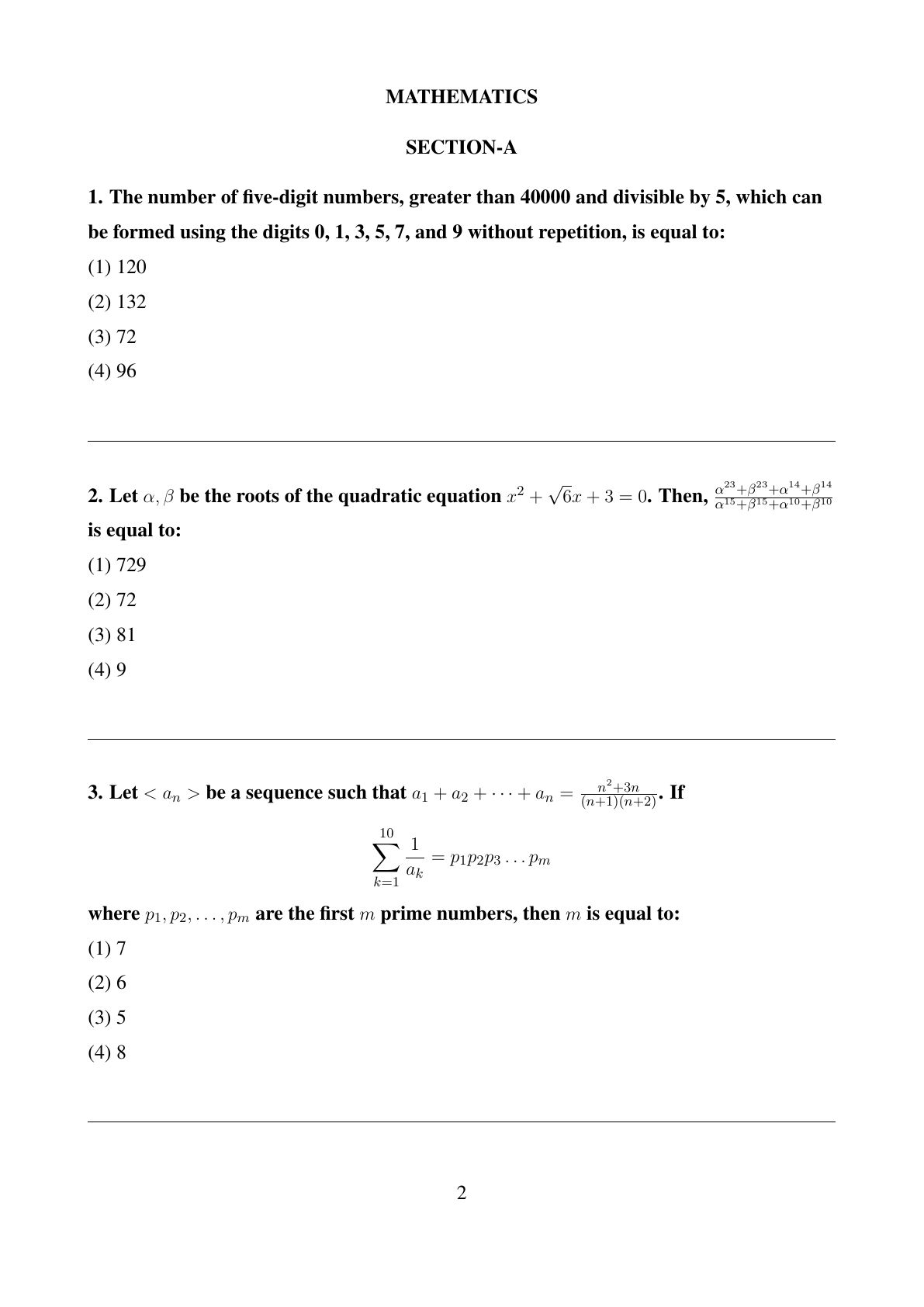
The number of five-digit numbers, greater than 40000 and divisible by 5, which can be formed using the digits 0, 1, 3, 5, 7, and 9 without repetition, is equal to:
View Solution
Let \( \alpha, \beta \) be the roots of the quadratic equation \( x^2 + \sqrt{6}x + 3 = 0 \). Then, \( \frac{\alpha^{23} + \beta^{23} + \alpha^{14} + \beta^{14}}{\alpha^{15} + \beta^{15} + \alpha^{10} + \beta^{10}} \) is equal to:
View Solution
Let < an >
where \( p_1, p_2, \dots, p_m \) are the first \( m \) prime numbers, then \( m \) is equal to:
View Solution
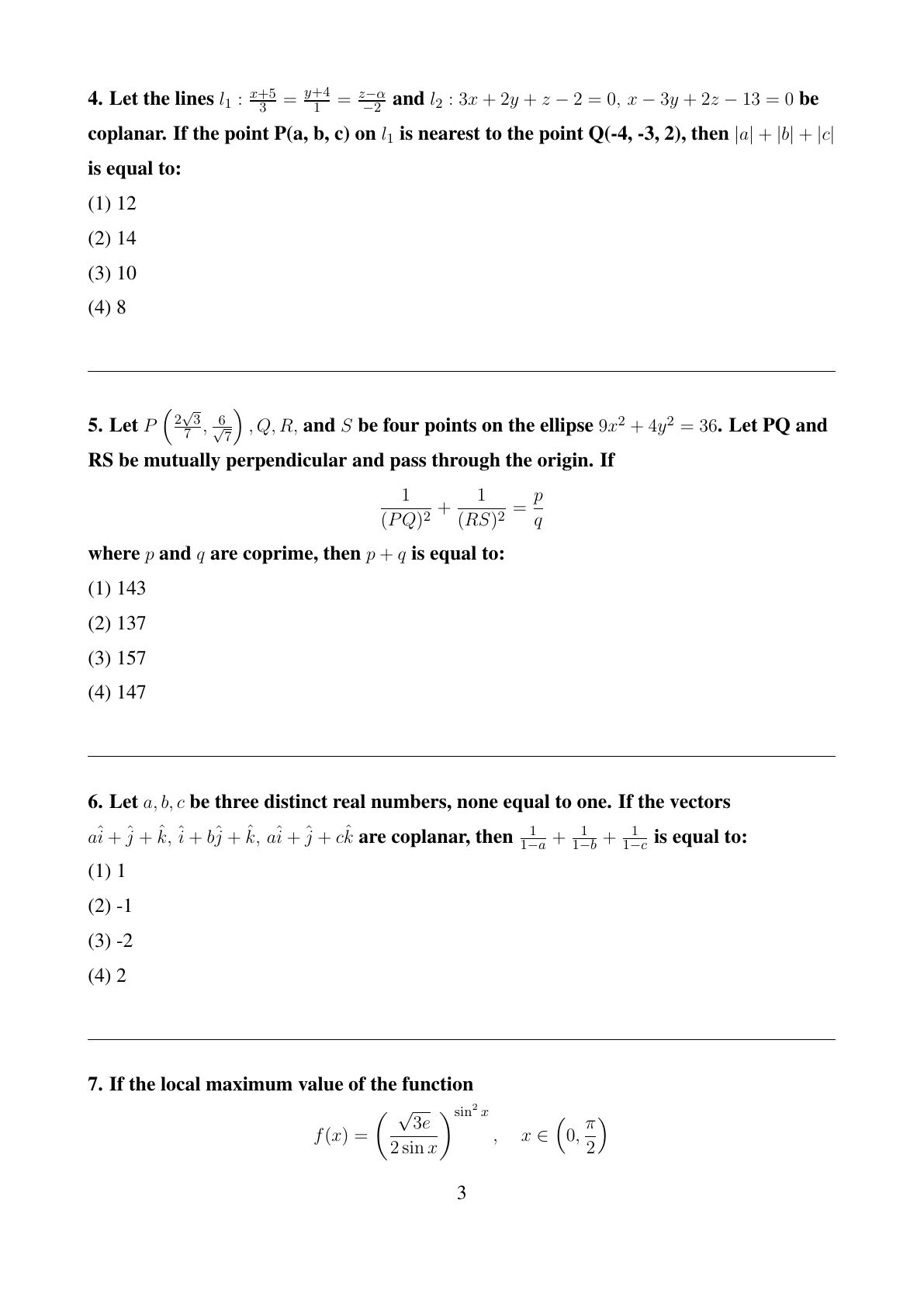
Let the lines \( l_1 : \frac{x + 5}{3} = \frac{y + 4}{1} = \frac{z - \alpha}{-2} \) and \( l_2 : 3x + 2y + z - 2 = 0, \, x - 3y + 2z - 13 = 0 \) be coplanar. If the point P(a, b, c) on \( l_1 \) is nearest to the point Q(-4, -3, 2), then \( |a| + |b| + |c| \) is equal to:
View Solution
Let \( P \left( \frac{2\sqrt{3}}{7}, \frac{6}{\sqrt{7}} \right), Q, R, \) and \( S \) be four points on the ellipse \( 9x^2 + 4y^2 = 36 \). Let PQ and RS be mutually perpendicular and pass through the origin. If \[ \frac{1}{(PQ)^2} + \frac{1}{(RS)^2} = \frac{p}{q} \]
where \( p \) and \( q \) are coprime, then \( p + q \) is equal to:
View Solution
Let \(a, b, c\) be three distinct real numbers, none equal to one. If the vectors \( a \hat{i} + \hat{j} + \hat{k}, \, \hat{i} + b\hat{j} + \hat{k}, \, a \hat{i} + \hat{j} + c \hat{k} \) are coplanar, then \( \frac{1}{1 - a} + \frac{1}{1 - b} + \frac{1}{1 - c} \) is equal to:
View Solution
If the local maximum value of the function \[ f(x) = \left( \frac{\sqrt{3e}}{2 \sin x} \right)^{\sin^2 x}, \quad x \in \left( 0, \frac{\pi}{2} \right) \]
is \( \frac{k}{e} \), then \[ \left( \frac{k}{e} \right)^8 + \frac{k^8}{e^5} + k^8 \]
is equal to:
View Solution
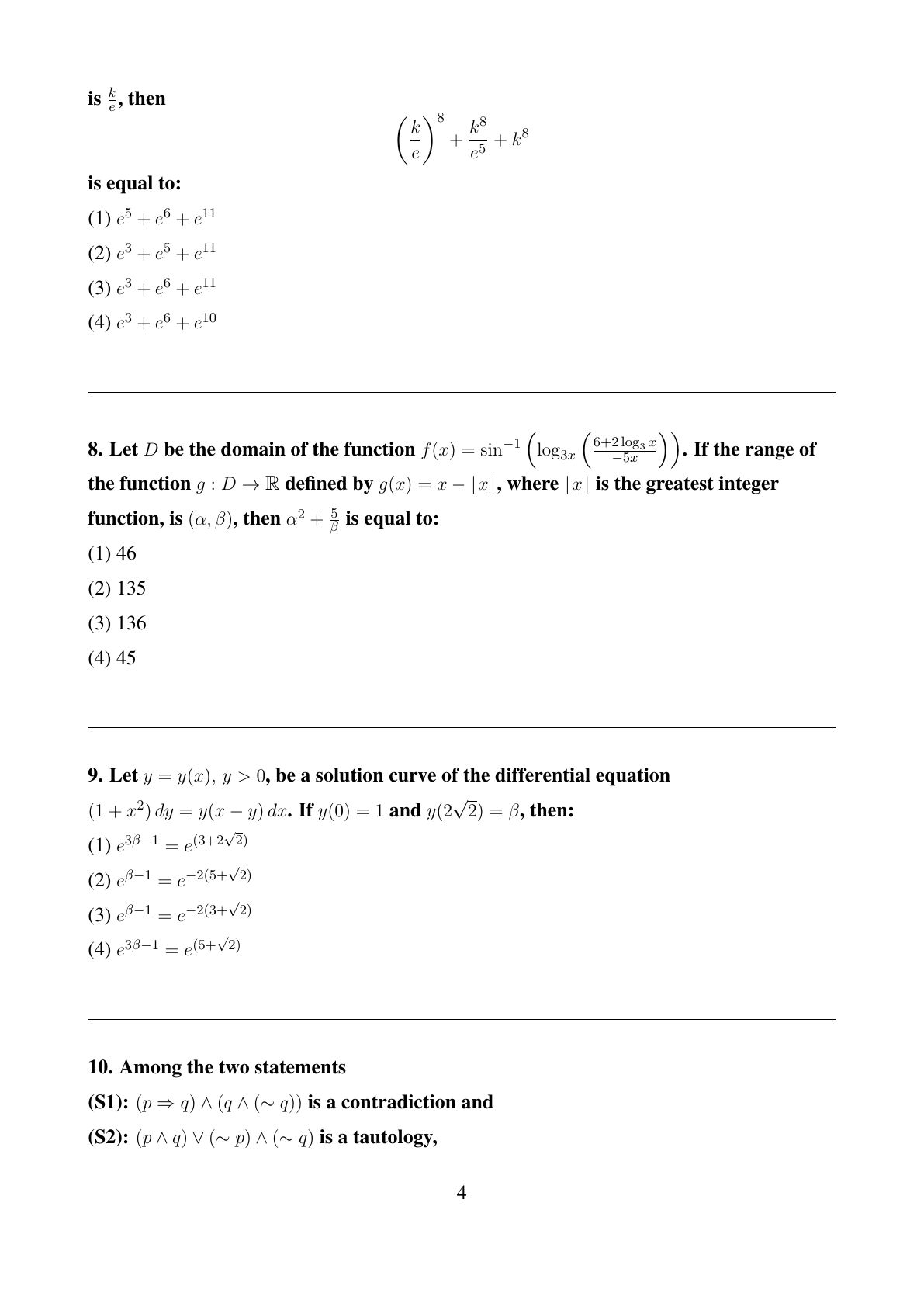
Let \( D \) be the domain of the function \( f(x) = \sin^{-1} \left( \log_{3x} \left( \frac{6 + 2 \log_3 x}{-5x} \right) \right) \). If the range of the function \( g: D \to \mathbb{R} \) defined by \( g(x) = x - \lfloor x \rfloor \), where \( \lfloor x \rfloor \) is the greatest integer function, is \( (\alpha, \beta) \), then \( \alpha^2 + \frac{5}{\beta} \) is equal to:
View Solution
Let \( y = y(x), \, y > 0 \), be a solution curve of the differential equation \( (1 + x^2) \, dy = y(x - y) \, dx \). If \( y(0) = 1 \) and \( y(2\sqrt{2}) = \beta \), then:
View Solution
Step 1: Rearrange the given differential equation.
The given equation is: \[ (1 + x^2) \, \frac{dy}{dx} = y(x - y) \]
We can express it as: \[ \frac{dy}{dx} = \frac{y(x - y)}{1 + x^2} \]
Step 2: Transform into a solvable form.
Rewrite the equation as: \[ \frac{dy}{dx} + y \left( \frac{-x}{1 + x^2} \right) = \left( \frac{-1}{1 + x^2} \right) y^2 \]
Multiply through by \( \frac{1}{y} \): \[ \frac{1}{y} \frac{dy}{dx} + \frac{-x}{(1 + x^2)y} = \frac{-1}{(1 + x^2)} \]
Step 3: Simplify the integrals.
Let \( \frac{1}{y} = t \), then we have the differential equation: \[ \frac{-1}{y^2} \frac{dy}{dx} = \frac{dt}{dx} \]
Integrating both sides: \[ \int \frac{1}{1 + x^2} \, dx = \int \frac{1}{y} \, dt \]
Thus, we obtain the general solution: \[ \sqrt{1 + x^2} = y \ln(e(x + \sqrt{1 + x^2})) \]
Step 4: Apply the boundary conditions.
We know that \( y(0) = 1 \), so we can use this to find the value of the constant.
Substitute \( x = 0 \) and \( y = 1 \) into the equation: \[ 1 = \sqrt{1 + 0^2} \ln(e(0 + \sqrt{1 + 0^2})) \]
This simplifies to \( 1 = \ln(e(1)) = 1 \), confirming the constant is correct.
Step 5: Find the value of \( \beta \).
Now, for \( y(2\sqrt{2}) = \beta \), we substitute \( x = 2\sqrt{2} \) into the solution to find \( \beta \): \[ \beta = \frac{3}{\ln(e(3 + 2\sqrt{2}))} \]
Thus, we obtain \( 3 = \ln(e(3 + 2\sqrt{2})) \), which leads to: \[ e^{3\beta - 1} = e^{(3 + 2\sqrt{2})} \] Quick Tip: When solving first-order differential equations, use the method of integrating factors. This helps in simplifying the equation to an easily solvable form.
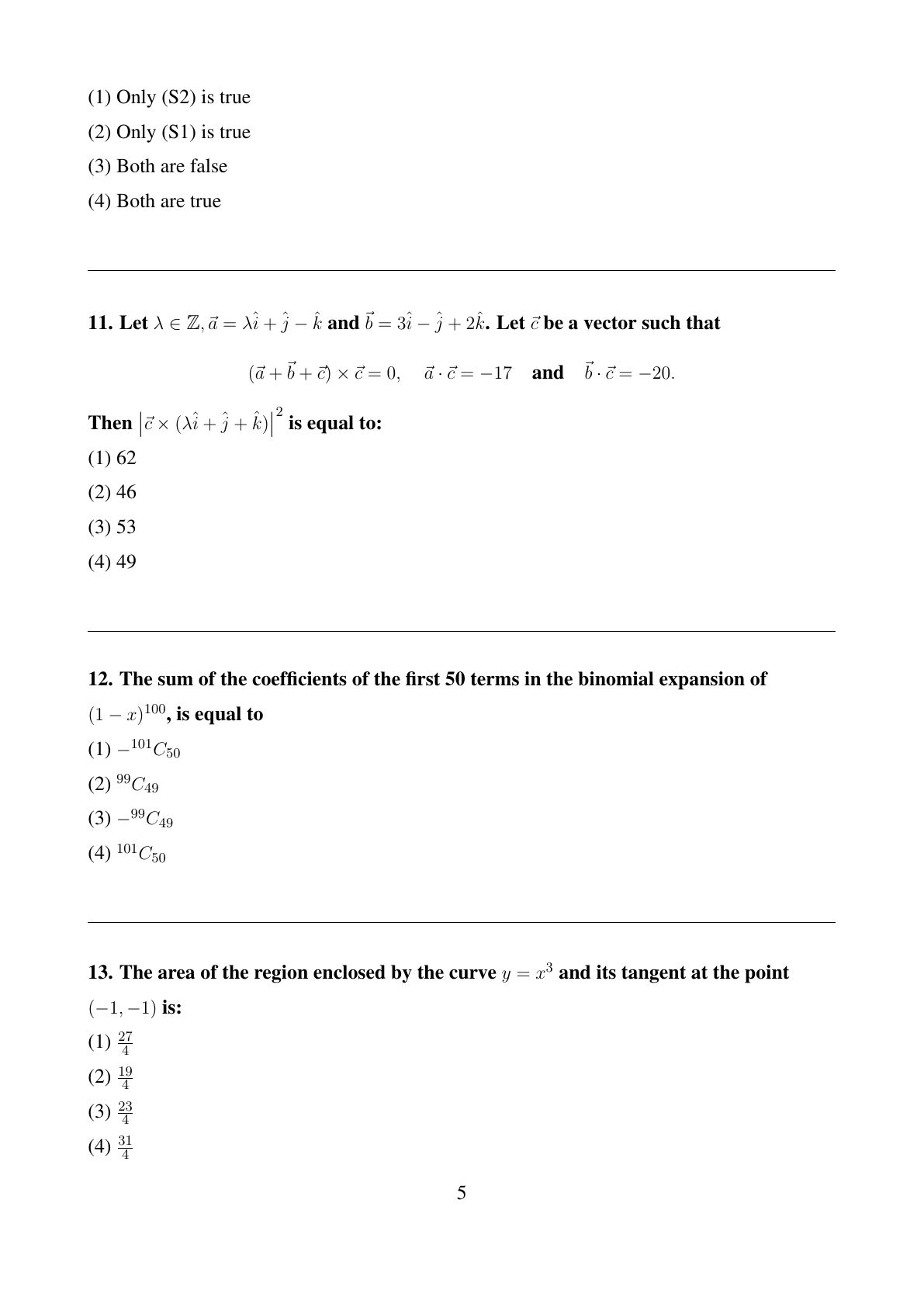
Among the two statements
(S1): \( (p \Rightarrow q) \land (q \land (\sim q)) \) is a contradiction and
(S2): \( (p \land q) \lor (\sim p) \land (\sim q) \) is a tautology,
View Solution
Let \( \lambda \in \mathbb{Z}, \vec{a} = \lambda \hat{i} + \hat{j} - \hat{k} \) and \( \vec{b} = 3\hat{i} - \hat{j} + 2\hat{k} \). Let \( \vec{c} \) be a vector such that \[ (\vec{a} + \vec{b} + \vec{c}) \times \vec{c} = 0, \quad \vec{a} \cdot \vec{c} = -17 \quad and \quad \vec{b} \cdot \vec{c} = -20. \]
Then \( \left| \vec{c} \times (\lambda \hat{i} + \hat{j} + \hat{k}) \right|^2 \) is equal to:
View Solution
The sum of the coefficients of the first 50 terms in the binomial expansion of \((1-x)^{100}\), is equal to\
View Solution
The area of the region enclosed by the curve \( y = x^3 \) and its tangent at the point \( (-1, -1) \) is:
View Solution
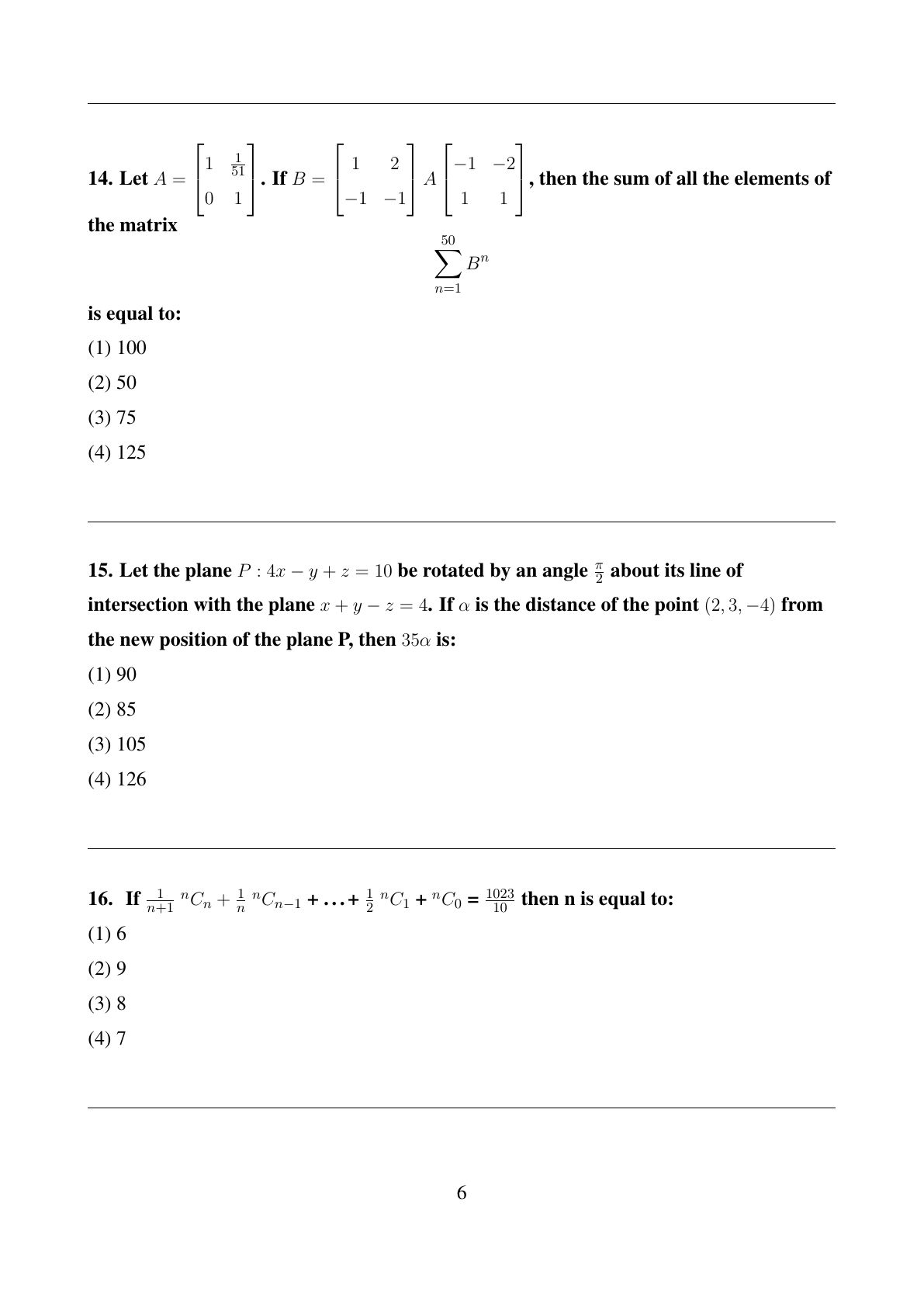
Let \( A = \begin{bmatrix} 1 & \frac{1}{51}
0 & 1 \end{bmatrix} \). If \( B = \begin{bmatrix} 1 & 2
-1 & -1 \end{bmatrix} A \begin{bmatrix} -1 & -2
1 & 1 \end{bmatrix} \),
then the sum of all the elements of the matrix \[ \sum_{n=1}^{50} B^n \]
is equal to:
View Solution
Let the plane \( P : 4x - y + z = 10 \) be rotated by an angle \( \frac{\pi}{2} \) about its line of intersection with the plane \( x + y - z = 4 \). If \( \alpha \) is the distance of the point \( (2, 3, -4) \) from the new position of the plane P, then \( 35\alpha \) is:
View Solution
If \(\frac{1}{n+1}\) \({^{n}C_{n}}+\frac{1}{n}\) \({^{n}C_{n-1}}\) + \dots + \(\frac{1}{2}\) \({^{n}C_{1}}\) + \({^{n}C_{0}}\) = \(\frac{1023}{10}\) then n is equal to:
View Solution
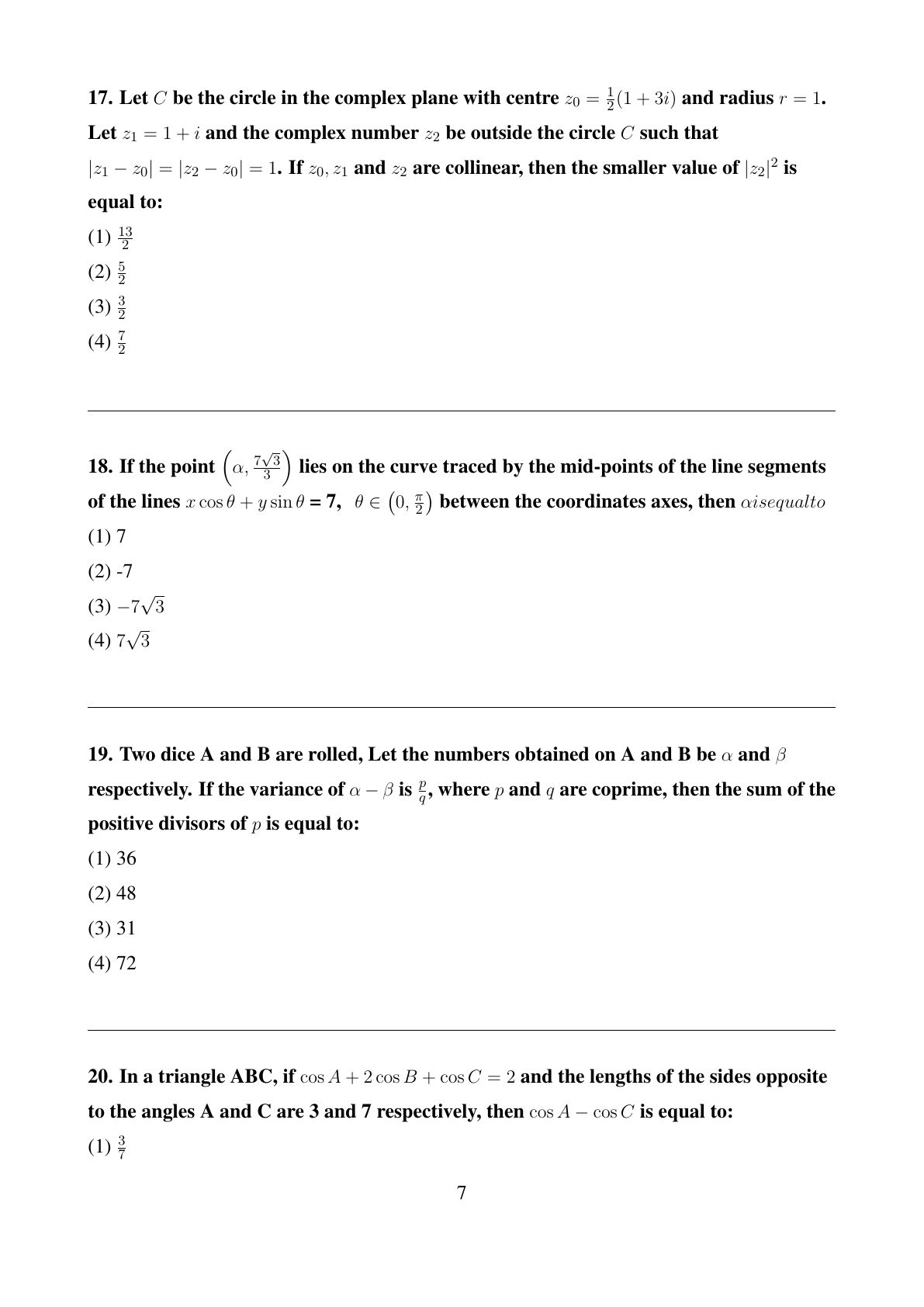
Let \( C \) be the circle in the complex plane with centre \( z_0 = \frac{1}{2}(1 + 3i) \) and radius \( r = 1 \). Let \( z_1 = 1 + i \) and the complex number \( z_2 \) be outside the circle \( C \) such that \( |z_1 - z_0| = |z_2 - z_0| = 1 \). If \( z_0, z_1 \) and \( z_2 \) are collinear, then the smaller value of \( |z_2|^2 \) is equal to:
View Solution

View Solution
Two dice A and B are rolled, Let the numbers obtained on A and B be \( \alpha \) and \( \beta \) respectively. If the variance of \( \alpha - \beta \) is \( \frac{p}{q} \), where \( p \) and \( q \) are coprime, then the sum of the positive divisors of \( p \) is equal to:
View Solution
In a triangle ABC, if \( \cos A + 2 \cos B + \cos C = 2 \) and the lengths of the sides opposite to the angles A and C are 3 and 7 respectively, then \( \cos A - \cos C \) is equal to:
View Solution
We are given the equation: \[ \cos A + 2 \cos B + \cos C = 2 \]
Also, the lengths of the sides opposite to angles A and C are \( a = 3 \) and \( c = 7 \), respectively.
We can use the identity: \[ \cos \left( \frac{A + C}{2} \right) = \sin \left( \frac{B}{2} \right) \]
which simplifies to: \[ \cos A - \cos C = 2 \sin \frac{B}{2} \cos \frac{B}{2} \]
Next, we use the given identity \( 2 \cos B / 2 \cos A \) and simplify the calculation to the sum of \( A + C \) and thus \( \cos A - \cos C \).
So, after calculating the entire expression: \[ \boxed{\cos A - \cos C = \frac{10}{7}} \] Quick Tip: For triangle trigonometry problems, use the relationship between the sides and angles, as well as the trigonometric identities for the sum and difference of angles. In this case, use the cosine and sine half-angle identities to simplify.
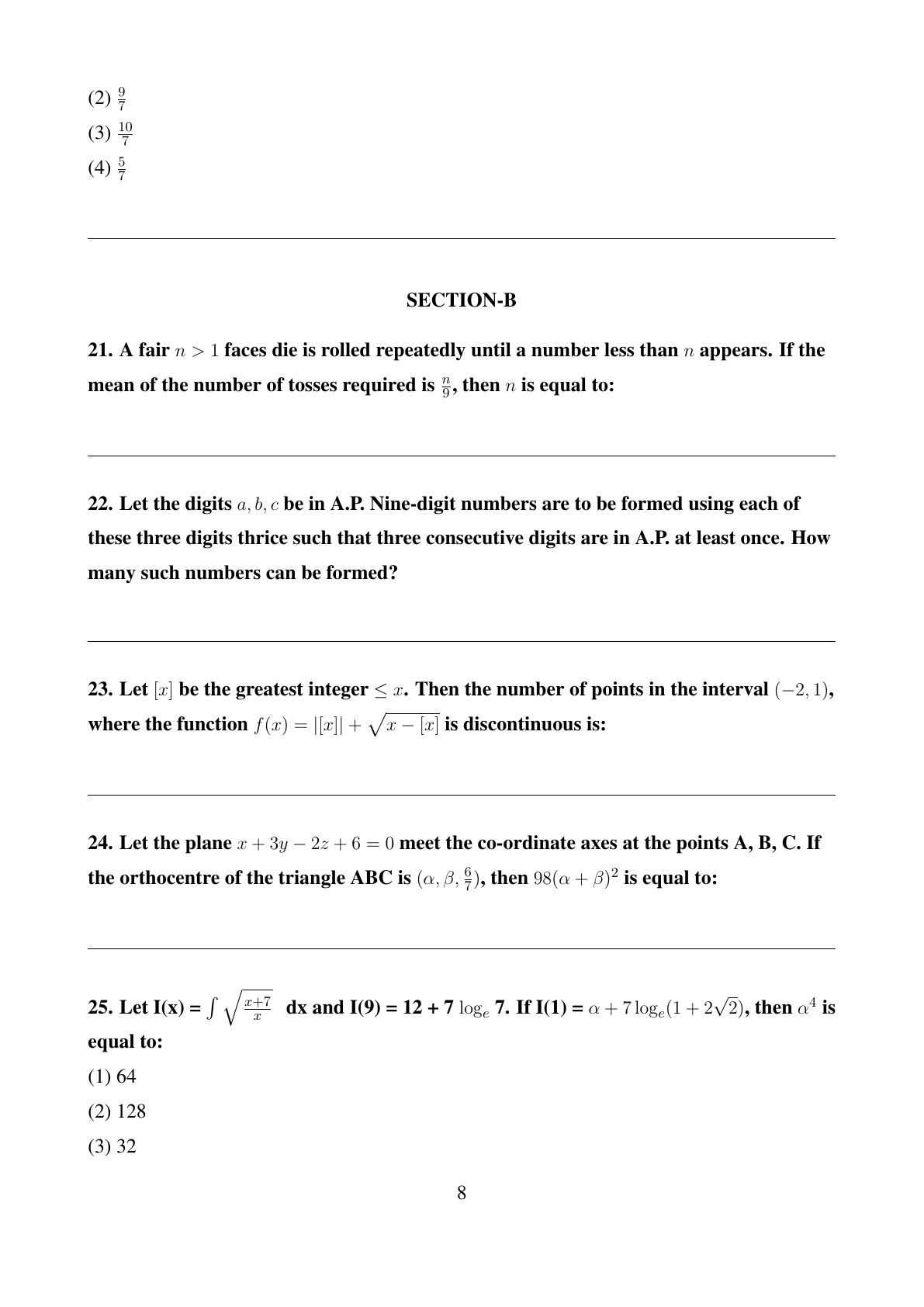
A fair \( n > 1 \) faces die is rolled repeatedly until a number less than \( n \) appears. If the mean of the number of tosses required is \( \frac{n}{9} \), then \( n \) is equal to:
View Solution
Let the digits \( a, b, c \) be in A.P. Nine-digit numbers are to be formed using each of these three digits thrice such that three consecutive digits are in A.P. at least once. How many such numbers can be formed?
View Solution
Let \( [x] \) be the greatest integer \( \leq x \). Then the number of points in the interval \( (-2, 1) \), where the function \( f(x) = |[x]| + \sqrt{x - [x]} \) is discontinuous is:
View Solution
Let the plane \( x + 3y - 2z + 6 = 0 \) meet the co-ordinate axes at the points A, B, C. If the orthocentre of the triangle ABC is \( (\alpha, \beta, \frac{6}{7}) \), then \( 98(\alpha + \beta)^2 \) is equal to:
View Solution
Let I(x) = \(\int \sqrt{\frac{x+7}{x}}\) \, dx and I(9) = 12 + 7 \(\log_e\) 7.
If I(1) = \(\alpha + 7 \log_e (1+2\sqrt{2})\), then \(\alpha^4\) is equal to:
View Solution

View Solution
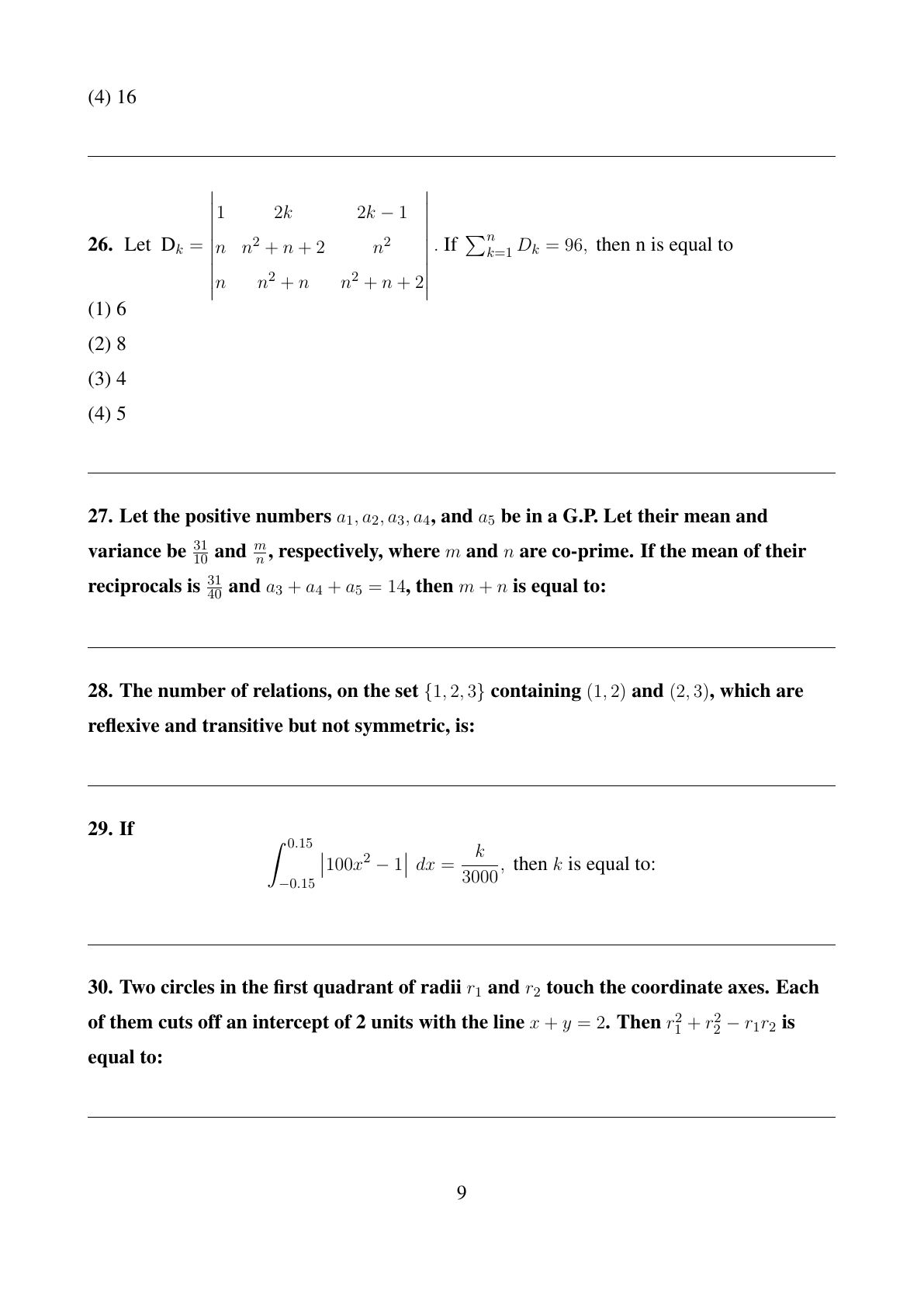
Let the positive numbers \( a_1, a_2, a_3, a_4 \), and \( a_5 \) be in a G.P. Let their mean and variance be \( \frac{31}{10} \) and \( \frac{m}{n} \), respectively, where \( m \) and \( n \) are co-prime. If the mean of their reciprocals is \( \frac{31}{40} \) and \( a_3 + a_4 + a_5 = 14 \), then \( m + n \) is equal to:
View Solution
The number of relations, on the set \( \{1, 2, 3\} \) containing \( (1, 2) \) and \( (2, 3) \), which are reflexive and transitive but not symmetric, is:
View Solution
If \[ \int_{-0.15}^{0.15} \left| 100x^2 - 1 \right| \, dx = \frac{k}{3000}, then k is equal to: \]
View Solution
Two circles in the first quadrant of radii \( r_1 \) and \( r_2 \) touch the coordinate axes. Each of them cuts off an intercept of 2 units with the line \( x + y = 2 \). Then \( r_1^2 + r_2^2 - r_1r_2 \) is equal to:
View Solution
JEE Main 2023 Mathematics Paper Analysis April 12 Shift 1
JEE Main 2023 Mathematics Paper Analysis for the exam scheduled on April 12 Shift 1 is available here. Candidates can check subject-wise paper analysis for the exam scheduled on April 12 Shift 1 here along with the topics with the highest weightage.
JEE Main 2023 Mathematics Question Paper Pattern
| Feature | Question Paper Pattern |
|---|---|
| Examination Mode | Computer-based Test |
| Exam Language | 13 languages (English, Hindi, Assamese, Bengali, Gujarati, Kannada, Malayalam, Marathi, Odia, Punjabi, Tamil, Telugu, and Urdu) |
| Exam Duration | 3 hours |
| Sectional Time Limit | None |
| Mathematics Marks | 100 marks |
| Total Number of Questions Asked | 20 MCQs + 10 Numerical Type Questions |
| Total Number of Questions to be Answered | 20 MCQs + 5 Numerical Type Questions |
| Marking Scheme | +4 for each correct answer |
| Negative Marking | -1 for each incorrect answer |
Also Check:



Comments