




JEE Main 2023 Mathematics April 13 Shift 2 Question Paper is available here for download. Candidates can download official JEE Main 2023 Mathematics Question Paper PDF with Solution and Answer Key for April 13 Shift 2 using the link below. JEE Main Mathematics Question Paper is divided into two sections, Section A with 20 MCQs and Section B with 10 numerical type questions. Candidates are required to answer all questions from Section A and any 5 questions from section B.
JEE Main 2023 Mathematics Question Paper April 13 Shift 2 PDF
| JEE Main 2023 April 13 Shift 2 Mathematics Question Paper with Solution PDF |  Download Download |
Check Solution |
JEE Main 2023 Mathematics Questions with Solutions
Section – A
Question 1:
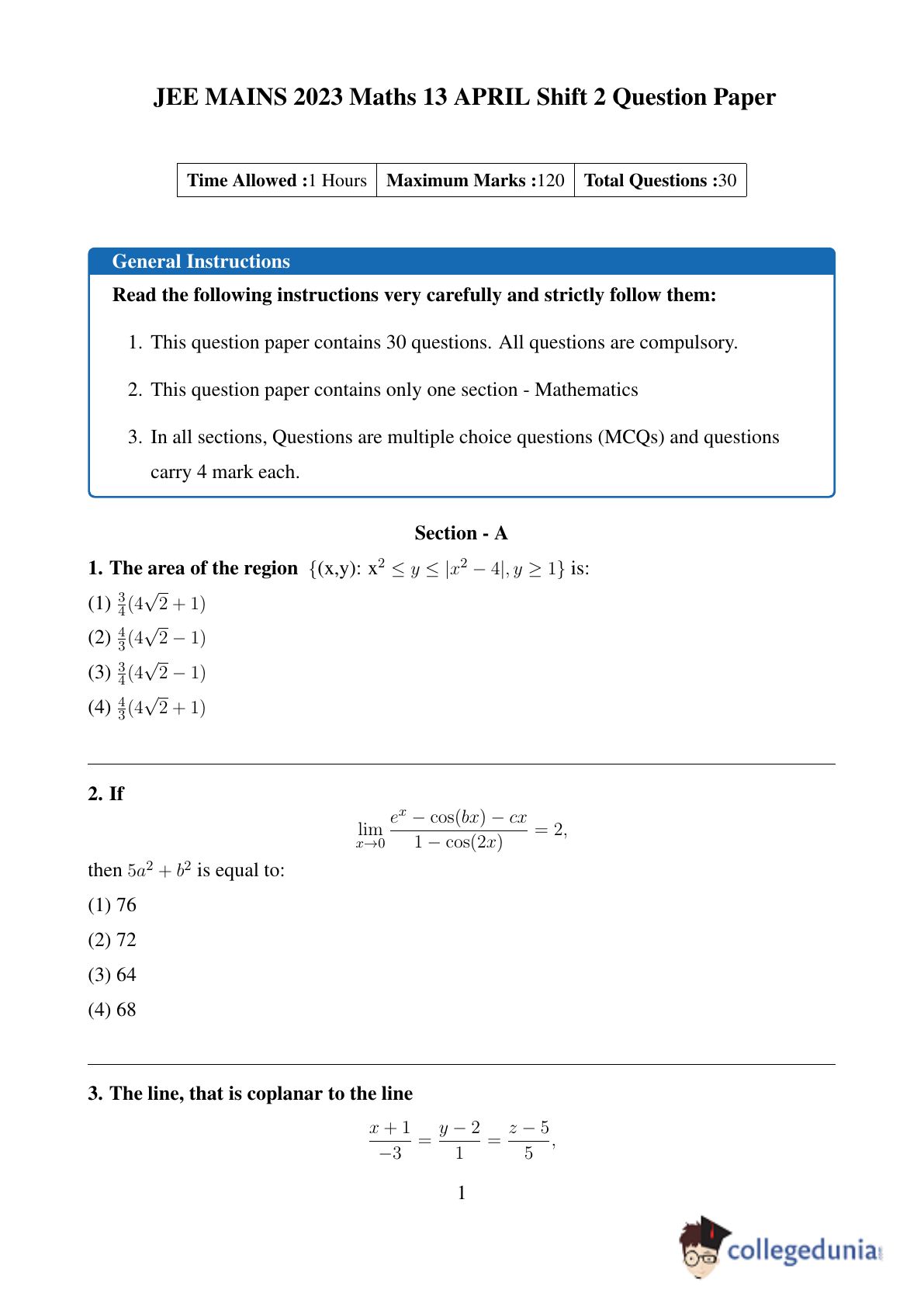
The area of the region \{(x,y): x^2 \leq y \leq |x^2 - 4|, y \geq 1\ \text{ is:
View Solution
The given problem asks to find the area of a region bounded by the equations of curves. The expression for the required area involves integrating two functions over the given limits.
The area can be represented as:
\[ Required area = \int_{-2}^{2} \sqrt{y} \, dy + \int_{-2}^{2} \sqrt{4 - y} \, dy = \frac{4}{3} \left[ 4\sqrt{2} - 1 \right] \] Quick Tip: To find the area between curves, set up the integral based on the limits of integration derived from the boundaries of the region. Ensure the expressions under the integral sign are correctly derived from the curves.
If \[ \lim_{x \to 0} \frac{e^{x} - \cos(bx) - cx}{1 - \cos(2x)} = 2, \]
then \( 5a^2 + b^2 \) is equal to:
View Solution
The line, that is coplanar to the line \[ \frac{x+1}{-3} = \frac{y-2}{1} = \frac{z-5}{5}, \]
is:
View Solution
The plane, passing through the points \( (0, -1, 2) \) and \( (-1, 2, 1) \) and parallel to the line passing through \( (5,1,-7) \) and \( (1,-1,-1) \), also passes through the point
View Solution
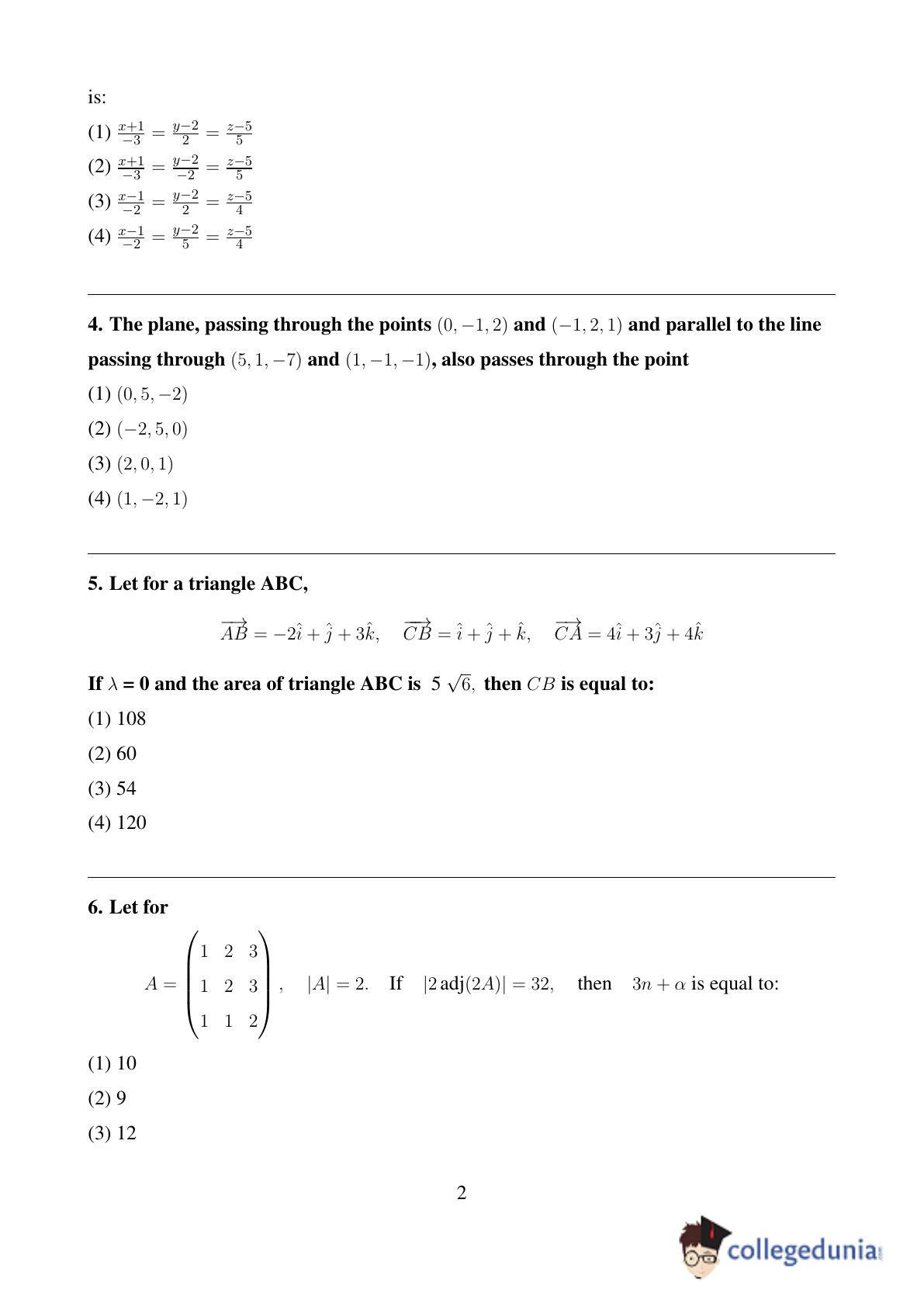
Let for a triangle ABC, \[ \overrightarrow{AB} = -2\hat{i} + \hat{j} + 3\hat{k}, \quad \overrightarrow{CB} = \hat{i} + \hat{j} + \hat{k}, \quad \overrightarrow{CA} = 4\hat{i} + 3\hat{j} + 4\hat{k} \]
If \( \lambda \) = 0 and the area of triangle ABC is 5 \sqrt{6, then \( CB \) is equal to:
View Solution
Let for \[ A = \begin{pmatrix} 1 & 2 & 3
1 & 2 & 3
1 & 1 & 2 \end{pmatrix}, \quad |A| = 2. \quad If \quad |2 \, adj (2A)| = 32, \quad then \quad 3n + \alpha is equal to: \]
View Solution
The range of \( f(x) = 4 \sin \left( \frac{x^2}{x^2 + 1} \right) \) is:
View Solution
Let \( a_1, a_2, a_3, \dots \) be a G.P. of increasing positive numbers. Let the sum of its 6th and 8th terms be 2 and the product of its 3rd and 5th terms be \( \frac{1}{9} \). Then \( 6a_6 + a_6 a_8 \) is equal to:
View Solution
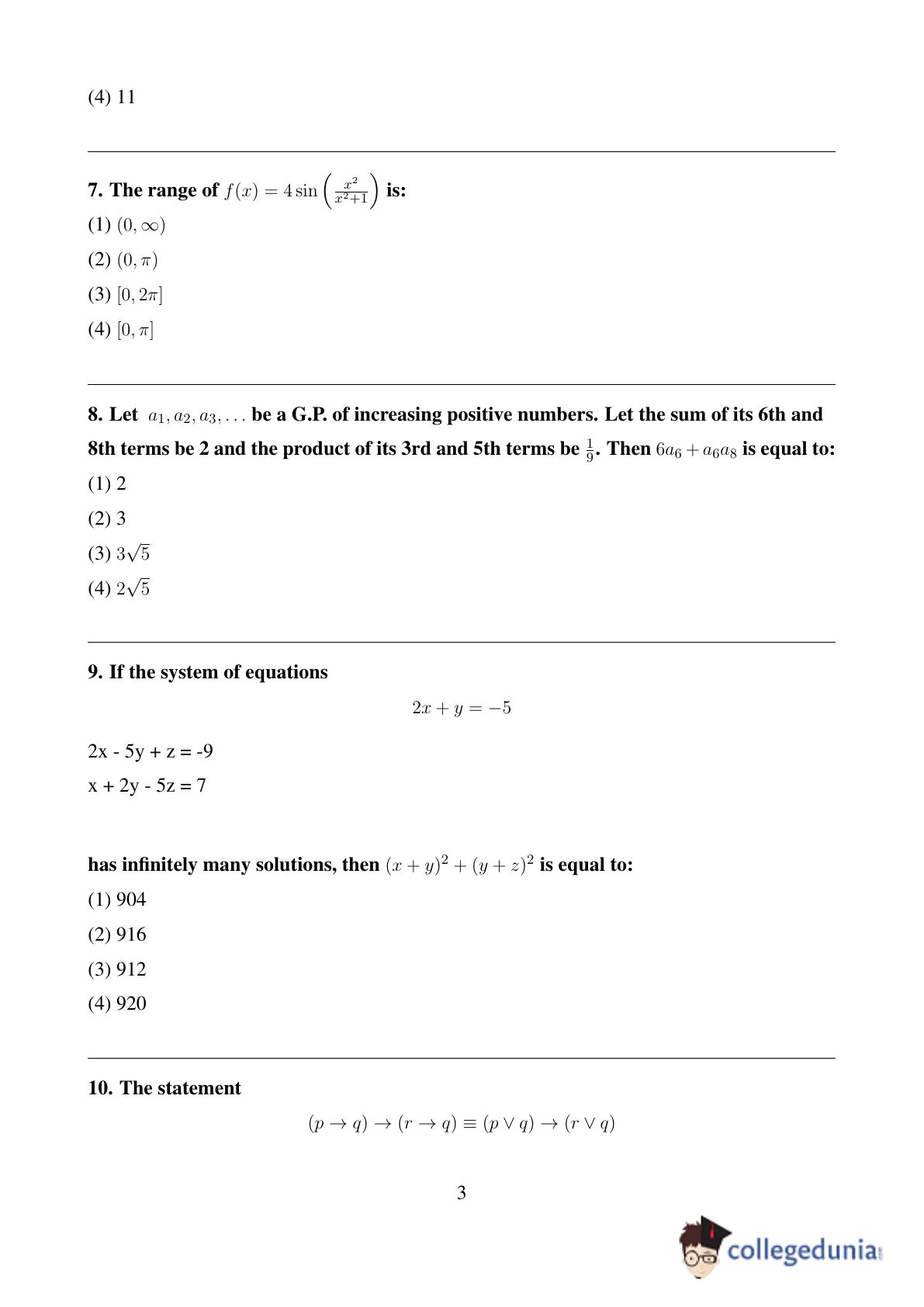
If the system of equations \[ 2x + y = -5
2x - 5y + z = -9
x + 2y - 5z = 7 \]
has infinitely many solutions, then \( (x + y)^2 + (y + z)^2 \) is equal to:
View Solution
The statement \[ (p \rightarrow q) \rightarrow (r \rightarrow q) \equiv (p \vee q) \rightarrow (r \vee q) \]
is equivalent to:
View Solution
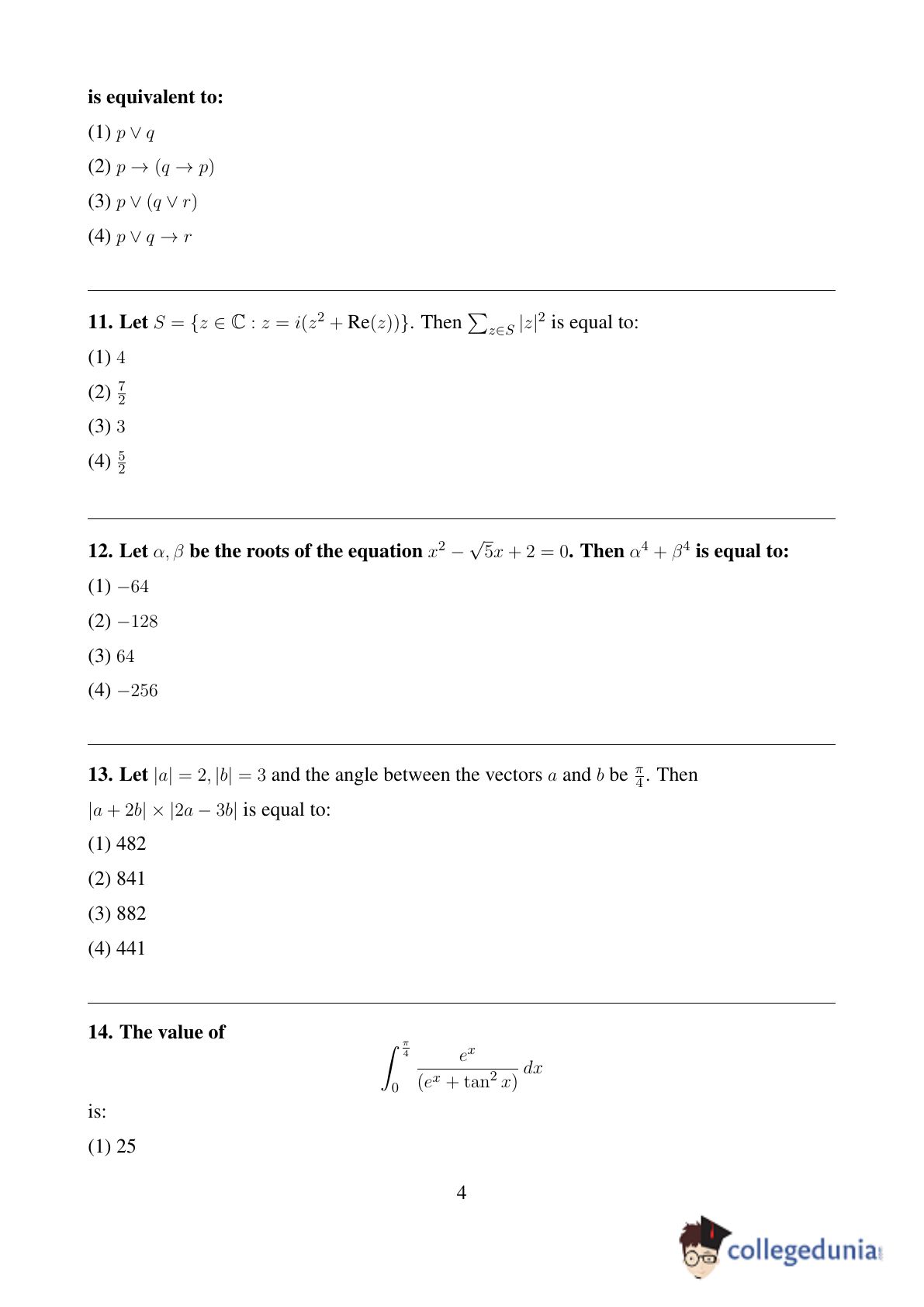
Let \( S = \{ z \in \mathbb{C} : z = i(z^2 + Re(z)) \} \). Then \( \sum_{z \in S} |z|^2 \) is equal to:
View Solution
Let \( \alpha, \beta \) be the roots of the equation \( x^2 - \sqrt{5}x + 2 = 0 \). Then \( \alpha^4 + \beta^4 \) is equal to:
View Solution
Let \( |a| = 2, |b| = 3 \) and the angle between the vectors \( a \) and \( b \) be \( \frac{\pi}{4} \). Then \( |a + 2b| \times |2a - 3b| \) is equal to:
View Solution
The value of \[ \int_{0}^{\frac{\pi}{4}} \frac{e^x}{(e^x + \tan^2 x)} \, dx \]
is:
View Solution
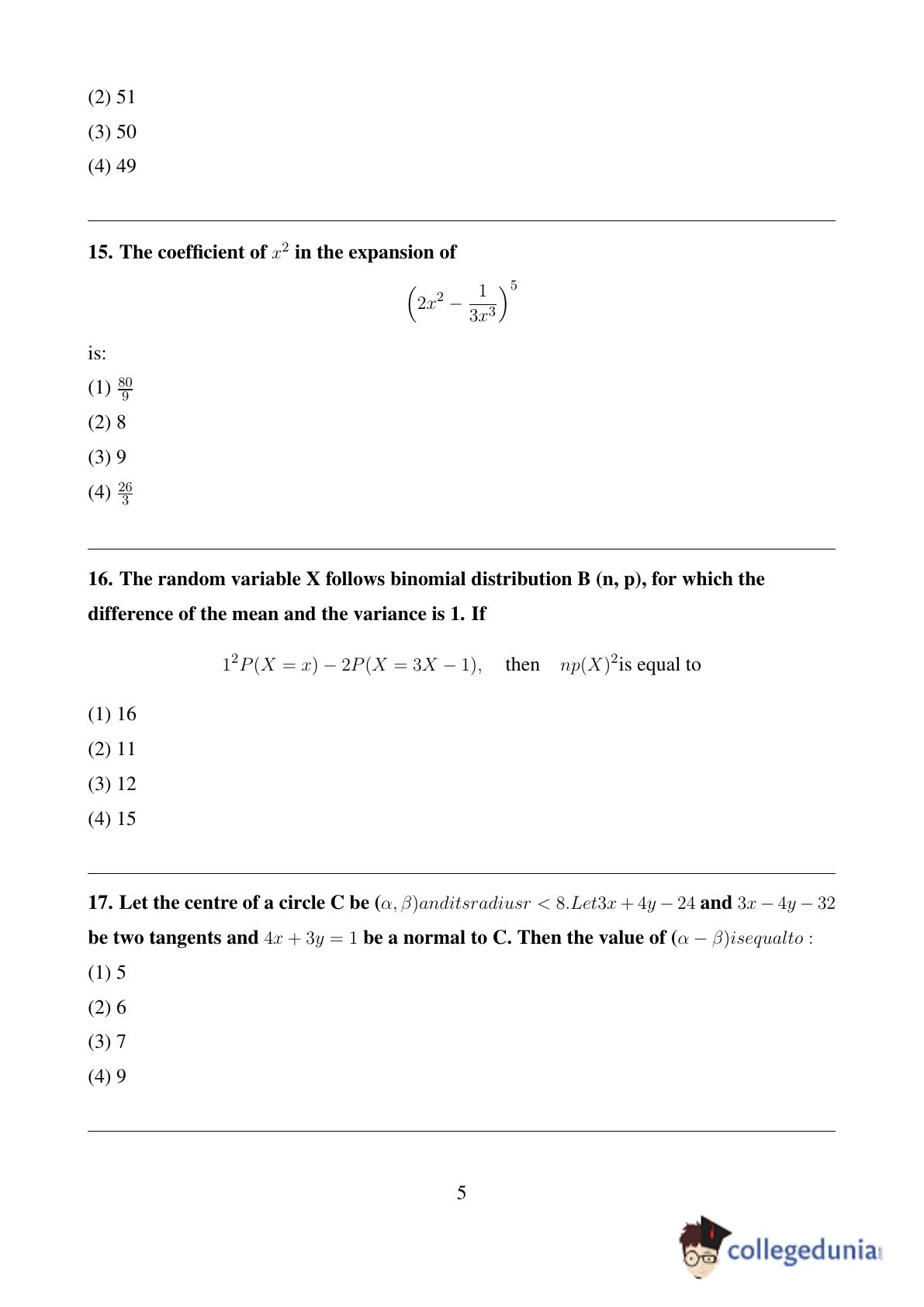
The coefficient of \( x^2 \) in the expansion of \[ \left( 2x^2 - \frac{1}{3x^3} \right)^5 \]
is:
View Solution
The random variable X follows binomial distribution B (n, p), for which the difference of the mean and the variance is 1. If \[ 1^{2}P(X = x) - 2P(X = 3X - 1), \quad then \quad np(X)^{2} is equal to \]
View Solution
Let the centre of a circle C be (\alpha, \beta) and its radius r < 8. Let \(3x + 4y - 24\) and \(3x - 4y - 32\) be two tangents and \(4x + 3y = 1\) be a normal to C. Then the value of (\alpha - \beta) is equal to:
View Solution
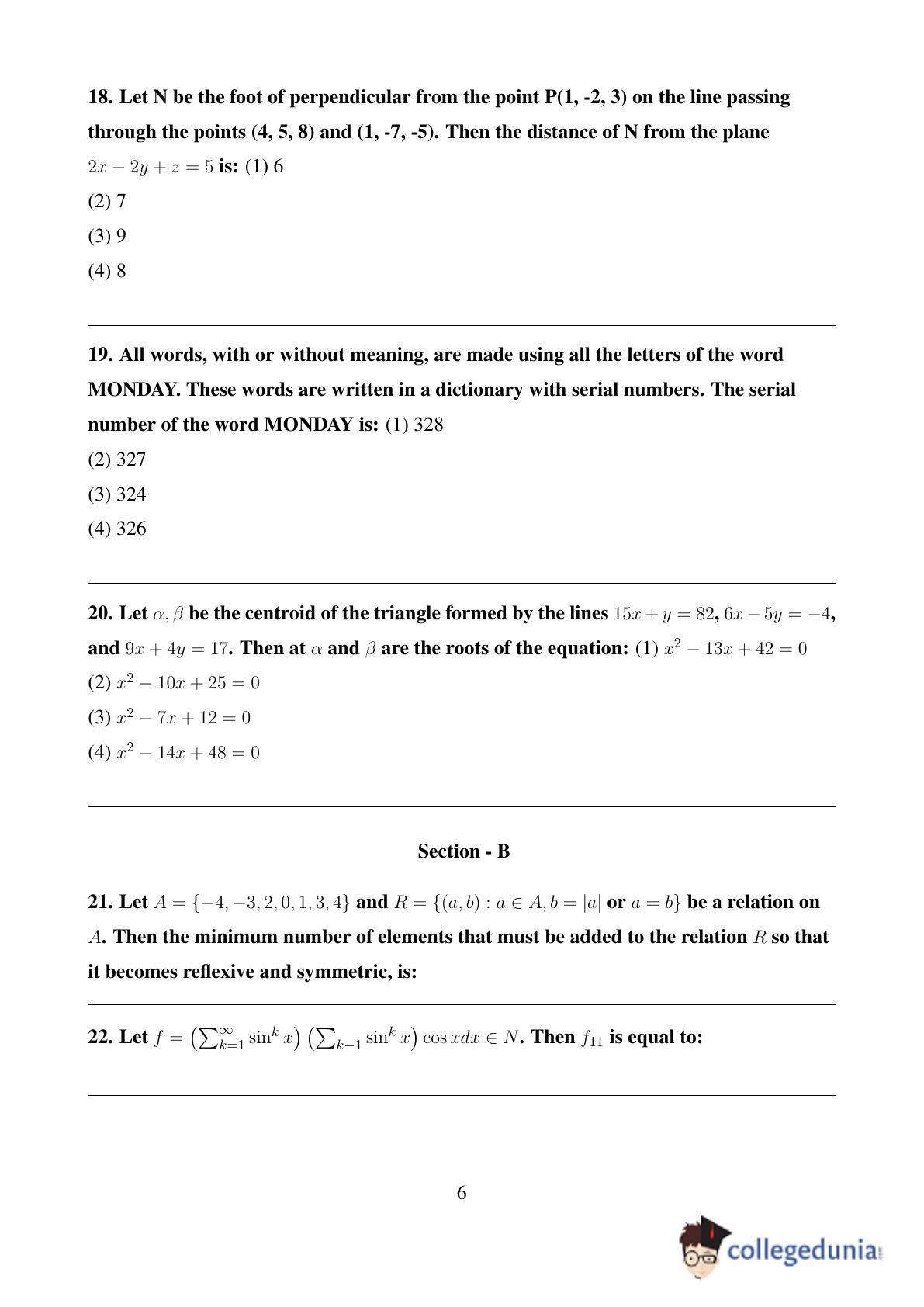
Let N be the foot of perpendicular from the point P(1, -2, 3) on the line passing through the points (4, 5, 8) and (1, -7, -5). Then the distance of N from the plane \( 2x - 2y + z = 5 \) is:
View Solution
All words, with or without meaning, are made using all the letters of the word MONDAY. These words are written in a dictionary with serial numbers. The serial number of the word MONDAY is:
View Solution
Let \( \alpha, \beta \) be the centroid of the triangle formed by the lines \( 15x + y = 82 \), \( 6x - 5y = -4 \), and \( 9x + 4y = 17 \). Then at \( \alpha \) and \( \beta \) are the roots of the equation:
View Solution
Section – B
Question 21:
Let \( A = \{-4, -3, 2, 0, 1, 3, 4\} \) and \( R = \{(a, b) : a \in A, b = |a| or a = b\} \) be a relation on \( A \). Then the minimum number of elements that must be added to the relation \( R \) so that it becomes reflexive and symmetric, is:
View Solution
We are given a relation \( R = \{(a, b): a \in A, b = |a| or a = b\} \) on \( A \), where \( A = \{-4, -3, 2, 0, 1, 3, 4\} \).
The relation is initially defined as follows:
\[ R = \{(-4, -4), (-3, 3), (3, -3), (2, 2), (0, 0), (1, 1), (4, 4)\} \]
For \( R \) to be reflexive, we need to ensure that every element in \( A \) is related to itself. The elements \( -4, 3, 1 \) are already related to themselves, so we need to add the following pairs to make the relation reflexive: \[ \{(-3, -3), (2, 2), (0, 0)\} \]
Next, for \( R \) to be symmetric, if \( (a, b) \) is in \( R \), then \( (b, a) \) must also be in \( R \). The pairs that are not symmetric are \( (-4, 3) \) and \( (3, -4) \), so we need to add the pair \( (-3, -3) \).
The total number of pairs added to make the relation reflexive and symmetric is \( 7 \). Quick Tip: For a relation to be reflexive, each element in the set should be related to itself. For a relation to be symmetric, if an element is related to another, the reverse must also hold.
Let \( f = \left( \sum_{k=1}^{\infty} \sin^k x \right) \left( \sum_{k-1} \sin^k x \right) \cos x dx \in N \). Then \( f_{11} \) is equal to:
View Solution
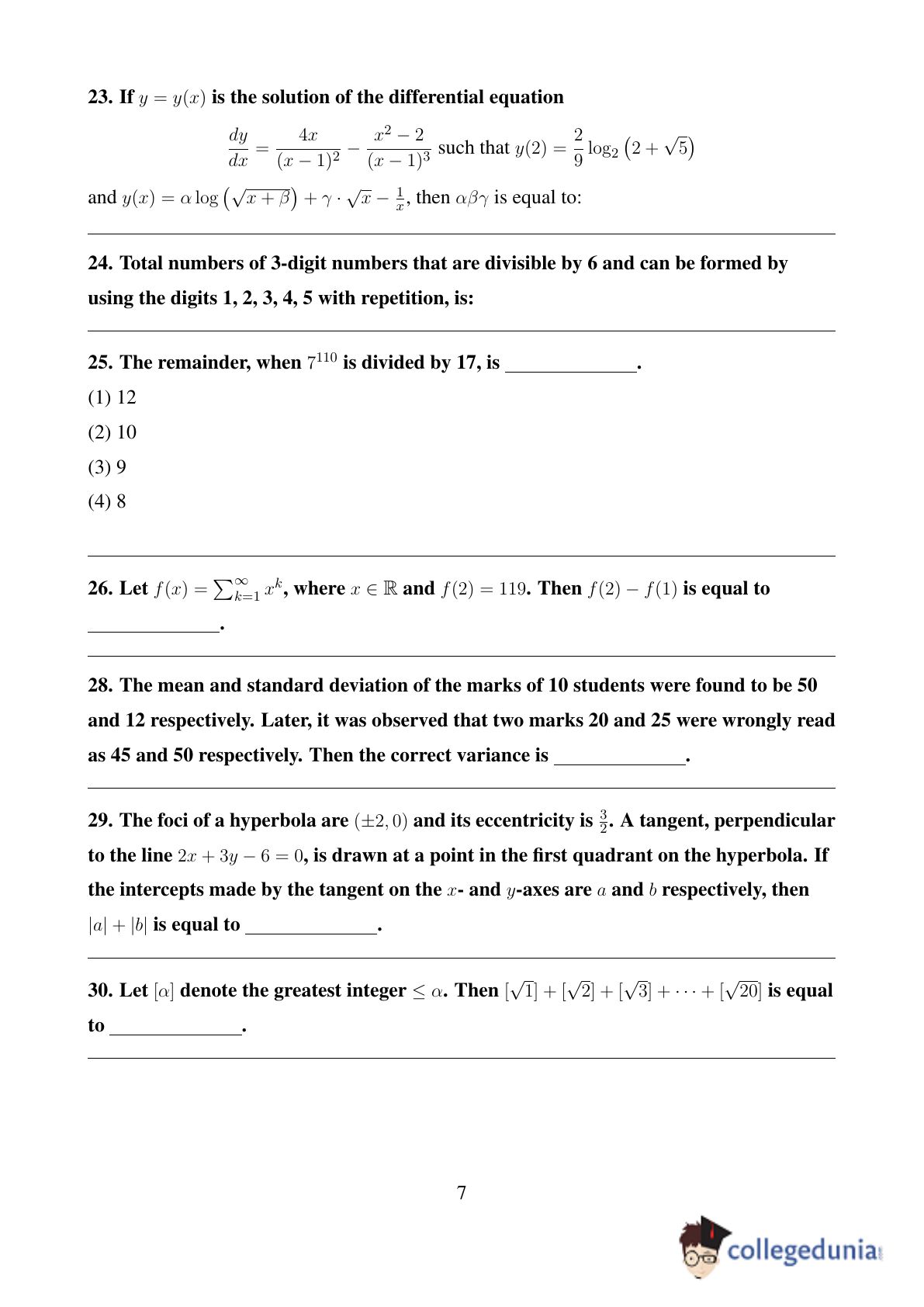
If \( y = y(x) \) is the solution of the differential equation \[ \frac{dy}{dx} = \frac{4x}{(x - 1)^{2}} - \frac{x^2 - 2}{(x - 1)^{3}} such that y(2) = \frac{2}{9} \log_2 \left( 2 + \sqrt{5} \right) \]
and \( y(x) = \alpha \log \left( \sqrt{x + \beta} \right) + \gamma \cdot \sqrt{x} - \frac{1}{x} \), then \( \alpha \beta \gamma \) is equal to:
View Solution
Total numbers of 3-digit numbers that are divisible by 6 and can be formed by using the digits 1, 2, 3, 4, 5 with repetition, is:
View Solution
The remainder, when \(7^{110}\) is divided by 17, is \underline{\hspace{3cm.
View Solution
Let \( f(x) = \sum_{k=1}^{\infty} x^k \), where \( x \in \mathbb{R} \) and \( f(2) = 119 \). Then \( f(2) - f(1) \) is equal to _______________.
View Solution
N/A
For \( x \in (-1, 1) \), the number of solutions of the equation \( \sin x = 2 \tan x \) is equal to_______________.
View Solution
The mean and standard deviation of the marks of 10 students were found to be 50 and 12 respectively. Later, it was observed that two marks 20 and 25 were wrongly read as 45 and 50 respectively. Then the correct variance is \hspace{3cm}.
View Solution
The foci of a hyperbola are \( (\pm 2, 0) \) and its eccentricity is \( \frac{3}{2} \). A tangent, perpendicular to the line \( 2x + 3y - 6 = 0 \), is drawn at a point in the first quadrant on the hyperbola. If the intercepts made by the tangent on the \( x \)- and \( y \)-axes are \( a \) and \( b \) respectively, then \( |a| + |b| \) is equal to \underline{\hspace{3cm.
View Solution
Let \( [\alpha] \) denote the greatest integer \( \leq \alpha \). Then \( [\sqrt{1}] + [\sqrt{2}] + [\sqrt{3}] + \dots + [\sqrt{20}] \) is equal to \underline{\hspace{3cm.
View Solution
JEE Main 2023 Mathematics Paper Analysis April 13 Shift 2
JEE Main 2023 Mathematics Paper Analysis for the exam scheduled on April 13 Shift 2 is available here. Candidates can check subject-wise paper analysis for the exam scheduled on April 13 Shift 2 here along with the topics with the highest weightage.
JEE Main 2023 Mathematics Question Paper Pattern
| Feature | Question Paper Pattern |
|---|---|
| Examination Mode | Computer-based Test |
| Exam Language | 13 languages (English, Hindi, Assamese, Bengali, Gujarati, Kannada, Malayalam, Marathi, Odia, Punjabi, Tamil, Telugu, and Urdu) |
| Exam Duration | 3 hours |
| Sectional Time Limit | None |
| Mathematics Marks | 100 marks |
| Total Number of Questions Asked | 20 MCQs + 10 Numerical Type Questions |
| Total Number of Questions to be Answered | 20 MCQs + 5 Numerical Type Questions |
| Marking Scheme | +4 for each correct answer |
| Negative Marking | -1 for each incorrect answer |
Also Check:



Comments