




JEE Main 2023 Physics April 6 Shift 2 Question Paper is available here for download. Candidates can download official JEE Main 2023 Physics Question Paper PDF with Solution and Answer Key for April 6 Shift 2 using the link below. JEE Main Physics Question Paper is divided into two sections, Section A with 20 MCQs and Section B with 10 numerical type questions. Candidates are required to answer all questions from Section A and any 5 questions from section B.
Related Links:
- JEE Main 2025 Question Paper pdf with solutions
- JEE Main Previous Years Question Paper with Solution PDF
JEE Main 2023 Physics Question Paper April 6 Shift 2 PDF
| JEE Main 2023 April 6 Shift 2 Physics Question Paper with Solution PDF |  Download Download |
Check Solution |

JEE Main 2023 Physics Questions with Solutions
Section – A
Question 1:
The temperature of an ideal gas is increased from 200 K to 800 K. If r.m.s. speed of gas at 200 K is \(v_0\), then the r.m.s. speed of the gas at 800 K will be:
View Solution
Using \(v_{rms} = \sqrt{\frac{3RT}{m}}\)
At \(200 \, K\), the r.m.s. speed is \(v_0\): \[ v_0 = \sqrt{\frac{3R \times 200}{m}} \quad \cdots (1) \]
At \(800 \, K\), the r.m.s. speed is \(v'\): \[ v' = \sqrt{\frac{3R \times 800}{m}} \quad \cdots (2) \]
Dividing equation (2) by equation (1): \[ \frac{v'}{v_0} = \sqrt{\frac{800}{200}} = \sqrt{4} = 2 \]
Therefore, \(v' = 2v_0\). Quick Tip: When dealing with thermodynamics problems involving ideal gases, always start by using the ideal gas law and the relationship between temperature and the r.m.s. speed of gas molecules.
Given below are two statements: one is labelled as assertion A and the other is labelled as Reason R.
Assertion A: The phase difference of two light waves change if they travel through different media having same thickness, but different indices of refraction.
Reason R: The wavelengths of waves are different in different media.
In the light of the above statements, choose the most appropriate answer from the options given below:
View Solution
As we know the speed of light in a medium: \[ v = \frac{c}{\mu} \quad or \quad f \lambda = \frac{c}{\mu} \]
Therefore, \(\lambda \propto \frac{1}{\mu}\).
When light travels through two different mediums, their phase difference will change: \[ \Delta Q = \frac{2\pi}{\lambda} \]
Thus, statement R is the correct explanation of A. Quick Tip: For light wave problems, always consider the relationship between wavelength, refractive index, and phase difference when dealing with different media.
For an amplitude modulated wave, the minimum amplitude is 3 V, while the modulation index is 60%. The maximum amplitude of the modulated wave is:
View Solution
Given, modulation index \(m = 60% = 0.6\) and minimum amplitude \(A_c = 3 \, V\).
Using the formula for amplitude modulation: \[ A_m = mA_c \]
The maximum amplitude of the modulated wave is: \[ A_m + A_c = 0.6 \times 1 + 3 = 1.6 \, V \]
Now applying the amplitude formula: \[ A_m + A_c = \frac{1.6}{-0.4} = 12 \, V \] Quick Tip: When working with amplitude modulation problems, remember to use the formula for maximum and minimum amplitudes based on modulation index and carrier amplitude.
The ratio of speed of sound in hydrogen gas to the speed of sound in oxygen gas at the same temperature is:
View Solution
Using the formula for the speed of sound, \(v = \sqrt{\frac{\gamma RT}{m}}\), we can write for hydrogen and oxygen:
\[ \frac{v_{H_2}}{v_{O_2}} = \sqrt{\frac{m_{O_2}}{m_{H_2}}} = \sqrt{\frac{32}{2}} = \sqrt{16} = 4 : 1 \]
Thus, the ratio is \(4 : 1\). Quick Tip: Remember to apply the formula for speed of sound in gases, which depends on the molecular mass and temperature. The ratio of the molecular masses plays a crucial role in this type of problem.
A dipole comprises of two charged particles of identical magnitude \(q\) and opposite in nature. The mass \(m\) of the positive charged particle is half of the mass of the negative charged particle. The two charges are separated by a distance \(l\). If the dipole is placed in a uniform electric field \(E\), making a very small angle with the electric field, the angular frequency of the oscillations when released is given by:
View Solution
In this case, since masses of both charges are not the same, we need to find center of mass (COM), about which dipole will oscillate and then we will find moment of inertia about this axis, to find torque and hence angular frequency \( \omega \).
Given, the mass of positive charge is \(m\), so the center of mass will be at a distance \(L\) from the negative charge: \[ \frac{L}{3} = \frac{2m}{3m} = \frac{2L}{3} \]
The moment of inertia about the axis is \(I = \frac{2mL^2}{3}\). Hence, angular frequency: \[ \omega = \sqrt{\frac{qE}{I}} = \frac{4qE}{3ml} \] Quick Tip: For dipole oscillations in electric fields, consider the center of mass for accurate calculation of moment of inertia, which affects the angular frequency.
Given below are two statements: one is labelled as Assertion A and the other is labelled as Reason R.
Assertion A: When you squeeze one end of a tube to get toothpaste out from the other end, Pascal's principle is observed.
Reason R: A change in the pressure applied to an enclosed incompressible fluid is transmitted undiminished to every portion of the fluid and to the walls of its container.
In the light of the above statements, choose the most appropriate answer from the options given below:
View Solution
As per Pascal’s law, when we apply pressure to an ideal liquid, it is equally distributed in the entire liquid and to the walls as well. The pressure change allows the toothpaste to be squeezed out.
Thus, both statements are true, and R explains A. Quick Tip: For problems related to fluids, always remember Pascal's law which applies to incompressible fluids and explains how pressure changes propagate within the fluid.
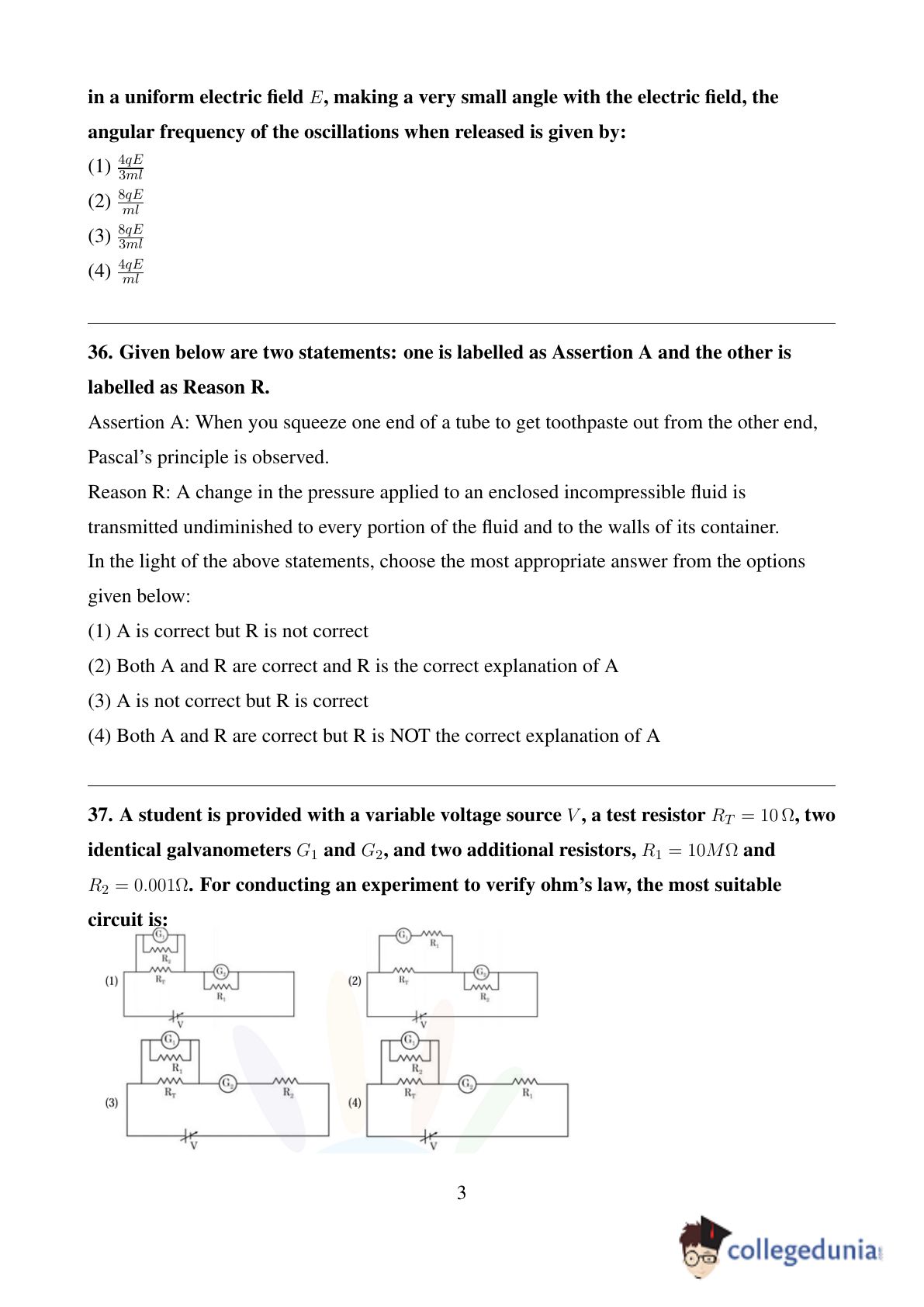
A student is provided with a variable voltage source \(V\), a test resistor \(R_T = 10 \, \Omega\), two identical galvanometers \(G_1\) and \(G_2\), and two additional resistors, \(R_1 = 10M\Omega\) and \(R_2 = 0.001\Omega\). For conducting an experiment to verify ohm’s law, the most suitable circuit is:

View Solution
This question is based on conceptual clarity that we should connect ammeter in series and voltmeter in parallel to measure current and potential difference, respectively. Also, when using a galvanometer to create an ammeter, shunt resistance should be very small and should be in parallel.
When we create a voltmeter shunt should be large and in series with the galvanometer.
All these criteria are satisfied in option (2). Quick Tip: For circuit-based experiments, always ensure the correct placement of ammeters and voltmeters for accurate measurement of current and voltage. Remember that a shunt resistor is crucial for converting a galvanometer into an ammeter.
A body cools in 7 minutes from 60°C to 40°C. The temperature of the surroundings is 10°C. The temperature of the body after the next 7 minutes is:
View Solution
Method-1:
Using the exact law of cooling: \[ T - T_s = (T_0 - T_s) e^{-kt} \]
Case-I: \((40 - 10) = (60 - 10) e^{-7k}\) \[ 30 - 50e^{-7k} \quad \dots \, (1) \]
Case-II: \((T - 10) = (40 - 10) e^{-7k} \quad T - 10 = 30e^{-7k}\)
Dividing equation (2) by (1): \[ \frac{40 - T}{30} = \frac{20}{40 + T} \] \[ \Rightarrow T - 10 = 30 \times \frac{30}{50} = 18 \]
Thus, the temperature after 7 more minutes is \(T = 28°C\).
Method-2:
Using Newton's law of cooling: \[ \frac{T - T_s}{t} = k \left( \frac{T_1 + T_2}{2} - T_s \right) \]
Case-I: \[ \frac{60 - 40}{7} = k \left( \frac{40 + 10}{2} - 10 \right) \Rightarrow k = \frac{20}{7} \]
Case-II: \[ \frac{40 - 10}{7} = k \left( \frac{20 + T}{2} - 10 \right) \Rightarrow T = 28°C \] Quick Tip: Always remember that cooling problems can be solved using either the exact law of cooling or Newton's law of cooling. Choose the method that suits the given data.
The energy density associated with electric field \(E\) and magnetic field \(B\) of an electromagnetic wave in free space is given by \(\epsilon_0\) - permittivity of free space, \(\mu_0\) - permeability of free space:
View Solution
By theory of electromagnetic waves: \[ U_E = \frac{1}{2} \epsilon_0 E^2 \quad and \quad U_B = \frac{1}{2} \mu_0 B^2 \] Quick Tip: For energy density in electromagnetic waves, remember that the energy is shared equally between the electric and magnetic fields.
The weight of a body on the surface of the earth is 100 N. The gravitational force on it when taken at a height, from the surface of earth, equal to one-fourth the radius of the earth is:
View Solution
Using Newton's formula: \[ F = \frac{GMm}{r^2} \]
At surface of the earth, \[ F = \frac{GMm}{R_e^2} \quad (eq. 1) \]
At \(r = R_e + \frac{R_e}{4} = \frac{5R_e}{4}\), \[ F' = \frac{GMm}{\left(\frac{5R_e}{4}\right)^2} = \frac{16GMm}{25R_e^2} \]
Thus, \[ F' = \frac{16}{25} F = \frac{16}{25} \times 100 = 64 \, N \] Quick Tip: Remember that gravitational force decreases with the square of the distance from the center of the Earth. When the distance increases, the force decreases.
A capacitor of capacitance 150.0 μF is connected to an alternating source of emf given by \(E = 36 \sin (120 \pi t)\) V. The maximum value of current in the circuit is approximately equal to:
View Solution
Given alternating AC source \(E = 36 \sin (120 \pi t)\) V and capacitor \(C = 150 \mu F\), we can write: \[ Q = CV \quad and \quad i = \frac{dQ}{dt} = C E \omega \cos \omega t \]
Maximum value of current: \[ i_0 = C E_0 \omega = 150 \times 10^{-6} \times 36 \times 120 \pi = 2.03 A \] Quick Tip: In AC circuits with capacitors, the maximum current is found by multiplying the capacitance, maximum voltage, and angular frequency.
A 2 meter long scale with least count of 0.2 cm is used to measure the locations of objects on an optical bench. While measuring the focal length of a convex lens, the object pin and the convex lens are placed at 80 cm mark and 1 m mark, respectively. The image of the object pin on the other side of lens coincides with image pin that is kept at 180 cm mark. The % error in the estimation of focal length is:
View Solution
Based on the data provided: \[ U = 100 - 80 = 20 \, cm, \quad V = 180 - 100 = 80 \, cm \]
Using the formula: \[ \frac{1}{f} = \frac{1}{u} + \frac{1}{v} \quad or \quad f = \frac{uv}{u + v} \quad \Rightarrow f = \frac{20 \times 80}{20 + 80} = 16 \, cm \]
For error analysis: \[ \frac{1}{f} = \frac{1}{u} + \frac{1}{v} \]
Differentiating: \[ \frac{Df}{f^2} = \frac{Du}{u^2} + \frac{Dv}{v^2} \]
Now: \[ \Delta u = 0.4 \, cm, \, \Delta v = 0.4 \, cm \]
Now, \[ \frac{\Delta f}{f} = \left[ \frac{16 \times 0.4}{(80)^2} + \frac{16 \times 0.4}{(20)^2} \right] \] \[ \Rightarrow \frac{\Delta f}{f} = 16 \times 0.4 \left( \frac{17}{400} \right) \quad \Rightarrow % \, Error = \frac{17 \times 0.4}{400} \times 1000 = 1.7 \] Quick Tip: When calculating percentage error, remember that any measurement errors in \( u \) and \( v \) can affect \( f \). Use differentials to find the total error in calculated quantities.
Figure shows a part of an electric circuit. The potentials at points a, b, and c are 30 V, 12 V, and 2 V respectively. The current through the 20 Ω resistor will be:
View Solution
Let potential of the junction be \( x \) volts using junction law \( i_1 + i_2 + i_3 = 0 \). \[ x - 30 = \frac{x - 12}{10} \quad and \quad x - 2 = \frac{x - 12}{20} \]
Solving for \( x \): \[ x = 20 \, V, \quad current through \, 20 \, \Omega \, resistor = \frac{20 - 12}{20} = 0.4 \, A \] Quick Tip: For circuits with multiple components, apply Kirchhoff's current and voltage laws to simplify the analysis and solve for unknowns.
A small particle of mass m moves in such a way that its potential energy \( U = \frac{1}{2}m\omega^2 r^2 \) where \( \omega \) is constant and \( r \) is the distance of the particle from origin. Assuming Bohr's quantization of momentum and circular orbit, the radius of the nth orbit will be proportional to:
View Solution
Using Bohr’s postulate: angular momentum \( L = mvr = \frac{nh}{2\pi} \).
Therefore: \[ m r \omega^2 = \frac{nh}{2\pi} \] \[ \Rightarrow r \propto \sqrt{n} \] Quick Tip: Bohr's model applies quantization of angular momentum to describe the radii of orbits in atomic systems. Use this principle to relate radius to quantum number \( n \).
Given below are two statements: one is labelled as Assertion A and the other is labelled as Reason R
Assertion A: Diffusion current in a p-n junction is greater than the drift current in magnitude if the junction is forward biased.
Reason R: Diffusion currents in a p-n junction are from the n-side to the p-side if the junction is forward biased.
In the light of the above statements, choose the most appropriate answer from the options given below:
View Solution
The diffusion current in a forward biased p-n junction is greater than the drift current, as the charge carriers move due to the gradient in the concentration. The direction of the diffusion current is from the n-side to the p-side, which is correctly explained by Reason R. Quick Tip: In p-n junctions, diffusion current dominates in forward bias conditions. Remember that drift current is due to an electric field, while diffusion current is due to concentration gradients.
Choose the incorrect statement from the following :
View Solution
Since planets revolve around the sun in an elliptical orbit, its linear speed is not constant, hence option (1) is incorrect. Other statements are correct as per theory.
Quick Tip: For planets in elliptical orbits, remember that their linear speed changes depending on their position along the orbit. The total energy of a planet remains constant in elliptical orbits.
A child of mass 5 kg is going round a merry-go-round that makes 1 rotation in 3.14 s. The radius of the merry-go-round is 2 m. The centrifugal force on the child will be :
View Solution
Given, \(m = 5 \, kg\), \(R = 2 \, m\), time \(t\) for 1 rev \(= 3.14 \, sec\) or \(\pi \, sec\).
So, \(\theta\) for 1 rev \(= 2\pi \, rad\).
Therefore, \(\omega = \frac{\theta}{t} = \frac{2\pi}{\pi} = 2 \, rad/s\).
Centrifugal force \(F = mR\omega^2 = 5 \times 2 \times 2^2 = 40 \, N\).
Quick Tip: To calculate centrifugal force in rotational motion, use the formula \( F = mR\omega^2 \) where \(\omega\) is the angular velocity and \(R\) is the radius of the circular path.
As shown in the figure, a particle is moving with constant speed \(\pi \, m/s\). Considering its motion from A to B, the magnitude of the average velocity is :

View Solution
Given, speed \(v = \pi \, m/s\), or \(R\omega = \pi\).
Therefore, \(\omega = \frac{\pi}{R} \, rad/s\).
Angular displacement \(\theta = 120^\circ = \frac{2\pi}{3}\).
Using \(\theta = \omega t\), we get: \[ t = \frac{\theta}{\omega} = \frac{2\pi/3}{\pi/R} = \frac{2R}{3}. \]
Linear displacement \(d = 2R \sin( \theta / 2 ) = 2R \sin(60^\circ) = 2R \times \frac{\sqrt{3}}{2} = R\sqrt{3}\).
Hence, average velocity \( = \frac{d}{t} = \frac{R \sqrt{3}}{2R/3} = 1.5 \sqrt{3} \, m/s\).
Quick Tip: To find the average velocity for circular motion, use the formula \( average velocity = \frac{d}{t} \) where \(d\) is the linear displacement and \(t\) is the time taken.
The work functions of Aluminium and Gold are 4.1 eV and 5.1 eV respectively. The ratio of the slope of the stopping potential versus frequency plot for Gold to that of Aluminium is
View Solution
Using \( K.E_{max} = eV_s = hf - \phi_0 \), where \(\phi_0\) is work function, \(V_s\) is stopping potential, and \(f\) is frequency, we get: \[ V_s = \frac{h}{e} f - \frac{\phi_0}{e}. \]
Therefore, the slope \( m \) will be the same for all graphs and will be independent of \(\phi_0\).
Quick Tip: In photoelectric experiments, the slope of the stopping potential versus frequency plot is independent of the material’s work function.
A particle starts with an initial velocity of 10.0 m/s along x-direction and accelerates uniformly at the rate of 2.0 m/s\(^2\). The time taken by the particle to reach the velocity of 60.0 m/s is
View Solution
Using the first equation of motion: \[ t = \frac{v - u}{a} \] \[ t = \frac{60 - 10}{2} = \frac{50}{2} = 25 \, sec \] Quick Tip: Remember, for uniform acceleration problems, use the first equation of motion: \( v = u + at \), where \( v \) is final velocity, \( u \) is initial velocity, \( a \) is acceleration, and \( t \) is time.
Section – B
Question 21:
A simple pendulum with length 100 cm and bob of mass 250 g is executing S.H.M. of amplitude 10 cm. The maximum tension in the string is found to be \(\dfrac{x}{40}\) N. The value of \(x\) is
View Solution
For pendulum: \[ T_{max} = mg + \frac{mv^2}{L} \tag{1} \]
Given \( m = \frac{1}{4} \, kg, L = 1 \, m, g = 9.8 \, m/s^2 \) and amplitude \( A = \frac{1}{10} \, m \)
For SHM, \( K_{max} = \frac{1}{2} mv^2 = \frac{1}{2} m \omega^2 A^2 \)
Using \( \omega = \sqrt{\frac{g}{L}} \), we get: \[ mv^2 = m \left( \frac{g}{L} \right) A^2 = m g \frac{A^2}{L} \]
Substitute this into equation (1): \[ T_{max} = 2mg + \frac{mgA^2}{L^2} \]
Substituting the given values: \[ T_{max} = 2 \times \frac{1}{4} \times 9.8 + \frac{1}{4} \times 9.8 \times \frac{101}{100} \] \[ T_{max} = \frac{98.98}{40} \]
Therefore, \( x = 99 \) Quick Tip: In SHM, maximum tension is calculated by considering both gravitational force and the force due to the velocity of the bob at maximum displacement.
Experimentally it is found that 12.8 eV energy is required to separate a hydrogen atom into a proton and an electron. So the orbital radius of the electron in a hydrogen atom is \(\dfrac{9}{x} \times 10^{-10}\) m. The value of \(x\) is
View Solution
Using \( E = \frac{k e^2}{2r} \), we can find \( r \) as follows: \[ r = \frac{Re^2}{2E} \]
Given \( E = 12.8 \, eV = 12.8 \times 1.6 \times 10^{-19} \, J \), \[ r = \frac{2 \times 10^9 e^2}{9 \times 10^{-10}} = \frac{9 \times 10^{-10}}{(2 \times 12.8 / 1.6)} \times 10 \] \[ r = 16 \times 10^{-10} \, m \]
Therefore, \( x = 16 \) Quick Tip: The orbital radius of an electron can be calculated using the energy required to separate the proton and electron in a hydrogen atom, based on Coulomb's law.
A beam of light consisting of two wavelengths 7000 \(\AA\) and 5500 \(\AA\) is used to obtain interference pattern in Young's double slit experiment. The distance between the slits is 2.5 mm and the distance between the place of slits and the screen is 150 cm. The least distance from the central fringe, where the bright fringes due to both the wavelengths coincide, is \(n \times 10^{-5}\) m. The value of \(n\) is
View Solution
Let \( n_1 \) maxima of 7000 \(\AA\) coincide with \( n_2 \) maxima of 5500 \(\AA\).
Therefore, \( n_1 \beta_1 = n_2 \beta_2 \), \[ \frac{n_1}{n_2} = \frac{\lambda_2}{\lambda_1} = \frac{5500}{7000} = \frac{11}{14} \]
Hence, the 11th maximum of 7000 \(\AA\) coincides with the 14th maximum of 5500 \(\AA\).
To find the least distance from this, \[ y = n_1 \beta_1 D / d \] \[ y = \frac{11 \times 7000 \times 10^{-10} \times 150 \times 10^{-2}}{2.5 \times 10^{-3}} = 462 \times 10^{-5} \, m \]
Thus, \( n = 462 \) Quick Tip: In interference problems, use the relationship between the wavelengths and the maxima to calculate the least distance where bright fringes coincide.
Two concentric circular coils with radii 1 cm and 1000 cm, and number of turns 10 and 200 respectively are placed coaxially with centers coinciding. The mutual inductance of this arrangement will be ____ \(\times 10^8\) H.
View Solution

Given, \[ a = 1000 \, cm, \quad b = 1 \, cm \]
As the larger coil is taken as primary, \[ Mutual inductance M = \frac{\mu_0 N n b^2}{2a} \] \[ M = \frac{4\pi \times 10^{-7} \times 200 \times 10 \times \pi \times 1 \times 10^{-4}}{2 \times 1000 \times 10^{-2}} \] \[ M = 4 \times 10^{-8} \, H \]
Therefore, the value of mutual inductance is 4 \(\times 10^{-8}\) H.
Quick Tip: For mutual inductance, always remember the formula \(M = \frac{\mu_0 N n b^2}{2a}\) for concentric coils, where \(a\) is the radius of the larger coil and \(b\) is the radius of the smaller coil.
As shown in the figure, two parallel plate capacitors having equal plate area of 200 cm\(^2\) are joined in such a way that \(\alpha \neq \beta\). The equivalent capacitance of the combination is \(x \varepsilon_0\) F. The value of \(x\) is

View Solution
As per the arrangement given, the distance between the capacitor plates are \(a\) and \(b\) and \(a \neq b\). Using the diagram we can write \[ b = 5 - a - 1 = (4 - a) in mm \]
As we know the capacitance of a capacitor \(C = \dfrac{\varepsilon_0 A}{d}\) and in series arrangement \[ \frac{1}{C_{eq}} = \frac{1}{C_1} + \frac{1}{C_2} \] \[ \frac{1}{C_{eq}} = \frac{a A}{\varepsilon_0 A} + \frac{4 - a}{\varepsilon_0 A} = \frac{4 (in mm)}{\varepsilon_0 A} \]
or \[ C_{eq} = \frac{\varepsilon_0 A}{4(mm)} \]
Given \(A = 200 cm^2\), \[ C_{eq} = \varepsilon_0 \times 200 \times 10^{-4} = 4 \times 10^{-3} = 50 \times 10^{-1} \]
or \[ C_{eq} = 5 \varepsilon_0 farad \]
Therefore, \(C_{eq} = 5 \varepsilon_0\), so \(x = 5\).
Quick Tip: Royal genealogies and epics provide valuable evidence of the dominance of patriliny in early Indian society.
A proton with a kinetic energy of 2.0 eV moves into a region of uniform magnetic field of magnitude \(\dfrac{\pi}{2} \times 10^{-3} T\). The angle between the direction of magnetic field and velocity of proton is 60°. The pitch of the helical path taken by the proton is ___\ cm.
View Solution
Given: \[ B = \frac{\pi}{2} \times 10^{-3} \, T, \quad K.E. = 2.0 \, eV, \quad m = 1.67 \times 10^{-27} \, kg, \quad Charge on proton = 1.6 \times 10^{-19} \, C \]
From the kinetic energy formula \( K.E. = \frac{1}{2} m v^2 \), we can solve for the velocity \(v\) as follows:

\[ v = \sqrt{\frac{2 K.E.}{m}} \]
The pitch of the helical path is given by: \[ Pitch = v \cos 60^\circ \times time period of one rotation \] \[ v = v \cos 60^\circ = \frac{2\pi r}{e B} \] \[ = \sqrt{\frac{2 \times 2 \times 10^{-19}}{1.6 \times 10^{-27}}} \times \cos 60^\circ = \frac{2 \pi \times 1.6 \times 10^{-19}}{1.6 \times 10^{-27} \times \frac{\pi}{2} \times 10^{-3}} \] \[ = 2 \times 10^4 \times \frac{1}{2} \times 4 \times 10^{-5} = 4 \times 10^1 cm \]
Thus, the pitch of the helical path is 40 cm.
Quick Tip: To calculate the pitch of a proton's helical path, use the relationship between velocity, magnetic field, and the angle between them.
A body is dropped on ground from a height 'h\(_1\) and after hitting the ground, it rebounds to a height 'h\(_2\). If the ratio of velocities of the body just before and after hitting the ground is 4, then percentage loss in kinetic energy of the body is \(\frac{x}{4}\). The value of \(x\) is
View Solution
Let \(u\) and \(v\) be the speeds, just before and after the body strikes the ground.
Given \( \frac{u}{v} = 4 \).
We know that the loss in kinetic energy is: \[ \Delta K.E. = \frac{1}{2} m u^2 - \frac{1}{2} m v^2 \]
Thus, \[ \Delta K.E. = \frac{1}{2} m \left( u^2 - v^2 \right) \]
Substitute the values: \[ \Delta K.E. = \frac{1}{2} m \left( \left( 4v \right)^2 - v^2 \right) \] \[ = \frac{1}{2} m \left( 16v^2 - v^2 \right) = \frac{1}{2} m \times 15v^2 \]
Thus, the percentage loss is: \[ \frac{15}{16} \times 100 = 93% \]
Therefore, the percentage loss in kinetic energy is 93%.
Quick Tip: This problem involves kinetic energy calculations and how the velocity changes with the body's rebound after striking the ground.
A ring and a solid sphere rotating about an axis passing through their centers have the same radii of gyration. The axis of rotation is perpendicular to the plane of the ring. The ratio of radius of ring to that of sphere is \(\sqrt{\frac{2}{x}}\). The value of \(x\) is
View Solution
Given radius of gyration is same for ring and solid sphere: \[ K_R = K_{ss} \]
For ring and sphere, the radius of gyration is: \[ R_R = \sqrt{\frac{2}{5}} R_{ss} \]
Thus, \[ \frac{R_R}{R_{ss}} = \sqrt{\frac{2}{5}} \]
Therefore, \(x = 5\).
Quick Tip: The radius of gyration for different objects depends on their mass distribution. For a ring and a solid sphere, the ratio depends on how their mass is spread relative to their axis of rotation.
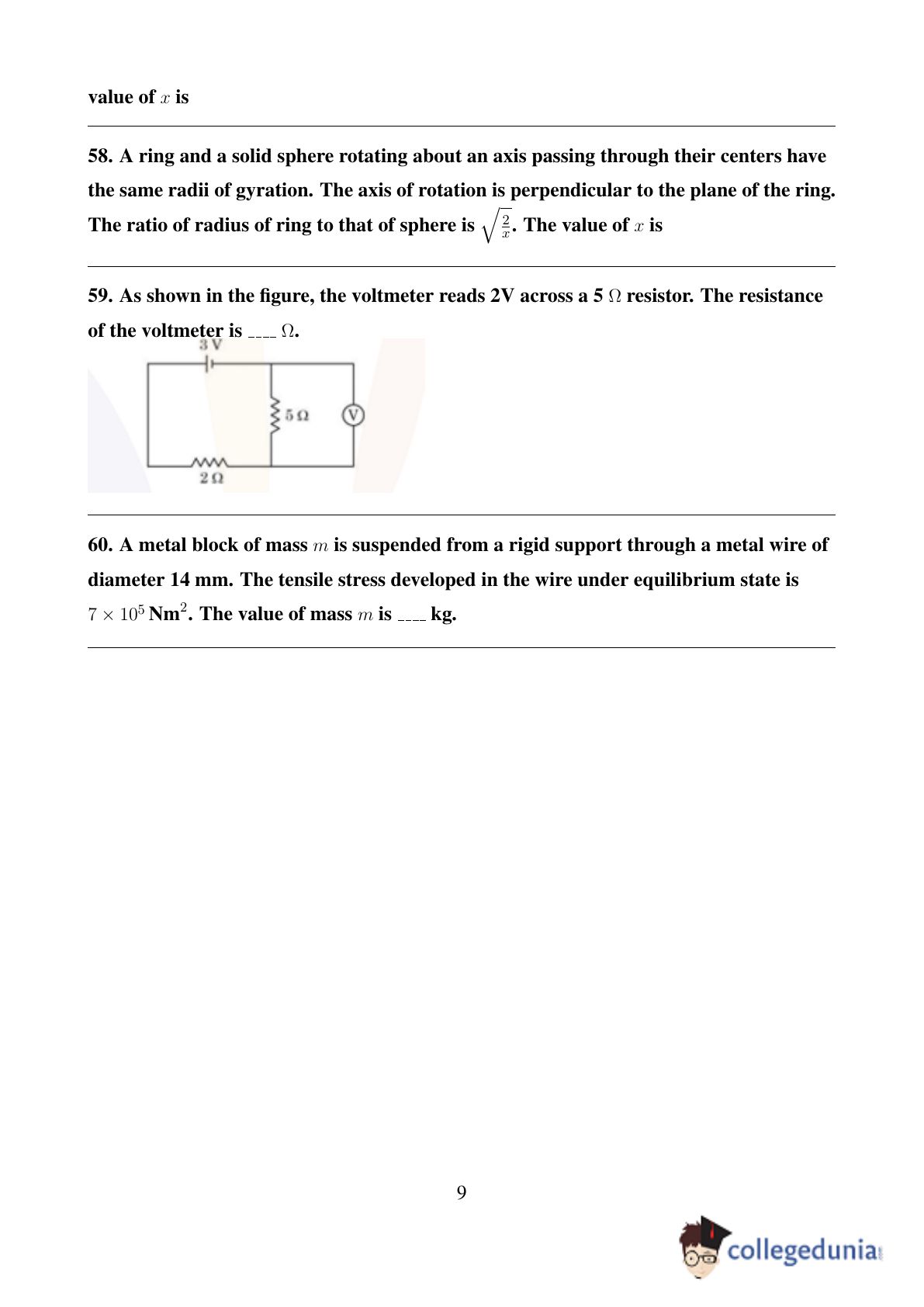
As shown in the figure, the voltmeter reads 2V across a 5 \(\Omega\) resistor. The resistance of the voltmeter is ____ \(\Omega\).

View Solution
Method-I:
The equivalent resistance for the given circuit is:

\[ R_{eq} = 2 + \frac{5R}{5 + R} \]
Using Ohm's law: \[ i = \frac{3}{R_{eq}} = \frac{3}{5 + R} \]
The current in the circuit is: \[ i = 3 \times \frac{5R}{5 + R} \]
From the voltage readings, we calculate \(R = 20 \, \Omega\).
Method-II:
Given potential across 5 \(\Omega\) and voltmeter is 2V, to find the resistance \(R\) of the voltmeter: \[ i = \frac{2}{5} = \frac{1}{2} \]
Using junction law: \[ i = i_1 + i_2 \]
Hence, \(R = 20 \, \Omega\).
Quick Tip: In voltage divider circuits, the resistance of the voltmeter plays a crucial role in the reading and must be taken into account when calculating the equivalent resistance.
A metal block of mass \(m\) is suspended from a rigid support through a metal wire of diameter 14 mm. The tensile stress developed in the wire under equilibrium state is \(7 \times 10^5 \, Nm^2\). The value of mass \(m\) is ____ kg.
View Solution
Using stress = \(\frac{force}{area} = \frac{mg}{A}\)
\[ \Rightarrow m = \frac{S \times A}{g} \] \[ m = \frac{7 \times 10^5 \times \pi \times (7 \times 10^{-3})^2}{9.8} \] \[ m = \frac{7 \times 10^5 \times \frac{22}{7} \times (7 \times 10^{-3})^2}{9.8} \] \[ m = 11 \, kg \]
(Note: \(14 \, mm\) is diameter)
Quick Tip: The formula for stress is \(Stress = \frac{Force}{Area}\), where area is the cross-sectional area of the wire, and force is due to the weight of the block.
JEE Main 2023 Physics Paper Analysis April 6 Shift 2
JEE Main 2023 Physics Paper Analysis for the exam scheduled on April 6 Shift 2 is available here. Candidates can check subject-wise paper analysis for the exam scheduled on April 6 Shift 2 here along with the topics with the highest weightage.
JEE Main 2023 Physics Question Paper Pattern
| Feature | Question Paper Pattern |
|---|---|
| Examination Mode | Computer-based Test |
| Exam Language | 13 languages (English, Hindi, Assamese, Bengali, Gujarati, Kannada, Malayalam, Marathi, Odia, Punjabi, Tamil, Telugu, and Urdu) |
| Exam Duration | 3 hours |
| Sectional Time Limit | None |
| Physics Marks | 100 marks |
| Total Number of Questions Asked | 20 MCQs + 10 Numerical Type Questions |
| Total Number of Questions to be Answered | 20 MCQs + 5 Numerical Type Questions |
| Marking Scheme | +4 for each correct answer |
| Negative Marking | -1 for each incorrect answer |
Also Check:
JEE Main Previous Year Question Paper
| JEE Main 2022 Question Paper | JEE Main 2021 Question Paper | JEE Main 2020 Question Paper |
| JEE Main 2019 Question Paper | JEE Main 2018 Question Paper | JEE Main 2017 Question Paper |



Comments