




Thermodynamics and the Gaseous State are essential topics in Physical Chemistry for JEE Mains. The Thermodynamics and the Gaseous State in JEE Mains contribute approximately 8-10% weighatge to the total Chemistry marks, with 2-3 questions usually asked from each topic.
Most common topics and questions of Thermodynamics and the Gaseous State from JEE Main and JEE Advanced are laws of thermodynamics, entropy, enthalpy, Gibbs free energy, ideal gas laws, and real gases. There are 25 questions in the Chemistry paper of JEE Main.
These concepts are vital for solving problems related to heat exchange, chemical reactions, and energy efficiency. Similarly, the Gaseous State focuses on the properties and behavior of gases, including gas laws, Ideal Gas Law, Kinetic Molecular Theory, and real gases.
Must Read Articles
- Download JEE Main Last 10 year PYQ for Free
- Download JEE Main 2025 Shift 1 Question Paper with Detailed Solutions
Listed below is the list of Thermodynamics and the Gaseous State questions with detailed solutions asked in JEE Main.

Question 1.
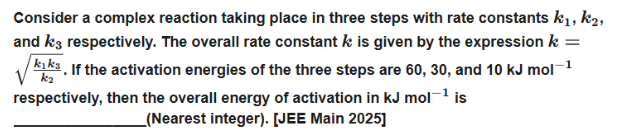
Question 2.
The possible number of stereoisomers for 5-phenylpent-4-en-2-ol is: ______________
[JEE Main 2025]
Question 3.

Question 4.
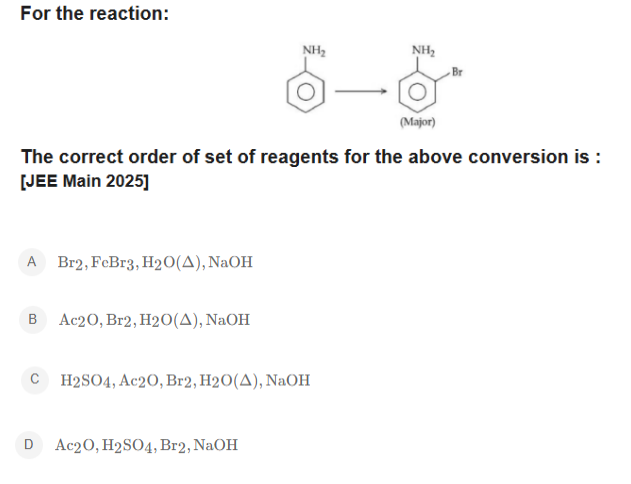
Question 5.
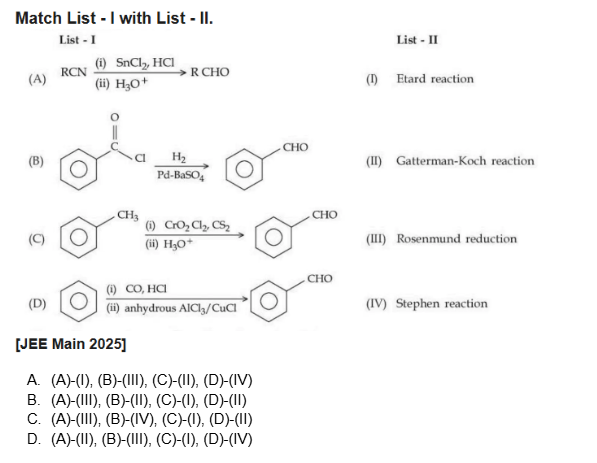
Question 6.
The elemental composition of a compound is 54.2%C, 9.2%H, and 36.6%O. If the molar mass of the compound is 132 g/mol, the molecular formula of the compound is: [JEE Main 2025]
A. C6H12O6
B. C6H12O3
C. C4H9O3
D. C4H8O2
Question 7.
When Ethane-1,2-diamine is added progressively to an aqueous solution of Nickel (II) chloride, the sequence of colour change observed will be: [JEE Main 2025]
A. Green → Pale Blue → Blue → Violet
B. Pale Blue → Blue → Green → Violet
C. Pale Blue → Blue → Violet → Green
D. Violet → Blue → Pale Blue → Green
Question 8.
Which of the following mixing of 1M base and 1M acid leads to the largest increase in temperature? [JEE Main 2025]
A. 30 mL CH₃COOH and 30 mL NaOH
B. 45 mL CH₃COOH and 25 mL NaOH
C. 50 mL HCl and 20 mL NaOH
D. 30 mL HCl and 30 mL NaOH
Question 9.
In the given structure, the number of sp and sp² hybridized carbon atoms present respectively are: [JEE Main 2025]

A. 3 and 5
B. 4 and 5
C. 3 and 6
D. 4 and 6
Question 10.

A. 348 K and 300 J
B. 378 K and 500 J
C. 378 K and 300 J
D. 368 K and 500 J
Question 11.
If
C(diamond) → C(graphite) + X kJ mol⁻¹
C(diamond) + O₂(g) → CO(g) + Y kJ mol⁻¹
C(graphite) + O₂(g) → CO(g) + Z kJ mol⁻¹
At constant temperature. Then: [JEE Main 2025]
A. X = Y + Z
B. X − Y = Z
C. X = Y − Z
D. X = Z
Question 12.
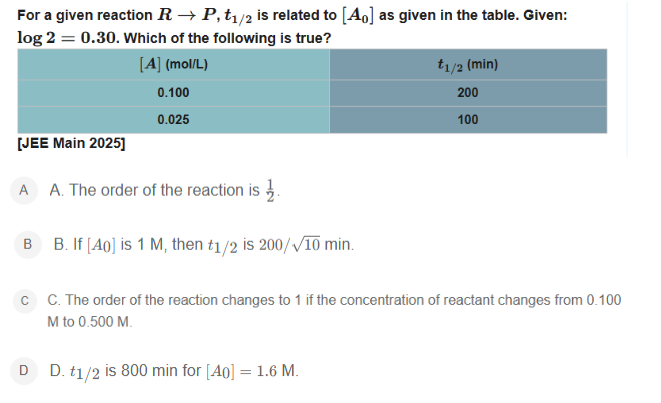
Question 13.
The molarity of a 70%(mass/mass) aqueous solution of a monobasic acid (X) is: [JEE Main 2025]
Question 14.
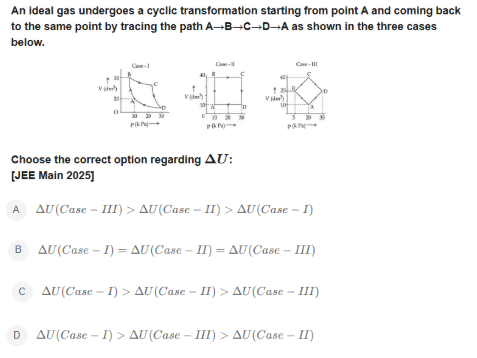
Question 15.

- 8
- 12
- -12
- -8
JEE Main Chemistry Paper Pattern

JEE Main Chemistry Chapter - Wise Weightage
The JEE Main 2025 Chemistry Chapter is divided into 3 sections i.e. Inorganic Chemistry, Organic Chemistry, and Physical Chemistry.
The major topics in Inorganic Chemistry are, Transition Elements, Coordination Compounds, and Periodic Table and p-Block Elements account for 9.9% (3-4 questions). Whereas, Atomic Structure, Chemical Bonding, and Environmental Chemistry account for 6.6% each, or about 2 questions.
In Organic Chemistry, the Biomolecules, Carbohydrates, and Carboxylic Acids chapters hold 6.6% weightage each. Aromatic Compounds and Hydrocarbons sections have 3.3%, so organic chemistry is an important subject.
The Physical Chemistry chapters of Chemical Kinetics and Electrochemistry hold 3.3% each or 1 question each. They are compulsory but have less weightage as compared to inorganic and organic chemistry.
JEE Main 2025 Chemistry Chapter-Wise Weightage
| Chapter | Approximate Weightage (%) | Number of Questions |
|---|---|---|
| Transition Elements and Coordination Compounds | 9.9% | 3-4 |
| Periodic Table and p-Block Elements | 9.9% | 3-4 |
| Atomic Structure | 6.6% | 2 |
| Nuclear and Environmental Chemistry | 6.6% | 2 |
| Chemical Bonding and Molecular Structure | 6.6% | 2 |
| Chemical and Ionic Equilibrium | 6.6% | 2 |
| Thermodynamics and the Gaseous State | 6.6% | 2 |
| Biomolecules | 6.6% | 2 |
| Carbohydrates, Amino Acids, and Polymers | 6.6% | 2 |
| Carboxylic Acids and their Derivatives | 6.6% | 2 |
| Aromatic Compounds | 6.6% | 2 |
| General Organic Chemistry | 3.3% | 1 |
| Stereochemistry | 3.3% | 1 |
| Hydrocarbons | 3.3% | 1 |
| Alkyl Halides | 3.3% | 1 |
| Solutions and Colligative Properties | 3.3% | 1 |
| Electrochemistry | 3.3% | 1 |
| Chemical Kinetics | 3.3% | 1 |
| Redox Reactions | 3.3% | 1 |
| Mole Concept | 3.3% | 1 |
| Solid State and Surface Chemistry | 3.3% | 1 |
| Transition Elements | 3.3% | 1 |
| Coordination Compounds | 3.3% | 1 |
| General Principles of Metallurgy | 3.3% | 1 |
- The inorganic Chemistry section has the highest weightage of 35% in the JEE Main Chemistry Paper.
Organic Chemistry has a weightage of approx 20-25%.
Physical Chemistry is about 15-20% of the total questions.
JEE Main Last 5 Year Chemistry Papers Pdf
JEE Main 2024 Chemistry Question Paper Session 1
| Exam Date | Question Paper | Solution PDF |
|---|---|---|
| JEE Main 2024 Feb 1 Shift 2 Chemistry Question Paper | Download | Check Solution |
| JEE Main 2024 Feb 1 Shift 1 Chemistry Question Paper | Download | Check Solution |
| JEE Main 2024 Jan 31 Shift 2 Chemistry Question Paper | Download | Check Solution |
| JEE Main 2024 Jan 31 Shift 1 Chemistry Question Paper | Download | Check Solution |
| JEE Main 2024 Jan 30 Shift 2 Chemistry Question Paper | Download | Check Solution |
| JEE Main 2024 Jan 30 Shift 1 Chemistry Question Paper | Download | Check Solution |
| JEE Main 2024 Jan 29 Shift 2 Chemistry Question Paper | Download | Check Solution |
| JEE Main 2024 Jan 29 Shift 1 Chemistry Question Paper | Download | Check Solution |
| JEE Main 2024 Jan 27 Shift 2 Chemistry Question Paper | Download | Check Solution |
| JEE Main 2024 Jan 27 Shift 1 Chemistry Question Paper | Download | Check Solution |
JEE Main 2024 Chemistry Question Paper Session 2
| Exam Date and Shift | Question Paper | Solution PDF |
|---|---|---|
| JEE Main 2024 April 4 Shift 1 Chemistry Question Paper | Download | Check Solution |
| JEE Main 2024 April 4 Shift 2 Chemistry Question Paper | Download | Check Solution |
| JEE Main 2024 April 5 Shift 1 Chemistry Question Paper | Download | Check Solution |
| JEE Main 2024 April 5 Shift 2 Chemistry Question Paper | Download | Check Solution |
| JEE Main 2024 April 6 Shift 1 Chemistry Question Paper | Download | Check Solution |
| JEE Main 2024 April 6 Shift 2 Chemistry Question Paper | Download | Check Solution |
| JEE Main 2024 April 8 Shift 1 Chemistry Question Paper | Download | Check Solution |
| JEE Main 2024 April 8 Shift 2 Chemistry Question Paper | Download | Check Solution |
| JEE Main 2024 April 9 Shift 1 Chemistry Question Paper | Download | Check Solution |
| JEE Main 2024 April 9 Shift 2 Chemistry Question Paper | Download | Check Solution |
JEE Main 2023 Chemistry Question Paper Session 2
| Exam Date | Chemistry Question Paper 2023 |
|---|---|
| Chemistry 6 April Shift 1 Question Paper | Check Here |
| Chemistry 6 April Shift 2 Question Paper | Check Here |
| Chemistry 8 April Shift 1 Question Paper | Check Here |
| Chemistry 8 April Shift 2 Question Paper | Check Here |
| Chemistry 10 April Shift 1 Question Paper | Check Here |
| Chemistry 10 April Shift 2 Question Paper | Check Here |
| Chemistry 11 April Shift 1 Question Paper | Check Here |
| Chemistry 11 April Shift 2 Question Paper | Check Here |
| Chemistry 12 April Shift 1 Question Paper | Check Here |
| Chemistry 13 April Shift 1 Question Paper | Check Here |
| Chemistry 13 April Shift 2 Question Paper | Check Here |
| Chemistry 15 April Shift 1 Question Paper | Check Here |
JEE Main 2023 Chemistry Question Paper Session 1
| Exam Date and Shift | Chemistry Question Paper 2023 |
|---|---|
| Chemistry 24 January Shift 1 Question Paper | Check Here |
| 2023 Chemistry 24 January Shift 2 Question Paper | Check Here |
| Chemistry 25 January Shift 1 Question Paper | Check Here |
| Chemistry 25 January Shift 2 Question Paper | Check Here |
| Chemistry 29 January Shift 1 Question Paper | Check Here |
| Chemistry 29 January Shift 2 Question Paper | Check Here |
| Chemistry 30 January Shift 1 Question Paper | Check Here |
| Chemistry 30 January Shift 2 Question Paper | Check Here |
| Chemistry 31 January Shift 1 Question Paper | Check Here |
| Chemistry 31 January Shift 2 Question Paper | Check Here |
| Chemistry 1 February Shift 1 Question Paper | Check Here |
| Chemistry 1 February Shift 2 Question Paper | Check Here |
JEE Main 2022 Chemistry Question Paper with Solution PDF- Phase 2
| Exam Date | Shift/ Slot | Question Paper PDF |
|---|---|---|
| July 25 | Shift 1 | Check Here |
| July 25 | Shift 2 | Check Here |
| July 26 | Shift 1 | Check Here |
| July 26 | Shift 2 | Check Here |
| July 27 | Shift 1 | Check Here |
| July 27 | Shift 2 | Check Here |
| July 28 | Shift 1 | Check Here |
| July 28 | Shift 2 | Check Here |
| July 29 | Shift 1 | Check Here |
| July 29 | Shift 2 | Check Here |
JEE Main 2022 Chemistry Question Paper with Solution PDF- Phase 1
| Exam Date | Shift/ Slot | Question Paper PDF |
|---|---|---|
| June 29 | Shift 1 | Check Here |
| June 29 | Shift 2 | Check Here |
| June 28 | Shift 1 | Check Here |
| June 28 | Shift 2 | Check Here |
| June 27 | Shift 1 | Check Here |
| June 27 | Shift 2 | Check Here |
| June 26 | Shift 1 | Check Here |
| June 26 | Shift 2 | Check Here |
| June 25 | Shift 1 | Check Here |
| June 25 | Shift 2 | Check Here |
| June 24 | Shift 1 | Check Here |
| June 24 | Shift 2 | Check Here |
JEE Main 2021 Chemistry Question Paper with Solution (Session 4- August)- Download PDF
| Exam Date | Shift/ Slot | Question Paper PDF |
|---|---|---|
| August 26 | Shift 1 | Check Here |
| August 26 | Shift 2 | Check Here |
| August 27 | Shift 1 | Check Here |
| August 27 | Shift 2 | Check Here |
| August 31 | Shift 1 | Check Here |
| August 31 | Shift 2 | Check Here |
| September 1 | Shift 2 | Check Here |
JEE Main 2021 Chemistry Question Paper with Solution (Session 3- July)- Download PDF
| Exam Date | Shift/ Slot | Question Paper PDF |
|---|---|---|
| July 22 | Shift 2 | Check Here |
| July 25 | Shift 1 | Check Here |
| July 25 | Shift 2 | Check Here |
| July 27 | Shift 1 | Check Here |
| August 3 | Shift 1 | Check Here |
| August 3 | Shift 2 | Check Here |
| August 4 | Shift 1 | Check Here |
| August 4 | Shift 2 | Check Here |
JEE Main 2021 Chemistry Question Paper with Solution (Session 2- March)- Download PDF
| Exam Date | Shift/ Slot | Question Paper PDF |
|---|---|---|
| March 16 | Shift 1 | Check Here |
| March 16 | Shift 2 | Check Here |
| March 17 | Shift 1 | Check Here |
| March 17 | Shift 2 | Check Here |
| March 18 | Shift 1 | Check Here |
| March 18 | Shift 2 | Check Here |
JEE Main 2021 Chemistry Question Paper with Solution (Session 1- February)- Download PDF
| Exam Date | Shift/ Slot | Question Paper PDF |
|---|---|---|
| February 24 | Shift 1 | Check Here |
| February 24 | Shift 2 | Check Here |
| February 25 | Shift 1 | Check Here |
| February 25 | Shift 2 | Check Here |
| February 26 | Shift 1 | Check Here |
| February 26 | Shift 2 | Check Here |
JEE Main 2020 Chemistry Question Paper with Solutions (Session 2- September)- Download PDF
| Exam Date | Shift/ Slot | JEE Main Question Paper PDF |
|---|---|---|
| September 2 | Shift 1 | Check Here |
| September 2 | Shift 2 | Check Here |
| September 3 | Shift 1 | Check Here |
| September 3 | Shift 2 | Check Here |
| September 4 | Shift 1 | Check Here |
| September 4 | Shift 2 | Check Here |
| September 5 | Shift 1 | Check Here |
| September 5 | Shift 2 | Check Here |
| September 6 | Shift 1 | Check Here |
| September 6 | Shift 2 | Check Here |
JEE Main 2020 Chemistry Question Paper with Solutions (Session 1- January)- Download PDF
| Exam Date | Shift/ Slot | JEE Main Question Paper PDF |
|---|---|---|
| January 8 | Shift 1 | Check Here |
| January 8 | Shift 2 | Check Here |
| January 9 | Shift 1 | Check Here |
| January 9 | Shift 2 | Check Here |
Important Topics Related toThermodynamics and the Gaseous State
- Relation Between Molarity and Molality: Definition & Formula
- NCERT Class 12 Chemistry Book PDF
- Structure of Atom Class 11 MCQ
Frequently Asked Questions
Q1. Is thermodynamics tough in JEE?
Answer: The difficulty level of Thermodynamics is rated as moderately difficult in JEE.
- In JEE Mains, thermodynamics has about 5–6% weightage of the total marks, which is about 2–3 questions from the topics of the first law, entropy, enthalpy, and Gibbs free energy.
- In JEE Advanced, thermodynamics typically has a weightage of 6–8%.
Q2. What chapters have more weightage in the JEE Mains?
Answer: JEE Mains varies slightly every year, but certain chapters from Physics, Chemistry, and Mathematics are consistently given higher weightage.
Check: JEE Main 2025 Chapter Wise Weightage
| Subject | Chapter | Weightage (%) | Topics Covered |
|---|---|---|---|
| Physics | Mechanics (Kinematics, Laws of Motion) | 15–20% | Motion, Newton's laws, work-energy theorem, conservation of momentum, circular motion, rotational motion. |
| Physics | Electricity and Magnetism | 10–15% | Electrostatics, current electricity, magnetism, electromagnetic induction, alternating current (AC). |
| Physics | Optics | 8–10% | Reflection, refraction, lenses, optical instruments, wave optics. |
| Chemistry | Physical Chemistry (Thermodynamics, Gaseous State, Chemical Kinetics) | 12–15% | Laws of thermodynamics, ideal gas laws, entropy, reaction rates, Arrhenius equation. |
| Chemistry | Inorganic Chemistry (Periodic Table, Coordination Compounds) | 10–12% | Trends in the periodic table, chemical bonding, d-block elements, isomerism in coordination compounds. |
| Chemistry | Organic Chemistry (Aromatic Compounds, Hydrocarbons, Polymers) | 8–10% | Benzene derivatives, functional groups, nomenclature, reactions of alkenes, alkynes, and polymers. |
| Mathematics | Algebra (Quadratic Equations, Complex Numbers) | 12–15% | Roots of equations, polynomial equations, properties of complex numbers, binomial theorem. |
| Mathematics | Calculus (Differentiation, Integration) | 15–20% | Limits, continuity, differentiation, definite and indefinite integrals, applications of integrals. |
| Mathematics | Coordinate Geometry (Straight Lines, Circles) | 8–10% | Equation of straight lines, slopes, distance between points, circle equations, tangents, and normal. |
| Mathematics | Probability and Statistics | 6–8% | Permutation, combination, probability, mean, median, standard deviation. |
Q3. Is scoring 150 marks in JEE Mains easy?
Answer: Scoring 150 marks in JEE Mains is possible with proper preparation, but it's not a cakewalk. It can be simple or difficult based on the year, but 150 will broadly fall under moderate to difficult as per difficulty levels.
- High-Weightage Topics: For scoring 150, the candidate must prioritize the high-weightage topics in JEE Main such as Mechanics, Thermodynamics, and Calculus.
- Consistency and Practice: Practice regularly improves the speed and accuracy, which is extremely crucial in order to secure high marks in JEE Mains.
- Time Management: Time management is essential at the time of the exam. Attempt questions for which you are most sure first, and don't waste much time on a single question.
- Conceptual Clarity: To have a lucid understanding of fundamental concepts facilitates your comprehension of the question when you are in the exam room.
Also Check: How to Prepare for JEE Main?



Comments