




The most asked topics and questions from Transition Elements and Coordinate Chemistry in JEE Main and JEE Advanced are d-block elements' properties, electronic configurations, and coordination compounds. JEE Main Chemistry paper consists of 25 questions.
The Transition Elements and Coordination Chemistry contribute approximately 9.9% of the total Chemistry Weightage which is about 3-4 questions in the JEE Mains exam.
The exam consists of 20 MCQ-type questions and 5 Numerical Value Based Questions, with a marking scheme of +4 marks for correct answers and -1 mark for incorrect answers.
Must Read Articles
- Download JEE Main Last 10 year PYQ for Free
- Download JEE Main 2025 Shift 1 Question Paper with Detailed Solutions
Listed below is the list of Transition Elements and Coordinate Chemistry questions with detailed solutions asked in JEE Main.

Question 1.


Question 2.
The complex that shows Facial - Meridional isomerism is: [JEE Main 2025]
A. \( [Co(NH_3)_3Cl_3]^+ \)
B. \( [Co(NH_3)_4Cl_2]^+ \)
C. \( [Co(en)_3]^+ \)
D. \( [Co(en)_2Cl_2]^+ \)
Question 3.
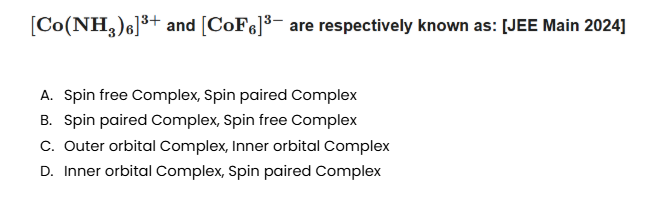
Question 4.

Question 5.

- Fe
- Mn
- Ti
- Co
Question 6.

Question 7.

Question 8.
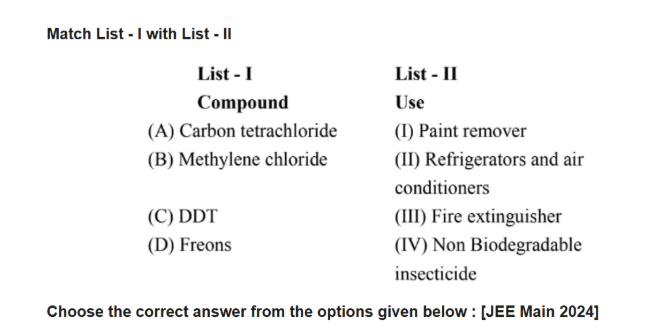
- (A)-(I), (B), (II), (C)-(III), (D)-(IV)
- (A)-(III), (B)-(I), (C)-(IV), (D)-( II)
- (A)-(IV), (B)-(III), (C)-(II), (D)-(I)
- (A)-( II), (B)-(III), (C)-(I), (D)-(IV)
Question 9.

Question 10.

- Statement I is false but Statement II is true
- Both Statement I and Statement II are true
- Both Statement I and Statement II are false
- Statement I is true but Statement II is false
Question 11.

- 3
- 1
- 4
- 2
Question 12.

- 4
- 0
- 2
- 3
Question 13.

- 1
- 3
- 2
- 5
Question 14.

- Statement I is incorrect but Statement II is correct
- Both Statement I and Statement II are correct
- Statement I is correct but Statement II is incorrect
- Both Statement I and Statement II are incorrect
JEE Main Chemistry Paper Pattern
The JEE Main Chemistry section consists of 25 questions, which is divided into two sections:
- Section A (MCQs)
- Section B (Numerical Value Questions)
The total marks allocated for Chemistry is 100.
| Section | Question Type | No. of Questions | Attempt Required | Marking Scheme | Maximum Marks |
|---|---|---|---|---|---|
| A | Multiple Choice (MCQs) | 20 | All Compulsory | (+4) for Correct, -1 for Incorrect | 80 |
| B | Numerical Value Questions | 5 | All Compulsory | (+4) for Correct, No Negative Marking | 20 |
| Total | 25 | 25 | 100 |
JEE Main Chemistry Chapter - Wise Weightage
The JEE Main 2025 Chemistry Chapter is divided into 3 sections i.e. Inorganic Chemistry, Organic Chemistry, and Physical Chemistry.
The major topics in Inorganic Chemistry are, Transition Elements, Coordination Compounds, and Periodic Table and p-Block Elements account for 9.9% (3-4 questions). Whereas, Atomic Structure, Chemical Bonding, and Environmental Chemistry account for 6.6% each, or about 2 questions.
In Organic Chemistry, the Biomolecules, Carbohydrates, and Carboxylic Acids chapters hold 6.6% weightage each. Aromatic Compounds and Hydrocarbons sections have 3.3%, so organic chemistry is an important subject.
The Physical Chemistry chapters of Chemical Kinetics and Electrochemistry hold 3.3% each or 1 question each. They are compulsory but have less weightage as compared to inorganic and organic chemistry.
JEE Main 2025 Chemistry Chapter-Wise Weightage
| Chapter | Approximate Weightage (%) | Number of Questions |
|---|---|---|
| Transition Elements and Coordination Compounds | 9.9% | 3-4 |
| Periodic Table and p-Block Elements | 9.9% | 3-4 |
| Atomic Structure | 6.6% | 2 |
| Nuclear and Environmental Chemistry | 6.6% | 2 |
| Chemical Bonding and Molecular Structure | 6.6% | 2 |
| Chemical and Ionic Equilibrium | 6.6% | 2 |
| Thermodynamics and the Gaseous State | 6.6% | 2 |
| Biomolecules | 6.6% | 2 |
| Carbohydrates, Amino Acids, and Polymers | 6.6% | 2 |
| Carboxylic Acids and their Derivatives | 6.6% | 2 |
| Aromatic Compounds | 6.6% | 2 |
| General Organic Chemistry | 3.3% | 1 |
| Stereochemistry | 3.3% | 1 |
| Hydrocarbons | 3.3% | 1 |
| Alkyl Halides | 3.3% | 1 |
| Solutions and Colligative Properties | 3.3% | 1 |
| Electrochemistry | 3.3% | 1 |
| Chemical Kinetics | 3.3% | 1 |
| Redox Reactions | 3.3% | 1 |
| Mole Concept | 3.3% | 1 |
| Solid State and Surface Chemistry | 3.3% | 1 |
| Transition Elements | 3.3% | 1 |
| Coordination Compounds | 3.3% | 1 |
| General Principles of Metallurgy | 3.3% | 1 |
- Inorganic Chemistry holds the strong section of 35% of the questions in the JEE Main Chemistry Paper.
- Organic Chemistry holds the approx of 20-25% of the total weightage.
- Physical Chemistry is about 15-20% of the total questions.
JEE Main Last 5 Year Chemistry Papers Pdf
JEE Main 2024 Chemistry Question Paper Session 1
| Exam Date | Question Paper | Solution PDF |
|---|---|---|
| JEE Main 2024 Feb 1 Shift 2 Chemistry Question Paper | Download | Check Solution |
| JEE Main 2024 Feb 1 Shift 1 Chemistry Question Paper | Download | Check Solution |
| JEE Main 2024 Jan 31 Shift 2 Chemistry Question Paper | Download | Check Solution |
| JEE Main 2024 Jan 31 Shift 1 Chemistry Question Paper | Download | Check Solution |
| JEE Main 2024 Jan 30 Shift 2 Chemistry Question Paper | Download | Check Solution |
| JEE Main 2024 Jan 30 Shift 1 Chemistry Question Paper | Download | Check Solution |
| JEE Main 2024 Jan 29 Shift 2 Chemistry Question Paper | Download | Check Solution |
| JEE Main 2024 Jan 29 Shift 1 Chemistry Question Paper | Download | Check Solution |
| JEE Main 2024 Jan 27 Shift 2 Chemistry Question Paper | Download | Check Solution |
| JEE Main 2024 Jan 27 Shift 1 Chemistry Question Paper | Download | Check Solution |
JEE Main 2024 Chemistry Question Paper Session 2
| Exam Date and Shift | Question Paper | Solution PDF |
|---|---|---|
| JEE Main 2024 April 4 Shift 1 Chemistry Question Paper | Download | Check Solution |
| JEE Main 2024 April 4 Shift 2 Chemistry Question Paper | Download | Check Solution |
| JEE Main 2024 April 5 Shift 1 Chemistry Question Paper | Download | Check Solution |
| JEE Main 2024 April 5 Shift 2 Chemistry Question Paper | Download | Check Solution |
| JEE Main 2024 April 6 Shift 1 Chemistry Question Paper | Download | Check Solution |
| JEE Main 2024 April 6 Shift 2 Chemistry Question Paper | Download | Check Solution |
| JEE Main 2024 April 8 Shift 1 Chemistry Question Paper | Download | Check Solution |
| JEE Main 2024 April 8 Shift 2 Chemistry Question Paper | Download | Check Solution |
| JEE Main 2024 April 9 Shift 1 Chemistry Question Paper | Download | Check Solution |
| JEE Main 2024 April 9 Shift 2 Chemistry Question Paper | Download | Check Solution |
JEE Main 2023 Chemistry Question Paper Session 2
| Exam Date | Chemistry Question Paper 2023 |
|---|---|
| Chemistry 6 April Shift 1 Question Paper | Check Here |
| Chemistry 6 April Shift 2 Question Paper | Check Here |
| Chemistry 8 April Shift 1 Question Paper | Check Here |
| Chemistry 8 April Shift 2 Question Paper | Check Here |
| Chemistry 10 April Shift 1 Question Paper | Check Here |
| Chemistry 10 April Shift 2 Question Paper | Check Here |
| Chemistry 11 April Shift 1 Question Paper | Check Here |
| Chemistry 11 April Shift 2 Question Paper | Check Here |
| Chemistry 12 April Shift 1 Question Paper | Check Here |
| Chemistry 13 April Shift 1 Question Paper | Check Here |
| Chemistry 13 April Shift 2 Question Paper | Check Here |
| Chemistry 15 April Shift 1 Question Paper | Check Here |
JEE Main 2023 Chemistry Question Paper Session 1
| Exam Date and Shift | Chemistry Question Paper 2023 |
|---|---|
| Chemistry 24 January Shift 1 Question Paper | Check Here |
| 2023 Chemistry 24 January Shift 2 Question Paper | Check Here |
| Chemistry 25 January Shift 1 Question Paper | Check Here |
| Chemistry 25 January Shift 2 Question Paper | Check Here |
| Chemistry 29 January Shift 1 Question Paper | Check Here |
| Chemistry 29 January Shift 2 Question Paper | Check Here |
| Chemistry 30 January Shift 1 Question Paper | Check Here |
| Chemistry 30 January Shift 2 Question Paper | Check Here |
| Chemistry 31 January Shift 1 Question Paper | Check Here |
| Chemistry 31 January Shift 2 Question Paper | Check Here |
| Chemistry 1 February Shift 1 Question Paper | Check Here |
| Chemistry 1 February Shift 2 Question Paper | Check Here |
JEE Main 2022 Chemistry Question Paper with Solution PDF- Phase 2
| Exam Date | Shift/ Slot | Question Paper PDF |
|---|---|---|
| July 25 | Shift 1 | Check Here |
| July 25 | Shift 2 | Check Here |
| July 26 | Shift 1 | Check Here |
| July 26 | Shift 2 | Check Here |
| July 27 | Shift 1 | Check Here |
| July 27 | Shift 2 | Check Here |
| July 28 | Shift 1 | Check Here |
| July 28 | Shift 2 | Check Here |
| July 29 | Shift 1 | Check Here |
| July 29 | Shift 2 | Check Here |
JEE Main 2022 Chemistry Question Paper with Solution PDF- Phase 1
| Exam Date | Shift/ Slot | Question Paper PDF |
|---|---|---|
| June 29 | Shift 1 | Check Here |
| June 29 | Shift 2 | Check Here |
| June 28 | Shift 1 | Check Here |
| June 28 | Shift 2 | Check Here |
| June 27 | Shift 1 | Check Here |
| June 27 | Shift 2 | Check Here |
| June 26 | Shift 1 | Check Here |
| June 26 | Shift 2 | Check Here |
| June 25 | Shift 1 | Check Here |
| June 25 | Shift 2 | Check Here |
| June 24 | Shift 1 | Check Here |
| June 24 | Shift 2 | Check Here |
JEE Main 2021 Chemistry Question Paper with Solution (Session 4- August)- Download PDF
| Exam Date | Shift/ Slot | Question Paper PDF |
|---|---|---|
| August 26 | Shift 1 | Check Here |
| August 26 | Shift 2 | Check Here |
| August 27 | Shift 1 | Check Here |
| August 27 | Shift 2 | Check Here |
| August 31 | Shift 1 | Check Here |
| August 31 | Shift 2 | Check Here |
| September 1 | Shift 2 | Check Here |
JEE Main 2021 Chemistry Question Paper with Solution (Session 3- July)- Download PDF
| Exam Date | Shift/ Slot | Question Paper PDF |
|---|---|---|
| July 22 | Shift 2 | Check Here |
| July 25 | Shift 1 | Check Here |
| July 25 | Shift 2 | Check Here |
| July 27 | Shift 1 | Check Here |
| August 3 | Shift 1 | Check Here |
| August 3 | Shift 2 | Check Here |
| August 4 | Shift 1 | Check Here |
| August 4 | Shift 2 | Check Here |
JEE Main 2021 Chemistry Question Paper with Solution (Session 2- March)- Download PDF
| Exam Date | Shift/ Slot | Question Paper PDF |
|---|---|---|
| March 16 | Shift 1 | Check Here |
| March 16 | Shift 2 | Check Here |
| March 17 | Shift 1 | Check Here |
| March 17 | Shift 2 | Check Here |
| March 18 | Shift 1 | Check Here |
| March 18 | Shift 2 | Check Here |
JEE Main 2021 Chemistry Question Paper with Solution (Session 1- February)- Download PDF
| Exam Date | Shift/ Slot | Question Paper PDF |
|---|---|---|
| February 24 | Shift 1 | Check Here |
| February 24 | Shift 2 | Check Here |
| February 25 | Shift 1 | Check Here |
| February 25 | Shift 2 | Check Here |
| February 26 | Shift 1 | Check Here |
| February 26 | Shift 2 | Check Here |
JEE Main 2020 Chemistry Question Paper with Solutions (Session 2- September)- Download PDF
| Exam Date | Shift/ Slot | JEE Main Question Paper PDF |
|---|---|---|
| September 2 | Shift 1 | Check Here |
| September 2 | Shift 2 | Check Here |
| September 3 | Shift 1 | Check Here |
| September 3 | Shift 2 | Check Here |
| September 4 | Shift 1 | Check Here |
| September 4 | Shift 2 | Check Here |
| September 5 | Shift 1 | Check Here |
| September 5 | Shift 2 | Check Here |
| September 6 | Shift 1 | Check Here |
| September 6 | Shift 2 | Check Here |
JEE Main 2020 Chemistry Question Paper with Solutions (Session 1- January)- Download PDF
| Exam Date | Shift/ Slot | JEE Main Question Paper PDF |
| January 8 | Shift 1 | Check Here |
| January 8 | Shift 2 | Check Here |
| January 9 | Shift 1 | Check Here |
| January 9 | Shift 2 | Check Here |
Important Topics Related to Transition Elements and Coordinate Chemistry
- Relation Between Molarity and Molality: Definition & Formula
- NCERT Class 12 Chemistry Book PDF
- Structure of Atom Class 11 MCQ
Frequently Asked Questions
Q1. Which chemistry has more weightage in JEE Mains?
Answer: In JEE Mains, Organic Chemistry and Inorganic Chemistry carry the maximum weightage with approximately 35% each of the Chemistry paper.
- Inorganic Chemistry (for example, Transition Elements, Coordination Compounds, Periodic Table) carries approximately 35% weightage.
- Organic Chemistry (for example, Biomolecules, Carboxylic Acids, Hydrocarbons) also accounts for 30-35%.
- Physical Chemistry (e.g., Thermodynamics, Electrochemistry, Chemical Kinetics) contributes approximately 25-30%.
Q2. What is the toughest chapter in chemistry for JEE?
Answer: The most challenging chapters in Chemistry for JEE have the following approximate weightage:
Coordination Compounds (Inorganic Chemistry):
- Weightage: 9.9% (approximately 3-4 questions)
- This chapter is important for understanding complex geometry and bonding, which is usually considered difficult because of the depth of the subject.
Chemical Bonding and Molecular Structure (Inorganic Chemistry):
- Weightage: 6.6% (approximately 2 questions)
- A difficult topic because of the fine understanding needed in concepts such as hybridization, molecular orbital theory, and polarity of the bond.
Chemical Kinetics (Physical Chemistry):
- Weightage: 3.3% (approximately 1 question)
- Chemical kinetics is challenging because it deals with reaction rates, activation energy, and intricate calculations involving rate laws.
Thermodynamics (Physical Chemistry):
- Weightage: 6.6% (approximately 2 questions)
- This subject includes important concepts like entropy, enthalpy, and Gibbs free energy, which demand problem-solving and thorough conceptual understanding.
Q3. Are PYQs repeated in JEE Mains?
Answer: No, PYQs are not repeated as such in JEE Mains. Whereas, the concept and nature of questions from previous years tend to return in some other form.
- JEE Mains generally attempts to test the same fundamental subjects every year, so PYQs make you familiar with the pattern of the exam and commonly tested concepts.
- While the precise questions are not recycled, the difficulty, question style, and conceptual emphasis are frequently the same.
Q4. Coordination Compounds JEE Mains weightage
Answer: The Coordinate Compounds in the JEE Main holds approximately 9.9% weightage, which corresponds to about 3-4 questions in the exam.
Coordinate Chemistry is the part of inorganic Chemistry, the topics like coordination number, ligand types, isomerism, and bonding in coordination compounds are important to understand.
Q5. Coordination Compounds JEE Mains Notes
Answer: Coordination Compounds is an important concept in Inorganic Chemistry for JEE Mains. Coordination Compounds consist of a central metal atom or ion bonded to the surrounding ligands by coordinate bonds. These compounds have significant applications in various fields, including catalysis, medicine, and material science.
Click here to How to Prepare for JEE Main Chemistry? IIT JEE Study Plan, Time Table, Best Books, Mock Tests, PYQs



Comments