




JEE Main 2021 August 31 Shift 1 Question Paper is available here with solutions PDF and detailed solutions for every question. NTA conducted the first shift on August 31, 2021, from 9:00 AM to 12:00 PM. The JEE Main 2021 Paper 1 (B.E./B.Tech) question paper includes the following:
- 90 questions in a 3-hour CBT Mode: 30 each from Mathematics, Physics and Chemistry (75 to be attempted)
- Section A: 20 multiple choice questions (MCQs) per subject, all compulsory, 4 marks each
- Section B: 10 numerical value questions per subject, any 5 to be attempted, 4 marks each
- Marking: +4 for a correct answer, -1 for an incorrect MCQ, 0 for an unattempted question; no negative marking for numerical value questions
- Maximum marks: 300 (100 per subject)
JEE Main 2021 August 31 Shift 1 Question Paper with Solution PDF
| NTA Official PDF | CD PDF | CD PDF with Solutions |
|---|---|---|
| Download official PDF 6.47 MB | Download Collegedunia PDF 1.05 MB | Download solutions PDF 2.29 MB |
Also Check:
JEE Main 2021 August 31 Shift 1 Questions with Solutions
Mathematics - Section A (Q1 - Q20)
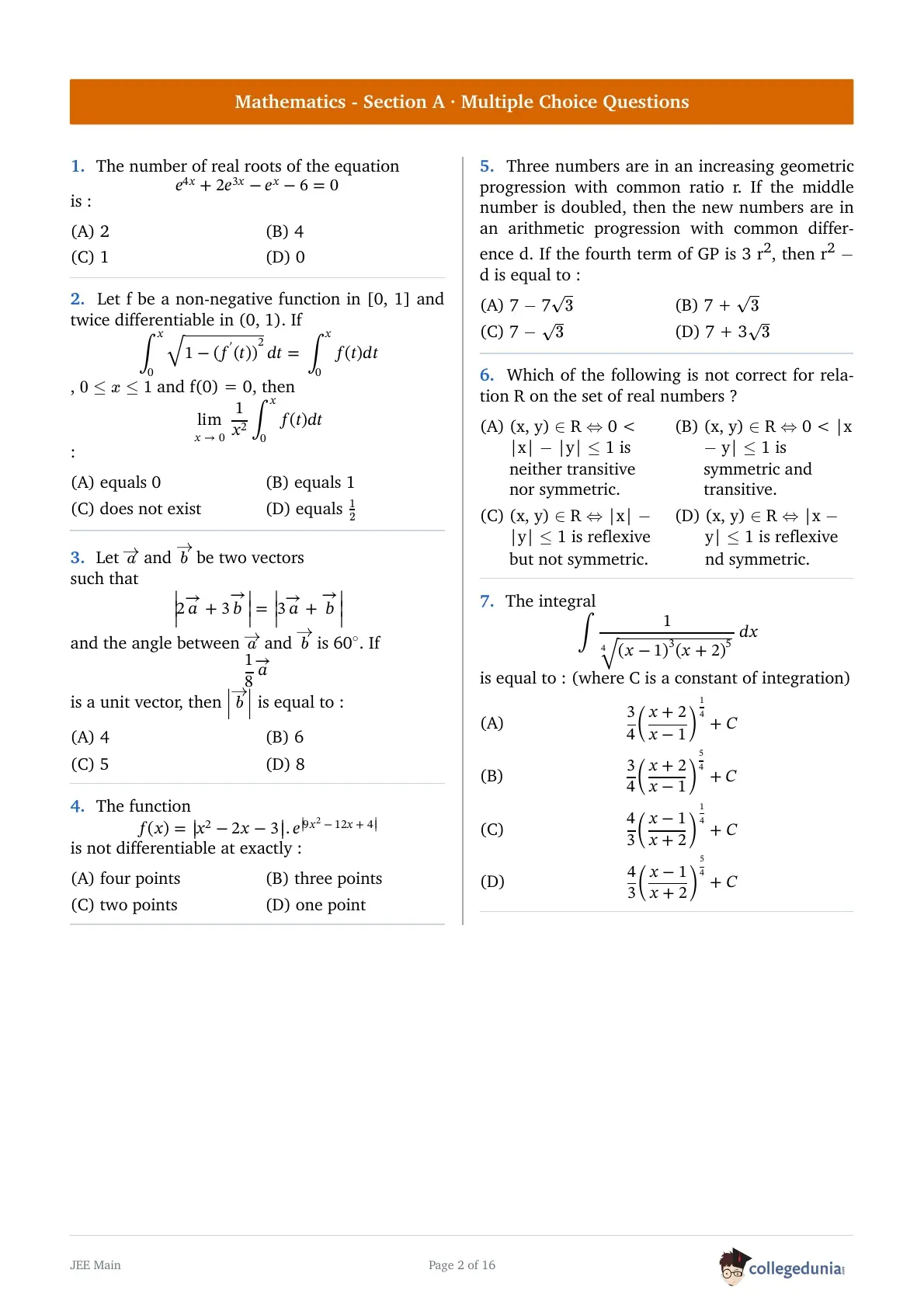
The number of real roots of the equation \( e^{4x} + 2e^{3x} - e^x - 6 = 0 \) is :
Let \(f\) be a non-negative function in \([0, 1]\) and twice differentiable in \((0, 1)\). If \(\int_0^x \sqrt{1 - (f'(t))^2} \, dt = \int_0^x f(t) \, dt\), \(0 \leq x \leq 1\) and \(f(0) = 0\), then \(\lim_{x \to 0} \frac{1}{x^2} \int_0^x f(t) \, dt\) :
Let \(\vec{a}\) and \(\vec{b}\) be two vectors such that \(|2\vec{a} + 3\vec{b}| = |3\vec{a} + \vec{b}|\) and the angle between \(\vec{a}\) and \(\vec{b}\) is \(60^\circ\). If \(\frac{1}{8} \vec{a}\) is a unit vector, then \(|\vec{b}|\) is equal to :
The function \(f(x) = |x^2 - 2x - 3| \cdot e^{|9x^2 - 12x + 4|}\) is not differentiable at exactly :
Three numbers are in an increasing geometric progression with common ratio \( r \). If the middle number is doubled, then the new numbers are in an arithmetic progression with common difference \( d \). If the fourth term of GP is \( 3 r^2 \), then \( r^2 - d \) is equal to :
Which of the following is not correct for relation \( R \) on the set of real numbers?
The integral \(\int \frac{1}{\sqrt[4]{(x - 1)^3 (x + 2)^5}} \, dx\) is equal to :
(where C is a constant of integration)
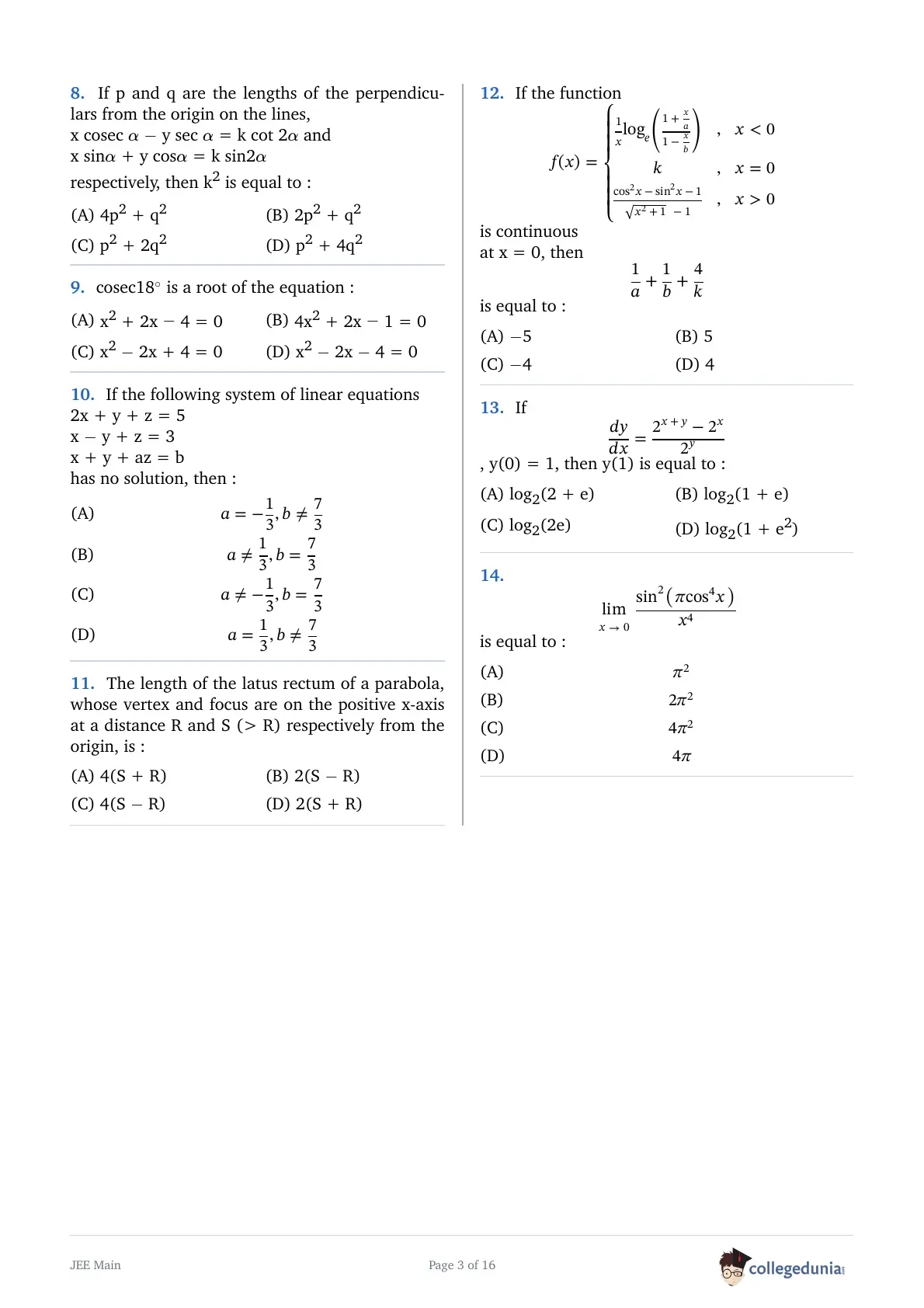
If \(p\) and \(q\) are the lengths of the perpendiculars from the origin on the lines, \(x \csc \alpha - y \sec \alpha = k \cot 2\alpha\) and \(x \sin \alpha + y \cos \alpha = k \sin 2\alpha\) respectively, then \(k^2\) is equal to :
\(\csc 18^\circ\) is a root of the equation :
If the following system of linear equations
\( 2x + y + z = 5 \)
\( x - y + z = 3 \)
\( x + y + az = b \)
has no solution, then :
The length of the latus rectum of a parabola, whose vertex and focus are on the positive \(x\)-axis at a distance \(R\) and \(S\) (\(S>R\)) respectively from the origin, is :
If the function 
is continuous at \(x = 0\), then \(\frac{1}{a} + \frac{1}{b} + \frac{4}{k}\) is equal to :}
If \(\frac{dy}{dx} = \frac{2^{x+y} - 2^x}{2^y}\), \(y(0) = 1\), then \(y(1)\) is equal to :
\( \lim_{x \to 0} \frac{\sin^2(\pi \cos^4 x)}{x^4} \) is equal to :
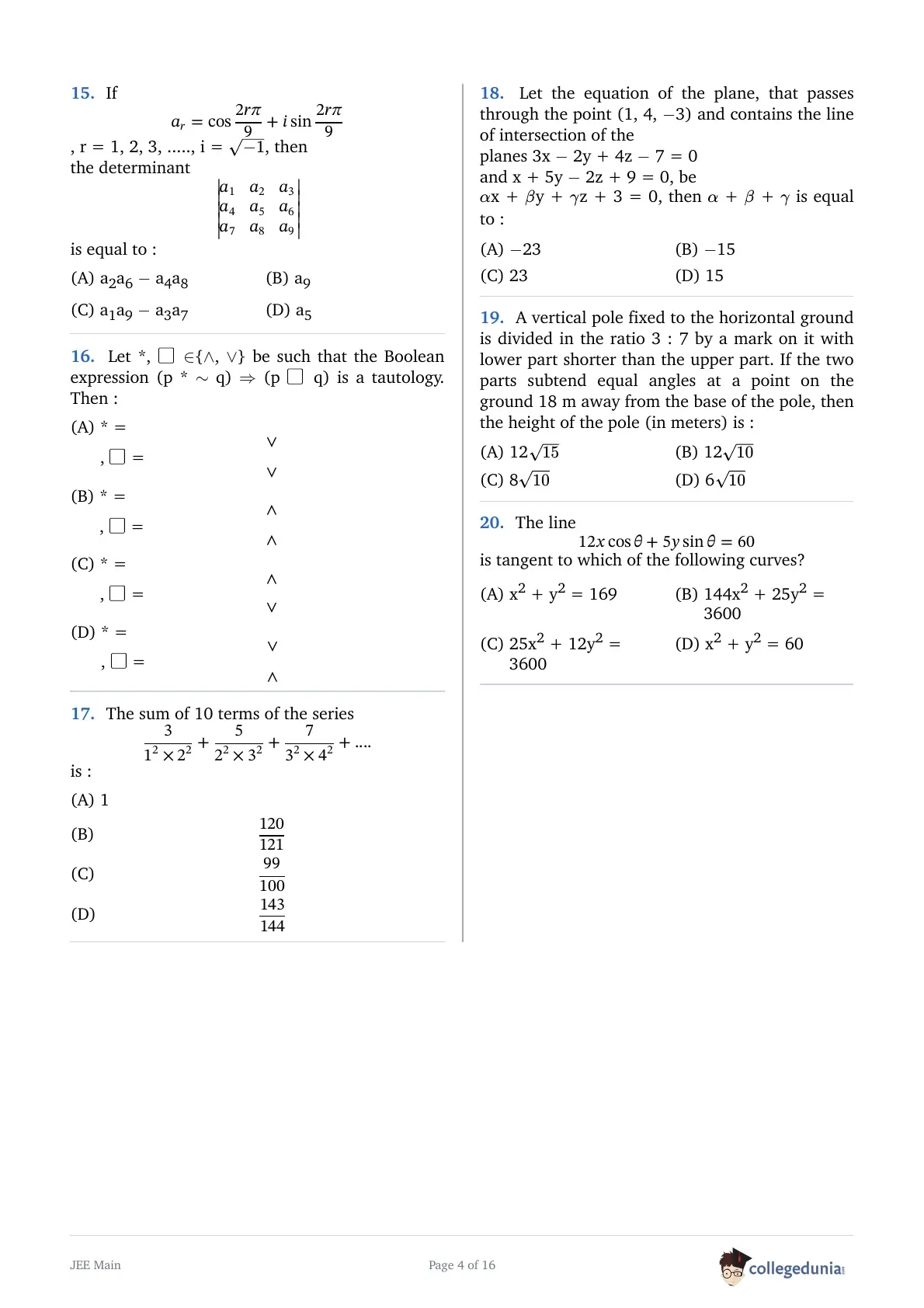
If \( a_r = \cos\frac{2r\pi}{9} + i \sin\frac{2r\pi}{9}, r = 1, 2, 3, \dots, i = \sqrt{-1} \), then the determinant
\( \begin{vmatrix}
a_1 & a_2 & a_3 \\
a_4 & a_5 & a_6 \\
a_7 & a_8 & a_9
\end{vmatrix} \) is equal to :
Let \(*, \square \in \{\wedge, \vee\}\) be such that the Boolean expression \((p * \sim q) \implies (p \square q)\) is a tautology. Then :
The sum of 10 terms of the series \( \frac{3}{1^2 \times 2^2} + \frac{5}{2^2 \times 3^2} + \frac{7}{3^2 \times 4^2} + \dots \) is :
Let the equation of the plane, that passes through the point \((1, 4, -3)\) and contains the line of intersection of the planes \(3x - 2y + 4z - 7 = 0\) and \(x + 5y - 2z + 9 = 0\), be \(\alpha x + \beta y + \gamma z + 3 = 0\), then \(\alpha + \beta + \gamma\) is equal to :
A vertical pole fixed to the horizontal ground is divided in the ratio \(3 : 7\) by a mark on it with lower part shorter than the upper part. If the two parts subtend equal angles at a point on the ground \(18\text{ m}\) away from the base of the pole, then the height of the pole (in meters) is :
The line \(12x \cos \theta + 5y \sin \theta = 60\) is tangent to which of the following curves ?
Mathematics - Section B (Q21 - Q30)
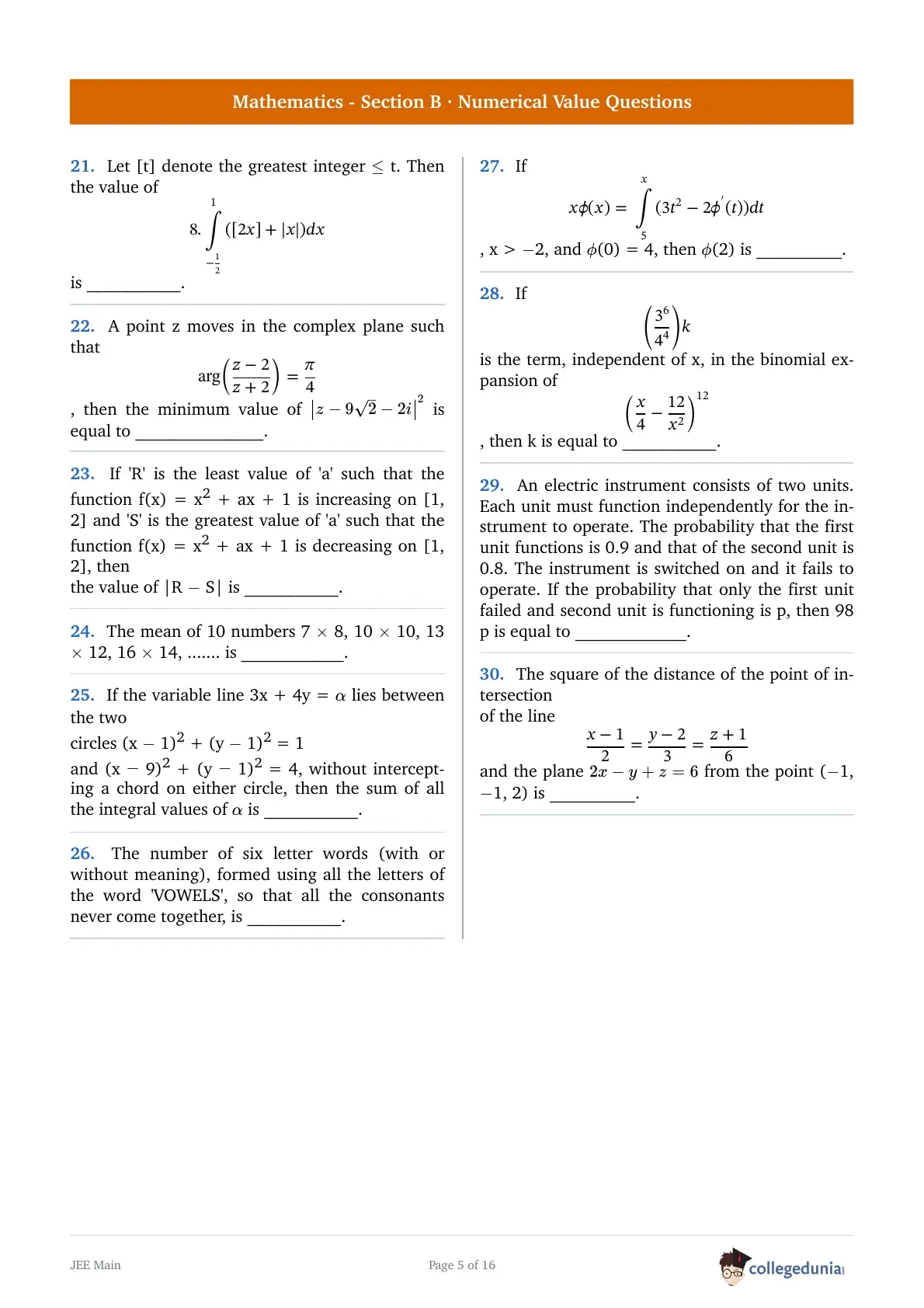
Let \([t]\) denote the greatest integer \(\leq t\). Then the value of \(8 \cdot \int_{-1/2}^{1} ([2x] + |x|) \, dx\) is _________
A point \(z\) moves in the complex plane such that \(\arg\left(\frac{z-2}{z+2}\right) = \frac{\pi}{4}\), then the minimum value of \(|z - 9\sqrt{2} - 2i|^2\) is equal to _________
If 'R' is the least value of 'a' such that the function \(f(x) = x^2 + ax + 1\) is increasing on \([1, 2]\) and 'S' is the greatest value of 'a' such that the function \(f(x) = x^2 + ax + 1\) is decreasing on \([1, 2]\), then the value of \(|R-S|\) is ________________.
The mean of 10 numbers \(7 \times 8, 10 \times 10, 13 \times 12, 16 \times 14, \dots\) is ___________
If the variable line \(3x + 4y = \alpha\) lies between the two circles \((x-1)^2 + (y-1)^2 = 1\) and \((x-9)^2 + (y-1)^2 = 4\), without intercepting a chord on either circle, then the sum of all the integral values of \(\alpha\) is _____________
The number of six letter words (with or without meaning), formed using all the letters of the word 'VOWELS', so that all the consonants never come together, is ___________
If \(x \phi(x) = \int_{5}^{x} (3t^2 - 2\phi'(t))dt\), \(x>-2\), and \(\phi(0)=4\), then \(\phi(2)\) is ___________
If \(\left(\frac{3^6}{4^4}\right)k\) is the term independent of \(x\) in the binomial expansion of \(\left(\frac{x}{4} - \frac{12}{x^2}\right)^{12}\), then \(k\) is equal to ___________
An electric instrument consists of two units. Each unit must function independently for the instrument to operate. The probability that the first unit functions is \(0.9\) and that of the second unit is \(0.8\). The instrument is switched on and it fails to operate. If the probability that only the first unit failed and second unit is functioning is \(p\), then \(98p\) is equal to ________________.
The square of the distance of the point of intersection of the line \(\frac{x-1}{2} = \frac{y-2}{3} = \frac{z+1}{6}\) and the plane \(2x - y + z = 6\) from the point \((-1, -1, 2)\) is _____________
Physics - Section A (Q31 - Q50)
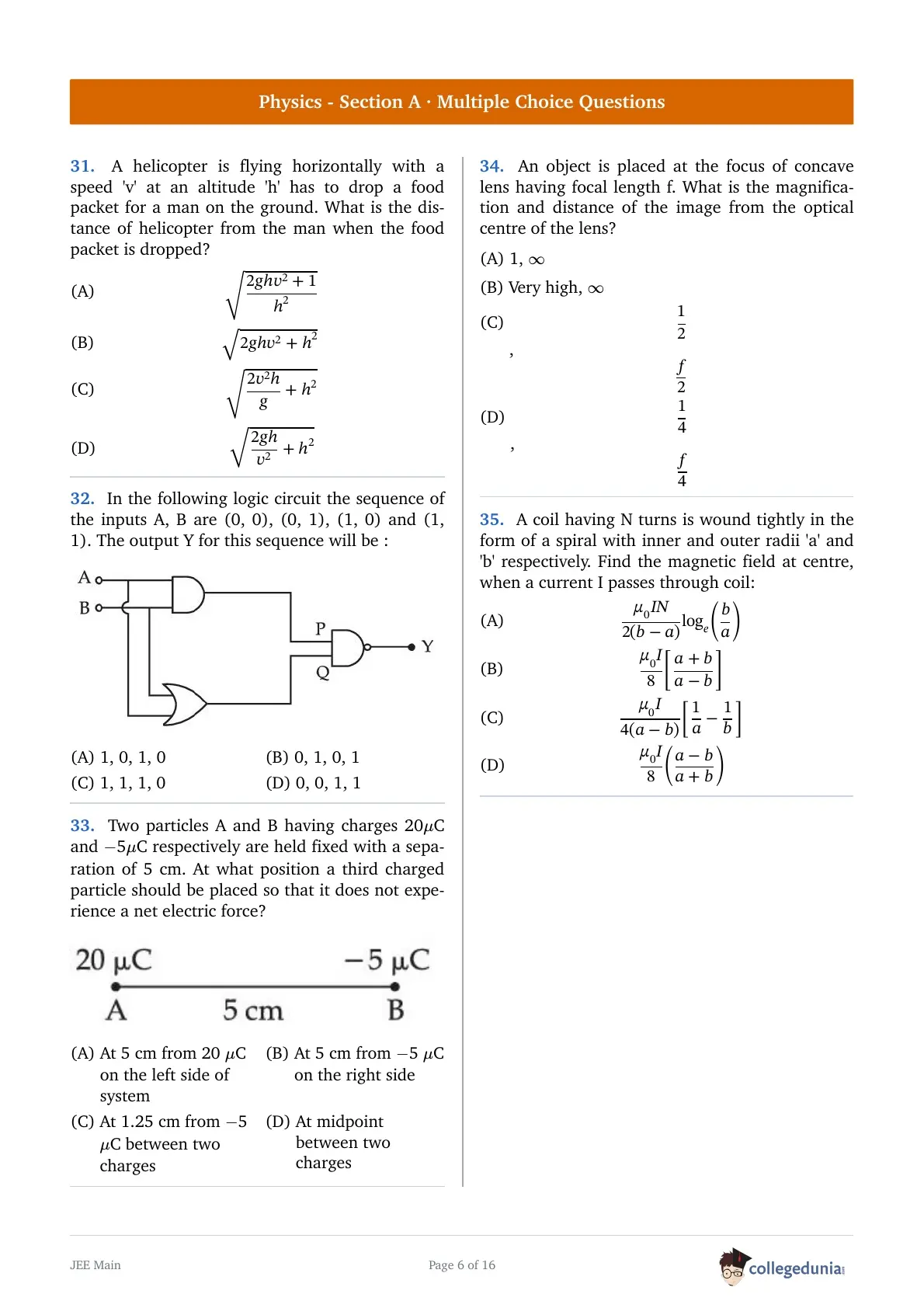
A helicopter is flying horizontally with a speed 'v' at an altitude 'h' has to drop a food packet for a man on the ground. What is the distance of helicopter from the man when the food packet is dropped ?
In the following logic circuit the sequence of the inputs A, B are (0, 0), (0, 1), (1, 0) and (1, 1). The output Y for this sequence will be : 
Two particles A and B having charges \(20\,\mu C\) and \(-5\,\mu C\) respectively are held fixed with a separation of \(5\,\text{cm}\). At what position a third charged particle should be placed so that it does not experience a net electric force ?
An object is placed at the focus of concave lens having focal length f. What is the magnification and distance of the image from the optical centre of the lens ?
A coil having N turns is wound tightly in the form of a spiral with inner and outer radii 'a' and 'b' respectively. Find the magnetic field at centre, when a current I passes through coil :
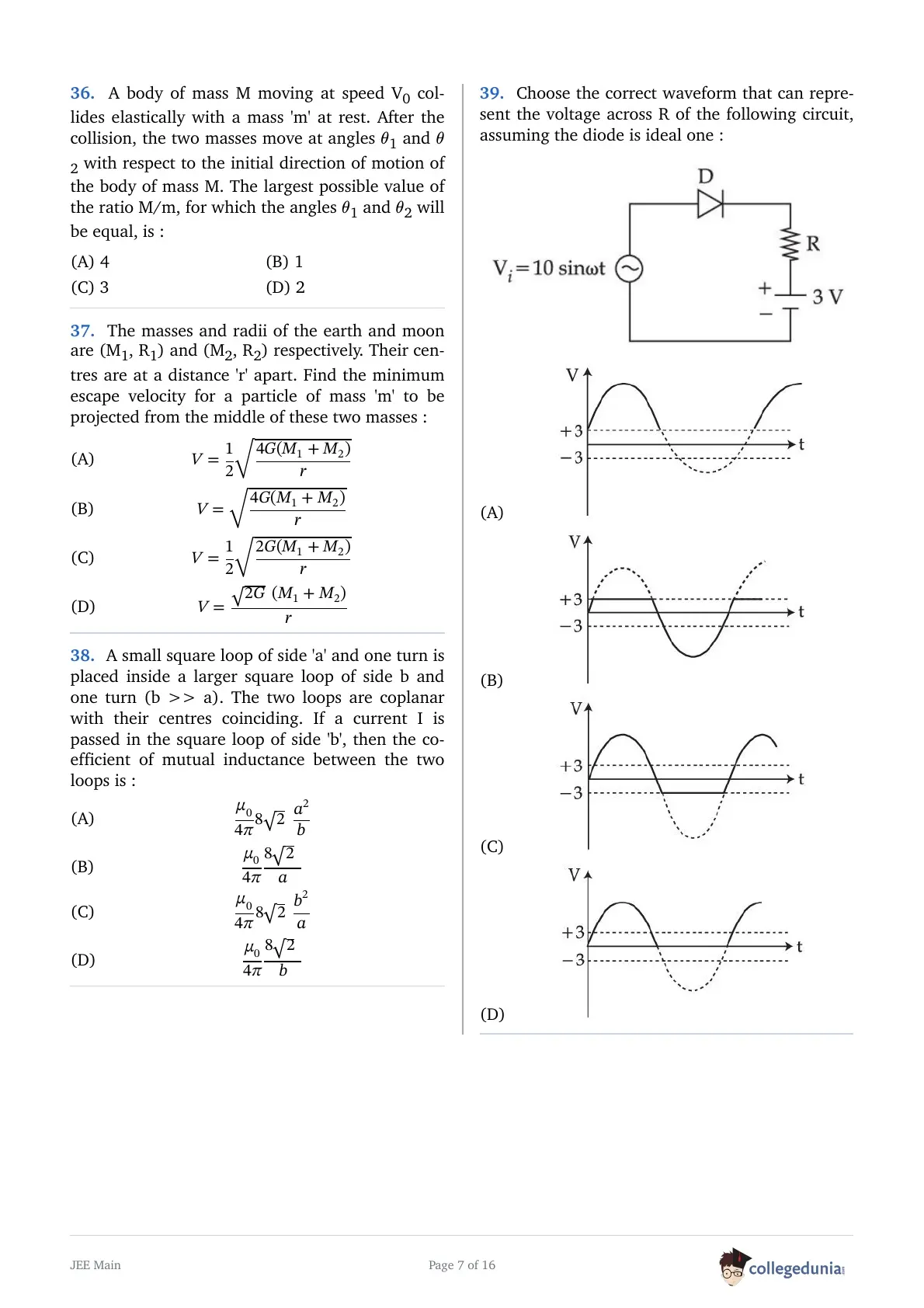
A body of mass M moving at speed \(V_0\) collides elastically with a mass 'm' at rest. After the collision, the two masses move at angles \(\theta_1\) and \(\theta_2\) with respect to the initial direction of motion of the body of mass M. The largest possible value of the ratio M/m, for which the angles \(\theta_1\) and \(\theta_2\) will be equal, is :
The masses and radii of the earth and moon are (\(M_1, R_1\)) and (\(M_2, R_2\)) respectively. Their centres are at a distance 'r' apart. Find the minimum escape velocity for a particle of mass 'm' to be projected from the middle of these two masses :
A small square loop of side 'a' and one turn is placed inside a larger square loop of side b and one turn (\( b \gg a \)). The two loops are coplanar with their centres coinciding. If a current I is passed in the square loop of side 'b', then the coefficient of mutual inductance between the two loops is :
Choose the correct waveform that can represent the voltage across R of the following circuit, assuming the diode is ideal one : 
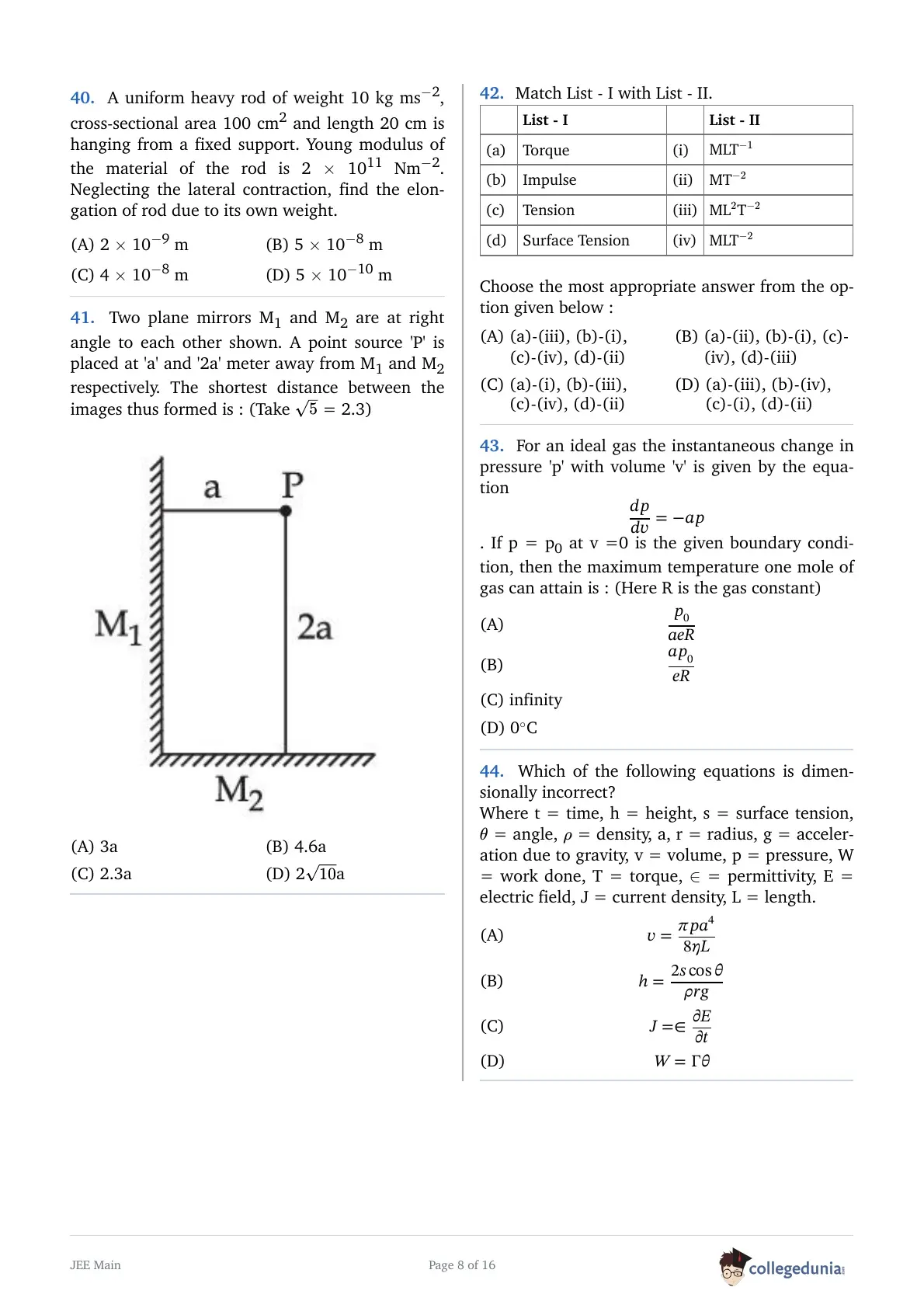
A uniform heavy rod of weight \(10\,\text{kg}\,\text{ms}^{-2}\), cross-sectional area \(100\,\text{cm}^2\) and length \(20\,\text{cm}\) is hanging from a fixed support. Young modulus of the material of the rod is \(2 \times 10^{11}\,\text{Nm}^{-2}\). Neglecting the lateral contraction, find the elongation of rod due to its own weight :
Two plane mirrors \( M_1 \) and \( M_2 \) are at right angle to each other shown. A point source 'P' is placed at 'a' and '2a' meter away from \( M_1 \) and \( M_2 \) respectively. The shortest distance between the images thus formed is : (Take \( \sqrt{5} = 2.3 \)) 
Match List - I with List - II 
Choose the most appropriate answer from the option given below :
For an ideal gas the instantaneous change in pressure 'p' with volume 'v' is given by the equation \(\frac{dp}{dv} = -ap\). If \(p = p_0\) at \(v = 0\) is the given boundary condition, then the maximum temperature one mole of gas can attain is : (Here R is the gas constant)
Which of the following equations is dimensionally incorrect ?
Where t = time, h = height, s = surface tension, \(\theta\) = angle, \(\rho\) = density, a, r = radius, g = acceleration due to gravity, v = volume, p = pressure, W = work done, \(\Gamma\) = torque, \(\epsilon\) = permittivity, E = electric field, J = current density, L = length.
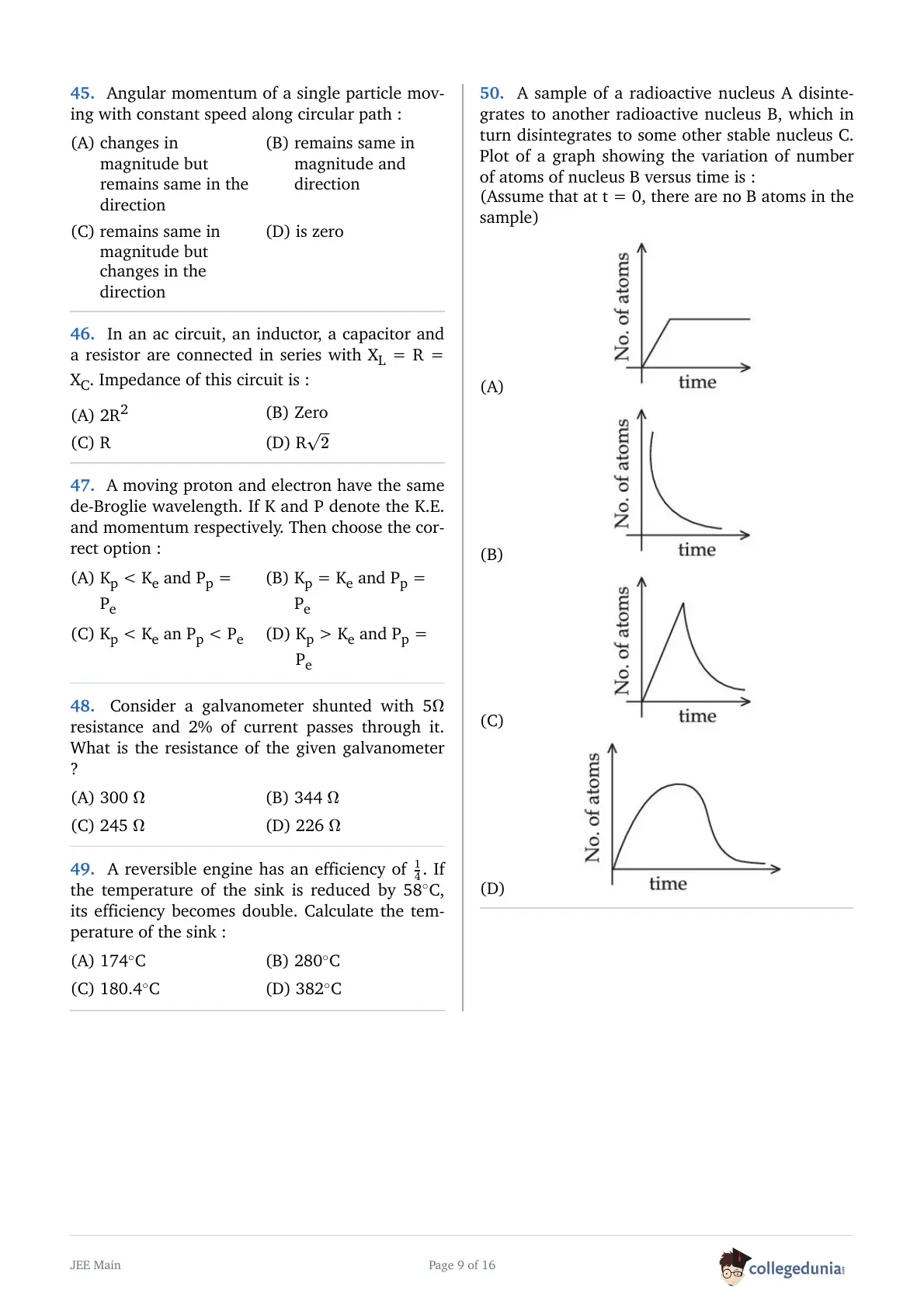
Angular momentum of a single particle moving with constant speed along circular path :
In an ac circuit, an inductor, a capacitor and a resistor are connected in series with \( X_L = R = X_C \). Impedance of this circuit is :
A moving proton and electron have the same de-Broglie wavelength. If K and P denote the K.E. and momentum respectively. Then choose the correct option :
Consider a galvanometer shunted with \( 5 \Omega \) resistance and \( 2% \) of current passes through it. What is the resistance of the given galvanometer ?
A reversible engine has an efficiency of \(\frac{1}{4}\). If the temperature of the sink is reduced by \(58^\circ\text{C}\), its efficiency becomes double. Calculate the temperature of the sink :
A sample of a radioactive nucleus A disintegrates to another radioactive nucleus B, which in turn disintegrates to some other stable nucleus C. Plot of a graph showing the variation of number of atoms of nucleus B versus time is : (Assume that at t=0, there are no B atoms in the sample) 
Physics - Section B (Q51 - Q60)
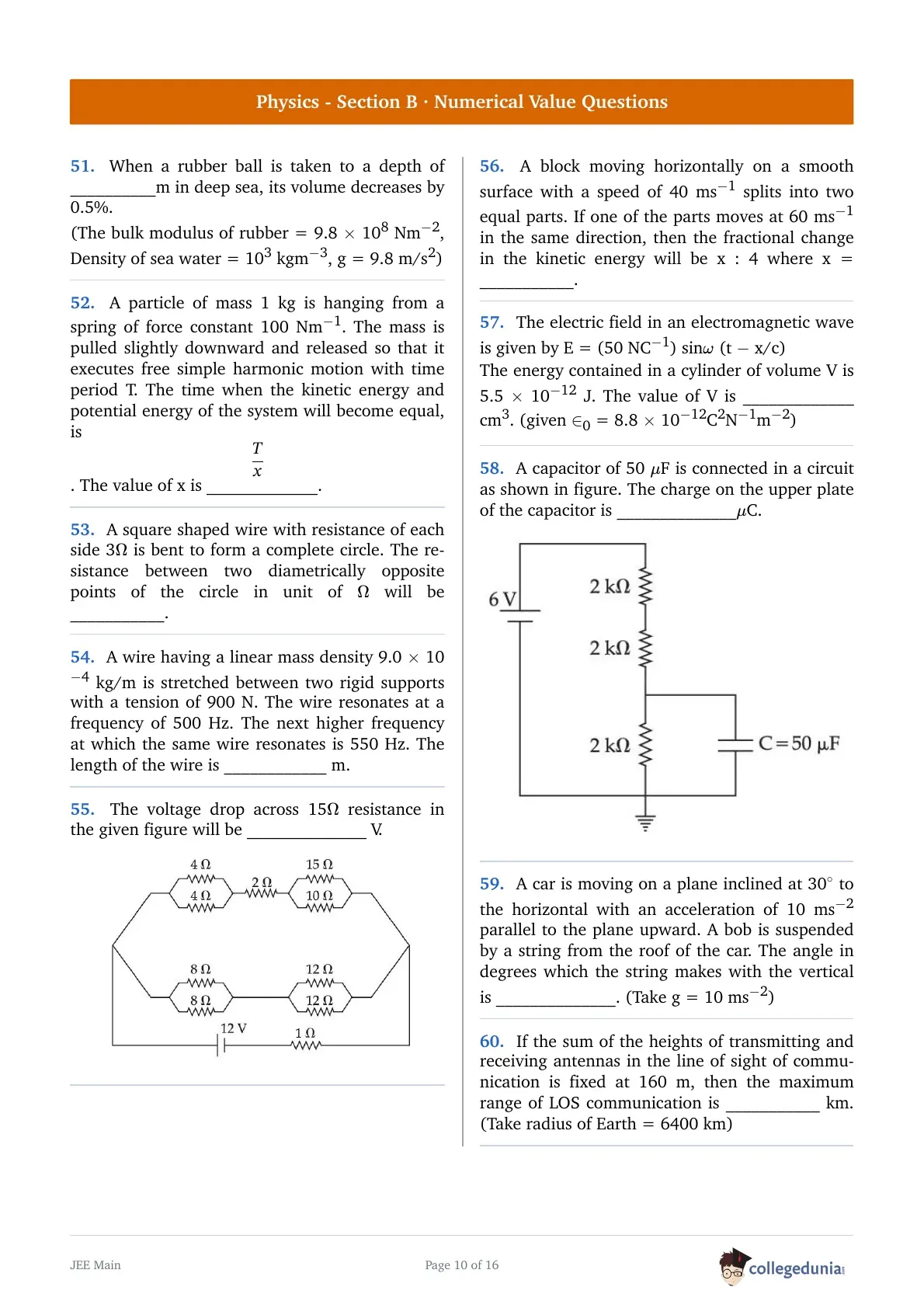
When a rubber ball is taken to a depth of \(\dots\dots\dots\) m in deep sea, its volume decreases by \( 0.5% \).
(The bulk modulus of rubber \(= 9.8 \times 10^8 \, Nm^{-2} \)
Density of sea water \(= 10^3 \, kg m^{-3} \)
\( g = 9.8 \, m/s^2 \))
A particle of mass \( 1 \, kg \) is hanging from a spring of force constant \( 100 \, Nm^{-1} \). The mass is pulled slightly downward and released so that it executes free simple harmonic motion with time period T. The time when the kinetic energy and potential energy of the system will become equal, is \( \frac{T}{x} \). The value of x is \(\dots\dots\dots\).
A square shaped wire with resistance of each side \( 3 \, \Omega \) is bent to form a complete circle. The resistance between two diametrically opposite points of the circle in unit of \( \Omega \) will be \(\dots\dots\dots\).
A wire having a linear mass density \( 9.0 \times 10^{-4} \, kg/m \) is stretched between two rigid supports with a tension of \( 900 \, N \). The wire resonates at a frequency of \( 500 \, Hz \). The next higher frequency at which the same wire resonates is \( 550 \, Hz \). The length of the wire is \(\dots\dots\dots\) m.
The voltage drop across \( 15 \, \Omega \) resistance in the given figure will be \(\dots\dots\) V. 
A block moving horizontally on a smooth surface with a speed of \( 40 \, ms^{-1} \) splits into two equal parts. If one of the parts moves at \( 60 \, ms^{-1} \) in the same direction, then the fractional change in the kinetic energy will be \( x : 4 \) where \( x = \dots\dots\dots \).
The electric field in an electromagnetic wave is given by \( E = (50 \, NC^{-1}) \sin \omega (t - x/c) \). The energy contained in a cylinder of volume V is \( 5.5 \times 10^{-12} \, J \). The value of V is \(\dots\dots\dots\) \( cm^3 \).
(given \( \epsilon_0 = 8.8 \times 10^{-12} \, C^2 N^{-1} m^{-2} \))
A capacitor of \( 50 \, \mu F \) is connected in a circuit as shown in figure. The charge on the upper plate of the capacitor is \(\dots\dots\dots\) \( \mu C \). 
A car is moving on a plane inclined at \( 30^\circ \) to the horizontal with an acceleration of \( 10 \, ms^{-2} \) parallel to the plane upward. A bob is suspended by a string from the roof of the car. The angle in degrees which the string makes with the vertical is \(\dots\dots\dots\). (Take \( g = 10 \, ms^{-2} \))
If the sum of the heights of transmitting and receiving antennas in the line of sight of communication is fixed at \( 160 \, m \), then the maximum range of LOS communication is \(\dots\dots\dots\) km.
(Take radius of Earth \( = 6400 \, km \))
Chemistry - Section A (Q61 - Q80)
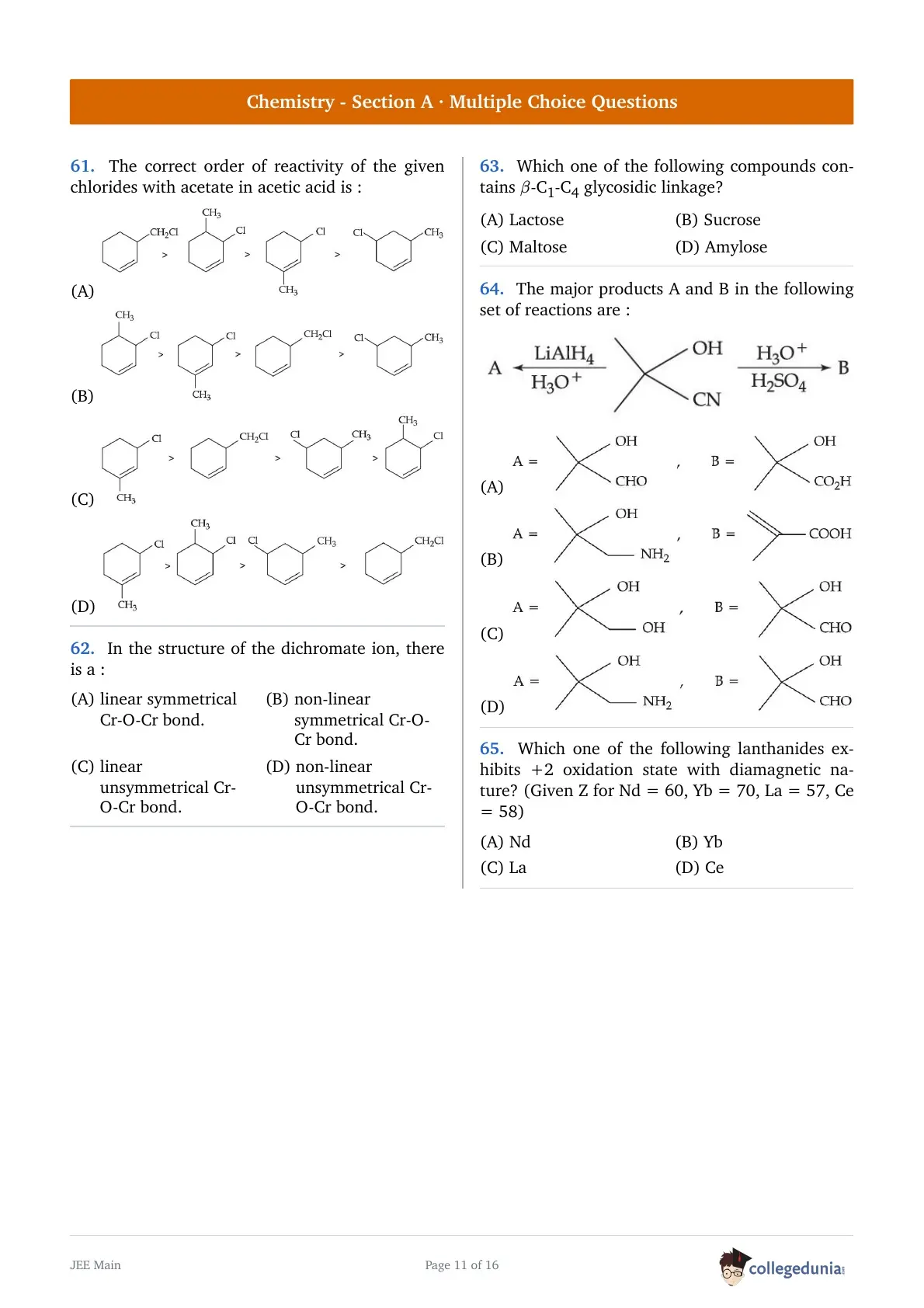
The correct order of reactivity of the given chlorides with acetate in acetic acid is : 
In the structure of the dichromate ion, there is a :
Which one of the following compounds contains \(\beta\)-C\(_1\)-C\(_4\) glycosidic linkage?
The major products A and B in the following set of reactions are : 
Which one of the following lanthanides exhibits +2 oxidation state with diamagnetic nature ? (Given Z for Nd=60, Yb=70, La=57, Ce=58)
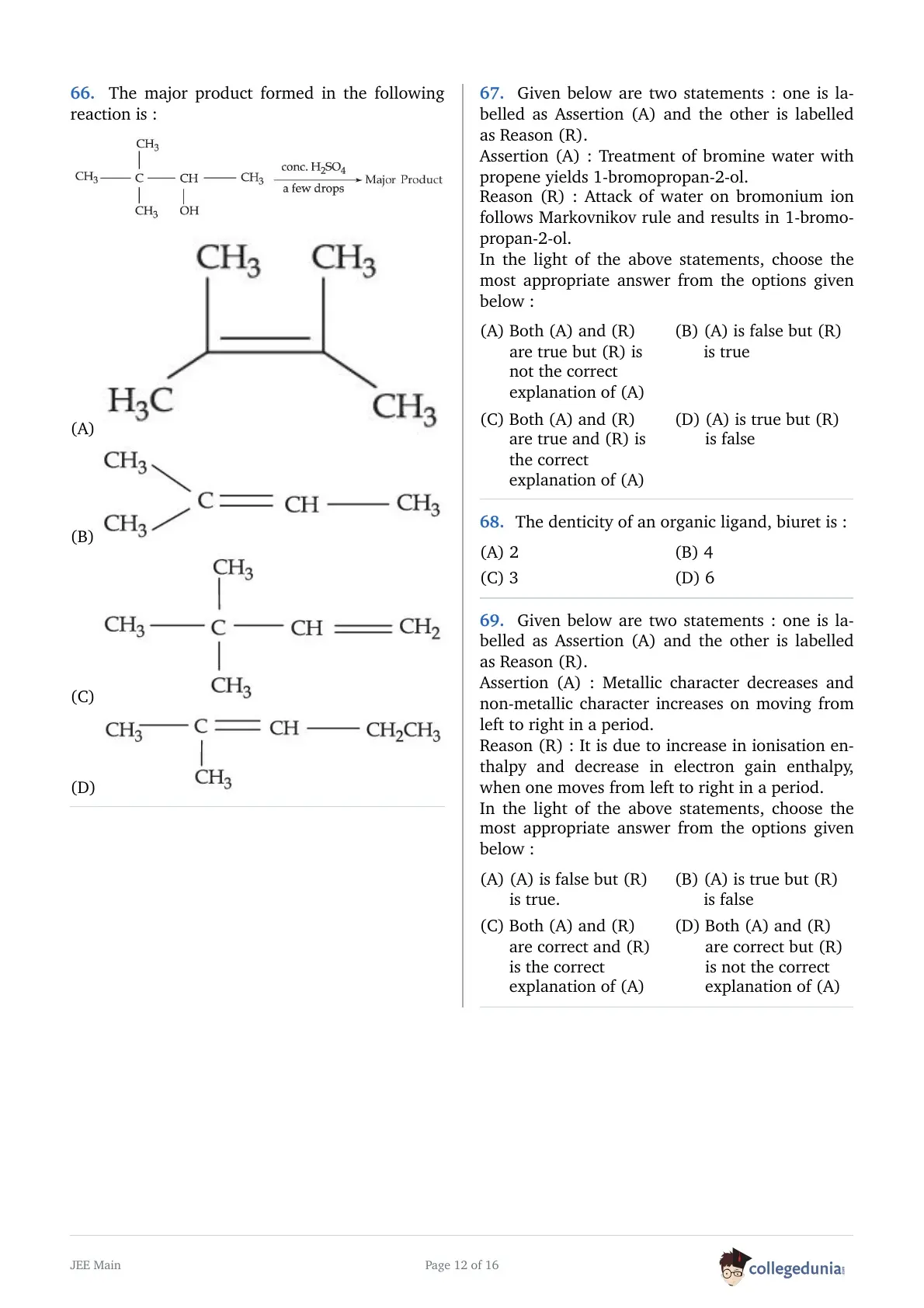
The major product formed in the following reaction is : 
Given below are two statements : one is labelled as Assertion (A) and the other is labelled as Reason (R).
Assertion (A) : Treatment of bromine water with propene yields 1-bromopropan-2-ol.
Reason (R) : Attack of water on bromonium ion follows Markovnikov rule and results in 1-bromopropan-2-ol.
In the light of the above statements, choose the most appropriate answer from the options given below :
The denticity of an organic ligand, biuret is :
Given below are two statements : one is labelled as Assertion (A) and the other is labelled as Reason (R).
Assertion (A) : Metallic character decreases and non-metallic character increases on moving from left to right in a period.
Reason (R) : It is due to increase in ionisation enthalpy and decrease in electron gain enthalpy, when one moves from left to right in a period.
In the light of the above statements, choose the most appropriate answer from the options given below :
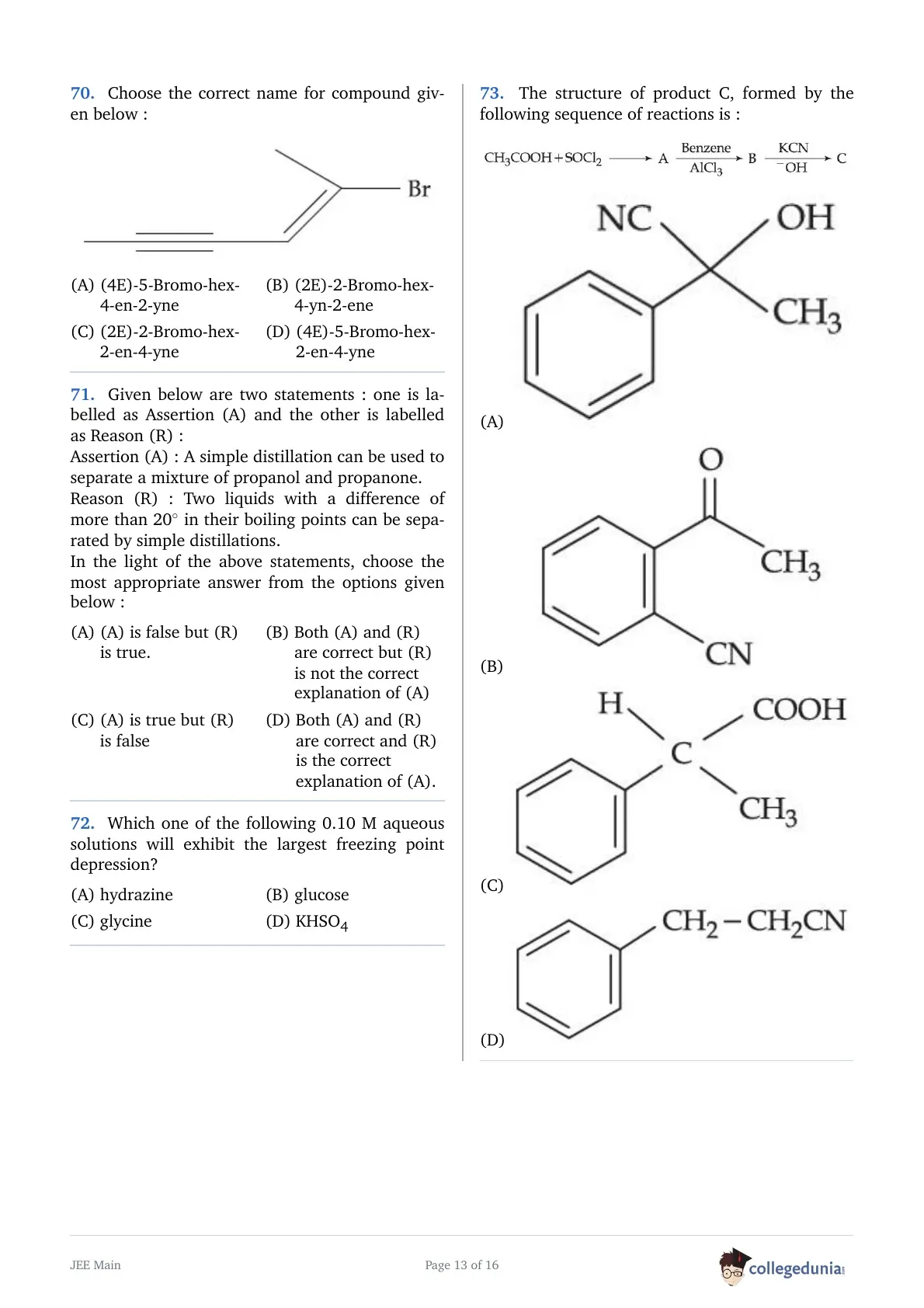
Choose the correct name for compound given below : 
Given below are two statements : one is labelled as Assertion (A) and the other is labelled as Reason (R).
Assertion (A) : A simple distillation can be used to separate a mixture of propanol and propanone.
Reason (R) : Two liquids with a difference of more than \( 20^\circ\text{C} \) in their boiling points can be separated by simple distillations.
In the light of the above statements, choose the most appropriate answer from the options given below :
Which one of the following \( 0.10 \, \text{M} \) aqueous solutions will exhibit the largest freezing point depression ?
The structure of product C, formed by the following sequence of reactions is :
\( CH_3COOH + SOCl_2 \to A \xrightarrow[\text{AlCl}_3]{\text{Benzene}} B \xrightarrow[\text{}^-OH]{\text{KCN}} C \) 
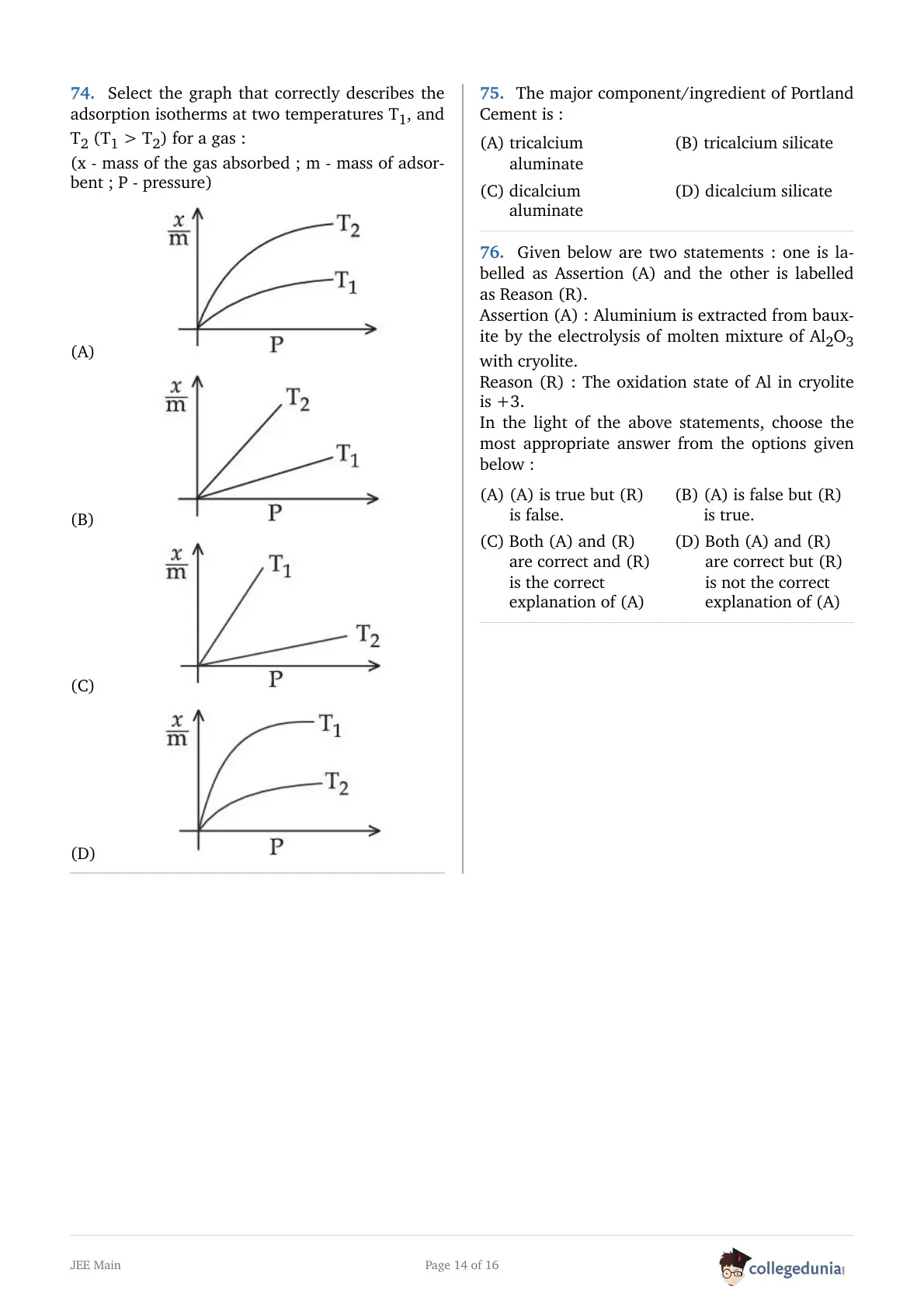
Select the graph that correctly describes the adsorption isotherms at two temperatures \( T_1 \) and \( T_2 \) (\( T_1>T_2 \)) for a gas : (x - mass of the gas adsorbed, m - mass of adsorbent, P - pressure) 
The major component/ingredient of Portland Cement is :
Given below are two statements : one is labelled as Assertion (A) and the other is labelled as Reason (R).
Assertion (A) : Aluminium is extracted from bauxite by the electrolysis of molten mixture of \( \text{Al}_2\text{O}_3 \) with cryolite.
Reason (R) : The oxidation state of Al in cryolite is +3.
In the light of the above statements, choose the most appropriate answer from the options given below :
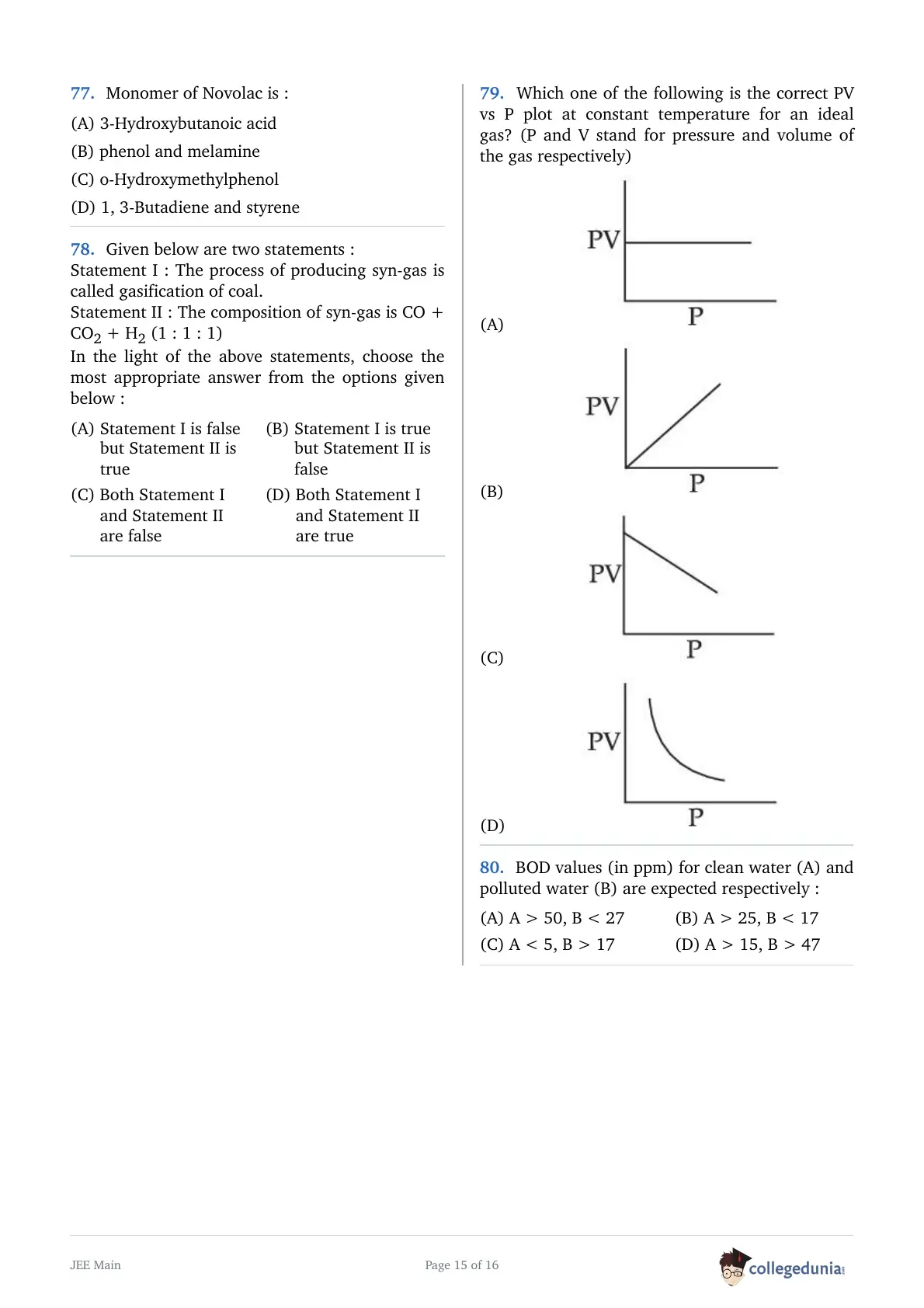
Monomer of Novolac is :
Given below are two statements :
Statement I : The process of producing syn-gas is called gasification of coal.
Statement II : The composition of syn-gas is \( \text{CO} + \text{CO}_2 + \text{H}_2 \) (1 : 1 : 1).
In the light of the above statements, choose the most appropriate answer from the options given below :
Which one of the following is the correct PV vs P plot at constant temperature for an ideal gas ? (P and V stand for pressure and volume of the gas respectively) 
BOD values (in ppm) for clean water (A) and polluted water (B) are expected respectively as :
Chemistry - Section B (Q81 - Q90)
Consider the following cell reaction
\(\text{Cd}_{(s)} + \text{Hg}_2\text{SO}_{4(s)} + \frac{9}{5} \text{H}_2\text{O}_{(l)} \rightleftharpoons \text{CdSO}_4 \cdot \frac{9}{5} \text{H}_2\text{O}_{(s)} + 2\text{Hg}_{(l)}\)
The value of \(E_{cell}^0\) is \(4.315\text{ V}\) at \(25^\circ\text{C}\). If \(\Delta H^0 = -825.2\text{ kJ mol}^{-1}\), the standard entropy change \(\Delta S^0\) in J K\(^{-1}\) is \(\dots\dots\dots\). (Nearest integer)
[Given : Faraday constant = \(96487\text{ C mol}^{-1}\)]
The molarity of the solution prepared by dissolving \(6.3\text{ g}\) of oxalic acid (\(\text{H}_2\text{C}_2\text{O}_4 \cdot 2\text{H}_2\text{O}\)) in \(250\text{ mL}\) of water in mol L\(^{-1}\) is \(x \times 10^{-2}\). The value of \(x\) is \(\dots\dots\dots\). (Nearest integer)
[Atomic mass : H : 1.0, C : 12.0, O : 16.0]
The total number of reagents from those given below, that can convert nitrobenzene into aniline is ___________. (Integer answer)
I. \( Sn - HCl \)
II. \( Sn - NH_4OH \)
III. \( Fe - HCl \)
IV. \( Zn - HCl \)
V. \( H_2 - Pd \)
VI. \( H_2 - Raney \ Nickel \)}
For a first order reaction, the ratio of the time for \(75%\) completion of a reaction to the time for \(50%\) completion is \(\dots\dots\dots\). (Integer answer)
The number of hydrogen bonded water molecule(s) associated with stoichiometry \( CuSO_4 \cdot 5H_2O \) is ____________
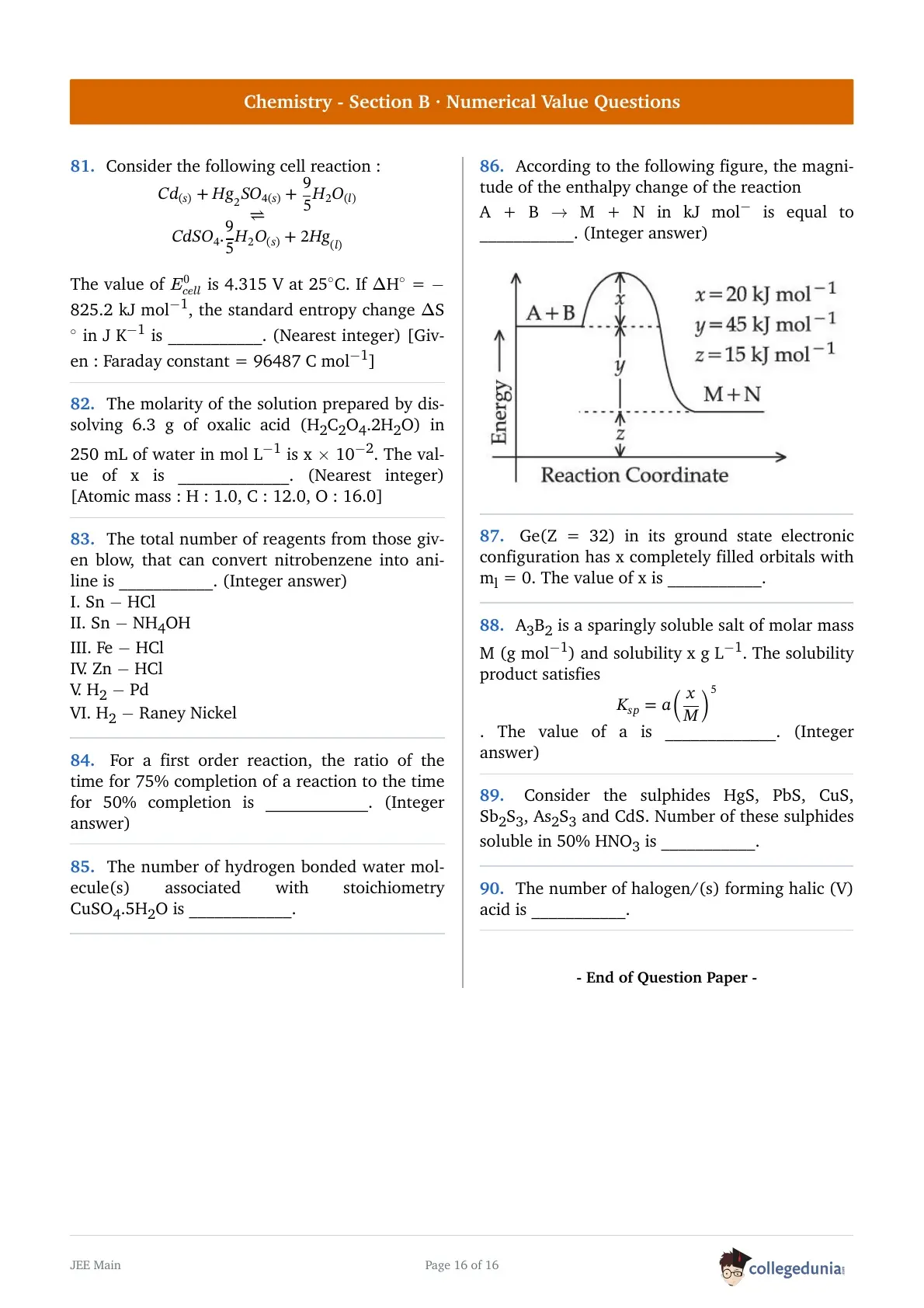
According to the following figure, the magnitude of the enthalpy change of the reaction \(A + B \to M + N\) in kJ mol\(^{-1}\) is equal to \(\dots\dots\dots\). (Integer answer)
[Given: \(x = 20\text{ kJ mol}^{-1}\), \(y = 45\text{ kJ mol}^{-1}\), \(z = 15\text{ kJ mol}^{-1}\)] 
Ge (\(Z=32\)) in its ground state electronic configuration has \(x\) completely filled orbitals with \(m_l=0\). The value of \(x\) is \(\dots\dots\dots\).
A\(_3\)B\(_2\) is a sparingly soluble salt of molar mass M (g mol\(^{-1}\)) and solubility \(x\text{ g L}^{-1}\). The solubility product satisfies \(K_{sp} = a \left(\frac{x}{M}\right)^5\). The value of \(a\) is \(\dots\dots\dots\). (Integer answer)
Consider the sulphides \( HgS, PbS, CuS, Sb_2S_3, As_2S_3 \) and \( CdS \). Number of these sulphides soluble in \( 50% \ HNO_3 \) is _____________
The number of halogen/(s) forming halic (V) acid is ____________
JEE Main 2021 Exam Pattern and Marking Scheme
| Particulars | Details |
|---|---|
| Exam Mode | Online (Computer-Based Test) |
| Paper | B.E./B.Tech (Paper 1) |
| Duration | 3 hours (180 minutes) |
| Type of Questions | Multiple Choice Questions (MCQs) + Numerical Value Questions |
| Subjects | Mathematics, Physics, Chemistry |
| Total Questions | 90 questions (75 to be attempted) |
| Total Marks | 300 marks |
| Marking Scheme | +4 for correct answer & -1 for incorrect MCQ; no negative marking for Numerical Value Questions |
JEE Main 2021 August 31 Shift 1 Difficulty Level
JEE Main Question Paper for August 31, 2021, Forenoon Session was termed to be of moderate difficulty by the experts. According to the test-takers, the Physics section was the most difficult section of the paper. Second on the difficulty scale was the Mathematics Section. The Chemistry section was the easiest of the three sections. In keeping with JEE Main Exam Pattern, each section featured 30 questions (20 MCQs and 10 NATs), with the option of attempting any 5 NAT questions for a total of 25 attempts by the candidates.
JEE Main 2021 B.E./B.Tech Question Paper August 31 (FN): Paper Analysis
JEE Main August 31, 2021 Forenoon (Shift 1) was conducted from 9.00 AM to 12.00 Noon. The sectional analysis of the paper is as follows:
Mathematics
- Differential Calculus (12%), Integral Calculus (18%), Coordinate Geometry (12%), and Trigonometry (15%) were the major contributing units in the paper
- The questions asked from Class XI and Class XII topics were roughly equal. Around 16 questions were asked from class XII topics and 14 Questions were asked from class XI topics. View JEE Main Mathematics Syllabus
Physics
- Mechanics (37%), Electrodynamics(27%), and Modern Physics (17%) were the major units asked in the paper.
- 19 questions were asked from class XII topics and 11 Questions were asked from class XI topics. View JEE Main Physics syllabus
Chemistry
- Dominant units in the paper included: Organic Chemistry II (36%), Inorganic Chemistry I (20%), and Physical Chemistry II (20%)
- 13 Questions were framed from Class XI Chemistry Syllabus, and 17 Questions were framed from Class XII Chemistry Syllabus. View JEE Main Chemistry Syllabus



Comments