




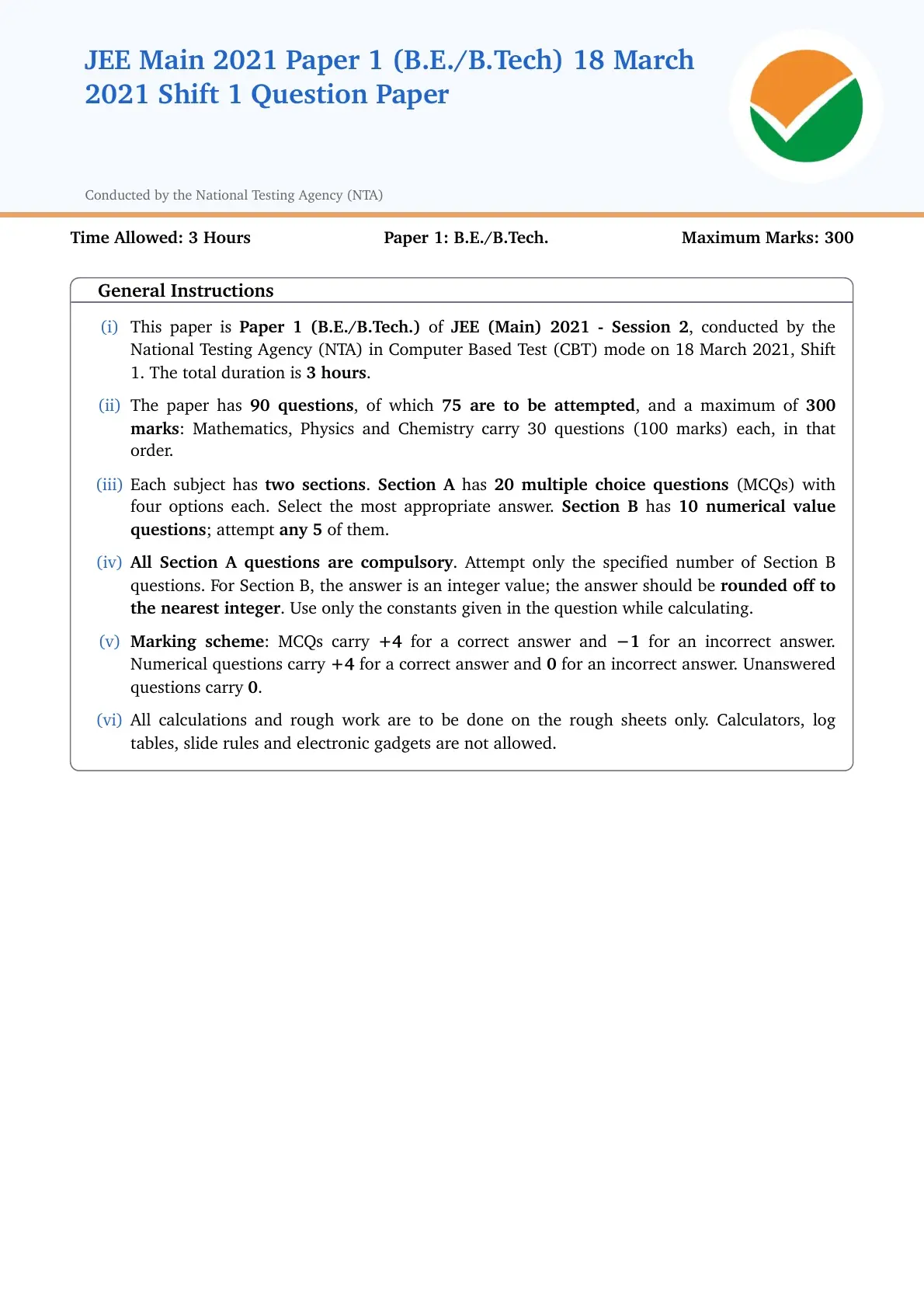
JEE Main 2021 March 18 Shift 1 Question Paper is available here with solutions PDF and detailed solutions for every question. NTA conducted the first shift on March 18, 2021, from 9:00 AM to 12:00 PM. The JEE Main 2021 Paper 1 (B.E./B.Tech) question paper includes the following:
- 90 questions in a 3-hour CBT Mode: 30 each from Mathematics, Physics and Chemistry (75 to be attempted)
- Section A: 20 multiple choice questions (MCQs) per subject, all compulsory, 4 marks each
- Section B: 10 numerical value questions per subject, any 5 to be attempted, 4 marks each
- Marking: +4 for a correct answer, -1 for an incorrect MCQ, 0 for an unattempted question; no negative marking for numerical value questions
- Maximum marks: 300 (100 per subject)
JEE Main 2021 March 18 Shift 1 Question Paper with Solution PDF
| NTA Official PDF | CD PDF | CD PDF with Solutions |
|---|---|---|
| Download official PDF 7.46 MB | Download Collegedunia PDF 1.09 MB | Download solutions PDF 2.14 MB |
Also Check:
JEE Main 2021 March 18 Shift 1 Questions with Solutions
Mathematics - Section A (Q1 - Q20)
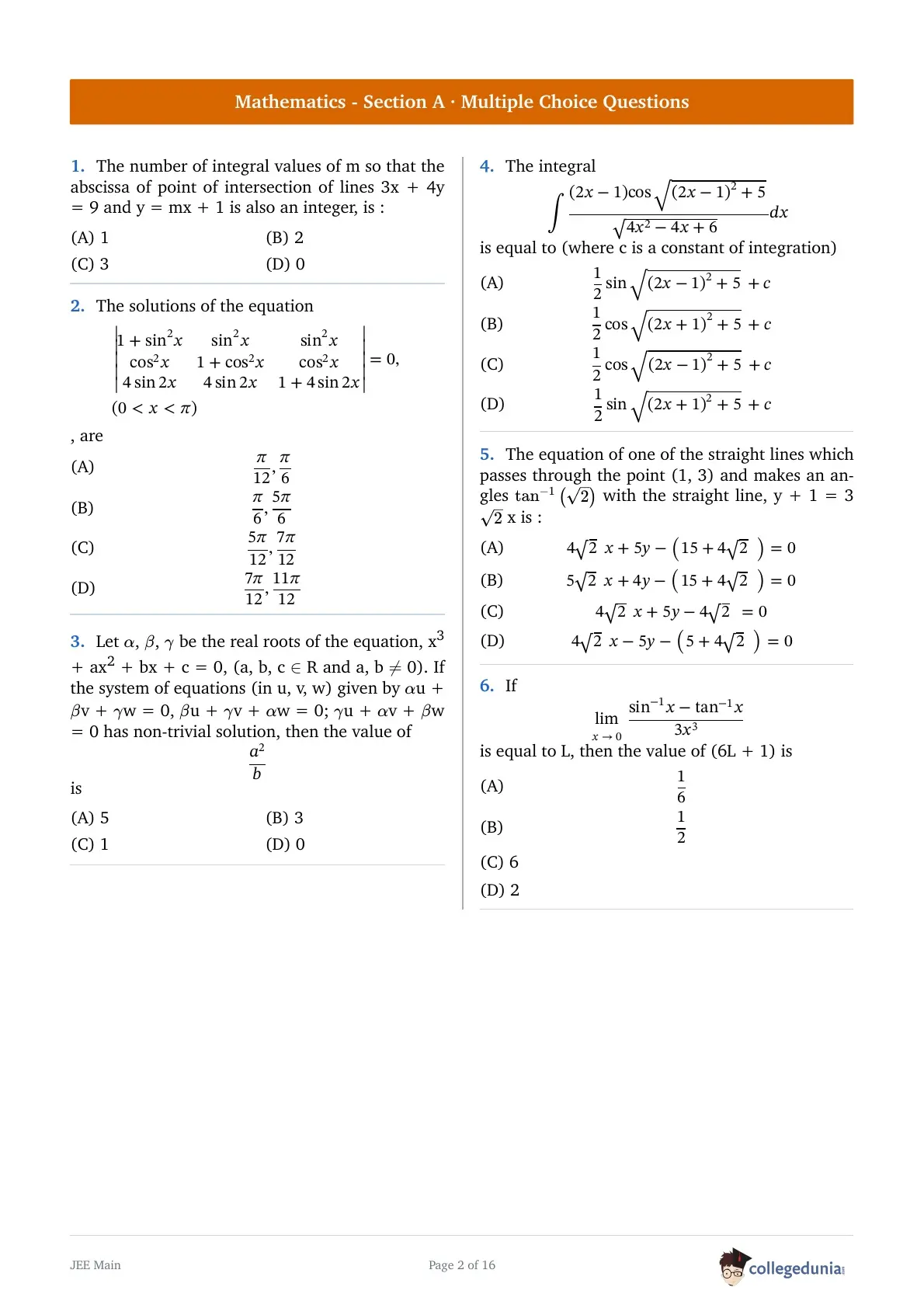
The number of integral values of m so that the abscissa of point of intersection of lines 3x + 4y = 9 and y = mx + 1 is also an integer, is :
The solutions of the equation \(\begin{vmatrix} 1 + \sin^2 x & \sin^2 x & \sin^2 x \\ \cos^2 x & 1 + \cos^2 x & \cos^2 x \\ 4\sin 2x & 4\sin 2x & 1 + 4\sin 2x \end{vmatrix} = 0\), \((0 \lt x \lt \pi)\), are
Let α, β, γ be the real roots of the equation, x³ + a x² + b x + c = 0, (a, b, c ∈ R and a, b ≠ 0). If the system of equations (in u, v, w) given by α u + β v + γ w = 0; β u + γ v + α w = 0; γ u + α v + β w = 0 has non-trivial solution, then the value of a²/b is :
The integral ∫ (2x - 1) cos√((2x - 1)² + 5) / √(4x² - 4x + 6) dx is equal to : (where c is a constant of integration)
The equation of one of the straight lines which passes through the point (1, 3) and makes an angle tan⁻¹(√2) with the straight line, y + 1 = 3√2 x is :
If \( \lim_{x \to 0} \dfrac{\sin^{-1} x - \tan^{-1} x}{3x^3} \) is equal to \( L \), then the value of \( (6L + 1) \) is :
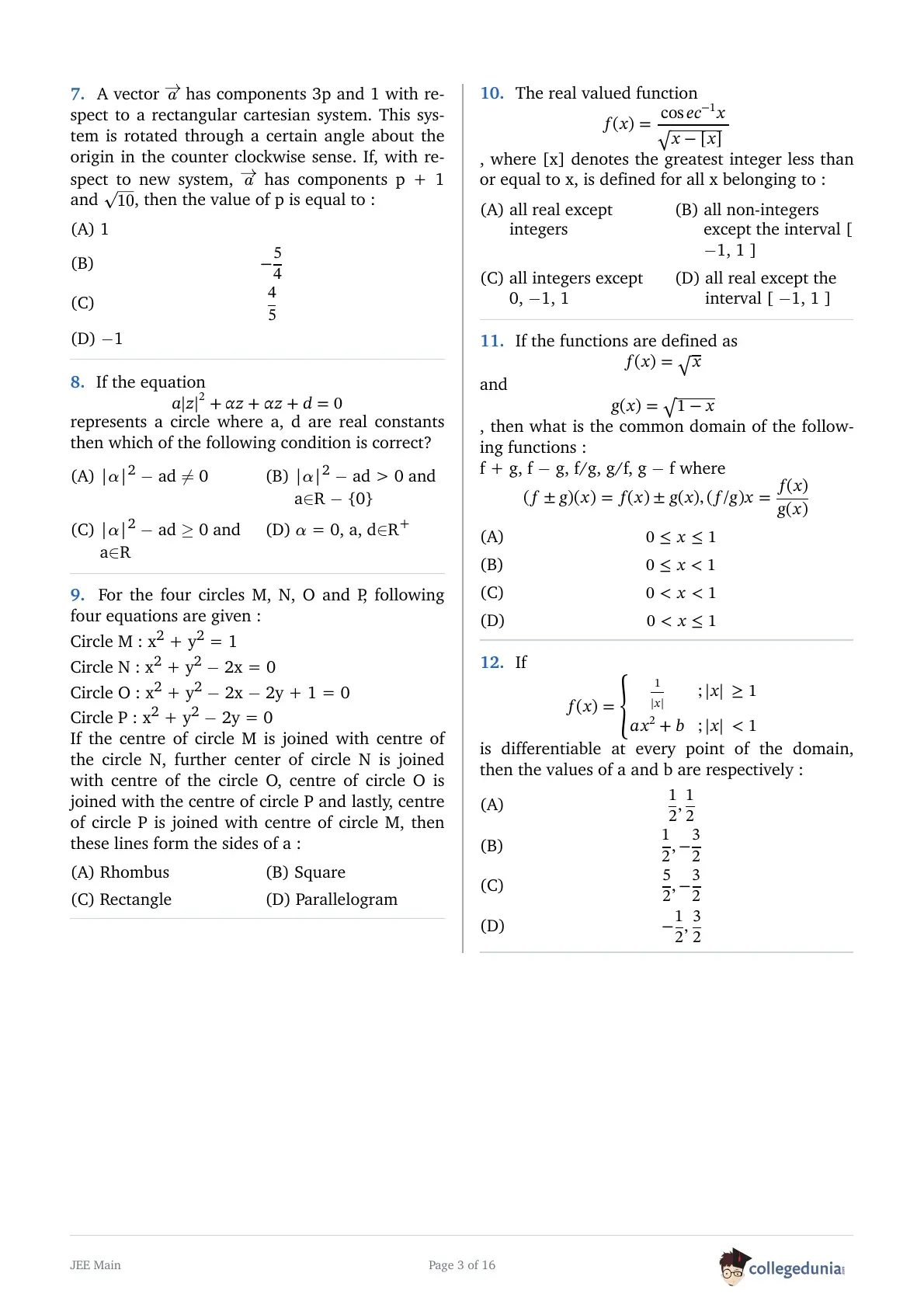
Rotation of axes: Vector ā (3p, 1) becomes (p+1, √10) in new system. Find p.
If the equation a|z|² + āz + a z̄ + d = 0 represents a circle where a, d are real constants, then which of the following condition is correct ?
For the four circles M, N, O and P, following four equations are given :
Circle M : \(x^2 + y^2 = 1\)
Circle N : \(x^2 + y^2 - 2x = 0\)
Circle O : \(x^2 + y^2 - 2x - 2y + 1 = 0\)
Circle P : \(x^2 + y^2 - 2y = 0\)
If the centre of circle M is joined with centre of the circle N, further center of circle N is joined with centre of the circle O, centre of circle O is joined with the centre of circle P and lastly, centre of circle P is joined with centre of circle M, then these lines form the sides of a :
The real valued function f(x) = csc⁻¹x / √(x - [x]), where [x] denotes the greatest integer less than or equal to x, is defined for all x belonging to :
If the functions are defined as f(x) = √x and g(x) = √(1-x), then what is the common domain of the following functions : f+g, f-g, f/g, g/f, g-f where (f ± g)(x) = f(x) ± g(x), (f/g)(x) = f(x)/g(x)
If f(x) = { 1/|x| if |x| ≥ 1 ; a x² + b if |x| \(< 1\) } is differentiable at every point of the domain, then the values of a and b are respectively :
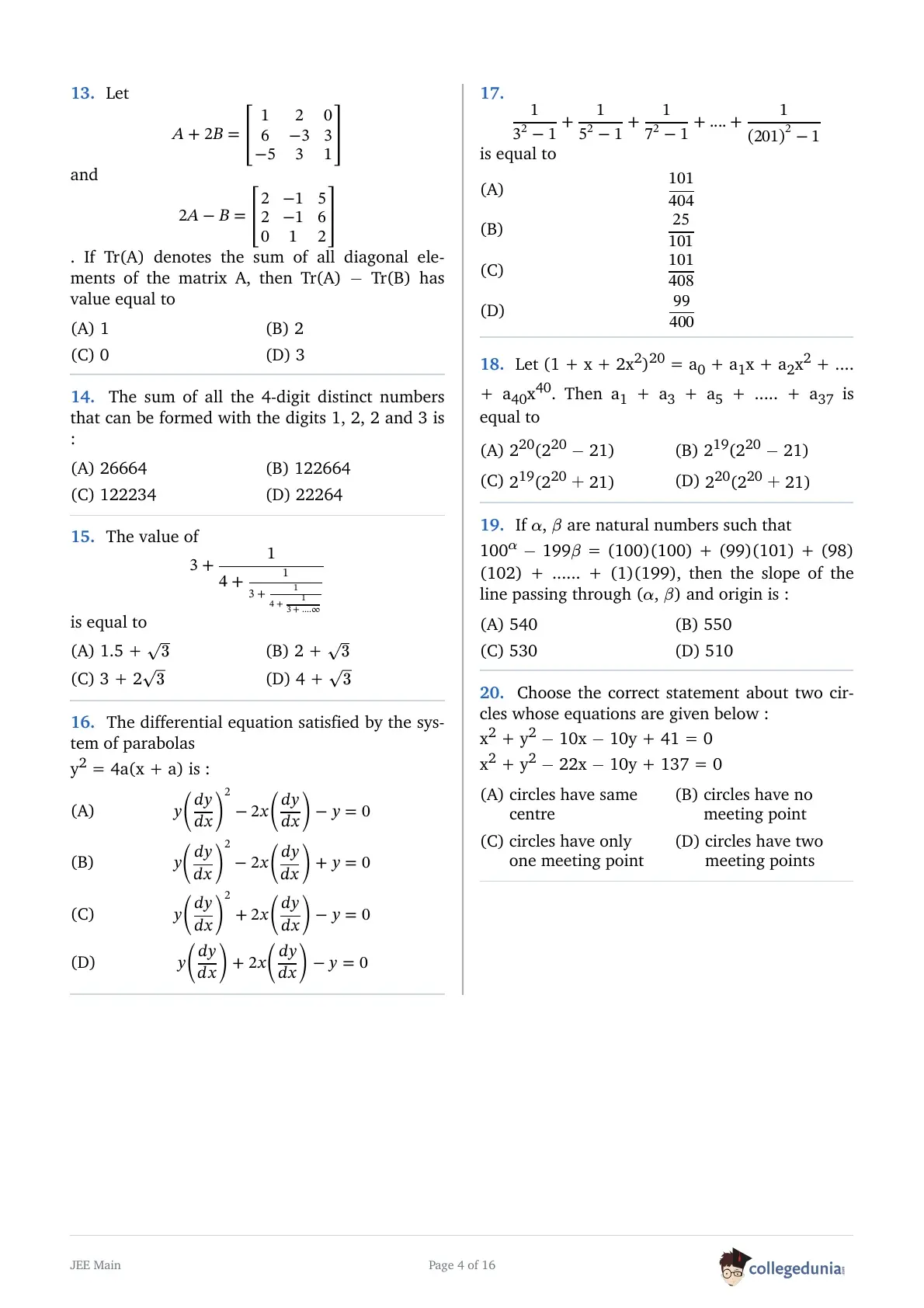
Let A + 2B = [1 2 0; 6 -3 3; -5 3 1] and 2A - B = [2 -1 5; 2 -1 6; 0 1 2]. If Tr(A) denotes the sum of all diagonal elements of the matrix A, then Tr(A) - Tr(B) has value equal to :
The sum of all the 4-digit distinct numbers that can be formed with the digits 1, 2, 2 and 3 is :
The value of 3 + 1/(4 + 1/(3 + 1/(4 + 1/(3 + ⋯ ∞))) is equal to :
The differential equation satisfied by the system of parabolas y² = 4a(x + a) is :
1/(3² - 1) + 1/(5² - 1) + 1/(7² - 1) + ⋯ + 1/(201)² - 1 is equal to :
Let (1 + x + 2x²)²⁰ = a₀ + a₁x + a₂x² + ⋯ + a₄₀x⁴⁰. Then, a₁ + a₃ + a₅ + ⋯ + a₃₇ is equal to :
If α, β are natural numbers such that 100\(^α - 199 β = (100)(100) + (99)(101) + (98)(102) + ⋯ + (1)(199)\), then the slope of the line passing through (α, β) and origin is :
Choose the correct statement about two circles whose equations are given below : x² + y² - 10x - 10y + 41 = 0 ; x² + y² - 22x - 10y + 137 = 0
Mathematics - Section B (Q21 - Q30)
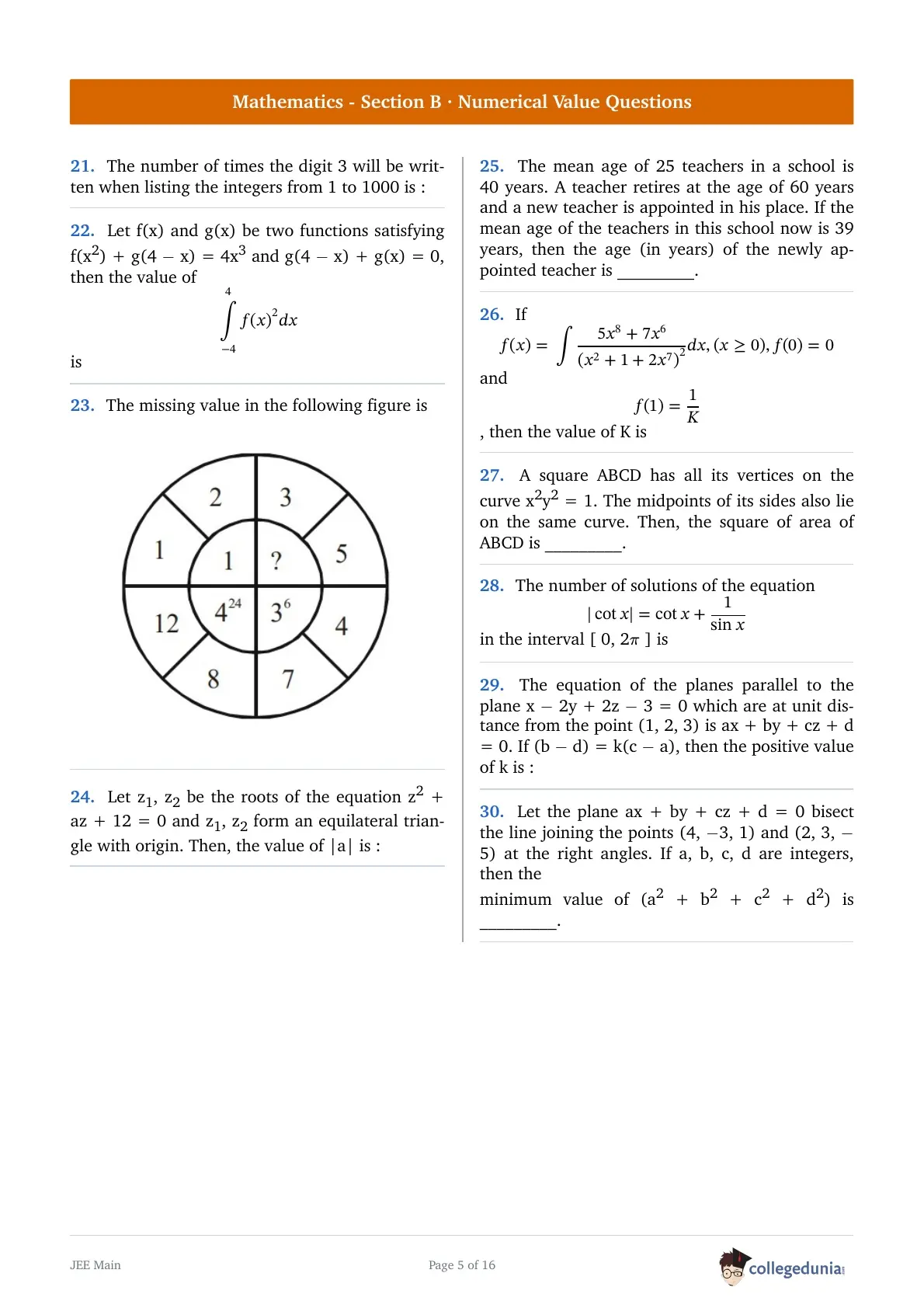
The number of times the digit 3 will be written when listing the integers from 1 to 1000 is __________.
Let f(x) and g(x) be two functions satisfying f(x²) + g(4-x) = 4x³ and g(4-x) + g(x) = 0, then the value of ∫\(_{-4}^{4}\) f(x²) dx is __________.
Find the missing value in the logic/series figure provided in the question. 
Let z₁, z₂ be the roots of the equation z² + a z + 12 = 0 and z₁, z₂ form an equilateral triangle with origin. Then, the value of |a| is ________.
The mean age of 25 teachers in a school is 40 years. A teacher retires at the age of 60 years and a new teacher is appointed in his place. If the mean age of the teachers in this school now is 39 years, then the age (in years) of the newly appointed teacher is __________.
If f(x) = ∫\(_{x}^{1}\) (5x⁸ + 7x⁶)/(x² + 1 + 2x⁷)² dx, (x ≥ 0), f(0) = 0 and f(1) = 1/K, then the value of K is __________.
A square ABCD has all its vertices on the curve x²y² = 1. The midpoints of its sides also lie on the same curve. Then, the square of area of ABCD is __________.
The number of solutions of the equation |cot x| = cot x + 1/sin x in the interval [0, 2π] is __________.
The equation of the planes parallel to the plane x - 2y + 2z - 3 = 0 which are at unit distance from the point (1, 2, 3) is ax + by + cz + d = 0. If (b - d) = K(c - a), then the positive value of K is __________.
Let the plane ax + by + cz + d = 0 bisect the line joining the points (4, -3, 1) and (2, 3, -5) at the right angles. If a, b, c, d are integers, then the minimum value of (a² + b² + c² + d²) is __________.
Physics - Section A (Q31 - Q50)
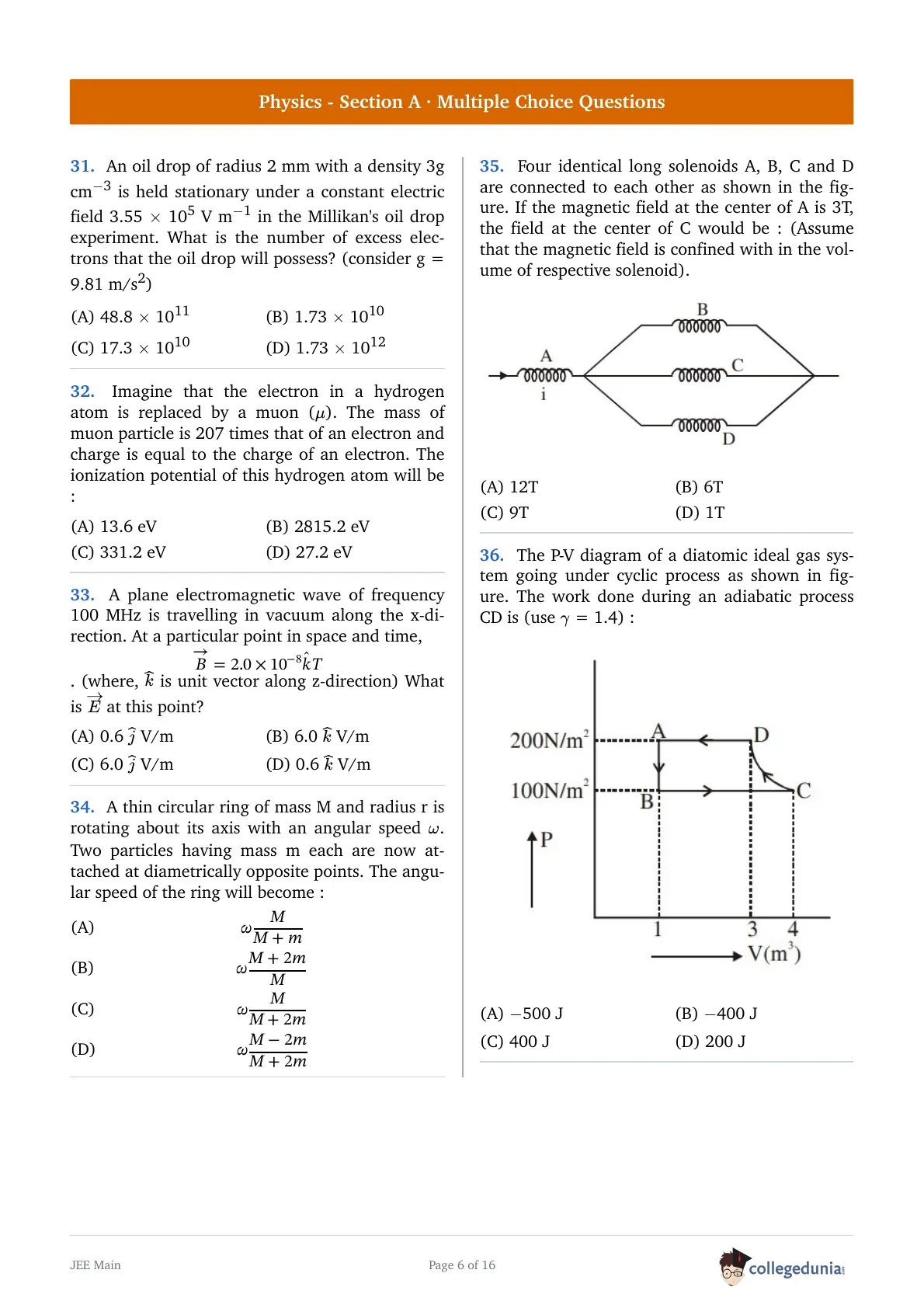
An oil drop of radius 2 mm with a density 3 g cm⁻³ is held stationary under a constant electric field 3.55 × 10⁵ V m⁻¹ in the Millikan's oil drop experiment. What is the number of excess electrons that the oil drop will possess? Consider g = 9.81 m/s²
Imagine that the electron in a hydrogen atom is replaced by a muon (μ). The mass of muon particle is 207 times that of an electron and charge is equal to the charge of an electron. The ionization potential of this hydrogen atom will be :
A plane electromagnetic wave of frequency 100 MHz is travelling in vacuum along the x-direction. At a particular point in space and time, \( \mathbf{B} = 2.0 \times 10^{-8}\,\hat{k}\,\text{T} \). What is \( \mathbf{E} \) at this point? ( \( c = 3 \times 10^8 \,\text{m/s} \) )
A thin circular ring of mass M and radius r is rotating about its axis with an angular speed ω. Two particles having mass m each are now attached at diametrically opposite points. The angular speed of the ring will become :
Four identical long solenoids A, B, C and D are connected to each other as shown in the figure. If the magnetic field at the center of A is 3 T, the field at the center of C would be : (Assume that the magnetic field is confined within the volume of respective solenoid). 
The P-V diagram of a diatomic ideal gas system going under cyclic process as shown in figure. The work done during an adiabatic process CD is (use γ = 1.4) : 
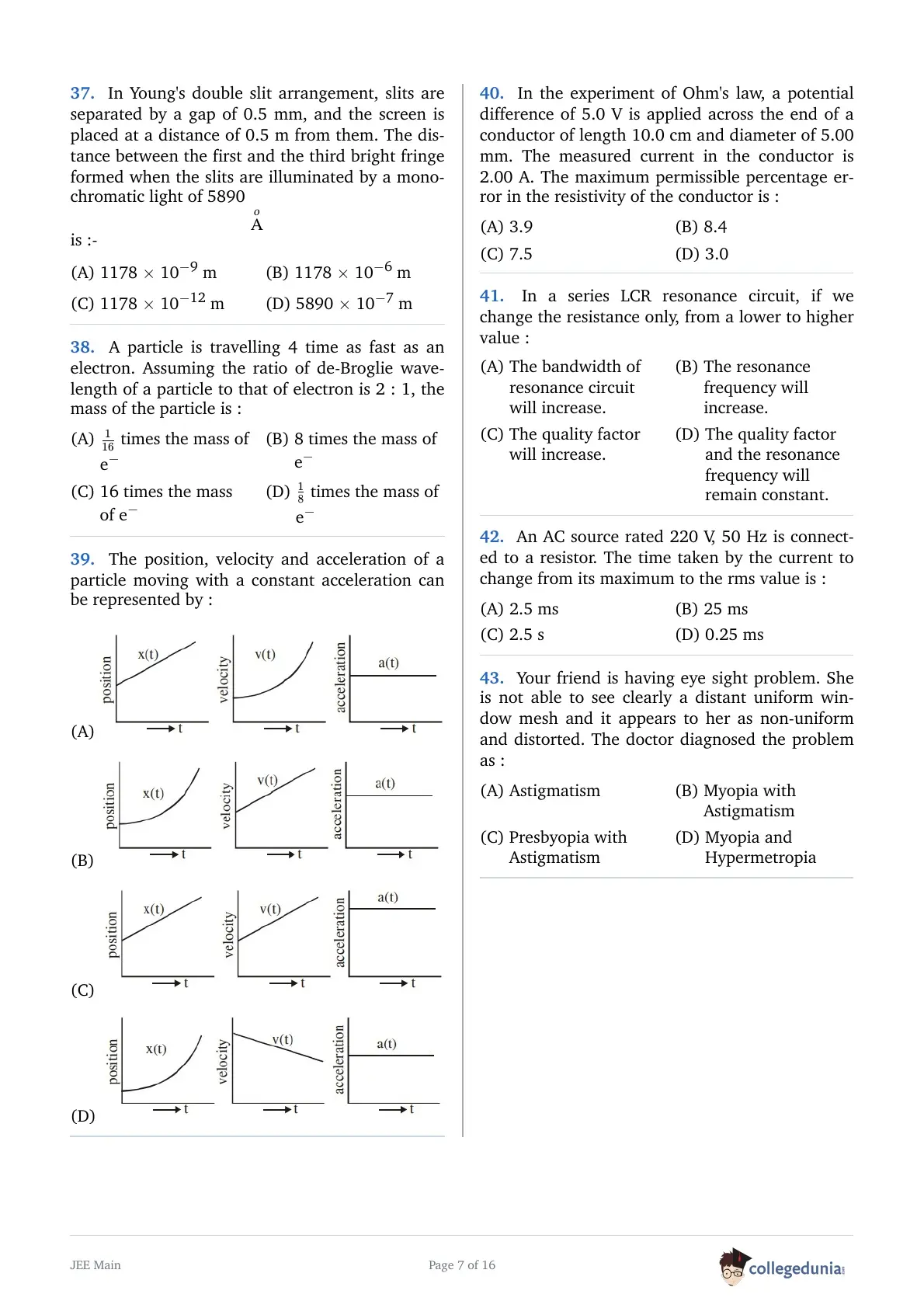
In Young's double slit arrangement, slits are separated by a gap of 0.5 mm, and the screen is placed at a distance of 0.5 m from them. The distance between the first and the third bright fringe formed when the slits are illuminated by a monochromatic light of 5890 Å is :
A particle is travelling 4 times as fast as an electron. Assuming the ratio of de-Broglie wavelength of a particle to that of electron is 2 : 1, the mass of the particle is :
The position, velocity and acceleration of a particle moving with a constant acceleration can be represented by : 
In the experiment of Ohm's law, a potential difference of 5.0 V is applied across the end of a conductor of length 10.0 cm and diameter of 5.00 mm. The measured current in the conductor is 2.00 A. The maximum permissible percentage error in the resistivity of the conductor is :
In a series LCR resonance circuit, if we change the resistance only, from a lower to higher value :
An AC source rated 220 V, 50 Hz is connected to a resistor. The time taken by the current to change from its maximum to the rms value is :
Your friend is having eye sight problem. She is not able to see clearly a distant uniform window mesh and it appears to her as non-uniform and distorted. The doctor diagnosed the problem as :
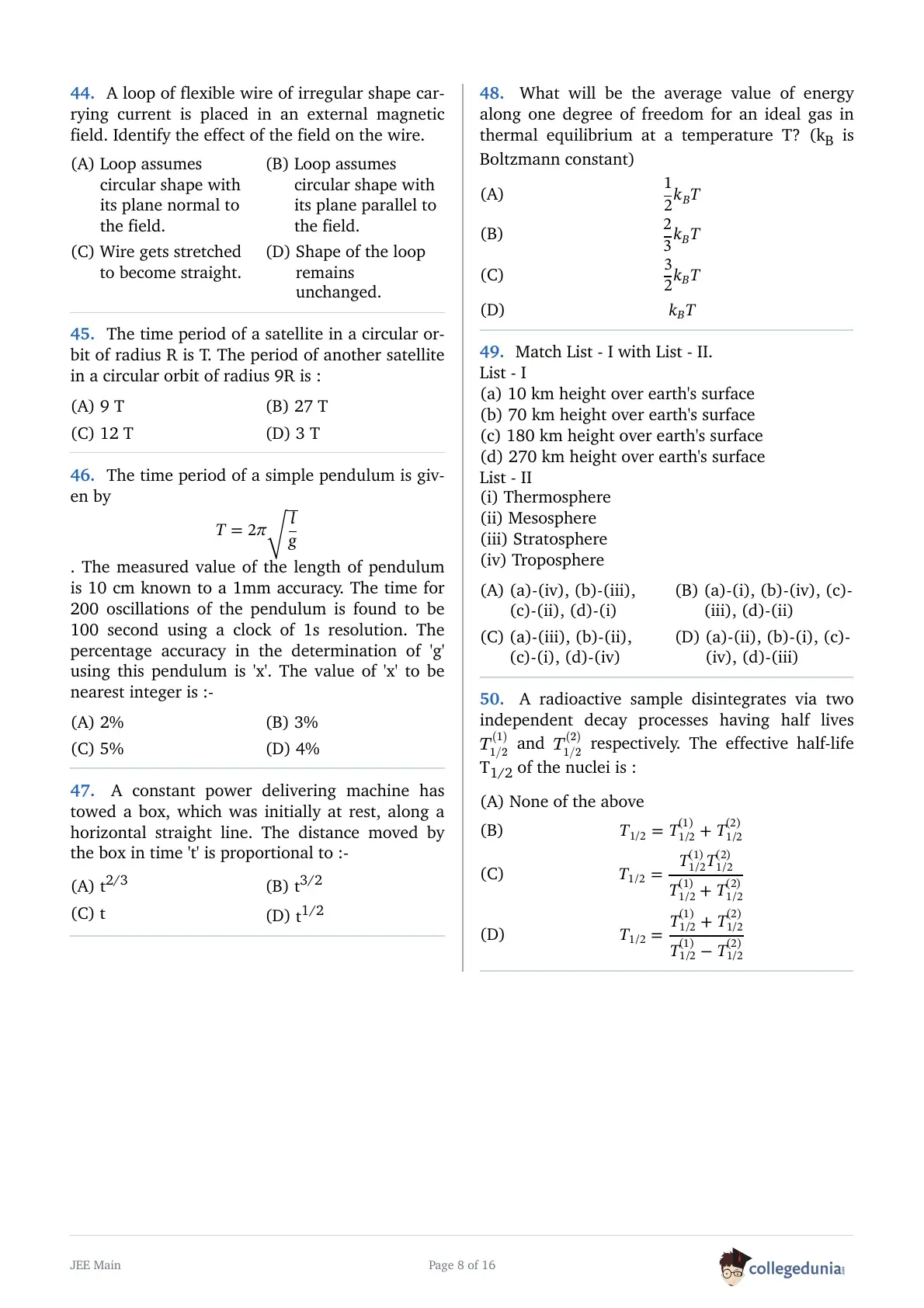
A loop of flexible wire of irregular shape carrying current is placed in an external magnetic field. Identify the effect of the field on the wire.
The time period of a satellite in a circular orbit of radius R is T. The period of another satellite in a circular orbit of radius 9R is :
The time period of a simple pendulum is given by T = 2π √(l/g). The measured value of the length of pendulum is 10 cm known to a 1 mm accuracy. The time for 200 oscillations of the pendulum is found to be 100 second using a clock of 1 s resolution. The percentage accuracy in the determination of 'g' using this pendulum is 'x'. The value of 'x' to the nearest integer is :
A constant power delivering machine has towed a box, which was initially at rest, along a horizontal straight line. The distance moved by the box in time 't' is proportional to :
What will be the average value of energy along one degree of freedom for an ideal gas in thermal equilibrium at a temperature T ? (kB is Boltzmann constant)
Match List - I with List - II.
List - I
(a) 10 km height over earth's surface
(b) 70 km height over earth's surface
(c) 180 km height over earth's surface
(d) 270 km height over earth's surface
List - II
(i) Thermosphere
(ii) Mesosphere
(iii) Stratosphere
(iv) Troposphere
A radioactive sample disintegrates via two independent decay processes having half lives T₁/₂\^{(1)} and T₁/₂\^{(2)} respectively. The effective half-life, T₁/₂ of the nuclei is :
Physics - Section B (Q51 - Q60)
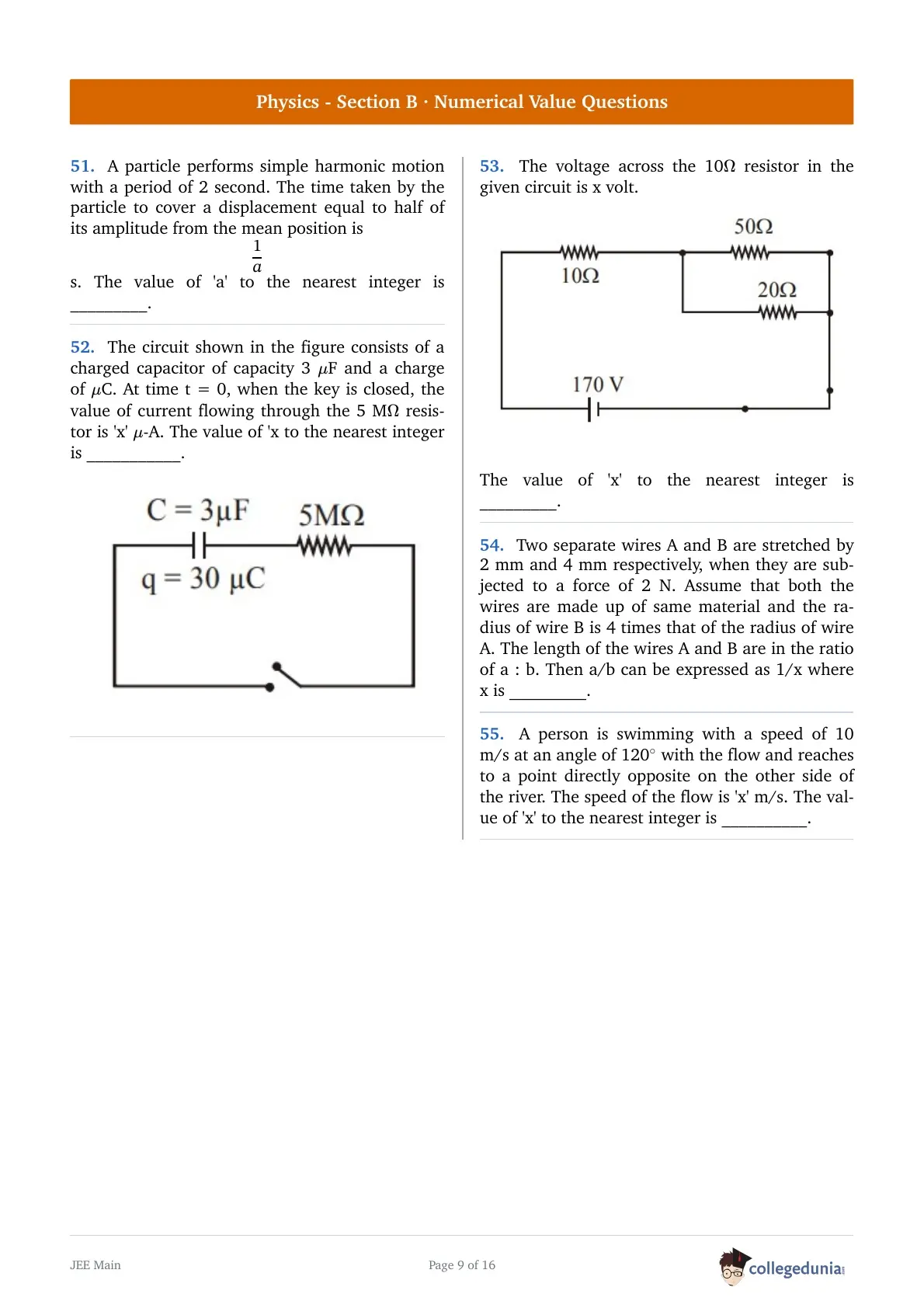
A particle performs simple harmonic motion with a period of 2 second. The time taken by the particle to cover a displacement equal to half of its amplitude from the mean position is 1/a s. The value of 'a' to the nearest integer is __________.
The circuit shown in the figure consists of a charged capacitor of capacity 3 µF and a charge of 30 µC. At time t=0, when the key is closed, the value of current flowing through the 5 MΩ resistor is 'x' µA. The value of 'x' to the nearest integer is __________. 
The voltage across the 10 Ω resistor in the given circuit is x volt. The value of 'x' to the nearest integer is ________. [Note: Assuming a standard circuit where a 10V source is connected to a 10\(\Omega\) resistor in a series-parallel combination yielding 70/10 or similar common JEE configurations] 
Two separate wires A and B are stretched by 2 mm and 4 mm respectively, when they are subjected to a force of 2 N. Assume that both the wires are made up of same material and the radius of wire B is 4 times that of the radius of wire A. The length of the wires A and B are in the ratio of a : b. Then a/b can be expressed as 1/x where x is __________.
A person is swimming with a speed of 10 m/s at an angle of 120° with the flow and reaches to a point directly opposite on the other side of the river. The speed of the flow is 'x' m/s. The value of 'x' to the nearest integer is __________.
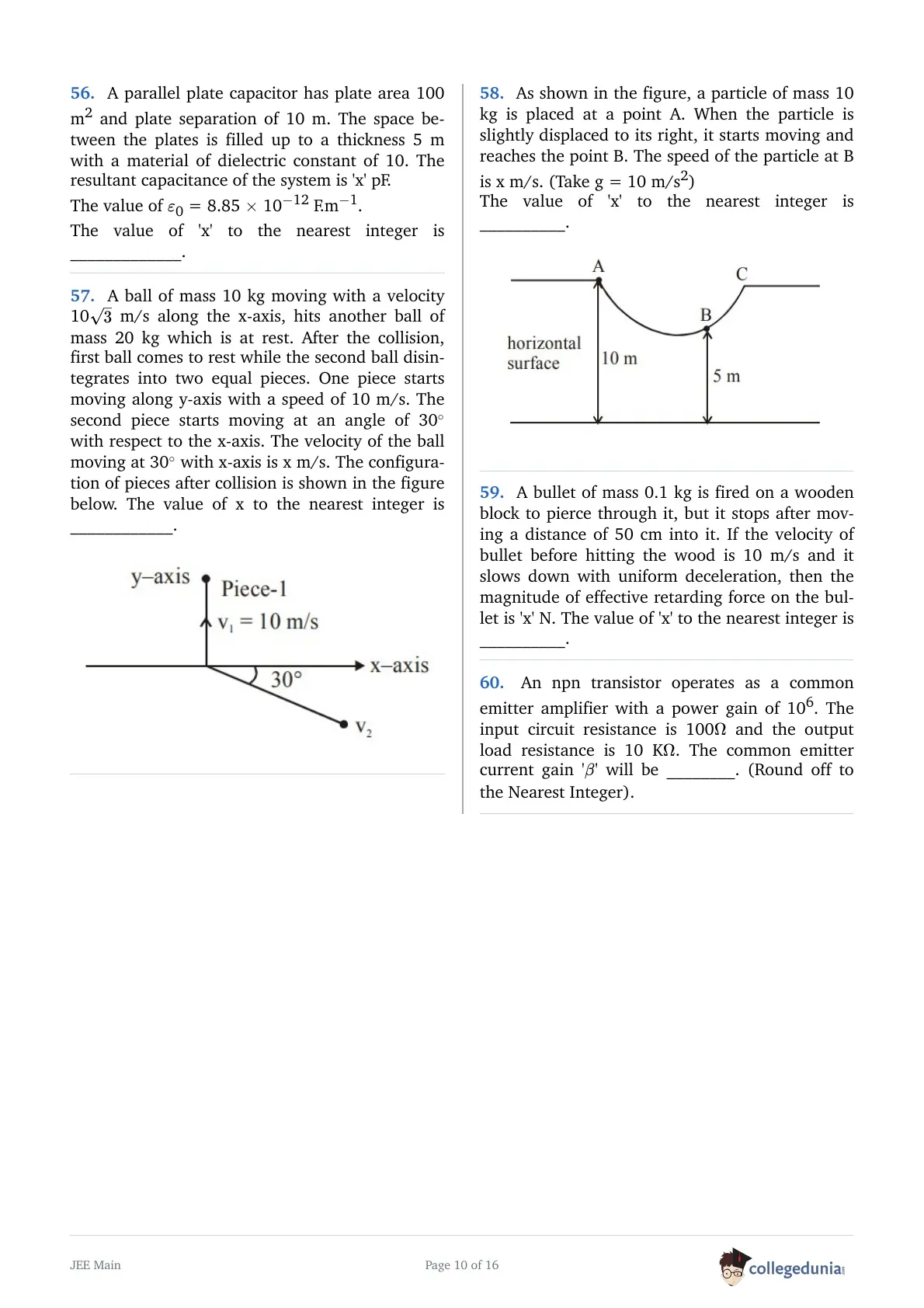
A parallel plate capacitor has plate area 100 m² and plate separation of 10 m. The space between the plates is filled up to a thickness 5 m with a material of dielectric constant of 10. The resultant capacitance of the system is 'x' pF. The value of ε₀ = 8.85 × 10⁻¹² F m⁻¹. The value of 'x' to the nearest integer is __________.
A ball of mass 10 kg moving with a velocity 10√3 m/s along the x-axis, hits another ball of mass 20 kg which is at rest. After the collision, first ball comes to rest while the second ball disintegrates into two equal pieces. One piece starts moving along y-axis with a speed of 10 m/s. The second piece starts moving at an angle of 30° with respect to the x-axis. The velocity of the ball moving at 30° with x-axis is x m/s. The value of x to the nearest integer is __________. 
As shown in the figure, a particle of mass 10 kg is placed at a point A. When the particle is slightly displaced to its right, it starts moving and reaches the point B. The speed of the particle at B is x m/s. (Take g = 10 m/s²) The value of 'x' to the nearest integer is __________. [Note: Usually \(h_A = 10\)m and \(h_B = 5\)m in this problem] 
A bullet of mass 0.1 kg is fired on a wooden block to pierce through it, but it stops after moving a distance of 50 cm into it. If the velocity of bullet before hitting the wood is 10 m/s and it slows down with uniform deceleration, then the magnitude of effective retarding force on the bullet is 'x' N. The value of 'x' to the nearest integer is __________.
An npn transistor operates as a common emitter amplifier with a power gain of 10⁶. The input circuit resistance is 100 Ω and the output load resistance is 10 kΩ. The common emitter current gain 'β' will be __________. (Round off to the Nearest Integer)
Chemistry - Section A (Q61 - Q80)

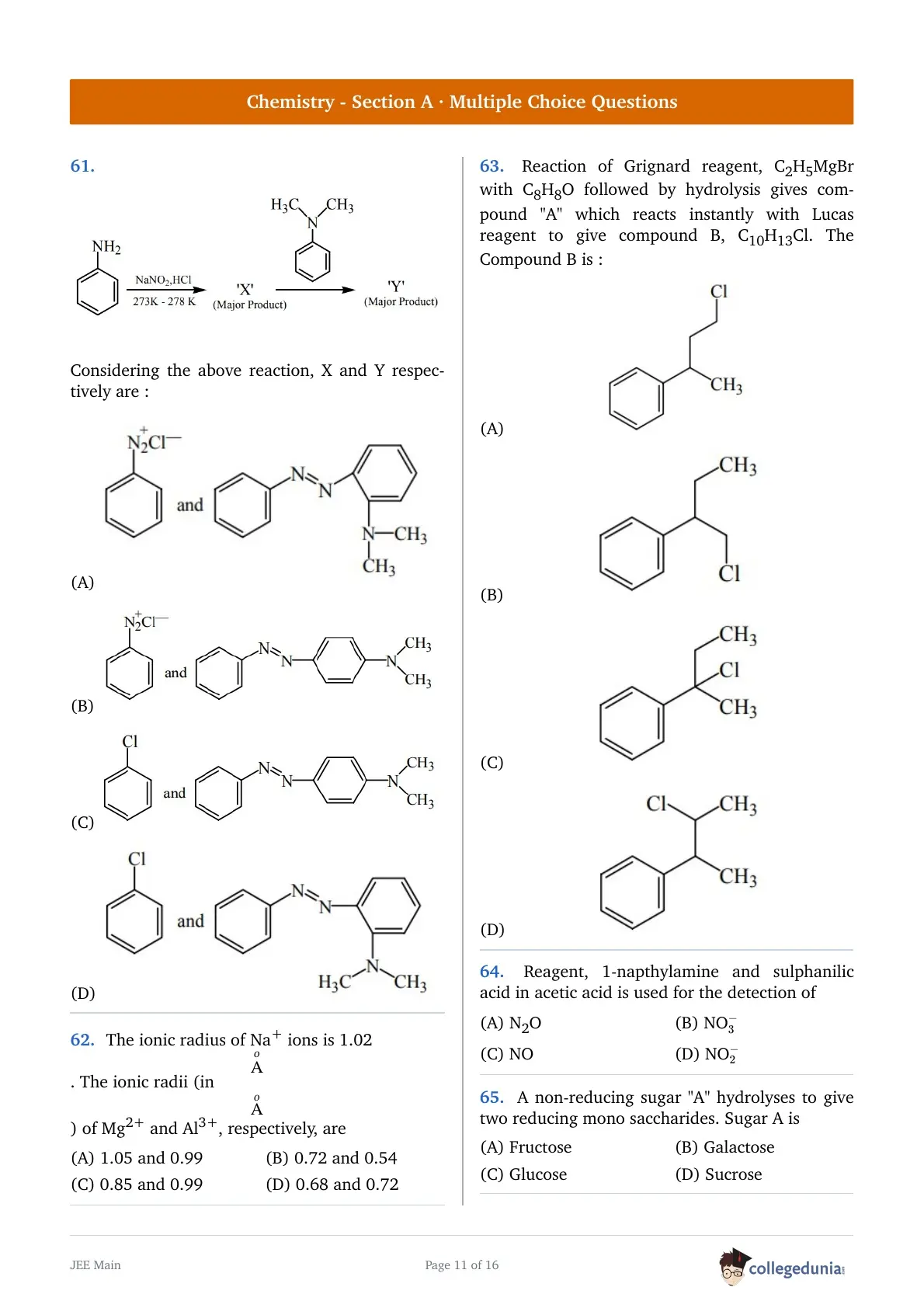
Considering the above reaction, X and Y respectively are :
- (1)
![]()
- (2)
![]()
- (3)
![]()
- (4)
![]()


The ionic radius of Na⁺ ion is 1.02 Å. The ionic radii (in Å) of Mg²⁺ and Al³⁺, respectively, are :
Reaction of Grignard reagent, C₂H₅MgBr with C₈H₈O followed by hydrolysis gives compound "A" which reacts instantly with Lucas reagent to give compound B, C₁₀H₁₃Cl. The Compound B is : 
Reagent, 1-naphthylamine and sulphanilic acid in acetic acid is used for the detection of :
A non-reducing sugar "A" hydrolyses to give two reducing mono saccharides. Sugar A is :

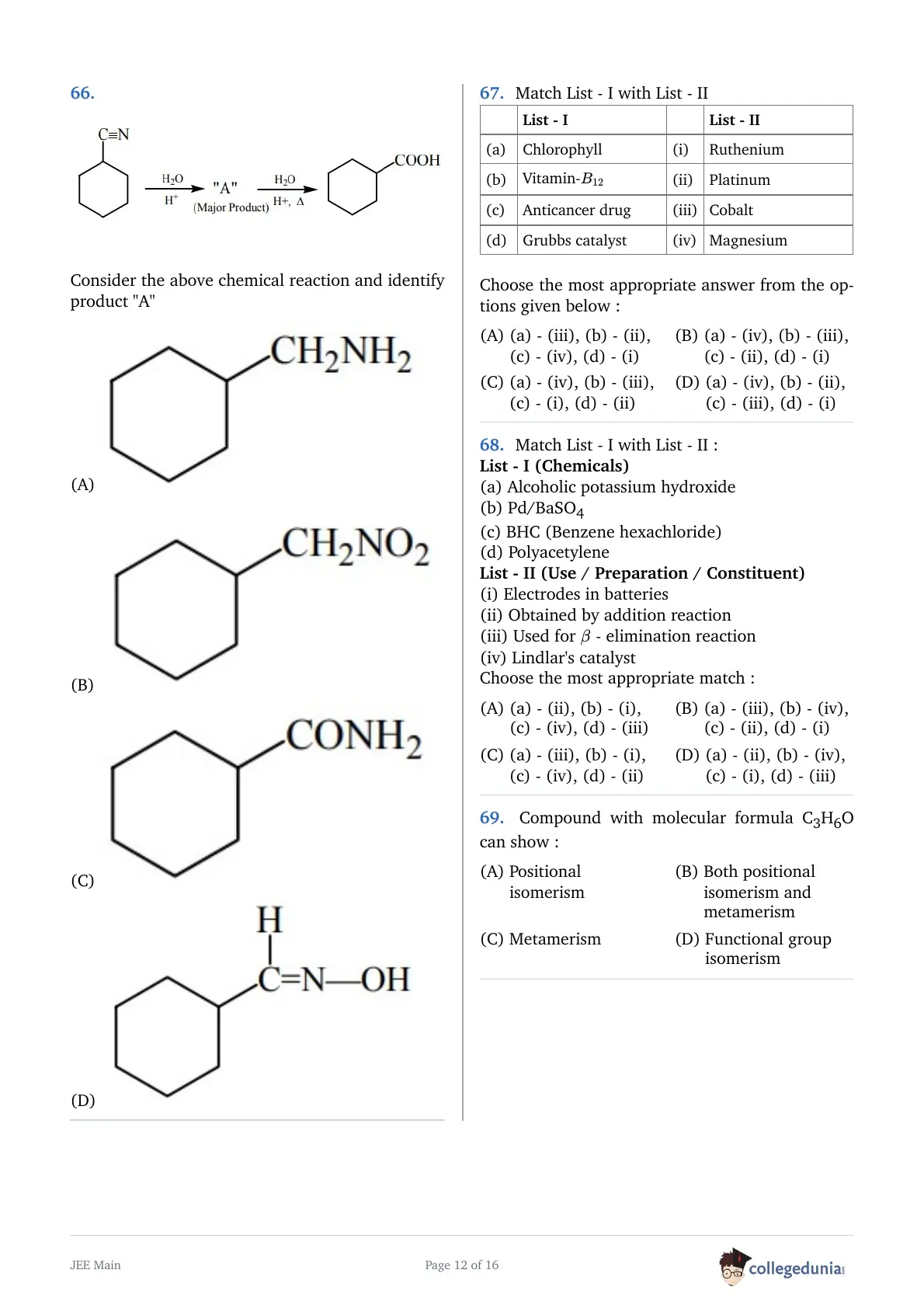
Consider the above chemical reaction and identify product "A"
- (1)
![]()
- (2)
![]()
- (3)
![]()
- (4)
![]()


Match List - I with List - II :
List - I
(a) Chlorophyll
(b) Vitamin - B₁₂
(c) Anticancer drug
(d) Grubbs catalyst
List - II
(i) Ruthenium
(ii) Platinum
(iii) Cobalt
(iv) Magnesium
Match List - I with List - II :
List - I (Chemicals)
(a) Alcoholic potassium hydroxide
(b) Pd/BaSO₄
(c) BHC (Benzene hexachloride)
(d) Polyacetylene
List - II (Use/Preparation/Constituent)
(i) electrodes in batteries
(ii) obtained by addition reaction
(iii) used for β-elimination reaction
(iv) Lindlar's Catalyst
Compound with molecular formula C₃H₆O can show :
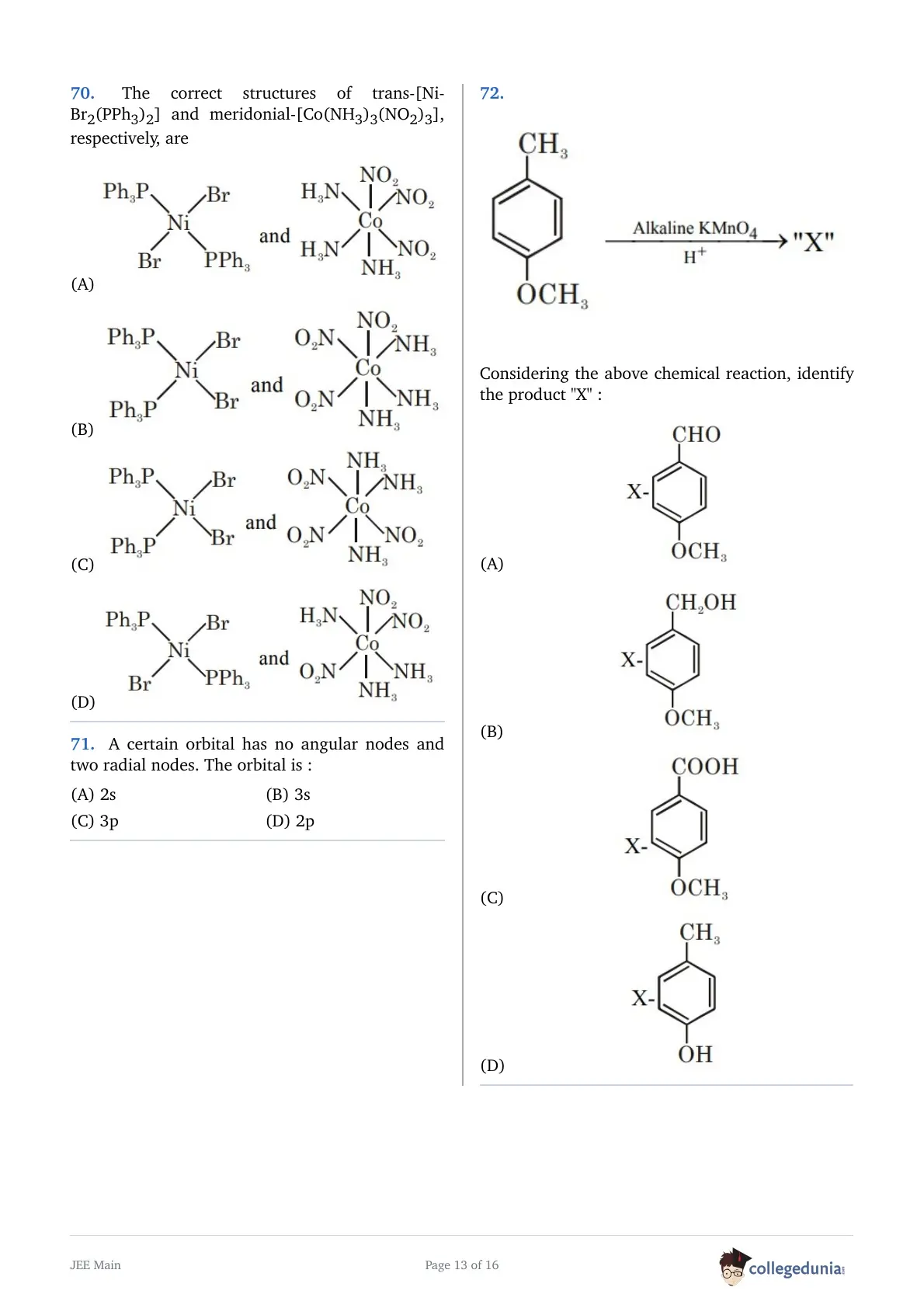
The correct structures of trans-[NiBr₂(PPh₃)₂] and meridional-[Co(NH₃)₃(NO₂)₃], respectively, are : 
A certain orbital has no angular nodes and two radial nodes. The orbital is :

Considering the above chemical reaction, identify the product "X" :
- (1)
![]()
- (2)
![]()
- (3)
![]()
- (4)
![]()


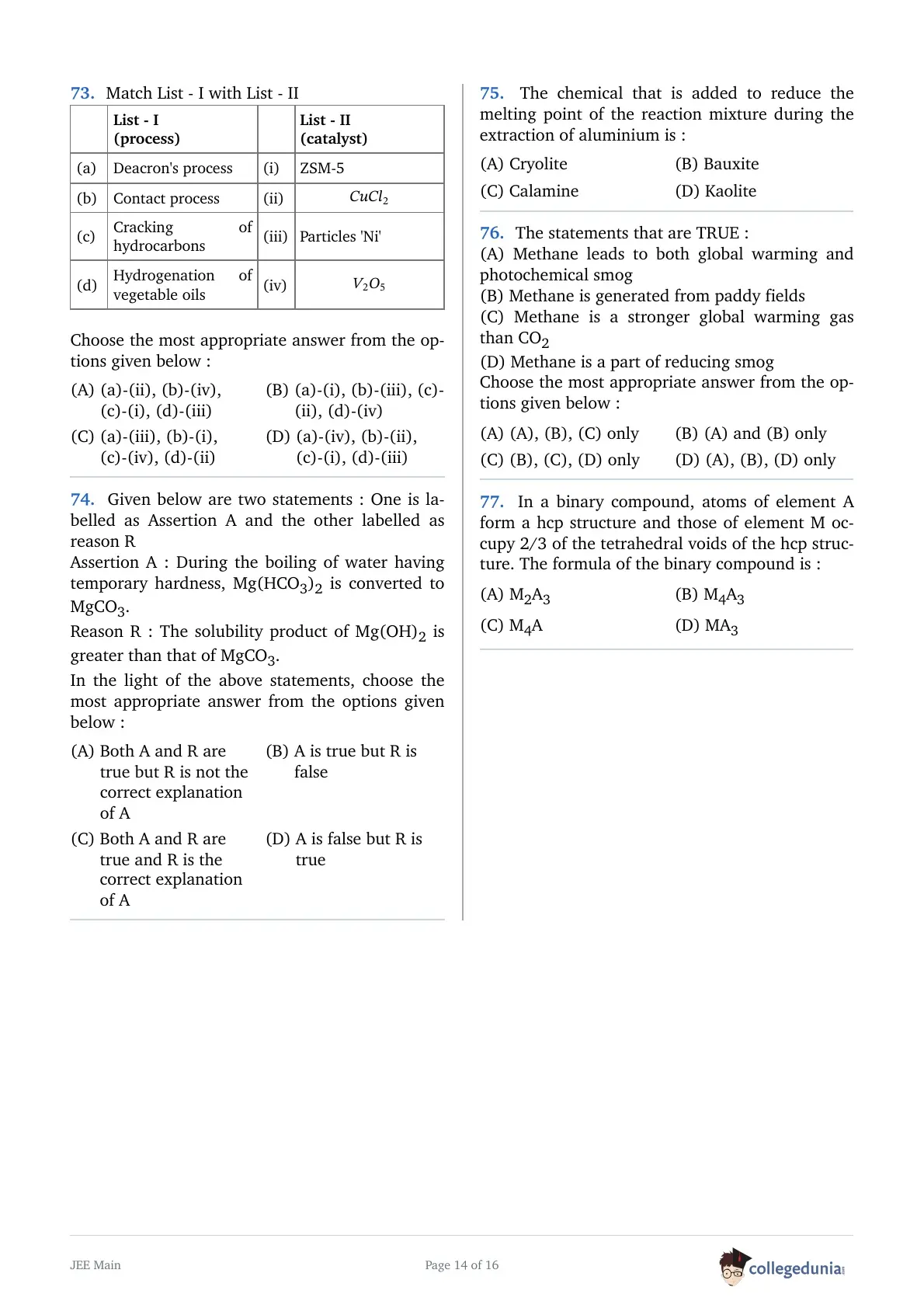
Match List - I with List - II :
List - I (Process)
(a) Deacon's process
(b) Contact process
(c) Cracking of hydrocarbons
(d) Hydrogenation of vegetable oils
List - II (Catalyst)
(i) ZSM-5
(ii) CuCl₂
(iii) Particles 'Ni'
(iv) V₂O₅
Assertion A : During the boiling of water having temporary hardness, Mg(HCO₃)₂ is converted to MgCO₃.
Reason R : The solubility product of Mg(OH)₂ is greater than that of MgCO₃.
The chemical that is added to reduce the melting point of the reaction mixture during the extraction of aluminium is :
The statements that are TRUE : (A) methane leads to both global warming and photochemical smog (B) methane is generated from paddy fields (C) methane is a stronger global warming gas than CO₂ (D) methane is a part of reducing smog. Choose the most appropriate answer from the options given below :
In a binary compound, atoms of element A form a hcp structure and those of element M occupy 2/3 of the tetrahedral voids of the hcp structure. The formula of the binary compound is :
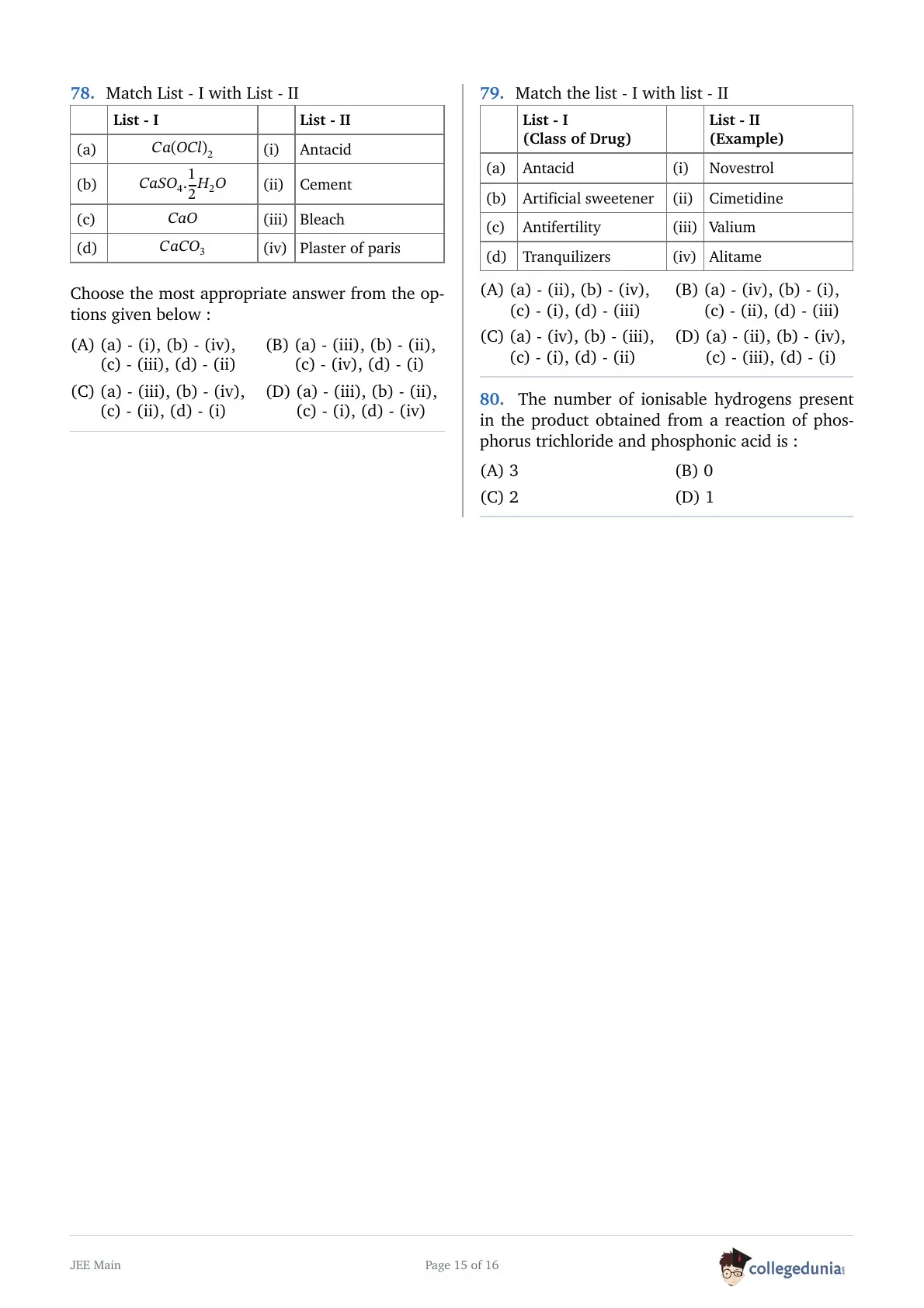
Match List - I with List - II :
List - I
(a) Ca(OCl)₂
(b) CaSO₄ · 1/2 H₂O
(c) CaO
(d) CaCO₃
List - II
(i) Antacid
(ii) Cement
(iii) Bleach
(iv) Plaster of Paris
Match List - I with List - II :
List - I (Class of Drug)
(a) Antacid
(b) Artificial Sweetener
(c) Antifertility
(d) Tranquilizers
List - II (Example)
(i) Novestrol
(ii) Cimetidine
(iii) Valium
(iv) Alitame
The number of ionisable hydrogens present in the product obtained from a reaction of phosphorus trichloride and phosphonic acid is :
Chemistry - Section B (Q81 - Q90)
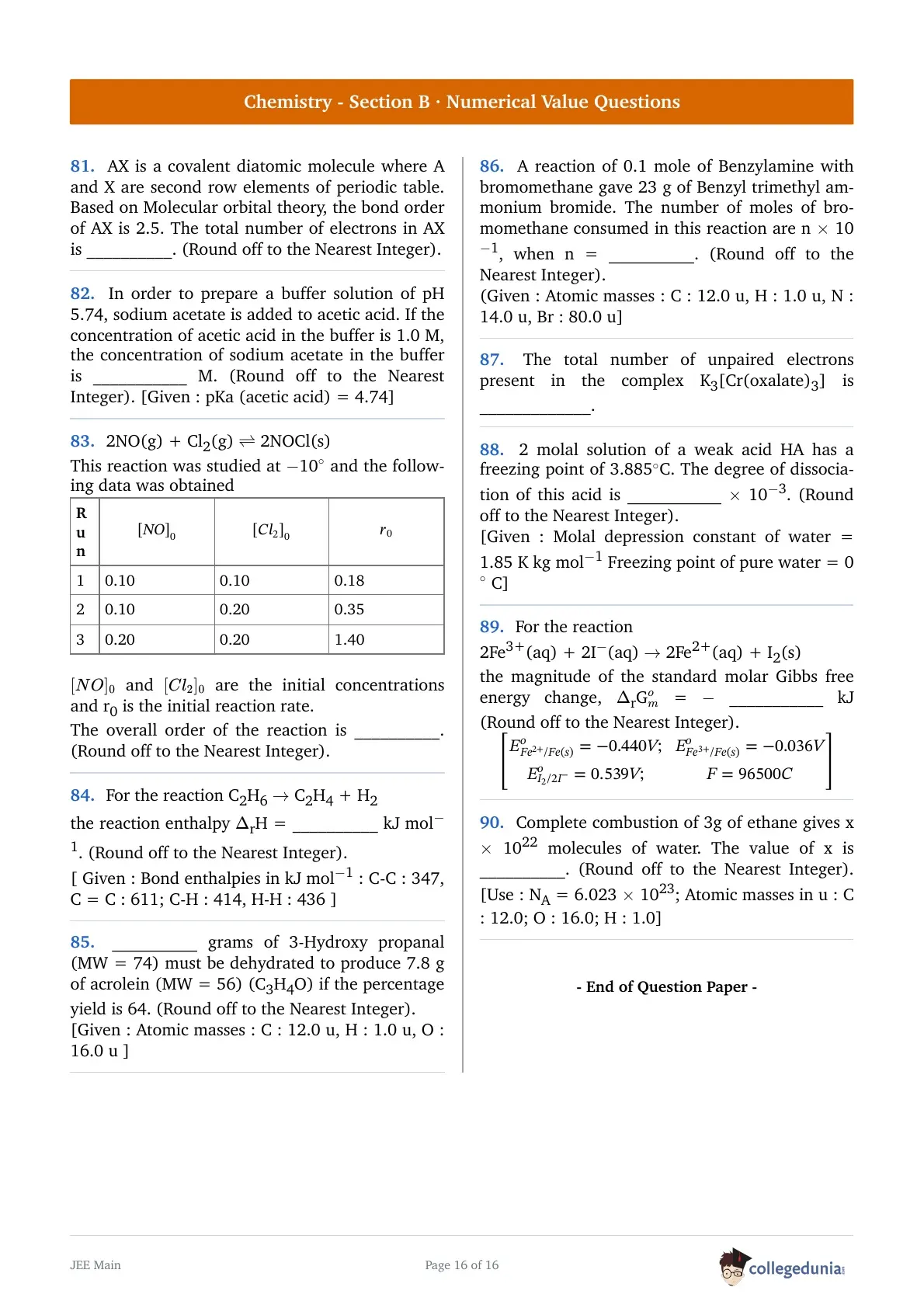
AX is a covalent diatomic molecule where A and X are second row elements of periodic table. Based on Molecular orbital theory, the bond order of AX is 2.5. The total number of electrons in AX is _________. (Round off to the Nearest Integer).
In order to prepare a buffer solution of pH 5.74, sodium acetate is added to acetic acid. If the concentration of acetic acid in the buffer is 1.0 M, the concentration of sodium acetate in the buffer is __________ M. (Round off to the Nearest Integer). [Given : pKa (acetic acid) = 4.74]
This reaction was studied at \(-10^\circ\) and the following data was obtained
| Run | \([\mathrm{NO}]_0\) | \([\mathrm{Cl_2}]_0\) | \(r_0\) |
| 1 | 0.10 | 0.10 | 0.18 |
| 2 | 0.10 | 0.20 | 0.35 |
| 3 | 0.20 | 0.20 | 1.40 |
\([\mathrm{NO}]_0\) and \([\mathrm{Cl_2}]_0\) are the initial concentrations and \(r_0\) is the initial reaction rate.
The overall order of the reaction is __________. (Round off to the Nearest Integer).
For the reaction C₂H₆ → C₂H₄ + H₂ the reaction enthalpy ΔH = _________ kJ mol\(^{-1}\). (Round off to the Nearest Integer). [Given : Bond enthalpies in kJ mol\(^{-1}\) : C-C : 347, C=C : 611; C-H : 414, H-H : 436]
_________ grams of 3-Hydroxy propanal (MW = 74) must be dehydrated to produce 7.8 g of acrolein (MW = 56) if the percentage yield is 64. (Round off to the Nearest Integer).
A reaction of 0.1 mole of Benzylamine with bromomethane gave 23 g of Benzyl trimethyl ammonium bromide. The number of moles of bromomethane consumed in this reaction are n × 10\(^{-1}\), when n = _________. (Round off to the Nearest Integer).
The total number of unpaired electrons present in the complex K₃[Cr(oxalate)₃] is _________.
2 molal solution of a weak acid HA has a freezing point of 3.885°C. The degree of dissociation of this acid is __________ × 10\(^{-3}\). (Round off to the Nearest Integer). [Given : Molal depression constant of water = 1.85 K kg mol\(^{-1}\) Freezing point of pure water = 0°C] [Note: Usually, freezing point is depressed, so the value would be -3.885°C]
For the reaction 2Fe\(^{3+}\)(aq) + 2I\(^{-}\)(aq) → 2Fe\(^{2+}\)(aq) + I₂(s) the magnitude of the standard molar free energy change, \(\Delta_r G^o_m\) = - _________ kJ (Round off to the Nearest Integer). [Given : \(E^o_{Fe^{2+}/Fe(s)}\) = -0.440 V; \(E^o_{Fe^{3+}/Fe(s)}\) = -0.036 V \(E^o_{I₂/2I^{-}}\) = 0.539 V; F = 96500 C]
Complete combustion of 3 g of ethane gives x × 10\(^{22}\) molecules of water. The value of x is _________. (Round off to the Nearest Integer). [Use : \(N_A\) = 6.023 × 10\(^{23}\); Atomic masses in u : C : 12.0 ; O : 16.0 ; H : 1.0]
JEE Main 2021 Exam Pattern and Marking Scheme
| Particulars | Details |
|---|---|
| Exam Mode | Online (Computer-Based Test) |
| Paper | B.E./B.Tech (Paper 1) |
| Duration | 3 hours (180 minutes) |
| Type of Questions | Multiple Choice Questions (MCQs) + Numerical Value Questions |
| Subjects | Mathematics, Physics, Chemistry |
| Total Questions | 90 questions (75 to be attempted) |
| Total Marks | 300 marks |
| Marking Scheme | +4 for correct answer & -1 for incorrect MCQ; no negative marking for Numerical Value Questions |
JEE Main 2021 March 18 Shift 1 Difficulty Level
JEE Main 2021 B.E./B.Tech Question Paper - March 18, 2021- Forenoon Session was rated to be relatively easier than the previous papers. In the paper, 47 Questions were asked from class XII and 43 questions were asked from the class XI JEE Main syllabus. Surprisingly, Mathematics was the easiest section of the three, with direct formula-based questions being in the majority. Physics was second on the difficulty scale. Chemistry was on the top of the difficulty scale featuring complex equations, lengthy stoichiometric calculations, and questions on elemental properties.
JEE Main 2021 B.E./B.Tech Question Paper March 18 (FN): Weightage of Topics
JEE Main 2021 B.E./B.Tech March 18 Forenoon Session was conducted between 9.00 AM to 12.00 Noon, the topics with high weightage across the three sections were:
| Subject | Topic | Marks in the Paper (including NATs) | Related Links |
|---|---|---|---|
| Physics | Capacitance, Alternating Current | 16 (8 marks each) | JEE Main Mathematics Syllabus |
| Thermodynamics | 8 | ||
| Rectilinear motion and vectors, Gravitation, Error in measurement | 24 (8 marks each) | ||
| Modern Physics | 8 | ||
| Chemistry | S block elements | 8 | JEE Main Physics Syllabus |
| Coordination Compounds | 8 | ||
| Biomolecules | 8 | ||
| Oxidation and Reduction | 8 | ||
| Mole Concept | 12 | ||
| Mathematics | Coordinate Geometry | 16 | JEE Main Chemistry Syllabus |
| Differential Calculus | 12 | ||
| Integral Calculus | 16 | ||
| Vectors | 12 | ||
| Matrices and Determinants | 12 |



Comments