



.png?h=35&w=35&mode=stretch)
JEE Main 2023 Chemistry Question Paper Jan 25 Shift 1 is available here. Candidates can download JEE Main 2023 Chemistry Question Paper PDF with Answer Key for Jan 25 Shift 1 using the link below. JEE Main Chemistry Question Paper is divided into two sections, Section A with 20 MCQs and Section B with 10 numerical type questions. Candidates are required to answer all questions from Section A and any 5 questions from section B.
Related Links:
- Download JEE Main Previous Year Question Papers PDF with Solutions
- Download JEE Main 2025 Question Paper for all Shifts
JEE Main 2023 Chemistry Question Paper Jan 25 Shift 1- Download PDF
| JEE Main 2023 25 Jan Shift 1 Chemistry Question Paper with Solution PDF |  Download Download |
Check Solution |
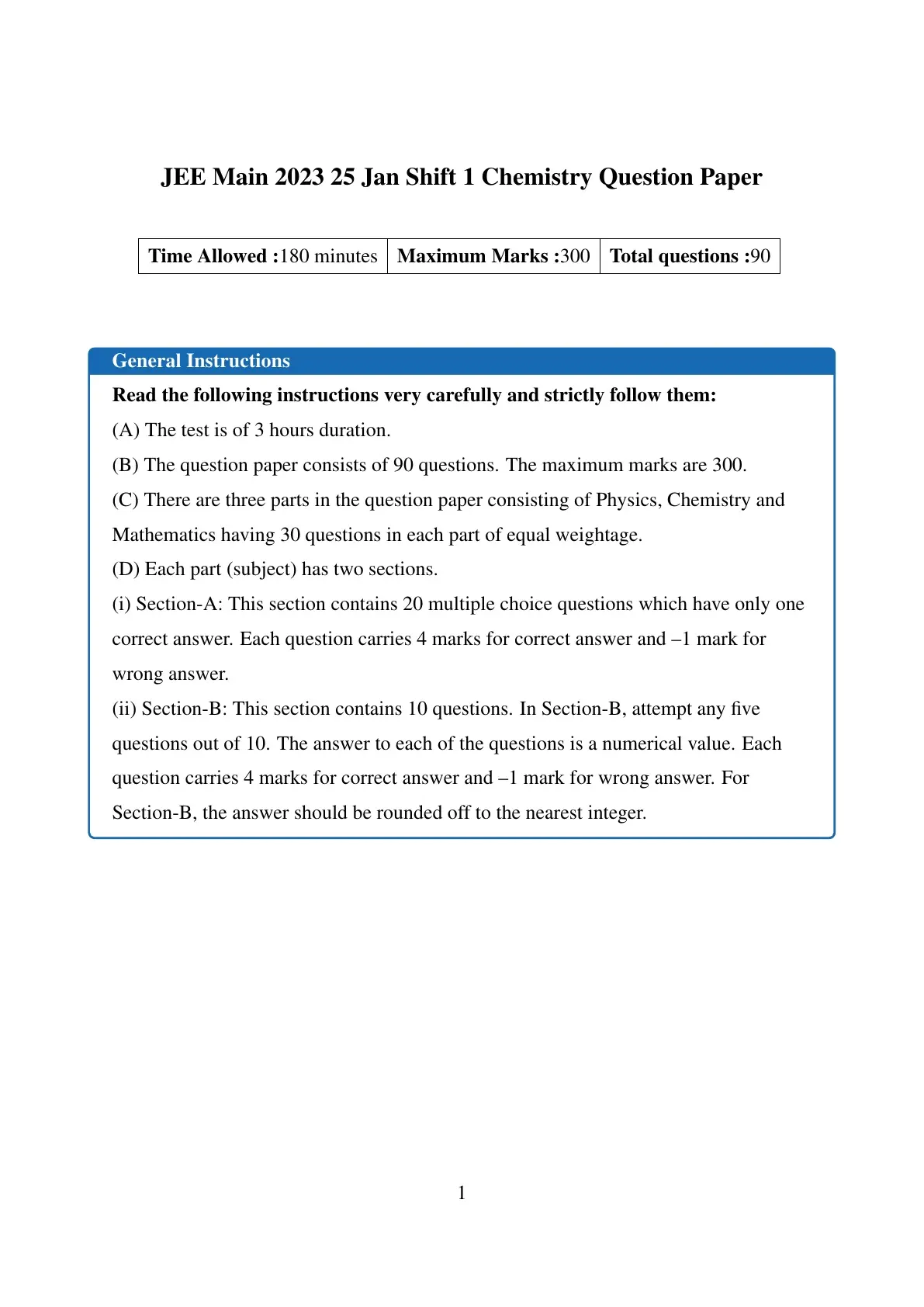
The compound which will have the lowest rate towards nucleophilic aromatic substitution on treatment with OH\(^-\) is:


View Solution
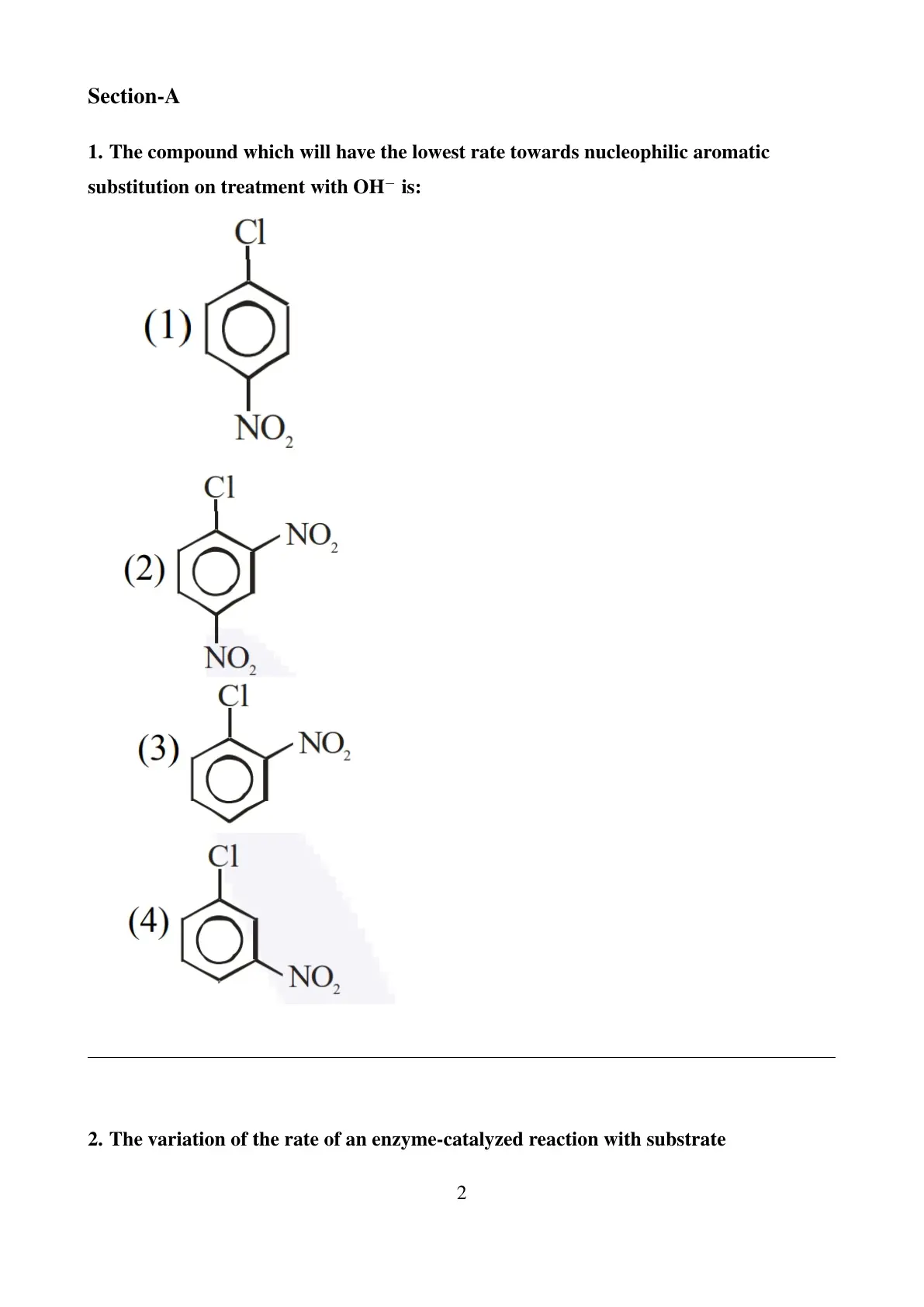
The variation of the rate of an enzyme-catalyzed reaction with substrate concentration is correctly represented by which graph?


Options:
1. a
2. b.
3. c.
4. d.
View Solution
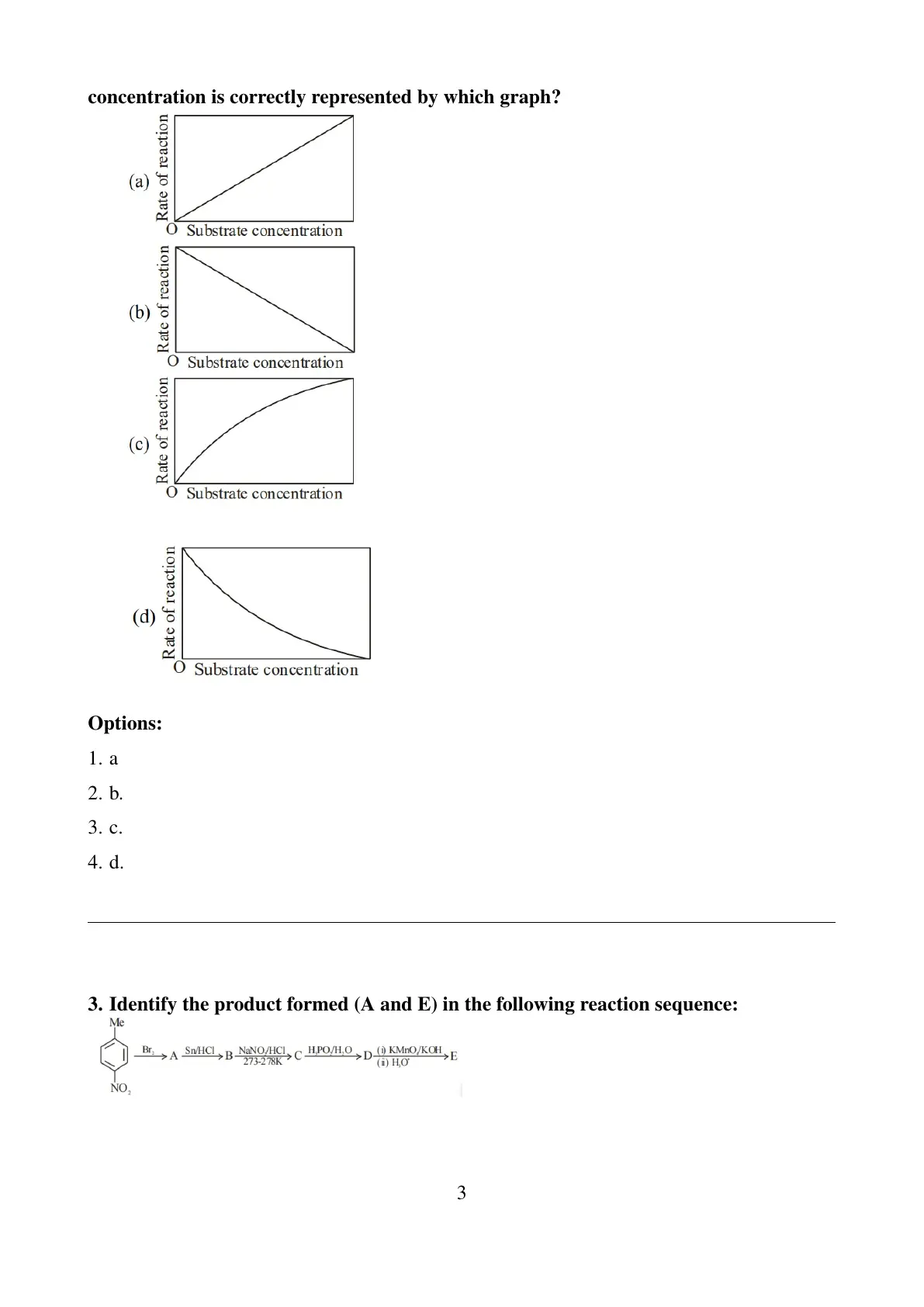
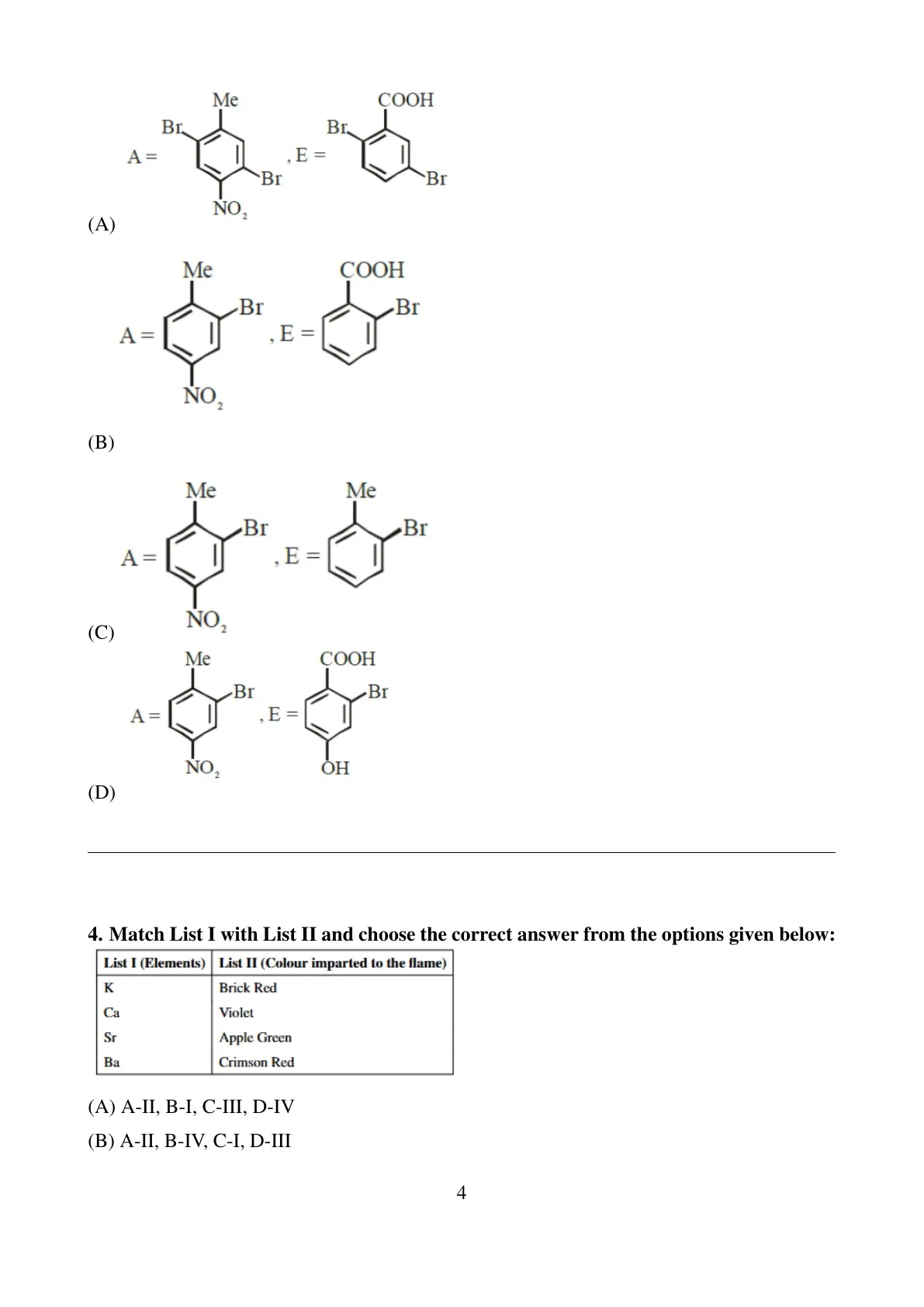
Identify the product formed (A and E) in the following reaction sequence:

\
- (A)
![]() \
\ - (B)
![]() \
\ - (C)
![]() \
\ - (D)
![]()
 \
\ \
\ \
\
View Solution
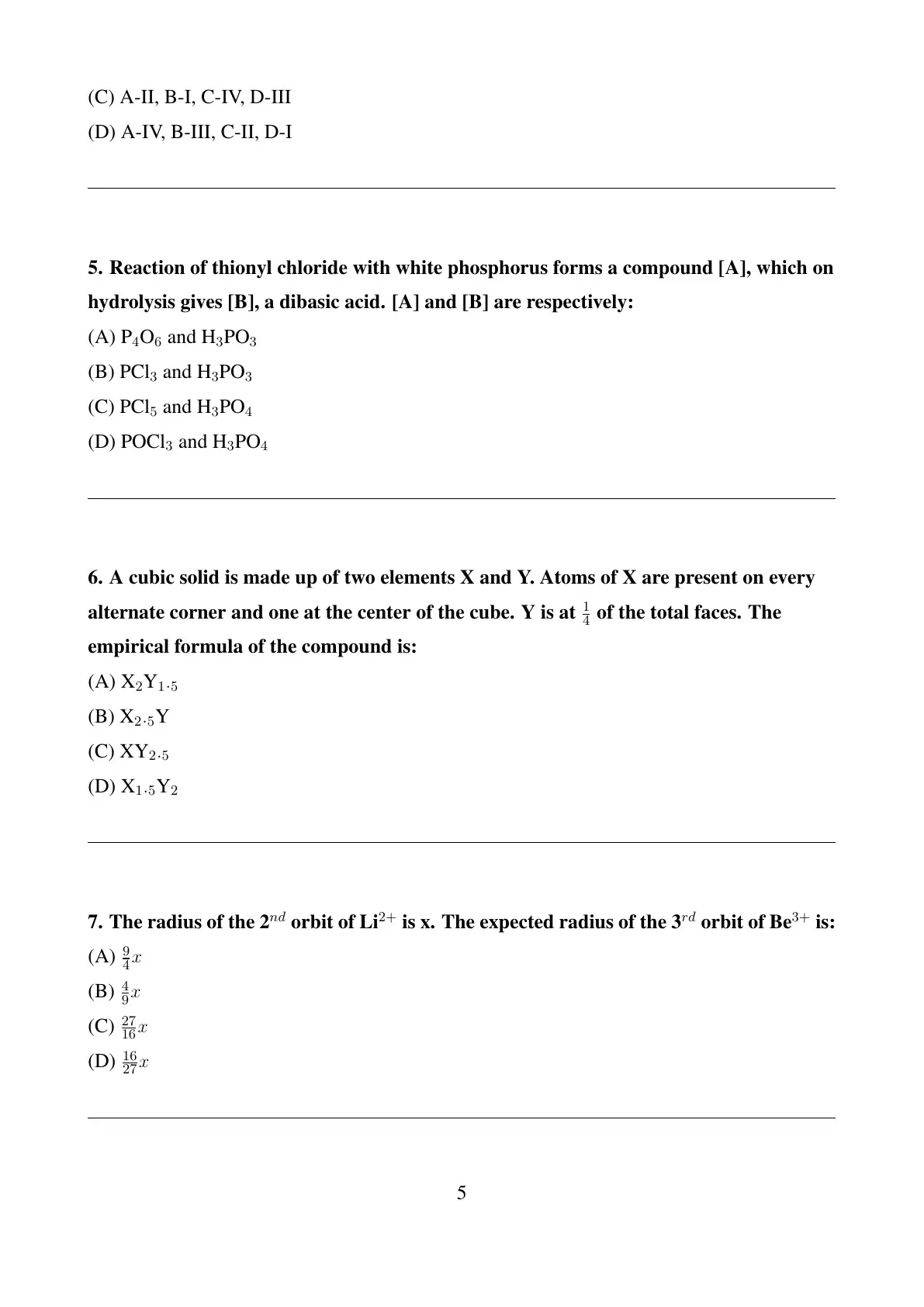
Match List I with List II and choose the correct answer from the options given below:

View Solution
Reaction of thionyl chloride with white phosphorus forms a compound \textbf{[A]}, which on hydrolysis gives \textbf{[B]}, a dibasic acid. \textbf{[A]} and \textbf{[B]} are respectively:
View Solution
A cubic solid is made up of two elements X and Y. Atoms of X are present on every alternate corner and one at the center of the cube. Y is at \(\frac{1}{4}\) of the total faces. The empirical formula of the compound is:
View Solution
The radius of the 2\(^{nd}\) orbit of Li\(^{2+}\) is x. The expected radius of the 3\(^{rd}\) orbit of Be\(^{3+}\) is:
View Solution
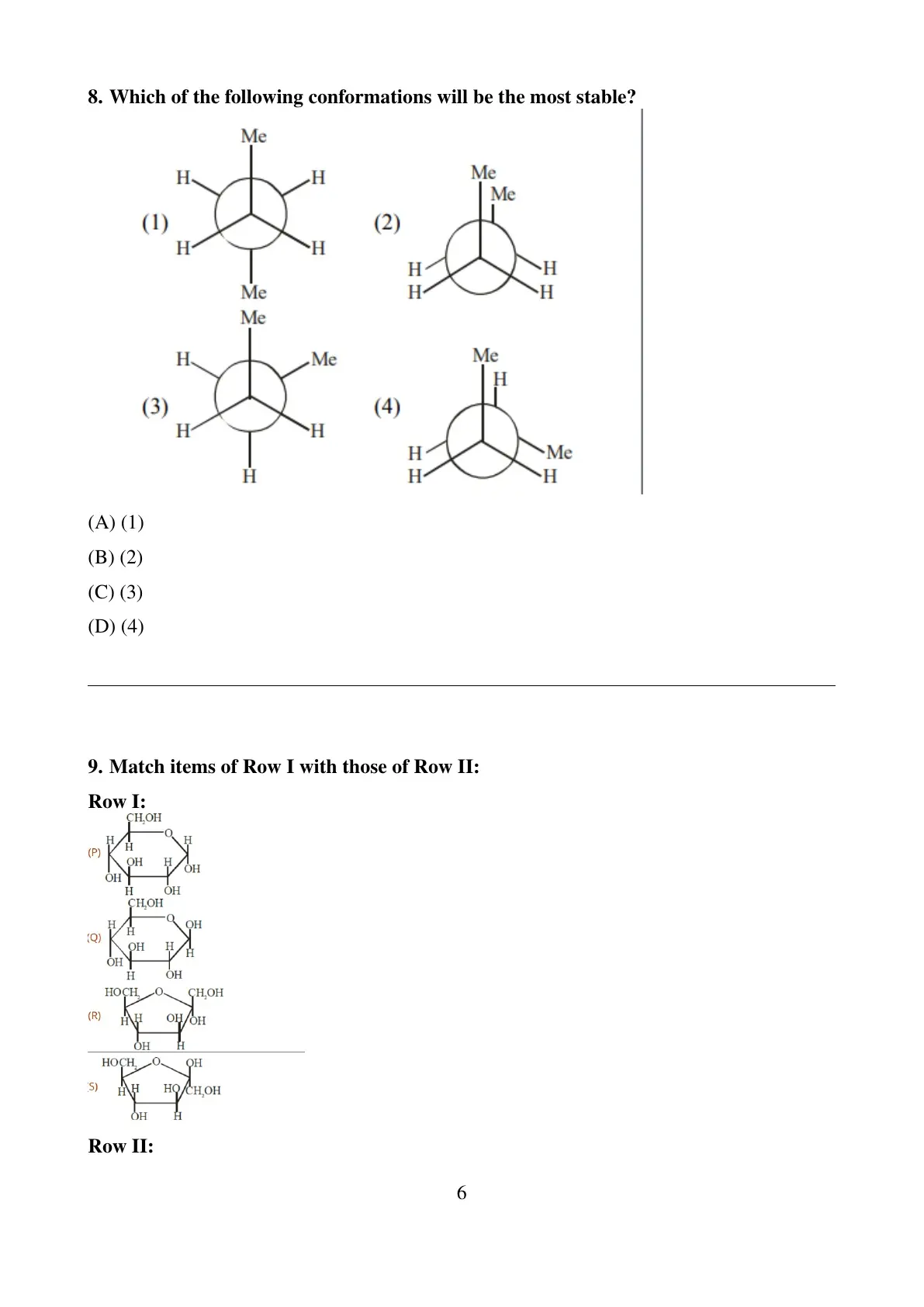
Which of the following conformations will be the most stable?

View Solution
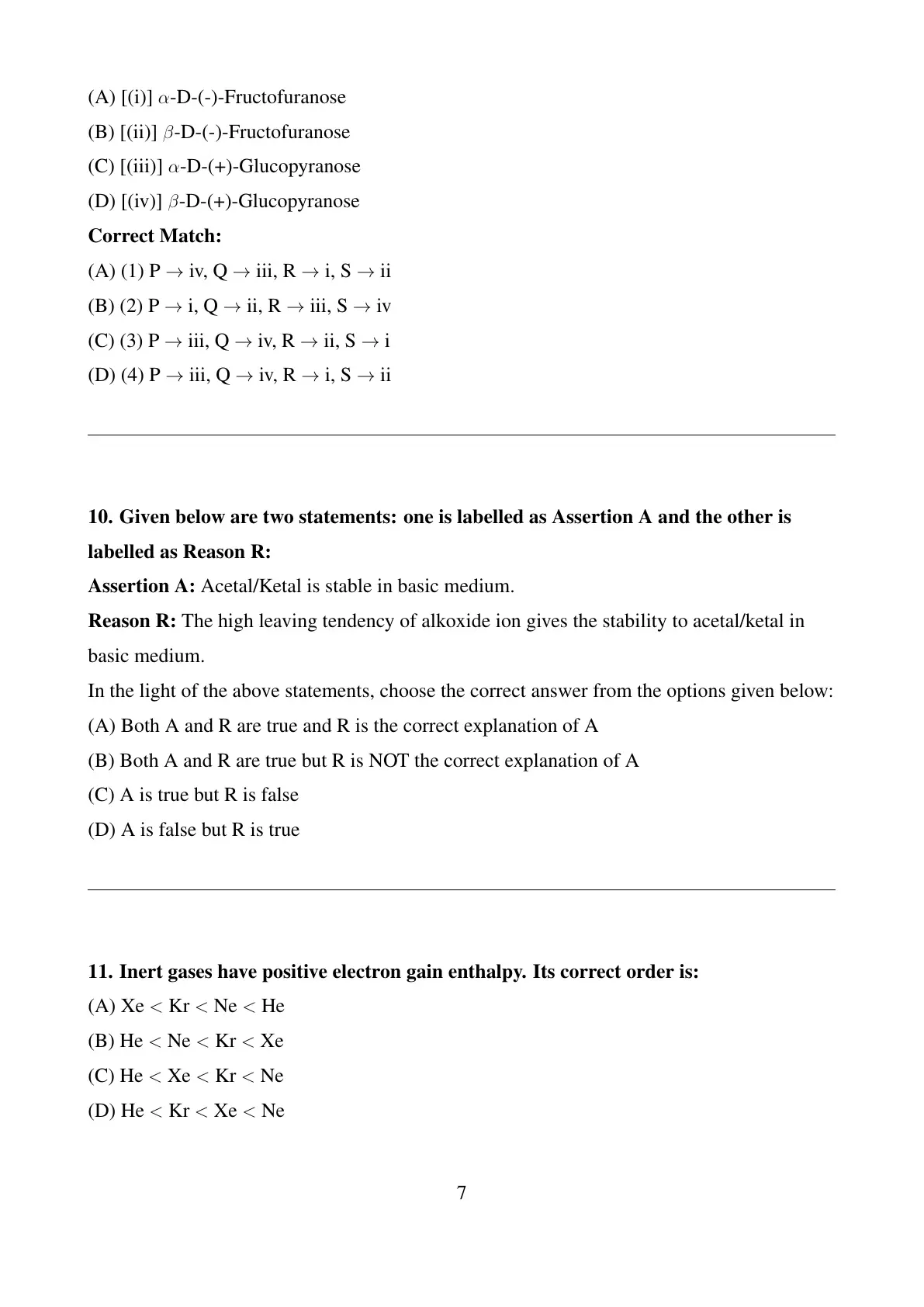
Match items of Row I with those of Row II:
Row I:


Row II:
View Solution
- (P): $\alpha$-D-(+)-Glucopyranose (iii): This structure has the -OH group at C1 in the $\alpha$-position (below the plane) in the six-membered pyranose ring.\\ - (Q): $\beta$-D-(+)-Glucopyranose (iv): This structure has the -OH group at C1 in the $\beta$-position (above the plane) in the six-membered pyranose ring.\\ - (R): $\alpha$-D-(-)-Fructofuranose (i): This structure is a five-membered fructofuranose ring with the $\alpha$-configuration (OH group at C2 below the plane).\\ - (S): $\beta$-D-(-)-Fructofuranose (ii): This structure is a five-membered fructofuranose ring with the $\beta$-configuration (OH group at C2 above the plane).\\ Thus, the correct matching is: \[ \text{P $\to$ iii, Q $\to$ iv, R $\to$ i, S $\to$ ii.} \] 1. Glucose exists in both pyranose ($\text{six-membered}$) and furanose ($\text{five-membered}$) forms. Pyranose forms are more stable.\\ 2. $\alpha$ and $\beta$ forms differ in the configuration of the hydroxyl group at the anomeric carbon (C1 for glucose and C2 for fructose).\\ 3. Fructose predominantly forms five-membered furanose rings due to its keto group.\\Given below are two statements: one is labelled as Assertion A and the other is labelled as Reason R:
Assertion A: Acetal/Ketal is stable in basic medium.
Reason R: The high leaving tendency of alkoxide ion gives the stability to acetal/ketal in basic medium.
In the light of the above statements, choose the correct answer from the options given below:
Inert gases have positive electron gain enthalpy. Its correct order is:
View Solution
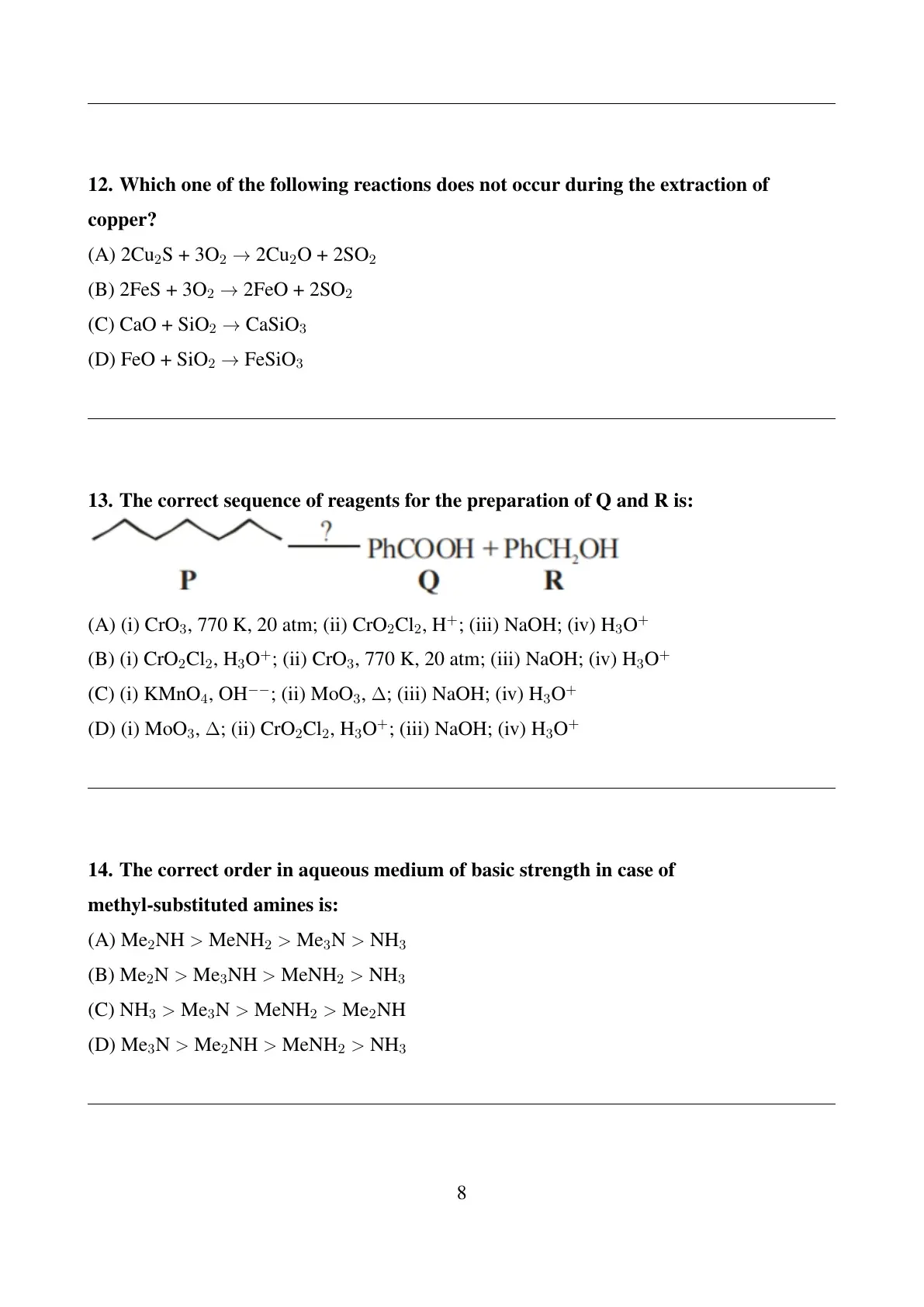
12. Which one of the following reactions does not occur during the extraction of copper?
View Solution
13. The correct sequence of reagents for the preparation of Q and R is:

View Solution
The reaction sequence involves:Step 1: Oxidation of benzene to benzoquinone using CrO$_3$ at 770 K and 20 atm.
Step 2: Formation of phenol by further oxidation with CrO$_2$Cl$_2$ in acidic medium.
Step 3: Neutralization with NaOH to form phenoxide ion.
Step 4: Acidification with H$_3$O$^+$ to yield phenol. In the preparation of phenol from benzene, the use of CrO$_3$ and CrO$_2$Cl$_2$ ensures selective oxidation steps. Acidic and basic conditions aid in subsequent transformations.
The correct order in aqueous medium of basic strength in case of methyl-substituted amines is:
View Solution
25-volume hydrogen peroxide means:
View Solution
Which of the following statements is incorrect for antibiotics?
View Solution
Compound A reacts with NH\(_3\)Cl and forms B and C. Compound B reacts with H\(_2\)O and CO\(_2\) to form C. The compounds A, B, and C are:
View Solution
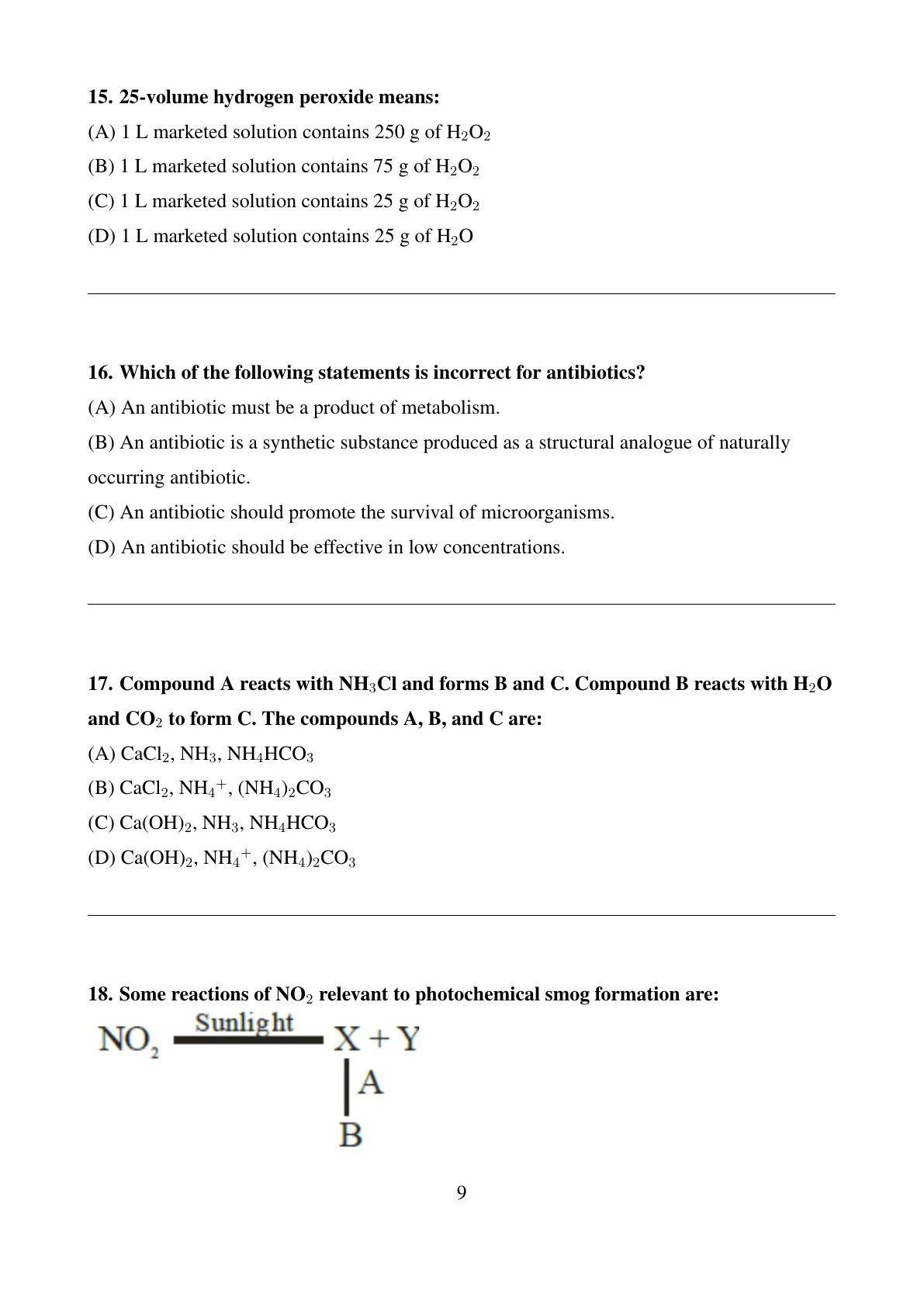
Some reactions of NO\(_2\) relevant to photochemical smog formation are:

Identify A, B, X, and Y:
View Solution
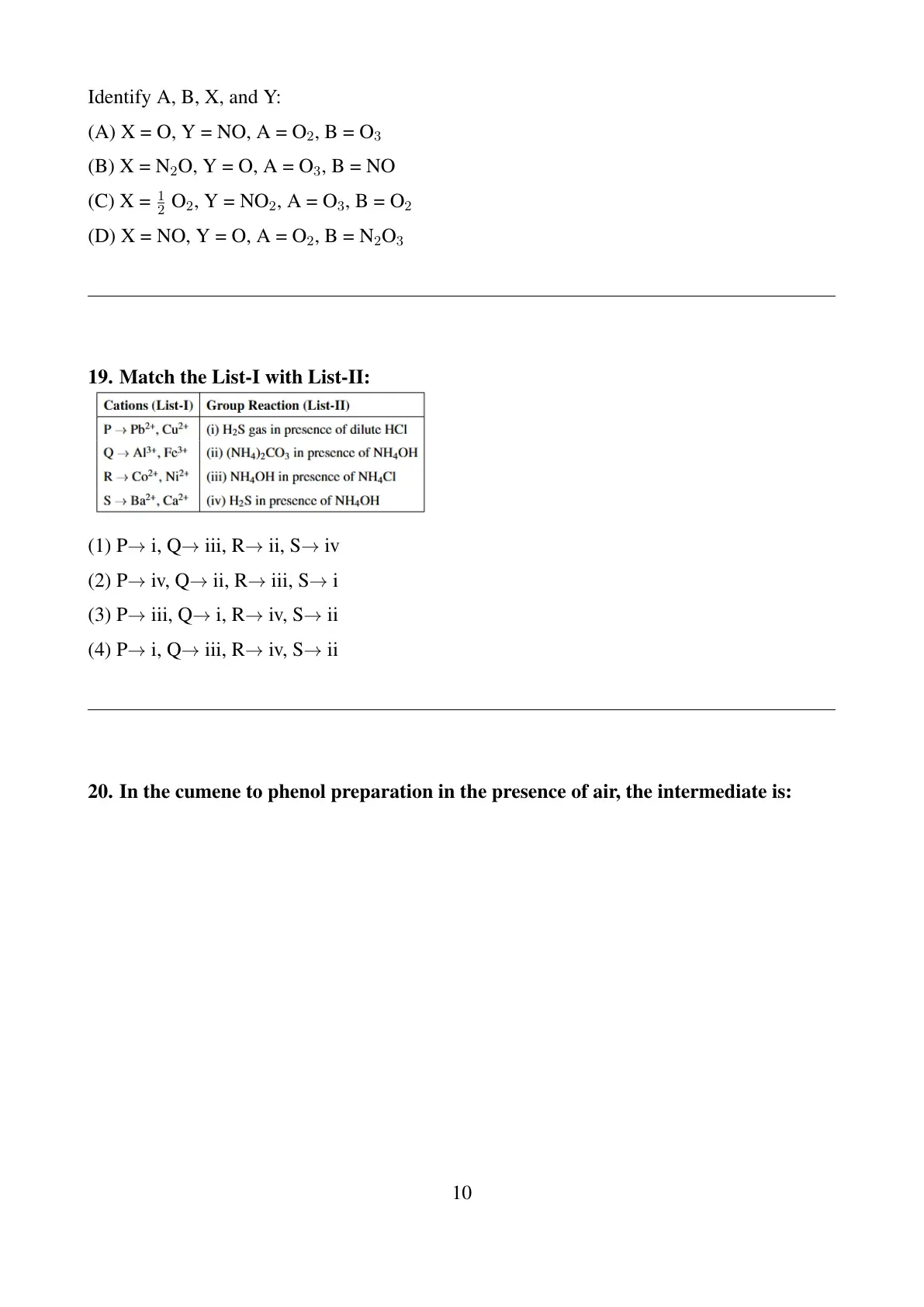
Match the List-I with List-II:

View Solution
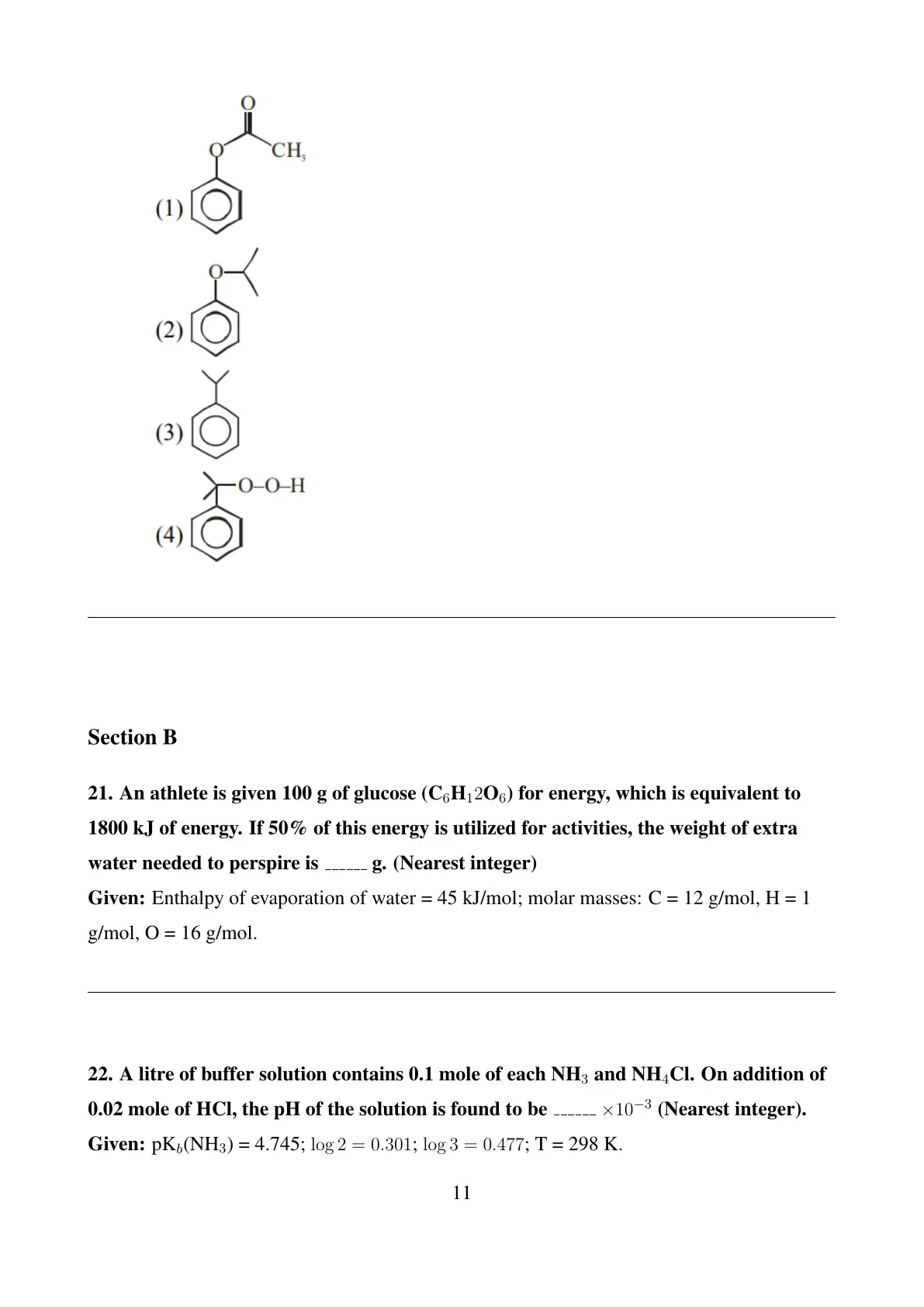
In the cumene to phenol preparation in the presence of air, the intermediate is:

View Solution
An athlete is given 100 g of glucose (C\(_6\)H\(_12\)O\(_6\)) for energy, which is equivalent to 1800 kJ of energy. If 50% of this energy is utilized for activities, the weight of extra water needed to perspire is ______ g. (Nearest integer)
Given: Enthalpy of evaporation of water = 45 kJ/mol; molar masses: C = 12 g/mol, H = 1 g/mol, O = 16 g/mol.
View Solution
A litre of buffer solution contains 0.1 mole of each NH\(_3\) and NH\(_4\)Cl. On addition of 0.02 mole of HCl, the pH of the solution is found to be ______ \(\times 10^{-3}\) (Nearest integer).
Given: pK\(_b\)(NH\(_3\)) = 4.745; \(\log 2 = 0.301\); \(\log 3 = 0.477\); T = 298 K.
View Solution
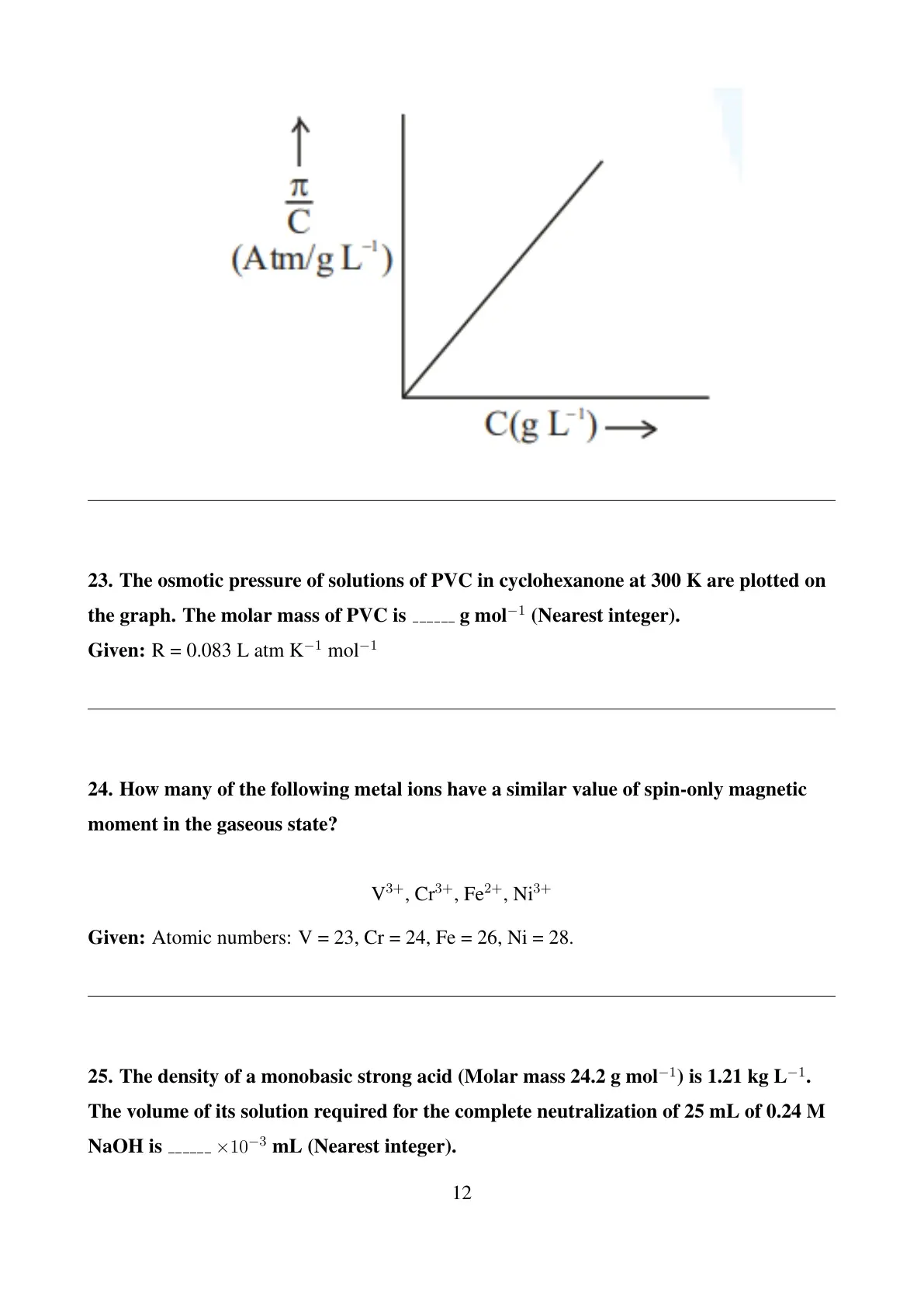
The osmotic pressure of solutions of PVC in cyclohexanone at 300 K are plotted on the graph. The molar mass of PVC is ______ g mol\(^{-1}\) (Nearest integer).

Given: R = 0.083 L atm K\(^{-1}\) mol\(^{-1}\)
View Solution
How many of the following metal ions have a similar value of spin-only magnetic moment in the gaseous state?
\[ V\(^{3+\), Cr\(^{3+}\), Fe\(^{2+}\), Ni\(^{3+}\)} \]
Given: Atomic numbers: V = 23, Cr = 24, Fe = 26, Ni = 28.
View Solution
The density of a monobasic strong acid (Molar mass 24.2 g mol\(^{-1}\)) is 1.21 kg L\(^{-1}\). The volume of its solution required for the complete neutralization of 25 mL of 0.24 M NaOH is ______ \(\times 10^{-3}\) mL (Nearest integer).
View Solution
For the first-order reaction \(A \rightarrow B\), the half-life is 30 min. The time taken for 75% completion of the reaction is _______ min (Nearest integer).
View Solution
The total number of lone pairs of electrons on oxygen atoms of ozone is _______.
View Solution
In sulphur estimation, 0.471 g of an organic compound gave 1.4439 g of barium sulphate. The percentage of sulphur in the compound is _______ (Nearest Integer).
Given: Atomic masses: Ba = 137, S = 32, O = 16.
View Solution
The number of paramagnetic species from the following is _______.
\[ [Ni(CN)_4]^{2-}, [Ni(CO)_4], [NiCl_4]^{2-}, [Fe(CN)_6]^{3-}, [Cu(NH_3)_4]^{2+}, [Fe(H_2O)_6]^{2+} \]
View Solution
Consider the cell:
\[ Pt(s)|H_2(g)(1 atm)|H^{+}(aq,1 M)||Fe^{3+}(aq),Fe^{2+}(aq)|Pt(s) \]
Given: \(E^\circ_{Fe^{3+}/Fe^{2+}} = 0.771 \, V, \, E^\circ_{H^+/H_2} = 0 \, V, \, T = 298 \, K\).
If the potential of the cell is 0.712 V, the ratio of concentration of \(Fe^{2+}\) to \(Fe^{3+}\) is _______ (Nearest integer).
View Solution

Also Check:
JEE Main 2023 Chemistry Analysis Jan 25 Shift 1
JEE Main 2023 Paper Analysis for Chemistry paper conducted on January 25 Shift 1 is updated here. Candidates can check the topics with the highest weightage, difficulty level and memory-based Chemistry questions using the link below.
JEE Main 2023 Chemistry Question Paper Pattern
| Feature | Question Paper Pattern |
|---|---|
| Examination Mode | Computer-based Test |
| Exam Language | 13 languages (English, Hindi, Assamese, Bengali, Gujarati, Kannada, Malayalam, Marathi, Odia, Punjabi, Tamil, Telugu, and Urdu) |
| Exam Duration | 3 hours |
| Sectional Time Limit | None |
| Chemistry Marks | 100 marks |
| Total Number of Questions Asked | 20 MCQs + 10 Numerical Type Questions |
| Total Number of Questions to be Answered | 20 MCQs + 5 Numerical Type Questions |
| Marking Scheme | +4 for each correct answer |
| Negative Marking | -1 for each incorrect answer |
Also Check:
JEE Main 2022 Question Paper
JEE Main 2023 aspirants can practice and check their exam prep level by attempting the previous year question papers as well. The table below shows JEE Main 2022 Question Paper PDF for B.E./B.Tech to practice.



Comments