



.png?h=35&w=35&mode=stretch)
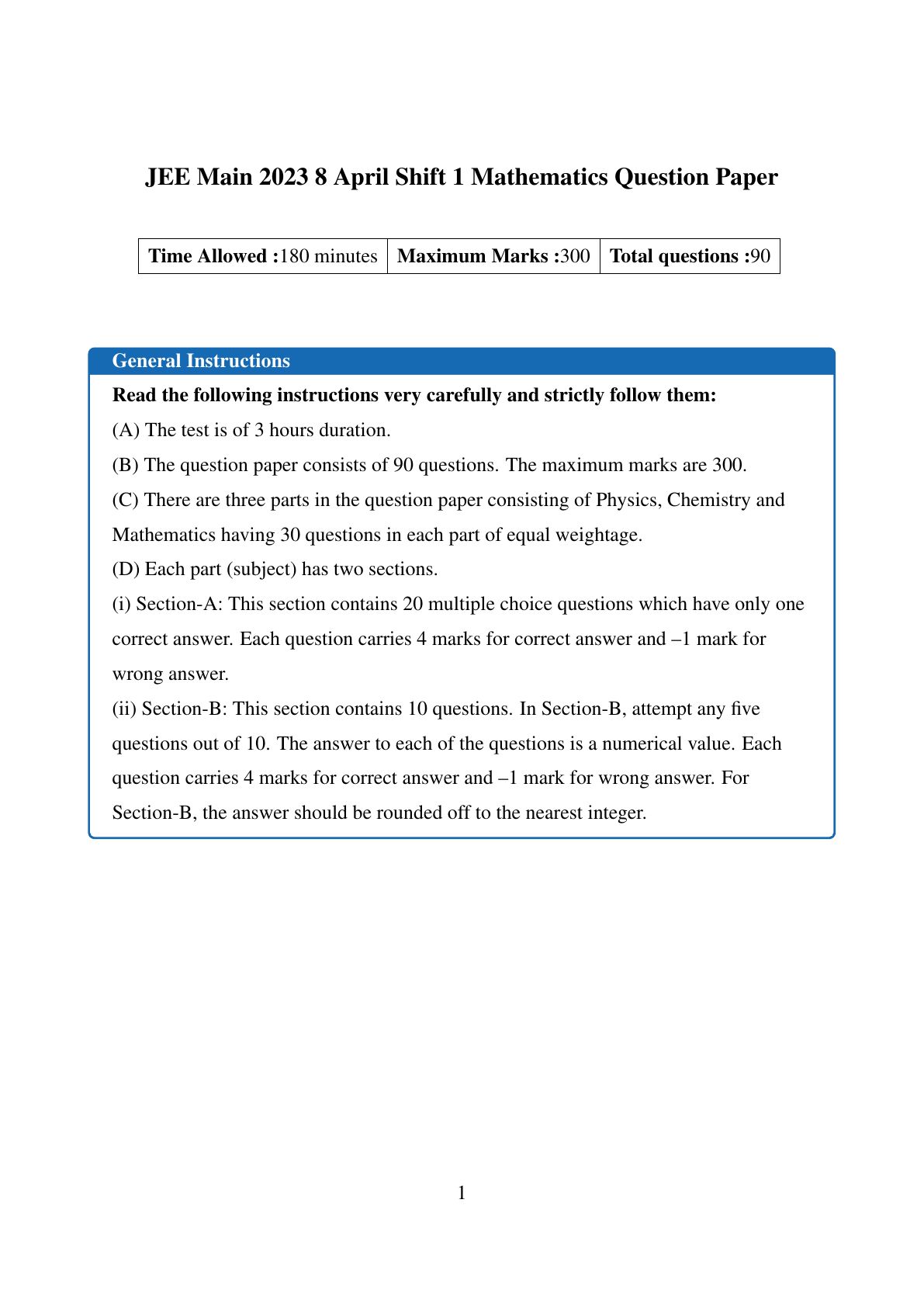
JEE Main 2023 Mathematics April 8 Shift 1 Question Paper is available here for download. Candidates can download official JEE Main 2023 Mathematics Question Paper PDF with Solution and Answer Key for April 8 Shift 1 using the link below. JEE Main Mathematics Question Paper is divided into two sections, Section A with 20 MCQs and Section B with 10 numerical type questions. Candidates are required to answer all questions from Section A and any 5 questions from section B.
Related Links:
- Download JEE Main Previous Year Question Papers PDF with Solutions
- Download JEE Main 2025 Question Paper for all Shifts
JEE Main 2023 Mathematics Question Paper April 8 Shift 1 PDF
| JEE Main 2023 8th April Shift 1 Mathematics Question Paper with Solution PDF |  Download Download |
Check Solution |

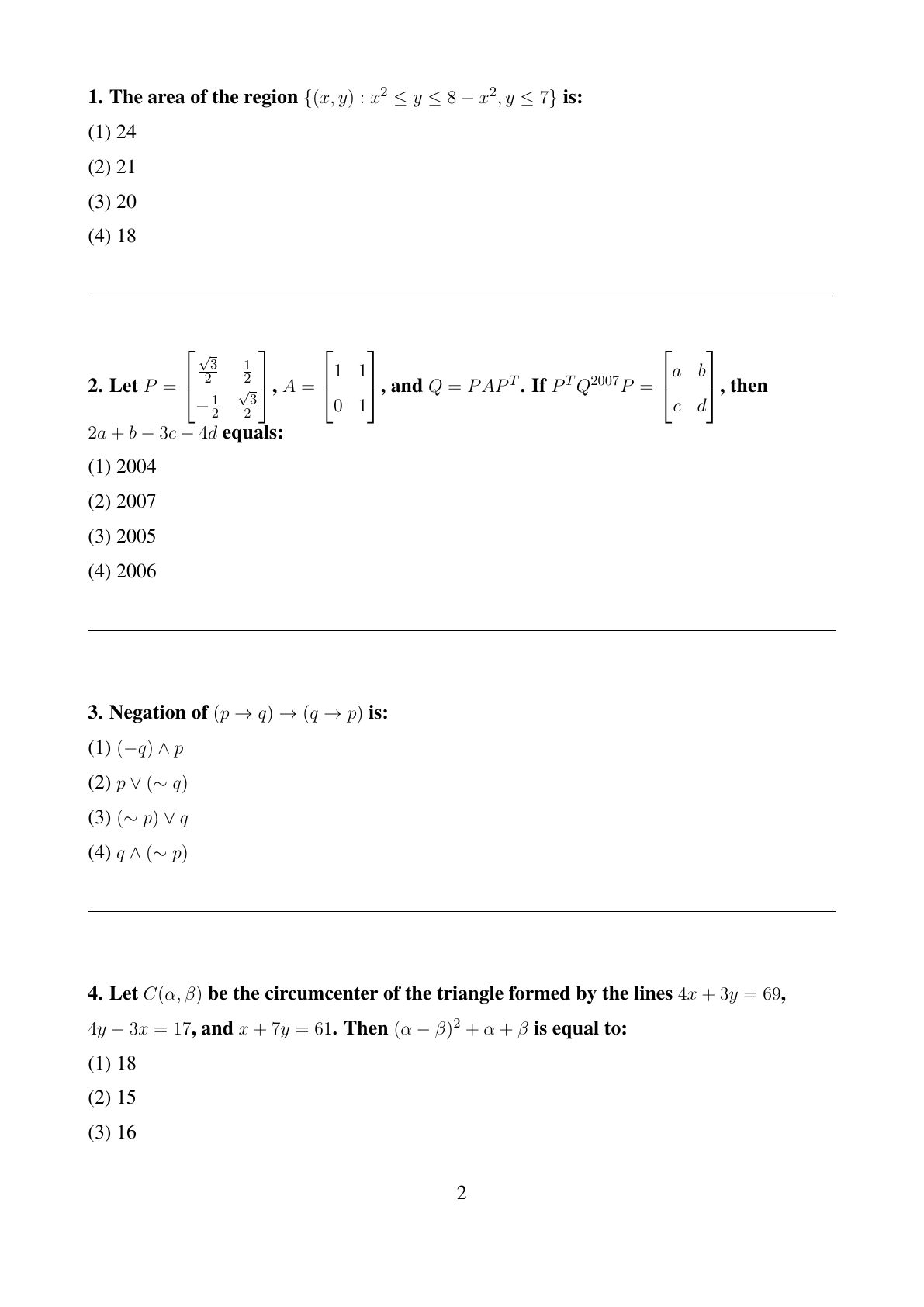
The area of the region \(\{(x, y): x^2 \leq y \leq 8-x^2, y \leq 7\}\) is:
Let \(P = \begin{bmatrix} \frac{\sqrt{3}}{2} & \frac{1}{2}
-\frac{1}{2} & \frac{\sqrt{3}}{2} \end{bmatrix}\), \(A = \begin{bmatrix} 1 & 1
0 & 1 \end{bmatrix}\), and \(Q = PAP^T\). If \(P^TQ^{2007}P = \begin{bmatrix} a & b
c & d \end{bmatrix}\), then \(2a + b - 3c - 4d\) equals:
Negation of \((p \to q) \to (q \to p)\) is:
Let \(C(\alpha, \beta)\) be the circumcenter of the triangle formed by the lines \(4x + 3y = 69\), \(4y - 3x = 17\), and \(x + 7y = 61\). Then \((\alpha - \beta)^2 + \alpha + \beta\) is equal to:
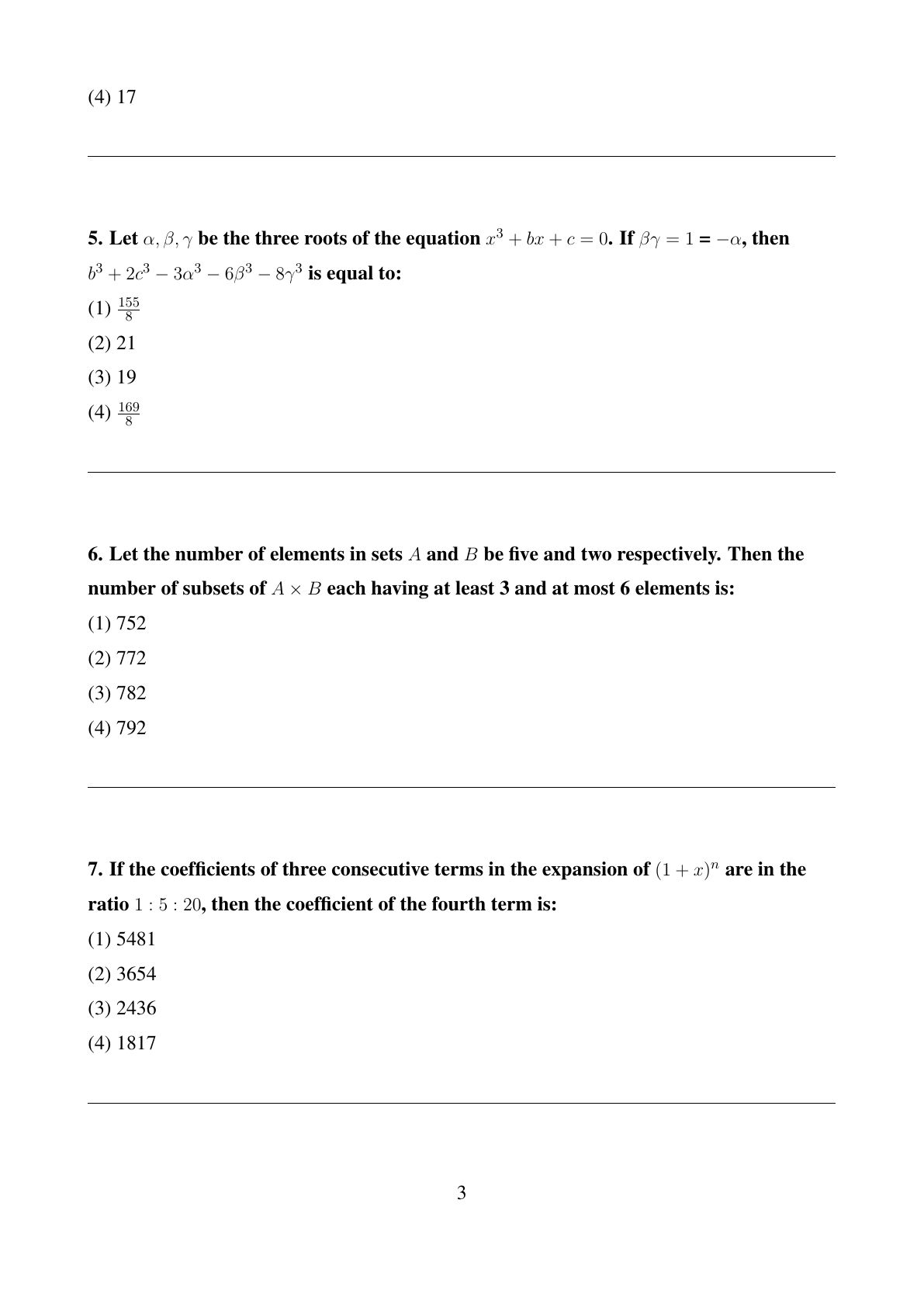
Let \(\alpha, \beta, \gamma\) be the three roots of the equation \(x^3 + bx + c = 0\). If \(\beta\gamma = 1\) = \(-\alpha \), then \(b^3 + 2c^3 - 3\alpha^3 - 6\beta^3 - 8\gamma^3\) is equal to:
Let the number of elements in sets \(A\) and \(B\) be five and two respectively. Then the number of subsets of \(A \times B\) each having at least 3 and at most 6 elements is:
If the coefficients of three consecutive terms in the expansion of \((1 + x)^n\) are in the ratio \(1 : 5 : 20\), then the coefficient of the fourth term is:
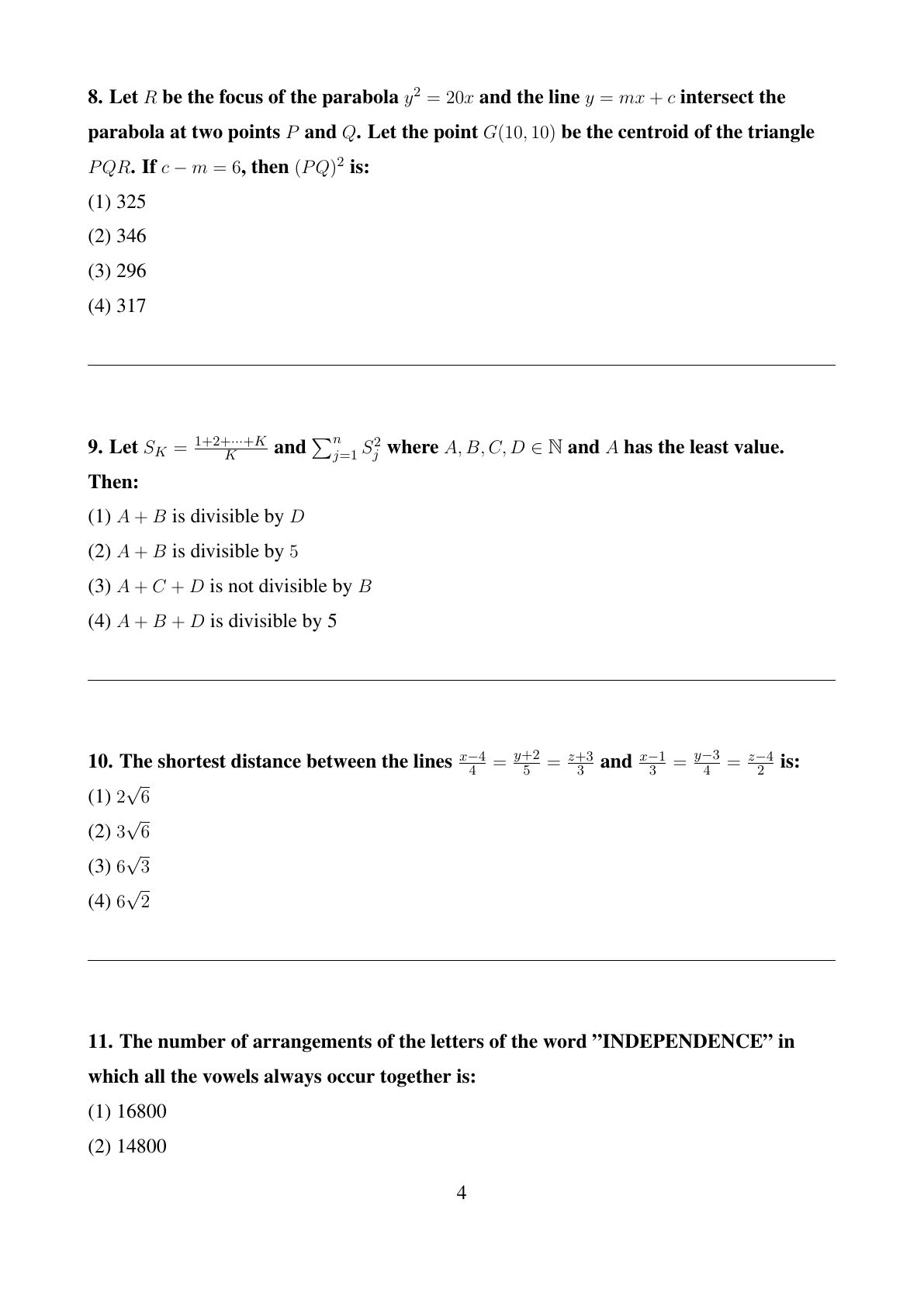
Let \(R\) be the focus of the parabola \(y^2 = 20x\) and the line \(y = mx + c\) intersect the parabola at two points \(P\) and \(Q\). Let the point \(G(10, 10)\) be the centroid of the triangle \(PQR\). If \(c - m = 6\), then \((PQ)^2\) is:
Let \( S_K = \frac{1 + 2 + \dots + K}{K} \) and \( \sum_{j=1}^{n} S_j^2 \) where \( A, B, C, D \in \mathbb{N} \) and \( A \) has the least value. Then:
View Solution
The shortest distance between the lines \(\frac{x-4}{4} = \frac{y+2}{5} = \frac{z+3}{3}\) and \(\frac{x-1}{3} = \frac{y-3}{4} = \frac{z-4}{2}\) is:
The number of arrangements of the letters of the word "INDEPENDENCE" in which all the vowels always occur together is:
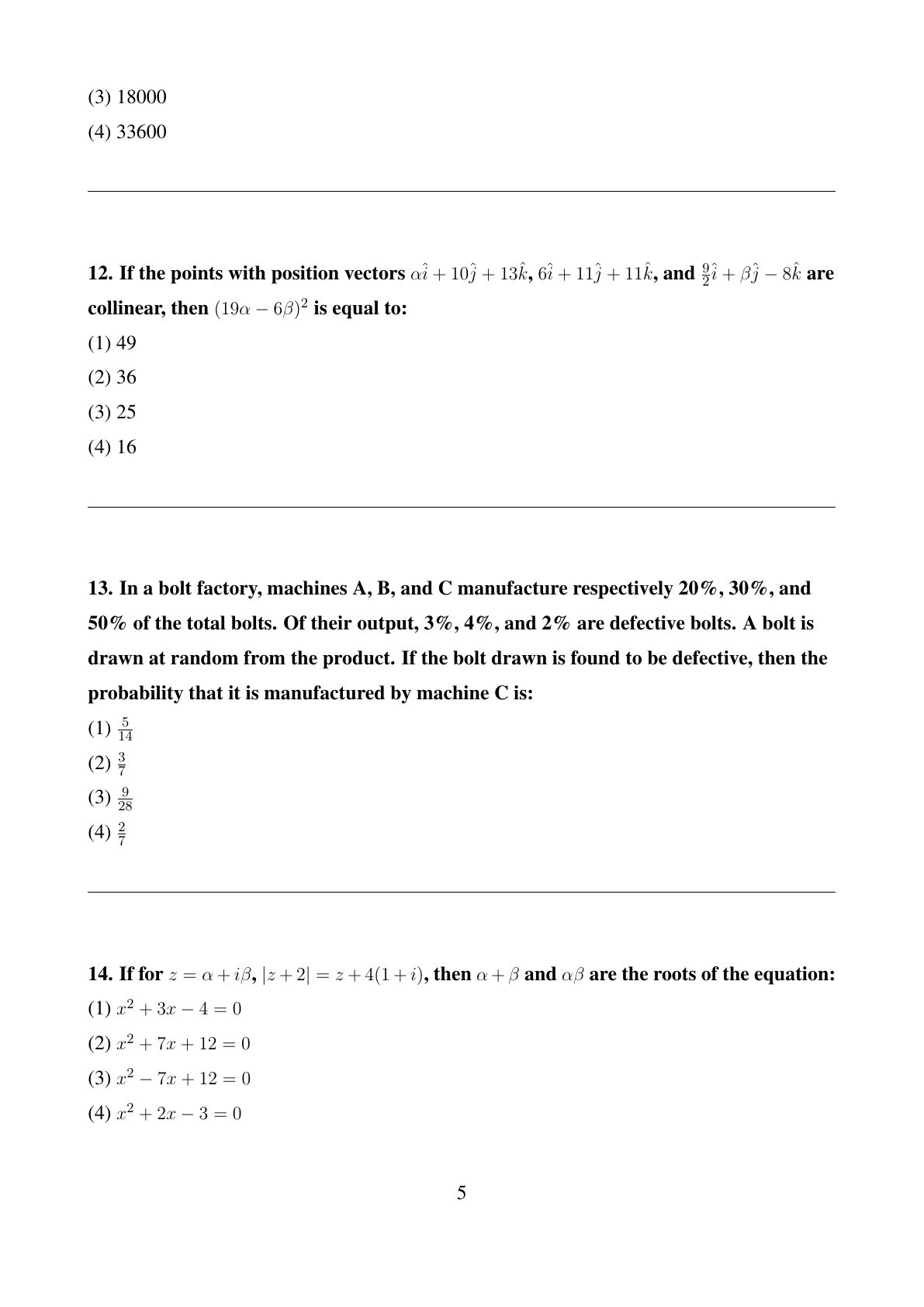
If the points with position vectors \(\alpha \hat{i} + 10\hat{j} + 13\hat{k}\), \(6\hat{i} + 11\hat{j} + 11\hat{k}\), and \(\frac{9}{2}\hat{i} + \beta\hat{j} - 8\hat{k}\) are collinear, then \((19\alpha - 6\beta)^2\) is equal to:
In a bolt factory, machines A, B, and C manufacture respectively 20%, 30%, and 50% of the total bolts. Of their output, 3%, 4%, and 2% are defective bolts. A bolt is drawn at random from the product. If the bolt drawn is found to be defective, then the probability that it is manufactured by machine C is:
View Solution
If for \(z = \alpha + i\beta\), \(|z + 2| = z + 4(1 + i)\), then \(\alpha + \beta\) and \(\alpha\beta\) are the roots of the equation:
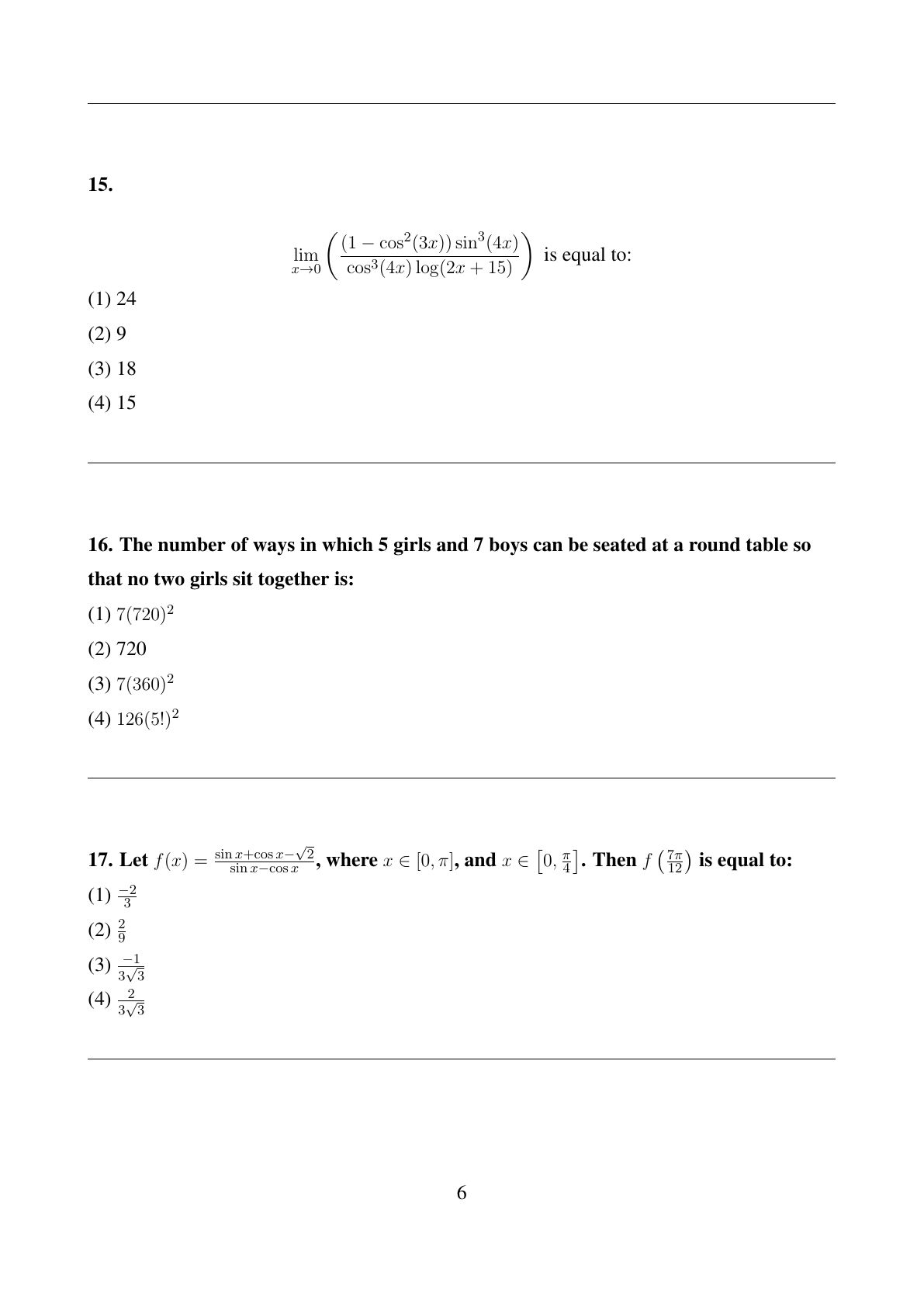
\[ \lim_{x \to 0} \left( \frac{(1 - \cos^2(3x)) \sin^3(4x)}{\cos^3(4x) \log(2x + 15)} \right) is equal to: \]
View Solution
The number of ways in which 5 girls and 7 boys can be seated at a round table so that no two girls sit together is:
Let \( f(x) = \frac{\sin x + \cos x - \sqrt{2}}{\sin x - \cos x} \), where \( x \in \left[0, \pi \right] \), and \( x \in \left[0, \frac{\pi}{4} \right] \). Then \( f\left( \frac{7\pi}{12} \right) \) is equal to:
View Solution
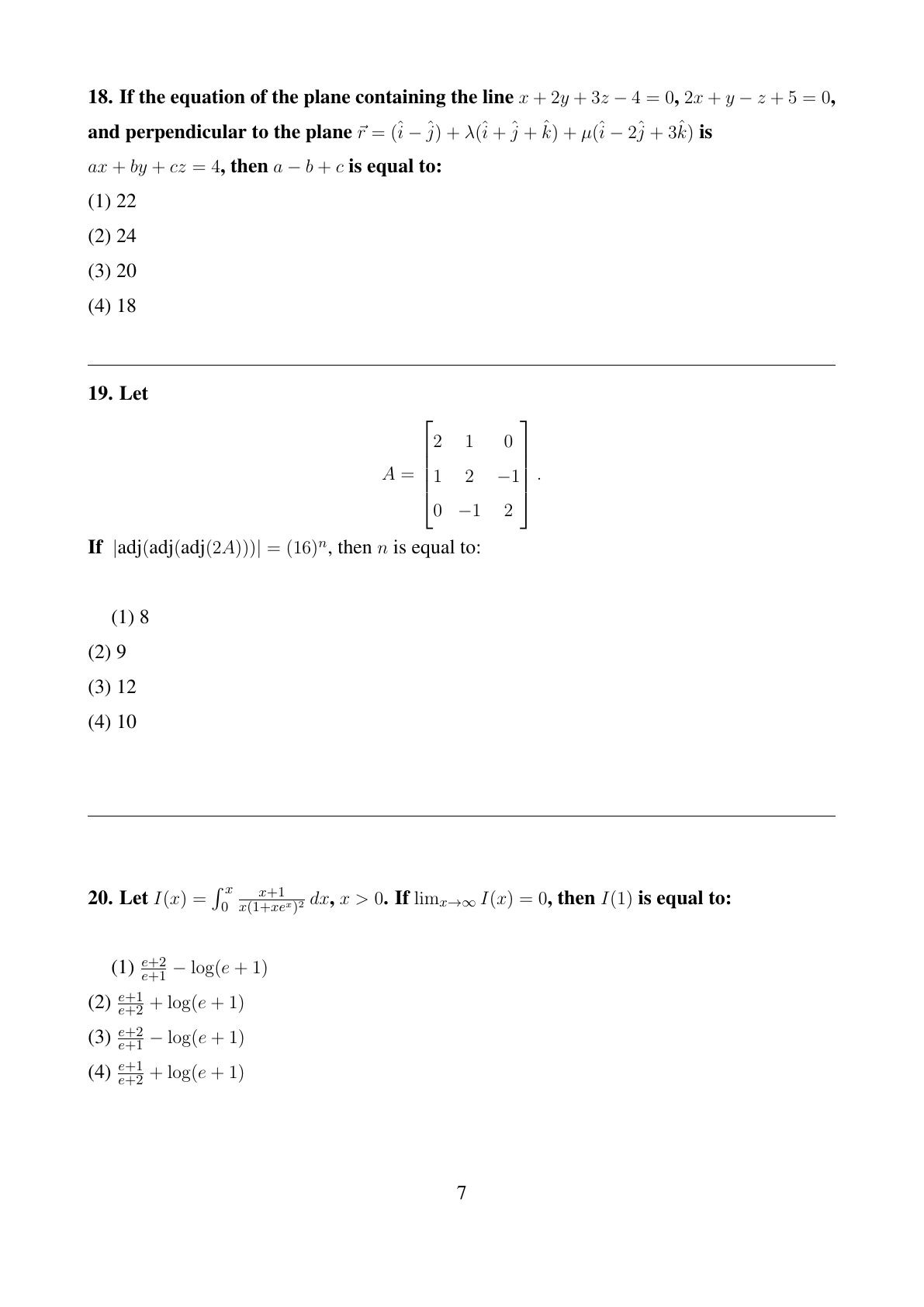
If the equation of the plane containing the line \(x + 2y + 3z - 4 = 0\), \(2x + y - z + 5 = 0\), and perpendicular to the plane \(\vec{r} = (\hat{i} - \hat{j}) + \lambda (\hat{i} + \hat{j} + \hat{k}) + \mu (\hat{i} - 2\hat{j} + 3\hat{k})\) is \(ax + by + cz = 4\), then \(a - b + c\) is equal to:
Let \[ A = \begin{bmatrix} 2 & 1 & 0
1 & 2 & -1
0 & -1 & 2 \end{bmatrix}. \]
If \( \left| adj(adj(adj(2A))) \right| = (16)^n \), then \( n \) is equal to:
View Solution
Let \(I(x) = \int_{0}^{x} \frac{x+1}{x(1+x e^x)^2} \, dx\), \(x > 0\). If \(\lim_{x \to \infty} I(x) = 0\), then \(I(1)\) is equal to:
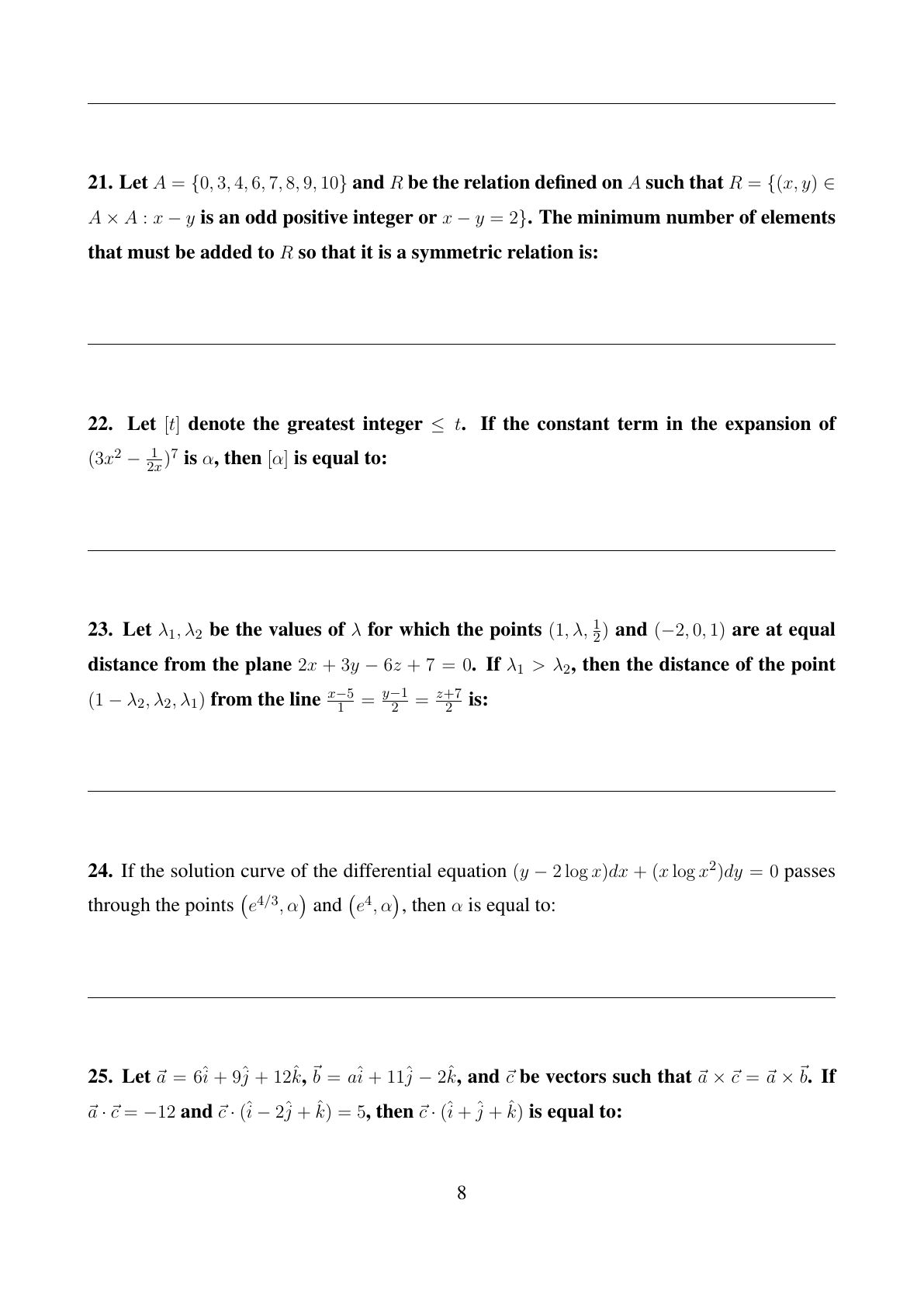
Let \(A = \{0, 3, 4, 6, 7, 8, 9, 10\}\) and \(R\) be the relation defined on \(A\) such that \(R = \{(x, y) \in A \times A : x - y is an odd positive integer or x - y = 2\}\). The minimum number of elements that must be added to \(R\) so that it is a symmetric relation is:
Let \([t]\) denote the greatest integer \(\leq t\). If the constant term in the expansion of \((3x^2 - \frac{1}{2x})^7\) is \(\alpha\), then \([\alpha]\) is equal to:
Let \(\lambda_1, \lambda_2\) be the values of \(\lambda\) for which the points \((1, \lambda, \frac{1}{2})\) and \((-2, 0, 1)\) are at equal distance from the plane \(2x + 3y - 6z + 7 = 0\). If \(\lambda_1 > \lambda_2\), then the distance of the point \((1 - \lambda_2, \lambda_2, \lambda_1)\) from the line \(\frac{x-5}{1} = \frac{y-1}{2} = \frac{z+7}{2}\) is:
If the solution curve of the differential equation \( (y - 2 \log x) dx + (x \log x^2) dy = 0 \) passes through the points \( \left( e^{4/3}, \alpha \right) \) and \( \left( e^4, \alpha \right) \), then \( \alpha \) is equal to:
Let \(\vec{a} = 6\hat{i} + 9\hat{j} + 12\hat{k}\), \(\vec{b} = a\hat{i} + 11\hat{j} - 2\hat{k}\), and \(\vec{c}\) be vectors such that \(\vec{a} \times \vec{c} = \vec{a} \times \vec{b}\). If \(\vec{a} \cdot \vec{c} = -12\) and \(\vec{c} \cdot (\hat{i} - 2\hat{j} + \hat{k}) = 5\), then \(\vec{c} \cdot (\hat{i} + \hat{j} + \hat{k})\) is equal to:
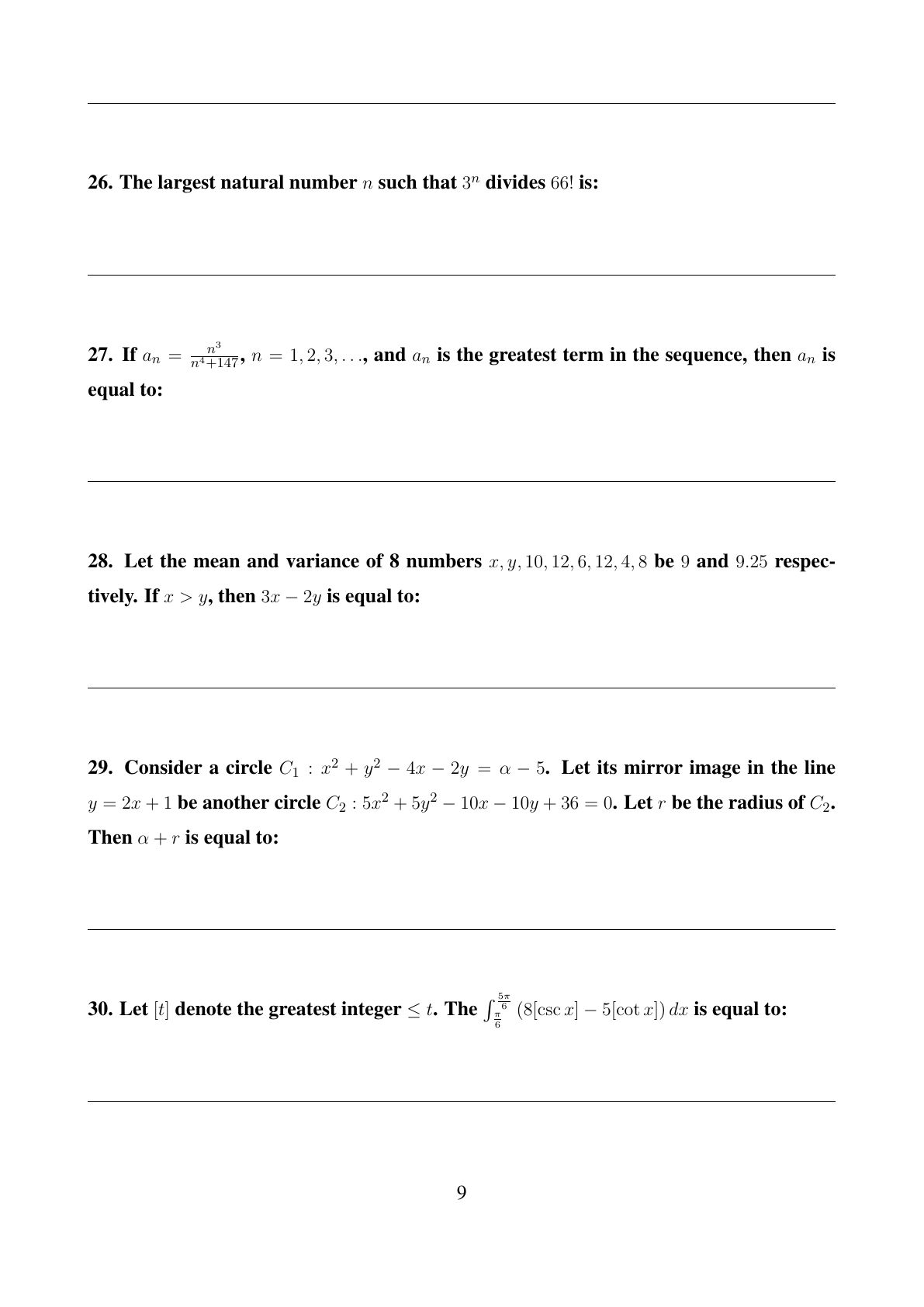
The largest natural number \(n\) such that \(3^n\) divides \(66!\) is:
View Solution
Step 1: Use Legendre’s formula.
The largest power of a prime \(p\) dividing \(n!\) is given by: \[ \left\lfloor \frac{n}{p} \right\rfloor + \left\lfloor \frac{n}{p^2} \right\rfloor + \left\lfloor \frac{n}{p^3} \right\rfloor + \dots \]
Step 2: Apply for \(p = 3\) and \(n = 66\).
\[ \left\lfloor \frac{66}{3} \right\rfloor + \left\lfloor \frac{66}{9} \right\rfloor + \left\lfloor \frac{66}{27} \right\rfloor = 22 + 7 + 2 = 31. \]
Final Answer: The largest \(n\) is 31.
Quick Tip: To find the highest power of a prime dividing \(n!\), use successive divisions by powers of the prime.
If \(a_n = \frac{n^3}{n^4 + 147}\), \(n = 1, 2, 3, \dots\), and \(a_n\) is the greatest term in the sequence, then \(a_n\) is equal to:
Let the mean and variance of 8 numbers \(x, y, 10, 12, 6, 12, 4, 8\) be \(9\) and \(9.25\) respectively. If \(x > y\), then \(3x - 2y\) is equal to:
Consider a circle \(C_1 : x^2 + y^2 - 4x - 2y = \alpha - 5\). Let its mirror image in the line \(y = 2x + 1\) be another circle \(C_2 : 5x^2 + 5y^2 - 10x - 10y + 36 = 0\). Let \(r\) be the radius of \(C_2\). Then \(\alpha + r\) is equal to:
Let \([t]\) denote the greatest integer \(\leq t\). The \(\int_{\frac{\pi}{6}}^{\frac{5\pi}{6}} \left(8[\csc x] - 5[\cot x]\right) dx\) is equal to:
JEE Main 2023 Mathematics Paper Analysis April 8 Shift 1
JEE Main 2023 Mathematics Paper Analysis for the exam scheduled on April 8 Shift 1 is available here. Candidates can check subject-wise paper analysis for the exam scheduled on April 8 Shift 1 here along with the topics with the highest weightage.
JEE Main 2023 Mathematics Question Paper Pattern
| Feature | Question Paper Pattern |
|---|---|
| Examination Mode | Computer-based Test |
| Exam Language | 13 languages (English, Hindi, Assamese, Bengali, Gujarati, Kannada, Malayalam, Marathi, Odia, Punjabi, Tamil, Telugu, and Urdu) |
| Exam Duration | 3 hours |
| Sectional Time Limit | None |
| Mathematics Marks | 100 marks |
| Total Number of Questions Asked | 20 MCQs + 10 Numerical Type Questions |
| Total Number of Questions to be Answered | 20 MCQs + 5 Numerical Type Questions |
| Marking Scheme | +4 for each correct answer |
| Negative Marking | -1 for each incorrect answer |
Also Check:



Comments