




JEE Main 2023 Physics Question Paper Jan 29 Shift 2 is updated here after the conclusion of the exam. Candidates can download JEE Main 2023 Physics Question Paper PDF with Answer Key for Jan 29 Shift 2 using the link below. JEE Main Physics Question Paper is divided into two sections, Section A with 20 MCQs and Section B with 10 numerical type questions. Candidates are required to answer all questions from Section A and any 5 questions from section B.
Related Links:
- Download JEE Main Previous Year Question Papers PDF with Solutions
- Download JEE Main 2025 Question Paper for all Shifts
JEE Main 2023 Physics Question Paper Jan 29 Shift 2- Download PDF
| JEE Main 2023 29 Jan Shift 2 Physics Question Paper with Solution PDF |  Download Download |
Check Solution |

Substance A has atomic mass number 16 and half-life of 1 day. Another substance B has atomic mass number 32 and half-life of ½ day. If both A and B simultaneously start undergoing radioactivity at the same time with initial mass 320 g each, how many total atoms of A and B combined would be left after 2 days?
View Solution
For substance A:
\[ (N_0)_A = \frac{320}{16} = 20 \, moles \] \[ N_A = (N_0)_A \left(\frac{1}{2}\right)^2 = 20 \times \frac{1}{4} = 5 \, moles \]
For substance B:
\[ (N_0)_B = \frac{320}{32} = 10 \, moles \] \[ N_B = (N_0)_B \left(\frac{1}{2}\right)^4 = 10 \times \frac{1}{16} = 0.625 \, moles \]
Total moles = \(5 + 0.625 = 5.625\). The total number of atoms: \[ 5.625 \times 6.023 \times 10^{23} = 3.38 \times 10^{24} \] Quick Tip: For half-life problems, use \((1/2)^n\), where \(n\) is the number of half-lives elapsed.
At 300 K, the rms speed of oxygen molecules is \(\frac{\alpha+5}{\alpha}\) times to that of its average speed in the gas. Then, the value of \(\alpha\) will be (used \(\pi = \frac{22}{7}\)):
View Solution
The root mean square (rms) speed and average speed are related as: \[ \sqrt{\frac{3RT}{M}} = \frac{\alpha + 5}{\alpha} \sqrt{\frac{8RT}{\pi M}} \]
Squaring both sides and simplifying: \[ 3 = \frac{\alpha + 5}{\alpha} \cdot \frac{8}{\pi} \]
Substitute \(\pi = \frac{22}{7}\): \[ 3 = \frac{\alpha + 5}{\alpha} \cdot \frac{8 \times 7}{22} \] \[ 3 = \frac{\alpha + 5}{\alpha} \cdot \frac{28}{22} \] \[ \alpha = 28 \] Quick Tip: Understand the relationship between rms speed and average speed to solve such problems efficiently.
The ratio of de-Broglie wavelength of an \(\alpha\)-particle and a proton accelerated from rest by the same potential is \(\sqrt{m}\). The value of \(m\) is:
View Solution
The de-Broglie wavelength is given by: \[ \lambda = \frac{h}{\sqrt{2mqV}} \]
For \(\alpha\)-particle and proton, the ratio: \[ \frac{\lambda_\alpha}{\lambda_p} = \sqrt{\frac{m_p}{m_\alpha}} \]
Mass of \(\alpha\)-particle = 4 \(\times\) mass of proton: \[ \frac{\lambda_\alpha}{\lambda_p} = \sqrt{\frac{1}{4}} = \sqrt{8}, \, m = 8 \] Quick Tip: De-Broglie wavelength depends inversely on the square root of particle mass.
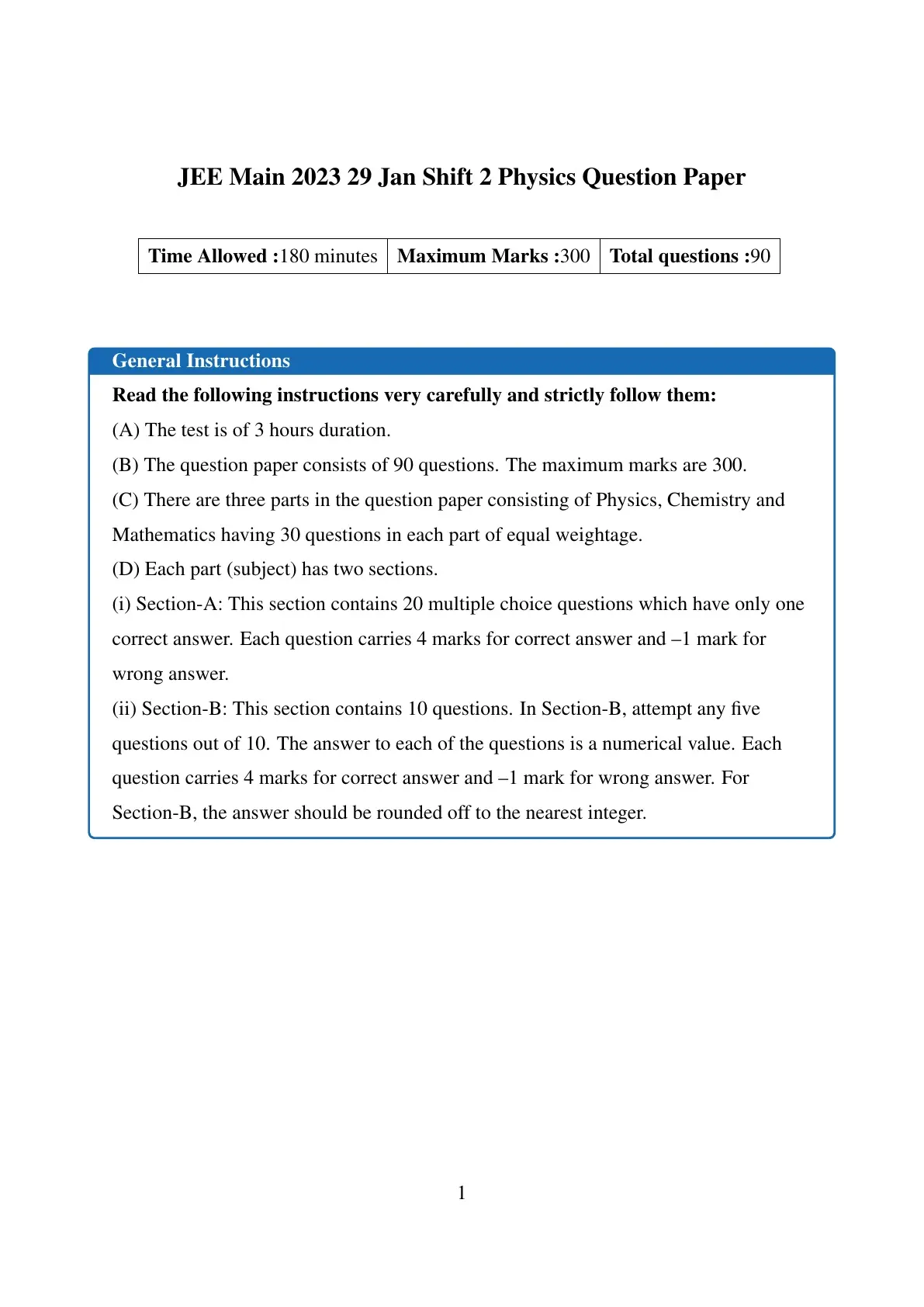
For the given logic gates combination, the correct truth table will be:

- (A)
![]()
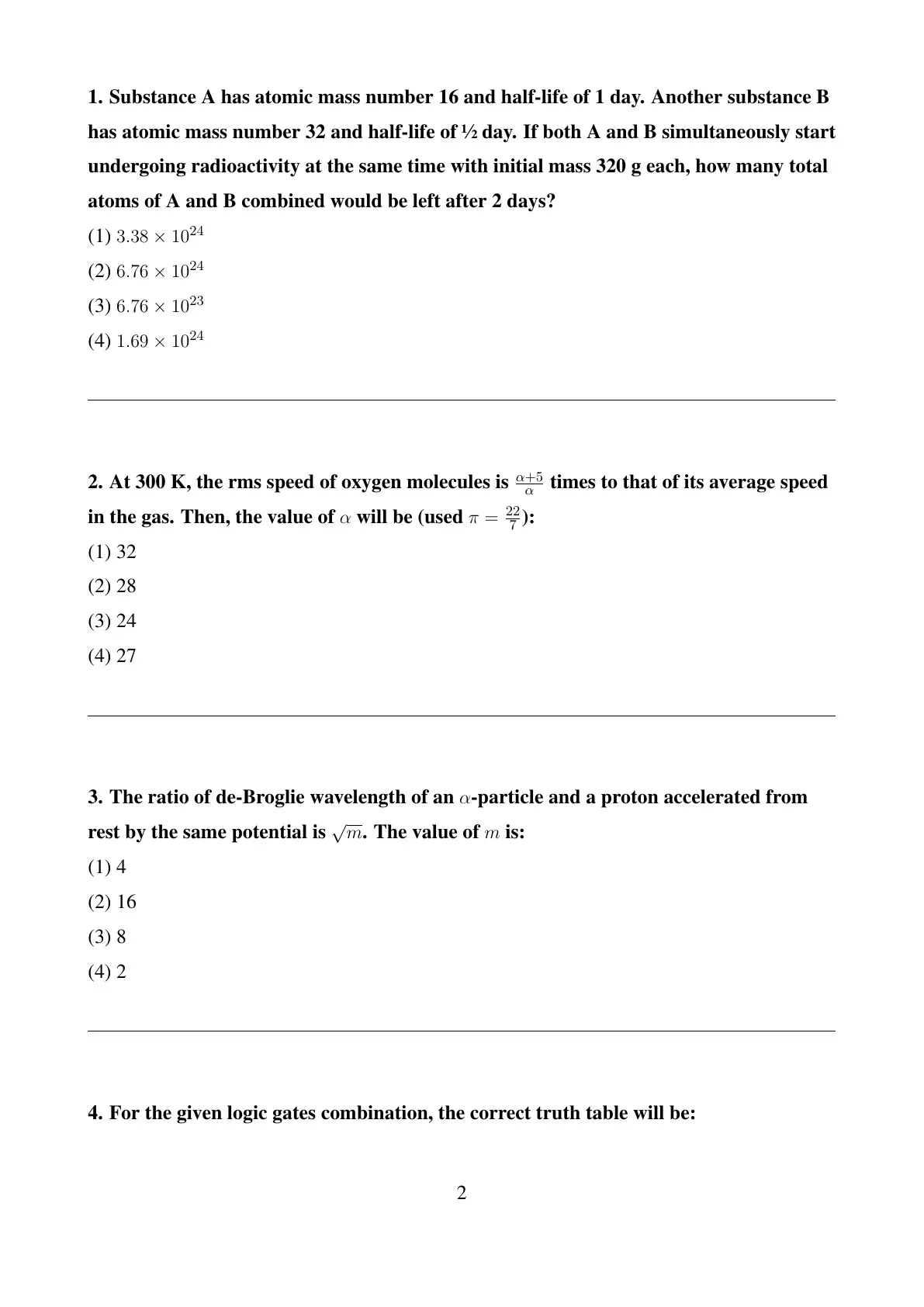
- (B)
![]()
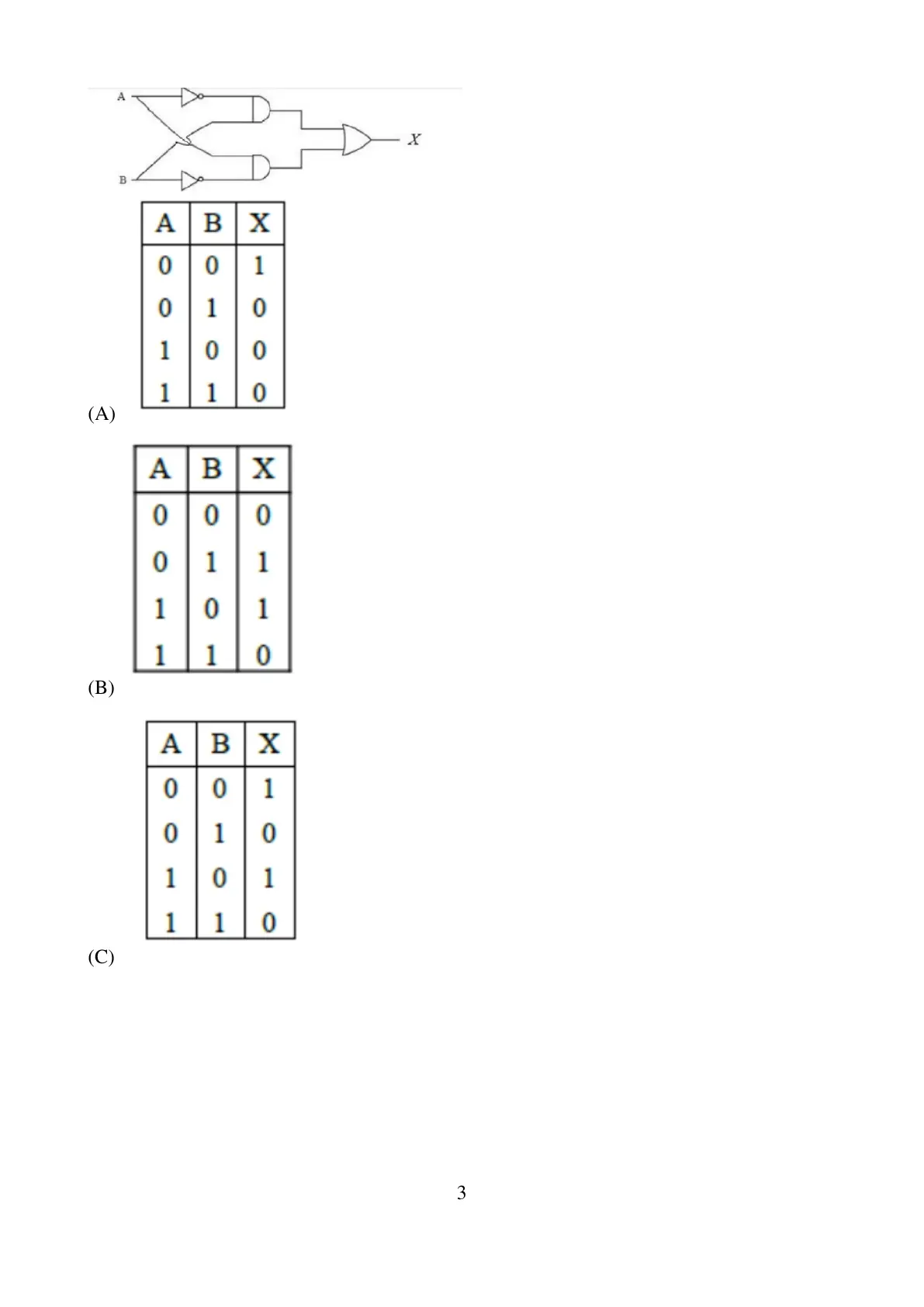
- (C)
![]()
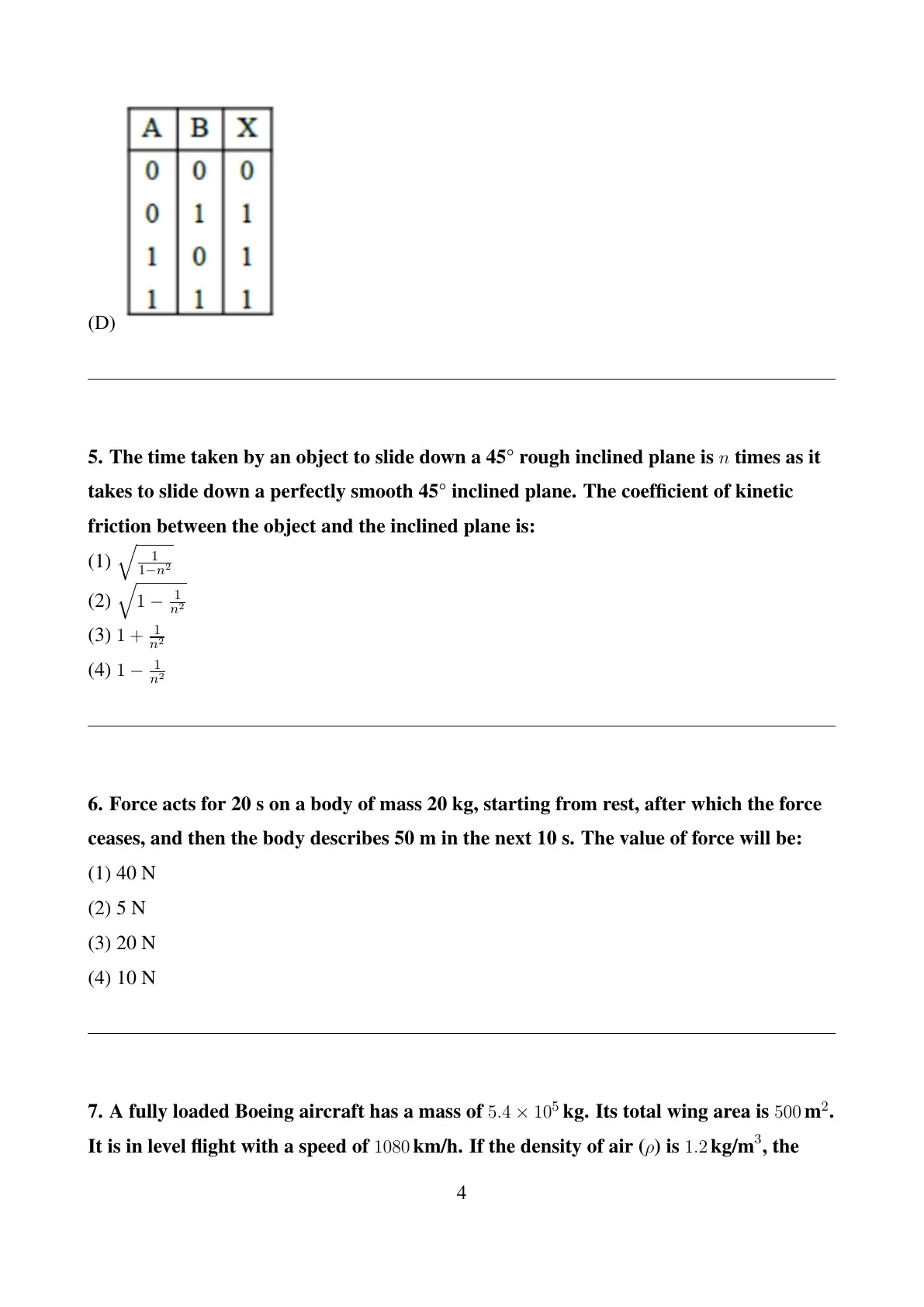
- (D)
![]()
- (A) When \(A = 0\) and \(B = 0\), the output \(X = 1\).
- (B) When \(A = 0\) and \(B = 1\), the output \(X = 0\).
- (C) When \(A = 1\) and \(B = 0\), the output \(X = 1\).


View Solution
The given circuit consists of a combination of NOT, AND, and OR gates. The truth table is derived as follows:
1. The NOT gates invert the inputs \(A\) and \(B\).
2. These inverted values are then input into the AND gates, and the output of each AND gate is determined.
3. Finally, the outputs of the AND gates are fed into the OR gate to produce the final output \(X\).
Truth Table Analysis:
% Option
(A) When \(A = 0\) and \(B = 0\), the output \(X = 1\).
% Option
(B) When \(A = 0\) and \(B = 1\), the output \(X = 0\).
% Option
(C) When \(A = 1\) and \(B = 0\), the output \(X = 1\).
% Option
(D) When \(A = 1\) and \(B = 1\), the output \(X = 0\).
Hence, the correct truth table corresponds to Table 2. Quick Tip: To construct a truth table, process the inputs through each gate step-by-step while following the logic gate rules.
The time taken by an object to slide down a 45° rough inclined plane is \(n\) times as it takes to slide down a perfectly smooth 45° inclined plane. The coefficient of kinetic friction between the object and the inclined plane is:
View Solution
For the smooth inclined plane: \[ a_1 = g \sin\theta = \frac{g}{\sqrt{2}} \]
For the rough inclined plane: \[ a_2 = g \sin\theta - \mu g \cos\theta = \frac{g}{\sqrt{2}} - \mu \frac{g}{\sqrt{2}} \]
Using \(t_2 = n t_1\) and the equation of motion: \[ a_1 t_1^2 = a_2 t_2^2 \] \[ \frac{g}{\sqrt{2}} t_1^2 = \left(\frac{g}{\sqrt{2}} - \mu \frac{g}{\sqrt{2}}\right)(n t_1)^2 \]
Simplifying: \[ 1 = n^2 (1 - \mu) \quad \Rightarrow \quad \mu = 1 - \frac{1}{n^2} \] Quick Tip: Use the equations of motion with modified acceleration for rough and smooth inclined planes to calculate friction coefficients.
Force acts for 20 s on a body of mass 20 kg, starting from rest, after which the force ceases, and then the body describes 50 m in the next 10 s. The value of force will be:
View Solution
The velocity of the body after 20 s of applied force is: \[ S = v t \quad \Rightarrow \quad 50 = v \times 10 \quad \Rightarrow \quad v = 5 \, m/s \]
Using \(v = u + at\), where \(u = 0\): \[ v = a \times 20 \quad \Rightarrow \quad 5 = a \times 20 \quad \Rightarrow \quad a = \frac{1}{4} \, m/s^2 \]
The force is: \[ F = ma = 20 \times \frac{1}{4} = 5 \, N \] Quick Tip: For problems with changing forces, relate acceleration to the change in velocity over the time of applied force.
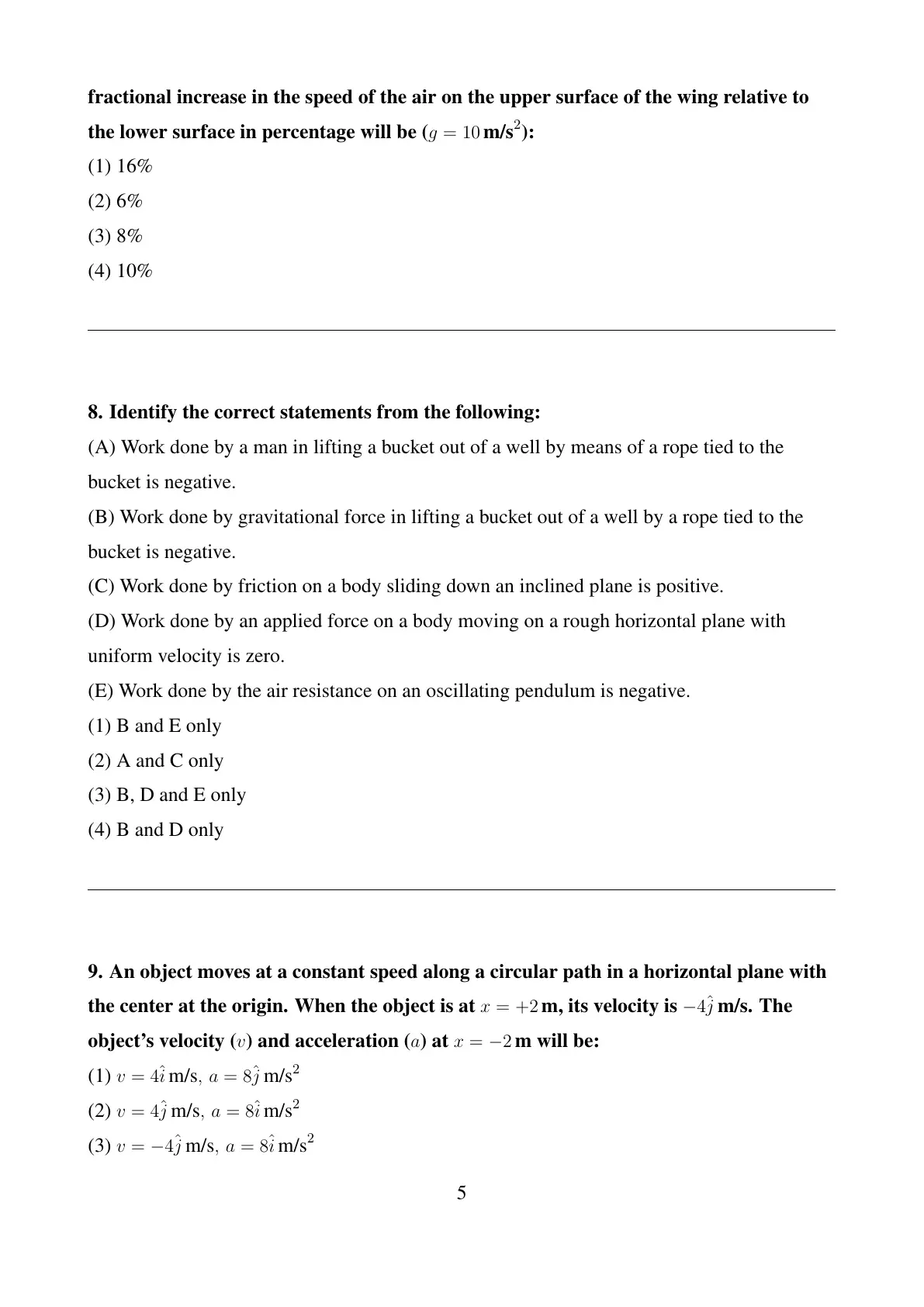
A fully loaded Boeing aircraft has a mass of \(5.4 \times 10^5 \, kg\). Its total wing area is \(500 \, m^2\). It is in level flight with a speed of \(1080 \, km/h\). If the density of air (\(\rho\)) is \(1.2 \, kg/m^3\), the fractional increase in the speed of the air on the upper surface of the wing relative to the lower surface in percentage will be (\(g = 10 \, m/s^2\)):
View Solution
Using Bernoulli’s principle: \[ P_2 A - P_1 A = 5.4 \times 10^5 \times g \quad \Rightarrow \quad P_2 - P_1 = \frac{5.4 \times 10^5 \times 10}{500} = 10.8 \times 10^3 \, N/m^2 \]
The pressure difference is related to the velocity difference: \[ P_2 - P_1 = \frac{1}{2} \rho (V_1^2 - V_2^2) = \rho (V_1 - V_2)(V_1 + V_2) \]
Substituting: \[ 10.8 \times 10^3 = 1.2 \times (V_1 - V_2) \times 600 \] \[ V_1 - V_2 = 30 \, m/s \quad \Rightarrow \quad \frac{V_1 - V_2}{V_1} \times 100 = \frac{30}{300} \times 100 = 10% \] Quick Tip: Apply Bernoulli's principle and continuity equations for airfoil problems to relate pressure and velocity differences.
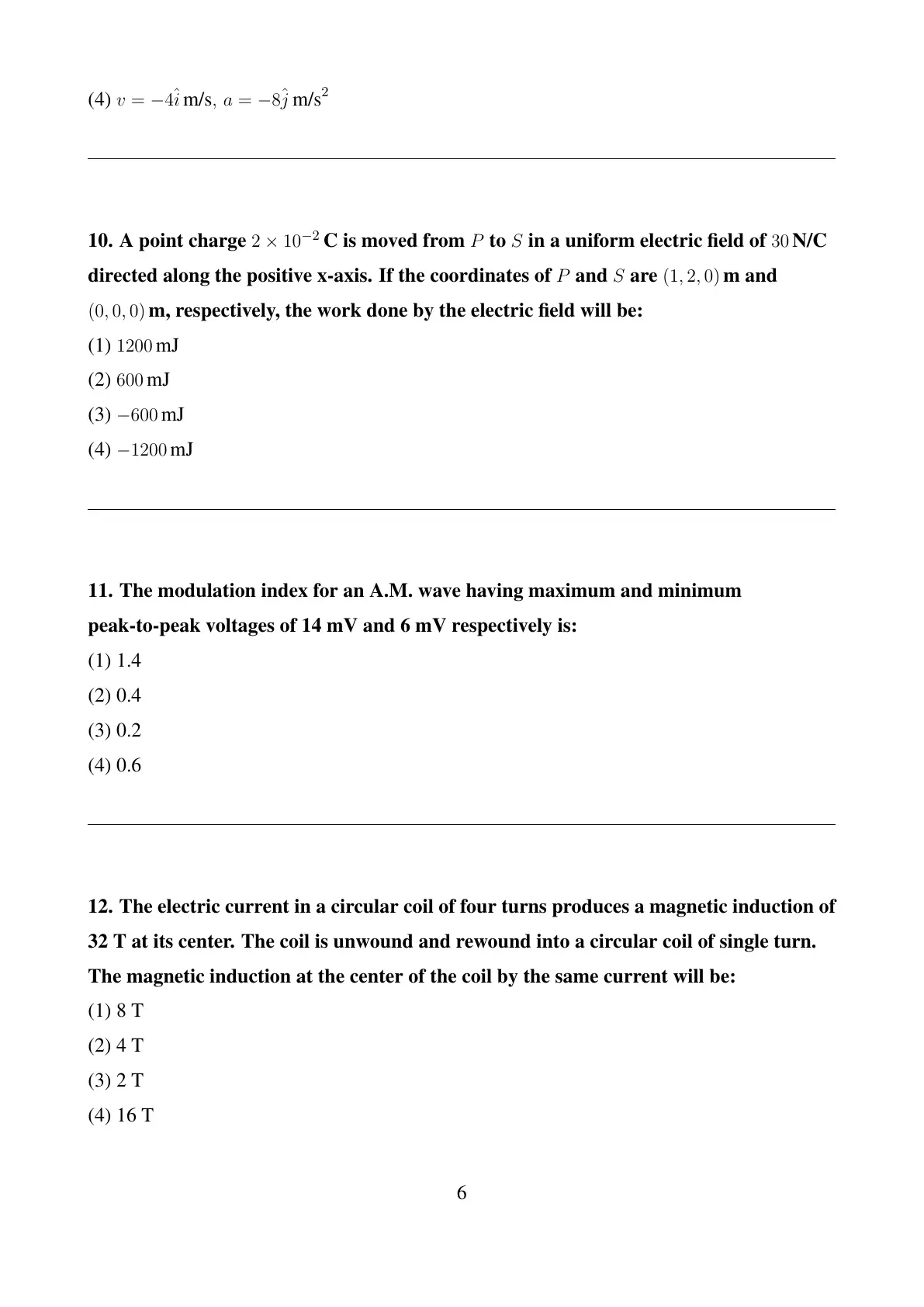
Identify the correct statements from the following:
View Solution
- (B) Work done by gravity is negative because the gravitational force opposes the upward motion.
- (E) Work done by air resistance is always negative because it opposes motion.
- Other statements are incorrect because:
- (A) Work done by a man is positive as the applied force is in the direction of displacement.
- (C) Work done by friction is negative, not positive.
- (D) Work done is zero only if there is no displacement, not due to roughness. Quick Tip: For work-related problems, analyze the direction of force relative to displacement.
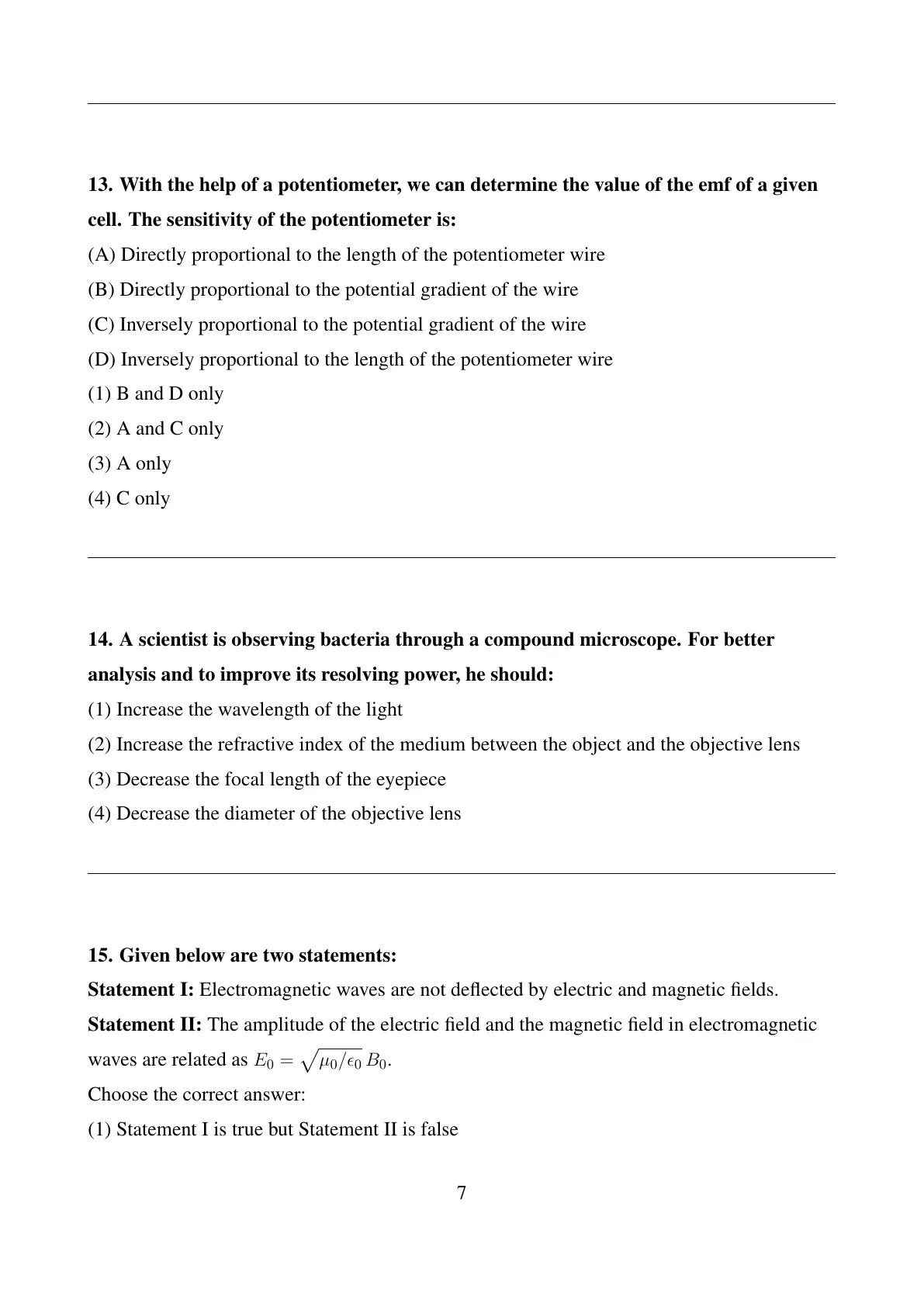
An object moves at a constant speed along a circular path in a horizontal plane with the center at the origin. When the object is at \(x = +2 \, m\), its velocity is \(-4\hat{j} \, m/s\). The object's velocity (\(v\)) and acceleration (\(a\)) at \(x = -2 \, m\) will be:
View Solution
The object is moving in a circular path with constant speed. At \(x = +2 \, m\), the velocity is \(-4\hat{j} \, m/s\), indicating a downward motion.
At \(x = -2 \, m\), the velocity will be upward, i.e., \(+4\hat{j} \, m/s\).
The acceleration is centripetal and always directed toward the center of the circle. At \(x = -2 \, m\), the acceleration will point along the positive x-axis: \[ a = 8\hat{i} \, m/s^2 \] Quick Tip: In uniform circular motion, velocity is tangential, and acceleration is centripetal, always pointing toward the center of the circle.
A point charge \(2 \times 10^{-2} \, C\) is moved from \(P\) to \(S\) in a uniform electric field of \(30 \, N/C\) directed along the positive x-axis. If the coordinates of \(P\) and \(S\) are \((1, 2, 0) \, m\) and \((0, 0, 0) \, m\), respectively, the work done by the electric field will be:
View Solution
Work done by the electric field is given by: \[ W = q E \cdot d \]
where:
\(q = 2 \times 10^{-2} \, C\),
\(E = 30 \, N/C\),
\(d\) is the displacement along the direction of the electric field.
The displacement along the x-axis is: \[ \Delta x = 1 \, m. \]
Substitute the values: \[ W = (2 \times 10^{-2}) \cdot 30 \cdot 1 = 0.6 \, J = 600 \, mJ. \]
Since the charge is moved opposite to the direction of the field, the work done is negative: \[ W = -600 \, mJ. \] Quick Tip: The work done by an electric field is negative if the charge moves opposite to the direction of the field.
The modulation index for an A.M. wave having maximum and minimum peak-to-peak voltages of 14 mV and 6 mV respectively is:
View Solution
The modulation index (\(\mu\)) is given by: \[ \mu = \frac{A_{max} - A_{min}}{A_{max} + A_{min}}. \]
Substitute the values: \[ \mu = \frac{14 - 6}{14 + 6} = \frac{8}{20}. \]
Simplify: \[ \mu = 0.4. \] Quick Tip: The modulation index determines the extent of modulation in an AM wave. It is typically less than 1 for under-modulated waves.
The electric current in a circular coil of four turns produces a magnetic induction of 32 T at its center. The coil is unwound and rewound into a circular coil of single turn. The magnetic induction at the center of the coil by the same current will be:
View Solution
The magnetic field at the center of a circular coil is given by: \[ B = \frac{\mu_0 I N}{2R}, \]
where \(N\) is the number of turns and \(R\) is the radius of the coil.
Step 1: Magnetic Field with 4 Turns
Initially, \(N = 4\) and the magnetic field is: \[ B = 32 \, T. \]
Step 2: Magnetic Field with 1 Turn
When the coil is rewound into a single turn (\(N' = 1\)), the radius increases proportionally (\(R' = 4R\)). The new magnetic field becomes: \[ B' = \frac{\mu_0 I (1)}{2 (4R)} = \frac{B}{4}. \]
Step 3: Calculate New Magnetic Field
Substitute \(B = 32 \, T\): \[ B' = \frac{32}{4} = 8 \, T. \] Quick Tip: For the same wire length, the radius of the coil is inversely proportional to the number of turns, which directly affects the magnetic field.
With the help of a potentiometer, we can determine the value of the emf of a given cell. The sensitivity of the potentiometer is:
View Solution
The sensitivity of the potentiometer is defined as the smallest potential difference that can be measured. This sensitivity is:
Directly proportional to the length of the potentiometer wire (\(A\)): Longer wires provide higher sensitivity.
Inversely proportional to the potential gradient (\(C\)): Lower gradients increase sensitivity. Quick Tip: To increase the sensitivity of a potentiometer, increase the wire length and decrease the potential gradient.
A scientist is observing bacteria through a compound microscope. For better analysis and to improve its resolving power, he should:
View Solution
The resolving power (\(P\)) of a microscope is given by: \[ P = \frac{2 \mu \sin \theta}{1.22 \lambda}, \]
where:
\(\mu\) is the refractive index of the medium,
\(\lambda\) is the wavelength of light.
To improve resolving power:
Increasing \(\mu\) (refractive index) improves \(P\),
Decreasing \(\lambda\) also increases \(P\). Quick Tip: To enhance resolving power, use a higher refractive index medium and shorter wavelength light.
Given below are two statements:
Statement I: Electromagnetic waves are not deflected by electric and magnetic fields.
Statement II: The amplitude of the electric field and the magnetic field in electromagnetic waves are related as \(E_0 = \sqrt{\mu_0 / \epsilon_0} \, B_0\).
Choose the correct answer:
View Solution
- Statement I: True, as electromagnetic waves consist of oscillating electric and magnetic fields that do not experience deflection in external electric or magnetic fields.
- Statement II: False, because the relation is \(E_0 = c B_0\), not \(E_0 = \sqrt{\mu_0 / \epsilon_0} B_0\). Quick Tip: Electromagnetic waves are self-propagating and do not require external forces for their motion.
Heat energy of \(184 \, kJ\) is given to ice of mass \(600 \, g\) at \(-12^\circ C\). Specific heat of ice is \(2222.3 \, J/kg/^\circ C\) and latent heat of ice is \(336 \, kJ/kg\).
View Solution
Step 1: Calculate the heat required to raise the temperature of ice from \(-12^\circ C\) to \(0^\circ C\):
\[ Q_1 = m S \Delta T \]
Substitute the values: \[ Q_1 = 0.600 \, kg \times 2222.3 \, J/kg/^\circ C \times 12^\circ C \] \[ Q_1 = 16000.56 \, J \]
Step 2: Find the remaining heat available after raising the ice to \(0^\circ C\):
\[ \Delta Q_1 = 184000 - 16000.56 = 167999.44 \, J \]
Step 3: Check if the remaining heat is sufficient to melt all the ice:
Heat required to completely melt \(0.600 \, kg\) of ice: \[ Q_2 = m L = 0.600 \, kg \times 336000 \, J/kg \] \[ Q_2 = 201600 \, J \]
Since \(167999.44 \, J < 201600 \, J\), only part of the ice melts.
Step 4: Calculate the mass of ice melted:
\[ Mass of melted ice = \frac{\Delta Q_1}{L} = \frac{167999.44}{336000} \approx 0.4999 \, kg \]
Step 5: Determine the ratio of ice to water:
\[ Mass of remaining ice = 0.600 - 0.4999 = 0.1001 \, kg \] \[ Ice:Water ratio = 0.1001 : 0.4999 \approx 1:5 \]
Final system: Mixture of ice and water at \(0^\circ C\) with a ratio of 1:5. Quick Tip: To solve heat exchange problems, calculate the heat required for each phase change and ensure total energy conservation.
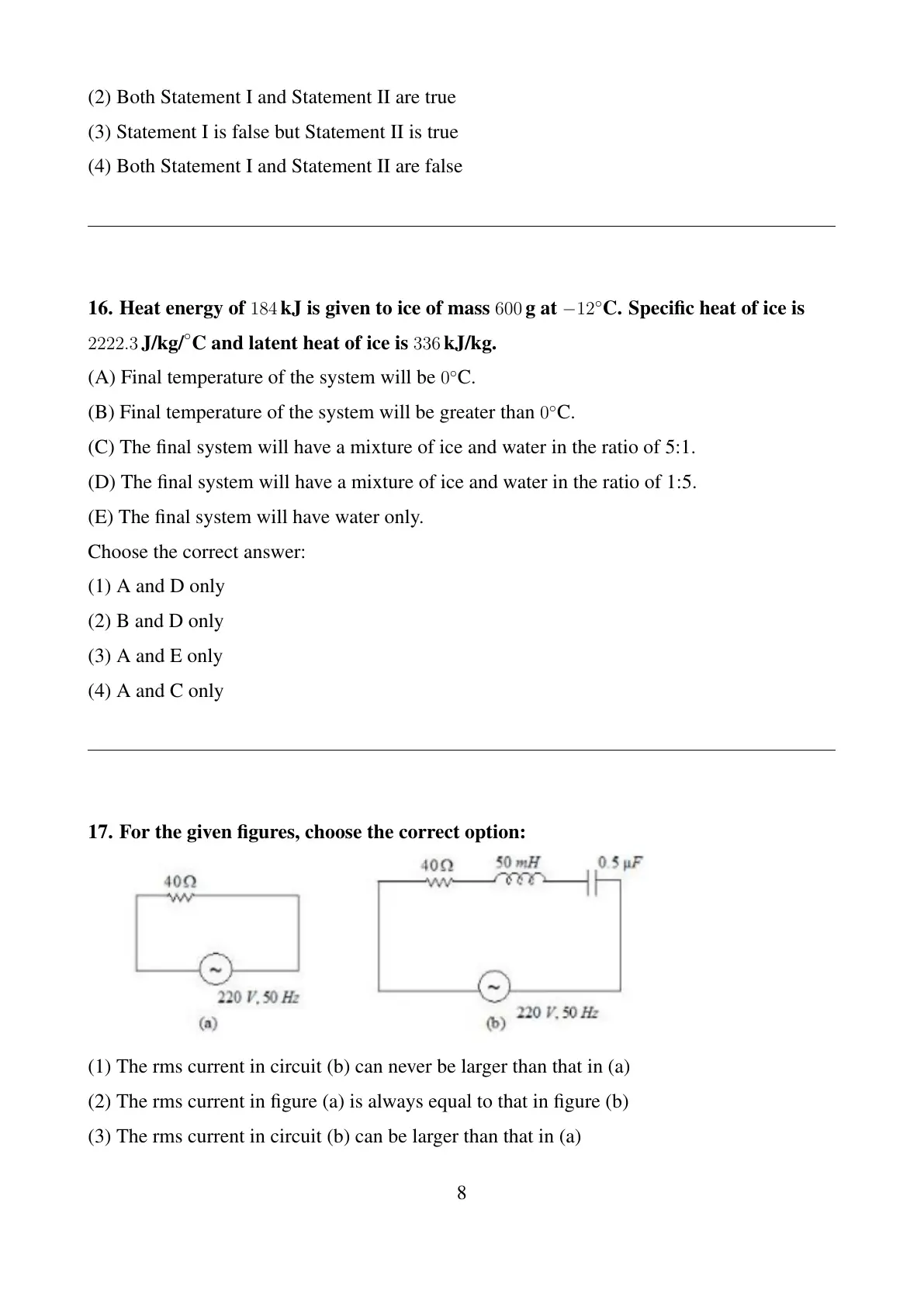
For the given figures, choose the correct option:

View Solution
Step 1: Impedance in Circuit (a):
Circuit (a) consists only of a resistor. The total impedance is: \[ Z_a = R \]
This results in the maximum possible rms current for a given voltage: \[ I_a = \frac{V}{R} \]
Step 2: Impedance in Circuit (b):
Circuit (b) consists of a resistor and reactive components (inductor and capacitor). The total impedance is: \[ Z_b = \sqrt{R^2 + (X_L - X_C)^2} \]
Since \(|X_L - X_C| \geq 0\), the impedance in circuit (b) is always greater than or equal to \(R\): \[ Z_b \geq Z_a \]
Step 3: Compare the rms currents:
The rms current in circuit (b) is: \[ I_b = \frac{V}{Z_b} \]
Since \(Z_b \geq Z_a\), it follows that: \[ I_b \leq I_a \]
Hence, the rms current in circuit (b) can never exceed that in circuit (a). Quick Tip: In AC circuits, the impedance determines the current. Adding reactance increases impedance, reducing current.
The time period of a satellite of Earth is 24 hours. If the separation between the Earth and the satellite is decreased to one-fourth of the previous value, then its new time period will become:
View Solution
Step 1: Relationship between time period and radius:
The orbital time period (\(T\)) is related to the orbital radius (\(R\)) as: \[ T^2 \propto R^3 \]
Step 2: Given change in radius:
The new radius is: \[ R_2 = \frac{R_1}{4} \]
Step 3: Relate the time periods:
\[ \left(\frac{T_2}{T_1}\right)^2 = \left(\frac{R_2}{R_1}\right)^3 \] \[ \left(\frac{T_2}{24}\right)^2 = \left(\frac{1}{4}\right)^3 = \frac{1}{64} \] \[ T_2 = 24 \times \frac{1}{8} = 3 \, hours \] Quick Tip: For satellite motion, remember that \(T^2 \propto R^3\) allows you to easily relate time periods and orbital radii.
The equation of a circle is given by \(x^2 + y^2 = a^2\), where \(a\) is the radius. If the equation is modified to change the origin other than \((0, 0)\), then find out the correct dimensions of \(A\) and \(B\) in a new equation:
\[ (x - At)^2 + \left(y - \frac{t}{B}\right)^2 = a^2. \]
The dimensions of \(t\) are given as \([T^{-1}]\).
View Solution
The given equation of the circle is: \[ (x - At)^2 + \left(y - \frac{t}{B}\right)^2 = a^2. \]
Step 1: Dimensional Analysis of the First Term:
The term \((x - At)\) must have the same dimensions as \(x\), which is \([L]\) (length): \[ [At] = [L]. \]
Since \(t\) has dimensions of \([T^{-1}]\), the dimensions of \(A\) are: \[ [A] = \frac{[L]}{[T^{-1}]} = [L] \cdot [T] = [LT]. \]
Step 2: Dimensional Analysis of the Second Term:
The term \((y - \frac{t}{B})\) must have the same dimensions as \(y\), which is \([L]\): \[ \frac{t}{B} = [L]. \]
Substituting the dimensions of \(t\) as \([T^{-1}]\), the dimensions of \(B\) are: \[ [B] = \frac{[T^{-1}]}{[L]} = [L^{-1}] \cdot [T^{-1}] = [L^{-1} T^{-1}]. \]
Step 3: Finalize the Dimensions:
From the above analysis: \[ A = [LT], \quad B = [L^{-1} T^{-1}]. \]
Thus, the correct dimensions are \(A = [LT]\) and \(B = [L^{-1} T^{-1}]\). Quick Tip: Always ensure that the dimensions of each term in the equation match the physical quantities they represent. For terms involving multiplication or division, combine dimensions accordingly.
A square loop of area \(25 \, cm^2\) has a resistance of \(10 \, \Omega\). The loop is placed in a uniform magnetic field of \(40.0 \, T\). The plane of the loop is perpendicular to the magnetic field. The work done in pulling the loop out of the magnetic field slowly and uniformly in 1.0 second will be:
View Solution
Step 1: Write the formula for work done:
The work done (\(W\)) in pulling the loop is related to the induced emf and the resistance of the loop: \[ W = F \cdot l = \frac{B^2 v l^2}{R} \]
where:
\(B = 40 \, T\) (magnetic field strength),
\(v = 0.05 \, m/s\) (velocity of pulling the loop),
\(l = 0.05 \, m\) (length of one side of the loop, calculated as \(\sqrt{Area} = \sqrt{25 \, cm^2}\)),
\(R = 10 \, \Omega\) (resistance of the loop).
Step 2: Substitute the values into the formula:
\[ W = \frac{40^2 \cdot 0.05 \cdot 0.05^2}{10} \] \[ W = \frac{1600 \cdot 0.05 \cdot 0.0025}{10} \] \[ W = \frac{1600 \cdot 0.000125}{10} = \frac{0.2}{10} = 0.001 \, J \]
Step 3: Convert to millijoules:
\[ W = 1.0 \times 10^{-3} \, J \] Quick Tip: For induced emf and work problems, always ensure the velocity of motion and loop dimensions are consistent with the magnetic field direction.
When two resistances \(R_1\) and \(R_2\) are connected in series and introduced into the left gap of a meter bridge and a resistance of 10 \(\Omega\) is introduced into the right gap, a null point is found at 60 cm from the left side. When \(R_1\) and \(R_2\) are connected in parallel and introduced into the left gap, a resistance of 3 \(\Omega\) is introduced into the right gap to get the null point at 40 cm from the left end. The product of \(R_1 R_2\) is ______ \(\Omega^2\):
View Solution
Using the meter bridge principle: \[ \frac{R_1 + R_2}{10} = \frac{60}{40} \implies R_1 + R_2 = 15 \, \Omega. \]
For the parallel combination: \[ \frac{R_1 R_2}{R_1 + R_2} = 3 \implies R_1 R_2 = 30 \, \Omega^2. \] Quick Tip: In meter bridge problems, use the ratio of the lengths to find equivalent resistance in the left and right gaps.
A particle of mass 100 g is projected at time \(t = 0\) with a speed of \(20 \, ms^{-1}\) at an angle \(45^\circ\) to the horizontal. The magnitude of the angular momentum of the particle about the starting point at time \(t = 2 \, s\) is found to be \(\sqrt{K} \, kgm^2/s\). The value of \(K\) is:
View Solution
The angular momentum about the starting point is: \[ L = m \cdot v_x \cdot h, \]
where:
\(m = 0.1 \, kg\),
\(v_x = v \cos 45^\circ = 20 \cdot \frac{\sqrt{2}}{2} = 10\sqrt{2} \, ms^{-1}\),
\(h = vertical displacement at t = 2 \, s\).
The vertical displacement is: \[ h = v_y t - \frac{1}{2} g t^2 = 20 \cdot \frac{\sqrt{2}}{2} \cdot 2 - \frac{1}{2} \cdot 10 \cdot 2^2 = 20\sqrt{2} - 20 = 20(\sqrt{2} - 1) \, m. \]
Substitute values into \(L\): \[ L = (0.1) \cdot (10\sqrt{2}) \cdot [20(\sqrt{2} - 1)] = 20\sqrt{2} \cdot (\sqrt{2} - 1) = \sqrt{800} \, kgm^2/s. \] Quick Tip: Angular momentum is calculated about the point of projection using \(L = m \cdot v_x \cdot h\), where \(h\) is the height at the given time.
In an experiment measuring the refractive index of a glass slab using a traveling microscope, the real thickness of the slab is measured as \(5.25 \, mm\) and the apparent thickness as \(5.00 \, mm\). The estimated uncertainty in the measurement of refractive index is \(x \cdot 10^{-3}\), where \(x\) is:
View Solution
The refractive index is: \[ \mu = \frac{Real thickness}{Apparent thickness} = \frac{5.25}{5.00}. \]
For uncertainty in \(\mu\): \[ \frac{\Delta \mu}{\mu} = \frac{\Delta h}{h} + \frac{\Delta h'}{h'}, \]
where \(\Delta h = 0.01 \, mm\) and \(\Delta h' = 0.01 \, mm\): \[ \Delta \mu = \mu \left(\frac{\Delta h}{h} + \frac{\Delta h'}{h'}\right). \]
Substitute values: \[ \Delta \mu = \frac{5.25}{5.00} \cdot \left(\frac{0.01}{5.25} + \frac{0.01}{5.00}\right) = 41 \cdot 10^{-3}. \] Quick Tip: Uncertainty in measurements is propagated through addition of relative uncertainties when dividing two quantities.
For a charged spherical ball, the electrostatic potential inside the ball varies with \(r\) as \(V = 2ar^2 + b\). The volume charge density inside the ball is \(-\lambda \alpha \varepsilon_0\). The value of \(\lambda\) is:
View Solution
The electric field is related to potential as: \[ E = -\frac{dV}{dr} = -\frac{d}{dr}(2ar^2 + b) = -4ar. \]
The charge density is: \[ \rho = \varepsilon_0 \cdot \nabla \cdot \mathbf{E} = \varepsilon_0 \cdot \frac{1}{r^2} \frac{d}{dr}(r^2 E). \]
Substitute \(E = -4ar\): \[ \rho = \varepsilon_0 \cdot \frac{1}{r^2} \frac{d}{dr}(-4ar^3) = \varepsilon_0 \cdot (-12a). \]
Thus: \[ \lambda = 12. \] Quick Tip: For spherically symmetric charge distributions, use Gauss's law and the relation \(E = -dV/dr\).
A car is moving on a circular path of radius 600 m such that the magnitudes of the tangential acceleration and centripetal acceleration are equal. The time taken by the car to complete the first quarter of the revolution, if it is moving with an initial speed of 54 km/hr, is \(t(1-e^{-\pi/2}) \, s\). The value of \(t\) is:
View Solution
Step 1: Relating Tangential and Centripetal Acceleration
Given: \[ v_0 = 54 \, km/hr = 15 \, m/s, \quad R = 600 \, m. \]
The tangential acceleration is \(a_t = \frac{dv}{dt}\), and the centripetal acceleration is \(a_c = \frac{v^2}{R}\). The problem states that: \[ a_t = a_c \implies \frac{dv}{dt} = \frac{v^2}{R}. \]
Step 2: Differential Equation for Velocity
Rearrange the equation: \[ \frac{dv}{v^2} = \frac{dt}{R}. \]
Integrate both sides: \[ \int_{v_0}^{v} \frac{dv}{v^2} = \int_{0}^{t} \frac{dt}{R}. \]
The integration gives: \[ -\frac{1}{v} \Big|_{v_0}^v = \frac{t}{R}. \]
Simplify: \[ \frac{1}{v} - \frac{1}{v_0} = \frac{t}{R}. \]
Step 3: Solve for Velocity as a Function of Time
Rearrange to find \(v(t)\): \[ \frac{1}{v} = \frac{1}{v_0} + \frac{t}{R}. \]
Thus: \[ v(t) = \frac{1}{\frac{1}{v_0} + \frac{t}{R}}. \]
Step 4: Angular Displacement for Quarter Revolution
The angular displacement \(\theta\) for circular motion is related to velocity by: \[ d\theta = \frac{v}{R} dt. \]
Substitute \(v(t)\): \[ d\theta = \frac{1}{R \left( \frac{1}{v_0} + \frac{t}{R} \right)} dt. \]
Integrate from \(\theta = 0\) to \(\pi/2\) for the quarter revolution: \[ \int_{0}^{\pi/2} d\theta = \int_{0}^{t} \frac{1}{R \left( \frac{1}{v_0} + \frac{t}{R} \right)} dt. \]
Solve the integral: \[ \theta = -\ln \left( 1 - \frac{t R}{v_0} \right). \]
For \(\theta = \pi/2\), substitute and solve: \[ t = 40 (1 - e^{-\pi/2}) \, s. \]
Thus, the time for the first quarter revolution is \(t = 40 \, s\). Quick Tip: For problems involving circular motion with equal tangential and centripetal accelerations, use the relationship \(\frac{dv}{v^2} = \frac{dt}{R}\) and integrate to find velocity or time.
An inductor of inductance \(2 \, \muH\) is connected in series with a resistance, a variable capacitor, and an AC source of frequency 7 kHz. The value of capacitance for which maximum current is drawn into the circuit is \(1/x \, F\), where the value of \(x\) is:
View Solution
For maximum current, the circuit must be in resonance, i.e., the inductive reactance equals the capacitive reactance: \[ \frac{1}{2 \pi f C} = 2 \pi f L. \]
Rearrange to find \(C\): \[ C = \frac{1}{4 \pi^2 f^2 L}. \]
Substitute values: \[ f = 7 \, kHz = 7 \times 10^3 \, Hz, \quad L = 2 \times 10^{-6} \, H. \]
\[ C = \frac{1}{4 \pi^2 (7 \times 10^3)^2 (2 \times 10^{-6})}. \]
Simplify: \[ C = \frac{1}{4 \times (3.14)^2 \times 49 \times 10^6 \times 2 \times 10^{-6}} = \frac{1}{3872}. \]
Thus, \(x = 3872\). Quick Tip: For resonance in an LCR circuit, equate the inductive reactance and capacitive reactance to find the resonant capacitance.
A metal block of base area \(0.20 \, m^2\) is placed on a table. A liquid film of thickness \(0.25 \, mm\) is inserted between the block and the table. The block is pushed by a horizontal force of \(0.1 \, N\) and moves with a constant speed. If the viscosity of the liquid is \(5.0 \times 10^{-3} \, Pl\), the speed of the block is ______ \(\times 10^{-3} \, m/s\).
View Solution
Using the equation for viscous force: \[ F = \eta A \frac{\Delta v}{\Delta h}. \]
Substitute: \[ 0.1 = (5 \times 10^{-3}) (0.2) \frac{v}{0.25 \times 10^{-3}}. \]
Solve for \(v\): \[ v = \frac{0.1 \cdot 0.25 \times 10^{-3}}{5 \times 10^{-3} \cdot 0.2}. \]
Simplify: \[ v = 25 \times 10^{-3} \, m/s. \]
Thus, the speed is \(25 \times 10^{-3} \, m/s\). Quick Tip: For objects moving in viscous fluids, use the formula \(F = \eta A (\Delta v / \Delta h)\) to relate force, viscosity, and velocity.
A particle of mass \(250 \, g\) executes simple harmonic motion under a periodic force \(F = -25x \, N\). The particle attains a maximum speed of \(4 \, m/s\) during its oscillation. The amplitude of the motion is ______ cm.
View Solution
The force equation for SHM is: \[ F = -kx \quad and \quad a = -\omega^2 x. \]
Equate: \[ \omega^2 = \frac{k}{m}. \]
Given \(F = -25x\), so \(k = 25 \, N/m\), and \(m = 0.25 \, kg\): \[ \omega^2 = \frac{25}{0.25} = 100 \implies \omega = 10 \, rad/s. \]
The maximum speed is: \[ v_{max} = A \omega. \]
Substitute \(v_{max} = 4 \, m/s\) and \(\omega = 10 \, rad/s\): \[ A = \frac{v_{max}}{\omega} = \frac{4}{10} = 0.4 \, m = 40 \, cm. \] Quick Tip: The amplitude in SHM can be calculated using the maximum speed formula \(v_{max} = A \omega\).
Unpolarised light is incident on the boundary between two dielectric media, whose dielectric constants are \(2.8\) (medium-1) and \(6.8\) (medium-2), respectively. To satisfy the condition such that the reflected and refracted rays are perpendicular to each other, the angle of incidence should be \(\tan^{-1}(\sqrt{\mu_2/\mu_1})\). The value of \(\theta\) is:
View Solution
The condition for reflected and refracted rays to be perpendicular is known as Brewster's law. The angle of incidence satisfies: \[ \tan \theta = \sqrt{\frac{\mu_2}{\mu_1}}, \]
where \(\mu_1 = \sqrt{\varepsilon_1}\) and \(\mu_2 = \sqrt{\varepsilon_2}\). Given \(\varepsilon_1 = 2.8\) and \(\varepsilon_2 = 6.8\): \[ \tan \theta = \sqrt{\frac{6.8}{2.8}}. \]
Simplify: \[ \tan \theta = \sqrt{2.43} \approx 1.56. \]
Take the arctangent: \[ \theta = \tan^{-1}(1.56) \approx 7^\circ. \] Quick Tip: At the Brewster angle, reflected and refracted rays are perpendicular, and \(\tan \theta = \sqrt{\mu_2 / \mu_1}\) applies for dielectric media.
A null point is found at \(200 \, cm\) in a potentiometer when the cell in the secondary circuit is shunted by \(5 \, \Omega\). When a resistance of \(15 \, \Omega\) is used for shunting, the null point moves to \(300 \, cm\). The internal resistance of the cell is:
View Solution
Let \(\varepsilon\) be the emf of the cell and \(r\) be its internal resistance. Using the potentiometer principle, we write: \[ \frac{\varepsilon}{r + 5} = 200k \quad and \quad \frac{\varepsilon}{r + 15} = 300k, \]
where \(k\) is the potential gradient.
Dividing these two equations: \[ \frac{\varepsilon / (r + 5)}{\varepsilon / (r + 15)} = \frac{200}{300}. \]
Simplify: \[ \frac{r + 15}{r + 5} = \frac{300}{200} = \frac{3}{2}. \]
Cross-multiply: \[ 2(r + 15) = 3(r + 5). \]
Expand and simplify: \[ 2r + 30 = 3r + 15 \implies r = 15 \, \Omega - 30 = 5 \, \Omega. \] Quick Tip: In potentiometer problems, use the ratio of null lengths to relate the emf and resistances in the circuit.
Also Check:
JEE Main 2023 Physics Analysis Jan 29 Shift 2
JEE Main 2023 Paper Analysis for physics paper scheduled on January 29 Shift 2 will be updated here after the conclusion of the exam. Candidates will be able to check the topics with the highest weightage, difficulty level and memory-based Physics questions.
| JEE Main 2023 Paper Analysis Jan 29 Shift 2 (After Exam) |
JEE Main 2023 Physics Question Paper Pattern
| Feature | Question Paper Pattern |
|---|---|
| Examination Mode | Computer-based Test |
| Exam Language | 13 languages (English, Hindi, Assamese, Bengali, Gujarati, Kannada, Malayalam, Marathi, Odia, Punjabi, Tamil, Telugu, and Urdu) |
| Exam Duration | 3 hours |
| Sectional Time Limit | None |
| Physics Marks | 100 marks |
| Total Number of Questions Asked | 20 MCQs + 10 Numerical Type Questions |
| Total Number of Questions to be Answered | 20 MCQs + 5 Numerical Type Questions |
| Marking Scheme | +4 for each correct answer |
| Negative Marking | -1 for each incorrect answer |
Also Check:
JEE Main 2022 Question Paper
JEE Main 2023 aspirants can practice and check their exam prep level by attempting the previous year question papers as well. The table below shows JEE Main 2022 Question Paper PDF for B.E./B.Tech to practice.



Comments