




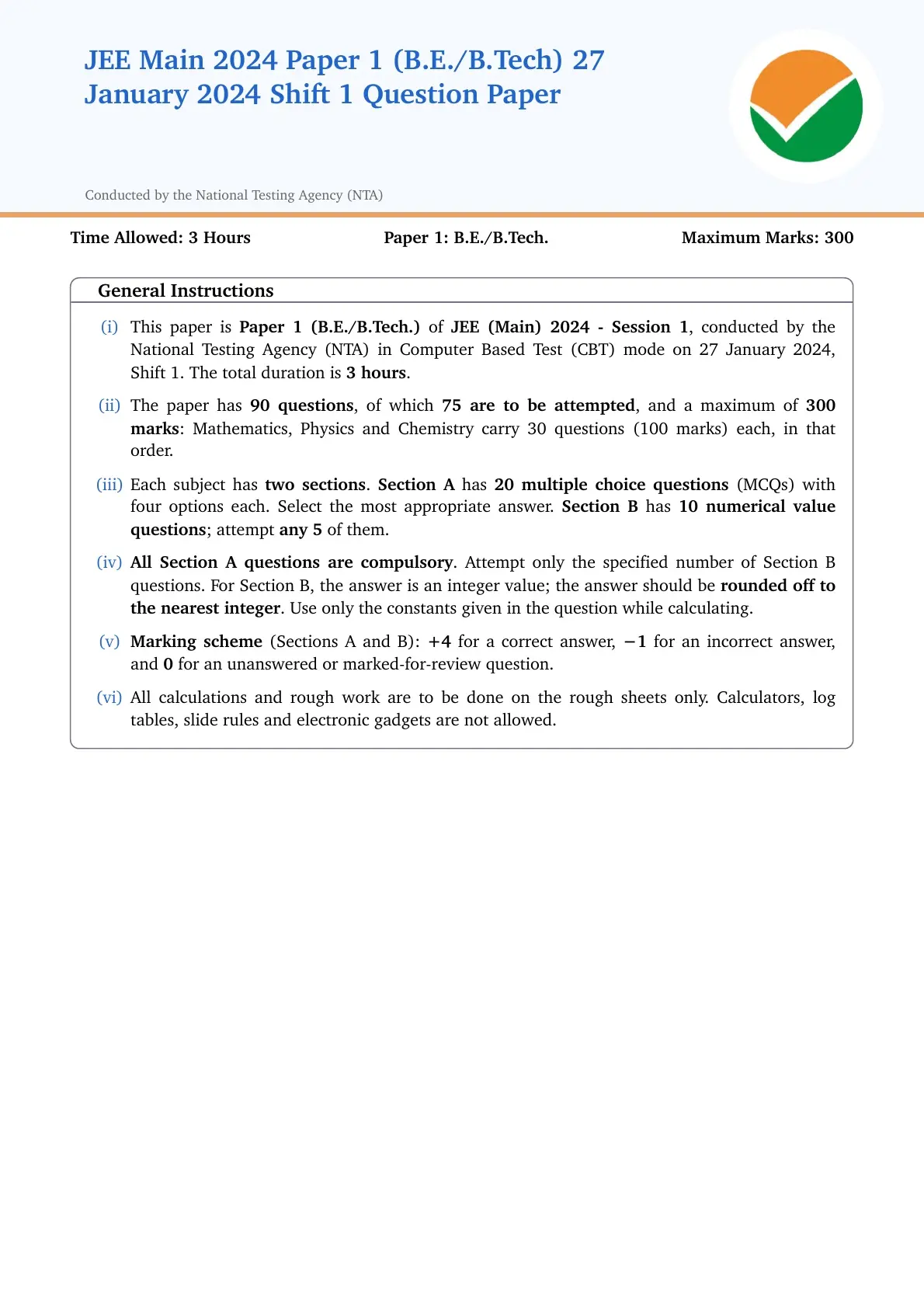
JEE Main 2024 January 27 Shift 1 Question Paper is available here with answer key and solution pdf. NTA conducted the first shift on January 27, 2024, from 9:00 AM to 12:00 PM. The JEE Main 2024 Paper 1 (B.E./B.Tech) question paper includes the following:
- 90 questions in a 3-hour CBT Mode: 30 each from Mathematics, Physics and Chemistry (75 to be attempted)
- Section A: 20 multiple choice questions (MCQs) per subject, 4 marks each
- Section B: 10 numerical value questions per subject, attempt any 5, 4 marks each (integer answer)
- Marking: +4 for a correct answer, -1 for an incorrect answer, 0 for an unattempted question
JEE Main 2024 January 27 Shift 1 Question Paper with Solution PDF
| NTA Official PDF | CD PDF | CD PDF with Solutions |
|---|---|---|
| Download official PDF 4.22 MB | Download Collegedunia PDF 0.86 MB | Download solutions PDF 1.22 MB |
Also Check:
JEE Main 2024 January 27 Shift 1 Questions with Solutions
Mathematics - Section A (Q1 - Q20)
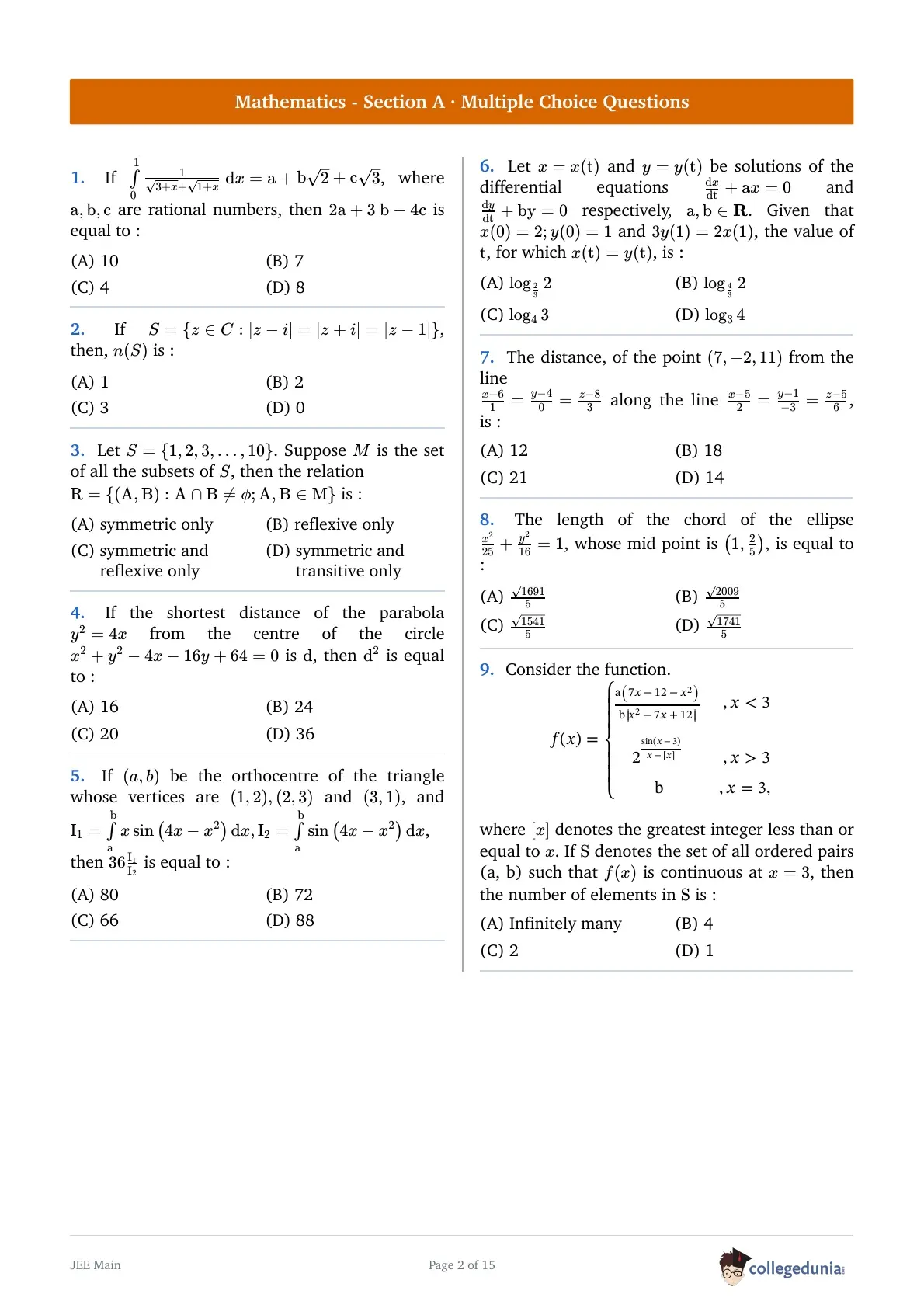
Evaluate the integral \(\int_{0}^{1} \frac{1}{\sqrt{3+x} + \sqrt{1+x}} \, dx\) Given that the integral can be expressed in the form \(a + b\sqrt{2} + c\sqrt{3}\), where \(a, b, c\) are rational numbers, find the value of \(2a + 3b - 4c\).
If \(S = \{z \in C : |z – i| = |z + i| = |z–1|\}\), then, n(S) is:
Let \( S = \{ 1, 2, 3, \ldots, 10 \} \). Suppose \( M \) is the set of all the subsets of \( S \), then the relation \( R = \{ (A, B): A \cap B \neq \phi; A, B \in M \} \) is:
If the shortest distance of the parabola \(y^{2}=4x\) from the centre of the circle \(x² + y² - 4x - 16y + 64 = 0\) is d, then d2 is equal to:
If \( (a, b) \) be the orthocenter of the triangle whose vertices are \( (1, 2) \), \( (2, 3) \), and \( (3, 1) \), and \( I_1 = \int_a^b x \sin(4x - x^2) dx \), \( I_2 = \int_a^b \sin(4x - x^2) dx \), then \( 36 \frac{I_1}{I_2} \) is equal to:
Let \( x = x(t) \) and \( y = y(t) \) be solutions of the differential equations \( \frac{dx}{dt} + ax = 0 \) and \( \frac{dy}{dt} + by = 0 \) respectively, \( a, b \in \mathbb{R} \). Given \( x(0) = 2 \), \( y(0) = 1 \), and \( 3y(1) = 2x(1) \), the value of t for which \( x(t) = y(t) \), is:
The distance of the point \( (7, -2, 11) \) from the line \( \frac{x - 6}{1} = \frac{y - 4}{0} = \frac{z - 8}{3} \) along the line \( \frac{x - 5}{2} = \frac{y - 1}{-3} = \frac{z - 5}{6} \), is:
The length of the chord of the ellipse \(\frac{x^2}{25} + \frac{y^2}{16} = 1\), whose mid-point is \(\left(1, \frac{2}{5}\right)\), is equal to:
Consider the function.\(f(x) = \begin{cases} \frac{a(7x - 12 - x^2)}{b(x^2 - 7x + 12)} & , \quad x < 3 \\[8pt] \frac{\sin(x - 3)}{2^{x - \lfloor x \rfloor}} & , \quad x > 3 \\[8pt] b & , \quad x = 3 \end{cases}\)Where \(\lfloor x \rfloor\)denotes the greatest integer less than or equal to \(x\). If \(S\) denotes the set of all ordered pairs \((a, b)\) such that \(f(x)\) is continuous at \(x = 3\), then the number of elements in \(S\) is:
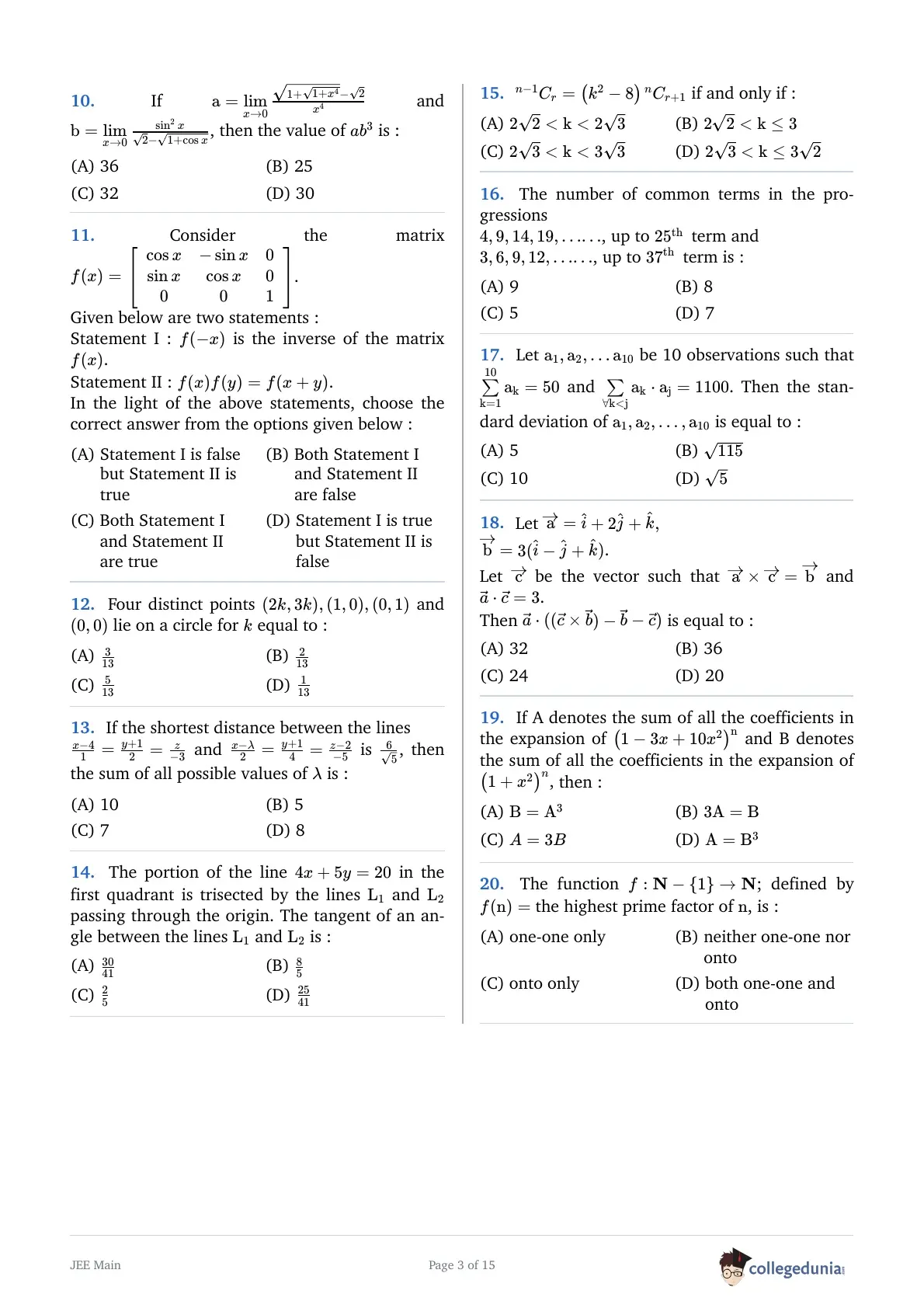
If \( a = \lim_{{x \to 0}} \frac{\sqrt{1 + \sqrt{1 + x^4}} - \sqrt{2}}{x^4} \) and \( b = \lim_{{x \to 0}} \frac{\sin^2 x}{\sqrt{2} - \sqrt{1 + \cos x}} \), then the value of \( ab^3 \) is:
Consider the matrix \( f(x) = \begin{bmatrix} \cos x & -\sin x & 0 \\ \sin x & \cos x & 0 \\ 0 & 0 & 1 \end{bmatrix} \).
Given below are two statements:
Statement I: \( f(-x) \) is the inverse of the matrix \( f(x) \).
Statement II: \( f(x) f(y) = f(x + y) \).
In the light of the above statements, choose the correct answer from the options given below:"
Four distinct points \( (2k, 3k), (1, 0), (0, 1) \) and \( (0, 0) \) lie on a circle for \( k \) equal to:
If the shortest distance between the lines \(\frac{x - 4}{1} = \frac{y + 1}{2} = \frac{z}{-3} and \frac{x - \lambda}{2} = \frac{y + 1}{4} = \frac{z - 2}{-5}\) is \(\frac{6}{\sqrt{5}}\), then the sum of all possible values of \(\lambda\) is:
The portion of the line \( 4x + 5y = 20 \) in the first quadrant is trisected by the lines \( L_1 \) and \( L_2 \) passing through the origin. The tangent of an angle between the lines \( L_1 \) and \( L_2 \) is:
\(^{n-1}C_r = (k^2 - 8) ^{n}C_{r+1}\) if and only if:
The number of common terms in the progressions 4, 9, 14, 19, ...,up to 25th term and 3, 6, 9, 12, ..., up to 37th term is:
Let \( a_1, a_2, \ldots, a_{10} \) be 10 observations such that \(\sum_{k=1}^{10} a_k = 50 \quad \text{and} \quad \sum_{1 \leq k < j \leq 10} a_k \cdot a_j = 1100\). Then the standard deviation of \( a_1, a_2, \ldots, a_{10} \) is equal to:
Let \(\vec{a} = \hat{i} + 2\hat{j} + \hat{k}\), \(\vec{b} = 3(\hat{i} - \hat{j} + \hat{k})\). Let \(\vec{c}\) be the vector such that \(\vec{a} \times \vec{c} = \vec{b}\) and \(\vec{a} \cdot \vec{c} = 3\). Then \(\vec{a} \cdot ((\vec{c} \times \vec{b}) - \vec{b} \cdot \vec{c})\) is equal to:
If \( A \) denotes the sum of all the coefficients in the expansion of \( (1 - 3x + 10x^2)^n \) and \( B \) denotes the sum of all the coefficients in the expansion of \( (1 + x^2)^n \), then:
The function \( f : \mathbb{N} - \{1\} \to \mathbb{N} \); defined by \( f(n) \) = the highest prime factor of \( n \), is:
Mathematics - Section B (Q21 - Q30)
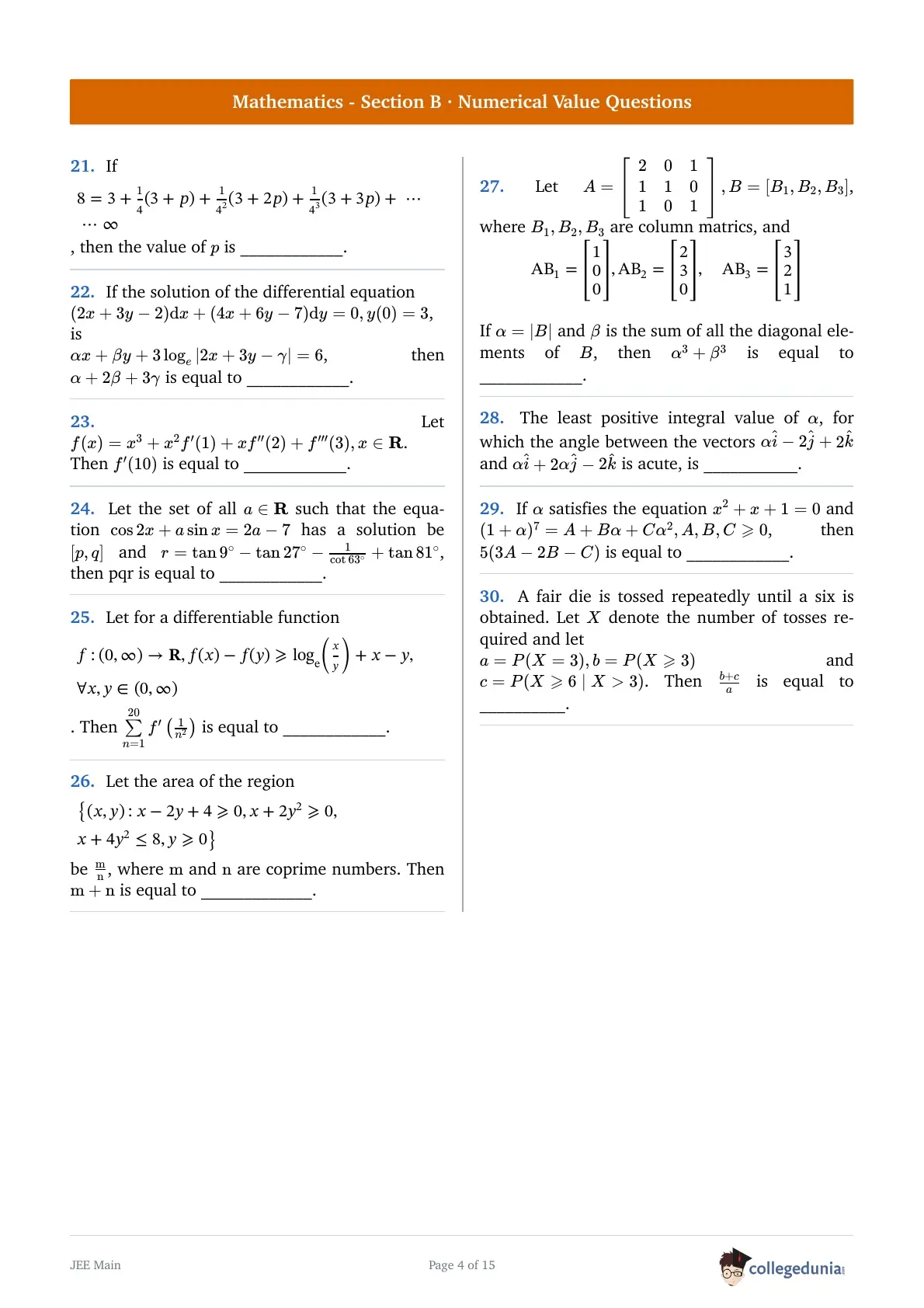
If \( 8 = 3 + \frac{1}{4}(3 + p) + \frac{1}{4^2}(3 + 2p) + \frac{1}{4^3}(3 + 3p) + \ldots \infty \), then the value of \( p \) is ______.
If the solution of the differential equation \((2x + 3y - 2) \, dx + (4x + 6y - 7) \, dy = 0, \quad y(0) = 3,\) is \(\alpha x + \beta y + 3 \log_e |2x + 3y - \gamma| = 6,\) then \(\alpha + 2\beta + 3\gamma\) is equal to ____.
Let \( f(x) = x^3 + x^2 f'(1) + x f''(2) + f'''(3) \), \( x \in \mathbb{R} \). Then \( f'(10) \) is equal to ______.
Let the set of all \( a \in \mathbb{R} \) such that the equation \(\cos 2x + a \sin x = 2a - 7\) has a solution be \([p, q]\) and \( r = \tan 9^\circ - \tan 27^\circ - \frac{1}{\cot 63^\circ + \tan 81^\circ} \), then \( pqr \) is equal to ______.
Let for a differentiable function \(f : (0, \infty) \rightarrow \mathbb{R}\), \(f(x) - f(y) \geq \log_e \left( \frac{x}{y} \right) + x - y, \quad \forall \; x, y \in (0, \infty).\)
Then \(\sum_{n=1}^{20} f'\left(\frac{1}{n^2}\right)\) is equal to ____.
Let the area of the region \(\{(x, y) : x - 2y + 4 \geq 0, x + 2y^2 \geq 0, x + 4y^2 \leq 8, y \geq 0\}\) be \(\frac{m}{n}\), where \( m \) and \( n \) are coprime numbers. Then \( m + n \) is equal to ______.
Let \( A = \begin{bmatrix} 2 & 0 & 1 \\ 1 & 1 & 0 \\ 1 & 0 & 1 \end{bmatrix} \), \( B = [B_1, B_2, B_3] \), where \( B_1, B_2, B_3 \) are column matrices, and \( AB_1 = \begin{bmatrix} 1 \\ 0 \\ 0 \end{bmatrix} \), \( AB_2 = \begin{bmatrix} 2 \\ 3 \\ 0 \end{bmatrix} \), \( AB_3 = \begin{bmatrix} 3 \\ 2 \\ 1 \end{bmatrix} \).
If \(\alpha = |B|\) and \(\beta\) is the sum of all the diagonal elements of B, then \(\alpha^3 + \beta^3\) is equal to _____.
The least positive integral value of \( \alpha \), for which the angle between the vectors \( \alpha \hat{i} - 2\hat{j} + 2\hat{k} \) and \( \alpha \hat{i} + 2\alpha \hat{j} - 2\hat{k} \) is acute, is ______.
If \(\alpha\) satisfies the equation \(x^2 + x + 1 = 0\) and \((1 + \alpha)^7 = A + B \alpha + C \alpha^2\), \(A, B, C \geq 0\), then \(5(3A - 2B - C)\) is equal to ______.
A fair die is tossed repeatedly until a six is obtained. Let X denote the number of tosses required and let \(a=P(X=3), b=P(X≥3)\), and \(( c = P(X \geq 6|X>3).\) Then \(\frac{b+c}{a}\) is equals to ____.
Physics - Section A (Q31 - Q50)
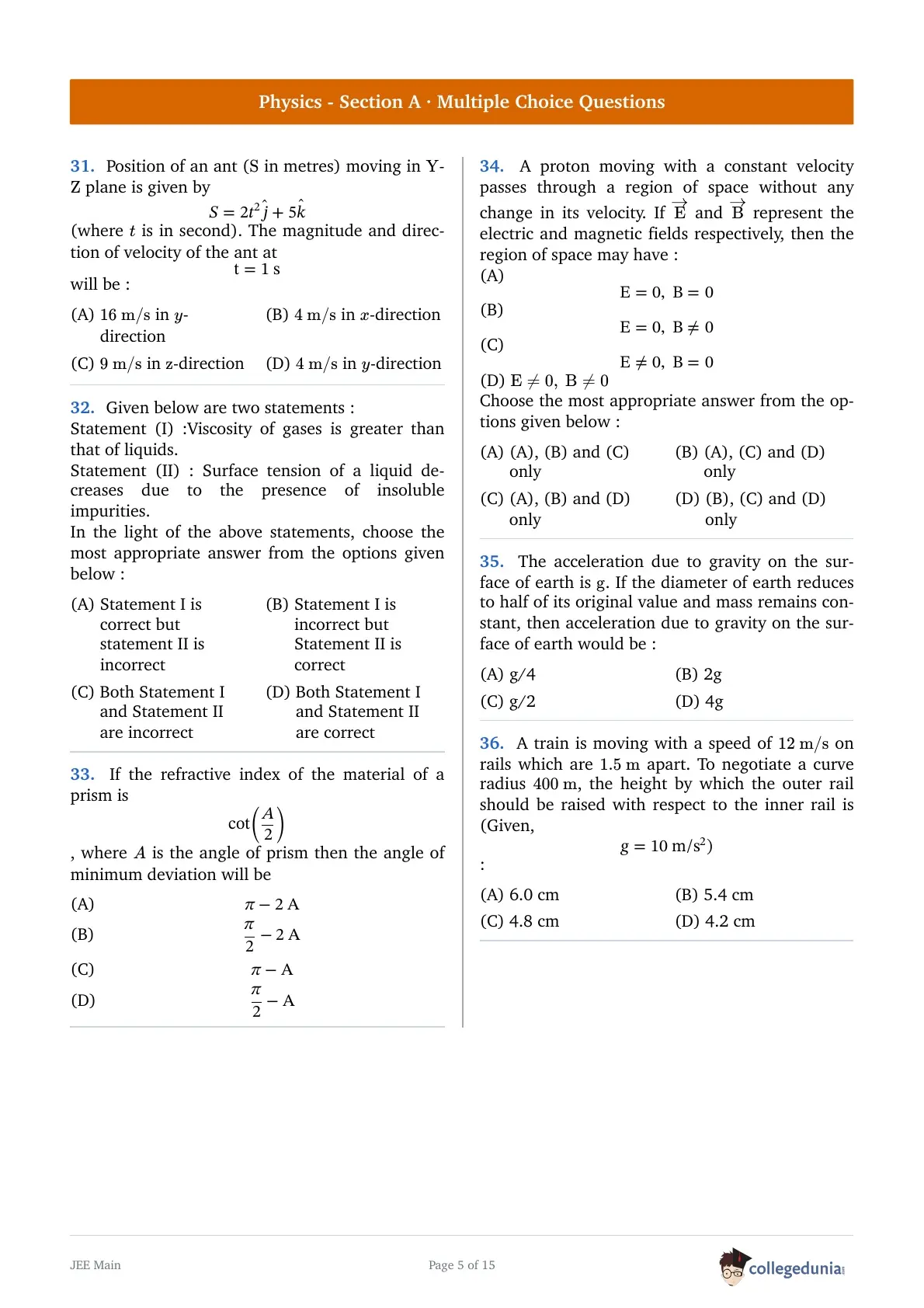
Position of an ant \( S \) (in meters) moving in the Y-Z plane is given by \( S = 2t \hat{j} + 5t \hat{k} \) (where \( t \) is in seconds). The magnitude and direction of velocity of the ant at \( t = 1 \, s \) will be:
Given below are two statements:
Statement (I): Viscosity of gases is greater than that of liquids.
Statement (II): Surface tension of a liquid decreases due to the presence of insoluble impurities.
In the light of the above statements, choose the most appropriate answer from the options given below:
If the refractive index of the material of a prism is \(cot\bigg(\frac{A}{2}\bigg)\), where A is the angle of the prism, then the angle of minimum deviation will be:
A proton moving with a constant velocity passes through a region of space without any change in its velocity. If \( \vec{E} \) and \( \vec{B} \) represent the electric and magnetic fields respectively, then the region of space may have:
(A) \( \vec{E} = 0, \vec{B} = 0 \)
(B) \( \vec{E} = 0, \vec{B} \neq 0 \)
(C) \( \vec{E} \neq 0, \vec{B} = 0 \)
(D) \( \vec{E} \neq 0, \vec{B} \neq 0 \)
Choose the most appropriate answer from the options given below:
The acceleration due to gravity on the surface of earth is g. If the diameter of earth reduces to half of its original value and mass remains constant, then acceleration due to gravity on the surface of earth would be:
A train is moving with a speed of 12 m/s on rails which are 1.5 m apart. To negotiate a curve radius of 400 m, the height by which the outer rail should be raised with respect to the inner rail is (Given, \( g = 10 \, \text{m/s}^2 \)):


Identify the physical quantity that cannot be measured using a spherometer:
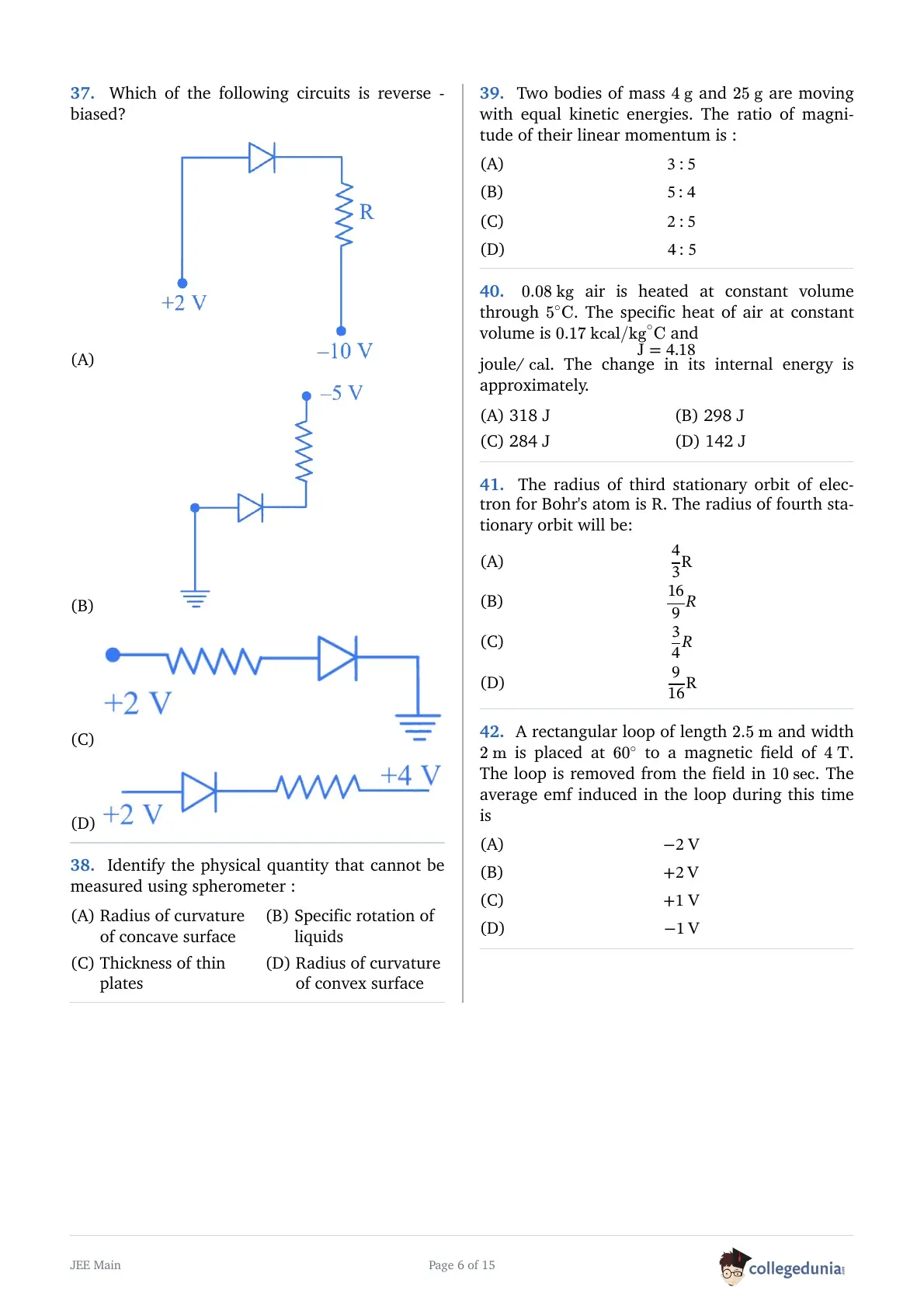
Two bodies of mass 4 g and 25 g are moving with equal kinetic energies. The ratio of the magnitude of their linear momentum is:
0.08 kg of air is heated at constant volume through 5°C. The specific heat of air at constant volume is 0.17 kcal/kg°C and \( J = 4.18 \) joule/cal. The change in its internal energy is approximately:
The radius of the third stationary orbit of an electron in Bohr's atom is \( R \). The radius of the fourth stationary orbit will be:
A rectangular loop of length 2.5 m and width 2 m is placed at 60° to a magnetic field of 4 T. The loop is removed from the field in 10 sec. The average emf induced in the loop during this time is:
An electric charge \(10^{-6} \, \mu C\) is placed at the origin (0, 0) of an X-Y coordinate system. Two points P and Q are situated at \((\sqrt{3}, \sqrt{3}) \, \text{mm}\) and \((\sqrt{6}, 0) \, \text{mm}\) respectively. The potential difference between the points P and Q will be:
A convex lens of focal length 40 cm forms an image of an extended source of light on a photo-electric cell. A current \( I \) is produced. The lens is replaced by another convex lens having the same diameter but focal length 20 cm. The photoelectric current now is:
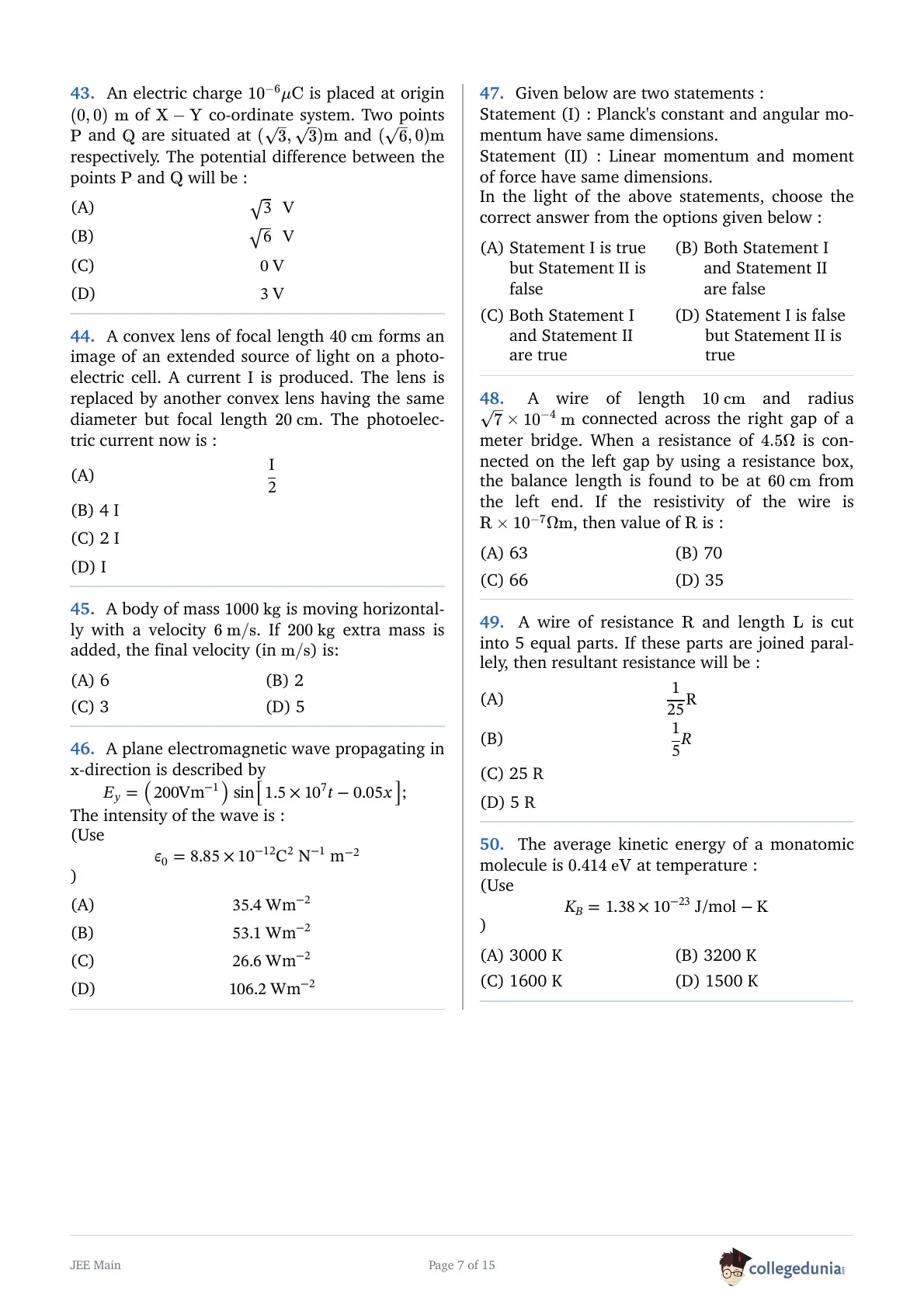
A body of mass 1000 kg is moving horizontally with a velocity of 6 m/s. If 200 kg extra mass is added, the final velocity (in m/s) is:
A plane electromagnetic wave propagating in x-direction is described by \( E_y = (200 \, \text{V/m}) \sin(1.5 \times 10^7 t - 0.05 x) \). The intensity of the wave is:
Given below are two statements:
Statement (I): Planck's constant and angular momentum have the same dimensions.
Statement (II): Linear momentum and moment of force have the same dimensions.
In the light of the above statements, choose the correct answer from the options given below:
A wire of length 10 cm and radius \( \sqrt{7} \times 10^{-4} \, m \) is connected across the right gap of a meter bridge. When a resistance of 4.5 \( \Omega \) is connected on the left gap by using a resistance box, the balance length is found to be at 60 cm from the left end. If the resistivity of the wire is \( R \times 10^{-7} \, \Omega \, m \), then the value of \( R \) is:
A wire of resistance \( R \) and length \( L \) is cut into 5 equal parts. If these parts are joined in parallel, then the resultant resistance will be:
The average kinetic energy of a monatomic molecule is 0.414 eV at temperature: (Use \( k_B = 1.38 \times 10^{-23} \, \text{J/mol-K} \))
Physics - Section B (Q51 - Q60)
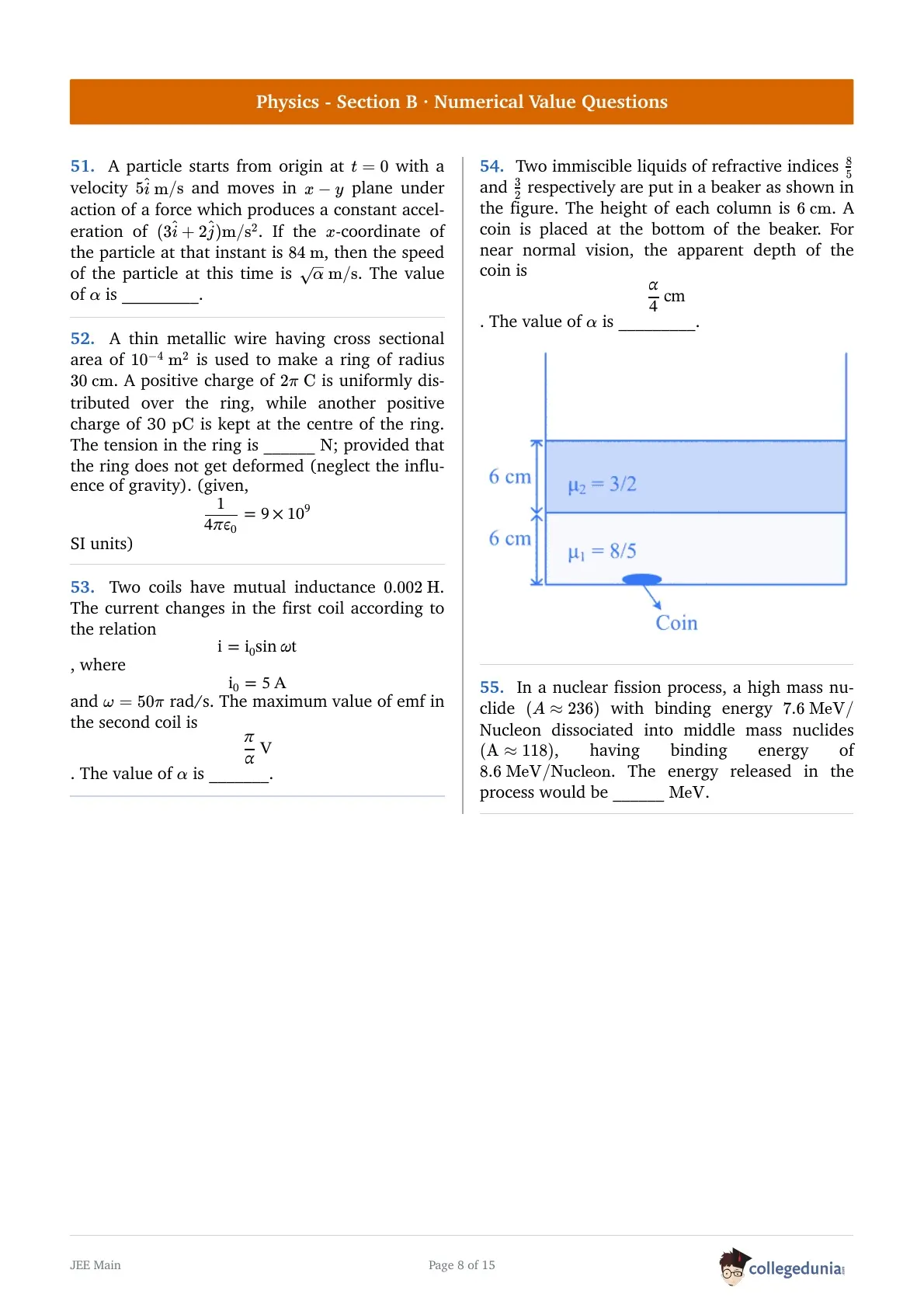
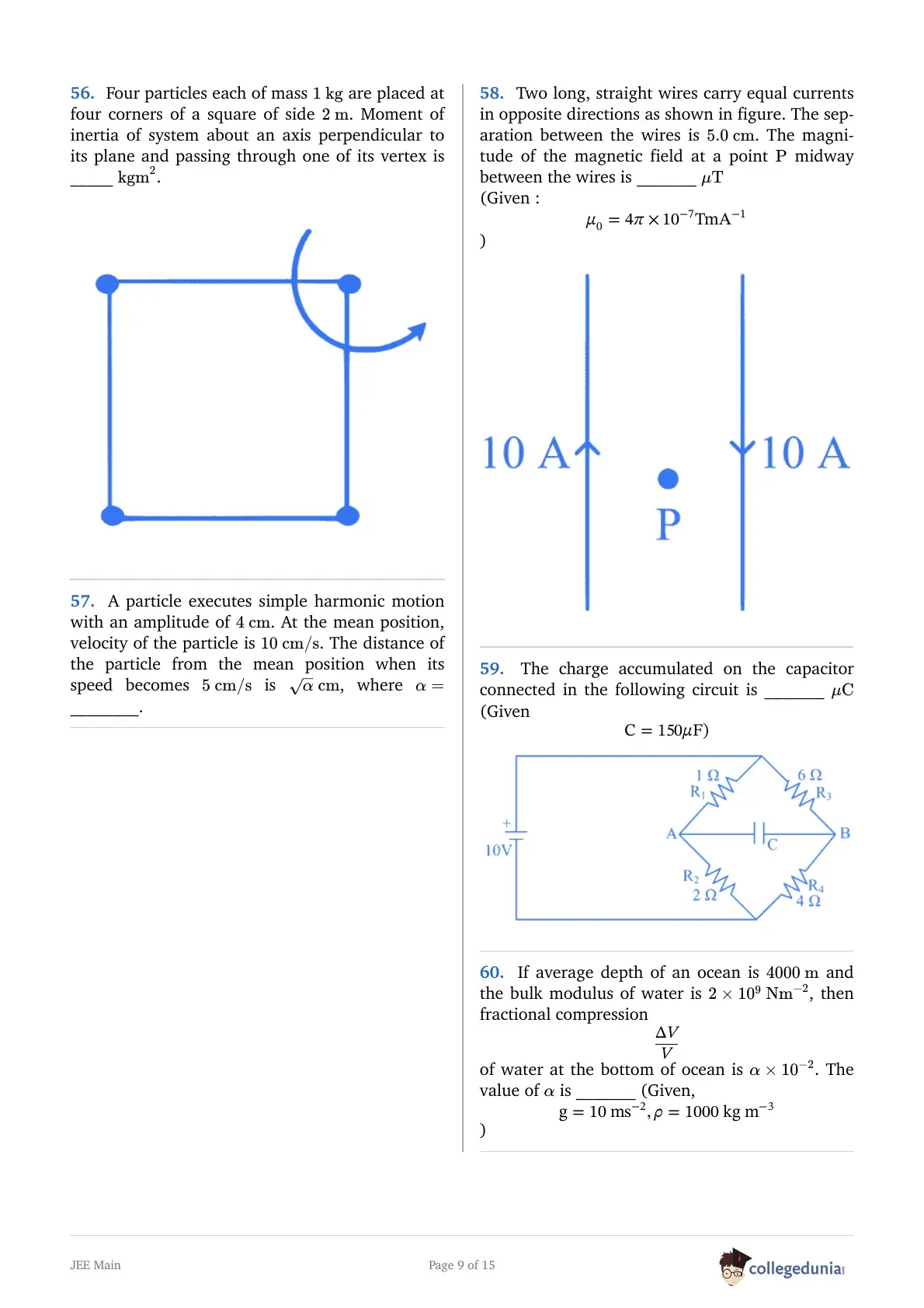
A particle starts from origin at \( t = 0 \) with a velocity \( 5\hat{i} \, \text{m/s} \) and moves in the \( x\)-\( y \) plane under the action of a force that produces a constant acceleration of \( (3\hat{i} + 2\hat{j}) \, \text{m/s}^2 \). If the \( x \)-coordinate of the particle at that instant is 84 m, then the speed of the particle at this time is \( \sqrt{\alpha} \, \text{m/s} \). The value of \( \alpha \) is ______.
A thin metallic wire having a cross-sectional area of \( 10^{-4} \, \text{m}^2 \) is used to make a ring of radius 30 cm. A positive charge of \( 2\pi \, C \) is uniformly distributed over the ring, while another positive charge of 30 pC is kept at the center of the ring. The tension in the ring is ______ N; provided that the ring does not deform (neglect the influence of gravity).
(Given, \(\frac{1}{4 \pi \varepsilon_0} = 9 \times 10^9 \, \text{SI units}\))
Two coils have mutual inductance 0.002 H. The current changes in the first coil according to the relation \( i = i_0 \sin \omega t \), where \( i_0 = 5 \, \text{A} \) and \( \omega = 50\pi \, \text{rad/s} \). The maximum value of emf in the second coil is \( \frac{\pi}{\alpha} \). The value of \( \alpha \) is ______.
Two immiscible liquids of refractive indices \( \frac{8}{5} \) and \( \frac{3}{2} \) respectively are put in a beaker as shown in the figure. The height of each column is 6 cm. A coin is placed at the bottom of the beaker. For near-normal vision, the apparent depth of the coin is \( \frac{\alpha}{4} \) cm. The value of \( \alpha \) is ______.
In a nuclear fission process, a high mass nuclide (A ≈ 236) with binding energy 7.6 MeV/Nucleon dissociated into middle mass nuclides (A ≈ 118), having binding energy of 8.6 MeV/Nucleon. The energy released in the process would be ____ MeV.
Four particles each of mass 1 kg are placed at four corners of a square of side 2 m. Moment of inertia of system about an axis perpendicular to its plane and passing through one of its vertices is _____ kgm2.
A particle executes simple harmonic motion with an amplitude of 4 cm. At the mean position, the velocity of the particle is 10 cm/s. The distance of the particle from the mean position when its speed becomes 5 cm/s is \( \sqrt{\alpha} \) cm, where \(\alpha\) = ______
Two long, straight wires carry equal currents in opposite directions as shown in figure. The separation between the wires is 5.0 cm. The magnitude of the magnetic field at a point P midway between the wires is ____ μT
(Given: \(\mu_0 = 4\pi \times 10^{-7} \, \text{TmA}^{-1}\))
The charge accumulated on the capacitor connected in the following circuit is ____ µC
(Given \( C = 150 \, \mu \text{F} \))
If the average depth of an ocean is 4000 m and the bulk modulus of water is \( 2 \times 10^9 \, \text{N/m}^2 \), then the fractional compression \( \frac{\Delta V}{V} \) of water at the bottom of the ocean is \( \alpha \times 10^{-2} \). The value of \( \alpha \) is ______ (Given \( g = 10 \, \text{m/s}^2 \), \( p = 1000 \, \text{kg/m}^3 \)).
Chemistry - Section A (Q61 - Q80)
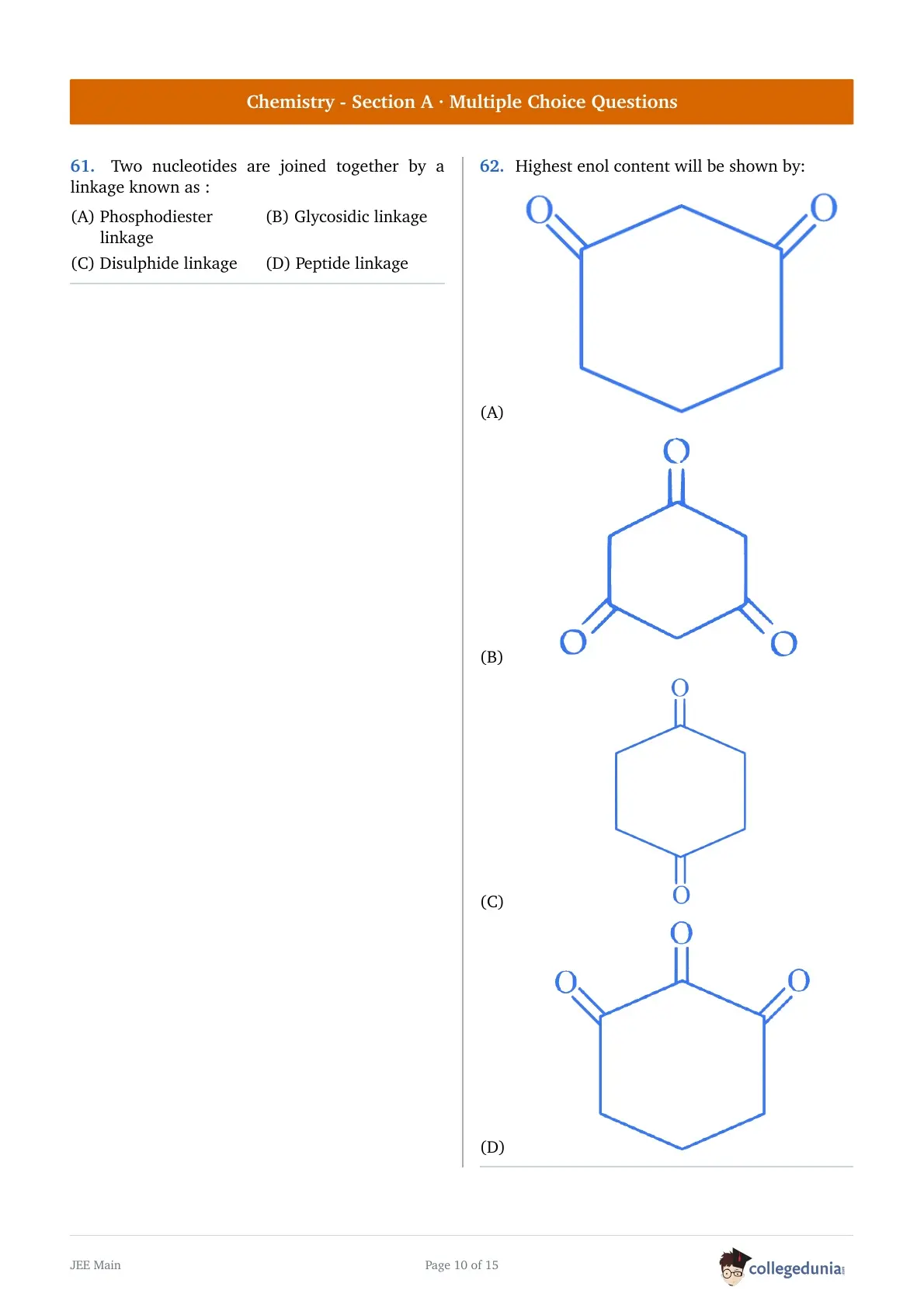
Two nucleotides are joined together by a linkage known as:


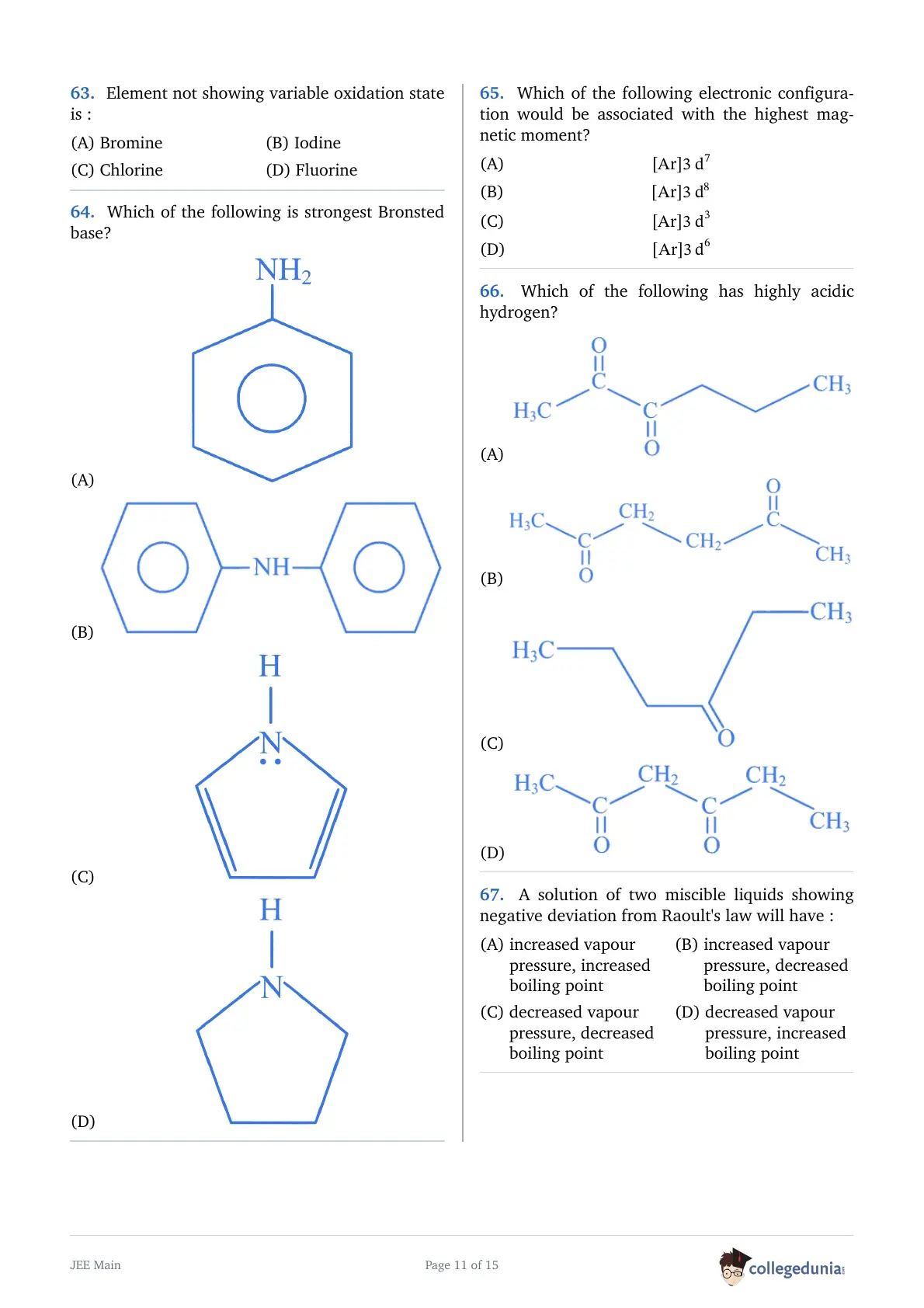
Element not showing variable oxidation state is:


Which of the following electronic configurations would be associated with the highest magnetic moment?


A solution of two miscible liquids showing negative deviation from Raoult's law will have:
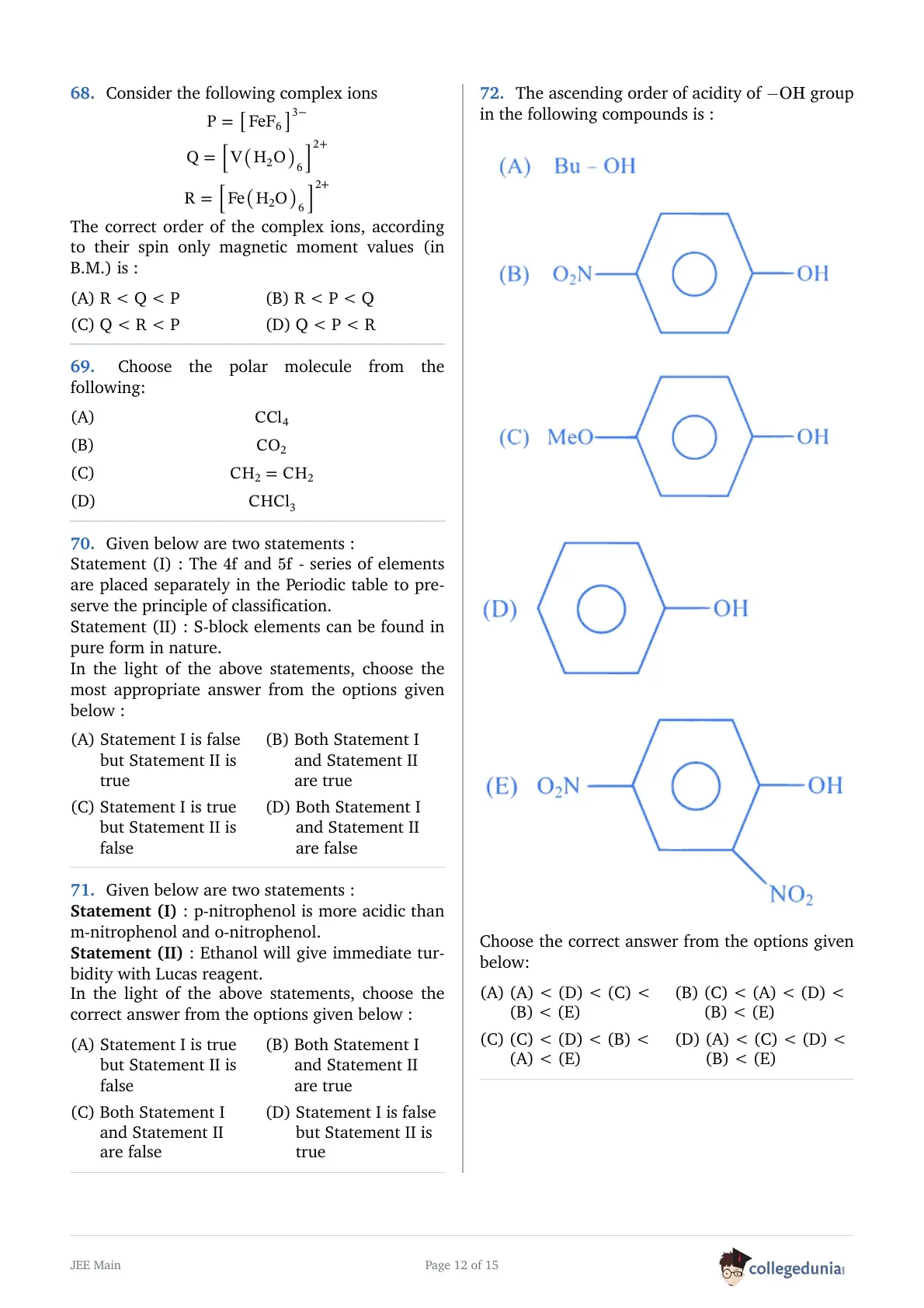
Consider the following complex ions:
P = \([FeF_6]^{3-}\)
Q = \([V(H_2O)_6]^{2+}\)
R = \([Fe(H_2O)_6]^{2+}\)
The correct order of the complex ions, according to their spin-only magnetic moment values (in B.M.) is:
Choose the polar molecule from the following:
Given below are two statements:
Statement (I): The 4f and 5f-series of elements are placed separately in the Periodic table to preserve the principle of classification.
Statement (II): s-block elements can be found in pure form in nature.
In the light of the above statements, choose the most appropriate answer from the options given below:
Given below are two statements:
Statement (I): p-nitrophenol is more acidic than m-nitrophenol and o-nitrophenol.
Statement (II): Ethanol will give immediate turbidity with Lucas reagent.
In the light of the above statements, choose the correct answer from the options given below:
The ascending order of acidity of –OH group in the following compounds is: 
Choose the correct answer from the options given below :
Given below are two statements: one is labelled as Assertion (A) and the other is labelled as Reason (R).
Assertion (A): Melting point of Boron (2453 K) is unusually high in group 13 elements.
Reason (R): Solid Boron has a very strong crystalline lattice.
In the light of the above statements, choose the most appropriate answer from the options given below:
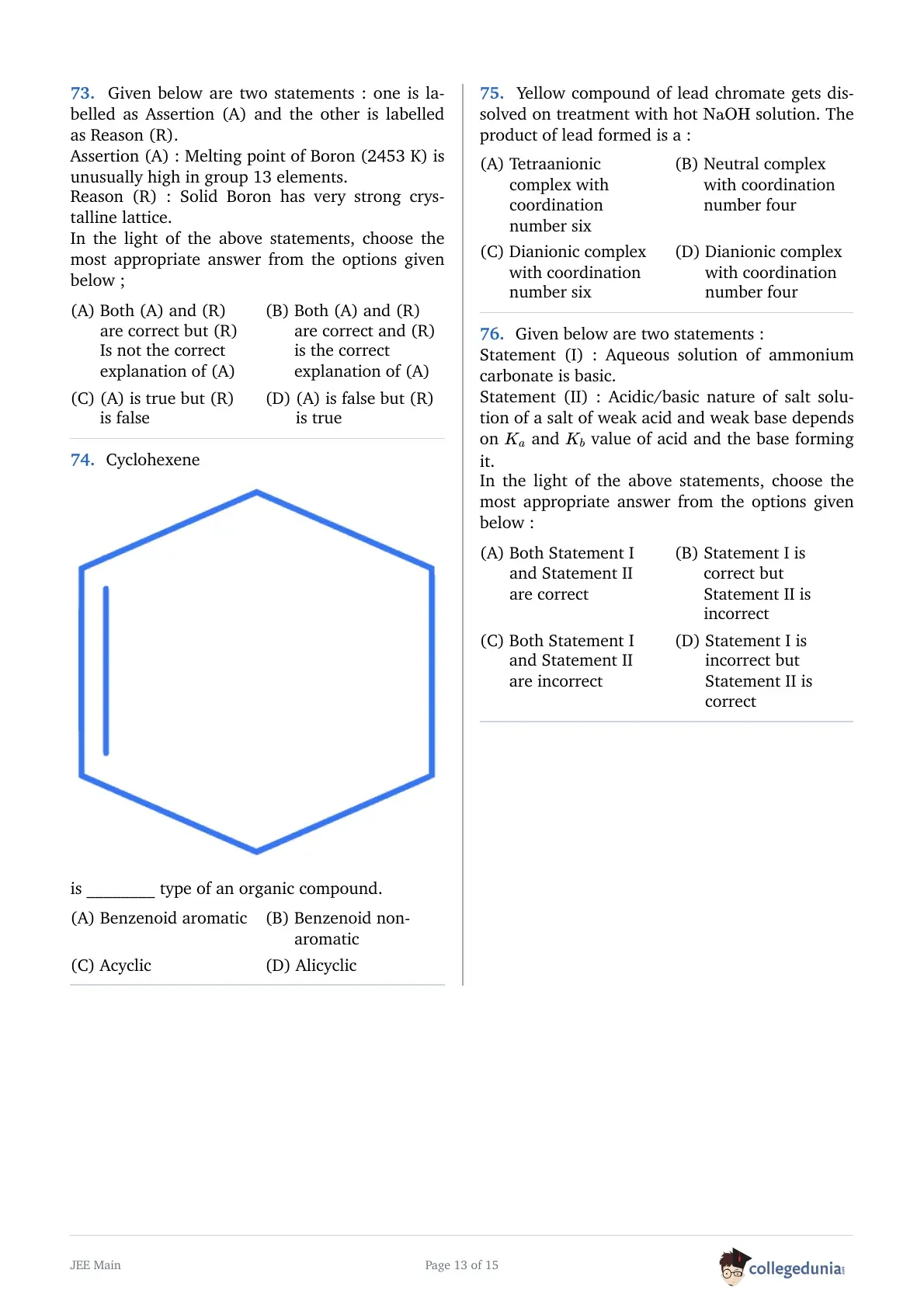
Cyclohexene  is _________ type of an organic compound.
Yellow compound of lead chromate gets dissolved on treatment with hot NaOH solution. The product of lead formed is a:
Given below are two statements:
Statement (I): Aqueous solution of ammonium carbonate is basic.
Statement (II): Acidic/basic nature of salt solution of a salt of weak acid and weak base depends on \( K_a \) and \( K_b \) value of acid and the base forming it.
In the light of the above statements, choose the most appropriate answer from the options given below:
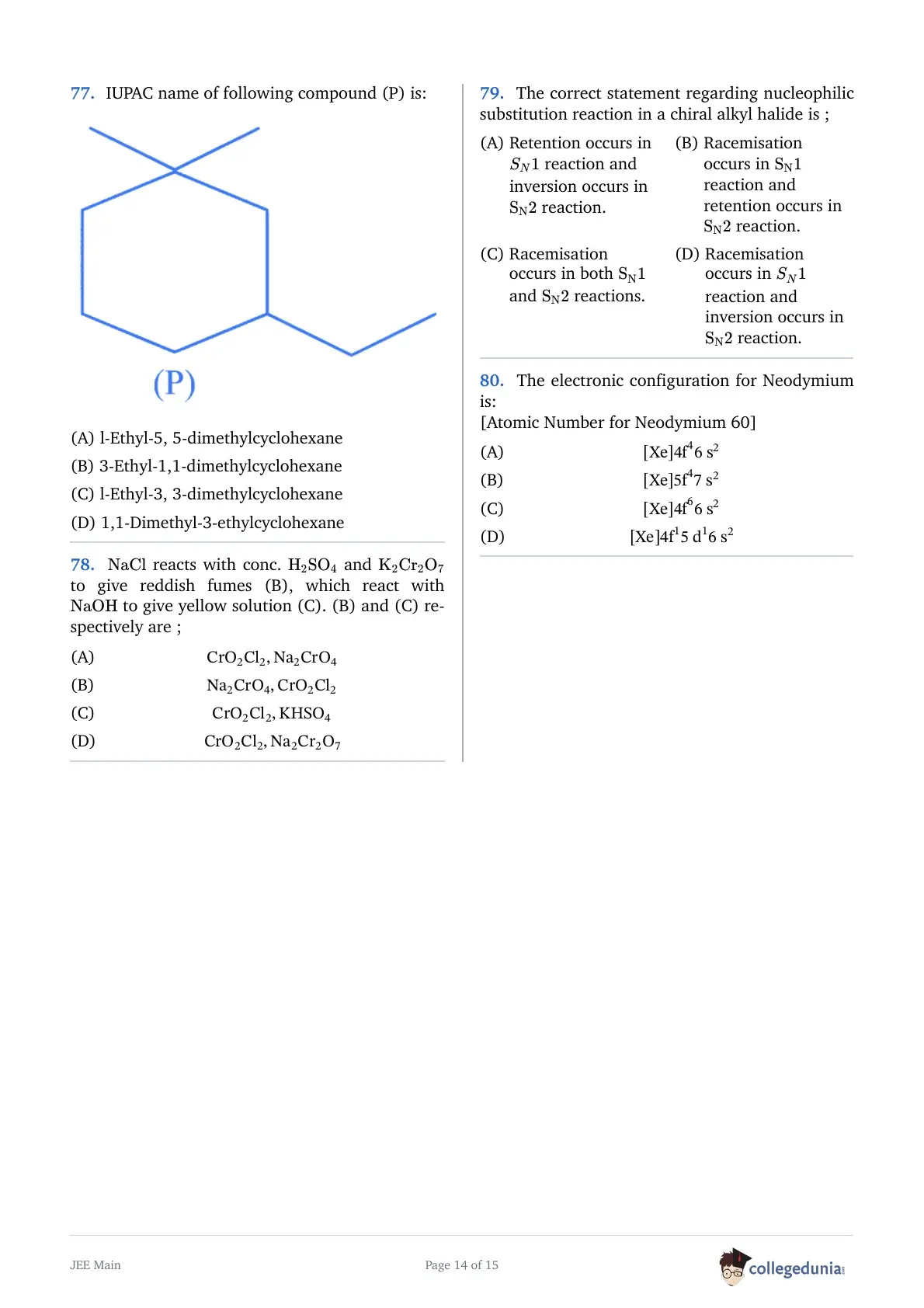
IUPAC name of the following compound (P) is:
NaCl reacts with conc. \( H_2SO_4 \) and \( K_2Cr_2O_7 \) to give reddish fumes (B), which react with NaOH to give yellow solution (C). (B) and (C) respectively are:
The correct statement regarding nucleophilic substitution reaction in a chiral alkyl halide is:
The electronic configuration of Neodymium (60) Nd is
Chemistry - Section B (Q81 - Q90)
The mass of silver (Molar mass of Ag : 108 gmol–1 ) displaced by a quantity of electricity which displaces 5600 mL of O2 at S.T.P. will be _____ g.
Consider the following data for the given reaction
\(2\)\(\text{HI}_{(g)}\) \(\rightarrow\) \(\text{H}_2{(g)}\)\( + \)\(\text{I}_2{(g)}\)
The order of the reaction is __________.
Mass of methane required to produce 22 g of CO2 after complete combustion is ______ g.
(Given Molar mass in g mol−1: C=12.0, H=1.0, O=16.0).
If three moles of an ideal gas at 300 K expand isothermally from 30 dm3 to 45 dm3 against a constant opposing pressure of 80 kPa, then the amount of heat transferred is ______ J.
3-Methylhex-2-ene on reaction with HBr in presence of peroxide forms an addition product (A). The number of possible stereoisomers for 'A' is ______.
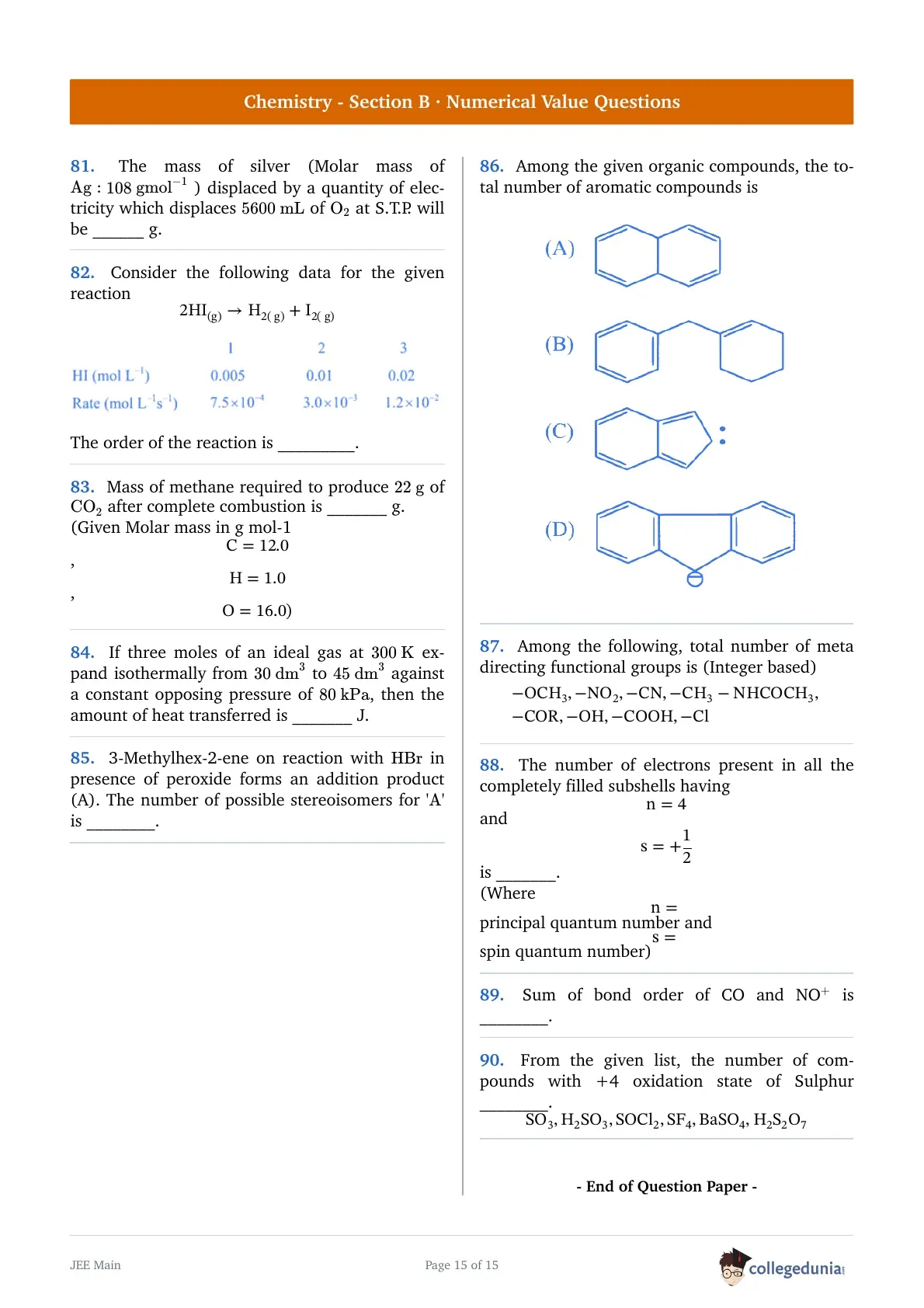
Among the given organic compounds, the total number of aromatic compounds is

Among the following, total number of meta directing functional groups is (Integer based) \(−OCH_3, −NO_2, −CN, −CH_3, −NHCOCH_3, −COR, −OH, −COOH, −Cl\).
The number of electrons present in all the completely filled subshells having n=4 and s=+½ is _____. (Where n = principal quantum number and s = spin quantum number).
Sum of bond order of CO and NO+ is _____.
From the given list, the number of compounds with +4 oxidation state of Sulphur_____.
\(SO_3, H_2SO_3, SOCl_2, SF_4, BaSO_4, H_2S_2O_7\).
JEE Main 2024 Exam Pattern and Marking Scheme
| Particulars | Details |
|---|---|
| Exam Mode | Online (Computer-Based Test) |
| Paper | B.E./B.Tech |
| Medium of Exam | 13 languages: English, Hindi, Gujarati, Bengali, Tamil, Telugu, Kannada, Marathi, Malayalam, Odia, Punjabi, Assamese, Urdu |
| Duration | 3 hours (180 minutes) |
| Type of Questions | Multiple Choice Questions (MCQs) + Numerical Value Questions (attempt any 5 of 10 per subject) |
| Total Marks | 300 marks |
| Subjects | Mathematics, Physics, Chemistry |
| Marking Scheme | +4 for correct answer & -1 for incorrect MCQ and Numerical Value-based Questions |
| Total Questions | 90 Questions (30 per subject), 75 to be attempted |
| Eligibility | Passed or appearing in Class 12 with Physics, Chemistry, and Mathematics |
JEE Main 2024 Jan 27 Shift 1 Question Paper by Coaching Institute
| Coaching Institutes | Question Paper with Solutions PDF |
|---|---|
| Aakash BYJUs | Download PDF |
| Reliable Institute | Physics Chemistry Maths |
| Resonance | Physics Chemistry Maths |
| Vedantu | Download PDF |
| Sri Chaitanya | To be updated |
| FIIT JEE | To be updated |
JEE Main 27 Jan Shift 1 2024 Paper Analysis
JEE Main 2024 Jan 27 Shift 1 paper analysis for B.E./ B.Tech is available here with details on the difficulty level of the exam, topics with the highest weightage in the exam, section-wise difficulty level, etc. after the conclusion of the exam.
JEE Main 2024 Question Paper Pattern
| Feature | Question Paper Pattern |
|---|---|
| Examination Mode | Computer-based Test |
| Exam Language | 13 languages (English, Hindi, Assamese, Bengali, Gujarati, Kannada, Malayalam, Marathi, Odia, Punjabi, Tamil, Telugu, and Urdu) |
| Number of Sections | Three- Physics, Chemistry, Mathematics |
| Exam Duration | 3 hours |
| Sectional Time Limit | None |
| Total Marks | 300 marks |
| Total Number of Questions Asked | 90 Questions |
| Total Number of Questions to be Answered | 75 questions |
| Type of Questions | MCQs and Numerical Answer Type Questions |
| Section-wise Number of Questions | Physics- 20 MCQs and 10 numerical type, Chemistry- 20 MCQs and 10 numerical type, Mathematics- 20 MCQs and 10 numerical type |
| Marking Scheme | +4 for each correct answer |
| Negative Marking | -1 for each incorrect answer |
Read More:
- JEE Main 2024 question paper pattern and marking scheme
- Most important chapters in JEE Mains 2024, Check chapter wise weightage here
JEE Main 2024 Question Paper Session 1 (January)
Those appearing for JEE Main 2024 can use the links below to practice and keep track of their exam preparation level by attempting the shift-wise JEE Main 2024 question paper provided below.
| Exam Date and Shift | Question Paper PDF |
|---|---|
| JEE Main 24 Jan Shift 2 2024 Question Paper | Check Here |
| JEE Main 27 Jan Shift 2 2024 Question Paper | Check Here |
| JEE Main 29 Jan Shift 1 2024 Question Paper | Check Here |
| JEE Main 29 Jan Shift 2 2024 Question Paper | Check Here |
| JEE Main 30 Jan Shift 1 2024 Question Paper | Check Here |
| JEE Main 30 Jan Shift 2 2024 Question Paper | Check Here |
| JEE Main 31 Jan Shift 1 2024 Question Paper | Check Here |
| JEE Main 31 Jan Shift 2 2024 Question Paper | Check Here |
| JEE Main 1 Feb Shift 1 2024 Question Paper | Check Here |
| JEE Main 1 Feb Shift 2 2024 Question Paper | Check Here |



Comments