




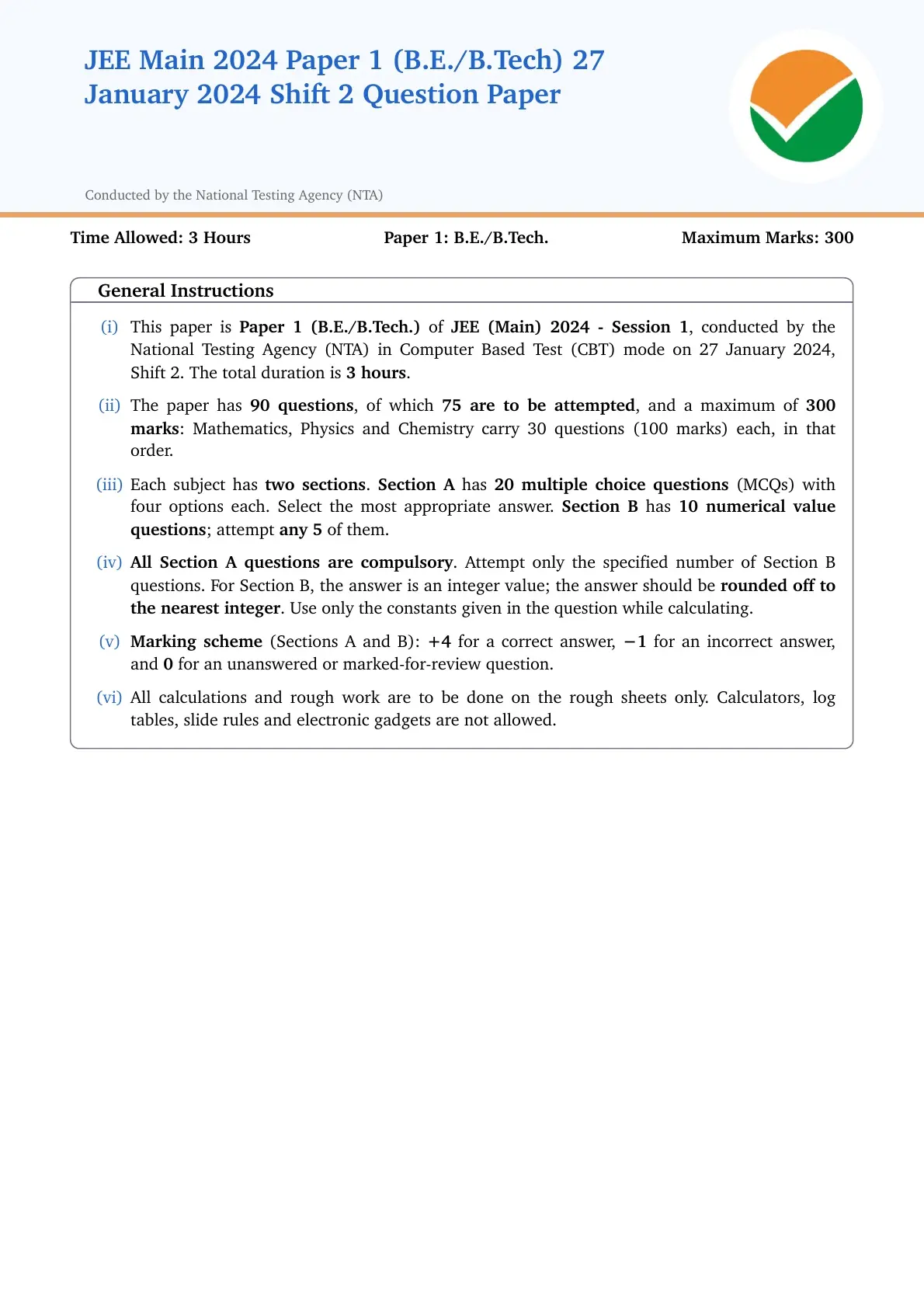
JEE Main 2024 January 27 Shift 2 Question Paper is available here with answer key and solution pdf. NTA conducted the second shift on January 27, 2024, from 3:00 PM to 6:00 PM. The JEE Main 2024 Paper 1 (B.E./B.Tech) question paper includes the following:
- 90 questions in a 3-hour CBT Mode: 30 each from Mathematics, Physics and Chemistry (75 to be attempted)
- Section A: 20 multiple choice questions (MCQs) per subject, 4 marks each
- Section B: 10 numerical value questions per subject, attempt any 5, 4 marks each (integer answer)
- Marking: +4 for a correct answer, -1 for an incorrect answer, 0 for an unattempted question
JEE Main 2024 January 27 Shift 2 Question Paper with Solution PDF
| NTA Official PDF | CD PDF | CD PDF with Solutions |
|---|---|---|
| Download official PDF 4.64 MB | Download Collegedunia PDF 1.14 MB | Download solutions PDF 1.24 MB |
Also Check:
JEE Main 2024 January 27 Shift 2 Questions with Solutions
Mathematics - Section A (Q1 - Q20)
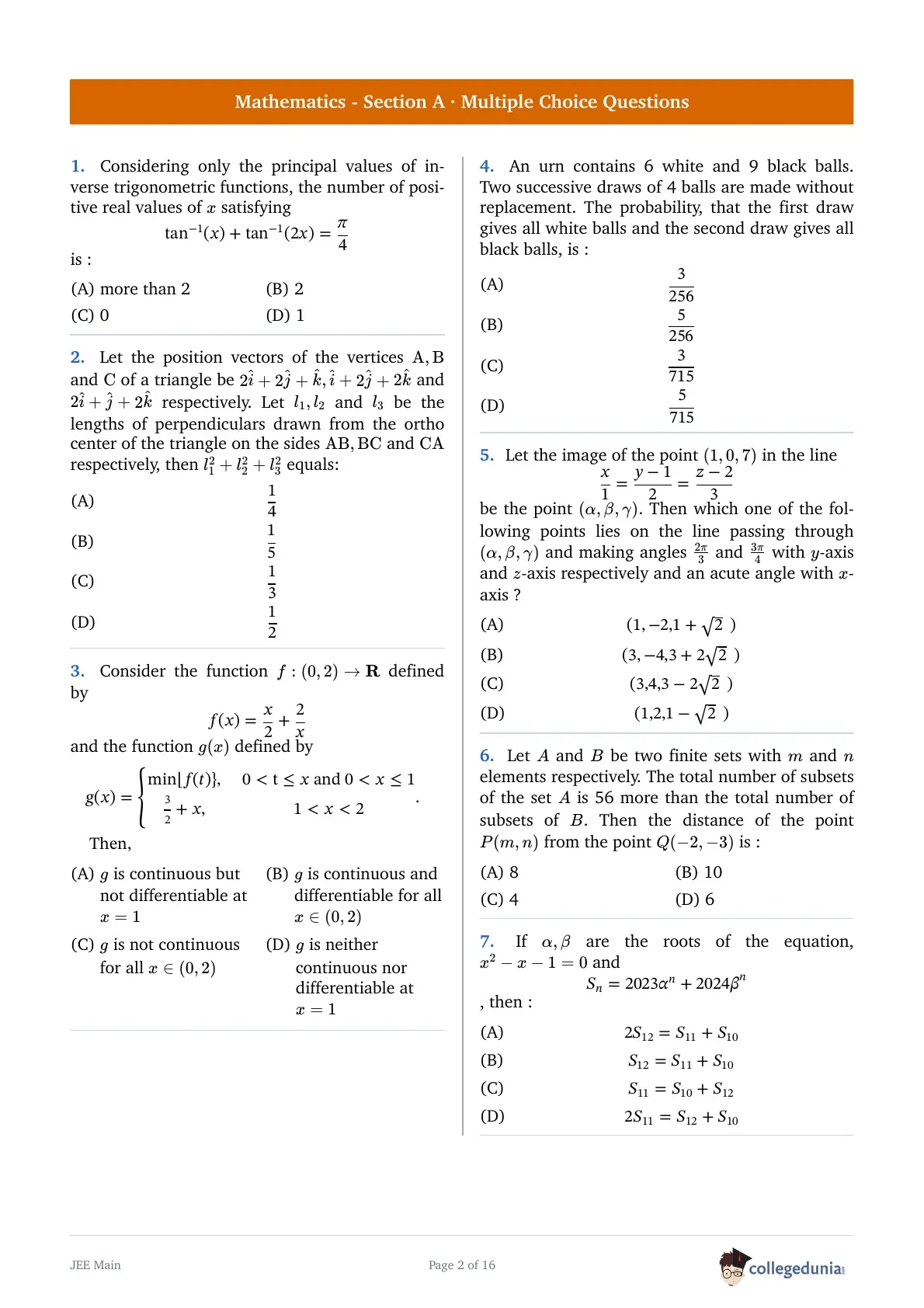
Considering only the principal values of inverse trigonometric functions, the number of positive real values of \( x \) satisfying \[ \tan^{-1}(x) + \tan^{-1}(2x) = \frac{\pi}{4} \] is:
Let the position vectors of the vertices \( A, B \) and \( C \) of a triangle be \[ 2\mathbf{i} + 2\mathbf{j} + \mathbf{k}, \quad \mathbf{i} + 2\mathbf{j} + 2\mathbf{k} \quad \text{and} \quad 2\mathbf{i} + \mathbf{j} + 2\mathbf{k} \] respectively. Let \( l_1, l_2 \) and \( l_3 \) be the lengths of the perpendiculars drawn from the ortho center of the triangle on the sides \( AB, BC \) and \( CA \) respectively. Then \( l_1^2 + l_2^2 + l_3^2 \) equals:
Consider the function \( f : (0, 2) \to \mathbb{R} \) defined by \[ f(x) = \frac{x}{2} + \frac{2}{x} \] and the function \( g(x) \) defined by \[ g(x) = \begin{cases} \min\{f(t)\}, & 0 < t \leq x \text{ and } 0 < x \leq 1 \\ \frac{3}{2} + x, & 1 < x < 2 \end{cases} \] Then:
An urn contains 6 white and 9 black balls. Two successive draws of 4 balls are made without replacement. The probability that the first draw gives all white balls, and the second draw gives all black balls, is:
Let the image of the point \( (1, 0, 7) \) in the line \[ \frac{x}{1} = \frac{y - 1}{2} = \frac{z - 2}{3} \] be the point \( (\alpha, \beta, \gamma) \). Then which one of the following points lies on the line passing through \( (\alpha, \beta, \gamma) \) and making angles \( \frac{2\pi}{3} \) and \( \frac{3\pi}{4} \) with the y-axis and z-axis respectively and an acute angle with the x-axis?
Let \( A \) and \( B \) be two finite sets with \( m \) and \( n \) elements respectively. The total number of subsets of the set \( A \) is 56 more than the total number of subsets of \( B \). Then the distance of the point \( P(m, n) \) from the point \( Q(-2, -3) \) is:
If \( \alpha, \beta \) are the roots of the equation \( x^2 - x - 1 = 0 \) and \( S_n = 2023 \alpha^n + 2024 \beta^n \), then:
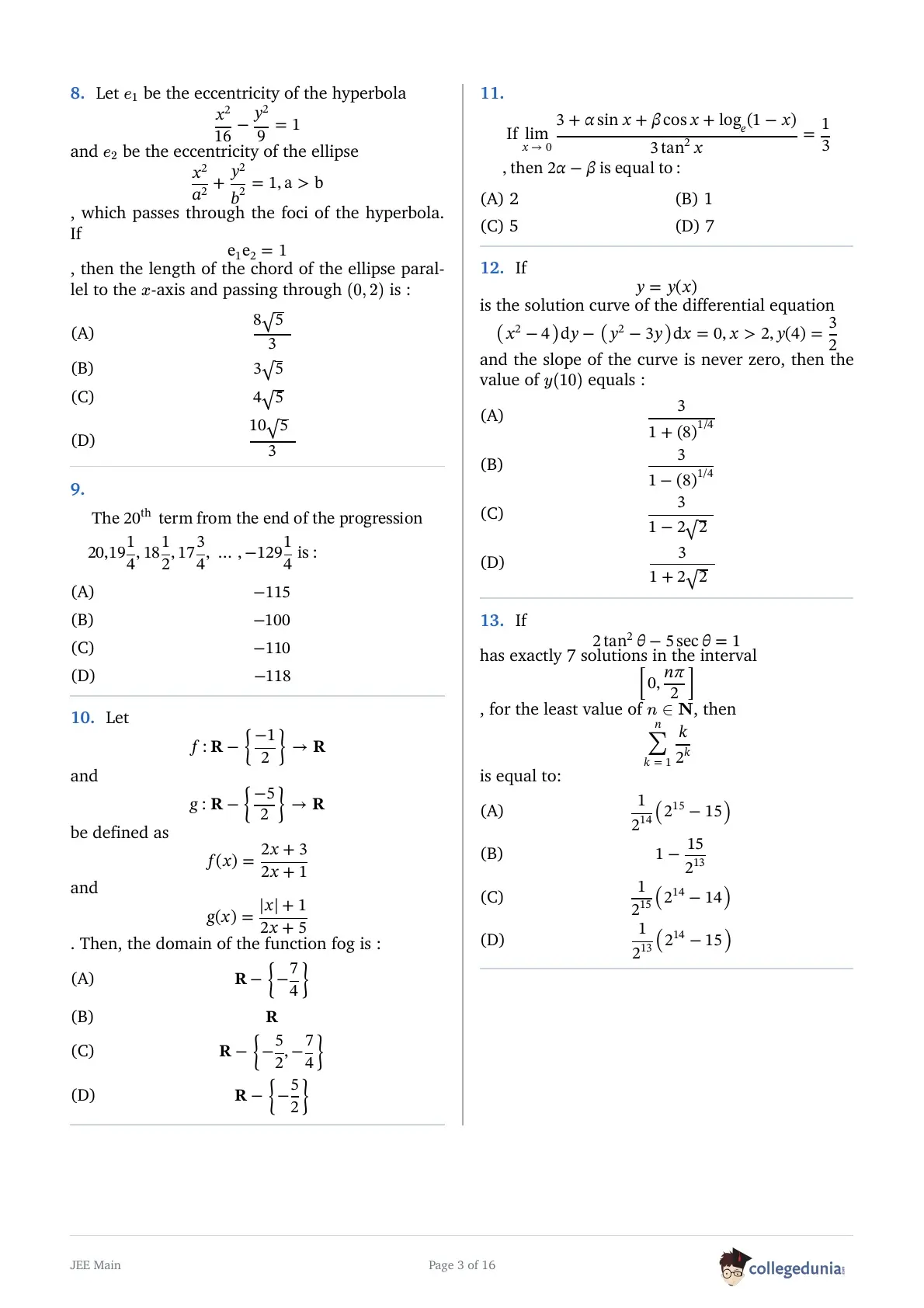
Let \( e_1 \) be the eccentricity of the hyperbola \[ \frac{x^2}{16} - \frac{y^2}{9} = 1 \] and \( e_2 \) be the eccentricity of the ellipse \[ \frac{x^2}{a^2} + \frac{y^2}{b^2} = 1, \quad a > b, \] which passes through the foci of the hyperbola. If \( e_1 e_2 = 1 \), then the length of the chord of the ellipse parallel to the x-axis and passing through (0, 2) is:
The 20th term from the end of the progression \[ 20, 19, \frac{1}{4}, \frac{1}{2}, \frac{3}{4}, \ldots, -129 \frac{1}{4} \] is:
Let \( f : R \setminus \left\{ -\frac{1}{2} \right\} \to R \) and \( g : R \setminus \left\{ -\frac{5}{2} \right\} \to R \) be defined as \( f(x) = \frac{2x + 3}{2x + 1} \) and \( g(x) = \frac{|x| + 1}{2x + 5} \). Then the domain of the function \( f(g(x)) \) is:
If \[ \lim_{x \to 0} \frac{3 + \alpha \sin x + \beta \cos x + \log(1 - x)}{3 \tan^2 x} = \frac{1}{3}, \] then \( 2\alpha - \beta \) is equal to:
If \(y = y(x)\) is the solution curve of the differential equation \[ (x^2 - 4) \, dy - (y^2 - 3y) \, dx = 0, \] with \(x > 2\), \(y(4) = \frac{3}{2}\) and the slope of the curve is never zero, then the value of \(y(10)\) equals:
If \( 2 \tan^2 \theta - 5 \sec \theta = 1 \) has exactly 7 solutions in the interval \(\left[ 0, \frac{n\pi}{2} \right],\) for the least value of \( n \in \mathbb{N} \) then \(\sum_{k=1}^{n} \frac{k}{2^k}\) is equal to:
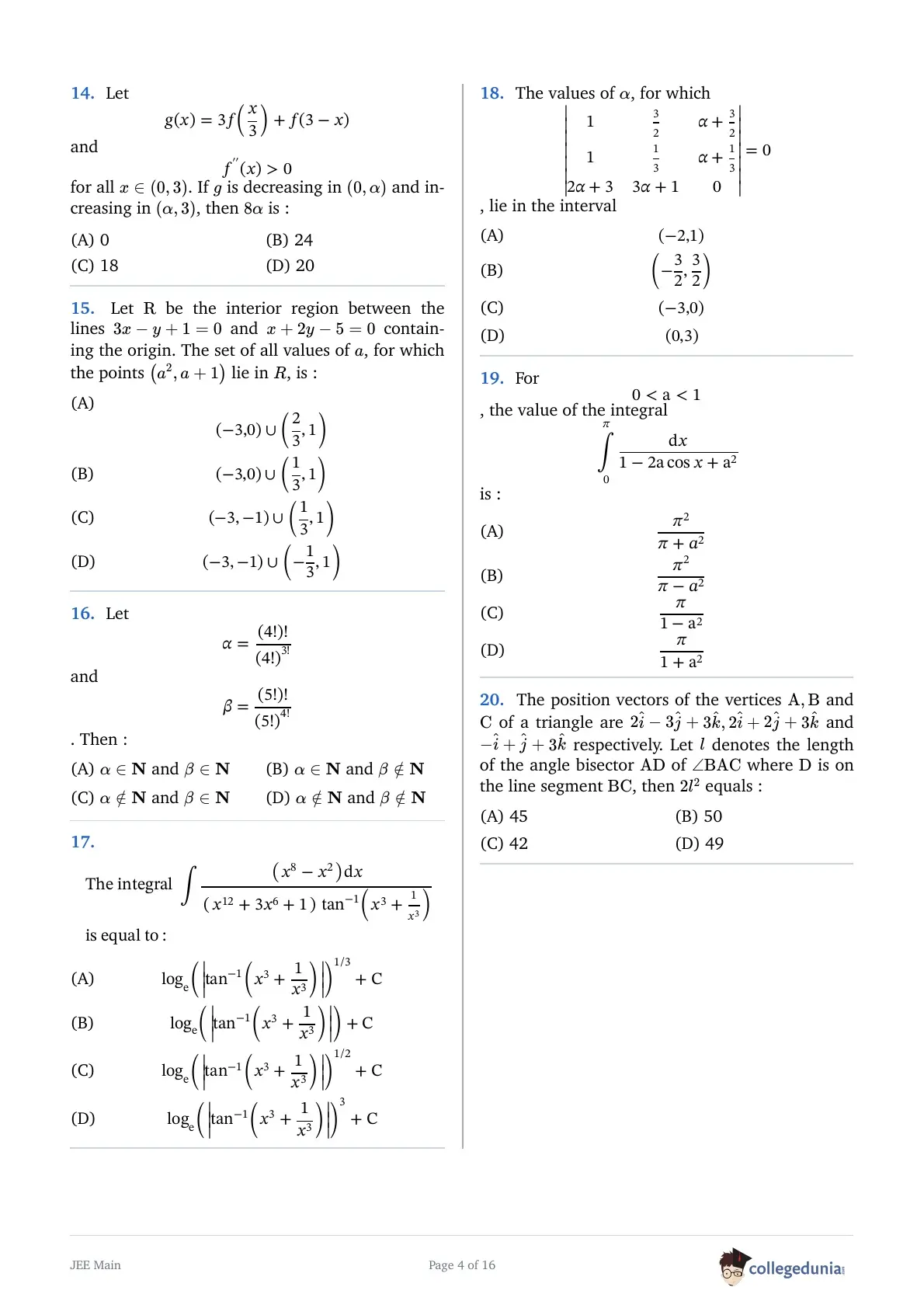
Let \( g(x) = 3f\left(\frac{x}{3}\right) + f(3 - x) \) and \( f''(x) >0 \) for all \( x \in (0, 3) \). If \( g \) is decreasing in \( (0, \alpha) \) and increasing in \( (\alpha, 3) \), then \( 8\alpha \) is:
Let \( R \) be the interior region between the lines \( 3x - y + 1 = 0 \) and \( x + 2y - 5 = 0 \) containing the origin. The set of all values of \( a \), for which the points \( (a^2, a + 1) \) lie in \( R \), is:
Let \( \alpha = \frac{(4!)!}{(4!)^{3!}} \) and \( \beta = \frac{(5!)!}{(5!)^{4!}} \). Then:
The integral \[ \int \frac{x^8 - x^2}{(x^{12} + 3x^6 + 1) \tan^{-1}\left( \frac{x^3 + 1}{x^3} \right)} \, dx \] is equal to:
The values of \(\alpha\), for which
lie in the interval
For \(0<a<1\), the value of the integral \(\displaystyle\int_0^{\pi}\frac{dx}{1-2a\cos x+a^2}\) is :
The position vectors of the vertices \( A, B \) and \( C \) of a triangle are \[ 2\mathbf{i} - 3\mathbf{j} + 3\mathbf{k}, \quad 2\mathbf{i} + 2\mathbf{j} + 3\mathbf{k} \quad \text{and} \quad -\mathbf{i} + \mathbf{j} + 3\mathbf{k} \] respectively. Let \( l \) denote the length of the angle bisector \( AD \) of \( \angle BAC \) where \( D \) is on the line segment \( BC \). Then \( 2l^2 \) equals:
Mathematics - Section B (Q21 - Q30)
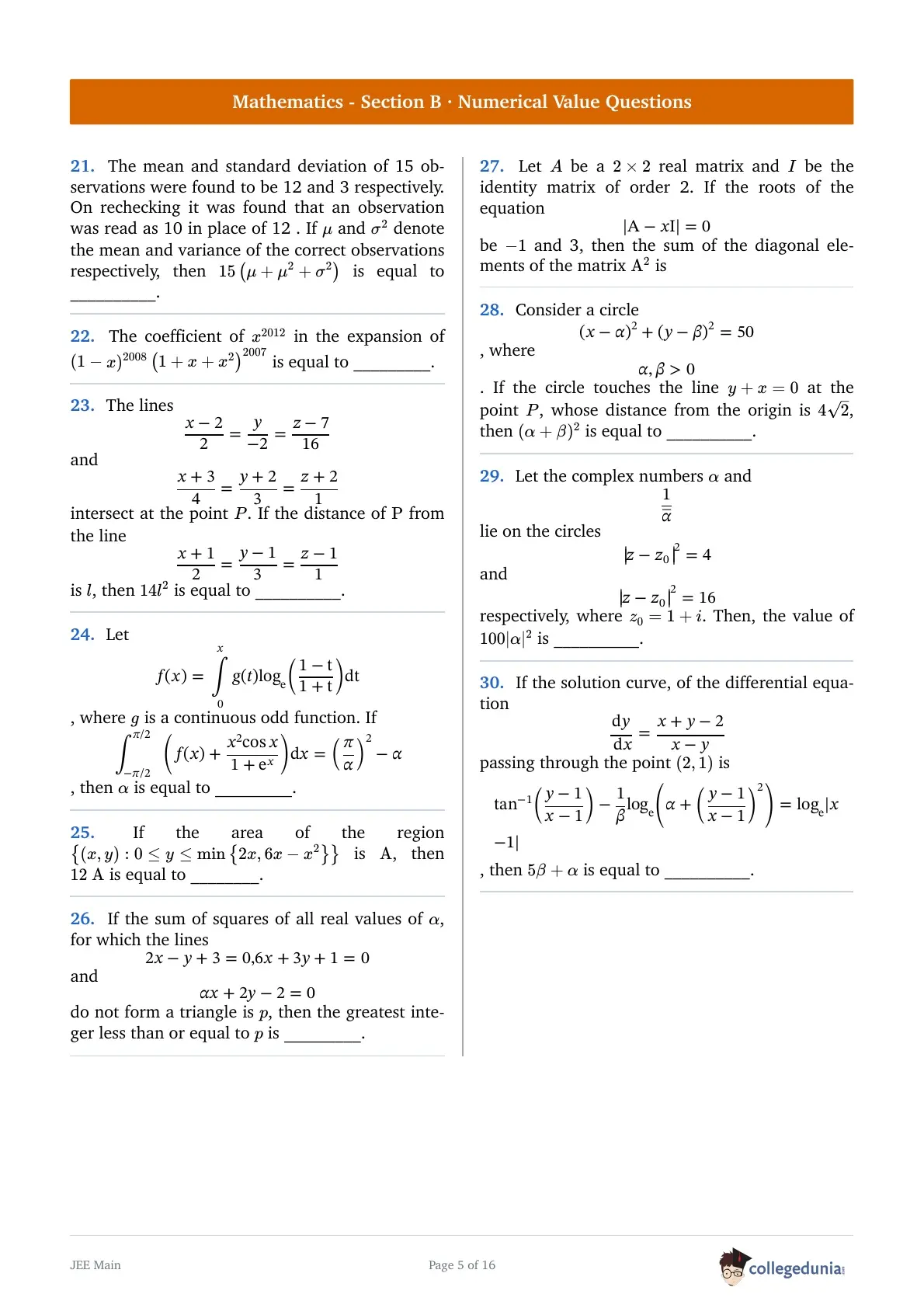
The mean and standard deviation of 15 observations were found to be 12 and 3 respectively. On rechecking it was found that an observation was read as 10 in place of 12. If \( \mu \) and \( \sigma^2 \) denote the mean and variance of the correct observations respectively, then \( 15(\mu + \mu^2 + \sigma^2) \) is equal to \(\ldots\)
Coefficient of x2012 in (1-x)2008(1+x+x²)2007 is equal to ___
The lines \[ \frac{x - 2}{2} = \frac{y + 2}{-2} = \frac{z - 7}{16} \] and \[ \frac{x + 3}{4} = \frac{y + 2}{3} = \frac{z + 2}{1} \] intersect at the point \( P \). If the distance of \( P \) from the line \[ \frac{x + 1}{2} = \frac{y - 1}{3} = \frac{z - 1}{1} \] is \( l \), then \( 14l^2 \) is equal to ________
Let \( f(x) = \int_0^x g(t) \log_e \left( \frac{1 - t}{1 + t} \right) dt \), where \( g \) is a continuous odd function. If \[ \int_{-\frac{\pi}{2}}^{\frac{\pi}{2}} \left( f(x) + \frac{x^2 \cos x}{1 + e^x} \right) dx = \left( \frac{\pi}{\alpha} \right)^2 - \alpha, \] then \( \alpha \) is equal to .....
If the area of the region \[ \{(x,y) : 0 \leq y \leq \min\{2x, 6x - x^2\}\} \] is \( A \), then \( 12A \) is equal to ________
If the sum of squares of all real values of \( \alpha \), for which the lines \( 2x - y + 3 = 0 \), \( 6x + 3y + 1 = 0 \) and \( \alpha x + 2y - 2 = 0 \) do not form a triangle \( p \), then the greatest integer less than or equal to \( p \) is ....
Let \( A \) be a \( 2 \times 2 \) real matrix and \( I \) be the identity matrix of order 2. If the roots of the equation \[ |A - xI| = 0 \] be \( -1 \) and \( 3 \), then the sum of the diagonal elements of the matrix \( A^2 \) is .....
Consider a circle \( (x - \alpha)^2 + (y - \beta)^2 = 50 \), where \( \alpha, \beta> 0 \). If the circle touches the line \( y + x = 0 \) at the point \( P \), whose distance from the origin is \( 4\sqrt{2} \), then \( (\alpha + \beta)^2 \) is equal to ....
Let the complex numbers \( \alpha \) and \( \frac{1}{\alpha} \) lie on the circles \[ |z - z_0|^2 = 4 \] and \[ |z - z_0|^2 = 16 \] respectively, where \( z_0 = 1 + i \). Then, the value of \( 100 |\alpha|^2 \) is ....
If the solution curve of the differential equation \[ \frac{dy}{dx} = \frac{x + y - 2}{x - y} \] passing through the point \( (2, 1) \) is \[ \tan^{-1}\left(\frac{y - 1}{x - 1}\right) - \frac{1}{\beta} \log_e\left(\alpha + \left(\frac{y - 1}{x - 1}\right)^2\right) = \log_e |x - 1|, \] then \( 5\beta + \alpha \) is equal to
Physics - Section A (Q31 - Q50)
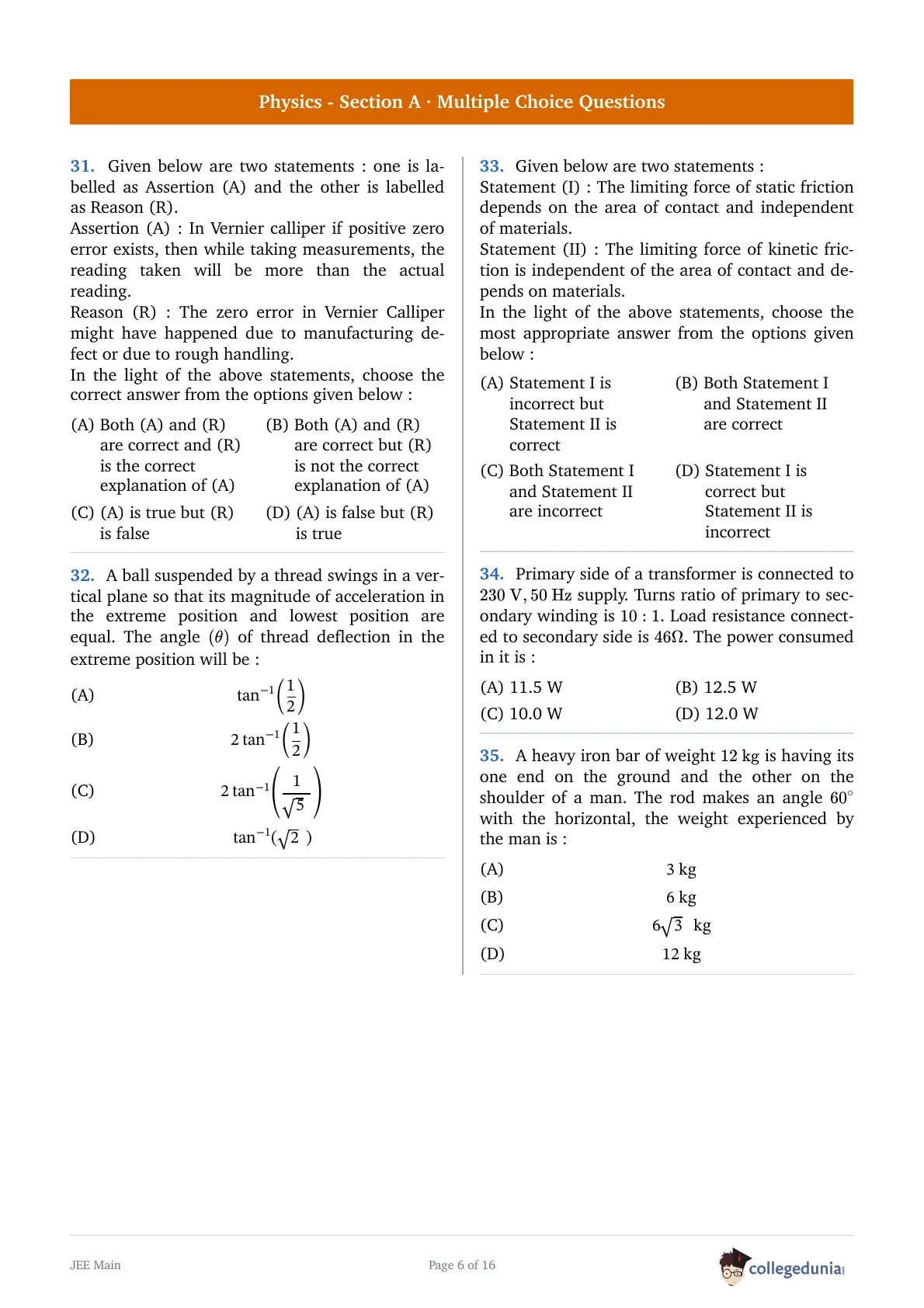
Given below are two statements : one is labelled as Assertion(A) and the other is labelled as Reason (R).
Assertion (A) : In Vernier calliper if positive zero error exists, then while taking measurements, the reading taken will be more than the actual reading.
Reason (R) : The zero error in Vernier Calliper might have happened due to manufacturing defect or due to rough handling.
In the light of the above statements, choose the correct answer from the options given below :
A ball suspended by a thread swings in a vertical plane so that its magnitude of acceleration in the extreme position and lowest position are equal. The angle \(\theta\) of thread deflection in the extreme position will be :
Given below are two statements :
Statement (I) : The limiting force of static friction depends on the area of contact and independent of materials.
Statement (II) : The limiting force of kinetic friction is independent of the area of contact and depends on materials.
In the light of the above statements, choose the most appropriate answer from the options given below :
Primary side of a transformer is connected to 230 V, 50 Hz supply. Turns ratio of primary to secondary winding is 10 : 1. Load resistance connected to secondary side is 46 \(\Omega \). The power consumed in it is :
A heavy iron bar of weight 12 kg is having its one end on the ground and the other on the shoulder of a man. The rod makes an angle \(60^\circ\) with the horizontal, the weight experienced by the man is :
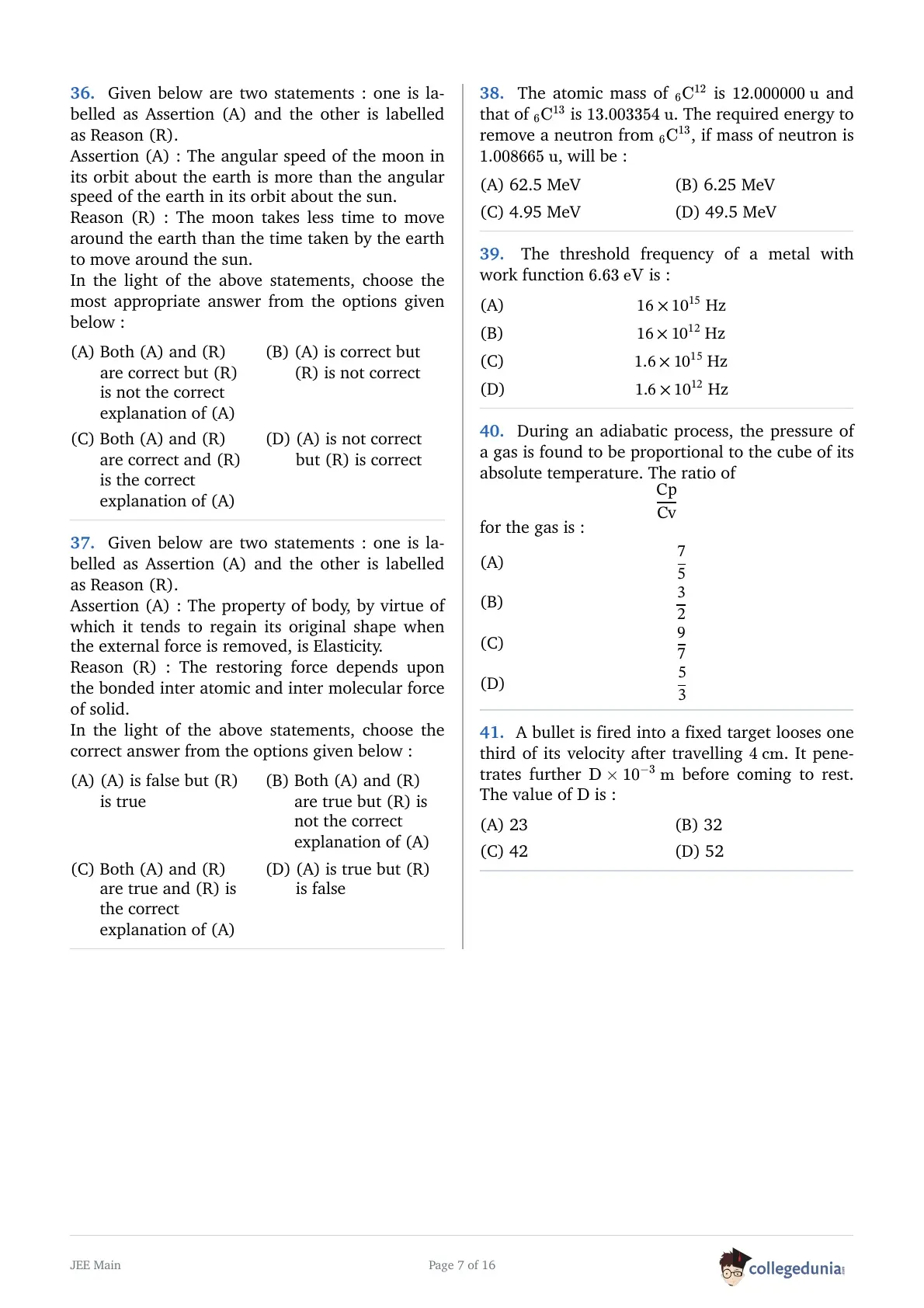
Assertion: The angular velocity of the moon revolving around the earth is more than that of the earth revolving around the Sun.
Reason: The time taken by the moon to revolve around the earth is less than the time taken by the earth to revolve around the sun.
Given below are two statements : one is labelled as Assertion (A) and the other is labelled as Reason (R)
Assertion (A) : The property of body, by virtue of which it tends to regain its original shape when the external force is removed, is Elasticity.
Reason (R) : The restoring force depends upon the bonded inter atomic and inter molecular force of solid.
In the light of the above statements, choose the correct answer from the options given below :
The atomic mass of \(_{6}^{12}C\) is 12.000000 u and that of \(_{6}^{13}C\) is 13.003354 u. The required energy to remove a neutron from \(_{6}^{13}C\), if mass of neutron is 1.008665 u, will be :
If the work function of a metal is 6.63 eV, then find the threshold frequency for photoelectric effect.
During an adiabatic process, the pressure of a gas is found to be proportional to the cube of its absolute temperature. The ratio of \(\frac{C_p}{C_v}\) for the gas is :
A bullet is fired into a fixed target looses one third of its velocity after travelling 4 cm. It penetrates further \( D \times 10^{-3} \) m before coming to rest. The value of \( D \) is :
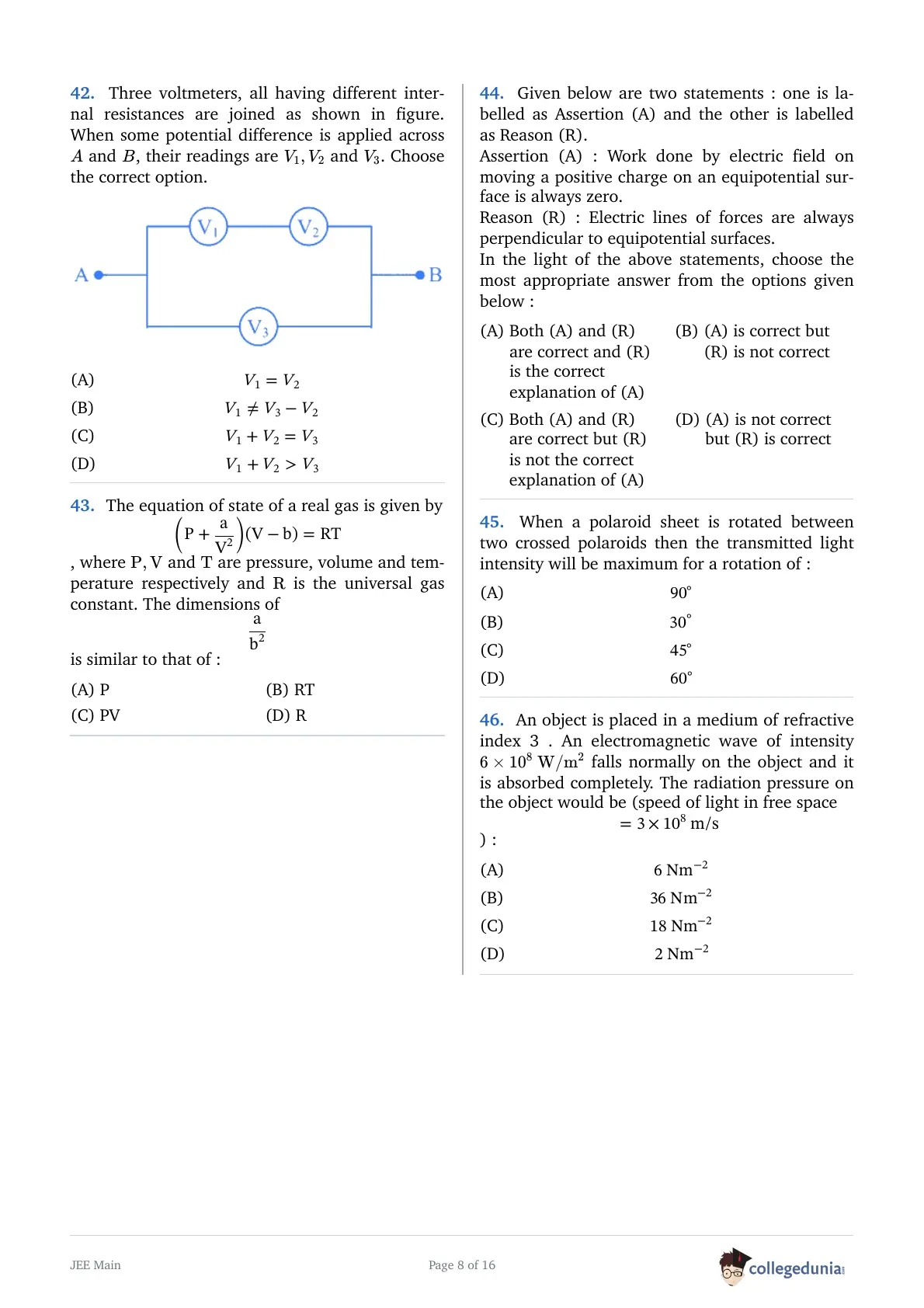
Three voltmeters, all having different internal resistances are joined as shown in figure. When some potential difference is applied across A and B, their readings are \(V_1\), \(V_2\) and \(V_3\). 
Choose the correct option.
The equation of state of a real gas is given by \[ \left( P + \frac{a}{V^2} \right)(V - b) = RT, \] where \( P, V \) and \( T \) are pressure, volume and temperature respectively and \( R \) is the universal gas constant. The dimensions of \[ \frac{a}{b^2} \] is similar to that of :
Given below are two statements : one is labelled a Assertion (A) and the other is labelled as Reason(R)
Assertion (A) : Work done by electric field on moving a positive charge on an equipotential surface is always zero.
Reason (R) : Electric lines of forces are always perpendicular to equipotential surfaces.
In the light of the above statements, choose the most appropriate answer from the options given below :
When a polaroid sheet is rotated between two crossed polaroids then the transmitted light intensity will be maximum for a rotation of :
An object is placed in a medium of refractive index 3. An electromagnetic wave of intensity \(6 \times 10^8 \, \text{W/m}^2\) falls normally on the object and it is absorbed completely. The radiation pressure on the object would be (speed of light in free space = \(3 \times 10^8\) m/s) :
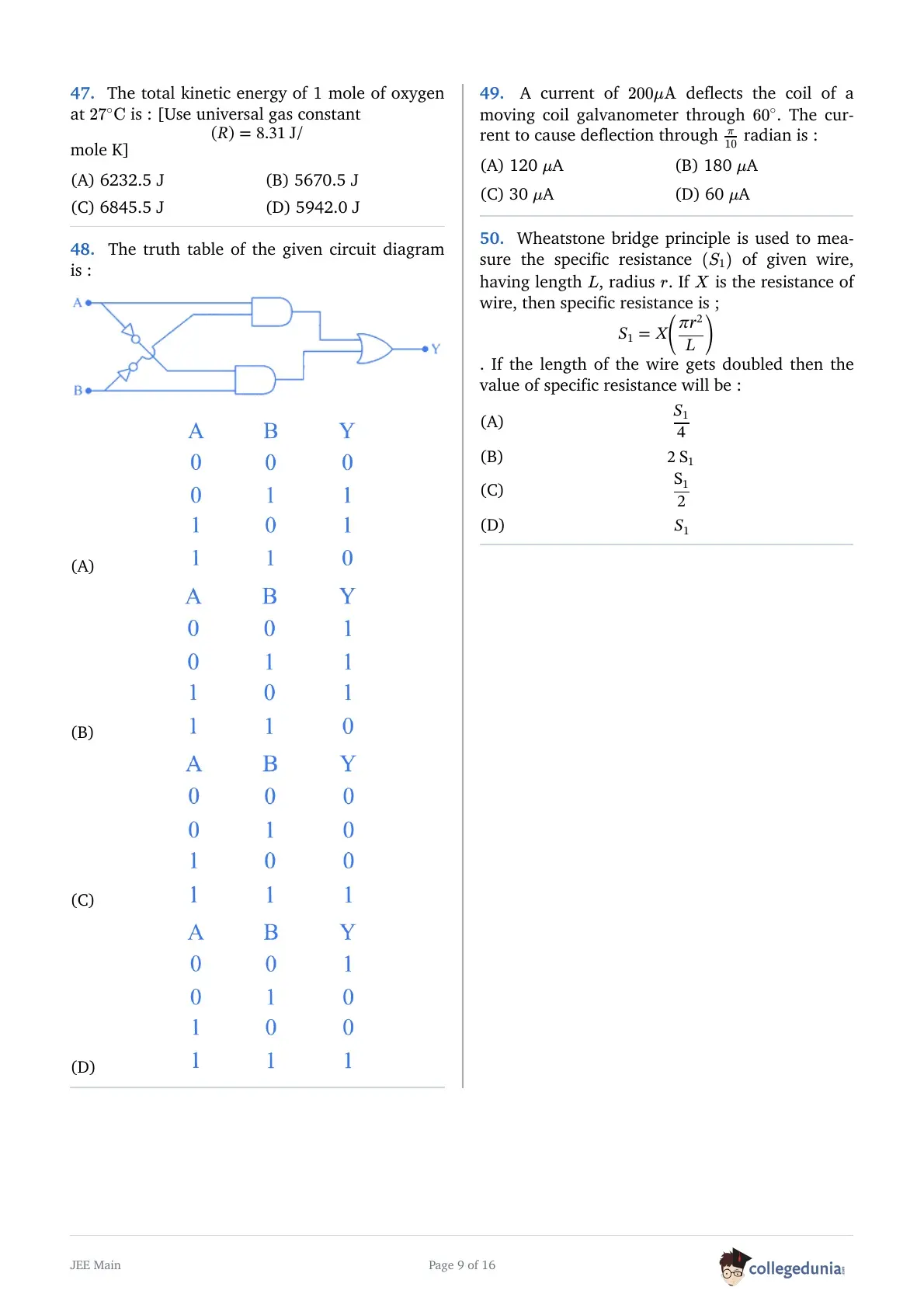
The total kinetic energy of 1 mole of oxygen at 27°C is :
[Use universal gas constant (R)= 8.31 J/mole K]


A current of 200 \(\mu A\) deflects the coil of a moving coil galvanometer through \(60^{\circ}\). The current to cause deflection through \(\frac{\pi}{10}\) radian is :
Wheatstone bridge principle is used to measure the specific resistance \( (S_1) \) of a given wire, having length \( L \), radius \( r \). If \( X \) is the resistance of the wire, then specific resistance is: \[ S_1 = X\left( \frac{\pi r^2}{L} \right). \] If the length of the wire gets doubled, then the value of specific resistance will be:
Physics - Section B (Q51 - Q60)
A closed organ pipe 150 cm long gives 7 beats per second with an open organ pipe of length 350 cm, both vibrating in fundamental mode. The velocity of sound is ________ m/s.
A series LCR circuit with \( L = \frac{100}{\pi} \) mH, \( C = \frac{10^{-3}}{\pi} \) F and \( R = 10 \, \Omega \) is connected across an AC source of 220 V, 50 Hz supply. The power factor of the circuit would be _____.
Two charges of \( -4 \, \mu C \) and \( +4 \, \mu C \) are placed at the points \( A(1, 0, 4) \, m \) and \( B(2, -1, 5) \, m \) located in an electric field \( \vec{E} = 0.20 \, \hat{i} \, V / cm \). The magnitude of the torque acting on the dipole is \( 8\sqrt{\alpha} \times 10^{-5} \, Nm \), where \( \alpha = \, \).
A ring and a solid sphere roll down the same inclined plane without slipping. They start from rest. The radii of both bodies are identical and the ratio of their kinetic energies is \( \frac{7}{x} \) where \( x \) is \(\_\_\_\_\_\_\_\).
A body falling under gravity covers two points A and B separated by 80 m in 2s. The distance of upper point A from the starting point is ________ m (use g = 10 ms–2)
The electric potential at the surface of an atomic nucleus \( (z = 50) \) of radius \( 9 \times 10^{-13} \) cm is \(\_\_\_\_\_\_\_ \)\(\times 10^{6} V\).
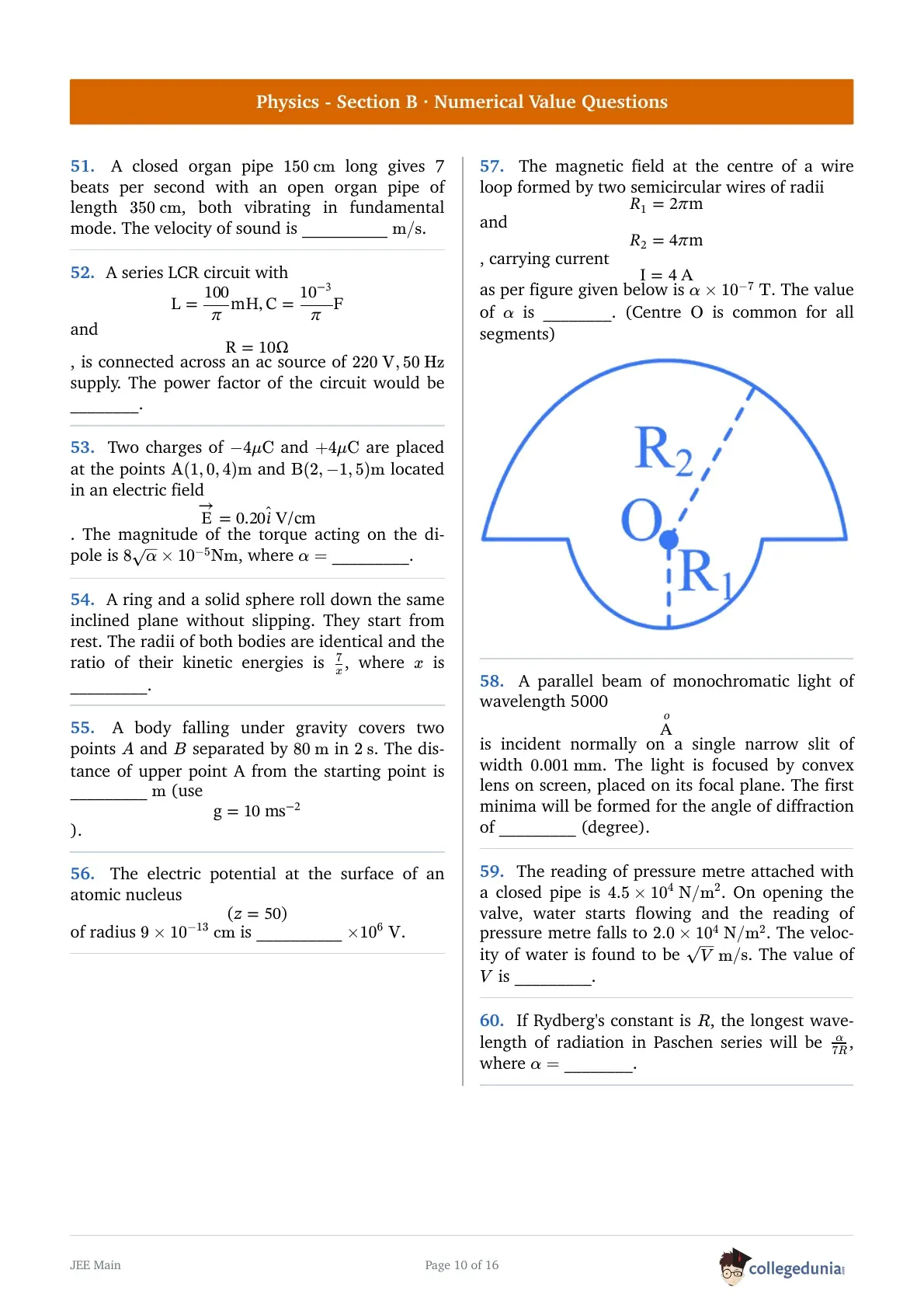
The magnetic field at the centre of a wire loop formed by two semicircular wires of radii \( R_1 = 2\pi \, m \) and \( R_2 = 4\pi \, m \) carrying current \( I = 4A \) as per figure given below is \( \alpha \times 10^{-7} \, T \). The value of \( \alpha \) is ______. (Centre O is common for all segments)
A parallel beam of monochromatic light of wavelength 5000 •Å is incident normally on a single narrow slit of width 0.001 mm. The light is focused by convex lens on screen, placed on its focal plane. The first minima will be formed for the angle of diffraction of ________ (degree).
The reading of pressure metre attached with a closed pipe is \( 4.5 \times 10^4 \, N/m^2 \). On opening the valve, water starts flowing and the reading of pressure metre falls to \( 2.0 \times 10^4 \, N/m^2 \). The velocity of water is found to be \( \sqrt{V} \, m/s \). The value of \( V \) is _____.
If Rydberg’s constant is \( R \), the longest wavelength of radiation in Paschen series will be \( \frac{\alpha}{7R} \), where \( \alpha = \_\_\_\_\_\_\_ \).
Chemistry - Section A (Q61 - Q80)
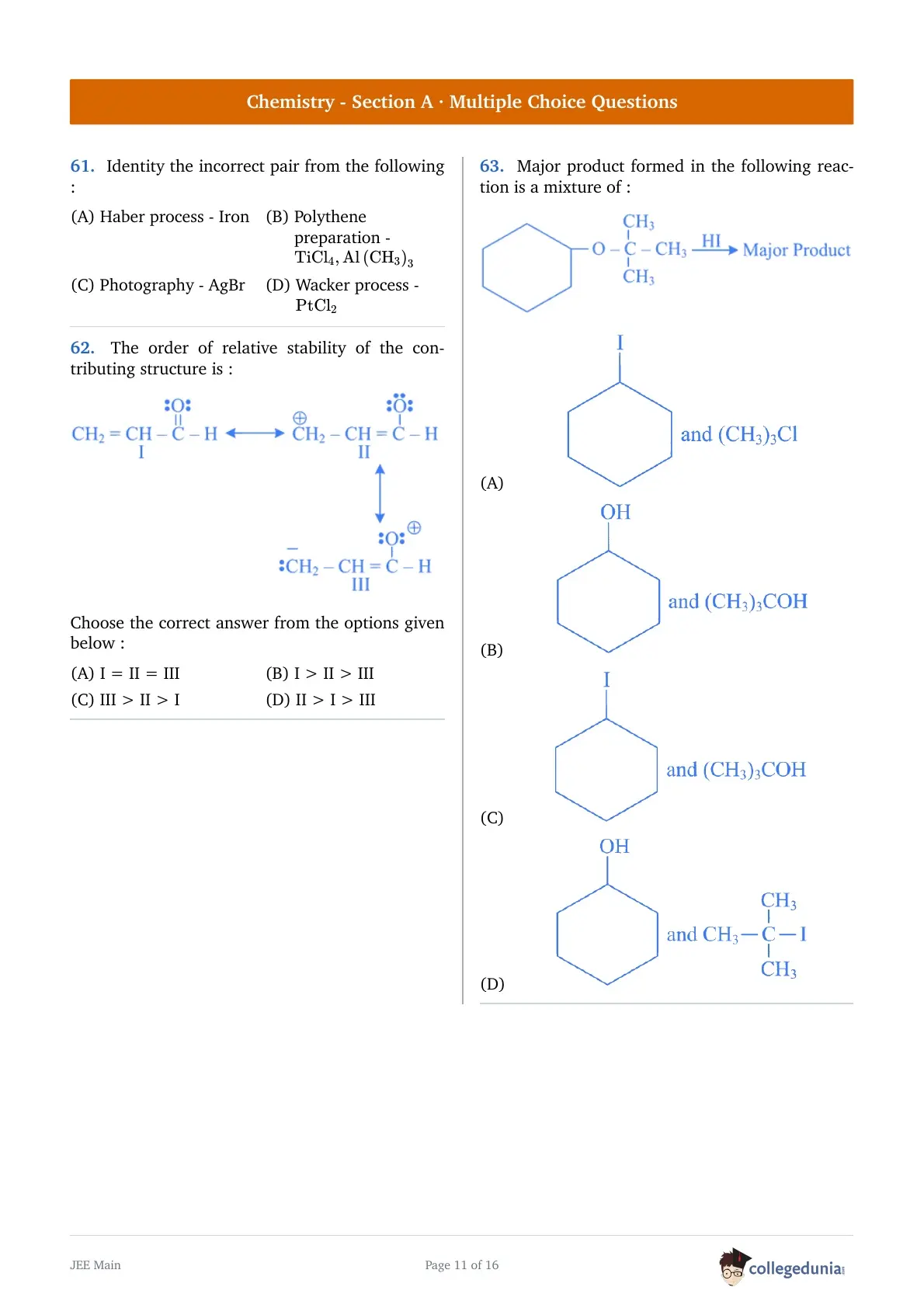
Identity the incorrect pair from the following:
The order of relative stability of the contributing structure is:
Choose the correct answer from the options given below:


Given below are two statements:
Statement (I) : Oxygen being the first member of group 16 exhibits only –2 oxidation state.
Statement (II) : Down the group 16 stability of +4 oxidation state decreases and +6 oxidation state increases.
In the light of the above statements, choose the most appropriate answer from the options given below:
The technique used for purification of steam volatile water immiscible substance is:
Which structure of protein remains intact after coagulation of egg white on boiling?
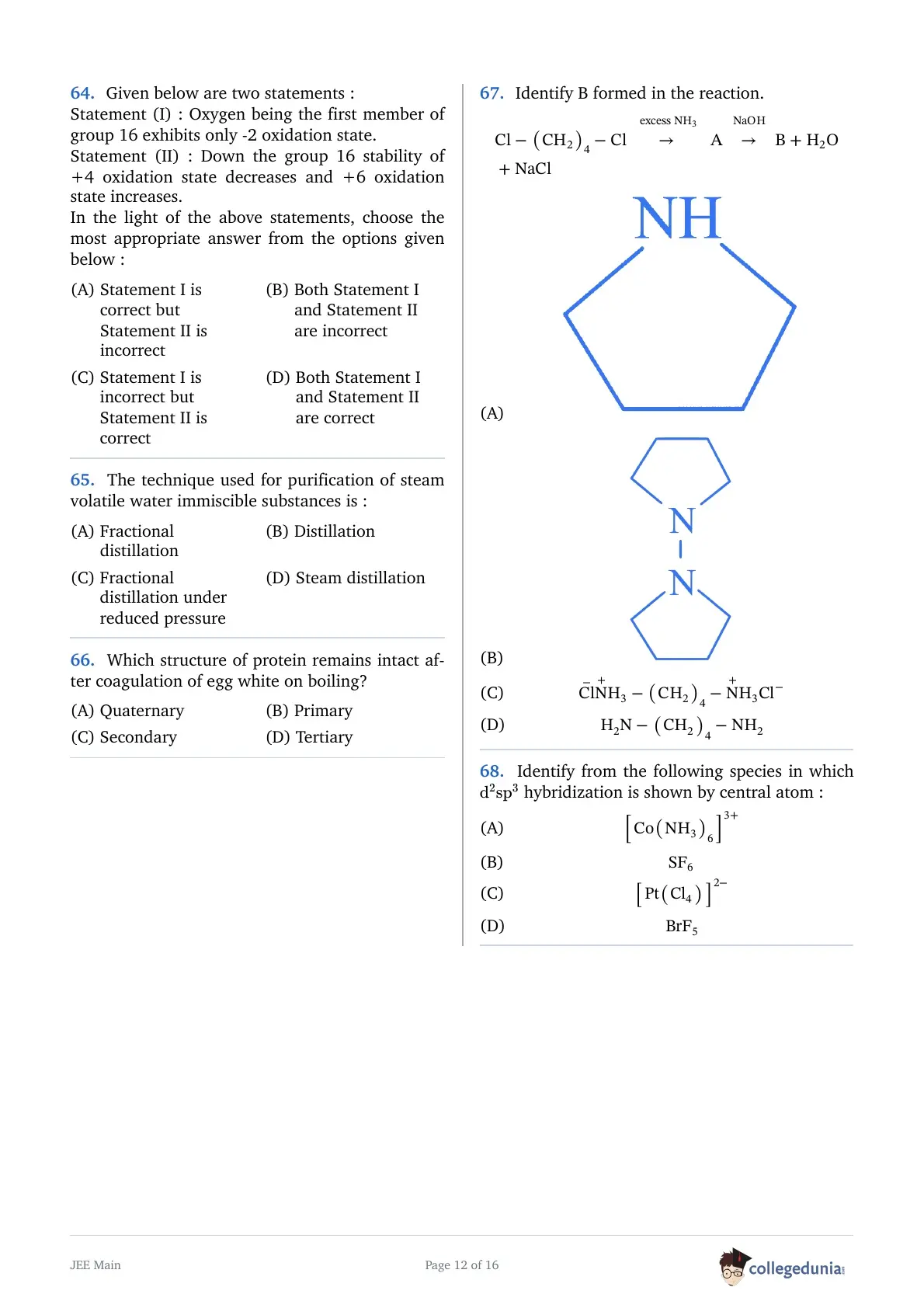
Identify B formed in the reaction.
\[ \text{Cl} - \text{(CH}_2\text{)}_4 - \text{Cl} \xrightarrow{\text{excess NH}_3} A \xrightarrow{\text{NaOH}} B + \text{H}_2\text{O} + \text{NaCl} \]
- (1)
![Fig 1]()
- (2) \[ \text{H}_2\text{N} - \text{(CH}_2\text{)}_4 - \text{NH}_2 \]
- (3) \[ \text{ClNH}_3 - \text{(CH}_2\text{)}_4 - \text{NH}_3\text{Cl}^- \]
- (4)
![Fig 2]()


Identify the following species in which \(d^2sp^3\) hybridization is shown by the central atom.
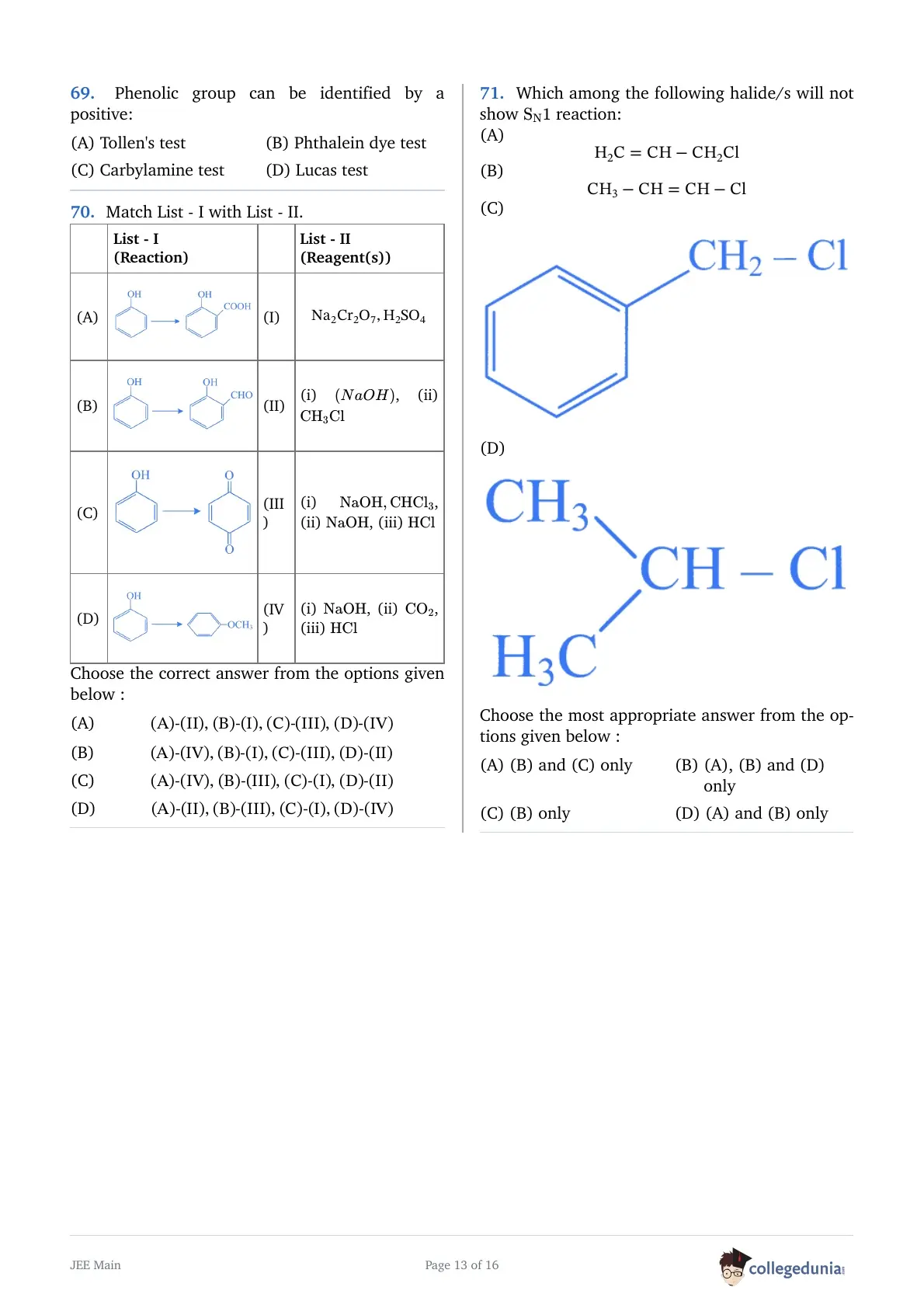
Phenolic group can be identified by a positive
Match List-I with List-II.
Choose the correct answer from the options given below:
Which among the following halide/s will not show S\(_N\)1 reaction:
Choose the most appropriate answer from the options given below:
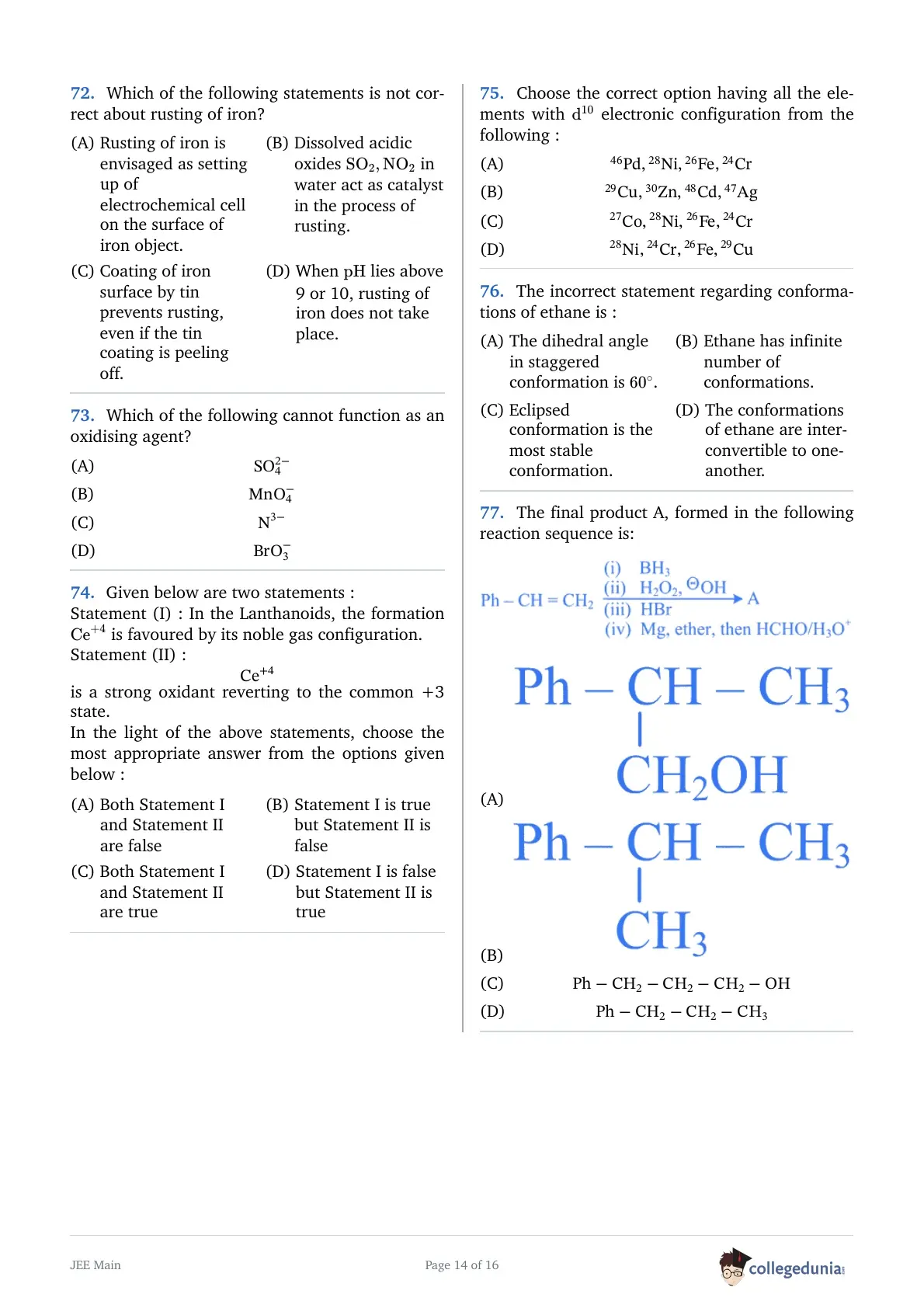
Which of the following statements is not correct about rusting of iron?
Which of the following can not act as an oxidising agent?
Given below are two statements:
Statement (I) : In the Lanthanoids, the formation of Ce+4 is favoured by its noble gas configuration.
Statement (II) : Ce+4 is a strong oxidant reverting to the common +3 state.
In the light of the above statements, choose the most appropriate answer from the options given below:
Choose the correct option having all the elements with \( d^{10} \) electronic configuration from the following:
The incorrect statement regarding conformations of ethane is:
The final product A, formed in the following reaction sequence is:
- (1) \( \text{Ph} - \text{CH}_2 - \text{CH}_2 - \text{CH}_3 \)
- (2)
![Option 2]()
- (3)
![Option 3]()
- (4) \( \text{Ph} - \text{CH}_2 - \text{CH}_2 - \text{CH}_2 - \text{OH} \)


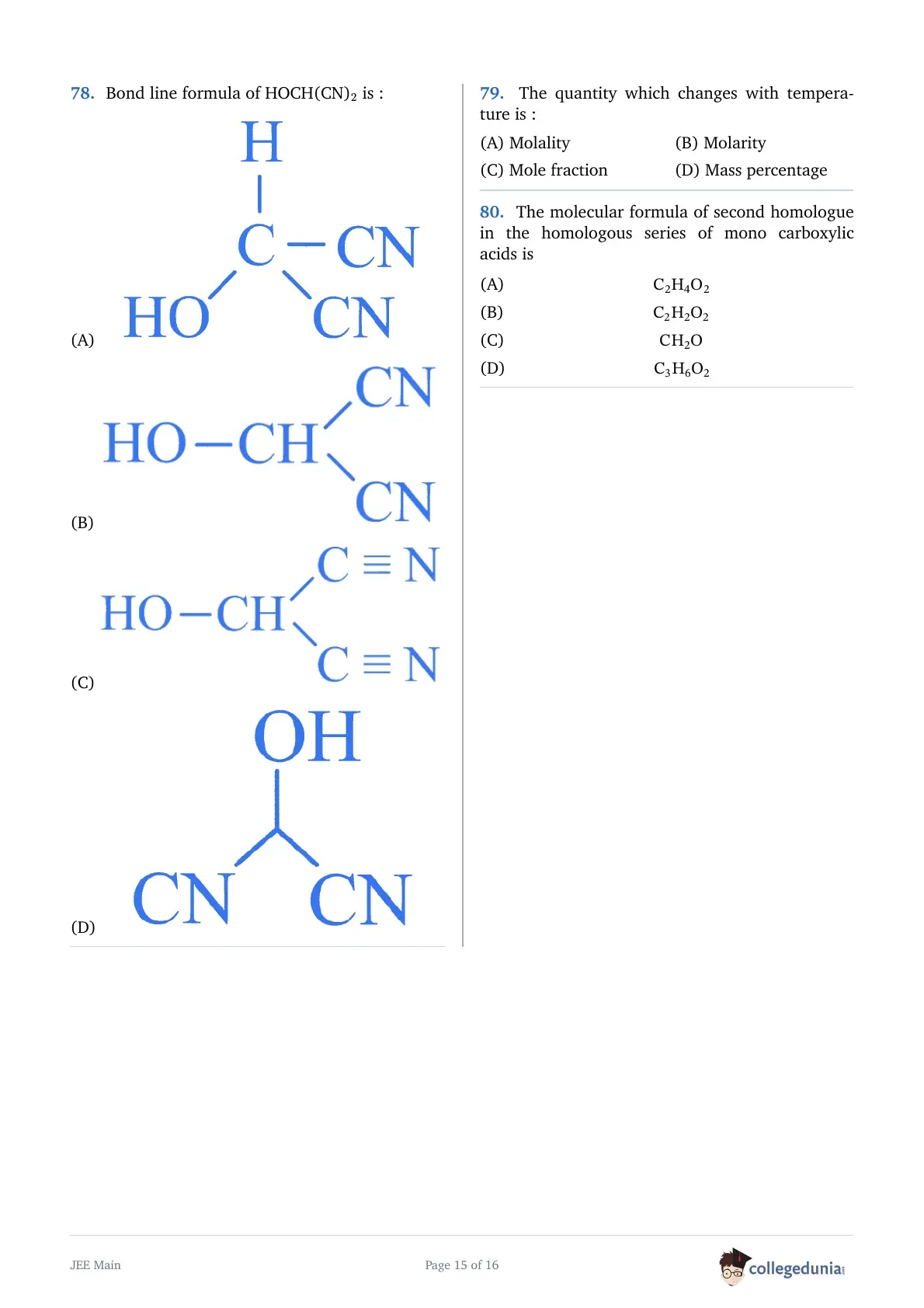
The quantity which changes with temperature:
The molecular formula of second homologue in the homologous series of monocarboxylic acid is
Chemistry - Section B (Q81 - Q90)
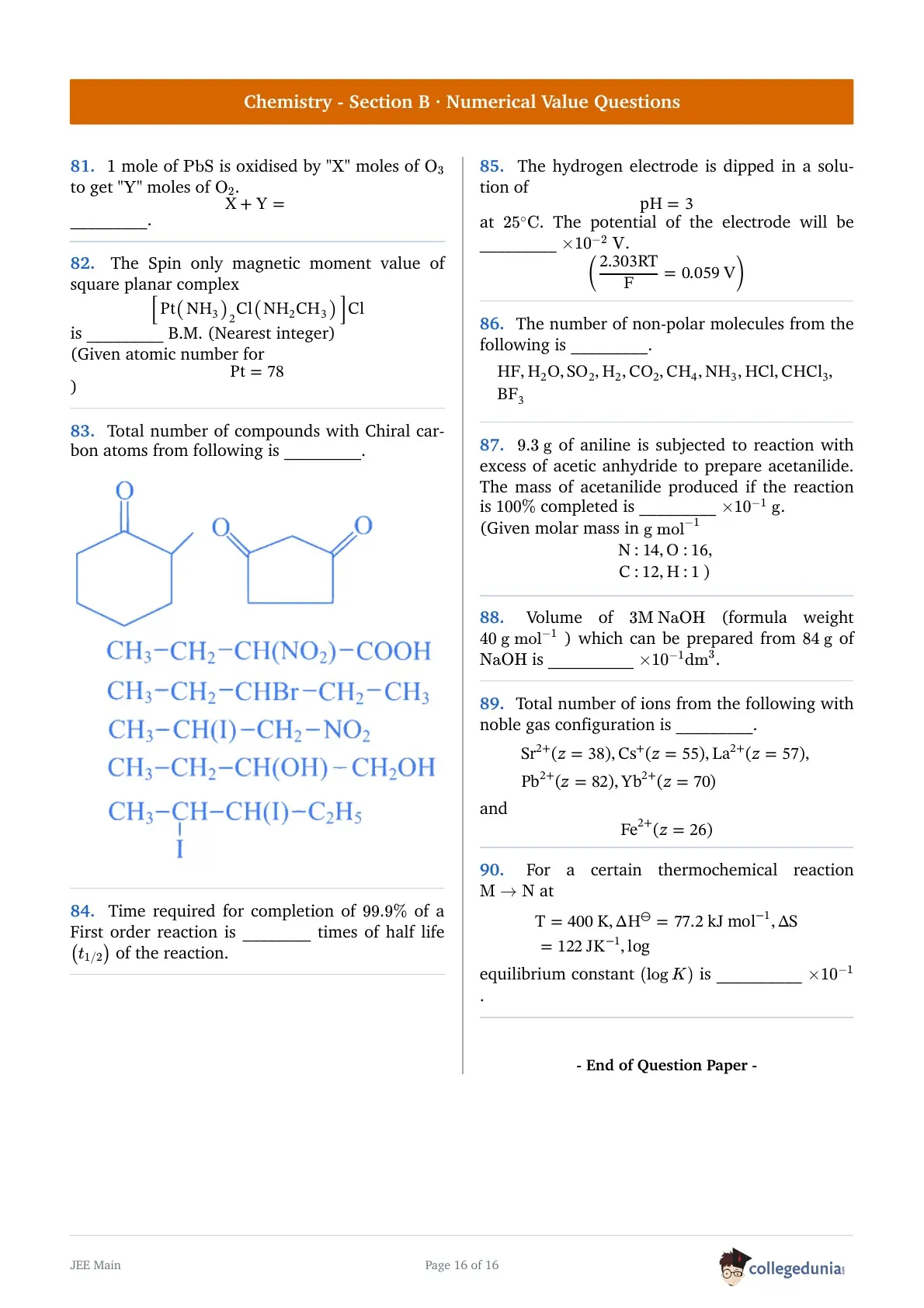
1 mole of PbS is oxidised by “X” moles of O3>to get “Y” moles of O2. X + Y = __________
\(\text{The Spin only magnetic moment value of square planar complex } [\text{Pt(NH}_3\text{)}_2\text{Cl(NH}_2\text{CH}_3\text{)}]\text{Cl is } \_\_\_\_\_\_ \text{ B.M. (Nearest integer)}\)
\(\text{(Given atomic number for Pt = 78)}\)
Total number of compounds with Chiral carbon atoms from following is ________.
\(\text{CH}_3 - \text{CH}_2 - \text{CH(NO}_2\text{) - COOH}\)
\(\text{CH}_3 - \text{CH}_2 - \text{CHBr - CH}_2 - \text{CH}_3\)
\(\text{CH}_3 - \text{CH(I) - CH}_2 - \text{NO}_2\)
\(\text{CH}_3 - \text{CH}_2 - \text{CH(OH) - CH}_2\text{OH}\)
\(\text{Time required for completion of 99.9\% of a first order reaction is \_\_\_\_\_\_ times of half life } (t_{1/2}) \text{ of the reaction.}\)
\(\text{The hydrogen electrode is dipped in a solution of pH = 3 at } 25^{\circ}\text{C. The potential of the electrode will be } -\_\_\_\_\_ \times 10^{-2} \text{ V.}\)
\(\left( \frac{2.303RT}{F} = 0.059 \, \text{V} \right)\)
\(\text{The number of non-polar molecules from the following is \_\_\_\_\_\_.}\)
\(\text{HF, H}_2\text{O, SO}_2, \, \text{H}_2, \, \text{CO}_2, \, \text{CH}_4, \, \text{NH}_3, \, \text{HCl, CHCl}_3, \, \text{BF}_3\)
\(9.3 \, \text{g of aniline is subjected to reaction with excess of acetic anhydride to prepare acetanilide. The mass of acetanilide produced if the reaction is 100\% completed is } \_\_\_\_\_ \times 10^{-1} \, \text{g.}\)
\(\text{(Given molar mass in g mol}^{-1}\text{) N: 14, O: 16, C: 12, H: 1}\)
\(\text{Volume of } 3 \, \text{M NaOH (formula weight 40 g mol}^{-1}\text{) which can be prepared from } 84 \, \text{g of NaOH is } \_\_\_\_\_ \times 10^{-1} \, \text{dm}^3.\)
\(\text{Total number of ions from the following with noble gas configuration is \_\_\_\_\_\_.}\)
\(\text{Sr}^{2+} \, (Z = 38), \, \text{Cs}^{+} \, (Z = 55), \, \text{La}^{2+} \, (Z = 57), \, \text{Pb}^{2+} \, (Z = 82), \, \text{Yb}^{2+} \, (Z = 70), \, \text{and} \, \text{Fe}^{2+} \, (Z = 26)\)
\(\text{For a certain thermochemical reaction } \text{M} \rightarrow \text{N at } T = 400 \, \text{K}, \, \Delta H^\circ = 77.2 \, \text{kJ mol}^{-1}, \, \Delta S = 122 \, \text{JK}^{-1},\)
\(\text{log equilibrium constant (log K) is } - \_\_\_\_\_ \times 10^{-1}.\)
JEE Main 2024 Exam Pattern and Marking Scheme
| Particulars | Details |
|---|---|
| Exam Mode | Online (Computer-Based Test) |
| Paper | B.E./B.Tech |
| Medium of Exam | 13 languages: English, Hindi, Gujarati, Bengali, Tamil, Telugu, Kannada, Marathi, Malayalam, Odia, Punjabi, Assamese, Urdu |
| Duration | 3 hours (180 minutes) |
| Type of Questions | Multiple Choice Questions (MCQs) + Numerical Value Questions (attempt any 5 of 10 per subject) |
| Total Marks | 300 marks |
| Subjects | Mathematics, Physics, Chemistry |
| Marking Scheme | +4 for correct answer & -1 for incorrect MCQ and Numerical Value-based Questions |
| Total Questions | 90 Questions (30 per subject), 75 to be attempted |
| Eligibility | Passed or appearing in Class 12 with Physics, Chemistry, and Mathematics |
JEE Main 2024 Jan 27 Shift 2 Question Paper by Coaching Institute
| Coaching Institutes | Question Paper with Solutions PDF |
|---|---|
| Aakash BYJUs | Download PDF |
| Reliable Institute | Physics Chemistry Maths |
| Resonance | Physics Chemistry Maths |
| Vedantu | Download PDF |
| Sri Chaitanya | Download PDF |
| FIIT JEE | To be updated |
JEE Main 27 Jan Shift 2 2024 Paper Analysis
JEE Main 2024 Jan 27 Shift 2 paper analysis for B.E./ B.Tech is updated here with details on the difficulty level of the exam, topics with the highest weightage in the exam, section-wise difficulty level, etc.
JEE Main 2024 Question Paper Pattern
| Feature | Question Paper Pattern |
|---|---|
| Examination Mode | Computer-based Test |
| Exam Language | 13 languages (English, Hindi, Assamese, Bengali, Gujarati, Kannada, Malayalam, Marathi, Odia, Punjabi, Tamil, Telugu, and Urdu) |
| Number of Sections | Three- Physics, Chemistry, Mathematics |
| Exam Duration | 3 hours |
| Sectional Time Limit | None |
| Total Marks | 300 marks |
| Total Number of Questions Asked | 90 Questions |
| Total Number of Questions to be Answered | 75 questions |
| Type of Questions | MCQs and Numerical Answer Type Questions |
| Section-wise Number of Questions | Physics- 20 MCQs and 10 numerical type, Chemistry- 20 MCQs and 10 numerical type, Mathematics- 20 MCQs and 10 numerical type |
| Marking Scheme | +4 for each correct answer |
| Negative Marking | -1 for each incorrect answer |
Read More:
- JEE Main 2024 question paper pattern and marking scheme
- Most important chapters in JEE Mains 2024, Check chapter wise weightage here
JEE Main 2024 Question Paper Session 1 (January)
Those appearing for JEE Main 2024 can use the links below to practice and keep track of their exam preparation level by attempting the shift-wise JEE Main 2024 question paper provided below.
| Exam Date and Shift | Question Paper PDF |
|---|---|
| JEE Main 24 Jan Shift 2 2024 Question Paper | Check Here |
| JEE Main 27 Jan Shift 1 2024 Question Paper | Check Here |
| JEE Main 29 Jan Shift 1 2024 Question Paper | Check Here |
| JEE Main 29 Jan Shift 2 2024 Question Paper | Check Here |
| JEE Main 30 Jan Shift 1 2024 Question Paper | Check Here |
| JEE Main 30 Jan Shift 2 2024 Question Paper | Check Here |
| JEE Main 31 Jan Shift 1 2024 Question Paper | Check Here |
| JEE Main 31 Jan Shift 2 2024 Question Paper | Check Here |
| JEE Main 1 Feb Shift 1 2024 Question Paper | Check Here |
| JEE Main 1 Feb Shift 2 2024 Question Paper | Check Here |



Comments