




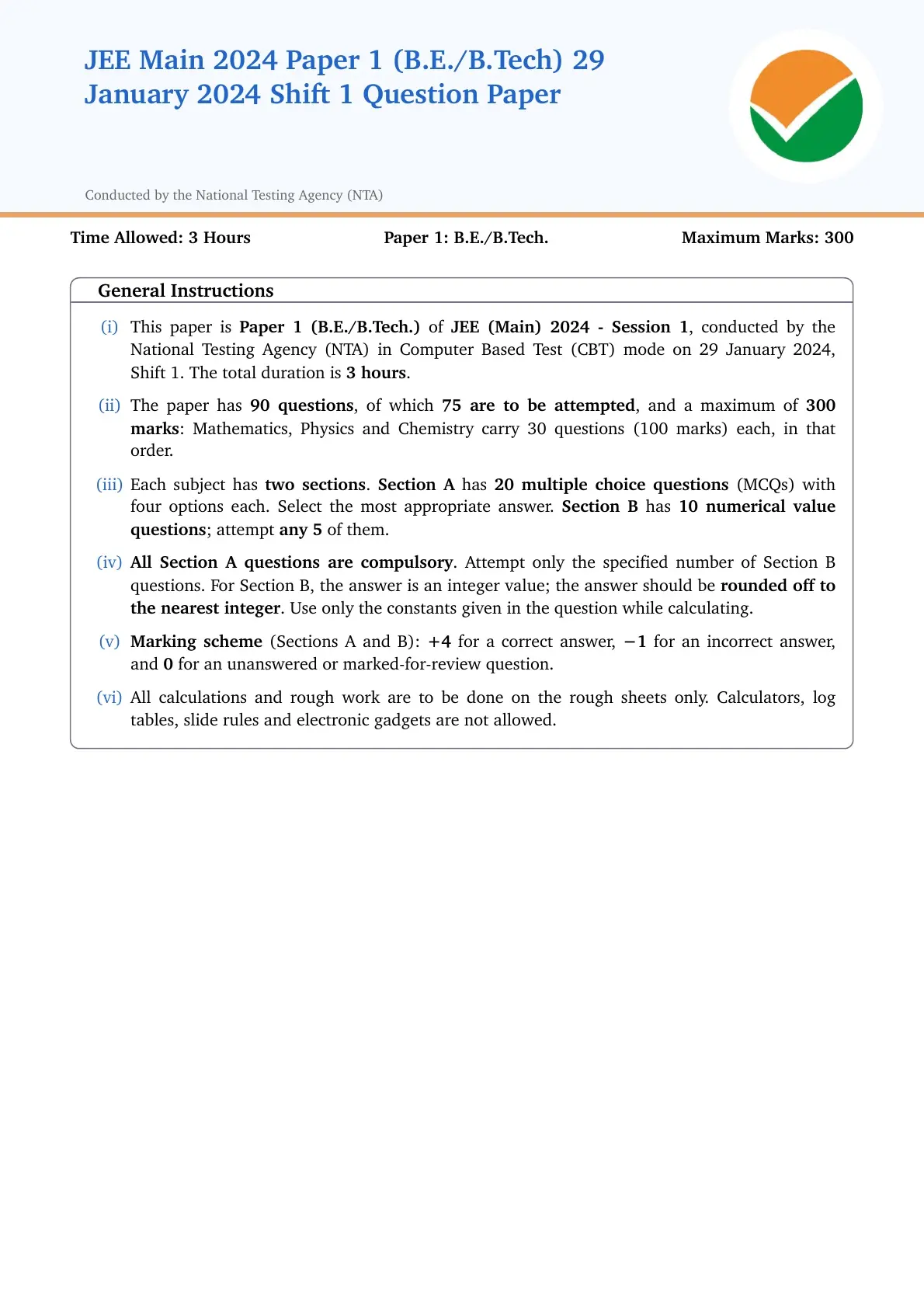
JEE Main 2024 January 29 Shift 1 Question Paper is available here with answer key and solution pdf. NTA conducted the first shift on January 29, 2024, from 9:00 AM to 12:00 PM. The JEE Main 2024 Paper 1 (B.E./B.Tech) question paper includes the following:
- 90 questions in a 3-hour CBT Mode: 30 each from Mathematics, Physics and Chemistry (75 to be attempted)
- Section A: 20 multiple choice questions (MCQs) per subject, 4 marks each
- Section B: 10 numerical value questions per subject, attempt any 5, 4 marks each (integer answer)
- Marking: +4 for a correct answer, -1 for an incorrect answer, 0 for an unattempted question
JEE Main 2024 January 29 Shift 1 Question Paper with Solution PDF
| NTA Official PDF | CD PDF | CD PDF with Solutions |
|---|---|---|
| Download official PDF 4.32 MB | Download Collegedunia PDF 1.06 MB | Download solutions PDF 1.05 MB |
Also Check:
JEE Main 2024 January 29 Shift 1 Questions with Solutions
Mathematics - Section A (Q1 - Q20)
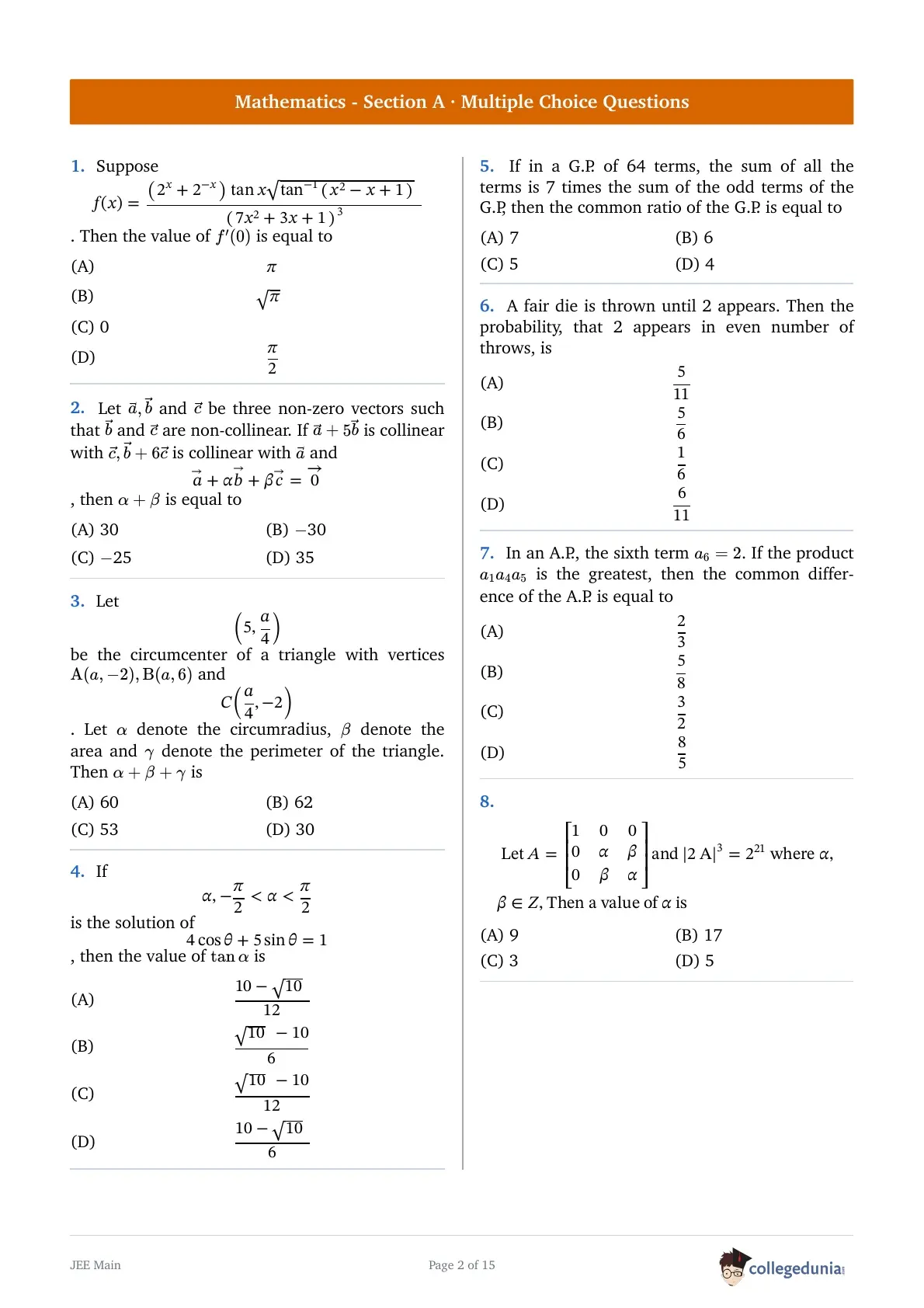
Suppose\(f(x)=\frac{(2^x+2^{-x})tanx\sqrt{tan^{-1}(x^2-x+1)}}{(7x^2+3x+1)^{3}}\) then the value of \(f'(0)\) is equal to
Let \(\overrightarrow{a},\overrightarrow{b}\) and \(\overrightarrow{c}\) be three non-zero vectors such that \(\overrightarrow{b}\) and \(\overrightarrow{c}\) are non-collinear. If \(\overrightarrow{a}+5\overrightarrow{b}\) is collinear with \(\overrightarrow{c},\overrightarrow{b}+6\overrightarrow{c}\) is collinear with \(\overrightarrow{a}\) and \(\overrightarrow{a}+ α\overrightarrow{b} + β\overrightarrow{c} = 0\), then α + β is equal to
Let\((5,\frac{a}{4})\),be the circumcenter of a triangle with vertices A (a, -2),B (a, 6)and C \((\frac{a}{4},-2)\).Let \(\alpha\) denote the circumradius, \(\beta\) denote the area and \(\gamma\) denote the perimeter of the triangle. Then \(\alpha+\beta+\gamma\) is
If\(\alpha,-\frac{\pi}{2}<\alpha<\frac{\pi}{2}\)is the solution of\( 4cos\theta+ 5sin\theta=1\)then the value of \(tan\alpha\) is
If in a G.P. of64terms, the sum of all the terms is 7 times the sum of the odd terms of the G.P., then the common ratio of the G.P. is equal to:
A fair die is thrown until the number 2 appears. What is the probability that 2 appears in an even number of throws?
In an A.P., the sixth term a6=2. If the product a1a4a5 is the greatest, then the common difference of the A.P. is equal to:
Let
\( A = \begin{bmatrix} 1 & 0 & 0 \\ 0 & \alpha & \beta \\ 0 & \beta & \alpha \end{bmatrix} \)
and \(|2A|^3 = 2^{21}\) where \(\alpha, \beta \in \mathbb{Z}\). Then a value of \(\alpha\) is:
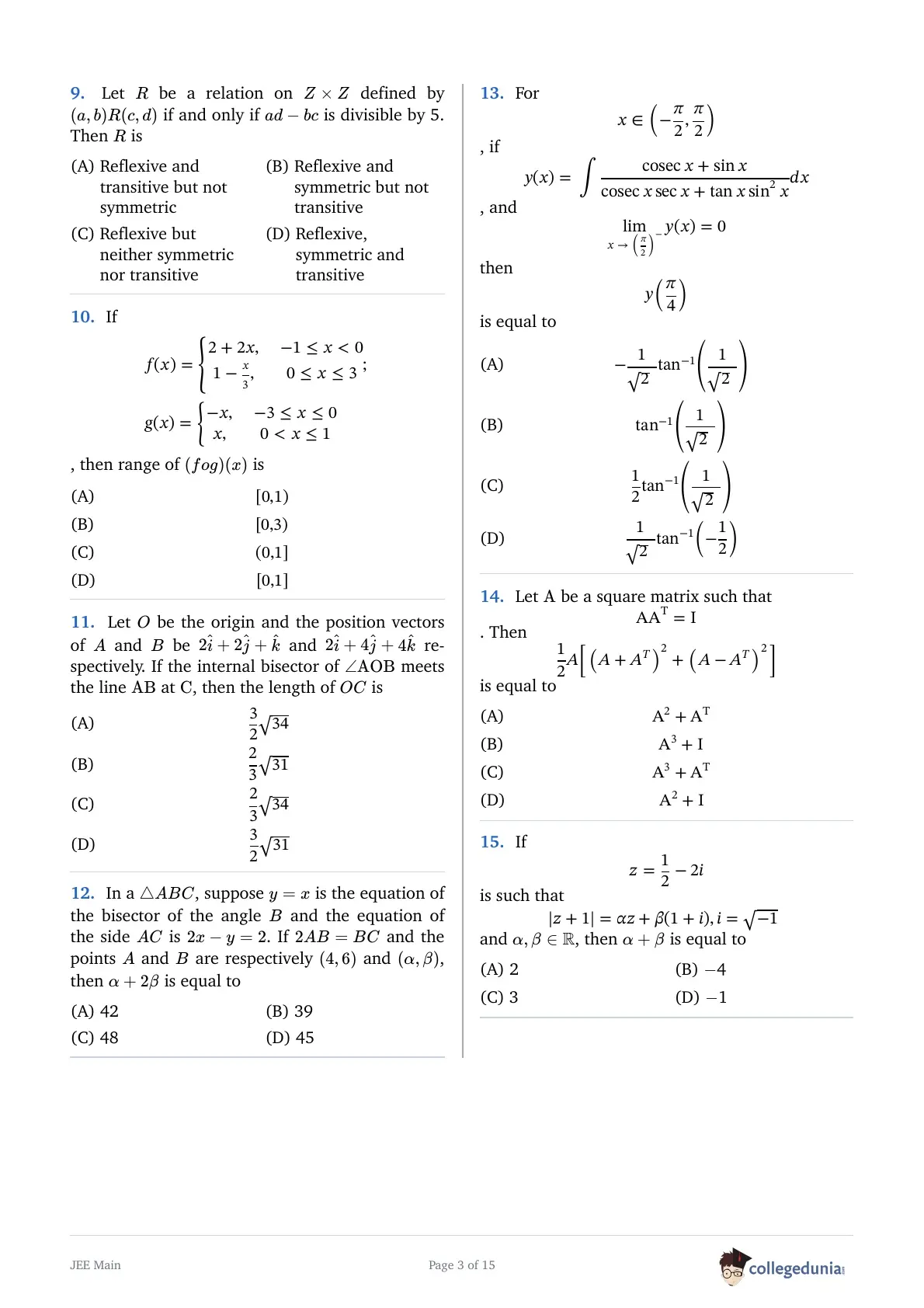
Let \( R \) be a relation on \( \mathbb{Z} \times \mathbb{Z} \) defined by \((a, b) R (c, d)\) if and only if \(ad - bc\) is divisible by 5.
Then \( R \) is:
If \(f(x)=\begin{cases}2+2x, & -1\le x<0\\ 1-\dfrac{x}{3}, & 0\le x\le 3\end{cases}\) ; \(g(x)=\begin{cases}-x, & -3\le x\le 0\\ x, & 0<x\le 1\end{cases}\), then the range of \((f\circ g)(x)\) is
Let O be the origin and the position vector of A and B be \(2\hat{i}+2\hat{j}+\hat{k}\) and \(2\hat{i}+4\hat{j}+4\hat{k}\) respectively. If the internal bisector of\(\angle AOB\) meets the line AB at C, then the length of OC is
In a △ABC, suppose y = x is the equation of the bisector of the angle B and the equation of the side AC is 2x−y = 2. If 2AB = BC and the points A and B are respectively (4, 6) and (α, β), then α + 2β is equal to:
For \( x \in \left( -\frac{\pi}{2}, \frac{\pi}{2} \right) \), if\[y(x) = \int \frac{\csc x + \sin x}{\csc x \sec x + \tan x \sin^2 x} \, dx\]and\[\lim_{x \to -\frac{\pi}{2}} y(x) = 0\]then \( y\left(\frac{\pi}{4}\right) \) is equal to
Let A be a square matrix such that \(AA^T=I\).Then \(\frac{1}{2}A[(A+A^T)^2+(A-A^T)^2]\) is equal to
If \( z = \frac{1}{2} - 2i \), is such that \( |z + 1| = \alpha z + \beta (1 + i) \), \( i = \sqrt{-1} \) and \( \alpha, \beta \in \mathbb{R} \), then \( \alpha + \beta \) is equal to:
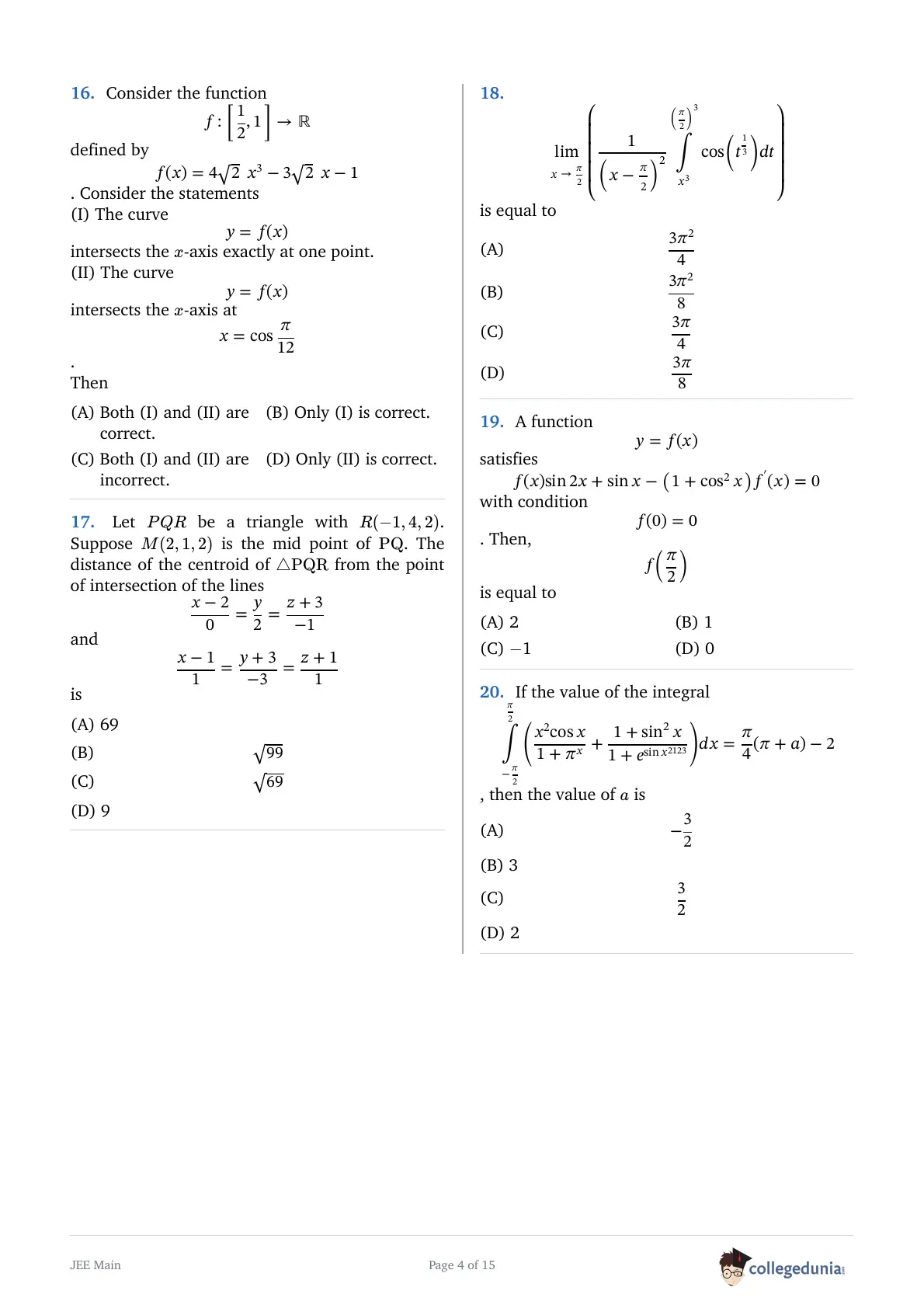
Consider the function \(f :[\frac{1}{2},1]\)⇢R defined by \(f(x)=4\sqrt2x^3-3\sqrt2x-1\).Consider the statements
(1)The curve y=f(x) intersect the x-axis exactly at one point
(2)The curve y=f(x) intersect the x-axis at \(x=cos\frac{\pi}{12}\)
Then
Let PQR be a triangle with R (-1,4, 2). Suppose M(2, 1, 2) is the mid point of PQ. The distance of the centroid of \(\triangle PQR\) from the point of intersection of the line\(\frac{x-2}{0}=\frac{y}{2}=\frac{z+3}{-1}\) and \(\frac{x-1}{1}=\frac{y+3}{-3}=\frac{z+1}{1}\) is
\(\displaystyle\lim_{x\to\frac{\pi}{2}}\left(\frac{1}{\left(x-\frac{\pi}{2}\right)^2}\int_{x^3}^{\left(\frac{\pi}{2}\right)^3}\cos\left(t^{1/3}\right)dt\right)\) is equal to
A function \(y=f(x)\) satisfies\(f (x)sin2x+sinx-(1+cos^2x) f'(x)=0\) with condition\(f(0)=0\).Then\(f(\frac{\pi}{2})\) equals to
If the value of the integral
\[ \int_{-\frac{\pi}{2}}^{\frac{\pi}{2}} \left( \frac{x^2 \cos x}{1 + \pi^x} + \frac{1 + \sin^2 x}{1 + e^{\sin^x 2023}} \right) dx = \frac{\pi}{4} (\pi + a) - 2, \]
then the value of \(a\) is:
Mathematics - Section B (Q21 - Q30)
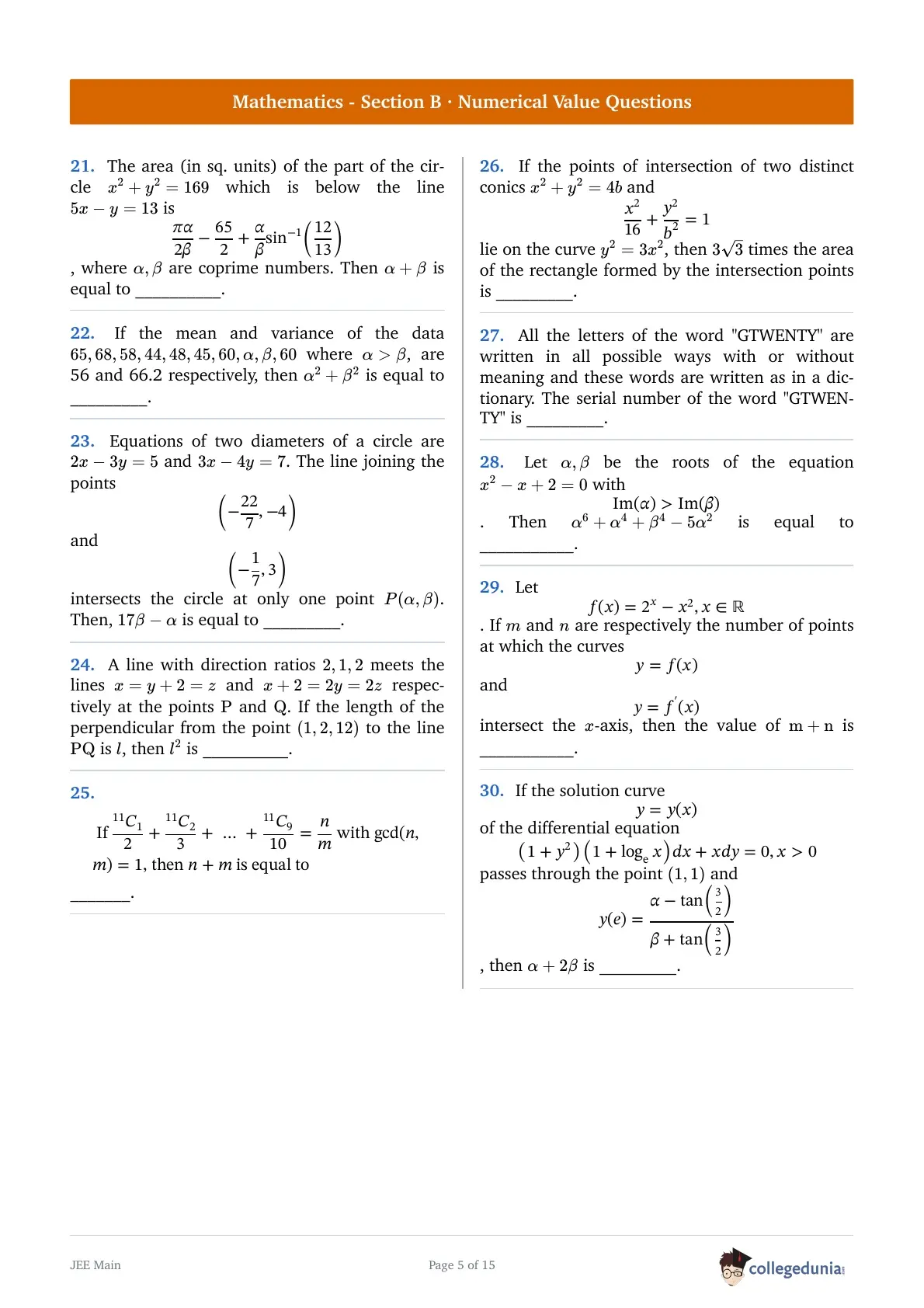
The area (in square units) of the part of the circle \(x^2 + y^2 = 169\) which is below the line \( 5x - y = 13 \) is\[\frac{\pi \alpha}{2 \beta} - \frac{65}{2} + \frac{\alpha}{\beta} \sin^{-1} \left( \frac{12}{13} \right)\]where \( \alpha \) and \( \beta \) are coprime numbers. Then \( \alpha + \beta \) is equal to
If the mean and variance of the data \( 65, 68, 58, 44, 48, 45, 60, \alpha, \beta, 60 \) where \( \alpha > \beta \) are \( 56 \) and \( 66.2 \) respectively, then \( \alpha^2 + \beta^2 \) is equal to
Equation of two diameters of a circle are \(2x-3y=5\) and \(3x-4y=7\).The line joining the points \((-\frac{22}{7},-4)\) and \((-\frac{1}{7},3)\) intersects the circle at only one point \(P(\alpha,\beta)\).Then \(17\beta-\alpha\) is equal to.
A line with direction ratios \( 2, 1, 2 \) meets the lines \(x = y + 2 = z\) and \(x + 2 = 2y = 2z\) respectively at the points \( P \) and \( Q \). If the length of the perpendicular from the point \( (1, 2, 12) \) to the line \( PQ \) is \( l \), then \( l^2 \) is
If \(\frac{{^{11}C_1}}{2} + \frac{{^{11}C_2}}{3} + \ldots + \frac{{^{11}C_9}}{10} = \frac{n}{m}\) with \(\gcd(n, m) = 1\), then \(n + m\) is equal to:
If the points of intersection of two distinct conics \(x^2 + y^2 = 4b\) and \(\frac{x^2}{16} + \frac{y^2}{b^2} = 1\) lie on the curve \(y^2 = 3x^2\) then \( 3\sqrt{3} \) times the area of the rectangle formed by the intersection points is __.
All the letters of the word "GTWENTY" are written in all possible ways with or without meaning, and these words are arranged as in a dictionary. The serial number of the word "GTWENTY" is:
Let \( \alpha, \beta \) be the roots of the equation \( x^2 - x + 2 = 0 \) with \( \text{Im}(\alpha) > \text{Im}(\beta) \). Then \( \alpha^6 + \alpha^4 + \beta^4 - 5 \alpha^2 \) is equal to
Let \( f(x) = 2^x - x^2, \, x \in \mathbb{R} \). If \( m \) and \( n \) are respectively the number of points at which the curves \( y = f(x) \) and \( y = f'(x) \) intersect the x-axis, then the value of \( m + n \) is
If the solution curve \( y = y \, x \) of the differential equation \((1 + y^2) \left(1 + \log_e x\right) dx + x \, dy = 0, \quad x > 0\) passes through the point \( (1, 1) \) and\[y(e) = \frac{\alpha - \tan\left(\frac{3}{2}\right)}{\beta + \tan\left(\frac{3}{2}\right)},\]then \( \alpha + 2\beta \) is
Physics - Section A (Q31 - Q50)
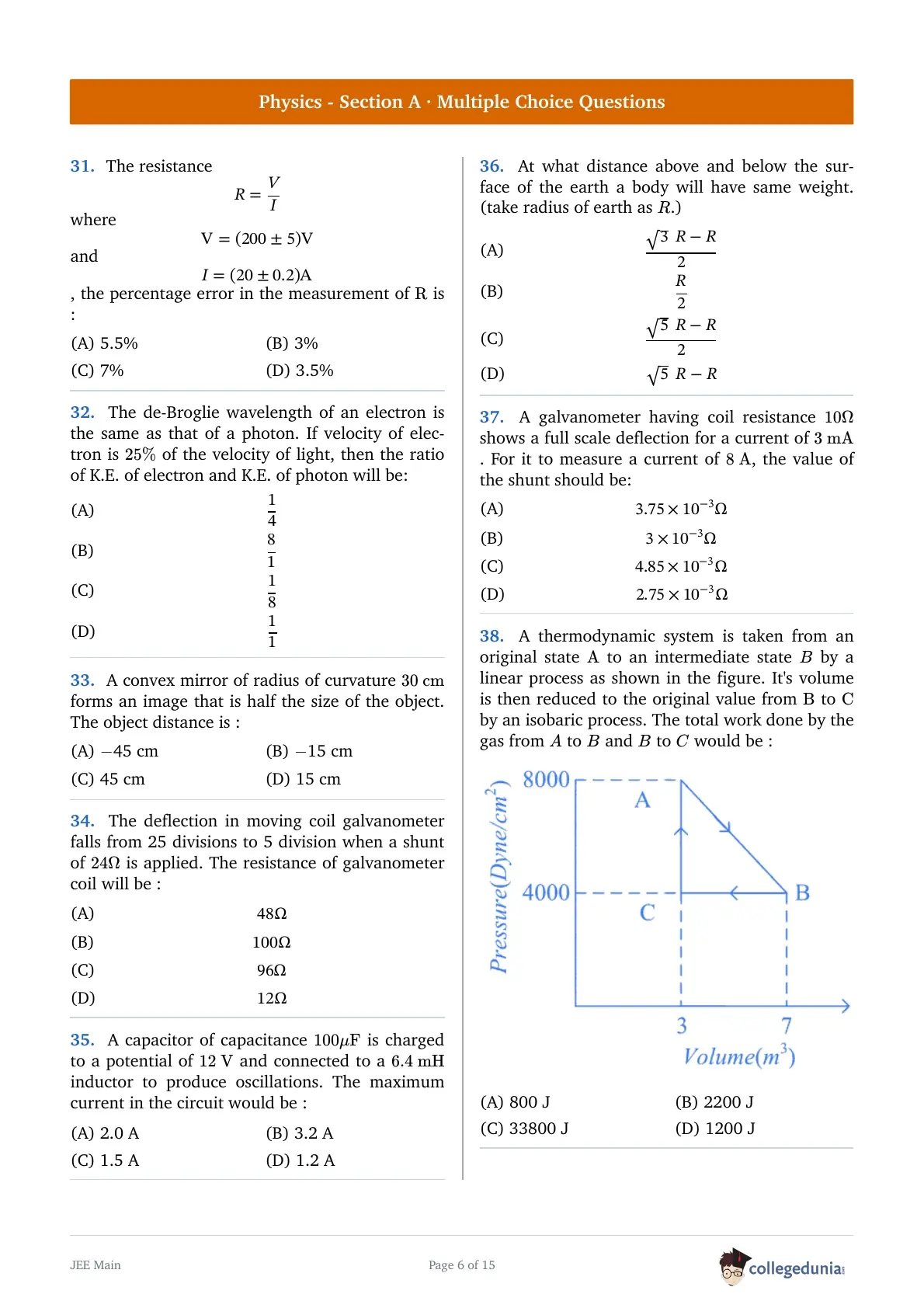
Voltage and resistance for a resistor are measured as \(V = 200±5V \;\&\; R = 20 + 0.2 \;Ω\). Find the percentage error in the current \(I = \frac{V }{R}\)
The de-Broglie wavelength of an electron is the same as that of a photon. If the velocity of the electron is 25% of the velocity of light, then the ratio of the K.E. of the electron to the K.E. of the photon will be:
A convex mirror of radius of curvature 30 cm forms an image that is half the size of the object. The object distance is:
The deflection in a moving coil galvanometer falls from 25 divisions to 5 divisions when a shunt of \( 24 \, \Omega \) is applied. The resistance of the galvanometer coil will be:
A capacitor of capacitance 100 μF is charged to a potential of 12 V and connected to a 6.4 mH inductor to produce oscillations. The maximum current in the circuit would be:
At what distance above and below the surface of the earth a body will have the same weight (take radius of earth as R)?
A galvanometer having coil resistance 10 Ω shows a full scale deflection for a current of 3 mA. For it to measure a current of 8 A, the value of the shunt should be:
A thermodynamic system is taken from an original state A to an intermediate state B by a linear process as shown in the figure. It's volume is then reduced to the original value from B to C by an isobaric process. The total work done by the gas from A to B and B to C would be :
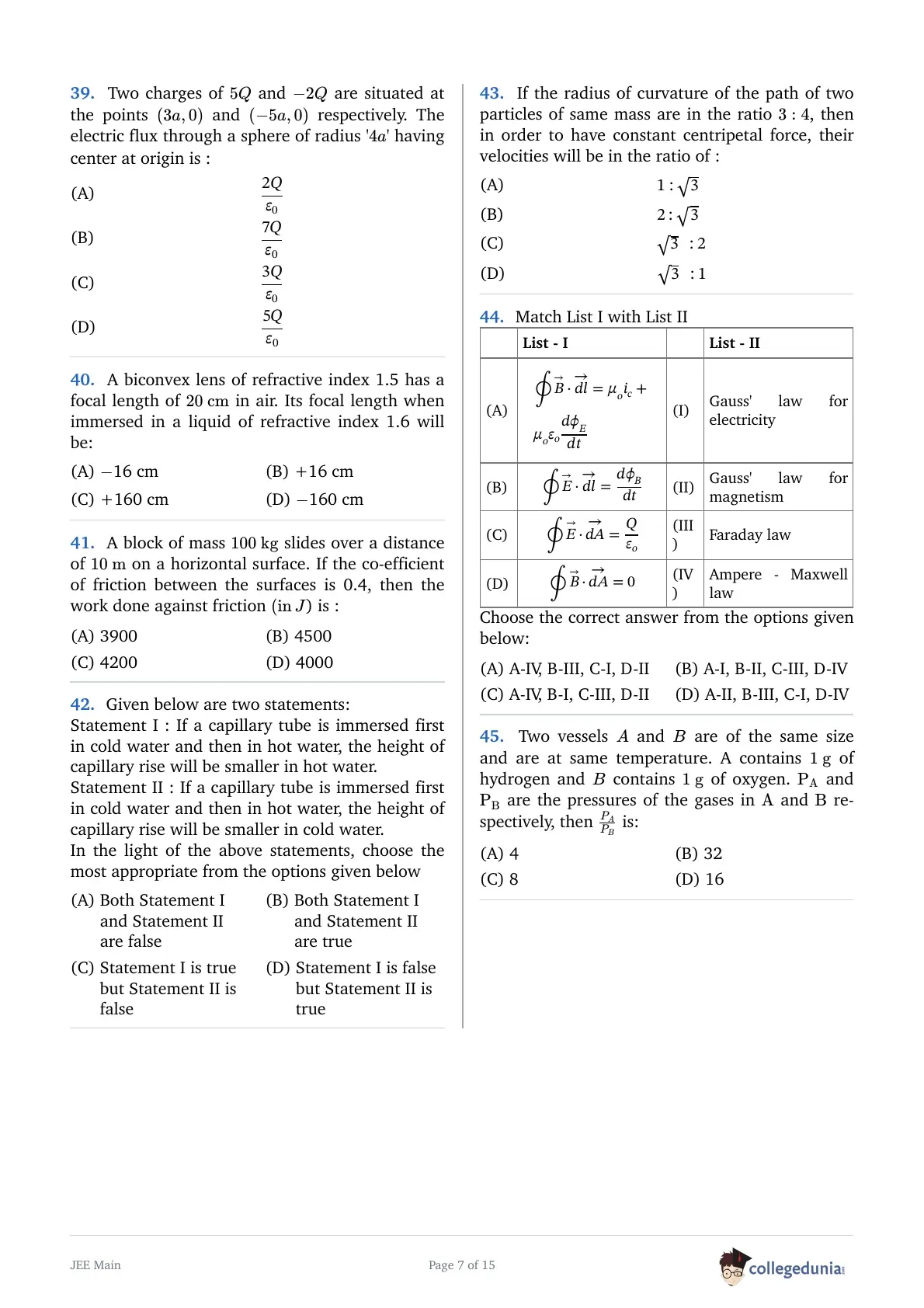
Two charges of \(5Q\) and \(-2Q\) are situated at the points \((3a, 0)\) and \((-5a, 0)\) respectively. The electric flux through a sphere of radius \(4a\) having its center at the origin is:
A biconvex lens of refractive index 1.5 has a focal length of 20 cm in air. Its focal length when immersed in a liquid of refractive index 1.6 will be:
A block of mass 100 kg slides over a distance of 10 m on a horizontal surface. If the coefficient of friction between the surfaces is 0.4, then the work done against friction (in J) is:
Given below are two statements:
Statement 1: If a capillary tube is immersed first in cold water and then in hot water, the height of capillary rise will be smaller in hot water.
Statement 2: If a capillary tube is immersed first in cold water and then in hot water, the height of capillary rise will be smaller in cold water.
In the light of the above statements, choose the most appropriate option from the options given below:
If the radius of curvature of the path of two particles of the same mass are in the ratio \( 3:4 \), then in order to have constant centripetal force, their velocities will be in the ratio of:
| List I | List II |
|---|---|
| A. \( \oint \vec{B} \cdot d\vec{l} = \mu_0 i_c + \mu_0 \epsilon_0 \frac{d\phi_E}{dt} \) | I. Gauss' law for electricity |
| B. \( \oint \vec{E} \cdot d\vec{l} = -\frac{d\phi_B}{dt} \) | II. Gauss' law for magnetism |
| C. \( \oint \vec{E} \cdot d\vec{A} = \frac{Q}{\epsilon_0} \) | III. Faraday law |
| D. \( \oint \vec{B} \cdot d\vec{A} = 0 \) | IV. Ampere – Maxwell law |
Choose the correct answer from the options given below
Two vessels A and B are of the same size and are at the same temperature. A contains 1 g of hydrogen and B contains 1 g of oxygen. \(P_A\) and \(P_B\) are the pressures of the gases in A and B respectively, then \(\frac{P_A}{P_B}\) is:
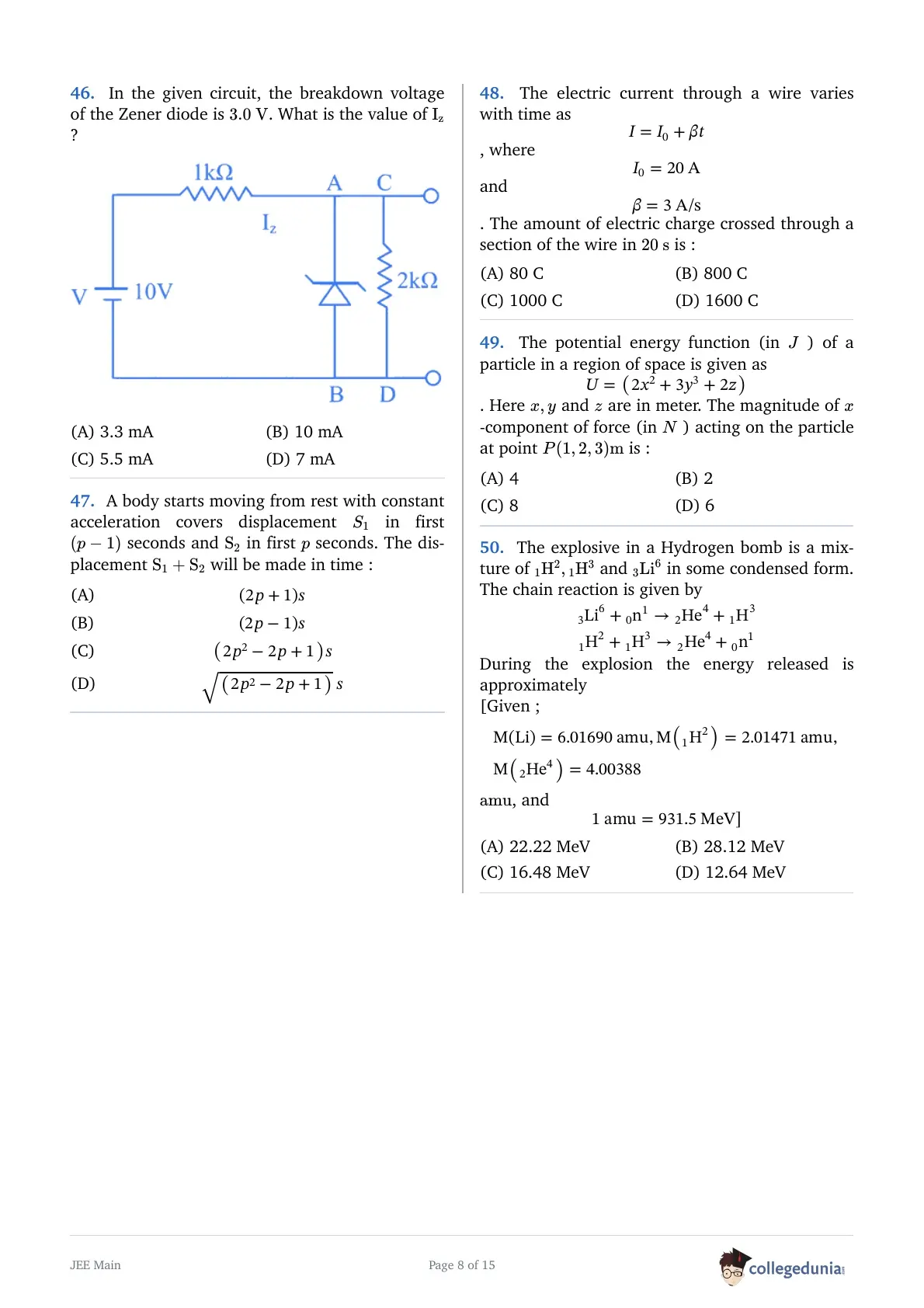
In the given circuit, the breakdown voltage of the Zener diode is 3.0 V. What is the value of Iz ?
A body starts moving from rest with constant acceleration and covers displacement \(S_1\) in the first \((p - 1)\) seconds and \(S_2\) in the first \(p\) seconds. The displacement \(S_1 + S_2\) will be made in time:
The electric current through a wire varies with time as \(I = I_0 + \beta t\) where \( I_0 = 20 \, \text{A} \) and \( \beta = 3 \, \text{A/s} \). The amount of electric charge that crosses through a section of the wire in \( 20 \, \text{s} \) is:
The potential energy function (in joules) of a particle in a region of space is given as\[U = (2x^2 + 3y^3 + 2z).\]Here \( x \), \( y \), and \( z \) are in meters. The magnitude of the \( x \)-component of force (in newtons) acting on the particle at point \( P (1, 2, 3) \) m is:
The explosive in a hydrogen bomb is a mixture of \( ^2\text{H} \), \( ^3\text{H} \), and \( ^6\text{Li} \) in some condensed form. The chain reaction is given by\[_3^6\text{Li} + _0^1\text{n} \rightarrow _2^4\text{He} + _1^3\text{H}\]\[_1^2\text{H} + _1^3\text{H} \rightarrow _2^4\text{He} + _0^1\text{n}\]During the explosion, the energy released is approximately ____.[Given: \( M(\text{Li}) = 6.01690 \, \text{amu} \), \( M(^3\text{H}) = 2.01471 \, \text{amu} \), \( M(_2^4\text{He}) = 4.00388 \, \text{amu} \), and \( 1 \, \text{amu} = 931.5 \, \text{MeV} \)]
Physics - Section B (Q51 - Q60)
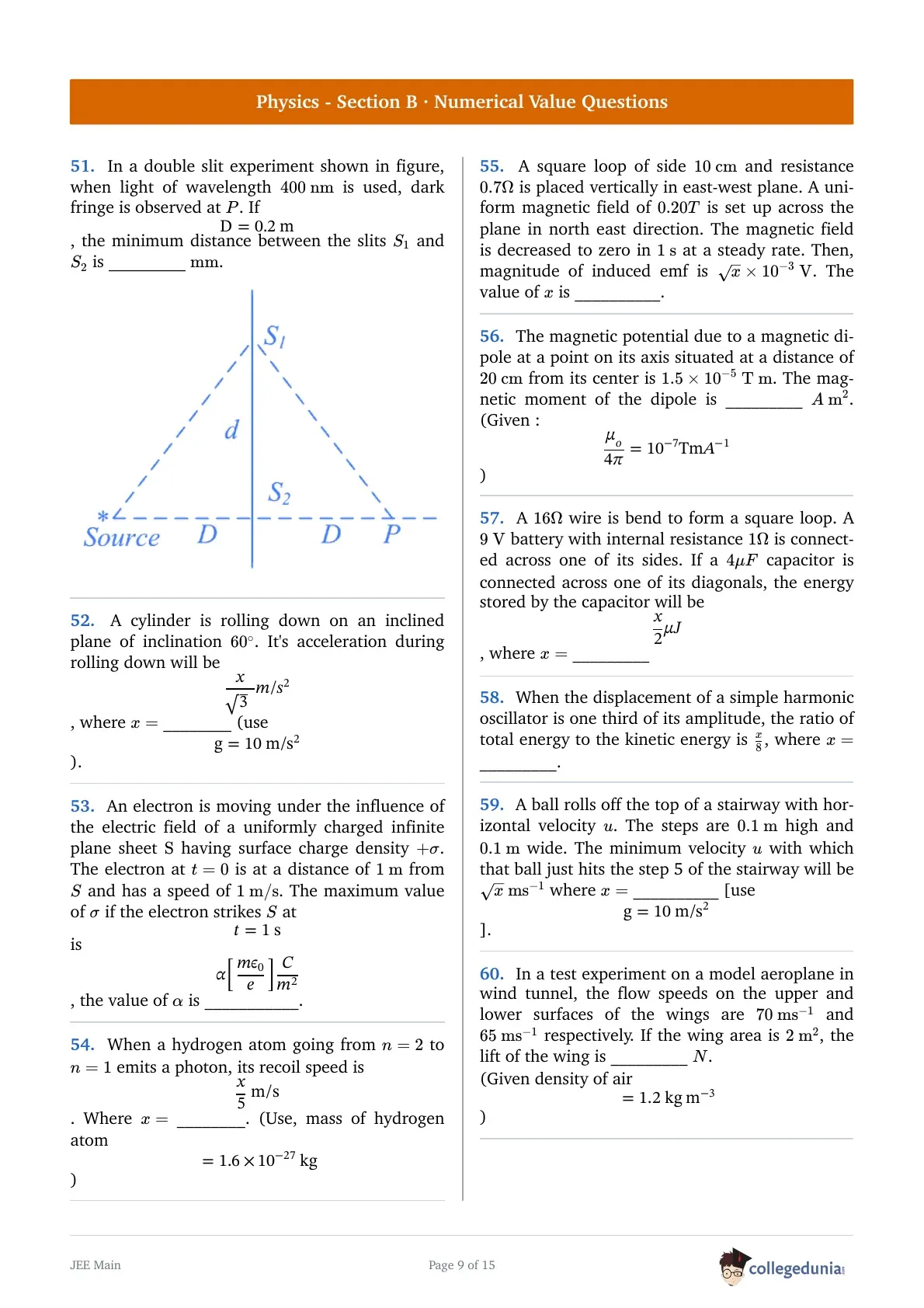
In a double slit experiment shown in figure, when light of wavelength 400 nm is used, dark fringe is observed at P. If D = 0.2 m. the minimum distance between the slits S1 and S2 is ______ mm.
A cylinder is rolling down an inclined plane of inclination \( 60^\circ \). Its acceleration during rolling down will be \( \frac{x}{\sqrt{3}} \, \text{m/s}^2 \), where \( x = \) _____. (Use \( g = 10 \, \text{m/s}^2 \)).
An electron is moving under the influence of the electric field of a uniformly charged infinite plane sheet \( S \) having surface charge density \( +\sigma \). The electron at \( t = 0 \) is at a distance of 1 m from \( S \) and has a speed of 1 m/s. The maximum value of \( \sigma \) if the electron strikes \( S \) at \( t = 1 \, \text{s} \) is \( \alpha \left[ \frac{m \epsilon_0}{e} \right] \frac{\text{C}}{\text{m}^2} \). The value of \( \alpha \) is ______.
When a hydrogen atom going from \( n = 2 \) to \( n = 1 \) emits a photon, its recoil speed is \( \frac{x}{5} \) m/s. Where \( x = \, \) _____. (Use: mass of hydrogen atom \( = 1.6 \times 10^{-27} \, \text{kg} \))
A square loop of side \( 10 \, \text{cm} \) and resistance \( 0.7 \, \Omega \) is placed vertically in the east-west plane. A uniform magnetic field of \( 0.20 \, \text{T} \) is set up across the plane in the northeast direction. The magnetic field is decreased to zero in \( 1 \, \text{s} \) at a steady rate. Then, the magnitude of the induced emf is \( \sqrt{x} \times 10^{-3} \, \text{V} \). The value of \( x \) is _____.
The magnetic potential due to a magnetic dipole at a point on its axis situated at a distance of 20 cm from its center is \( 1.5 \times 10^{-5} \, \text{Tm} \). The magnetic moment of the dipole is _______ \( \text{Am}^2 \).
(Given: \( \frac{\mu_0}{4\pi} = 10^{-7} \, \text{TmA}^{-1} \))
A 16Ω wire is bent to form a square loop. A 9 V battery with internal resistance 1Ω is connected across one of its sides. If a 4μF capacitor is connected across one of its diagonals, the energy stored by the capacitor will be \(\frac{x}{2}\) μJ, where \(x =\) _____.
When the displacement of a simple harmonic oscillator is one third of its amplitude, the ratio of total energy to the kinetic energy is \(\frac{x}{ 8}\) , where x = _________.
A ball rolls off the top of a stairway with horizontal velocity \( u \). The steps are \( 0.1 \, \text{m} \) high and \( 0.1 \, \text{m} \) wide. The minimum velocity \( u \) with which the ball just hits the step 5 of the stairway will be \( \sqrt{x} \, \text{m/s} \) where \( x = \) _____. (Use \( g = 10 \, \text{m/s}^2 \)).
In a test experiment on a model aeroplane in wind tunnel, the flow speeds on the upper and lower surfaces of the wings are 70 ms–1 and 65 ms–1 respectively. If the wing area is 2 m2 the lift of the wing is _______ N.
(Given density of air = 1.2 kg m-3)
Chemistry - Section A (Q61 - Q80)
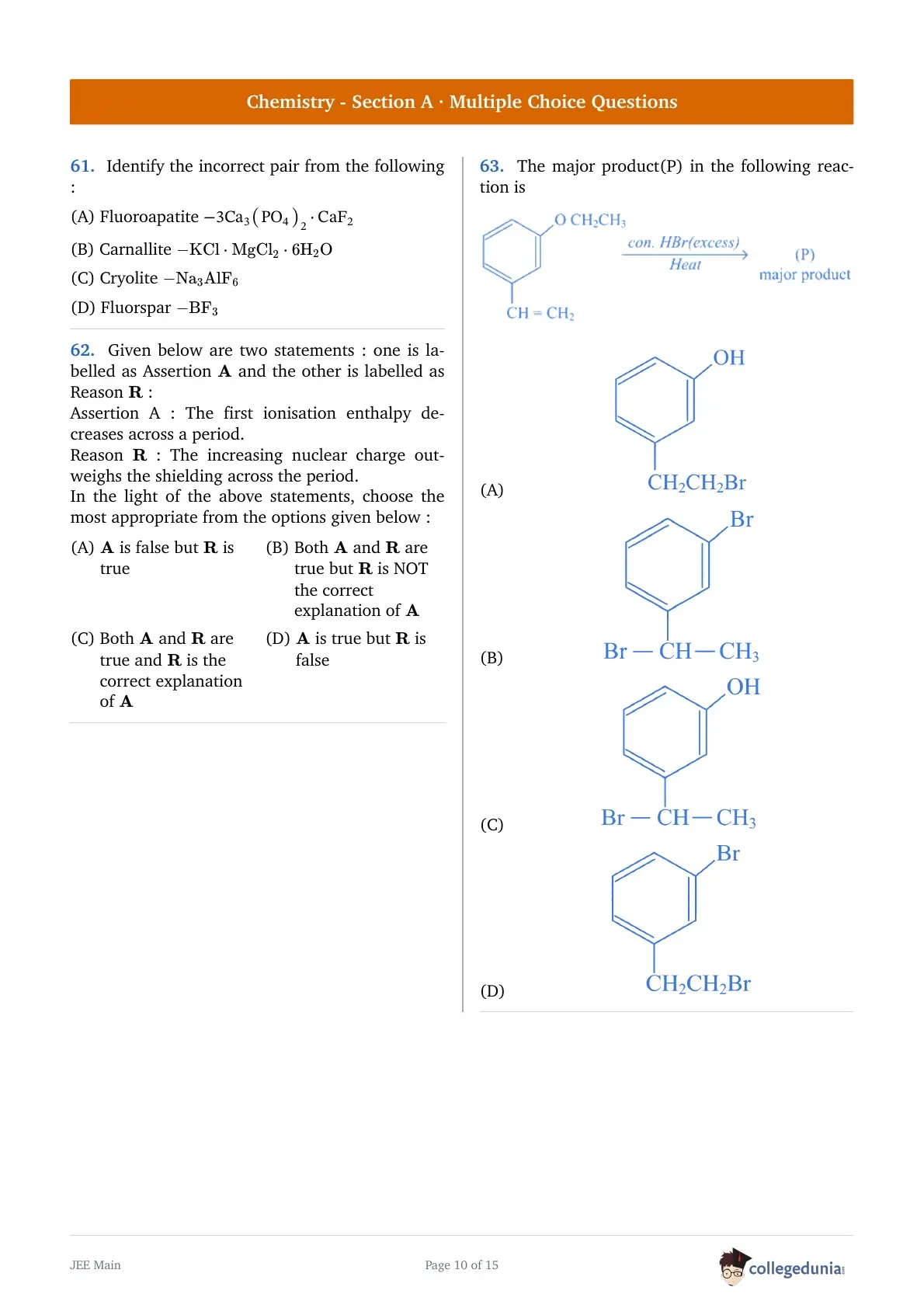
Identify the incorrect pair from the following:
Given below are two statements: one is labelled as Assertion A and the other is labelled as Reason R:
Assertion A: The first ionisation enthalpy decreases across a period.
Reason R: The increasing nuclear charge outweighs the shielding across the period.
In the light of the above statements, choose the most appropriate from the options given below:


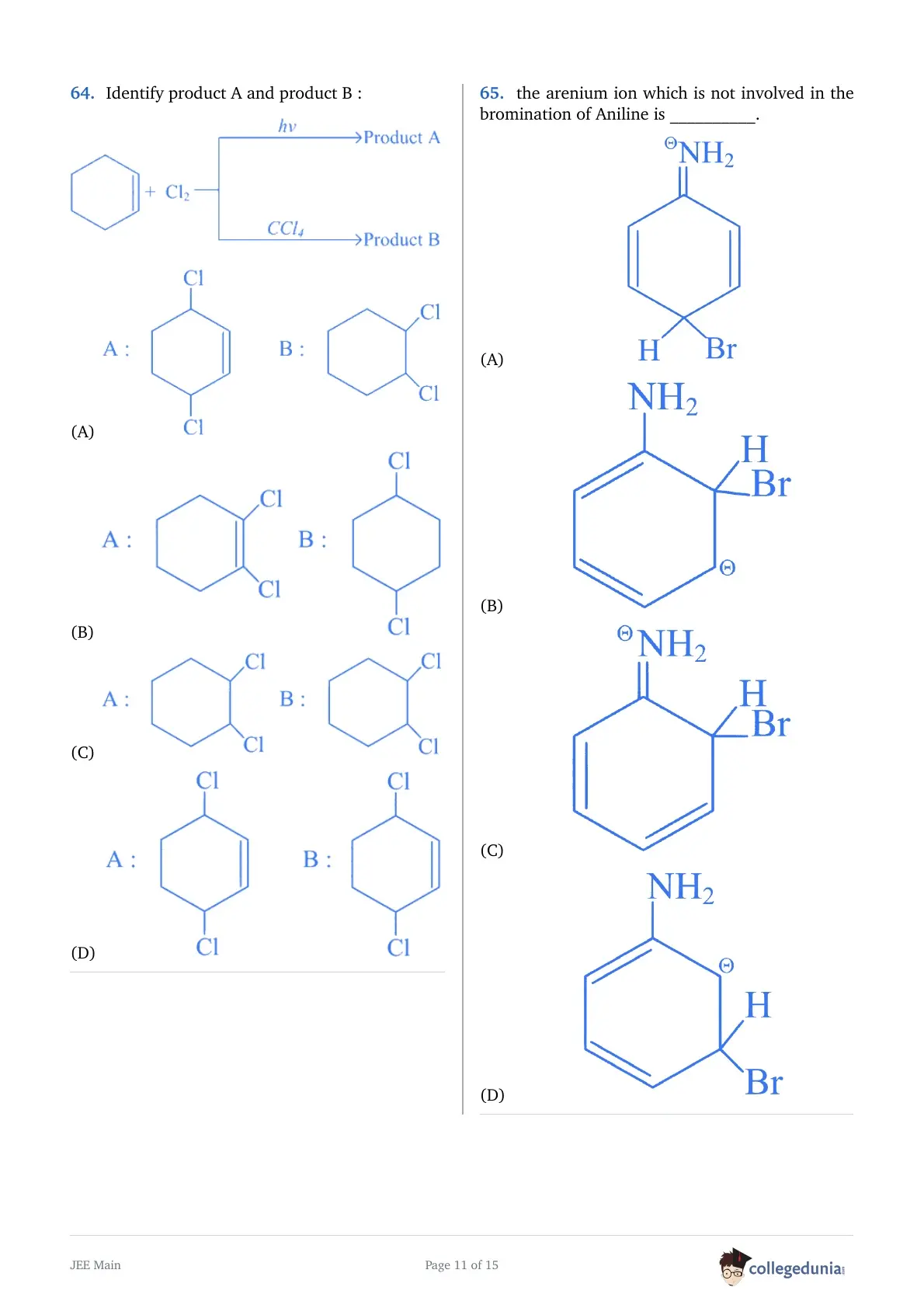
The arenium ion which is not involved in the bromination of Aniline is .
- (1)
![A]()
- (2)
![B]()
- (3)
![C]()
- (4)
![D]()


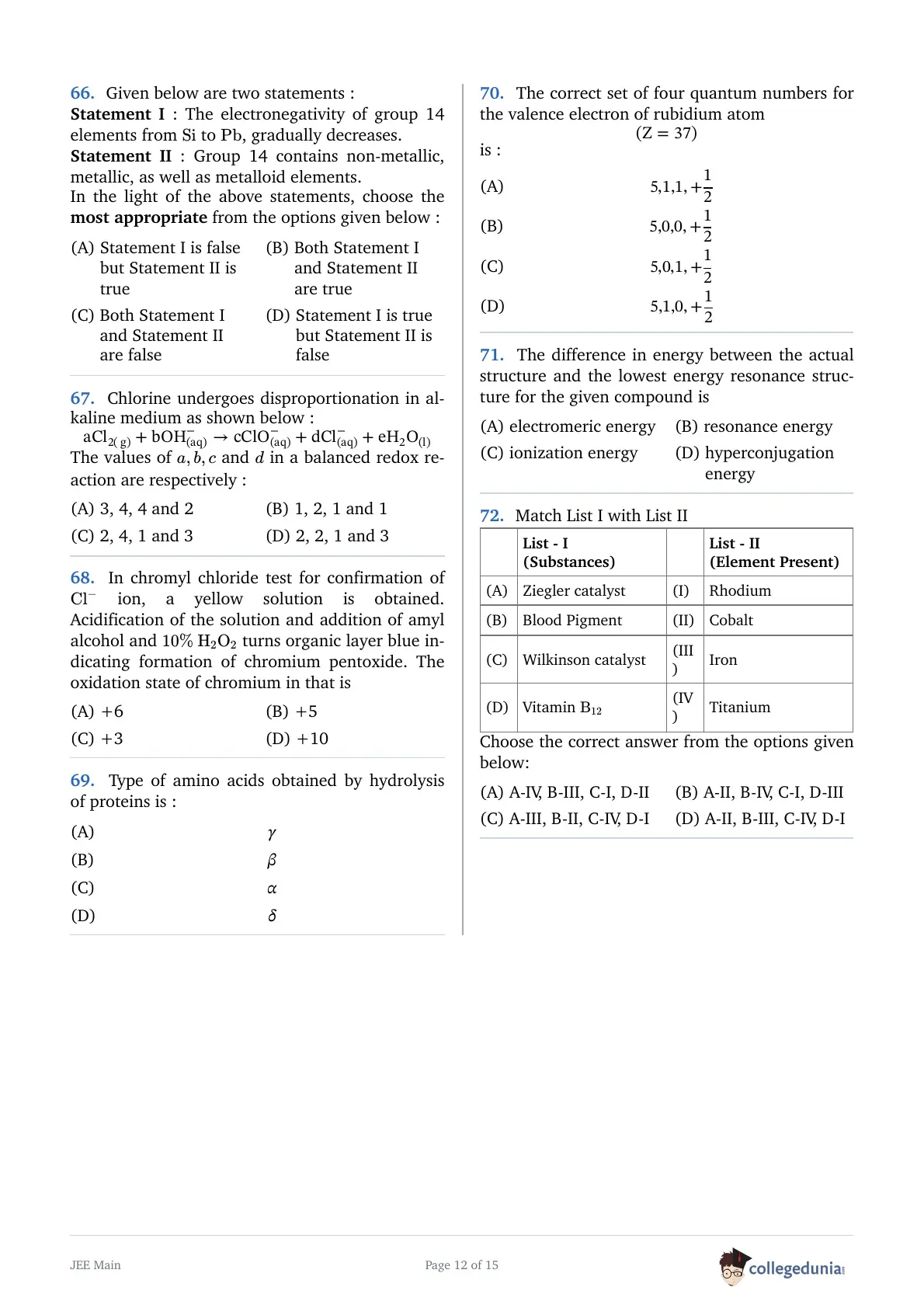
Given below are two statements:
Statement I: The electronegativity of group 14 elements from Si to Pb gradually decreases.
Statement II: Group 14 contains non-metallic, metallic, as well as metalloid elements.
In the light of the above statements, choose the most appropriate from the options given below:
Chlorine undergoes disproportionation in alkaline medium as shown below:
\(a \, \text{Cl}_2(g) + b \, \text{OH}^-(\text{aq}) \rightarrow c \, \text{ClO}^-(\text{aq}) + d \, \text{Cl}^-(\text{aq}) + e \, \text{H}_2\text{O}(\text{l})\)
The values of \( a \), \( b \), \( c \), and \( d \) in a balanced redox reaction are respectively:
In chromyl chloride test for confirmation of Cl-, a yellow solution is obtained. Acidification of the solution and addition of amyl alcohol and 10% H2O2 turns organic layer blue indicating formation of chromium pentoxide. The oxidation state of chromium in that is
Type of amino acids obtained by hydrolysis of proteins is:
The correct set of four quantum numbers for the valence electron of rubidium atom (Z = 37) is:
The difference in energy between the actual structure and the lowest energy resonance structure for the given compound is
| List I (Substances) | List II (Element Present) |
| (A) Ziegler catalyst | (I) Rhodium |
| (B) Blood Pigment | (II) Cobalt |
| (C) Wilkinson catalyst | (III) Iron |
| (D) Vitamin B12 | (IV) Titanium |
Choose the correct answer from the options given below :
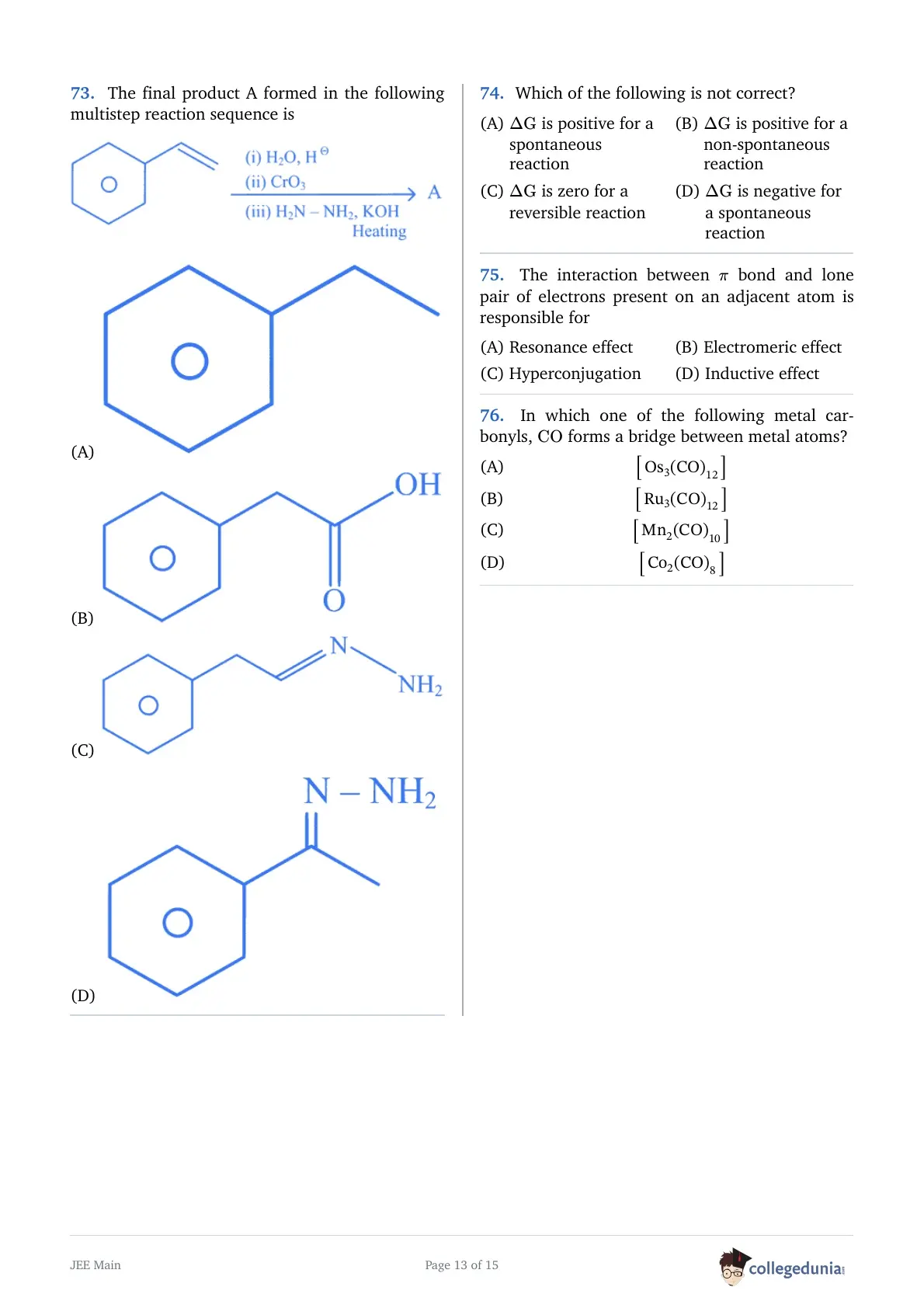
The final product A formed in the following multistep reaction sequence is
- (1)
![A]()
- (2)
![B]()
- (3)
![C]()
- (4)
![D]()


Which of the following is not correct?
The interaction between π bond and lone pair of electrons present on an adjacent atom is responsible for
In which one of the following metal carbonyls, CO forms a bridge between metal atoms?
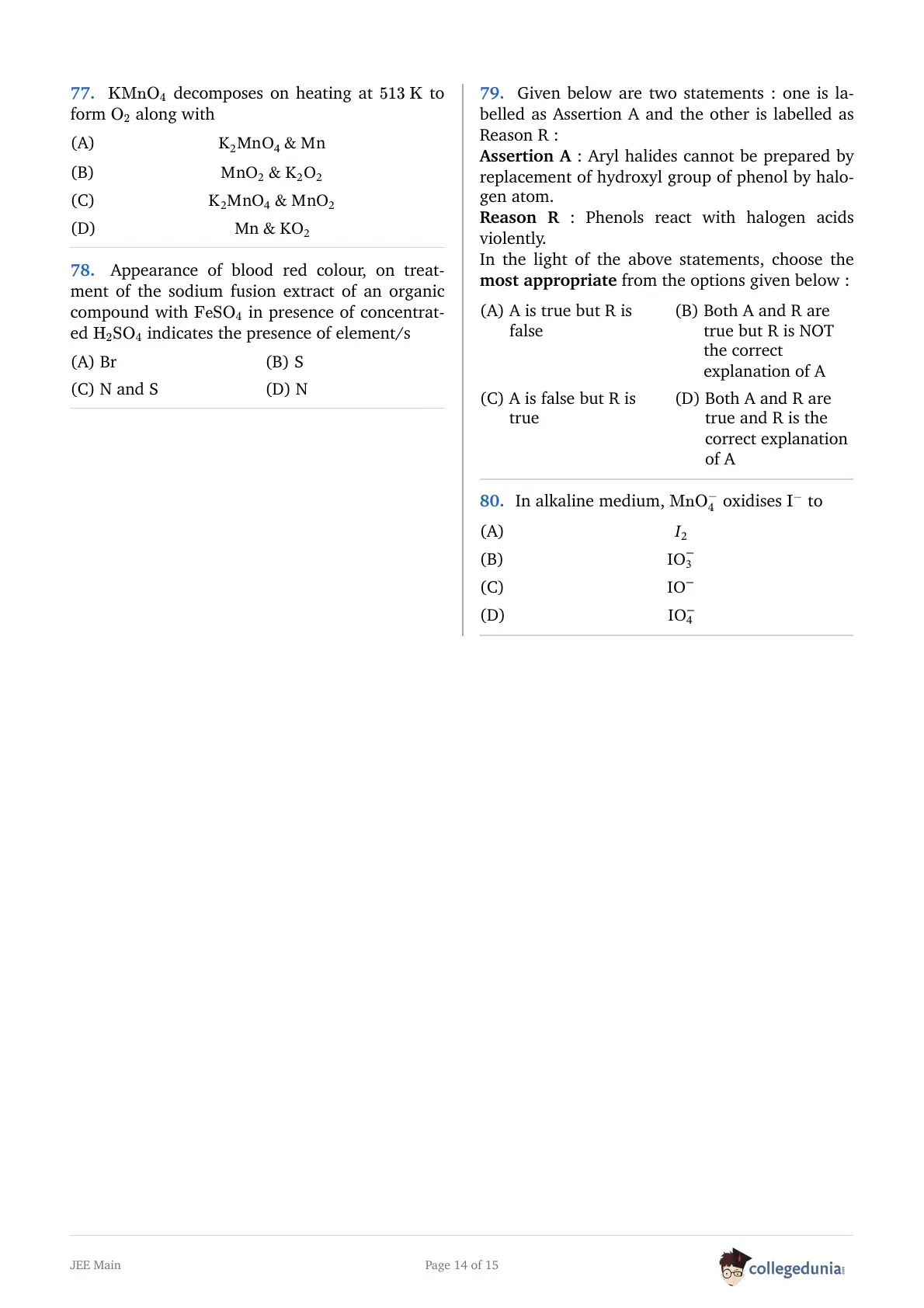
KMnO4 decomposes on heating at 513 K to form O2 along with
Appearance of blood red colour on treatment of the sodium fusion extract of an organic compound with FeSO4 in presence of concentrated H2SO4 indicates the presence of element(s).
Given below are two statements : one is labelled as Assertion A and the other is labelled as Reason R :
Assertion A : Aryl halides cannot be prepared by replacement of hydroxyl group of phenol by halogen atom.
Reason R : Phenols react with halogen acids violently. In the light of the above statements.
Choose the most appropriate from the options given below:
In alkaline medium, \( \text{MnO}_4^- \) oxidizes \( \text{I}^- \) to:
Chemistry - Section B (Q81 - Q90)
The mass of zinc produced by the electrolysis of zinc sulfate solution with a steady current of 0.015 A for 15 minutes is _____ \( \times \, 10^{-4} \) g.
(Atomic mass of zinc = 65.4 amu)
A solution of \( \text{H}_2\text{SO}_4 \) is 31.4% \( \text{H}_2\text{SO}_4 \) by mass and has a density of \( 1.25 \, \text{g/mL} \). The molarity of the \( \text{H}_2\text{SO}_4 \) solution is _____ M (nearest integer).
[Given molar mass of \( \text{H}_2\text{SO}_4 = 98 \, \text{g/mol} \)]

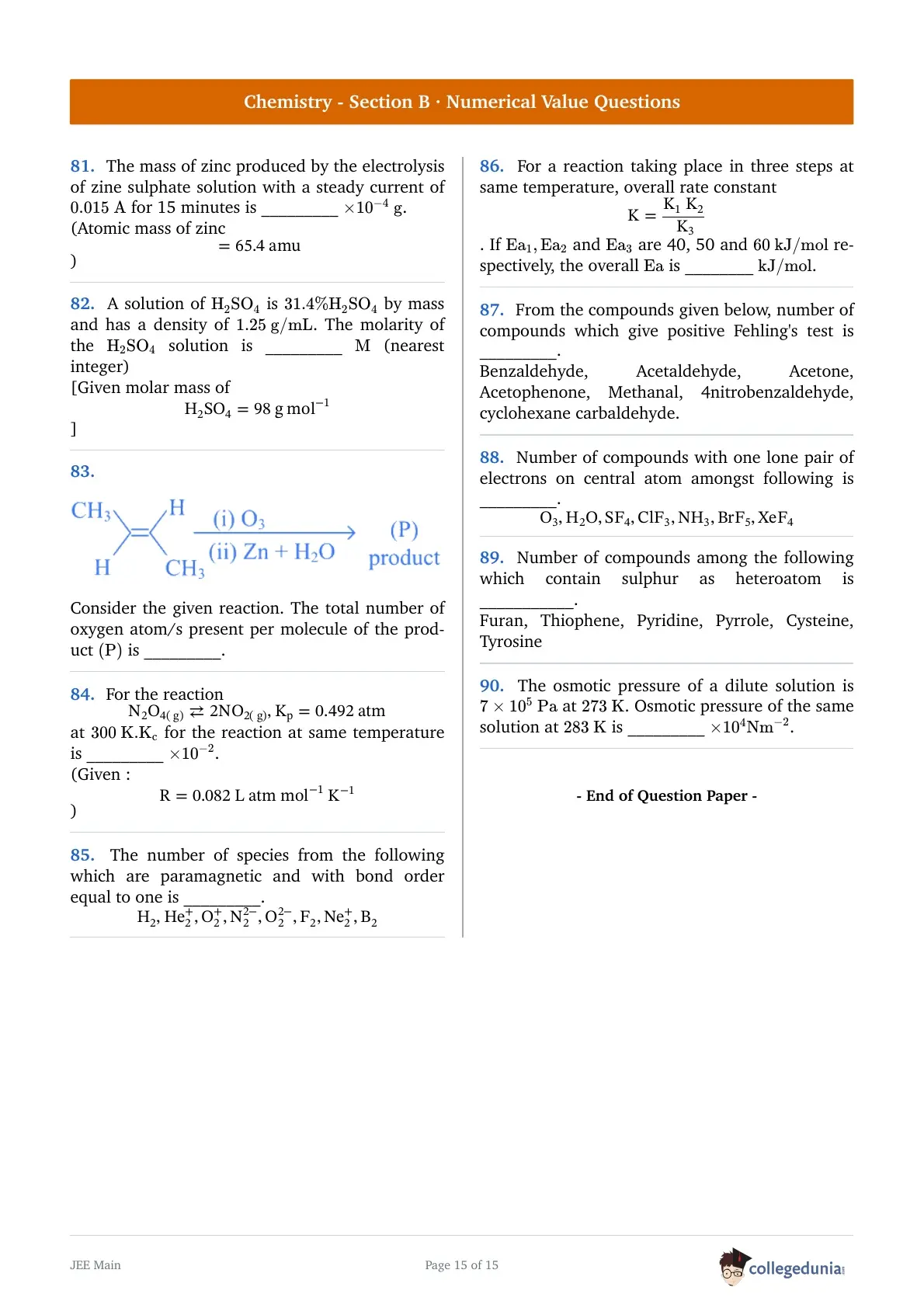
Consider the given reaction. The total number of oxygen atoms present per molecule of the product (P) is____.
For the reaction \( \text{N}_2\text{O}_4(g) \rightleftharpoons 2\text{NO}_2(g) \), \( K_p = 0.492 \, \text{atm} \) at 300 K. \( K_c \) for the reaction at the same temperature is _____ \( \times \, 10^{-2} \).
(Given: \( R = 0.082 \, \text{L atm mol}^{-1} \text{K}^{-1} \))
The number of species from the following which are paramagnetic and with bond order equal to one is ___.
Species: H2, He2+, O2-, N2, O22-, F2, Ne2+, B2
For a reaction taking place in three steps at the same temperature, the overall rate constant \( K = \frac{K_1 K_2}{K_3} \). If \( E_{a1} \), \( E_{a2} \), and \( E_{a3} \) are 40, 50, and 60 kJ/mol respectively, the overall \( E_a \) is ____ kJ/mol.
From the compounds given below, the number of compounds which give a positive Fehling’s test is____.
Compounds: Benzaldehyde, Acetaldehyde, Acetone, Acetophenone, Methanal, 4-nitrobenzaldehyde, cyclohexane carbaldehyde.
Number of compounds with one lone pair of electrons on central atom amongst following is
\(CIF_3, XeO_3, BrF_5, XeF_4, O_3, NH_3\),\( H_2O\)
Number of compounds among the following which contain sulfur as a heteroatom is ___.
Compounds: Furan, Thiophene, Pyridine, Pyrrole, Cysteine, Tyrosine
The osmotic pressure of a dilute solution is \(7 × 10^5\) Pa at \(273K\). Osmotic pressure of the same solution at\(283K\) is _____\(× 10^4 Nm^2\)
JEE Main 2024 Exam Pattern and Marking Scheme
| Particulars | Details |
|---|---|
| Exam Mode | Online (Computer-Based Test) |
| Paper | B.E./B.Tech |
| Medium of Exam | 13 languages: English, Hindi, Gujarati, Bengali, Tamil, Telugu, Kannada, Marathi, Malayalam, Odia, Punjabi, Assamese, Urdu |
| Duration | 3 hours (180 minutes) |
| Type of Questions | Multiple Choice Questions (MCQs) + Numerical Value Questions (attempt any 5 of 10 per subject) |
| Total Marks | 300 marks |
| Subjects | Mathematics, Physics, Chemistry |
| Marking Scheme | +4 for correct answer & -1 for incorrect MCQ and Numerical Value-based Questions |
| Total Questions | 90 Questions (30 per subject), 75 to be attempted |
| Eligibility | Passed or appearing in Class 12 with Physics, Chemistry, and Mathematics |
JEE Main 2024 Jan 29 Shift 1 Question Paper by Coaching Institute
| Coaching Institutes | Question Paper with Solutions PDF |
|---|---|
| Aakash BYJUs | Download PDF |
| Reliable Institute | Physics Chemistry |
| Resonance | Physics Chemistry Maths |
| Vedantu | Download PDF |
| Sri Chaitanya | To be updated |
| FIIT JEE | To be updated |
JEE Main 29 Jan Shift 1 2024 Paper Analysis
JEE Main 2024 Jan 29 Shift 1 paper analysis for B.E./ B.Tech is updated here with details on the difficulty level of the exam, topics with the highest weightage in the exam, section-wise difficulty level, etc.
JEE Main 2024 Question Paper Pattern
| Feature | Question Paper Pattern |
|---|---|
| Examination Mode | Computer-based Test |
| Exam Language | 13 languages (English, Hindi, Assamese, Bengali, Gujarati, Kannada, Malayalam, Marathi, Odia, Punjabi, Tamil, Telugu, and Urdu) |
| Number of Sections | Three- Physics, Chemistry, Mathematics |
| Exam Duration | 3 hours |
| Sectional Time Limit | None |
| Total Marks | 300 marks |
| Total Number of Questions Asked | 90 Questions |
| Total Number of Questions to be Answered | 75 questions |
| Type of Questions | MCQs and Numerical Answer Type Questions |
| Section-wise Number of Questions | Physics- 20 MCQs and 10 numerical type, Chemistry- 20 MCQs and 10 numerical type, Mathematics- 20 MCQs and 10 numerical type |
| Marking Scheme | +4 for each correct answer |
| Negative Marking | -1 for each incorrect answer |
Read More:
- JEE Main 2024 question paper pattern and marking scheme
- Most important chapters in JEE Mains 2024, Check chapter wise weightage here
JEE Main 2024 Question Paper Session 1 (January)
Those appearing for JEE Main 2024 can use the links below to practice and keep track of their exam preparation level by attempting the shift-wise JEE Main 2024 question paper provided below.
| Exam Date and Shift | Question Paper PDF |
|---|---|
| JEE Main 24 Jan Shift 2 2024 Question Paper | Check Here |
| JEE Main 27 Jan Shift 1 2024 Question Paper | Check Here |
| JEE Main 27 Jan Shift 2 2024 Question Paper | Check Here |
| JEE Main 29 Jan Shift 2 2024 Question Paper | Check Here |
| JEE Main 30 Jan Shift 1 2024 Question Paper | Check Here |
| JEE Main 30 Jan Shift 2 2024 Question Paper | Check Here |
| JEE Main 31 Jan Shift 1 2024 Question Paper | Check Here |
| JEE Main 31 Jan Shift 2 2024 Question Paper | Check Here |
| JEE Main 1 Feb Shift 1 2024 Question Paper | Check Here |
| JEE Main 1 Feb Shift 2 2024 Question Paper | Check Here |



Comments