




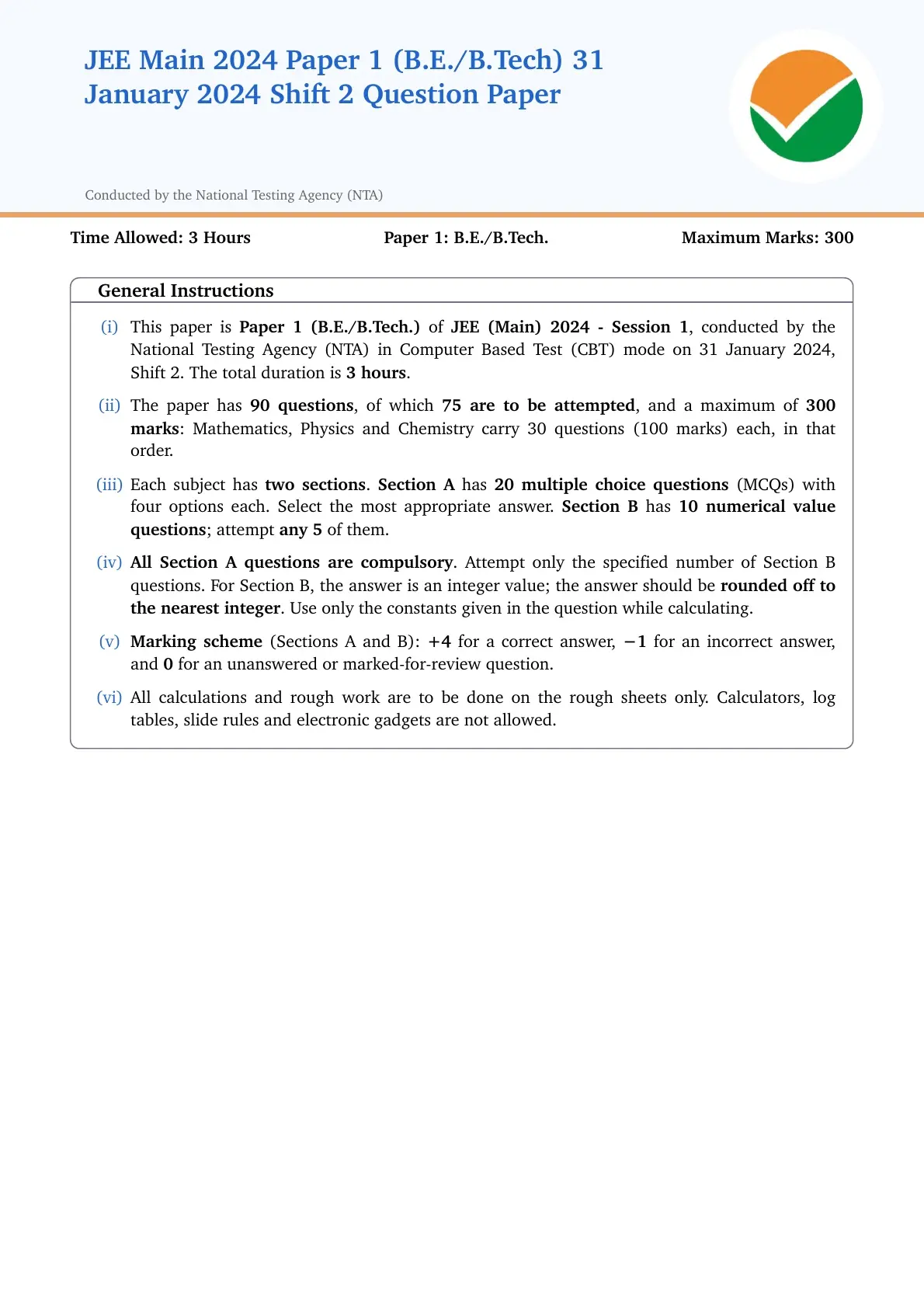
JEE Main 2024 January 31 Shift 2 Question Paper is available here with answer key and solution pdf. NTA conducted the second shift on January 31, 2024, from 3:00 PM to 6:00 PM. The JEE Main 2024 Paper 1 (B.E./B.Tech) question paper includes the following:
- 90 questions in a 3-hour CBT Mode: 30 each from Mathematics, Physics and Chemistry (75 to be attempted)
- Section A: 20 multiple choice questions (MCQs) per subject, 4 marks each
- Section B: 10 numerical value questions per subject, attempt any 5, 4 marks each (integer answer)
- Marking: +4 for a correct answer, -1 for an incorrect answer, 0 for an unattempted question
JEE Main 2024 January 31 Shift 2 Question Paper with Solution PDF
| NTA Official PDF | CD PDF | CD PDF with Solutions |
|---|---|---|
| Download official PDF 4.76 MB | Download Collegedunia PDF 1.25 MB | Download solutions PDF 1.29 MB |
Also Check:
JEE Main 2024 January 31 Shift 2 Questions with Solutions
Mathematics - Section A (Q1 - Q20)
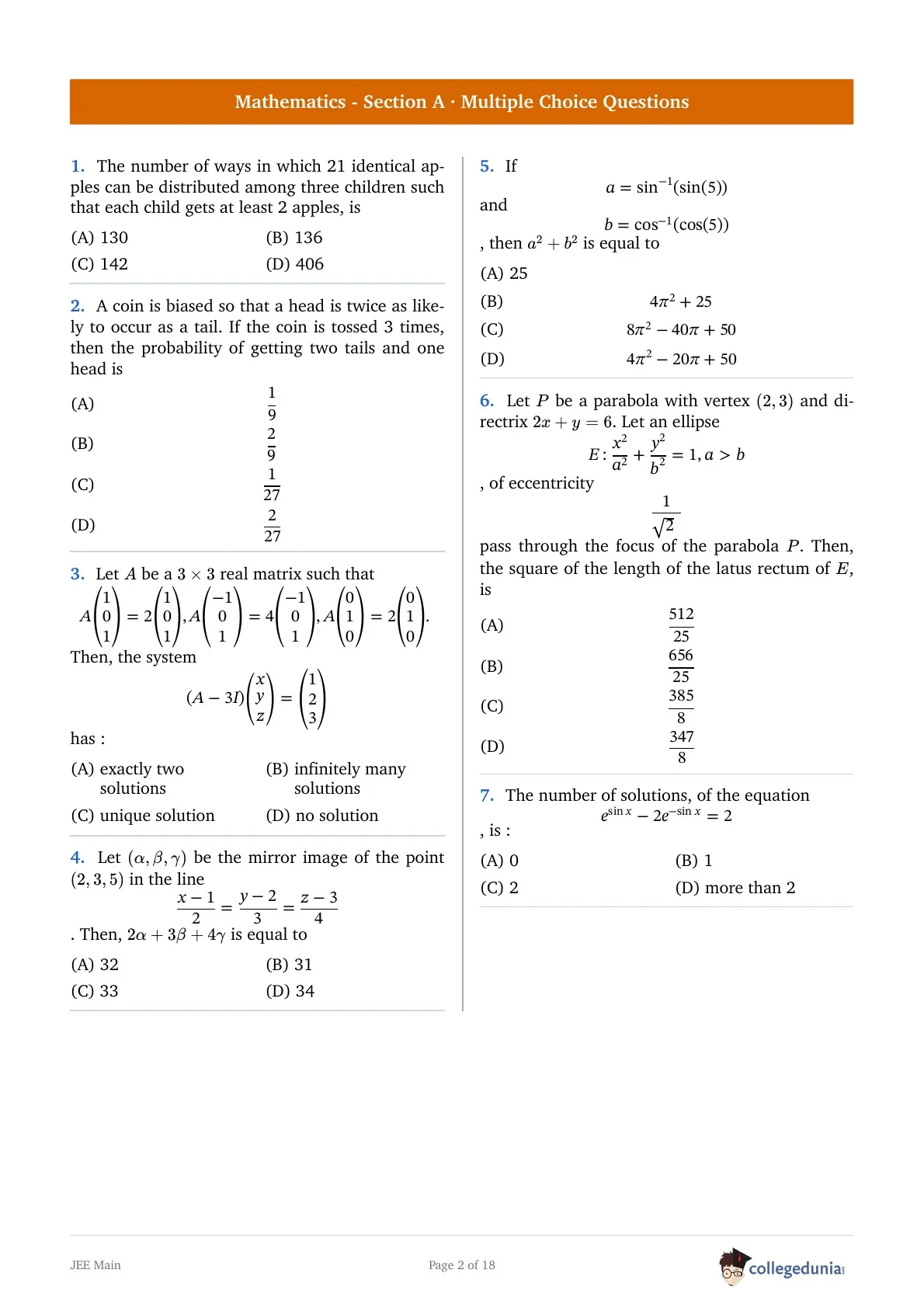
The number of ways in which 21 identical apples can be distributed among three children such that each child gets at least 2 apples, is
A coin is based so that a head is twice as likely to occur as a tail. If the coin is tossed 3 times, then the probability of getting two tails and one head is-
Let \(A\) be a \(3\times3\) real matrix such that \(A\begin{pmatrix}1\\0\\1\end{pmatrix}=2\begin{pmatrix}1\\0\\1\end{pmatrix},\ A\begin{pmatrix}-1\\0\\1\end{pmatrix}=4\begin{pmatrix}-1\\0\\1\end{pmatrix},\ A\begin{pmatrix}0\\1\\0\end{pmatrix}=2\begin{pmatrix}0\\1\\0\end{pmatrix}\).
Then, the system \((A-3I)\begin{pmatrix}x\\y\\z\end{pmatrix}=\begin{pmatrix}1\\2\\3\end{pmatrix}\) has :
Let \( (\alpha, \beta, \gamma) \) be the mirror image of the point \( (2, 3, 5) \) in the line \(\frac{x - 1}{2} = \frac{y - 2}{3} = \frac{z - 3}{4}\). Then \( 2\alpha + 3\beta + 4\gamma \) is equal to
If \( a = \sin^{-1} (\sin(5)) \) and \( b = \cos^{-1} (\cos(5)) \), then \( a^2 + b^2 \) is equal to
Let \( P \) be a parabola with vertex \( (2, 3) \) and directrix \( 2x + y = 6 \). Let an ellipse \( E : \frac{x^2}{a^2} + \frac{y^2}{b^2} = 1 \), \( a > b \), of eccentricity \( \frac{1}{\sqrt{2}} \) pass through the focus of the parabola \( P \). Then the square of the length of the latus rectum of \( E \) is
The number of solutions of the equation \(e^{\sin x} - 2e^{-\sin x} = 2\) is
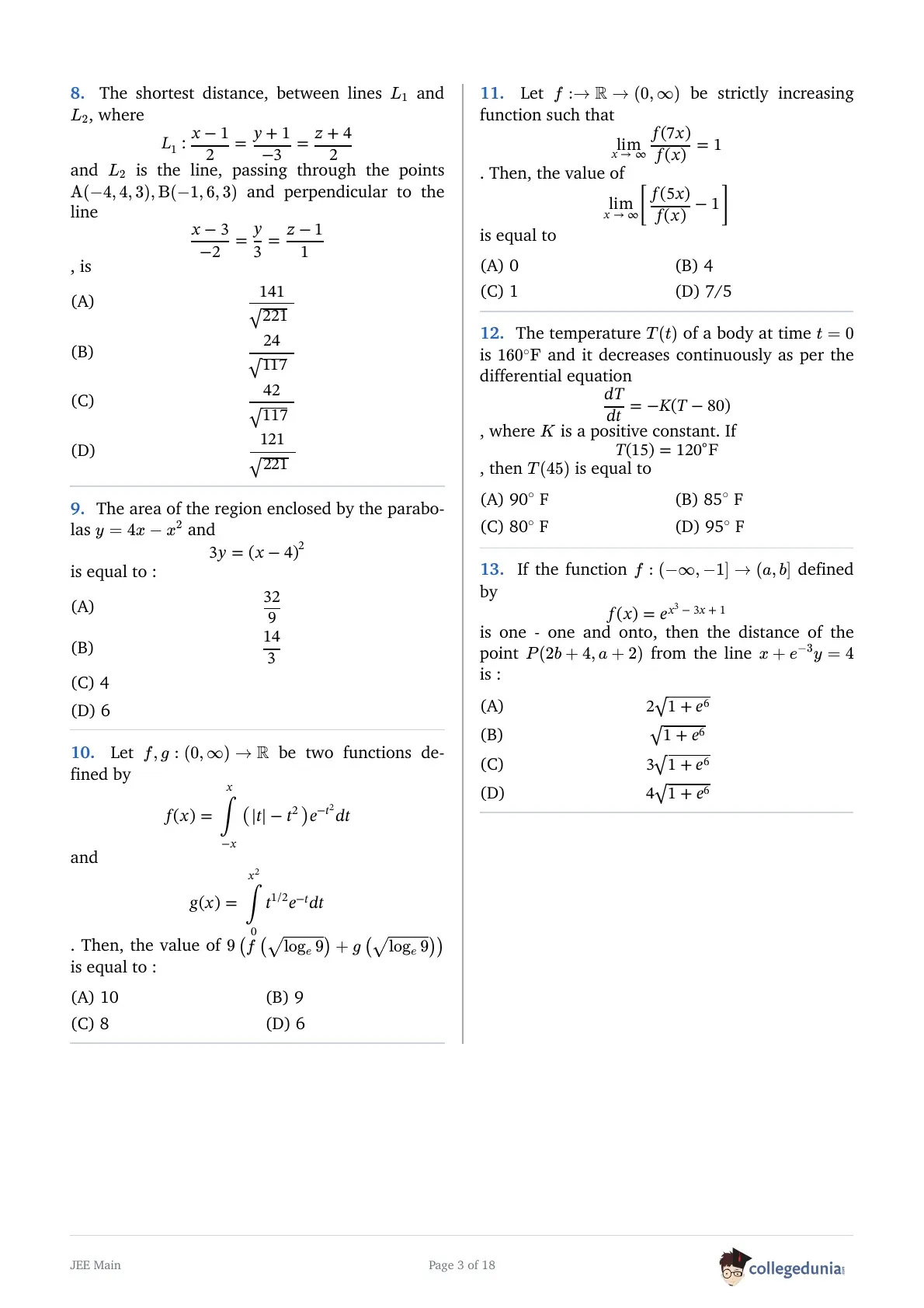
The shortest distance between lines \( L_1 \) and \( L_2 \), where \( L_1 : \frac{x - 1}{2} = \frac{y + 1}{-3} = \frac{z + 4}{2} \) and \( L_2 \) is the line passing through the points \( A(-4, 4, 3) \), \( B(-1, 6, 3) \) and perpendicular to the line \( \frac{x - 3}{-2} = \frac{y}{3} = \frac{z - 1}{1} \), is
The area of the region enclosed by the parabola \( y = 4x - x^2 \) and \( 3y = (x - 4)^2 \) is equal to
Let \( f, g : (0, \infty) \rightarrow \mathbb{R} \) be two functions defined by \(f(x) = \int_{-x}^{x} (|t| - t^2) e^{-t^2} \, dt \quad \text{and} \quad g(x) = \int_{0}^{x} t^{1/2} e^{-t} \, dt.\)Then the value of \( f \left( \sqrt{\log_e 9} \right) + g \left( \sqrt{\log_e 9} \right) \) is equal to
Let \( f : \mathbb{R} \rightarrow (0, \infty) \) be a strictly increasing function such that \(\lim_{x \to \infty} \frac{f(7x)}{f(x)} = 1.\)Then, the value of \(\lim_{x \to \infty} \left[ \frac{f(5x)}{f(x)} - 1 \right]\)is equal to
The temperature \( T(t) \) of a body at time \( t = 0 \) is \( 160^\circ \)F and it decreases continuously as per the differential equation \[ \frac{dT}{dt} = -K(T - 80), \] **where \( K \) is a positive constant. If \( T(15) = 120^\circ \)F, then \( T(45) \) is equal to
If the function \( f : (-\infty, -1] \rightarrow (a, b) \) defined by \(f(x) = e^{x^3 - 3x + 1}\) is one-one and onto, then the distance of the point \( P(2b + 4, a + 2) \) from the line \( x + e^{-3} y = 4 \) is:
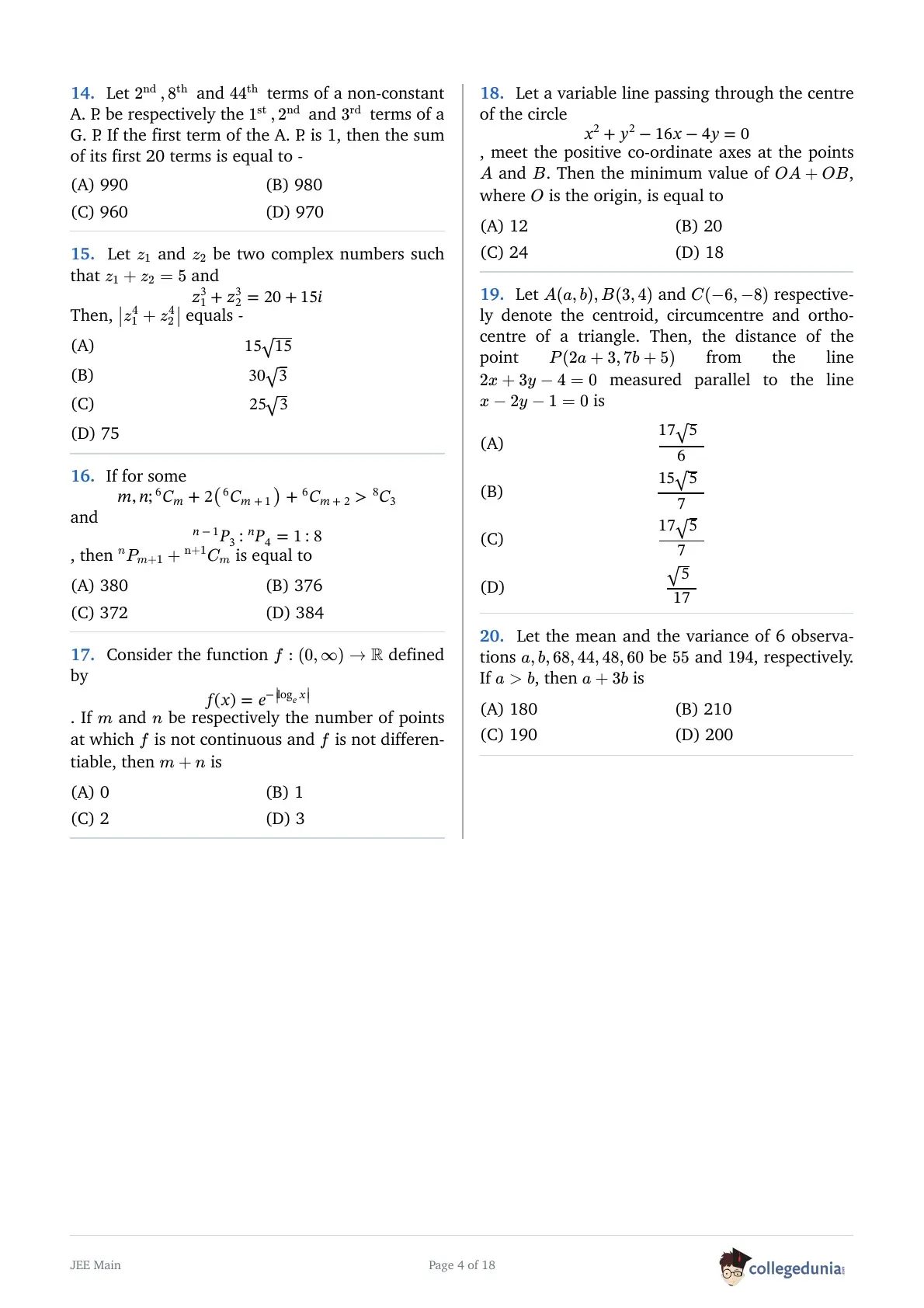
Let 2nd, 8th, and 44th terms of a non-constant A.P. be respectively the 1st, 2nd, and 3rd terms of a G.P. If the first term of A.P. is 1, then the sum of the first 20 terms is equal to
Let \( z_1 \) and \( z_2 \) be two complex numbers such that \( z_1 + z_2 = 5 \) and \( z_1^3 + z_2^3 = 20 + 15i \). Then \( \left| z_1^4 + z_2^4 \right| \) equals
If for some \( m, n \); \( ^6C_m + 2\left(^6C_{m+1}\right) + ^6C_{m+2} > ^8C_3 \) and \( ^{n-1}P_3 \cdot ^nP_4 = 1 : 8 \), then \( ^nP_{m+1} + ^{n+1}C_m \) is equal to
Consider the function \( f : (0, \infty) \rightarrow \mathbb{R} \) defined by \(f(x) = e^{-| \log_e x |}.\)If \( m \) and \( n \) be respectively the number of points at which \( f \) is not continuous and \( f \) is not differentiable, then \( m + n \) is
Let a variable line passing through the centre of the circle x2 + y2 – 16x – 4y = 0, meet the positive co-ordinate axes at the point A and B. Then the minimum value of OA + OB, where O is the origin, is equal to
Let \( A (a, b), B(3, 4) \) and \( (-6, -8) \) respectively denote the centroid, circumcentre, and orthocentre of a triangle. Then, the distance of the point \( P(2a + 3, 7b + 5) \) from the line \( 2x + 3y - 4 = 0 \) measured parallel to the line \( x - 2y - 1 = 0 \) is
Let the mean and the variance of 6 observation a,b, 68, 44, 48, 60 be 55 and 194, respectively if a > b, then a + 3b is
Mathematics - Section B (Q21 - Q30)
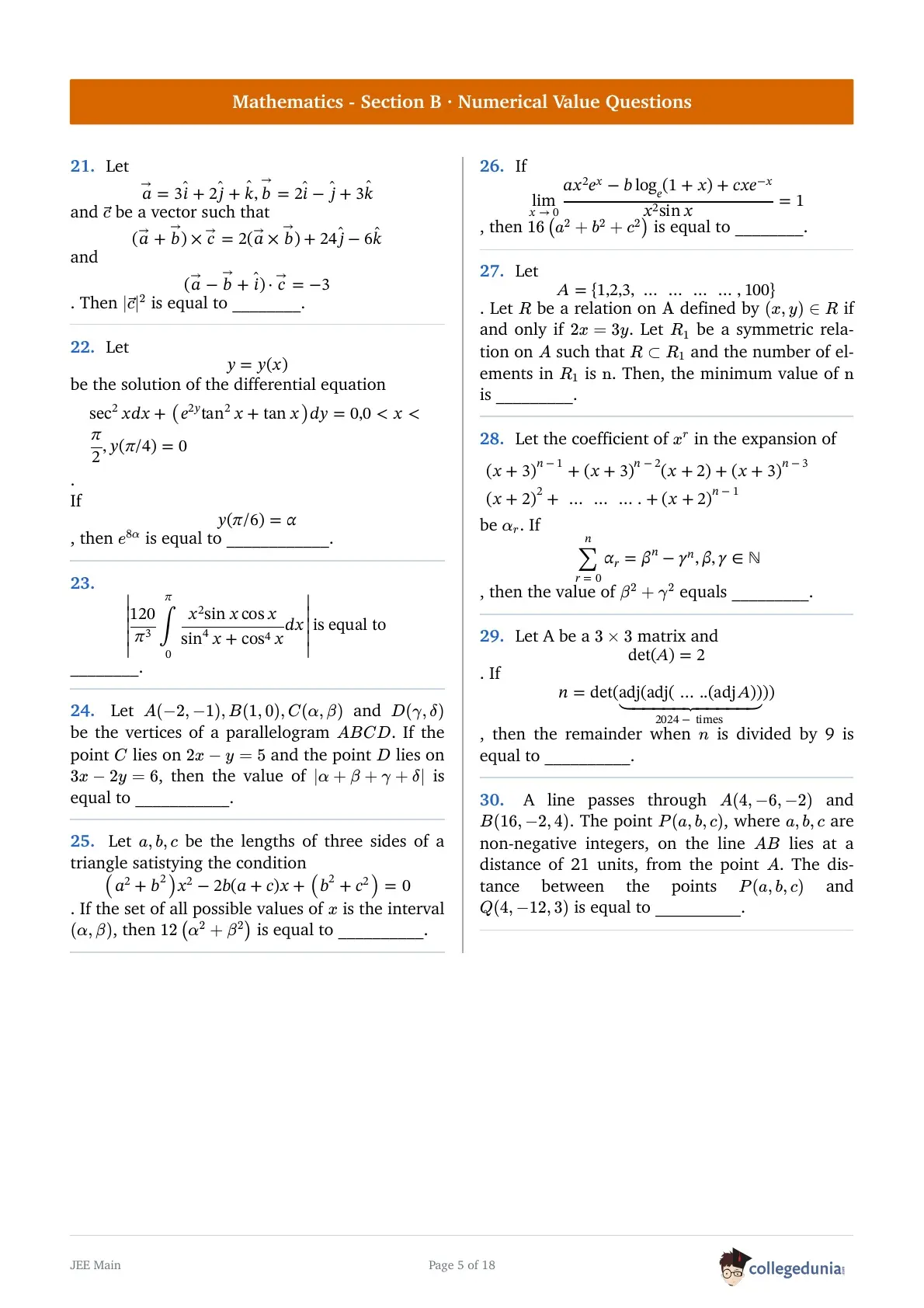
Let \( \vec{a} = 3\hat{i} + 2\hat{j} + \hat{k} \), \( \vec{b} = 2\hat{i} - \hat{j} + 3\hat{k} \), and \( \vec{c} \) be a vector such that
\((\vec{a} + \vec{b}) \times \vec{c} = 2(\vec{a} \times \vec{b}) + 24\hat{j} - 6\hat{k}\) and \((\vec{a} - \vec{b} + \hat{i}) \cdot \vec{c} = -3.\)Then \( |\vec{c}|^2 \) is equal to \(\_\_\_\_\_.\)
Let \( y = y(x) \) be the solution of the differential equation \(\sec^2 x \, dx + \left( e^{2y} \tan^2 x + \tan x \right) dy = 0,\)\( 0 < x < \frac{\pi}{2} \), \( y \left( \frac{\pi}{4} \right) = 0 \). If \( y \left( \frac{\pi}{6} \right) = \alpha \), then \( e^{8\alpha} \) is equal to\(\_\_\_\_\_\).
\(\left| \frac{120}{\pi^3} \int_0^{\frac{\pi}{2}} \frac{x^2 \sin x \cos x}{\sin^4 x + \cos^4 x} \, dx \right| \text{ is equal to } \_\_\_\_\_\_\_\_.\)
Let \( A(-2, -1) \), \( B(1, 0) \), \( C(\alpha, \beta) \), and \( D(\gamma, \delta) \) be the vertices of a parallelogram \( ABCD \). If the point \( C \) lies on \( 2x - y = 5 \) and the point \( D \) lies on \( 3x - 2y = 6 \), then the value of \( | \alpha + \beta + \gamma + \delta | \) is equal to\( \_\_\_\_\_\).
Let \( a \), \( b \), \( c \) be the lengths of three sides of a triangle satisfying the condition \( (a^2 + b^2)x^2 - 2b(a + c)x + (b^2 + c^2) = 0 \). If the set of all possible values of \( x \) is the interval \( (\alpha, \beta) \), then \( 12(\alpha^2 + \beta^2) \) is equal to \(\_\_\_\_\_\).
If \(\lim_{x \to 0} \frac{ax^2 e^x - b \log_e (1 + x) + c x e^{-x}}{x^2 \sin x} = 1,\)then \( 16(a^2 + b^2 + c^2) \) is equal to \(\_\_\_\_\_\).
Let \( A = \{1, 2, 3, \ldots, 100\} \). Let \( R \) be a relation on \( A \) defined by \( (x, y) \in R \) if and only if \( 2x = 3y \). Let \( R_1 \) be a symmetric relation on \( A \) such that \( R \subset R_1 \) and the number of elements in \( R_1 \) is \( n \). Then, the minimum value of \( n \) is \(\_\_\_\_\_\).
Let the coefficient of \( x^r \) in the expansion of \((x + 3)^{n-1} + (x + 3)^{n-2} (x + 2) + (x + 3)^{n-3} (x + 2)^2 + \ldots + (x + 2)^{n-1}\)
be \( \alpha_r \). If \( \sum_{r=0}^n \alpha_r = \beta^n - \gamma^n \), \( \beta, \gamma \in \mathbb{N} \), then the value of \( \beta^2 + \gamma^2 \) equals \(\_\_\_\_\_\).
Let \( A \) be a \( 3 \times 3 \) matrix and \( \det(A) = 2 \). If \(n = \det(\text{adj}(\text{adj}(\ldots(\text{adj}(A))\ldots)))\) with adjoint applied 2024 times, then the remainder when \( n \) is divided by 9 is equal to \(\_\_\_\_\_.\)
A line passes through \( A(4, -6, -2) \) and \( B(16, -2, 4) \). The point \( P(a, b, c) \) where \( a \), \( b \), \( c \) are non-negative integers, on the line \( AB \) lies at a distance of 21 units from the point \( A \). The distance between the points \( P(a, b, c) \) and \( Q(4, -12, 3) \) is equal to \(\_\_\_\_\_\).
Physics - Section A (Q31 - Q50)
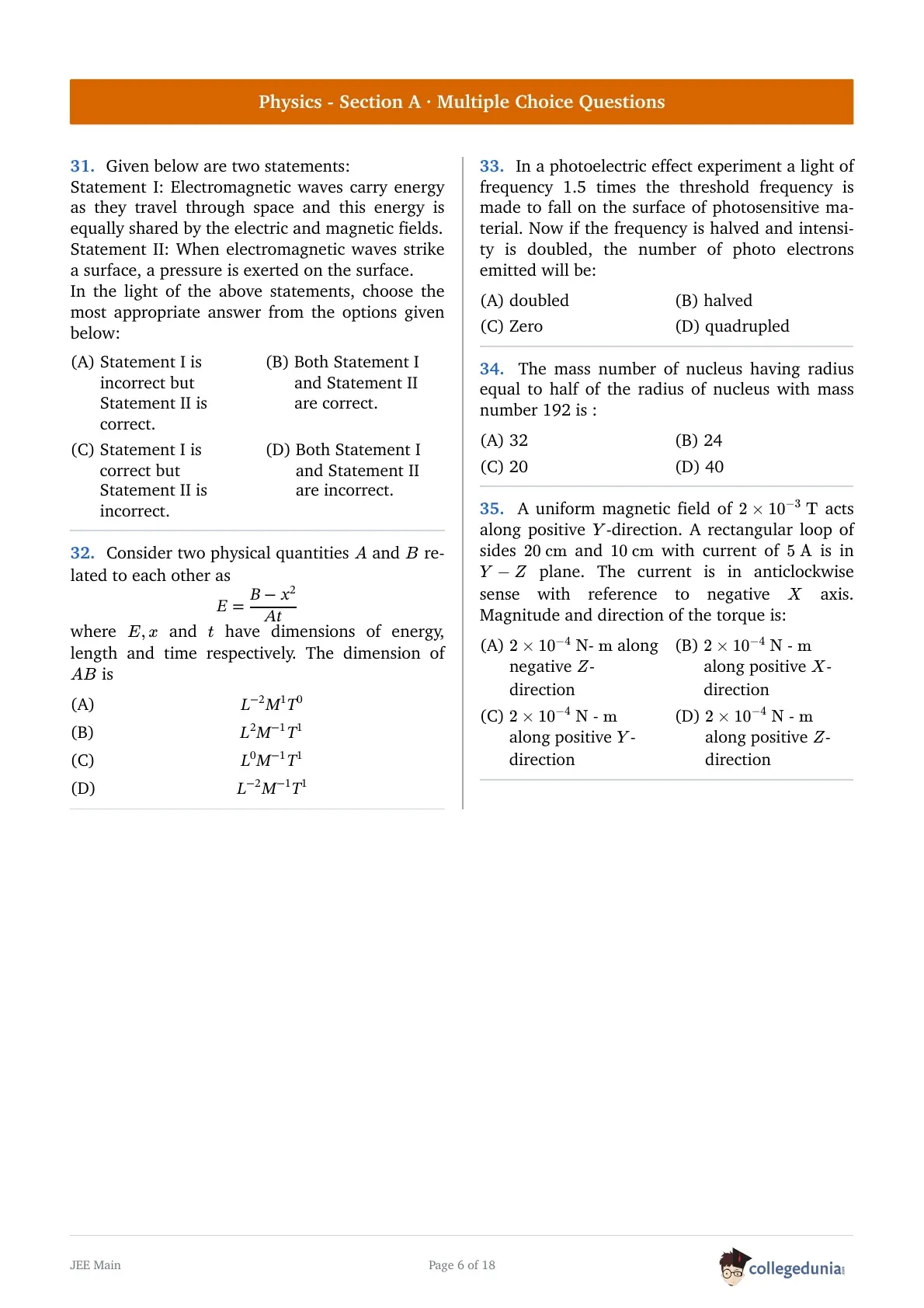
Given below are two statements:
Statement I: Electromagnetic waves carry energy as they travel through space and this energy is equally shared by the electric and magnetic fields.
Statement II: When electromagnetic waves strike a surface, a pressure is exerted on the surface. In the light of the above statements.
Choose the most appropriate answer from the options given below:
Consider two physical quantities \( A \) and \( B \) related to each other as \( E = \frac{B - x^2}{At} \) where \( E \), \( x \), and \( t \) have dimensions of energy, length, and time, respectively. The dimension of \( AB \) is:
In a photoelectric effect experiment a light of frequency 1.5 times the threshold frequency is made to fall on the surface of photosensitive material. Now if the frequency is halved and intensity is doubled, the number of photo electrons emitted will be:
The mass number of nucleus having radius equal to half of the radius of nucleus with mass number 192 is:
A uniform magnetic field of \( 2 \times 10^{-3} \, \text{T} \) acts along positive Y-direction. A rectangular loop of sides 20 cm and 10 cm with current of 5 A is in the Y-Z plane. The current is in anticlockwise sense with reference to the negative X-axis. Magnitude and direction of the torque is:
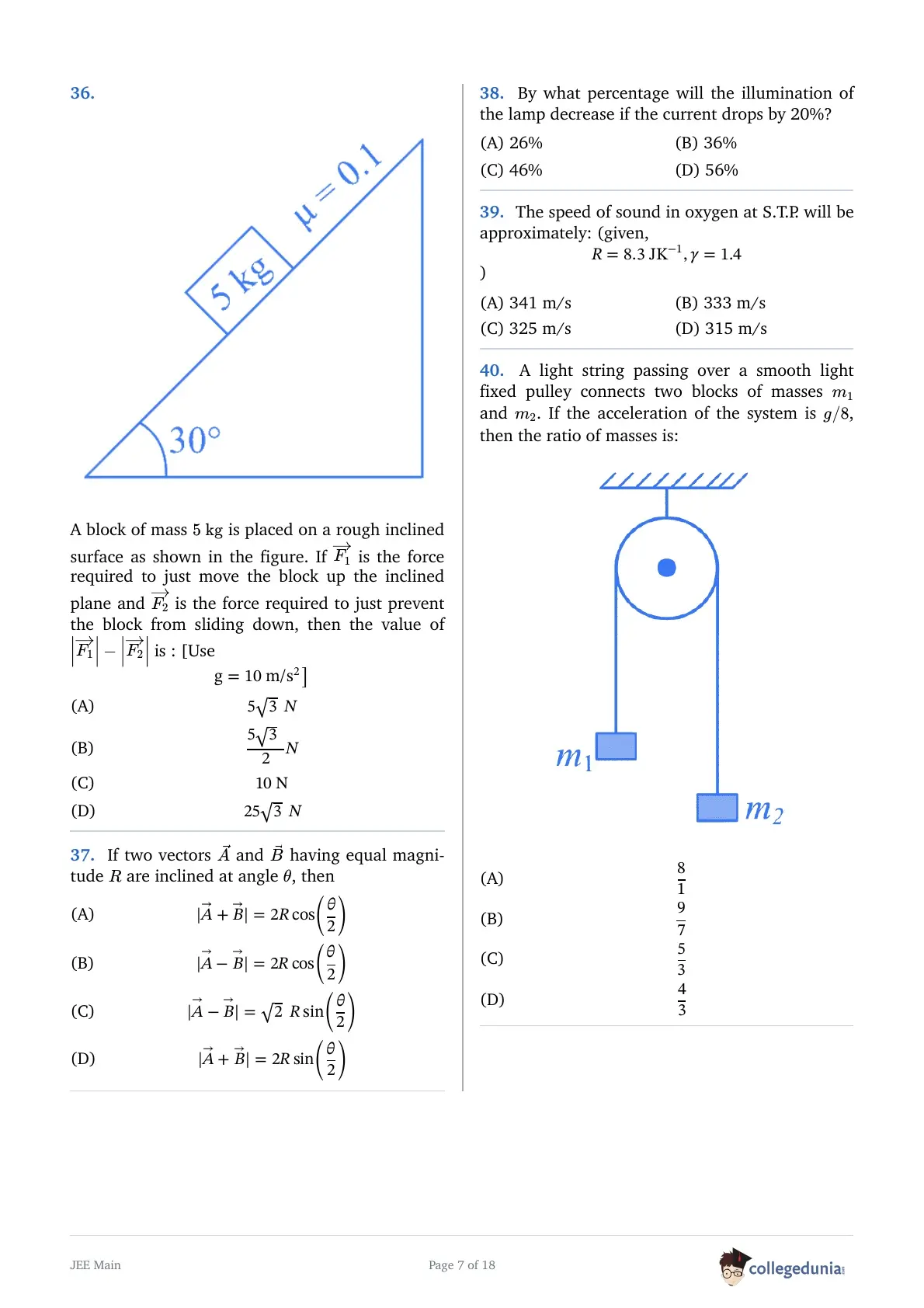
A block of mass 5 kg is placed on a rough inclined surface as shown in the figure.
If \(\vec{F_1}\) is the force required to just move the block up the inclined plane and \(\vec{F_2}\) is the force required to just prevent the block from sliding down, then the value of \(|\vec{F_1}| - |\vec{F_2}|\) is: [Use \(g = 10 \, \text{m/s}^2\)]
If two vectors \(\vec{A}\) and \(\vec{B}\) having equal magnitude \(R\) are inclined at an angle \(\theta\), then
By what percentage will the illumination of the lamp decrease if the current drops by 20%?
The speed of sound in oxygen at S.T.P. will be approximately: Given, \( R = 8.3 \, \text{J K}^{-1} \), \( \gamma = 1.4 \))
A light string passing over a smooth light fixed pulley connects two blocks of masses m1 and m2. If the acceleration of the system is g/8, then the ratio of masses is
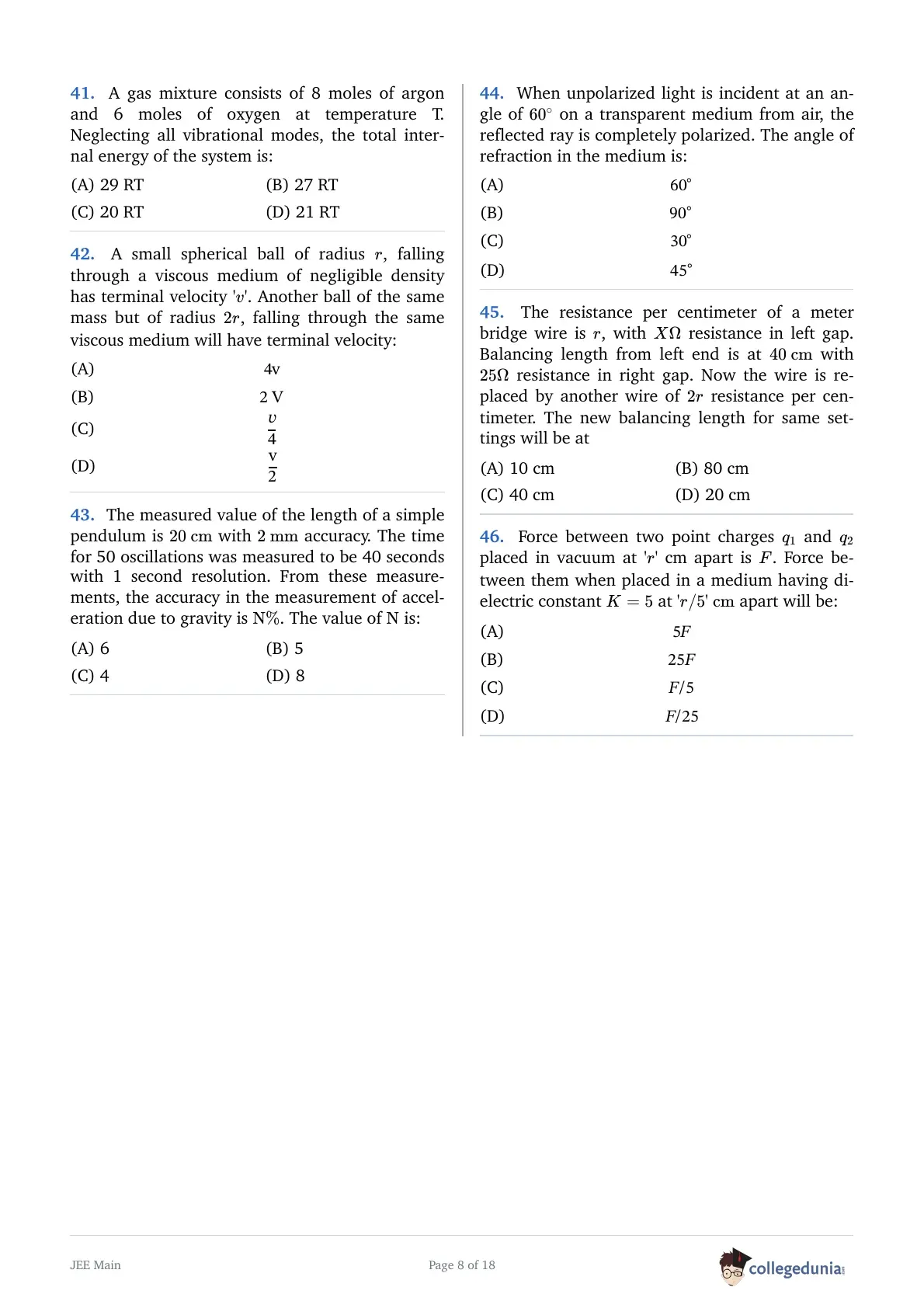
A gas mixture consists of 8 moles of argon and 6 moles of oxygen at temperature T. Neglecting all vibrational modes, the total internal energy of the system is
A small spherical ball of radius r, falling through a viscous medium of negligible density has terminal velocity 'v'. Another ball of the same mass but of radius 2r, falling through the same viscous medium will have terminal velocity:
The measured value of the length of a simple pendulum is 20 cm with 2 mm accuracy. The time for 50 oscillations was measured to be 40 seconds with 1 second resolution. From these measurements, the accuracy in the measurement of acceleration due to gravity is N%. The value of N is:
When unpolarized light is incident at an angle of 60° on a transparent medium from air. The reflected ray is completely polarized. The angle of refraction in the medium is
The resistance per centimeter of a meter bridge wire is \( r \), with \( X \, \Omega \) resistance in the left gap. Balancing length from the left end is at 40 cm with 25 \( \Omega \) resistance in the right gap. Now the wire is replaced by another wire of \( 2r \) resistance per centimeter. The new balancing length for the same settings will be at:
Force between two point charges \( q_1 \) and \( q_2 \) placed in vacuum at \( r \) cm apart is \( F \). Force between them when placed in a medium having dielectric \( K = 5 \) at \( r/5 \) cm apart will be:
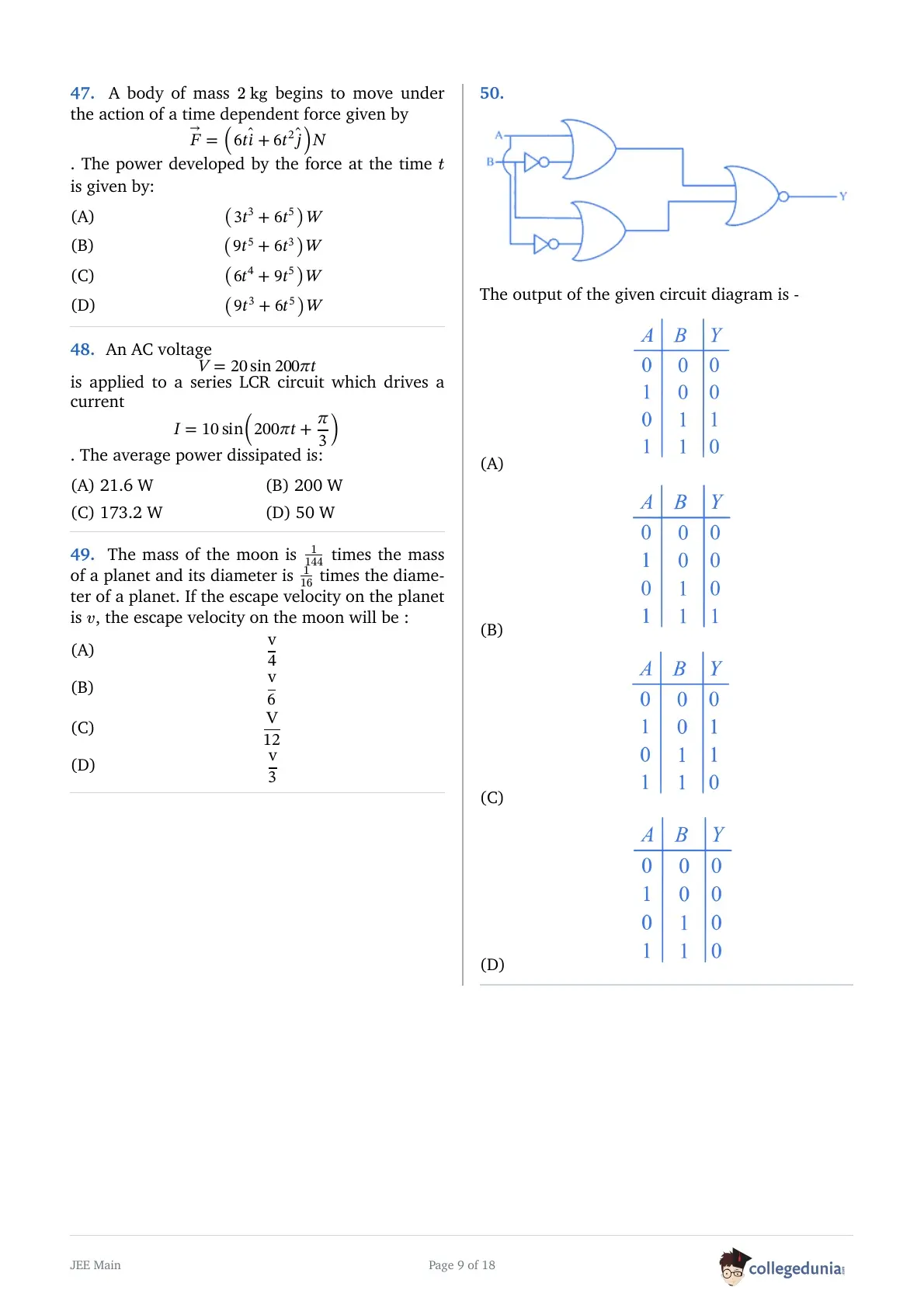
A body of mass \(2 \, \text{kg}\) begins to move under the action of a time-dependent force given by \(\vec{F} = (6t \, \hat{i} + 6t^2 \, \hat{j}) \, \text{N}\). The power developed by the force at the time \(t\) is given by:
An AC voltage \( V = 20 \sin 200 \pi t \) is applied to a series LCR circuit which drives a current \( I = 10 \sin \left( 200 \pi t + \frac{\pi}{3} \right) \). The average power dissipated is:
The mass of the moon is 1/144 times the mass of a planet and its diameter 1/16 times the diameter of a planet. If the escape velocity on the planet is v, the escape velocity on the moon will be:

Physics - Section B (Q51 - Q60)
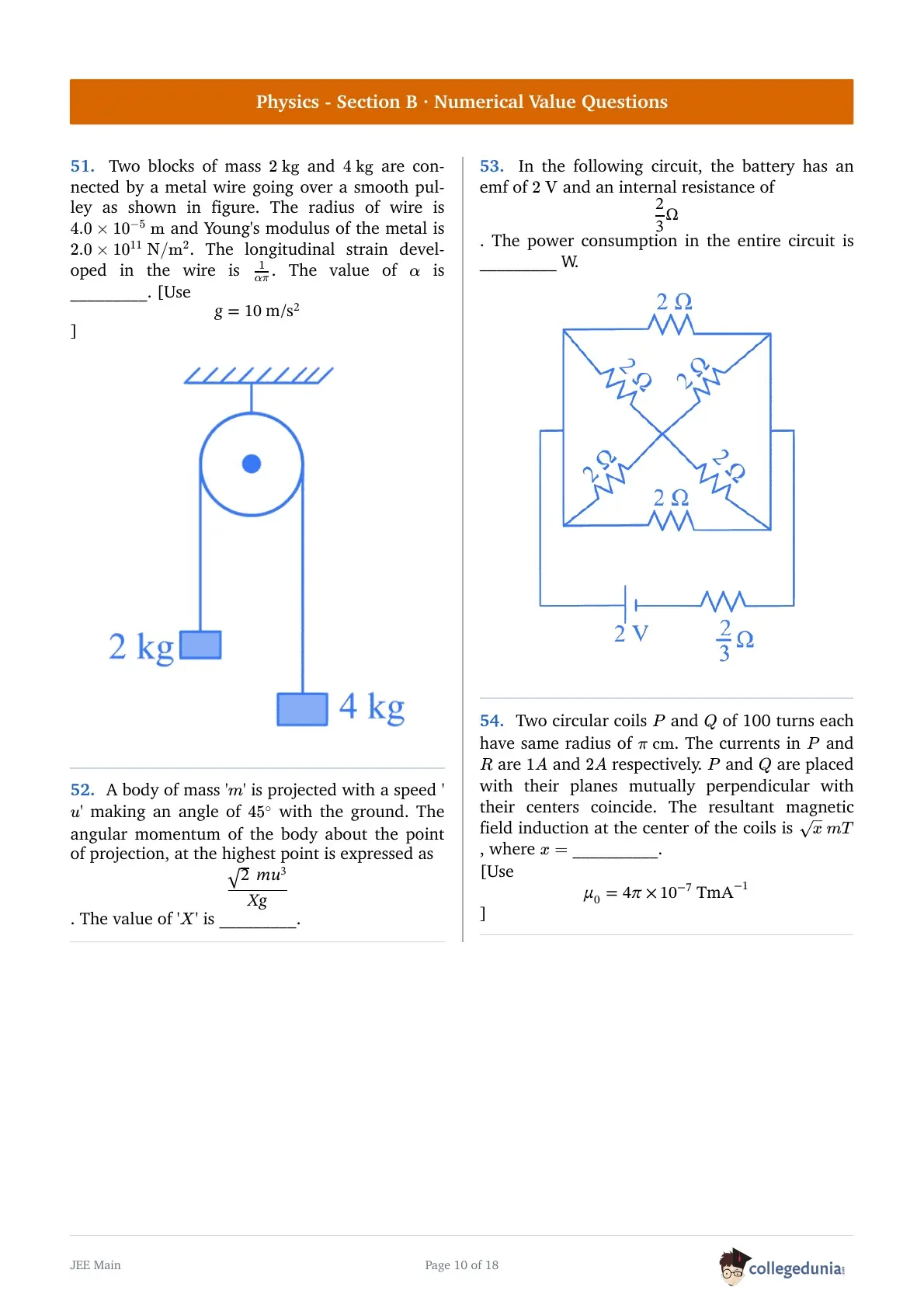
Two blocks of mass \(2 \, \text{kg}\) and \(4 \, \text{kg}\) are connected by a metal wire going over a smooth pulley as shown in the figure. The radius of the wire is \(4.0 \times 10^{-5} \, \text{m}\) and Young's modulus of the metal is \(2.0 \times 10^{11} \, \text{N/m}^2\). The longitudinal strain developed in the wire is \(\frac{1}{\alpha \pi}\). The value of \(\alpha\) is _____. [Use \(g = 10 \, \text{m/s}^2\)]
A body of mass 'm' is projected with a speed 'u' making an angle of \(45^\circ\) with the ground. The angular momentum of the body about the point of projection, at the highest point, is expressed as \(\frac{\sqrt{2} \, m u^3}{X g}\). The value of 'X' is ______.
In the following circuit, the battery has an emf of \(2 \, \text{V}\) and an internal resistance of \(\frac{2}{3} \, \Omega\). The power consumption in the entire circuit is ______ W.
Two circular coils \(P\) and \(Q\) of \(100\) turns each have the same radius of \(\pi \, \text{cm}\). The currents in \(P\) and \(Q\) are \(1 \, \text{A}\) and \(2 \, \text{A}\) respectively. \(P\) and \(Q\) are placed with their planes mutually perpendicular with their centers coinciding. The resultant magnetic field induction at the center of the coils is \(\sqrt{x} \, \text{mT}\), where \(x =\) ______.
[Use \(\mu_0 = 4 \pi \times 10^{-7} \, \text{TmA}^{-1}\)]
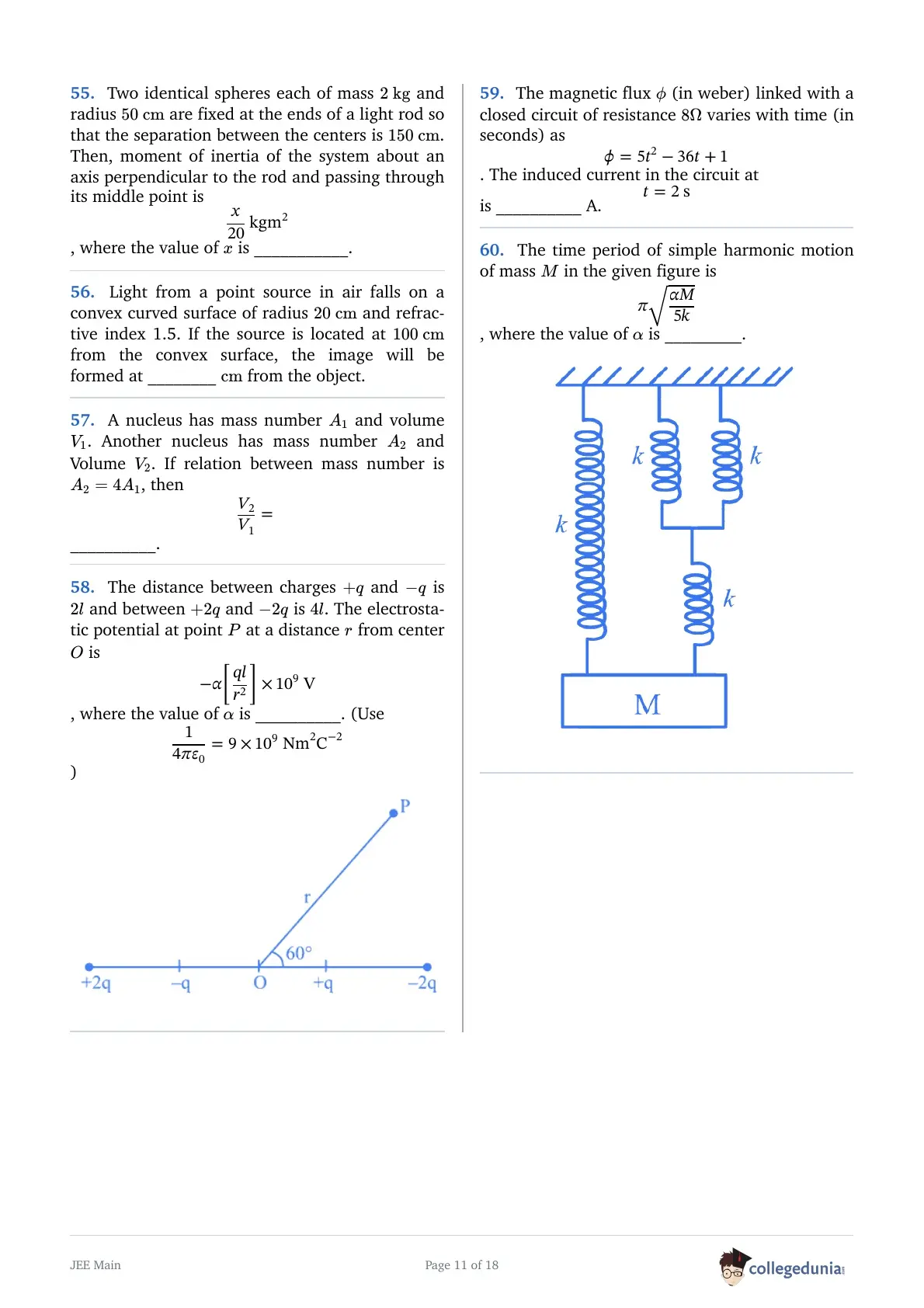
Two identical spheres each of mass 2 kg and radius 50 cm are fixed at the ends of a light rod so that the separation between the centers is 150 cm. Then, moment of inertia of the system about an axis perpendicular to the rod and passing through its middle point is \(\frac{x}{20}\) kg m3 , where the value of x is ____.
Light from a point source in air falls on a convex curved surface of radius 20 cm and refractive index 1.5. If the source is located at 100 cm from the convex surface, the image will be formed at____ cm from the object.
A nucleus has mass number \(A_1\) and volume \(V_1\). Another nucleus has mass number \(A_2\) and volume \(V_2\). If the relation between mass numbers is \(A_2 = 4A_1\), then \(\frac{V_2}{V_1} =\) _______.
The distance between charges \(+q\) and \(-q\) is \(2l\) and between \(+2q\) and \(-2q\) is \(4l\). The electrostatic potential at point \(P\) at a distance \(r\) from center \(O\) is \(-\alpha \left[\frac{q}{r^2}\right] \times 10^9 \, \text{V}\), where the value of \(\alpha\) is ______.
(Use \(\frac{1}{4 \pi \epsilon_0} = 9 \times 10^9 \, \text{Nm}^2 \text{C}^{-2}\))
The magnetic flux \(\phi\) (in weber) linked with a closed circuit of resistance \(8 \, \Omega\) varies with time (in seconds) as \(\phi = 5t^2 - 36t + 1\). The induced current in the circuit at \(t = 2 \, \text{s}\) is ______ A.
The time period of simple harmonic motion of mass \(M\) in the given figure is \(\pi \sqrt{\frac{\alpha M}{5K}}\), where the value of \(\alpha\) is ______.
Chemistry - Section A (Q61 - Q80)


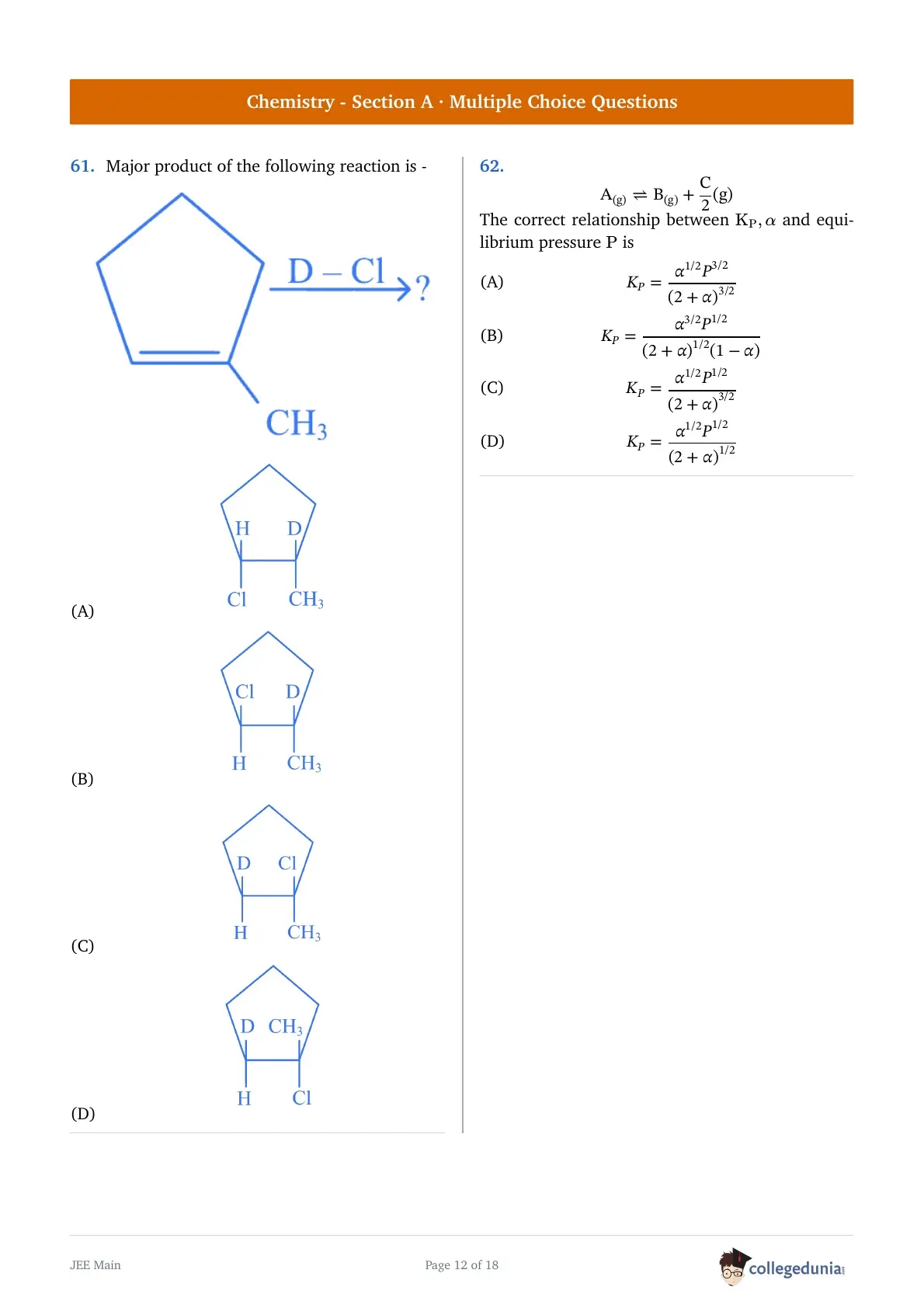
\( A_{(g)} \rightleftharpoons B_{(g)} + \frac{C}{2}_{(g)} \) The correct relationship between \( K_P \), \( \alpha \), and equilibrium pressure \( P \) is:
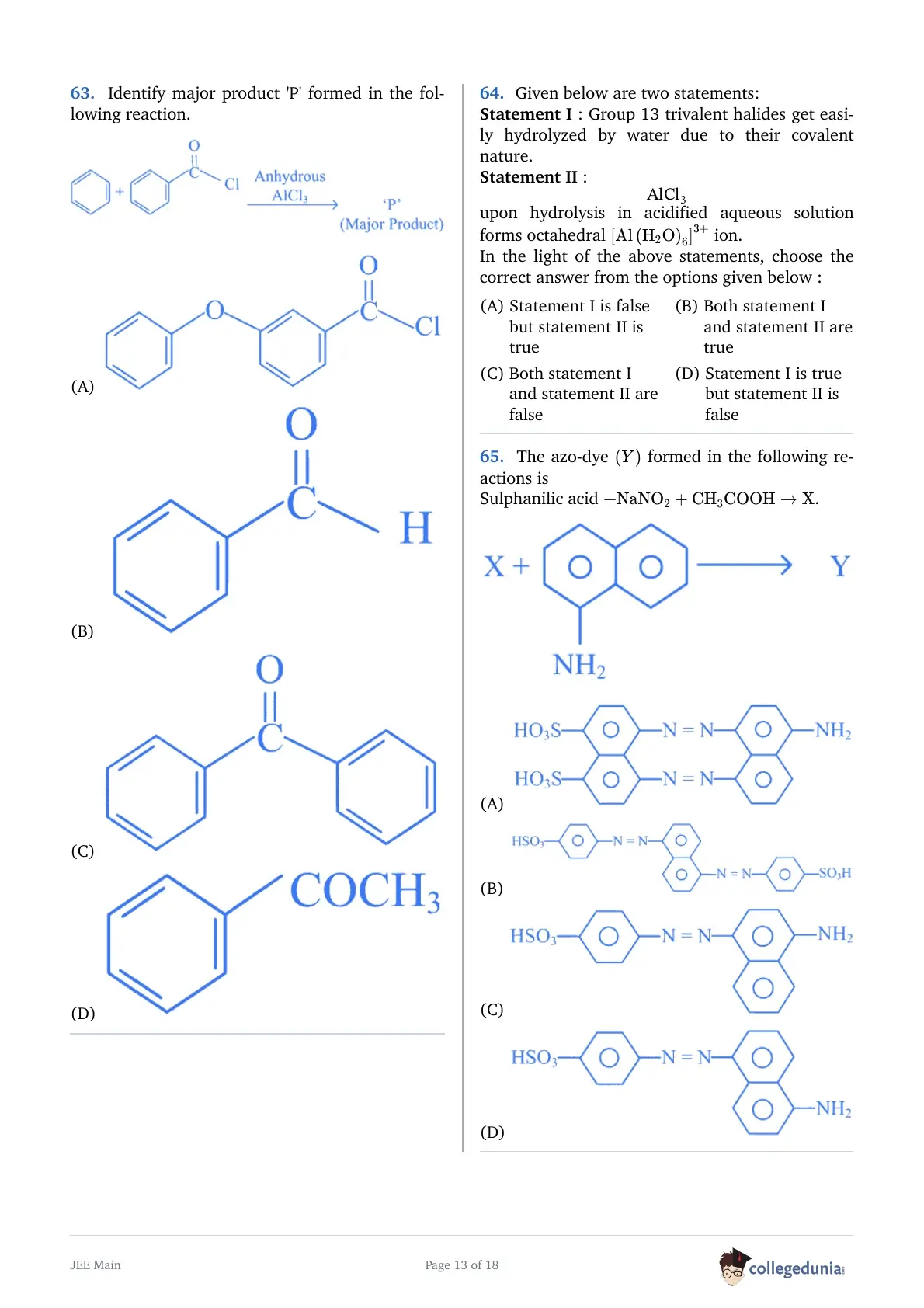
Identify major product ‘P’ formed in the following reaction.

- (1)
![cl1]()
- (2)
![cl2]()
- (3)
![cl3]()
- (4)
![cl4]()


Given below are two statements:
Statement I: Group 13 trivalent halides get easily hydrolyzed by water due to their covalent nature.
Statement II: \( AlCl_3 \) upon hydrolysis in acidified aqueous solution forms octahedral \([Al(H_2O)_6]^{3+}\) ion.
In the light of the above statements, choose the correct answer from the options given below:
The azo-dye (Y) formed in the following reactions is: Sulphanilic acid + NaNO\(_2\) + CH\(_3\)COOH → X

- (1)
![]()
- (2)
![]()
- (3)
![]()
- (4)
![]()


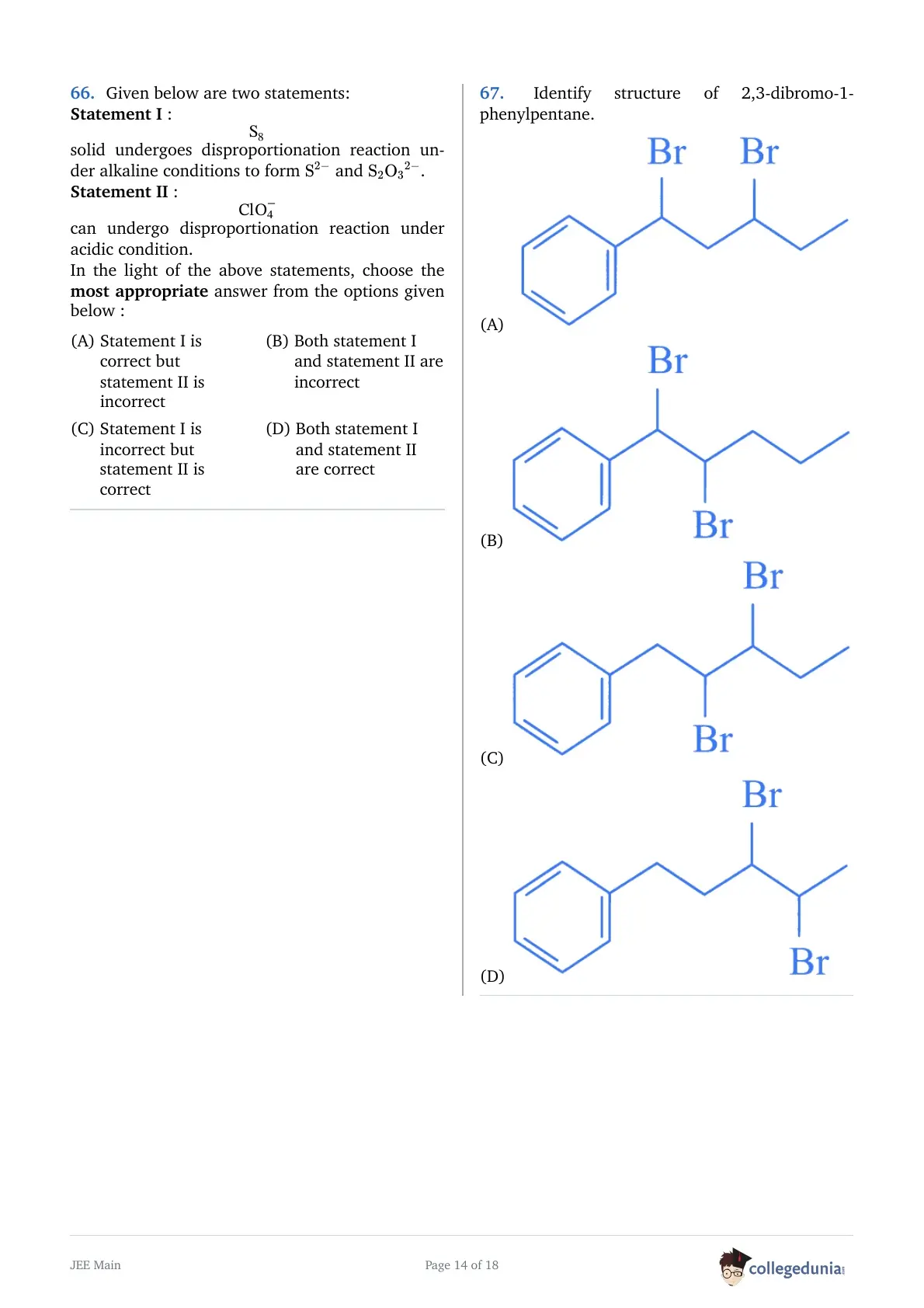
Given below are two statements:
Statement I: \( \text{S}_8 \) solid undergoes disproportionation reaction under alkaline conditions to form \( \text{S}^{2-} \) and \( \text{S}_2\text{O}_3^{2-} \).
Statement II: \( \text{ClO}_4^- \) can undergo disproportionation reaction under acidic condition.
In the light of the above statements, choose the most appropriate answer from the options given below:


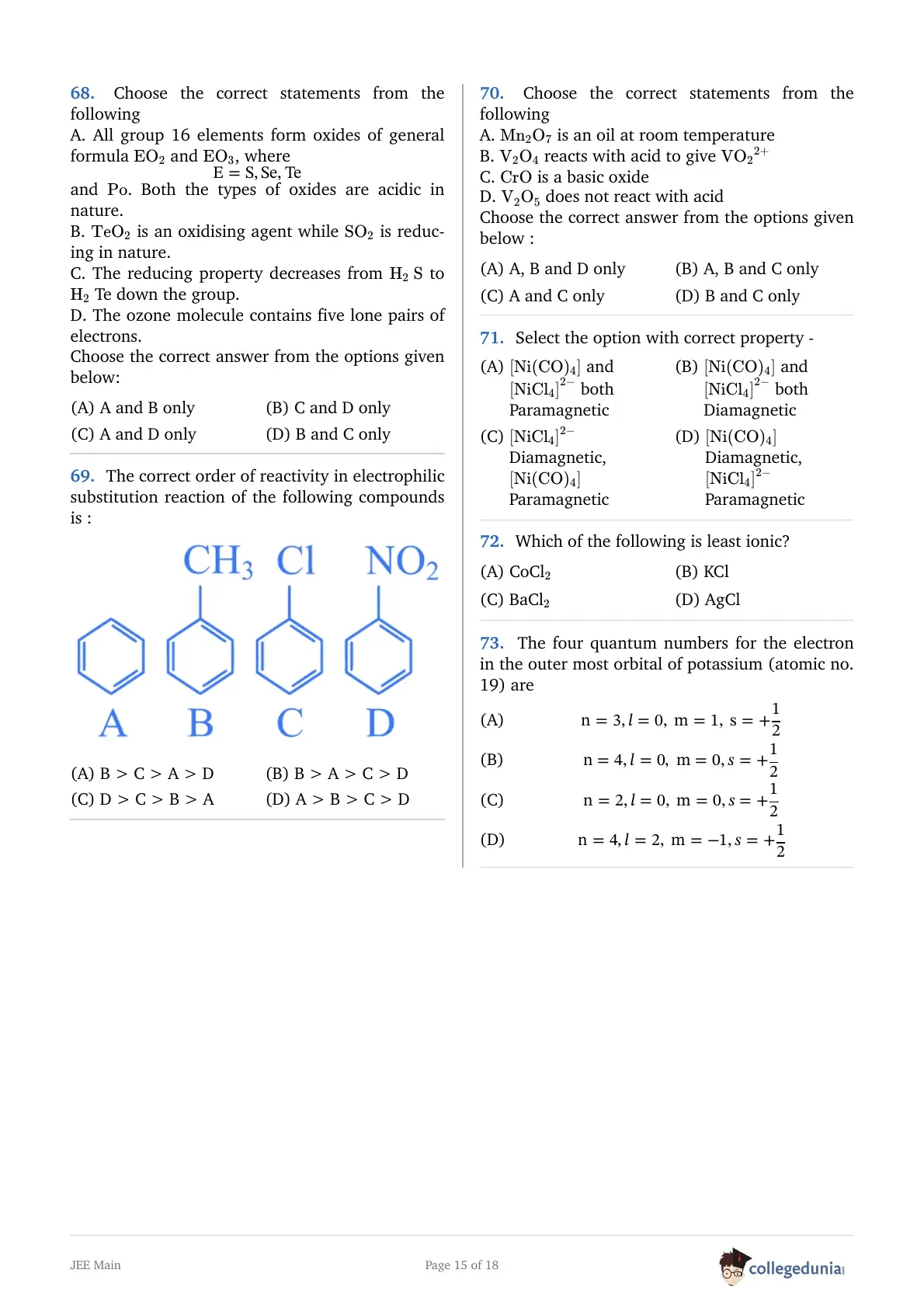
Choose the correct statements from the following:
A. All group 16 elements form oxides of general formula \( EO_2 \) and \( EO_3 \) where \( E = S, Se, Te, \) and Po. Both the types of oxides are acidic in nature.
B. TeO\(_2\) is an oxidising agent while SO\(_2\) is reducing in nature.
C. The reducing property decreases from H\(_2\)S to H\(_2\)Te down the group.
D. The ozone molecule contains five lone pairs of electrons.
Choose the correct answer from the options given below:
The correct order of reactivity in electrophilic substitution reaction of the following compounds is :

Choose the correct statements from the following:
A. \( Mn_2O_7 \) is an oil at room temperature
B. \( V_2O_4 \) reacts with acid to give \( VO_2^{2+} \)
C. \( CrO \) is a basic oxide
D. \( V_2O_5 \) does not react with acid
Choose the correct answer from the options given below:
Select the option with correct property -
Which of the following is least ionic ?
The four quantum numbers for the electron in the outer most orbital of potassium (atomic no. 19) are


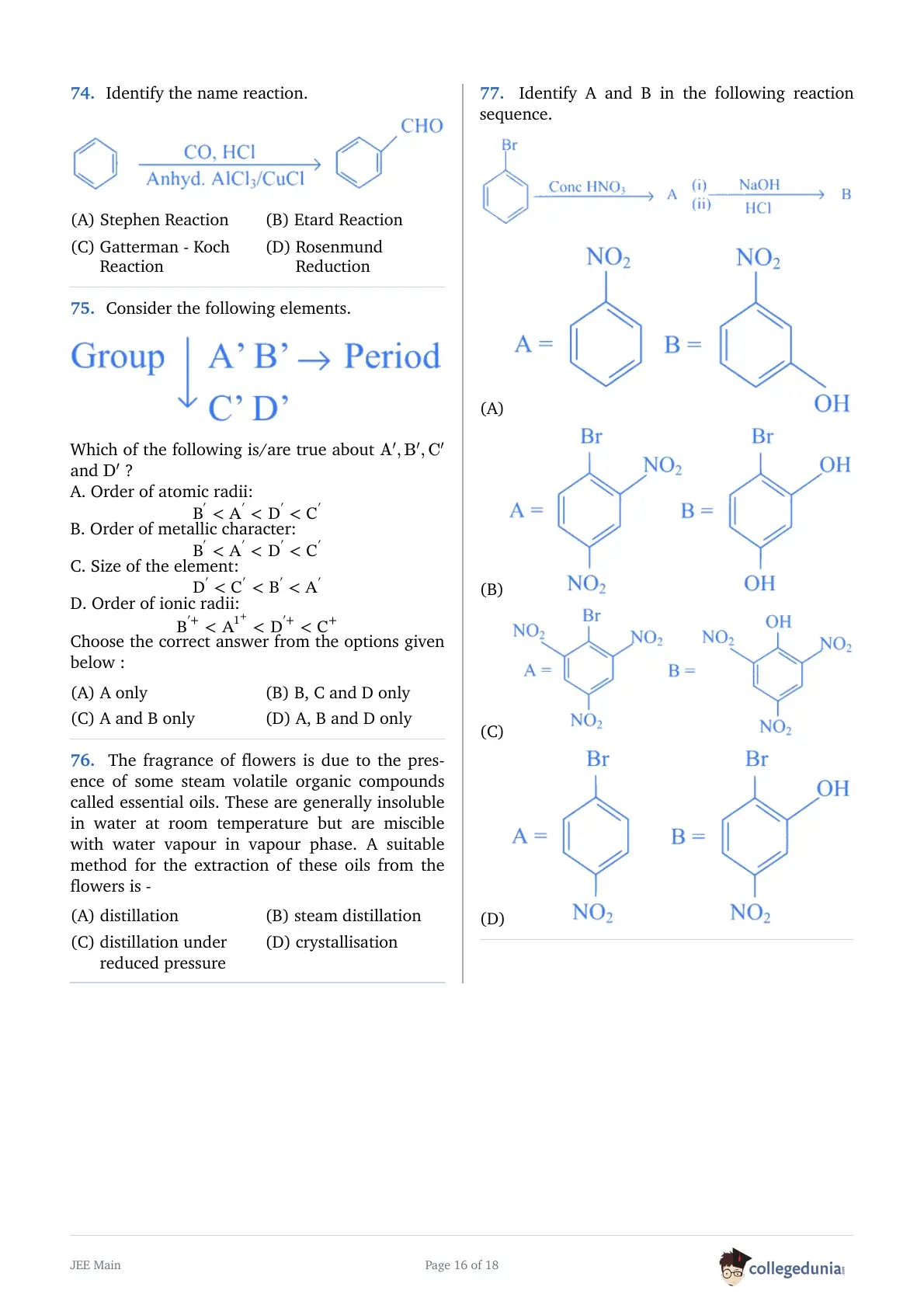
Which of the following is/are true about A',B',C'andD' ? A. Order of atomic radii: \( B' < A' < D' < C' \)
B. Order of metallic character: \( B' < A' < D' < C' \)
C. Size of the element: \( D' < C' < B' < A' \)
D. Order of ionic radii: \( B^{+} < A^{+} < D^{+} < C^{+} \)
Choose the correct answer from the options given below:
The fragrance of flowers is due to the presence of some steam volatile organic compounds called essential oils. These are generally insoluble in water at room temperature but are miscible with water vapour in vapour phase. A suitable method for the extraction of these oils from the flowers is -


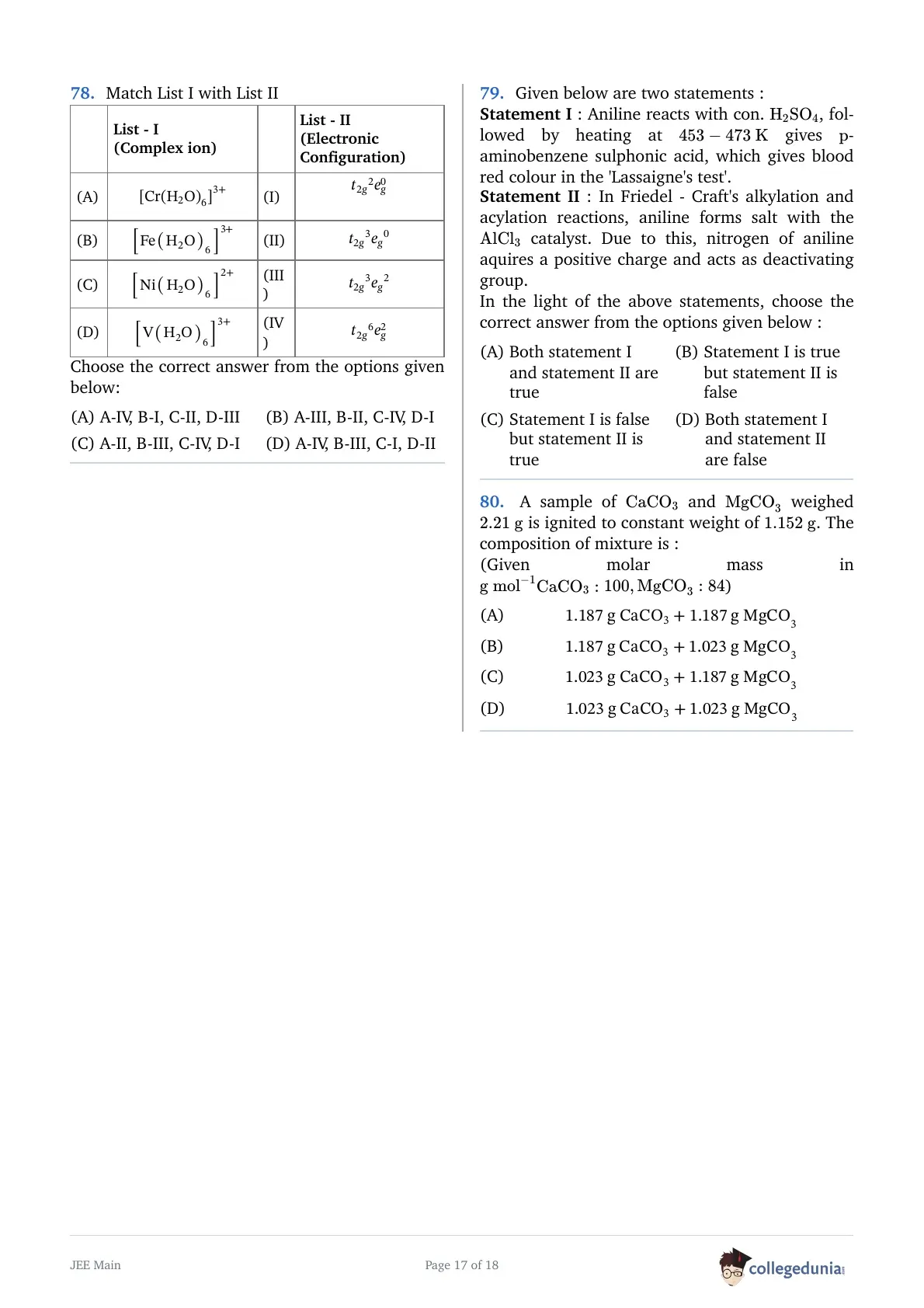
Match List I with List II

Given below are two statements:
Statement I: Aniline reacts with con. \( H_2SO_4 \) followed by heating at 453–473 K gives p-aminobenzene sulphonic acid, which gives blood red colour in the 'Lassaigne's test'.
Statement II: In Friedel-Craft's alkylation and acylation reactions, aniline forms salt with the \( AlCl_3 \) catalyst. Due to this, nitrogen of aniline acquires a positive charge and acts as a deactivating group.
In the light of the above statements, choose the correct answer from the options given below:
A sample of \( \text{CaCO}_3 \) and \( \text{MgCO}_3 \) weighed 2.21 g is ignited to constant weight of 1.152 g. The composition of the mixture is:
(Given molar mass in g mol\(^{-1}\))
Chemistry - Section B (Q81 - Q90)
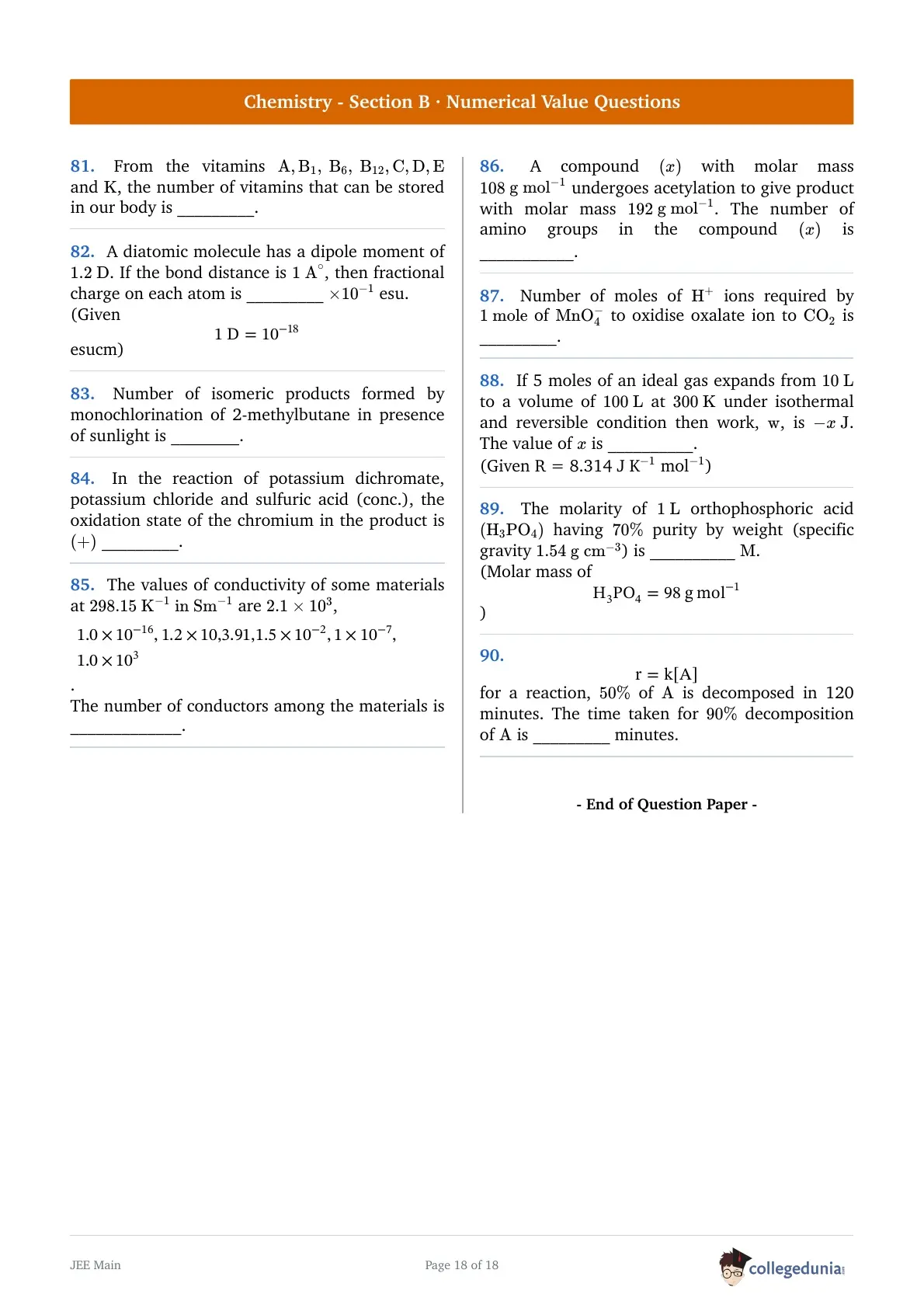
From the vitamins \( A, \, B_1, \, B_6, \, B_{12}, \, C, \, D, \, E, \, \text{and} \, K \), the number of vitamins that can be stored in our body is ______.
A diatomic molecule has a dipole moment of \( 1.2 \, D \). If the bond distance is \( 1 \, \text{Å} \), then fractional charge on each atom is ______ \( \times 10^{-1} \, \text{esu} \).
(Given \( 1 \, D = 10^{-18} \, \text{esu cm} \))
Number of isomeric products formed by monochlorination of 2-methylbutane in presence of sunlight is _______.
In the reaction of potassium dichromate, potassium chloride and sulfuric acid (conc.), the oxidation state of the chromium in the product is (+)_______.
The values of conductivity of some materials at \( 298.15 \, \text{K} \) in \( \text{S m}^{-1} \) are:
\( 2.1 \times 10^3, \, 1.0 \times 10^{-16}, \, 1.2 \times 10^1, \, 3.91, \, 1.5 \times 10^{-2}, \, 1 \times 10^{-7}, \, 1.0 \times 10^3 \).
The number of conductors among the materials is ______.
A compound (\( x \)) with molar mass \( 108 \, \text{g mol}^{-1} \) undergoes acetylation to give a product with molar mass \( 192 \, \text{g mol}^{-1} \). The number of amino groups in the compound (\( x \)) is ______.
Number of moles of \( H^+ \) ions required by 1 mole of \( MnO_4^- \) to oxidise oxalate ion to \( CO_2 \) is ____.
If 5 moles of an ideal gas expands from \( 10 \, L \) to a volume of \( 100 \, L \) at \( 300 \, K \) under isothermal and reversible conditions, then work, \( w \), is \( -x \, J \). The value of \( x \) is ______.
(Given \( R = 8.314 \, \text{J K}^{-1} \text{mol}^{-1} \))
The molarity of 1 L orthophosphoric acid (\( H_3PO_4 \)) having 70% purity by weight (specific gravity \( 1.54 \, \text{g cm}^{-3} \)) is ______ M.
(Molar mass of \( H_3PO_4 = 98 \, \text{g mol}^{-1} \))
r =k[A] for a reaction, 50% of A is decomposed in 120 minutes. The time taken for 90% decomposition of A is ______ minutes.
JEE Main 2024 Exam Pattern and Marking Scheme
| Particulars | Details |
|---|---|
| Exam Mode | Online (Computer-Based Test) |
| Paper | B.E./B.Tech |
| Medium of Exam | 13 languages: English, Hindi, Gujarati, Bengali, Tamil, Telugu, Kannada, Marathi, Malayalam, Odia, Punjabi, Assamese, Urdu |
| Duration | 3 hours (180 minutes) |
| Type of Questions | Multiple Choice Questions (MCQs) + Numerical Value Questions (attempt any 5 of 10 per subject) |
| Total Marks | 300 marks |
| Subjects | Mathematics, Physics, Chemistry |
| Marking Scheme | +4 for correct answer & -1 for incorrect MCQ and Numerical Value-based Questions |
| Total Questions | 90 Questions (30 per subject), 75 to be attempted |
| Eligibility | Passed or appearing in Class 12 with Physics, Chemistry, and Mathematics |
JEE Main 2024 Jan 31 Shift 2 Question Paper by Coaching Institute
| Coaching Institutes | Question Paper with Solutions PDF |
|---|---|
| Aakash BYJUs | Download PDF |
| Reliable Institute | Physics Chemistry |
| Resonance | Physics Chemistry Maths |
| Vedantu | Download PDF |
| Sri Chaitanya | To be updated |
| FIIT JEE | To be updated |
JEE Main 31 Jan Shift 2 2024 Paper Analysis
JEE Main 2024 Jan 31 Shift 2 paper analysis for B.E./ B.Tech is updated here with details on the difficulty level of the exam, topics with the highest weightage in the exam, section-wise difficulty level, etc. after the conclusion of the exam.
JEE Main 2024 Question Paper Pattern
| Feature | Question Paper Pattern |
|---|---|
| Examination Mode | Computer-based Test |
| Exam Language | 13 languages (English, Hindi, Assamese, Bengali, Gujarati, Kannada, Malayalam, Marathi, Odia, Punjabi, Tamil, Telugu, and Urdu) |
| Number of Sections | Three- Physics, Chemistry, Mathematics |
| Exam Duration | 3 hours |
| Sectional Time Limit | None |
| Total Marks | 300 marks |
| Total Number of Questions Asked | 90 Questions |
| Total Number of Questions to be Answered | 75 questions |
| Type of Questions | MCQs and Numerical Answer Type Questions |
| Section-wise Number of Questions | Physics- 20 MCQs and 10 numerical type, Chemistry- 20 MCQs and 10 numerical type, Mathematics- 20 MCQs and 10 numerical type |
| Marking Scheme | +4 for each correct answer |
| Negative Marking | -1 for each incorrect answer |
Read More:
- JEE Main 2024 question paper pattern and marking scheme
- Most important chapters in JEE Mains 2024, Check chapter wise weightage here
JEE Main 2024 Question Paper Session 1 (January)
Those appearing for JEE Main 2024 can use the links below to practice and keep track of their exam preparation level by attempting the shift-wise JEE Main 2024 question paper provided below.
| Exam Date and Shift | Question Paper PDF |
|---|---|
| JEE Main 24 Jan Shift 2 2024 Question Paper | Check Here |
| JEE Main 27 Jan Shift 1 2024 Question Paper | Check Here |
| JEE Main 27 Jan Shift 2 2024 Question Paper | Check Here |
| JEE Main 29 Jan Shift 1 2024 Question Paper | Check Here |
| JEE Main 29 Jan Shift 2 2024 Question Paper | Check Here |
| JEE Main 30 Jan Shift 1 2024 Question Paper | Check Here |
| JEE Main 30 Jan Shift 2 2024 Question Paper | Check Here |
| JEE Main 31 Jan Shift 1 2024 Question Paper | Check Here |
| JEE Main 31 Jan Shift 2 2024 Question Paper | Check Here |
| JEE Main 1 Feb Shift 1 2024 Question Paper | Check Here |
| JEE Main 1 Feb Shift 2 2024 Question Paper | Check Here |



Comments