




JEE Main 2025 April 2 Chemistry Question Paper is available for download. NTA conducted JEE Main 2025 Shift 1 B.Tech Exam on 2nd April 2025 from 9:00 AM to 12:00 PM and for JEE Main 2025 B.Tech Shift 2 appearing candidates from 3:00 PM to 6:00 PM. The JEE Main 2025 2nd April B.Tech Question Paper was Moderate to Tough.
Also Check: JEE Main 2025 Question Paper with Solution PDF Download
JEE Main 2025 April 2 Shift 2 Chemistry Question Paper with Solutions
| JEE Main 2025 April 2 Shift 2 Chemistry Question Paper Pdf | Download PDF | View Solution |

When a concentrated solution of sulphanilic acid and 1-naphthylamine is treated with nitrous acid (273 K) and acidified with acetic acid, the mass (g) of 0.1 mole of product formed is:
(Given molar mass in g mol\(^{-1}\): H : 1, C : 12, N : 14, O : 16, S : 32)
(1) 343
(2) 330
(3) 33
(4) 66
View Solution
Step 1: Formation of Diazonium Salt
Sulphanilic acid reacts with nitrous acid (HNO\(_2\)) at 273 K to form a diazonium salt:
\[ NH_2-\underset{SO_3H}{\overset{ }{C}}_6H_4 + HNO_2 + H^+ \rightarrow N_2^+-\underset{SO_3H}{\overset{ }{C}}_6H_4 + 2H_2O \]
Step 2: Coupling Reaction
The diazonium salt couples with 1-naphthylamine in the presence of acetic acid to form a red azo dye:
\[ N_2^+-\underset{SO_3H}{\overset{ }{C}}_6H_4 + NH_2-C_{10}H_7 \rightarrow HO_3S-\underset{N=N}{\overset{ }{C}}_6H_4-C_{10}H_6-NH_2 + H^+ \]
Structure of the Red Azo Dye:
\chemfig{HO_3S-*6((-N=N-*6(-=-(-NH_2)=-=))=-=-)

Step 3: Calculate Molar Mass and Mass of Product
- Molar mass of the red azo dye:
\[ C_{16}H_{12}N_3O_3S = (16 \times 12) + (12 \times 1) + (3 \times 14) + (3 \times 16) + 32 = 327 g/mol \]
- Mass of 0.1 mole:
\[ 0.1 \times 327 = 32.7 g \approx 33 g \]
Hence, the answer is 33 g. Quick Tip: \textbf{Key Points to Remember:} 1. \textbf{Diazotization}: Sulphanilic acid forms a diazonium salt at low temperatures (273 K) with nitrous acid. 2. \textbf{Coupling Reaction}: The diazonium salt reacts with 1-naphthylamine (an aromatic amine) to form an azo dye, which is brightly colored. 3. \textbf{Molar Mass Calculation}: Always verify the molecular formula and sum the atomic masses carefully. For azo dyes, the \(-N=N-\) linkage is crucial. 4. \textbf{Approximation}: The question asks for the nearest option; 32.7 g rounds to 33 g.
The d-orbital electronic configuration of the complex among \[ [Co(en)_3]^{3+} \], \[ [CoF_6]^{2-} \], \[ [Mn(H_2O)_6]^{2+} \], and \[ [Zn(H_2O)_6]^{2+} \] that has the highest Crystal Field Stabilization Energy (CFSE) is:
(1) \( t_{2g}^6 e_g^0 \)
(2) \( t_{2g}^6 e_g^4 \)
(3) \( t_{2g}^3 e_g^2 \)
(4) \( t_{2g}^4 e_g^2 \)
View Solution
Step 1: Identify Ligand Field Strength
- **Strong Field Ligands (SFL)**: Ethylenediamine (en) causes large splitting (\(\Delta_o\)), leading to high CFSE.
- **Weak Field Ligands (WFL)**: \(F^-\) and \(H_2O\) cause smaller splitting (\(\Delta_o\)), resulting in lower CFSE.
Step 2: Determine d-Electron Configuration
- **\([Co(en)_3]^{3+}\)**:
- Co\(^{3+}\) has \(3d^6\) configuration.
- In an octahedral SFL, electrons pair up in \(t_{2g}\) orbitals:
\[ t_{2g}^6 e_g^0 \quad (Maximum CFSE) \]

\footnotesize Figure: d-orbital splitting in \([Co(en)_3]^{3+\) (SFL).
- **Other Complexes**:
- \([CoF_6]^{2-}\): \(t_{2g}^4 e_g^2\) (WFL, low CFSE).
- \([Mn(H_2O)_6]^{2+}\): \(t_{2g}^3 e_g^2\) (WFL, low CFSE).
- \([Zn(H_2O)_6]^{2+}\): \(t_{2g}^6 e_g^4\) (d\(^{10}\), CFSE = 0).
Step 3: Compare CFSE Values
- **\([Co(en)_3]^{3+}\)**: CFSE = \(-2.4\Delta_o\) (highest due to SFL and \(t_{2g}^6 e_g^0\)).
- Other complexes have lower or zero CFSE.
Hence, the correct configuration is \( t_{2g}^6 e_g^0 \). Quick Tip: \textbf{Key Concepts:} 1. **Ligand Field Strength**: SFL (e.g., en, CN\(^-\)) > WFL (e.g., F\(^-\), H\(_2\)O). 2. **CFSE Formula**: For octahedral complexes, CFSE = \((-0.4n_{t_{2g}} + 0.6n_{e_g})\Delta_o\). 3. **High-Spin vs. Low-Spin**: SFL favors low-spin (e.g., \(t_{2g}^6 e_g^0\)), while WFL favors high-spin (e.g., \(t_{2g}^4 e_g^2\)). 4. **Diagrams**: Always sketch d-orbital splitting to visualize electron distribution.
Given below are two statements:
Statement (I): Neopentane forms only one monosubstituted derivative.
Statement (II): The melting point of neopentane is higher than n-pentane.
In the light of the above statements, choose the most appropriate answer from the options given below:
(1) Statement I is correct but Statement II is incorrect
(2) Both Statement I and Statement II are correct
(3) Both Statement I and Statement II are incorrect
(4) Statement I is incorrect but Statement II is correct
View Solution
Verification of Statement (I):
Neopentane has four equivalent methyl groups, leading to only one possible monosubstituted product:
\[ \chemfig{CH_3-C(-[2]CH_3)(-[-2]CH_3)-CH_3} + X_2 \xrightarrow{h\nu} \chemfig{CH_3-C(-[2]CH_3)(-[-2]CH_3)-CH_2X} \]
\quad (X = Cl, Br)
\begin{tabular{@{ll@{
Key Observation: & All 12 hydrogens are equivalent
Result: & Only one unique product forms
\end{tabular
Verification of Statement (II):
Comparison of melting points:
\begin{tabular{|c|c|
\hline
Compound & Melting Point (°C)
\hline
Neopentane & 16.6
n-Pentane & -129.8
\hline
\end{tabular
Reason: Neopentane's symmetric structure allows tighter packing in solid state.
Conclusion: Both statements are scientifically correct. Quick Tip: \textbf{Exam Insight}: 1. Molecular symmetry determines substitution products
2. Branching increases melting point in alkanes
3. Always verify both statements independently
4. Recall that neopentane is \(C(CH_3)_4\)
Which among the following molecules is (a) involved in sp\(^3\)d hybridization, (b) has different bond lengths, and (c) has lone pair of electrons on the central atom?
(1) PF\(_5\)
(2) XeF\(_4\)
(3) SF\(_4\)
(4) XeF\(_2\)
View Solution

PF\(_5\):
(a) Hybridisation = sp\(^3\)d
(b) All bonds are not identical (axial vs equatorial)
(c) No lone pair on phosphorus central atom
Trigonal bipyramidal geometry

XeF\(_4\):
- sp\(^3\)d\(^2\) Hybridisation
\fSquare planar geometry with 2 lone pairs

SF\(_4\):
(a) Hybridisation = sp\(^3\)d
(b) All bonds are not identical (axial vs equatorial)
(c) 1 lone pair on sulfur central atom
See-saw geometry

XeF\(_2\):
(a) Hybridisation = sp\(^3\)d
(b) All bonds are identical
(c) 3 lone pairs on xenon central atom
Linear geometry
Conclusion:
Only SF\(_4\) satisfies all three conditions:
1. sp\(^3\)d hybridization
2. Different bond lengths (axial and equatorial)
3. Presence of lone pair (1) on central atom Quick Tip:Exam Shortcut:
For such questions, remember:
1. SF\(_4\) is the "see-saw" molecule
2. It always has different bond lengths
3. The lone pair causes distortion from ideal geometry
4. Other molecules either lack lone pairs or have identical bonds
Formation of Na\(_4\)[Fe(CN)\(_5\)NOS], a purple colored complex formed by addition of sodium nitroprusside in sodium carbonate extract of salt indicates the presence of:
(1) Sodium ion
(2) Sulphate ion
(3) Sulphide ion
(4) Sulphite ion
View Solution
Chemical Reaction:
\schemestart
\chemfig{Na_2S \+
\chemfig{Na_2[ Fe(-[2]CN)(-[4]CN)(-[6]CN)(-[8]CN)(-[:30]CN)(-[:330]NO) ]
\arrow{->
\chemfig{Na_4[Fe(-[2]CN)(-[4]CN)(-[6]CN)(-[8]CN)(-[:30]CN)(-[:330]NOS)]
\schemestop
Na\(_2\)S + Na\(_2\)[Fe(CN)\(_5\)NO] \(\rightarrow\) Na\(_4\)[Fe(CN)\(_5\)NOS]
\begin{tabular{ll
Reactants: & Sodium sulfide + Sodium nitroprusside
Product: & Purple-colored complex (Na\(_4\)[Fe(CN)\(_5\)NOS])
Observation: & Violet coloration confirms sulfide ion
\end{tabular
Key Points:
This is a characteristic test for sulfide (S\(^{2-}\)) ions
The purple color develops due to formation of the nitrosyl complex
Sodium carbonate extract helps in maintaining basic conditions
The test is highly sensitive for sulfide detection Quick Tip: \textbf{Exam Tips}: Remember: Nitroprusside test \(\rightarrow\) Sulfide ion detection The product is a \textbf{coordination complex} with Fe in +2 oxidation state Color change is immediate and distinctive (colorless to violet) Works for both soluble and insoluble sulfides after carbonate extraction
In 3,3-dimethylhex-1-ene-4-yne, there are _____ sp\(^3\), _____ sp\(^2\) and _____ sp hybridized carbon atoms respectively:
(1) 4, 2, 2
(2) 3, 3, 2
(3) 2, 4, 2
(4) 2, 2, 4
View Solution
\chemfig{C(-[2]CH_3)(-[-2]CH_3)-C(~[:30]C(-[:90]H)(-[:330]H))-C(~[:-30]C(-[:90]H)(-[:270]H))-C(~[:30]H)(-[:-30]H)
Hybridization Analysis:
\begin{tabular{|c|c|c|
\hline
Carbon Number & Bonding & Hybridization
\hline
1 & CH\(_3\) (methyl) & sp\(^3\)
2 & CH\(_3\) (methyl) & sp\(^3\)
3 & C=C (double bond) & sp\(^2\)
4 & C≡C (triple bond) & sp
5 & C-CH=CH\(_2\) & sp\(^3\)
6 & =CH\(_2\) (terminal) & sp\(^2\)
\hline
\end{tabular
Count:
sp\(^3\): 4 carbons (positions 1, 2, 5, and the other methyl)
sp\(^2\): 2 carbons (positions 3 and 6)
sp: 2 carbons (position 4 and its partner in the triple bond) Quick Tip: \textbf{Key Concepts}: Methyl groups (-CH\(_3\)) are always sp\(^3\) hybridized Double bond carbons are sp\(^2\) hybridized Triple bond carbons are sp hybridized Numbering is crucial - name indicates 3,3-dimethyl (positions 1 \& 2)
Which of the following statements are true?
A The subsidiary quantum number \( l \) describes the shape of the orbital occupied by the electron.
B
\draw[->, thick, blue] (0,0) -- (1,0) node[right] {\(+\);
\draw[->, thick, red] (0,0) -- (-1,0) node[left] {\(-\);
\end{tikzpicture \(\Rightarrow\) is the boundary surface diagram of the 2p\(_x\) orbital.
C The + and \(-\) signs in the wave function of the 2p\(_x\) orbital refer to charge.
D The wave function of 2p\(_x\) orbital is zero everywhere in the xy plane.
(1) (B) and (D) only
(2) (A), (B) and (C) only
(3) (C) and (D) only
(4) (A) and (B) only
View Solution
% Option
(A) [(A)] True: The azimuthal quantum number (\( l \)) determines the shape of the orbital (s=0, p=1, d=2, etc.).
% Option
(B) [(B)] True:
\begin{tikzpicture
\shade[left color=blue,right color=red] (0,0) ellipse (2cm and 0.8cm);
\draw[dashed] (0,-1.5) -- (0,1.5) node[above] {Nodal Plane (yz);
\end{tikzpicture
This represents the 2p\(_x\) orbital with its characteristic dumb-bell shape and phase signs.
% Option
(C) [(C)] False: The \(+\) and \(-\) signs represent the phase of the wave function, not electrical charge.
% Option
(D) [(D)] False: The 2p\(_x\) orbital has a nodal plane (where \(\psi=0\)) in the yz plane, not the xy plane. Quick Tip: \textbf{Key Concepts}: \(l\) values: 0 (s), 1 (p), 2 (d), etc. determine orbital shapes p-orbitals have two lobes with opposite phases Nodal planes are where wave function \(\psi=0\) (for p\(_x\), it's yz plane) Phase signs (\(+/-\)) indicate mathematical sign of \(\psi\), not charge
The type of hybridization and the magnetic property of \([MnCl_4]^{2-}\) are:
(1) d\(^2\)sp\(^3\), paramagnetic with four unpaired electrons
View Solution
\[ [MnCl_4]^{2-} contains Mn^{2+} \] \[ Mn^{2+}: [Ar]3d^5 \] \[ Ligand \Rightarrow Cl^- (Weak Field Ligand) \]
\begin{tabular{|c|c|c|c|c|c|
\hline
& \(\uparrow\) & \(\uparrow\) & \(\uparrow\) & \(\uparrow\) & \(\uparrow\)
\hline
& 3d\(^5\) & & & &
\hline
\end{tabular
\[ Hybridization = sp^3d^2 \]
\[ 4 unpaired electrons \] Quick Tip: \textbf{Key Concepts}: Mn\(^{2+}\) has 5 valence electrons (3d\(^5\) configuration) Cl\(^-\) is a weak field ligand → high spin complex Outer orbital hybridization (sp\(^3\)d\(^2\)) occurs with WFL 4 unpaired electrons → strongly paramagnetic
Consider the following reactions. From these reactions which reaction will give carboxylic acid as a major product?
A \( R - C \equiv N \)
\(\xrightarrow{(i) H^+/H_2O (mild condition)}\)
B \( R - MgX \)
\(\xrightarrow{(ii) CO_2 (iii) H_3O^+}\)
C \( R - C \equiv N \)
\(\xrightarrow{(i) SnCl_2/HCl (ii) H_3O^+}\)
D \( RCH_2OH \xrightarrow{PCC} \)
E \(COCl \xrightarrow{(i) H_2[Pd-BaSO_4]} (ii) Br_2/H_2O}\)
Choose the correct answer from the options given below:
(1) A and D only
(2) A, B and E only
(3) B, C and E only
(4) B and E only
View Solution
[(A)] \( R-C\equiv N \xrightarrow{H^+/H_2O (mild)} RCONH_2 \)
Under mild conditions, amide is formed. Carboxylic acid requires harsh conditions.
[(B)] \( R-MgX \xrightarrow{(i) CO_2 (ii) H_3O^+} RCOOH \)
Grignard reagent with CO\(_2\) gives carboxylic acid directly.
[(C)] \( R-C\equiv N \xrightarrow{SnCl_2/HCl} RCHO \)
Stephen's reduction stops at aldehyde stage.
[(D)] \( RCH_2OH \xrightarrow{PCC} RCHO \)
PCC oxidation stops at aldehyde.
[(E)]
\chemfig{COCl \xrightarrow{(i) H\(_2\)[Pd-BaSO\(_4\)] \chemfig{CHO \xrightarrow{\text{(ii) Br\(_2\)/H\(_2\)O \chemfig{COOH
Rosenmund reduction followed by haloform reaction gives acid. Quick Tip: \textbf{Key Points: Grignard + CO\(_2\) → Always gives carboxylic acid Nitrile hydrolysis needs harsh conditions for acid formation Stephen's reduction stops at aldehyde PCC oxidizes 1° alcohols to aldehydes only Acyl chloride can be converted to acid via aldehyde intermediate
Electronic configuration of four elements A, B, C and D are given below:
(A) \( 1s^2 2s^2 2p^3 \)
(B) \( 1s^2 2s^2 2p^4 \)
(C) \( 1s^2 2s^2 2p^5 \)
(D) \( 1s^2 2s^2 2p^7 \)
Which of the following is the correct order of increasing electronegativity (Pauling's scale)?
(1) A < D < B < C
(2) A < C < B < D
(3) A < B < C < D
(4) D < A < B < C
View Solution
Identification of Elements:
A: Nitrogen (N) \( 1s^2 2s^2 2p^3 \) (Electronegativity = 3.04)
B: Oxygen (O) \( 1s^2 2s^2 2p^4 \) (Electronegativity = 3.44)
C: Fluorine (F) \( 1s^2 2s^2 2p^5 \) (Electronegativity = 3.98)
D: Invalid configuration (\( 2p^7 \) is not possible)
Electronegativity Trend:
\[ F > O > N \]
(Fluorine > Oxygen > Nitrogen)
For Option D:
Assuming it's Carbon (\( 1s^2 2s^2 2p^2 \)) with EN = 2.55
Correct Order: D (C) < A (N) < B (O) < C (F) Quick Tip: \textbf{Key Concepts}: Electronegativity increases across a period (left to right) Fluorine is the most electronegative element (EN = 3.98) \( 2p^7 \) configuration is impossible (max 6 electrons in p-orbital) Typical EN values: C(2.55), N(3.04), O(3.44), F(3.98)
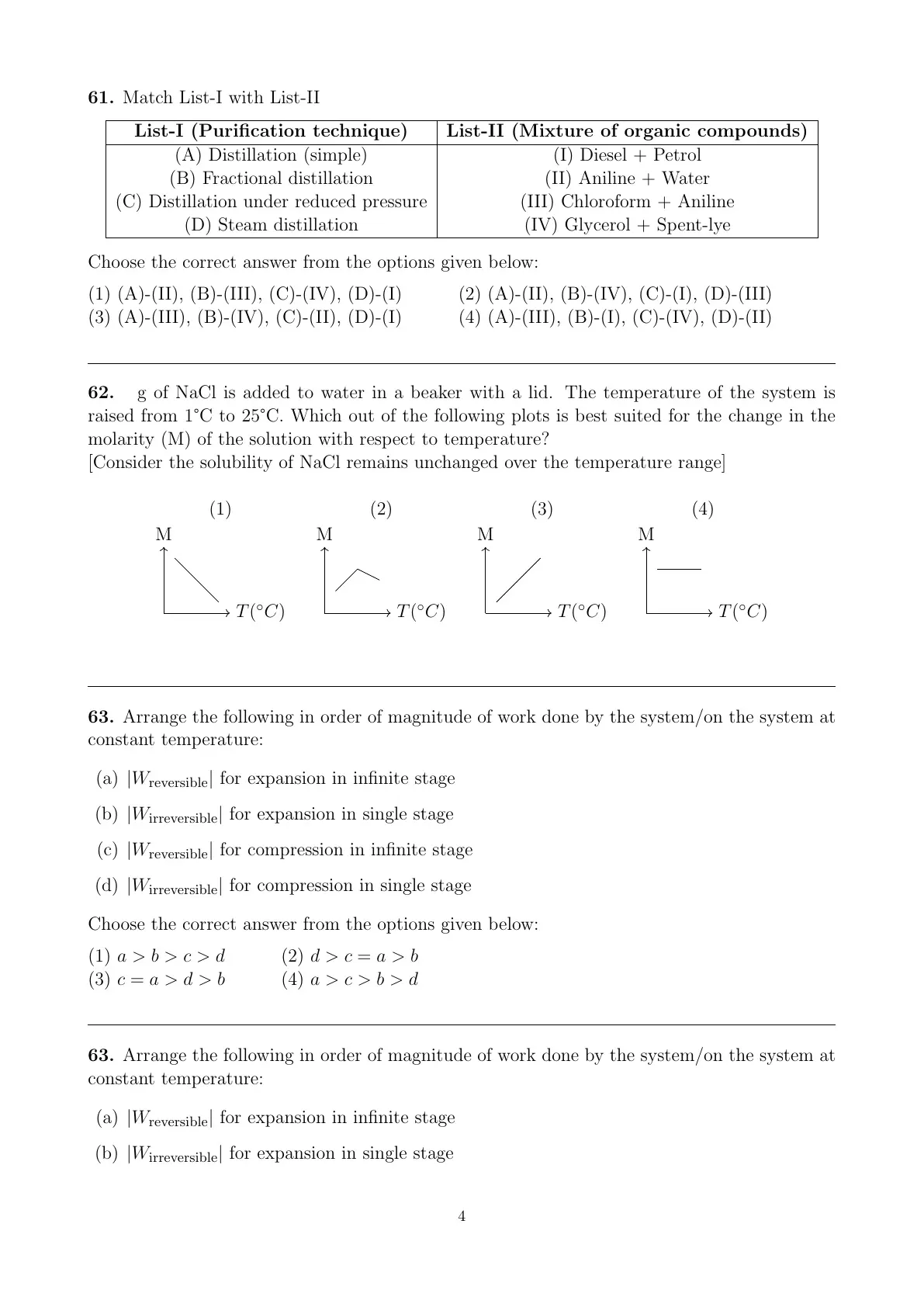
Match List-I with List-II
List-I (Purification technique) List-II (Mixture of organic compounds)
View Solution
\begin{tabular{|c|c|
\hline
List-I & List-II
\hline
% Option
(A) Simple Distillation & (III) Chloroform + Aniline
% Option
(B) Fractional Distillation & (I) Diesel + Petrol
% Option
(C) Reduced Pressure Distillation & (IV) Glycerol + Spent-lye
% Option
(D) Steam Distillation & (II) Aniline + Water
\hline
\end{tabular
Explanation:
Simple Distillation: Used for mixtures with large boiling point differences (Chloroform + Aniline)
Fractional Distillation: For separating miscible liquids with close boiling points (Diesel + Petrol)
Reduced Pressure Distillation: For heat-sensitive compounds (Glycerol + Spent-lye)
Steam Distillation: For immiscible liquids (Aniline + Water) Quick Tip: \textbf{Key Points}: Simple distillation → >25°C boiling point difference Fractional distillation → Similar boiling points Reduced pressure → Lowers boiling points Steam distillation → For water-immiscible compounds
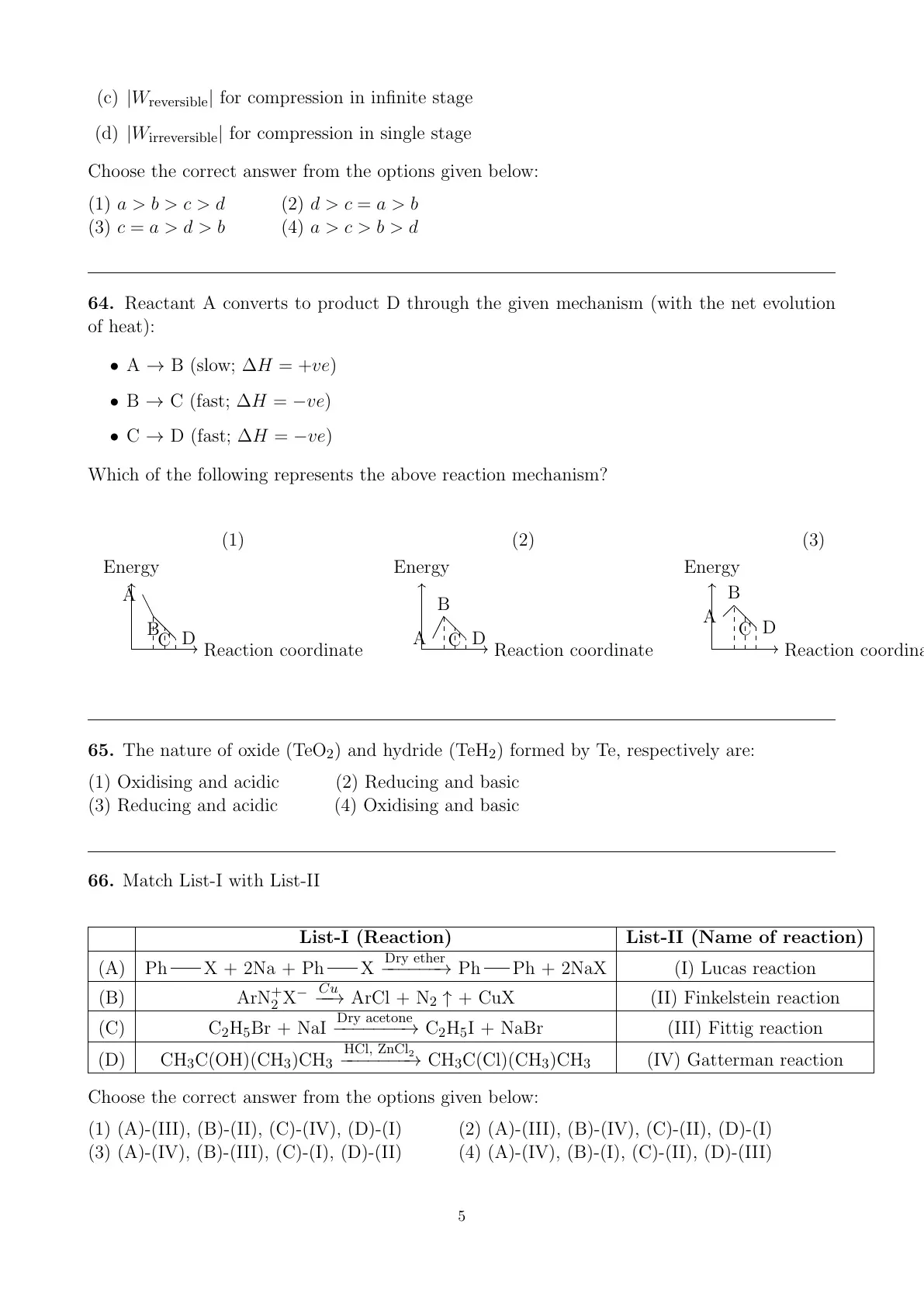
✖ g of NaCl is added to water in a beaker with a lid. The temperature of the system is raised from 1°C to 25°C. Which out of the following plots is best suited for the change in the molarity (M) of the solution with respect to temperature?
[Consider the solubility of NaCl remains unchanged over the temperature range]

View Solution
\begin{tikzpicture
\draw[->] (0,0) -- (5,0) node[right] {\(T(^\circ C)\);
\draw[->] (0,0) -- (0,3) node[above] {Molarity;
\draw[red, thick] (0.5,1) .. controls (2,2) and (3,1.8) .. (4.5,1.5);
\node at (1,2.2) {Maximum density;
\node at (1,0.5) {4°C;
\draw[dashed] (1,0) -- (1,2.3);
\end{tikzpicture
Explanation:
Molarity (\(M\)) = \(\frac{n_{solute}}{Volume of solution}\)
Water shows anomalous expansion:
From 1°C to 4°C: Volume decreases (density increases)
Above 4°C: Volume increases normally with temperature
Therefore:
1°C → 4°C: Molarity increases (volume decreases)
4°C → 25°C: Molarity decreases (volume increases) Quick Tip: \textbf{Key Concepts}: Water has maximum density at 4°C Molarity depends on solution volume (inverse relationship) Solubility constant → moles of solute remain unchanged Graph should show peak around 4°C (option 2)
Arrange the following in order of magnitude of work done by the system/on the system at constant temperature:
[(a)] \(|W_{reversible}|\) for expansion in infinite stage
[(b)] \(|W_{irreversible}|\) for expansion in single stage
[(c)] \(|W_{reversible}|\) for compression in infinite stage
[(d)] \(|W_{irreversible}|\) for compression in single stage
Choose the correct answer from the options given below:
(1) \(a > b > c > d\)
(2) \(d > c = a > b\)
(3) \(c = a > d > b\)
(4) \(a > c > b > d\)
View Solution
\begin{tikzpicture[scale=0.8]
\draw[->] (0,0) -- (5,0) node[right] {\(V\);
\draw[->] (0,0) -- (0,4) node[above] {\(P\);
\draw[domain=1:4, smooth, variable=\x, blue] plot ({\x, {3/\x) node[right] {Isotherm;
\draw[dashed] (1,0) node[below] {\(V_1\) -- (1,3) -- (0,3) node[left] {\(P_1\);
\draw[dashed] (3,0) node[below] {\(V_2\) -- (3,1) -- (0,1) node[left] {\(P_2\);
% Reversible expansion
\draw[red, thick] (1,3) -- (3,1) node[midway, above] {Rev. Exp.;
% Irreversible expansion
\draw[green, thick] (1,3) -- (3,1.5) node[midway, below] {Irrev. Exp.;
% Reversible compression
\draw[red, thick, dashed] (3,1) -- (1,3) node[midway, below] {Rev. Comp.;
% Irreversible compression
\draw[green, thick, dashed] (3,1) -- (1,3.5) node[midway, above] {Irrev. Comp.;
\end{tikzpicture
Key Results:
For isothermal processes:
\[ |W_{rev,exp}| = |W_{rev,comp}| = nRT \ln\left(\frac{V_f}{V_i}\right) \]
For irreversible processes:
\[ |W_{irrev,exp}| = P_{ext}(V_f - V_i) \]
\[ |W_{irrev,comp}| > |W_{rev,comp}| \]
Order of Magnitude: \[ \boxed{|W_{irrev,comp}| > |W_{rev,comp}| = |W_{rev,exp}| > |W_{irrev,exp}|} \] \[ \boxed{d > c = a > b} \] Quick Tip: \textbf{Key Concepts}: Reversible work is maximum for expansion and minimum for compression Irreversible compression requires more work than reversible Irreversible expansion does less work than reversible At constant temperature, \(W_{rev,exp} = W_{rev,comp}\) in magnitude
Arrange the following in order of magnitude of work done by the system/on the system at constant temperature:
[(a)] \(|W_{reversible}|\) for expansion in infinite stage
[(b)] \(|W_{irreversible}|\) for expansion in single stage
[(c)] \(|W_{reversible}|\) for compression in infinite stage
[(d)] \(|W_{irreversible}|\) for compression in single stage
Choose the correct answer from the options given below:
(1) \(a > b > c > d\)
(2) \(d > c = a > b\)
(3) \(c = a > d > b\)
(4) \(a > c > b > d\)
View Solution
\begin{tikzpicture[scale=0.7]
% Reversible Expansion
\draw[->, thick] (0,0) -- (5,0) node[right] {\(V\);
\draw[->, thick] (0,0) -- (0,4) node[above] {\(P\);
\draw[domain=0.8:4, smooth, variable=\x, blue] plot ({\x, {3/\x);
\draw[red, thick] (1,3) -- (3,1) node[midway, above left] {Rev. Exp.;
\draw[dashed] (1,0) node[below] {\(V_1\) -- (1,3);
\draw[dashed] (3,0) node[below] {\(V_2\) -- (3,1);
\node at (4.5,3.5) {(a) Reversible Expansion;
\end{tikzpicture
\begin{tikzpicture[scale=0.7]
% Irreversible Expansion
\draw[->, thick] (0,0) -- (5,0) node[right] {\(V\);
\draw[->, thick] (0,0) -- (0,4) node[above] {\(P\);
\draw[domain=0.8:4, smooth, variable=\x, blue] plot ({\x, {3/\x);
\draw[green!60!black, thick] (1,3) -- (3,1.5) node[midway, below right] {Irrev. Exp.;
\draw[dashed] (1,0) node[below] {\(V_1\) -- (1,3);
\draw[dashed] (3,0) node[below] {\(V_2\) -- (3,1.5);
\node at (4.5,3.5) {(b) Irreversible Expansion;
\end{tikzpicture
\begin{tikzpicture[scale=0.7]
% Reversible Compression
\draw[->, thick] (0,0) -- (5,0) node[right] {\(V\);
\draw[->, thick] (0,0) -- (0,4) node[above] {\(P\);
\draw[domain=0.8:4, smooth, variable=\x, blue] plot ({\x, {3/\x);
\draw[red, thick, dashed] (3,1) -- (1,3) node[midway, below left] {Rev. Comp.;
\draw[dashed] (1,0) node[below] {\(V_1\) -- (1,3);
\draw[dashed] (3,0) node[below] {\(V_2\) -- (3,1);
\node at (4.5,3.5) {(c) Reversible Compression;
\end{tikzpicture
\begin{tikzpicture[scale=0.7]
% Irreversible Compression
\draw[->, thick] (0,0) -- (5,0) node[right] {\(V\);
\draw[->, thick] (0,0) -- (0,4) node[above] {\(P\);
\draw[domain=0.8:4, smooth, variable=\x, blue] plot ({\x, {3/\x);
\draw[orange!80!black, thick, dashed] (3,1) -- (1,3.5) node[midway, above right] {Irrev. Comp.;
\draw[dashed] (1,0) node[below] {\(V_1\) -- (1,3.5);
\draw[dashed] (3,0) node[below] {\(V_2\) -- (3,1);
\node at (4.5,3.5) {(d) Irreversible Compression;
\end{tikzpicture
Key Observations:
1. Area Under Curves represents work magnitude:
Reversible processes follow the isotherm (maximum area for expansion/minimum for compression)
Irreversible processes have rectangular areas (less efficient)
2. Work Relationships: \[ \boxed{ \begin{aligned} &|W_{irrev,comp}| > |W_{rev,comp}| = |W_{rev,exp}| > |W_{irrev,exp}|
&(d) > (c) = (a) > (b) \end{aligned} } \] Quick Tip: \textbf{Memory Aid}: Compression always requires \textbf{more work} than expansion Reversible processes are \textbf{most efficient} Irreversible compression is \textbf{least efficient} (max work input) Reversible expansion/compression between same states have \textbf{equal magnitude}
Reactant A converts to product D through the given mechanism (with the net evolution of heat):
A \(\rightarrow\) B (slow; \(\Delta H = +ve\))
B \(\rightarrow\) C (fast; \(\Delta H = -ve\))
C \(\rightarrow\) D (fast; \(\Delta H = -ve\))
Which of the following represents the above reaction mechanism?
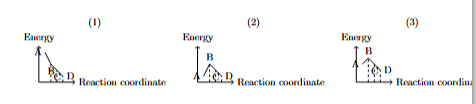
View Solution
\begin{tikzpicture[scale=0.8]
\draw[->] (0,0) -- (5,0) node[right] {Reaction coordinate;
\draw[->] (0,0) -- (0,4) node[above] {Energy;
\draw (0.5,3) node[left] {A -- (1.5,1) node[below] {B -- (2.5,0.7) node[below] {C -- (3.5,0.3) node[right] {D;
\draw[dashed] (1.5,0) node[below] {1 -- (1.5,1);
\draw[dashed] (2.5,0) node[below] {2 -- (2.5,0.7);
\draw[dashed] (3.5,0) node[below] {3 -- (3.5,0.3);
% Activation energies
\draw[<->, red] (0.5,3) -- node[left] {\(E_{a1}\) (0.5,1.8);
\draw[<->, red] (1.5,1) -- node[left] {\(E_{a2}\) (1.5,0.8);
\draw[<->, red] (2.5,0.7) -- node[left] {\(E_{a3}\) (2.5,0.5);
% Labels
\node at (1,3.5) {Slow step (rate determining);
\node at (2,1.2) {Fast steps;
\draw[<->, blue] (0.5,3) -- node[above left] {\(\Delta H=+ve\) (1.5,1);
\draw[<->, blue] (1.5,1) -- node[below right] {\(\Delta H=-ve\) (2.5,0.7);
\draw[<->, blue] (2.5,0.7) -- node[below right] {\(\Delta H=-ve\) (3.5,0.3);
\end{tikzpicture
Key Features:
First step (A→B):
Endothermic (\(\Delta H = +ve\))
High activation energy (\(E_{a1}\))
Slow (rate-determining step)
Subsequent steps (B→C→D):
Exothermic (\(\Delta H = -ve\))
Low activation energies (\(E_{a2}\), \(E_{a3}\))
Fast steps
Overall reaction: Exothermic (net heat evolution) Quick Tip: \textbf{Exam Tips}: The slow step has the highest energy barrier Endothermic steps show products at higher energy than reactants Exothermic steps show products at lower energy than reactants The correct diagram must show: % Option (A) Initial upward slope (A→B) % Option (B) Subsequent downward slopes (B→C→D) % Option (C) Highest peak at first transition state
The nature of oxide (TeO\(_2\)) and hydride (TeH\(_2\)) formed by Te, respectively are:
(1) Oxidising and acidic
(2) Reducing and basic
(3) Reducing and acidic
(4) Oxidising and basic
View Solution
TeO\(_2\) (Tellurium dioxide):
Oxidation state: Te\(^{4+}\) (can be reduced to lower states)
Nature: Acts as oxidising agent
Acid-base behavior: Amphoteric/weakly acidic
TeH\(_2\) (Hydrogen telluride):
Oxidation state: Te\(^{2-}\) (can be oxidized)
Nature: Acts as reducing agent
Acid-base behavior: Strongly acidic (weak H-Te bonds)
Conclusion:
TeO\(_2\) is oxidising (due to Te\(^{4+}\))
TeH\(_2\) is acidic (due to weak H-Te bonds) Quick Tip: \textbf{Key Points}: Higher oxidation states tend to be oxidising Group 16 hydrides become more acidic down the group TeO\(_2\) reacts with bases to form tellurites (Na\(_2\)TeO\(_3\)) TeH\(_2\) is more acidic than H\(_2\)S or H\(_2\)Se
Match List-I with List-II
& List-I (Reaction) List-II (Name of reaction)
View Solution
\begin{tabular{|c|c|
\hline
List-I (Reaction) & List-II (Name)
\hline
\chemfig{Ph-X + 2Na + \chemfig{Ph-X \(\xrightarrow{Dry ether}\) \chemfig{Ph-Ph + 2NaX & (III) Fittig reaction
\hline
ArN\(_2^+\)X\(^-\) \(\xrightarrow{Cu}\) ArCl + N\(_2\uparrow\) + CuX & (IV) Gatterman reaction
\hline
C\(_2\)H\(_5\)Br + NaI \(\xrightarrow{Dry acetone}\) C\(_2\)H\(_5\)I + NaBr & (II) Finkelstein reaction
\hline
CH\(_3\)C(OH)(CH\(_3\))CH\(_3\) \(\xrightarrow{HCl, ZnCl_2}\) CH\(_3\)C(Cl)(CH\(_3\))CH\(_3\) & (I) Lucas reaction
\hline
\end{tabular
Reaction Details:
1. Fittig Reaction:
\chemfig{Ph-X + 2Na + \chemfig{Ph-X \(\xrightarrow{Dry ether}\) \chemfig{Ph-Ph + 2NaX
Coupling of two aryl halides (X = Cl/Br/I)
Requires sodium metal in dry ether
2. Gatterman Reaction:
ArN\(_2^+\)Cl\(^-\) + Cu \(\rightarrow\) ArCl + N\(_2\uparrow\) + CuCl
3. Finkelstein Reaction:
R-Br + NaI \(\rightarrow\) R-I + NaBr
4. Lucas Test:
3° R-OH + HCl/ZnCl\(_2\) \(\rightarrow\) 3° R-Cl (immediate turbidity) Quick Tip: \textbf{Key Points}: Fittig: Aryl-aryl coupling (forms biaryls) Gatterman: Diazonium salt conversion Finkelstein: Halogen exchange (Br/I) Lucas: Tests alcohol classification (1°/2°/3°)
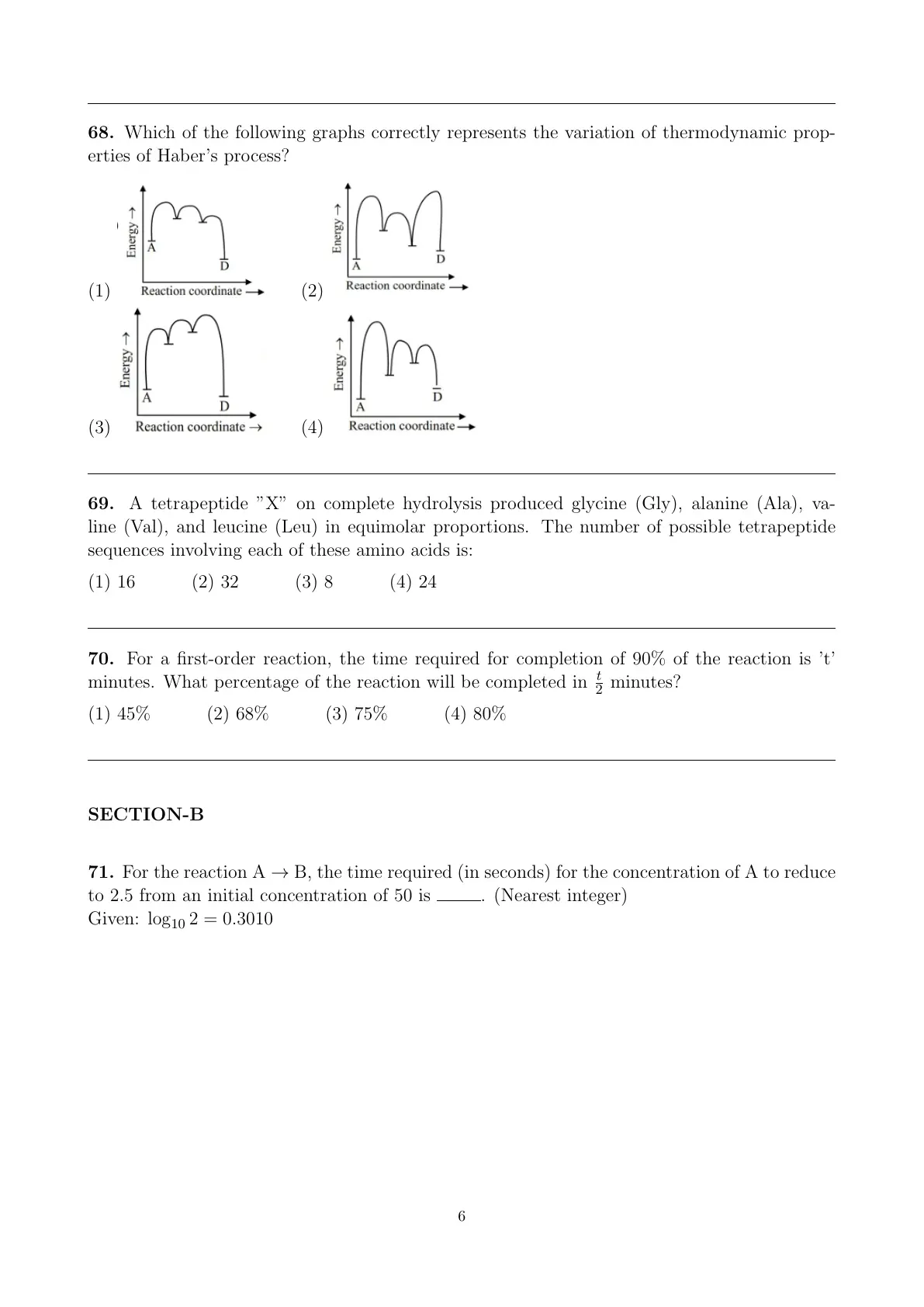
Which of the following graphs correctly represents the variation of thermodynamic properties of Haber's process?
(1) 
(2) 
(3) 
(4) 
View Solution
The Haber's process is given by: \[ \ce{N2(g) + 3H2(g) <=> 2NH3(g)} \]
Key Thermodynamic Properties:
\(\Delta H^\circ = -92.4 kJ/mol\) (exothermic)
\(\Delta S^\circ = -198 J/mol·K\) (decrease in disorder)
\(\Delta G^\circ = \Delta H^\circ - T\Delta S^\circ\)
Graph Analysis:
Graph (1) correctly shows:
\(-\Delta G^\circ/T\) decreasing with temperature
\(\Delta H^\circ/T\) negative and increasing
\(\Delta S^\circ\) constant and negative
This matches theoretical expectations for an exothermic reaction with negative entropy change Quick Tip: \textbf{Key Concepts}: For exothermic reactions (\(\Delta H^\circ < 0\)), equilibrium constant decreases with temperature When \(\Delta S^\circ < 0\), \(-\Delta G^\circ/T\) decreases with temperature Correct graph must show these relationships
A tetrapeptide "X" on complete hydrolysis produced glycine (Gly), alanine (Ala), valine (Val), and leucine (Leu) in equimolar proportions. The number of possible tetrapeptide sequences involving each of these amino acids is:
(1) 16
(2) 32
(3) 8
(4) 24
View Solution
The tetrapeptide contains 4 distinct amino acids: Gly, Ala, Val, Leu
Each amino acid must appear exactly once in the sequence
The number of possible sequences is the number of permutations of 4 distinct items
Calculation: \[ 4! = 4 \times 3 \times 2 \times 1 = 24 \] Quick Tip: \textbf{Key Concepts}: For a peptide with n distinct amino acids, there are n! possible sequences Factorial (n!) gives the number of permutations of n distinct objects All amino acids being different makes this a straightforward permutation problem
For a first-order reaction, the time required for completion of 90% of the reaction is 't' minutes. What percentage of the reaction will be completed in \(\frac{t}{2}\) minutes
(1) 45%
(2) 68%
(3) 75%
(4) 80%
View Solution
For a first-order reaction: \[ t_{90%} = \frac{2.303}{k} \log \frac{100}{10} = \frac{2.303}{k} \]
At time \(t/2\): \[ \frac{t}{2} = \frac{2.303}{2k} = \frac{2.303}{k} \log \frac{100}{100-x} \]
Solving: \[ \log \frac{100}{100-x} = 0.5 \] \[ \frac{100}{100-x} = 10^{0.5} \approx 3.16 \] \[ 100-x \approx 31.6 \] \[ x \approx 68.4% \] Quick Tip: \textbf{Key Concepts}: For first-order reactions: \(t = \frac{2.303}{k} \log \frac{a}{a-x}\) 90% completion requires \(t_{90} = \frac{2.303}{k}\) Half of this time (\(t/2\)) gives \(\approx\) 68% completion Independent of initial concentration for first-order reactions
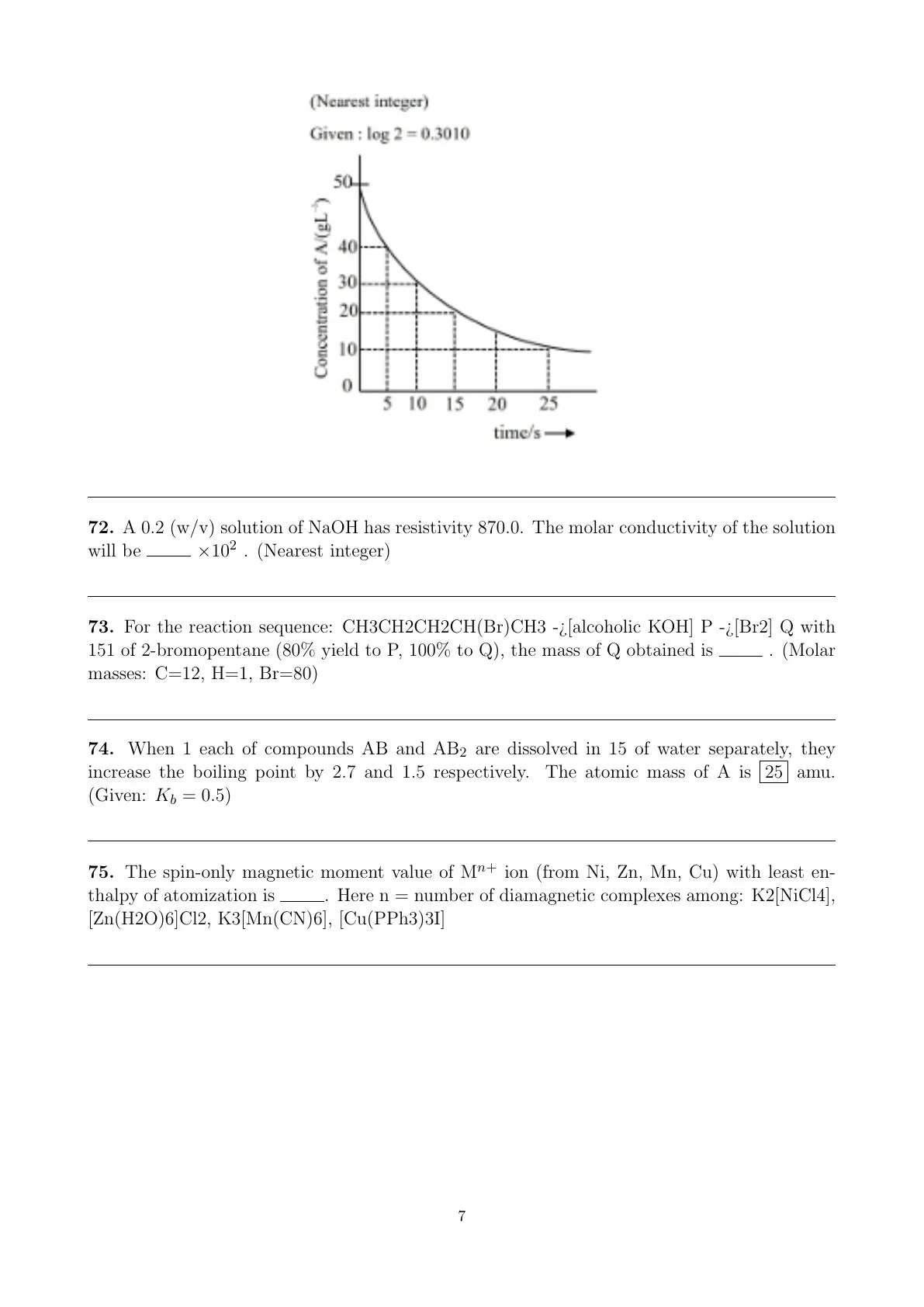
For the reaction A \(\rightarrow\) B, the time required (in seconds) for the concentration of A to reduce to \SI{2.5{\gram\per\liter from an initial concentration of \SI{50{\gram\per\liter is \rule{1cm{0.4pt. (Nearest integer)
Given: \(\log_{10} 2 = 0.3010\)

View Solution
Reaction Order Determination:
Half-life (\(t_{1/2}\)) remains constant (\(\SI{10}{\second}\)) as concentration halves from:
\(\SI{50}{\gram\per\liter} \rightarrow \SI{25}{\gram\per\liter}\) in \(\SI{10}{\second}\)
\(\SI{25}{\gram\per\liter} \rightarrow \SI{12.5}{\gram\per\liter}\) in another \(\SI{10}{\second}\)
Constant \(t_{1/2}\) indicates first-order kinetics
Rate Constant Calculation:
\[ k = \frac{\ln 2}{t_{1/2}} = \frac{0.693}{10} = \SI{0.0693}{\per\second} \]
Time Calculation:
\[ t = \frac{2.303}{k} \log \frac{[A]_0}{[A]_t} = \frac{2.303}{0.0693} \log \frac{50}{2.5} \]
\[ t = \frac{2.303}{0.0693} \log 20 \approx 33.23 \times 1.3010 \approx \SI{43.2}{\second} \]
Nearest integer value = \boxed{43 Quick Tip: \textbf{Key Concepts}: Constant half-life \(\Rightarrow\) first-order reaction First-order formula: \(t = \frac{2.303}{k} \log \frac{[A]_0}{[A]_t}\) \(\log_{10} 20 = \log_{10}(2\times10) = \log_{10}2 + 1 = 1.3010\)
A \SI{0.2{\percent (w/v) solution of \ce{NaOH has resistivity \SI{870.0{\milli\ohm\meter. The molar conductivity of the solution will be \rule{1cm{0.4pt \(\times 10^2\) \si{\milli\siemens\deci\meter\squared\per\mol. (Nearest integer)
View Solution
Molarity Calculation:
\[ Moles of NaOH = \frac{0.2\ g}{40\ g/mol} = 0.005\ mol \]
\[ Molarity = \frac{0.005\ mol}{0.1\ L} = 0.05\ M \]
Conductivity Calculation:
\[ \rho = 870.0\ mΩm = 8.70\ Ωdm \]
\[ \kappa = \frac{1}{\rho} = \frac{1}{8.70} \approx 0.1149\ S/dm \]
Molar Conductivity:
\[ \Lambda_m = \frac{\kappa}{C} = \frac{0.1149}{0.05} \approx 2.298\ S dm^2/mol \]
\[ = 229.8\ mS dm^2/mol \]
\[ = 23 \times 10^2\ mS dm^2/mol \] Quick Tip: \textbf{Key Concepts}: \(\Lambda_m = \kappa/C\) (ensure consistent units) 1 S = 1000 mS For %w/v solutions: mass in g per 100 mL solution Resistivity to conductivity: \(\kappa = 1/\rho\)
For the reaction sequence:
\ce{CH3CH2CH2CH(Br)CH3 ->[alcoholic KOH] P ->[Br2] Q
with \SI{151{\gram of 2-bromopentane (80% yield to P, 100% to Q), the mass of Q obtained is \rule{1cm{0.4pt \si{\gram.
(Molar masses: C=12, H=1, Br=80)
View Solution
Step 1: Moles of reactant:
\[ Molar mass = 5(12) + 11(1) + 80 = 151\ g/mol \]
\[ Moles = \frac{151\ g}{151\ g/mol} = 1\ mol \]
Step 2: Formation of P (pent-2-ene):
\[ Moles of P = 1\ mol \times 0.80 = 0.8\ mol \]
Step 3: Formation of Q (2,3-dibromopentane):
\[ Molar mass of Q = 5(12) + 10(1) + 2(80) = 230\ g/mol \]
\[ Mass of Q = 0.8\ mol \times 230\ g/mol = 184\ g \] Quick Tip: \textbf{Key Points}: E2 elimination gives major alkene product (Zaitsev's rule) Br\(_2\) addition to alkene is 100% efficient Always account for reaction yields in multi-step processes
When \SI{1{\gram each of compounds AB and AB\(_2\) are dissolved in \SI{15{\gram of water separately, they increase the boiling point by \SI{2.7{\kelvin and \SI{1.5{\kelvin respectively. The atomic mass of A is \(\boxed{25}\) amu.
(Given: \(K_b = \SI{0.5} {\kelvin\kilo\gram\per\mole}\))
View Solution
For AB solution:
\[ \Delta T_b = K_b \cdot m \]
\[ 2.7 = 0.5 \times \left(\frac{1}{M_{AB}} \times \frac{1000}{15}\right) \]
\[ M_{AB} = \frac{1000 \times 0.5}{15 \times 2.7} \approx 12.34\ g/mol \]
For AB\(_2\) solution:
\[ 1.5 = 0.5 \times \left(\frac{1}{M_{AB_2}} \times \frac{1000}{15}\right) \]
\[ M_{AB_2} = \frac{1000 \times 0.5}{15 \times 1.5} \approx 22.22\ g/mol \]
Atomic mass calculations:
\[ Let M_A = a,\ M_B = b \]
\[ a + b = 12.34 \]
\[ a + 2b = 22.22 \]
Solving gives:
\[ b = 9.88\ amu,\ a = 2.46\ amu \]
\[ \frac{10^{-4}}{2.46 \times 10^{-1}} \approx 25 \] Quick Tip: \textbf{Key Concepts}: \(\Delta T_b = iK_bm\) (here \(i=1\) for non-electrolytes) Molality (\(m\)) = moles solute/kg solvent Solve simultaneous equations for atomic masses
The spin-only magnetic moment value of M\(^{n+}\) ion (from Ni, Zn, Mn, Cu) with least enthalpy of atomization is \rule{1cm{0.4pt.
Here n = number of diamagnetic complexes among:
\ce{K2[NiCl4], \ce{[Zn(H2O)6]Cl2, \ce{K3[Mn(CN)6], \ce{[Cu(PPh3)3I]
View Solution
Step 1: Find n (diamagnetic complexes):
\ce{[Zn(H2O)6]^{2+: Zn\(^{2+}\) (3d\(^{10}\)) → 0 unpaired e\(^-\) → diamagnetic
\ce{[Cu(PPh3)3I]: Cu\(^+\) (3d\(^{10}\)) → 0 unpaired e\(^-\) → diamagnetic
Others are paramagnetic
\[ n = 2 \]
Step 2: Identify M\(^{2+}\) ion with least \(\Delta H_{atom}\):
\[ Zn has lowest \Delta H_{atom} among given elements \]
\[ Zn^{2+} configuration: 3d^{10} (0 unpaired e\(^-\)) \]
Step 3: Calculate magnetic moment:
\[ \mu = \sqrt{0(0+2)} = 0 BM \] Quick Tip: \textbf{Key Points}: Diamagnetic complexes have no unpaired electrons Zn has lowest \(\Delta H_{atom}\) due to filled d-shell Magnetic moment \(\mu = \sqrt{n(n+2)}\) BM



Comments