




JEE Main 2025 April 3 Physics Question Paper is available for download. NTA conducted JEE Main 2025 Shift 1 B.Tech Exam on 3rd April 2025 from 9:00 AM to 12:00 PM and for JEE Main 2025 B.Tech Shift 2 appearing candidates from 3:00 PM to 6:00 PM. The JEE Main 2025 3rd April B.Tech Question Paper was Moderate to Tough.
Also Check: JEE Main 2025 Question Paper with Solution PDF Download
JEE Main 2025 April 3 Shift 2 Physics Question Paper with Solutions
| JEE Main 2025 April 3 Shift 2 Physics Question Paper Pdf | Download PDF | View Solution |

JEE Main 2025 Physics Questions with Solutions
A magnetic dipole experiences a torque of \( 80\sqrt{3} \) N m when placed in a uniform magnetic field in such a way that the dipole moment makes an angle of \( 60^\circ \) with the magnetic field. The potential energy of the dipole is:
View Solution
The torque \( \tau \) experienced by a magnetic dipole in a uniform magnetic field \( \vec{B} \) is given by: \[ \tau = \vec{M} \times \vec{B} = MB \sin \theta \]
where \( M \) is the magnitude of the magnetic dipole moment, \( B \) is the magnitude of the magnetic field, and \( \theta \) is the angle between \( \vec{M} \) and \( \vec{B} \).
Given \( \tau = 80\sqrt{3} \) N m and \( \theta = 60^\circ \). \[ 80\sqrt{3} = MB \sin 60^\circ \] \[ 80\sqrt{3} = MB \left( \frac{\sqrt{3}}{2} \right) \] \[ MB = \frac{80\sqrt{3} \times 2}{\sqrt{3}} = 160 \]
The potential energy \( U \) of the magnetic dipole in the uniform magnetic field is given by: \[ U = -\vec{M} \cdot \vec{B} = -MB \cos \theta \]
Substituting the values \( MB = 160 \) and \( \theta = 60^\circ \): \[ U = -(160) \cos 60^\circ \] \[ U = -160 \left( \frac{1}{2} \right) \] \[ U = -80 J \] Quick Tip: Remember the formulas for the torque \( \tau = MB \sin \theta \) and potential energy \( U = -MB \cos \theta \) of a magnetic dipole in a uniform magnetic field. Use the given torque and angle to find the product \( MB \), and then use this value to calculate the potential energy at the same angle.
In a resonance experiment, two air columns (closed at one end) of 100 cm and 120 cm long, give 15 beats per second when each one is sounding in the respective fundamental modes. The velocity of sound in the air column is :
View Solution
For an air column closed at one end, the fundamental frequency (first harmonic) is given by: \[ f = \frac{v}{4l} \]
where \( v \) is the velocity of sound in the air column and \( l \) is the length of the air column.
For the first air column of length \( l_1 = 100 \) cm = 1 m, the fundamental frequency is: \[ f_1 = \frac{v}{4l_1} = \frac{v}{4 \times 1} = \frac{v}{4} Hz \]
For the second air column of length \( l_2 = 120 \) cm = 1.2 m, the fundamental frequency is: \[ f_2 = \frac{v}{4l_2} = \frac{v}{4 \times 1.2} = \frac{v}{4.8} Hz \]
The number of beats per second is the absolute difference between the two frequencies: \[ Beat = |f_1 - f_2| \]
Given that the beat frequency is 15 Hz: \[ 15 = \left| \frac{v}{4} - \frac{v}{4.8} \right| \] \[ 15 = v \left| \frac{1}{4} - \frac{1}{4.8} \right| \] \[ 15 = v \left| \frac{4.8 - 4}{4 \times 4.8} \right| \] \[ 15 = v \left| \frac{0.8}{19.2} \right| \] \[ 15 = v \left( \frac{8}{192} \right) = v \left( \frac{1}{24} \right) \] \[ v = 15 \times 24 = 360 m/s \]
The velocity of sound in the air column is 360 m/s. Quick Tip: For a closed organ pipe, the fundamental frequency is \( f = \frac{v}{4l} \). The beat frequency produced by two sources of sound is the absolute difference of their frequencies. Set up an equation using the given beat frequency and the fundamental frequencies of the two air columns to solve for the velocity of sound \( v \). Ensure consistent units for length (meters in this case).
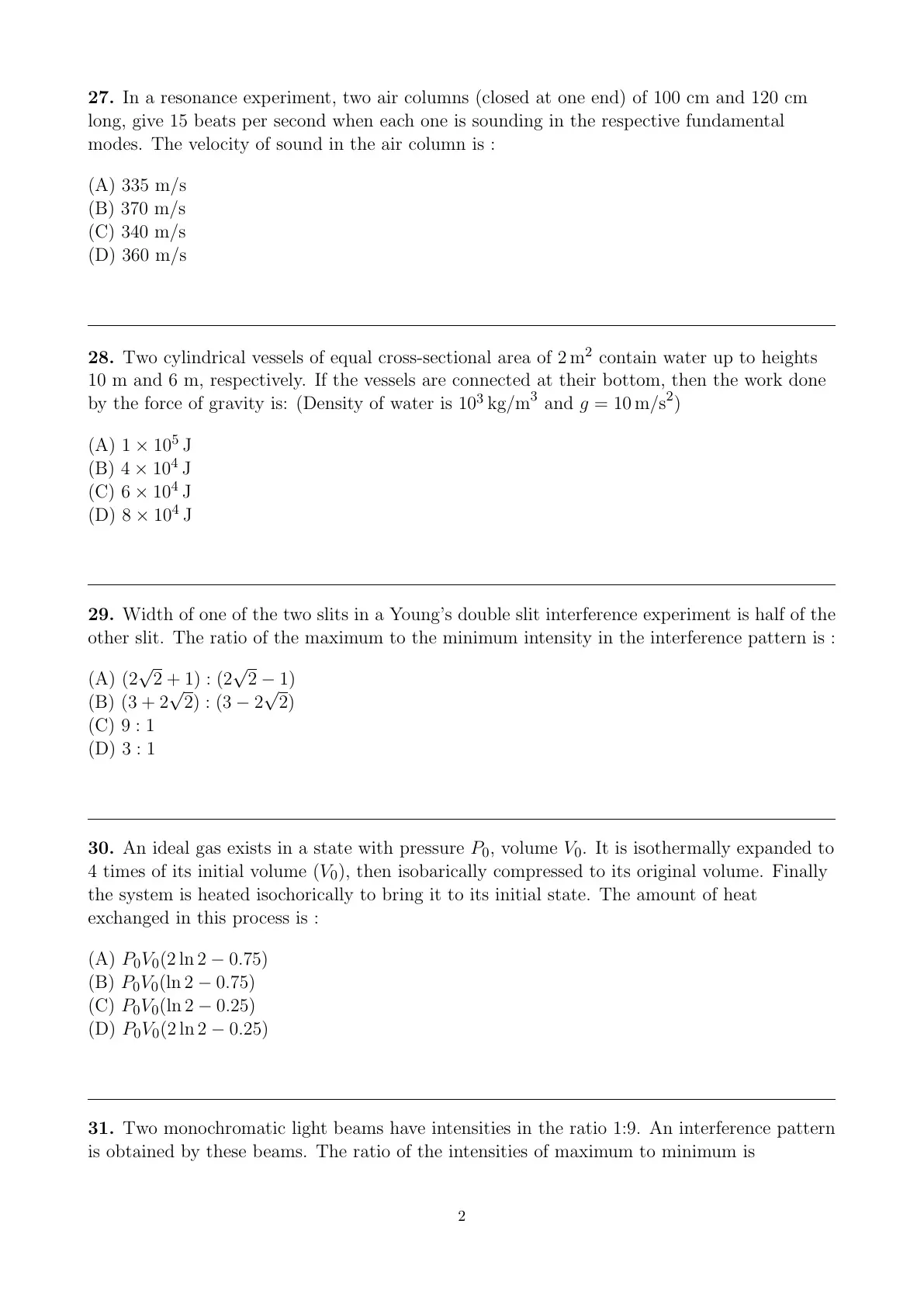
Two cylindrical vessels of equal cross-sectional area of \( 2 \, m^2 \) contain water up to heights 10 m and 6 m, respectively. If the vessels are connected at their bottom, then the work done by the force of gravity is: (Density of water is \( 10^3 \, kg/m^3 \) and \( g = 10 \, m/s^2 \))
View Solution
\includegraphics{28S.png
U_1 = (\rho_A \times 10)g \times 5 + (\rho_A 6)g \times 3
U_i = \rho_A g (50 + 18)
U_i = 68 \rho_A g
U_f = (\rho_A \times 16)g \times 4
= (\rho_A g) \times 64
\omega = \Delta U = 4 \times \rho_A g
= 4 \times 1000 \times 2 \times 10 = 8 \times 10^4 \ J Quick Tip: The work done by gravity is equal to the loss in potential energy. Calculate the initial and final potential energy of the water. The potential energy of a liquid column is given by \( mgh_{cm} \), where \( h_{cm} \) is the height of the center of mass of the liquid column from the reference level. When two connected vessels contain a liquid, the liquid levels equalize, conserving the total volume.
Width of one of the two slits in a Young's double slit interference experiment is half of the other slit. The ratio of the maximum to the minimum intensity in the interference pattern is :
View Solution
In Young's double slit experiment, the intensity of light passing through a slit is directly proportional to the width of the slit. Let the widths of the two slits be \( w_1 \) and \( w_2 \). Given that the width of one slit is half the width of the other slit, let \( w_1 = w \) and \( w_2 = 2w \).
The intensities of light from the two slits are proportional to their widths. Let the intensities be \( I_1 \) and \( I_2 \). \[ I_1 \propto w_1 = w \implies I_1 = I_0 \] \[ I_2 \propto w_2 = 2w \implies I_2 = 2I_0 \]
The maximum intensity \( I_{max} \) in the interference pattern occurs when the waves from the two slits interfere constructively, and is given by: \[ I_{max} = (\sqrt{I_1} + \sqrt{I_2})^2 \]
Substituting the values of \( I_1 \) and \( I_2 \): \[ I_{max} = (\sqrt{I_0} + \sqrt{2I_0})^2 = (\sqrt{I_0} (1 + \sqrt{2}))^2 = I_0 (1 + \sqrt{2})^2 = I_0 (1 + 2 + 2\sqrt{2}) = I_0 (3 + 2\sqrt{2}) \]
The minimum intensity \( I_{min} \) in the interference pattern occurs when the waves from the two slits interfere destructively, and is given by: \[ I_{min} = (\sqrt{I_1} - \sqrt{I_2})^2 \]
Substituting the values of \( I_1 \) and \( I_2 \): \[ I_{min} = (\sqrt{I_0} - \sqrt{2I_0})^2 = (\sqrt{I_0} (1 - \sqrt{2}))^2 = I_0 (1 - \sqrt{2})^2 = I_0 (1 + 2 - 2\sqrt{2}) = I_0 (3 - 2\sqrt{2}) \]
The ratio of the maximum to the minimum intensity is: \[ \frac{I_{max}}{I_{min}} = \frac{I_0 (3 + 2\sqrt{2})}{I_0 (3 - 2\sqrt{2})} = \frac{3 + 2\sqrt{2}}{3 - 2\sqrt{2}} \]
So, the ratio \( I_{max} : I_{min} \) is \( (3 + 2\sqrt{2}) : (3 - 2\sqrt{2}) \). Quick Tip: In Young's double slit experiment, the intensity of light is proportional to the width of the slit. The maximum intensity is \( (\sqrt{I_1} + \sqrt{I_2})^2 \) and the minimum intensity is \( (\sqrt{I_1} - \sqrt{I_2})^2 \), where \( I_1 \) and \( I_2 \) are the intensities from the two slits. Use the given relationship between the widths to find the ratio of intensities and then calculate the ratio of maximum to minimum intensity.
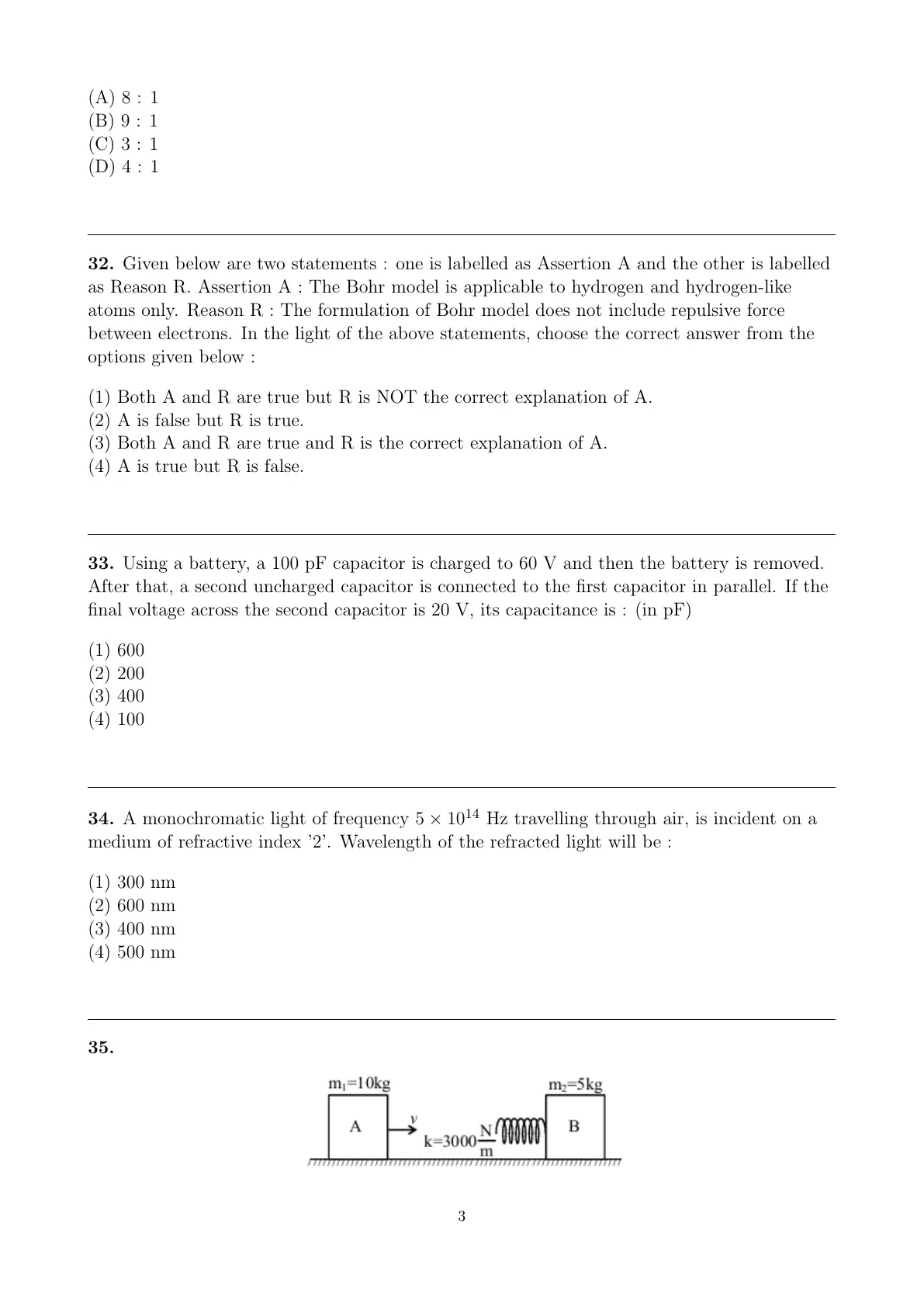
An ideal gas exists in a state with pressure \( P_0 \), volume \( V_0 \). It is isothermally expanded to 4 times of its initial volume \( (V_0) \), then isobarically compressed to its original volume. Finally the system is heated isochorically to bring it to its initial state. The amount of heat exchanged in this process is :
View Solution
\includegraphics{30S.png
The process consists of three steps forming a cycle. The total heat exchanged in a cyclic process is equal to the total work done by the system, since the change in internal energy for a cyclic process is zero (\( \Delta U_{cyclic} = 0 \)).
The total heat \( Q_T = \omega_1 + \omega_2 + \omega_3 \), where \( \omega_1, \omega_2, \omega_3 \) are the work done in the isothermal expansion, isobaric compression, and isochoric heating, respectively.
Step 1: Isothermal expansion from \( (P_0, V_0) \) to \( (P_1, 4V_0) \).
For an isothermal process, \( PV = constant \), so \( P_0 V_0 = P_1 (4V_0) \Rightarrow P_1 = \frac{P_0}{4} \).
Work done \( \omega_1 = \int_{V_0}^{4V_0} P dV = \int_{V_0}^{4V_0} \frac{P_0 V_0}{V} dV = P_0 V_0 [\ln V]_{V_0}^{4V_0} = P_0 V_0 (\ln(4V_0) - \ln V_0) = P_0 V_0 \ln \frac{4V_0}{V_0} = P_0 V_0 \ln 4 = P_0 V_0 (2 \ln 2) \).
Step 2: Isobaric compression from \( (\frac{P_0}{4}, 4V_0) \) to \( (\frac{P_0}{4}, V_0) \).
Work done \( \omega_2 = \int_{4V_0}^{V_0} P dV = P_1 (V_0 - 4V_0) = \frac{P_0}{4} (-3V_0) = -\frac{3}{4} P_0 V_0 = -0.75 P_0 V_0 \).
Step 3: Isochoric heating from \( (\frac{P_0}{4}, V_0) \) to \( (P_0, V_0) \).
For an isochoric process, the volume is constant (\( dV = 0 \)).
Work done \( \omega_3 = \int_{V_0}^{V_0} P dV = 0 \).
The total heat exchanged in the process is the sum of the work done in each step: \[ Q_T = \omega_1 + \omega_2 + \omega_3 = 2 P_0 V_0 \ln 2 - 0.75 P_0 V_0 + 0 = P_0 V_0 (2 \ln 2 - 0.75) \] Quick Tip: For a cyclic thermodynamic process, the net heat exchanged is equal to the net work done by the system. Calculate the work done in each step of the cycle: isothermal expansion \( W = nRT \ln \frac{V_f}{V_i} \), isobaric process \( W = P(V_f - V_i) \), and isochoric process \( W = 0 \). Sum the work done in each step to find the total heat exchanged.
Two monochromatic light beams have intensities in the ratio 1:9. An interference pattern is obtained by these beams. The ratio of the intensities of maximum to minimum is
View Solution
Let the intensities of the two monochromatic light beams be \( I_1 \) and \( I_2 \).
Given that the ratio of their intensities is 1:9, we can write \( \frac{I_1}{I_2} = \frac{1}{9} \).
Let \( I_1 = I \) and \( I_2 = 9I \).
The maximum intensity \( I_{max} \) in the interference pattern is given by: \[ I_{max} = (\sqrt{I_1} + \sqrt{I_2})^2 \]
Substituting the values of \( I_1 \) and \( I_2 \): \[ I_{max} = (\sqrt{I} + \sqrt{9I})^2 = (\sqrt{I} + 3\sqrt{I})^2 = (4\sqrt{I})^2 = 16I \]
The minimum intensity \( I_{min} \) in the interference pattern is given by: \[ I_{min} = (\sqrt{I_1} - \sqrt{I_2})^2 \]
Substituting the values of \( I_1 \) and \( I_2 \): \[ I_{min} = (\sqrt{I} - \sqrt{9I})^2 = (\sqrt{I} - 3\sqrt{I})^2 = (-2\sqrt{I})^2 = 4I \]
The ratio of the maximum to the minimum intensity is: \[ \frac{I_{max}}{I_{min}} = \frac{16I}{4I} = 4 \]
So, the ratio of the intensities of maximum to minimum is 4:1. Quick Tip: In an interference pattern formed by two sources of intensities \( I_1 \) and \( I_2 \), the maximum intensity is \( (\sqrt{I_1} + \sqrt{I_2})^2 \) and the minimum intensity is \( (\sqrt{I_1} - \sqrt{I_2})^2 \). Use the given ratio of intensities to express one intensity in terms of the other and then calculate the ratio of maximum to minimum intensity.
Given below are two statements : one is labelled as Assertion A and the other is labelled as Reason R.
Assertion A : The Bohr model is applicable to hydrogen and hydrogen-like atoms only.
Reason R : The formulation of Bohr model does not include repulsive force between electrons.
In the light of the above statements, choose the correct answer from the options given below :
View Solution
Assertion A states that the Bohr model is applicable to hydrogen and hydrogen-like atoms only. Hydrogen-like atoms are those that have only one electron, such as \( He^+, Li^{2+}, Be^{3+} \), etc. The Bohr model successfully explains the atomic spectra of hydrogen and these single-electron species. For atoms with more than one electron, the Bohr model fails to predict the correct spectra. Thus, Assertion A is true.
Reason R states that the formulation of the Bohr model does not include the repulsive force between electrons. The Bohr model is a simplified model of the atom that considers electrons orbiting the nucleus in specific quantized energy levels. It does not take into account the inter-electronic repulsions that are significant in multi-electron atoms. The absence of consideration for electron-electron repulsion is a primary reason why the Bohr model is only accurate for single-electron systems. Thus, Reason R is also true.
Furthermore, the reason R correctly explains why the Bohr model is limited to hydrogen and hydrogen-like atoms. The simplicity of having only one electron eliminates the complexities arising from electron-electron interactions, which are not accounted for in the Bohr model. Therefore, Reason R is the correct explanation of Assertion A. Quick Tip: The Bohr model is a foundational model in atomic physics but has limitations. Remember that it works well for single-electron systems because it neglects the complexities of electron-electron interactions. For multi-electron atoms, more sophisticated models like the quantum mechanical model are necessary.
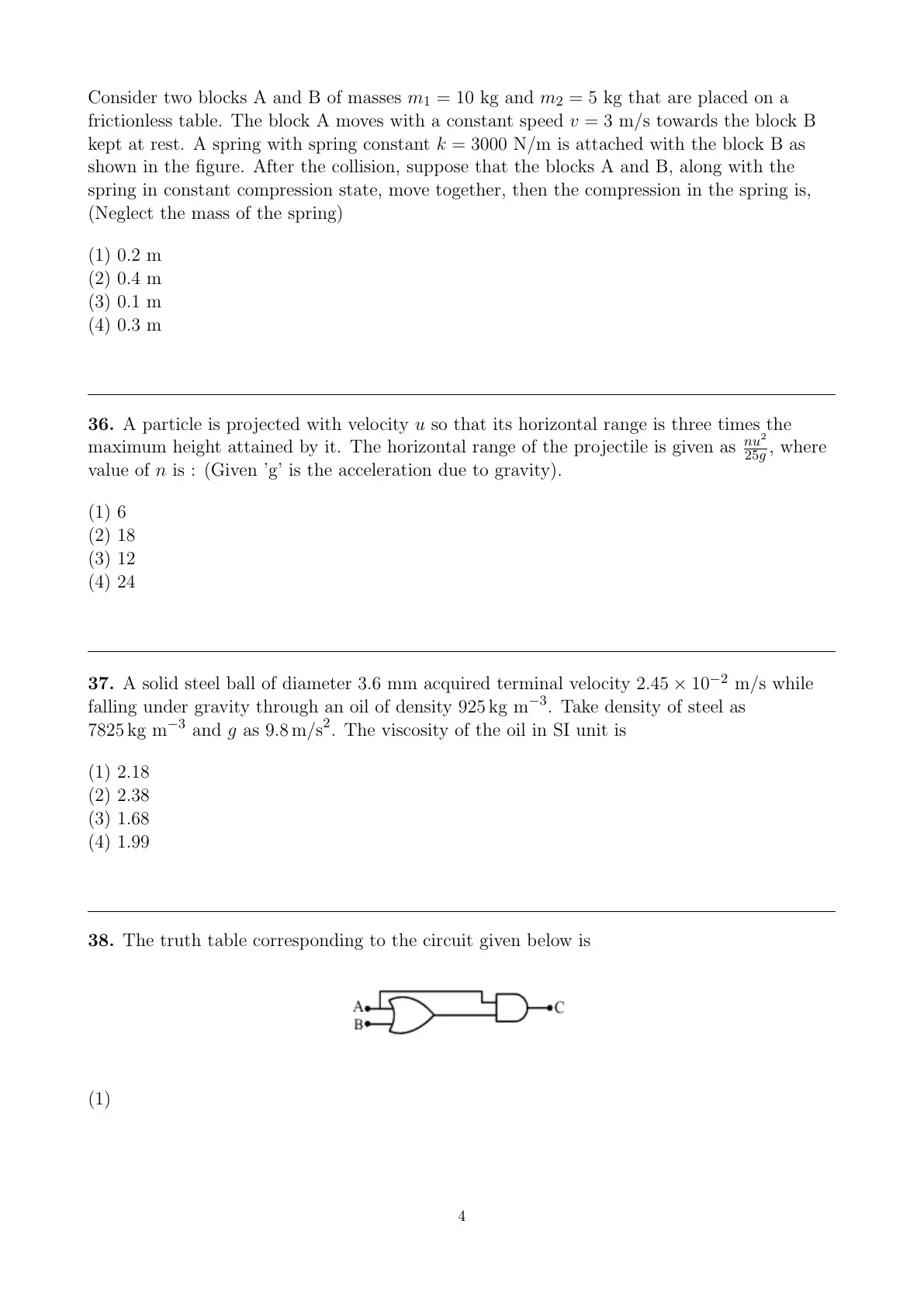
Using a battery, a 100 pF capacitor is charged to 60 V and then the battery is removed. After that, a second uncharged capacitor is connected to the first capacitor in parallel. If the final voltage across the second capacitor is 20 V, its capacitance is : (in pF)
View Solution
\includegraphics{33S.png
Let the capacitance of the first capacitor be \( C_1 = 100 \, pF \) and its initial voltage be \( V_i = 60 \, V \).
The initial charge on the first capacitor is \( Q_i = C_1 V_i = (100 \, pF)(60 \, V) = 6000 \, pC \).
A second uncharged capacitor with capacitance \( C_2 \) is connected in parallel to the first capacitor. When capacitors are connected in parallel, the voltage across them becomes equal. The final voltage across the second capacitor is given as \( V_f = 20 \, V \). Since they are in parallel, the final voltage across the first capacitor is also \( V_f = 20 \, V \).
The total charge in the system is conserved. The initial charge was only on the first capacitor, \( Q_i = 6000 \, pC \). After connecting the second capacitor, this charge is distributed between the two capacitors.
The final charge on the first capacitor is \( Q_{f1} = C_1 V_f = (100 \, pF)(20 \, V) = 2000 \, pC \).
The final charge on the second capacitor is \( Q_{f2} = C_2 V_f = C_2 (20 \, V) \).
By conservation of charge: \[ Q_i = Q_{f1} + Q_{f2} \] \[ 6000 \, pC = 2000 \, pC + C_2 (20 \, V) \] \[ 4000 \, pC = C_2 (20 \, V) \] \[ C_2 = \frac{4000 \, pC}{20 \, V} = 200 \, pF \]
The capacitance of the second capacitor is 200 pF.
Alternatively, using the formula for the final voltage when a charged capacitor \( C_1 \) with initial voltage \( V_i \) is connected in parallel to an uncharged capacitor \( C_2 \): \[ V_f = \frac{C_1 V_i}{C_1 + C_2} \]
Given \( V_f = 20 \, V \), \( C_1 = 100 \, pF \), and \( V_i = 60 \, V \): \[ 20 = \frac{(100)(60)}{100 + C_2} \] \[ 20 (100 + C_2) = 6000 \] \[ 2000 + 20 C_2 = 6000 \] \[ 20 C_2 = 4000 \] \[ C_2 = \frac{4000}{20} = 200 \, pF \] Quick Tip: When a charged capacitor is connected in parallel to an uncharged capacitor, charge is redistributed until the voltage across both capacitors is the same. The total charge in the system is conserved. You can use the conservation of charge or the formula for the final voltage in parallel capacitor combinations to solve such problems.
A monochromatic light of frequency \( 5 \times 10^{14} \) Hz travelling through air, is incident on a medium of refractive index '2'. Wavelength of the refracted light will be :
View Solution
The frequency of light remains unchanged when it passes from one medium to another.
Given frequency \( f = 5 \times 10^{14} \) Hz.
The speed of light in air (approximately vacuum) is \( c = 3 \times 10^8 \) m/s.
The wavelength of light in air (\( \lambda_{air} \)) is given by: \[ \lambda_{air} = \frac{c}{f} = \frac{3 \times 10^8 \, m/s}{5 \times 10^{14} \, Hz} = 0.6 \times 10^{-6} \, m = 600 \times 10^{-9} \, m = 600 \, nm \]
The refractive index of the medium is given as \( \mu = 2 \).
The wavelength of light in the medium (\( \lambda_{medium} \)) is related to the wavelength in vacuum (or air) by the refractive index: \[ \lambda_{medium} = \frac{\lambda_{air}}{\mu} \]
Substituting the values: \[ \lambda_{medium} = \frac{600 \, nm}{2} = 300 \, nm \]
The wavelength of the refracted light in the medium is 300 nm. Quick Tip: When light travels from one medium to another, its frequency remains constant, but its speed and wavelength change. The relationship between the wavelength in a medium (\( \lambda_{medium} \)), the wavelength in vacuum (\( \lambda_{vacuum} \)), and the refractive index (\( \mu \)) of the medium is \( \lambda_{medium} = \frac{\lambda_{vacuum}}{\mu} \). First, find the wavelength in air (approximated as vacuum) using the given frequency and the speed of light in vacuum. Then, use the refractive index to find the wavelength in the medium.
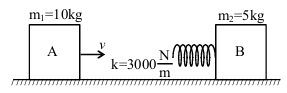
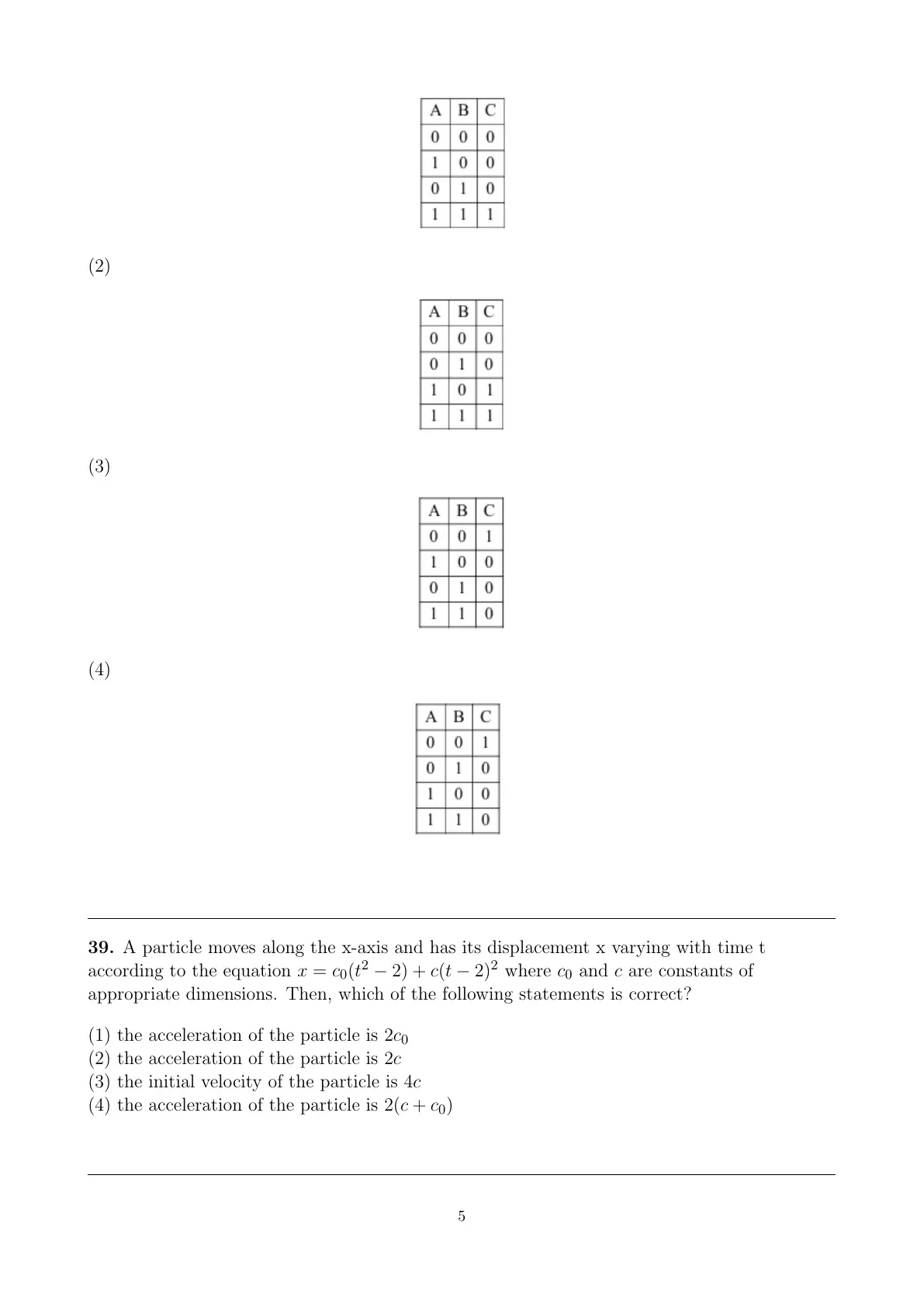
Consider two blocks A and B of masses \( m_1 = 10 \) kg and \( m_2 = 5 \) kg that are placed on a frictionless table. The block A moves with a constant speed \( v = 3 \) m/s towards the block B kept at rest. A spring with spring constant \( k = 3000 \) N/m is attached with the block B as shown in the figure. After the collision, suppose that the blocks A and B, along with the spring in constant compression state, move together, then the compression in the spring is, (Neglect the mass of the spring)
View Solution
We are given two blocks A and B with masses \( m_1 = 10 \) kg and \( m_2 = 5 \) kg on a frictionless table. Block A moves with a velocity \( v_1 = 3 \) m/s towards block B, which is initially at rest (\( v_2 = 0 \) m/s). After the collision, the blocks A and B move together with a common velocity \( v_{cm} \). We can find this common velocity using the principle of conservation of linear momentum: \[ m_1 v_1 + m_2 v_2 = (m_1 + m_2) v_{cm} \] \[ (10 \, kg)(3 \, m/s) + (5 \, kg)(0 \, m/s) = (10 \, kg + 5 \, kg) v_{cm} \] \[ 30 \, kg m/s = (15 \, kg) v_{cm} \] \[ v_{cm} = \frac{30}{15} = 2 \, m/s \]
The kinetic energy lost during the inelastic collision is stored as potential energy in the compressed spring. We can use the principle of conservation of energy. The initial kinetic energy of the system is the kinetic energy of block A: \[ KE_i = \frac{1}{2} m_1 v_1^2 = \frac{1}{2} (10 \, kg) (3 \, m/s)^2 = \frac{1}{2} (10)(9) = 45 \, J \]
The final kinetic energy of the combined mass (\( m_1 + m_2 \)) moving with velocity \( v_{cm} \) is: \[ KE_f = \frac{1}{2} (m_1 + m_2) v_{cm}^2 = \frac{1}{2} (15 \, kg) (2 \, m/s)^2 = \frac{1}{2} (15)(4) = 30 \, J \]
The loss in kinetic energy is stored as the potential energy in the compressed spring: \[ PE_{spring} = KE_i - KE_f = 45 \, J - 30 \, J = 15 \, J \]
The potential energy stored in a compressed spring with spring constant \( k \) and compression \( x \) is given by: \[ PE_{spring} = \frac{1}{2} k x^2 \]
We are given \( k = 3000 \) N/m. So, \[ 15 = \frac{1}{2} (3000) x^2 \] \[ 15 = 1500 x^2 \] \[ x^2 = \frac{15}{1500} = \frac{1}{100} \] \[ x = \sqrt{\frac{1}{100}} = \frac{1}{10} \, m = 0.1 \, m \]
The compression in the spring is 0.1 m. Quick Tip: In collisions where objects stick together, use the conservation of linear momentum to find the common final velocity. The kinetic energy lost during such inelastic collisions is often converted into other forms of energy, such as potential energy stored in a spring. Use the conservation of energy to relate the loss in kinetic energy to the potential energy stored in the spring and solve for the compression.
A particle is projected with velocity \( u \) so that its horizontal range is three times the maximum height attained by it. The horizontal range of the projectile is given as \( \frac{nu^2}{25g} \), where value of \( n \) is : (Given 'g' is the acceleration due to gravity).
View Solution
The horizontal range \( R \) of a projectile launched with initial velocity \( u \) at an angle \( \theta \) with the horizontal is given by: \[ R = \frac{u^2 \sin 2\theta}{g} \]
The maximum height \( H_{max} \) attained by the projectile is given by: \[ H_{max} = \frac{u^2 \sin^2 \theta}{2g} \]
We are given that the horizontal range is three times the maximum height: \[ R = 3 H_{max} \] \[ \frac{u^2 \sin 2\theta}{g} = 3 \left( \frac{u^2 \sin^2 \theta}{2g} \right) \] \[ \frac{u^2 (2 \sin \theta \cos \theta)}{g} = \frac{3 u^2 \sin^2 \theta}{2g} \]
We can cancel \( \frac{u^2}{g} \) from both sides (assuming \( u \neq 0 \)): \[ 2 \sin \theta \cos \theta = \frac{3}{2} \sin^2 \theta \]
Assuming \( \sin \theta \neq 0 \) (i.e., the projectile is launched at an angle other than 0 or 180 degrees), we can divide by \( \sin \theta \): \[ 2 \cos \theta = \frac{3}{2} \sin \theta \] \[ \frac{\sin \theta}{\cos \theta} = \tan \theta = \frac{2}{3/2} = \frac{4}{3} \]
Now we need to find the horizontal range \( R \) in terms of \( u \) and \( g \). We know \( R = \frac{u^2 \sin 2\theta}{g} = \frac{u^2 (2 \sin \theta \cos \theta)}{g} \).
If \( \tan \theta = \frac{4}{3} \), we can consider a right-angled triangle where the opposite side is 4 and the adjacent side is 3. The hypotenuse is \( \sqrt{4^2 + 3^2} = \sqrt{16 + 9} = \sqrt{25} = 5 \).
So, \( \sin \theta = \frac{4}{5} \) and \( \cos \theta = \frac{3}{5} \).
Substituting these values into the expression for \( R \): \[ R = \frac{u^2 (2 \times \frac{4}{5} \times \frac{3}{5})}{g} = \frac{u^2 (\frac{24}{25})}{g} = \frac{24 u^2}{25 g} \]
We are given that the horizontal range is \( R = \frac{nu^2}{25g} \). Comparing this with our result, we find that \( n = 24 \). Quick Tip: Use the formulas for the horizontal range and maximum height of a projectile. Set up the given condition relating the range and maximum height to find the angle of projection. Once the angle is known (or trigonometric ratios of the angle are known), substitute these values back into the formula for the range to express it in the required form and find the value of \( n \).
A solid steel ball of diameter 3.6 mm acquired terminal velocity \( 2.45 \times 10^{-2} \) m/s while falling under gravity through an oil of density \( 925 \, kg m^{-3} \). Take density of steel as \( 7825 \, kg m^{-3} \) and \( g \) as \( 9.8 \, m/s^2 \). The viscosity of the oil in SI unit is
View Solution
The terminal velocity \( v_T \) of a sphere falling through a viscous fluid is given by Stokes' Law: \[ v_T = \frac{2 r^2 (\rho_s - \rho_l) g}{9 \eta} \]
where \( r \) is the radius of the sphere, \( \rho_s \) is the density of the sphere (steel), \( \rho_l \) is the density of the liquid (oil), \( g \) is the acceleration due to gravity, and \( \eta \) is the viscosity of the liquid.
Given:
Diameter of the steel ball \( d = 3.6 \, mm = 3.6 \times 10^{-3} \, m \)
Radius of the steel ball \( r = \frac{d}{2} = \frac{3.6 \times 10^{-3}}{2} = 1.8 \times 10^{-3} \, m \)
Terminal velocity \( v_T = 2.45 \times 10^{-2} \, m/s \)
Density of oil \( \rho_l = 925 \, kg m^{-3} \)
Density of steel \( \rho_s = 7825 \, kg m^{-3} \)
Acceleration due to gravity \( g = 9.8 \, m/s^2 \)
We need to find the viscosity \( \eta \) of the oil. Rearranging the formula for terminal velocity: \[ \eta = \frac{2 r^2 (\rho_s - \rho_l) g}{9 v_T} \]
Substituting the given values: \[ \eta = \frac{2 (1.8 \times 10^{-3})^2 (7825 - 925) (9.8)}{9 (2.45 \times 10^{-2})} \] \[ \eta = \frac{2 (3.24 \times 10^{-6}) (6900) (9.8)}{9 (2.45 \times 10^{-2})} \] \[ \eta = \frac{2 \times 3.24 \times 10^{-6} \times 6900 \times 9.8}{0.2205} \] \[ \eta = \frac{0.436512}{0.2205} \] \[ \eta \approx 1.98 \, Pa s \]
The viscosity of the oil is approximately 1.98 Pa s, which is close to 1.99. Quick Tip: Use Stokes' Law for terminal velocity of a sphere falling through a viscous fluid: \( v_T = \frac{2 r^2 (\rho_s - \rho_l) g}{9 \eta} \). Ensure all units are in SI. Calculate the radius from the diameter. Rearrange the formula to solve for the viscosity \( \eta \). Substitute the given values and perform the calculation carefully.
The truth table corresponding to the circuit given below is
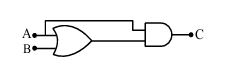
- (1)
![image]()
- (2)
![image]()
- (3)
![image]()
- (4)
![image]()
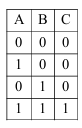
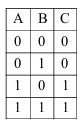
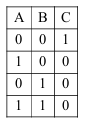
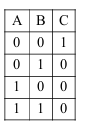
View Solution
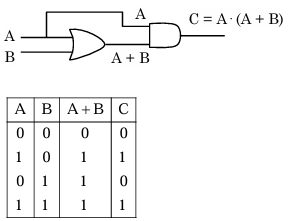 Quick Tip: To find the truth table for a given digital circuit, determine the Boolean expression for the output in terms of the inputs. Then, evaluate this expression for all possible combinations of input values (0 and 1) to create the truth table. You can also simplify the Boolean expression before creating the truth table to make the evaluation easier. For OR gate, output is 1 if at least one input is 1. For AND gate, output is 1 only if all inputs are 1.
A particle moves along the x-axis and has its displacement x varying with time t according to the equation \( x = c_0 (t^2 - 2) + c (t - 2)^2 \)
where \( c_0 \) and \( c \) are constants of appropriate dimensions. Then, which of the following statements is correct?
View Solution
\(\frac{dx}{dt} = v = 2tC_2 + 2C_1\)
\(\frac{dv}{dt} = a = 2C_2\) Quick Tip: To find the velocity and acceleration of a particle given its displacement as a function of time, differentiate the displacement with respect to time once for velocity and twice for acceleration. The initial velocity is the velocity at \( t = 0 \).
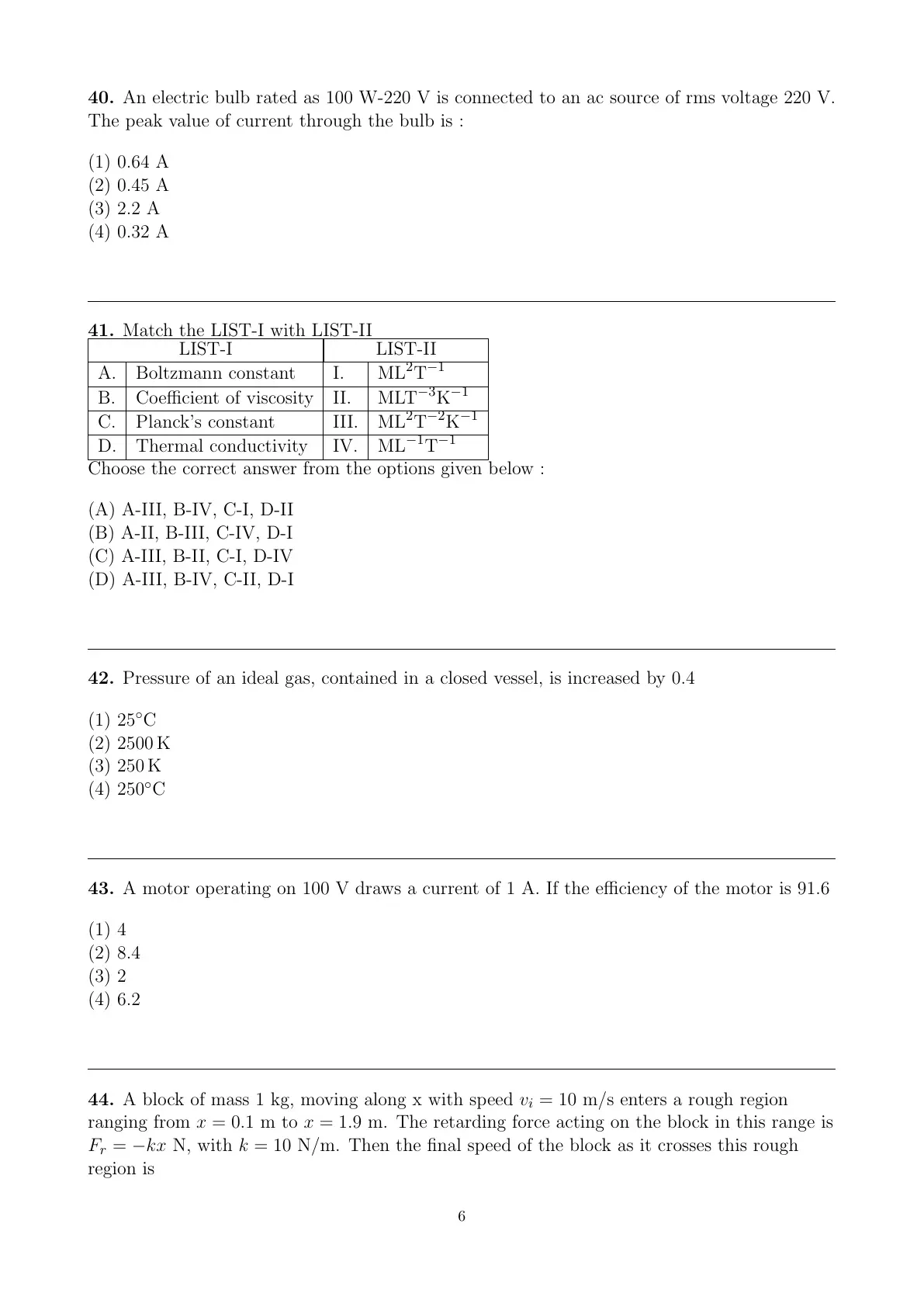
An electric bulb rated as 100 W-220 V is connected to an ac source of rms voltage 220 V. The peak value of current through the bulb is :
View Solution
The power rating of the electric bulb is \( P = 100 \, W \) at an rms voltage \( V_{rms} = 220 \, V \).
When the bulb is connected to an ac source of rms voltage 220 V, it will operate at its rated power.
The relationship between power, rms voltage, and rms current \( I_{rms} \) is: \[ P = V_{rms} I_{rms} \]
We can find the rms current through the bulb: \[ I_{rms} = \frac{P}{V_{rms}} = \frac{100 \, W}{220 \, V} = \frac{10}{22} \, A = \frac{5}{11} \, A \]
The peak value of the current \( I_0 \) in an ac circuit is related to the rms current by: \[ I_0 = \sqrt{2} I_{rms} \]
Substituting the value of \( I_{rms} \): \[ I_0 = \sqrt{2} \times \frac{5}{11} \, A \]
We know that \( \sqrt{2} \approx 1.414 \). \[ I_0 \approx 1.414 \times \frac{5}{11} = \frac{7.07}{11} \approx 0.6427 \, A \]
Rounding to two decimal places, the peak value of the current through the bulb is approximately 0.64 A. Quick Tip: For a resistive load like an electric bulb connected to an AC source, the power \( P = V_{rms} I_{rms} \). Use the given power and rms voltage to find the rms current. The peak value of current in an AC circuit is related to the rms current by \( I_0 = \sqrt{2} I_{rms} \).
Match the LIST-I with LIST-II
LIST-I LIST-II
A. Boltzmann constant I. \( ML^2T^{-1} \)
B. Coefficient of viscosity II. \( MLT^{-3}K^{-1} \)
C. Planck's constant III. \( ML^2T^{-2}K^{-1} \)
D. Thermal conductivity IV. \( ML^{-1}T^{-1} \)
Choose the correct answer from the options given below :
View Solution
Let's find the dimensions of each quantity in LIST-I.
A. Boltzmann constant (k):
From the ideal gas law, \( PV = NkT \), where P is pressure (\( ML^{-1}T^{-2} \)), V is volume (\( L^3 \)), N is the number of particles (dimensionless), k is the Boltzmann constant, and T is temperature (K).
So, \( k = \frac{PV}{NT} = \frac{(ML^{-1}T^{-2})(L^3)}{(1)(K)} = ML^2T^{-2}K^{-1} \)
Thus, A matches with III.
B. Coefficient of viscosity (\( \eta \)):
From viscous force \( F = 6\pi \eta r v \), where F is force (\( MLT^{-2} \)), r is radius (L), and v is velocity (\( LT^{-1} \)).
So, \( \eta = \frac{F}{6\pi r v} = \frac{MLT^{-2}}{(1)(L)(LT^{-1})} = \frac{MLT^{-2}}{L^2T^{-1}} = ML^{-1}T^{-1} \)
Thus, B matches with IV.
C. Planck's constant (h):
From the energy of a photon \( E = hf \), where E is energy (\( ML^2T^{-2} \)) and f is frequency (\( T^{-1} \)).
So, \( h = \frac{E}{f} = \frac{ML^2T^{-2}}{T^{-1}} = ML^2T^{-1} \)
Thus, C matches with I.
D. Thermal conductivity (K):
From the rate of heat flow \( \frac{dQ}{dt} = -KA \frac{dT}{dx} \), where \( \frac{dQ}{dt} \) is power (\( ML^2T^{-3} \)), A is area (\( L^2 \)), and \( \frac{dT}{dx} \) is temperature gradient (\( KL^{-1} \)).
So, \( K = \frac{(dQ/dt) dx}{A dT} = \frac{(ML^2T^{-3})(L)}{(L^2)(K)} = \frac{ML^3T^{-3}}{L^2K} = MLT^{-3}K^{-1} \)
Thus, D matches with II.
The correct matching is A-III, B-IV, C-I, D-II, which corresponds to option (A). Quick Tip: To find the dimensions of a physical quantity, use the fundamental formulas relating it to other quantities whose dimensions are known. Remember the fundamental dimensions of mass (M), length (L), time (T), and temperature (K). Derive the dimensions step by step using the definitions of the quantities involved.
Pressure of an ideal gas, contained in a closed vessel, is increased by 0.4% when heated by \( 1^\circ C \). Its initial temperature must be :
View Solution
The gas is contained in a closed vessel, so the volume remains constant. This is an isochoric process. For an ideal gas at constant volume, the pressure is directly proportional to the temperature (in Kelvin): \[ P \propto T \implies \frac{P}{T} = constant \implies \frac{\Delta P}{\Delta T} = \frac{P}{T} \]
Let the initial pressure be \( P \) and the initial temperature be \( T \) (in Kelvin).
The pressure increases by 0.4%, so the change in pressure \( \Delta P = 0.4% of P = \frac{0.4}{100} P = 0.004 P \).
The temperature is increased by \( 1^\circ C \), which is equal to \( 1 \, K \) change in Kelvin scale, so \( \Delta T = 1 \, K \).
Substituting these values into the equation: \[ \frac{0.004 P}{1} = \frac{P}{T} \] \[ 0.004 = \frac{1}{T} \] \[ T = \frac{1}{0.004} = \frac{1000}{4} = 250 \, K \]
The initial temperature of the gas is \( 250 \, K \). To convert this to Celsius, we use \( T(^\circ C) = T(K) - 273.15 \): \[ T(^\circ C) = 250 - 273.15 = -23.15^\circ C \]
However, the options are given in Celsius and Kelvin, and \( 250 \, K \) is one of the options. Quick Tip: For an ideal gas in a closed vessel (isochoric process), the ratio of pressure to temperature (in Kelvin) is constant. Use the given percentage increase in pressure and the change in temperature to set up a proportion and solve for the initial temperature in Kelvin. Remember to always use Kelvin for gas law calculations involving temperature.
A motor operating on 100 V draws a current of 1 A. If the efficiency of the motor is 91.6%, then the loss of power in units of cal/s is
View Solution
The input power to the motor is given by: \[ P_{input} = V \times I \]
where \( V \) is the voltage and \( I \) is the current.
Given \( V = 100 \, V \) and \( I = 1 \, A \), \[ P_{input} = 100 \, V \times 1 \, A = 100 \, W \]
The efficiency \( \eta \) of the motor is given by: \[ \eta = \frac{P_{output}}{P_{input}} \]
Given \( \eta = 91.6% = 0.916 \), we can find the output power: \[ P_{output} = \eta \times P_{input} = 0.916 \times 100 \, W = 91.6 \, W \]
The power loss in the motor is the difference between the input power and the output power: \[ P_{loss} = P_{input} - P_{output} = 100 \, W - 91.6 \, W = 8.4 \, W \]
We need to convert the power loss from watts to calories per second (cal/s). We know that 1 calorie (cal) is equal to 4.184 Joules (J). Since power is the rate of energy transfer (1 W = 1 J/s), we have: \[ 1 \, W = 1 \, J/s = \frac{1}{4.184} \, cal/s \]
So, the power loss in cal/s is: \[ P_{loss} (cal/s) = 8.4 \, W \times \frac{1}{4.184} \, cal/s/W \] \[ P_{loss} (cal/s) \approx 2.0076 \, cal/s \]
Rounding to the nearest whole number, the loss of power is approximately 2 cal/s. Quick Tip: First, calculate the input power to the motor using \( P_{input} = VI \). Then, use the efficiency to find the output power \( P_{output} = \eta P_{input} \). The power loss is \( P_{loss} = P_{input} - P_{output} \). Finally, convert the power loss from watts (J/s) to calories per second (cal/s) using the conversion factor 1 cal = 4.184 J.
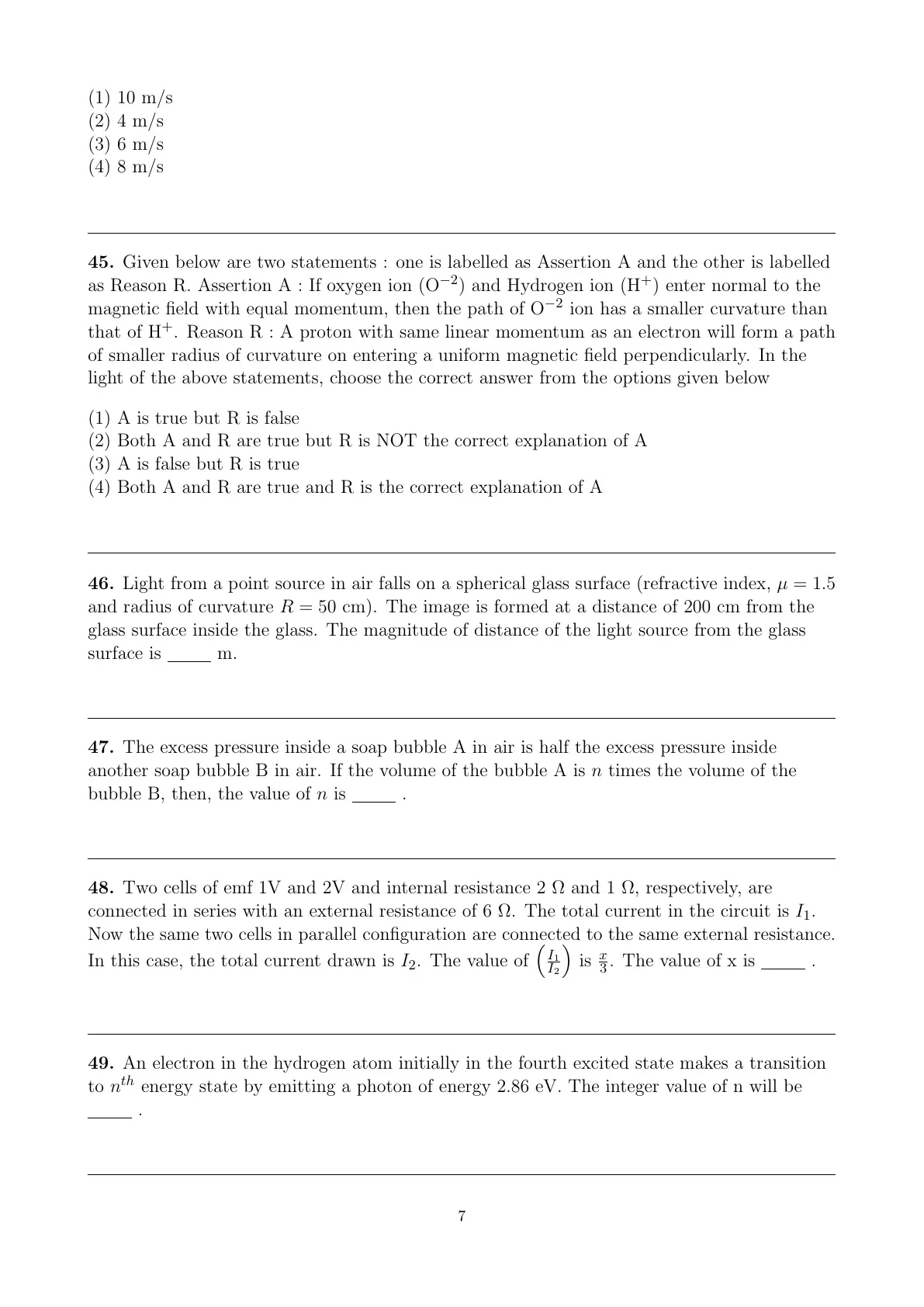
A block of mass 1 kg, moving along x with speed \( v_i = 10 \) m/s enters a rough region ranging from \( x = 0.1 \) m to \( x = 1.9 \) m. The retarding force acting on the block in this range is \( F_r = -kx \) N, with \( k = 10 \) N/m. Then the final speed of the block as it crosses this rough region is
View Solution
The work done by the retarding force on the block as it moves through the rough region is given by: \[ W = \int_{x_i}^{x_f} F_r dx = \int_{0.1}^{1.9} (-kx) dx \]
Substituting \( k = 10 \) N/m: \[ W = \int_{0.1}^{1.9} (-10x) dx = -10 \left[ \frac{x^2}{2} \right]_{0.1}^{1.9} \] \[ W = -5 \left[ (1.9)^2 - (0.1)^2 \right] = -5 [3.61 - 0.01] = -5 [3.60] = -18 \, J \]
The work-energy theorem states that the net work done on an object is equal to the change in its kinetic energy: \[ W_{net} = \Delta KE = KE_f - KE_i = \frac{1}{2} m v_f^2 - \frac{1}{2} m v_i^2 \]
Given mass \( m = 1 \) kg and initial speed \( v_i = 10 \) m/s. The work done by the retarding force is the net work done on the block. \[ -18 = \frac{1}{2} (1) v_f^2 - \frac{1}{2} (1) (10)^2 \] \[ -18 = \frac{1}{2} v_f^2 - \frac{1}{2} (100) \] \[ -18 = \frac{1}{2} v_f^2 - 50 \] \[ \frac{1}{2} v_f^2 = 50 - 18 = 32 \] \[ v_f^2 = 64 \] \[ v_f = \sqrt{64} = 8 \, m/s \]
The final speed of the block as it crosses the rough region is 8 m/s. Quick Tip: Use the work-energy theorem to solve this problem. First, calculate the work done by the retarding force over the given distance by integrating the force with respect to displacement. Then, equate this work done to the change in kinetic energy of the block to find the final speed.
Given below are two statements : one is labelled as Assertion A and the other is labelled as Reason R.
Assertion A : If oxygen ion (O\(^{-2}\)) and Hydrogen ion (H\(^{+}\)) enter normal to the magnetic field with equal momentum, then the path of O\(^{-2}\) ion has a smaller curvature than that of H\(^{+}\).
Reason R : A proton with same linear momentum as an electron will form a path of smaller radius of curvature on entering a uniform magnetic field perpendicularly.
In the light of the above statements, choose the correct answer from the options given below
View Solution
The radius of the circular path of a charged particle moving perpendicular to a uniform magnetic field is given by: \[ r = \frac{mv}{qB} = \frac{p}{qB} \]
where \( m \) is the mass of the particle, \( v \) is its velocity, \( q \) is the magnitude of the charge, \( B \) is the magnetic field strength, and \( p = mv \) is the linear momentum.
For Assertion A, the oxygen ion is O\(^{-2}\), so its charge magnitude is \( |q_{O^{-2}}| = 2e \). The hydrogen ion is H\(^{+}\), so its charge magnitude is \( |q_{H^{+}}| = e \), where \( e \) is the elementary charge. Both ions enter the magnetic field with equal momentum \( p \). The radius of curvature for O\(^{-2}\) is: \[ r_{O^{-2}} = \frac{p}{2eB} \]
The radius of curvature for H\(^{+}\) is: \[ r_{H^{+}} = \frac{p}{eB} \]
Comparing the radii, we see that \( r_{O^{-2}} = \frac{1}{2} r_{H^{+}} \). This means the path of O\(^{-2}\) ion has a smaller radius of curvature (larger curvature) than that of H\(^{+}\). Therefore, Assertion A is true.
For Reason R, a proton has charge \( +e \) and an electron has charge \( -e \), so their charge magnitudes are equal \( |q_p| = |q_e| = e \). They have the same linear momentum \( p \). The radius of curvature for the proton is: \[ r_p = \frac{p}{eB} \]
The radius of curvature for the electron is: \[ r_e = \frac{p}{eB} \]
Thus, \( r_p = r_e \). A proton and an electron with the same linear momentum will form paths of the same radius of curvature, not a smaller radius for the proton. Therefore, Reason R is false.
Since Assertion A is true and Reason R is false, the correct answer is (1). Quick Tip: The radius of the circular path of a charged particle in a magnetic field is directly proportional to its momentum and inversely proportional to the magnitude of its charge. When comparing particles with equal momentum, the particle with a larger charge will have a smaller radius of curvature.
Section – B
Question 21:
Light from a point source in air falls on a spherical glass surface (refractive index, \( \mu = 1.5 \) and radius of curvature \( R = 50 \) cm). The image is formed at a distance of 200 cm from the glass surface inside the glass. The magnitude of distance of the light source from the glass surface is \underline{\hspace{1cm m.
View Solution
We will use the formula for refraction at a spherical surface: \[ \frac{\mu_2}{v} - \frac{\mu_1}{u} = \frac{\mu_2 - \mu_1}{R} \]
where: \( \mu_1 \) is the refractive index of the first medium (air) = 1 \( \mu_2 \) is the refractive index of the second medium (glass) = 1.5 \( u \) is the object distance from the spherical surface (to be found) \( v \) is the image distance from the spherical surface = 200 cm (positive as the image is formed in the second medium) \( R \) is the radius of curvature of the spherical surface = +50 cm (positive as the surface is convex to the incident light)
Substituting the given values into the formula: \[ \frac{1.5}{200} - \frac{1}{u} = \frac{1.5 - 1}{50} \] \[ \frac{1.5}{200} - \frac{1}{u} = \frac{0.5}{50} \] \[ \frac{1.5}{200} - \frac{1}{u} = \frac{1}{100} \] \[ \frac{3}{400} - \frac{1}{u} = \frac{1}{100} \] \[ \frac{1}{u} = \frac{3}{400} - \frac{1}{100} = \frac{3}{400} - \frac{4}{400} = -\frac{1}{400} \] \[ u = -400 \, cm \]
The negative sign indicates that the object is real and located on the side from which the light is incident. The magnitude of the distance of the light source from the glass surface is \( |u| = 400 \, cm \).
To convert this distance to meters, we divide by 100: \[ |u| = \frac{400}{100} \, m = 4 \, m \] Quick Tip: Apply the formula for refraction at a spherical surface, \( \frac{\mu_2}{v} - \frac{\mu_1}{u} = \frac{\mu_2 - \mu_1}{R} \). Be careful with the sign conventions for \( u \), \( v \), and \( R \). For a convex surface, \( R \) is positive when light goes from a rarer to a denser medium. Real objects have negative \( u \), and real images formed on the opposite side of the refracting surface have positive \( v \). Ensure consistent units throughout the calculation and convert the final answer to the required unit.
The excess pressure inside a soap bubble A in air is half the excess pressure inside another soap bubble B in air. If the volume of the bubble A is \( n \) times the volume of the bubble B, then, the value of \( n \) is \underline{\hspace{1cm .
View Solution
The excess pressure \( \Delta P \) inside a soap bubble of radius \( R \) is given by: \[ \Delta P = \frac{4T}{R} \]
where \( T \) is the surface tension of the soap solution.
Let the excess pressure inside soap bubble A be \( \Delta P_A \) and its radius be \( R_A \).
Let the excess pressure inside soap bubble B be \( \Delta P_B \) and its radius be \( R_B \).
According to the problem, the excess pressure inside bubble A is half the excess pressure inside bubble B: \[ \Delta P_A = \frac{1}{2} \Delta P_B \]
Using the formula for excess pressure: \[ \frac{4T}{R_A} = \frac{1}{2} \left( \frac{4T}{R_B} \right) \] \[ \frac{1}{R_A} = \frac{1}{2 R_B} \] \[ R_A = 2 R_B \]
The volume of a spherical bubble is given by \( V = \frac{4}{3} \pi R^3 \).
Let the volume of bubble A be \( V_A \) and the volume of bubble B be \( V_B \). \[ V_A = \frac{4}{3} \pi R_A^3 \] \[ V_B = \frac{4}{3} \pi R_B^3 \]
We are given that the volume of bubble A is \( n \) times the volume of bubble B: \[ V_A = n V_B \] \[ \frac{\frac{4}{3} \pi R_A^3}{\frac{4}{3} \pi R_B^3} = n \] \[ \left( \frac{R_A}{R_B} \right)^3 = n \]
We found that \( R_A = 2 R_B \), so \( \frac{R_A}{R_B} = 2 \).
Substituting this into the equation for \( n \): \[ n = (2)^3 = 8 \]
The value of \( n \) is 8. Quick Tip: The excess pressure inside a soap bubble is inversely proportional to its radius. The volume of a soap bubble is proportional to the cube of its radius. Use the relationship between the excess pressures to find the relationship between the radii, and then use the relationship between the radii to find the relationship between the volumes.
Two cells of emf 1V and 2V and internal resistance 2 \( \Omega \) and 1 \( \Omega \), respectively, are connected in series with an external resistance of 6 \( \Omega \). The total current in the circuit is \( I_1 \). Now the same two cells in parallel configuration are connected to the same external resistance. In this case, the total current drawn is \( I_2 \). The value of \( \left( \frac{I_1}{I_2} \right) \) is \( \frac{x}{3} \). The value of x is \underline{\hspace{1cm .
View Solution

Case 1: Cells in series
The equivalent emf of the cells in series is \( \varepsilon_{eq,s} = \varepsilon_1 + \varepsilon_2 = 1 \, V + 2 \, V = 3 \, V \).
The equivalent internal resistance of the cells in series is \( r_{eq,s} = r_1 + r_2 = 2 \, \Omega + 1 \, \Omega = 3 \, \Omega \).
The total resistance in the circuit is \( R_1 = r_{eq,s} + R = 3 \, \Omega + 6 \, \Omega = 9 \, \Omega \).
The total current in the circuit is \( I_1 = \frac{\varepsilon_{eq,s}}{R_1} = \frac{3 \, V}{9 \, \Omega} = \frac{1}{3} \, A \).
Case 2: Cells in parallel
The equivalent emf of the cells in parallel is \( \varepsilon_{eq,p} = \frac{\frac{\varepsilon_1}{r_1} + \frac{\varepsilon_2}{r_2}}{\frac{1}{r_1} + \frac{1}{r_2}} = \frac{\frac{1}{2} + \frac{2}{1}}{\frac{1}{2} + \frac{1}{1}} = \frac{\frac{1+4}{2}}{\frac{1+2}{2}} = \frac{5/2}{3/2} = \frac{5}{3} \, V \).
The equivalent internal resistance of the cells in parallel is \( r_{eq,p} = \frac{1}{\frac{1}{r_1} + \frac{1}{r_2}} = \frac{1}{\frac{1}{2} + \frac{1}{1}} = \frac{1}{\frac{1+2}{2}} = \frac{1}{3/2} = \frac{2}{3} \, \Omega \).
The total resistance in the circuit is \( R_2 = r_{eq,p} + R = \frac{2}{3} \, \Omega + 6 \, \Omega = \frac{2 + 18}{3} \, \Omega = \frac{20}{3} \, \Omega \).
The total current in the circuit is \( I_2 = \frac{\varepsilon_{eq,p}}{R_2} = \frac{5/3 \, V}{20/3 \, \Omega} = \frac{5}{20} \, A = \frac{1}{4} \, A \).
Now we need to find the value of \( \frac{I_1}{I_2} \): \[ \frac{I_1}{I_2} = \frac{1/3}{1/4} = \frac{1}{3} \times \frac{4}{1} = \frac{4}{3} \]
We are given that \( \frac{I_1}{I_2} = \frac{x}{3} \).
Comparing the two expressions for \( \frac{I_1}{I_2} \): \[ \frac{x}{3} = \frac{4}{3} \]
Therefore, the value of \( x \) is 4. Quick Tip: When cells are connected in series, their emfs add up and their internal resistances add up. When cells are connected in parallel, the equivalent emf and equivalent internal resistance are calculated using specific formulas. After finding the equivalent emf and equivalent internal resistance for both series and parallel configurations, use Ohm's law to find the total current in each case. Finally, calculate the ratio of the currents as required.
An electron in the hydrogen atom initially in the fourth excited state makes a transition to \( n^{th} \) energy state by emitting a photon of energy 2.86 eV. The integer value of n will be \underline{\hspace{1cm .
View Solution
The energy of an electron in the \( n^{th} \) orbit of a hydrogen atom is given by: \[ E_n = -\frac{13.6}{n^2} \, eV \]
The electron is initially in the fourth excited state. The ground state is \( n=1 \), the first excited state is \( n=2 \), the second excited state is \( n=3 \), the third excited state is \( n=4 \), and the fourth excited state is \( n=5 \). So, the initial energy level is \( n_i = 5 \).
The electron makes a transition to the \( n^{th} \) energy state, so the final energy level is \( n_f = n \).
The energy of the emitted photon is equal to the difference in energy between the initial and final energy levels: \[ E_{photon} = E_i - E_f = -\frac{13.6}{n_i^2} - \left( -\frac{13.6}{n_f^2} \right) = 13.6 \left( \frac{1}{n_f^2} - \frac{1}{n_i^2} \right) \, eV \]
Given that the energy of the emitted photon is 2.86 eV, and \( n_i = 5 \), we have: \[ 2.86 = 13.6 \left( \frac{1}{n^2} - \frac{1}{5^2} \right) \] \[ 2.86 = 13.6 \left( \frac{1}{n^2} - \frac{1}{25} \right) \]
Divide both sides by 13.6: \[ \frac{2.86}{13.6} = \frac{1}{n^2} - \frac{1}{25} \] \[ 0.21029 \approx \frac{1}{n^2} - 0.04 \] \[ \frac{1}{n^2} = 0.21029 + 0.04 = 0.25029 \approx 0.25 = \frac{1}{4} \] \[ n^2 = 4 \] \[ n = \sqrt{4} = 2 \]
Since \( n \) must be an integer, the final energy state is \( n = 2 \). Quick Tip: Use the formula for the energy levels of a hydrogen atom and the energy of the emitted photon during a transition between energy levels. Identify the initial and final energy levels based on the given information. Set up the equation relating the photon energy to the initial and final quantum numbers and solve for the unknown final quantum number \( n \).
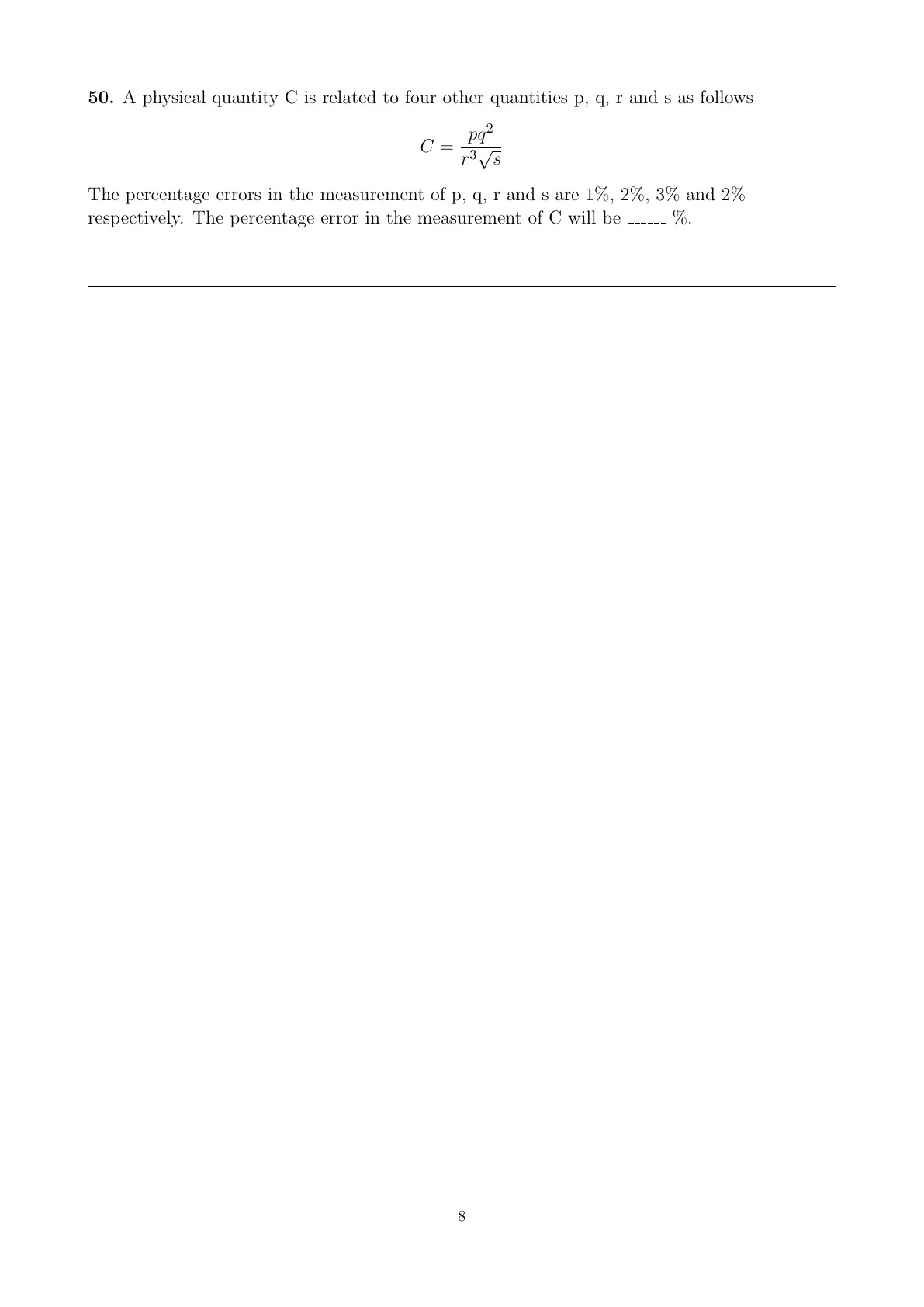
A physical quantity C is related to four other quantities p, q, r and s as follows \[ C = \frac{pq^2}{r^3 \sqrt{s}} \]
The percentage errors in the measurement of p, q, r and s are 1%, 2%, 3% and 2% respectively. The percentage error in the measurement of C will be ______ %.
View Solution
The physical quantity C is given by: \[ C = \frac{pq^2}{r^3 s^{1/2}} = p^1 q^2 r^{-3} s^{-1/2} \]
The percentage error in C is given by the sum of the percentage errors in each quantity multiplied by the absolute value of their exponents in the expression for C. \[ \left( \frac{\Delta C}{C} \times 100 \right)_{max} = \left| \frac{\partial C}{\partial p} \frac{p}{C} \right| \left( \frac{\Delta p}{p} \times 100 \right) + \left| \frac{\partial C}{\partial q} \frac{q}{C} \right| \left( \frac{\Delta q}{q} \times 100 \right) + \left| \frac{\partial C}{\partial r} \frac{r}{C} \right| \left( \frac{\Delta r}{r} \times 100 \right) + \left| \frac{\partial C}{\partial s} \frac{s}{C} \right| \left( \frac{\Delta s}{s} \times 100 \right) \]
Alternatively, using the rule for percentage errors: \[ % error in C = |1 \times (% error in p)| + |2 \times (% error in q)| + |-3 \times (% error in r)| + |-\frac{1}{2} \times (% error in s)| \]
Given percentage errors:
% error in p = 1%
% error in q = 2%
% error in r = 3%
% error in s = 2%
Substituting these values: \[ % error in C = |1 \times 1%| + |2 \times 2%| + |-3 \times 3%| + |-\frac{1}{2} \times 2%| \] \[ % error in C = 1% + 4% + 9% + 1% \] \[ % error in C = 15% \]
The maximum percentage error in the measurement of C will be 15%. Quick Tip: For a physical quantity \( C \) related to other quantities by \( C = p^a q^b r^c s^d \), the maximum percentage error in \( C \) is given by \( |a| (% error in p) + |b| (% error in q) + |c| (% error in r) + |d| (% error in s) \). Apply this rule directly to the given relation and percentage errors.



Comments