




JEE Main 2021 August 27 Shift 1 Question Paper is available here with solutions PDF and detailed solutions for every question. NTA conducted the first shift on August 27, 2021, from 9:00 AM to 12:00 PM. The JEE Main 2021 Paper 1 (B.E./B.Tech) question paper includes the following:
- 90 questions in a 3-hour CBT Mode: 30 each from Mathematics, Physics and Chemistry (75 to be attempted)
- Section A: 20 multiple choice questions (MCQs) per subject, all compulsory, 4 marks each
- Section B: 10 numerical value questions per subject, any 5 to be attempted, 4 marks each
- Marking: +4 for a correct answer, -1 for an incorrect MCQ, 0 for an unattempted question; no negative marking for numerical value questions
- Maximum marks: 300 (100 per subject)
JEE Main 2021 August 27 Shift 1 Question Paper with Solution PDF
| NTA Official PDF | CD PDF | CD PDF with Solutions |
|---|---|---|
| Download official PDF 6.32 MB | Download Collegedunia PDF 1.05 MB | Download solutions PDF 2.00 MB |
Also Check:
JEE Main 2021 August 27 Shift 1 Questions with Solutions
Mathematics - Section A (Q1 - Q20)
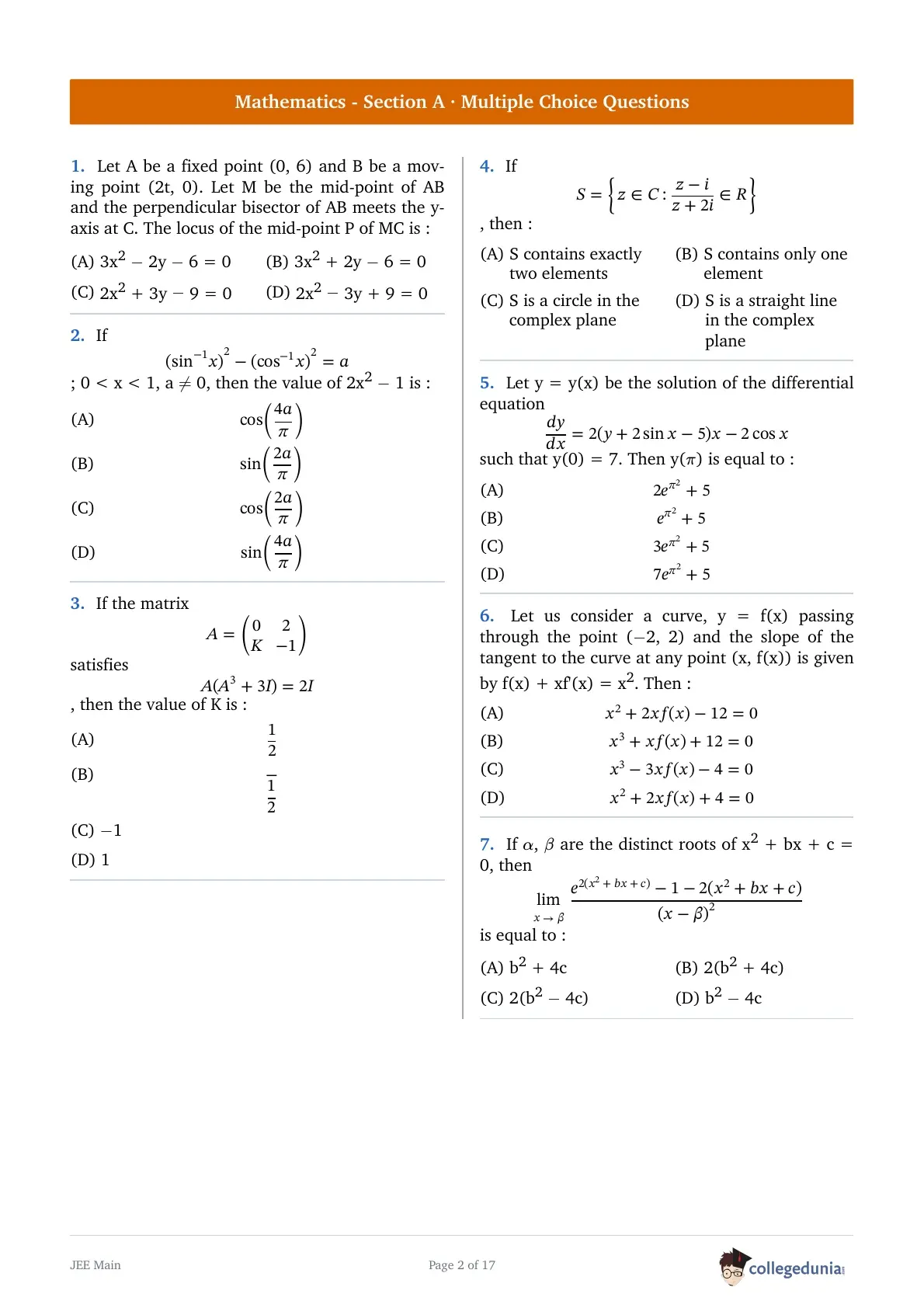
Let A be a fixed point (0, 6) and B be a moving point (2t, 0). Let M be the mid-point of AB and the perpendicular bisector of AB meets the y-axis at C. The locus of the mid-point P of MC is :
If \((\sin^{-1} x)^2 - (\cos^{-1} x)^2 = a; 0<x<1, a \neq 0\), then the value of \(2x^2 - 1\) is :
If the matrix \( A = \begin{pmatrix} 0 & 2 \\ K & -1 \end{pmatrix} \) satisfies \( A(A^3 + 3I) = 2I \), then the value of \( K \) is :
If \(S = \left\{z \in \mathbb{C} : \frac{z - i}{z + 2i} \in \mathbb{R}\right\}\), then :
Let \(y = y(x)\) be the solution of the differential equation \(\frac{dy}{dx} = 2(y + 2\sin x - 5)x - 2\cos x\) such that \(y(0) = 7\). Then \(y(\pi)\) is equal to :
Let us consider a curve, \(y = f(x)\) passing through the point \((-2, 2)\) and the slope of the tangent to the curve at any point \((x, f(x))\) is given by \(f(x) + x f'(x) = x^2\). Then :
If \(\alpha, \beta\) are the distinct roots of \(x^2 + bx + c = 0\), then \(\lim_{x \to \beta} \frac{e^{2(x^2 + bx + c)} - 1 - 2(x^2 + bx + c)}{(x - \beta)^2}\) is equal to :
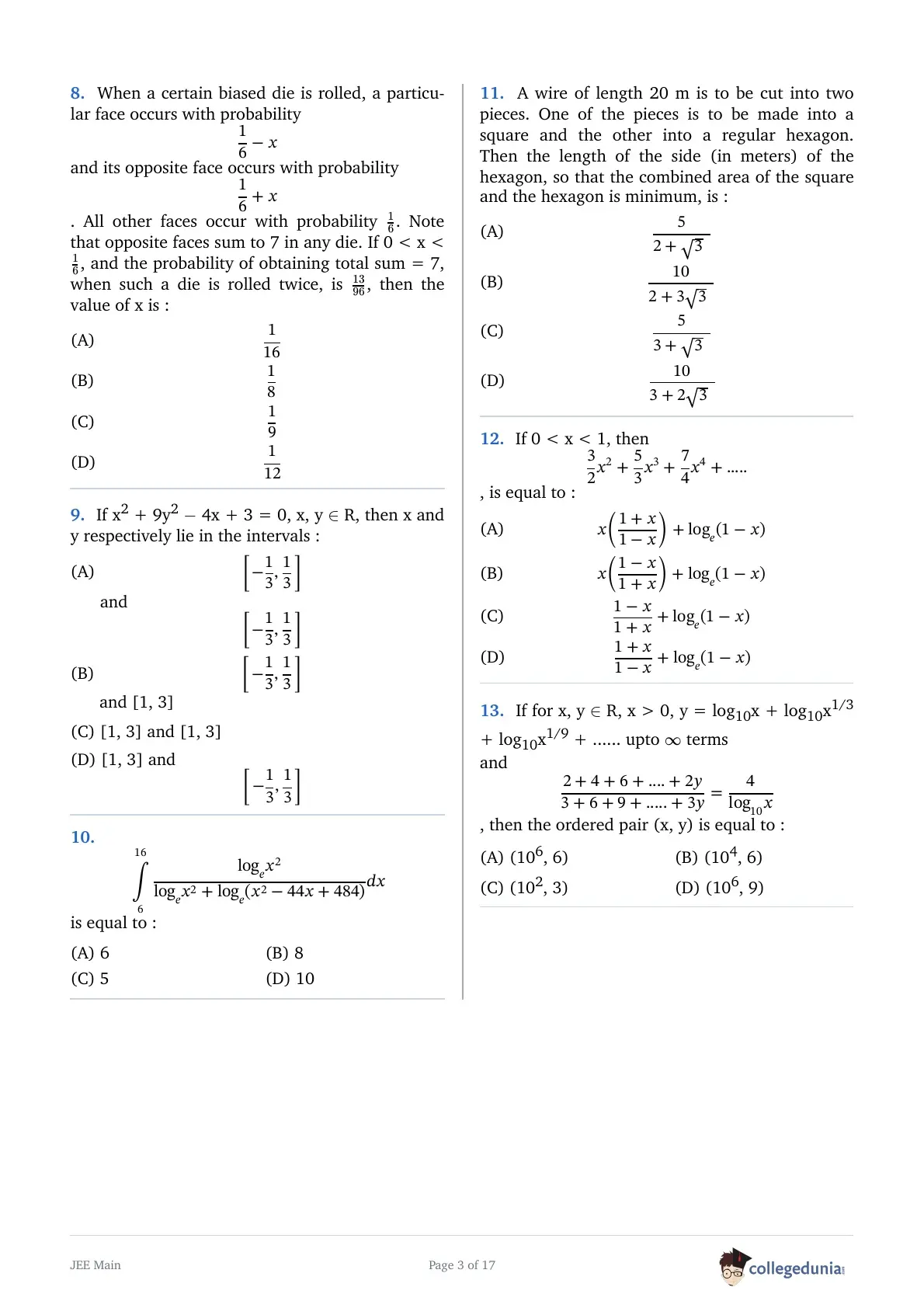
When a certain biased die is rolled, a particular face occurs with probability \(\frac{1}{6} - x\) and its opposite face occurs with probability \(\frac{1}{6} + x\). All other faces occur with probability \(\frac{1}{6}\). Note that opposite faces sum to 7 in any die. If \(0<x<\frac{1}{6}\), and the probability of obtaining total sum \(= 7\), when such a die is rolled twice, is \(\frac{13}{96}\), then the value of \(x\) is :
If \(x^2 + 9y^2 - 4x + 3 = 0, x, y \in \mathbb{R}\), then \(x\) and \(y\) respectively lie in the intervals :
\(\int_{6}^{16} \frac{\log_e x^2}{\log_e x^2 + \log_e(x^2 - 44x + 484)} \, dx\) is equal to :
A wire of length 20 m is to be cut into two pieces. One of the pieces is to be made into a square and the other into a regular hexagon. Then the length of the side (in meters) of the hexagon, so that the combined area of the square and the hexagon is minimum, is :
If \(0<x<1\), then \(\frac{3}{2}x^2 + \frac{5}{3}x^3 + \frac{7}{4}x^4 + \dots\), is equal to :
If for \(x, y \in \mathbb{R}, x>0, y = \log_{10} x + \log_{10} x^{1/3} + \log_{10} x^{1/9} + \dots\) upto \(\infty\) terms and \(\frac{2 + 4 + 6 + \dots + 2y}{3 + 6 + 9 + \dots + 3y} = \frac{4}{\log_{10} x}\), then the ordered pair \((x, y)\) is equal to :
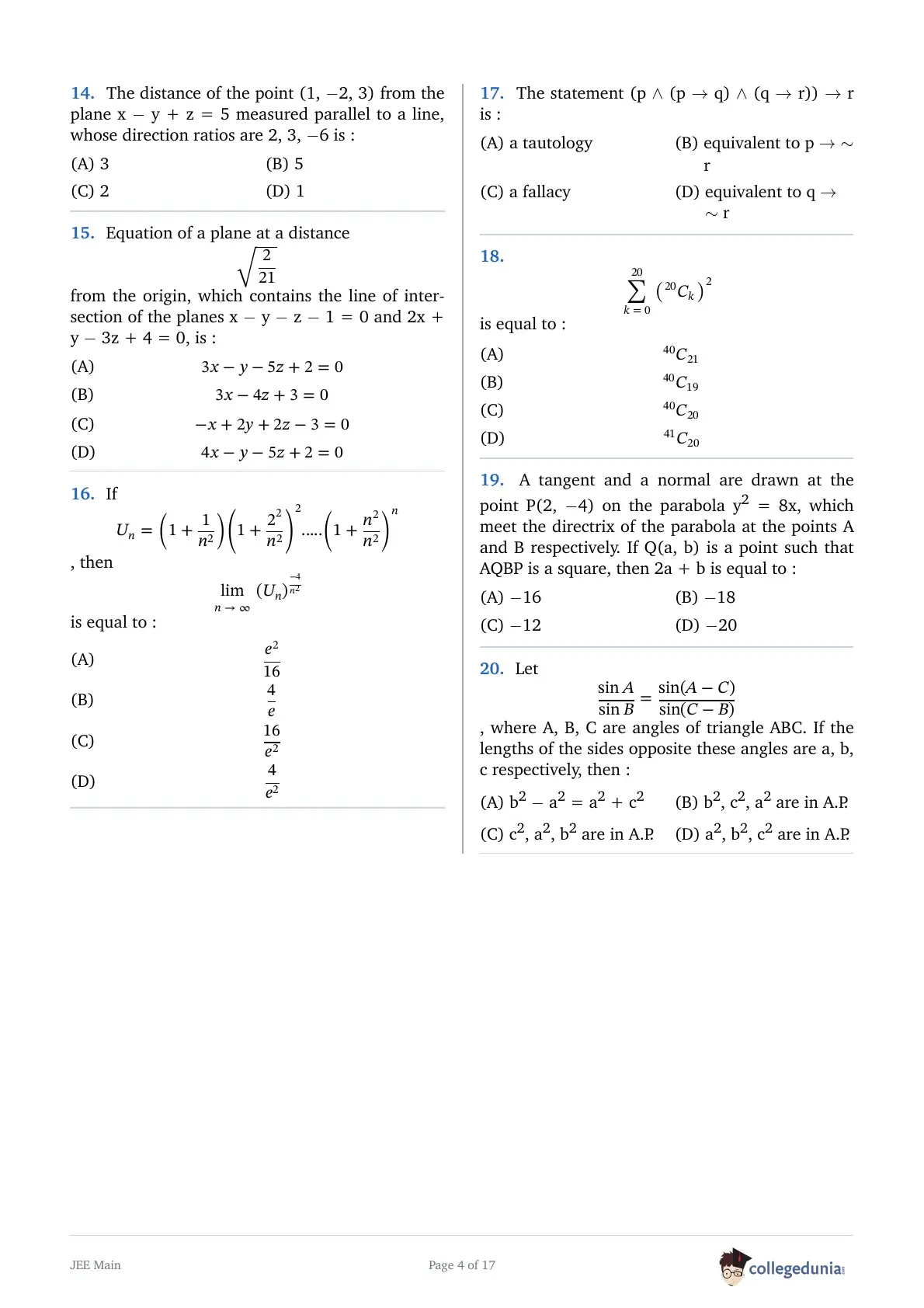
The distance of the point \((1, -2, 3)\) from the plane \(x - y + z = 5\) measured parallel to a line, whose direction ratios are \(2, 3, -6\) is :
Equation of a plane at a distance \(\sqrt{\frac{2}{21}}\) from the origin, which contains the line of intersection of the planes \(x - y - z - 1 = 0\) and \(2x + y - 3z + 4 = 0\), is :
If \(U_n = \left(1 + \frac{1}{n^2}\right) \left(1 + \frac{2^2}{n^2}\right)^2 \dots \left(1 + \frac{n^2}{n^2}\right)^n\), then \(\lim_{n \to \infty} (U_n)^{-\frac{4}{n^2}}\) is equal to :
The statement \((p \land (p \to q) \land (q \to r)) \to r\) is :
\(\sum_{k=0}^{20} (^{20}C_k)^2\) is equal to :
A tangent and a normal are drawn at the point \(P(2, -4)\) on the parabola \(y^2 = 8x\), which meet the directrix of the parabola at the points A and B respectively. If \(Q(a, b)\) is a point such that \(AQBP\) is a square, then \(2a + b\) is equal to :
Let \(\frac{\sin A}{\sin B} = \frac{\sin(A - C)}{\sin(C - B)}\), where A, B, C are angles of a triangle ABC. If the lengths of the sides opposite these angles are a, b, c respectively, then :
Mathematics - Section B (Q21 - Q30)
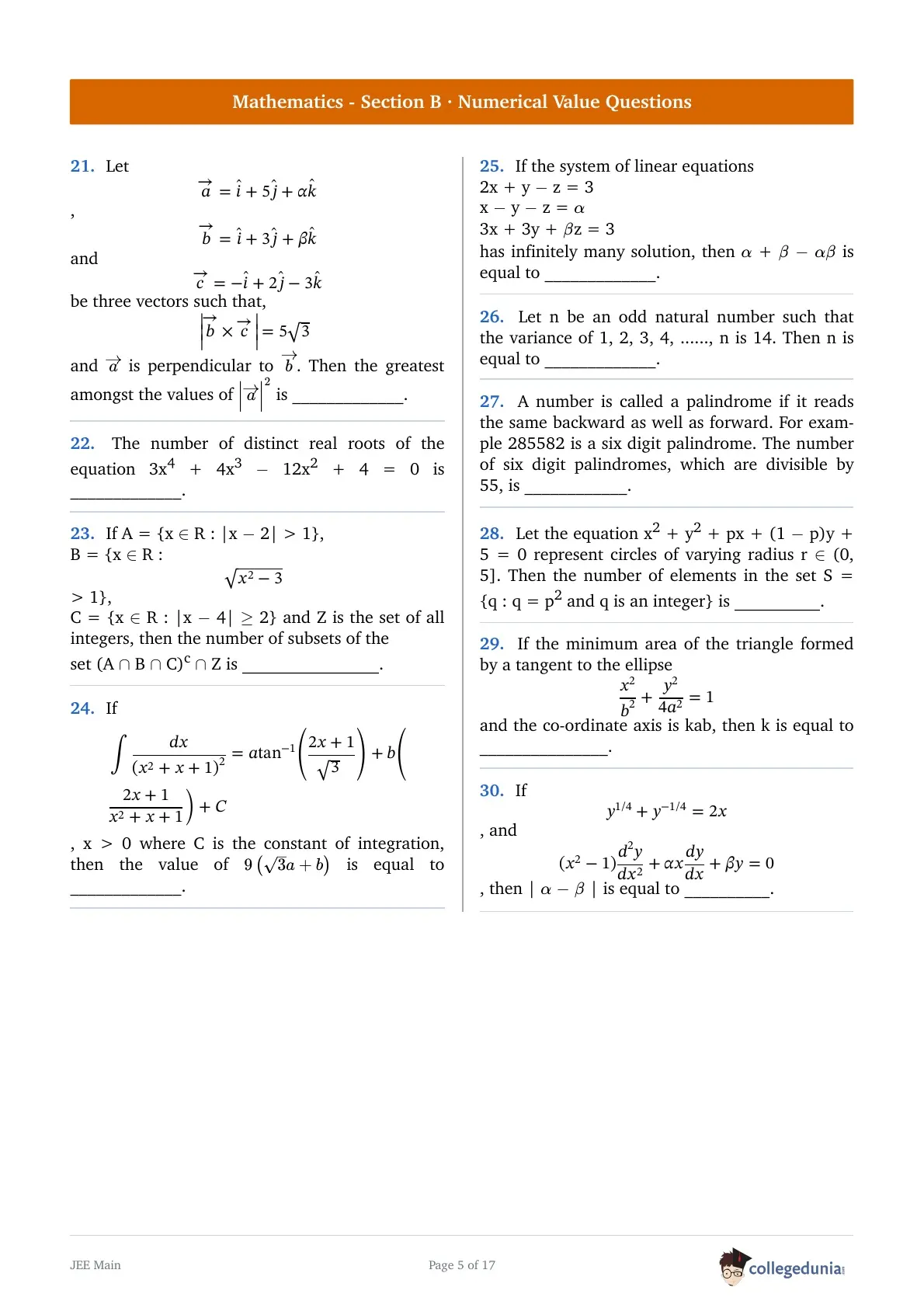
Let \(\vec{a} = \hat{i} + 5\hat{j} + \alpha\hat{k}\), \(\vec{b} = \hat{i} + 3\hat{j} + \beta\hat{k}\) and \(\vec{c} = -\hat{i} + 2\hat{j} - 3\hat{k}\) be three vectors such that, \(|\vec{b} \times \vec{c}| = 5\sqrt{3}\) and \(\vec{a}\) is perpendicular to \(\vec{b}\). Then the greatest amongst the values of \(|\vec{a}|^2\) is _________.
The number of distinct real roots of the equation \(3x^4 + 4x^3 - 12x^2 + 4 = 0\) is _________.
If \(A = \{x \in \mathbb{R} : |x-2|>1\}\), \(B = \{x \in \mathbb{R} : \sqrt{x^2-3}>1\}\), \(C = \{x \in \mathbb{R} : |x-4| \geq 2\}\) and \(\mathbb{Z}\) is the set of all integers, then the number of subsets of the set \((A \cap B \cap C)^c \cap \mathbb{Z}\) is _________.
If \(\int \frac{dx}{(x^2 + x + 1)^2} = a \tan^{-1} \left( \frac{2x + 1}{\sqrt{3}} \right) + b \left( \frac{2x + 1}{x^2 + x + 1} \right) + C, x>0\) where C is the constant of integration, then the value of \(9(\sqrt{3}a + b)\) is equal to _________.
If the system of linear equations
\(2x + y - z = 3\)
\(x - y - z = \alpha\)
\(3x + 3y + \beta z = 3\)
has infinitely many solutions, then \(\alpha + \beta - \alpha\beta\) is equal to _________.
Let n be an odd natural number such that the variance of 1, 2, 3, 4, ..., n is 14. Then n is equal to _________.
A number is called a palindrome if it reads the same backward as well as forward. For example 285582 is a six digit palindrome. The number of six digit palindromes, which are divisible by 55, is _________.
Let the equation \(x^2 + y^2 + px + (1 - p)y + 5 = 0\) represent circles of varying radius \(r \in (0, 5]\). Then the number of elements in the set \(S = \{q : q = p^2 \text{ and } q \text{ is an integer}\}\) is _________.
If the minimum area of the triangle formed by a tangent to the ellipse \(\frac{x^2}{b^2} + \frac{y^2}{4a^2} = 1\) and the co-ordinate axis is kab, then k is equal to _________.
If \(y^{1/4} + y^{-1/4} = 2x\), and \((x^2 - 1)\frac{d^2y}{dx^2} + \alpha x \frac{dy}{dx} + \beta y = 0\), then \(|\alpha - \beta|\) is equal to _________.
Physics - Section A (Q31 - Q50)
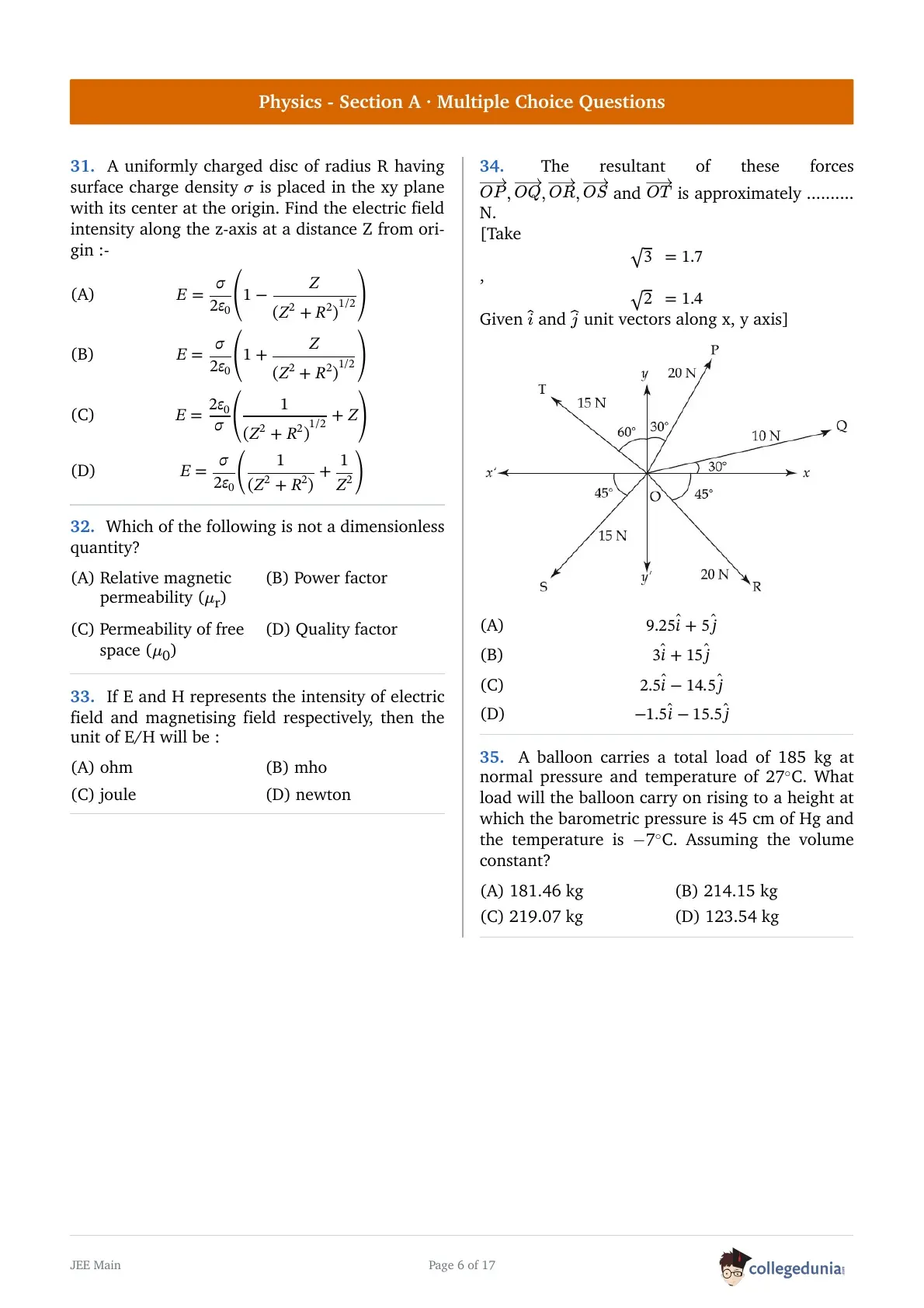
A uniformly charged disc of radius R having surface charge density \(\sigma\) is placed in the xy plane with its center at the origin. Find the electric field intensity along the z-axis at a distance Z from origin :
Which of the following is not a dimensionless quantity ?
If E and H represents the intensity of electric field and magnetising field respectively, then the unit of E/H will be :
The resultant of these forces \(\vec{OP}, \vec{OQ}, \vec{OR}, \vec{OS}\) and \(\vec{OT}\) is approximately ________ N.
[Take \(\sqrt{3} = 1.7, \sqrt{2} = 1.4\). Given \(\hat{i}\) and \(\hat{j}\) unit vectors along x, y axis] 
A balloon carries a total load of 185 kg at normal pressure and temperature of 27°C. What load will the balloon carry on rising to a height at which the barometric pressure is 45 cm of Hg and the temperature is -7°C. Assuming the volume constant ?
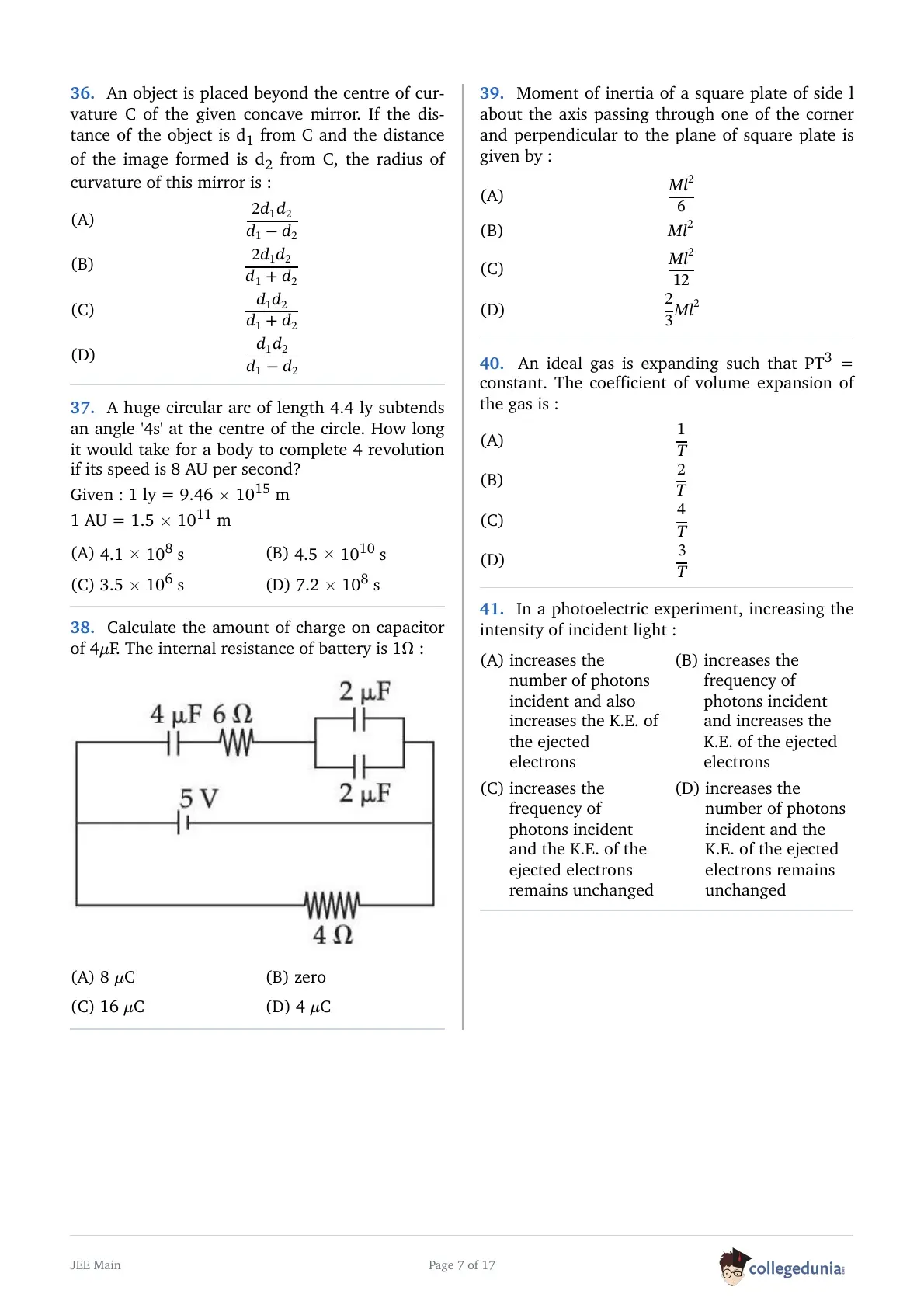
An object is placed beyond the centre of curvature C of the given concave mirror. If the distance of the object is \(d_1\) from C and the distance of the image formed is \(d_2\) from C, the radius of curvature of this mirror is :
A huge circular arc of length 4.4 ly subtends an angle '4s' at the centre of the circle. How long it would take for a body to complete 4 revolution if its speed is 8 AU per second ?
Given: 1 ly = \(9.46 \times 10^{15}\) m
1 AU = \(1.5 \times 10^{11}\) m
Calculate the amount of charge on capacitor of 4 \(\mu\)F. The internal resistance of battery is 1 \(\Omega\): 
Moment of inertia of a square plate of side l about the axis passing through one of the corner and perpendicular to the plane of square plate is given by :
An ideal gas is expanding such that \(PT^3 = \text{constant}\). The coefficient of volume expansion of the gas is :
In a photoelectric experiment, increasing the intensity of incident light :
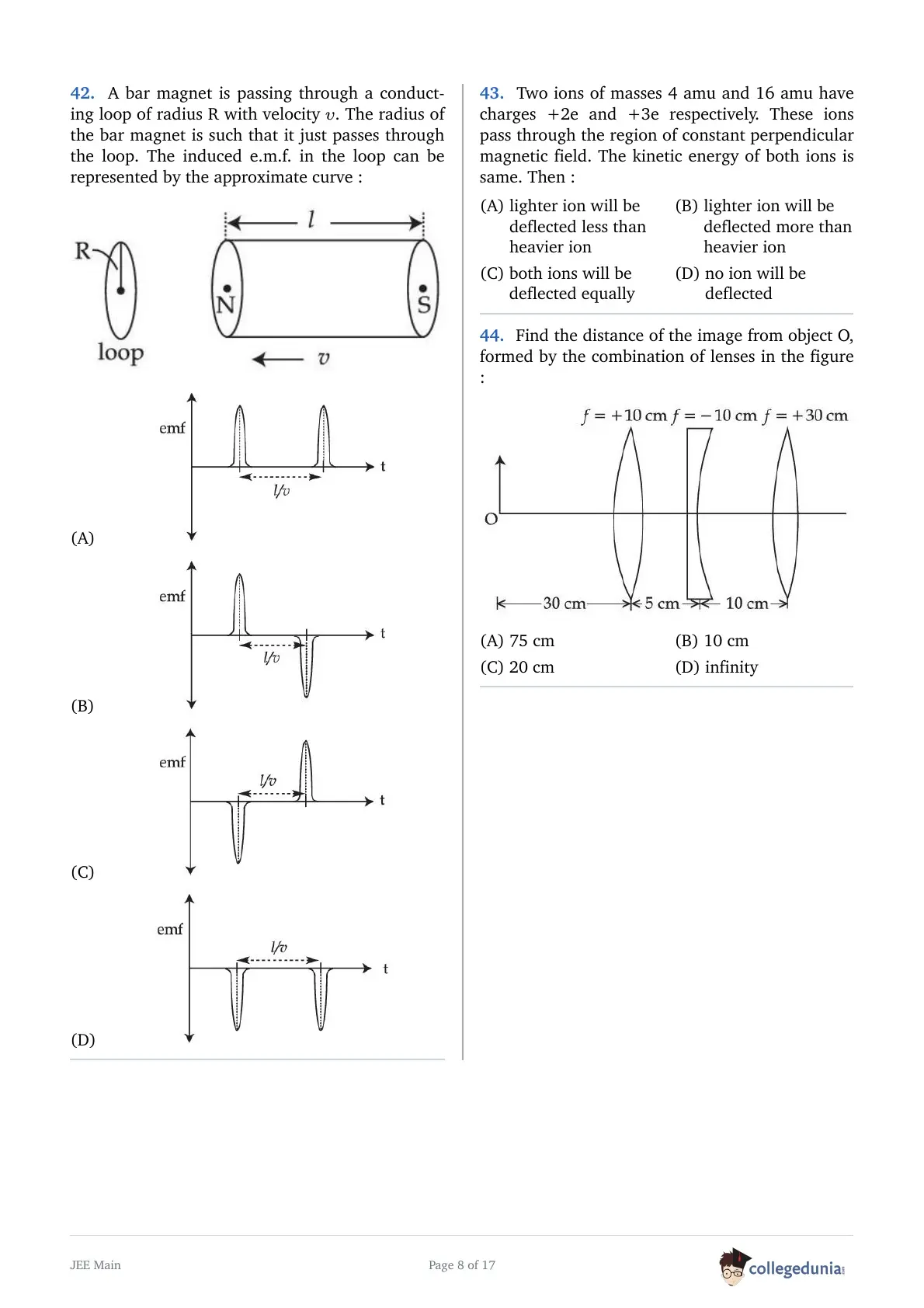
A bar magnet is passing through a conducting loop of radius R with velocity v. The radius of the bar magnet is such that it just passes through the loop. The induced e.m.f. in the loop can be represented by the approximate curve : 

Two ions of masses 4 amu and 16 amu have charges +2e and +3e respectively. These ions pass through the region of constant perpendicular magnetic field. The kinetic energy of both ions is same. Then :
Find the distance of the image from object O, formed by the combination of lenses in the figure : 
In Millikan's oil drop experiment, what is viscous force acting on an uncharged drop of radius \(2.0 \times 10^{-5}\) m and density \(1.2 \times 10^3\) kgm\(^{-3}\)? Take viscosity of liquid \(= 1.8 \times 10^{-5}\) Nsm\(^{-2}\). (Neglect buoyancy due to air).
Electric field in a plane electromagnetic wave is given by E = 50 sin(500x - 10 \(\times\) 10\(^{10}\)t) V/m. The velocity of electromagnetic wave in this medium is : (Given C = speed of light in vacuum)
Five identical cells each of internal resistance 1 \(\Omega\) and emf 5 V are connected in series and in parallel with an external resistance 'R'. For what value of 'R', current in series and parallel combination will remain the same ?
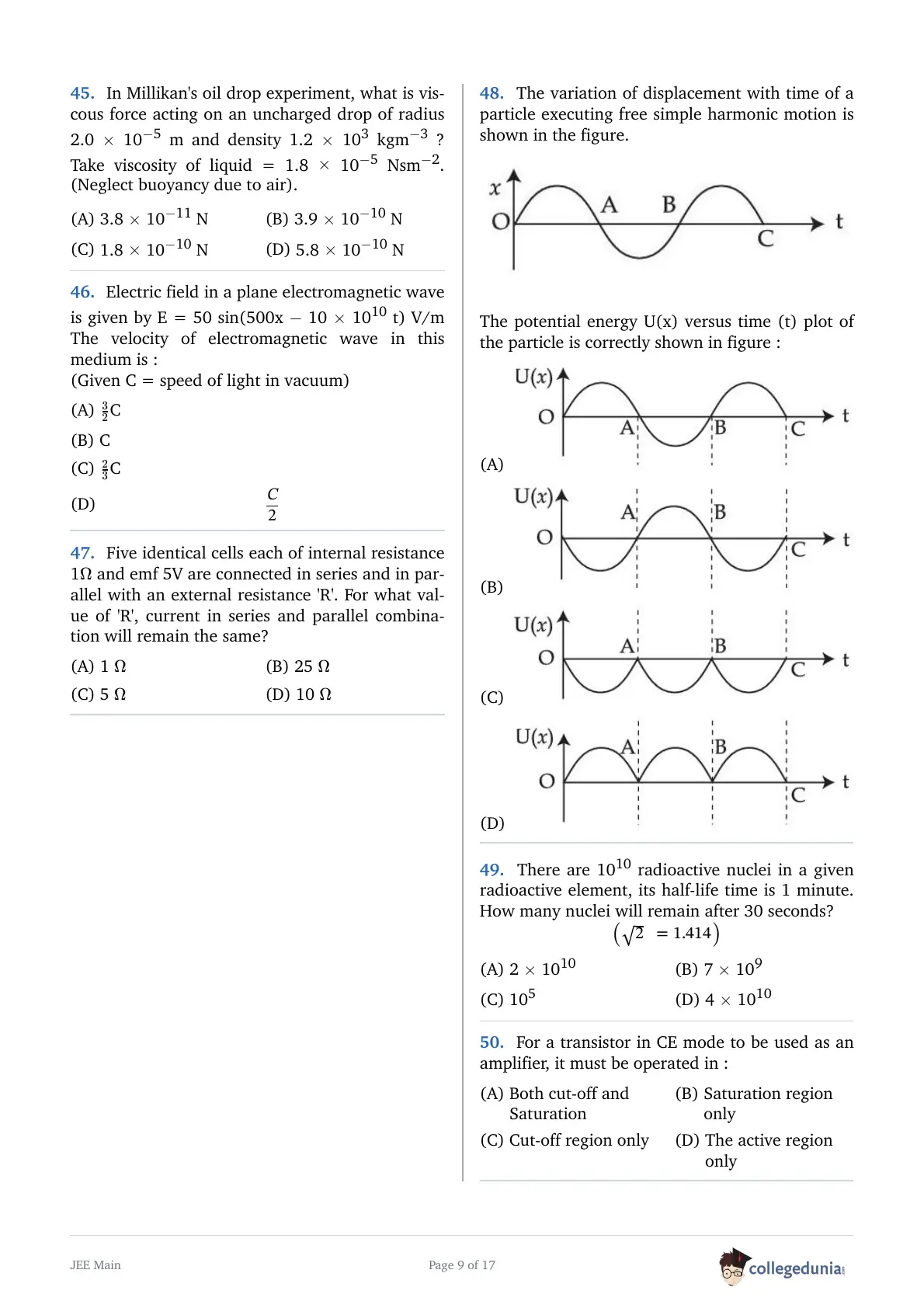
The variation of displacement with time of a particle executing free simple harmonic motion is shown in the figure.
The potential energy U(x) versus time (t) plot of the particle is correctly shown in figure : 
There are 10\(^{10}\) radioactive nuclei in a given radioactive element. Its half-life time is 1 minute. How many nuclei will remain after 30 seconds ? (\(\sqrt{2}\) = 1.414)
For a transistor in CE mode to be used as an amplifier, it must be operated in :
Physics - Section B (Q51 - Q60)
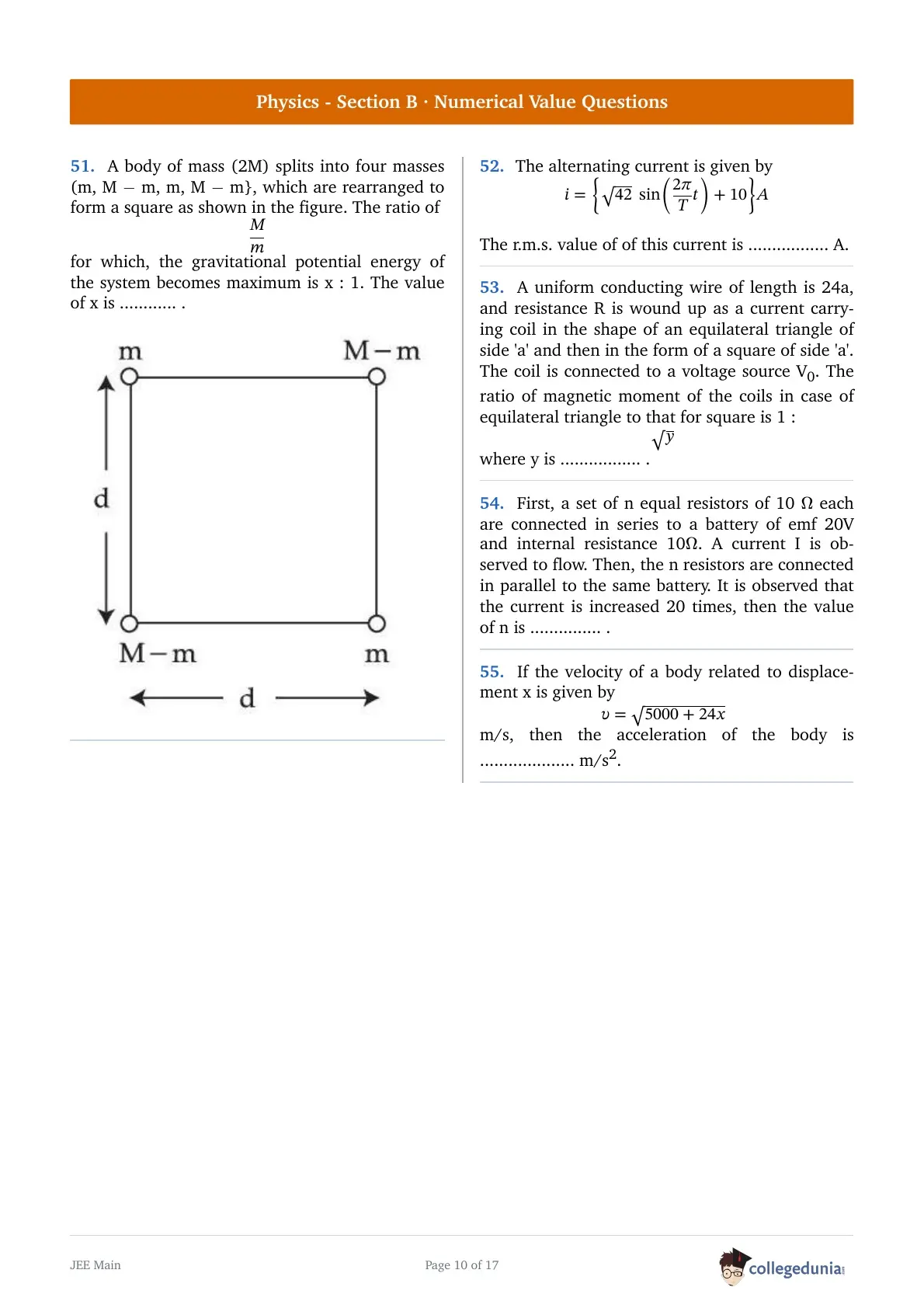
A body of mass (2M) splits into four masses m, M-m, m, M-m, which are rearranged to form a square as shown in the figure. The ratio of \(\frac{M}{m}\) for which, the gravitational potential energy of the system becomes maximum is x : 1. The value of x is ________. 
The alternating current is given by \(i = \{\sqrt{42} \sin(\frac{2\pi}{T}t) + 10\} A\). The r.m.s. value of this current is _________ A.
A uniform conducting wire of length is 24a, and resistance R is wound up as a current carrying coil in the shape of an equilateral triangle of side 'a' and then in the form of a square of side 'a'. The coil is connected to a voltage source V\(_0\). The ratio of magnetic moment of the coils in case of equilateral triangle to that for square is 1 : \(\sqrt{y}\) where y is _________.
First, a set of n equal resistors of 10 \(\Omega\) each are connected in series to a battery of emf 20 V and internal resistance 10 \(\Omega\). A current I is observed to flow. Then, the n resistors are connected in parallel to the same battery. It is observed that the current is increased 20 times, then the value of n is _________.
If the velocity of a body related to displacement x is given by \(v = \sqrt{5000 + 24x}\) m/s, then the acceleration of the body is ________ m/s\(^2\).
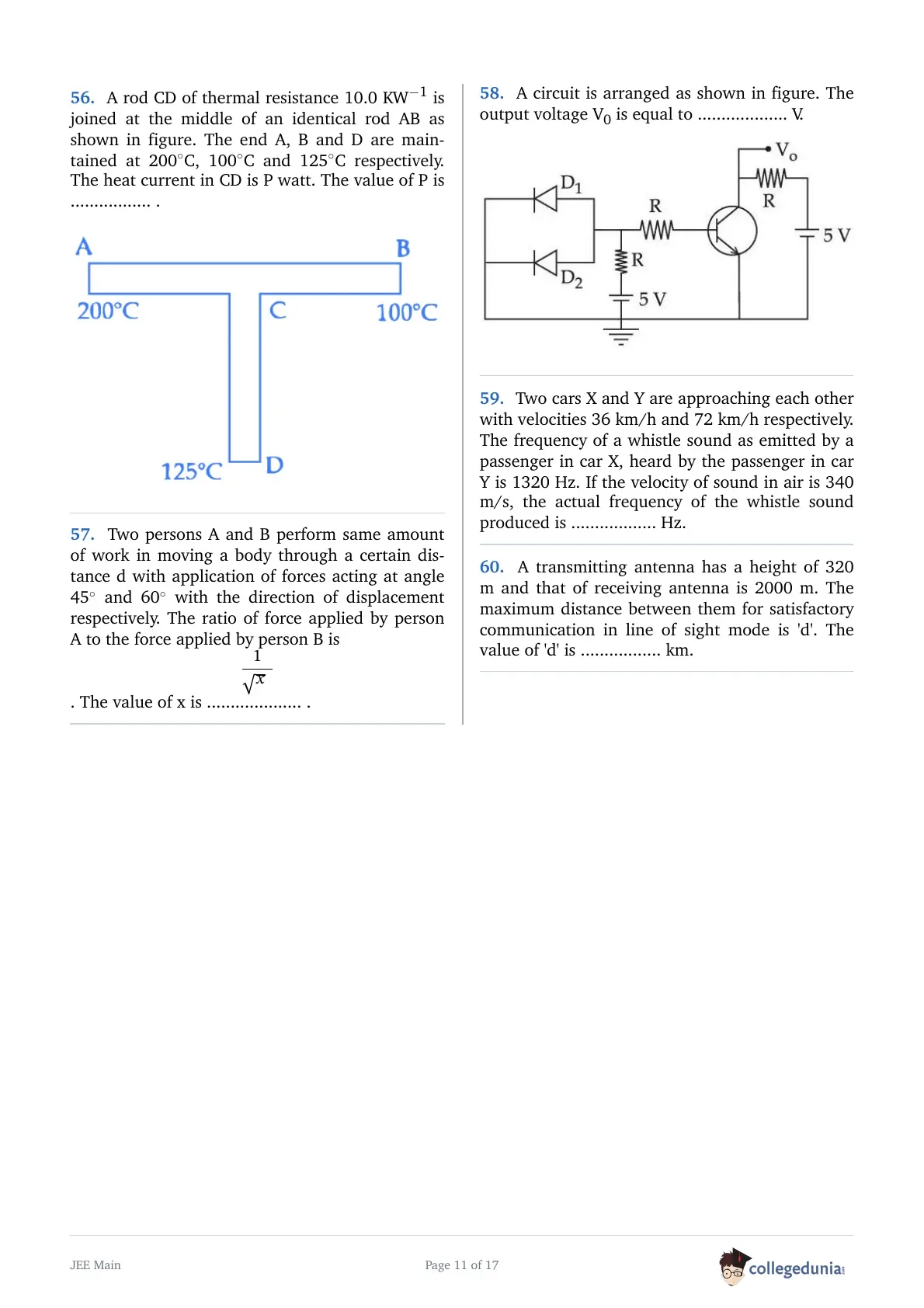
A rod CD of thermal resistance 10.0 KW\(^{-1}\) is joined at the middle of an identical rod AB as shown in figure. The ends A, B and D are maintained at 200\(^{\circ}\)C, 100\(^{\circ}\)C and 125\(^{\circ}\)C respectively. The heat current in CD is P watt. The value of P is _________. 
Two persons A and B perform same amount of work in moving a body through a certain distance d with application of forces acting at angles 45\(^\circ\) and 60\(^\circ\) with the direction of displacement respectively. The ratio of force applied by person A to the force applied by person B is \(\frac{1}{\sqrt{x}}\). The value of x is ________.
A circuit is arranged as shown in figure. The output voltage \(V_o\) is equal to ________ V. 
Two cars X and Y are approaching each other with velocities 36 km/h and 72 km/h respectively. The frequency of a whistle sound as emitted by a passenger in car X, heard by the passenger in car Y is 1320 Hz. If the velocity of sound in air is 340 m/s, the actual frequency of the whistle sound produced is _________ Hz.
A transmitting antenna has a height of 320 m and that of receiving antenna is 2000 m. The maximum distance between them for satisfactory communication in line of sight mode is 'd'. The value of 'd' is _________ km. (Radius of Earth = 6400 km)
Chemistry - Section A (Q61 - Q80)
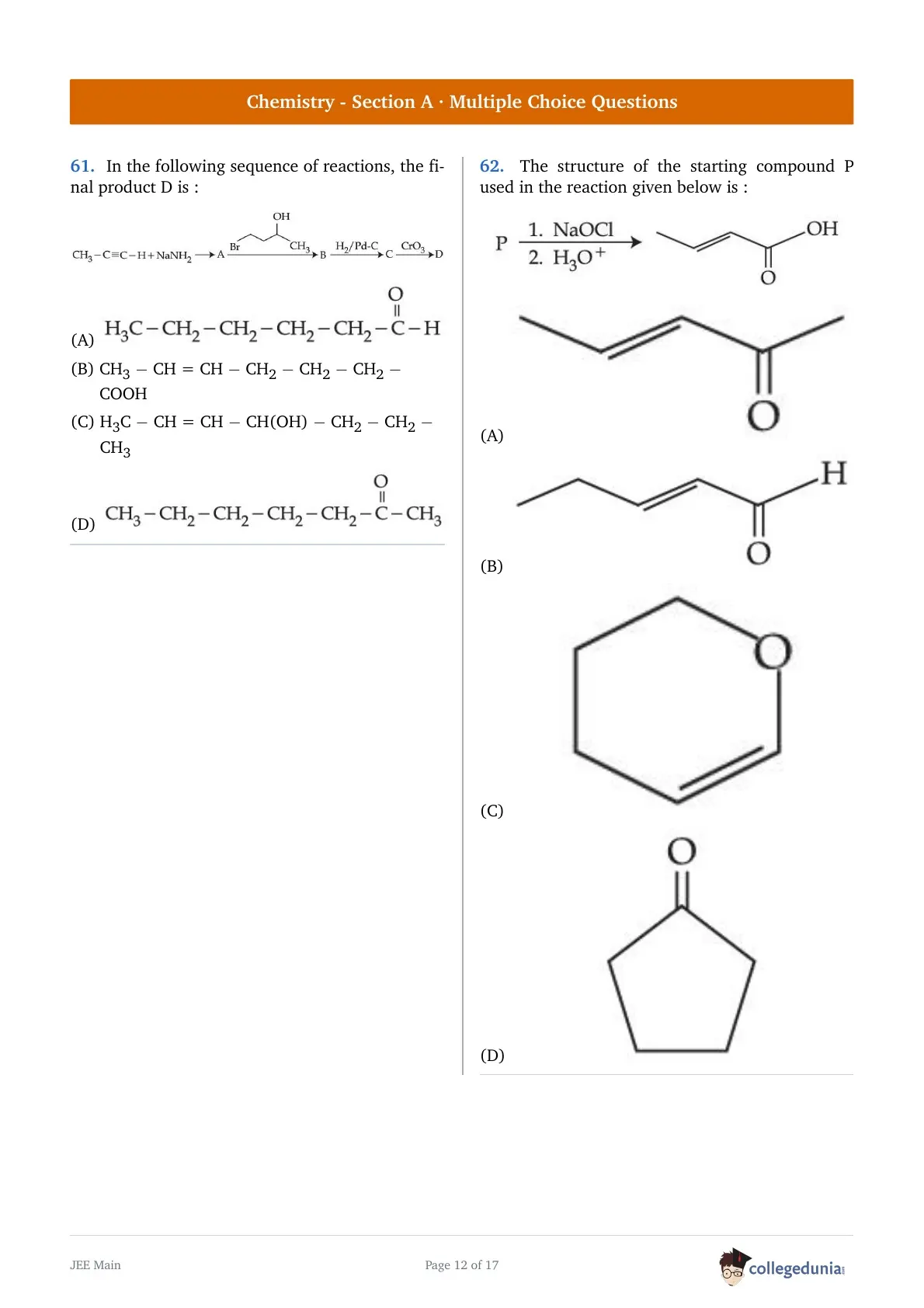
In the following sequence of reactions, the final product D is : 
The structure of the starting compound P used in the reaction given below is: 
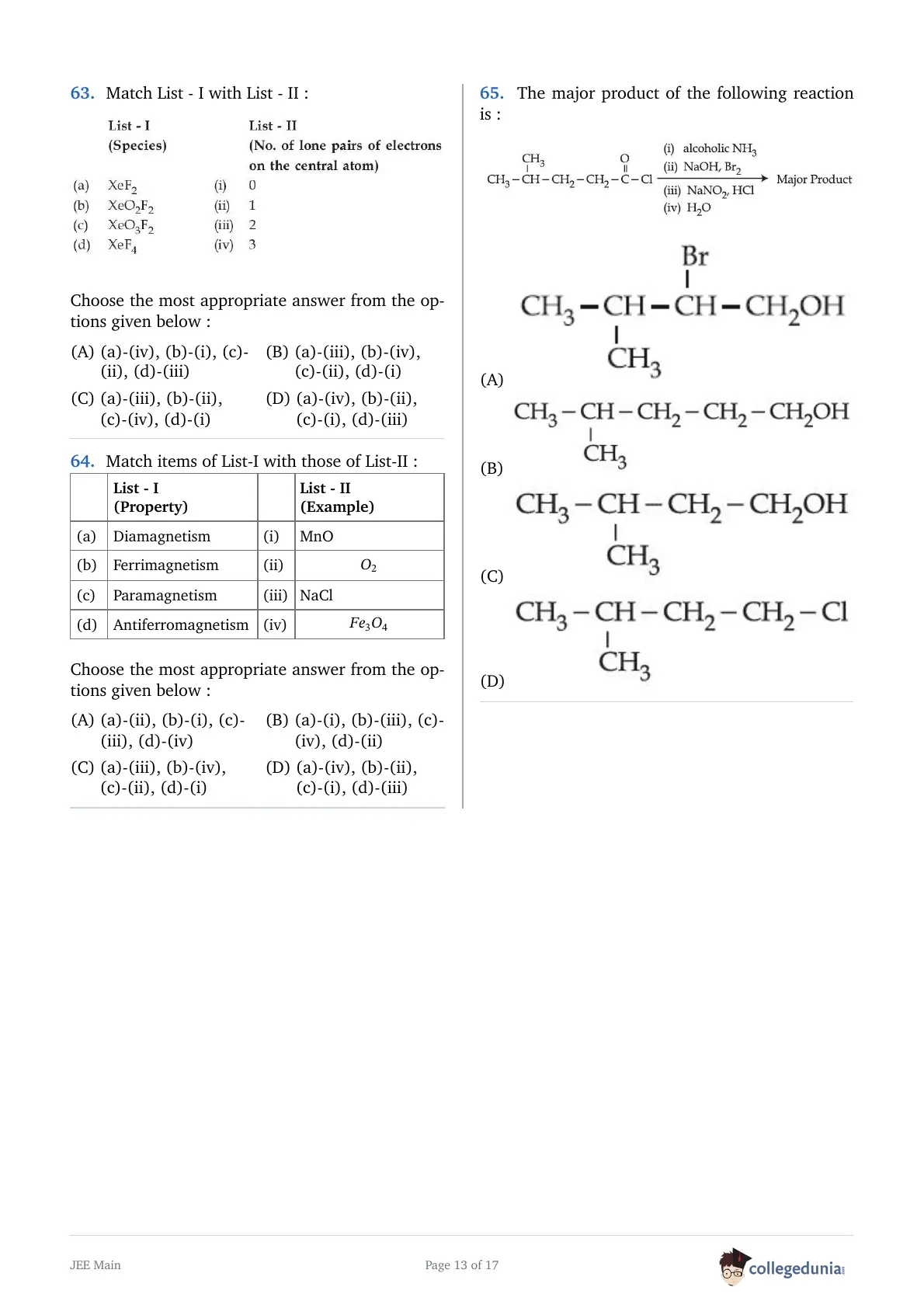
Match List - I with List - II : 
Choose the most appropriate answer from the options given below :
Match items of List - I with those of List - II: 
Choose the most appropriate answer from the options given below :
The major product of the following reaction is :
\(\mathrm{CH_3-CH(CH_3)-CH_2-CH_2-COCl}\)
(i) alcoholic \(\mathrm{NH_3}\)
(ii) \(\mathrm{NaOH,\ Br_2}\)
(iii) \(\mathrm{NaNO_2,\ HCl}\)
(iv) \(\mathrm{H_2O}\)
\(\longrightarrow\) Major Product
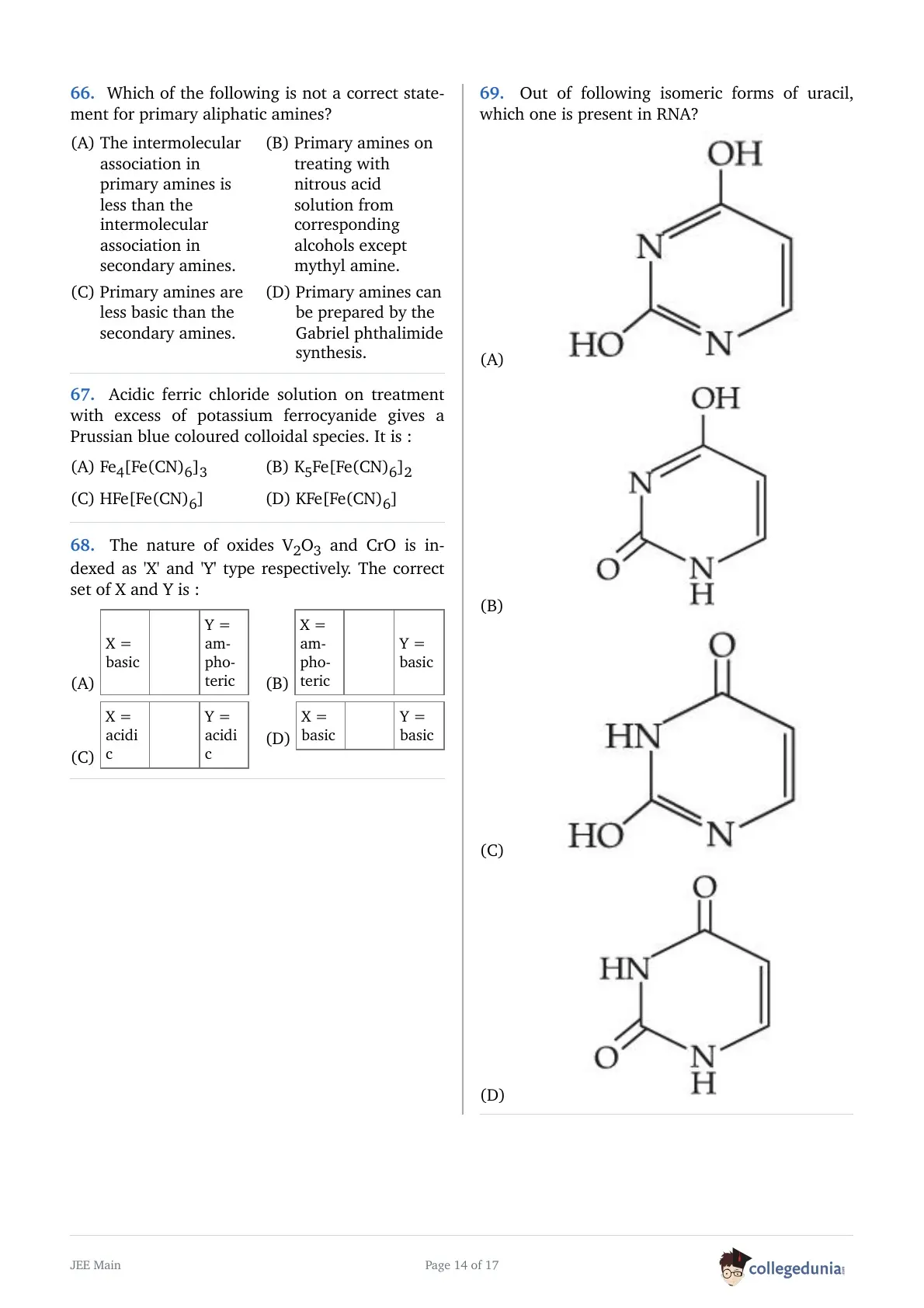
Which of the following is not a correct statement for primary aliphatic amines?
Acidic ferric chloride solution on treatment with excess of potassium ferrocyanide gives a Prussian blue coloured colloidal species. It is:
The nature of oxides V\(_2\)O\(_3\) and CrO is indexed as 'X' and 'Y' type respectively. The correct set of X and Y is:
Out of following isomeric forms of uracil, which one is present in RNA? 
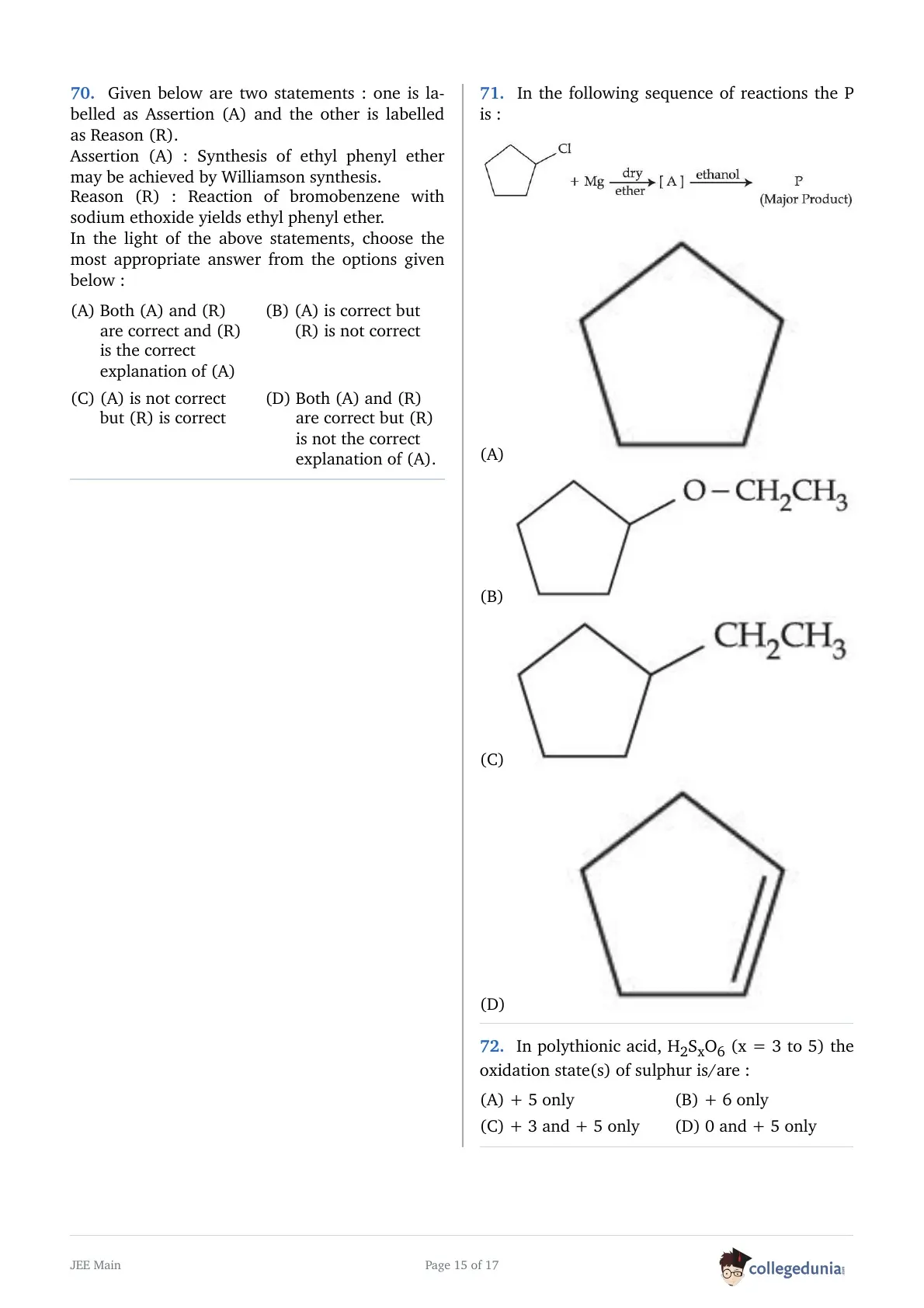
Given below are two statements: one is labelled as Assertion (A) and the other is labelled as Reason (R).
Assertion (A): Synthesis of ethyl phenyl ether may be achieved by Williamson synthesis.
Reason (R): Reaction of bromobenzene with sodium ethoxide yields ethyl phenyl ether.
In the light of the above statements, choose the most appropriate answer from the options given below :
In the following sequence of reactions the P is: 
In polythionic acid, H\(_2\)S\(_x\)O\(_6\) (x = 3 to 5) the oxidation state(s) of sulphur is/are :
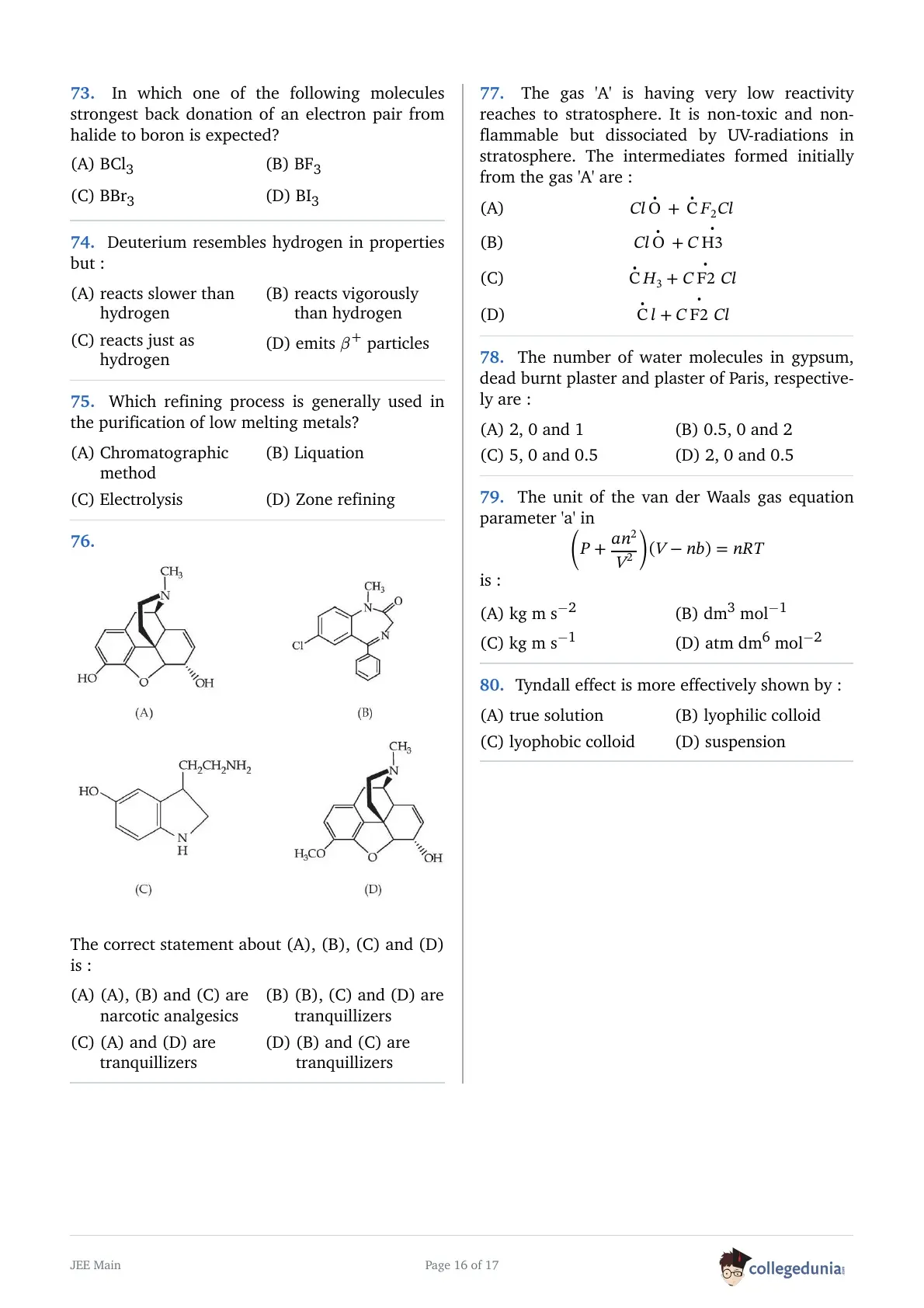
In which one of the following molecules strongest back donation of an electron pair from halide to boron is expected?
Deuterium resembles hydrogen in properties but :
Which refining process is generally used in the purification of low melting metals ?
The correct statement about (A), (B), (C) and (D) is: 
The gas 'A' is having very low reactivity reaches to stratosphere. It is non-toxic and non-flammable but dissociated by UV-radiations in stratosphere. The intermediates formed initially from the gas 'A' are:
The number of water molecules in gypsum, dead burnt plaster and plaster of Paris, respectively are :
The unit of the van der Waals gas equation parameter 'a' in \(\left(P + \frac{an^2}{V^2}\right)(V - nb) = nRT\) is:
Tyndall effect is more effectively shown by:
Chemistry - Section B (Q81 - Q90)
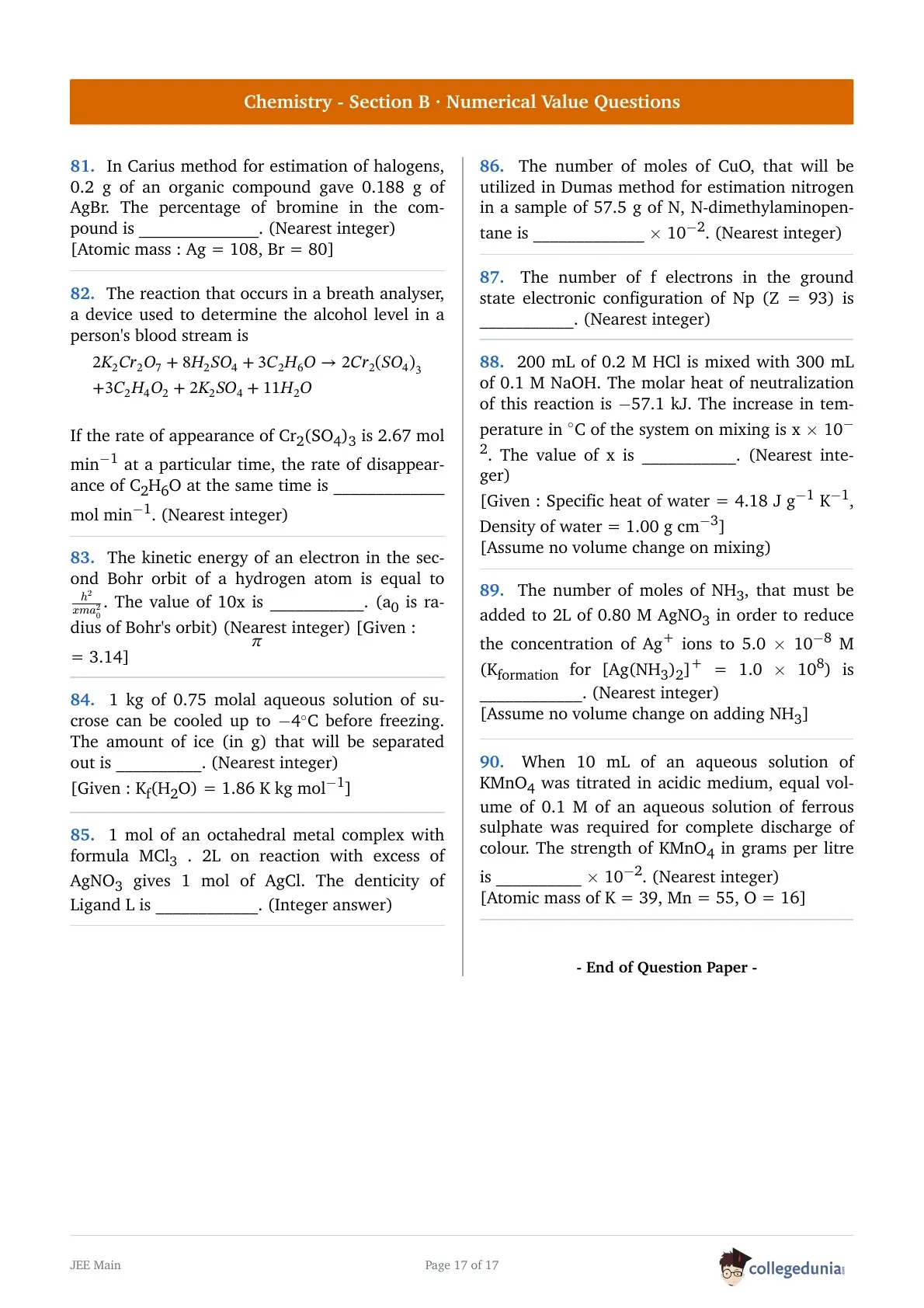
In Carius method for estimation of halogens, 0.2 g of an organic compound gave 0.188 g of \(AgBr\). The percentage of bromine in the compound is _________. (Nearest integer)
[Atomic mass : \(Ag = 108, Br = 80\)]
The reaction that occurs in a breath analyser, a device used to determine the alcohol level in a person's blood stream is:
\(2 K_2Cr_2O_7 + 8 H_2SO_4 + 3 C_2H_6O \to 2 Cr_2(SO_4)_3 + 3 C_2H_4O_2 + 2 K_2SO_4 + 11 H_2O\)
If the rate of appearance of \(Cr_2(SO_4)_3\) is \(2.67 \, \text{mol min}^{-1}\) at a particular time, the rate of disappearance of \(C_2H_6O\) at the same time is _________ \(\text{mol min}^{-1}\). (Nearest integer)
The kinetic energy of an electron in the second Bohr orbit of a hydrogen atom is equal to \(\frac{h^2}{x m a_0^2}\). The value of \(10x\) is _________. (\(a_0\) is radius of Bohr's orbit)
(Nearest integer)
[ Given : \(\pi = 3.14\) ]
1 kg of 0.75 molal aqueous solution of sucrose can be cooled up to \(-4^\circ C\) before freezing. The amount of ice (in g) that will be separated out is _________. (Nearest integer)
[ Given : \(K_f(H_2O) = 1.86 \, \text{K kg mol}^{-1}\) ]
1 mol of an octahedral metal complex with formula \(MCl_3 \cdot 2L\) on reaction with excess of \(AgNO_3\) gives 1 mol of \(AgCl\). The denticity of Ligand L is _________. (Integer answer)
The number of moles of \(CuO\), that will be utilized in Dumas method for estimating nitrogen in a sample of 57.5 g of N,N-dimethylaminopentane is \(x \times 10^{-2}\). (Nearest integer)
The number of \(f\) electrons in the ground state electronic configuration of Np (\(Z = 93\)) is _________. (Integer answer)
200 mL of 0.2 M HCl is mixed with 300 mL of 0.1 M NaOH. The molar heat of neutralization of this reaction is \(-57.1\) kJ. The increase in temperature in \(^\circ C\) of the system on mixing is \(x \times 10^{-2}\). The value of \(x\) is _________. (Nearest integer)
[ Given : Specific heat of water \(= 4.18 \, \text{J g}^{-1} \text{K}^{-1}\)
Density of water \(= 1.00 \, \text{g cm}^{-3}\) ]
(Assume no volume change on mixing)
The number of moles of \(NH_3\) that must be added to 2 L of 0.80 M \(AgNO_3\) in order to reduce the concentration of \(Ag^+\) ions to \(5.0 \times 10^{-8}\) M (\(K_{\text{formation}}\) for \([Ag(NH_3)_2]^+ = 1.0 \times 10^8\)) is _________. (Nearest integer)
[ Assume no volume change on adding \(NH_3\) ]
When 10 mL of an aqueous solution of \(KMnO_4\) was titrated in acidic medium, equal volume of 0.1 M of an aqueous solution of ferrous sulphate was required for complete discharge of colour. The strength of \(KMnO_4\) in grams per litre is _________ \(\times 10^{-2}\). (Nearest integer)
[ Atomic mass of \(K = 39, Mn = 55, O = 16\) ]
JEE Main 2021 Exam Pattern and Marking Scheme
| Particulars | Details |
|---|---|
| Exam Mode | Online (Computer-Based Test) |
| Paper | B.E./B.Tech (Paper 1) |
| Duration | 3 hours (180 minutes) |
| Type of Questions | Multiple Choice Questions (MCQs) + Numerical Value Questions |
| Subjects | Mathematics, Physics, Chemistry |
| Total Questions | 90 questions (75 to be attempted) |
| Total Marks | 300 marks |
| Marking Scheme | +4 for correct answer & -1 for incorrect MCQ; no negative marking for Numerical Value Questions |
JEE Main 2021 August 27 Shift 1 Difficulty Level
JEE Main 2021 B.E./B.Tech Question Paper - August 27, 2021- Forenoon session was rated to be of average difficulty by the premier coaching institutes of India. August 27 Shift 1 was the first paper of the 4th session in 2021. The exam had a dominant weightage of Class XII JEE Main syllabus, over Class XI syllabus. A total of 49 questions were asked from the Class XII syllabus and a total of 41 questions were asked from the Class XI syllabus.
JEE Main 2021 B.E./B.Tech Question Paper August 27 (FN): Weightage of Topics
JEE Main 2021 B.E./B.Tech Paper on August 27 Forenoon Session conducted between 9.00 AM to 12.00 Noon. The highest weightage in JEE Main August 27, 2021 Foreenon (Shift 1) Question Paper are:
| Subject | Topic | Marks in the Paper (including NATs) |
|---|---|---|
| Physics | Current Electricity, Electromagnetic Induction | 12 |
| Electromagnetic waves and communication | 8 | |
| Heat and Thermodynamics | 16 | |
| Rectilinear motion and vectors, Unit and Dimensions | 16 (8 marks each) | |
| Optics | 8 | |
| SHM and Waves | 9 | |
| Chemistry | Chemical Bonding | 8 |
| d block and f block elements | 8 | |
| Qualitative Analysis | 8 | |
| Grignard Reagent, Oxidation, Reduction | 8 | |
| Chemical Equilibrium | 12 | |
| Mathematics | Coordinate Geometry | 16 |
| Differential Calculus | 12 | |
| Integral Calculus | 20 | |
| Sequence and Series | 8 | |
| Trigonometry | 8 | |
| Vector 3D | 8 |
JEE Main B.E/ B. Tech Previous Year Question Paper with Answer Key PDFs
JEE Main aspirants can practice their knowledge and skills by going attempting the Previous Year Question papers linked below:
| JEE Main 2020 Question Paper | JEE Main 2019 Question Paper | JEE Main 2018 Question Paper |
| JEE Main Physics Question Paper | JEE Main Maths Question Paper | JEE Main Chemistry Question Paper |



Comments