




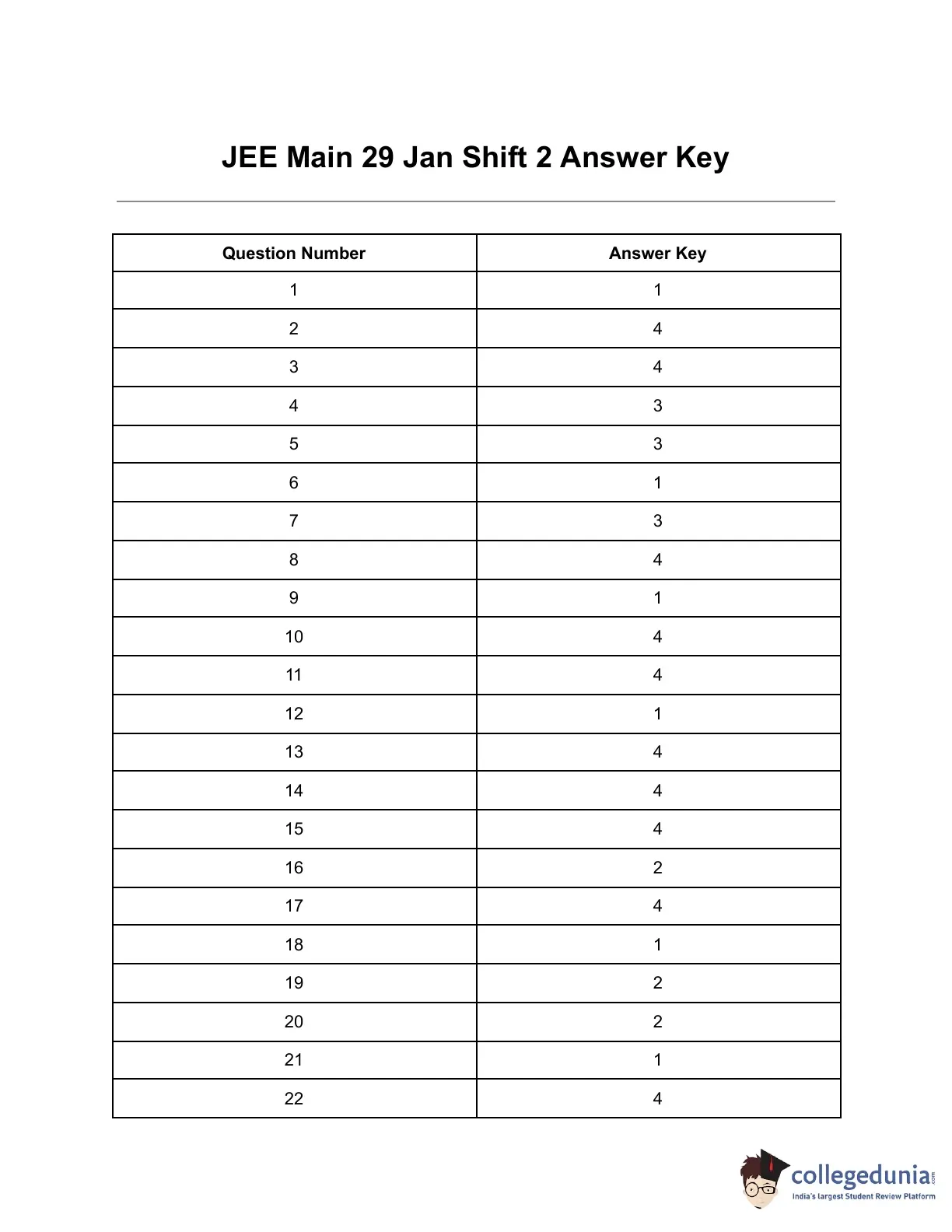
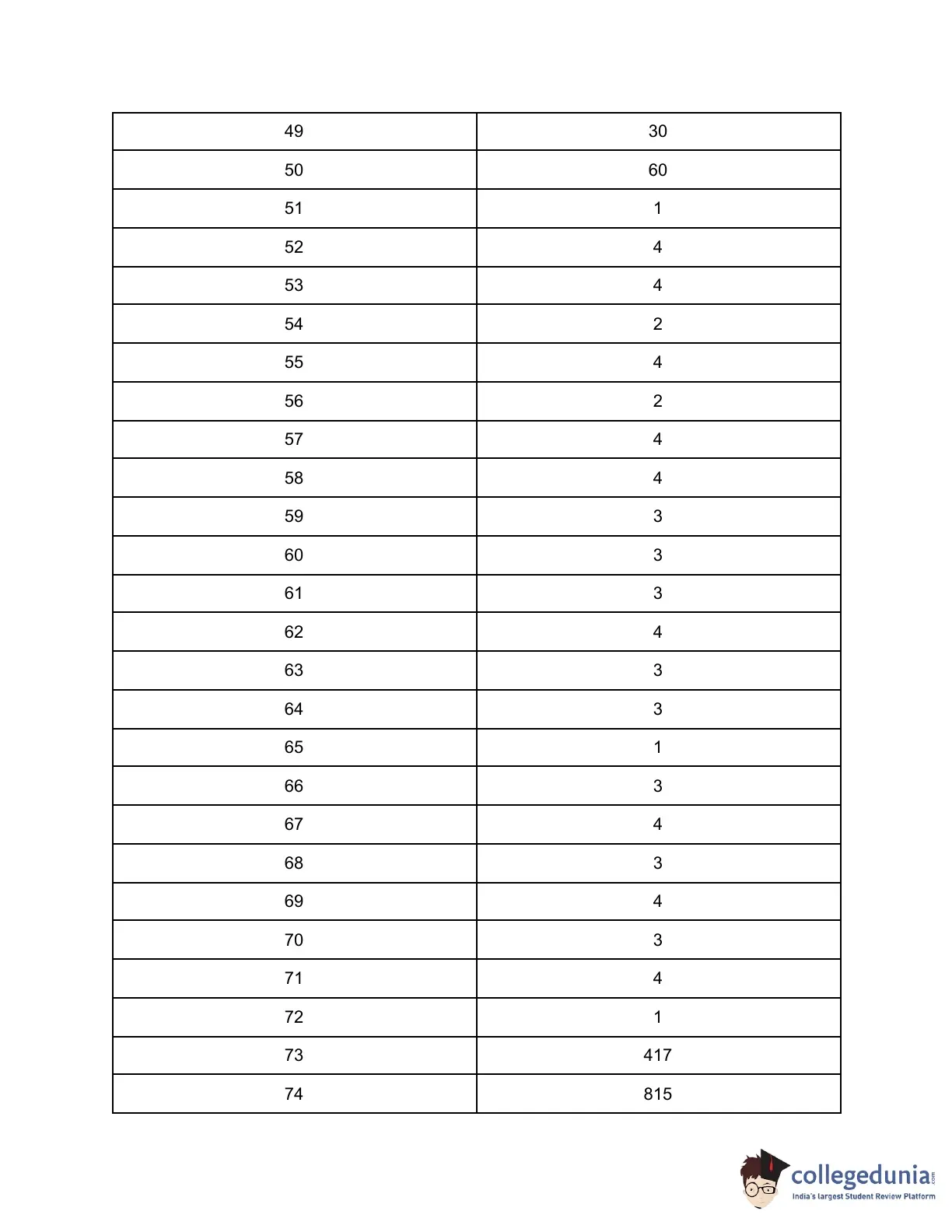
JEE Main 29 Jan Shift 2 2024 question paper with solutions and answers pdf is available here. NTA conducted JEE Main 2024 Jan 29 Shift 2 exam from 3 PM to 6 PM. The question paper for JEE Main 2024 Jan 29 Shift 2 includes 90 questions equally divided into Physics, Chemistry and Maths. Candidates must attempt 75 questions in a 3-hour time duration. The memory-based JEE Main 2024 question paper pdf for the Jan 29 Shift 2 exam is available for download using the link below.
Related Links:
- Download JEE Main Previous Year Question Papers PDF with Solutions
- Download JEE Main 2025 Question Paper for all Shifts
JEE Main 29 Jan Shift 2 2024 Question Paper PDF Download
| JEE Main 29 Jan Shift 2 2024 Question Paper with Answer Key PDF |  Download Download |
Check Solutions |

JEE Main 29 Jan Shift 2 2024 Questions with Solutions
SECTION- A
PHYSICS
Question 1:
Let
A =
| 2 | 1 | 2 |
| 6 | 2 | 11 |
| 3 | 3 | 2 |
P =
| 1 | 2 | 0 |
| 5 | 0 | 2 |
| 7 | 1 | 5 |
The sum of the prime factors of |P−1A P − 2I| is equal to:
(1) 26
(2) 27
(3) 66
(4) 23
View Solution
The number of ways of arranging 8 identical books into 4 identical shelves where any number of shelves may remain empty is equal to:
(1) 18
(2) 16
(3) 12
(4) 15
View Solution
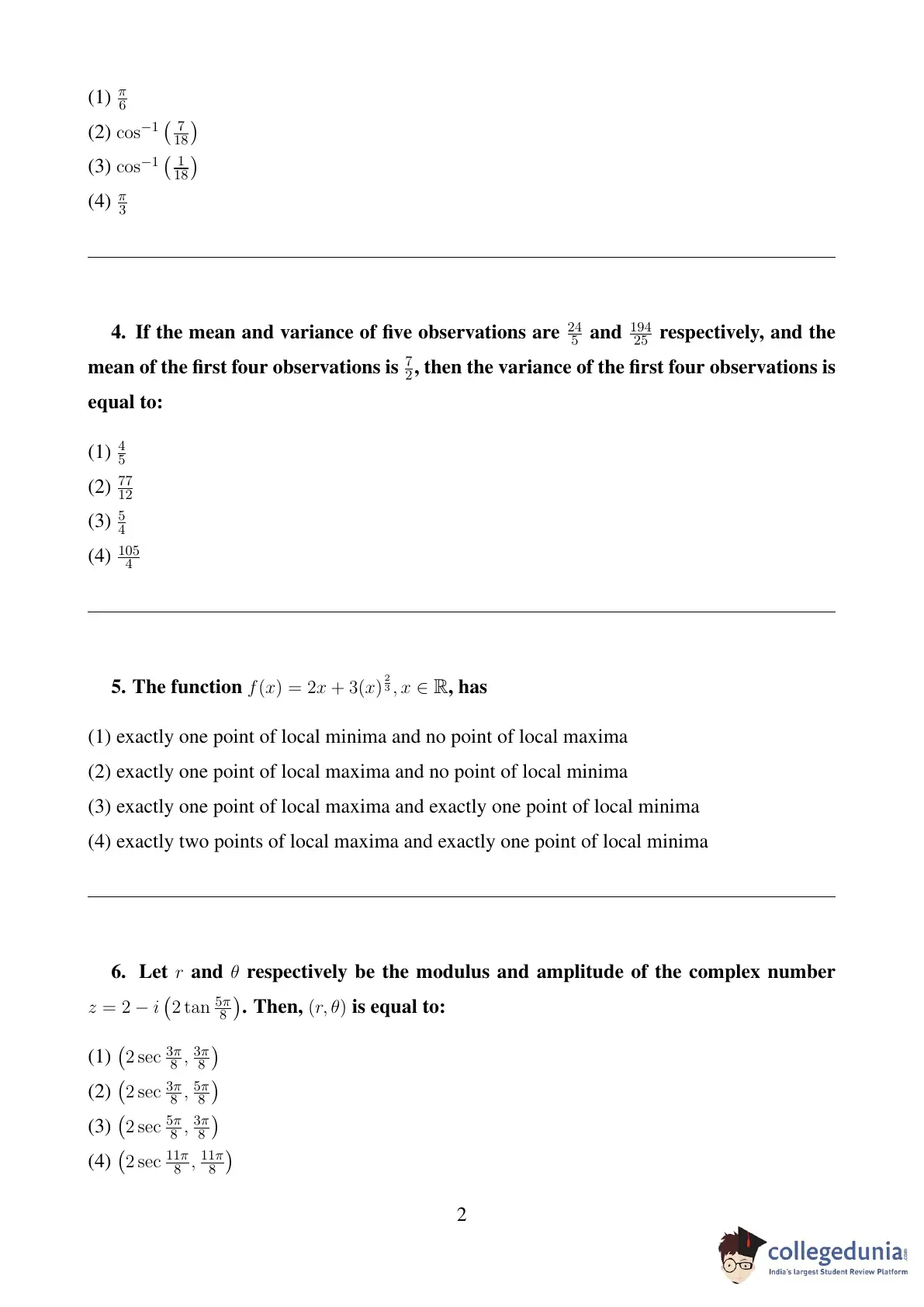
Let P(3, 2, 3), Q(4, 6, 2), R(7, 3, 2) be the vertices of △PQR. Then, the angle △QPR is:
(1) π/6
(2) cos⁻¹(7/18)
(3) cos⁻¹(1/18)
(4) π/3
View Solution
If the mean and variance of five observations are 24/5 and 194/25 respectively, and the mean of the first four observations is 7/2, then the variance of the first four observations is equal to:
(1) 4/5
(2) 77/12
(3) 5/4
(4) 105/4
View Solution
The function f(x) = 2x + 3x^(2/3), x ∈ R, has:
(1) Exactly one point of local minima and no point of local maxima.
(2) Exactly one point of local maxima and no point of local minima.
(3) Exactly one point of local maxima and exactly one point of local minima.
(4) Exactly two points of local maxima and exactly one point of local minima.
View Solution
Let r and θ respectively be the modulus and amplitude of the complex number z = 2 − i(2 tan(5π/8)). Then, (r, θ) is equal to:
(1) (2 sec(3π/8), 3π/8)
(2) (2 sec(3π/8), 5π/8)
(3) (2 sec(5π/8), 3π/8)
(4) (2 sec(11π/8), 11π/8)
View Solution
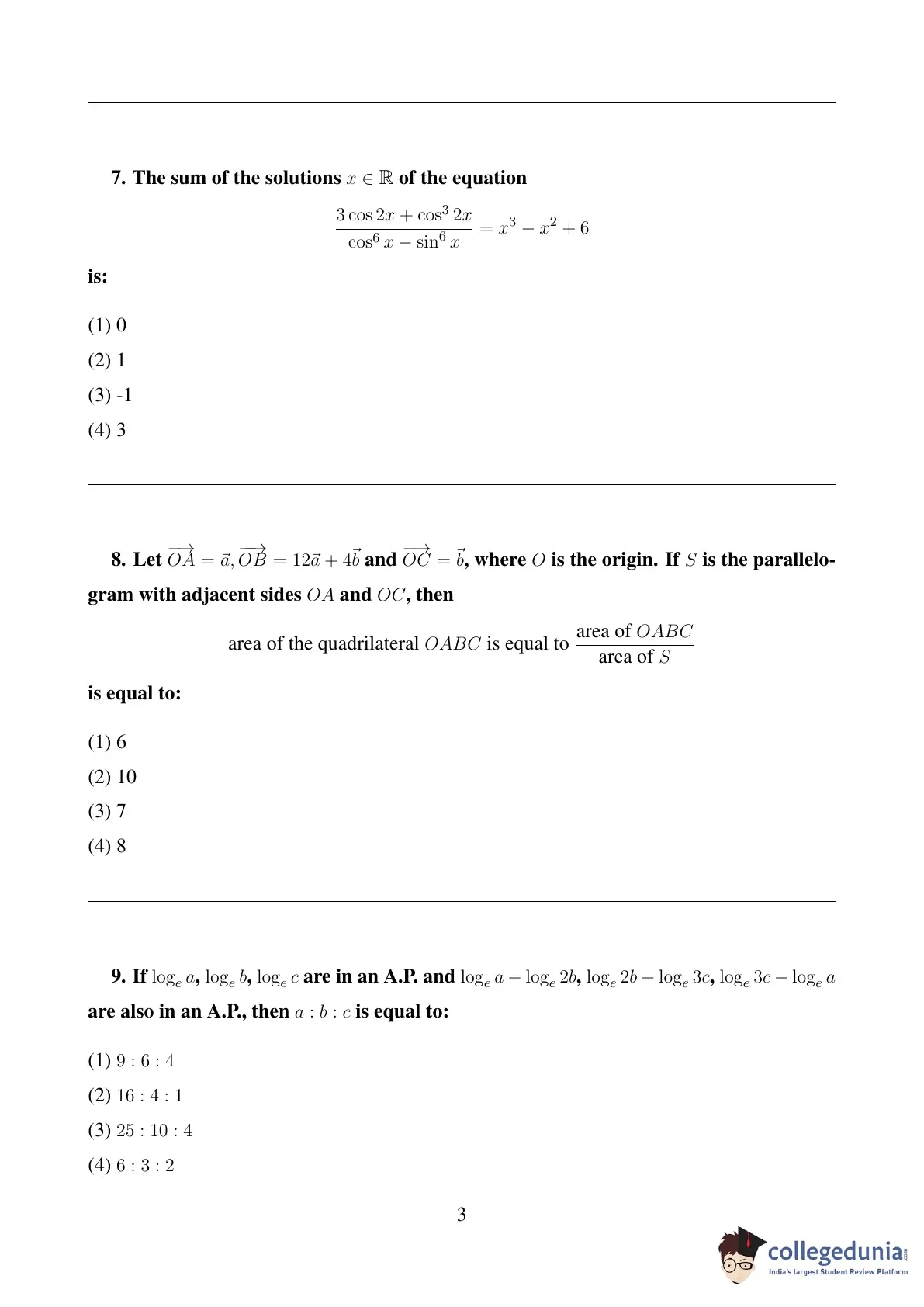
The sum of the solutions x ∈ R of the equation 3 cos(2x) + cos³(2x)/(cos⁶(x) − sin⁶(x)) = x³ − x² + 6 is:
(1) 0
(2) 1
(3) −1
(4) 3
View Solution
Let OA = a, OB = 12a + 4b, and OC = b, where O is the origin. If S is the parallelogram with adjacent sides OA and OC, then the ratio of the area of the quadrilateral OABC to the area of S is equal to:
(1) 6
(2) 10
(3) 7
(4) 8
View Solution
If log a, log b, log c are in an A.P. and log a − log 2b, log 2b − log 3c, log 3c − log a are also in an A.P., then a : b : c is equal to:
(1) 9 : 6 : 4
(2) 16 : 4 : 1
(3) 25 : 10 : 4
(4) 6 : 3 : 2
View Solution
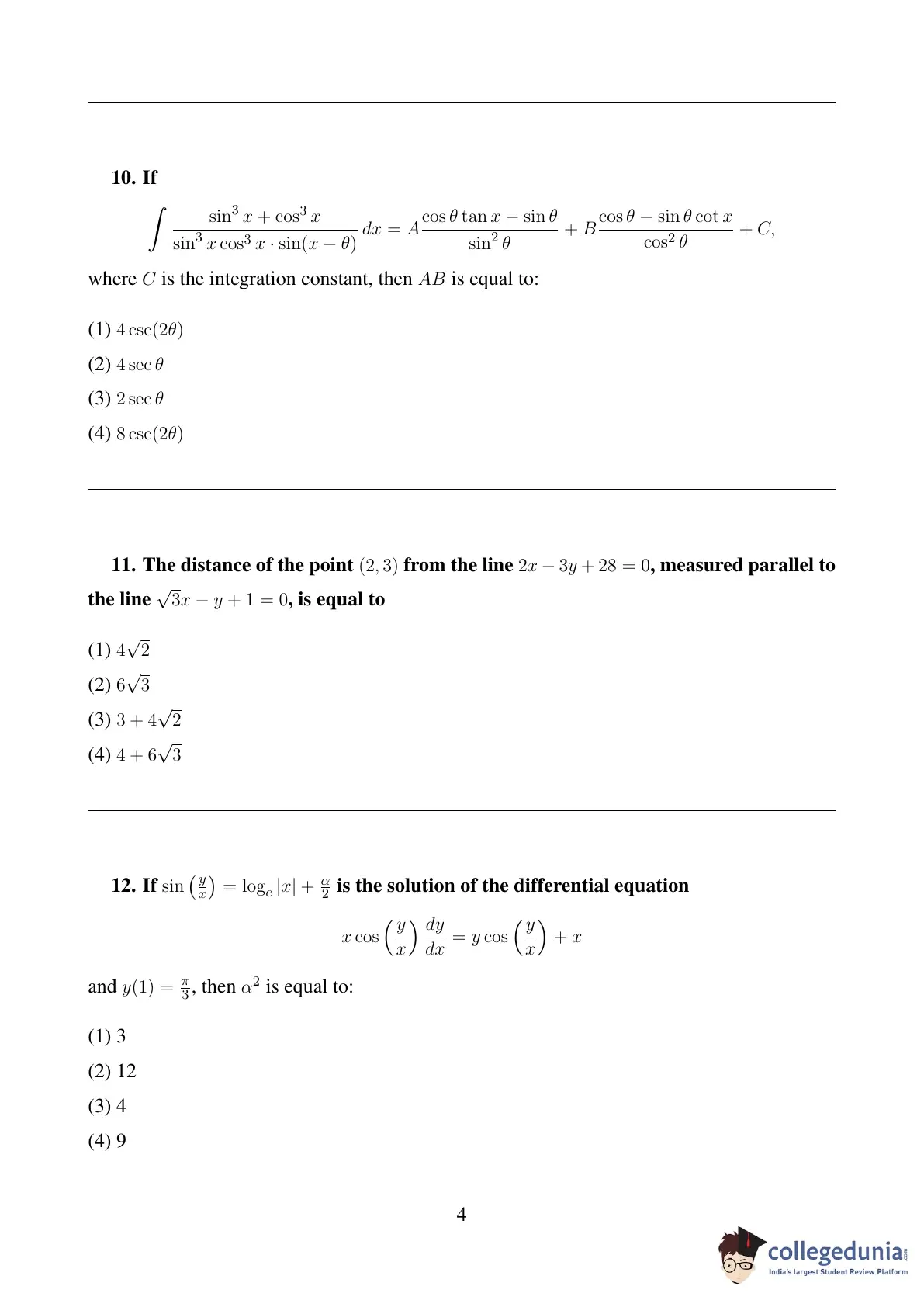
If ∫(sin^(3/2)x + cos^(3/2)x) / √(sin³x cos³x sin(x − θ)) dx = A cos θ sin x − B sin θ cos x + C, where C is the integration constant, then AB is equal to:
(1) 4 csc(2θ)
(2) 4 sec θ
(3) 2 sec θ
(4) 8 csc(2θ)
View Solution
The distance of the point (2, 3) from the line 2x − 3y + 28 = 0, measured parallel to the line √3x − y + 1 = 0, is equal to:
(1) 4√2
(2) 6√3
(3) 3 + 4√2
(4) 4 + 6√3
View Solution
If sin(y/x) = ln|x| + α/2 is the solution of the differential equation x cos(y/x) dy/dx = y cos(y/x) + x, and y(1) = π/3, then α² is equal to:
(1) 3
(2) 12
(3) 4
(4) 9
View Solution
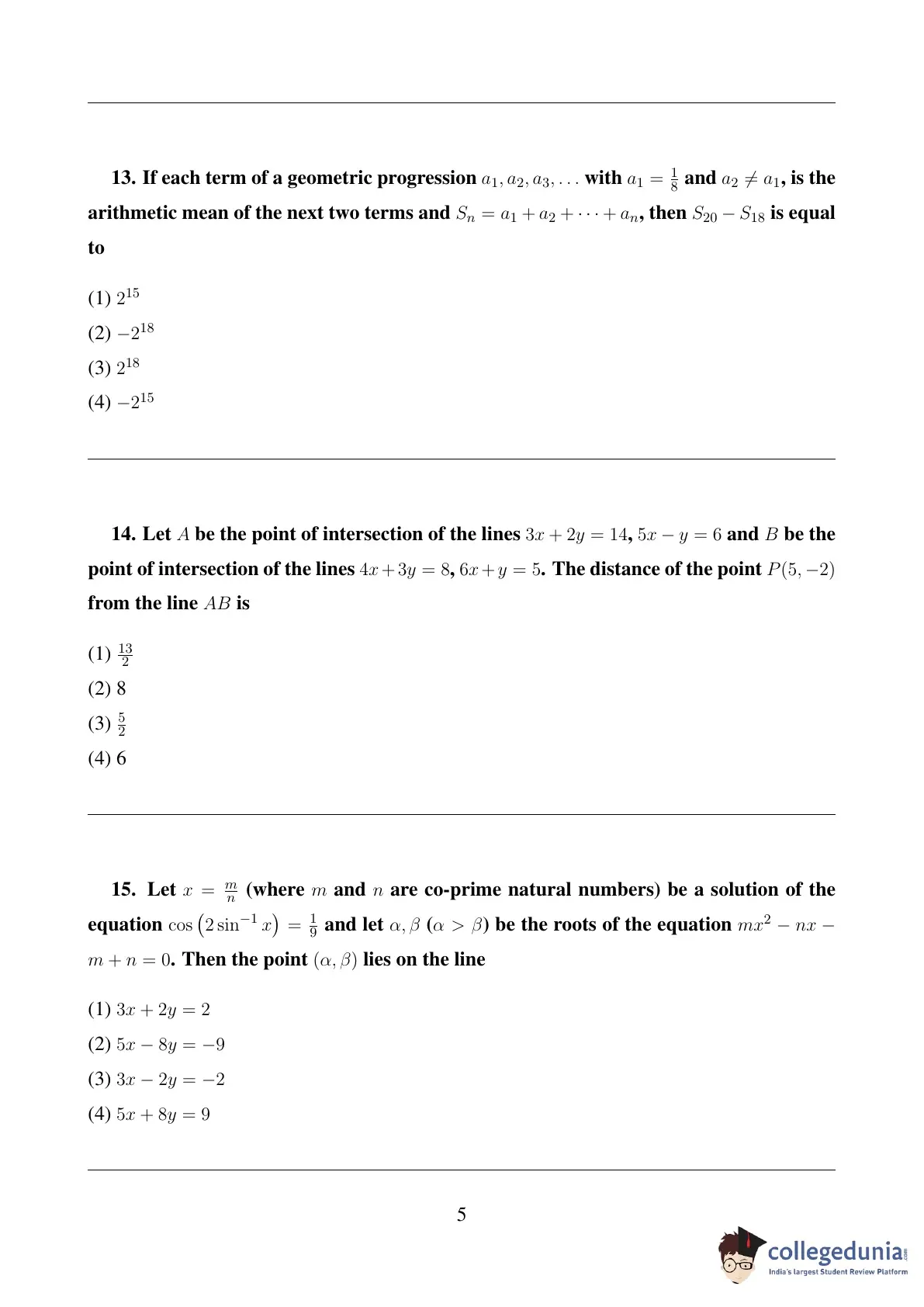
If each term of a geometric progression a₁, a₂, a₃, ... with a₁ = 1/8 and a₂ ≠ a₁, is the arithmetic mean of the next two terms and Sₙ = a₁ + a₂ + ... + aₙ, then S₂₀ − S₁₈ is equal to:
(1) 2^15
(2) −2^18
(3) 2^18
(4) −2^15
View Solution
Let A be the point of intersection of the lines 3x + 2y = 14 and 5x − y = 6, and B be the point of intersection of the lines 4x + 3y = 8 and 6x + y = 5. The distance of the point P(5, −2) from the line AB is:
(1) 13/2
(2) 8
(3) 5/2
(4) 6
View Solution
Let x = m/n (m, n are co-prime natural numbers) be a solution of the equation cos(2 sin⁻¹ x) = 1/9, and let α, β (α > β) be the roots of the equation mx² − nx − m + n = 0. Then the point (α, β) lies on the line:
(1) 3x + 2y = 2
(2) 5x − 8y = −9
(3) 3x − 2y = −2
(4) 5x + 8y = 9
View Solution
The function f(x) = x / (x² - 6x - 16), x ∈ R \ {−2, 8}, has:
(1) decreases in (−2, 8) and increases in (−∞, −2) ∪ (8, ∞)
(2) decreases in (−∞, −2) ∪ (−2, 8) ∪ (8, ∞)
(3) decreases in (−∞, −2) and increases in (8, ∞)
(4) increases in (−∞, −2) ∪ (−2, 8) ∪ (8, ∞)
View Solution
Let y = ln((1 − x²) / (1 + x²)), −1 < x < 1. Then at x = 1/2, the value of 225(y' − y'') is equal to:
(1) 732
(2) 746
(3) 742
(4) 736
View Solution
If R is the smallest equivalence relation on the set {1, 2, 3, 4} such that {(1, 2), (1, 3)} ⊆ R, then the number of elements in R is:
(1) 10
(2) 12
(3) 8
(4) 15
View Solution
An integer is chosen at random from the integers 1, 2, 3, ..., 50. The probability that the chosen integer is a multiple of at least one of 4, 6, 7 is:
(1) 8/25
(2) 21/50
(3) 9/50
(4) 14/25
View Solution
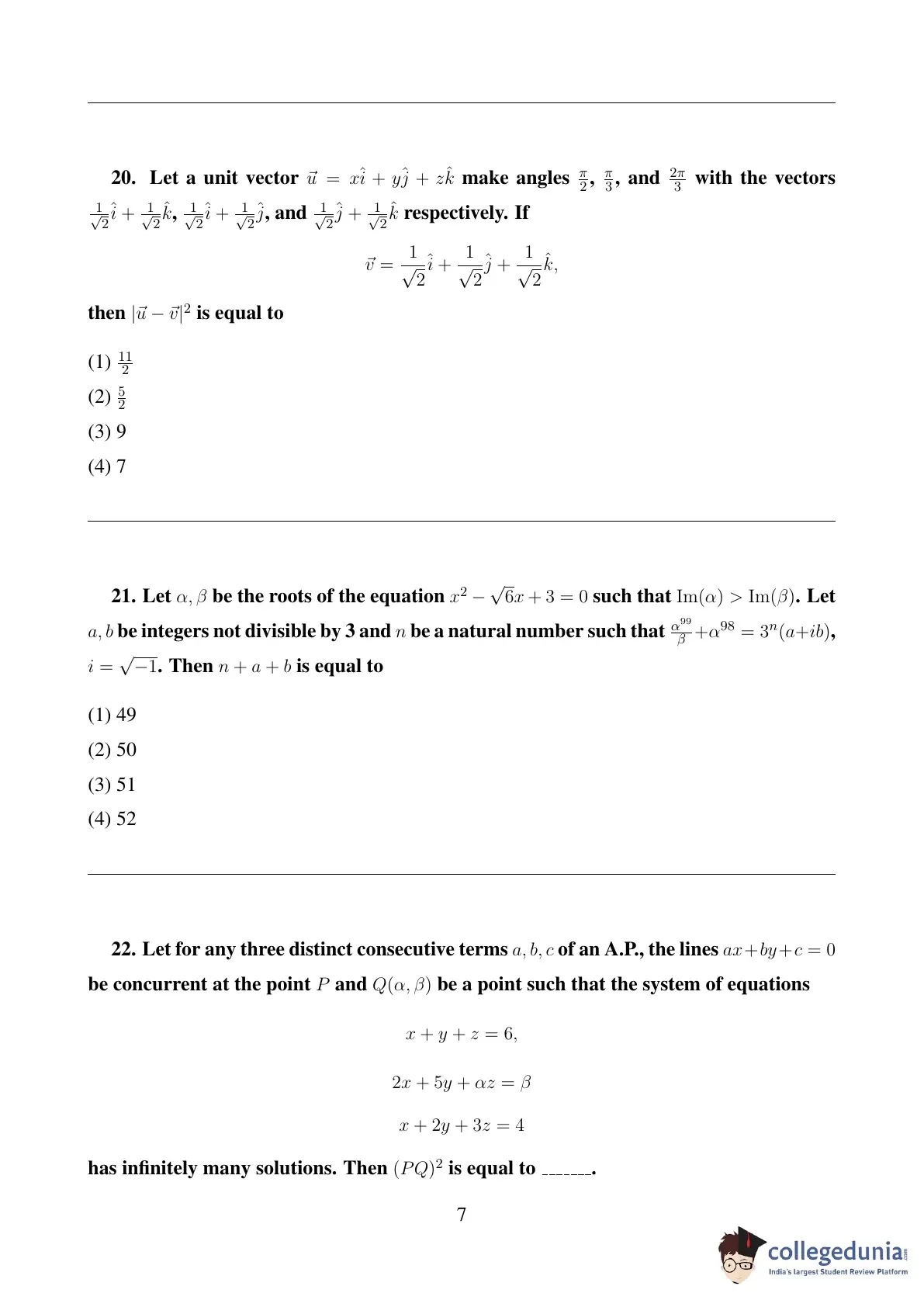
Let a unit vector u = xi + yj + zk make angles π/2, π/3, 2π/3 with the vectors p₁ = (1/√2)i + (1/√2)k, p₂ = (1/√2)j + (1/√2)k, and p₃ = (1/√2)i + (1/√2)j, respectively. If v = (1/√2)(i + j + k), then |u − v|² is equal to:
(1) 11/2
(2) 5/2
(3) 9
(4) 7
View Solution
Let α, β be the roots of the equation x² − √6x + 3 = 0 such that Im(α) > Im(β). Let a, b be integers not divisible by 3 and n be a natural number such that αⁿ / β + α⁹⁹ + α⁹⁸ = 3ⁿ(a + ib), i = √−1. Then n + a + b is equal to:
View Solution
Let for any three distinct consecutive terms a, b, c of an A.P., the lines ax + by + c = 0 be concurrent at the point P, and Q(α, β) be a point such that the system of equations x + y + z = 6, 2x + 5y + αz = β, x + 2y + 3z = 4 has infinitely many solutions. Then (PQ)² is equal to:
View Solution
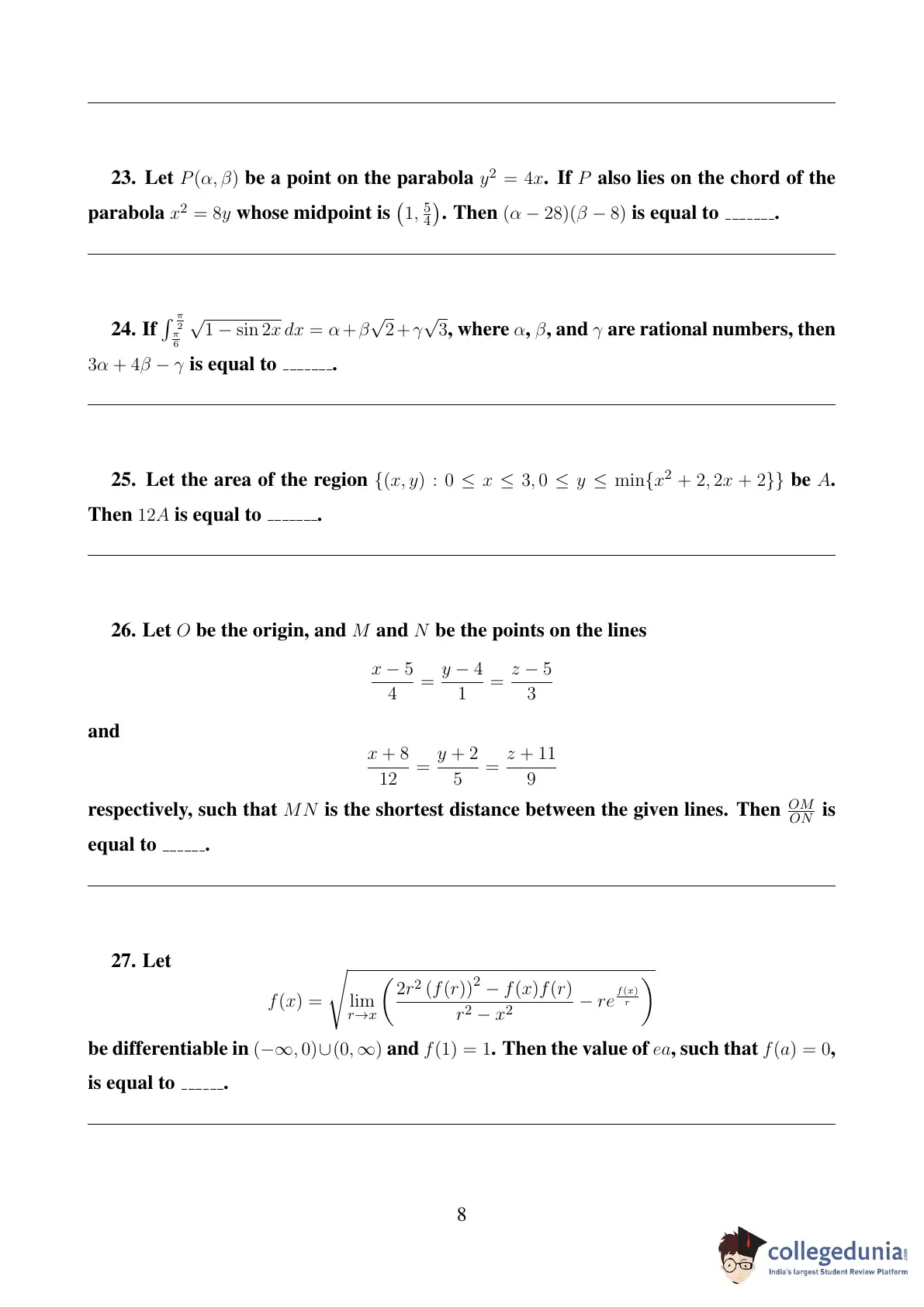
Let P(α, β) be a point on the parabola y² = 4x. If P also lies on the chord of the parabola x² = 8y whose midpoint is (1, 5/4), then (α − 28)(β − 8) is equal to:
View Solution
If ∫ π/3 π/6 √1 − sin 2x dx = α + β√2 + γ√3, where α, β, γ are rational numbers, then 3α + 4β − γ is equal to:
View Solution
Let the area of the region {(x, y) : 0 ≤ x ≤ 3, 0 ≤ y ≤ min(x² + 2, 2x + 2)} be A. Then 12A is equal to:
View Solution
Let O be the origin, and M and N be the points on the lines:
x−5/4 = y−4/1 = z−5/3 and x+8/12 = y+2/5 = z+11/9,
respectively, such that MN is the shortest distance between the given lines. Then OM · ON is equal to:
View Solution
Let f(x) = √lim(r→x) [2r²(f(r²) − f(x))f(r)/(r²−x²) − r²e^(f(r)/r)] be differentiable in (−∞, 0) ∪ (0,∞) and f(1) = 1. Then the value of eᵃ, such that f(a) = 0, is equal to:
View Solution
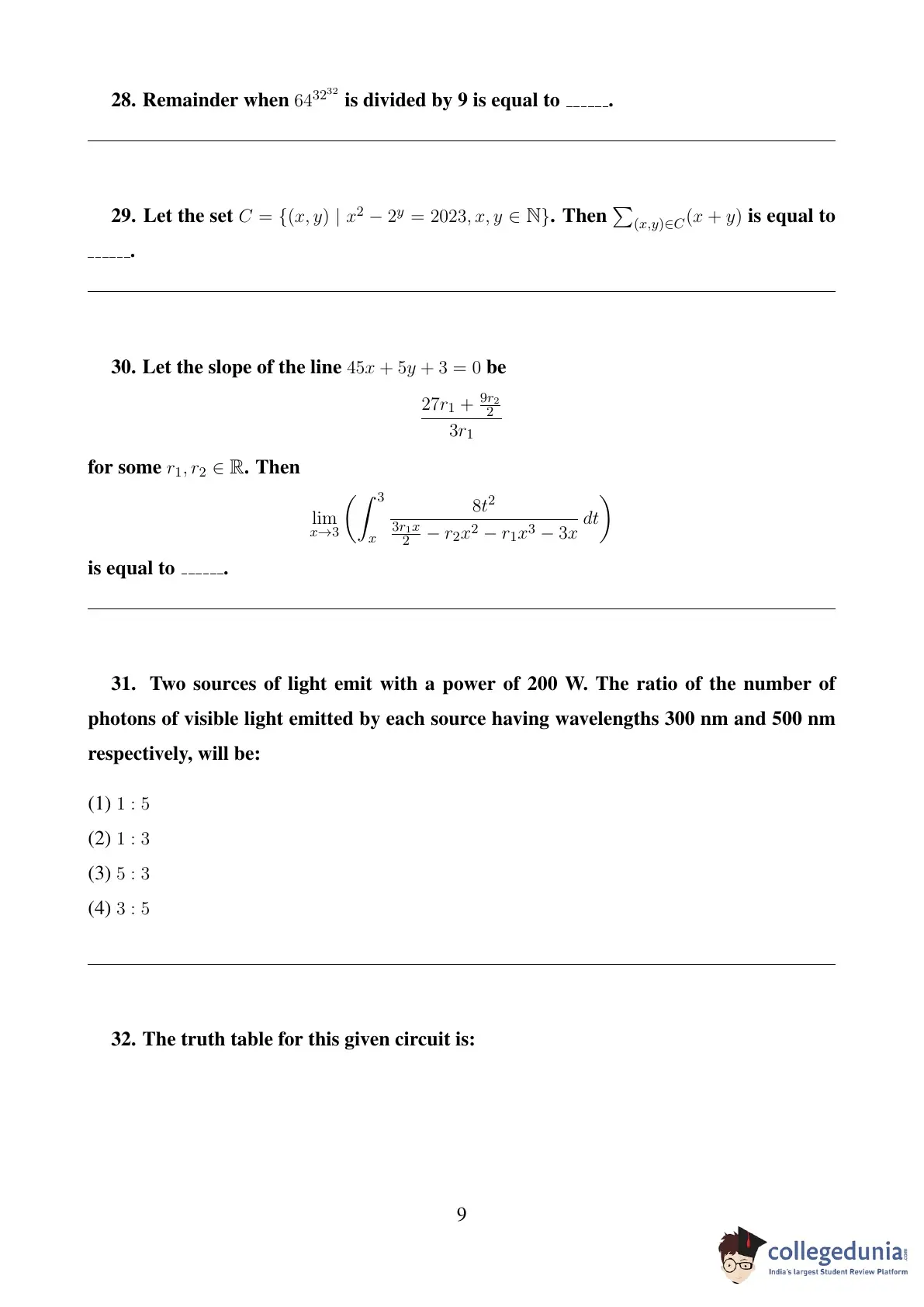
Remainder when 64³²³² is divided by 9 is equal to:
View Solution
Let the set C = {(x, y) | x² − 2y = 2023, x, y ∈ N}. Then ∑(x, y)∈C(x + y) is equal to:
View Solution
Let the slope of the line 45x + 5y + 3 = 0 be 27r₁ + 9r₂² for some r₁, r₂ ∈ R. Then:
lim(x→3)∫(x to 3)(8t²/(3r₂x² − r₂x² − r₁x³ − 3x))dt is equal to:
View Solution
Two sources of light emit with a power of 200 W. The ratio of the number of photons of visible light emitted by each source having wavelengths 300 nm and 500 nm respectively, will be:
(1) 1:5
(2) 1:3
(3) 5:3
(4) 3:5
View Solution
The truth table for the given circuit is:
(1) 1
(2) 2
(3) 3
(4) 4
View Solution
A physical quantity Q is found to depend on quantities a, b, c by the relation Q = a⁴b³/c². The percentage error in a, b, c are 3%, 4%, and 5% respectively. Then, the percentage error in Q is:
(1) 66%
(2) 43%
(3) 34%
(4) 14%
View Solution
In an a.c. circuit, voltage and current are given by V = 100 sin(100t) V and I = 100 sin(100t + π/3) mA, respectively. The average power dissipated in one cycle is:
(1) 5 W
(2) 10 W
(3) 2.5 W
(4) 25 W
View Solution
The temperature of a gas having 2.0×10²⁵ molecules per cubic meter at 1.38 atm (Given, k = 1.38×10⁻²³ JK⁻¹) is:
(1) 500 K
(2) 200 K
(3) 100 K
(4) 300 K
View Solution
A stone of mass 900 g is tied to a string and moved in a vertical circle of radius 1 m making 10 rpm. The tension in the string, when the stone is at the lowest point, is:
(1) 97 N
(2) 9.8 N
(3) 8.82 N
(4) 17.8 N
View Solution
The bob of a pendulum was released from a horizontal position. The length of the pendulum is 10 m. If it dissipates 10% of its initial energy against air resistance, the speed with which the bob arrives at the lowest point is:
(1) 6√5 m/s
(2) 5√6 m/s
(3) 5√5 m/s
(4) 2√5 m/s
View Solution
If the distance between an object and its two-times magnified virtual image produced by a curved mirror is 15 cm, the focal length of the mirror must be:
(1) 15 cm
(2) −12 cm
(3) −10 cm
(4) 10/3 cm
View Solution
Two particles X and Y having equal charges are being accelerated through the same potential difference. Thereafter, they enter normally in a region of uniform magnetic field and describe circular paths of radii R₁ and R₂, respectively. The mass ratio of X and Y is:
(1) (R₂/R₁)²
(2) (R₁/R₂)²
(3) R₁/R₂
(4) R₂/R₁
View Solution
In Young’s double slit experiment, light from two identical sources is superimposing on a screen. The path difference between the two lights reaching a point on the screen is 7λ/4. The ratio of intensity of the fringe at this point with respect to the maximum intensity of the fringe is:
(1) 1/2
(2) 3/4
(3) 1/3
(4) 1/4
View Solution
A small liquid drop of radius R is divided into 27 identical liquid drops. If the surface tension is T, then the work done in the process will be:
(1) 8πR²T
(2) 3πR²T
(3) 1/8πR²T
(4) 4πR²T
View Solution
A bob of mass ‘m’ is suspended by a light string of length ‘L’. It is imparted a minimum horizontal velocity at the lowest point A such that it just completes a half-circle reaching the topmost position B. The ratio of kinetic energies (K.E.)A : (K.E.)B is:
(1) 3:2
(2) 5:1
(3) 2:5
(4) 1:5
View Solution
A wire of length L and radius r is clamped at one end. If its other end is pulled by a force F, its length increases by l. If the radius of the wire and the applied force are both reduced to half of their original values, keeping the original length constant, the increase in length will become:
(1) 3 times
(2) 3/2 times
(3) 4 times
(4) 2 times
View Solution
A planet takes 200 days to complete one revolution around the Sun. If the distance of the planet from the Sun is reduced to one-fourth of the original distance, how many days will it take to complete one revolution?
(1) 25
(2) 50
(3) 100
(4) 20
View Solution
A plane electromagnetic wave of frequency 35 MHz travels in free space along the X-direction. At a particular point (in space and time), E = 9.6 j V/m. The value of the magnetic field at this point is:
(1) 3.2×10⁻⁸ kT
(2) 3.2×10⁻⁸ iT
(3) 9.6 jT
(4) 9.6×10⁻⁸ kT
View Solution
In the given circuit, the current in resistance R₃ is:
(1) 1 A
(2) 1.5 A
(3) 2 A
(4) 2.5 A
View Solution
A particle is moving in a straight line. The variation of position x as a function of time t is given as x = (t³ − 6t² + 20t + 15) m. The velocity of the body when its acceleration becomes zero is:
(1) 4 m/s
(2) 8 m/s
(3) 10 m/s
(4) 6 m/s
View Solution
N moles of a polyatomic gas (f = 6) must be mixed with two moles of a monoatomic gas so that the mixture behaves as a diatomic gas. The value of N is:
(1) 6
(2) 3
(3) 4
(4) 2
View Solution
Given below are two statements:
Statement I: Most of the mass of the atom and all its positive charge are concentrated in a tiny nucleus and the electrons revolve around it, is Rutherford’s model.
Statement II: An atom is a spherical cloud of positive charges with electrons embedded in it, is a special case of Rutherford’s model.
(1) Both Statement I and Statement II are false
(2) Statement I is false but Statement II is true
(3) Statement I is true but Statement II is false
(4) Both Statement I and Statement II are true
View Solution
An electric field is given by E = (6i + 5j + 3k) N/C. The electric flux through a surface area 30i m² lying in the YZ-plane (in SI units) is:
(1) 90
(2) 150
(3) 180
(4) 60
View Solution
Two metallic wires P and Q have the same volume and are made up of the same material. If their areas of cross-section are in the ratio 4:1 and force F₁ is applied to P, an extension of Δℓ is produced. The force required to produce the same extension in Q is F₂. The value of F₁/F₂ is:
(1) 16
(2) 3
(3) 2
(4) 4
View Solution
A horizontal straight wire 5 m long extending from east to west falls freely at a right angle to the horizontal component of Earth’s magnetic field 0.60 × 10⁻⁴ Wb/m². The instantaneous value of emf induced in the wire when its velocity is 10 m/s is:
(1) 3 × 10⁻³ V
(2) 6 × 10⁻³ V
(3) 9 × 10⁻³ V
(4) 2 × 10⁻³ V
View Solution
Hydrogen atom is bombarded with electrons accelerated through a potential difference V, which causes excitation of hydrogen atoms. If the experiment is performed at T = 0 K, the minimum potential difference needed to observe any Balmer series lines in the emission spectra will be α/10 V, where α is:
(1) 121
(2) 150
(3) 135
(4) 110
View Solution
A charge of 4.0 µC is moving with a velocity of 4.0 × 10⁶ m/s along the positive y-axis under a magnetic field B of strength 2k̂ T. The force acting on the charge is xî N. The value of x is:
(1) 32 N
(2) 24 N
(3) 20 N
(4) 16 N
View Solution
A simple harmonic oscillator has an amplitude A and a time period 6π seconds. Assuming the oscillation starts from its mean position, the time required by it to travel from x = A to x = √3/2 A will be π/x seconds, where x is:
(1) 3
(2) 5
(3) 2
(4) 4
View Solution
In the given figure, the charge stored in a 6µF capacitor, when points A and B are joined by a connecting wire, is µC:
View Solution
In a single slit diffraction pattern, a light of wavelength 6000 Å is used. The distance between the first and third minima in the diffraction pattern is found to be 3 mm when the screen is placed 50 cm away from the slits. The width of the slit is ×10⁻⁴ m:
View Solution
In the given circuit, the current flowing through the resistance 20Ω is 0.3A, while the ammeter reads 0.9A. The value of R₁ is Ω:
View Solution
A particle is moving in a circle of radius 50 cm in such a way that at any instant the normal and tangential components of its acceleration are equal. If its speed at t = 0 is 4 m/s, the time taken to complete the first revolution will be 1/α [1 − e⁻²π] seconds, where α is:
View Solution
A body of mass 5 kg moving with a uniform speed 3√2 m/s in the X-Y plane along the line y = x + 4. The angular momentum of the particle about the origin will be kg·m²/s:
View Solution
The ascending acidity order of the following H atoms is:
(1) C < D < B < A
(2) A < B < C < D
(3) A < B < D < C
(4) D < C < B < A
View Solution
Match List I with List II:
List I (Bio Polymer) | List II (Monomer)
A. Starch | I. Nucleotide
B. Cellulose | II. α-glucose
C. Nucleic acid | III. β-glucose
D. Protein | IV. α-amino acid
(1) A-II, B-I, C-III, D-IV
(2) A-IV, B-II, C-I, D-III
(3) A-I, B-III, C-IV, D-II
(4) A-II, B-III, C-I, D-IV
View Solution
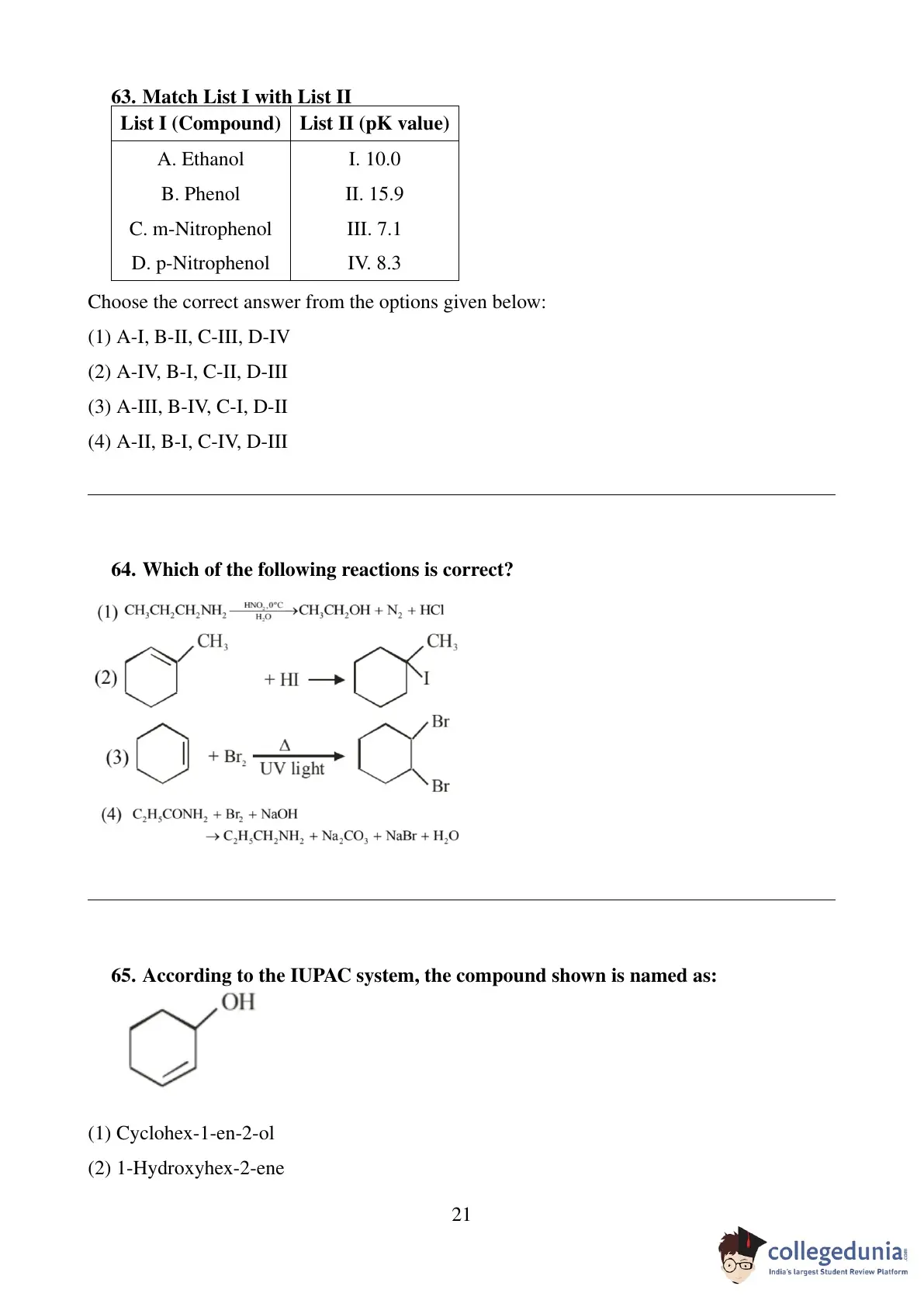
Match List I with List II:
List I (Compound) | List II (pKa value)
A. Ethanol | II. 15.9
B. Phenol | I. 10.0
C. m-Nitrophenol | IV. 8.3
D. p-Nitrophenol | III. 7.1
(1) A-I, B-II, C-III, D-IV
(2) A-IV, B-I, C-II, D-III
(3) A-III, B-IV, C-I, D-II
(4) A-II, B-I, C-IV, D-III
View Solution
Which of the following reaction is correct?
(1) Incorrect reaction
(2) Correct reaction
(3) Partially correct reaction
(4) Not a valid reaction
View Solution
According to IUPAC system, the compound is named as:
(1) Cyclohex-1-en-2-ol
(2) 1-Hydroxyhex-2-ene
(3) Cyclohex-1-en-3-ol
(4) Cyclohex-2-en-1-ol
View Solution
The compound contains a double bond and an alcohol group. Numbering starts from the alcohol group to give it the lowest locant.
The correct IUPAC name of K₂MnO₄ is:
(1) Potassium tetraoxopermanganate (VI)
(2) Potassium tetraoxidomanganate (VI)
(3) Dipotassium tetraoxidomanganate (VII)
(4) Potassium tetraoxidomanganese (VI)
View Solution
A reagent which gives a brilliant red precipitate with Nickel ions in a basic medium is:
View Solution
Phenol treated with chloroform in the presence of sodium hydroxide, followed by hydrolysis with acid, results in:
View Solution
Match List I with List II:
List I (Spectral Series for Hydrogen) | List II (Spectral Region)
A. Lyman | I. Infrared region
B. Balmer | II. UV region
C. Paschen | III. Infrared region
D. Pfund | IV. Visible region
(1) A-II, B-III, C-I, D-IV
(2) A-I, B-III, C-II, D-IV
(3) A-II, B-IV, C-III, D-I
(4) A-I, B-II, C-III, D-IV
View Solution
On passing a gas, ‘X,’ through Nessler’s reagent, a brown precipitate is obtained. The gas ‘X’ is:
View Solution
The product A formed in the following reaction is:
View Solution
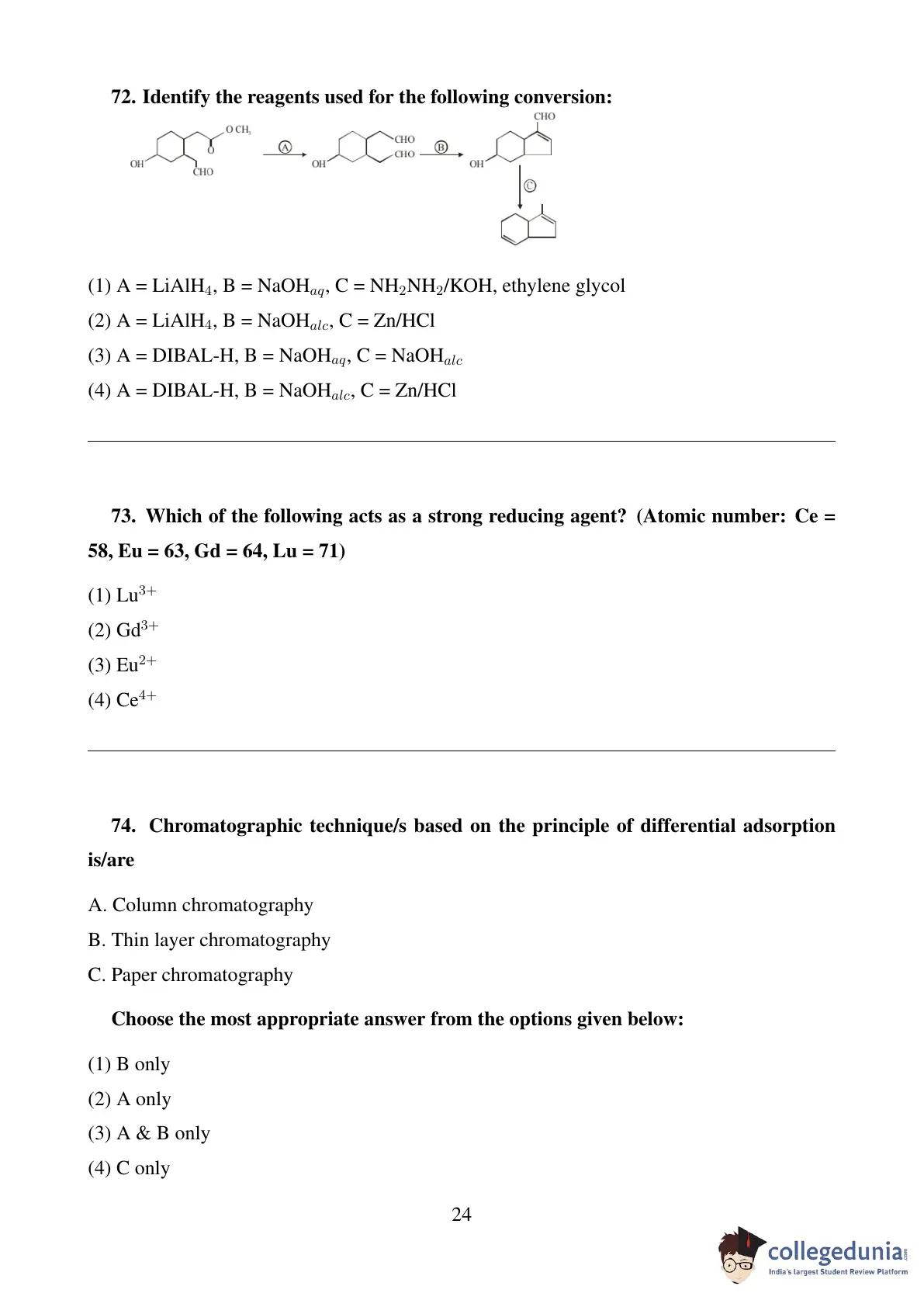
Identify the reagents used for the following conversion:
(1) A = LiAlH₄, B = NaOH(aq), C = NH₂NH₂/KOH
(2) A = LiAlH₄, B = NaOH(alc), C = Zn/HCl
(3) A = DIBAL-H, B = NaOH(aq), C = NH₂NH₂/KOH
(4) A = DIBAL-H, B = NaOH(alc), C = Zn/HCl
View Solution
DIBAL-H selectively reduces esters to aldehydes. NaOH(alc) facilitates aldol condensation, and Zn/HCl performs Clemmensen reduction to produce hydrocarbons.
Which of the following acts as a strong reducing agent? (Atomic numbers: Ce = 58, Eu = 63, Gd = 64, Lu = 71)
(1) Lu³⁺
(2) Gd³⁺
(3) Eu²⁺
(4) Ce⁴⁺
View Solution
Chromatographic technique(s) based on the principle of differential adsorption is/are:
A. Column chromatography
B. Thin layer chromatography
C. Paper chromatography
(1) B only
(2) A only
(3) A & B only
(4) C only
View Solution
Which of the following statements are correct about Zn, Cd, and Hg?
A. They exhibit high enthalpy of atomization as the d-subshell is full.
B. Zn and Cd do not show variable oxidation state while Hg shows +1 and +2.
C. Compounds of Zn, Cd, and Hg are paramagnetic in nature.
D. Zn, Cd, and Hg are called soft metals.
(1) B, D only
(2) B, C only
(3) A, D only
(4) C, D only
View Solution
The element having the highest first ionization enthalpy is:
(1) Si
(2) Al
(3) N
(4) C
View Solution
Alkyl halide is converted into alkyl isocyanide by reaction with:
View Solution
Which one of the following will show geometrical isomerism?
View Solution
Given below are two statements:
Statement I: Fluorine has the most negative electron gain enthalpy in its group.
Statement II: Oxygen has the least negative electron gain enthalpy in its group.
In the light of the above statements, choose the most appropriate option from the options given below:
View Solution
Anomalous behavior of oxygen is due to its:
View Solution
The total number of antibonding molecular orbitals formed from 2s and 2p atomic orbitals in a diatomic molecule is:
View Solution
The oxidation number of iron in the compound formed during the brown ring test for NO₃⁻ ion is:
View Solution
The equilibrium constant for the formation of NH₃ from N₂ and H₂, given [N₂] = 2×10⁻² M, [H₂] = 3×10⁻² M, [NH₃] = 1.5×10⁻² M at 500 K, is:
View Solution
The molality of a 0.8 M H₂SO₄ solution with density 1.06 g/cm³ is:
View Solution
The amount of NaOH in 50 mL of a solution neutralized by 50 mL of 0.5 M oxalic acid is:
View Solution
The total number of sigma (σ) and pi (π) bonds in 2-formylhex-4-enoic acid is:
View Solution
The half-life of radioisotopic bromine-82 is 36 hours. The fraction that remains after one day is:
View Solution
Standard enthalpy of vaporization for CCl₄ is 30.5 kJ/mol. Heat required for vaporization of 284 g of CCl₄ at constant temperature is:
View Solution
A constant current was passed through a solution of AuCl₄⁻ ions between gold electrodes. After 10 minutes, the increase in the cathode’s mass was 1.314 g. The total charge passed through the solution is:
View Solution
The total number of molecules with zero dipole moment among CH₄, BF₃, H₂O, HF, NH₃, CO₂, and SO₂ is:
View Solution










JEE Main 2024 Jan 29 Shift 2 Question Paper by Coaching Institute
| Coaching Institutes | Question Paper with Solutions PDF |
|---|---|
| Aakash BYJUs | Download PDF |
| Reliable Institute | Physics Chemistry |
| Resonance | Physics Chemistry Maths |
| Vedantu | Download PDF |
| Sri Chaitanya | Download PDF |
| FIIT JEE | To be updated |
JEE Main 29 Jan Shift 2 2024 Paper Analysis
JEE Main 2024 Jan 29 Shift 2 paper analysis for B.E./ B.Tech is updated here with details on the difficulty level of the exam, topics with the highest weightage in the exam, section-wise difficulty level, etc. after the conclusion of the exam.
JEE Main 2024 Question Paper Pattern
| Feature | Question Paper Pattern |
|---|---|
| Examination Mode | Computer-based Test |
| Exam Language | 13 languages (English, Hindi, Assamese, Bengali, Gujarati, Kannada, Malayalam, Marathi, Odia, Punjabi, Tamil, Telugu, and Urdu) |
| Number of Sections | Three- Physics, Chemistry, Mathematics |
| Exam Duration | 3 hours |
| Sectional Time Limit | None |
| Total Marks | 300 marks |
| Total Number of Questions Asked | 90 Questions |
| Total Number of Questions to be Answered | 75 questions |
| Type of Questions | MCQs and Numerical Answer Type Questions |
| Section-wise Number of Questions | Physics- 20 MCQs and 10 numerical type, Chemistry- 20 MCQs and 10 numerical type, Mathematics- 20 MCQs and 10 numerical type |
| Marking Scheme | +4 for each correct answer |
| Negative Marking | -1 for each incorrect answer |
Read More:
- JEE Main 2024 question paper pattern and marking scheme
- Most important chapters in JEE Mains 2024, Check chapter wise weightage here
JEE Main 2024 Question Paper Session 1 (January)
Those appearing for JEE Main 2024 can use the links below to practice and keep track of their exam preparation level by attempting the shift-wise JEE Main 2024 question paper provided below.
| Exam Date and Shift | Question Paper PDF |
|---|---|
| JEE Main 24 Jan Shift 2 2024 Question Paper | Check Here |
| JEE Main 27 Jan Shift 1 2024 Question Paper | Check Here |
| JEE Main 27 Jan Shift 2 2024 Question Paper | Check Here |
| JEE Main 29 Jan Shift 1 2024 Question Paper | Check Here |
| JEE Main 30 Jan Shift 1 2024 Question Paper | Check Here |
| JEE Main 30 Jan Shift 2 2024 Question Paper | Check Here |
| JEE Main 31 Jan Shift 1 2024 Question Paper | Check Here |
| JEE Main 31 Jan Shift 2 2024 Question Paper | Check Here |
| JEE Main 1 Feb Shift 1 2024 Question Paper | Check Here |
| JEE Main 1 Feb Shift 2 2024 Question Paper | Check Here |



Comments