




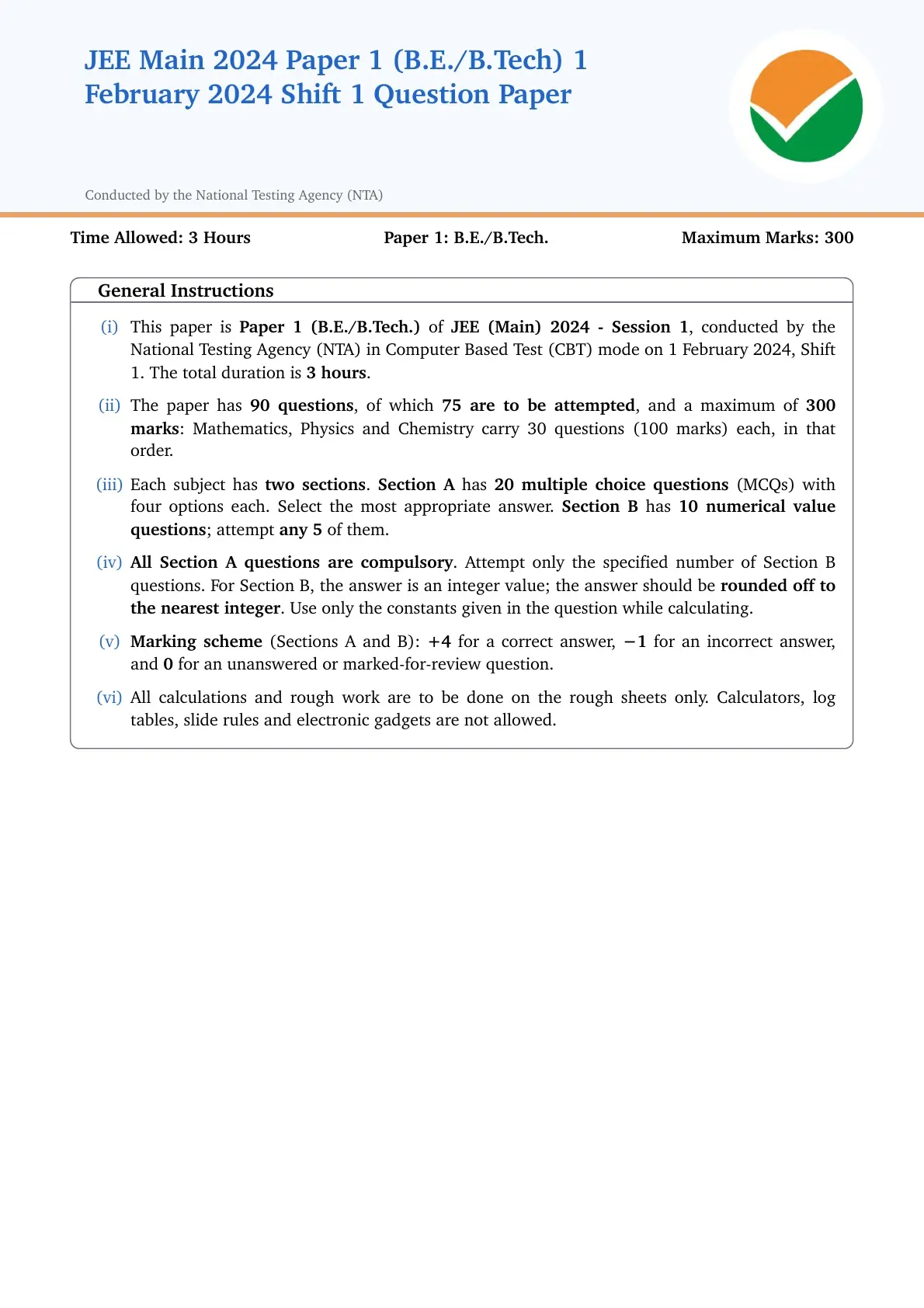
JEE Main 2024 February 1 Shift 1 Question Paper is available here with answer key and solution pdf. NTA conducted the first shift on February 1, 2024, from 9:00 AM to 12:00 PM. The JEE Main 2024 Paper 1 (B.E./B.Tech) question paper includes the following:
- 90 questions in a 3-hour CBT Mode: 30 each from Mathematics, Physics and Chemistry (75 to be attempted)
- Section A: 20 multiple choice questions (MCQs) per subject, 4 marks each
- Section B: 10 numerical value questions per subject, attempt any 5, 4 marks each (integer answer)
- Marking: +4 for a correct answer, -1 for an incorrect answer, 0 for an unattempted question
JEE Main 2024 February 1 Shift 1 Question Paper with Solution PDF
| NTA Official PDF | CD PDF | CD PDF with Solutions |
|---|---|---|
| Download official PDF 4.36 MB | Download Collegedunia PDF 0.69 MB | Download solutions PDF 1.15 MB |
Also Check:
JEE Main 2024 February 1 Shift 1 Questions with Solutions
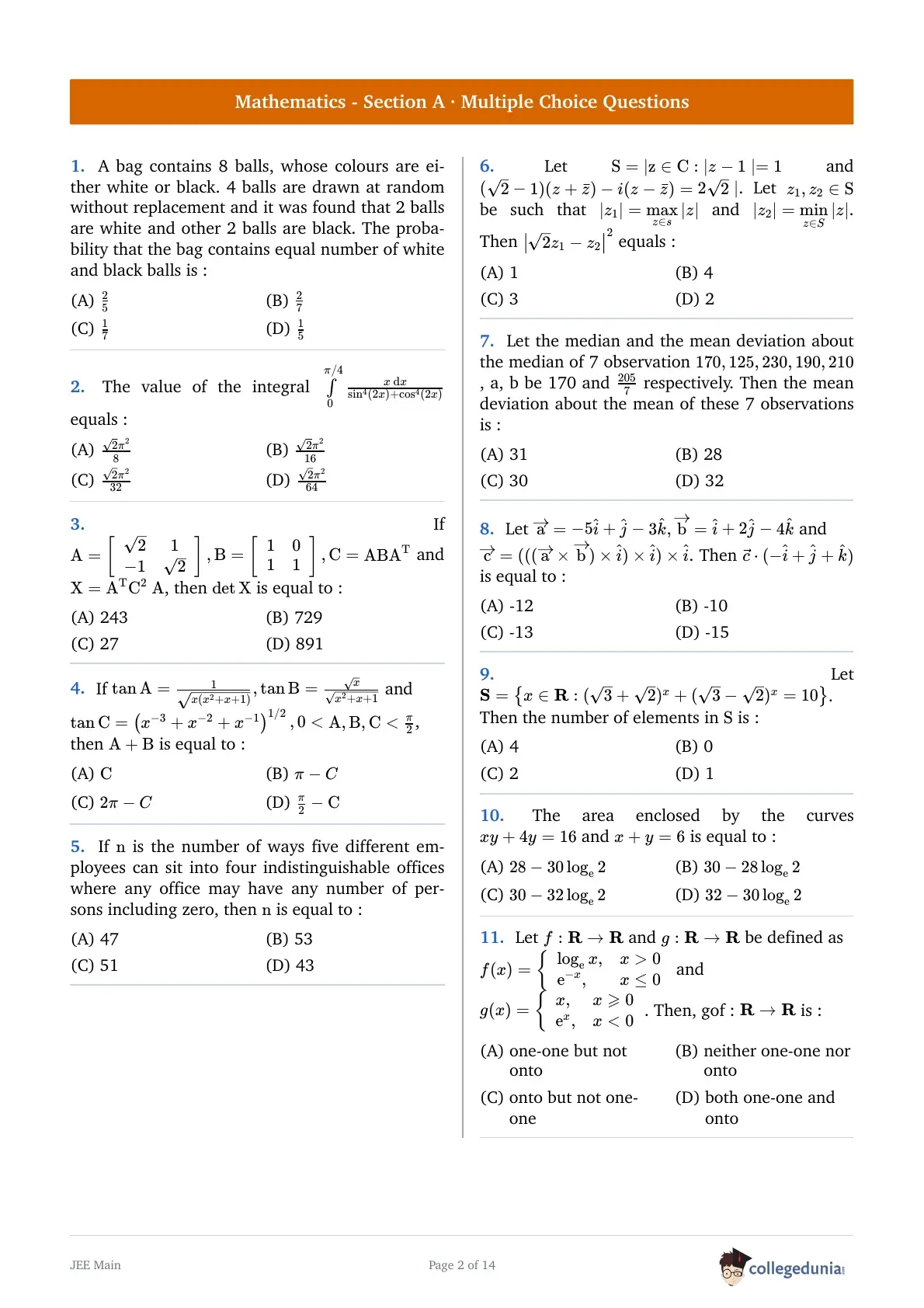
Mathematics - Section A (Q1 - Q20)
A bag contains 8 balls, whose colours are either white or black. 4 balls are drawn at random without replacement and it was found that 2 balls are white and other 2 balls are black. The probability that the bag contains equal number of white and black balls is:
The value of the integral \(\int_0^{\frac{\pi}{4}} \frac{x \, dx}{\sin^4(2x) + \cos^4(2x)}\)
If \( A = \begin{bmatrix} \sqrt{2} & 1 \\ -1 & \sqrt{2} \end{bmatrix} \), \( B = \begin{bmatrix} 1 & 0 \\ 1 & 1 \end{bmatrix} \), \( C = ABA^\top \) and \( X = A^\top C^2 A \), then \( \det (X) \) is equal to:
If \(\tan A = \frac{1}{\sqrt{x(x^2 + x + 1)}}, \quad \tan B = \frac{\sqrt{x}}{\sqrt{x^2 + x + 1}}\) and \(\tan C = \left(x^3 + x^2 + x^{-1}\right)^{\frac{1}{2}}, \quad 0 < A, B, C < \frac{\pi}{2}\),then \( A + B \) is equal to:
If n is the number of ways five different employees can sit into four indistinguishable offices where any office may have any number of persons including zero, then n is equal to:
Let \( S = \{ z \in \mathbb{C} : |z - 1| = 1 \} \) and \((\sqrt{2} - 1)(z + \overline{z}) - i(z - \overline{z}) = 2\sqrt{2}.\)
Let \( z_1, z_2 \in S \) be such that \( |z_1| = \max_{z \in S} |z| \) and \( |z_2| = \min_{z \in S} |z| \).
Then \( \sqrt{2}|z_1 - z_2|^2 \) equals:
Let the median and the mean deviation about the median of 7 observation 170, 125, 230, 190, 210, a, b be 170 and \(\frac{205}{7}\)respectively. Then the mean deviation about the mean of these 7 observations is :
Let \(\vec{a} = -5\hat{i} + \hat{j} - 3\hat{k}, \quad \vec{b} = \hat{i} + 2\hat{j} - 4\hat{k},\) and \(\vec{c} = \left( \left( \left( \vec{a} \times \vec{b} \right) \times \hat{i} \right) \times \hat{i} \right) \times \hat{i}.\) Then \(\vec{c} \cdot (-\hat{i} + \hat{j} + \hat{k})\) is equal to:
\(\text{Let } S = \{x \in \mathbb{R} : (\sqrt{3} + \sqrt{2})^x + (\sqrt{3} - \sqrt{2})^x = 10\}\).Then the number of elements in \( S \) is:
The area enclosed by the curves xy + 4y = 16 and x + y = 6 is equal to :
Let \( f: \mathbb{R} \to \mathbb{R} \) and \( g: \mathbb{R} \to \mathbb{R} \) be defined as: \(f(x) = \begin{cases} \log_e x, & \text{if } x > 0, \\ e^{-x}, & \text{if } x \leq 0, \end{cases}\) and
\(g(x) = \begin{cases} x, & \text{if } x \geq 0, \\ e^x, & \text{if } x < 0. \end{cases}\) Then \( g \circ f: \mathbb{R} \to \mathbb{R} \) is:
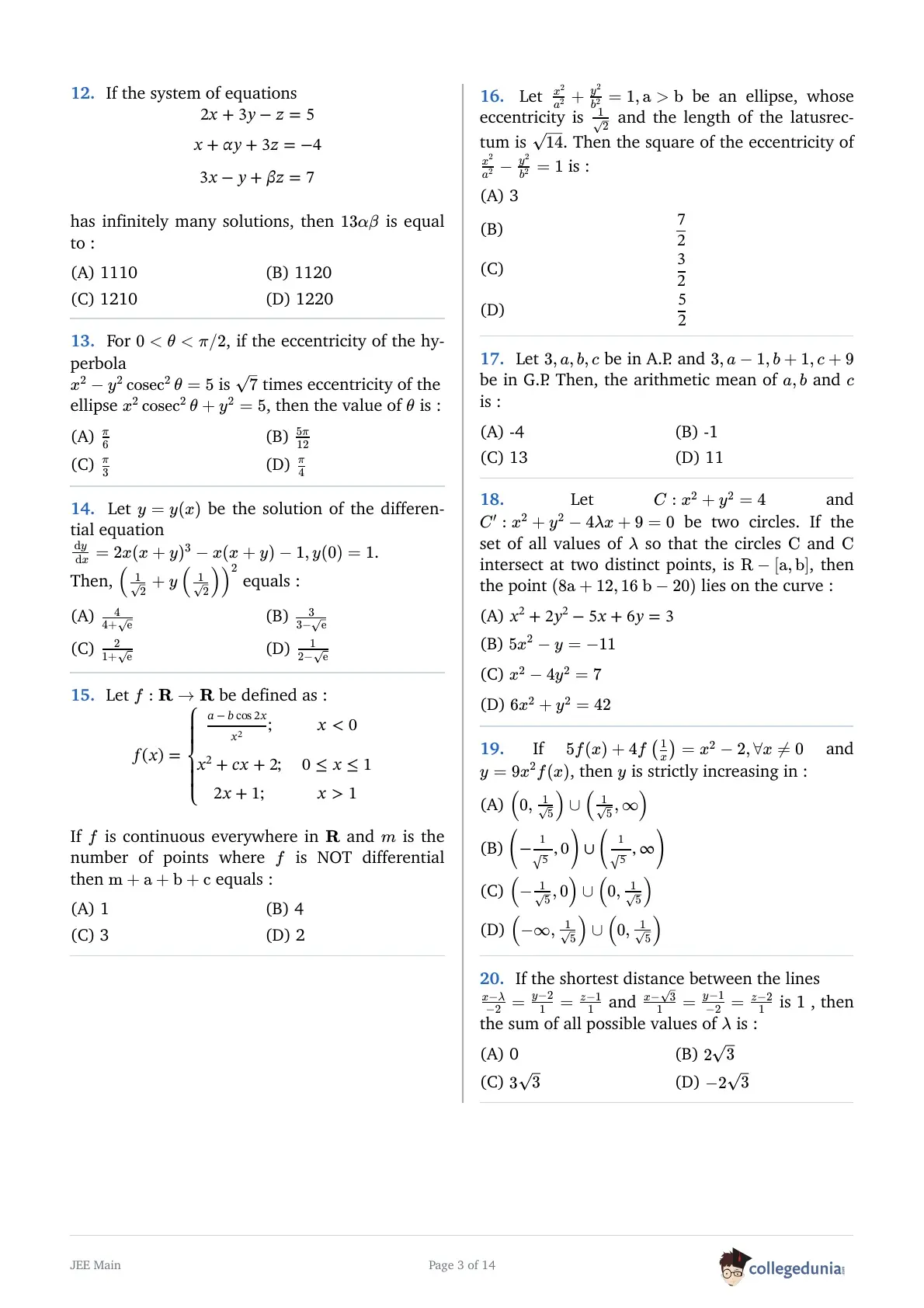
If the system of equations
\( 2x + 3y - z = 5 \)
\( x + \alpha y + 3z = -4 \)
\( 3x - y + \beta z = 7 \)
has infinitely many solutions, then \( 13 \alpha \beta \) is equal to:
For \(0 < \theta < \frac{pi}{2}\), if the eccentricity of the hyperbola \( x^2 - y^2 \csc^2 \theta = 5 \) is \( \sqrt{7} \) times the eccentricity of the ellipse \( x^2 \csc^2 \theta + y^2 = 5 \), then the value of \( \theta \) is:
Let \( y = y(x) \) be the solution of the differential equation \(\frac{dy}{dx} = 2x(x + y)^3 - x(x + y) - 1, \quad y(0) = 1.\)Then, \(\left( \frac{1}{\sqrt{2}} + y\left(\frac{1}{\sqrt{2}}\right) \right)^2\)equals:
Let \( f: \mathbb{R} \to \mathbb{R} \) be defined as: \(f(x) = \begin{cases} \frac{a - b \cos 2x}{x^2}, & x < 0, \\ x^2 + cx + 2, & 0 \leq x \leq 1, \\ 2x + 1, & x > 1. \end{cases}\)
If \( f \) is continuous everywhere in \( \mathbb{R} \) and \( m \) is the number of points where \( f \) is NOT differentiable, then \( m + a + b + c \) equals:
Let \( \frac{x^2}{a^2} + \frac{y^2}{b^2} = 1 \), where \( a>b \), be an ellipse whose eccentricity is \( \frac{1}{\sqrt{2}} \) and the length of the latus rectum is \( \sqrt{14} \). Then the square of the eccentricity of \( \frac{x^2}{a^2} - \frac{y^2}{b^2} = 1 \) is:
Let 3, a, b, c be in A.P. and 3, a – 1, b + l, c + 9 be in G.P. Then, the arithmetic mean of a, b and c is :
Let \( C: x^2 + y^2 = 4 \) and \( C': x^2 + y^2 - 4\lambda x + 9 = 0 \) be two circles. If the set of all values of \( \lambda \) such that the circles \( C \) and \( C' \) intersect at two distinct points is \( R = [a, b] \), then the point \( (8a + 12, 16b - 20) \) lies on the curve:
If \( 5f(x) + 4f\left(\frac{1}{x}\right) = x^2 - 2 \), for all \( x \neq 0 \), and \( y = 9x^2f(x) \), then \( y \) is strictly increasing in:
If the shortest distance between the lines \(\frac{x - \lambda}{-2} = \frac{y - 2}{1} = \frac{z - 1}{1}\) and \(\frac{x - \sqrt{3}}{1} = \frac{y - 1}{-2} = \frac{z - 2}{1}\) is 1, then the sum of all possible values of \( \lambda \) is:
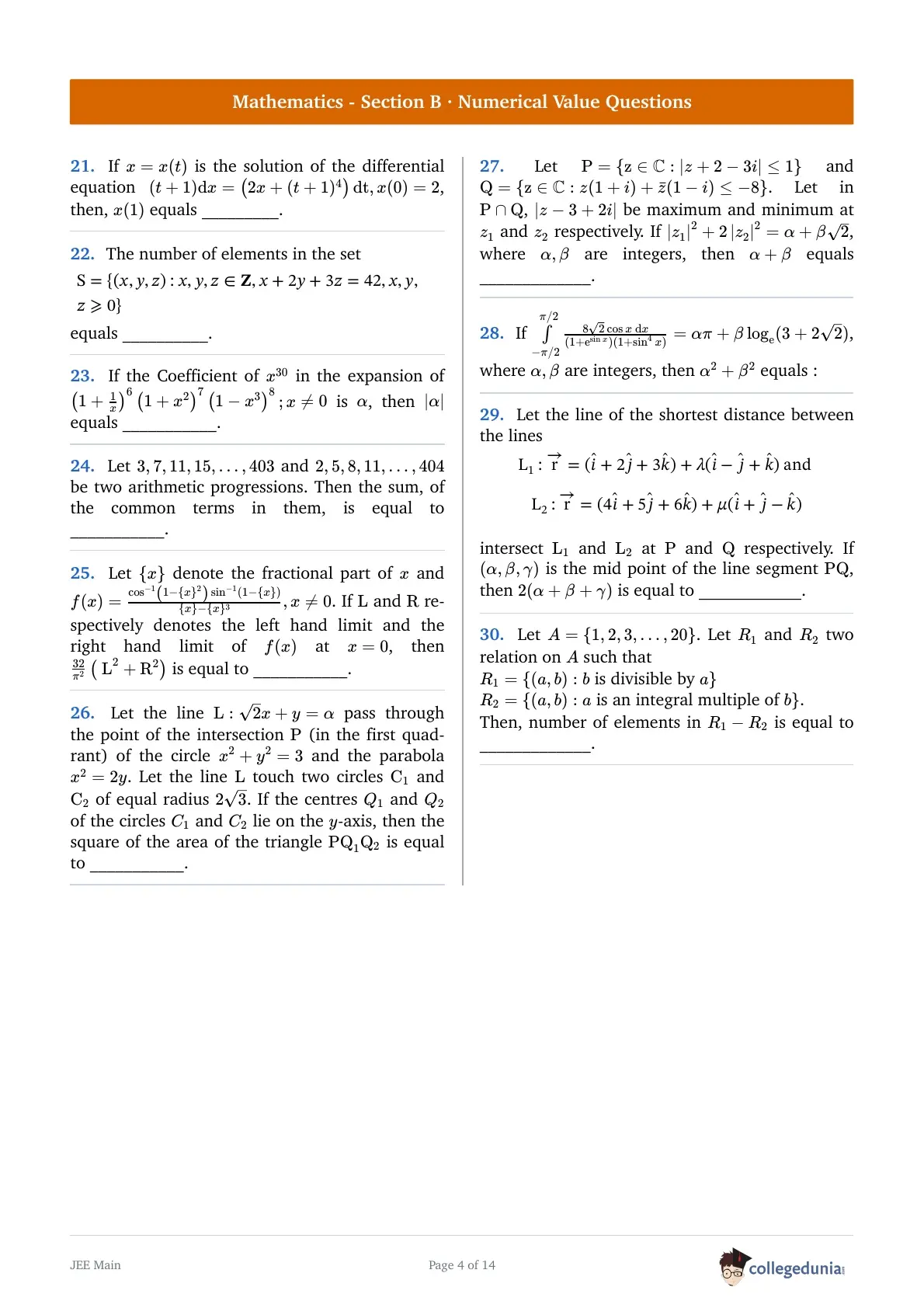
Mathematics - Section B (Q21 - Q30)
If \( x = x(t) \) is the solution of the differential equation \((t + 1) dx = \left(2x + (t + 1)^4\right) dt, \quad x(0) = 2,\) then \( x(1) \) equals ____.
The number of elements in the set S = {(x, y, z) : x, y, z ∈ Z, x + 2y + 3z = 42, x, y, z ≥ 0} equals ____
If the coefficient of \(x^{30}\) in the expansion of \(\left(1 + \frac{1}{x}\right)^6 (1 + x^2)^7 (1 - x^3)^8, \, x \neq 0\) is \(\alpha\), then \(|\alpha|\) equals ____.
Let 3, 7, 11, 15, ...., 403 and 2, 5, 8, 11, . . ., 404 be two arithmetic progressions. Then the sum, of the common terms in them, is equal to _________.
Let \(\{x\}\) denote the fractional part of \(x\), and \(f(x) = \frac{\cos^{-1}(1 - \{x\}^2) \sin^{-1}(1 - \{x\})}{\{x\} - \{x\}^3}, \quad x \neq 0\).If \(L\) and \(R\) respectively denote the left-hand limit and the right-hand limit of \(f(x)\) at \(x = 0\), then \(\frac{32}{\pi^2} \left(L^2 + R^2\right)\) is equal to \(\_\_\_\_\_\_\_\_\).
Let the line \( L : \sqrt{2}x + y = \alpha \) pass through the point of intersection \( P \) (in the first quadrant) of the circle \( x^2 + y^2 = 3 \) and the parabola \( x^2 = 2y \). Let the line \( L \) touch two circles \( C_1 \) and \( C_2 \) of equal radius \( 2\sqrt{3} \). If the centers \( Q_1 \) and \( Q_2 \) of the circles \( C_1 \) and \( C_2 \) lie on the y-axis, then the square of the area of the triangle \( PQ_1Q_2 \) is equal to ____.
Let \( P = \{ z \in \mathbb{C} : |z + 2 - 3i| \leq 1 \} \) and \( Q = \{ z \in \mathbb{C} : z(1 + i) + \overline{z}(1 - i) \leq -8 \} \).
Let \( z \) in \( P \cap Q \) have \( |z - 3 + 2i| \) be maximum and minimum at \( z_1 \) and \( z_2 \), respectively.
If \( |z_1|^2 + 2|z_2|^2 = \alpha + \beta \sqrt{2} \), where \( \alpha \) and \( \beta \) are integers, then \( \alpha + \beta \) equals ____.
If \(\int_{-\pi/2}^{\pi/2} \frac{8\sqrt{2} \cos x \, dx}{(1 + e^{\sin x})(1 + \sin^4 x)} = \alpha \pi + \beta \log_e(3 + 2\sqrt{2}),\) where \( \alpha \) and \( \beta \) are integers, then \( \alpha^2 + \beta^2 \) equals ____.
Let the line of the shortest distance between the lines \(L_1: \vec{r} = (\hat{i} + 2\hat{j} + 3\hat{k}) + \lambda(\hat{i} - \hat{j} + \hat{k})\)and \(L_2: \vec{r} = (4\hat{i} + 5\hat{j} + 6\hat{k}) + \mu(\hat{i} + \hat{j} - \hat{k})\) intersect \(L_1\) and \(L_2\) at \(P\) and \(Q\), respectively. If \((\alpha, \beta, \gamma)\) is the midpoint of the line segment \(PQ\), then \(2(\alpha + \beta + \gamma)\) is equal to \(\_\_\_\_\).
Let \( A = \{ 1, 2, 3, \dots, 20 \} \). Let \( R_1 \) and \( R_2 \) be two relations on \( A \) such that \(R_1 = \{(a, b) : b \text{ is divisible by } a\}\)
and \(R_2 = \{(a, b) : a \text{ is an integral multiple of } b\}\).Then, the number of elements in \( R_1 - R_2 \) is equal to \(\_\_\_\_.\)
Physics - Section A (Q31 - Q50)
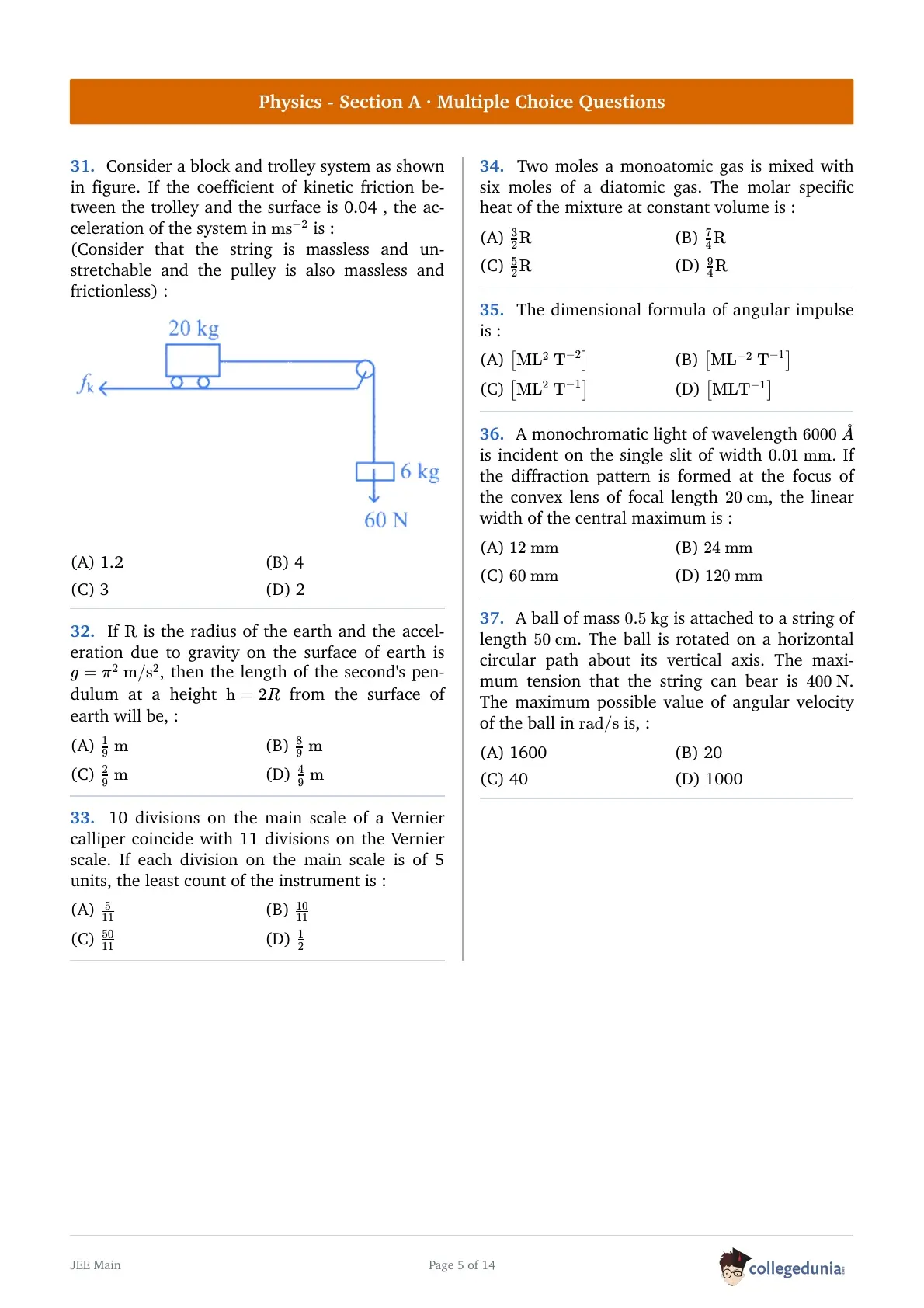
Consider a block and trolley system as shown in figure. If the coefficient of kinetic friction between the trolley and the surface is 0.04, the acceleration of the system in m/s2 is : (Consider that the string is massless and unstretchable and the pulley is also massless and frictionless) :

If \( R \) is the radius of the earth and the acceleration due to gravity on the surface of the earth is \( g = \pi^2 \, \text{m/s}^2 \), then the length of the second's pendulum at a height \( h = 2R \) from the surface of the earth will be:
10 divisions on the main scale of a Vernier calliper coincide with 11 divisions on the Vernier scale. If each division on the main scale is of 5 units, the least count of the instrument is :
Two moles a monoatomic gas is mixed with six moles of a diatomic gas. The molar specific heat of the mixture at constant volume is :
The dimensional formula of angular impulse is :
A monochromatic light of wavelength 6000Å is incident on the single slit of width 0.01 mm. If the diffraction pattern is formed at the focus of the convex lens of focal length 20 cm, the linear width of the central maximum is :
A ball of mass 0.5 kg is attached to a string of length 50 cm. The ball is rotated on a horizontal circular path about its vertical axis. The maximum tension that the string can bear is 400 N. The maximum possible value of angular velocity of the ball in rad/s is,:
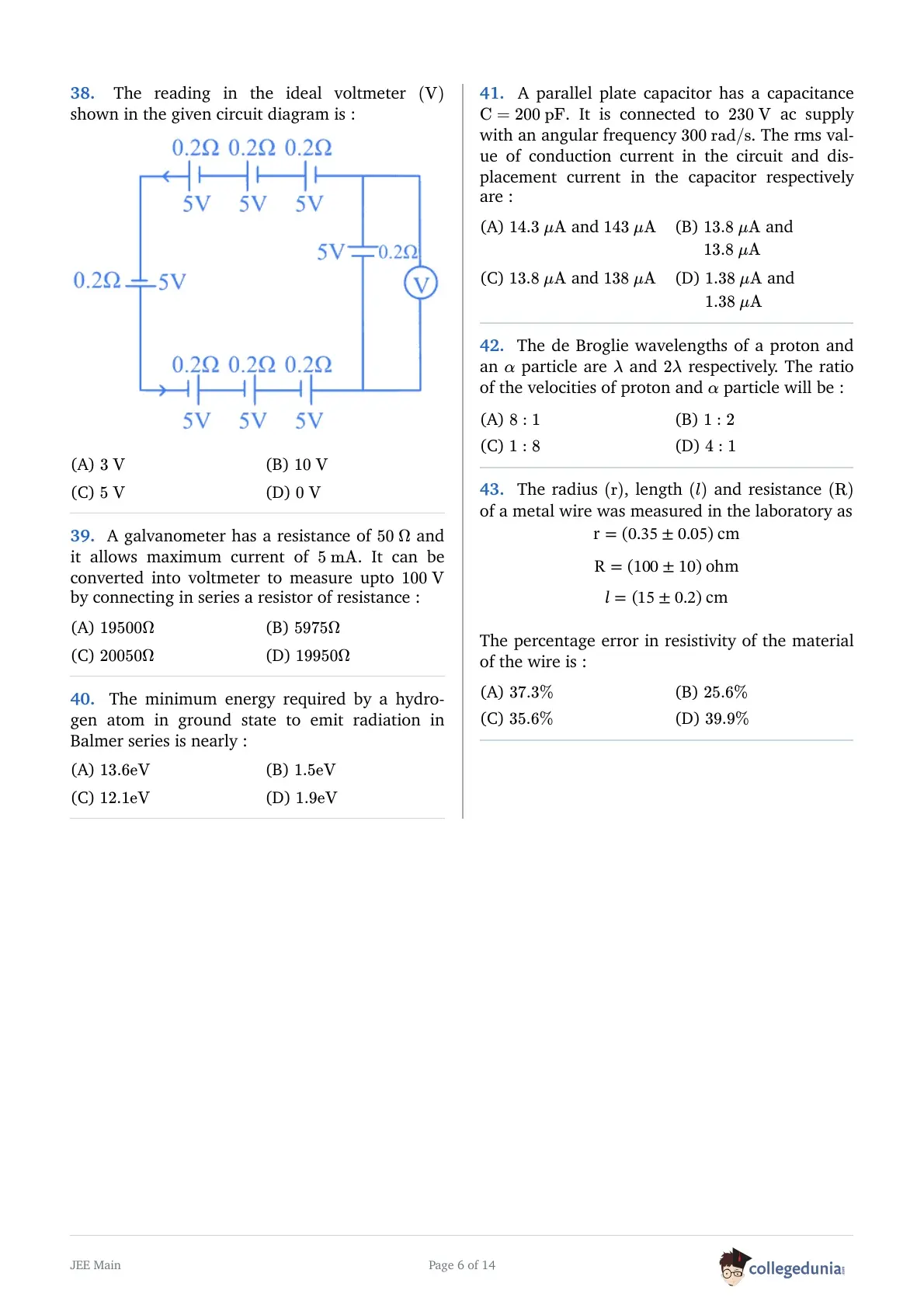
The reading in the ideal voltmeter (V) shown in the given circuit diagram is :
A galvanometer has a resistance of 50 Ω and it allows maximum current of 5 mA. It can be converted into voltmeter to measure upto 100 V by connecting in series a resistor of resistance
The minimum energy required by a hydrogen atom in ground state to emit radiation in Balmer series is nearly :
A parallel plate capacitor has a capacitance C = 200 pF. It is connected to 230 V ac supply with an angular frequency 300 rad/s. The rms value of conduction current in the circuit and displacement current in the capacitor respectively are :
The de Broglie wavelengths of a proton and an α particle are \( \lambda \) and \( 2\lambda \) respectively. The ratio of the velocities of proton and α particle will be:
The radius (\(r\)), length (\(l\)), and resistance (\(R\)) of a metal wire were measured in the laboratory as: \(r = (0.35 \pm 0.05) \, \text{cm}, \quad R = (100 \pm 10) \, \text{ohm}, \quad l = (15 \pm 0.2) \, \text{cm}.\)
The percentage error in the resistivity of the material of the wire is:
Two identical capacitors have same capacitance C. One of them is charged to the potential V and other to the potential 2V. The negative ends of both are connected together. When the positive ends are also joined together, the decrease in energy of the combined system is
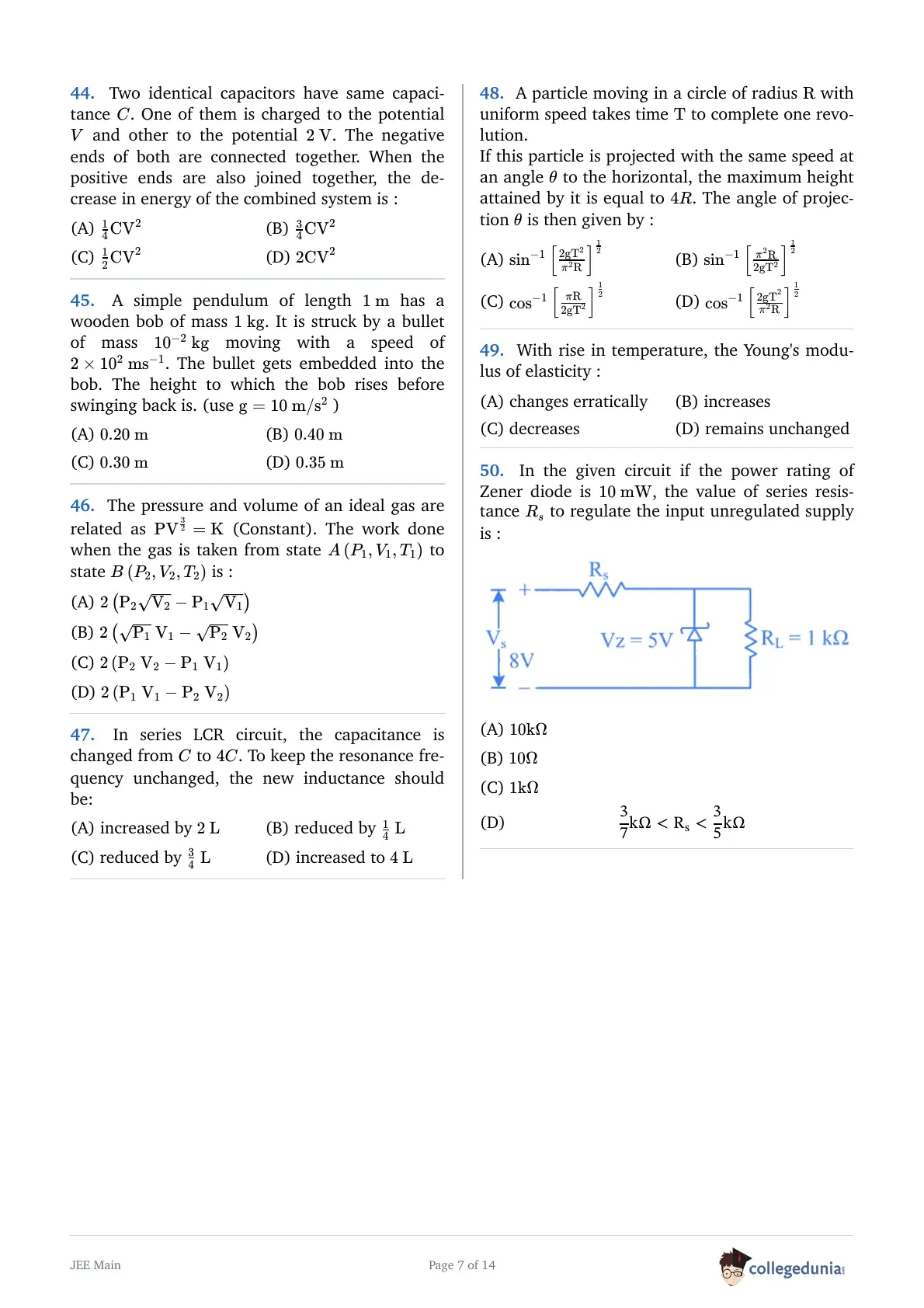
A simple pendulum of length 1 m has a wooden bob of mass 1 kg. It is struck by a bullet of mass 10–2 kg moving with a speed of 2 × 10² ms–1 . The bullet gets embedded into the bob. The height to which the bob rises before swinging back is. (use g = 10 ms-2 )
The pressure and volume of an ideal gas are related as \( PV^{3/2} = K \) (constant). The work done when the gas is taken from state A (\( P_1, V_1, T_1 \)) to state B (\( P_2, V_2, T_2 \)) is:
In series LCR circuit, the capacitance is changed from C to 4C. To keep the resonance frequency unchanged, the new inductance should be :
A particle moving in a circle of radius R with uniform speed takes time T to complete one revolution. If this particle is projected with the same speed at an angle θ to the horizontal, the maximum height attained by it is equal to 4R. The angle of projection θ is then given by
With rise in temperature, the Young's modulus of elasticity
In the given circuit if the power rating of Zener diode is 10 mW, the value of series resistance Rs to regulate the input unregulated supply is :
Physics - Section B (Q51 - Q60)
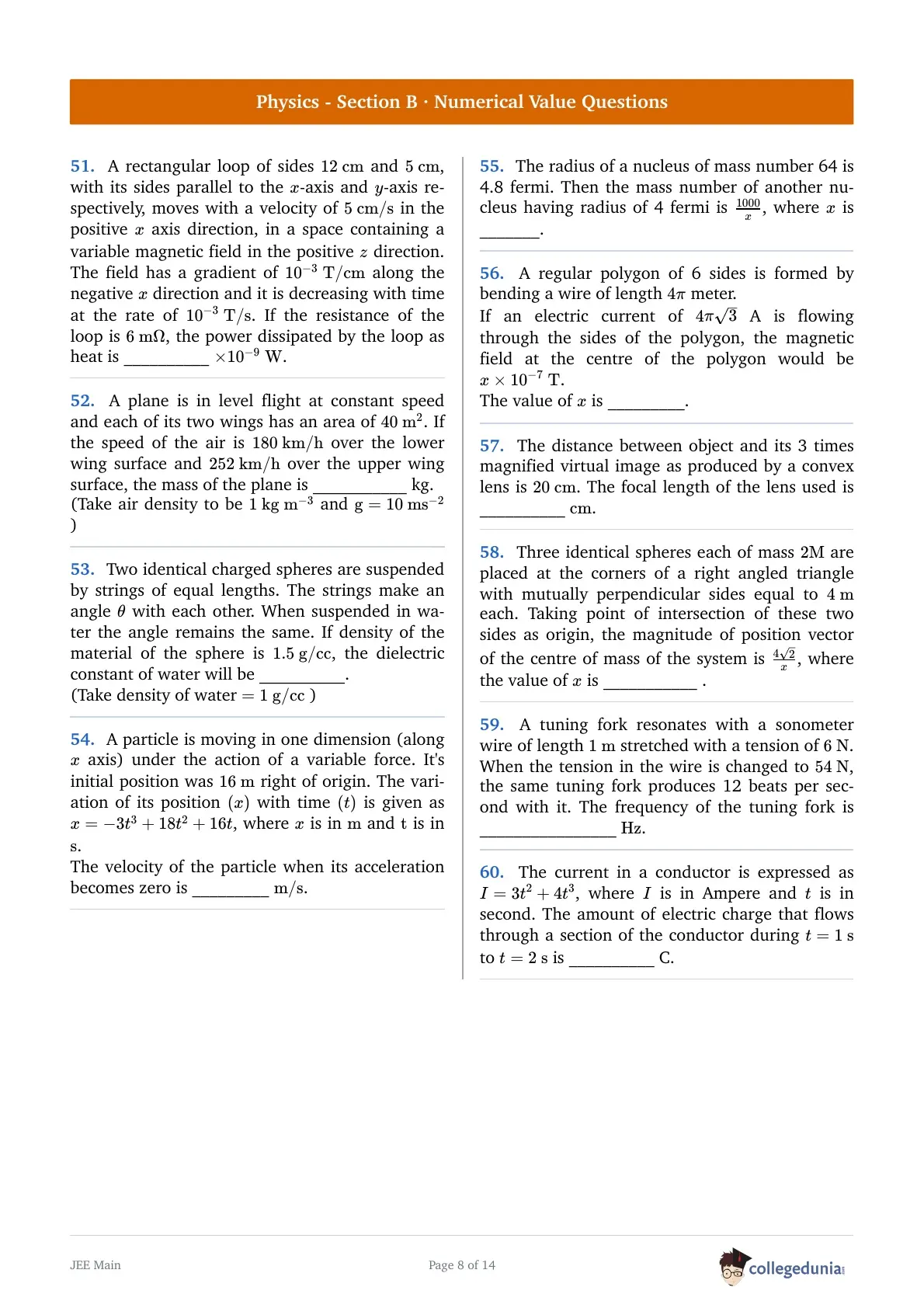
A rectangular loop of sides 12 cm and 5 cm, with its sides parallel to the x-axis and y-axis respectively, moves with a velocity of 5 cm/s in the positive x-axis direction, in a space containing a variable magnetic field in the positive z direction.
The field has a gradient of \(10^{-3}\) T/cm along the negative x direction, and it is decreasing with time at the rate of \(10^{-3}\) T/s. If the resistance of the loop is 6 mΩ, the power dissipated by the loop as heat is \(\_\_\_\_\_\_ \times 10^{-9}\) W.
A plane is in level flight at constant speed and each of its two wings has an area of 40 m2 . If the speed of the air is 180 km/h over the lower wing surface and 252 km/h over the upper wing surface, the mass of the plane is ________kg. (Take air density to be 1 kg m–3 and g = 10 ms–2
Two identical charged spheres are suspended by strings of equal lengths. The strings make an angle θ with each other. When suspended in water the angle remains the same. If density of the material of the sphere is 1.5 g/cc, the dielectric constant of water will be ________ (Take density of water = 1 g/cc)
A particle is moving in one dimension (along x axis) under the action of a variable force. It's initial position was 16 m right of origin. The variation of its position (x) with time (t) is given as x = –3t3 + 18t2 + 16t, where x is in m and t is in s. The velocity of the particle when its acceleration becomes zero is _________ m/s.
The radius of a nucleus of mass number 64 is 4.8 fermi. Then the mass number of another nucleus having radius of 4 fermi is \(\frac{1000}{x}\) , where x is _____.
A regular polygon of 6 sides is formed by bending a wire of length 4 \(\pi\) meter. If an electric current of \(4 \pi \sqrt3 \) A is flowing through the sides of the polygon, the magnetic field at the centre of the polygon would be \(x × 10^{–7}\) T. The value of \(x\) is ____.
The distance between object and its 3 times magnified virtual image as produced by a convex lens is 20 cm. The focal length of the lens used is __________ cm.
The identical spheres each of mass 2M are placed at the corners of a right angled triangle with mutually perpendicular sides equal to 4 m each. Taking point of intersection of these two sides as origin, the magnitude of position vector of the centre of mass of the system is \(\frac{4 \sqrt2} x\) , where the value of x is ___________
A tuning fork resonates with a sonometer wire of length 1 m stretched with a tension of 6 N. When the tension in the wire is changed to 54 N, the same tuning fork produces 12 beats per second with it. The frequency of the tuning fork is _______ Hz.
The current in a conductor is expressed as I = 3t2 + 4t3 , where I is in Ampere and t is in second. The amount of electric charge that flows through a section of the conductor during t = 1s to t = 2s is ____________ C.
Chemistry - Section A (Q61 - Q80)
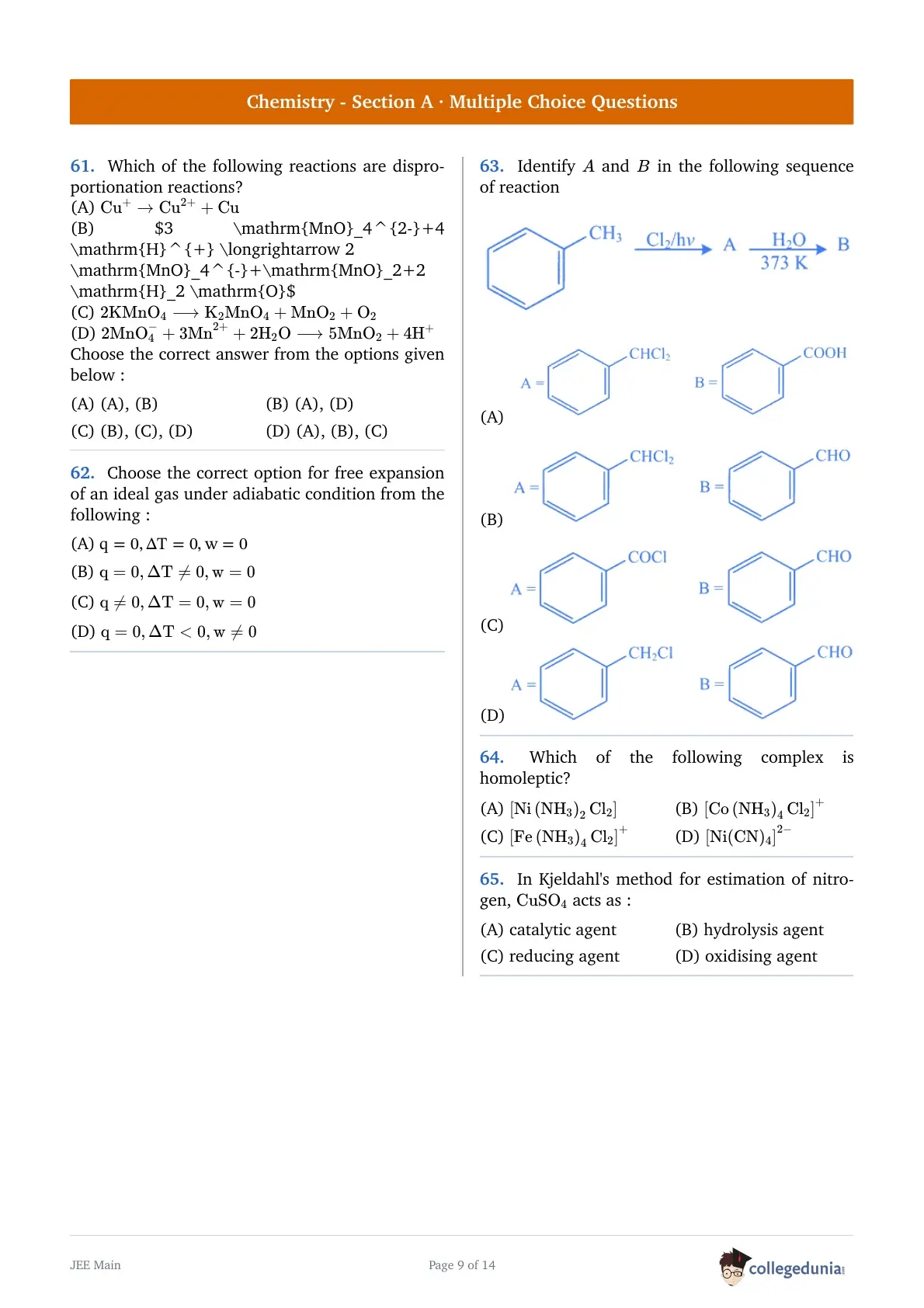
Which of the following reactions are disproportionation reactions?
\(\text{(A) } \text{Cu}^+ \rightarrow \text{Cu}^{2+} + \text{Cu}\)
\(\text{(B) } 3\text{MnO}_4^{2-} + 4\text{H}^+ \rightarrow 2\text{MnO}_4^- + \text{MnO}_2 + 2\text{H}_2\text{O}\)
\(\text{(C) } 2\text{KMnO}_4 \rightarrow \text{K}_2\text{MnO}_4 + \text{MnO}_2 + \text{O}_2\)
\(\text{(D) } 2\text{MnO}_4^- + 3\text{Mn}^{2+} + 2\text{H}_2\text{O} \rightarrow 5\text{MnO}_2 + 4\text{H}^+\)
Choose the correct answer from the options given below.
Choose the correct option for free expansion of an ideal gas under adiabatic condition from the following :
Identify A and B in the following sequence of reaction.
- (1)
![1]()
- (2)
![2]()
- (3)
![3]()
- (4)
![4]()


Which of the following complex is homoleptic?
In Kjeldahl’s method for estimation of nitrogen, CuSO\(_4\) acts as:
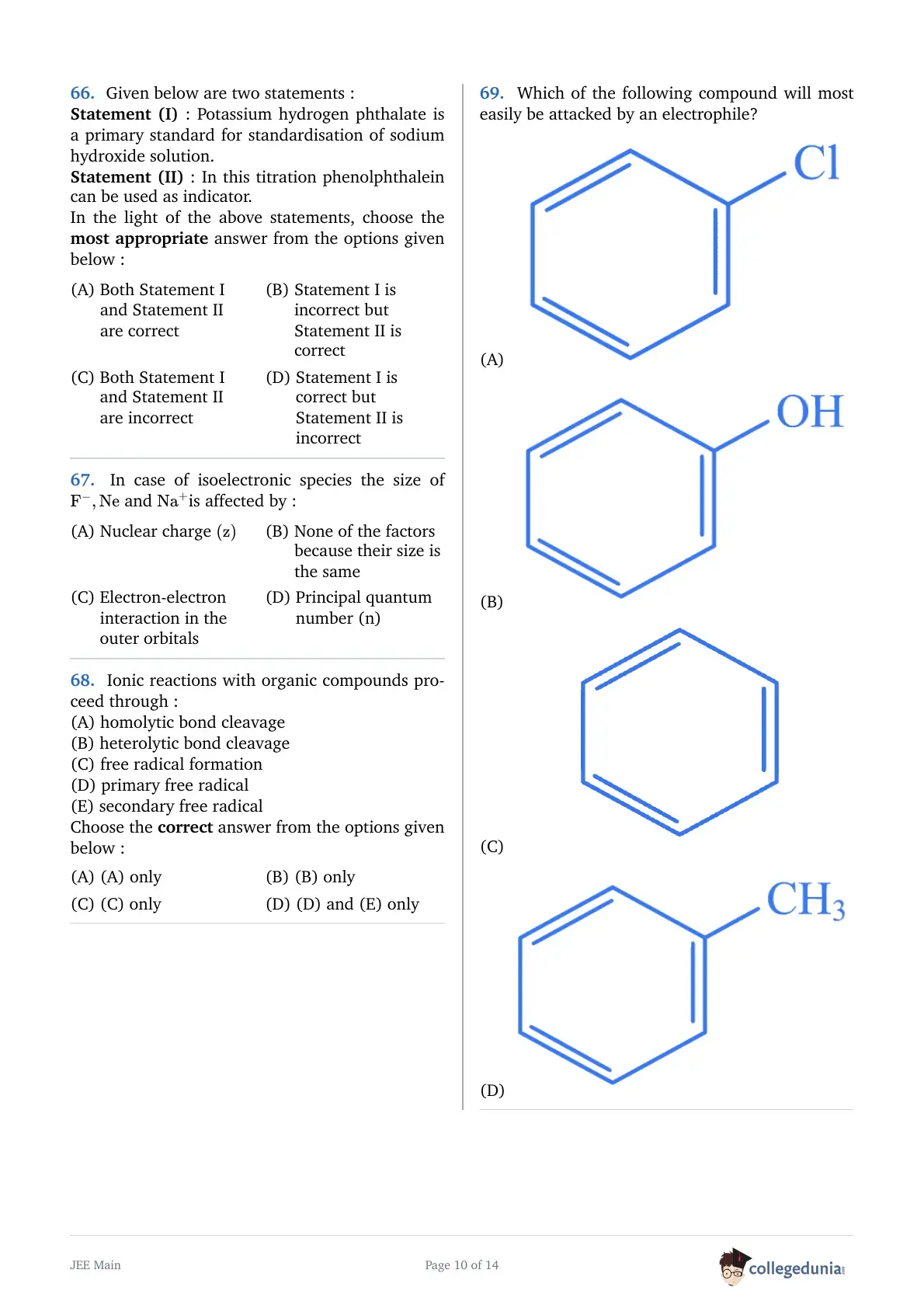
Given below are two statements :
Statement (I) : Potassium hydrogen phthalate is a primary standard for standardisation of sodium hydroxide solution.
Statement (II) : In this titration phenolphthalein can be used as indicator.
In the light of the above statements, choose the most appropriate answer from the options given below:
In case of isoelectronic species the size of F– , Ne and Na+ is affected by:
Ionic reactions with organic compounds proceed through:
(A) Homolytic bond cleavage
(B) Heterolytic bond cleavage
(C) Free radical formation
(D) Primary free radical
(E) Secondary free radical
Choose the correct answer from the options given below:
Which of the following compound will most easily be attacked by an electrophile?
- (1)
![Electrophile 1]()
- (2)
![Electrophile 2]()
- (3)
![Electrophile 3]()
- (4)
![Electrophile 4]()


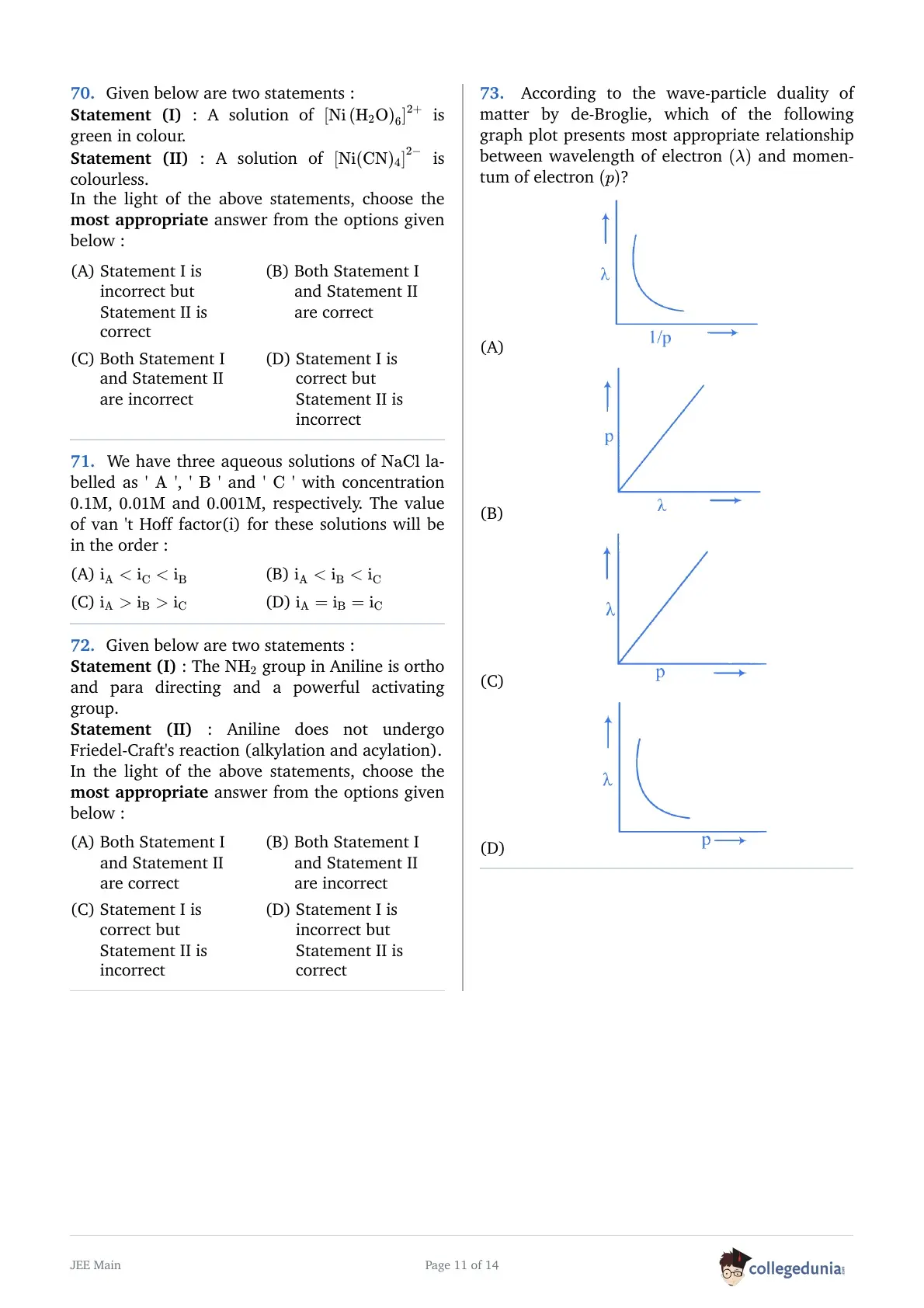
Given below are two statements:
Statement (I): A solution of \([Ni(H_2O)_6]^{2+}\) is green in color.
Statement (II): A solution of \([Ni(CN)_4]^{2-}\) is colorless.
In the light of the above statements, choose the most appropriate answer from the options given below.
We have three aqueous solutions of NaCl labelled as ‘A’, ‘B’ and ‘C’ with concentration 0.1 M, 0.01M & 0.001 M, respectively. The value of vant’ Haft factor (i) for these solutions will be in the order.
Given below are two statements:
Statement (I) : The NH2 group in Aniline is ortho and para directing and a powerful activating group.
Statement (II) : Aniline does not undergo Friedel- Craft’s reaction (alkylation and acylation). In the light of the above statements
Choose the most appropriate answer from the options given below :
According to the wave-particle duality of matter by de-Broglie, which of the following graph plot presents most appropriate relationship between wavelength of electron () and momentum of electron (p)?
- (1)
![1]()
- (2)
![2]()
- (3)
![C]()
- (4)
![4]()


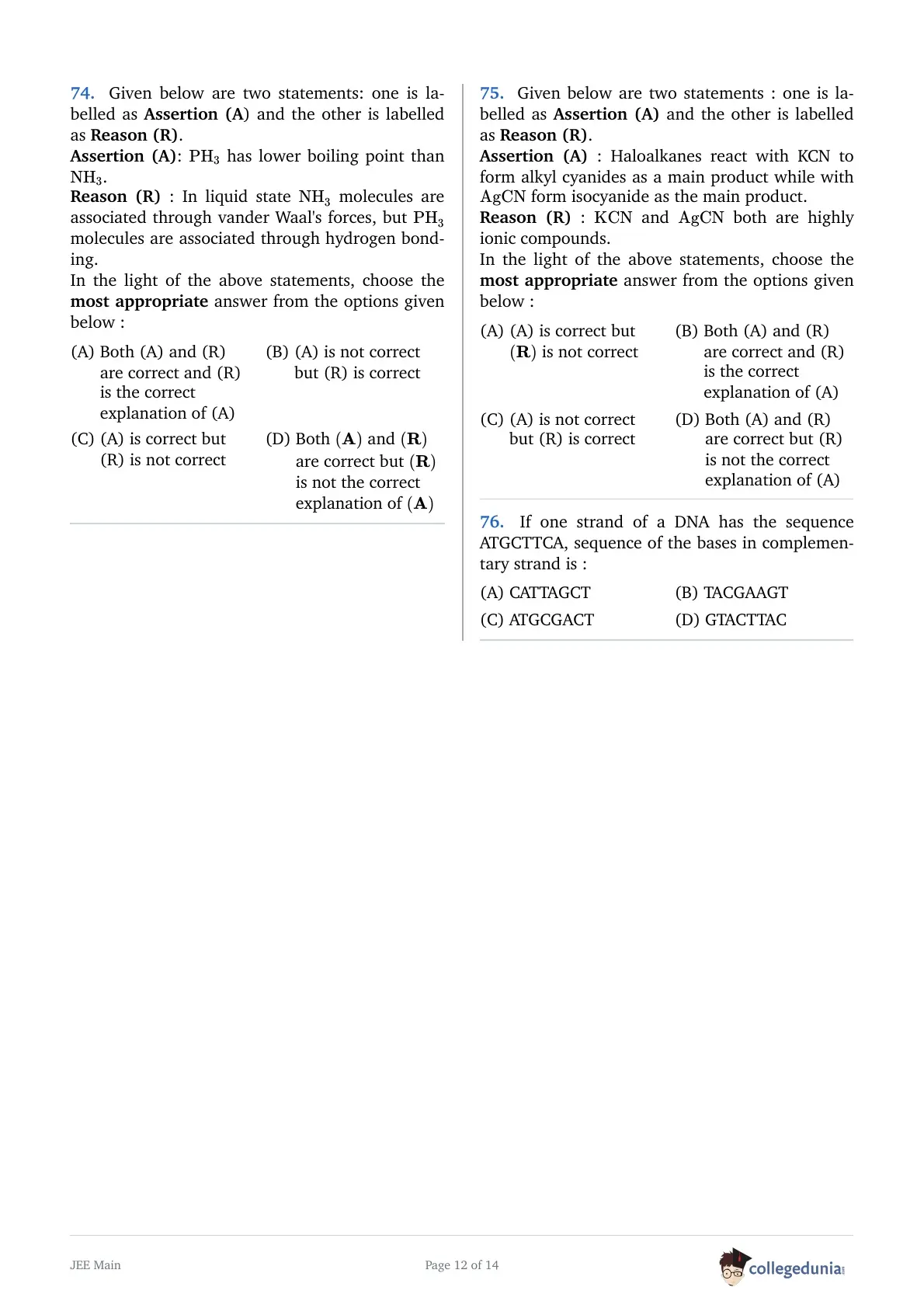
Given below are two statements: one is labelled as Assertion (A) and the other is labelled as Reason (R).
Assertion (A) : PH3 has lower boiling point than NH3.
Reason (R) : In liquid state NH3 molecules are associated through vander waal’s forces, but PH3 molecules are associated through hydrogen bonding.
In the light of the above statements.
Choose the most appropriate answer from the options given below:
Given below are two statements: one is labelled as Assertion (A) and the other is labelled as Reason (R).
Assertion (A) : Haloalkanes react with KCN to form alkyl cyanides as a main product while with AgCN form isocyanide as the main product.
Reason (R) : KCN and AgCN both are highly ionic compounds. In the light of the above statement
Choose the most appropriate answer from the options given below:
If one strand of a DNA has the sequence ATGCTTCA, sequence of the bases in complementary strand is:
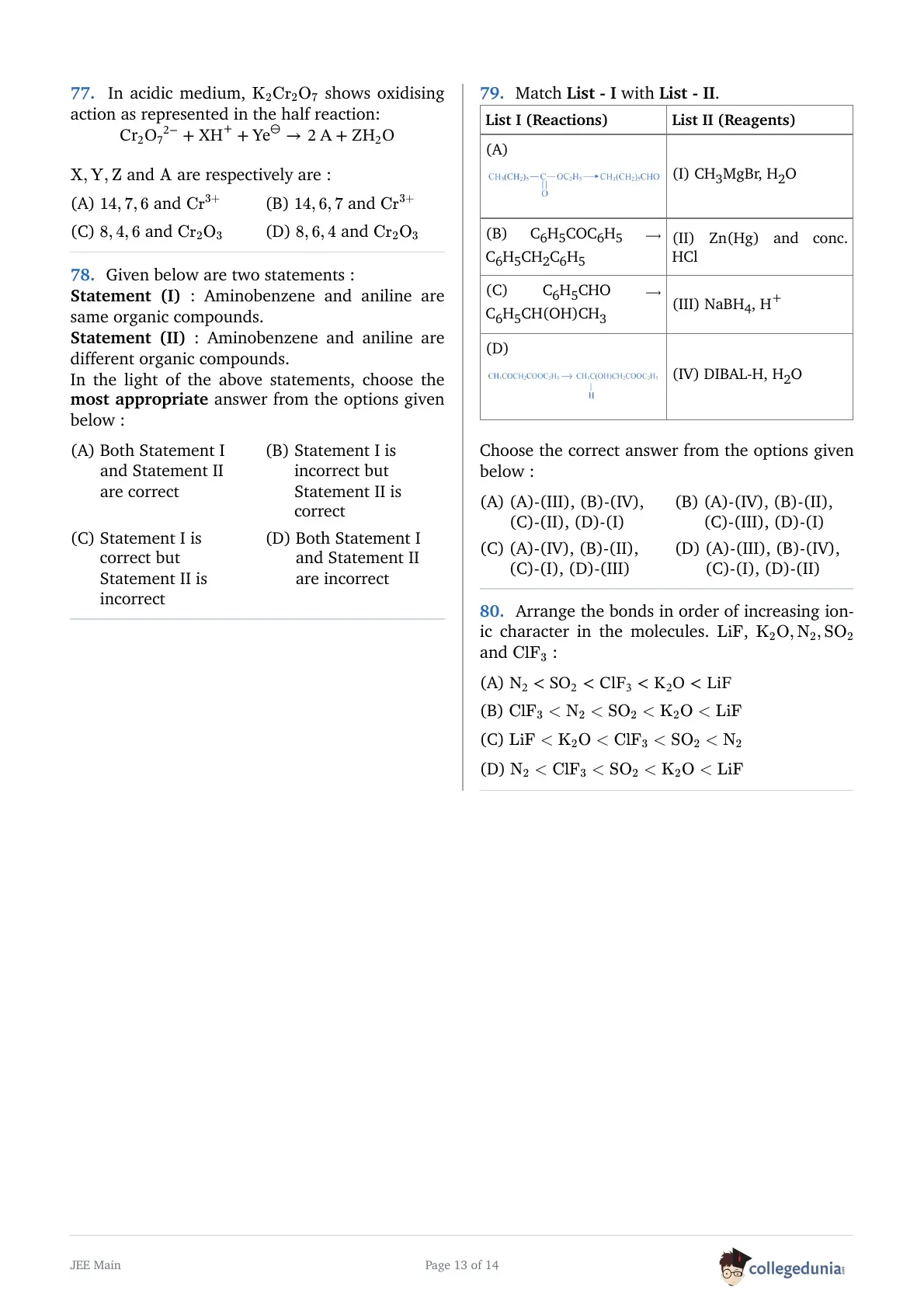
In acidic medium, \( K_2Cr_2O_7 \) shows oxidizing action as represented in the half-reaction: \(Cr_2O_7^{2-} + XH^+ + Ye^- \rightarrow 2A + ZH_2O\)
\( X \), \( Y \), \( Z \), and \( A \) are respectively:
Given below are two statements:
Statement (I) : Aminobenzene and aniline are same organic compounds.
Statement (II) : Aminobenzene and aniline are different organic compounds.
In the light of the above statements, choose the most appropriate answer from the options given below:
Match List – I with List –II.
Choose the correct answer from options given below:
Arrange the bonds in order of increasing ionic character in the molecules. LiF, K\(_2\)O, N\(_2\), SO\(_2\), and ClF\(_3\).
Chemistry - Section B (Q81 - Q90)
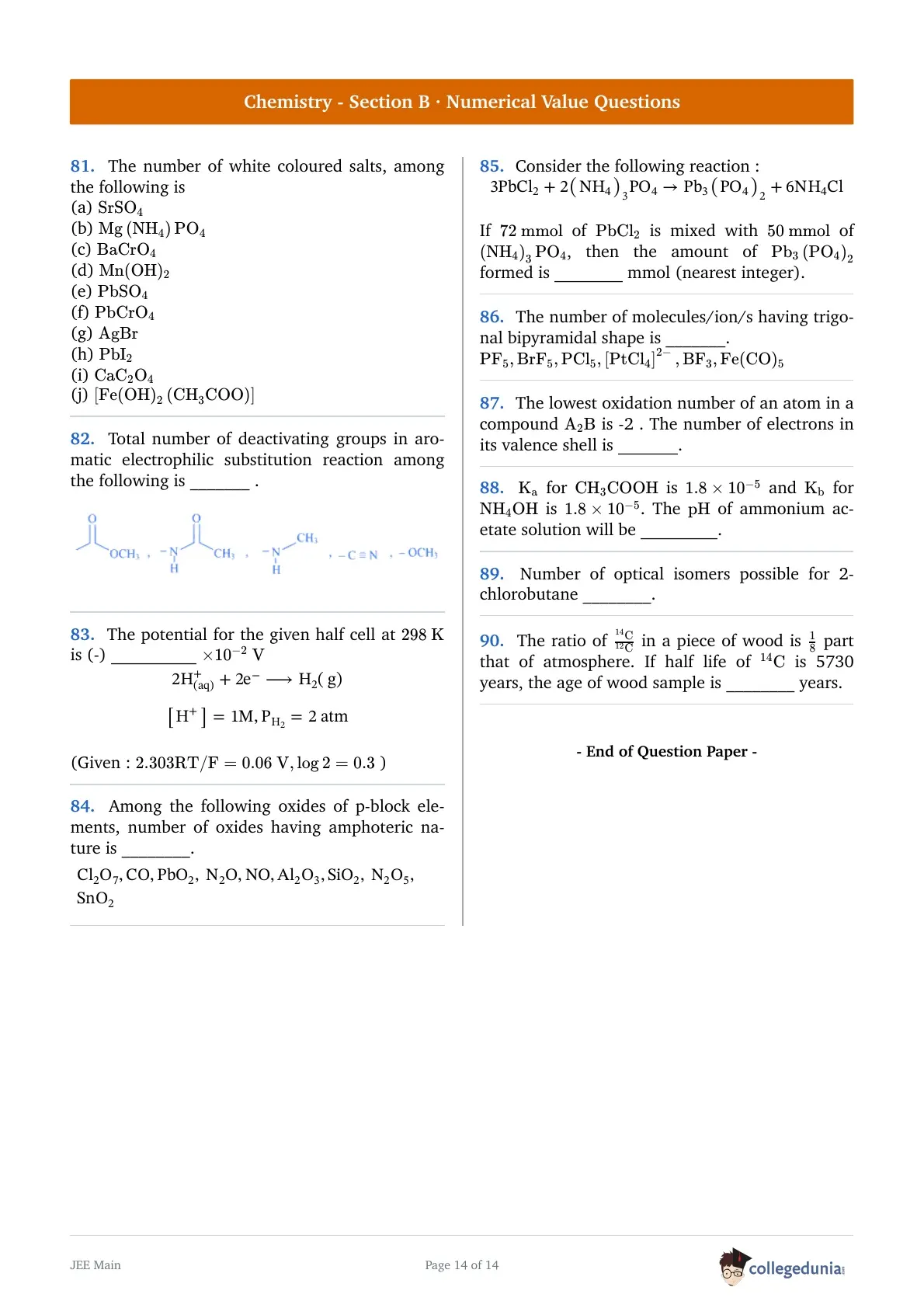
The number of white coloured salts among the following is ___________.
(A) SrSO\(_4\), (B) Mg(NH\(_4\))PO\(_4\), (C) BaCrO\(_4\), (D) Mn(OH)\(_2\), (E) PbSO\(_4\), (F) PbCrO\(_4\), (G) AgBr, (H) PbI\(_2\), (I) CaC\(_2\)O\(_4\),(J) [Fe(OH)\(_2\)(CH\(_3\)COO)\(_2\)]
Total number of deactivating groups in aromatic electrophilic substitution reaction among the following is

The potential for the given half cell at 298 K is\[(-) \ldots \times 10^{-2} \, \text{V}.\]\[2\text{H}^+ (\text{aq}) + 2e^- \rightarrow \text{H}_2 (\text{g})\]\[[\text{H}^+] = 1M, \, P_{\text{H}_2} = 2 \, \text{atm}\](Given: \( 2.303 \frac{RT}{F} = 0.06 \, \text{V}, \log 2 = 0.3 \))
Among the following oxides of p-block elements, the number of oxides having amphoteric nature is: \[\text{Cl}_2\text{O}_7, \, \text{CO}, \, \text{PbO}_2, \, \text{N}_2\text{O}, \, \text{NO}, \, \text{Al}_2\text{O}_3, \, \text{SiO}_2, \, \text{N}_2\text{O}_5, \, \text{SnO}_2\]
Consider the following reaction:\[3\text{PbCl}_2 + 2(\text{NH}_4)_3\text{PO}_4 \rightarrow \text{Pb}_3(\text{PO}_4)_2 + 6\text{NH}_4\text{Cl}\]If 72 mmol of PbCl\(_2\) is mixed with 50 mmol of (\(\text{NH}_4\))\(_3\)PO\(_4\), then the amount of \(\text{Pb}_3(\text{PO}_4)_2\) formed is ______ mmol (nearest integer).
The number of molecules/ions having trigonal bipyramidal shape is:
\(\text{PF}_5, \, \text{BrF}_5, \, \text{PCl}_5, \, [\text{PtCl}_4]^{2-}, \, \text{BF}_3, \, \text{Fe(CO)}_5\)
Lowest oxidation number of an atom in a compound \( A_2B \) is -2. The number of electrons in its valence shell is:
\( K_a \) for \( \text{CH}_3 \text{COOH} \) is \( 1.8 \times 10^{-5} \) and \( K_b \) for \( \text{NH}_4 \text{OH} \) is \( 1.8 \times 10^{-5} \). The pH of ammonium acetate solution will be:
Number of optical isomers possible for 2 – chlorobutane ________
The ratio of \(\frac{{^{14}\text{C}}}{{^{12}\text{C}}}\) in a piece of wood is \(\frac{1}{8}\) part that of atmosphere. If the half-life of \(^{14}\text{C}\) is 5730 years, the age of the wood sample is _______ years.
JEE Main 2024 Exam Pattern and Marking Scheme
| Particulars | Details |
|---|---|
| Exam Mode | Online (Computer-Based Test) |
| Paper | B.E./B.Tech |
| Medium of Exam | 13 languages: English, Hindi, Gujarati, Bengali, Tamil, Telugu, Kannada, Marathi, Malayalam, Odia, Punjabi, Assamese, Urdu |
| Duration | 3 hours (180 minutes) |
| Type of Questions | Multiple Choice Questions (MCQs) + Numerical Value Questions (attempt any 5 of 10 per subject) |
| Total Marks | 300 marks |
| Subjects | Mathematics, Physics, Chemistry |
| Marking Scheme | +4 for correct answer & -1 for incorrect MCQ and Numerical Value-based Questions |
| Total Questions | 90 Questions (30 per subject), 75 to be attempted |
| Eligibility | Passed or appearing in Class 12 with Physics, Chemistry, and Mathematics |
JEE Main 2024 Feb 1 Shift 1 Question Paper by Coaching Institute
| Coaching Institutes | Question Paper with Solutions PDF |
|---|---|
| Aakash BYJUs | Download PDF |
| Reliable Institute | Physics Chemistry |
| Resonance | Physics Chemistry Maths |
| Vedantu | Download PDF |
| Sri Chaitanya | To be updated |
| FIIT JEE | To be updated |
JEE Main 1 Feb Shift 1 2024 Paper Analysis
JEE Main 2024 Feb 1 Shift 1 paper analysis for B.E./ B.Tech is updated here with details on the difficulty level of the exam, topics with the highest weightage in the exam, section-wise difficulty level, etc.
JEE Main 2024 Question Paper Pattern
| Feature | Question Paper Pattern |
|---|---|
| Examination Mode | Computer-based Test |
| Exam Language | 13 languages (English, Hindi, Assamese, Bengali, Gujarati, Kannada, Malayalam, Marathi, Odia, Punjabi, Tamil, Telugu, and Urdu) |
| Number of Sections | Three- Physics, Chemistry, Mathematics |
| Exam Duration | 3 hours |
| Sectional Time Limit | None |
| Total Marks | 300 marks |
| Total Number of Questions Asked | 90 Questions |
| Total Number of Questions to be Answered | 75 questions |
| Type of Questions | MCQs and Numerical Answer Type Questions |
| Section-wise Number of Questions | Physics- 20 MCQs and 10 numerical type, Chemistry- 20 MCQs and 10 numerical type, Mathematics- 20 MCQs and 10 numerical type |
| Marking Scheme | +4 for each correct answer |
| Negative Marking | -1 for each incorrect answer |
Read More:
- JEE Main 2024 question paper pattern and marking scheme
- Most important chapters in JEE Mains 2024, Check chapter wise weightage here
JEE Main 2024 Question Paper Session 1 (January)
Those appearing for JEE Main 2024 can use the links below to practice and keep track of their exam preparation level by attempting the shift-wise JEE Main 2024 question paper provided below.
| Exam Date and Shift | Question Paper PDF |
|---|---|
| JEE Main 24 Jan Shift 2 2024 Question Paper | Check Here |
| JEE Main 27 Jan Shift 1 2024 Question Paper | Check Here |
| JEE Main 27 Jan Shift 2 2024 Question Paper | Check Here |
| JEE Main 29 Jan Shift 1 2024 Question Paper | Check Here |
| JEE Main 29 Jan Shift 2 2024 Question Paper | Check Here |
| JEE Main 30 Jan Shift 1 2024 Question Paper | Check Here |
| JEE Main 30 Jan Shift 2 2024 Question Paper | Check Here |
| JEE Main 31 Jan Shift 1 2024 Question Paper | Check Here |
| JEE Main 31 Jan Shift 2 2024 Question Paper | Check Here |
| JEE Main 1 Feb Shift 1 2024 Question Paper | Check Here |
| JEE Main 1 Feb Shift 2 2024 Question Paper | Check Here |



Comments