




The GATE 2026 Chemical Engineering (CH) question paper is now available with detailed solutions for free download. GATE 2026 CH was conducted by IIT Guwahati on February 7, 2026, in the afternoon session (2:30 PM to 5:30 PM), and the paper carried 65 questions for 100 marks in 3 hours.
| GATE 2026 Chemical Engineering Question Paper with Solutions | Download PDF | Check Solutions |
GATE 2026 Chemical Engineering Questions with Solutions
“He often the numbers. False claims are not going to help. Honesty trust,” said the manager.
Choose the option with the correct order of words to fill the blanks.
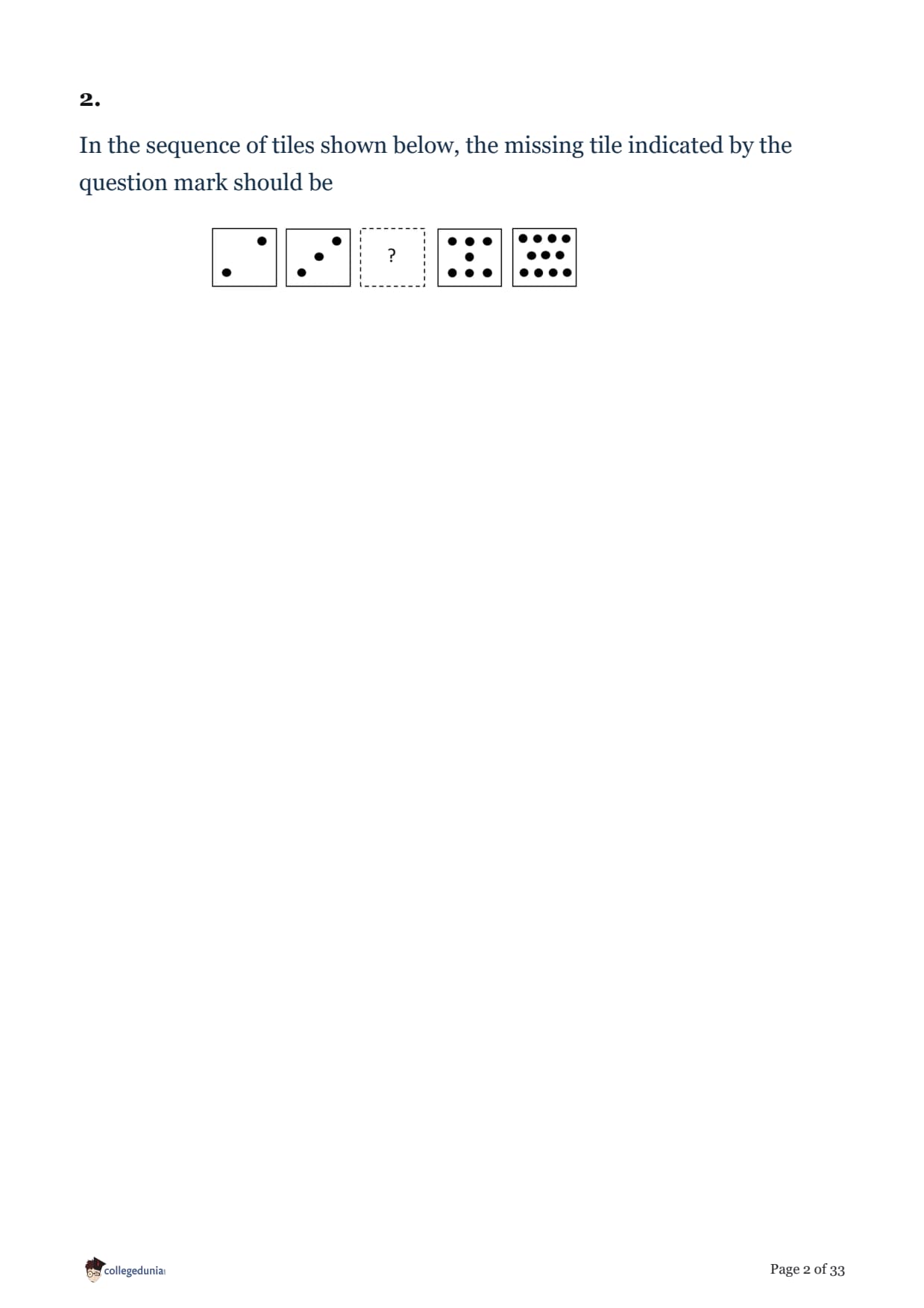
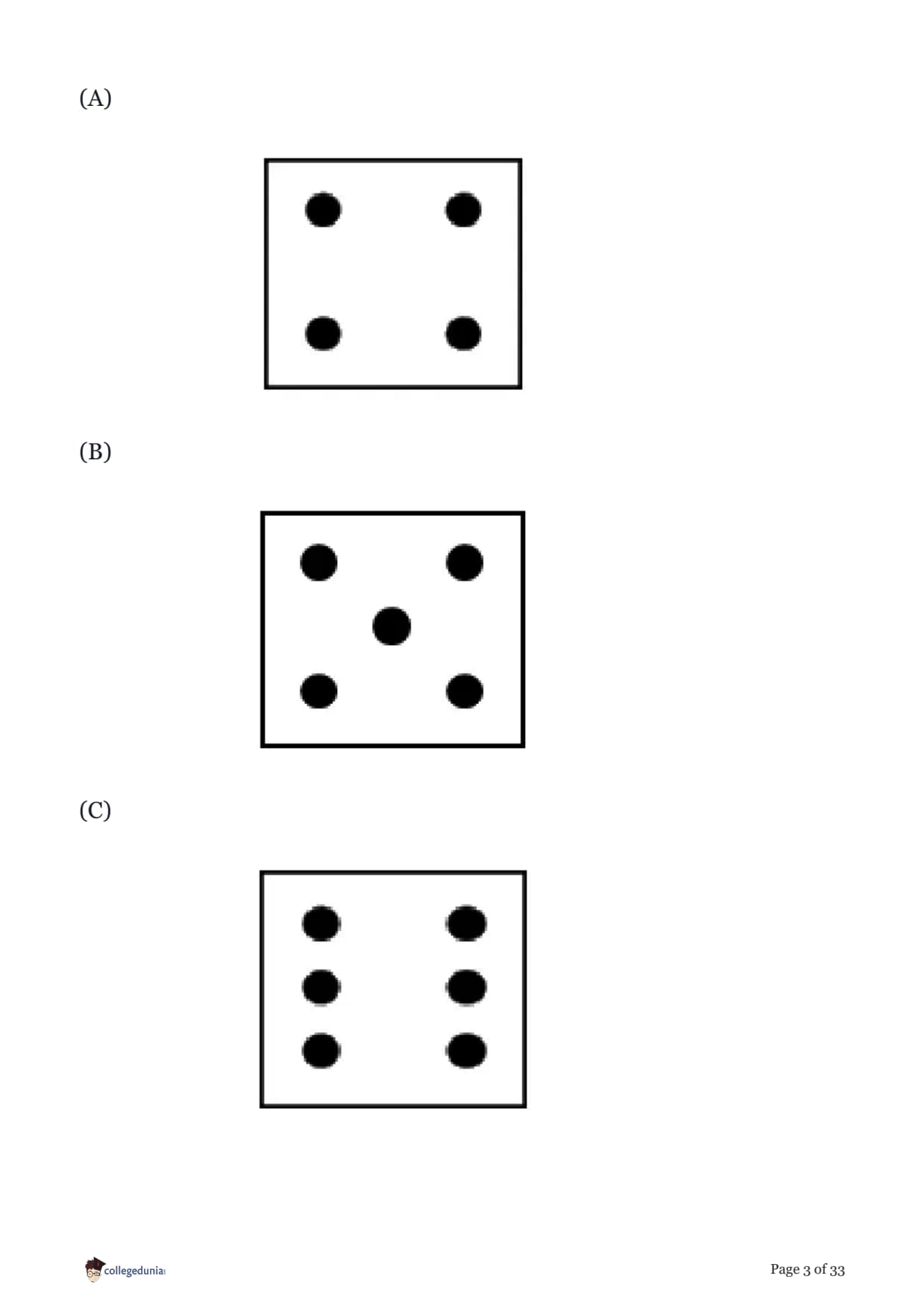
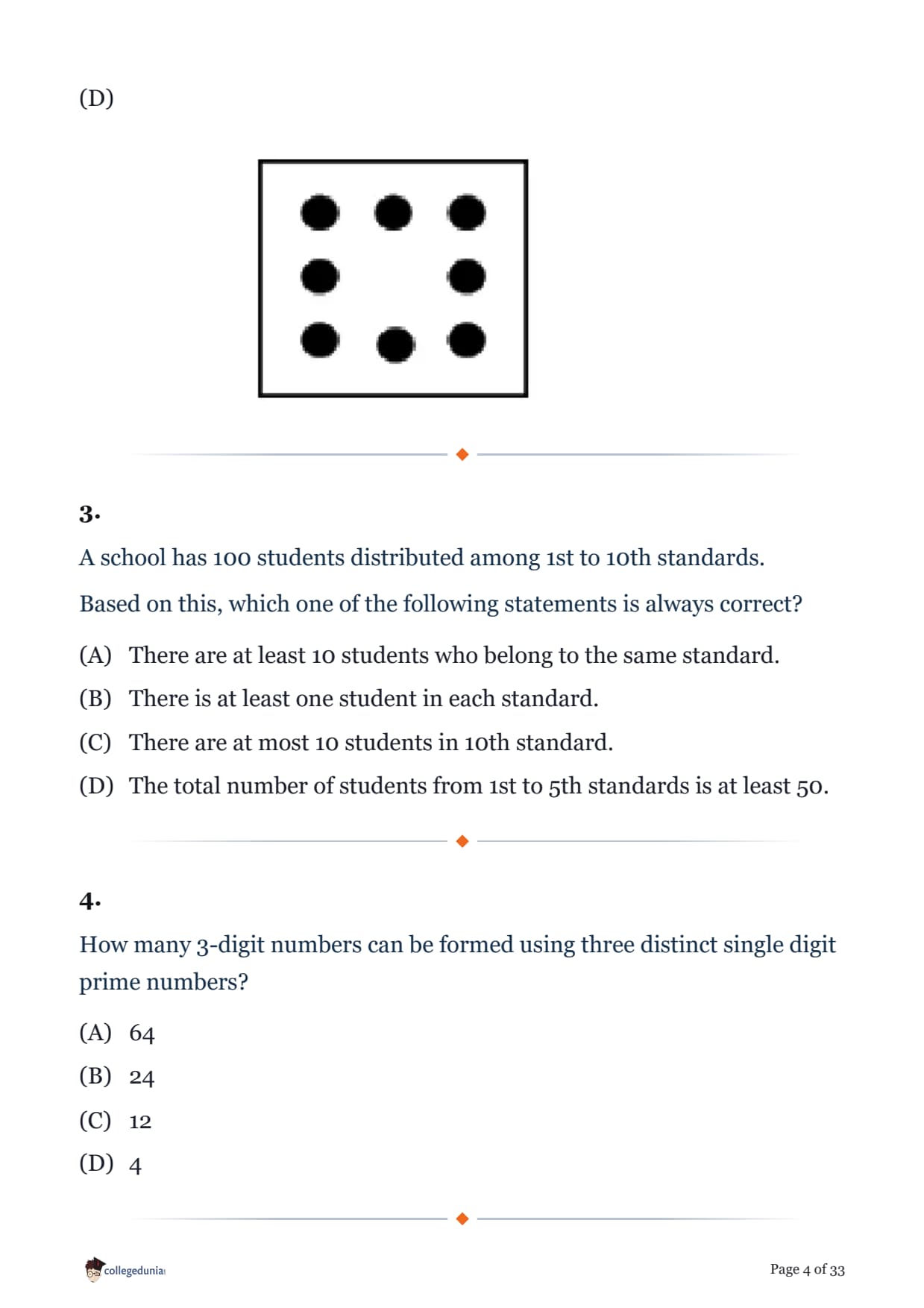
In the sequence of tiles shown below, the missing tile indicated by the question mark should be

- (A)
![]()
- (B)
![]()
- (C)
![]()
- (D)
![]()


A school has 100 students distributed among 1st to 10th standards.
Based on this, which one of the following statements is always correct?
How many 3-digit numbers can be formed using three distinct single digit prime numbers?
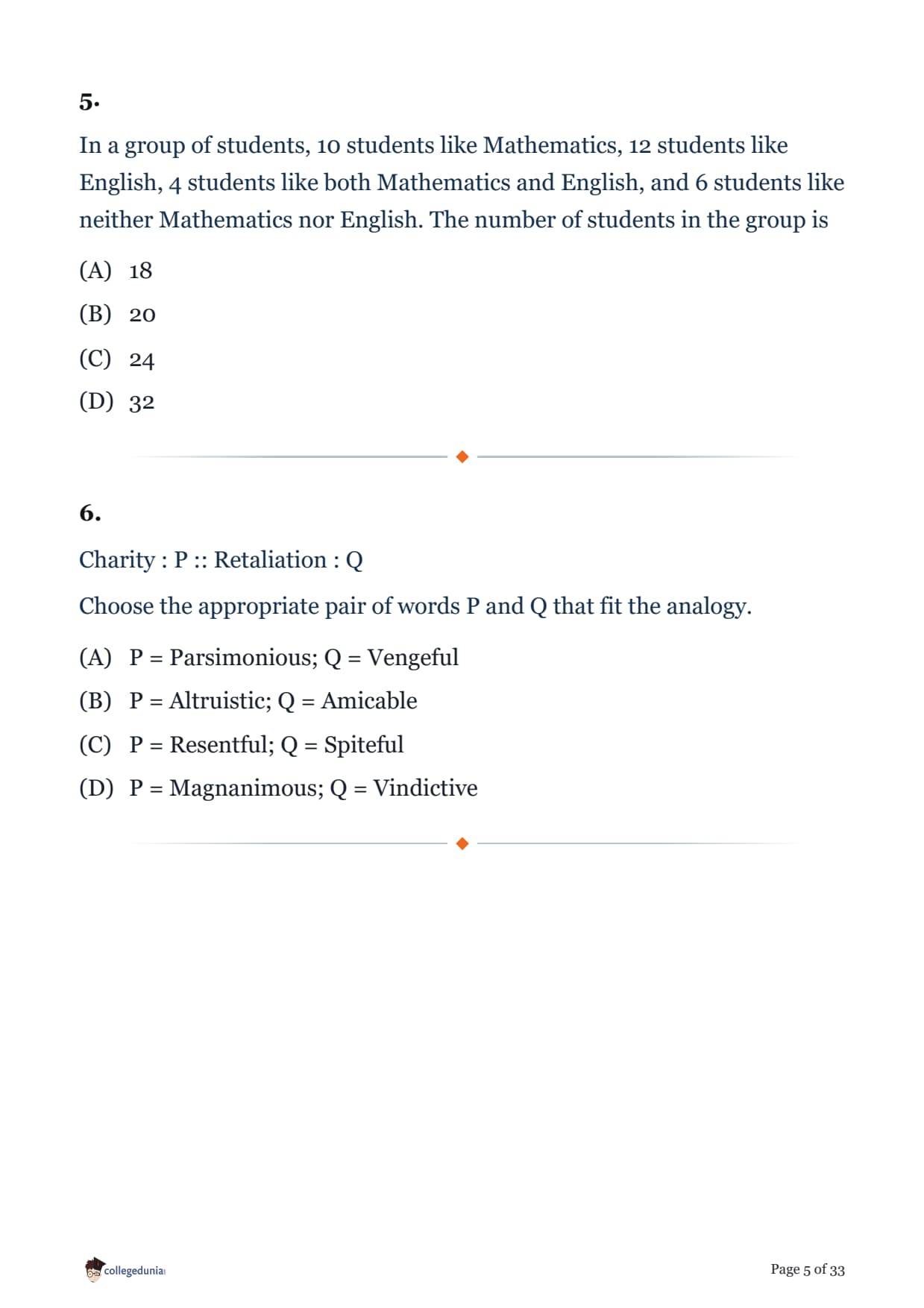
In a group of students, 10 students like Mathematics, 12 students like English, 4 students like both Mathematics and English, and 6 students like neither Mathematics nor English. The number of students in the group is
Charity : P :: Retaliation : Q
Choose the appropriate pair of words P and Q that fit the analogy.
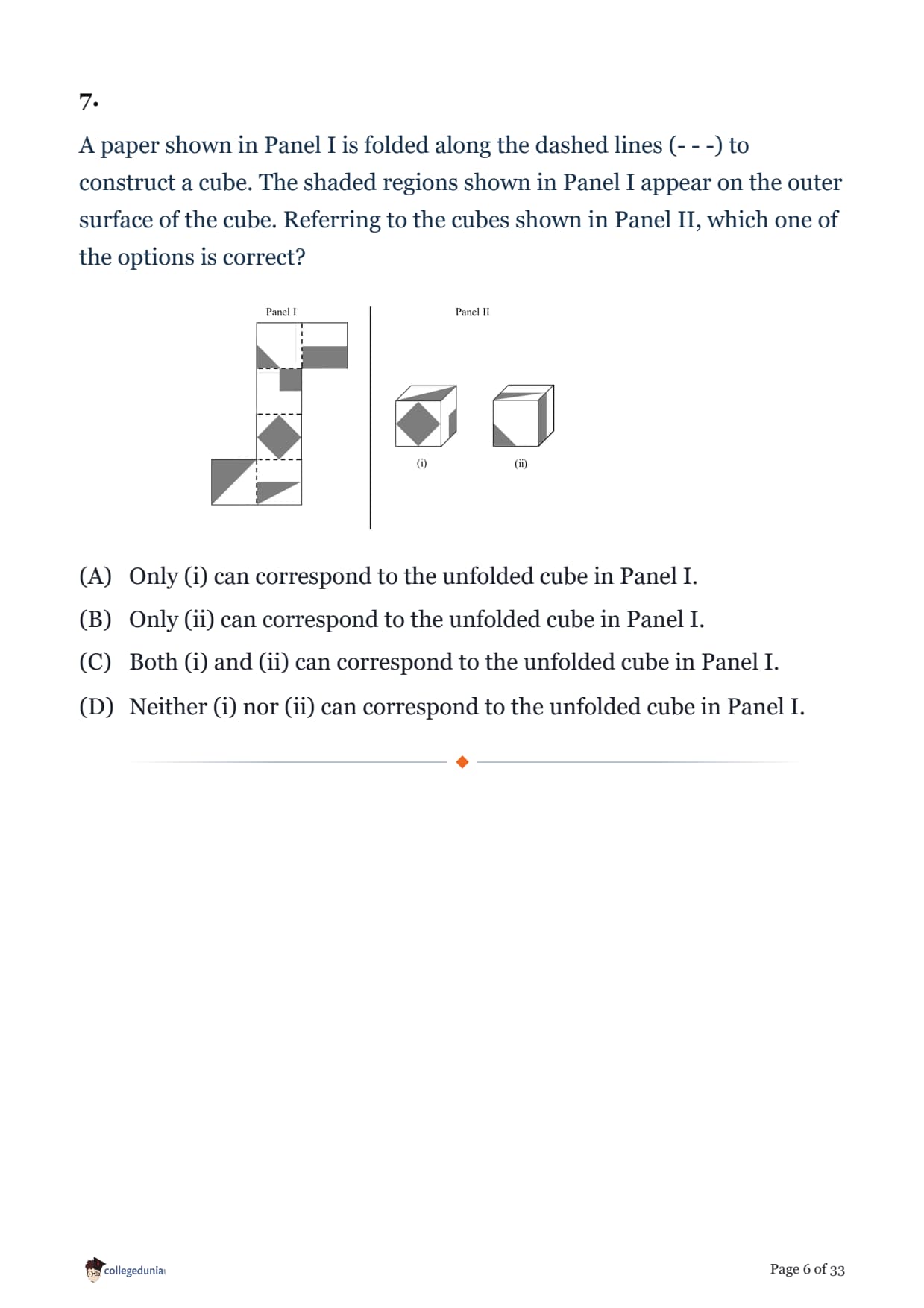
A paper shown in Panel I is folded along the dashed lines (- - -) to construct a cube. The shaded regions shown in Panel I appear on the outer surface of the cube. Referring to the cubes shown in Panel II, which one of the options is correct?

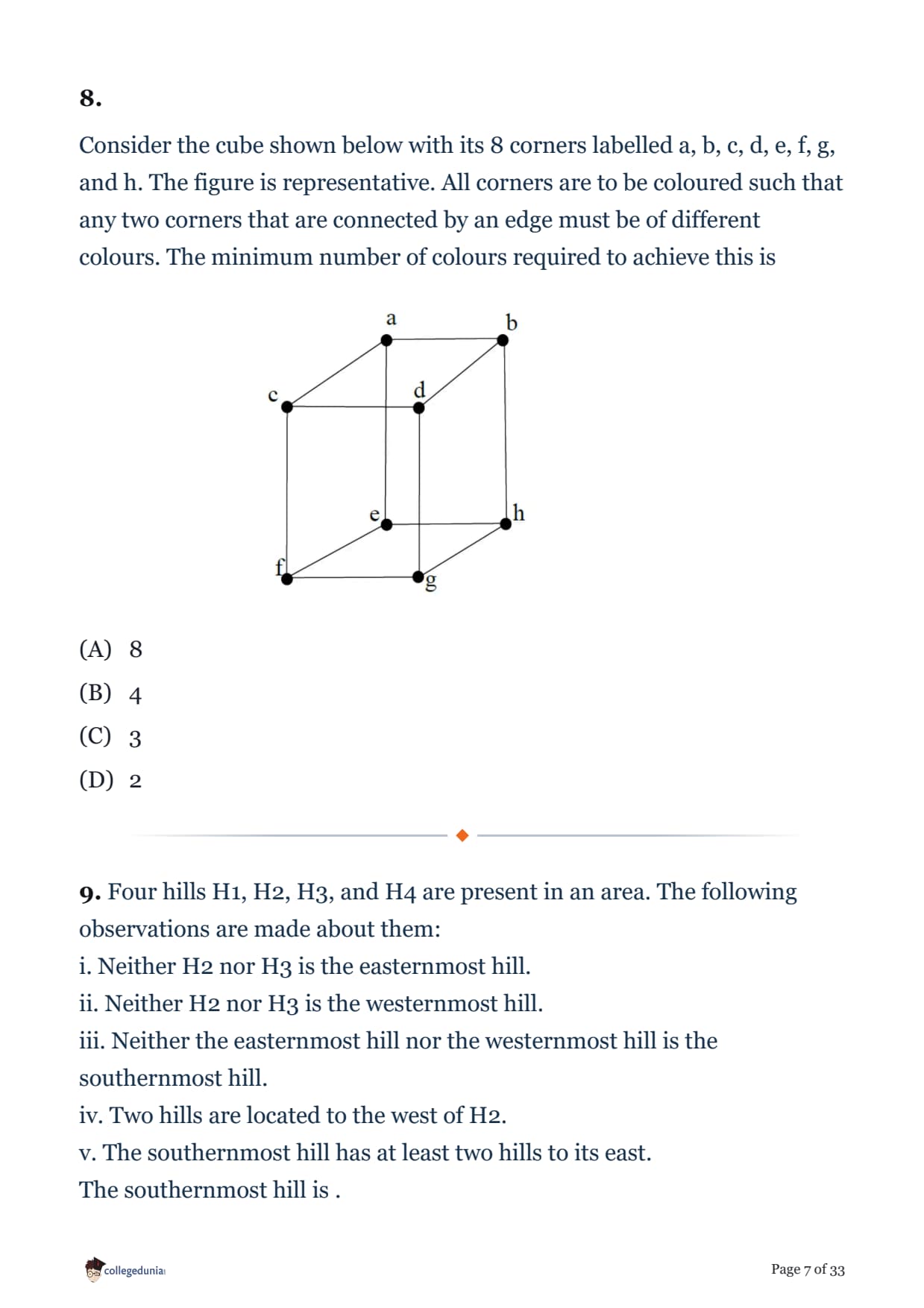
Consider the cube shown below with its 8 corners labelled a, b, c, d, e, f, g, and h. The figure is representative. All corners are to be coloured such that any two corners that are connected by an edge must be of different colours. The minimum number of colours required to achieve this is

Four hills H1, H2, H3, and H4 are present in an area. The following observations are made about them:
i. Neither H2 nor H3 is the easternmost hill.
ii. Neither H2 nor H3 is the westernmost hill.
iii. Neither the easternmost hill nor the westernmost hill is the southernmost hill.
iv. Two hills are located to the west of H2.
v. The southernmost hill has at least two hills to its east.
The southernmost hill is .
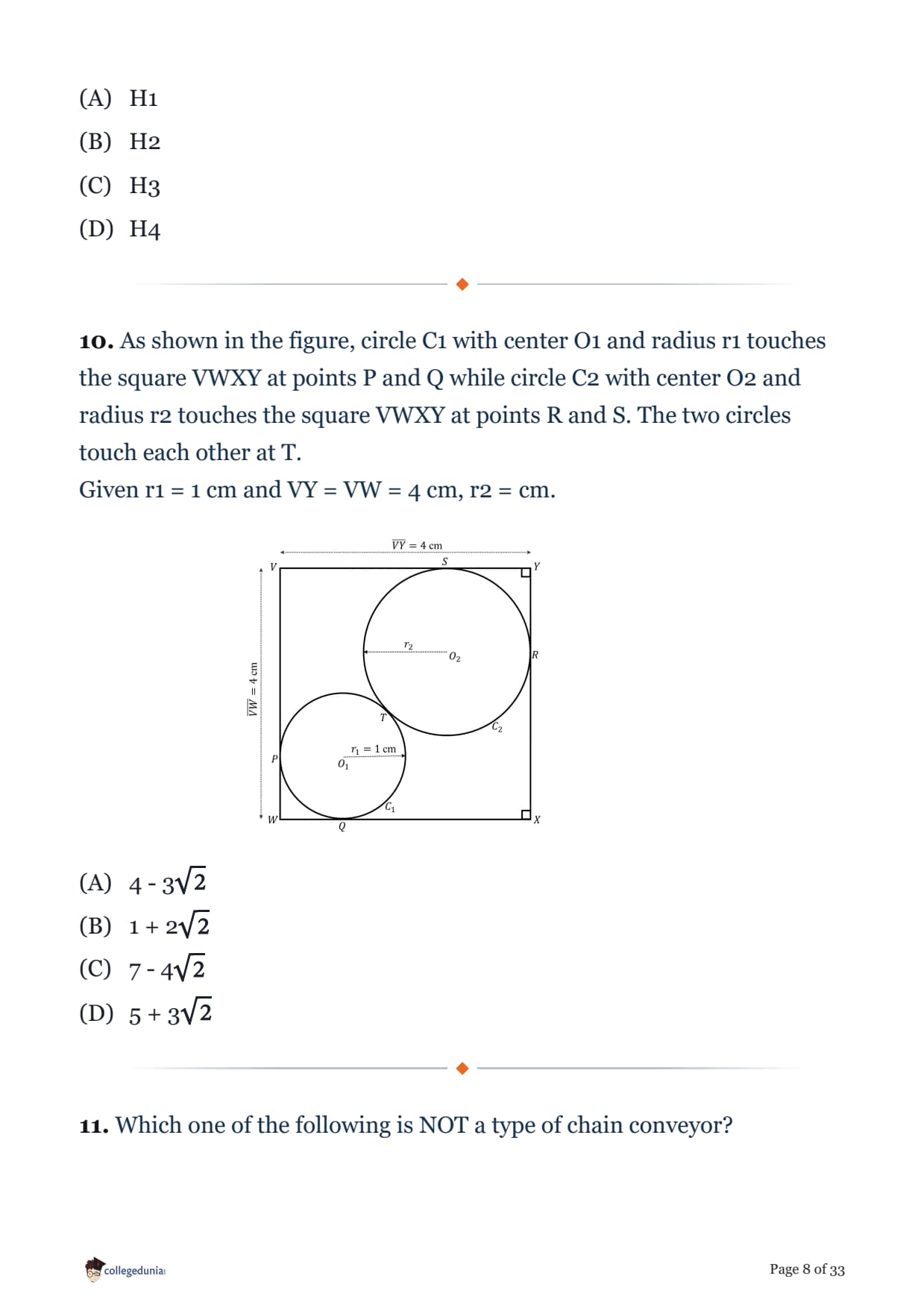
As shown in the figure, circle C1 with center O1 and radius r1 touches the square VWXY at points P and Q while circle C2 with center O2 and radius r2 touches the square VWXY at points R and S. The two circles touch each other at T.
Given r1 = 1 cm and VY = VW = 4 cm, r2 = cm.

Which one of the following is NOT a type of chain conveyor?
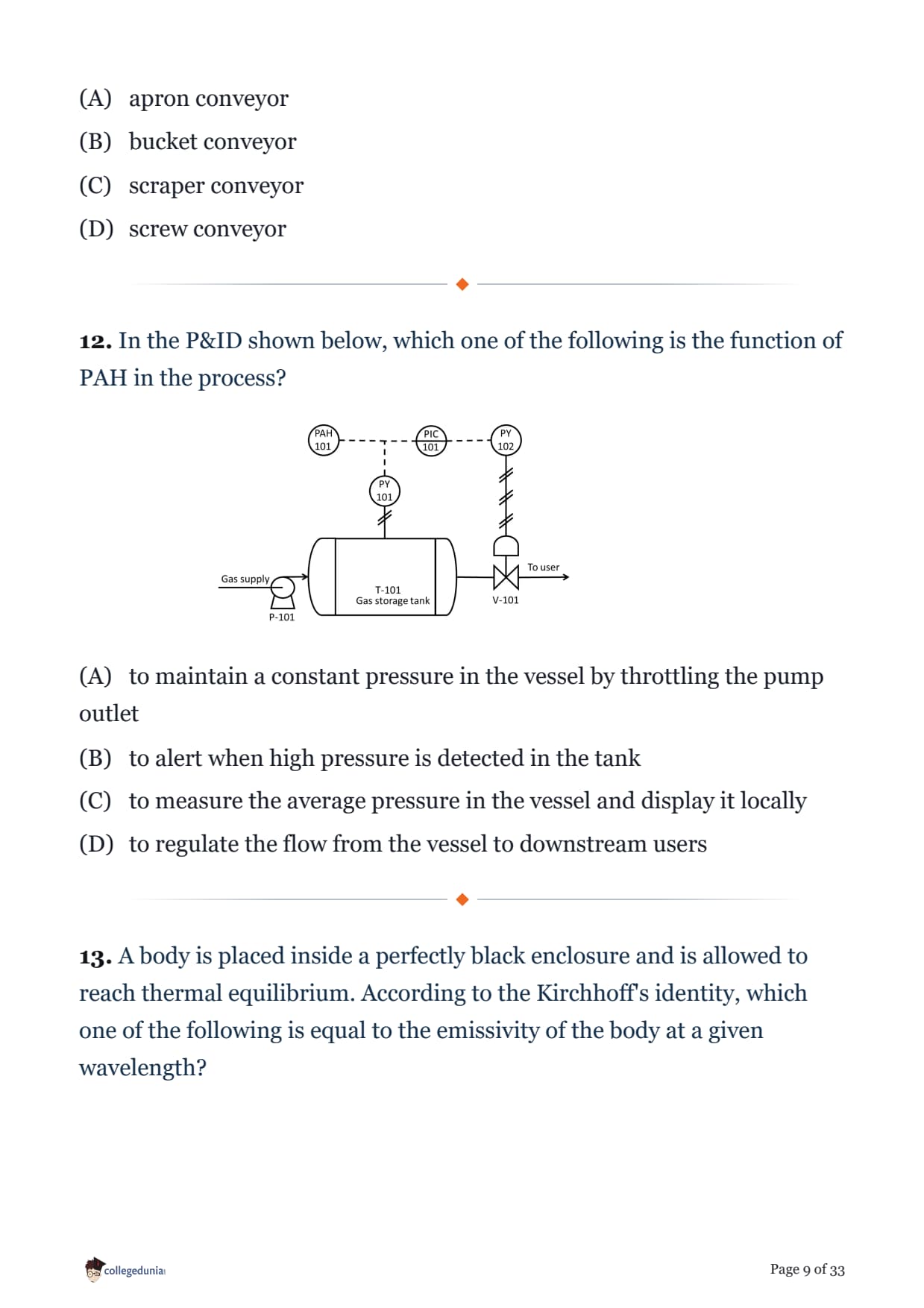
In the P&ID shown below, which one of the following is the function of PAH in the process?

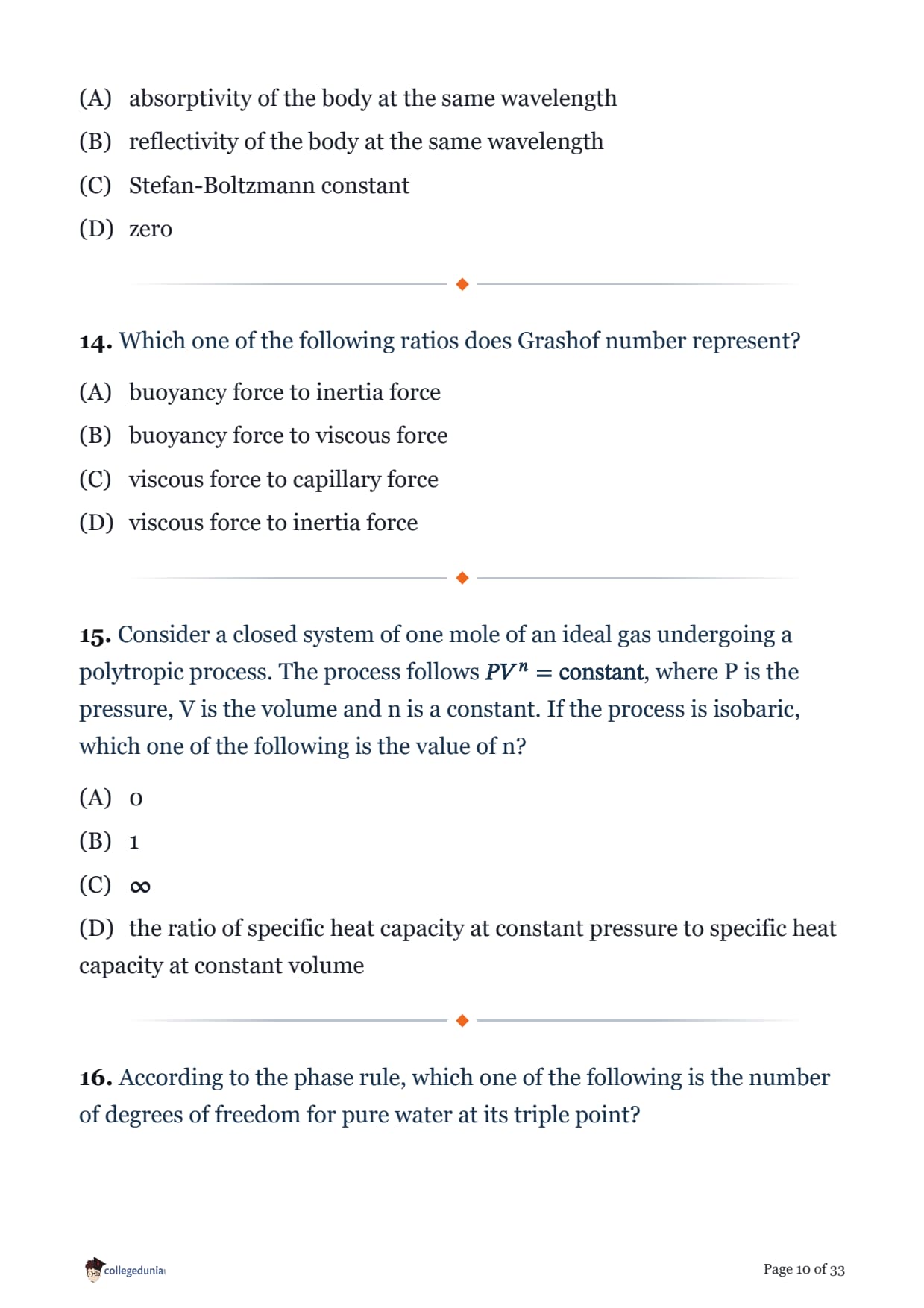
A body is placed inside a perfectly black enclosure and is allowed to reach thermal equilibrium. According to the Kirchhoff's identity, which one of the following is equal to the emissivity of the body at a given wavelength?
Which one of the following ratios does Grashof number represent?
Consider a closed system of one mole of an ideal gas undergoing a polytropic process. The process follows \( PV^n = \text{constant} \), where P is the pressure, V is the volume and n is a constant. If the process is isobaric, which one of the following is the value of n?
According to the phase rule, which one of the following is the number of degrees of freedom for pure water at its triple point?
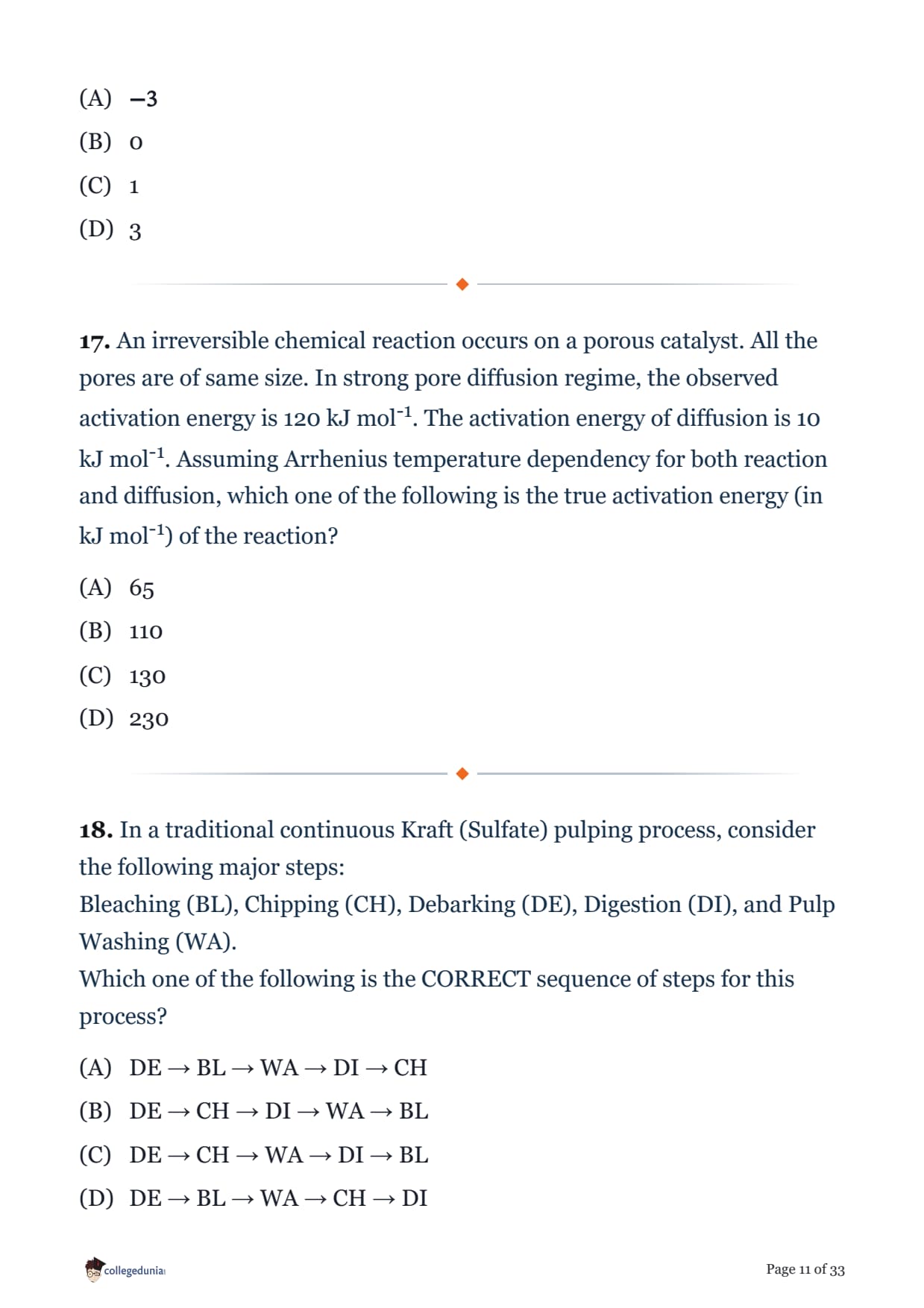
An irreversible chemical reaction occurs on a porous catalyst. All the pores are of same size. In strong pore diffusion regime, the observed activation energy is 120 kJ mol-1. The activation energy of diffusion is 10 kJ mol-1. Assuming Arrhenius temperature dependency for both reaction and diffusion, which one of the following is the true activation energy (in kJ mol-1) of the reaction?
In a traditional continuous Kraft (Sulfate) pulping process, consider the following major steps:
Bleaching (BL), Chipping (CH), Debarking (DE), Digestion (DI), and Pulp Washing (WA).
Which one of the following is the CORRECT sequence of steps for this process?
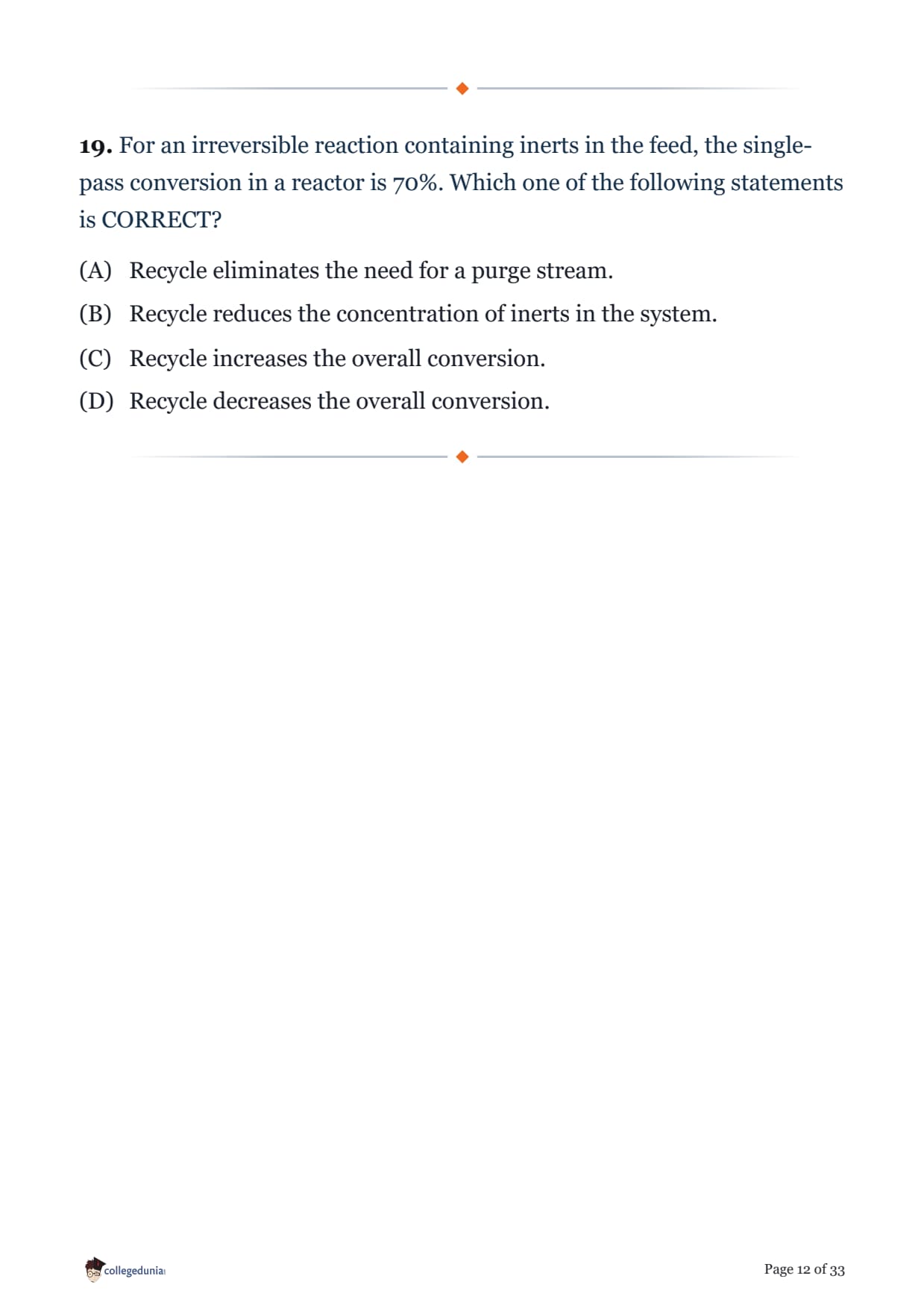
For an irreversible reaction containing inerts in the feed, the single-pass conversion in a reactor is 70%. Which one of the following statements is CORRECT?
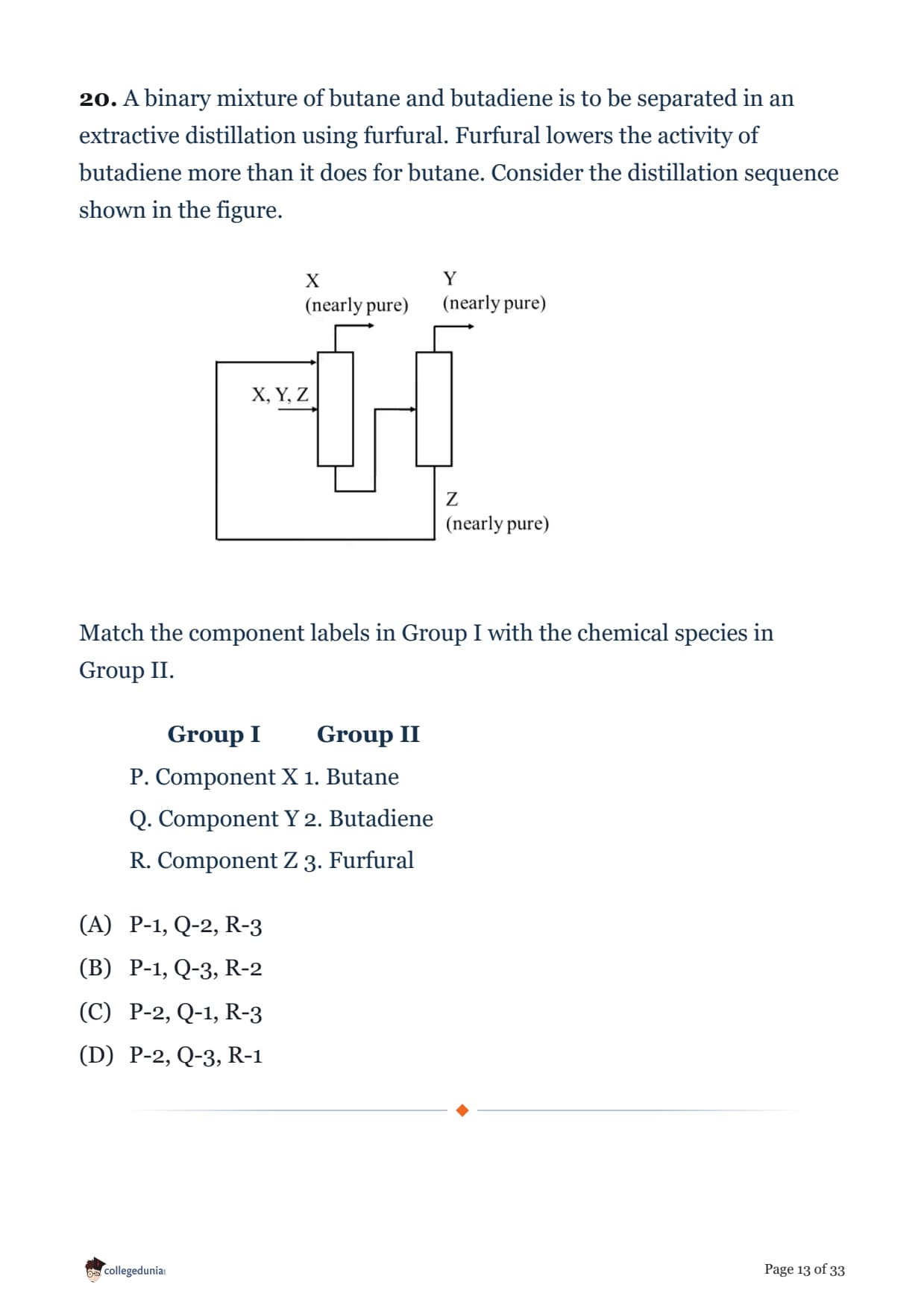
A binary mixture of butane and butadiene is to be separated in an extractive distillation using furfural. Furfural lowers the activity of butadiene more than it does for butane. Consider the distillation sequence shown in the figure.

Match the component labels in Group I with the chemical species in Group II.
| Group I | Group II |
|---|---|
| P. Component X | 1. Butane |
| Q. Component Y | 2. Butadiene |
| R. Component Z | 3. Furfural |
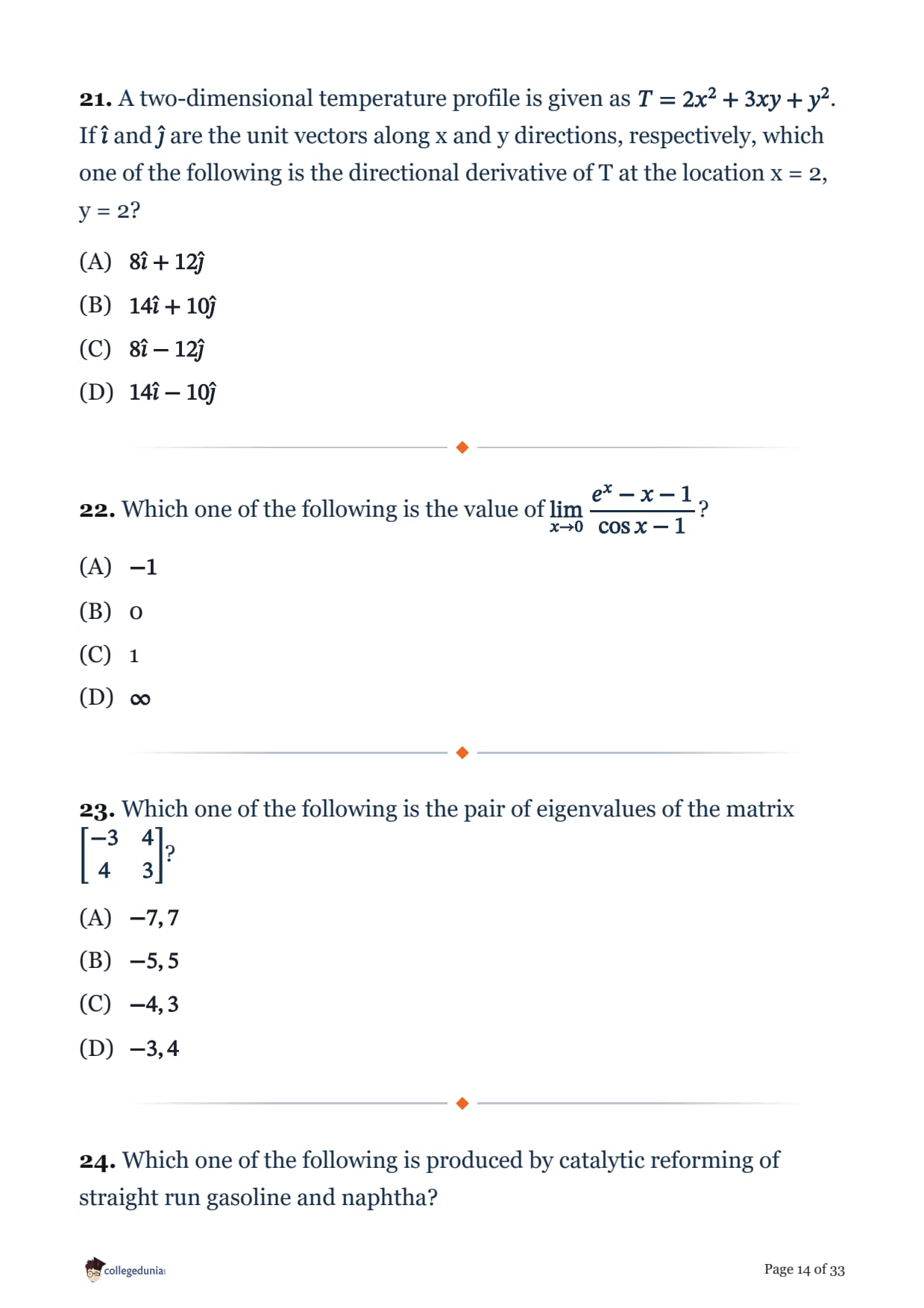
A two-dimensional temperature profile is given as \( T = 2x^2 + 3xy + y^2 \). If \(\hat{\imath}\) and \(\hat{\jmath}\) are the unit vectors along x and y directions, respectively, which one of the following is the directional derivative of T at the location x = 2, y = 2?
Which one of the following is the value of \( \displaystyle\lim_{x \to 0} \frac{e^{x} - x - 1}{\cos x - 1} \)?
Which one of the following is the pair of eigenvalues of the matrix \( \begin{bmatrix} -3 & 4 \\ 4 & 3 \end{bmatrix} \)?
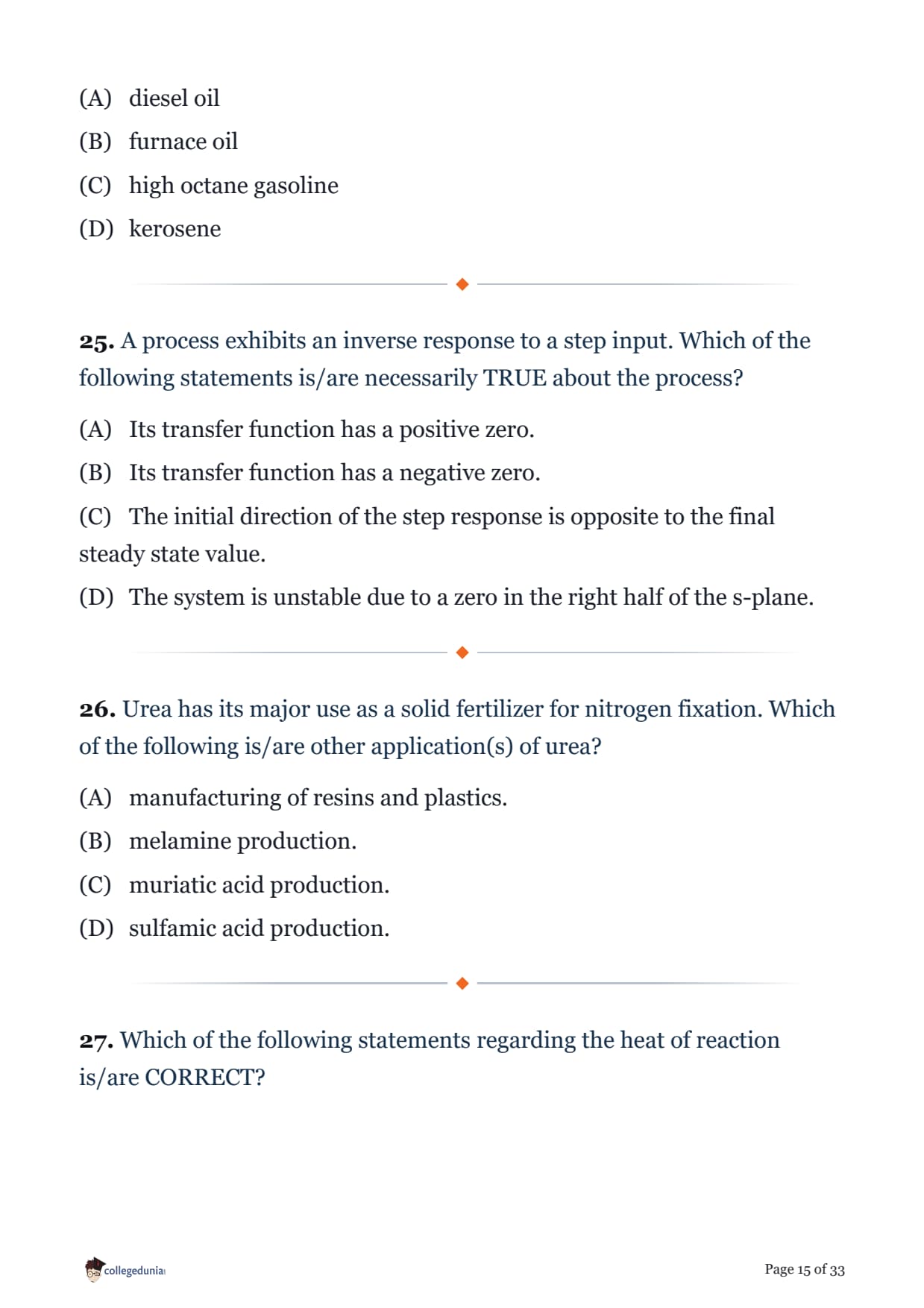
Which one of the following is produced by catalytic reforming of straight run gasoline and naphtha?
A process exhibits an inverse response to a step input. Which of the following statements is/are necessarily TRUE about the process?
Urea has its major use as a solid fertilizer for nitrogen fixation. Which of the following is/are other application(s) of urea?
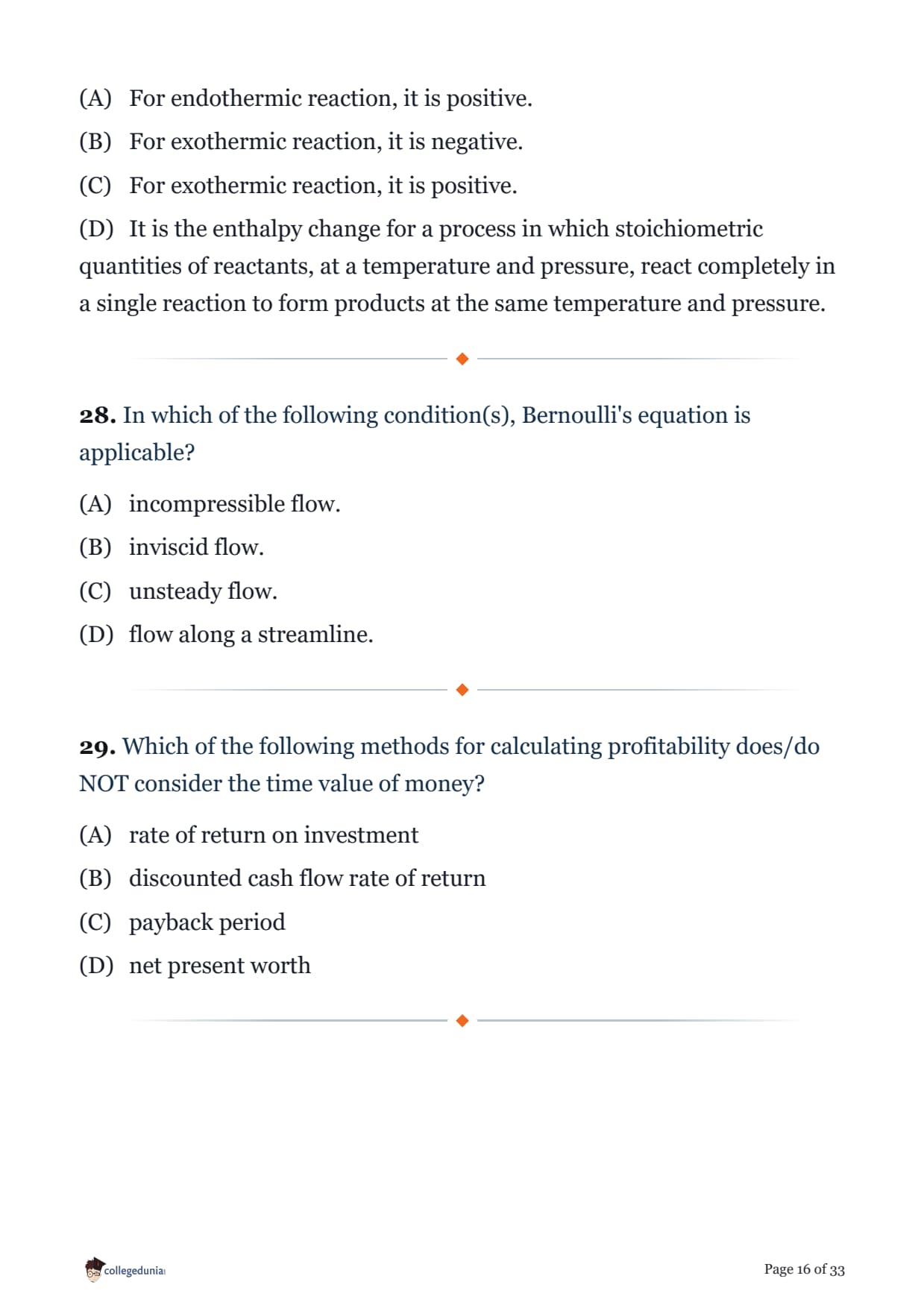
Which of the following statements regarding the heat of reaction is/are CORRECT?
In which of the following condition(s), Bernoulli's equation is applicable?
Which of the following methods for calculating profitability does/do NOT consider the time value of money?
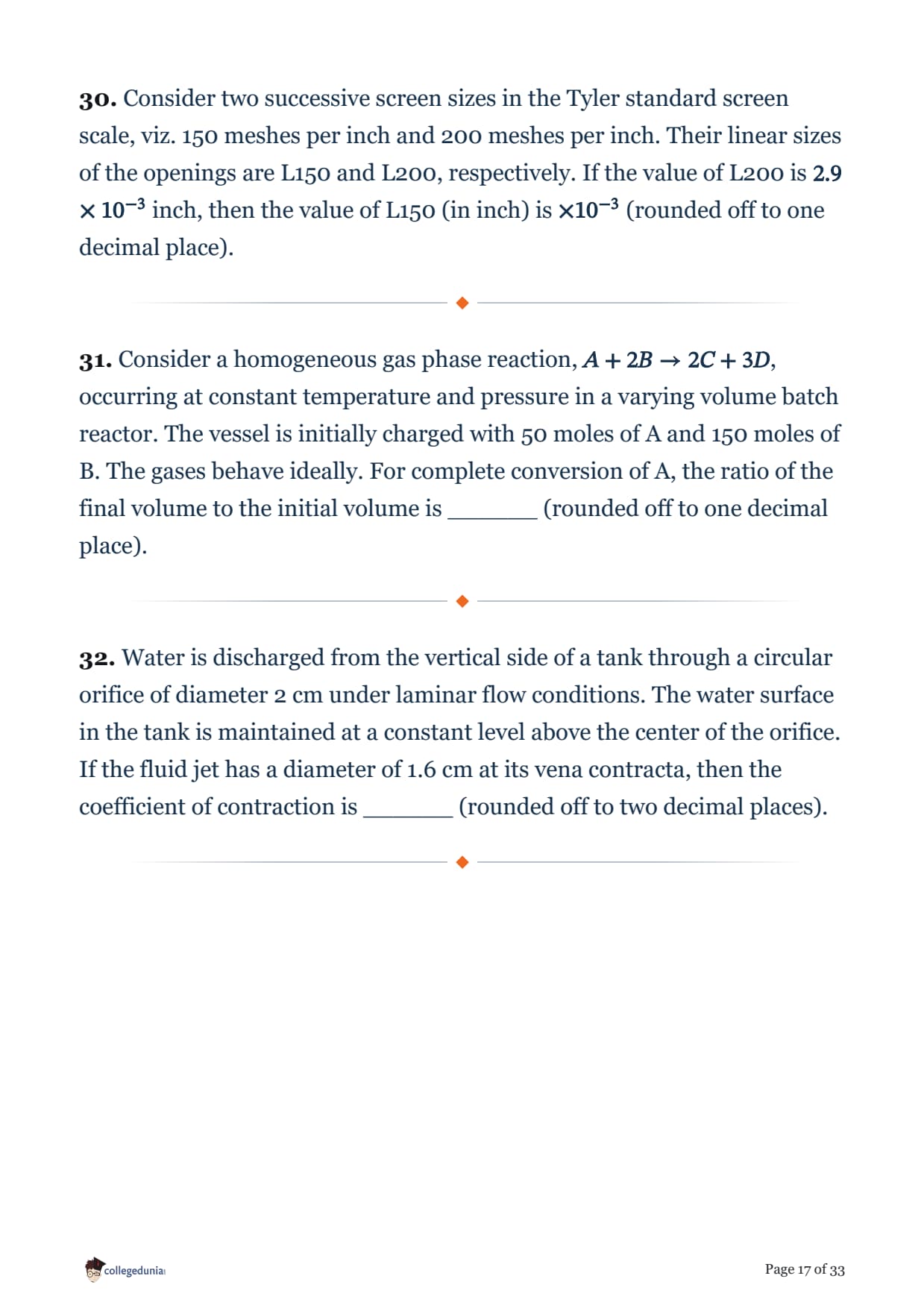
Consider two successive screen sizes in the Tyler standard screen scale, viz. 150 meshes per inch and 200 meshes per inch. Their linear sizes of the openings are L150 and L200, respectively. If the value of L200 is \(2.9 \times 10^{-3}\) inch, then the value of L150 (in inch) is \(\times 10^{-3}\) (rounded off to one decimal place).
Consider a homogeneous gas phase reaction, \(A + 2B \rightarrow 2C + 3D\), occurring at constant temperature and pressure in a varying volume batch reactor. The vessel is initially charged with 50 moles of A and 150 moles of B. The gases behave ideally. For complete conversion of A, the ratio of the final volume to the initial volume is ______ (rounded off to one decimal place).
Water is discharged from the vertical side of a tank through a circular orifice of diameter 2 cm under laminar flow conditions. The water surface in the tank is maintained at a constant level above the center of the orifice. If the fluid jet has a diameter of 1.6 cm at its vena contracta, then the coefficient of contraction is ______ (rounded off to two decimal places).
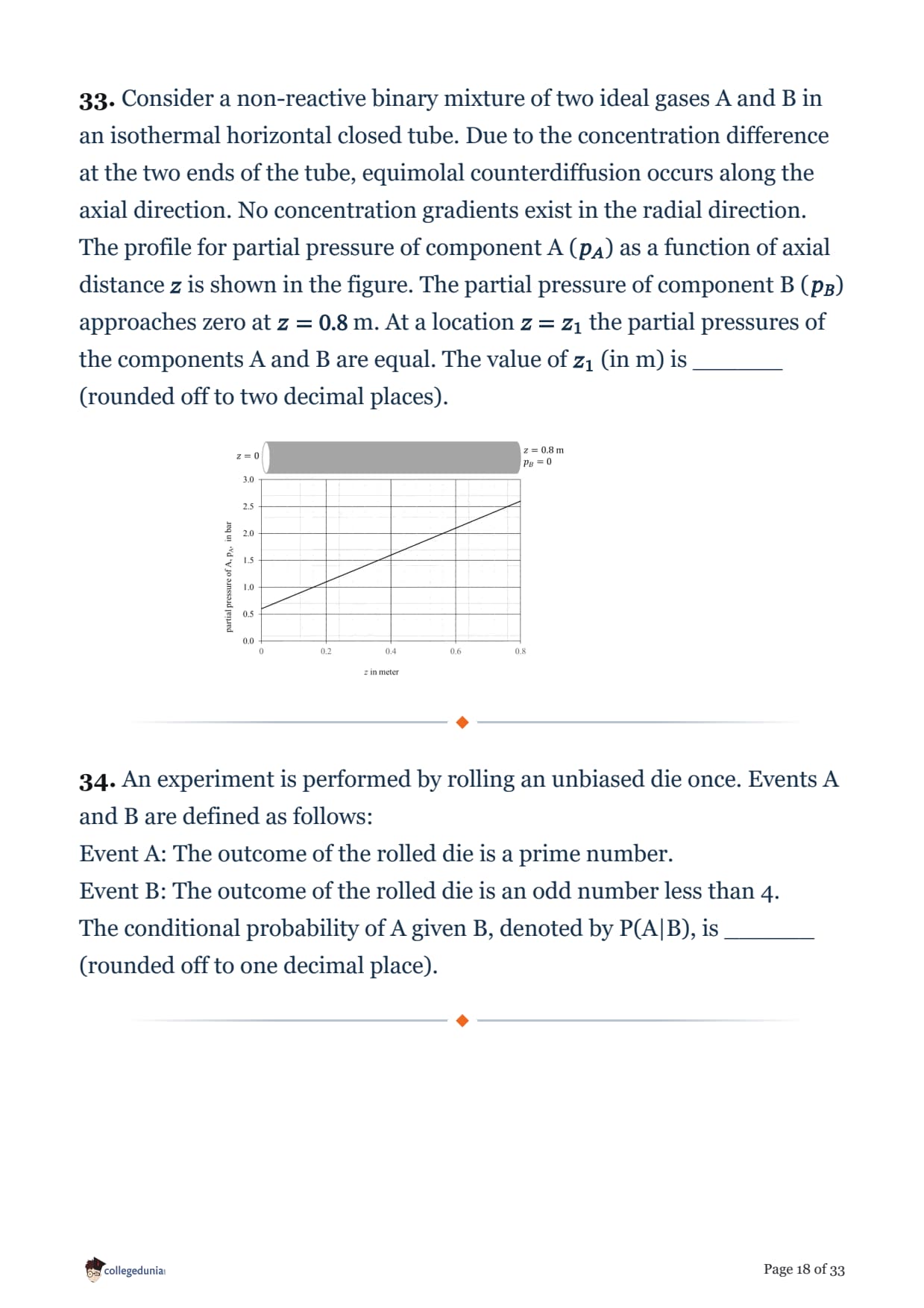
Consider a non-reactive binary mixture of two ideal gases A and B in an isothermal horizontal closed tube. Due to the concentration difference at the two ends of the tube, equimolal counterdiffusion occurs along the axial direction. No concentration gradients exist in the radial direction. The profile for partial pressure of component A (\(p_A\)) as a function of axial distance \(z\) is shown in the figure. The partial pressure of component B (\(p_B\)) approaches zero at \(z = 0.8\) m. At a location \(z = z_1\) the partial pressures of the components A and B are equal. The value of \(z_1\) (in m) is ______ (rounded off to two decimal places).

An experiment is performed by rolling an unbiased die once. Events A and B are defined as follows:
Event A: The outcome of the rolled die is a prime number.
Event B: The outcome of the rolled die is an odd number less than 4.
The conditional probability of A given B, denoted by P(A|B), is ______ (rounded off to one decimal place).
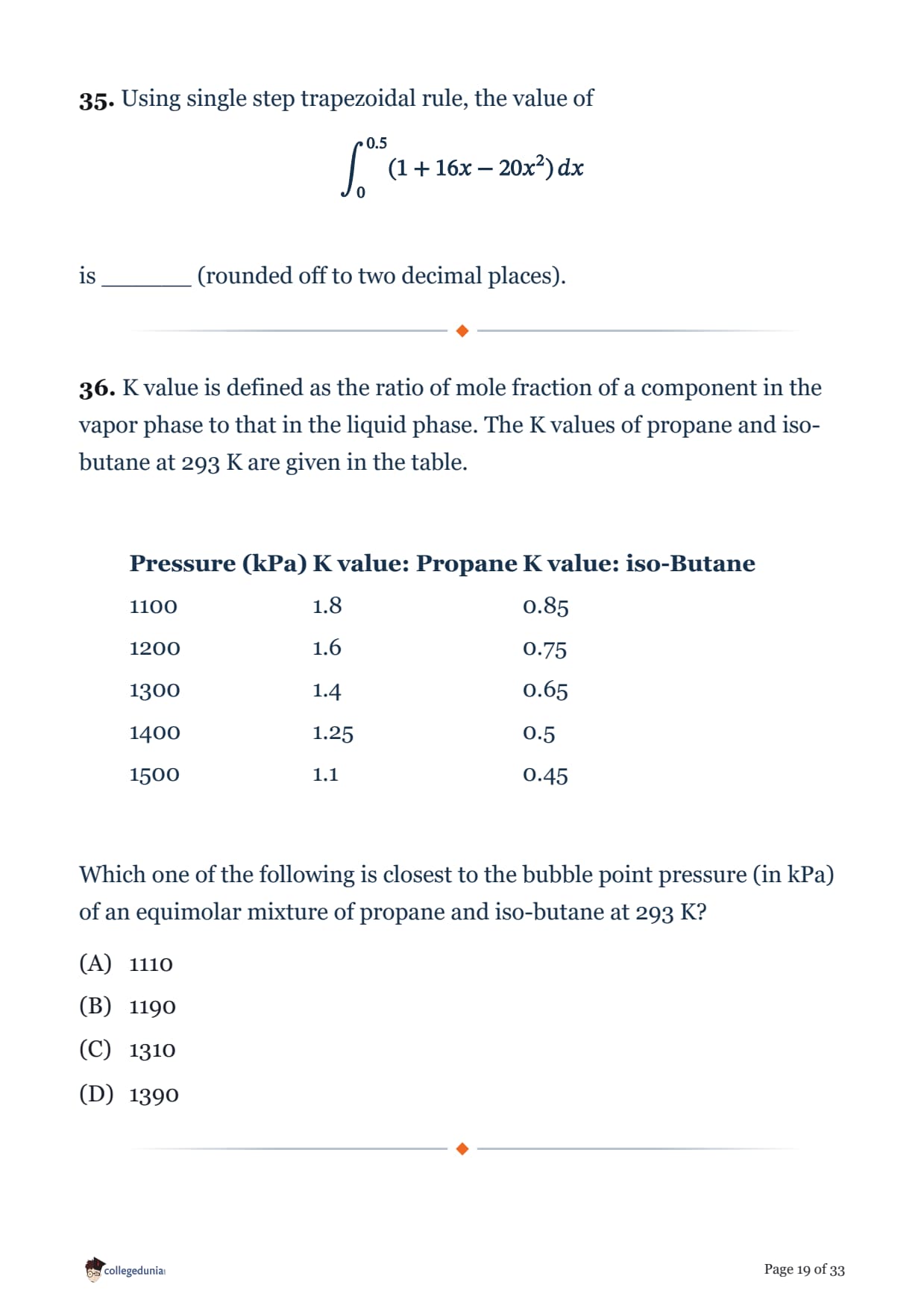
Using single step trapezoidal rule, the value of
\[ \int_{0}^{0.5} (1+16x-20x^2)\,dx \]
is ______ (rounded off to two decimal places).
K value is defined as the ratio of mole fraction of a component in the vapor phase to that in the liquid phase. The K values of propane and iso-butane at 293 K are given in the table.
| Pressure (kPa) | K value: Propane | K value: iso-Butane |
|---|---|---|
| 1100 | 1.8 | 0.85 |
| 1200 | 1.6 | 0.75 |
| 1300 | 1.4 | 0.65 |
| 1400 | 1.25 | 0.5 |
| 1500 | 1.1 | 0.45 |
Which one of the following is closest to the bubble point pressure (in kPa) of an equimolar mixture of propane and iso-butane at 293 K?
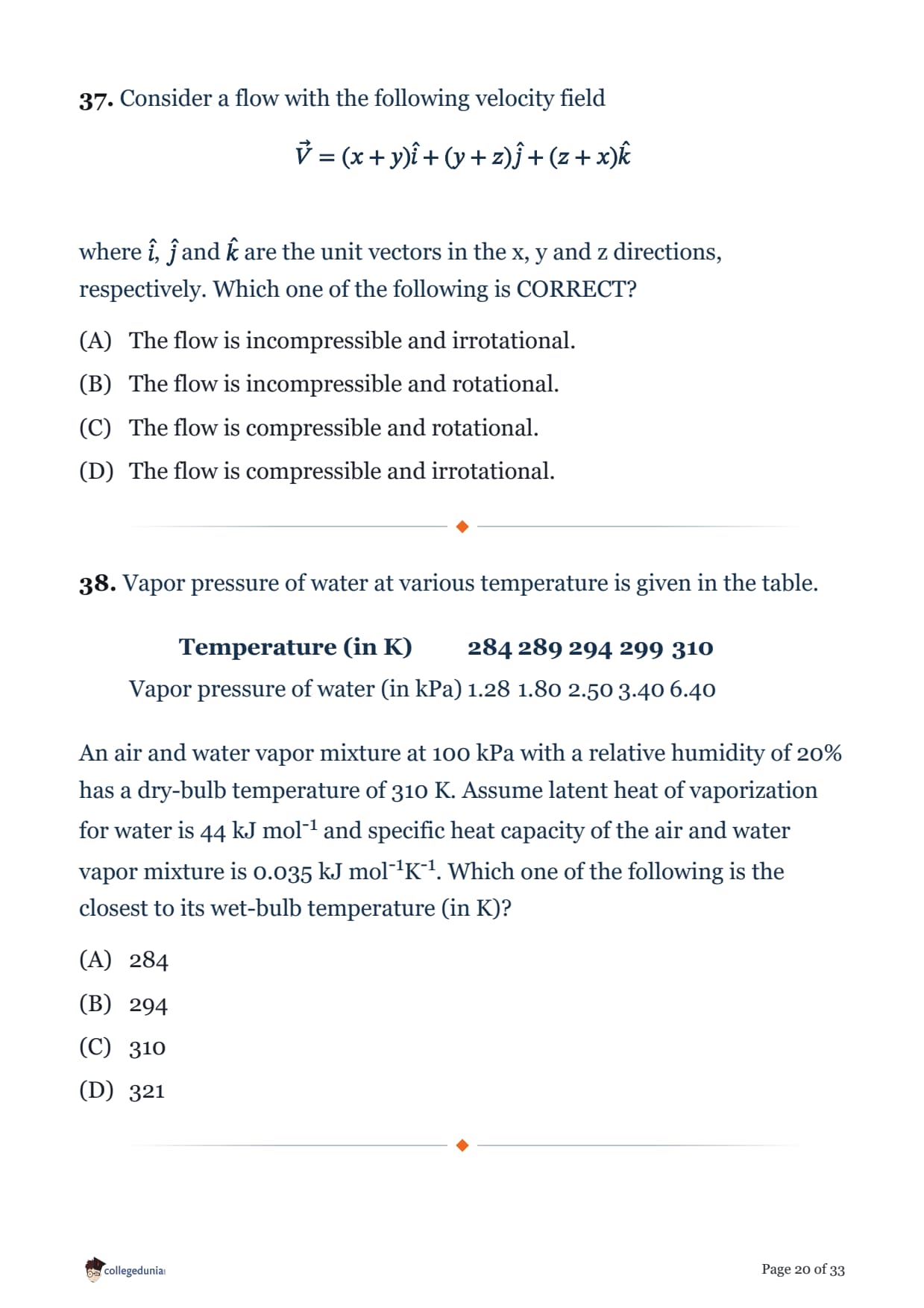
Consider a flow with the following velocity field
\[ \vec{V} = (x+y)\hat{i} + (y+z)\hat{j} + (z+x)\hat{k} \]
where \(\hat{i}\), \(\hat{j}\) and \(\hat{k}\) are the unit vectors in the x, y and z directions, respectively. Which one of the following is CORRECT?
Vapor pressure of water at various temperature is given in the table.
| Temperature (in K) | 284 | 289 | 294 | 299 | 310 |
|---|---|---|---|---|---|
| Vapor pressure of water (in kPa) | 1.28 | 1.80 | 2.50 | 3.40 | 6.40 |
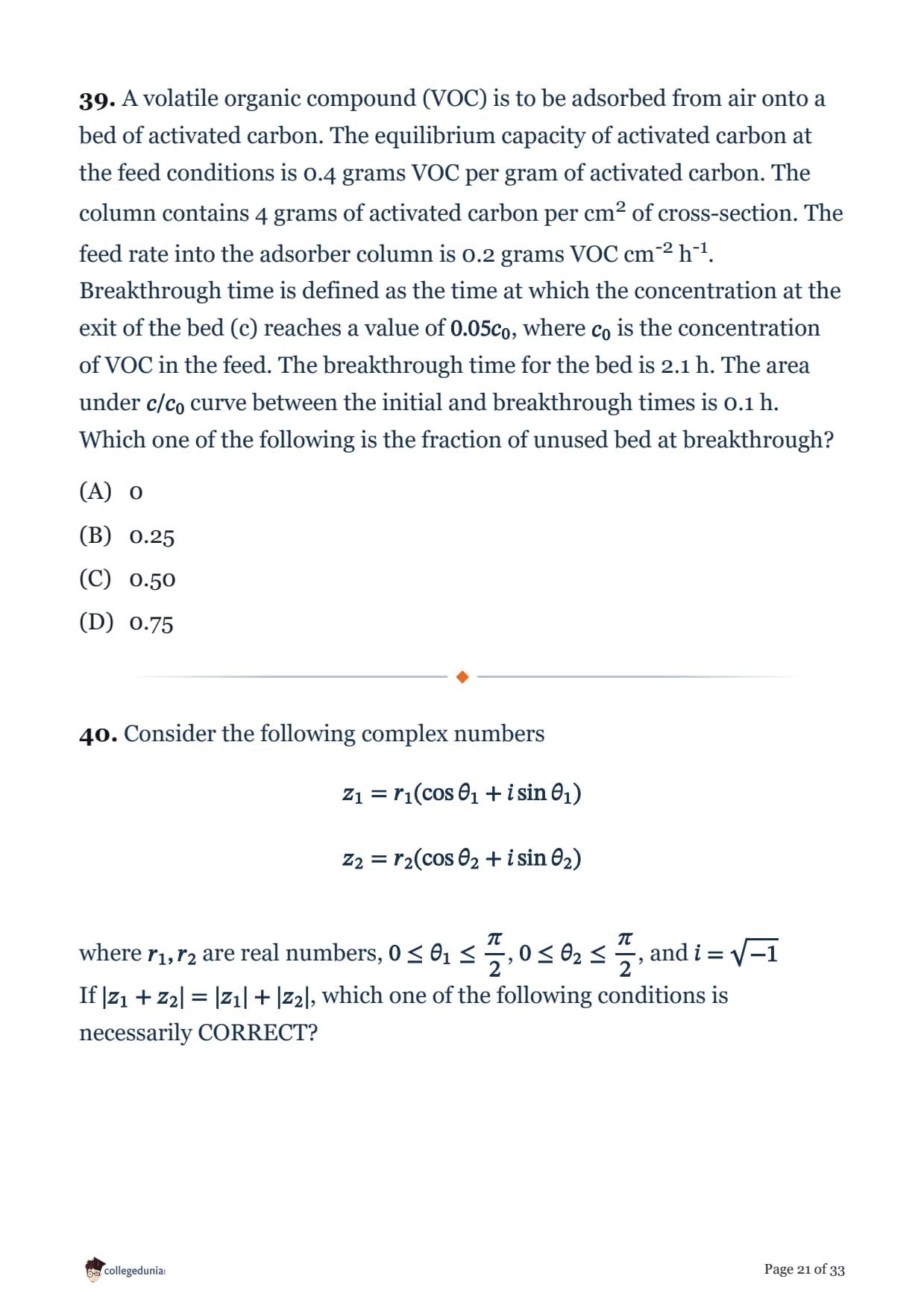
A volatile organic compound (VOC) is to be adsorbed from air onto a bed of activated carbon. The equilibrium capacity of activated carbon at the feed conditions is 0.4 grams VOC per gram of activated carbon. The column contains 4 grams of activated carbon per cm2 of cross-section. The feed rate into the adsorber column is 0.2 grams VOC cm-2 h-1. Breakthrough time is defined as the time at which the concentration at the exit of the bed (c) reaches a value of \(0.05c_0\), where \(c_0\) is the concentration of VOC in the feed. The breakthrough time for the bed is 2.1 h. The area under \(c/c_0\) curve between the initial and breakthrough times is 0.1 h. Which one of the following is the fraction of unused bed at breakthrough?
Consider the following complex numbers
\[ z_1 = r_1(\cos\theta_1 + i\sin\theta_1) \]\[ z_2 = r_2(\cos\theta_2 + i\sin\theta_2) \]
where \(r_1, r_2\) are real numbers, \(0 \le \theta_1 \le \dfrac{\pi}{2}\), \(0 \le \theta_2 \le \dfrac{\pi}{2}\), and \(i=\sqrt{-1}\)
If \(|z_1+z_2| = |z_1|+|z_2|\), which one of the following conditions is necessarily CORRECT?
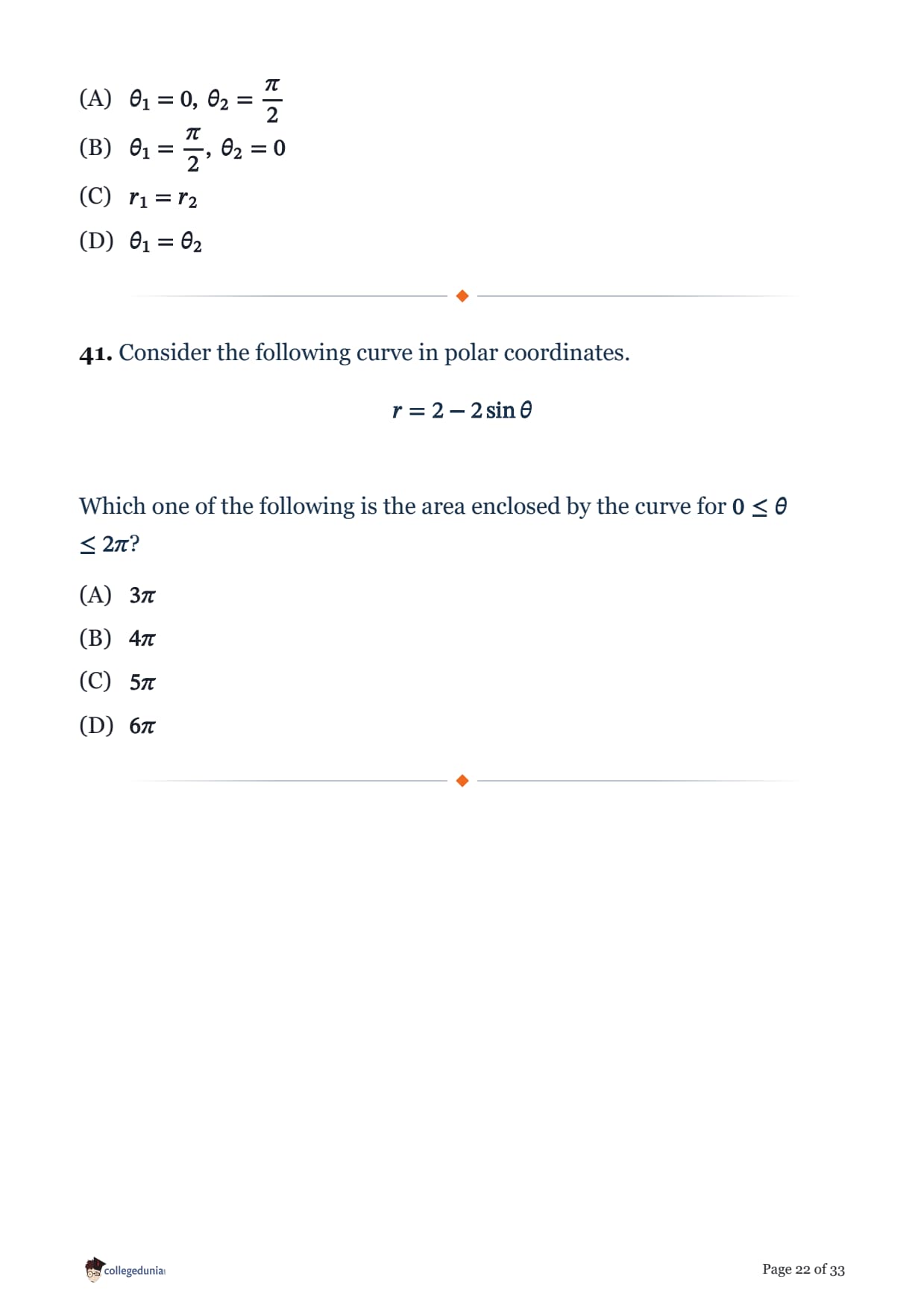
Consider the following curve in polar coordinates.
\[ r = 2 - 2\sin\theta \]
Which one of the following is the area enclosed by the curve for \(0 \le \theta \le 2\pi\)?
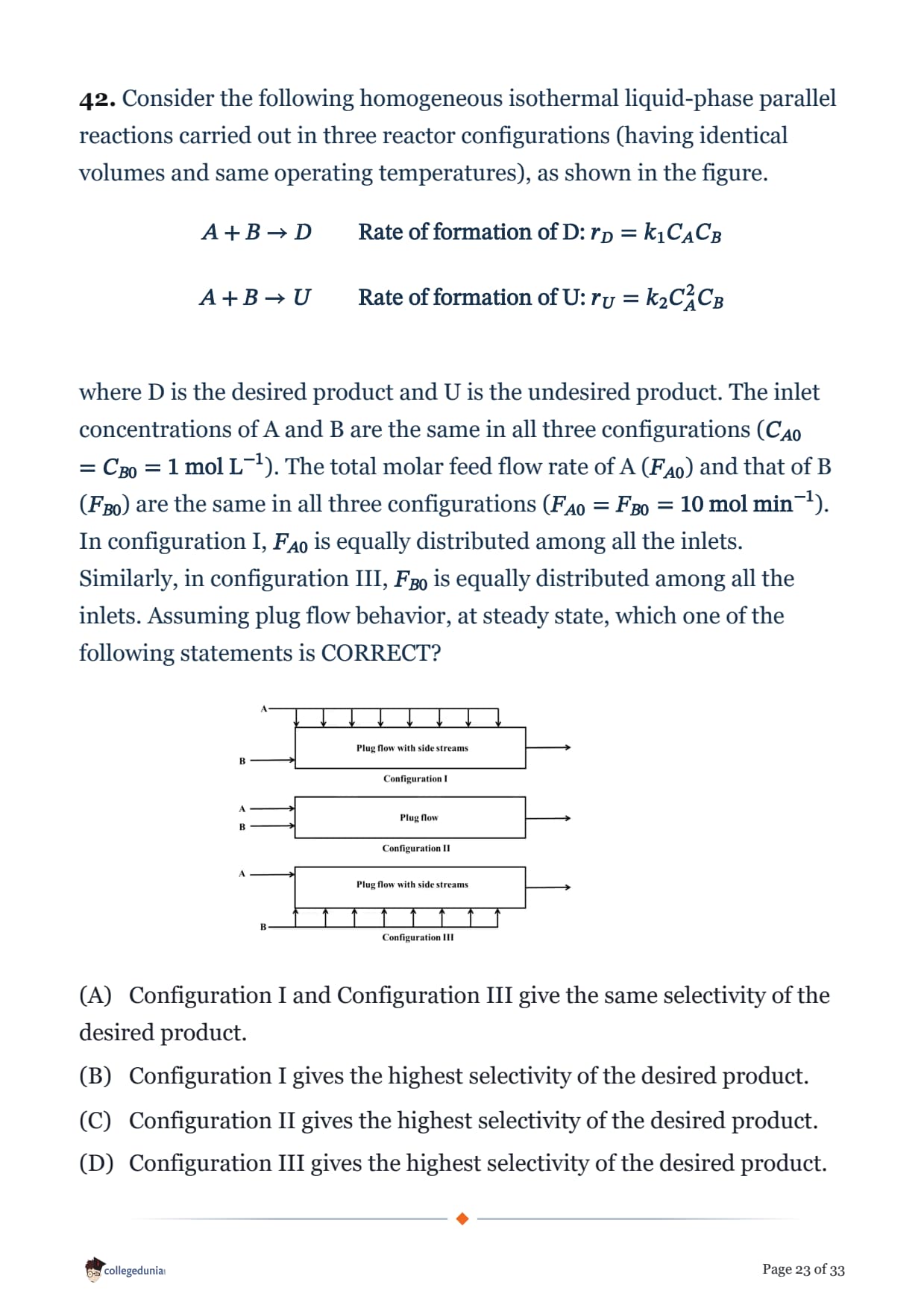
Consider the following homogeneous isothermal liquid-phase parallel reactions carried out in three reactor configurations (having identical volumes and same operating temperatures), as shown in the figure.
\[ A + B \rightarrow D \qquad \text{Rate of formation of D: } r_D = k_1 C_A C_B \]\[ A + B \rightarrow U \qquad \text{Rate of formation of U: } r_U = k_2 C_A^2 C_B \]
where D is the desired product and U is the undesired product. The inlet concentrations of A and B are the same in all three configurations (\(C_{A0}=C_{B0}=1\ \text{mol L}^{-1}\)). The total molar feed flow rate of A (\(F_{A0}\)) and that of B (\(F_{B0}\)) are the same in all three configurations (\(F_{A0}=F_{B0}=10\ \text{mol min}^{-1}\)). In configuration I, \(F_{A0}\) is equally distributed among all the inlets. Similarly, in configuration III, \(F_{B0}\) is equally distributed among all the inlets. Assuming plug flow behavior, at steady state, which one of the following statements is CORRECT?

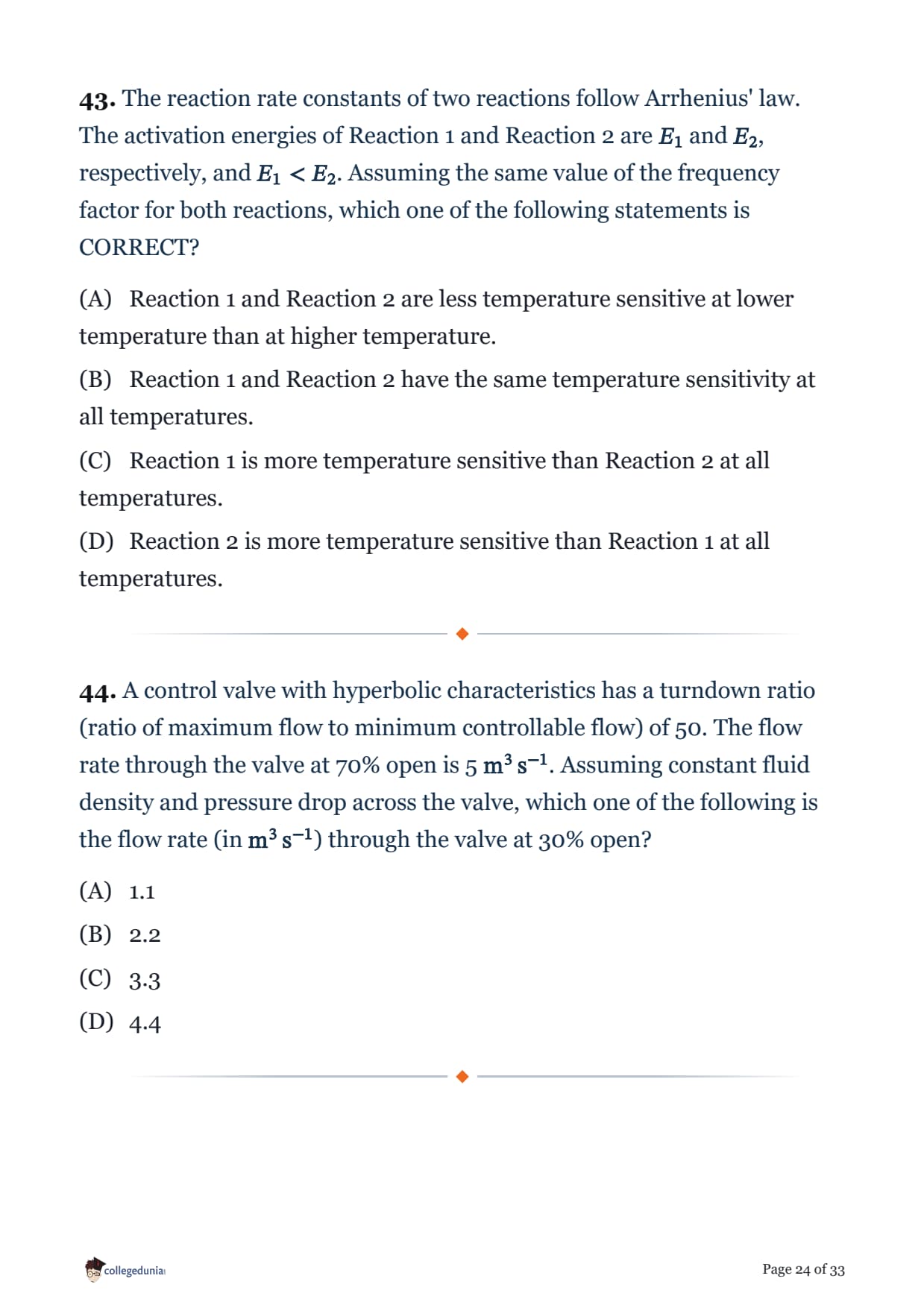
The reaction rate constants of two reactions follow Arrhenius' law. The activation energies of Reaction 1 and Reaction 2 are \(E_1\) and \(E_2\), respectively, and \(E_1 < E_2\). Assuming the same value of the frequency factor for both reactions, which one of the following statements is CORRECT?
A control valve with hyperbolic characteristics has a turndown ratio (ratio of maximum flow to minimum controllable flow) of 50. The flow rate through the valve at 70% open is 5 \(\text{m}^3\,\text{s}^{-1}\). Assuming constant fluid density and pressure drop across the valve, which one of the following is the flow rate (in \(\text{m}^3\,\text{s}^{-1}\)) through the valve at 30% open?
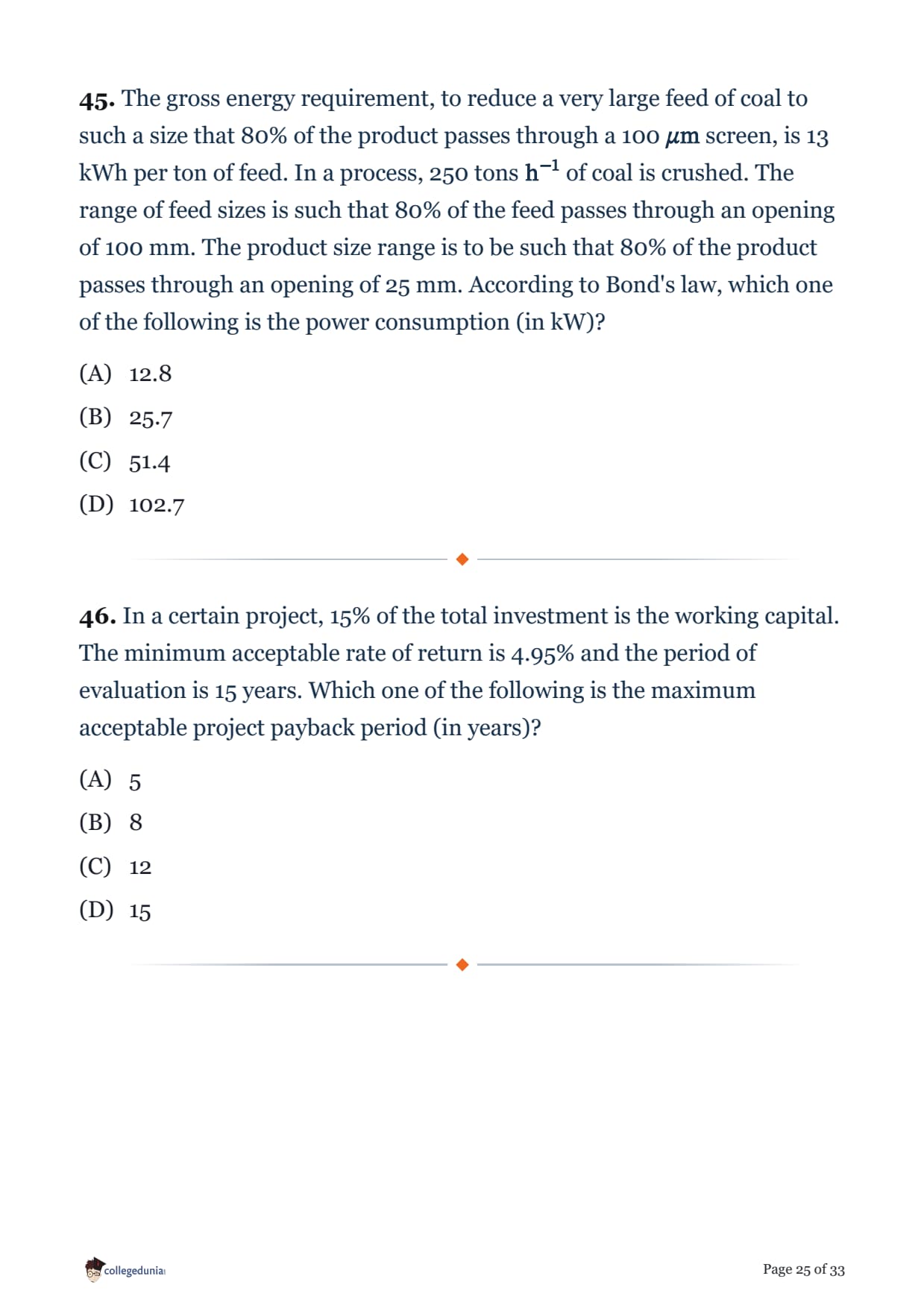
The gross energy requirement, to reduce a very large feed of coal to such a size that 80% of the product passes through a 100 \(\mu\text{m}\) screen, is 13 kWh per ton of feed. In a process, 250 tons \(\text{h}^{-1}\) of coal is crushed. The range of feed sizes is such that 80% of the feed passes through an opening of 100 mm. The product size range is to be such that 80% of the product passes through an opening of 25 mm. According to Bond's law, which one of the following is the power consumption (in kW)?
In a certain project, 15% of the total investment is the working capital. The minimum acceptable rate of return is 4.95% and the period of evaluation is 15 years. Which one of the following is the maximum acceptable project payback period (in years)?
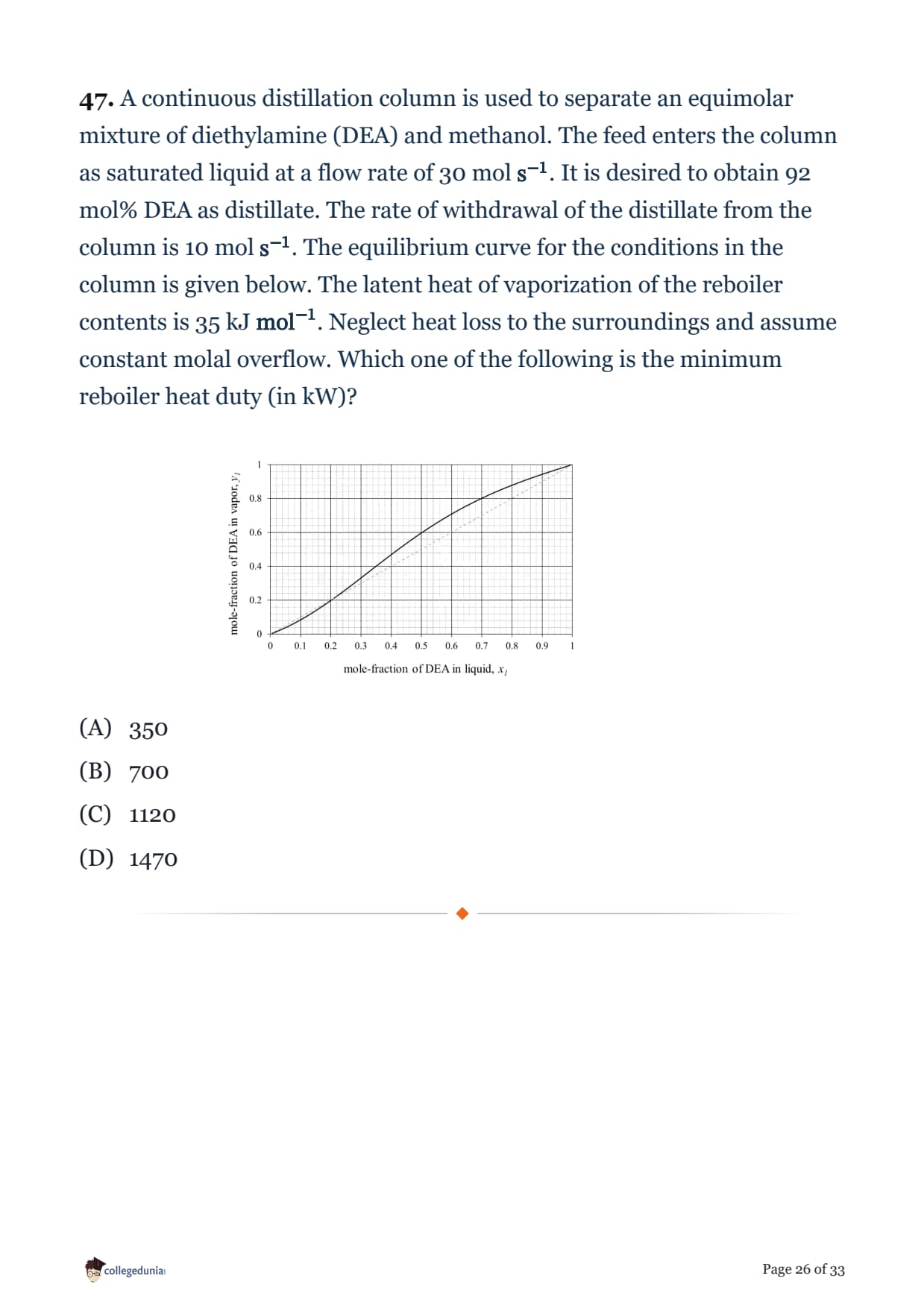
A continuous distillation column is used to separate an equimolar mixture of diethylamine (DEA) and methanol. The feed enters the column as saturated liquid at a flow rate of 30 mol \(\text{s}^{-1}\). It is desired to obtain 92 mol% DEA as distillate. The rate of withdrawal of the distillate from the column is 10 mol \(\text{s}^{-1}\). The equilibrium curve for the conditions in the column is given below. The latent heat of vaporization of the reboiler contents is 35 kJ \(\text{mol}^{-1}\). Neglect heat loss to the surroundings and assume constant molal overflow. Which one of the following is the minimum reboiler heat duty (in kW)?

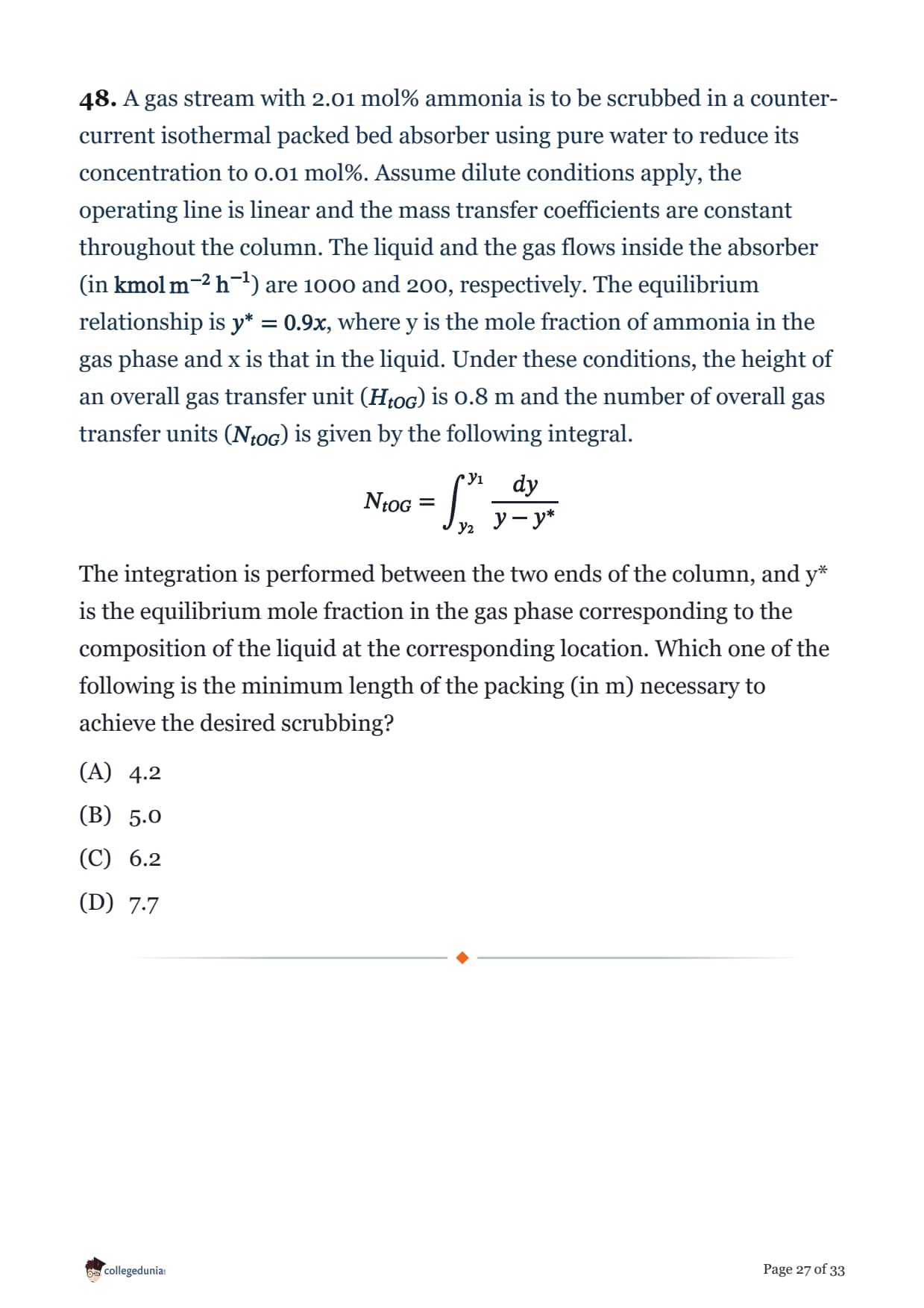
A gas stream with 2.01 mol% ammonia is to be scrubbed in a counter-current isothermal packed bed absorber using pure water to reduce its concentration to 0.01 mol%. Assume dilute conditions apply, the operating line is linear and the mass transfer coefficients are constant throughout the column. The liquid and the gas flows inside the absorber (in \(\text{kmol}\,\text{m}^{-2}\,\text{h}^{-1}\)) are 1000 and 200, respectively. The equilibrium relationship is \(y^* = 0.9x\), where y is the mole fraction of ammonia in the gas phase and x is that in the liquid. Under these conditions, the height of an overall gas transfer unit (\(H_{tOG}\)) is 0.8 m and the number of overall gas transfer units (\(N_{tOG}\)) is given by the following integral.
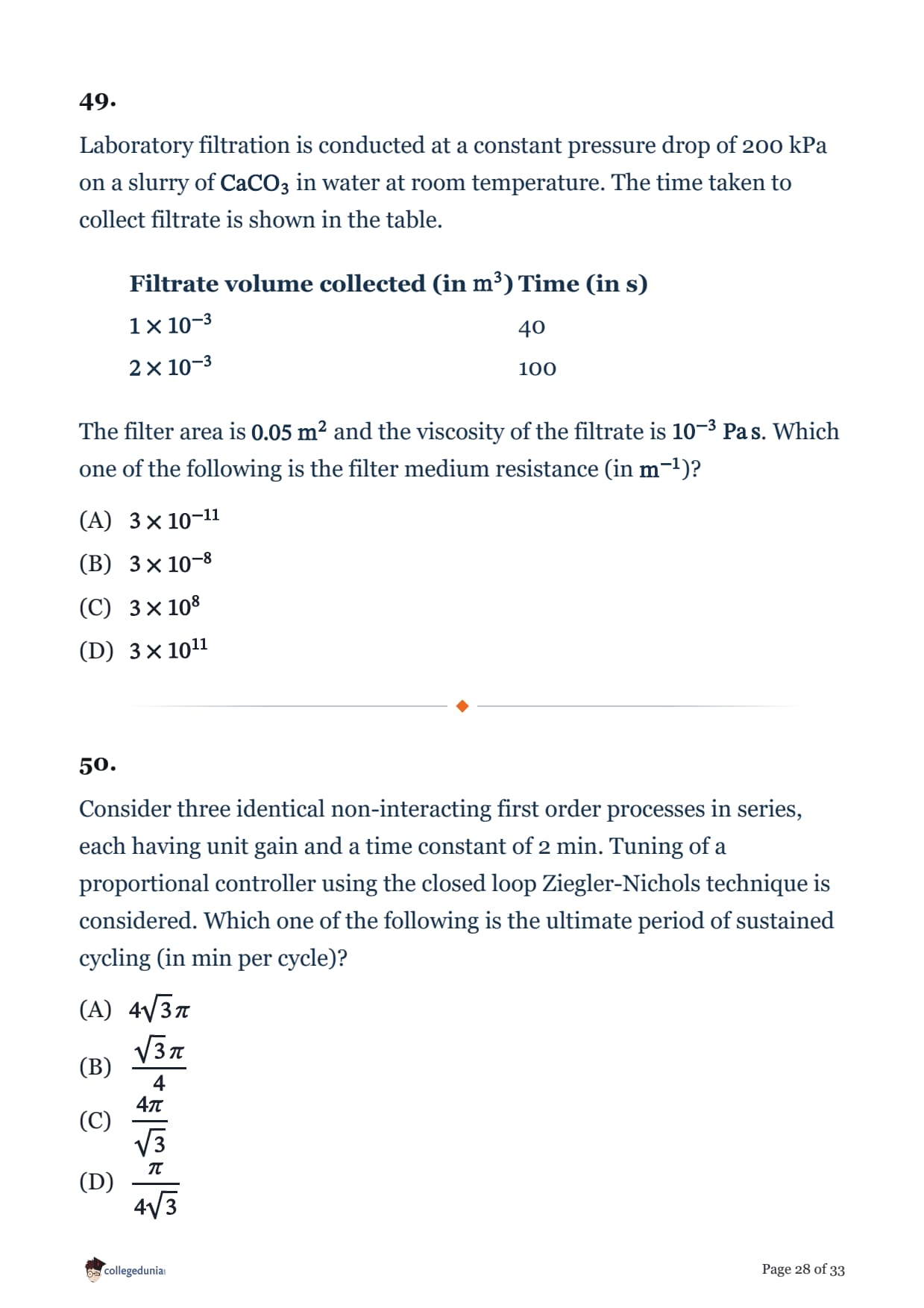
Laboratory filtration is conducted at a constant pressure drop of 200 kPa on a slurry of \(\mathrm{CaCO_3}\) in water at room temperature. The time taken to collect filtrate is shown in the table.
| Filtrate volume collected (in \(\mathrm{m^3}\)) | Time (in s) |
|---|---|
| \(1 \times 10^{-3}\) | 40 |
| \(2 \times 10^{-3}\) | 100 |
The filter area is \(0.05\ \mathrm{m^2}\) and the viscosity of the filtrate is \(10^{-3}\ \mathrm{Pa\,s}\). Which one of the following is the filter medium resistance (in \(\mathrm{m^{-1}}\))?
Consider three identical non-interacting first order processes in series, each having unit gain and a time constant of 2 min. Tuning of a proportional controller using the closed loop Ziegler-Nichols technique is considered. Which one of the following is the ultimate period of sustained cycling (in min per cycle)?
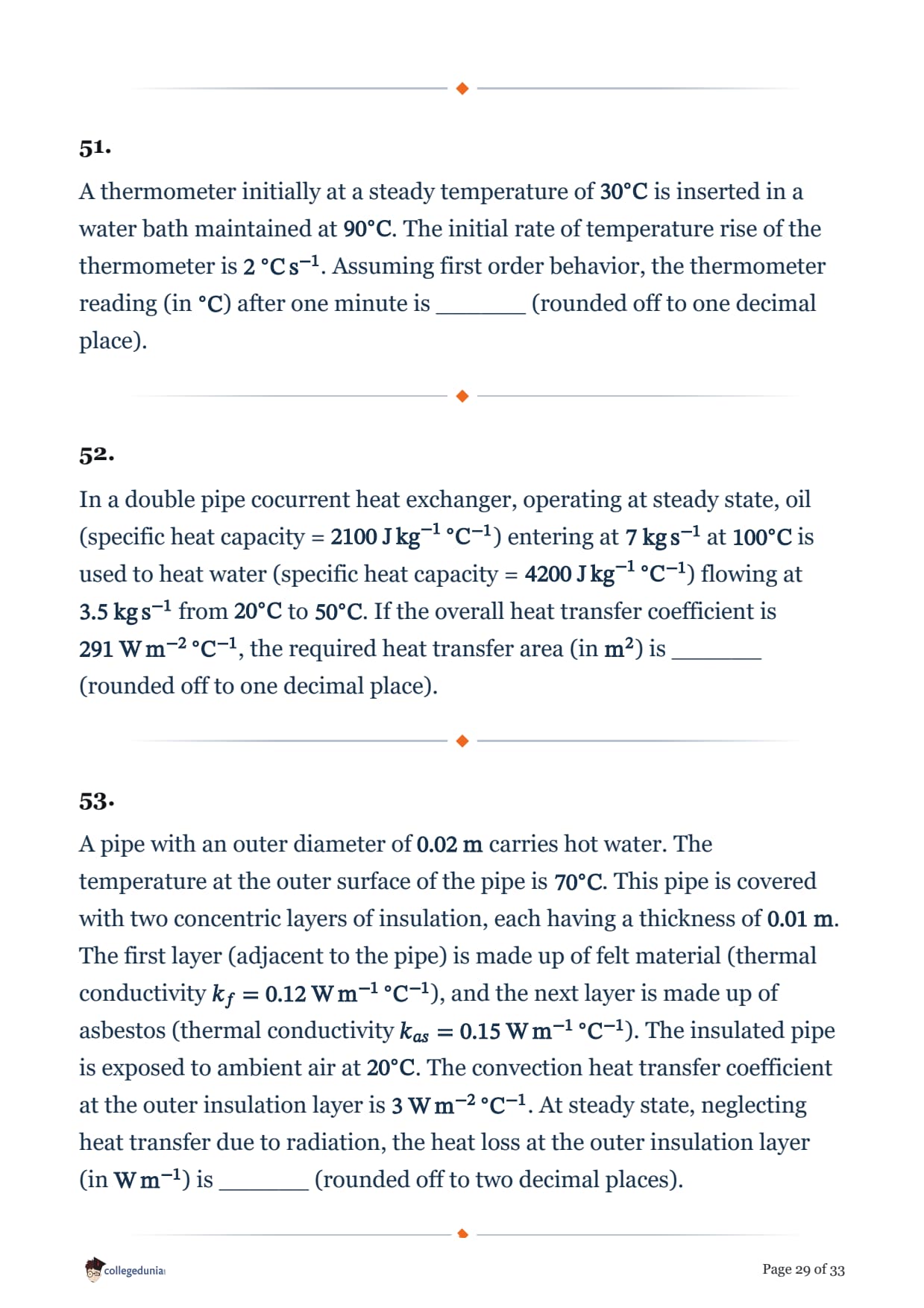
A thermometer initially at a steady temperature of \(30^\circ\mathrm{C}\) is inserted in a water bath maintained at \(90^\circ\mathrm{C}\). The initial rate of temperature rise of the thermometer is \(2\ ^\circ\mathrm{C\,s^{-1}}\). Assuming first order behavior, the thermometer reading (in \(^\circ\mathrm{C}\)) after one minute is ______ (rounded off to one decimal place).
In a double pipe cocurrent heat exchanger, operating at steady state, oil (specific heat capacity = \(2100\ \mathrm{J\,kg^{-1}\,^\circ C^{-1}}\)) entering at \(7\ \mathrm{kg\,s^{-1}}\) at \(100^\circ\mathrm{C}\) is used to heat water (specific heat capacity = \(4200\ \mathrm{J\,kg^{-1}\,^\circ C^{-1}}\)) flowing at \(3.5\ \mathrm{kg\,s^{-1}}\) from \(20^\circ\mathrm{C}\) to \(50^\circ\mathrm{C}\). If the overall heat transfer coefficient is \(291\ \mathrm{W\,m^{-2}\,^\circ C^{-1}}\), the required heat transfer area (in \(\mathrm{m^2}\)) is ______ (rounded off to one decimal place).
A pipe with an outer diameter of \(0.02\ \mathrm{m}\) carries hot water. The temperature at the outer surface of the pipe is \(70^\circ\mathrm{C}\). This pipe is covered with two concentric layers of insulation, each having a thickness of \(0.01\ \mathrm{m}\). The first layer (adjacent to the pipe) is made up of felt material (thermal conductivity \(k_f = 0.12\ \mathrm{W\,m^{-1}\,^\circ C^{-1}}\)), and the next layer is made up of asbestos (thermal conductivity \(k_{as} = 0.15\ \mathrm{W\,m^{-1}\,^\circ C^{-1}}\)). The insulated pipe is exposed to ambient air at \(20^\circ\mathrm{C}\). The convection heat transfer coefficient at the outer insulation layer is \(3\ \mathrm{W\,m^{-2}\,^\circ C^{-1}}\). At steady state, neglecting heat transfer due to radiation, the heat loss at the outer insulation layer (in \(\mathrm{W\,m^{-1}}\)) is ______ (rounded off to two decimal places).
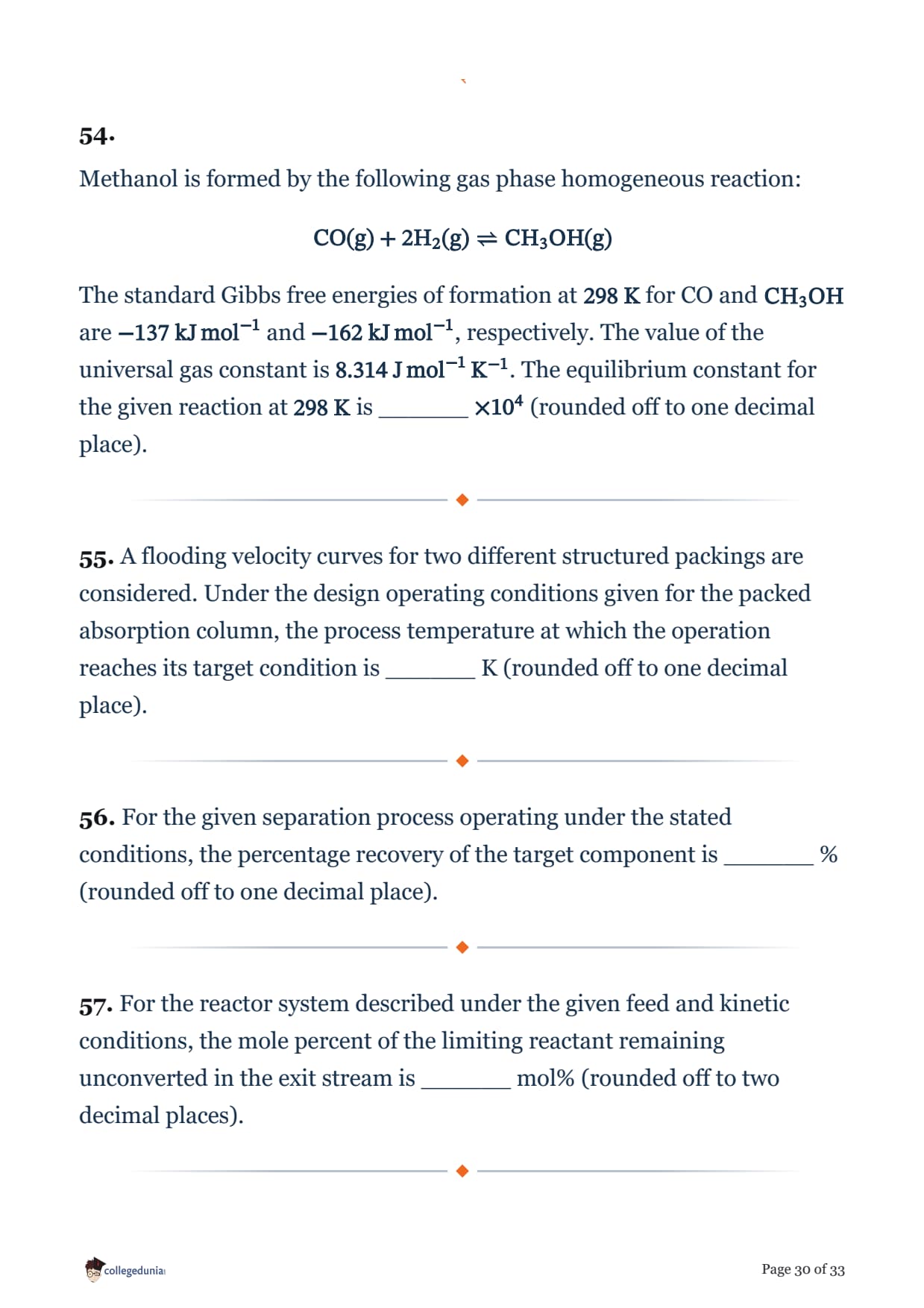
Methanol is formed by the following gas phase homogeneous reaction:
\[ \mathrm{CO(g) + 2H_2(g) \rightleftharpoons CH_3OH(g)} \]The standard Gibbs free energies of formation at \(298\ \mathrm{K}\) for CO and \(\mathrm{CH_3OH}\) are \(-137\ \mathrm{kJ\,mol^{-1}}\) and \(-162\ \mathrm{kJ\,mol^{-1}}\), respectively. The value of the universal gas constant is \(8.314\ \mathrm{J\,mol^{-1}\,K^{-1}}\). The equilibrium constant for the given reaction at \(298\ \mathrm{K}\) is ______ \(\times 10^4\) (rounded off to one decimal place).
A flooding velocity curves for two different structured packings are considered. Under the design operating conditions given for the packed absorption column, the process temperature at which the operation reaches its target condition is ______ K (rounded off to one decimal place).
For the given separation process operating under the stated conditions, the percentage recovery of the target component is ______ % (rounded off to one decimal place).
For the reactor system described under the given feed and kinetic conditions, the mole percent of the limiting reactant remaining unconverted in the exit stream is ______ mol% (rounded off to two decimal places).
For the given heat exchange/power process operating under the stated conditions, the net power requirement of the process is ______ kW (rounded off to one decimal place).
For the particle settling/separation system described under the given operating conditions, the cut size of the separation is ______ \(\mu\)m (rounded off to nearest integer).
For the equipment sizing problem described under the given operating and design conditions, the required diameter of the equipment is ______ mm (rounded off to one decimal place).
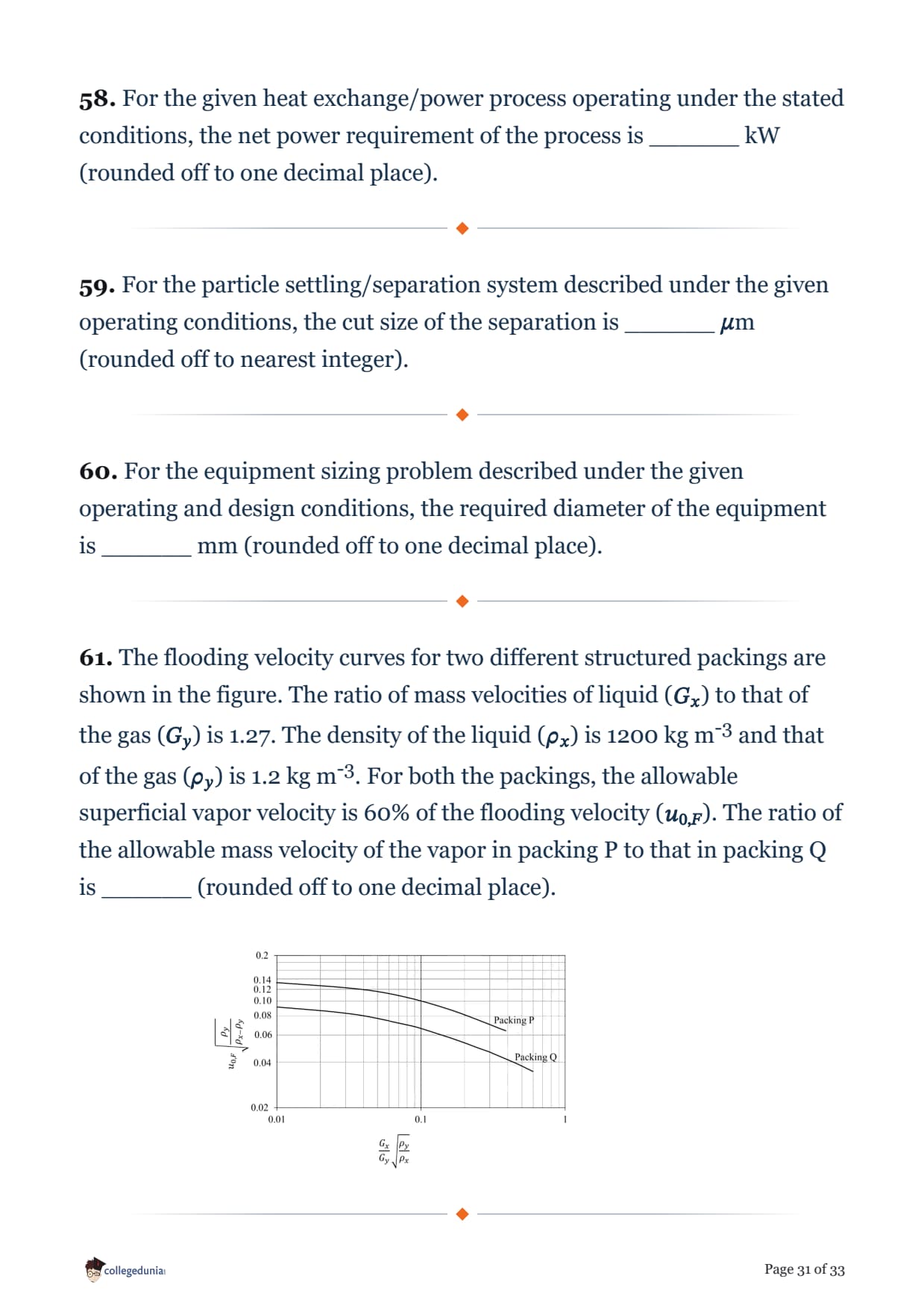
The flooding velocity curves for two different structured packings are shown in the figure. The ratio of mass velocities of liquid (\(G_x\)) to that of the gas (\(G_y\)) is 1.27. The density of the liquid (\(\rho_x\)) is 1200 kg m-3 and that of the gas (\(\rho_y\)) is 1.2 kg m-3. For both the packings, the allowable superficial vapor velocity is 60% of the flooding velocity (\(u_{0,F}\)). The ratio of the allowable mass velocity of the vapor in packing P to that in packing Q is ______ (rounded off to one decimal place).

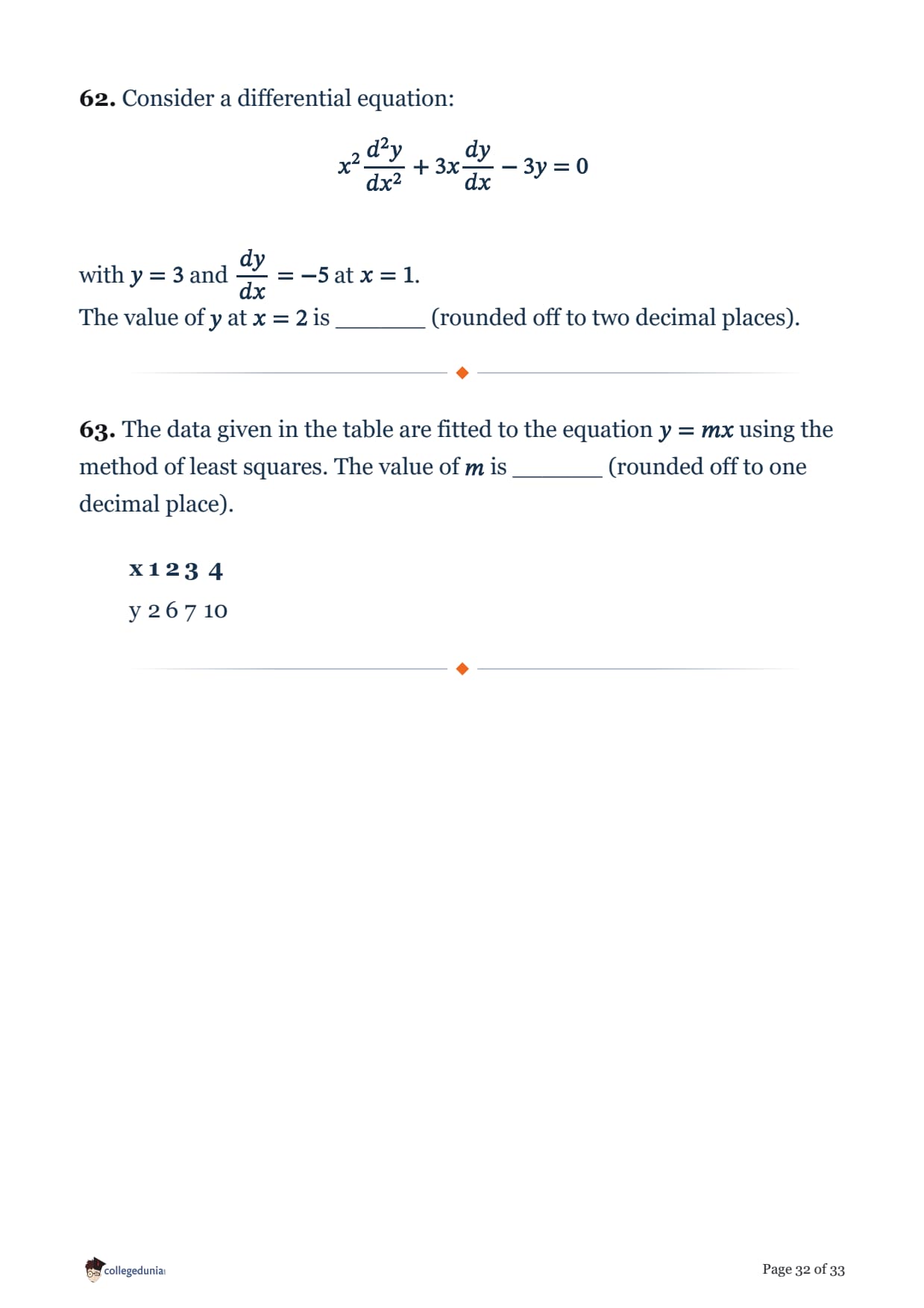
Consider a differential equation:
\[ x^2 \frac{d^2y}{dx^2} + 3x\frac{dy}{dx} - 3y = 0 \]
with \(y = 3\) and \(\dfrac{dy}{dx} = -5\) at \(x = 1\).
The value of \(y\) at \(x = 2\) is ______ (rounded off to two decimal places).
The data given in the table are fitted to the equation \(y = mx\) using the method of least squares. The value of \(m\) is ______ (rounded off to one decimal place).
| x | 1 | 2 | 3 | 4 |
|---|---|---|---|---|
| y | 2 | 6 | 7 | 10 |
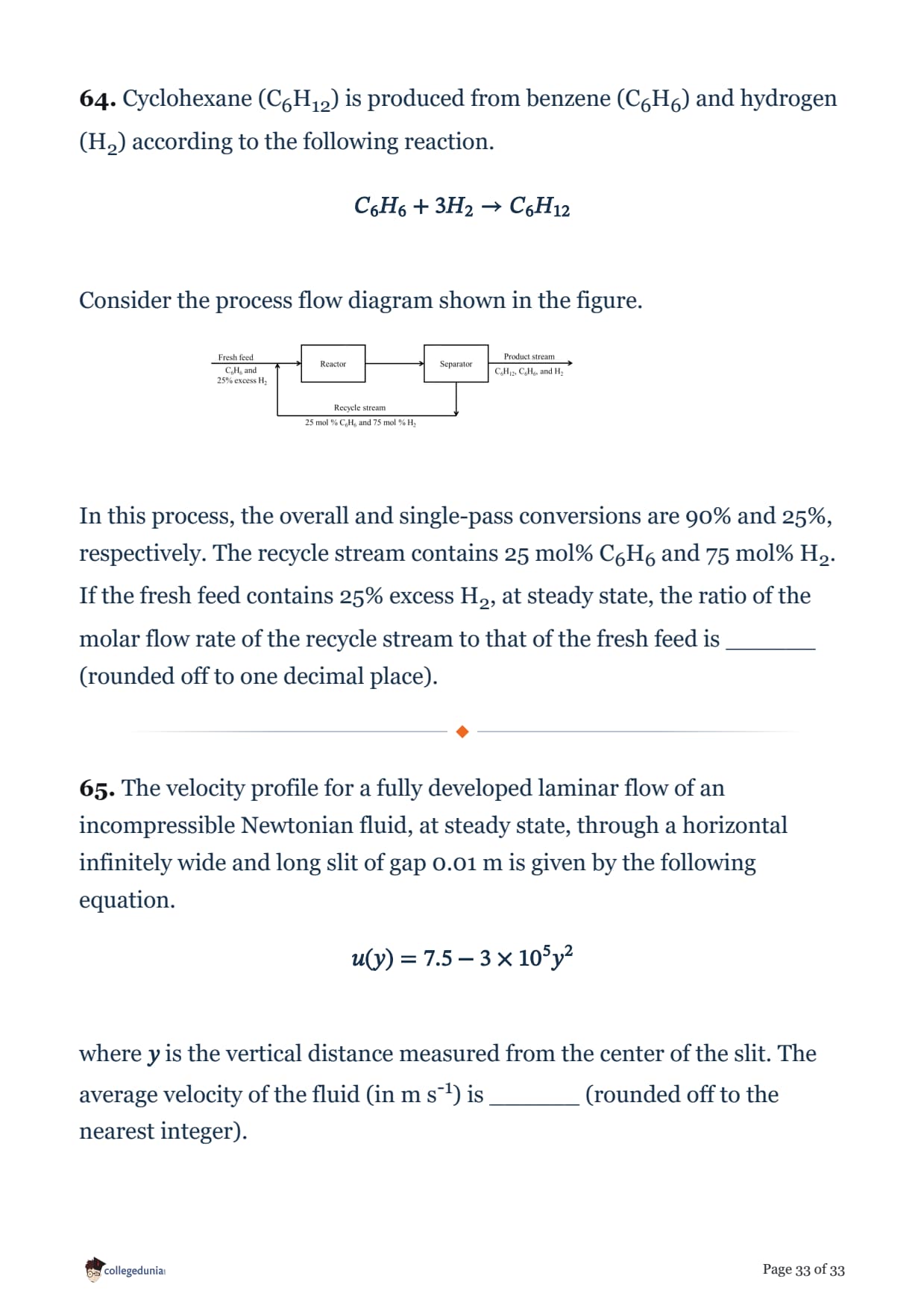
Cyclohexane (C6H12) is produced from benzene (C6H6) and hydrogen (H2) according to the following reaction.
\[ C_6H_6 + 3H_2 \rightarrow C_6H_{12} \]
Consider the process flow diagram shown in the figure.

In this process, the overall and single-pass conversions are 90% and 25%, respectively. The recycle stream contains 25 mol% C6H6 and 75 mol% H2. If the fresh feed contains 25% excess H2, at steady state, the ratio of the molar flow rate of the recycle stream to that of the fresh feed is ______ (rounded off to one decimal place).
The velocity profile for a fully developed laminar flow of an incompressible Newtonian fluid, at steady state, through a horizontal infinitely wide and long slit of gap 0.01 m is given by the following equation.
\[ u(y) = 7.5 - 3\times10^{5}y^2 \]
where \(y\) is the vertical distance measured from the center of the slit. The average velocity of the fluid (in m s-1) is ______ (rounded off to the nearest integer).
GATE 2026 Chemical Engineering Exam Pattern and Marking Scheme Explained
As per the information bulletin on the official website (gate2026.iitg.ac.in), GATE 2026 CH is a single 3-hour computer-based test covering General Aptitude, Engineering Mathematics, and the core Chemical Engineering syllabus.
- Total questions: 65, made up of 39 MCQs, 21 Numerical Answer Type (NAT) questions, and 5 Multiple Select (MSQ) questions
- Duration: 3 hours
- Total marks: 100 - General Aptitude carries 15 marks (10 questions), Engineering Mathematics 13 marks, and the core CH subject 72 marks
- Marking scheme: MCQs lose 1/3 mark for a wrong answer; NAT and MSQ questions carry no negative marking
- Question types: a mix of single-correct MCQs, multi-select MSQs, and NAT questions where you key in a numeric value
High-Weightage Subjects in GATE 2026 Chemical Engineering to Focus On First
Going through this year's 65 solved questions, Mass Transfer and Engineering Mathematics were the two heaviest subjects, each accounting for 9 questions.
- Mass Transfer: 9 questions - the single biggest block in the core section
- Engineering Mathematics: 9 questions, matching Mass Transfer for the top spot
- Chemical Reaction Engineering: 6 questions, several needing multi-step rate-law setups
- Fluid Mechanics: 6 questions, plus another 5 from Fluid Mechanics and Mechanical Operations - 11 questions in total when you count both together
- Process Control and Heat Transfer: 5 questions each
- Process Calculations and Thermodynamics: 4 questions, with Gibbs free energy and phase-rule concepts showing up here
GATE 2026 Chemical Engineering Paper Analysis Video
Source: Chemical GATEway
How to Use the GATE 2026 CH Question Paper for Practice
Treat this paper as a timed mock before you look at a single solution.
- Attempt all 65 questions in 3 hours under exam conditions first, without checking the solution PDF
- Score yourself with the marking scheme above (MCQ -1/3, NAT and MSQ with no negative marking) to get a realistic number
- Since Mass Transfer and Engineering Mathematics carried the most questions this year, redo every Mass Transfer and Engineering Mathematics question you got wrong before moving to lower-weightage subjects
- Use the solution PDF's step-by-step working for Chemical Reaction Engineering and Process Calculations questions - these carried the longest, most multi-step solutions in this paper
- Re-attempt the paper a second time a week later, focusing only on the subjects where you lost marks
GATE 2026 Chemical Engineering Question Paper FAQs
Ques. Was GATE 2026 Chemical Engineering tougher than previous years?
Ans. Post-exam analysis rated GATE 2026 CH as moderate difficulty. Chemical Reaction Engineering and Thermodynamics questions were conceptually deep, and Process Calculations had lengthy NAT questions, while Mechanical Operations, Process Design and Economics, and General Aptitude questions were comparatively easier.
Ques. Which topics had the highest weightage in GATE 2026 Chemical Engineering?
Ans. Mass Transfer and Engineering Mathematics led with 9 questions each, followed by Chemical Reaction Engineering and Fluid Mechanics with 6 questions each, and Process Control and Heat Transfer with 5 questions each.
Ques. How many questions in GATE 2026 CH were General Aptitude versus core Chemical Engineering?
Ans. General Aptitude had 10 questions worth 15 marks. The remaining 55 questions split across Engineering Mathematics (13 marks) and the core Chemical Engineering subject (72 marks), for 100 marks total.
Ques. Is there negative marking in GATE 2026 Chemical Engineering?
Ans. Yes, but only for MCQs - a wrong MCQ answer costs 1/3 mark. Numerical Answer Type (NAT) and Multiple Select (MSQ) questions carry no negative marking, so it's safer to attempt those even when you're not fully sure.
Ques. When was the GATE 2026 result declared?
Ans. The GATE 2026 result was declared on March 19, 2026, at 3 PM, with scorecards available for free download from March 27 to May 31, 2026, on the official GOAPS portal.
Ques. Where can I download the GATE 2026 Chemical Engineering question paper with solutions PDF for free?
Ans. Use the download table above on Collegedunia for the free question paper and solutions PDF. For the official paper and provisional answer key, check gate2026.iitg.ac.in.



Comments