




The GATE 2026 Geology and Geophysics (GG1) question paper is now available with detailed solutions for free download. GATE 2026 GG was conducted by IIT Guwahati on February 7, 2026 (morning session), and the paper carried 65 questions worth 100 marks in 3 hours.
| GATE 2026 Geology and Geophysics (GG1) Question Paper with Solutions | Download PDF | Check Solutions |
GATE 2026 Geology and Geophysics (GG1) Questions with Solutions
Suresh said, "I did it yesterday." Which one of the following options is the correct form of this sentence in indirect speech?
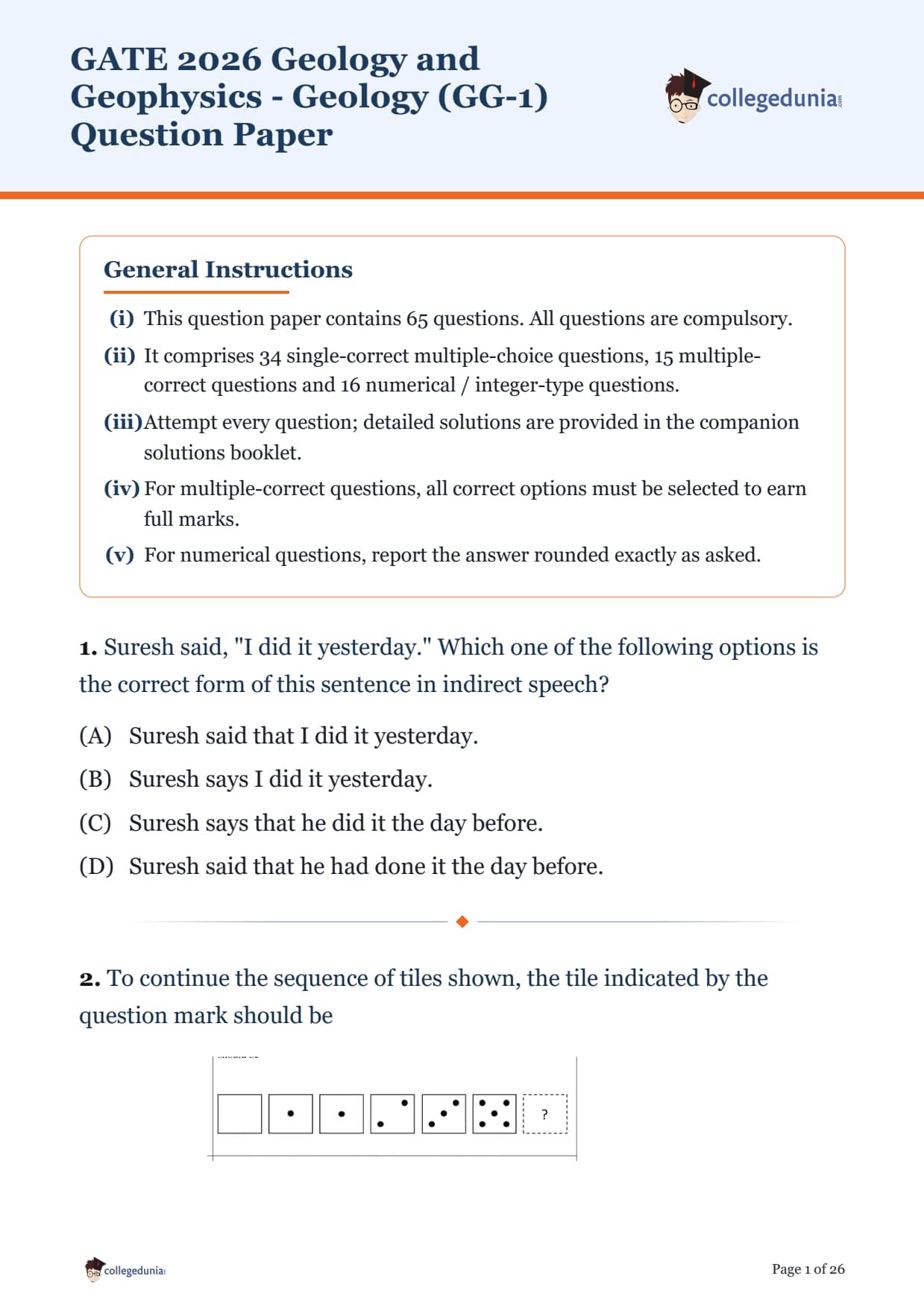
To continue the sequence of tiles shown, the tile indicated by the question mark should be

- (A)
![]()
- (B)
![]()
- (C)
![]()
- (D)
![]()


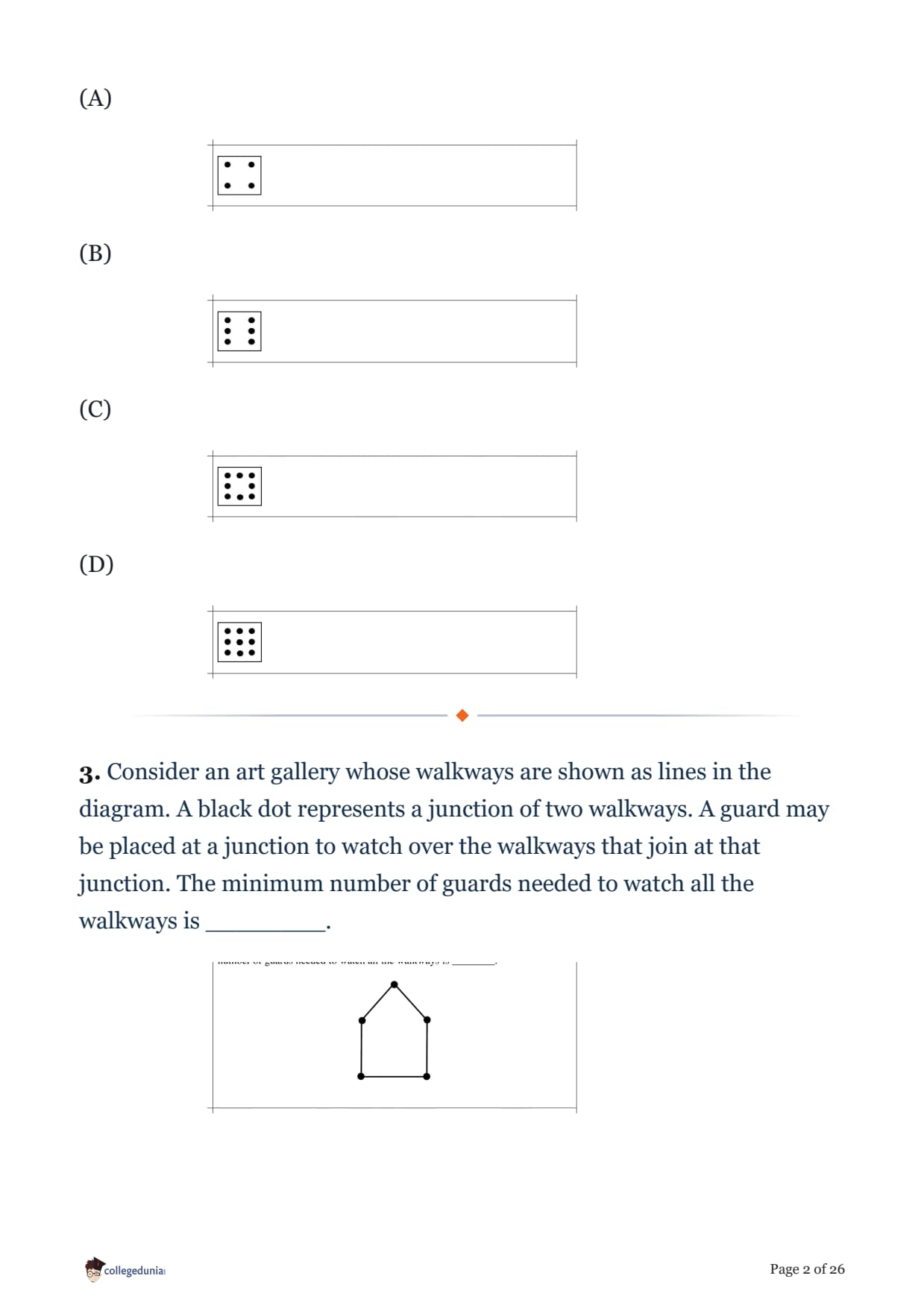
Consider an art gallery whose walkways are shown as lines in the diagram. A black dot represents a junction of two walkways. A guard may be placed at a junction to watch over the walkways that join at that junction. The minimum number of guards needed to watch all the walkways is ________.

The 2nd of June is a Thursday in a certain year. Which day of the week is the 3rd of July in that year?
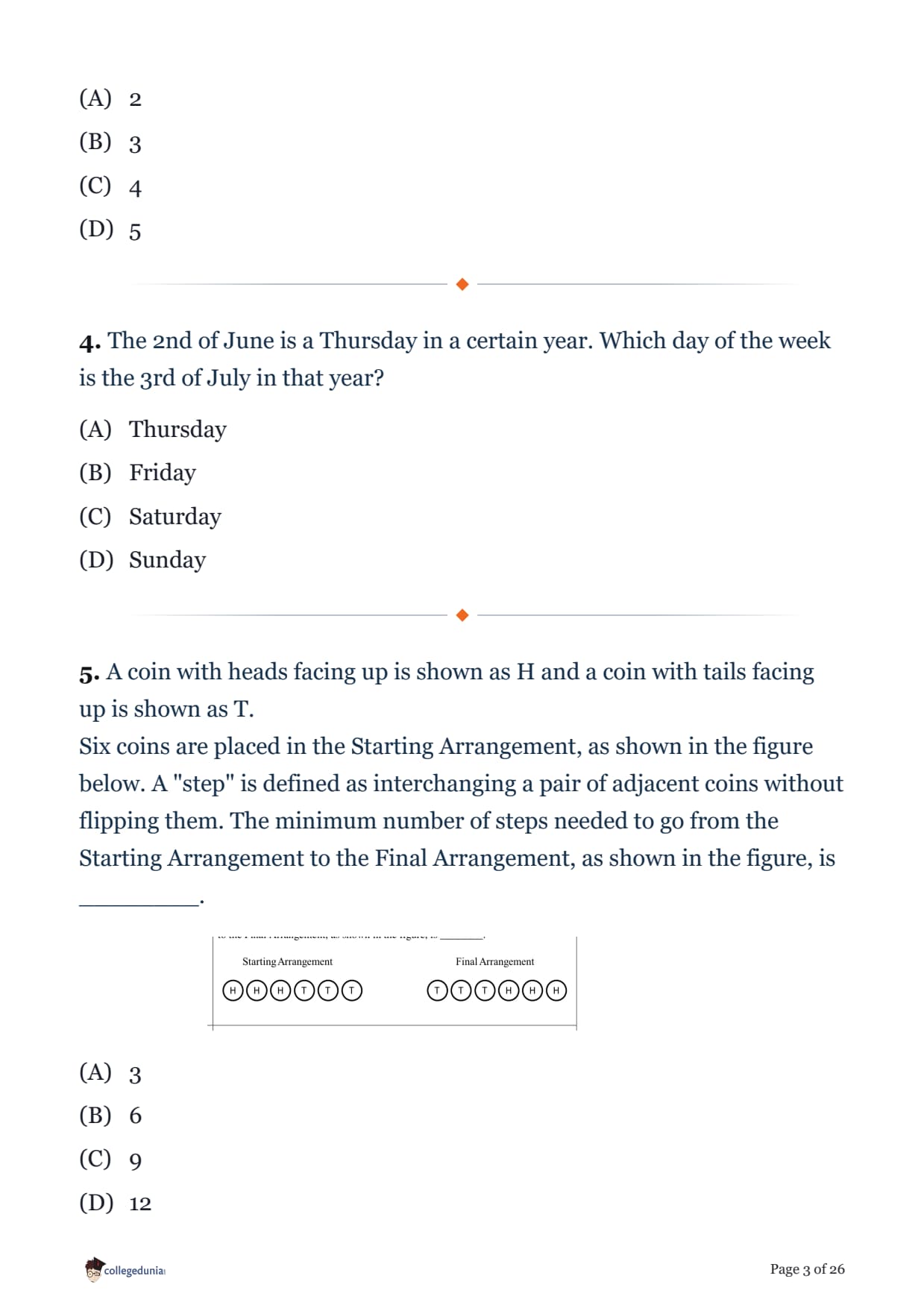
A coin with heads facing up is shown as H and a coin with tails facing up is shown as T.
Six coins are placed in the Starting Arrangement, as shown in the figure below. A "step" is defined as interchanging a pair of adjacent coins without flipping them. The minimum number of steps needed to go from the Starting Arrangement to the Final Arrangement, as shown in the figure, is ________.

Exacerbate : Mitigate :: ___________
Choose the option with the correct pair of words to fill the blank.
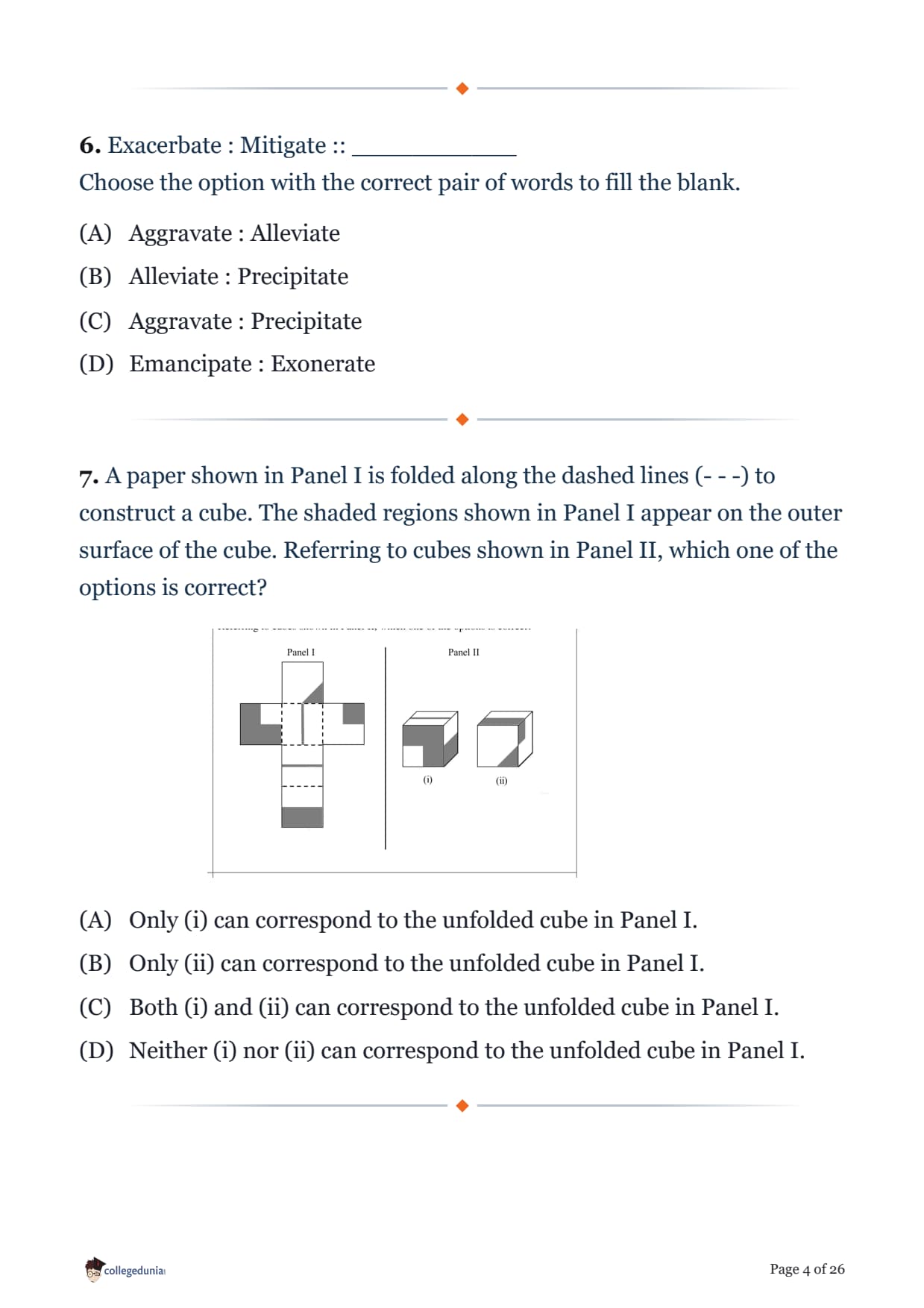
A paper shown in Panel I is folded along the dashed lines (- - -) to construct a cube. The shaded regions shown in Panel I appear on the outer surface of the cube. Referring to cubes shown in Panel II, which one of the options is correct?

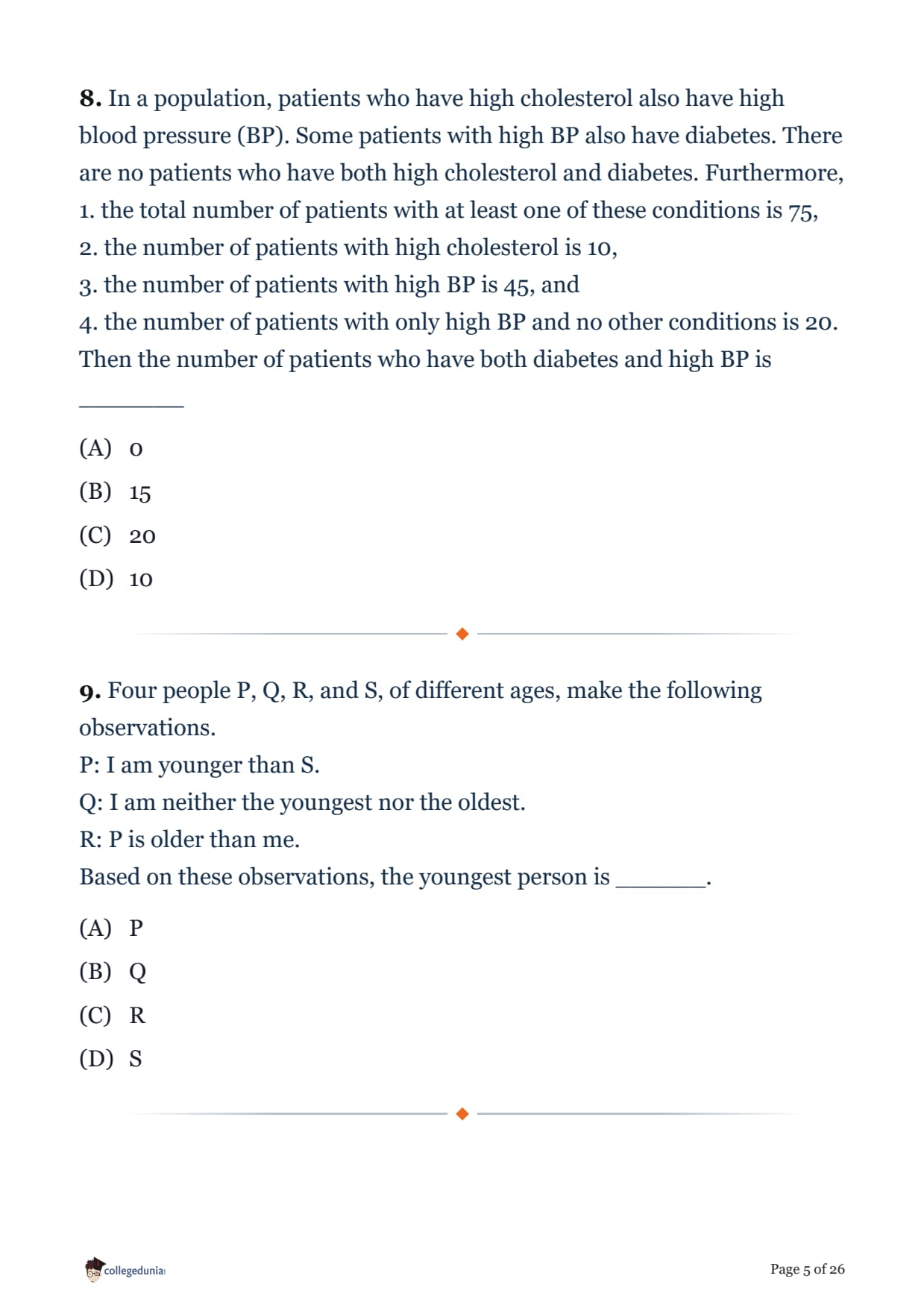
In a population, patients who have high cholesterol also have high blood pressure (BP). Some patients with high BP also have diabetes. There are no patients who have both high cholesterol and diabetes. Furthermore,
1. the total number of patients with at least one of these conditions is 75,
2. the number of patients with high cholesterol is 10,
3. the number of patients with high BP is 45, and
4. the number of patients with only high BP and no other conditions is 20.
Then the number of patients who have both diabetes and high BP is _______
Four people P, Q, R, and S, of different ages, make the following observations.
P: I am younger than S.
Q: I am neither the youngest nor the oldest.
R: P is older than me.
Based on these observations, the youngest person is ______.
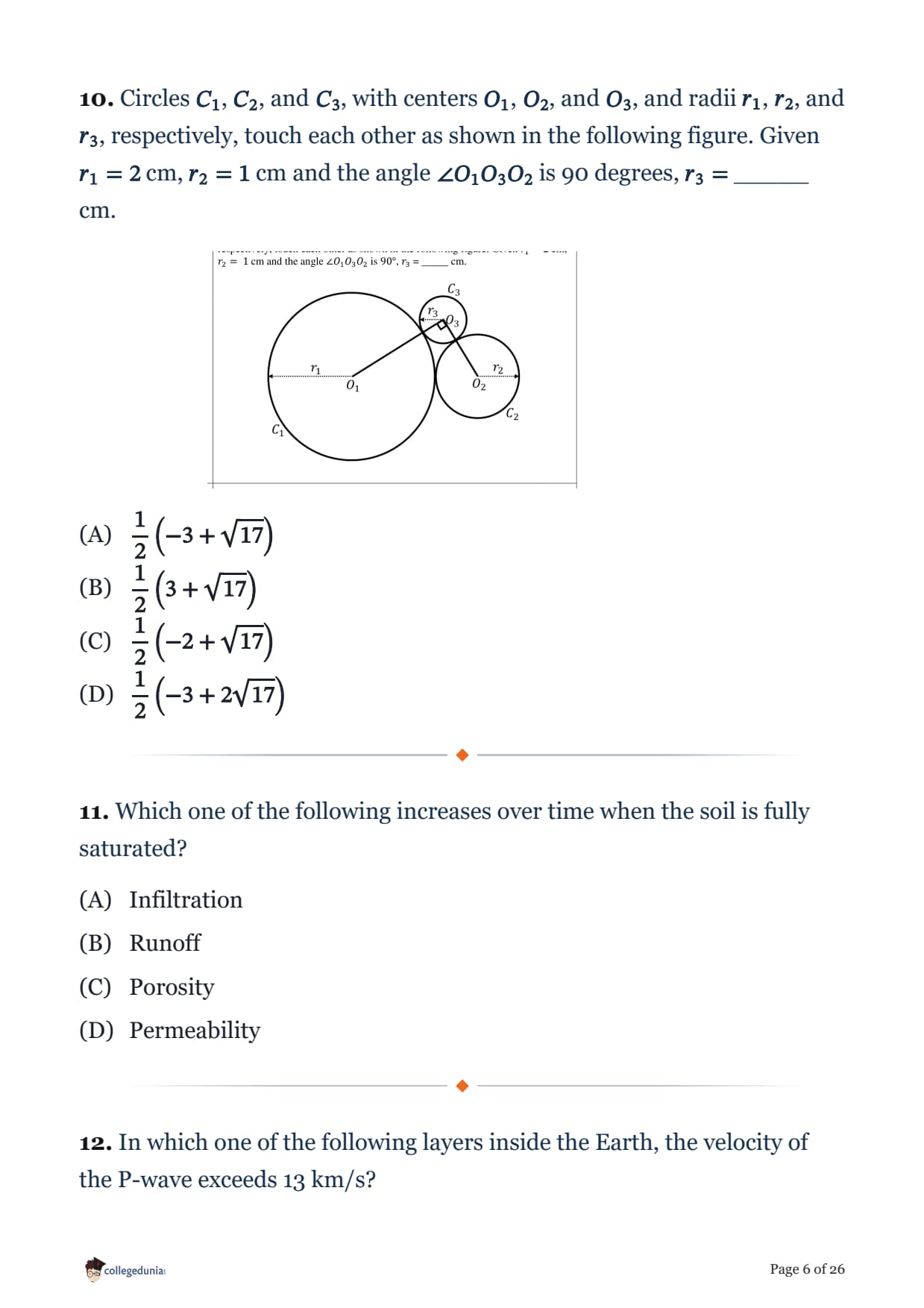
Circles \(C_1\), \(C_2\), and \(C_3\), with centers \(O_1\), \(O_2\), and \(O_3\), and radii \(r_1\), \(r_2\), and \(r_3\), respectively, touch each other as shown in the following figure. Given \(r_1 = 2\) cm, \(r_2 = 1\) cm and the angle \(\angle O_1 O_3 O_2\) is 90 degrees, \(r_3 =\) _____ cm.

Which one of the following increases over time when the soil is fully saturated?
In which one of the following layers inside the Earth, the velocity of the P-wave exceeds 13 km/s?
Which one of the following is NOT a volcanic igneous rock?
If \(r_1\) and \(r_2\), respectively, denote the equatorial and polar radii of a reference ellipsoid, then the radius, \(R\), of its equivalent sphere is given by
Which of the following sources is/are used in land seismic surveys?
A pebble has an average diameter of 8 mm. Its \(\phi\)-value on the Udden-Wentworth scale is ___________ (answer in integer).
A quartz vein in a granitic outcrop has an initial length of 20 cm. If it undergoes uniform stretching resulting in a longitudinal strain of 0.45, the length of the vein post deformation is _________cm (answer in integer).
Which one of the following is the CORRECT pair of radioactive parent isotope and the corresponding radiogenic daughter isotope?
Which one of the following pairs of geophysical signatures most commonly indicates volcanogenic massive sulphide deposits?
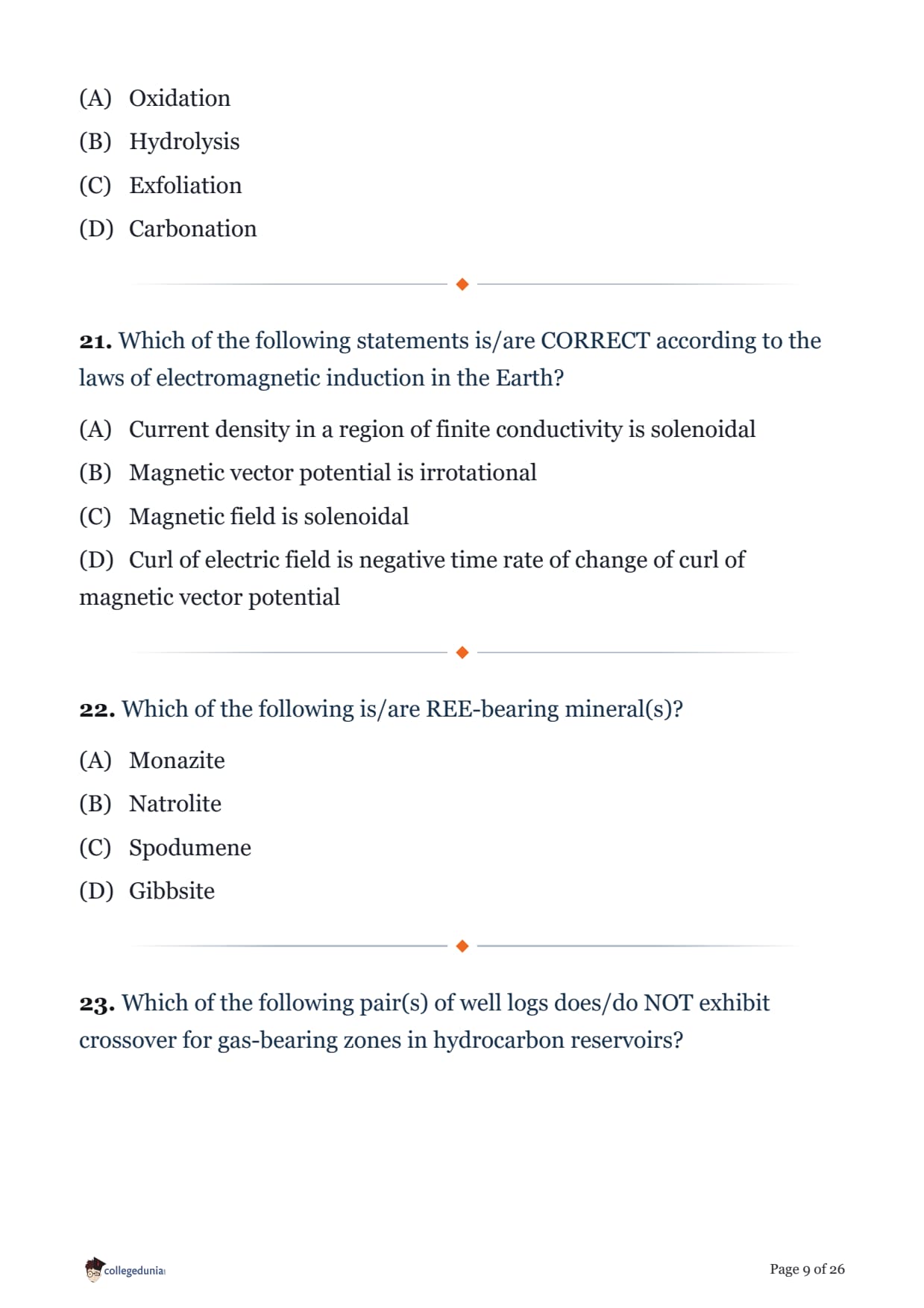
Which one of the following is a physical weathering process?
Which of the following statements is/are CORRECT according to the laws of electromagnetic induction in the Earth?
Which of the following is/are REE-bearing mineral(s)?
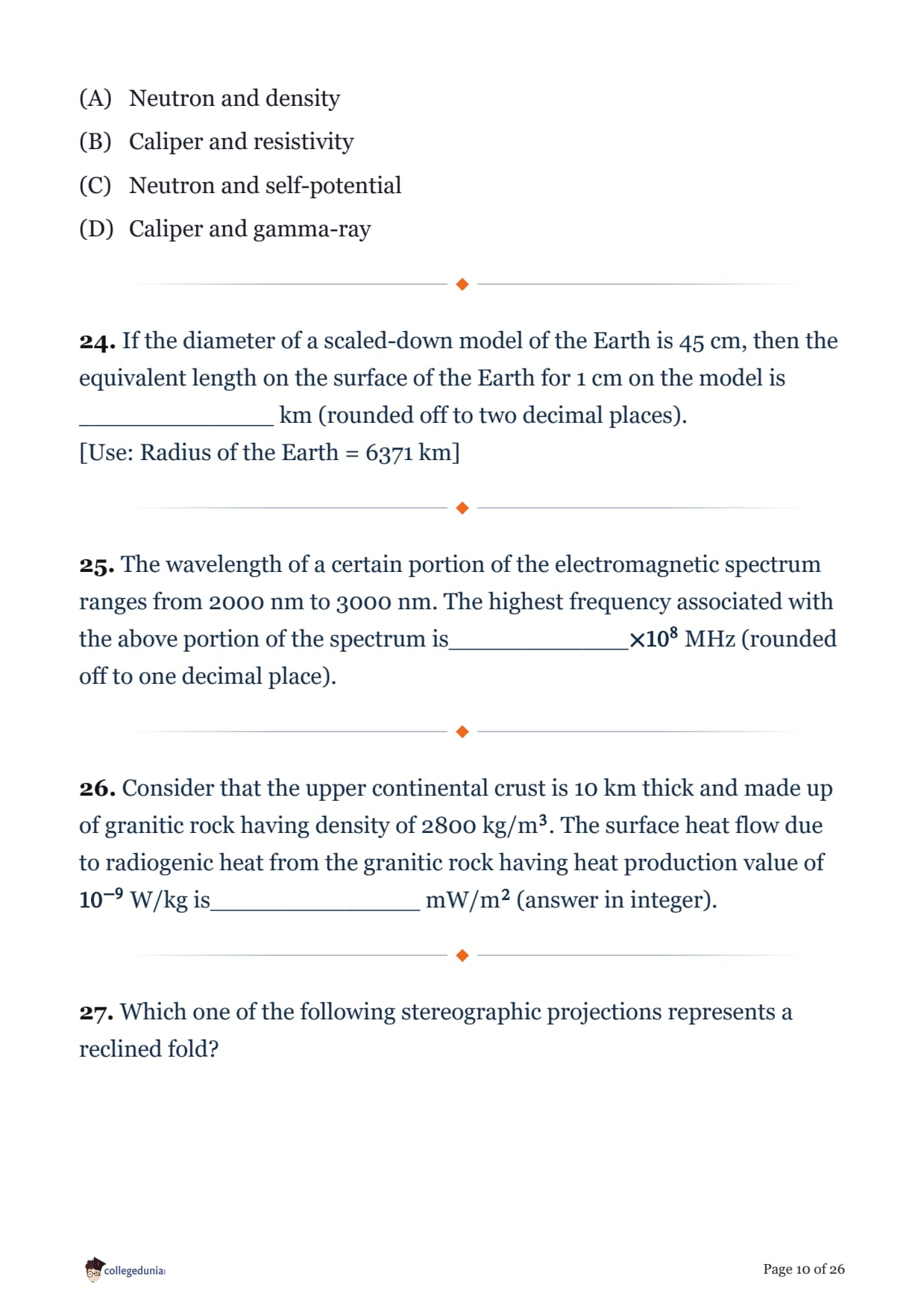
Which of the following pair(s) of well logs does/do NOT exhibit crossover for gas-bearing zones in hydrocarbon reservoirs?
If the diameter of a scaled-down model of the Earth is 45 cm, then the equivalent length on the surface of the Earth for 1 cm on the model is _____________ km (rounded off to two decimal places).
[Use: Radius of the Earth = 6371 km]
The wavelength of a certain portion of the electromagnetic spectrum ranges from 2000 nm to 3000 nm. The highest frequency associated with the above portion of the spectrum is____________\(\times10^{8}\) MHz (rounded off to one decimal place).
Consider that the upper continental crust is 10 km thick and made up of granitic rock having density of 2800 kg/m\(^3\). The surface heat flow due to radiogenic heat from the granitic rock having heat production value of \(10^{-9}\) W/kg is______________ mW/m\(^2\) (answer in integer).
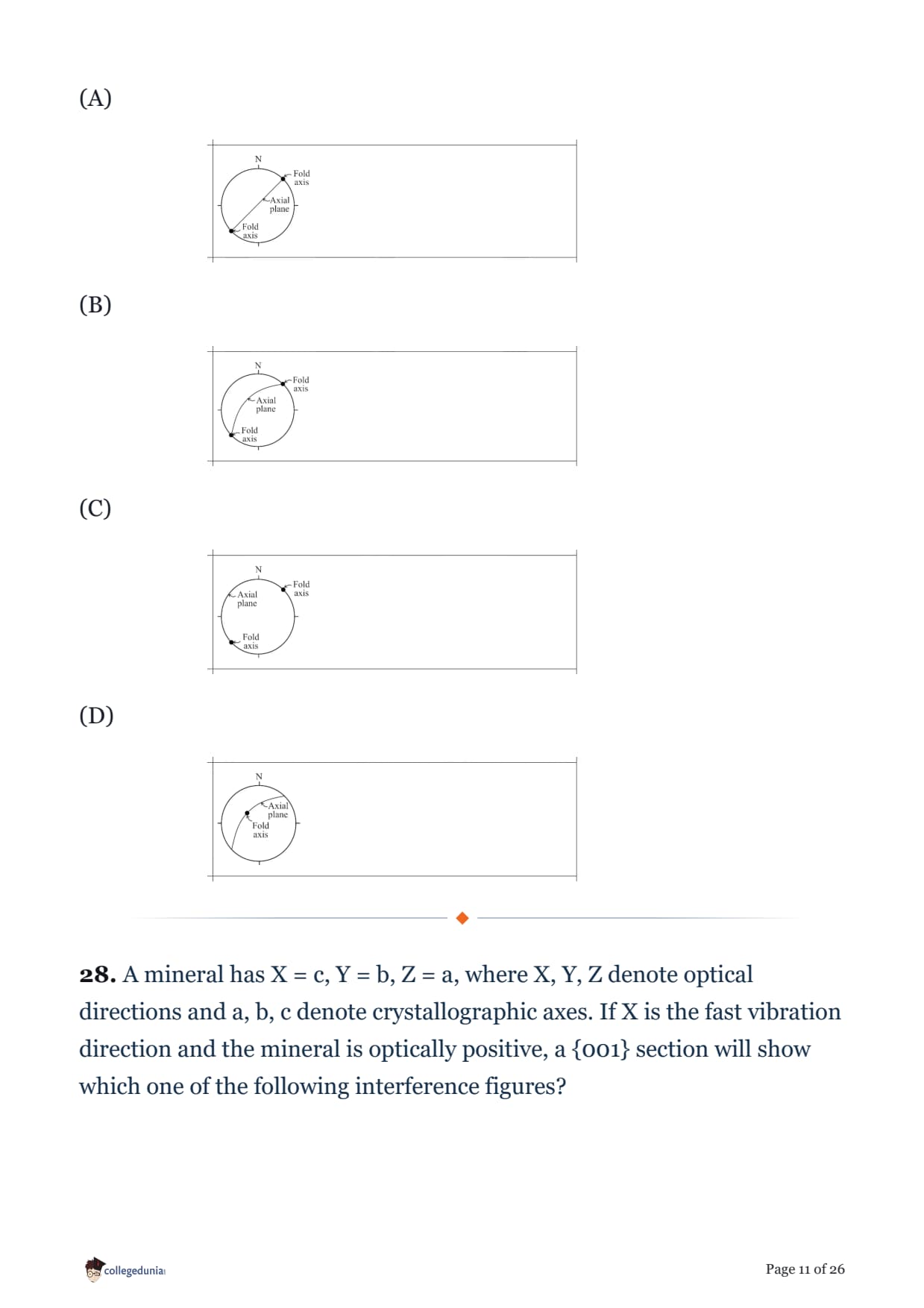
Which one of the following stereographic projections represents a reclined fold?
- (A)
![]()
- (B)
![]()
- (C)
![]()
- (D)
![]()


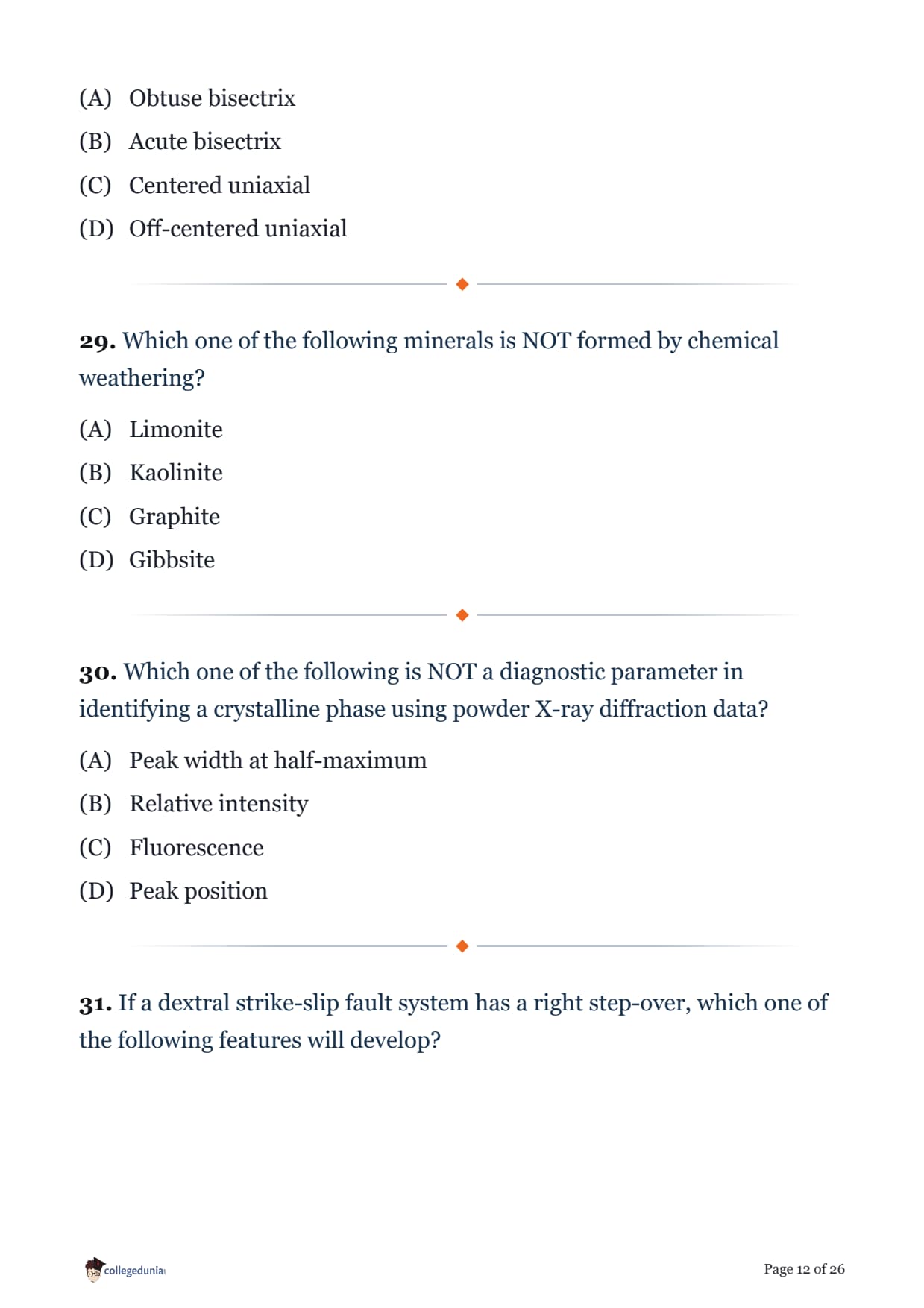
A mineral has X = c, Y = b, Z = a, where X, Y, Z denote optical directions and a, b, c denote crystallographic axes. If X is the fast vibration direction and the mineral is optically positive, a {001} section will show which one of the following interference figures?
Which one of the following minerals is NOT formed by chemical weathering?
Which one of the following is NOT a diagnostic parameter in identifying a crystalline phase using powder X-ray diffraction data?
If a dextral strike-slip fault system has a right step-over, which one of the following features will develop?
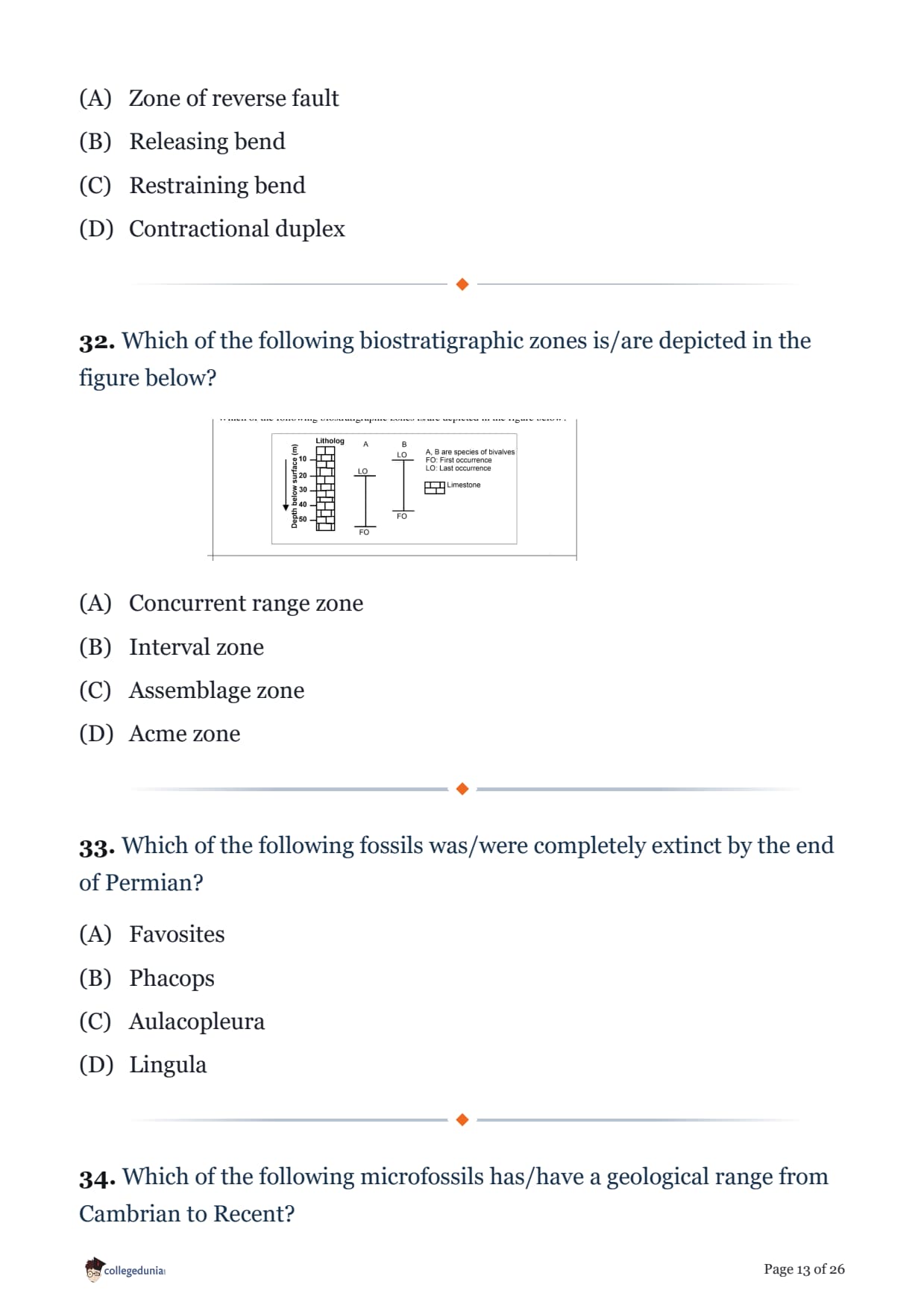
Which of the following biostratigraphic zones is/are depicted in the figure below?

Which of the following fossils was/were completely extinct by the end of Permian?
Which of the following microfossils has/have a geological range from Cambrian to Recent?
Which of the following statements is/are CORRECT in terms of dentition in bivalves?
Which of the following deposits is/are linked to magmatic-hydrothermal fluids derived from granitic plutons?
Which of the following statements related to crystal defects is/are CORRECT?
Choose the CORRECT factor(s) from the following, which affect(s) the \(^{18}O/^{16}O\) isotopic ratio in foraminifera growing in an ocean.
Which of the following sedimentological processes lead(s) to time averaging of fossil record?
A sandstone bed has an orientation of 360/45W. If the true thickness of the bed is 50 m, the width of the outcrop exposed on a flat surface is _________ m (rounded off to one decimal place).
For a chemical system with 5 phases at the invariant point, the number of possible univariant reactions in pressure-temperature space is ____ (answer in integer).
Two tectonic plates, P and Q, move in opposite directions along a transform fault boundary. If the plate velocity of P is 8 cm/year and of Q is 6 cm/year with respect to a fixed reference frame, the relative velocity between P and Q is _______ cm/year (answer in integer).
If the atomic mass units of \(^{85}\text{Rb}\) and \(^{87}\text{Rb}\) are \(84.912\) and \(86.901\), respectively, then the abundance of \(^{87}\text{Rb}\) is _________ % (rounded off to nearest integer).
[Use: Average atomic mass of Rb = \(85.467\) amu]
A mineral under crossed nicols displays second order greenish-yellow (\(M = 740\) nm) interference colour. On introduction of a gypsum plate (\(A = 550\) nm) along the length of the mineral orientation, first order grey interference colour is displayed. The net retardation is _________ nm (answer in integer).
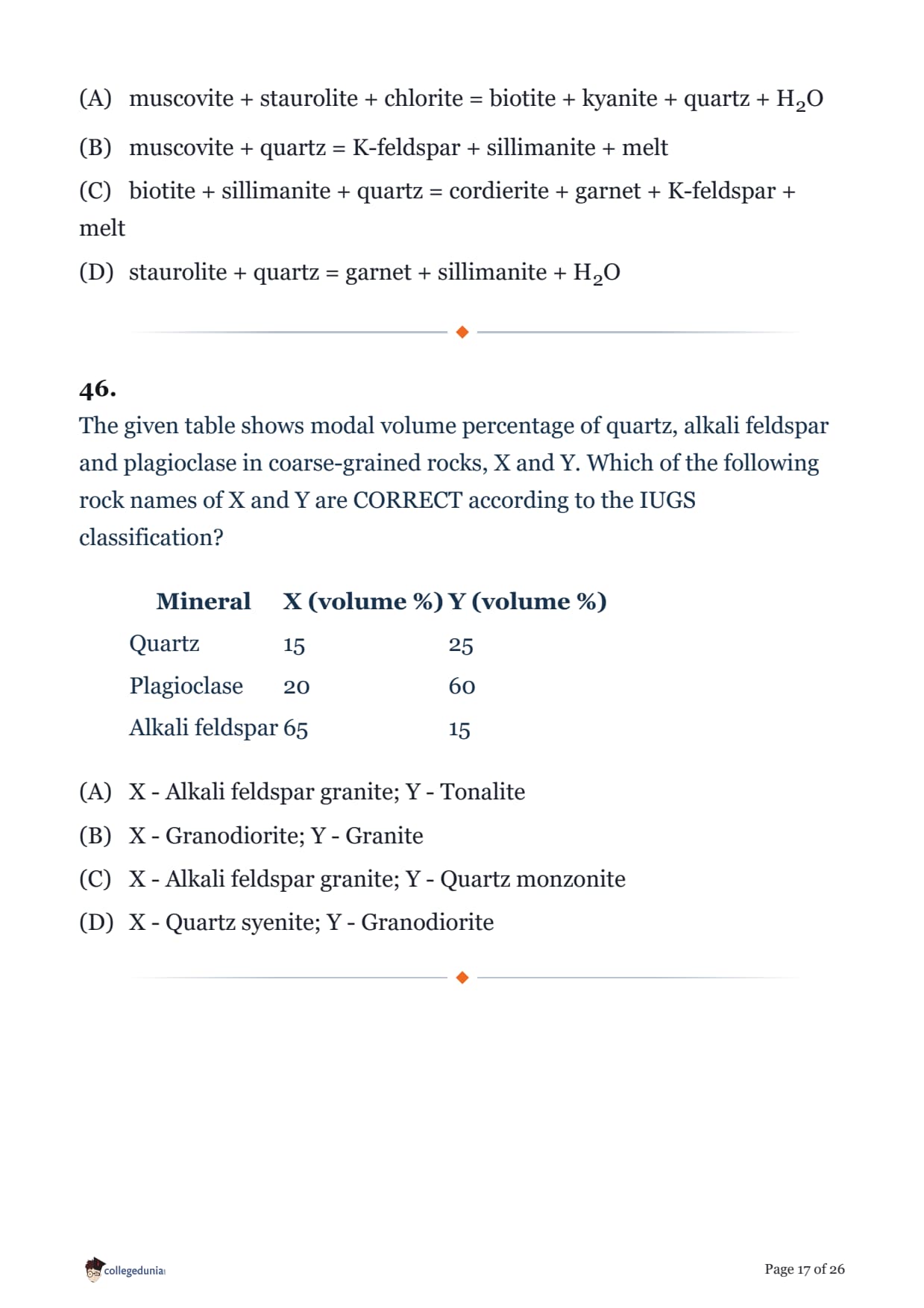
Which one of the following mineral reactions will result in the formation of a diagnostic granulite facies assemblage during regional metamorphism of a pelite?
| Mineral | X (volume %) | Y (volume %) |
|---|---|---|
| Quartz | 15 | 25 |
| Plagioclase | 20 | 60 |
| Alkali feldspar | 65 | 15 |
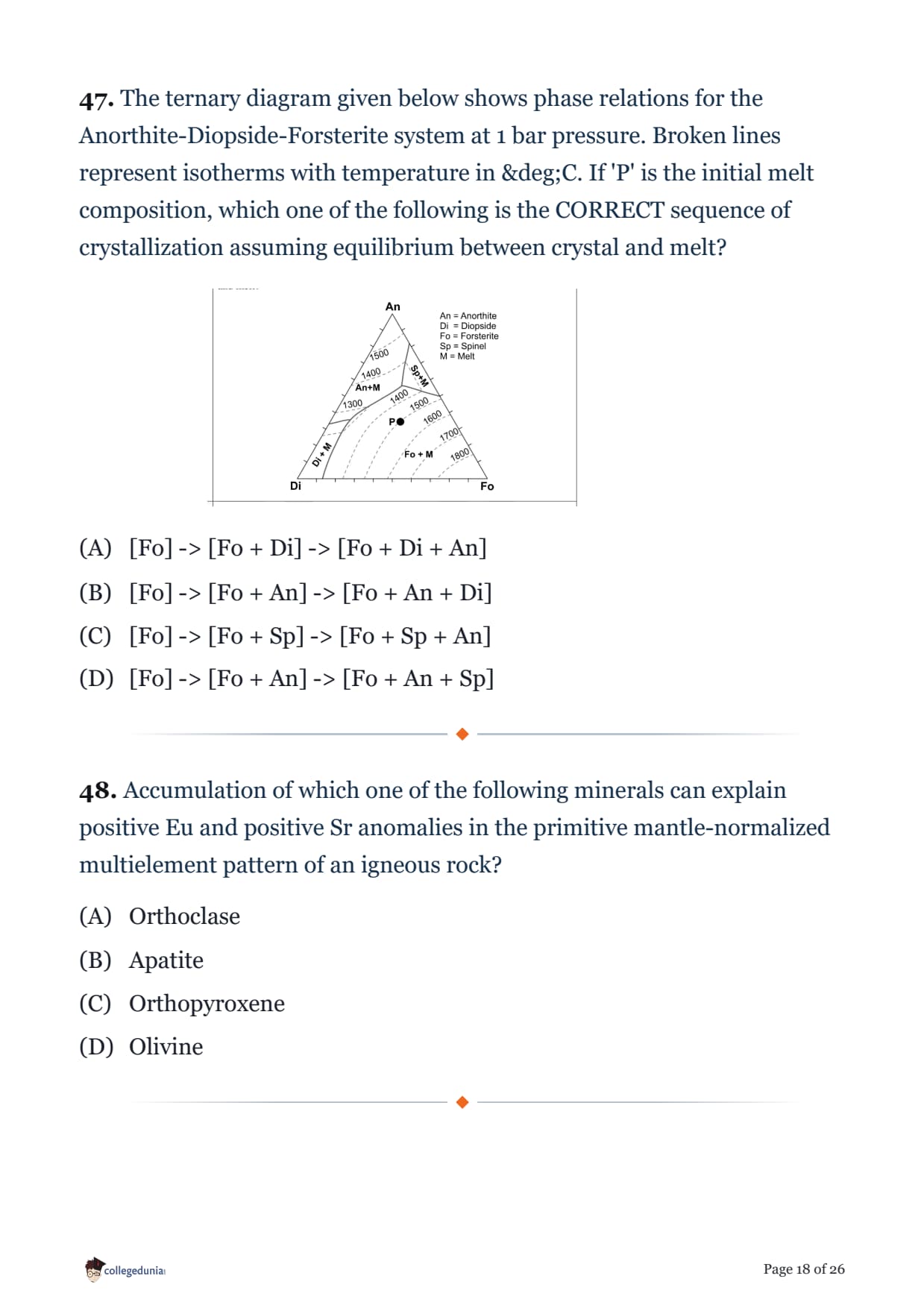
The ternary diagram given below shows phase relations for the Anorthite-Diopside-Forsterite system at 1 bar pressure. Broken lines represent isotherms with temperature in °C. If 'P' is the initial melt composition, which one of the following is the CORRECT sequence of crystallization assuming equilibrium between crystal and melt?

Accumulation of which one of the following minerals can explain positive Eu and positive Sr anomalies in the primitive mantle-normalized multielement pattern of an igneous rock?
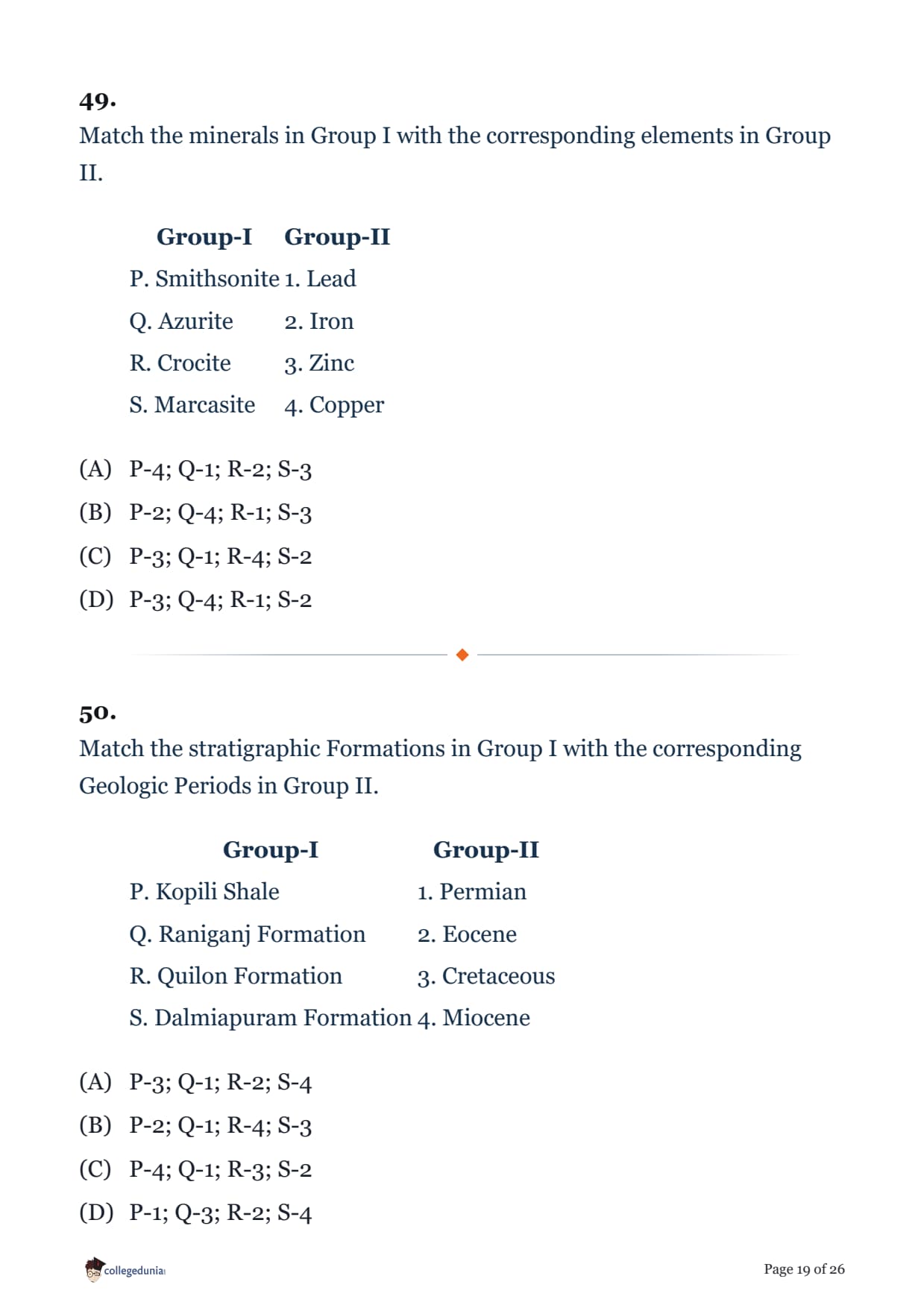
| Group-I | Group-II |
|---|---|
| P. Smithsonite | 1. Lead |
| Q. Azurite | 2. Iron |
| R. Crocite | 3. Zinc |
| S. Marcasite | 4. Copper |
| Group-I | Group-II |
|---|---|
| P. Kopili Shale | 1. Permian |
| Q. Raniganj Formation | 2. Eocene |
| R. Quilon Formation | 3. Cretaceous |
| S. Dalmiapuram Formation | 4. Miocene |
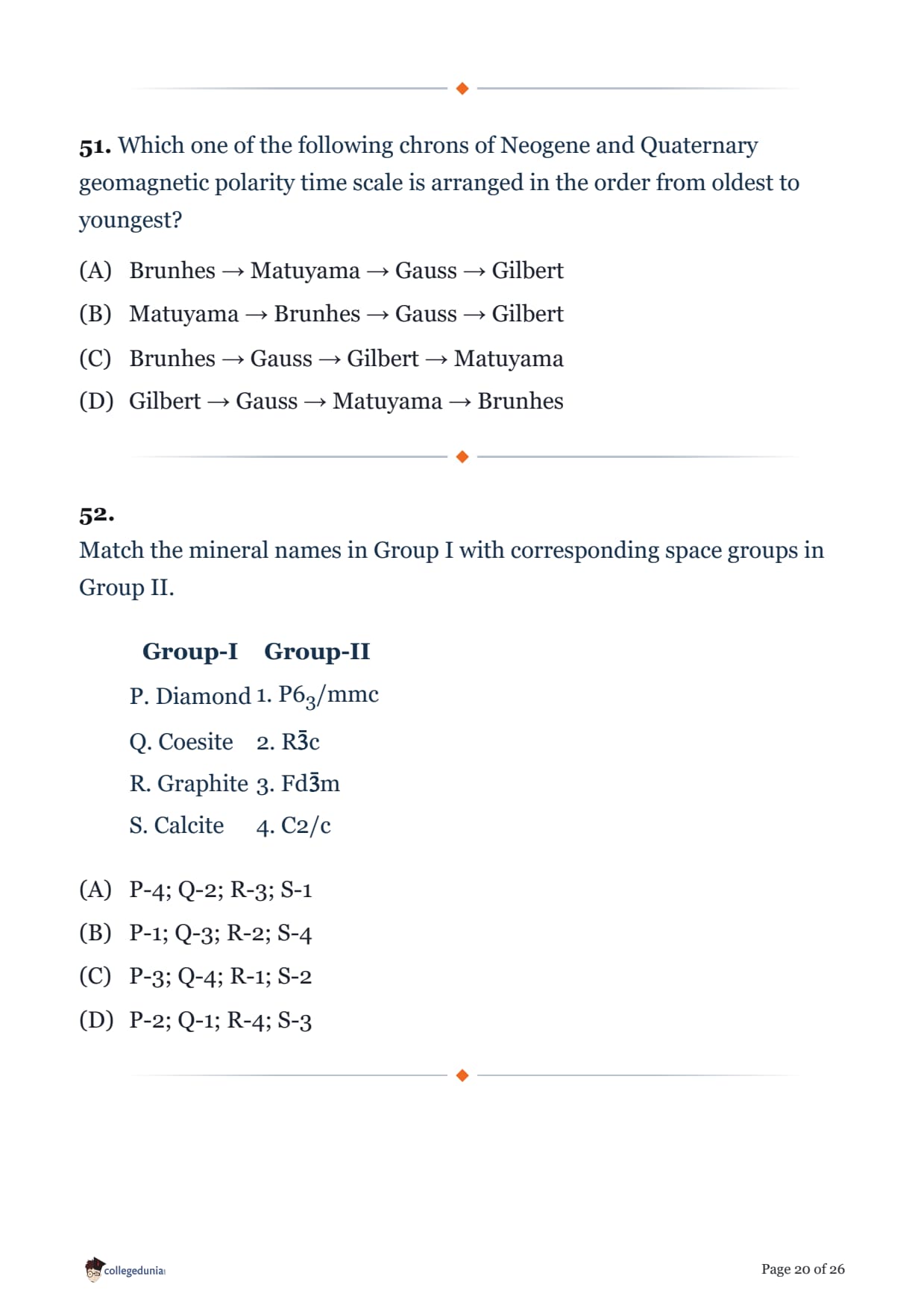
Which one of the following chrons of Neogene and Quaternary geomagnetic polarity time scale is arranged in the order from oldest to youngest?
| Group-I | Group-II |
|---|---|
| P. Diamond | 1. P63/mmc |
| Q. Coesite | 2. R\(\bar{3}\)c |
| R. Graphite | 3. Fd\(\bar{3}\)m |
| S. Calcite | 4. C2/c |
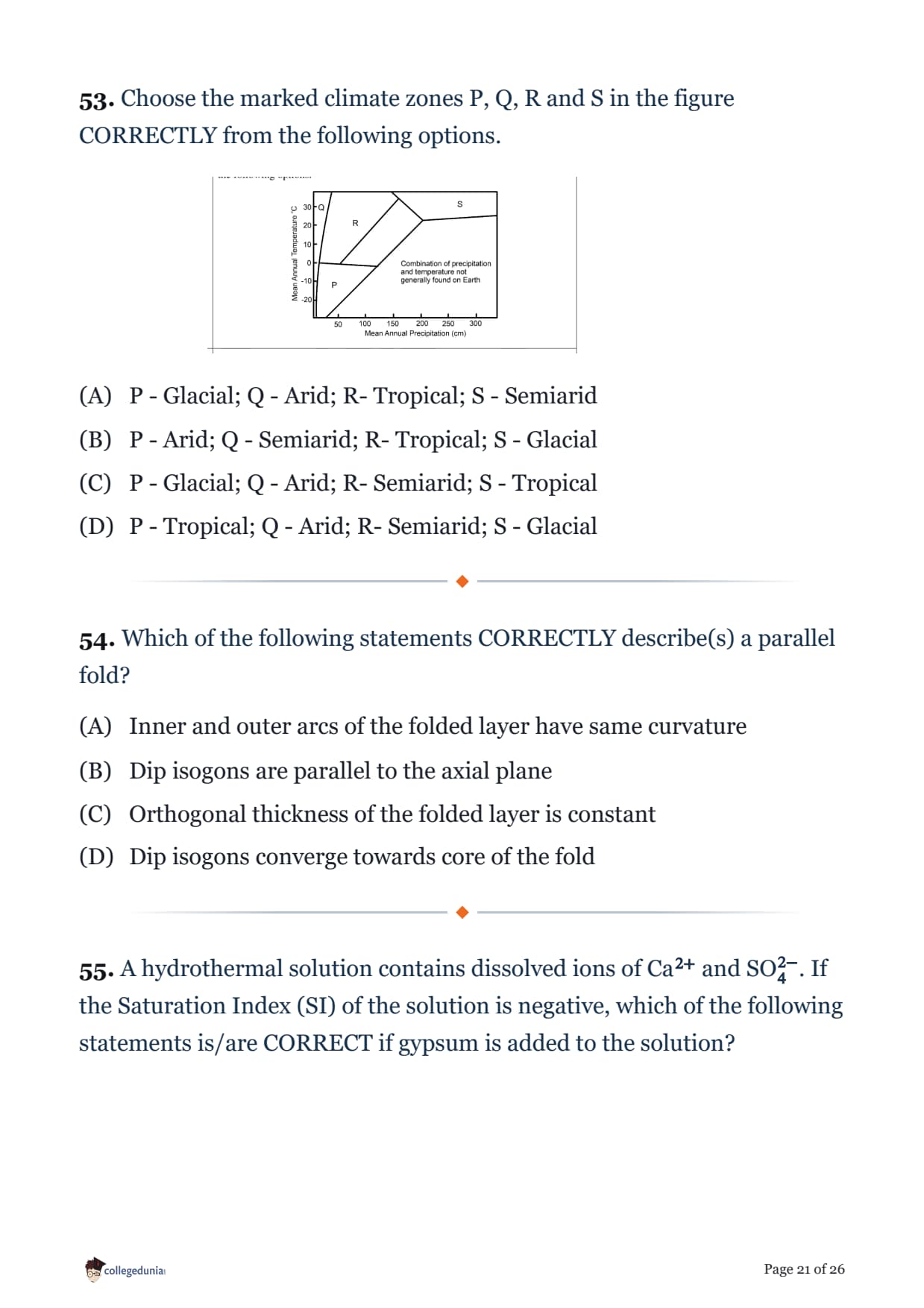
Choose the marked climate zones P, Q, R and S in the figure CORRECTLY from the following options.

Which of the following statements CORRECTLY describe(s) a parallel fold?
A hydrothermal solution contains dissolved ions of Ca\(^{2+}\) and SO\(_4^{2-}\). If the Saturation Index (SI) of the solution is negative, which of the following statements is/are CORRECT if gypsum is added to the solution?
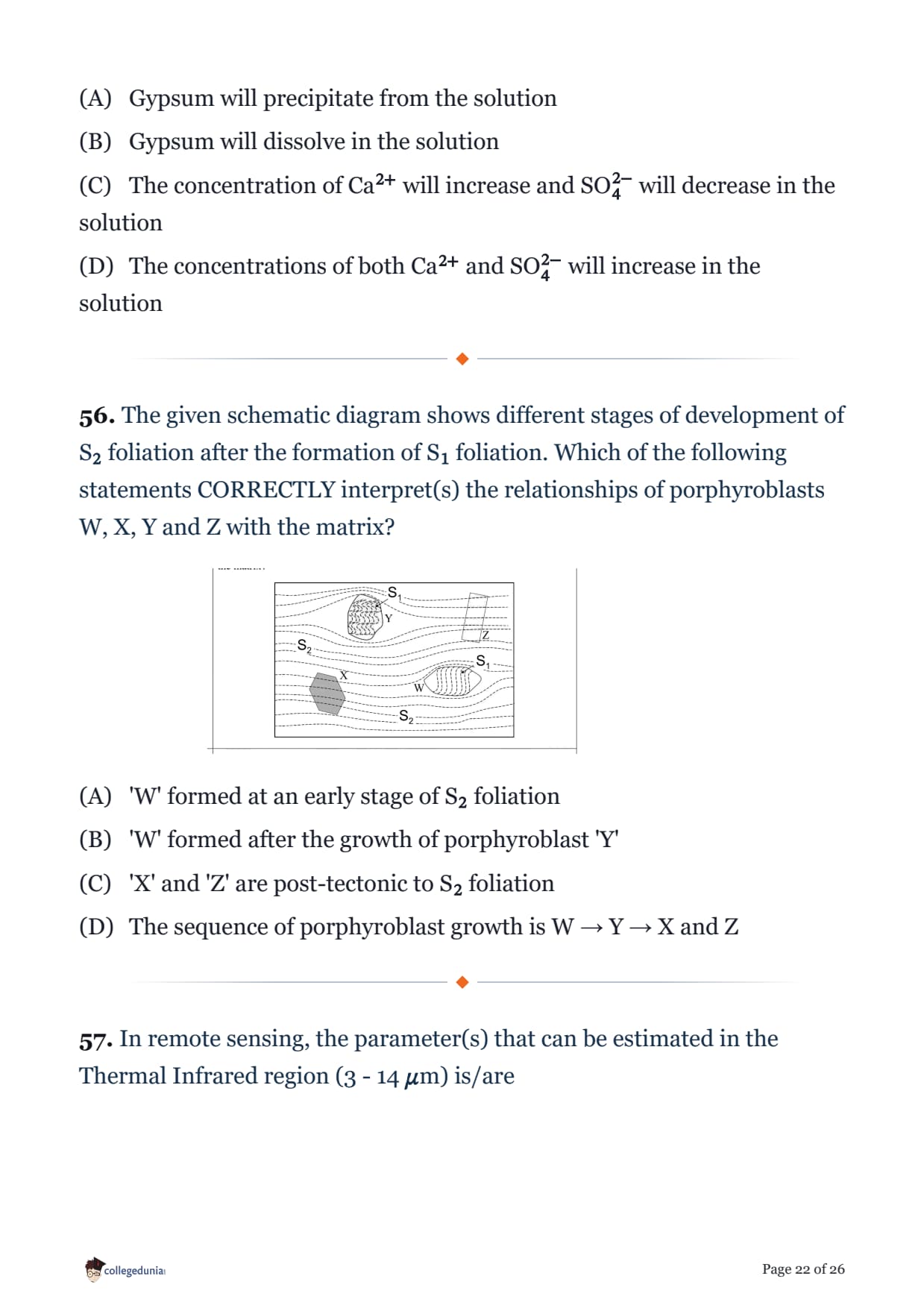
The given schematic diagram shows different stages of development of S\(_2\) foliation after the formation of S\(_1\) foliation. Which of the following statements CORRECTLY interpret(s) the relationships of porphyroblasts W, X, Y and Z with the matrix?

In remote sensing, the parameter(s) that can be estimated in the Thermal Infrared region (3 - 14 \(\mu\)m) is/are
Which of the following is/are diagnostic morphological feature(s) of brachiopods?
Which of the following is/are diagenetic process(es)?
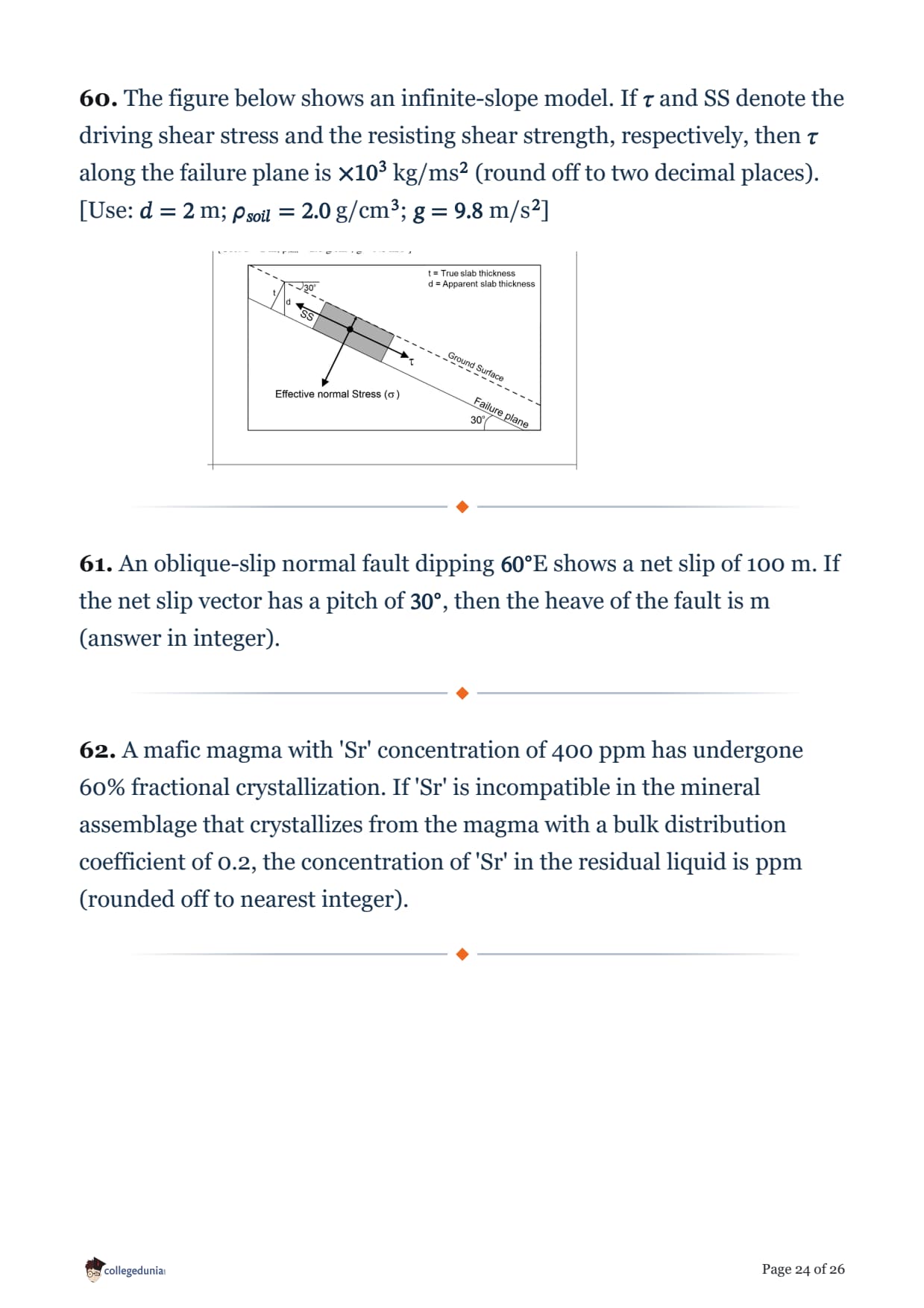
The figure below shows an infinite-slope model. If \(\tau\) and SS denote the driving shear stress and the resisting shear strength, respectively, then \(\tau\) along the failure plane is \(\times 10^3\) kg/ms\(^2\) (round off to two decimal places).
[Use: \(d = 2\) m; \(\rho_{soil} = 2.0\) g/cm\(^3\); \(g = 9.8\) m/s\(^2\)]

An oblique-slip normal fault dipping \(60^{\circ}\)E shows a net slip of 100 m. If the net slip vector has a pitch of \(30^{\circ}\), then the heave of the fault is m (answer in integer).
A mafic magma with 'Sr' concentration of 400 ppm has undergone 60% fractional crystallization. If 'Sr' is incompatible in the mineral assemblage that crystallizes from the magma with a bulk distribution coefficient of 0.2, the concentration of 'Sr' in the residual liquid is ppm (rounded off to nearest integer).
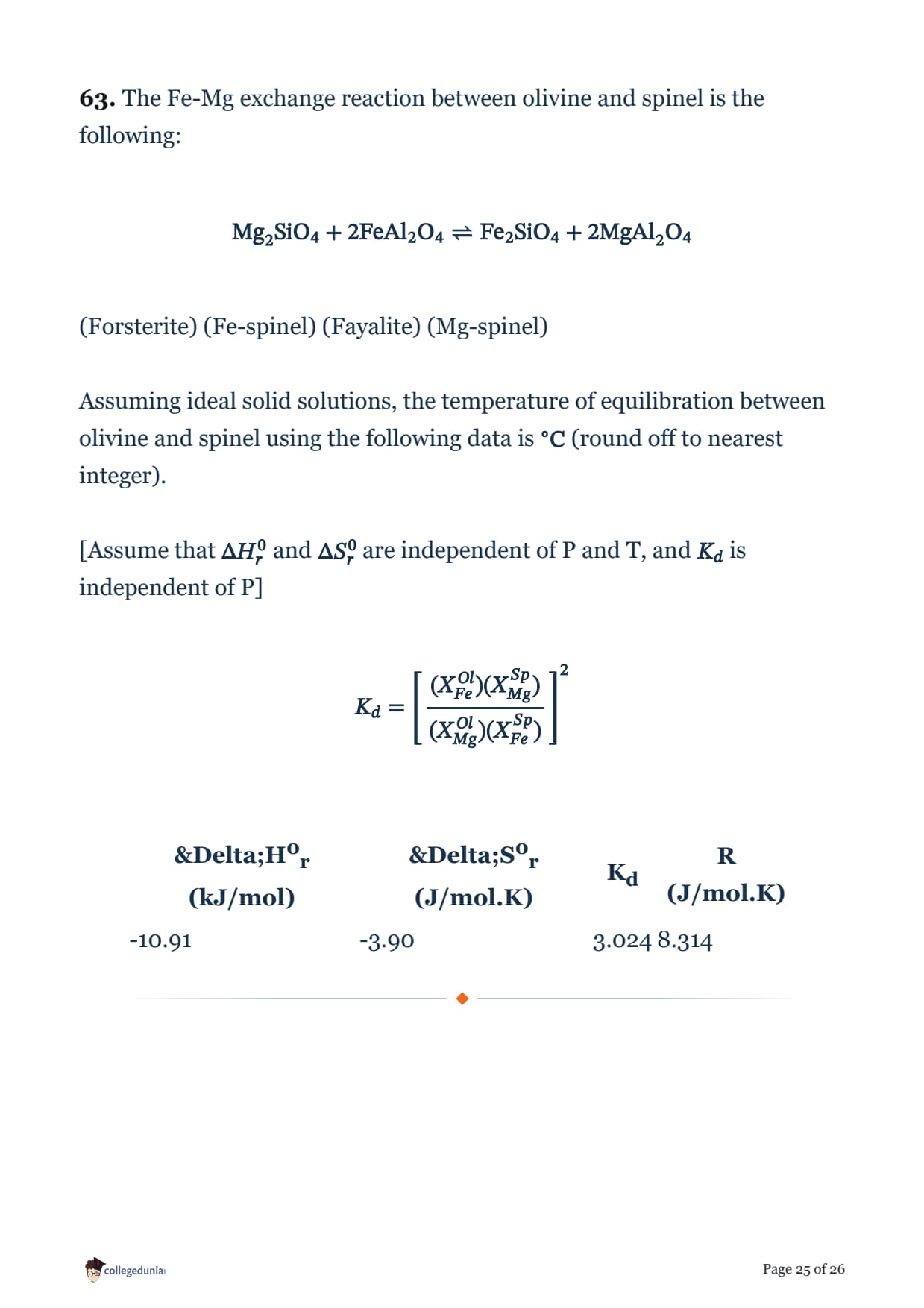
The Fe-Mg exchange reaction between olivine and spinel is the following:
\[ \mathrm{Mg_2SiO_4 + 2FeAl_2O_4 \rightleftharpoons Fe_2SiO_4 + 2MgAl_2O_4} \]
(Forsterite) (Fe-spinel) (Fayalite) (Mg-spinel)
Assuming ideal solid solutions, the temperature of equilibration between olivine and spinel using the following data is \(^{\circ}\text{C}\) (round off to nearest integer).
[Assume that \(\Delta H_r^{0}\) and \(\Delta S_r^{0}\) are independent of P and T, and \(K_d\) is independent of P]
\[ K_d = \left[\frac{(X_{Fe}^{Ol})(X_{Mg}^{Sp})}{(X_{Mg}^{Ol})(X_{Fe}^{Sp})}\right]^2 \]
| ΔH0r (kJ/mol) | ΔS0r (J/mol.K) | Kd | R (J/mol.K) |
|---|---|---|---|
| -10.91 | -3.90 | 3.024 | 8.314 |
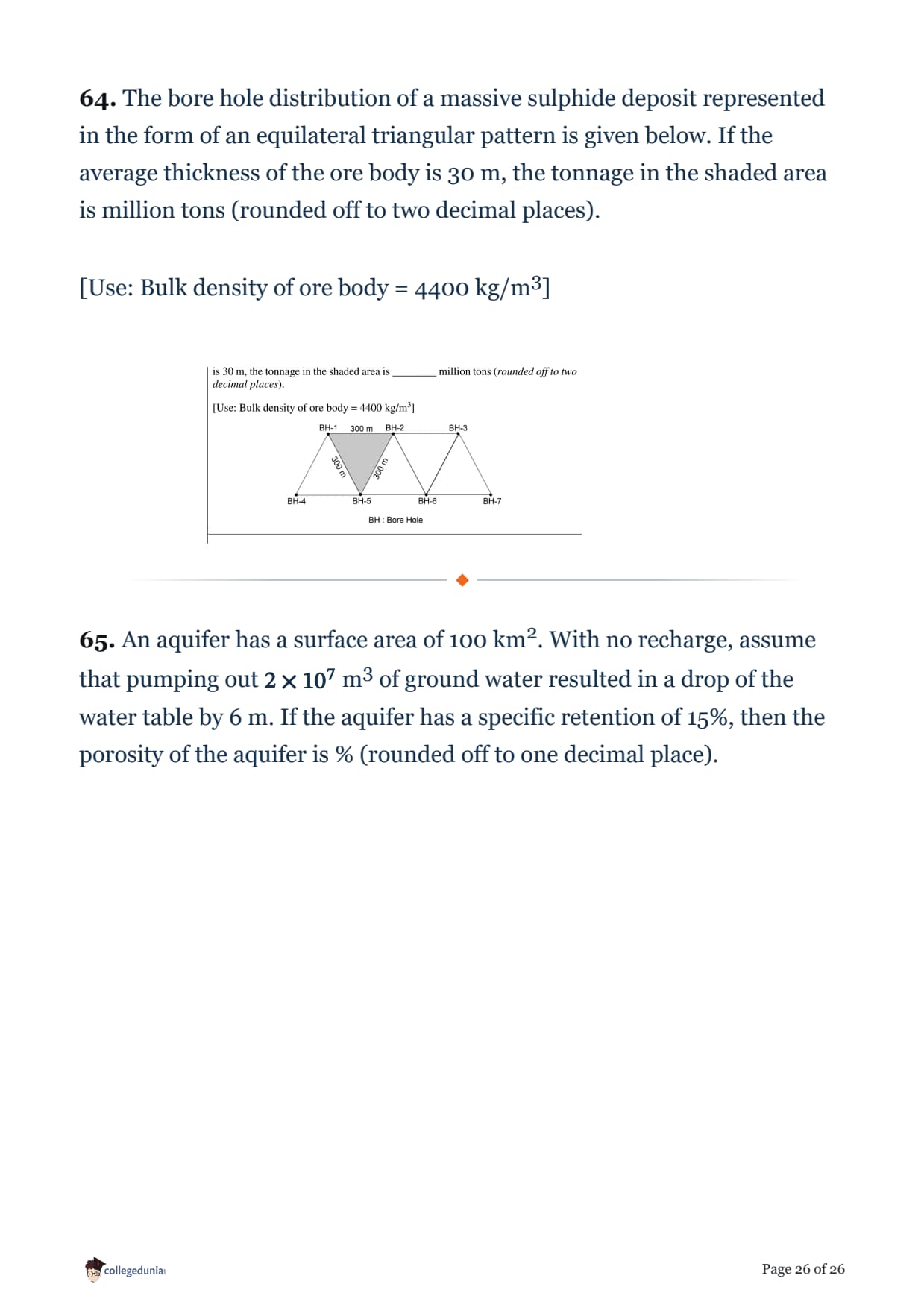
The bore hole distribution of a massive sulphide deposit represented in the form of an equilateral triangular pattern is given below. If the average thickness of the ore body is 30 m, the tonnage in the shaded area is million tons (rounded off to two decimal places).
[Use: Bulk density of ore body = 4400 kg/m3]

An aquifer has a surface area of 100 km2. With no recharge, assume that pumping out \(2 \times 10^{7}\) m3 of ground water resulted in a drop of the water table by 6 m. If the aquifer has a specific retention of 15%, then the porosity of the aquifer is % (rounded off to one decimal place).
GATE 2026 GG1 Exam Pattern and Marking Scheme Explained
As per the information bulletin on the official GATE 2026 website (gate2026.iitg.ac.in), the Geology and Geophysics paper is a computer-based test split into a common Part A and a subject-specific Part B.
- Total questions: 65 across General Aptitude (GA), Part A (compulsory for both Geology and Geophysics candidates), and Part B Section I (Geology-only, GG1)
- Duration: 3 hours
- Total marks: 100 (GA 15, Part A 25, Part B Geology 60)
- Marking scheme: 1/3 mark cut for a wrong 1-mark MCQ, 2/3 mark cut for a wrong 2-mark MCQ, no negative marking on MSQ or NAT questions
- Question types: single-correct MCQ, multiple-correct MSQ, and Numerical Answer Type (NAT) questions with no options
High-Weightage Topics in GATE 2026 GG1 to Focus On First
Going through the solved paper, Petrology and Structural Geology carried the most questions in the Geology-specific Part B, so start your revision there.
- Petrology (igneous, metamorphic, and general) made up 6 of the 39 Part B questions, from ternary phase diagrams to granulite-facies reactions
- Structural Geology followed with 5 questions, covering fold classification on stereonets, dip isogons, true-to-apparent thickness, and fault heave
- Crystallography and Economic Geology each carried 3 questions, testing crystal defects, space groups, and ore-forming deposits
- Palaeontology and biostratigraphy together accounted for 4 questions, including a concurrent-range-zone figure and Permian extinction fossils
- Across the full paper, 10 questions were General Aptitude, 16 were common Part A questions shared with Geophysics candidates, and 39 were Geology-only Part B
GATE 2026 GG1 Question Paper Analysis Video
Source: SOURAV SIR'S CLASSES
How to Use the GATE GG1 Question Paper for Practice
Treat this as a full 3-hour mock before you look at a single solution, then use the solved PDF to find exactly where marks slipped.
- Attempt all 65 questions in one 3-hour sitting under real exam conditions first
- Mark every question you were unsure of, then check it against the step-by-step solution PDF
- Redo the NAT questions on paper - GG1 2026 had 16 numerical questions across Part A and Part B, and small unit-conversion slips there cost marks
- Revisit MSQ questions separately - GG1 2026 carried 15 multiple-correct questions, and partial selection earns zero credit
GATE GG Cutoff Trend to Set Your Target Score
- The General category qualifying cutoff for GG has stayed in the 30-32 mark range over recent years
- Use this as your practice target when you total your score on this paper
- The official GATE 2026 cutoff is released by IIT Guwahati after the result declaration, alongside category-wise scores
GATE 2026 GG1 Question Paper FAQs
Ques. Where can I download the GATE 2026 Geology and Geophysics (GG1) question paper with solutions PDF for free?
Ans. You can download it from the table above on this Collegedunia page, which has both the questions-only PDF and the full solutions PDF. The official question paper and answer key are also available on gate2026.iitg.ac.in.
Ques. How many questions were there in the GATE 2026 GG1 (Geology) paper and how are they split?
Ans. The paper had 65 questions for 100 marks: 10 General Aptitude questions worth 15 marks, 16 Part A questions common to Geology and Geophysics worth 25 marks, and 39 Geology-only Part B questions worth 60 marks.
Ques. Which topics had the highest weightage in GATE 2026 GG1?
Ans. Petrology led with 6 of the 39 Part B questions, followed by Structural Geology with 5. Crystallography and Economic Geology carried 3 questions each, and palaeontology-related topics added up to 4 questions.
Ques. Is there negative marking in the GATE GG1 paper?
Ans. Yes, for MCQs only. A wrong 1-mark MCQ costs 1/3 mark and a wrong 2-mark MCQ costs 2/3 mark. Multiple-correct MSQ questions and Numerical Answer Type (NAT) questions carry no negative marking.
Ques. What is a good score to aim for in GATE GG based on past cutoffs?
Ans. The General category cutoff for GG has held in the 30-32 mark range in recent years. Use this range as your benchmark when you score yourself on this solved paper.
Ques. Are GATE GG1 questions repeated from previous years?
Ans. The exact questions are not repeated, but the same core topics - fold and fault mechanics, phase diagrams, optical mineralogy, and biostratigraphic zones - come back nearly every year, so solving multiple years of GG1 papers builds real pattern recognition.



Comments