




The GATE 2026 Mathematics (MA) question paper is now available with detailed solutions for free download. GATE 2026 MA was conducted by IIT Guwahati on February 7, 2026 in the forenoon session, and the paper carried 65 questions for 100 marks in 3 hours.
| GATE 2026 Mathematics (MA) Question Paper with Solutions | Download PDF | Check Solutions |
GATE 2026 Mathematics Questions with Solutions
Suresh said, "I did it yesterday." Which one of the following options is the correct form of this sentence in indirect speech?
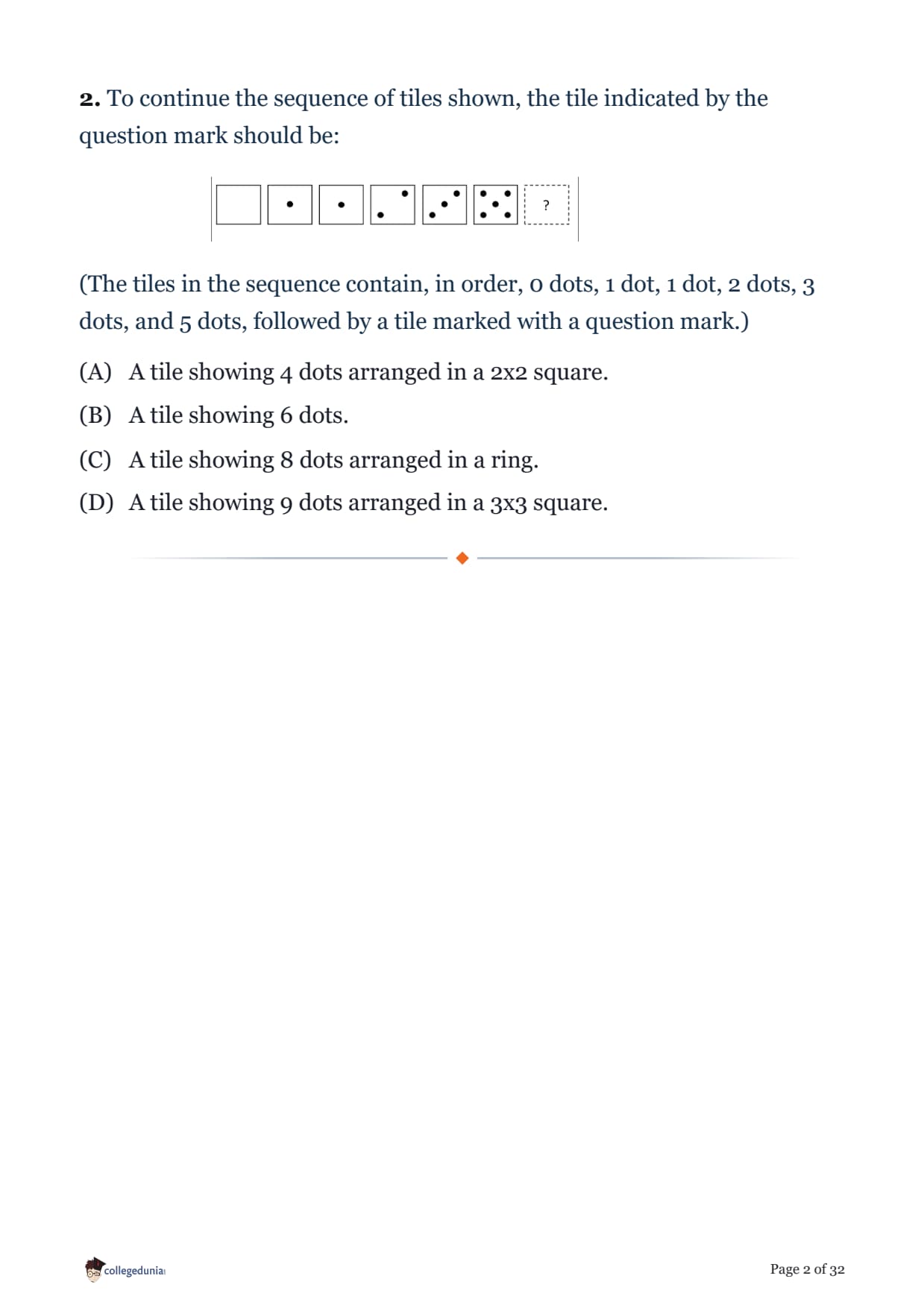
To continue the sequence of tiles shown, the tile indicated by the question mark should be:

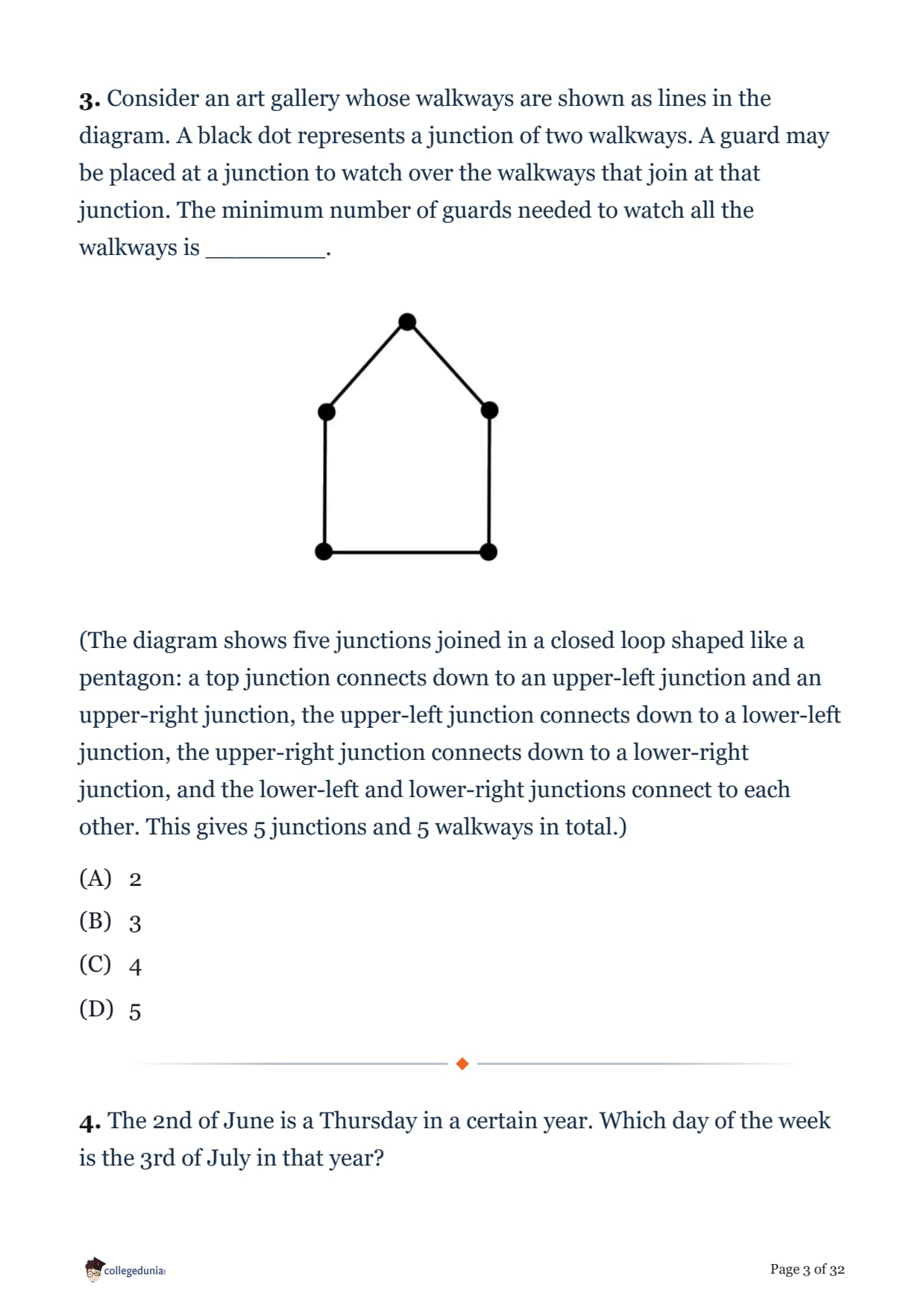
Consider an art gallery whose walkways are shown as lines in the diagram. A black dot represents a junction of two walkways. A guard may be placed at a junction to watch over the walkways that join at that junction. The minimum number of guards needed to watch all the walkways is ________.

The 2nd of June is a Thursday in a certain year. Which day of the week is the 3rd of July in that year?
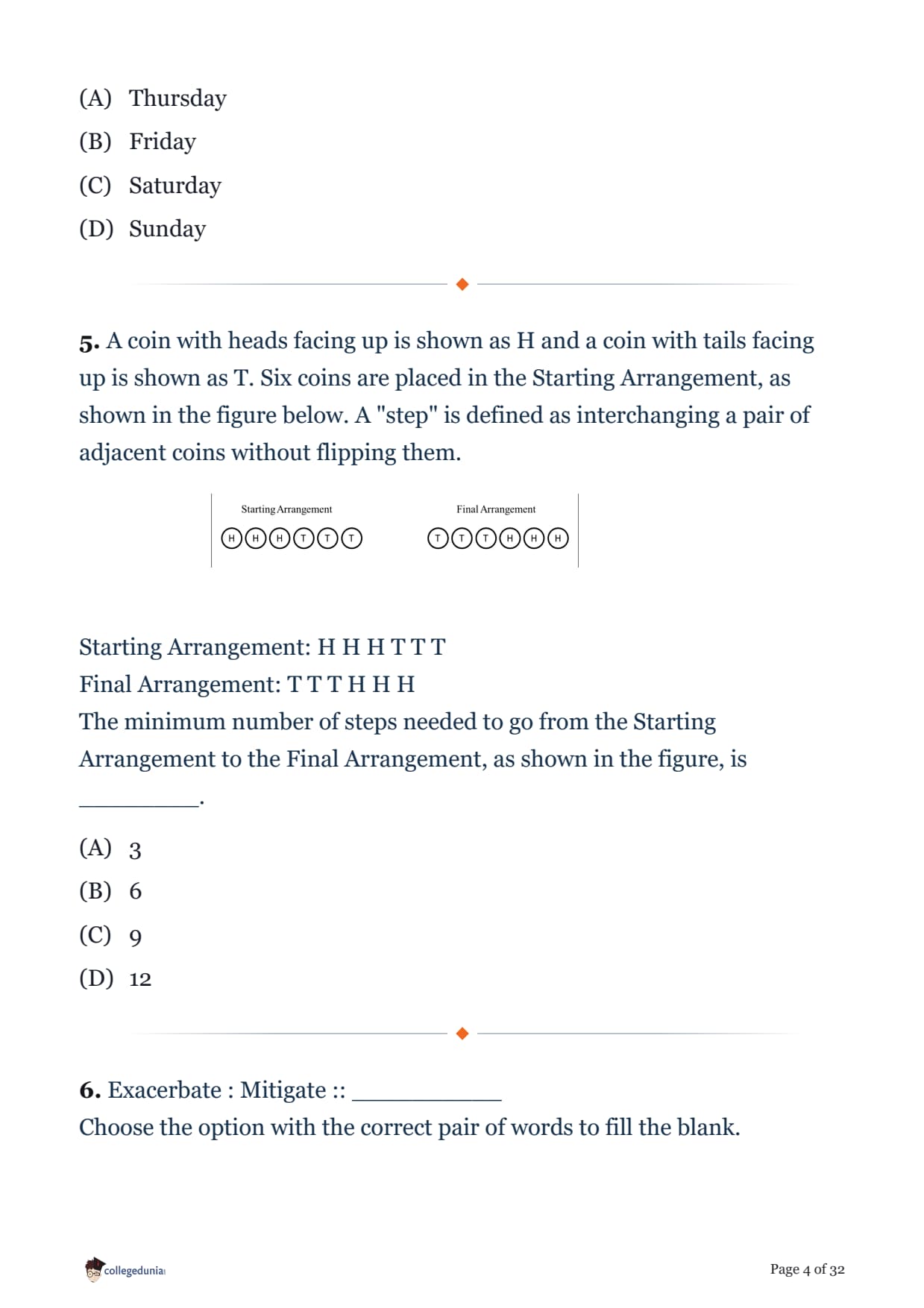
A coin with heads facing up is shown as H and a coin with tails facing up is shown as T. Six coins are placed in the Starting Arrangement, as shown in the figure below. A "step" is defined as interchanging a pair of adjacent coins without flipping them.

Starting Arrangement: H H H T T T
Final Arrangement: T T T H H H
The minimum number of steps needed to go from the Starting Arrangement to the Final Arrangement, as shown in the figure, is ________.
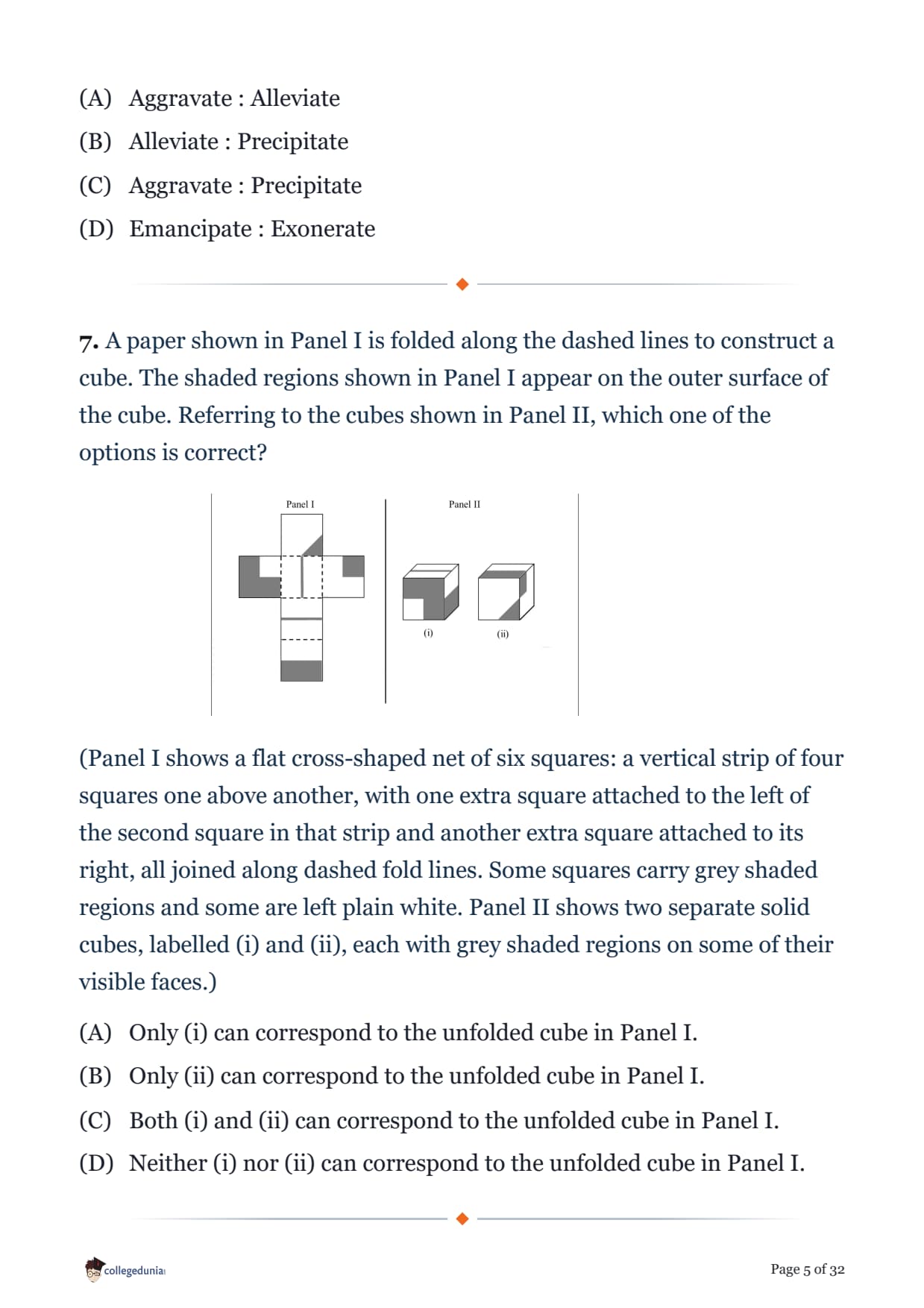
Exacerbate : Mitigate :: __________
Choose the option with the correct pair of words to fill the blank.
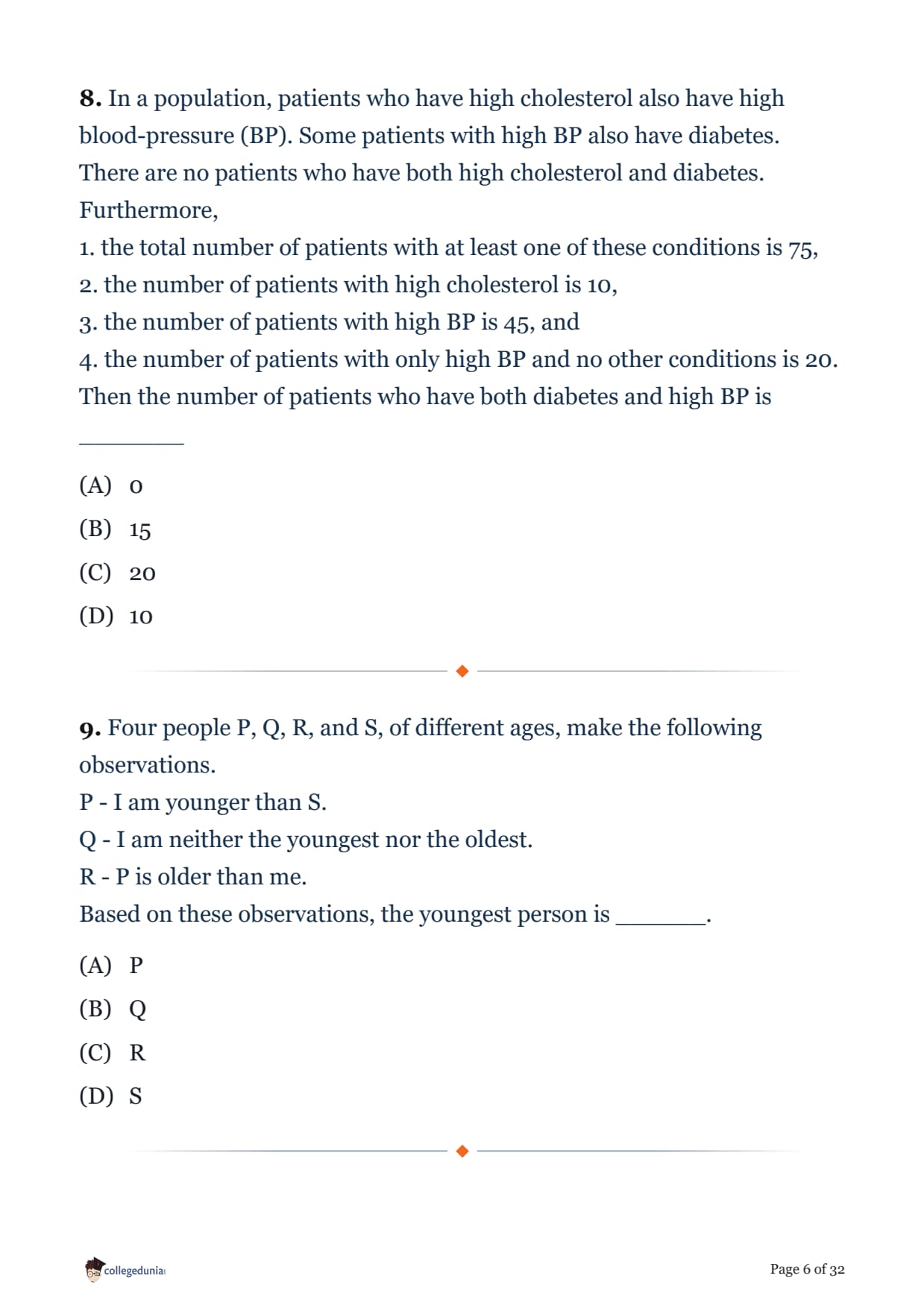
A paper shown in Panel I is folded along the dashed lines to construct a cube. The shaded regions shown in Panel I appear on the outer surface of the cube. Referring to the cubes shown in Panel II, which one of the options is correct?

In a population, patients who have high cholesterol also have high blood-pressure (BP). Some patients with high BP also have diabetes. There are no patients who have both high cholesterol and diabetes. Furthermore,
1. the total number of patients with at least one of these conditions is 75,
2. the number of patients with high cholesterol is 10,
3. the number of patients with high BP is 45, and
4. the number of patients with only high BP and no other conditions is 20.
Then the number of patients who have both diabetes and high BP is _______
Four people P, Q, R, and S, of different ages, make the following observations.
P - I am younger than S.
Q - I am neither the youngest nor the oldest.
R - P is older than me.
Based on these observations, the youngest person is ______.
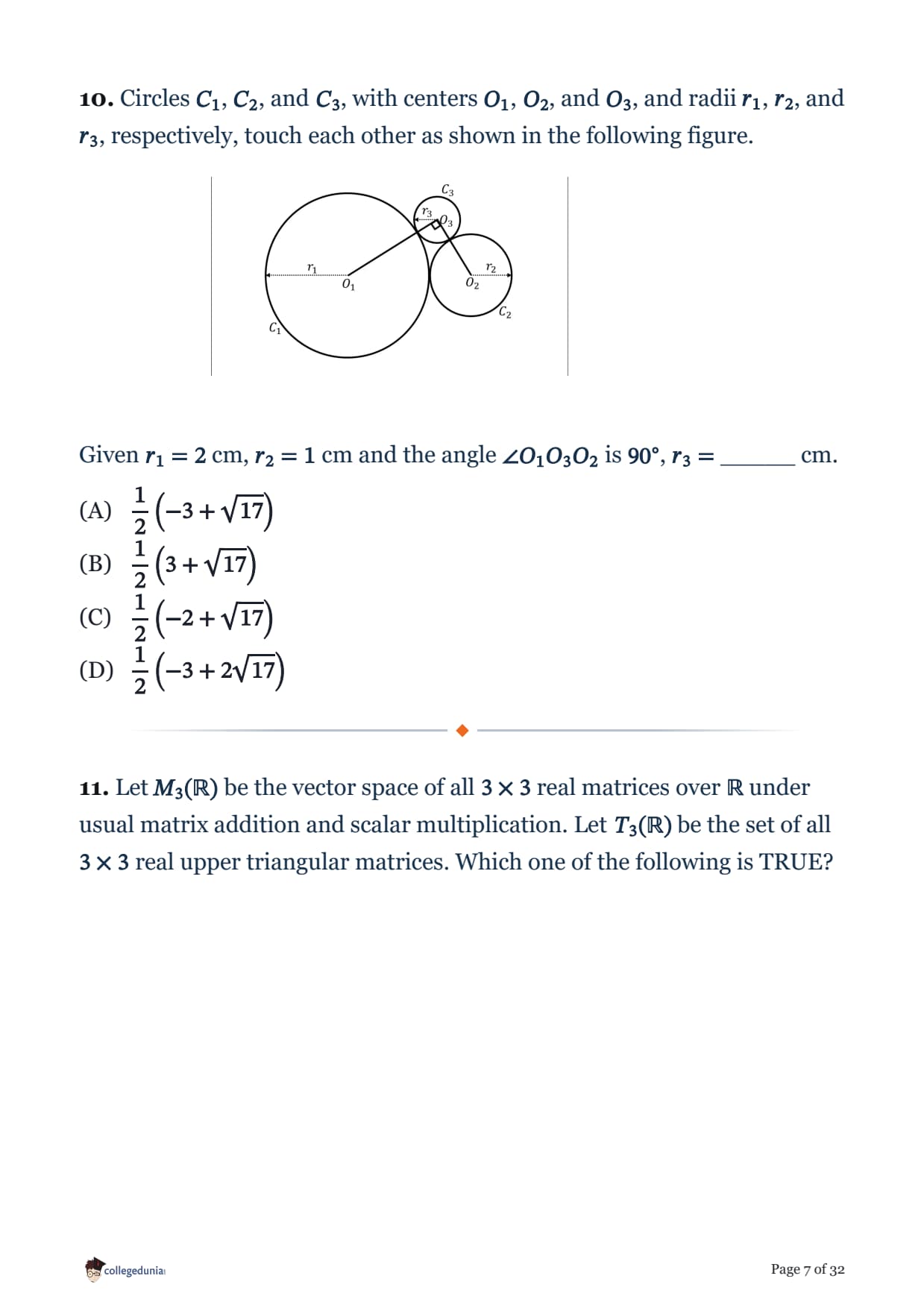
Circles \(C_1\), \(C_2\), and \(C_3\), with centers \(O_1\), \(O_2\), and \(O_3\), and radii \(r_1\), \(r_2\), and \(r_3\), respectively, touch each other as shown in the following figure.

Given \(r_1 = 2\) cm, \(r_2 = 1\) cm and the angle \(\angle O_1 O_3 O_2\) is \(90^{\circ}\), \(r_3 =\) _____ cm.
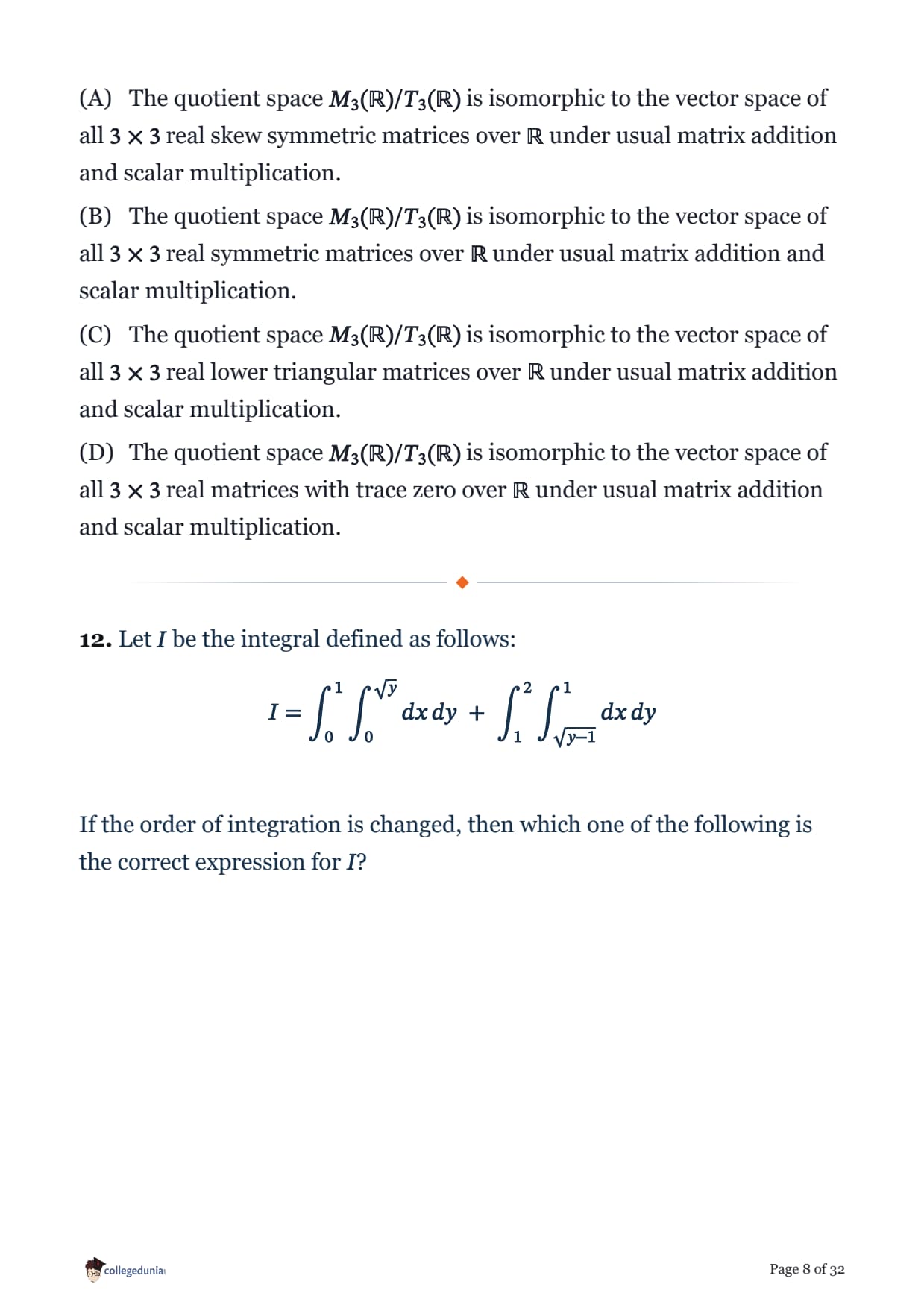
Let \( M_3(\mathbb{R}) \) be the vector space of all \( 3 \times 3 \) real matrices over \( \mathbb{R} \) under usual matrix addition and scalar multiplication. Let \( T_3(\mathbb{R}) \) be the set of all \( 3 \times 3 \) real upper triangular matrices. Which one of the following is TRUE?
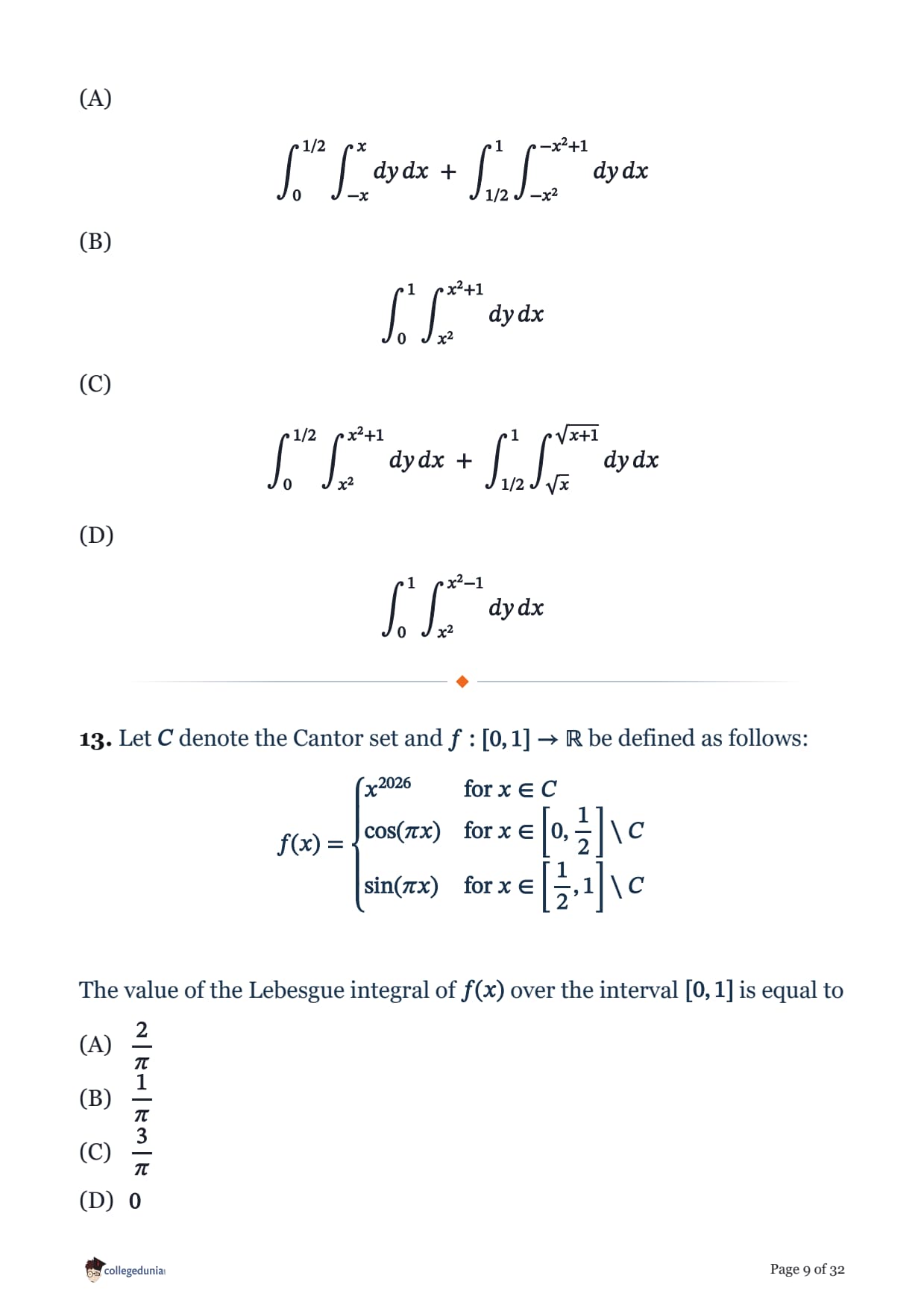
Let \( I \) be the integral defined as follows:
\[ I = \int_0^1 \int_0^{\sqrt{y}} dx\, dy \;+\; \int_1^2 \int_{\sqrt{y-1}}^{1} dx\, dy \]
If the order of integration is changed, then which one of the following is the correct expression for \( I \)?
Let \( C \) denote the Cantor set and \( f: [0,1] \to \mathbb{R} \) be defined as follows:
\[ f(x) = \begin{cases} x^{2026} & \text{for } x \in C \\ \cos(\pi x) & \text{for } x \in \left[0, \dfrac{1}{2}\right] \setminus C \\ \sin(\pi x) & \text{for } x \in \left[\dfrac{1}{2}, 1\right] \setminus C \end{cases} \]
The value of the Lebesgue integral of \( f(x) \) over the interval \( [0,1] \) is equal to
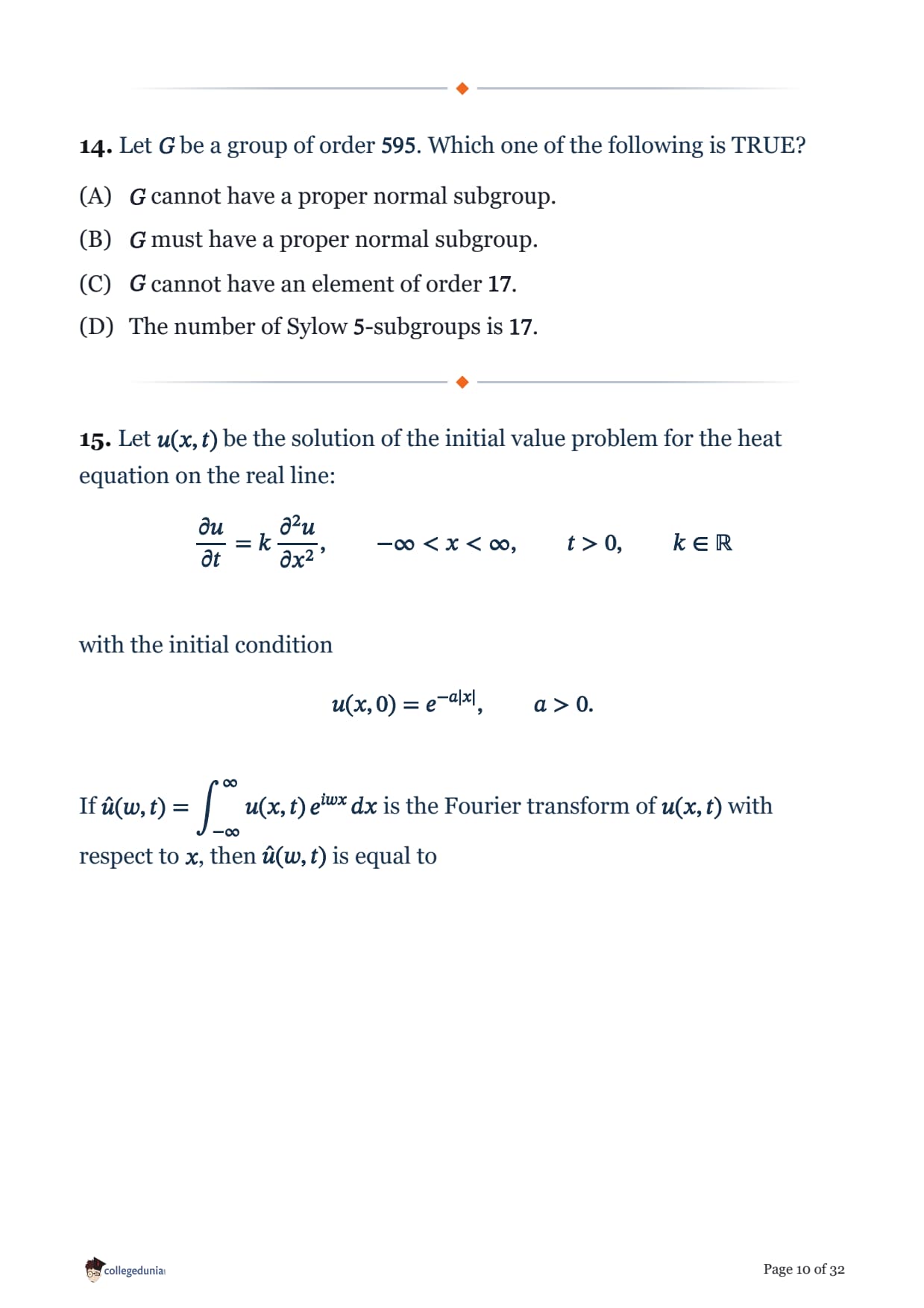
Let \( G \) be a group of order \( 595 \). Which one of the following is TRUE?
Let \( u(x,t) \) be the solution of the initial value problem for the heat equation on the real line:
\[ \frac{\partial u}{\partial t} = k\, \frac{\partial^2 u}{\partial x^2}, \qquad -\infty< x< \infty, \qquad t>0, \qquad k\in\mathbb{R} \]
with the initial condition
\[ u(x,0) = e^{-a|x|}, \qquad a>0. \]
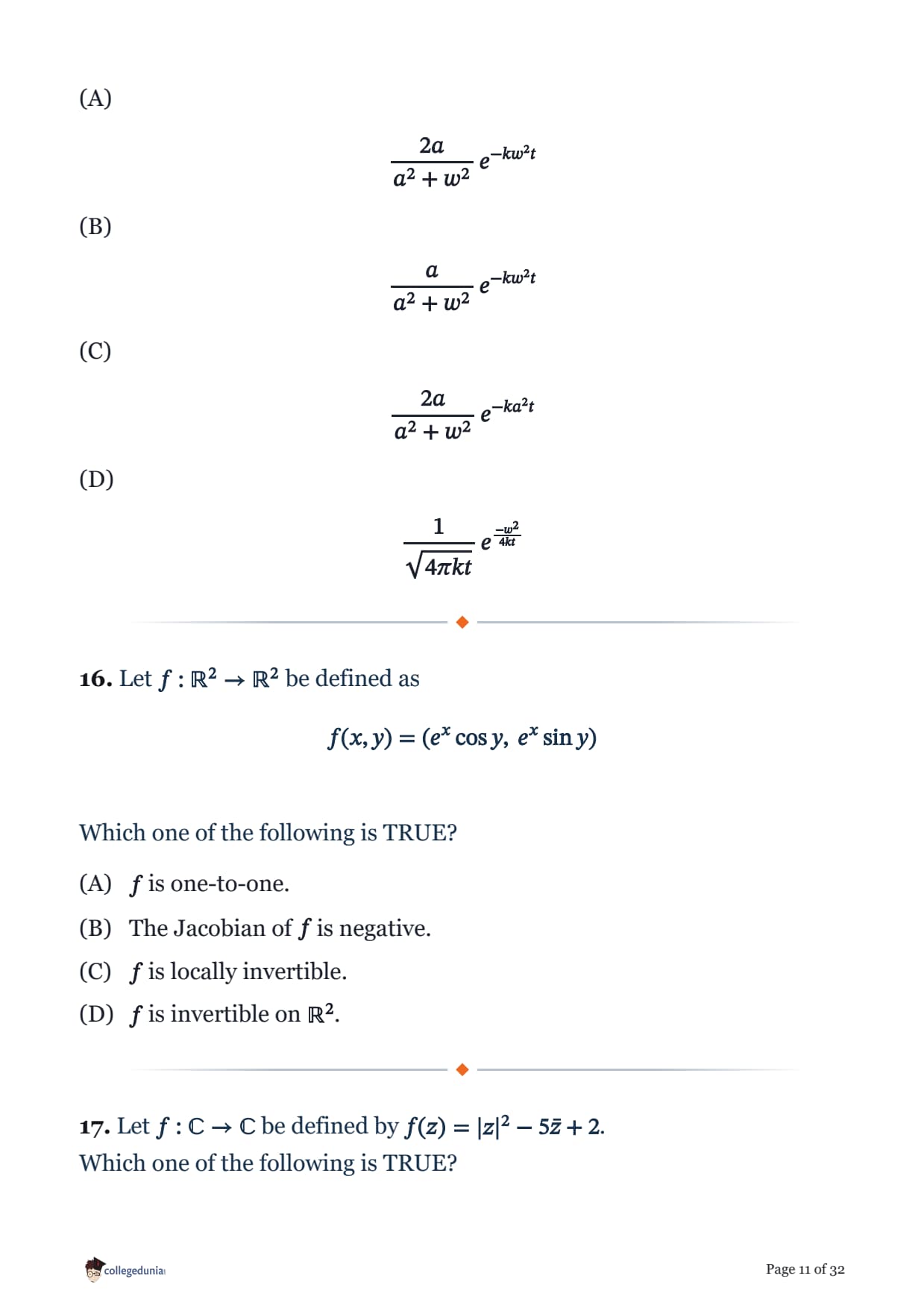
If \( \hat u(w,t) = \displaystyle\int_{-\infty}^{\infty} u(x,t)\, e^{iwx}\, dx \) is the Fourier transform of \( u(x,t) \) with respect to \( x \), then \( \hat u(w,t) \) is equal to
Let \( f: \mathbb{R}^2 \to \mathbb{R}^2 \) be defined as
\[ f(x, y) = (e^x \cos y,\ e^x \sin y) \]
Which one of the following is TRUE?
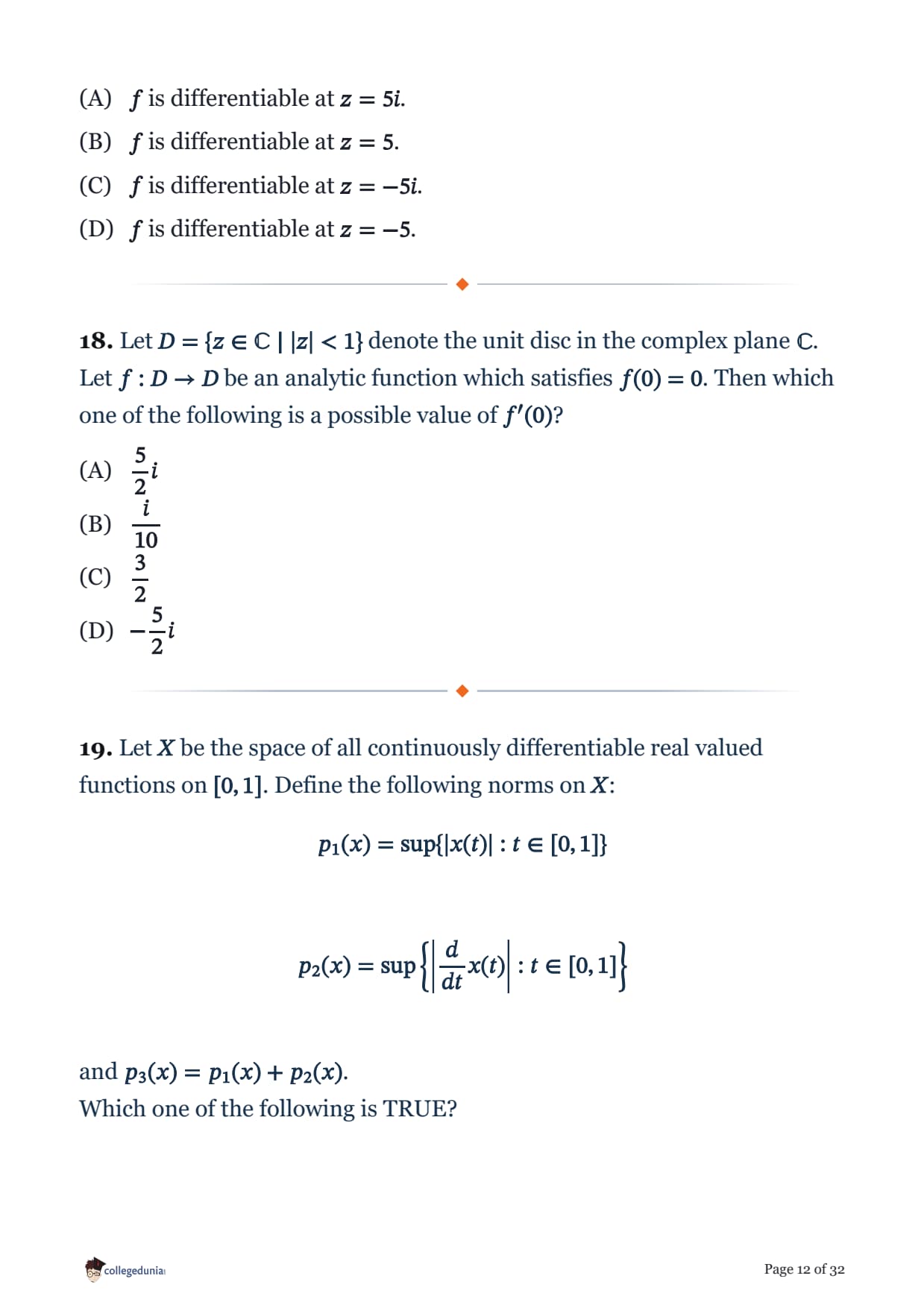
Let \( f: \mathbb{C} \to \mathbb{C} \) be defined by \( f(z) = |z|^2 - 5\bar{z} + 2 \).
Which one of the following is TRUE?
Let \( D = \{ z \in \mathbb{C} \mid |z| < 1 \} \) denote the unit disc in the complex plane \( \mathbb{C} \).
Let \( f: D \to D \) be an analytic function which satisfies \( f(0) = 0 \). Then which one of the following is a possible value of \( f'(0) \)?
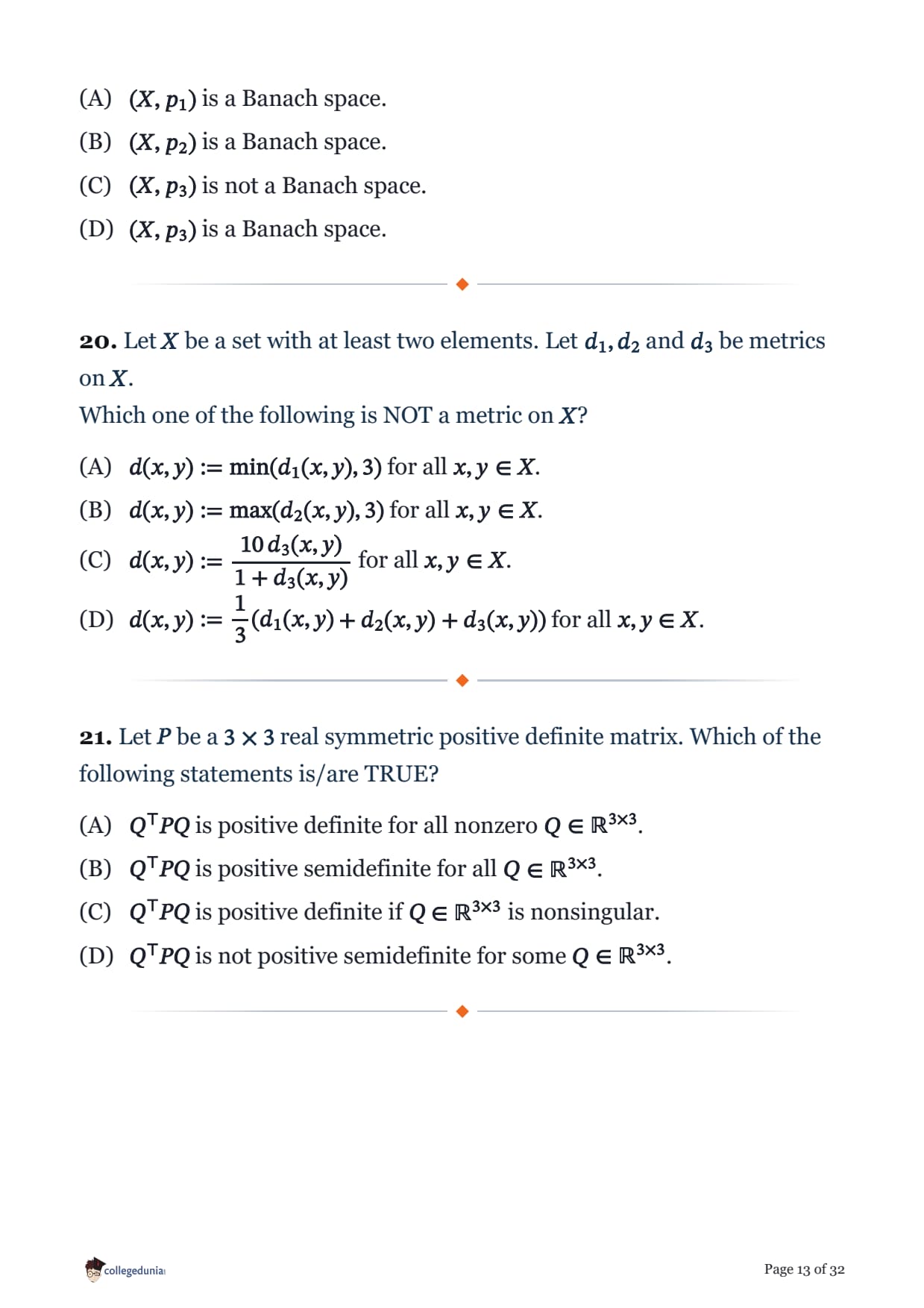
Let \( X \) be the space of all continuously differentiable real valued functions on \( [0,1] \). Define the following norms on \( X \):
\[ p_1(x) = \sup\{ |x(t)| : t \in [0,1] \} \]
\[ p_2(x) = \sup\left\{ \left| \frac{d}{dt} x(t) \right| : t \in [0,1] \right\} \]
and \( p_3(x) = p_1(x) + p_2(x) \).
Which one of the following is TRUE?
Let \( X \) be a set with at least two elements. Let \( d_1, d_2 \) and \( d_3 \) be metrics on \( X \).
Which one of the following is NOT a metric on \( X \)?
Let \(P\) be a \(3 \times 3\) real symmetric positive definite matrix. Which of the following statements is/are TRUE?
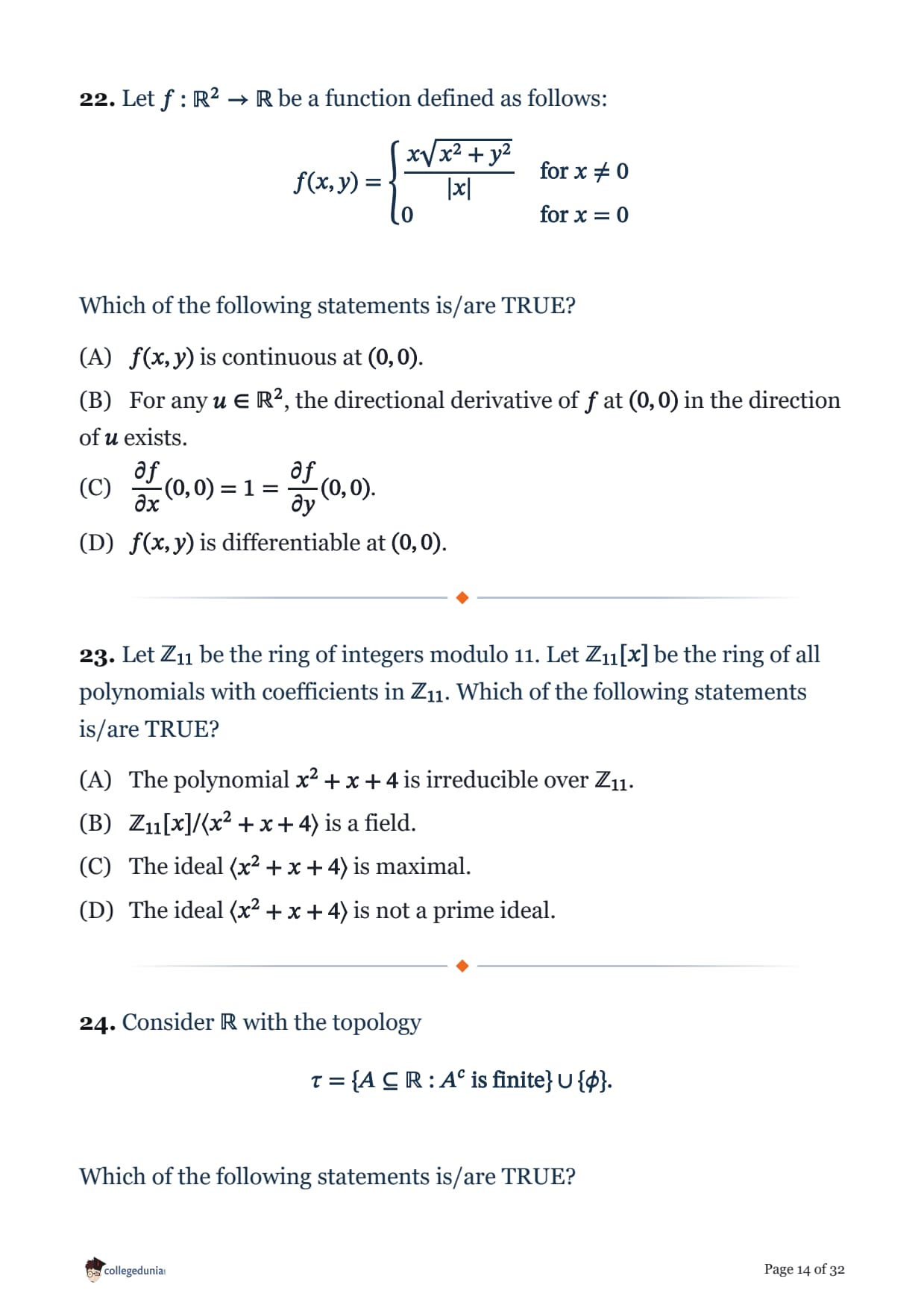
Let \(f: \mathbb{R}^2 \to \mathbb{R}\) be a function defined as follows:
\[ f(x,y) = \begin{cases} \dfrac{x\sqrt{x^2+y^2}}{|x|} & \text{for } x \neq 0 \\ 0 & \text{for } x = 0 \end{cases} \]
Which of the following statements is/are TRUE?
Let \(\mathbb{Z}_{11}\) be the ring of integers modulo 11. Let \(\mathbb{Z}_{11}[x]\) be the ring of all polynomials with coefficients in \(\mathbb{Z}_{11}\). Which of the following statements is/are TRUE?
Consider \(\mathbb{R}\) with the topology
\[ \tau = \{A \subseteq \mathbb{R} : A^c \text{ is finite}\} \cup \{\phi\}. \]
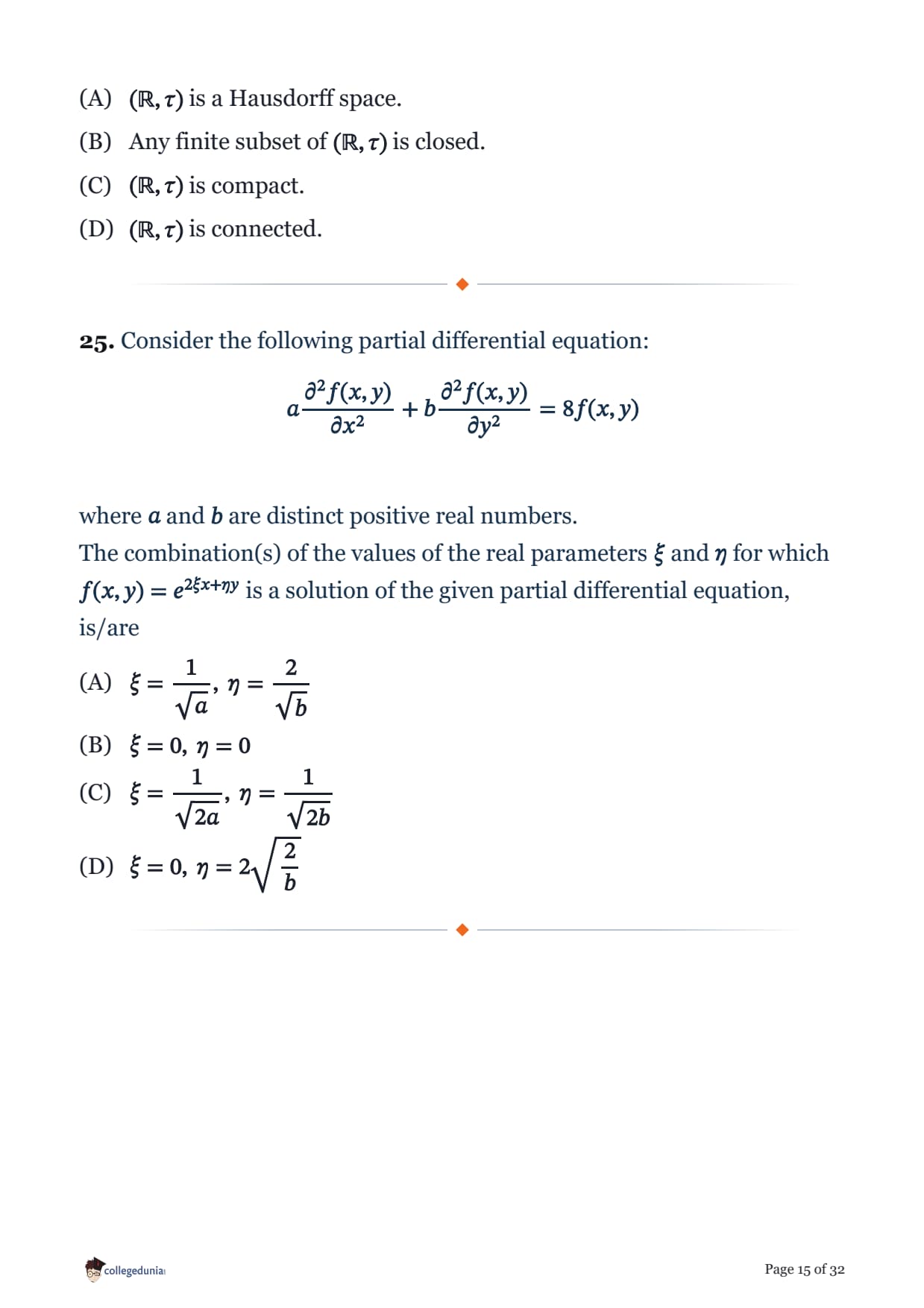
Which of the following statements is/are TRUE?
Consider the following partial differential equation:
\[ a\frac{\partial^2 f(x,y)}{\partial x^2} + b\frac{\partial^2 f(x,y)}{\partial y^2} = 8f(x,y) \]
where \(a\) and \(b\) are distinct positive real numbers.
The combination(s) of the values of the real parameters \(\xi\) and \(\eta\) for which \(f(x,y) = e^{2\xi x+\eta y}\) is a solution of the given partial differential equation, is/are
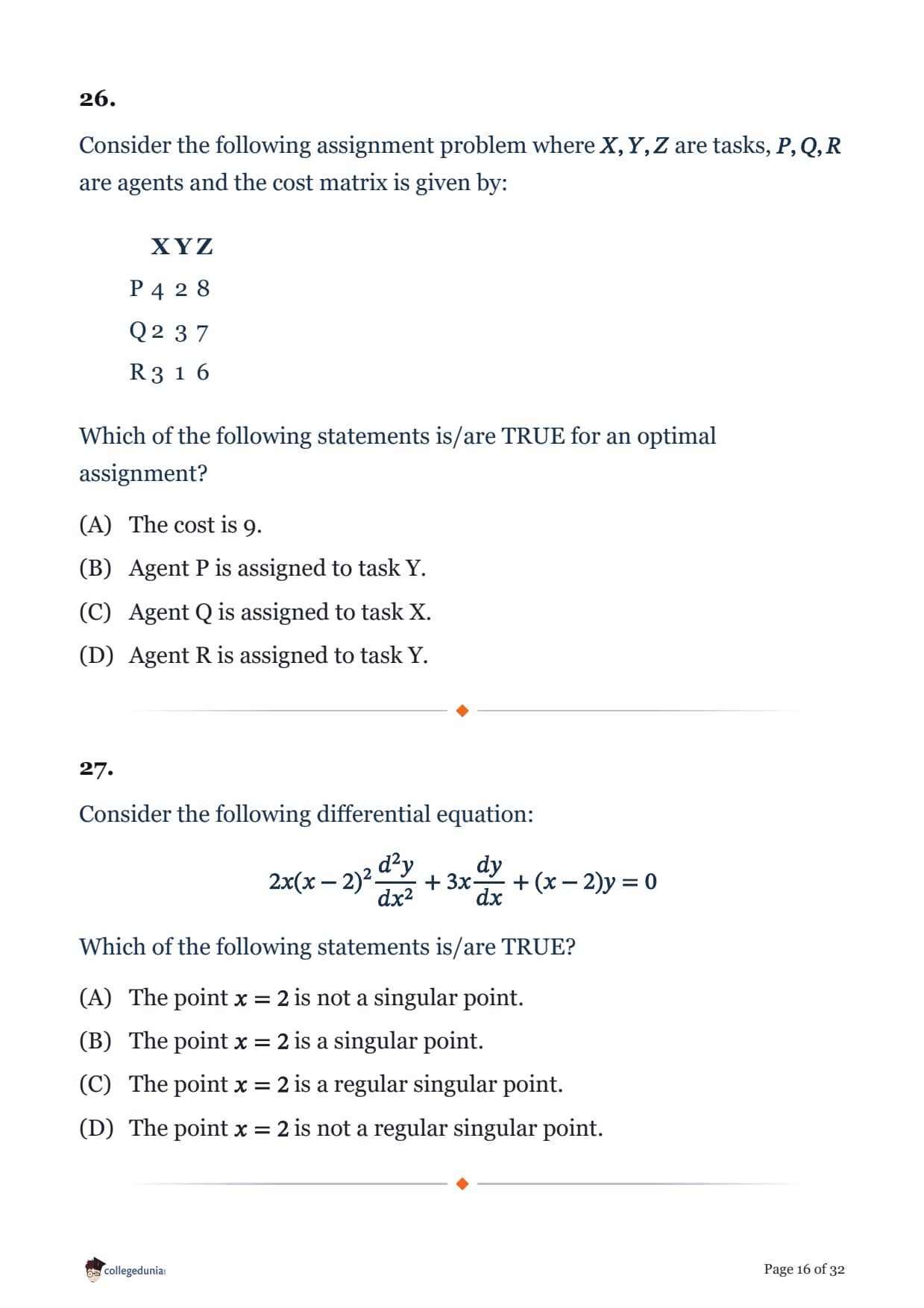
Consider the following assignment problem where \(X, Y, Z\) are tasks, \(P, Q, R\) are agents and the cost matrix is given by:
| X | Y | Z | |
|---|---|---|---|
| P | 4 | 2 | 8 |
| Q | 2 | 3 | 7 |
| R | 3 | 1 | 6 |
Which of the following statements is/are TRUE for an optimal assignment?
Consider the following differential equation:
\[ 2x(x-2)^2 \frac{d^2y}{dx^2} + 3x \frac{dy}{dx} + (x-2) y = 0 \]Which of the following statements is/are TRUE?
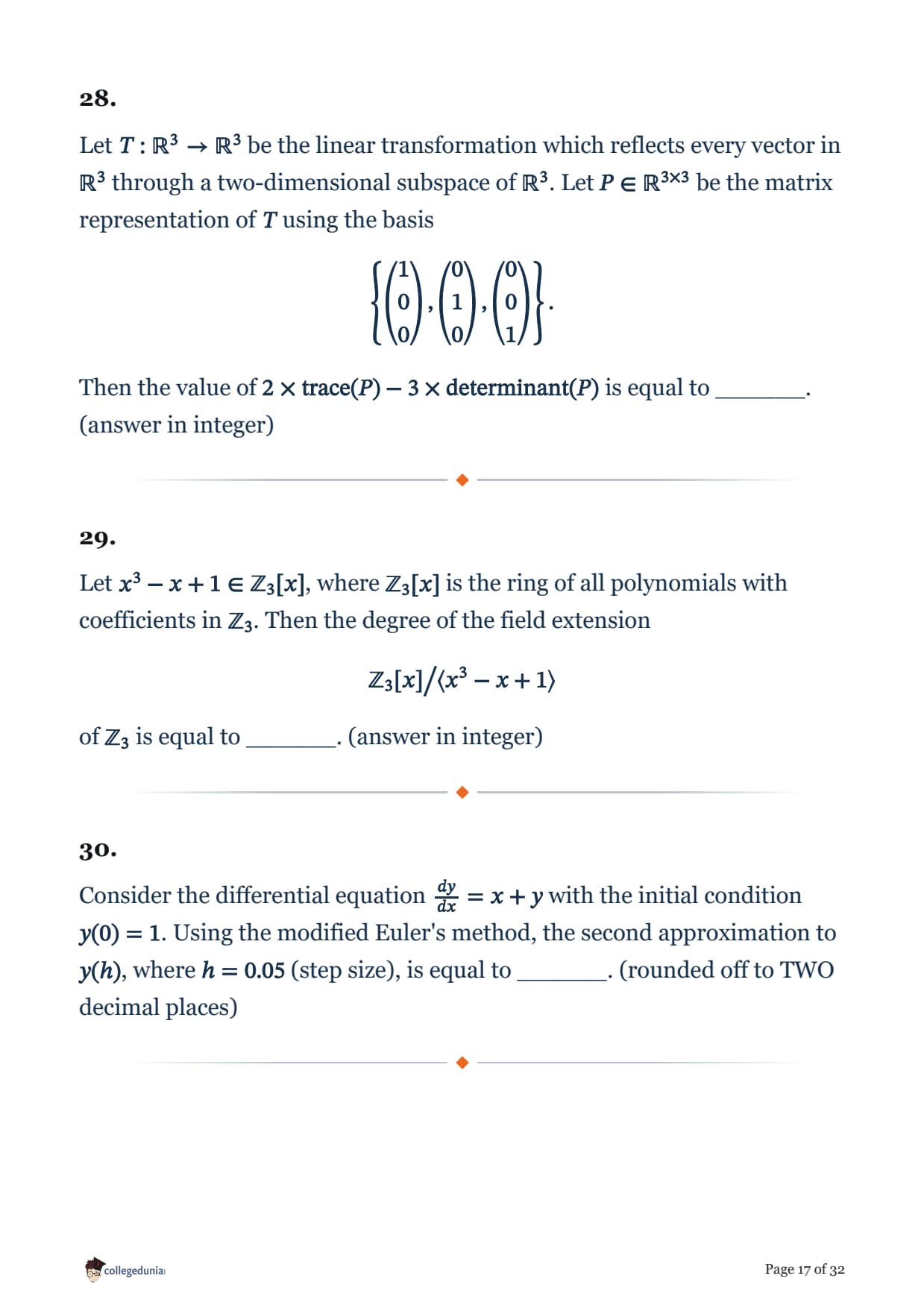
Let \(T: \mathbb{R}^3 \to \mathbb{R}^3\) be the linear transformation which reflects every vector in \(\mathbb{R}^3\) through a two-dimensional subspace of \(\mathbb{R}^3\). Let \(P \in \mathbb{R}^{3 \times 3}\) be the matrix representation of \(T\) using the basis
\[ \left\{ \begin{pmatrix} 1 \\ 0 \\ 0 \end{pmatrix}, \begin{pmatrix} 0 \\ 1 \\ 0 \end{pmatrix}, \begin{pmatrix} 0 \\ 0 \\ 1 \end{pmatrix} \right\}. \]Then the value of \(2 \times \text{trace}(P) - 3 \times \text{determinant}(P)\) is equal to ______. (answer in integer)
Let \(x^3 - x + 1 \in \mathbb{Z}_3[x]\), where \(\mathbb{Z}_3[x]\) is the ring of all polynomials with coefficients in \(\mathbb{Z}_3\). Then the degree of the field extension
\[ \left. \mathbb{Z}_3[x] \middle/ \langle x^3 - x + 1 \rangle \right. \]of \(\mathbb{Z}_3\) is equal to ______. (answer in integer)
Consider the differential equation \(\frac{dy}{dx} = x + y\) with the initial condition \(y(0) = 1\). Using the modified Euler's method, the second approximation to \(y(h)\), where \(h = 0.05\) (step size), is equal to ______. (rounded off to TWO decimal places)
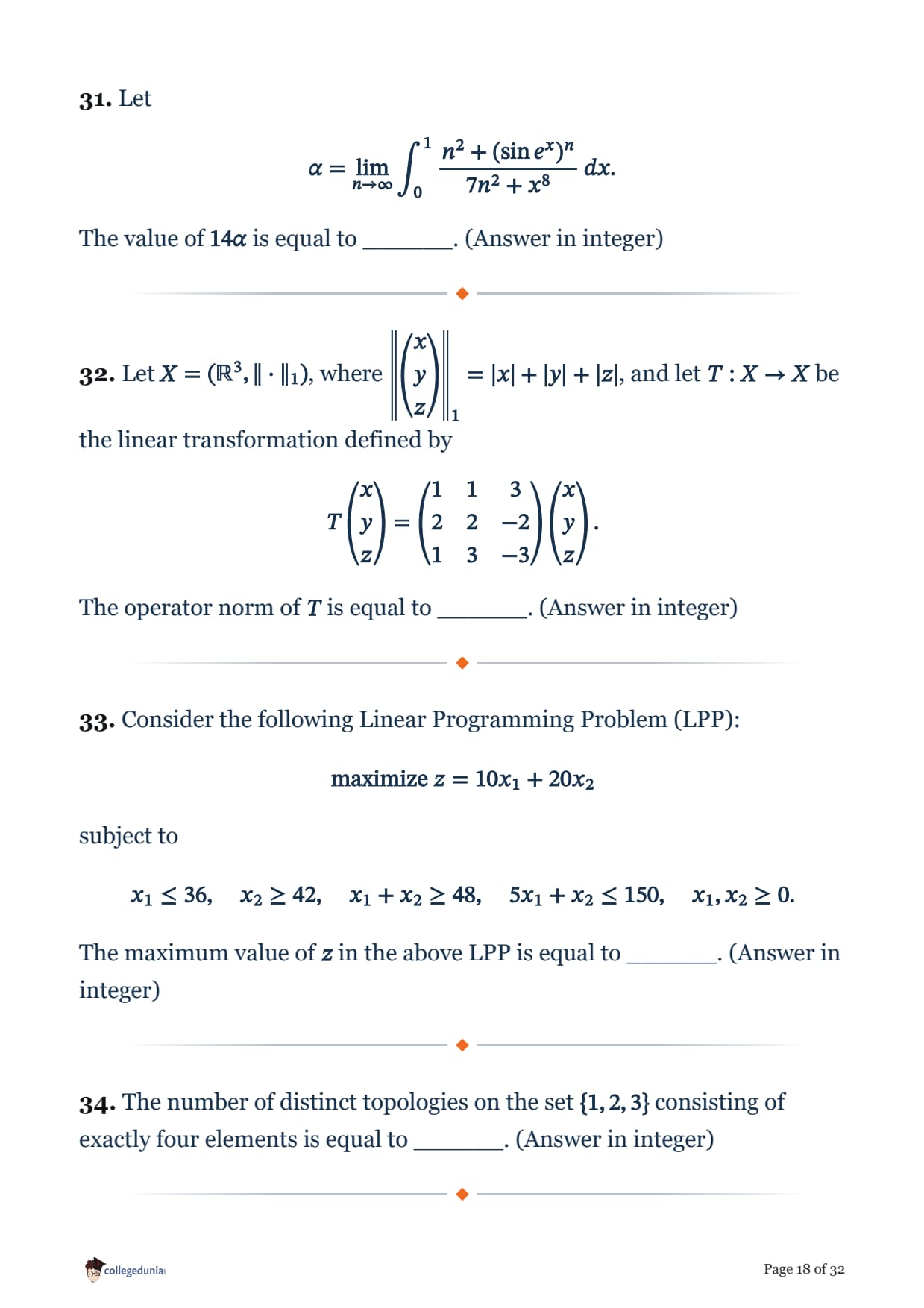
Let \[ \alpha = \lim_{n \to \infty} \int_0^{1} \frac{n^2 + (\sin e^x)^n}{7n^2 + x^8} \, dx. \] The value of \(14\alpha\) is equal to ______. (Answer in integer)
Let \(X = (\mathbb{R}^3, \|\cdot\|_1)\), where \(\left\|\begin{pmatrix} x \\ y \\ z \end{pmatrix}\right\|_1 = |x| + |y| + |z|\), and let \(T: X \to X\) be the linear transformation defined by \[ T\begin{pmatrix} x \\ y \\ z \end{pmatrix} = \begin{pmatrix} 1 & 1 & 3 \\ 2 & 2 & -2 \\ 1 & 3 & -3 \end{pmatrix} \begin{pmatrix} x \\ y \\ z \end{pmatrix}. \] The operator norm of \(T\) is equal to ______. (Answer in integer)
Consider the following Linear Programming Problem (LPP): \[ \text{maximize } z = 10x_1 + 20x_2 \] subject to \[ x_1 \leq 36, \quad x_2 \geq 42, \quad x_1 + x_2 \geq 48, \quad 5x_1 + x_2 \leq 150, \quad x_1, x_2 \geq 0. \] The maximum value of \(z\) in the above LPP is equal to ______. (Answer in integer)
The number of distinct topologies on the set \(\{1, 2, 3\}\) consisting of exactly four elements is equal to ______. (Answer in integer)
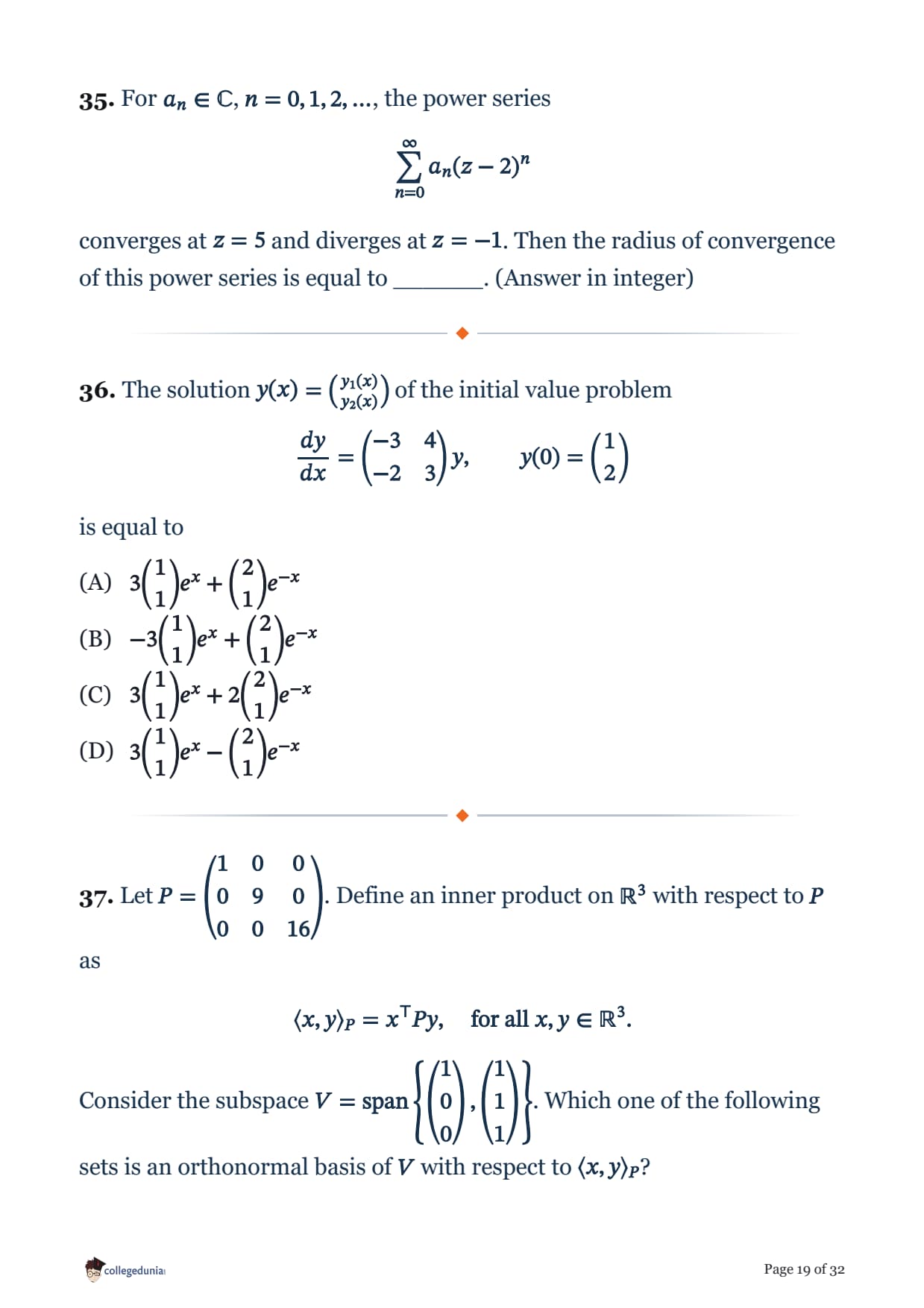
For \(a_n \in \mathbb{C}\), \(n = 0,1,2,\ldots\), the power series \[ \sum_{n=0}^{\infty} a_n (z-2)^n \] converges at \(z = 5\) and diverges at \(z = -1\). Then the radius of convergence of this power series is equal to ______. (Answer in integer)
The solution \(y(x) = \binom{y_1(x)}{y_2(x)}\) of the initial value problem \[ \frac{dy}{dx} = \begin{pmatrix} -3 & 4 \\ -2 & 3 \end{pmatrix} y, \qquad y(0) = \binom{1}{2} \] is equal to
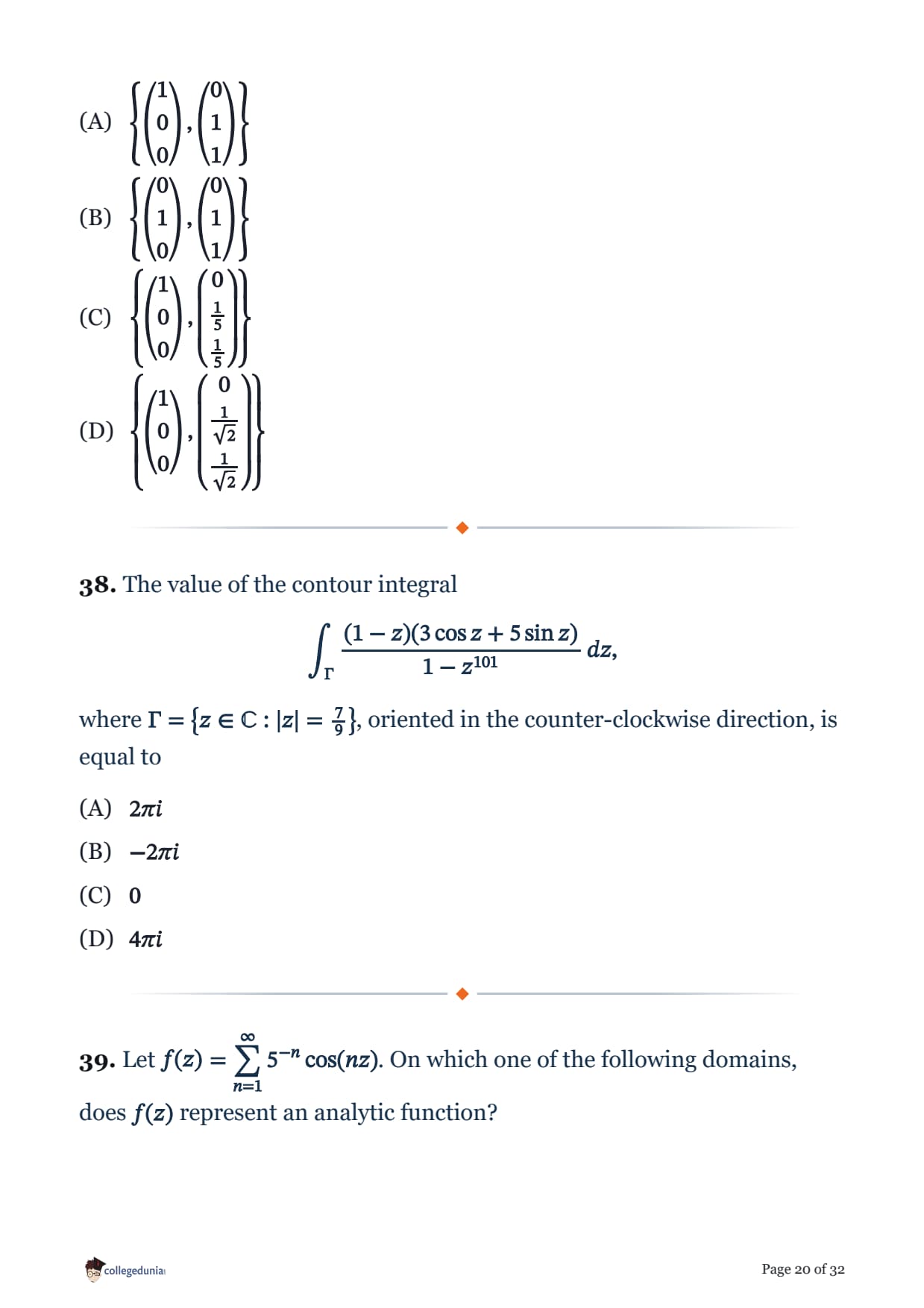
Let \(P = \begin{pmatrix} 1 & 0 & 0 \\ 0 & 9 & 0 \\ 0 & 0 & 16 \end{pmatrix}\). Define an inner product on \(\mathbb{R}^3\) with respect to \(P\) as \[ \langle x,y\rangle_P = x^{\top}Py, \quad \text{for all } x,y \in \mathbb{R}^3. \] Consider the subspace \(V = \text{span}\left\{\begin{pmatrix}1\\0\\0\end{pmatrix}, \begin{pmatrix}1\\1\\1\end{pmatrix}\right\}\). Which one of the following sets is an orthonormal basis of \(V\) with respect to \(\langle x,y\rangle_P\)?
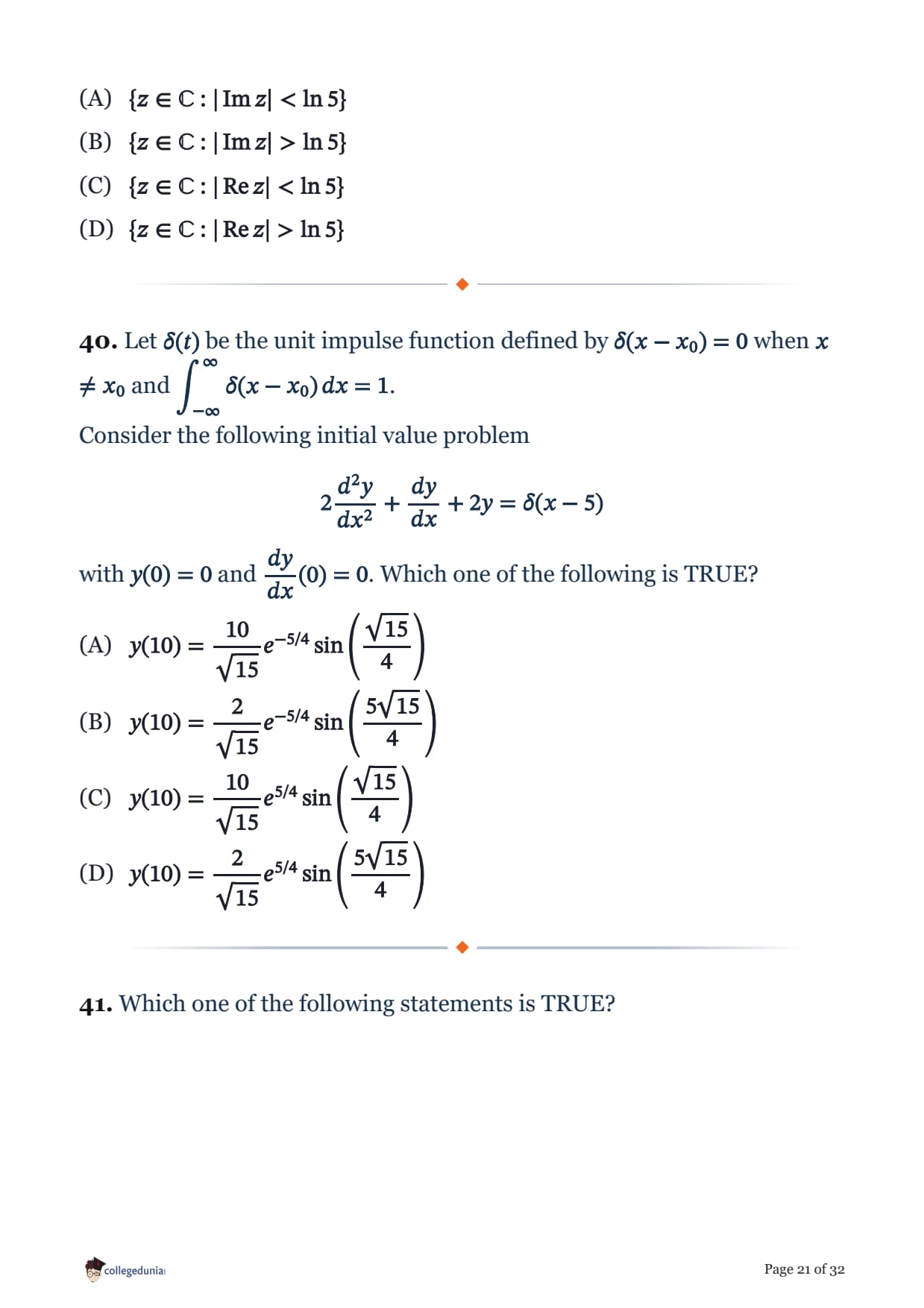
The value of the contour integral \[ \int_{\Gamma} \frac{(1-z)(3\cos z+5\sin z)}{1-z^{101}}\,dz, \] where \(\Gamma = \left\{z\in\mathbb{C} : |z|=\frac{7}{9}\right\}\), oriented in the counter-clockwise direction, is equal to
Let \(f(z) = \displaystyle\sum_{n=1}^{\infty} 5^{-n}\cos(nz)\). On which one of the following domains, does \(f(z)\) represent an analytic function?
Let \(\delta(t)\) be the unit impulse function defined by \(\delta(x-x_0)=0\) when \(x\ne x_0\) and \(\displaystyle\int_{-\infty}^{\infty}\delta(x-x_0)\,dx=1\).
Consider the following initial value problem
\[
2\frac{d^2y}{dx^2}+\frac{dy}{dx}+2y=\delta(x-5)
\]
with \(y(0)=0\) and \(\dfrac{dy}{dx}(0)=0\). Which one of the following is TRUE?
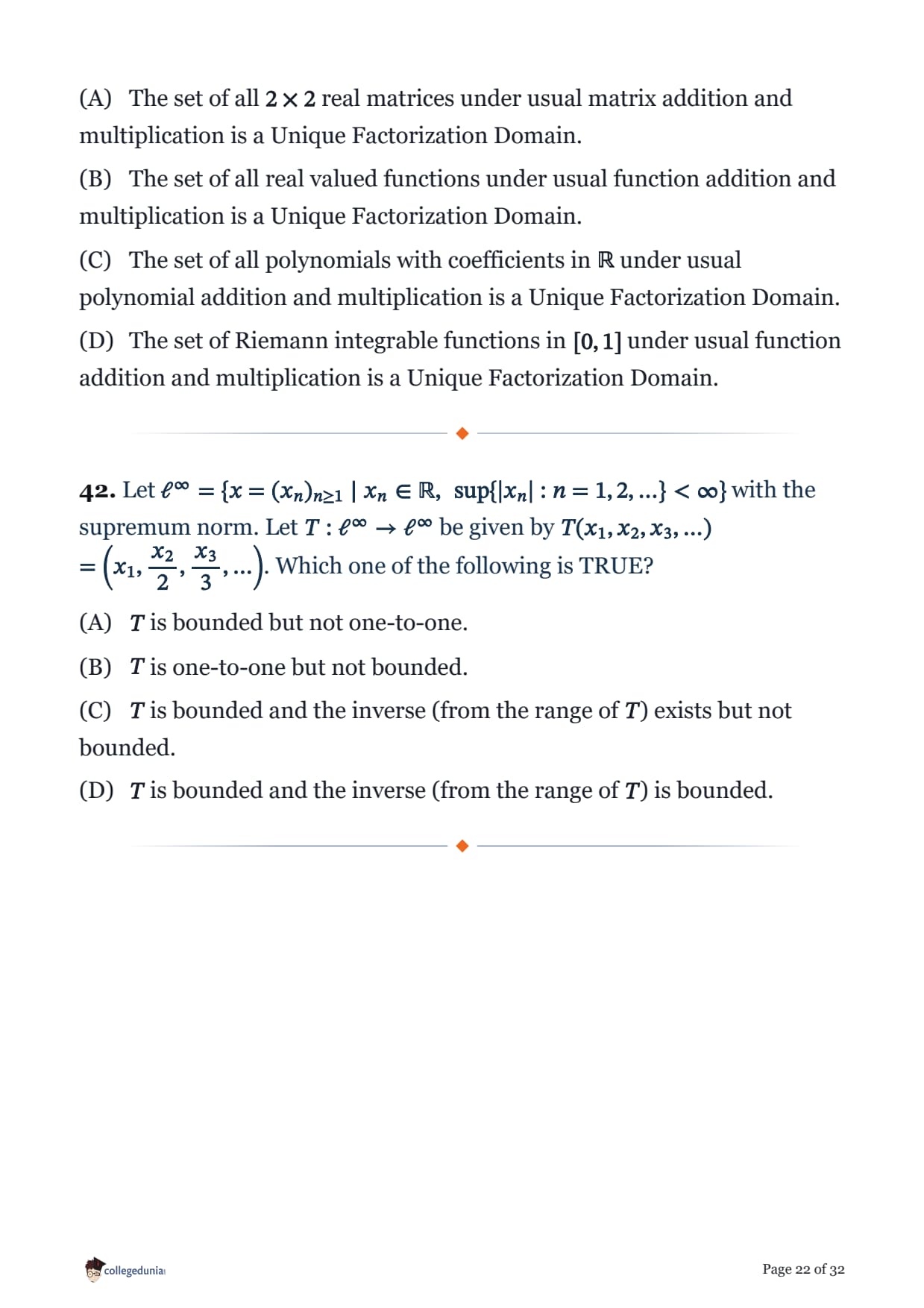
Which one of the following statements is TRUE?
Let \(\ell^{\infty} = \{x = (x_n)_{n \geq 1} \mid x_n \in \mathbb{R},\ \sup\{|x_n| : n = 1, 2, \ldots\} < \infty\}\) with the supremum norm. Let \(T : \ell^{\infty} \to \ell^{\infty}\) be given by \(T(x_1, x_2, x_3, \ldots) = \left(x_1, \dfrac{x_2}{2}, \dfrac{x_3}{3}, \ldots \right)\). Which one of the following is TRUE?
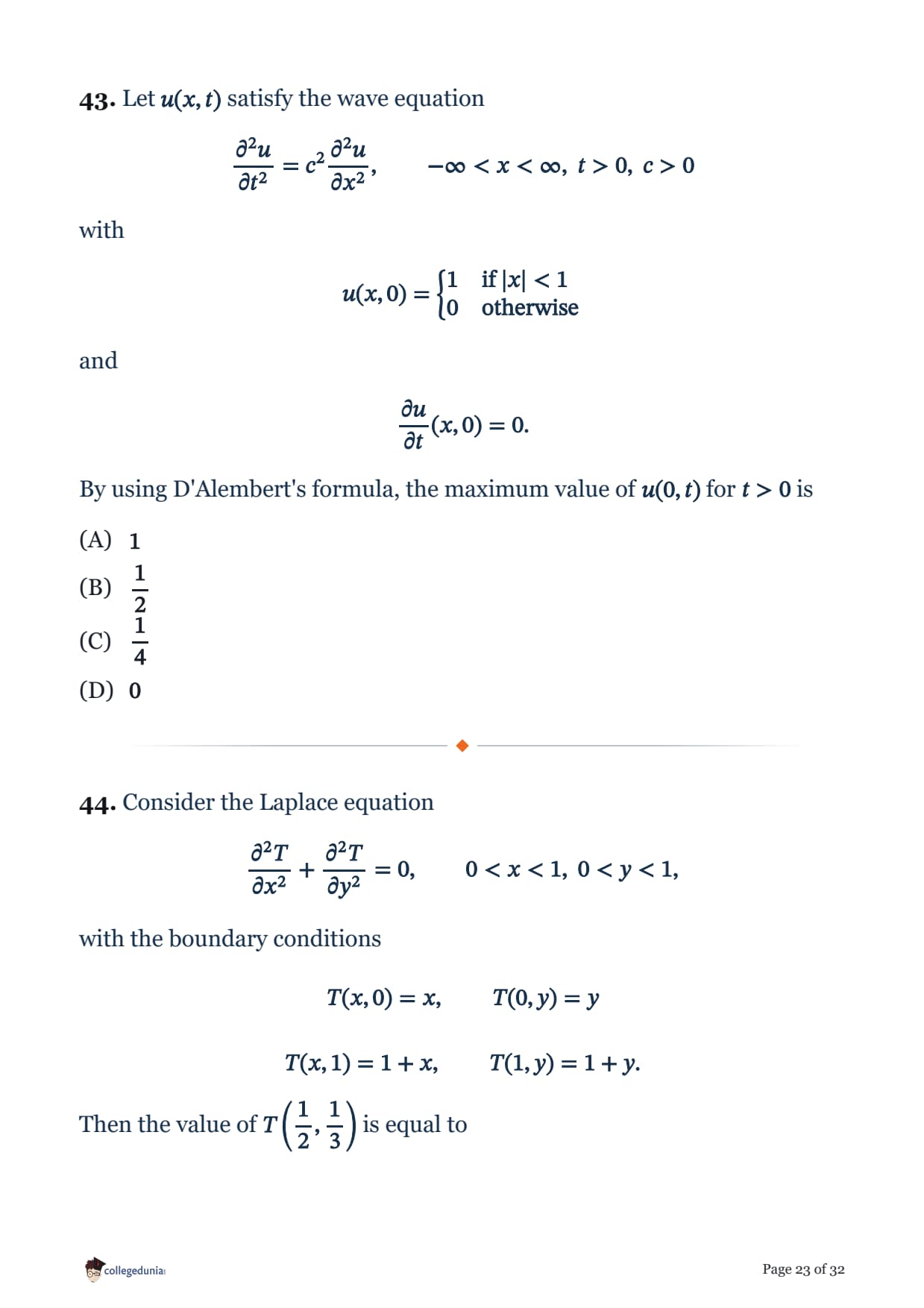
Let \(u(x,t)\) satisfy the wave equation
\[ \frac{\partial^2 u}{\partial t^2} = c^2 \frac{\partial^2 u}{\partial x^2}, \qquad -\infty < x < \infty, \; t > 0, \; c > 0 \] with
\[ u(x,0) = \begin{cases} 1 & \text{if } |x| < 1 \\ 0 & \text{otherwise} \end{cases} \] and
\[ \frac{\partial u}{\partial t}(x,0) = 0. \] By using D'Alembert's formula, the maximum value of \(u(0,t)\) for \(t > 0\) is
Consider the Laplace equation
\[ \frac{\partial^2 T}{\partial x^2} + \frac{\partial^2 T}{\partial y^2} = 0, \qquad 0 < x < 1,\; 0 < y < 1, \] with the boundary conditions
\[ T(x,0) = x, \qquad T(0,y) = y \] \[ T(x,1) = 1+x, \qquad T(1,y) = 1+y. \] Then the value of \(T\left(\dfrac{1}{2}, \dfrac{1}{3}\right)\) is equal to
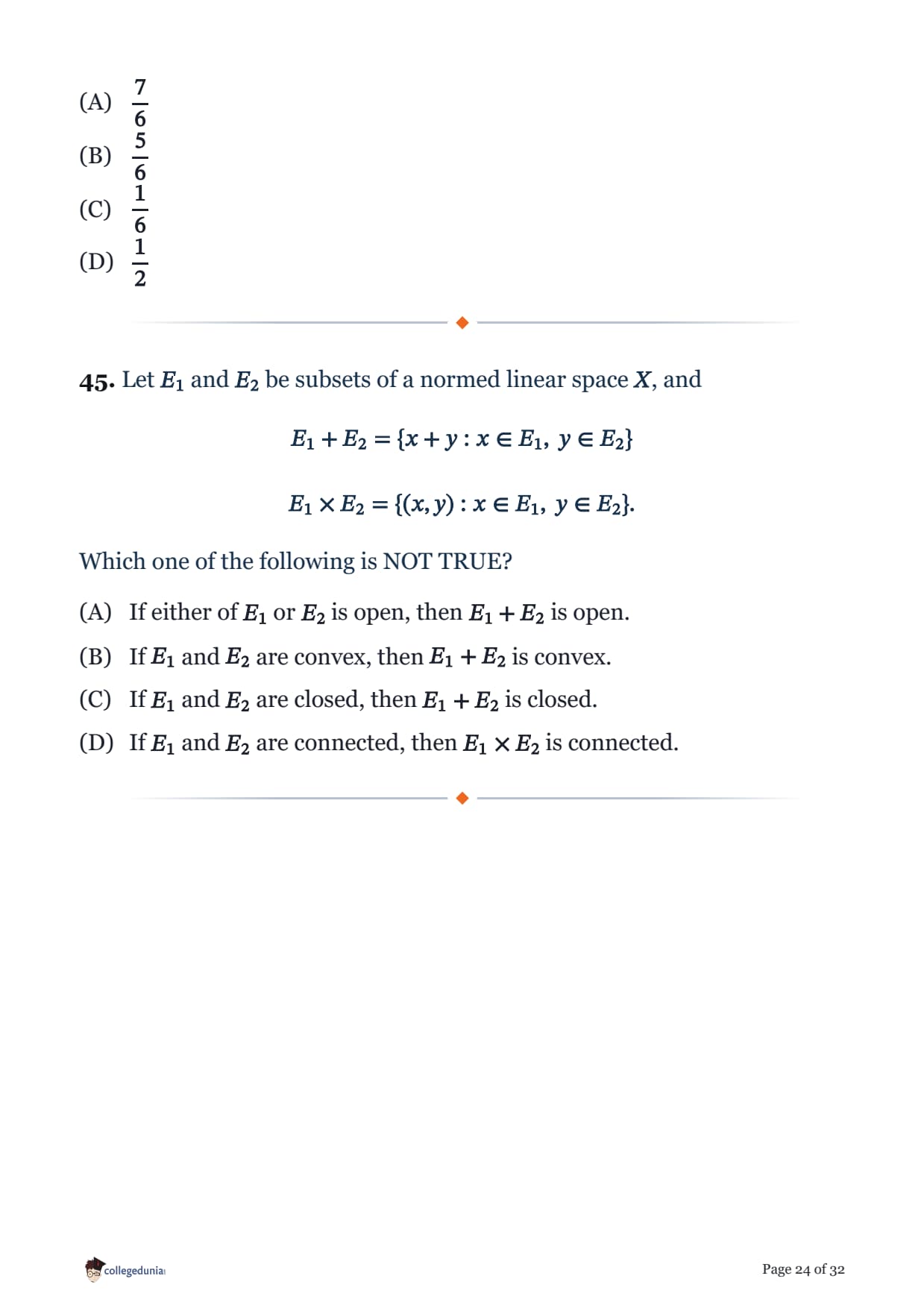
Let \(E_1\) and \(E_2\) be subsets of a normed linear space \(X\), and
\[ E_1 + E_2 = \{x+y : x \in E_1,\ y \in E_2\} \] \[ E_1 \times E_2 = \{(x,y) : x \in E_1,\ y \in E_2\}. \] Which one of the following is NOT TRUE?
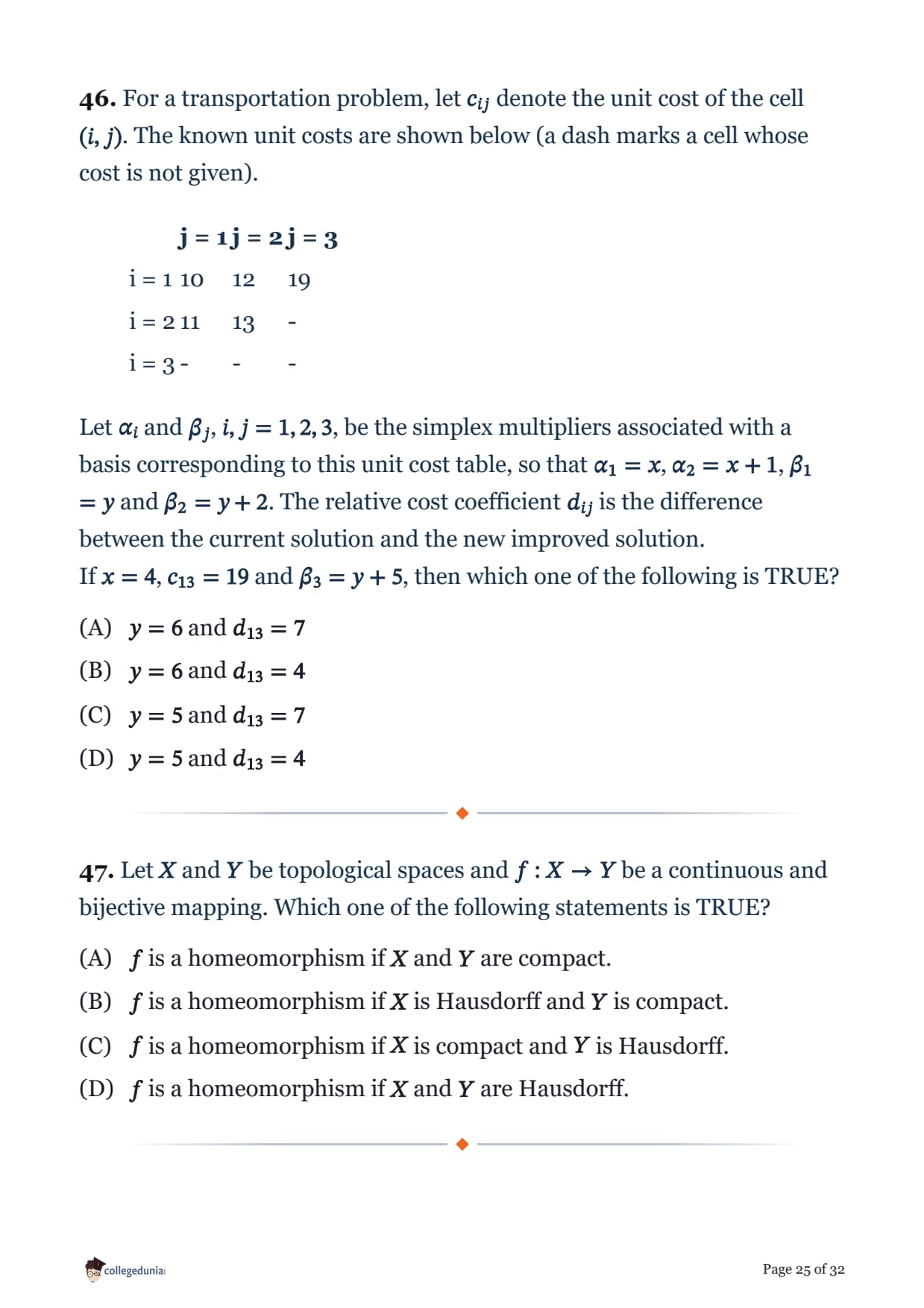
For a transportation problem, let \(c_{ij}\) denote the unit cost of the cell \((i, j)\). The known unit costs are shown below (a dash marks a cell whose cost is not given).
| j = 1 | j = 2 | j = 3 | |
|---|---|---|---|
| i = 1 | 10 | 12 | 19 |
| i = 2 | 11 | 13 | - |
| i = 3 | - | - | - |
If \(x = 4\), \(c_{13} = 19\) and \(\beta_3 = y + 5\), then which one of the following is TRUE?
Let \(X\) and \(Y\) be topological spaces and \(f: X \to Y\) be a continuous and bijective mapping. Which one of the following statements is TRUE?
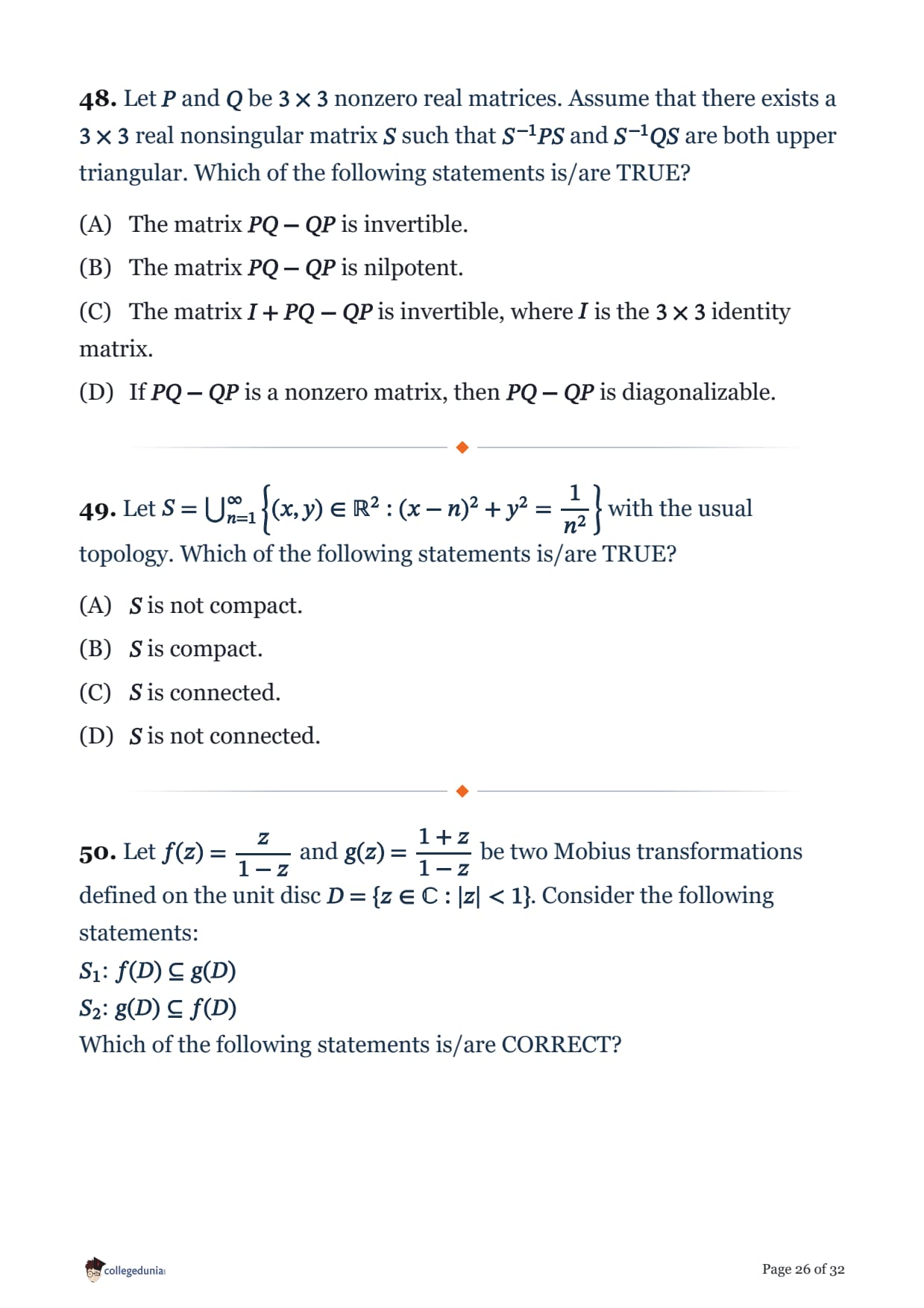
Let \(P\) and \(Q\) be \(3 \times 3\) nonzero real matrices. Assume that there exists a \(3 \times 3\) real nonsingular matrix \(S\) such that \(S^{-1}PS\) and \(S^{-1}QS\) are both upper triangular. Which of the following statements is/are TRUE?
Let \(S = \bigcup_{n=1}^{\infty} \left\{ (x, y) \in \mathbb{R}^2 : (x - n)^2 + y^2 = \dfrac{1}{n^2} \right\}\) with the usual topology. Which of the following statements is/are TRUE?
Let \(f(z) = \dfrac{z}{1-z}\) and \(g(z) = \dfrac{1+z}{1-z}\) be two Mobius transformations defined on the unit disc \(D = \{z \in \mathbb{C} : |z| < 1\}\). Consider the following statements:
\(S_1\): \(f(D) \subseteq g(D)\)
\(S_2\): \(g(D) \subseteq f(D)\)
Which of the following statements is/are CORRECT?
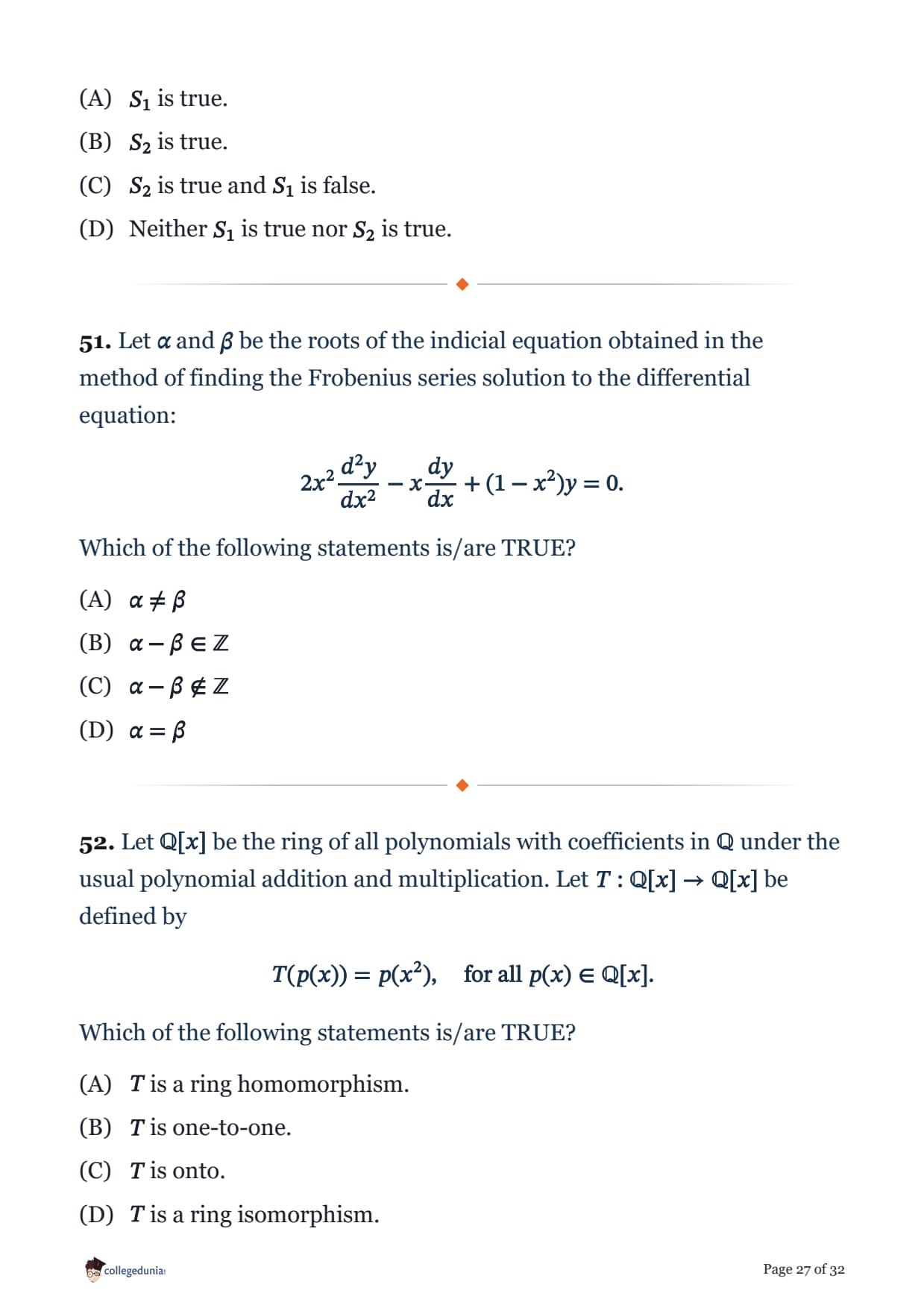
Let \( \alpha \) and \( \beta \) be the roots of the indicial equation obtained in the method of finding the Frobenius series solution to the differential equation: \[ 2x^2 \frac{d^2y}{dx^2} - x\frac{dy}{dx} + (1 - x^2) y = 0. \] Which of the following statements is/are TRUE?
Let \( \mathbb{Q}[x] \) be the ring of all polynomials with coefficients in \( \mathbb{Q} \) under the usual polynomial addition and multiplication. Let \( T: \mathbb{Q}[x] \to \mathbb{Q}[x] \) be defined by \[ T(p(x)) = p(x^2), \quad \text{for all } p(x) \in \mathbb{Q}[x]. \] Which of the following statements is/are TRUE?
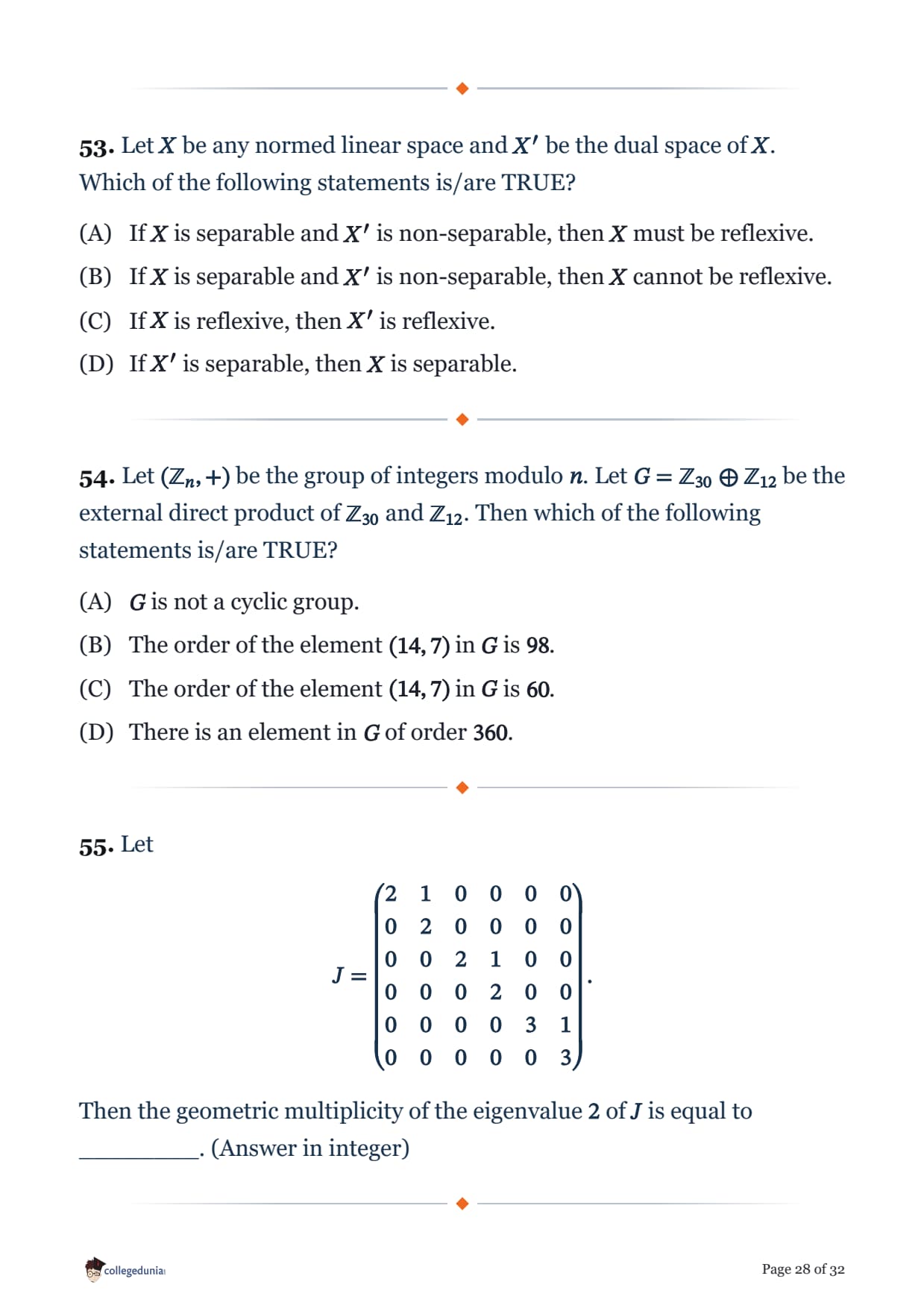
Let \(X\) be any normed linear space and \(X'\) be the dual space of \(X\). Which of the following statements is/are TRUE?
Let \( (\mathbb{Z}_n, +) \) be the group of integers modulo \(n\). Let \( G = \mathbb{Z}_{30} \oplus \mathbb{Z}_{12} \) be the external direct product of \(\mathbb{Z}_{30}\) and \(\mathbb{Z}_{12}\). Then which of the following statements is/are TRUE?
Let \[ J = \begin{pmatrix} 2 & 1 & 0 & 0 & 0 & 0 \\ 0 & 2 & 0 & 0 & 0 & 0 \\ 0 & 0 & 2 & 1 & 0 & 0 \\ 0 & 0 & 0 & 2 & 0 & 0 \\ 0 & 0 & 0 & 0 & 3 & 1 \\ 0 & 0 & 0 & 0 & 0 & 3 \end{pmatrix}. \] Then the geometric multiplicity of the eigenvalue \(2\) of \(J\) is equal to ________. (Answer in integer)
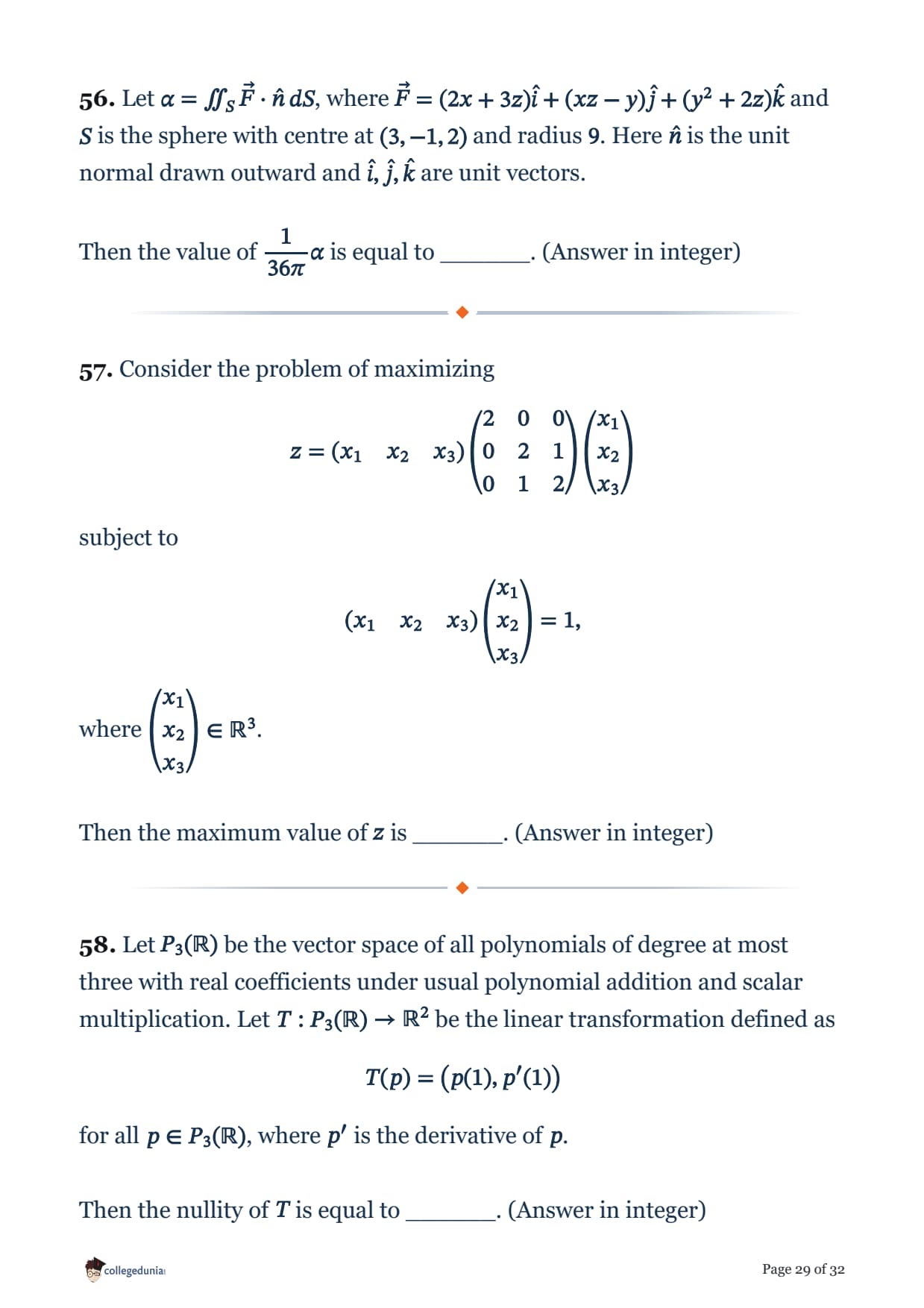
Let \( \alpha = \iint_S \vec{F} \cdot \hat{n} \, dS \), where \( \vec{F} = (2x + 3z)\hat{i} + (xz - y)\hat{j} + (y^2 + 2z)\hat{k} \) and \( S \) is the sphere with centre at \( (3, -1, 2) \) and radius \( 9 \). Here \( \hat{n} \) is the unit normal drawn outward and \( \hat{i}, \hat{j}, \hat{k} \) are unit vectors.
Then the value of \( \dfrac{1}{36\pi}\alpha \) is equal to ______. (Answer in integer)
Consider the problem of maximizing
\[ z = \begin{pmatrix} x_1 & x_2 & x_3 \end{pmatrix} \begin{pmatrix} 2 & 0 & 0 \\ 0 & 2 & 1 \\ 0 & 1 & 2 \end{pmatrix} \begin{pmatrix} x_1 \\ x_2 \\ x_3 \end{pmatrix} \]
subject to
\[ \begin{pmatrix} x_1 & x_2 & x_3 \end{pmatrix} \begin{pmatrix} x_1 \\ x_2 \\ x_3 \end{pmatrix} = 1, \]
where \( \begin{pmatrix} x_1 \\ x_2 \\ x_3 \end{pmatrix} \in \mathbb{R}^3 \).
Then the maximum value of \( z \) is ______. (Answer in integer)
Let \( P_3(\mathbb{R}) \) be the vector space of all polynomials of degree at most three with real coefficients under usual polynomial addition and scalar multiplication. Let \( T: P_3(\mathbb{R}) \to \mathbb{R}^2 \) be the linear transformation defined as
\[ T(p) = \left(p(1), p'(1)\right) \]
for all \( p \in P_3(\mathbb{R}) \), where \( p' \) is the derivative of \( p \).
Then the nullity of \( T \) is equal to ______. (Answer in integer)
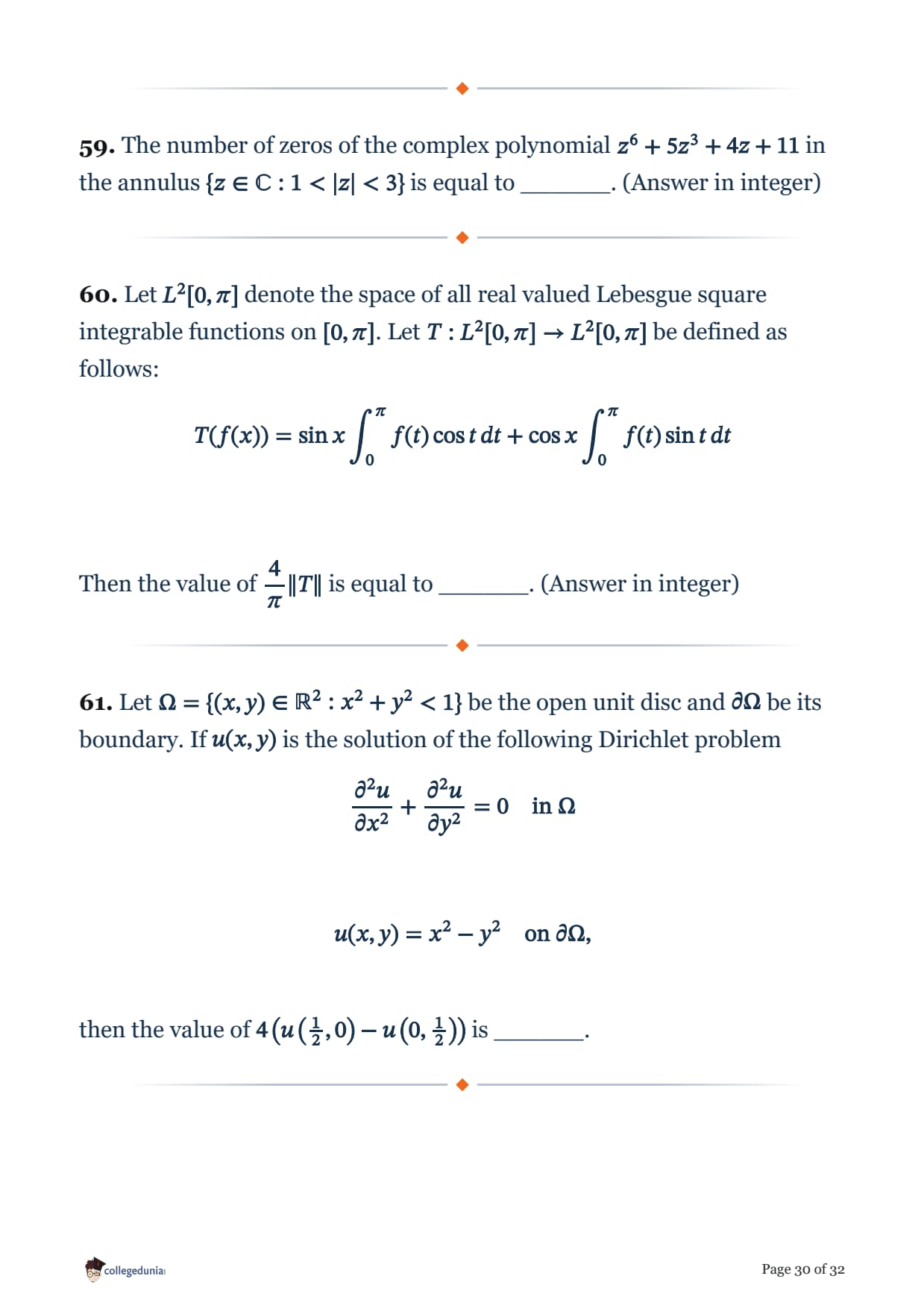
The number of zeros of the complex polynomial \( z^6 + 5z^3 + 4z + 11 \) in the annulus \( \{z \in \mathbb{C} : 1 < |z| < 3\} \) is equal to ______. (Answer in integer)
Let \( L^2[0, \pi] \) denote the space of all real valued Lebesgue square integrable functions on \( [0, \pi] \). Let \( T: L^2[0, \pi] \to L^2[0, \pi] \) be defined as follows:
\[ T(f(x)) = \sin x \int_0^{\pi} f(t)\cos t \, dt + \cos x \int_0^{\pi} f(t)\sin t \, dt \]
Then the value of \( \dfrac{4}{\pi}\|T\| \) is equal to ______. (Answer in integer)
Let \( \Omega = \{(x, y) \in \mathbb{R}^2 : x^2 + y^2 < 1\} \) be the open unit disc and \( \partial\Omega \) be its boundary. If \( u(x, y) \) is the solution of the following Dirichlet problem
\[ \frac{\partial^2 u}{\partial x^2} + \frac{\partial^2 u}{\partial y^2} = 0 \quad \text{in } \Omega \]
\[ u(x, y) = x^2 - y^2 \quad \text{on } \partial\Omega, \]
then the value of \( 4\left(u\left(\frac{1}{2}, 0\right) - u\left(0, \frac{1}{2}\right)\right) \) is ______.
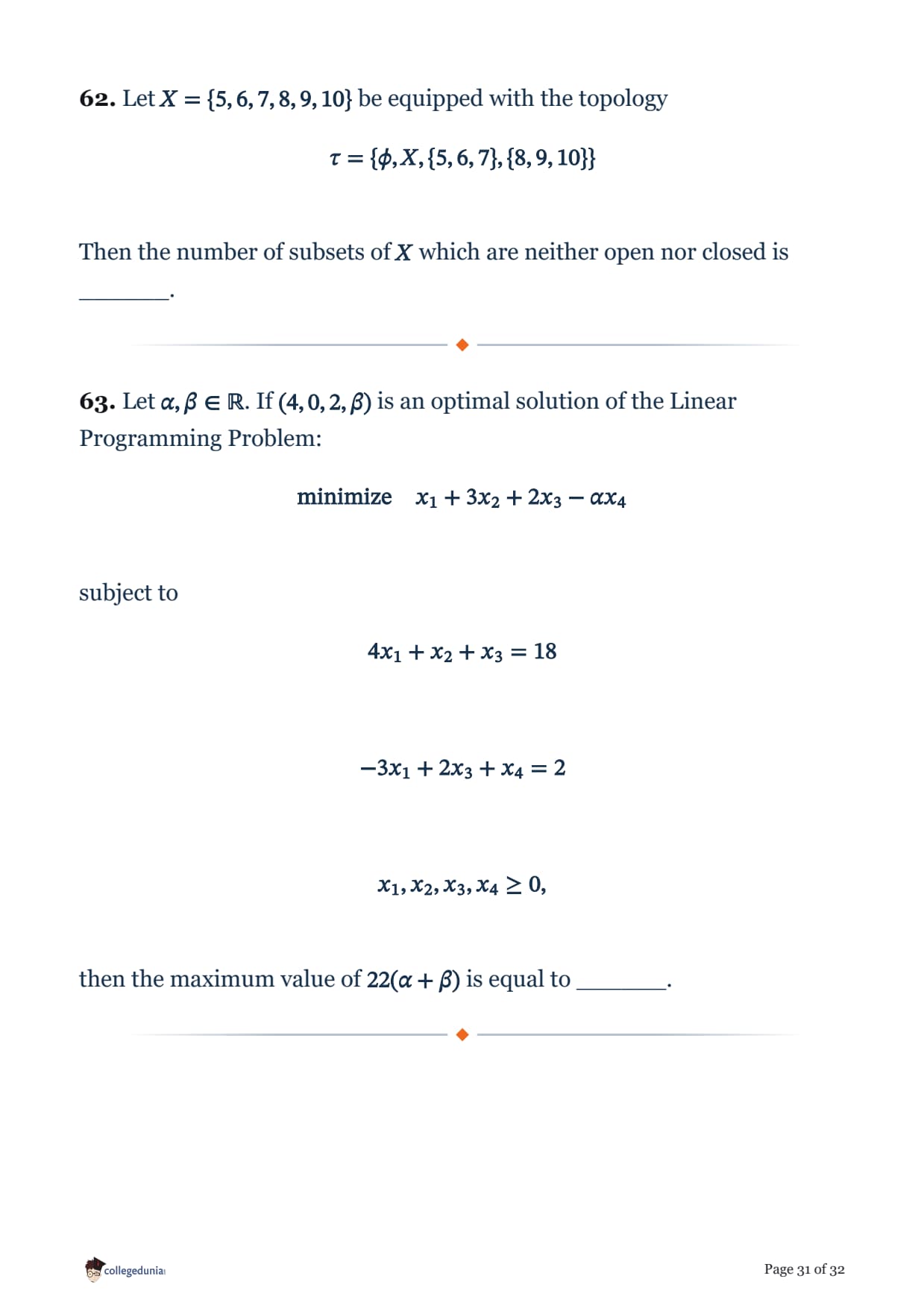
Let \( X = \{5, 6, 7, 8, 9, 10\} \) be equipped with the topology
\[ \tau = \{ \phi, X, \{5,6,7\}, \{8,9,10\} \} \]
Then the number of subsets of \( X \) which are neither open nor closed is ______.
Let \( \alpha, \beta \in \mathbb{R} \). If \( (4, 0, 2, \beta) \) is an optimal solution of the Linear Programming Problem:
\[ \text{minimize} \quad x_1 + 3x_2 + 2x_3 - \alpha x_4 \]
subject to
\[ 4x_1 + x_2 + x_3 = 18 \]
\[ -3x_1 + 2x_3 + x_4 = 2 \]
\[ x_1, x_2, x_3, x_4 \geq 0, \]
then the maximum value of \( 22(\alpha + \beta) \) is equal to ______.
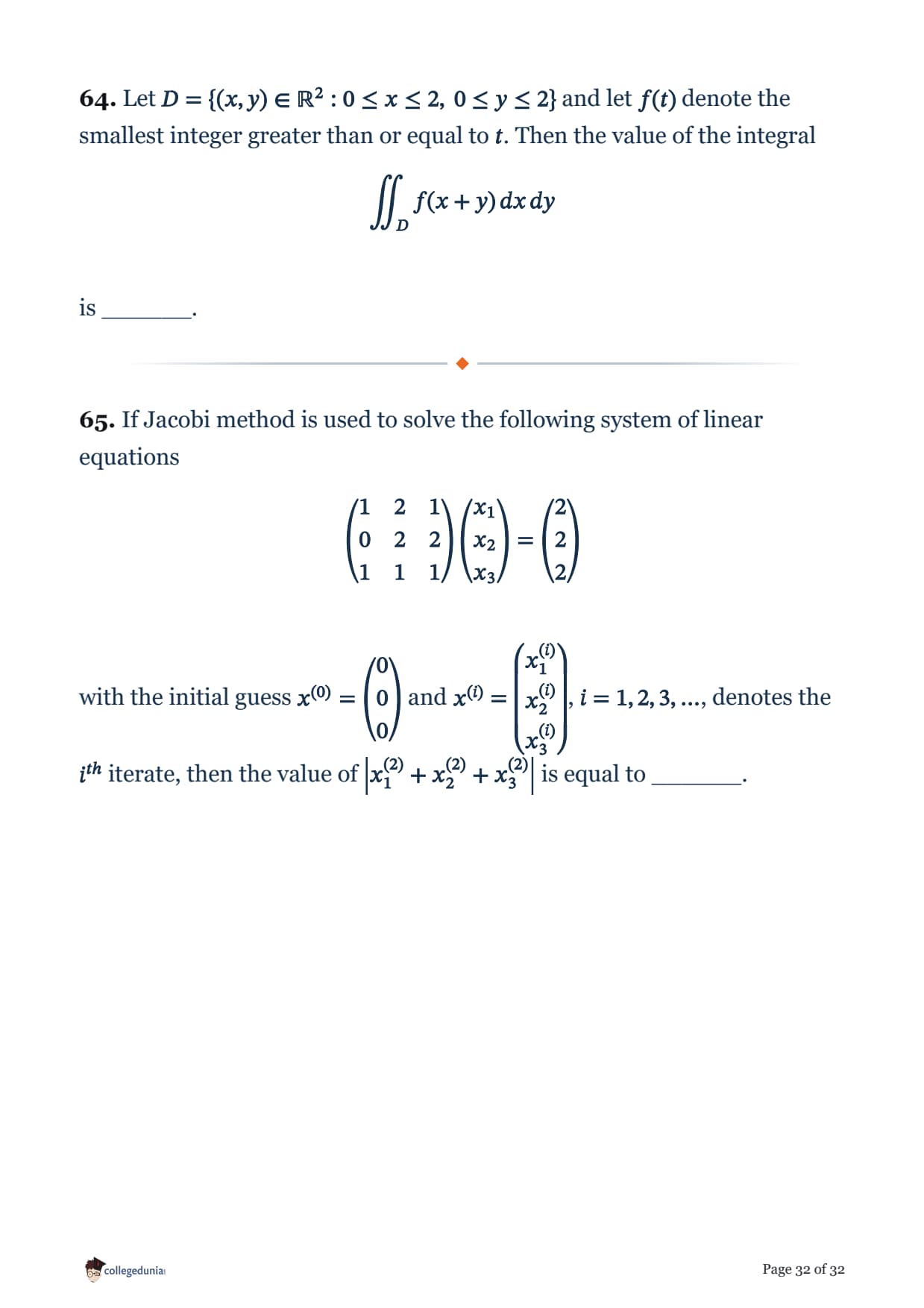
Let \( D = \{(x, y) \in \mathbb{R}^2 : 0 \leq x \leq 2,\ 0 \leq y \leq 2\} \) and let \( f(t) \) denote the smallest integer greater than or equal to \( t \). Then the value of the integral
\[ \iint_D f(x+y)\, dx\, dy \]
is ______.
If Jacobi method is used to solve the following system of linear equations
\[ \begin{pmatrix} 1 & 2 & 1 \\ 0 & 2 & 2 \\ 1 & 1 & 1 \end{pmatrix} \begin{pmatrix} x_1 \\ x_2 \\ x_3 \end{pmatrix} = \begin{pmatrix} 2 \\ 2 \\ 2 \end{pmatrix} \]
with the initial guess \( x^{(0)} = \begin{pmatrix} 0 \\ 0 \\ 0 \end{pmatrix} \) and \( x^{(i)} = \begin{pmatrix} x_1^{(i)} \\ x_2^{(i)} \\ x_3^{(i)} \end{pmatrix} \), \( i = 1,2,3,\ldots \), denotes the \( i^{th} \) iterate, then the value of \( \left| x_1^{(2)} + x_2^{(2)} + x_3^{(2)} \right| \) is equal to ______.
GATE 2026 Mathematics (MA) Exam Pattern and Marking Scheme Explained
As per the official GATE 2026 information brochure on the IIT Guwahati website (gate2026.iitg.ac.in), the MA paper mixes General Aptitude with core Mathematics and is a 3-hour computer-based test.
- Total questions: 65 questions - 10 General Aptitude and 55 Mathematics
- Total marks: 100 - General Aptitude carries 15 marks, Mathematics carries 85 marks
- Duration: 3 hours (180 minutes), single session
- Question types: MCQ (single correct), MSQ (one or more correct), and NAT (numerical answer type)
- Marking scheme: 1-mark and 2-mark questions. MCQs carry negative marking (-1/3 on 1-mark, -2/3 on 2-mark); MSQ and NAT questions have no negative marking
High-Weightage Subjects in GATE 2026 Mathematics (MA) to Focus On First
The 55 Mathematics questions this year were spread across the full MA syllabus, but a few areas clearly dominated the paper. These are where your practice pays back the most.
- Linear Algebra: the single biggest core area with 8 questions - matrices, quotient spaces, Jordan forms, inner products, and quadratic forms
- Real Analysis: 7 questions covering multivariable continuity, sequences of functions, Lebesgue integration, and double integrals
- Complex Analysis: 7 questions on analytic functions, contour integration, power series, and Rouche's theorem
- Algebra and Functional Analysis: 6 questions each - groups, rings and field extensions on one side, normed and Banach spaces, dual spaces and operator norms on the other
- Topology: 6 questions on compactness, connectedness, and finite topological spaces
- PDEs, Linear Programming and ODEs: 5, 4 and 3 questions respectively, with a couple of Numerical Analysis questions rounding off the paper
GATE 2026 Mathematics (MA) Question Paper Solution Video
Source: SOURAV SIR'S CLASSES
How to Use the GATE 2026 Mathematics Question Paper for Practice
Treat this paper as a full mock before you read a single solution. The MA paper rewards accuracy on the 2-mark MSQ and NAT questions, so time management matters more than raw speed.
- Solve all 65 questions in one 3-hour sitting first, then score yourself against the official answer key
- Review every wrong answer with the solution PDF above, focusing on the 2-mark MSQ questions where a single missed option costs the full 2 marks
- Redo the Linear Algebra, Real Analysis and Complex Analysis sets - together they were about 22 of the 55 core questions
- Attempt the NAT questions on paper without the on-screen calculator crutch, since MA NAT answers usually need exact reasoning, not heavy arithmetic
GATE 2026 Mathematics (MA) Question Paper FAQs
Ques. Was the GATE 2026 Mathematics (MA) paper tough?
Ans. Most students rated GATE 2026 MA moderate to tough. The 1-mark questions were manageable, but several 2-mark MSQ and NAT questions in Functional Analysis and Complex Analysis were time-consuming and needed careful reasoning.
Ques. Which topics had the highest weightage in GATE 2026 Mathematics?
Ans. Linear Algebra led with 8 questions, followed by Real Analysis and Complex Analysis with 7 each. Algebra, Functional Analysis and Topology contributed 6 questions each, so these six areas alone made up most of the 55 core questions.
Ques. How many questions and marks are there in the GATE MA paper?
Ans. GATE MA has 65 questions for 100 marks. 10 questions (15 marks) are General Aptitude and 55 questions (85 marks) are Mathematics, split across 1-mark and 2-mark questions of MCQ, MSQ and NAT type.
Ques. Is there negative marking in GATE 2026 Mathematics?
Ans. Yes, but only on MCQs. A wrong 1-mark MCQ loses 1/3 mark and a wrong 2-mark MCQ loses 2/3 mark. MSQ and NAT questions carry no negative marking, so never leave an NAT question blank if you have a reasonable value.
Ques. Where can I download the GATE 2026 Mathematics question paper with solutions PDF for free?
Ans. You can download the full GATE 2026 MA question paper with step-by-step solutions from the table at the top of this page on Collegedunia. The official master question paper and answer key are also available on the IIT Guwahati website, gate2026.iitg.ac.in.
Ques. How many marks are needed to qualify GATE 2026 Mathematics?
Ans. The MA qualifying mark usually sits in the mid-20s out of 100 for the general category, but a competitive score for admissions and scholarships is much higher. Aim for 55 to 60+ marks to target a rank under 1000.



Comments