




The GATE 2026 Metallurgical Engineering (MT) question paper is now available with detailed solutions for free download. GATE 2026 MT was conducted by IIT Guwahati on February 14, 2026, in the afternoon session (2:30 PM to 5:30 PM), and the paper carried 65 questions worth 100 marks in 3 hours.
| GATE 2026 Metallurgical Engineering Question Paper with Solutions | Download PDF | Check Solutions |
GATE 2026 Metallurgical Engineering Questions with Solutions
'The team ______ more than 300 runs in 20 overs ___________ rains. However, some players needed to improve their batting skills.'
Choose the option with the correct sequence of words to fill the blanks.
If a positive real \(x\) satisfies the following equation
\[ \log_2 x + \log_{\sqrt{2}} x = 48, \]
then the value of \(x\) is _________________
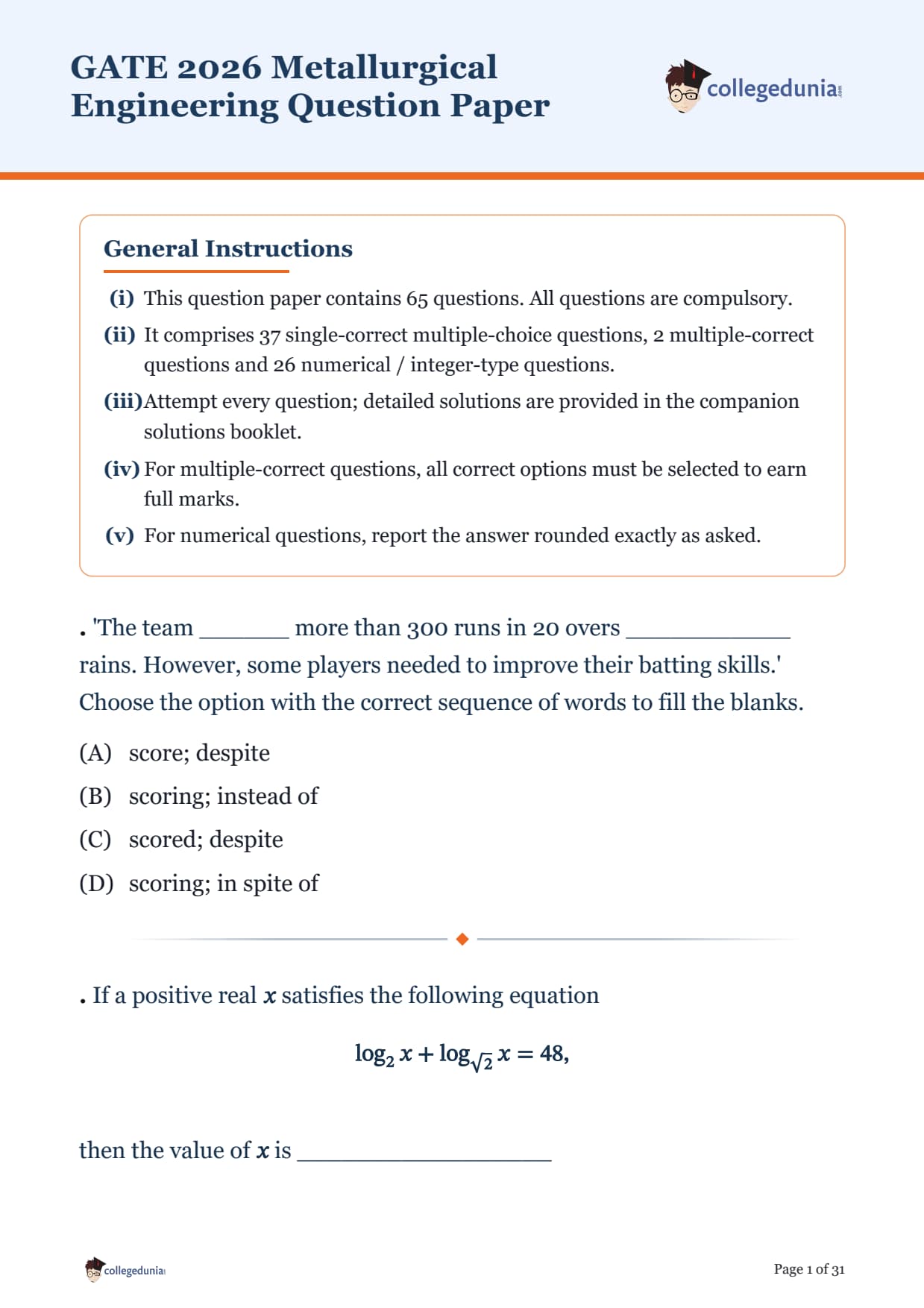
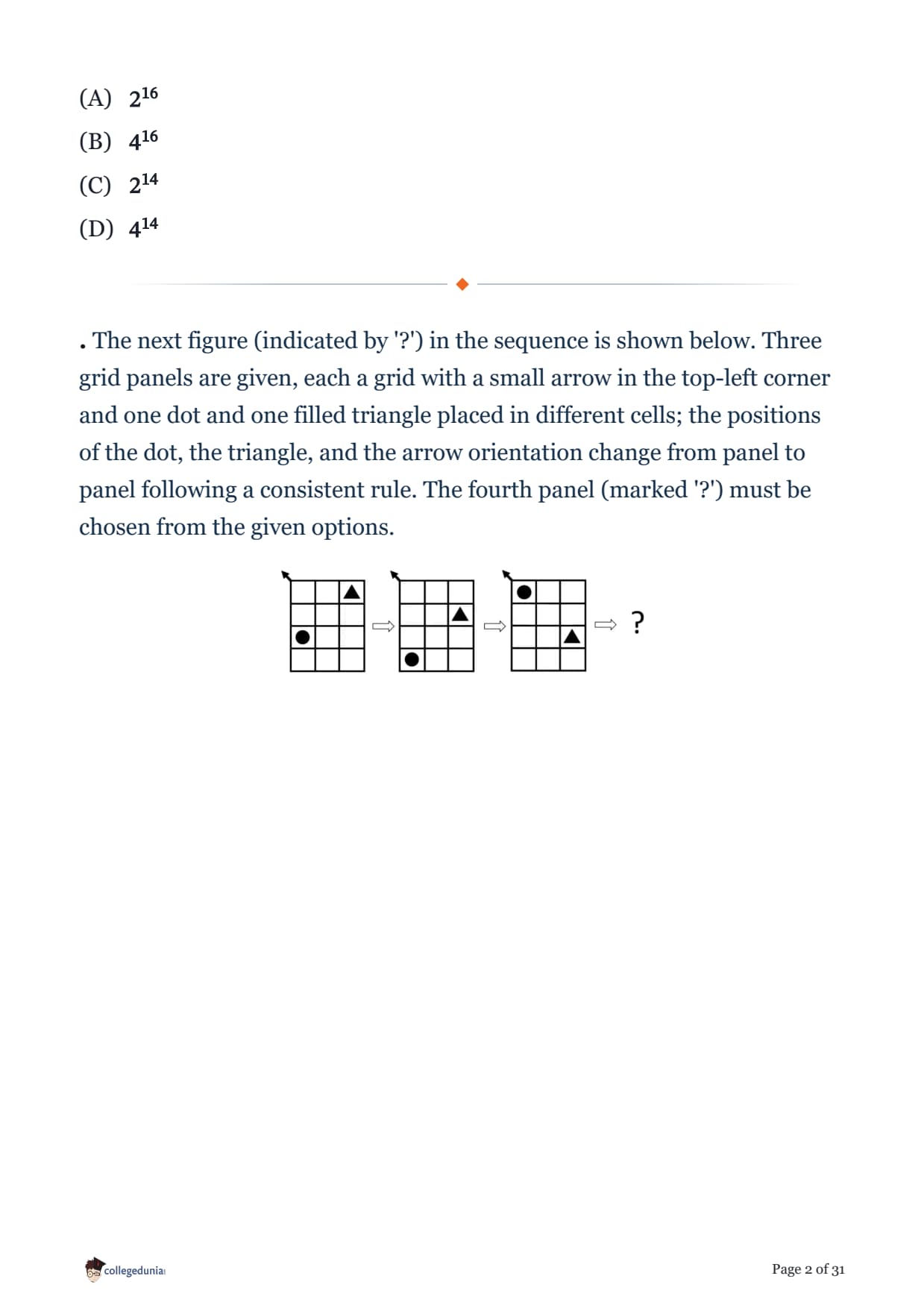
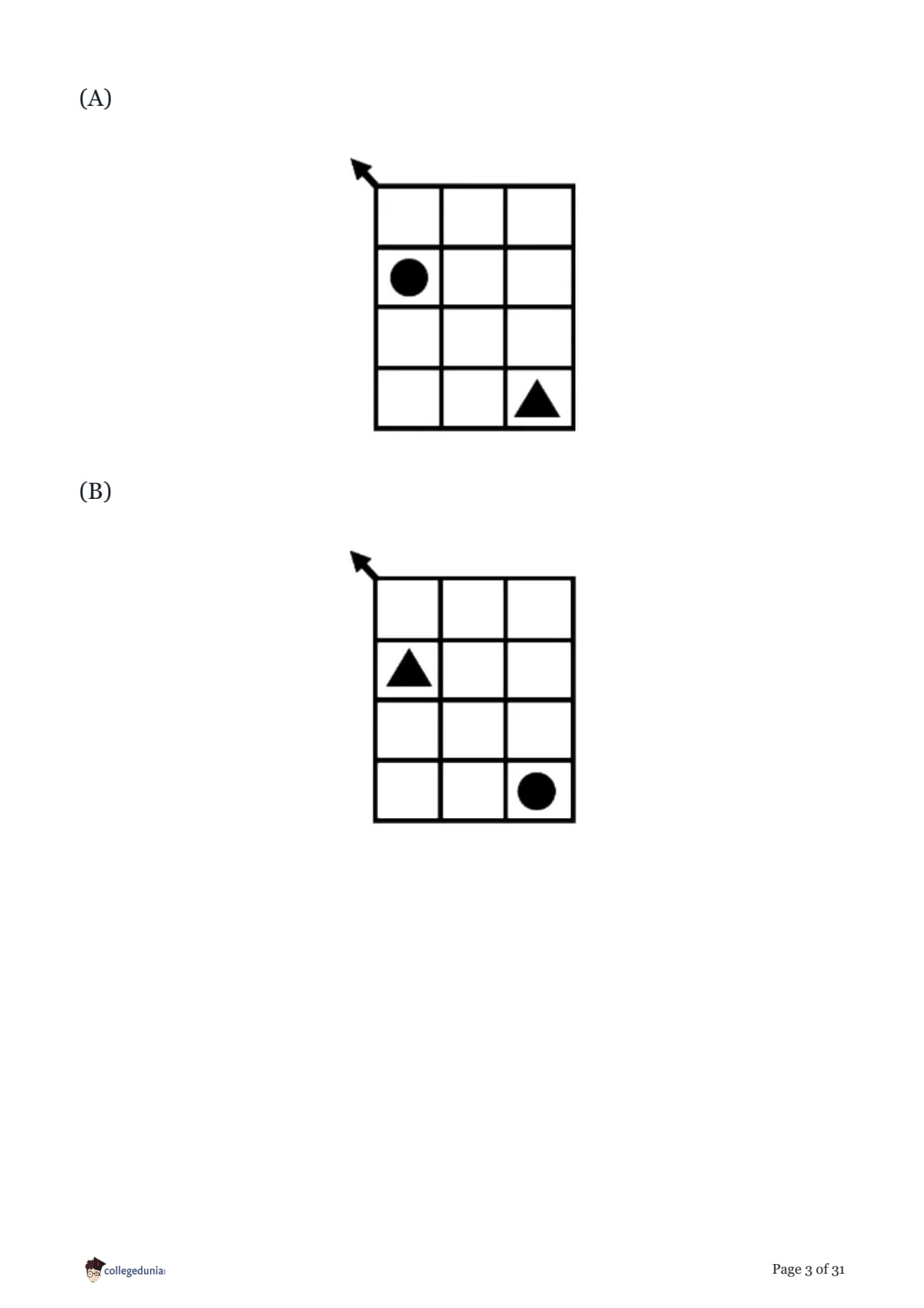
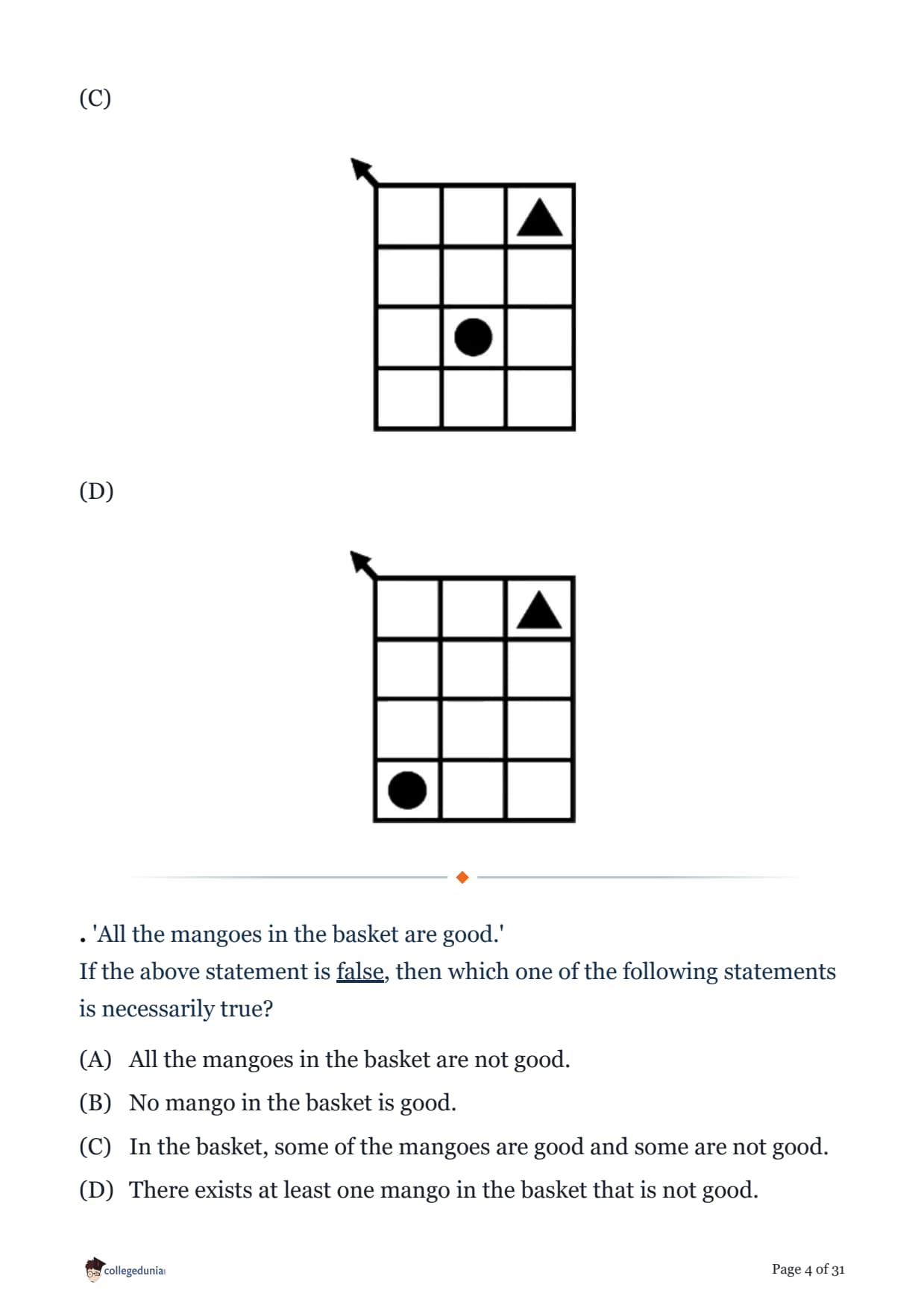
The next figure (indicated by '?') in the sequence is shown below. Three grid panels are given, each a grid with a small arrow in the top-left corner and one dot and one filled triangle placed in different cells; the positions of the dot, the triangle, and the arrow orientation change from panel to panel following a consistent rule. The fourth panel (marked '?') must be chosen from the given options.

- (A)
![]()
- (B)
![]()
- (C)
![]()
- (D)
![]()


'All the mangoes in the basket are good.'
If the above statement is false, then which one of the following statements is necessarily true?
Consider the following statements about four numbers:
(S1) The average of the four numbers is 25
(S2) Each number is at most 40
(S3) Each number is at least 20
Choose the option that is necessarily correct.
'People are crowding around ___ pit into which ___ elephant has fallen. I have never seen an elephant looking more bewildered ___ miserable. Here it is in a most undignified position, thrust into a pit and made to look up ___ a vast, curiosity-stricken crowd.'
Choose the option with the correct sequence of words to fill the blanks.
The table lists the unit selling price of five products P, Q, R, S, and T. On a particular day, 250 items were sold with the average selling price of Rs. 60. The following observations were made:
(i) The quantity of S sold was twice that of T.
(ii) The quantity of R sold was thrice that of T.
(iii) The quantity of Q sold was four times that of T.
| Product | P | Q | R | S | T |
|---|---|---|---|---|---|
| Unit selling price (Rs.) | 100 | 50 | 40 | 60 | 60 |
What is the quantity of product P sold on that day?
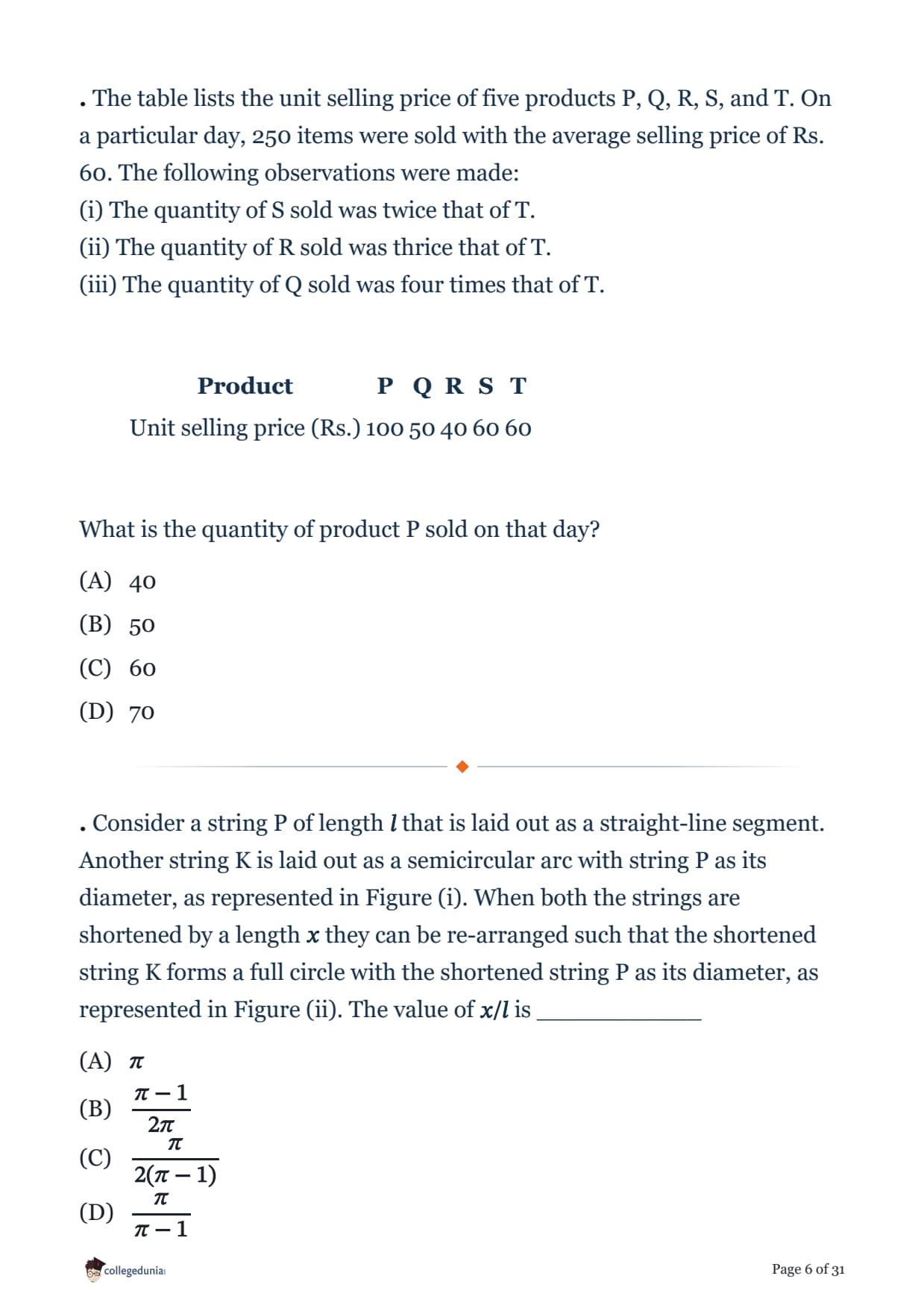
Consider a string P of length \(l\) that is laid out as a straight-line segment. Another string K is laid out as a semicircular arc with string P as its diameter, as represented in Figure (i). When both the strings are shortened by a length \(x\) they can be re-arranged such that the shortened string K forms a full circle with the shortened string P as its diameter, as represented in Figure (ii). The value of \(x/l\) is ___________
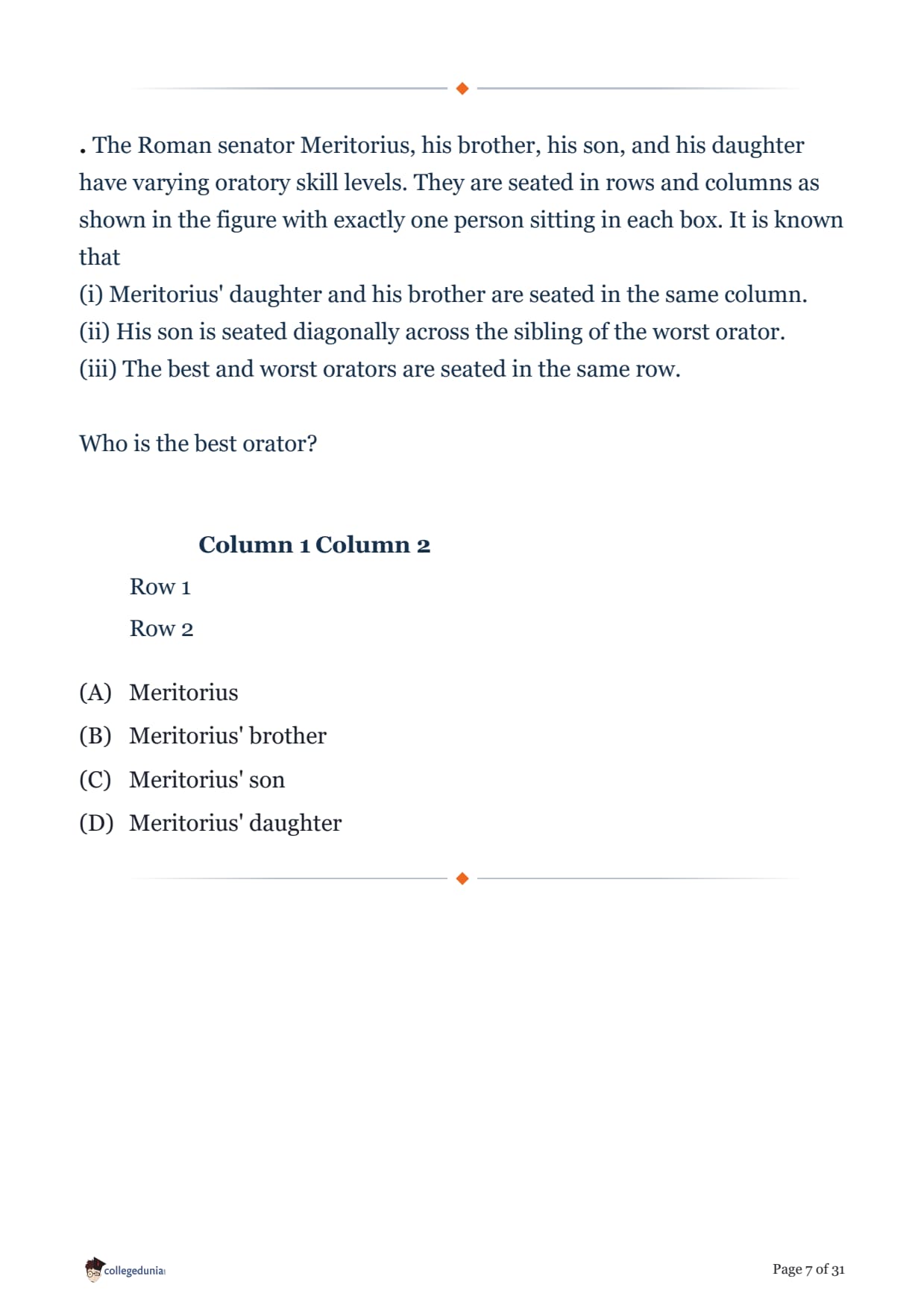
The Roman senator Meritorius, his brother, his son, and his daughter have varying oratory skill levels. They are seated in rows and columns as shown in the figure with exactly one person sitting in each box. It is known that
(i) Meritorius' daughter and his brother are seated in the same column.
(ii) His son is seated diagonally across the sibling of the worst orator.
(iii) The best and worst orators are seated in the same row.
Who is the best orator?
| Column 1 | Column 2 | |
|---|---|---|
| Row 1 | ||
| Row 2 |
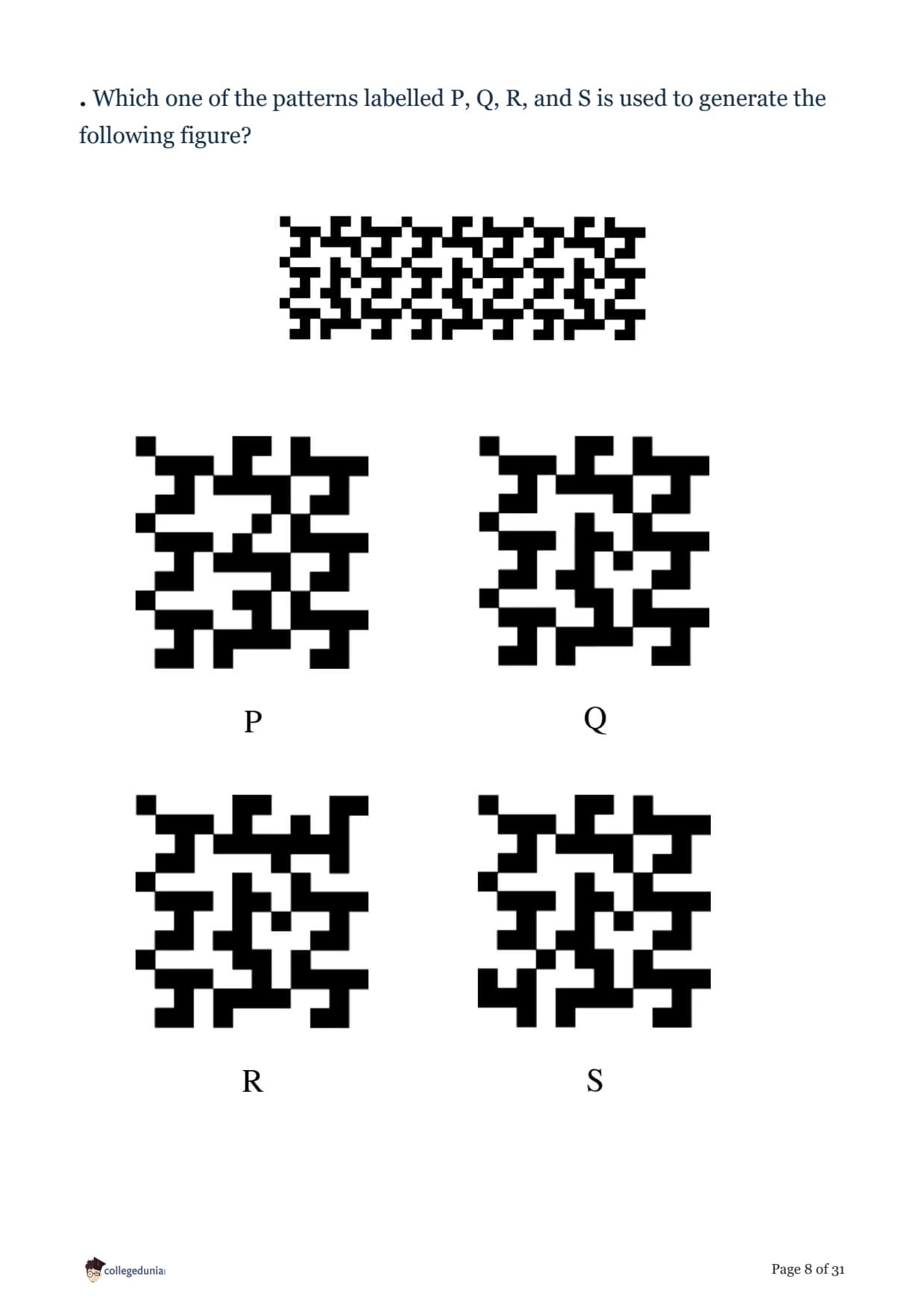
Which one of the patterns labelled P, Q, R, and S is used to generate the following figure?

 |  |
 |  |
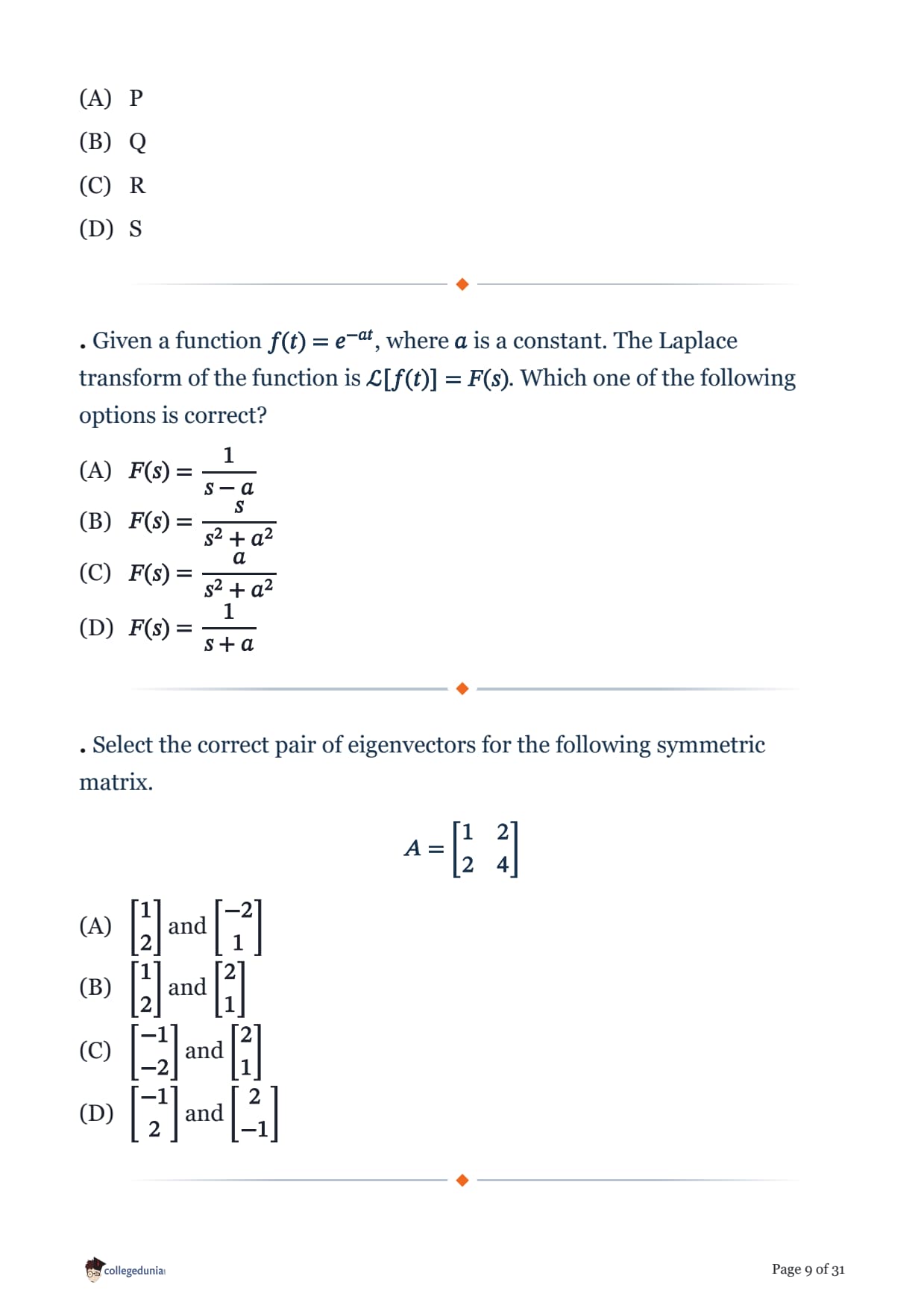
Given a function \(f(t) = e^{-at}\), where \(a\) is a constant. The Laplace transform of the function is \(\mathcal{L}[f(t)] = F(s)\). Which one of the following options is correct?
Select the correct pair of eigenvectors for the following symmetric matrix.
\[
A = \begin{bmatrix} 1 & 2 \\ 2 & 4 \end{bmatrix}
\]
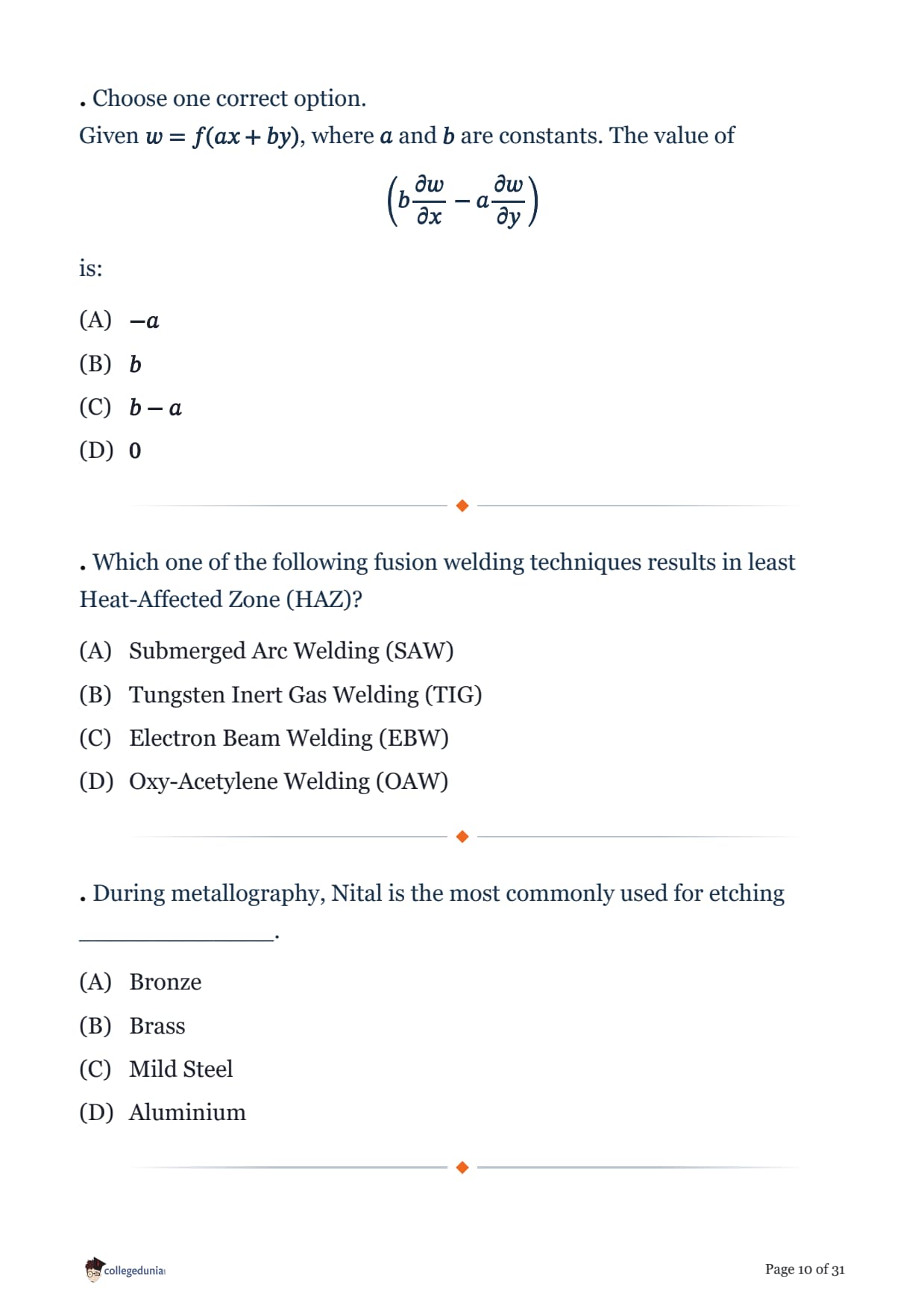
Choose one correct option.
Given \(w = f(ax+by)\), where \(a\) and \(b\) are constants. The value of
\[
\left(b\frac{\partial w}{\partial x} - a\frac{\partial w}{\partial y}\right)
\]
is:
Which one of the following fusion welding techniques results in least Heat-Affected Zone (HAZ)?
During metallography, Nital is the most commonly used for etching _____________.
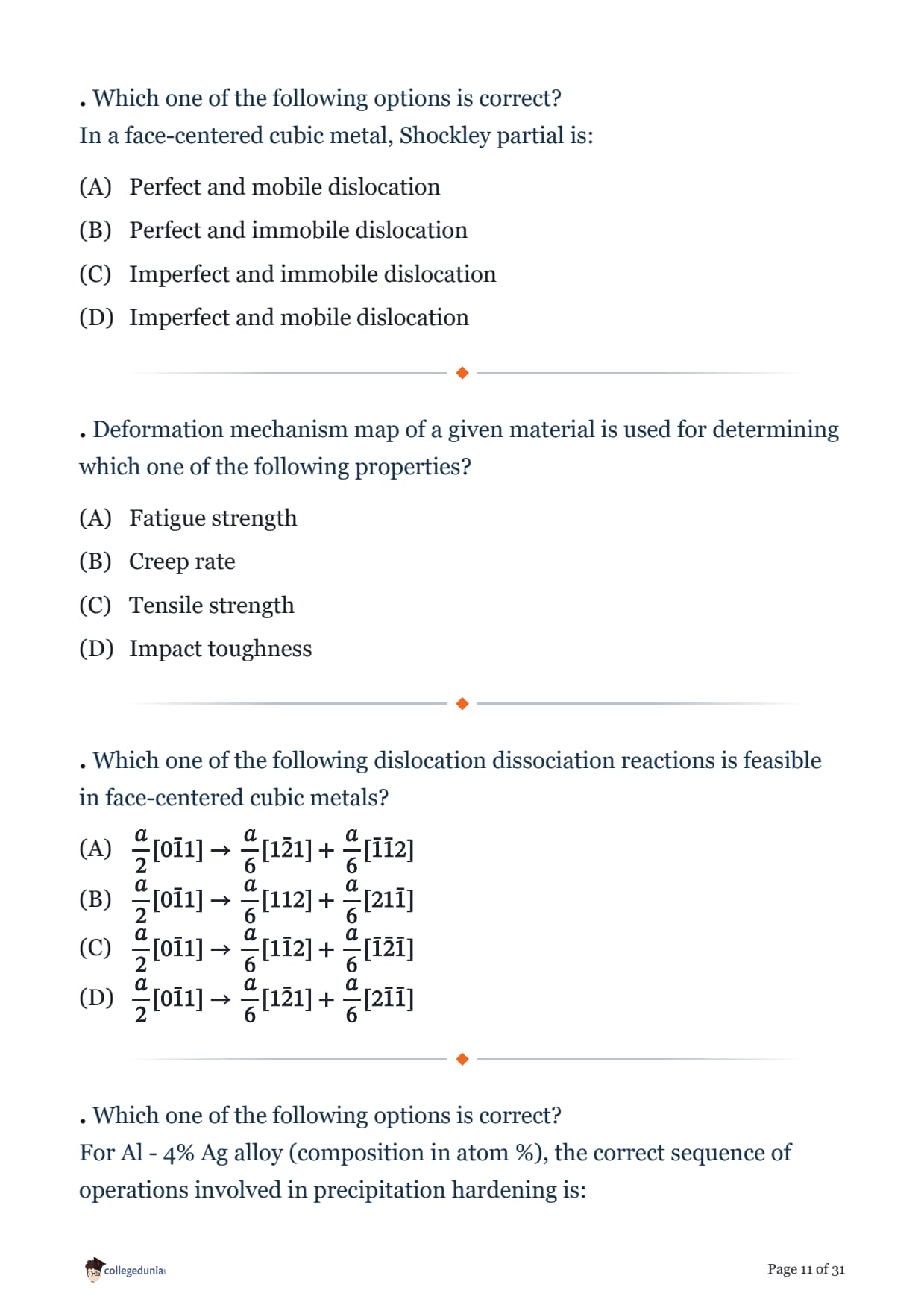
Which one of the following options is correct?
In a face-centered cubic metal, Shockley partial is:
Deformation mechanism map of a given material is used for determining which one of the following properties?
Which one of the following dislocation dissociation reactions is feasible in face-centered cubic metals?
Which one of the following options is correct?
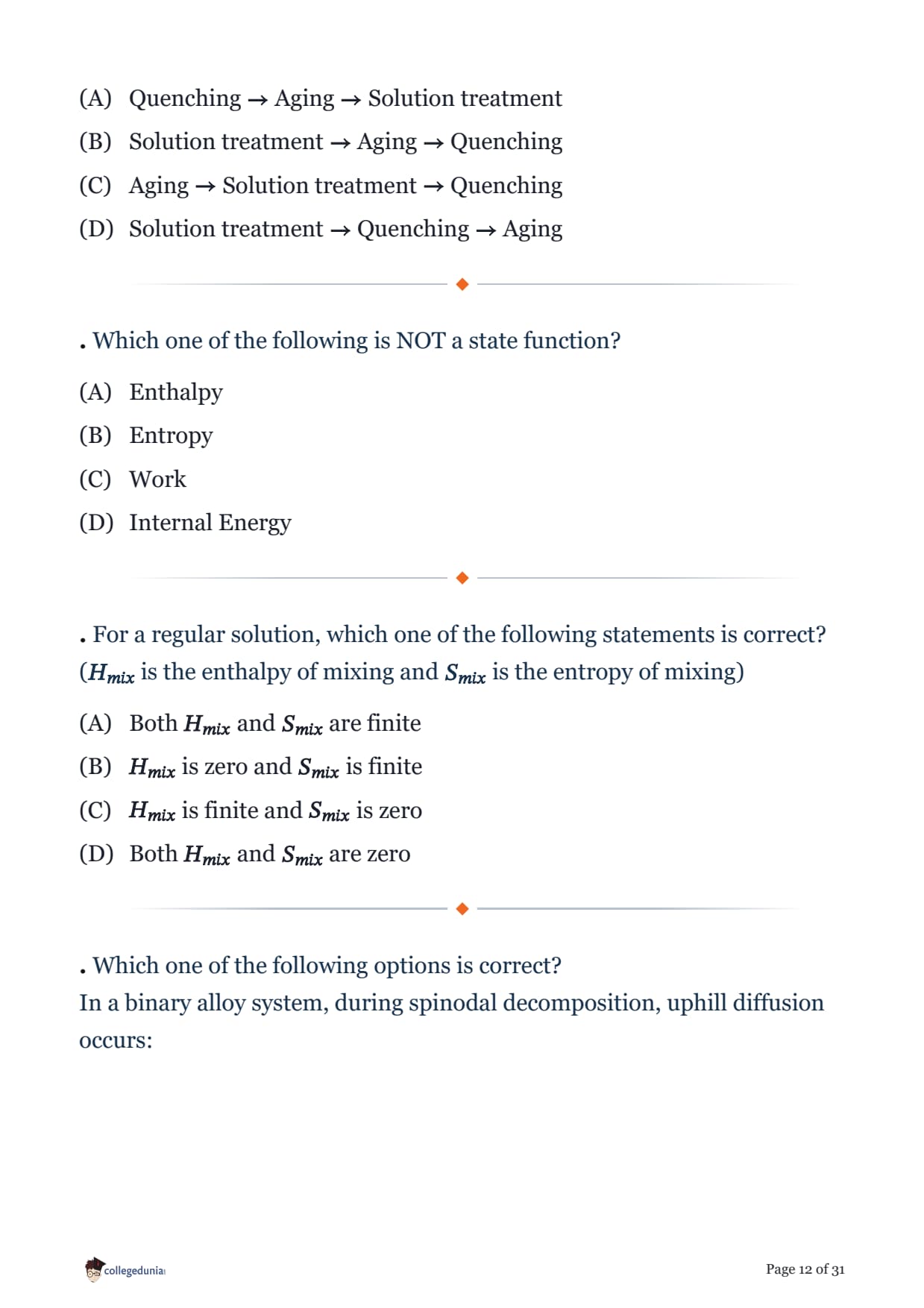
For Al - 4% Ag alloy (composition in atom %), the correct sequence of operations involved in precipitation hardening is:
Which one of the following is NOT a state function?
For a regular solution, which one of the following statements is correct?
(\(H_{mix}\) is the enthalpy of mixing and \(S_{mix}\) is the entropy of mixing)
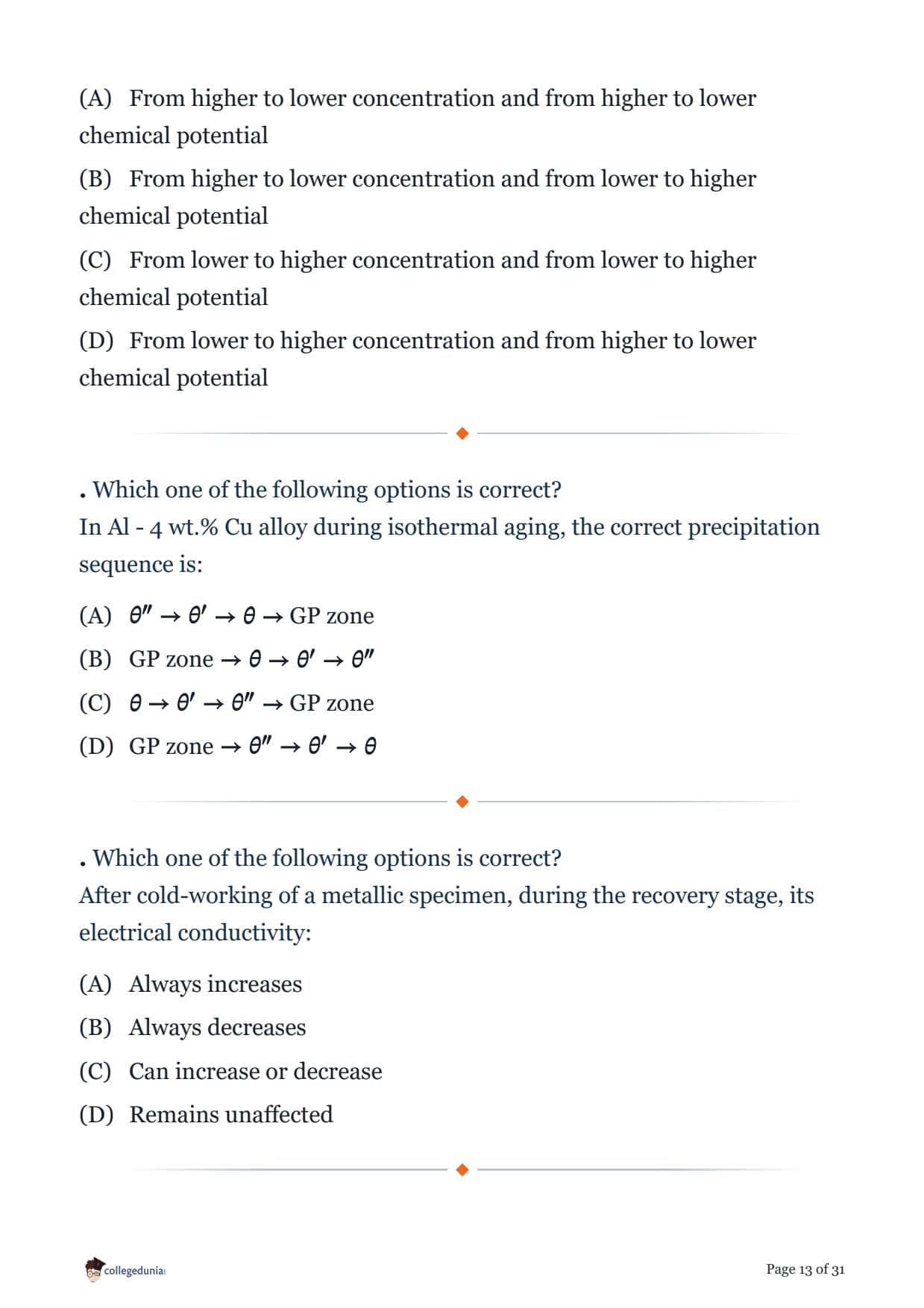
Which one of the following options is correct?
In a binary alloy system, during spinodal decomposition, uphill diffusion occurs:
Which one of the following options is correct?
In Al - 4 wt.% Cu alloy during isothermal aging, the correct precipitation sequence is:
Which one of the following options is correct?
After cold-working of a metallic specimen, during the recovery stage, its electrical conductivity:
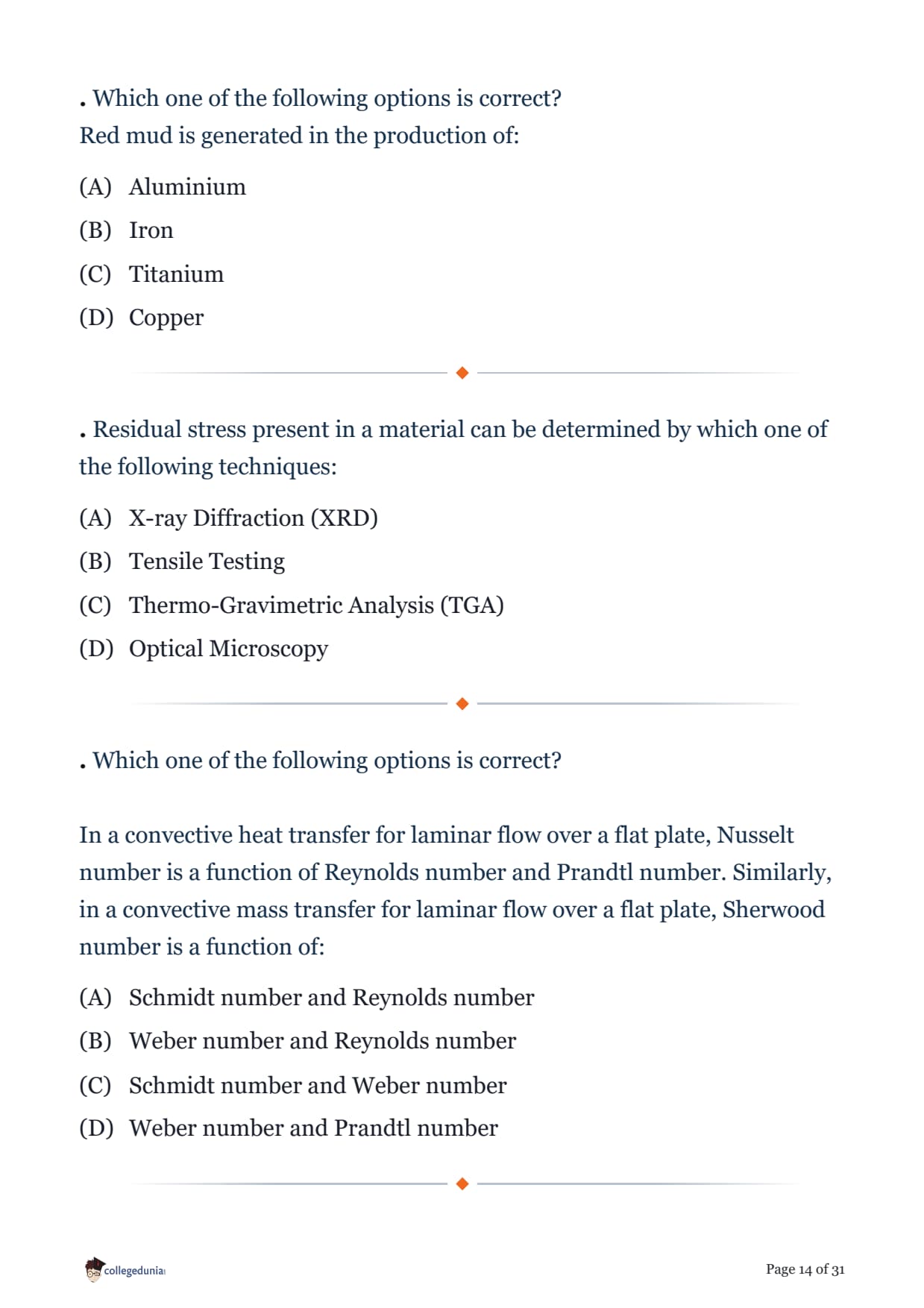
Which one of the following options is correct?
Red mud is generated in the production of:
Residual stress present in a material can be determined by which one of the following techniques:
Which one of the following options is correct?
In a convective heat transfer for laminar flow over a flat plate, Nusselt number is a function of Reynolds number and Prandtl number. Similarly, in a convective mass transfer for laminar flow over a flat plate, Sherwood number is a function of:
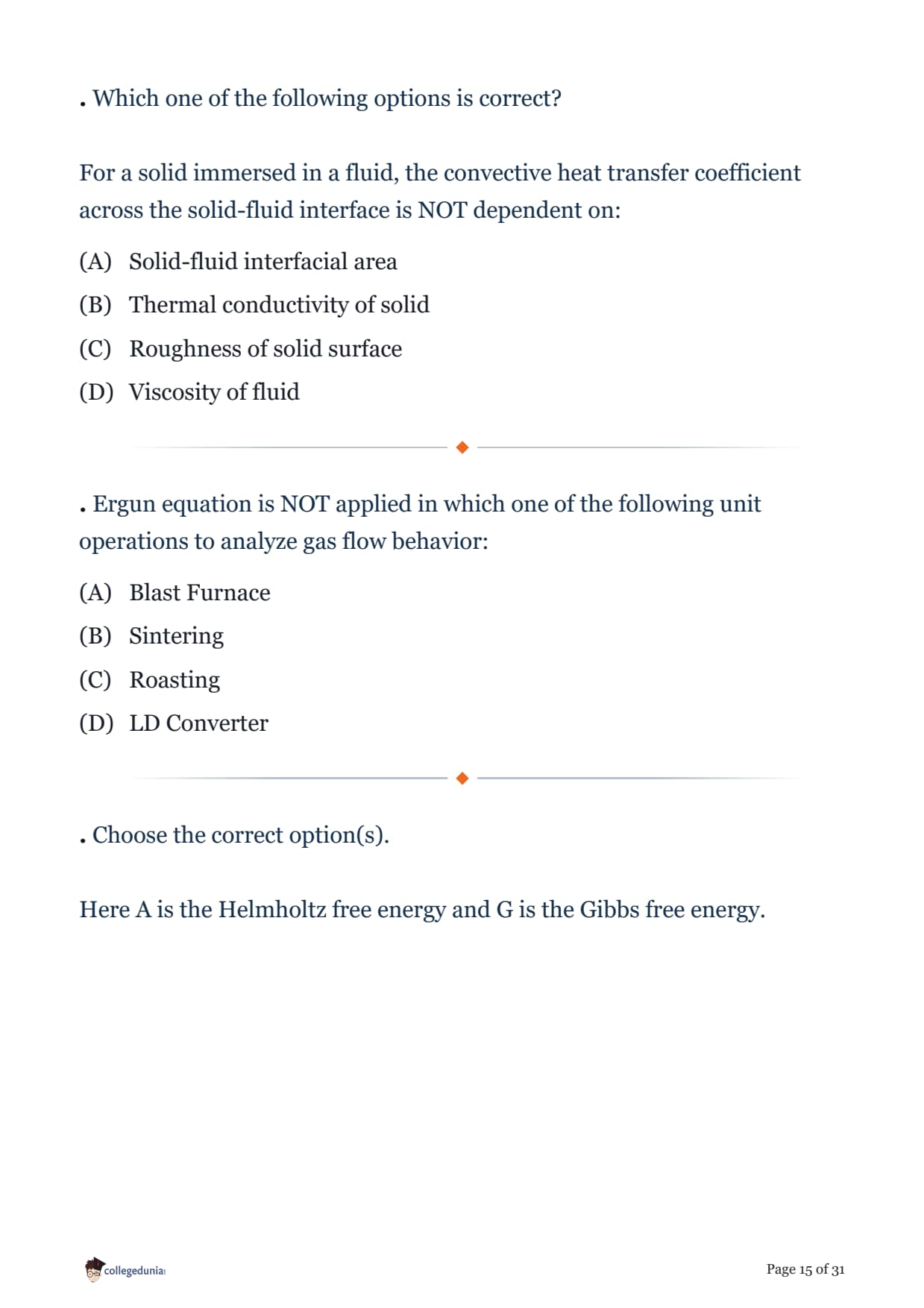
Which one of the following options is correct?
For a solid immersed in a fluid, the convective heat transfer coefficient across the solid-fluid interface is NOT dependent on:
Ergun equation is NOT applied in which one of the following unit operations to analyze gas flow behavior:
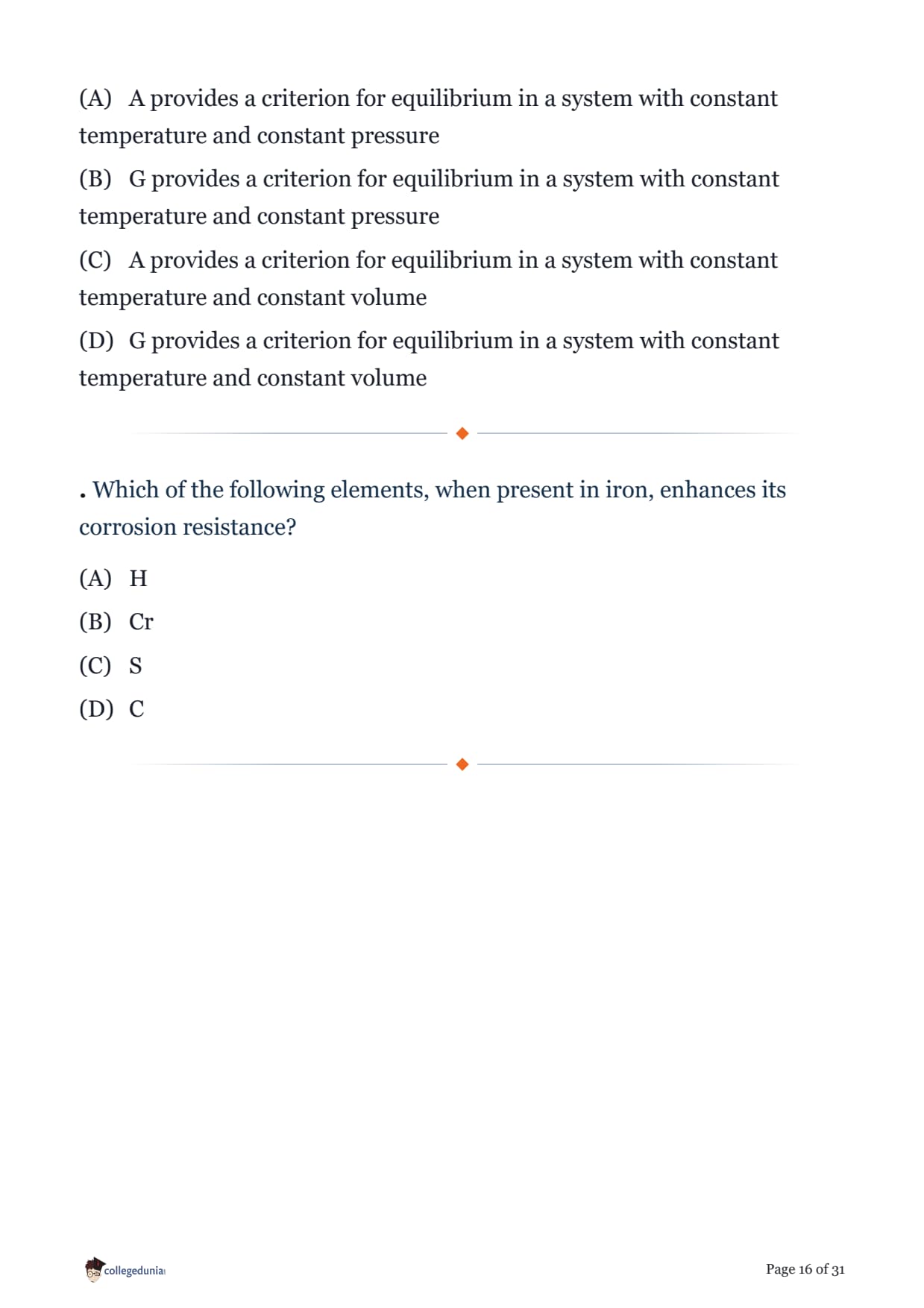
Choose the correct option(s).
Here A is the Helmholtz free energy and G is the Gibbs free energy.
Which of the following elements, when present in iron, enhances its corrosion resistance?
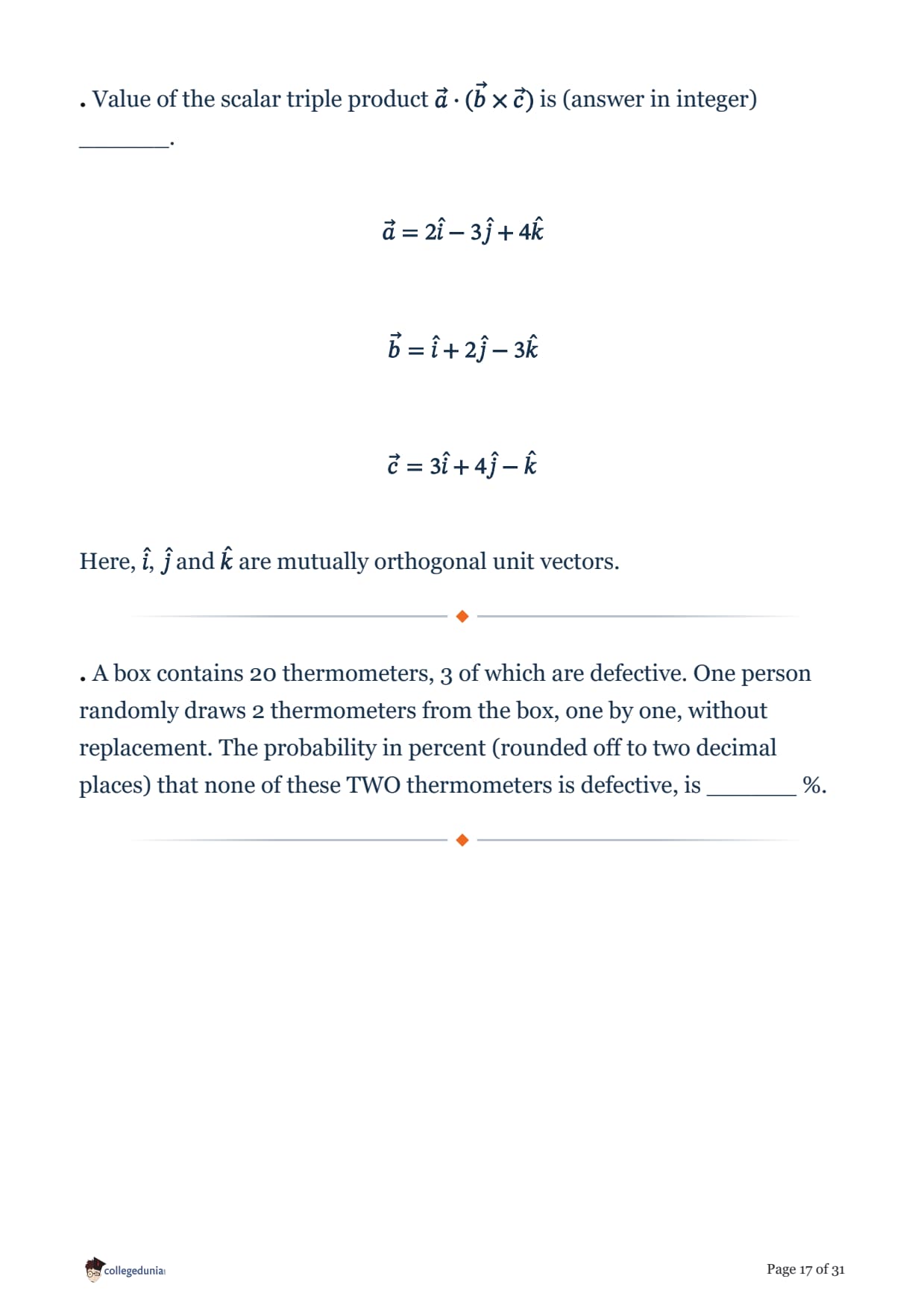
Value of the scalar triple product \(\vec{a}\cdot(\vec{b}\times\vec{c})\) is (answer in integer) ______.
\[ \vec{a}=2\hat{i}-3\hat{j}+4\hat{k} \]
\[ \vec{b}=\hat{i}+2\hat{j}-3\hat{k} \]
\[ \vec{c}=3\hat{i}+4\hat{j}-\hat{k} \]
Here, \(\hat{i}\), \(\hat{j}\) and \(\hat{k}\) are mutually orthogonal unit vectors.
A box contains 20 thermometers, 3 of which are defective. One person randomly draws 2 thermometers from the box, one by one, without replacement. The probability in percent (rounded off to two decimal places) that none of these TWO thermometers is defective, is ______ %.
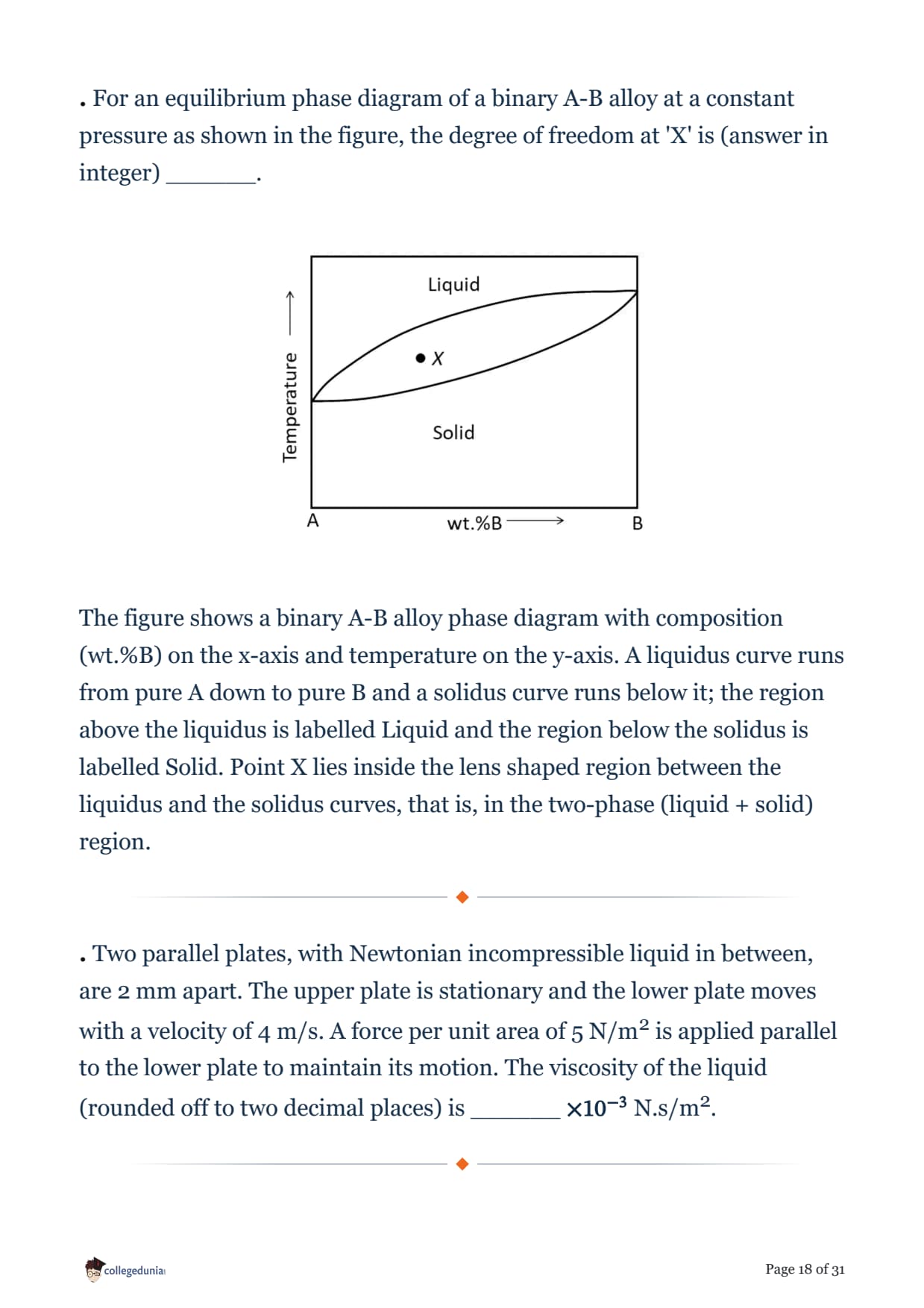
For an equilibrium phase diagram of a binary A-B alloy at a constant pressure as shown in the figure, the degree of freedom at 'X' is (answer in integer) ______.

The figure shows a binary A-B alloy phase diagram with composition (wt.%B) on the x-axis and temperature on the y-axis. A liquidus curve runs from pure A down to pure B and a solidus curve runs below it; the region above the liquidus is labelled Liquid and the region below the solidus is labelled Solid. Point X lies inside the lens shaped region between the liquidus and the solidus curves, that is, in the two-phase (liquid + solid) region.
Two parallel plates, with Newtonian incompressible liquid in between, are 2 mm apart. The upper plate is stationary and the lower plate moves with a velocity of 4 m/s. A force per unit area of 5 N/m2 is applied parallel to the lower plate to maintain its motion. The viscosity of the liquid (rounded off to two decimal places) is ______ \(\times10^{-3}\) N.s/m2.
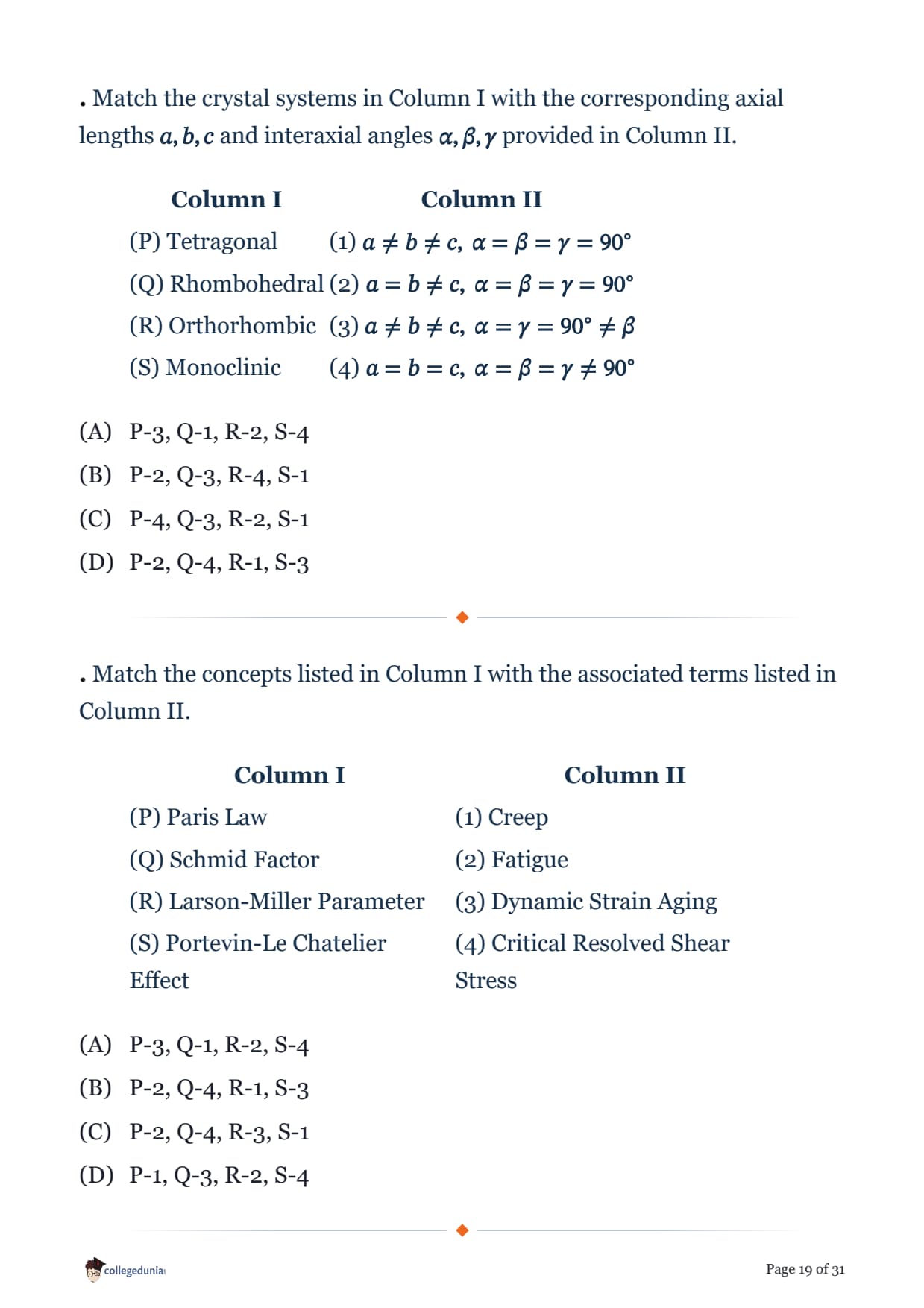
Match the crystal systems in Column I with the corresponding axial lengths \(a, b, c\) and interaxial angles \(\alpha, \beta, \gamma\) provided in Column II.
| Column I | Column II |
|---|---|
| (P) Tetragonal | (1) \(a \neq b \neq c,\ \alpha = \beta = \gamma = 90^{\circ}\) |
| (Q) Rhombohedral | (2) \(a = b \neq c,\ \alpha = \beta = \gamma = 90^{\circ}\) |
| (R) Orthorhombic | (3) \(a \neq b \neq c,\ \alpha = \gamma = 90^{\circ} \neq \beta\) |
| (S) Monoclinic | (4) \(a = b = c,\ \alpha = \beta = \gamma \neq 90^{\circ}\) |
Match the concepts listed in Column I with the associated terms listed in Column II.
| Column I | Column II |
|---|---|
| (P) Paris Law | (1) Creep |
| (Q) Schmid Factor | (2) Fatigue |
| (R) Larson-Miller Parameter | (3) Dynamic Strain Aging |
| (S) Portevin-Le Chatelier Effect | (4) Critical Resolved Shear Stress |
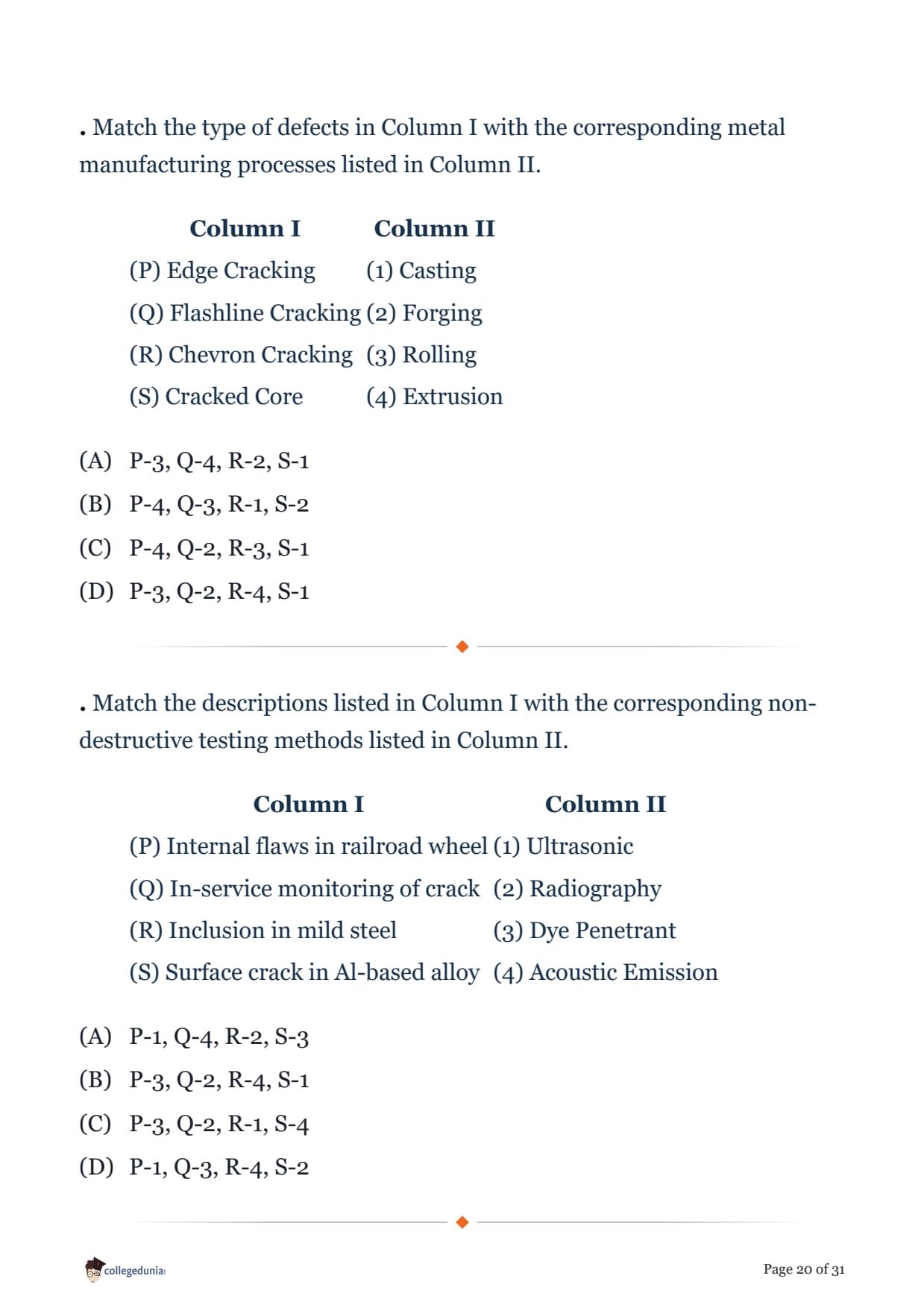
Match the type of defects in Column I with the corresponding metal manufacturing processes listed in Column II.
| Column I | Column II |
|---|---|
| (P) Edge Cracking | (1) Casting |
| (Q) Flashline Cracking | (2) Forging |
| (R) Chevron Cracking | (3) Rolling |
| (S) Cracked Core | (4) Extrusion |
Match the descriptions listed in Column I with the corresponding non-destructive testing methods listed in Column II.
| Column I | Column II |
|---|---|
| (P) Internal flaws in railroad wheel | (1) Ultrasonic |
| (Q) In-service monitoring of crack | (2) Radiography |
| (R) Inclusion in mild steel | (3) Dye Penetrant |
| (S) Surface crack in Al-based alloy | (4) Acoustic Emission |
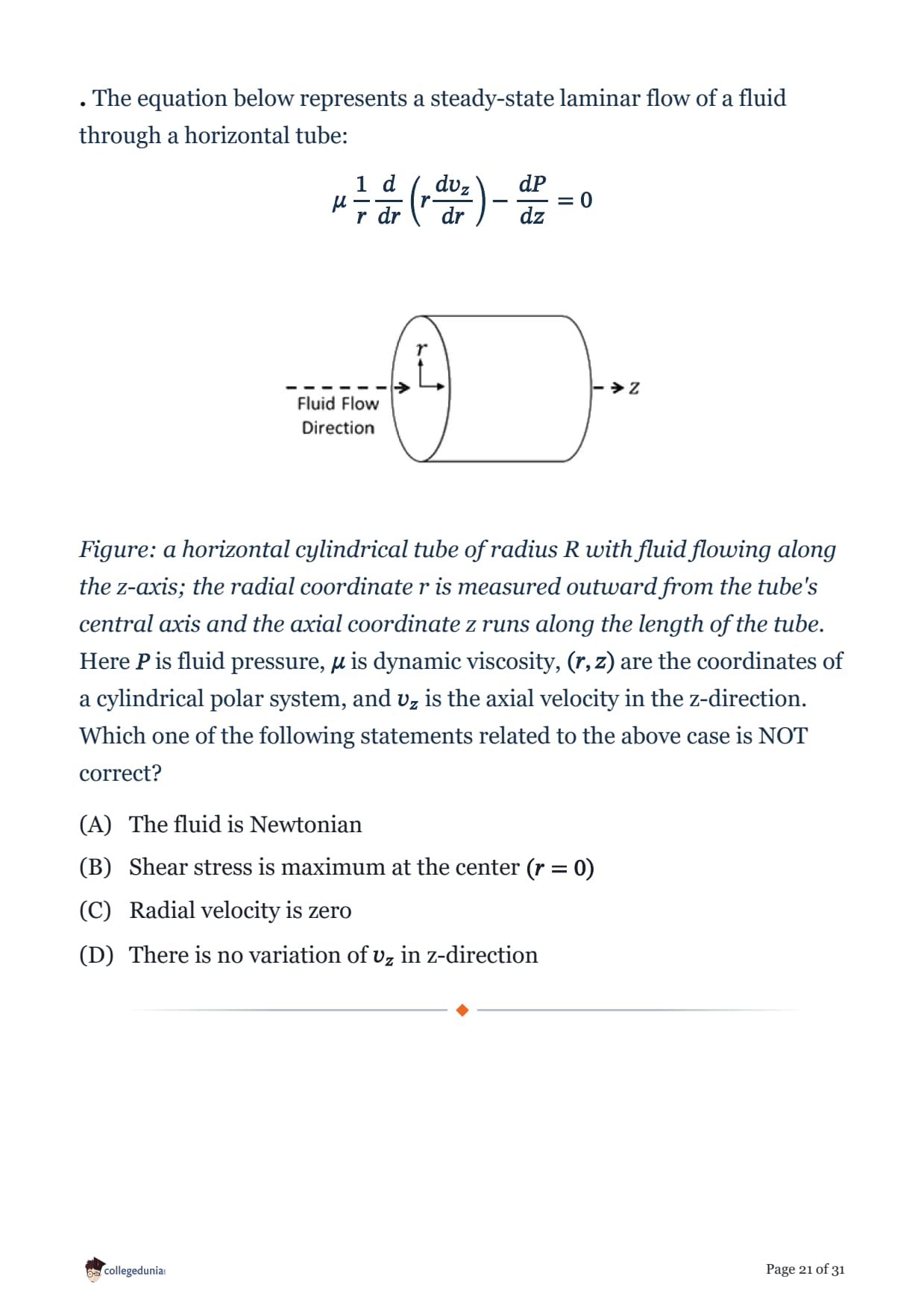
The equation below represents a steady-state laminar flow of a fluid through a horizontal tube:
\[ \mu\,\frac{1}{r}\frac{d}{dr}\left(r\frac{dv_z}{dr}\right) - \frac{dP}{dz} = 0 \]

Figure: a horizontal cylindrical tube of radius R with fluid flowing along the z-axis; the radial coordinate r is measured outward from the tube's central axis and the axial coordinate z runs along the length of the tube.
Here \(P\) is fluid pressure, \(\mu\) is dynamic viscosity, \((r, z)\) are the coordinates of a cylindrical polar system, and \(v_z\) is the axial velocity in the z-direction.
Which one of the following statements related to the above case is NOT correct?
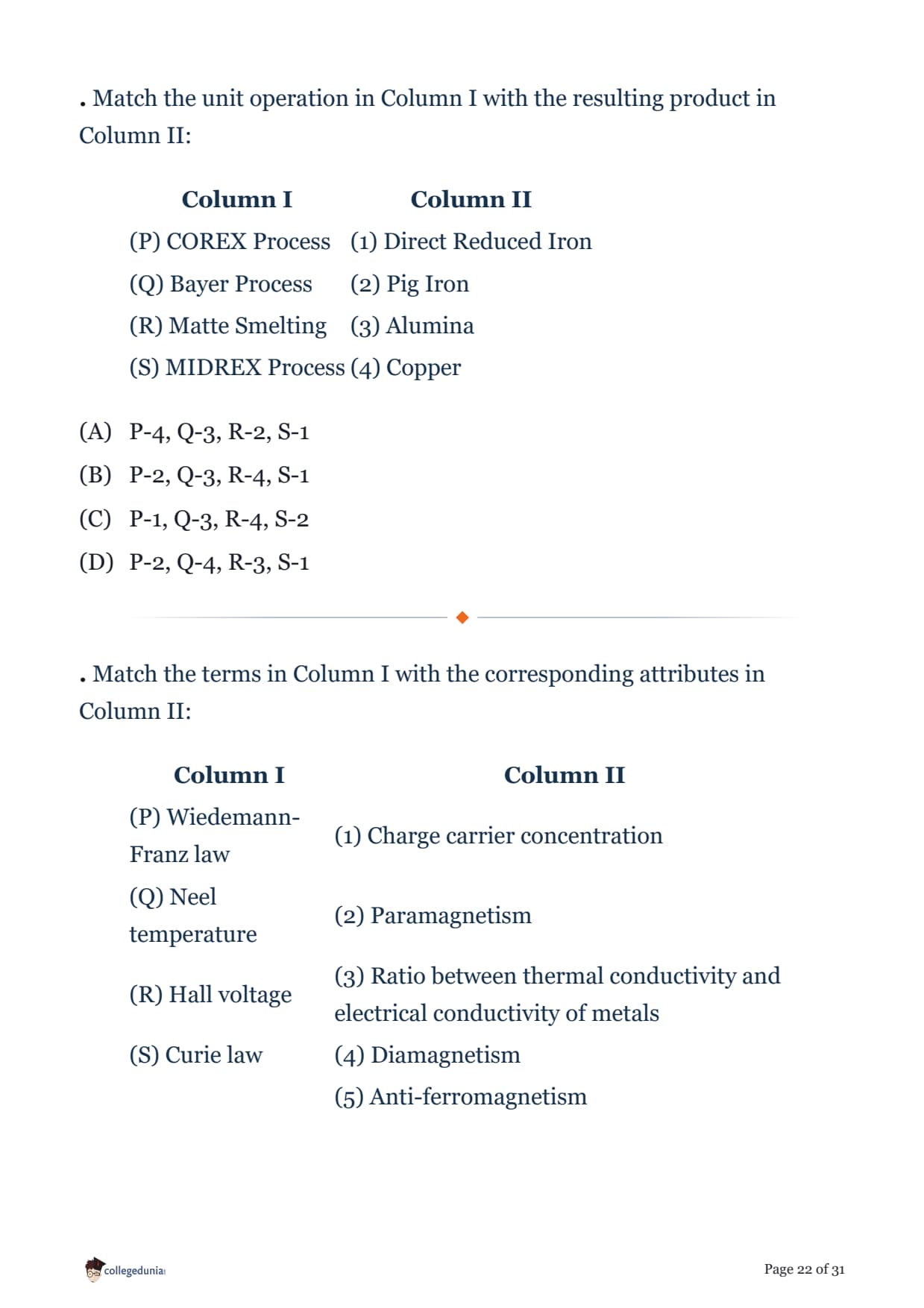
Match the unit operation in Column I with the resulting product in Column II:
| Column I | Column II |
|---|---|
| (P) COREX Process | (1) Direct Reduced Iron |
| (Q) Bayer Process | (2) Pig Iron |
| (R) Matte Smelting | (3) Alumina |
| (S) MIDREX Process | (4) Copper |
Match the terms in Column I with the corresponding attributes in Column II:
| Column I | Column II |
|---|---|
| (P) Wiedemann-Franz law | (1) Charge carrier concentration |
| (Q) Neel temperature | (2) Paramagnetism |
| (R) Hall voltage | (3) Ratio between thermal conductivity and electrical conductivity of metals |
| (S) Curie law | (4) Diamagnetism |
| (5) Anti-ferromagnetism |
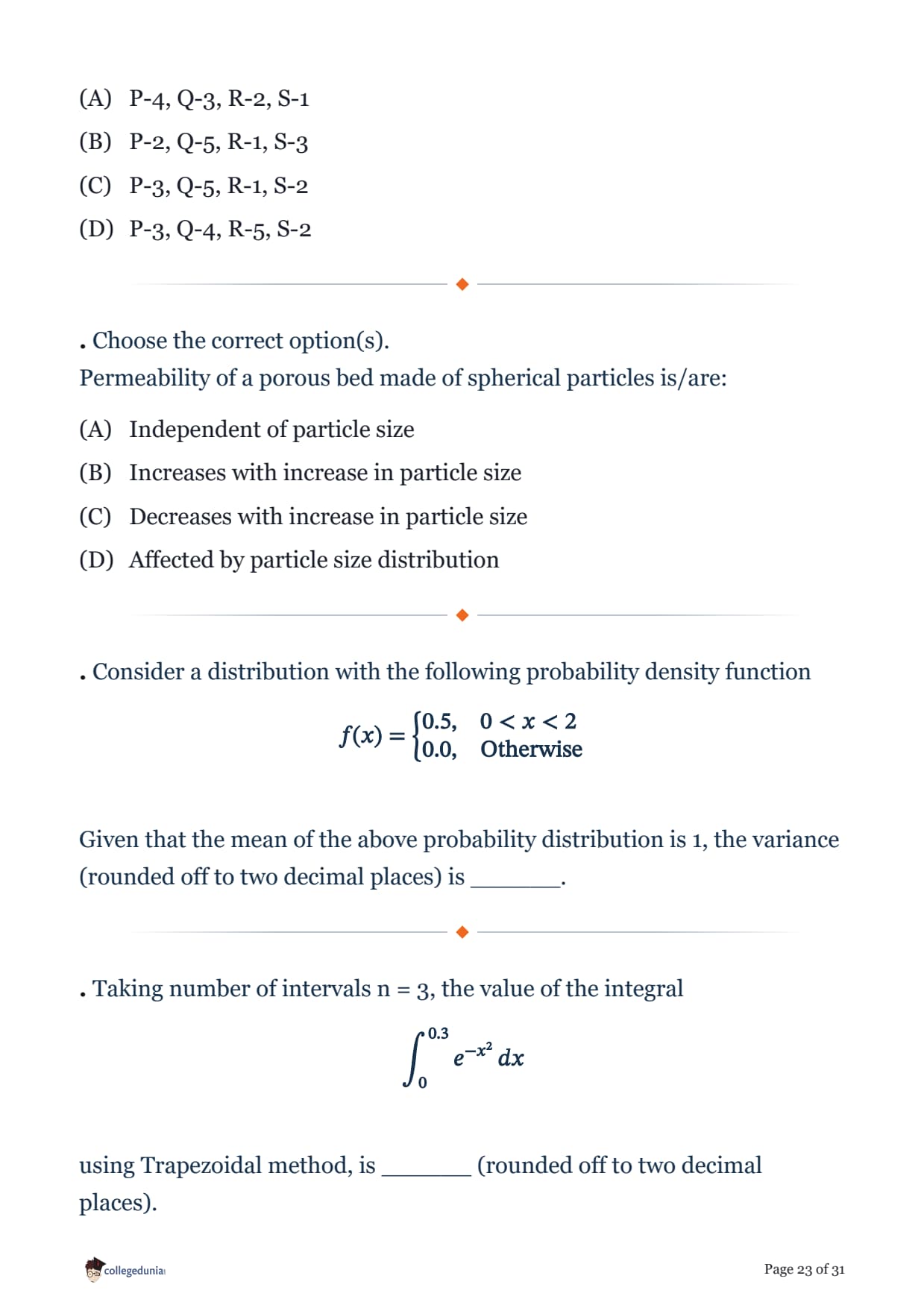
Choose the correct option(s).
Permeability of a porous bed made of spherical particles is/are:
Consider a distribution with the following probability density function
\[
f(x) = \begin{cases} 0.5, & 0 < x < 2 \\ 0.0, & \text{Otherwise} \end{cases}
\]
Given that the mean of the above probability distribution is 1, the variance (rounded off to two decimal places) is ______.
Taking number of intervals n = 3, the value of the integral
\[
\int_0^{0.3} e^{-x^2}\, dx
\]
using Trapezoidal method, is ______ (rounded off to two decimal places).
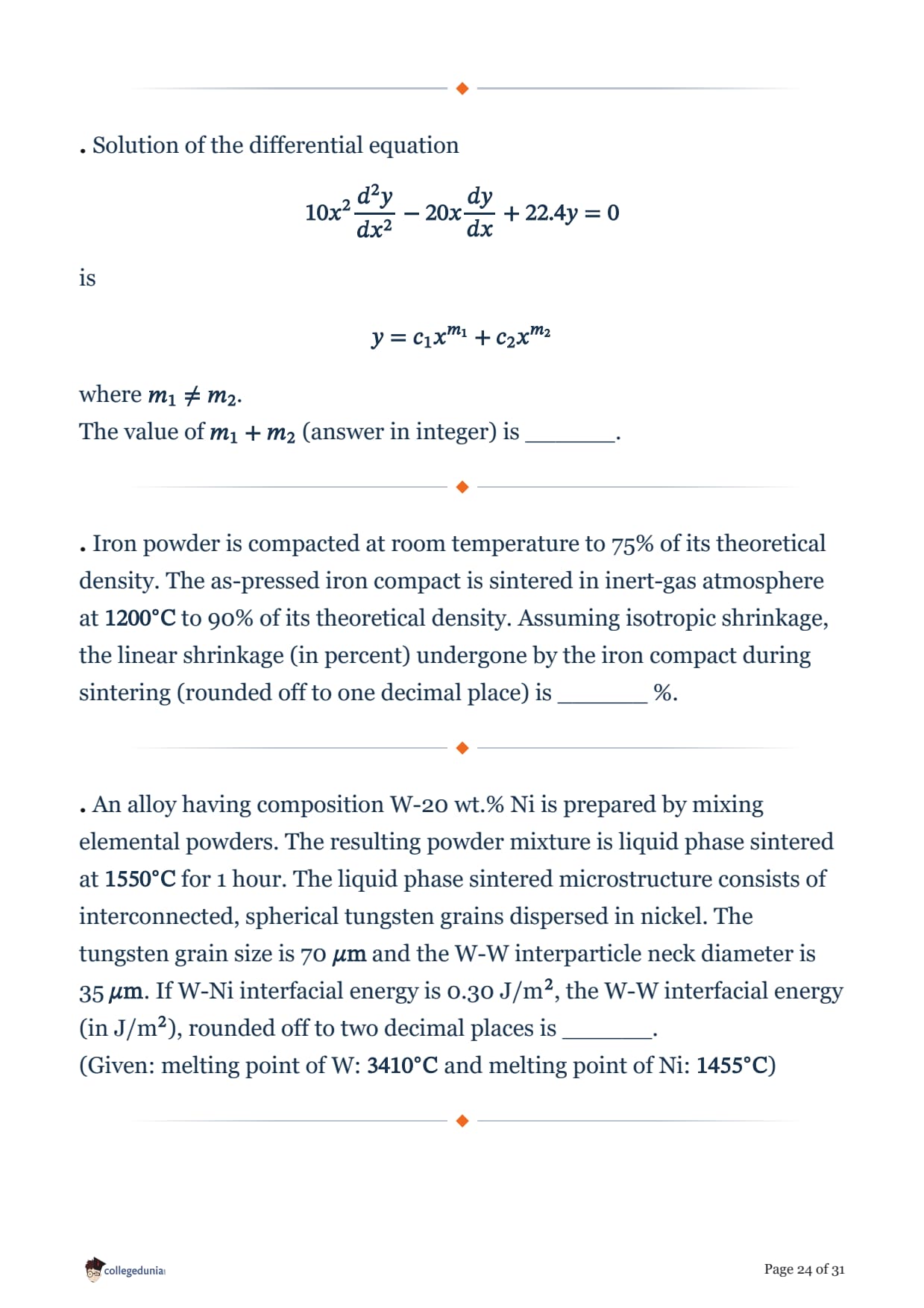
Solution of the differential equation
\[
10x^2\frac{d^2y}{dx^2}-20x\frac{dy}{dx}+22.4y=0
\]
is
\[
y=c_1x^{m_1}+c_2x^{m_2}
\]
where \(m_1 \neq m_2\).
The value of \(m_1+m_2\) (answer in integer) is ______.
Iron powder is compacted at room temperature to 75% of its theoretical density. The as-pressed iron compact is sintered in inert-gas atmosphere at \(1200^{\circ}\text{C}\) to 90% of its theoretical density. Assuming isotropic shrinkage, the linear shrinkage (in percent) undergone by the iron compact during sintering (rounded off to one decimal place) is ______ %.
An alloy having composition W-20 wt.% Ni is prepared by mixing elemental powders. The resulting powder mixture is liquid phase sintered at \(1550^{\circ}\text{C}\) for 1 hour. The liquid phase sintered microstructure consists of interconnected, spherical tungsten grains dispersed in nickel. The tungsten grain size is 70 \(\mu\text{m}\) and the W-W interparticle neck diameter is 35 \(\mu\text{m}\). If W-Ni interfacial energy is 0.30 J/m\(^2\), the W-W interfacial energy (in J/m\(^2\)), rounded off to two decimal places is ______.
(Given: melting point of W: \(3410^{\circ}\text{C}\) and melting point of Ni: \(1455^{\circ}\text{C}\))
A metal having body-centered cubic structure is analyzed through X-ray diffraction using monochromatic X-ray of wavelength 0.154 nm. The diffraction angle (\(2\theta\)) corresponding to \(\{2\,0\,0\}\) plane is \(60^{\circ}\) (for first order reflection).
The atomic radius of this element (rounded off to three decimal places) is ______ nm.
A cylindrical single crystal of copper having 10 mm diameter is deformed under a uniaxial tensile load of 2200 N. The angle between the normal to the slip plane and the tensile loading axis is \(\alpha\), whereas the angle between slip direction and the tensile axis is \(\beta\). The slip direction is in the plane defined by the stress axis and the normal to the slip plane.
If \(\alpha=\beta\), the critical resolved shear stress (CRSS), rounded off to one decimal place, is ______ MPa.
For plane strain fracture toughness (\(K_{Ic}\)) testing of a Maraging steel specimen, find the minimum thickness needed for a valid \(K_{Ic}\) measurement (answer as an integer, in mm).
Given: \(K_{Ic} = 90\ \text{MPa}\sqrt{\text{m}}\) and yield stress \(\sigma_y = 900\ \text{MPa}\).
The lattice parameter of Ni (face centered cubic) is \(0.35\) nm and its shear modulus is \(76\) GPa. Find the strain energy per unit length of a screw dislocation in the Ni crystal (rounded off to two decimal places), in units of \(10^{-9}\ \text{J/m}\).
\(20\) g of gold (Au) and \(20\) g of silver (Ag) are mixed to form a single phase solid solution (assume ideal mixing). The atomic weight of Au is \(197\) g/mol and the atomic weight of Ag is \(108\) g/mol. The universal gas constant \(R = 8.314\ \text{J/mol-K}\). Find the total entropy of mixing (rounded off to two decimal places), in J/K.
\(2\) moles of an ideal gas are reversibly expanded from \(10\) litre to \(20\) litre under isothermal conditions. The universal gas constant \(R = 8.314\ \text{J/mol-K}\). If the temperature of the gas is \(27^{\circ}\text{C}\), find the magnitude of the work done in the process (rounded off to two decimal places), in Joules.
The specific heat capacity at constant pressure (\(C_p\)) of a solid metal is given by
\[ C_p\ (\text{in J/mol-K}) = 20 + (5\times10^{-3})T \] valid for \(T = 298\) K to \(1000\) K. At constant pressure, if the temperature of \(2\) moles of the metal is increased from \(300\) K to \(600\) K, find the change in enthalpy of the metal (answer as an integer), in Joules.
With reference to the Ellingham diagram, the standard Gibbs free energy change for the oxidation of solid metal M(s) and liquid metal M(l) is given below.
Reaction I: \( M(s) + O_2(g) \rightarrow MO_2(s) \)
\[ \Delta G^{\circ} = (-338900 - 15.2\,T\ln T + 247T) \text{ Joules} \]
from \(T = 300\) K to the melting point.
Reaction II: \( M(l) + O_2(g) \rightarrow MO_2(s) \)
\[ \Delta G^{\circ} = (-390800 - 15.2\,T\ln T + 285.3T) \text{ Joules} \]
from the melting point to \(T = 1800\) K.
The melting point of the metal M (rounded off to one decimal place) is _______ Kelvin.
A given volume of liquid is undercooled just below the melting temperature to form a spherical solid nucleus (consider homogeneous nucleation). The Gibbs free energy of solidification (\(\Delta G_v\)) is \((-0.5 \times 10^{8})\) J/m\(^3\). The solid-liquid interfacial energy (\(\gamma\)) is isotropic and its value is \(0.1\) J/m\(^2\).
The critical nucleus size for a stable nucleus is _______ nm (answer in integer).
A 50 mm flat aluminium plate is reduced in thickness to 25 mm in a single pass cold-rolling operation with the rolling diameter of 1250 mm. For this case, the minimum required coefficient of friction between the plate and the roll (rounded off to two decimal places) is _______.

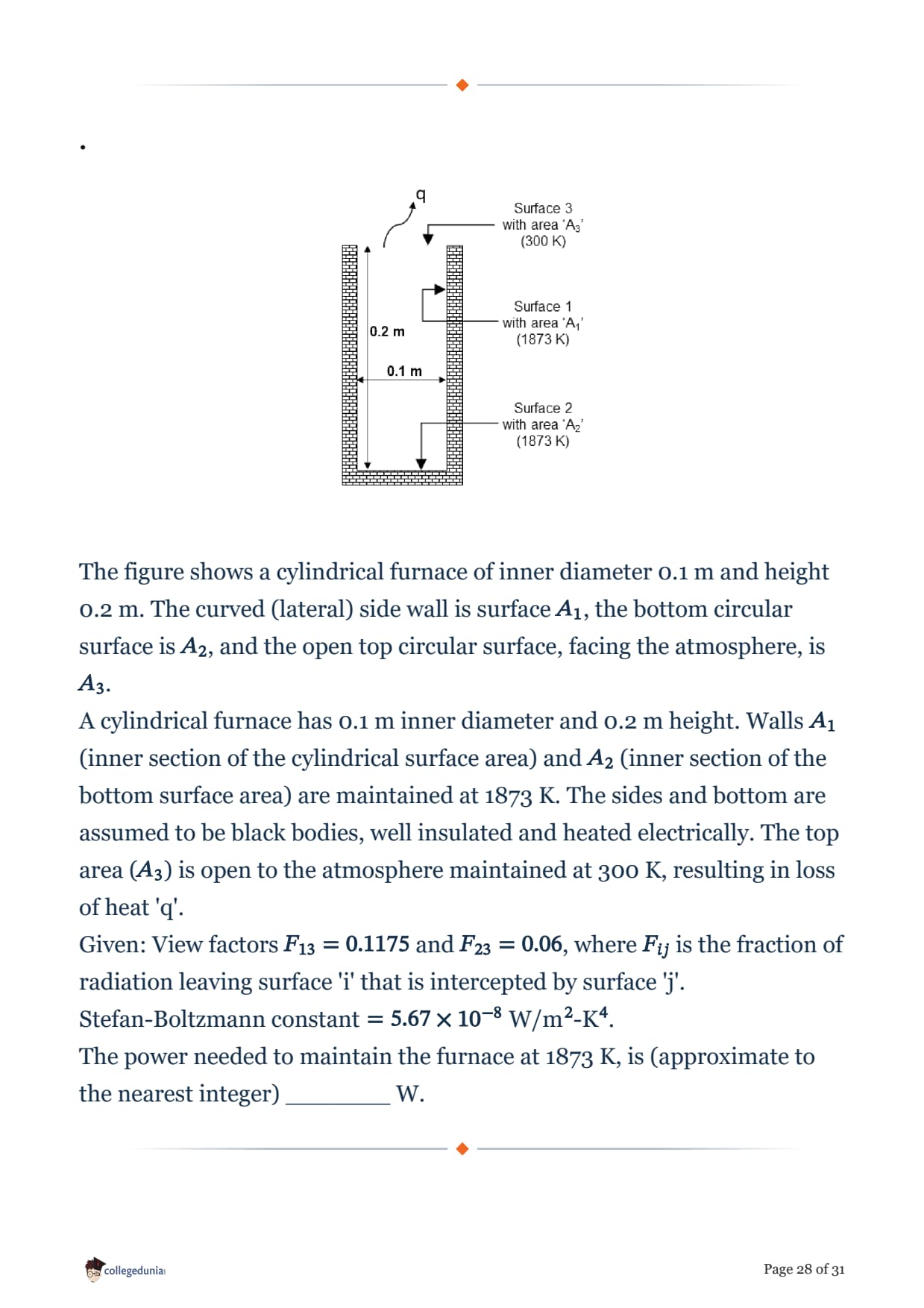
The figure shows a cylindrical furnace of inner diameter 0.1 m and height 0.2 m. The curved (lateral) side wall is surface \(A_1\), the bottom circular surface is \(A_2\), and the open top circular surface, facing the atmosphere, is \(A_3\).
A cylindrical furnace has 0.1 m inner diameter and 0.2 m height. Walls \(A_1\) (inner section of the cylindrical surface area) and \(A_2\) (inner section of the bottom surface area) are maintained at 1873 K. The sides and bottom are assumed to be black bodies, well insulated and heated electrically. The top area (\(A_3\)) is open to the atmosphere maintained at 300 K, resulting in loss of heat 'q'.
Given: View factors \(F_{13} = 0.1175\) and \(F_{23} = 0.06\), where \(F_{ij}\) is the fraction of radiation leaving surface 'i' that is intercepted by surface 'j'.
Stefan-Boltzmann constant \( = 5.67 \times 10^{-8} \) W/m\(^2\)-K\(^4\).
The power needed to maintain the furnace at 1873 K, is (approximate to the nearest integer) _______ W.
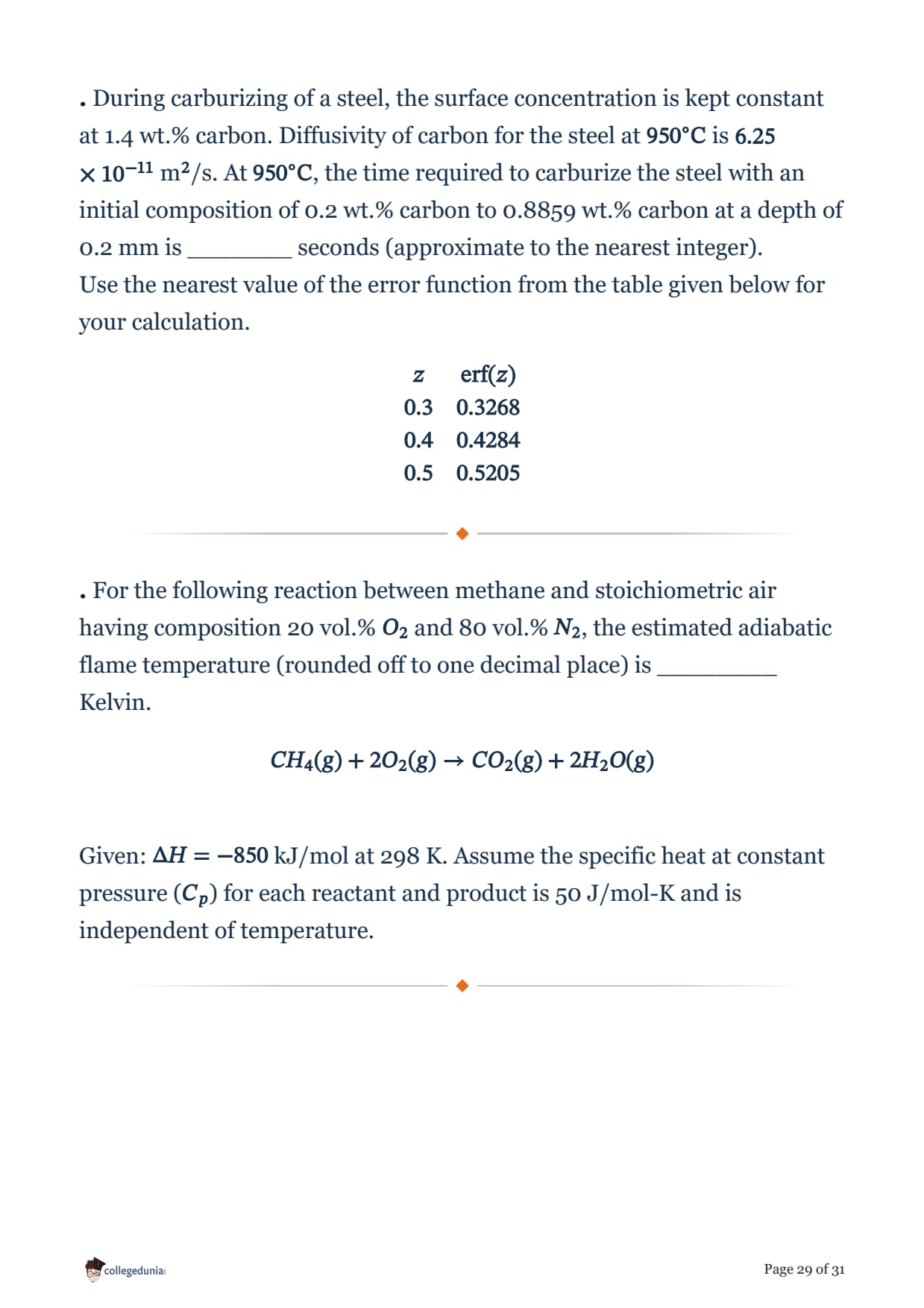
During carburizing of a steel, the surface concentration is kept constant at 1.4 wt.% carbon. Diffusivity of carbon for the steel at \(950^{\circ}\text{C}\) is \(6.25 \times 10^{-11}\) m\(^2\)/s. At \(950^{\circ}\text{C}\), the time required to carburize the steel with an initial composition of 0.2 wt.% carbon to 0.8859 wt.% carbon at a depth of 0.2 mm is _______ seconds (approximate to the nearest integer).
Use the nearest value of the error function from the table given below for your calculation.
\[ \begin{array}{cc} z & \text{erf}(z) \\ 0.3 & 0.3268 \\ 0.4 & 0.4284 \\ 0.5 & 0.5205 \end{array} \]
For the following reaction between methane and stoichiometric air having composition 20 vol.% \(O_2\) and 80 vol.% \(N_2\), the estimated adiabatic flame temperature (rounded off to one decimal place) is ________ Kelvin.
\[
CH_4(g) + 2O_2(g) \to CO_2(g) + 2H_2O(g)
\]
Given: \(\Delta H = -850\) kJ/mol at 298 K. Assume the specific heat at constant pressure (\(C_p\)) for each reactant and product is 50 J/mol-K and is independent of temperature.
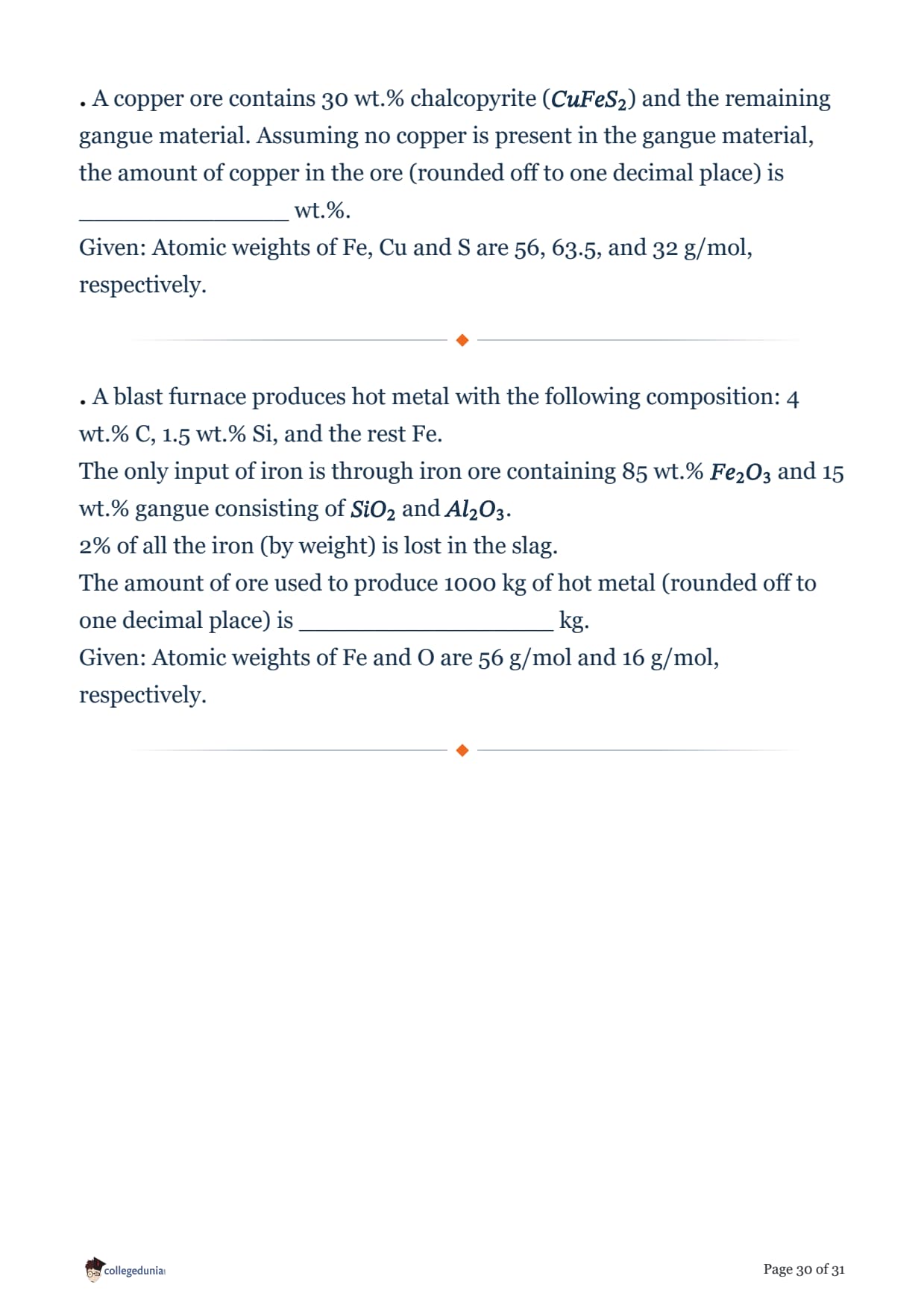
A copper ore contains 30 wt.% chalcopyrite (\(CuFeS_2\)) and the remaining gangue material. Assuming no copper is present in the gangue material, the amount of copper in the ore (rounded off to one decimal place) is ______________ wt.%.
Given: Atomic weights of Fe, Cu and S are 56, 63.5, and 32 g/mol, respectively.
A blast furnace produces hot metal with the following composition: 4 wt.% C, 1.5 wt.% Si, and the rest Fe.
The only input of iron is through iron ore containing 85 wt.% \(Fe_2O_3\) and 15 wt.% gangue consisting of \(SiO_2\) and \(Al_2O_3\).
2% of all the iron (by weight) is lost in the slag.
The amount of ore used to produce 1000 kg of hot metal (rounded off to one decimal place) is _________________ kg.
Given: Atomic weights of Fe and O are 56 g/mol and 16 g/mol, respectively.
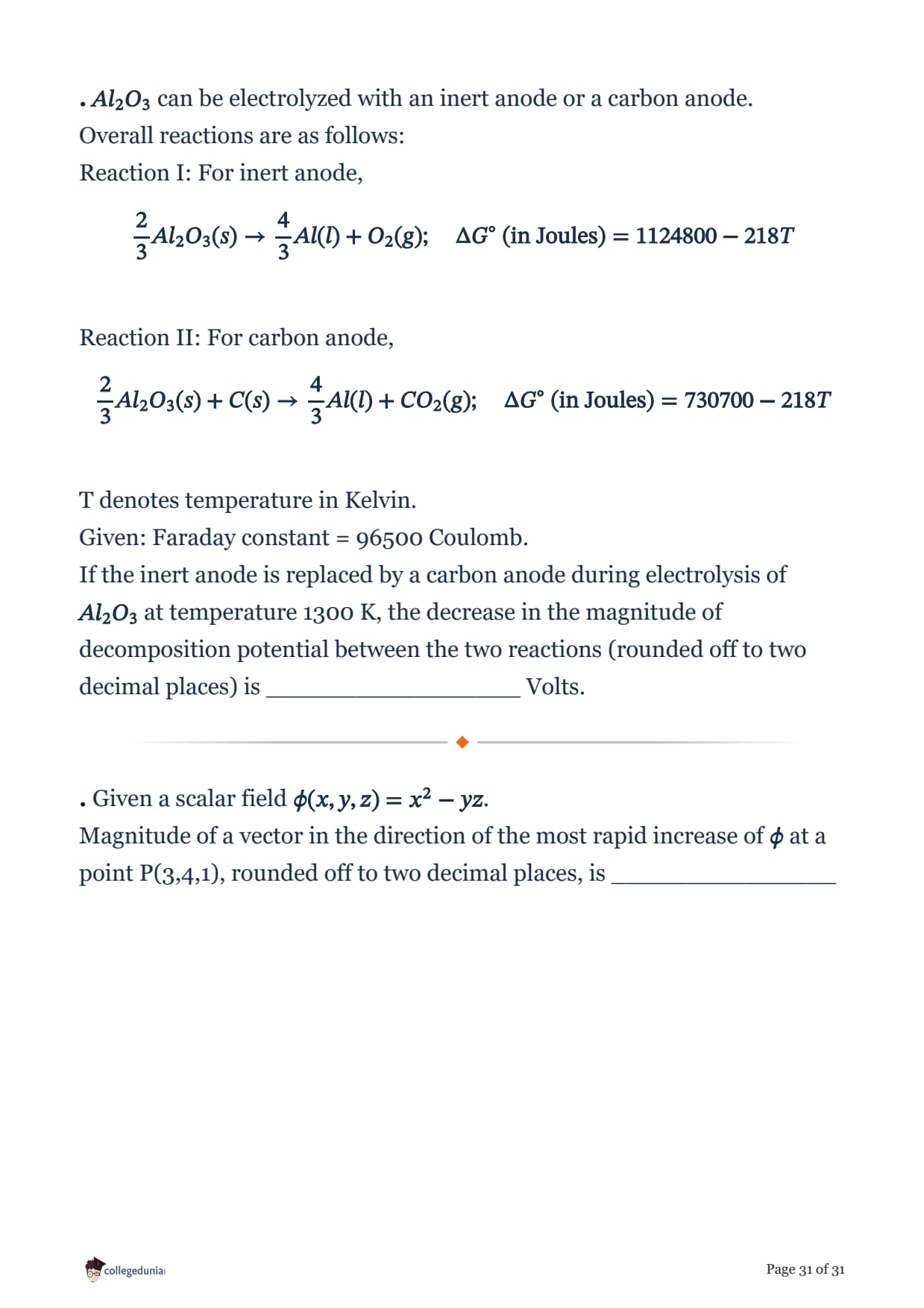
\(Al_2O_3\) can be electrolyzed with an inert anode or a carbon anode.
Overall reactions are as follows:
Reaction I: For inert anode,
\[
\frac{2}{3}Al_2O_3(s) \to \frac{4}{3}Al(l) + O_2(g); \quad \Delta G^\circ \text{ (in Joules)} = 1124800 - 218T
\]
Reaction II: For carbon anode,
\[
\frac{2}{3}Al_2O_3(s) + C(s) \to \frac{4}{3}Al(l) + CO_2(g); \quad \Delta G^\circ \text{ (in Joules)} = 730700 - 218T
\]
T denotes temperature in Kelvin.
Given: Faraday constant = 96500 Coulomb.
If the inert anode is replaced by a carbon anode during electrolysis of \(Al_2O_3\) at temperature 1300 K, the decrease in the magnitude of decomposition potential between the two reactions (rounded off to two decimal places) is _________________ Volts.
Given a scalar field \(\phi(x,y,z) = x^2 - yz\).
Magnitude of a vector in the direction of the most rapid increase of \(\phi\) at a point P(3,4,1), rounded off to two decimal places, is _______________
GATE 2026 Metallurgical Engineering Exam Pattern and Marking Scheme Explained
As per the official information bulletin on gate2026.iitg.ac.in, GATE 2026 MT was a computer based test split into a General Aptitude section and the core paper.
- Total questions: 65, made up of 10 General Aptitude questions and 55 questions from Engineering Mathematics and core Metallurgical Engineering
- Duration: 3 hours
- Total marks: 100 (General Aptitude 15 marks, remaining 85 marks from Engineering Mathematics and core subject)
- Marking scheme: for MCQs, 1/3 mark is cut for a wrong 1-mark question and 2/3 mark for a wrong 2-mark question
- Question types: Multiple Choice Questions (MCQ), Multiple Select Questions (MSQ) and Numerical Answer Type (NAT), with no negative marking on MSQ or NAT
High-Weightage Subjects in GATE 2026 Metallurgical Engineering to Focus On First
Subject-wise weightage varies slightly every year, but coaching-site analyses of recent GATE MT papers point to a fairly consistent split across the core areas.
- Physical Metallurgy (crystal structure, phase diagrams, dislocations, heat treatment) carries the largest share of the core paper, close to a fifth of the total marks
- Mechanical Metallurgy (deformation, fracture, fatigue, testing) is the next heaviest area
- Metallurgical Thermodynamics and Transport Phenomena and Rate Processes each carry a steady share every year
- Extractive Metallurgy and Manufacturing Processes (ironmaking, non-ferrous extraction, casting, welding, forming) round out the core paper
- Engineering Mathematics is worth roughly 15 percent of the paper on its own
GATE 2026 Metallurgical Engineering Question Paper Analysis Video
Source: GATE Metallurgy MT
How to Use the GATE Metallurgical Engineering Question Paper for Practice
Solve this paper as a timed 3-hour mock before you open the solutions PDF, then go back through every question you got wrong or skipped.
- Attempt General Aptitude first since it has fewer traps and locks in 15 easy marks
- Time-box the numerical answer type questions in Physical and Mechanical Metallurgy, since these carry no negative marking and are worth attempting even on a partial guess after elimination
- Redo every MSQ carefully, since picking only some of the correct options gets no partial credit on this paper
- Compare your worked answer against the step-by-step solution for each question, not just the final option
GATE 2026 Metallurgical Engineering Result and Scorecard Dates
- GATE 2026 results were declared on March 19, 2026 on gate2026.iitg.ac.in
- Scorecards were released on March 27, 2026, free to download until May 31, 2026
- Use your score against previous years' MT cutoffs to gauge where you stand for M.Tech and PSU shortlists
GATE 2026 Metallurgical Engineering Question Paper FAQs
Ques. Where can I download the GATE 2026 Metallurgical Engineering question paper with solutions PDF for free?
Ans. You can download the full 65-question GATE 2026 MT paper and its step-by-step solutions from the table above on this page. The official question paper and answer key are also released by IIT Guwahati on gate2026.iitg.ac.in.
Ques. How many questions were there in GATE 2026 Metallurgical Engineering and how much negative marking applies?
Ans. The paper had 65 questions for 100 marks in 3 hours. Negative marking applies only to MCQs, 1/3 mark for a wrong 1-mark MCQ and 2/3 mark for a wrong 2-mark MCQ. MSQ and NAT questions carry no negative marking.
Ques. Which topics have the highest weightage in GATE Metallurgical Engineering?
Ans. Physical Metallurgy and Mechanical Metallurgy together account for the largest share of the core paper, followed by Metallurgical Thermodynamics and Transport Phenomena and Rate Processes. Engineering Mathematics is worth close to 15 percent of the total paper on its own.
Ques. Who conducted GATE 2026 and when was the Metallurgical Engineering paper held?
Ans. GATE 2026 was conducted by IIT Guwahati. The Metallurgical Engineering (MT) paper was held on February 14, 2026, in the afternoon session from 2:30 PM to 5:30 PM as a computer based test.
Ques. When was the GATE 2026 result declared and how do I download the scorecard?
Ans. GATE 2026 results were declared on March 19, 2026, with scorecards released on March 27, 2026. Scorecards are free to download from gate2026.iitg.ac.in until May 31, 2026.
Ques. Are GATE Metallurgical Engineering questions repeated from previous years?
Ans. Exact repeats are rare, but the same core concepts, such as phase diagrams, dislocation theory and mass balance calculations in extractive metallurgy, come back in a new form almost every year, which is why solving past papers like this one helps.



Comments