




The GATE 2026 Mining Engineering (MN) question paper is now available with detailed solutions for free download. GATE 2026 MN was conducted by IIT Guwahati on 7 February 2026 in the forenoon session, and the paper carried 65 questions for 100 marks in 180 minutes.
| GATE 2026 Mining Engineering Question Paper with Solutions | Download PDF | Check Solutions |
GATE 2026 Mining Engineering Questions with Solutions
Suresh said, "I did it yesterday."
Which one of the following options is the correct form of this sentence in indirect speech?
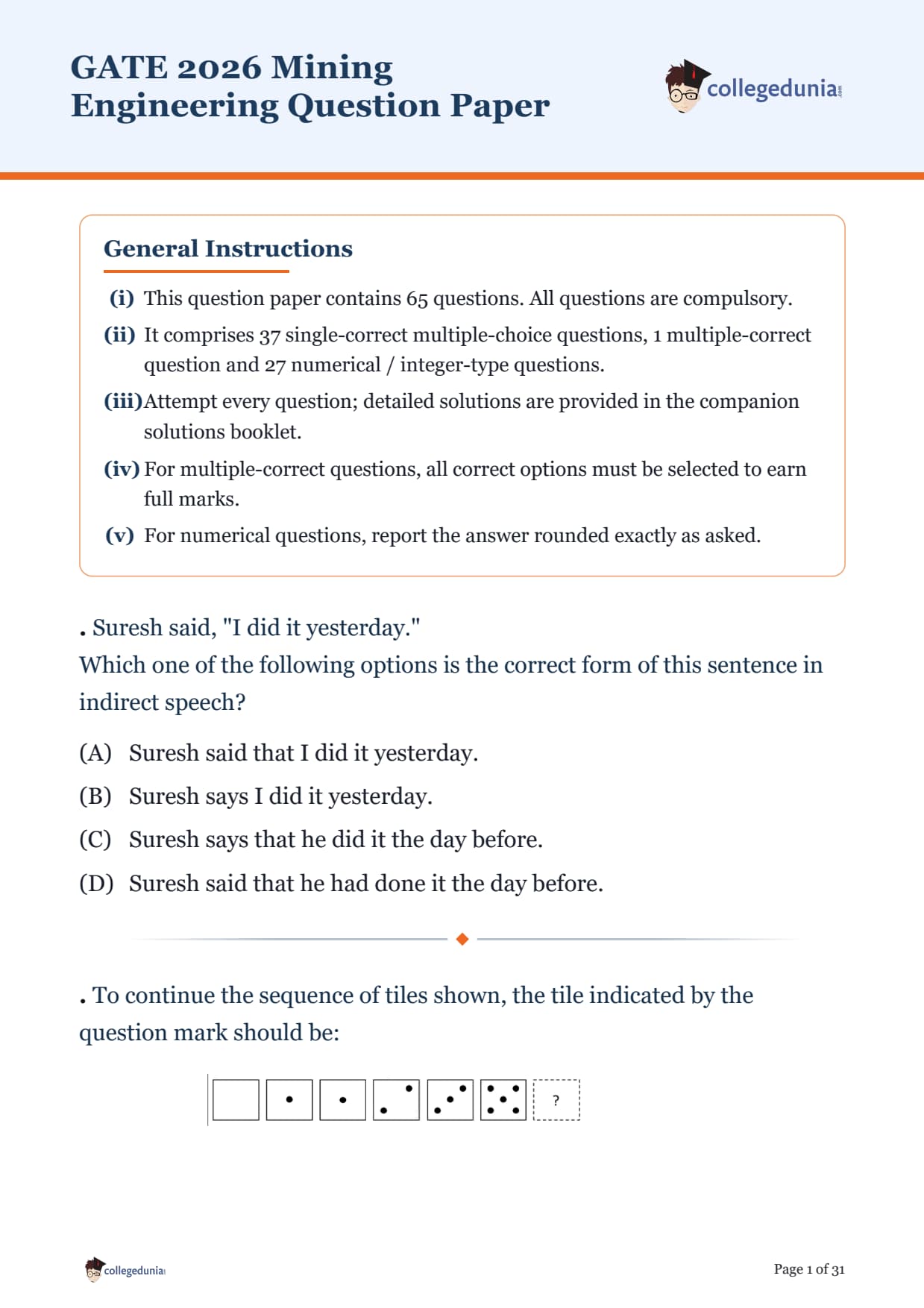
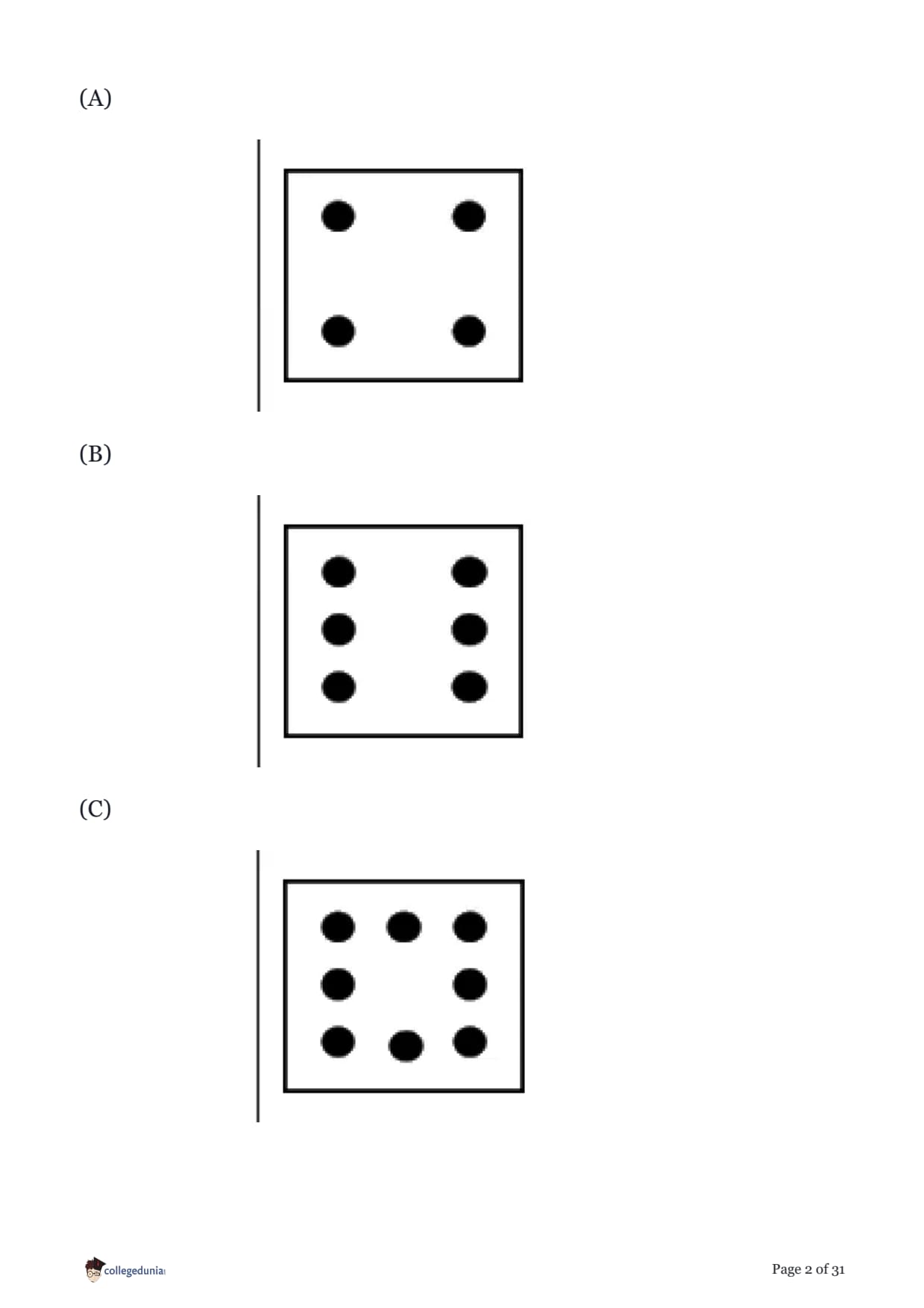
To continue the sequence of tiles shown, the tile indicated by the question mark should be:

- (A)
![]()
- (B)
![]()
- (C)
![]()
- (D)
![]()


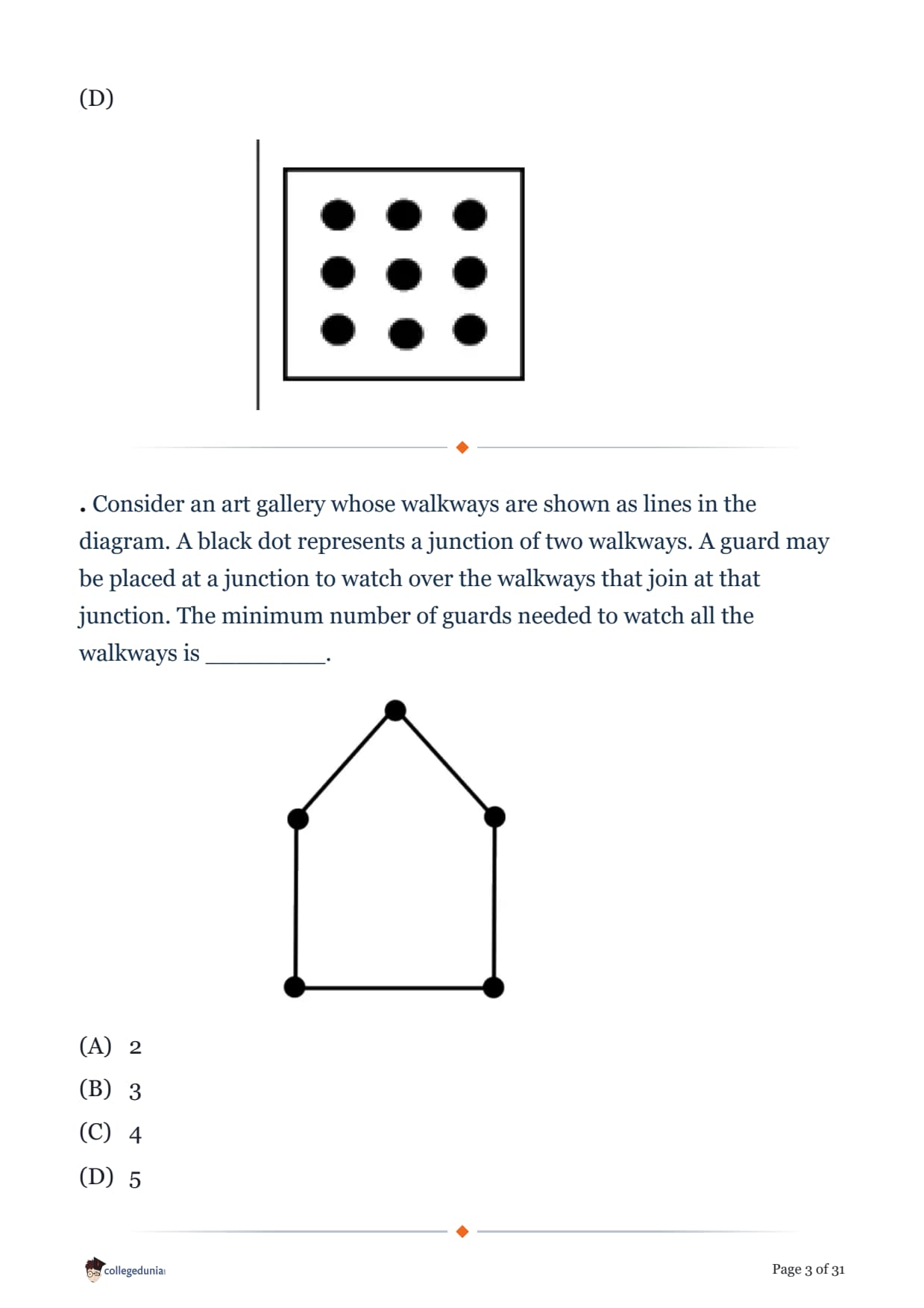
Consider an art gallery whose walkways are shown as lines in the diagram. A black dot represents a junction of two walkways. A guard may be placed at a junction to watch over the walkways that join at that junction. The minimum number of guards needed to watch all the walkways is ________.

The 2nd of June is a Thursday in a certain year. Which day of the week is the 3rd of July in that year?
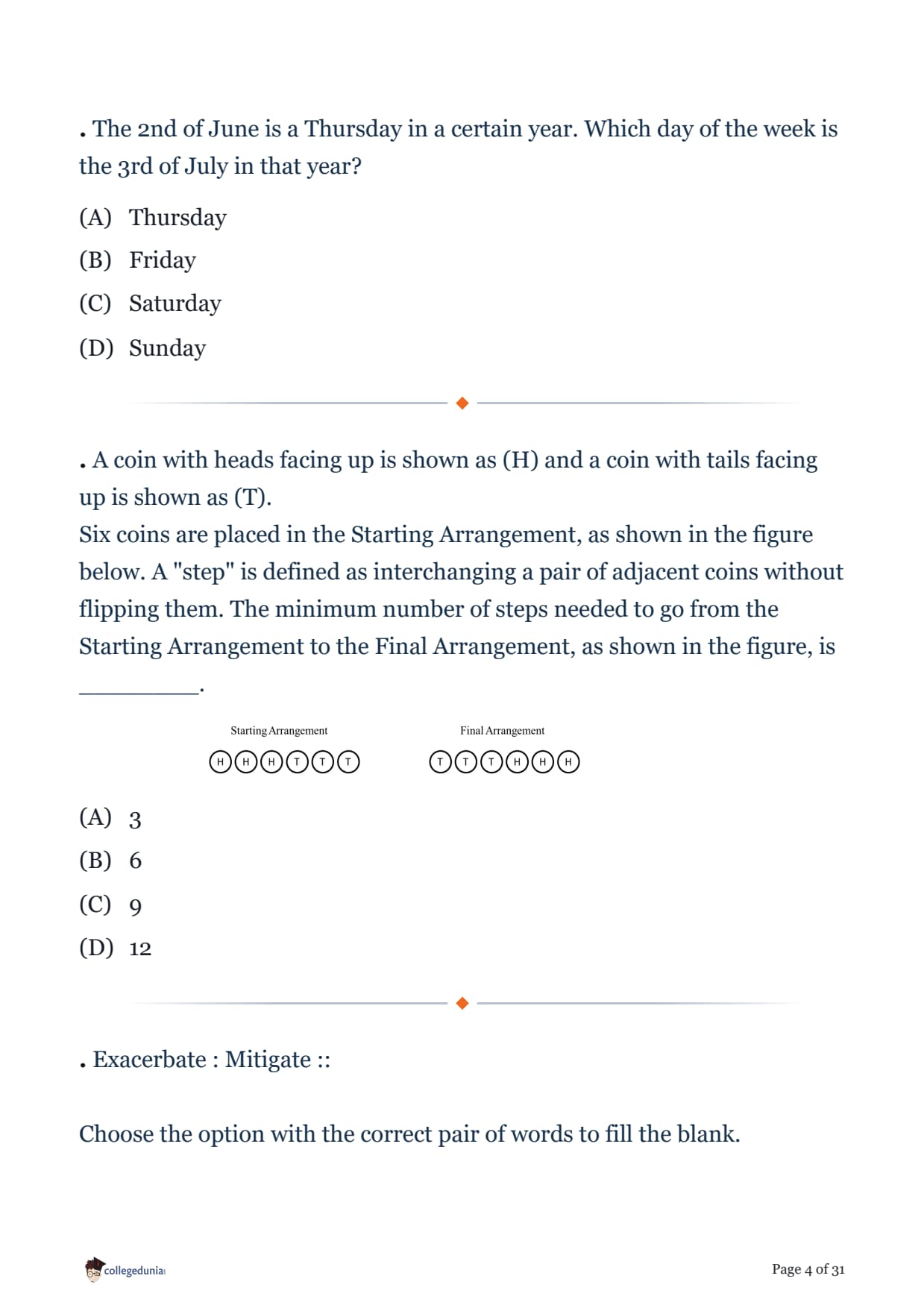
A coin with heads facing up is shown as (H) and a coin with tails facing up is shown as (T).
Six coins are placed in the Starting Arrangement, as shown in the figure below. A "step" is defined as interchanging a pair of adjacent coins without flipping them. The minimum number of steps needed to go from the Starting Arrangement to the Final Arrangement, as shown in the figure, is ________.

Exacerbate : Mitigate ::
Choose the option with the correct pair of words to fill the blank.
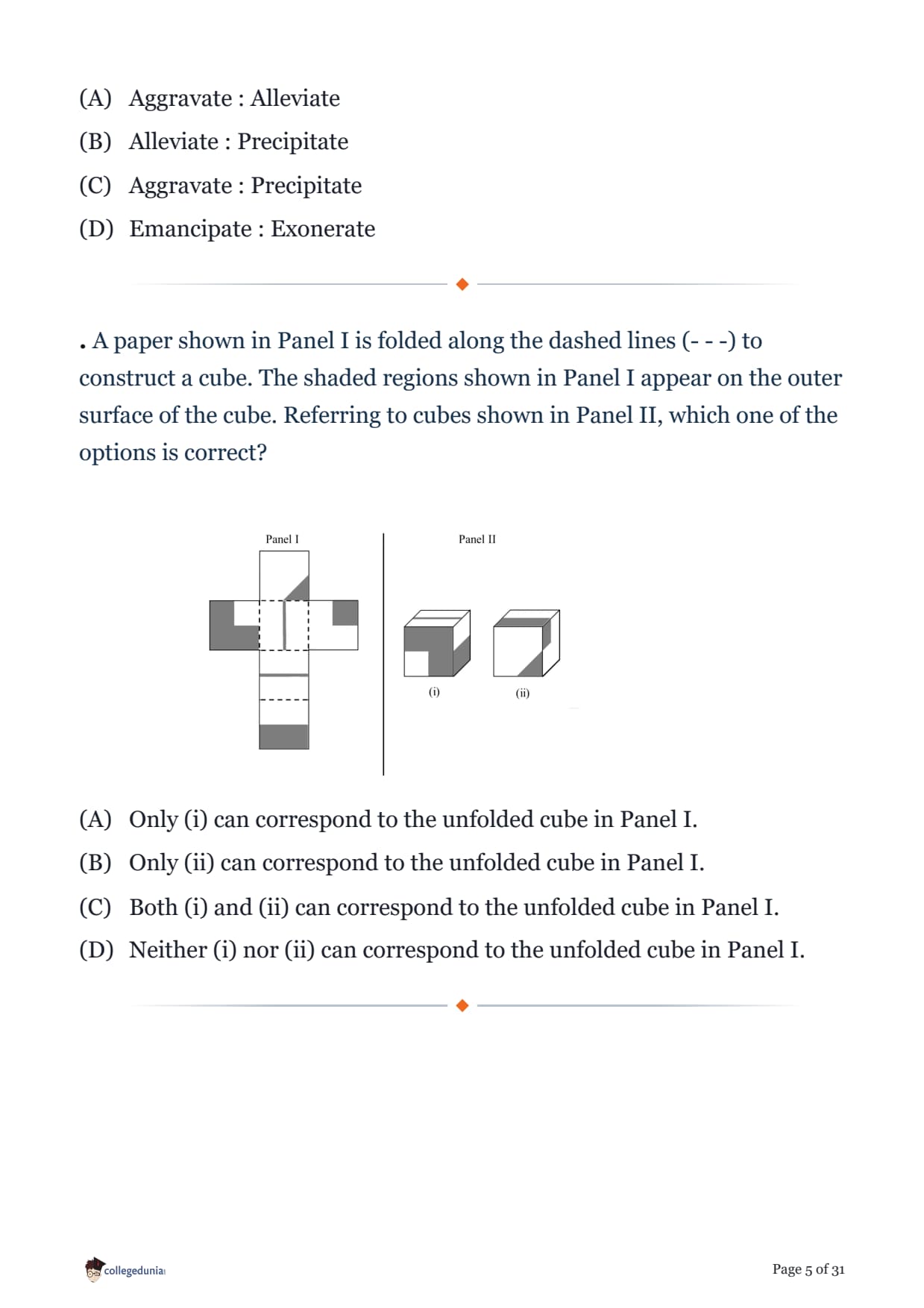
A paper shown in Panel I is folded along the dashed lines (- - -) to construct a cube. The shaded regions shown in Panel I appear on the outer surface of the cube. Referring to cubes shown in Panel II, which one of the options is correct?

In a population, patients who have high cholesterol also have high blood pressure (BP). Some patients with high BP also have diabetes. There are no patients who have both high cholesterol and diabetes. Furthermore,
1. the total number of patients with at least one of these conditions is 75,
2. the number of patients with high cholesterol is 10,
3. the number of patients with high BP is 45, and
4. the number of patients with only high BP and no other conditions is 20.
Then the number of patients who have both diabetes and high BP is
Four people P, Q, R, and S, of different ages, make the following observations.
P: I am younger than S.
Q: I am neither the youngest nor the oldest.
R: P is older than me.
Based on these observations, the youngest person is .
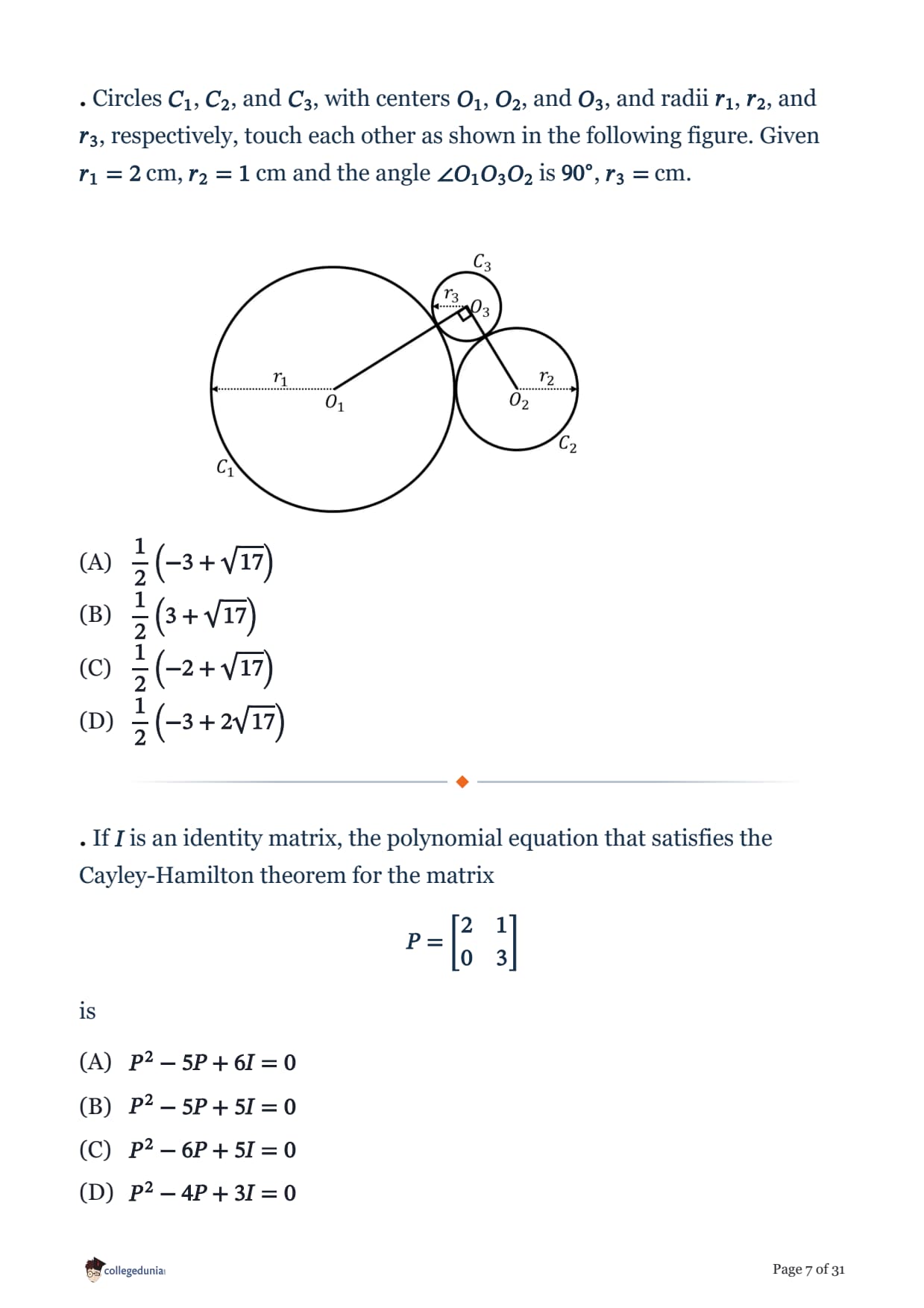
Circles \(C_1\), \(C_2\), and \(C_3\), with centers \(O_1\), \(O_2\), and \(O_3\), and radii \(r_1\), \(r_2\), and \(r_3\), respectively, touch each other as shown in the following figure. Given \(r_1 = 2\) cm, \(r_2 = 1\) cm and the angle \(\angle O_1O_3O_2\) is \(90^\circ\), \(r_3 = \) cm.

If \( I \) is an identity matrix, the polynomial equation that satisfies the Cayley-Hamilton theorem for the matrix \[ P = \begin{bmatrix} 2 & 1 \\ 0 & 3 \end{bmatrix} \] is
Let \( \hat{i} \) and \( \hat{j} \) be the unit vectors in the x and y direction, respectively. The divergence \( (\nabla . \vec{F}) \) of \( \vec{F} = x^2y\hat{i} + y^3x\hat{j} \) at the point \( (3,2) \) is
Which one of the following is a non-linear, second-order, and first-degree differential equation?
As per the Mohs scale of hardness, the correct sequence is
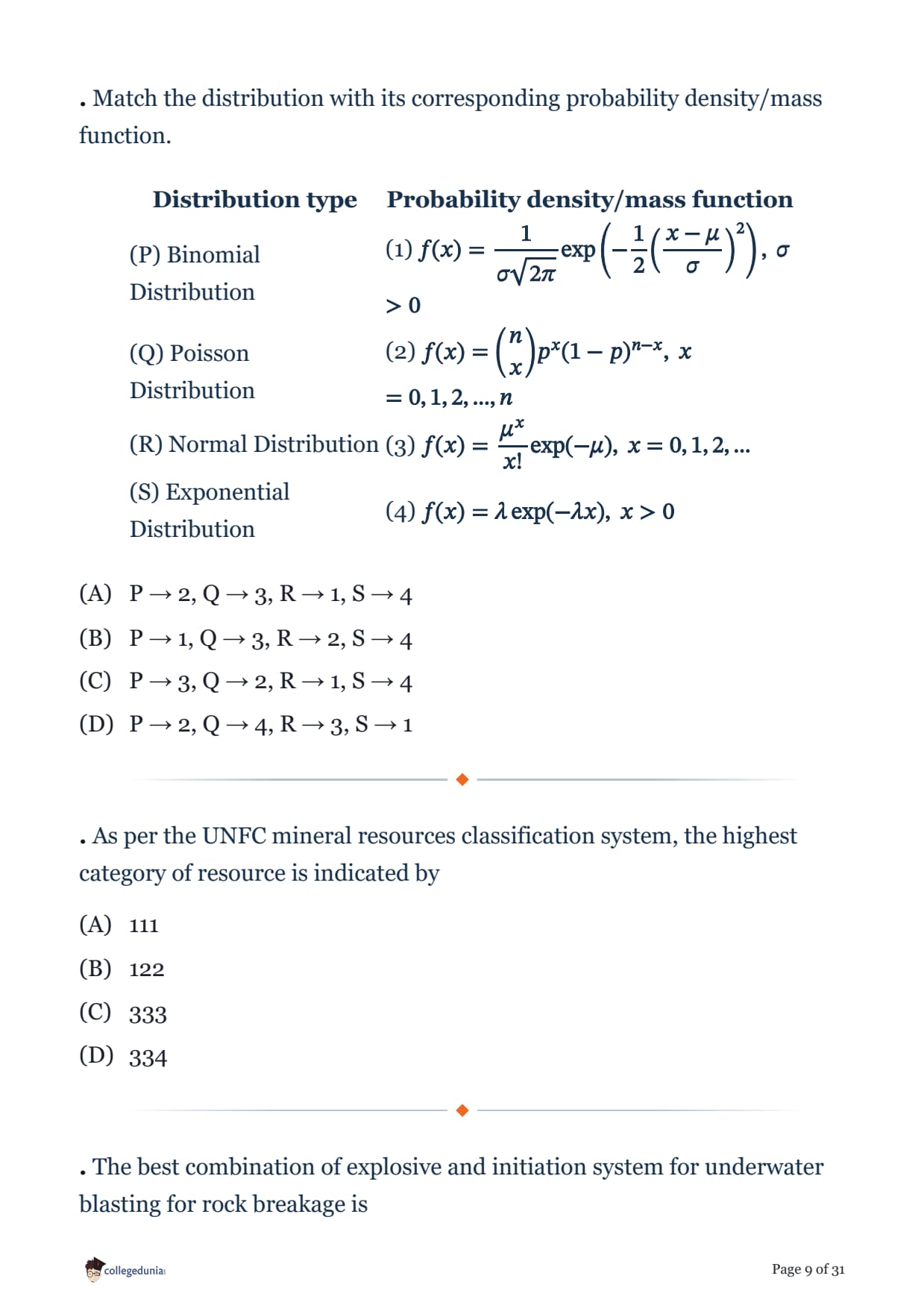
Match the distribution with its corresponding probability density/mass function.
| Distribution type | Probability density/mass function |
|---|---|
| (P) Binomial Distribution | (1) \( f(x) = \dfrac{1}{\sigma\sqrt{2\pi}}\exp\left(-\dfrac{1}{2}\left(\dfrac{x-\mu}{\sigma}\right)^2\right), \ \sigma>0 \) |
| (Q) Poisson Distribution | (2) \( f(x) = \dbinom{n}{x}p^x(1-p)^{n-x}, \ x=0,1,2,...,n \) |
| (R) Normal Distribution | (3) \( f(x) = \dfrac{\mu^x}{x!}\exp(-\mu), \ x=0,1,2,... \) |
| (S) Exponential Distribution | (4) \( f(x) = \lambda\exp(-\lambda x), \ x>0 \) |
As per the UNFC mineral resources classification system, the highest category of resource is indicated by
The best combination of explosive and initiation system for underwater blasting for rock breakage is
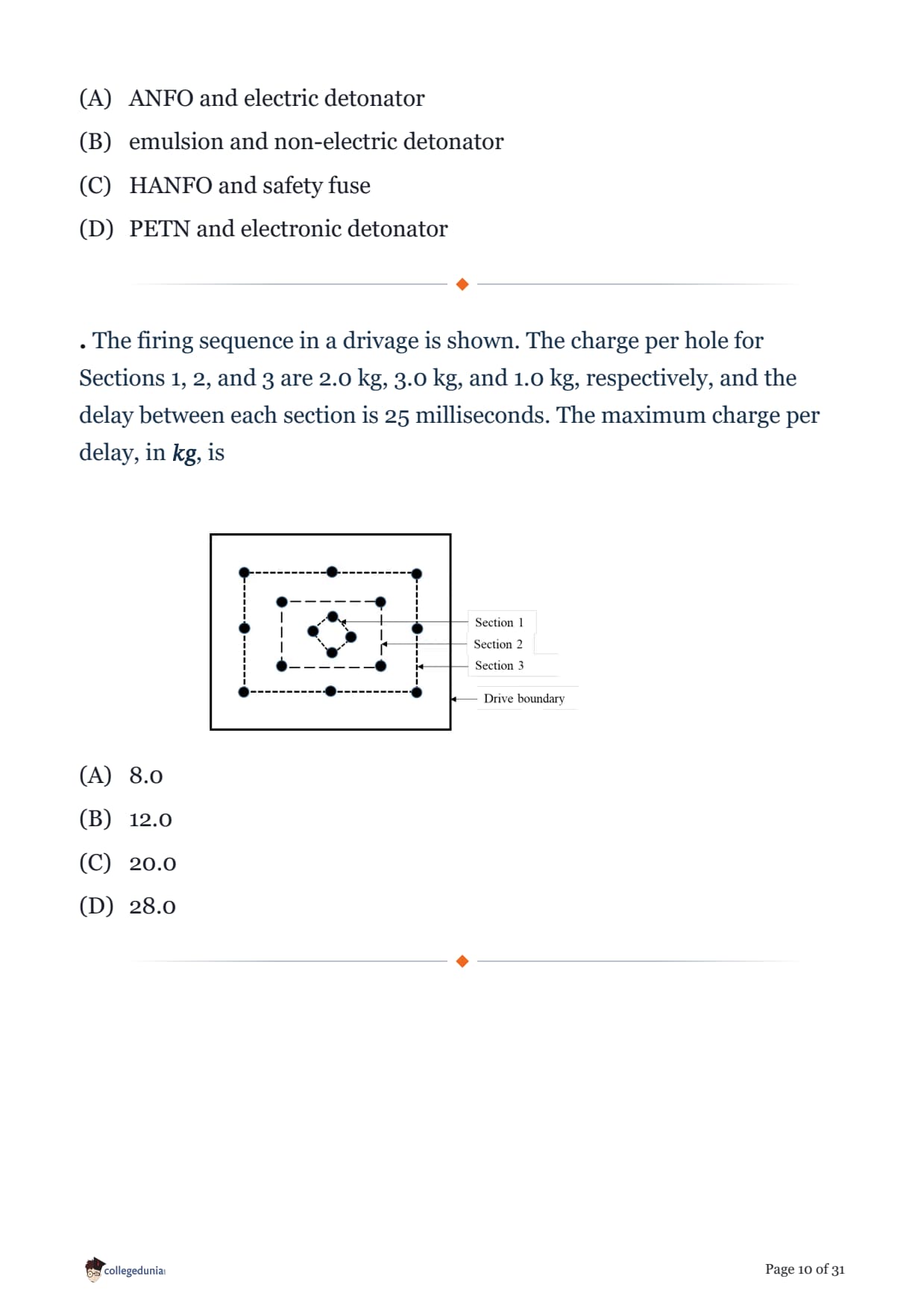
The firing sequence in a drivage is shown. The charge per hole for Sections 1, 2, and 3 are 2.0 kg, 3.0 kg, and 1.0 kg, respectively, and the delay between each section is 25 milliseconds. The maximum charge per delay, in \(kg\), is

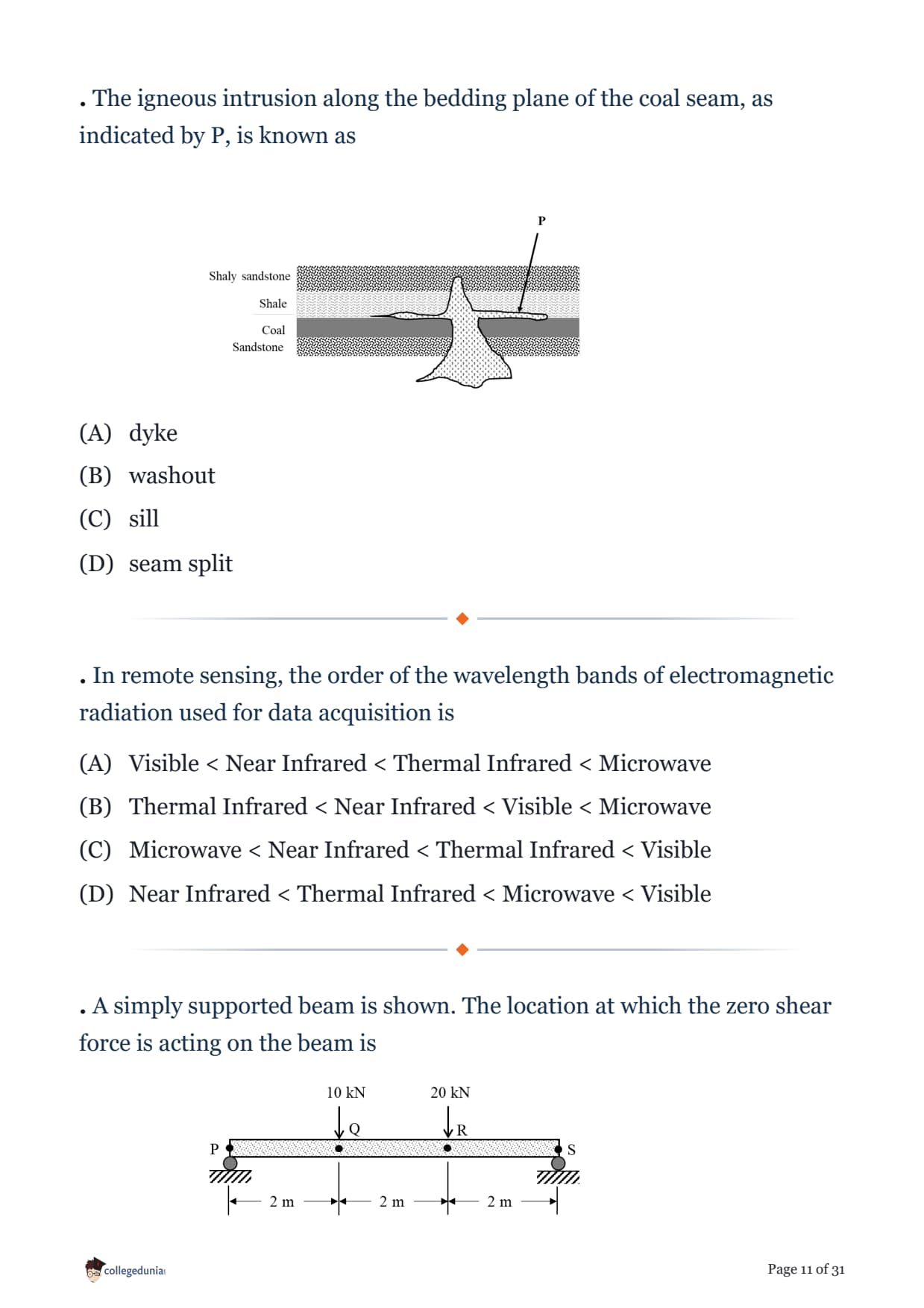
The igneous intrusion along the bedding plane of the coal seam, as indicated by P, is known as

In remote sensing, the order of the wavelength bands of electromagnetic radiation used for data acquisition is
A simply supported beam is shown. The location at which the zero shear force is acting on the beam is

In a Slake Durability Index (SDI) test, a rock sample of 500 g undergoes two standard cycles of wetting and drying. The mass of the sample retained after the test is 400 g. The SDI of the sample, in %, is
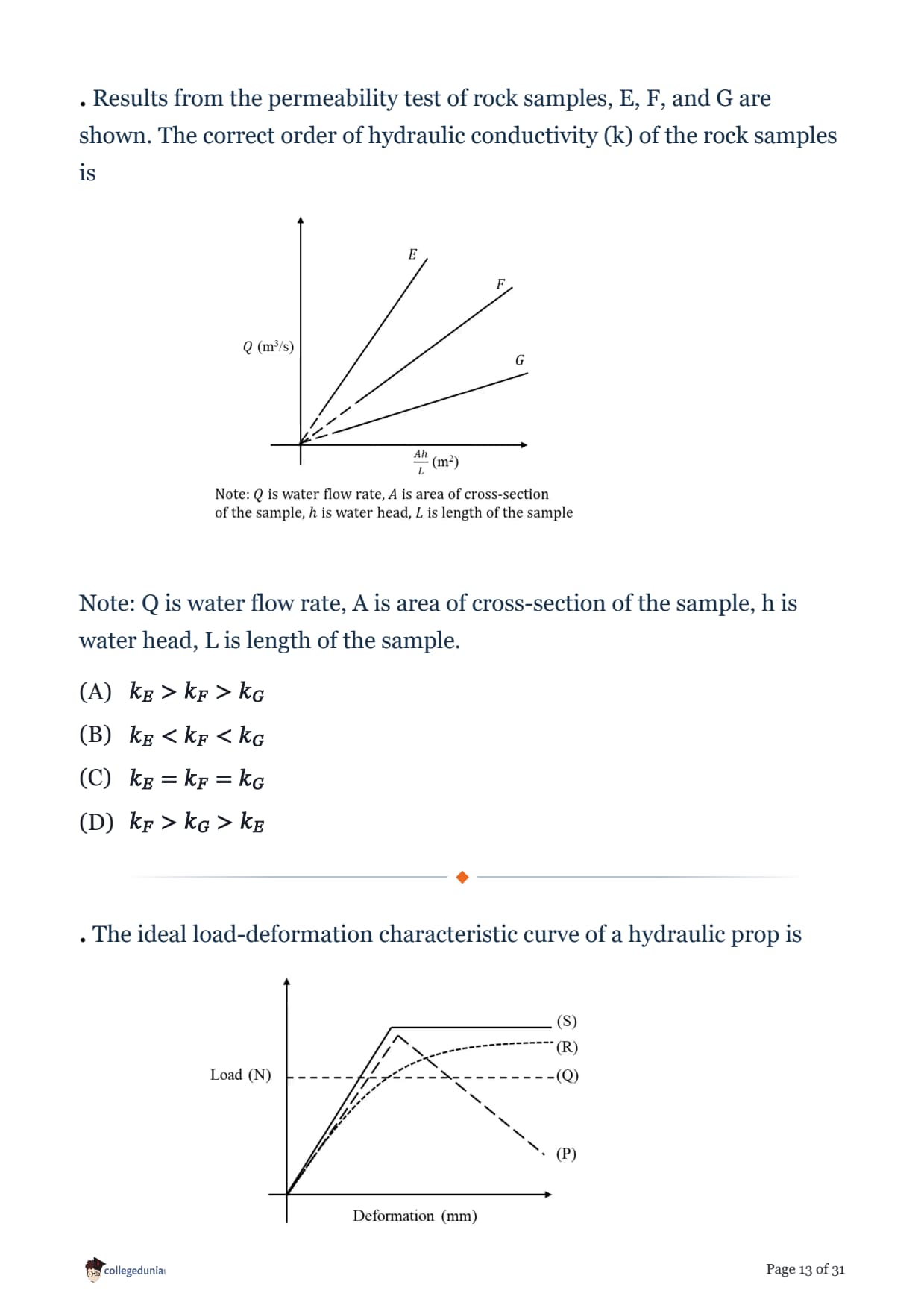
Results from the permeability test of rock samples, E, F, and G are shown. The correct order of hydraulic conductivity (k) of the rock samples is

Note: Q is water flow rate, A is area of cross-section of the sample, h is water head, L is length of the sample.
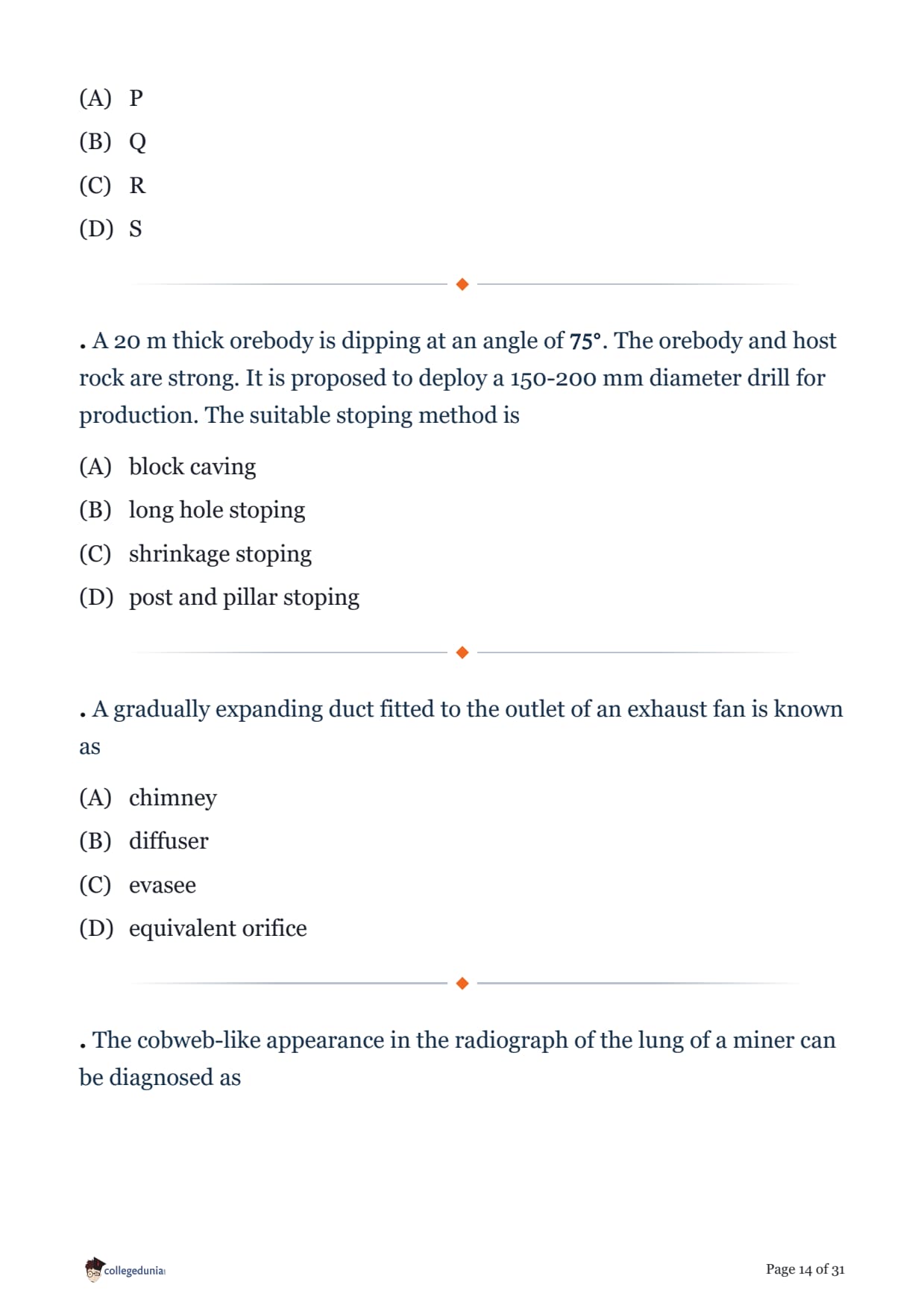
The ideal load-deformation characteristic curve of a hydraulic prop is

A 20 m thick orebody is dipping at an angle of \(75^\circ\). The orebody and host rock are strong. It is proposed to deploy a 150-200 mm diameter drill for production. The suitable stoping method is
A gradually expanding duct fitted to the outlet of an exhaust fan is known as
The cobweb-like appearance in the radiograph of the lung of a miner can be diagnosed as
In firedamp explosion, the methane concentration in the stoichiometric methane-air mixture, in % by volume, is
Assume the air contains 79% nitrogen and 21% oxygen, by volume.
Which of the following statements about Fourier series is/are correct?
A circular curve having a radius of curvature of \(1000\) m is set out by connecting two straights with a deflection angle of \(60^{\circ}\). The apex distance, in \(m\), is . (Rounded off to three decimal places)
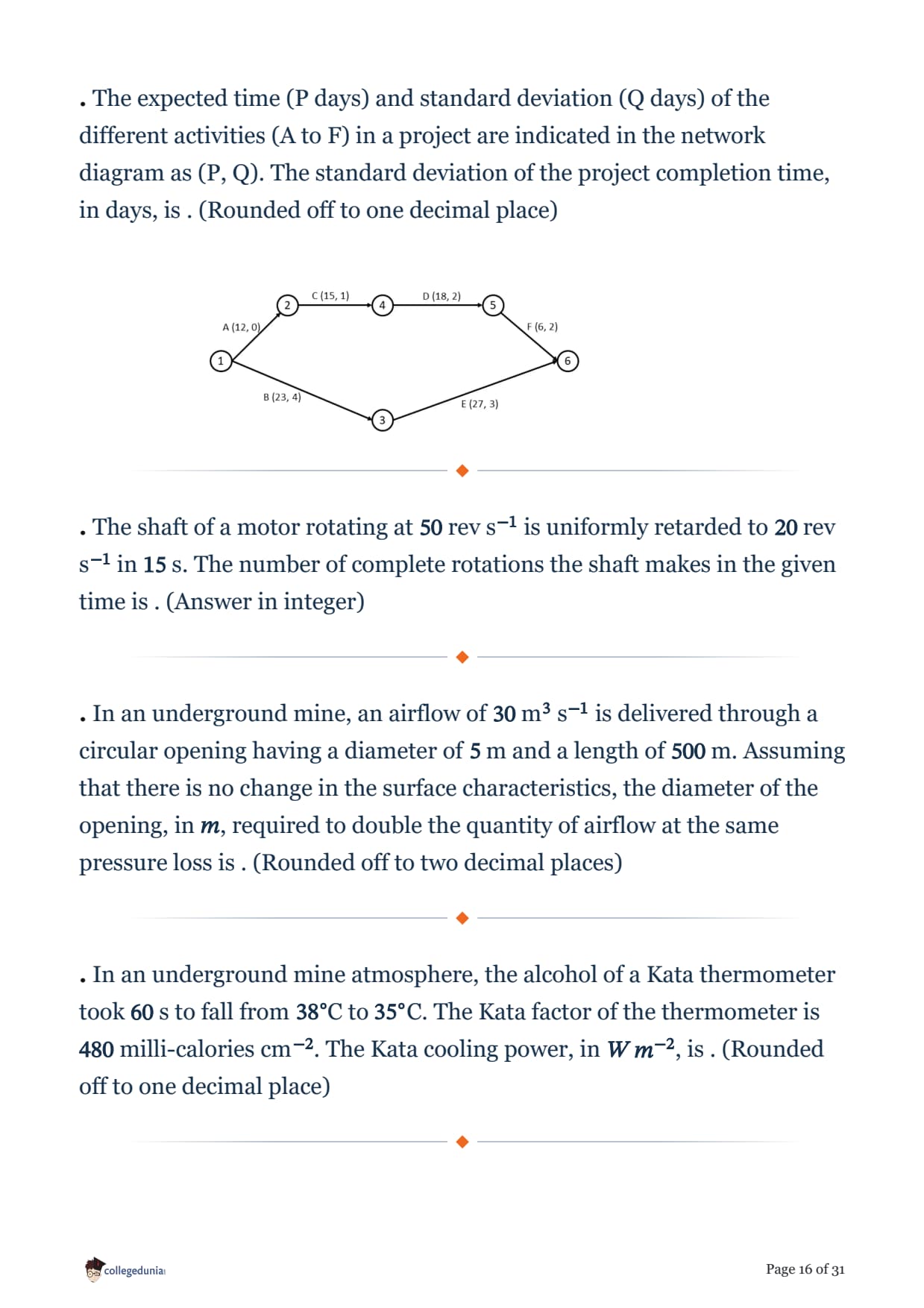
The expected time (P days) and standard deviation (Q days) of the different activities (A to F) in a project are indicated in the network diagram as (P, Q). The standard deviation of the project completion time, in days, is . (Rounded off to one decimal place)

The shaft of a motor rotating at \(50\) rev s\(^{-1}\) is uniformly retarded to \(20\) rev s\(^{-1}\) in \(15\) s. The number of complete rotations the shaft makes in the given time is . (Answer in integer)
In an underground mine, an airflow of \(30\) m\(^3\) s\(^{-1}\) is delivered through a circular opening having a diameter of \(5\) m and a length of \(500\) m. Assuming that there is no change in the surface characteristics, the diameter of the opening, in \(m\), required to double the quantity of airflow at the same pressure loss is . (Rounded off to two decimal places)
In an underground mine atmosphere, the alcohol of a Kata thermometer took \(60\) s to fall from \(38^{\circ}\)C to \(35^{\circ}\)C. The Kata factor of the thermometer is \(480\) milli-calories cm\(^{-2}\). The Kata cooling power, in \(W\,m^{-2}\), is . (Rounded off to one decimal place)
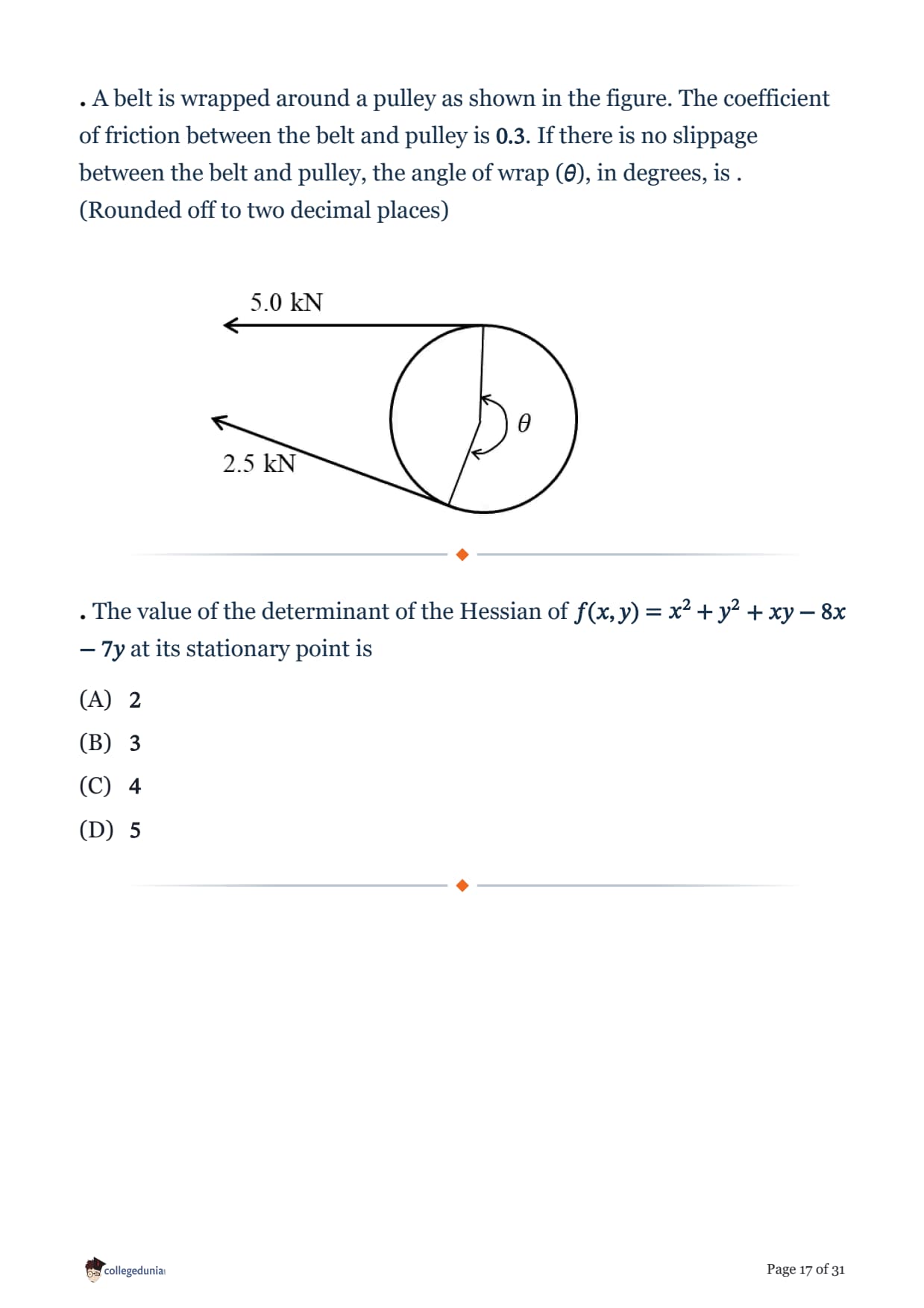
A belt is wrapped around a pulley as shown in the figure. The coefficient of friction between the belt and pulley is \(0.3\). If there is no slippage between the belt and pulley, the angle of wrap (\(\theta\)), in degrees, is . (Rounded off to two decimal places)

The value of the determinant of the Hessian of \( f(x, y) = x^2 + y^2 + xy - 8x - 7y \) at its stationary point is
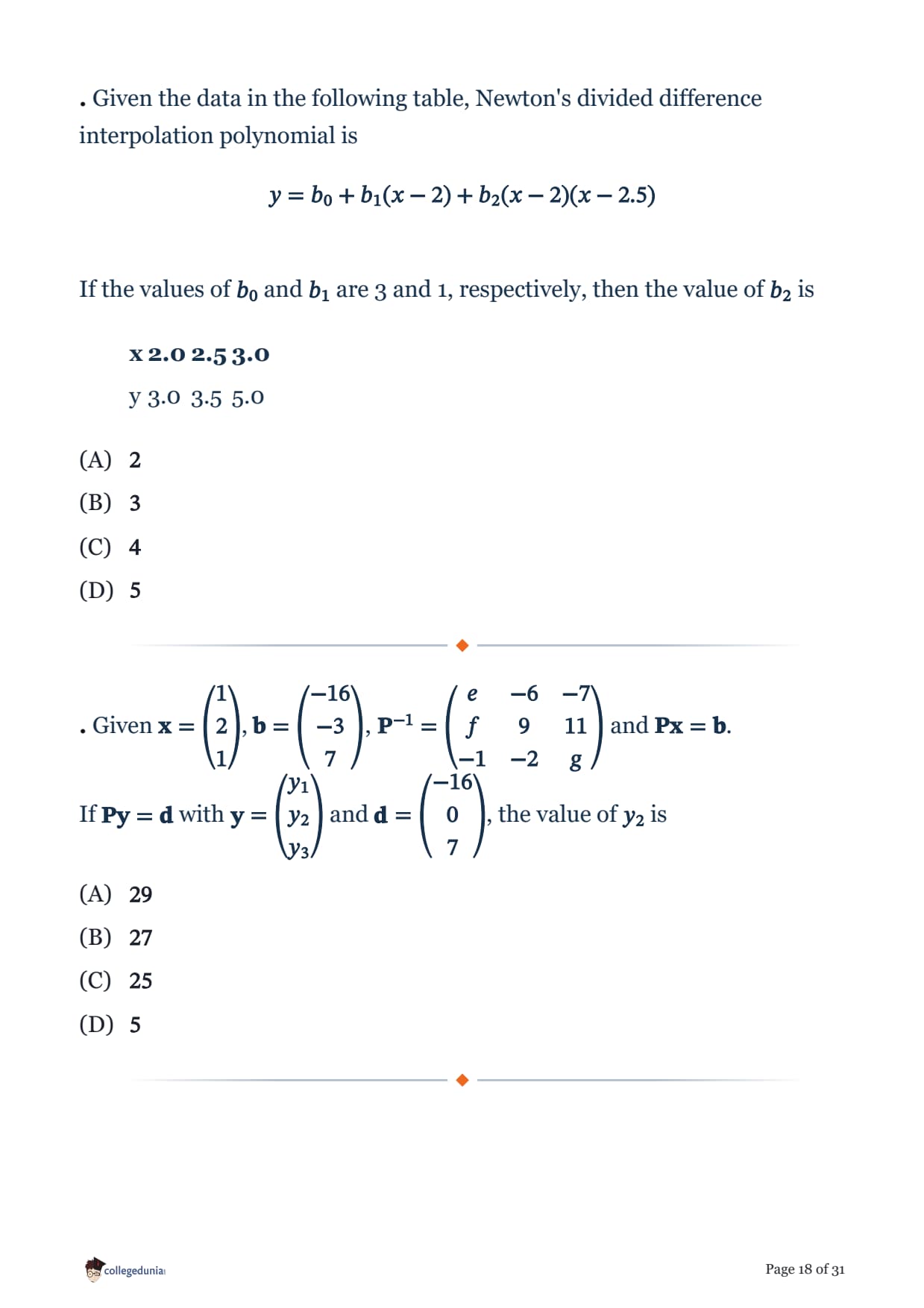
Given the data in the following table, Newton's divided difference interpolation polynomial is
\[ y = b_0 + b_1(x-2) + b_2(x-2)(x-2.5) \]
If the values of \( b_0 \) and \( b_1 \) are 3 and 1, respectively, then the value of \( b_2 \) is
| x | 2.0 | 2.5 | 3.0 |
|---|---|---|---|
| y | 3.0 | 3.5 | 5.0 |
Given \( \mathbf{x} = \begin{pmatrix} 1 \\ 2 \\ 1 \end{pmatrix} \), \( \mathbf{b} = \begin{pmatrix} -16 \\ -3 \\ 7 \end{pmatrix} \), \( \mathbf{P}^{-1} = \begin{pmatrix} e & -6 & -7 \\ f & 9 & 11 \\ -1 & -2 & g \end{pmatrix} \) and \( \mathbf{P}\mathbf{x} = \mathbf{b} \).
If \( \mathbf{P}\mathbf{y} = \mathbf{d} \) with \( \mathbf{y} = \begin{pmatrix} y_1 \\ y_2 \\ y_3 \end{pmatrix} \) and \( \mathbf{d} = \begin{pmatrix} -16 \\ 0 \\ 7 \end{pmatrix} \), the value of \( y_2 \) is
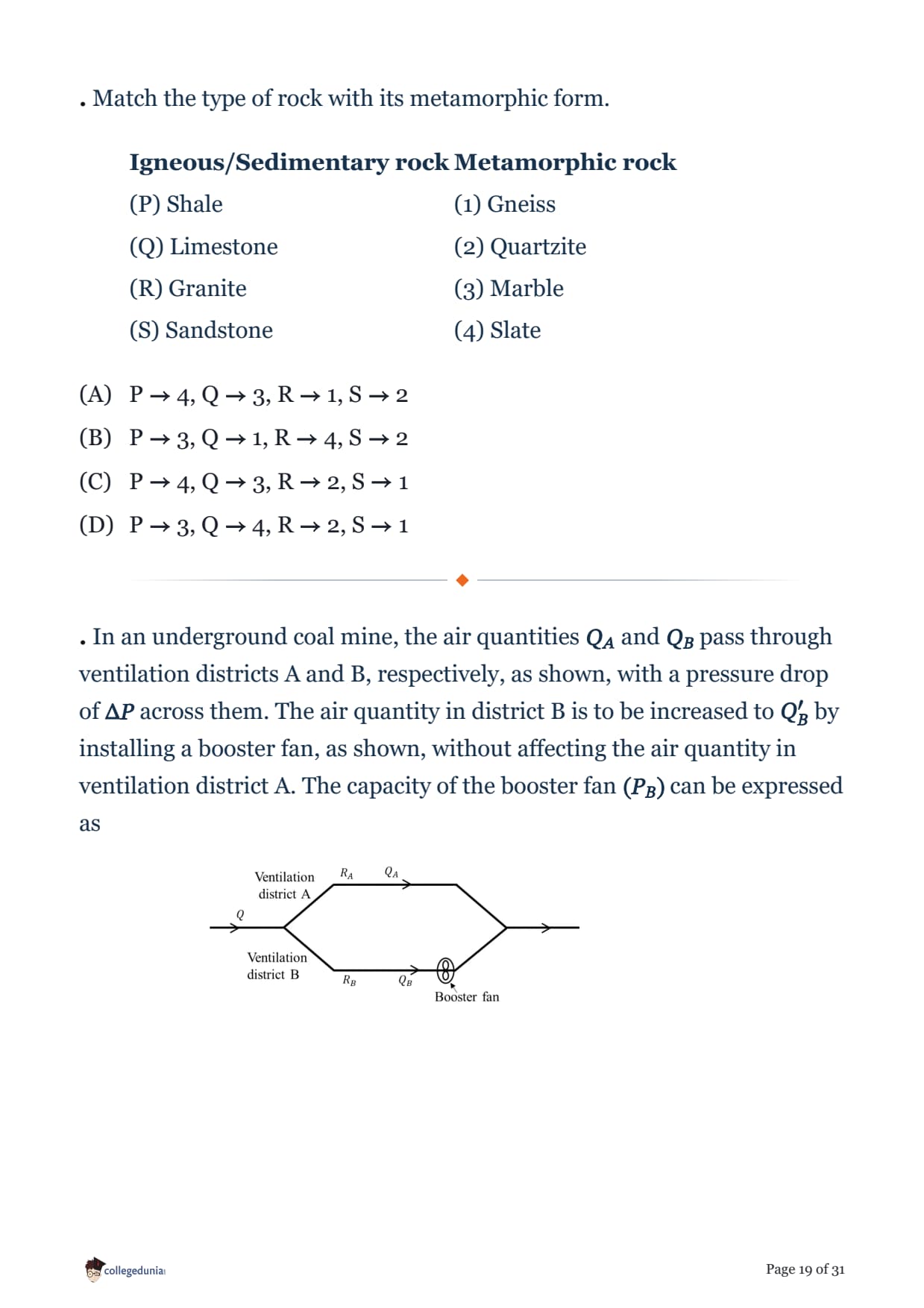
Match the type of rock with its metamorphic form.
| Igneous/Sedimentary rock | Metamorphic rock |
|---|---|
| (P) Shale | (1) Gneiss |
| (Q) Limestone | (2) Quartzite |
| (R) Granite | (3) Marble |
| (S) Sandstone | (4) Slate |
In an underground coal mine, the air quantities \( Q_A \) and \( Q_B \) pass through ventilation districts A and B, respectively, as shown, with a pressure drop of \( \Delta P \) across them. The air quantity in district B is to be increased to \( Q_B' \) by installing a booster fan, as shown, without affecting the air quantity in ventilation district A. The capacity of the booster fan \( (P_B) \) can be expressed as

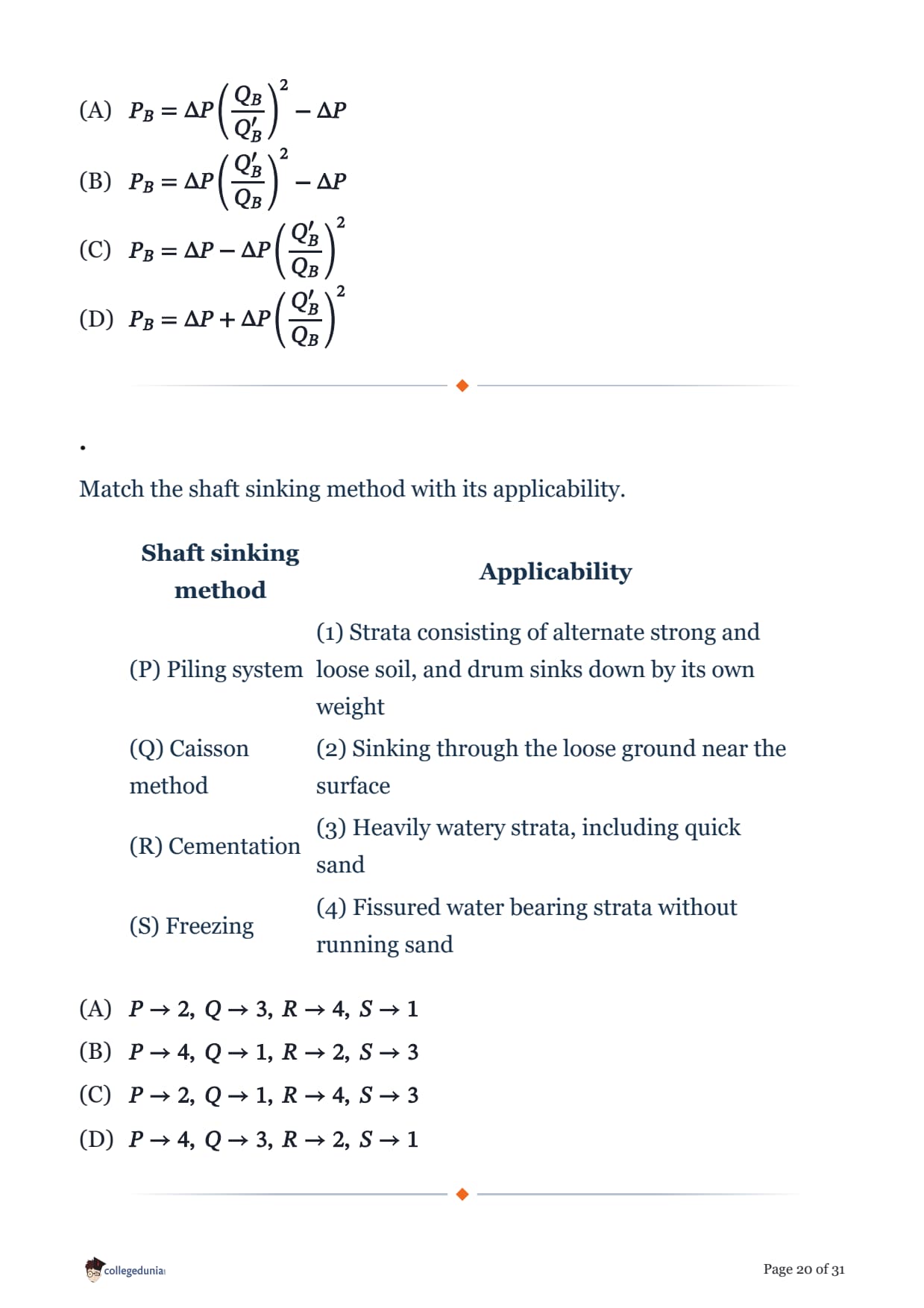
Match the shaft sinking method with its applicability.
| Shaft sinking method | Applicability |
|---|---|
| (P) Piling system | (1) Strata consisting of alternate strong and loose soil, and drum sinks down by its own weight |
| (Q) Caisson method | (2) Sinking through the loose ground near the surface |
| (R) Cementation | (3) Heavily watery strata, including quick sand |
| (S) Freezing | (4) Fissured water bearing strata without running sand |
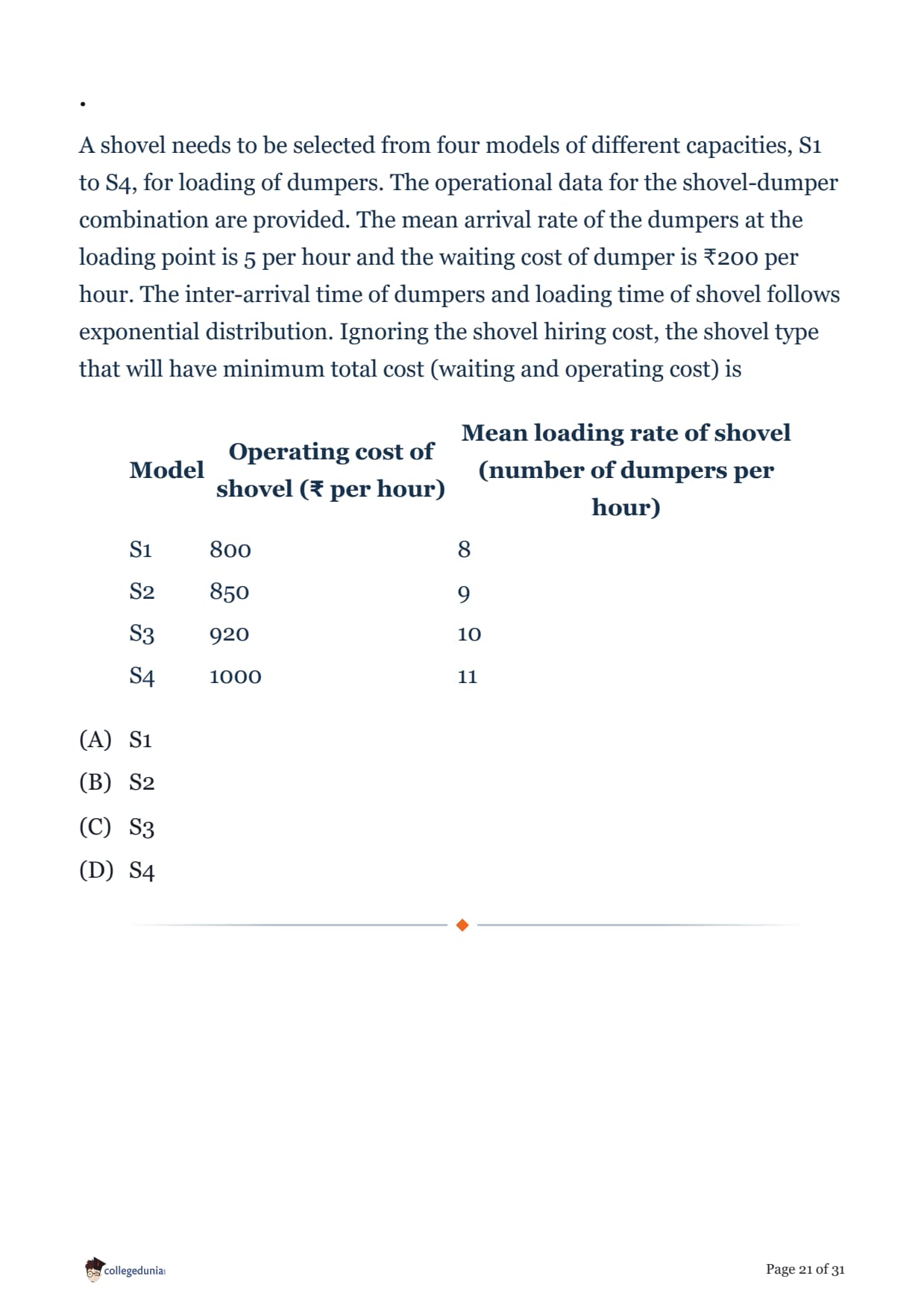
A shovel needs to be selected from four models of different capacities, S1 to S4, for loading of dumpers. The operational data for the shovel-dumper combination are provided. The mean arrival rate of the dumpers at the loading point is 5 per hour and the waiting cost of dumper is ₹200 per hour. The inter-arrival time of dumpers and loading time of shovel follows exponential distribution. Ignoring the shovel hiring cost, the shovel type that will have minimum total cost (waiting and operating cost) is
| Model | Operating cost of shovel (₹ per hour) | Mean loading rate of shovel (number of dumpers per hour) |
|---|---|---|
| S1 | 800 | 8 |
| S2 | 850 | 9 |
| S3 | 920 | 10 |
| S4 | 1000 | 11 |
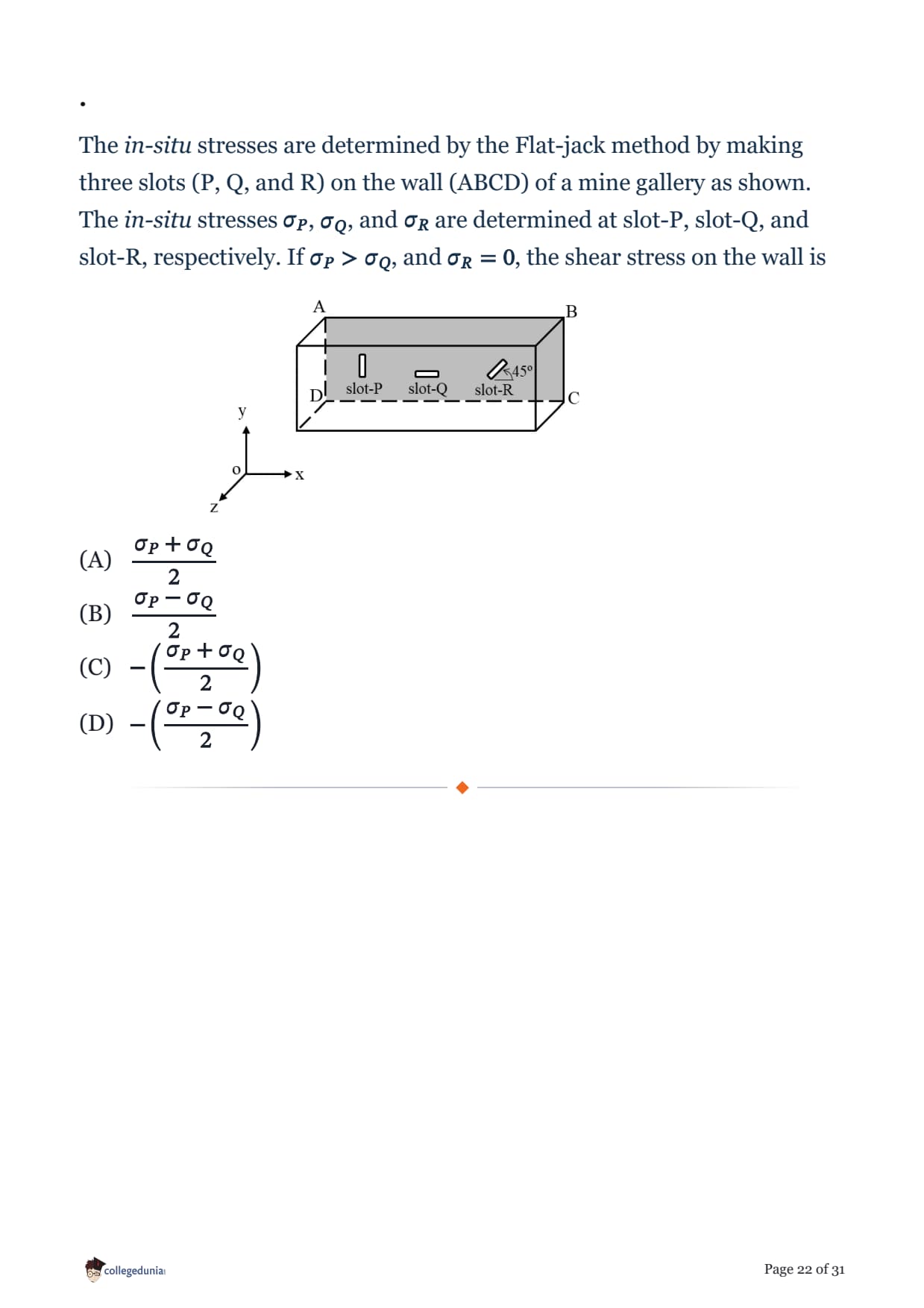
The in-situ stresses are determined by the Flat-jack method by making three slots (P, Q, and R) on the wall (ABCD) of a mine gallery as shown. The in-situ stresses \( \sigma_P \), \( \sigma_Q \), and \( \sigma_R \) are determined at slot-P, slot-Q, and slot-R, respectively. If \( \sigma_P > \sigma_Q \), and \( \sigma_R = 0 \), the shear stress on the wall is

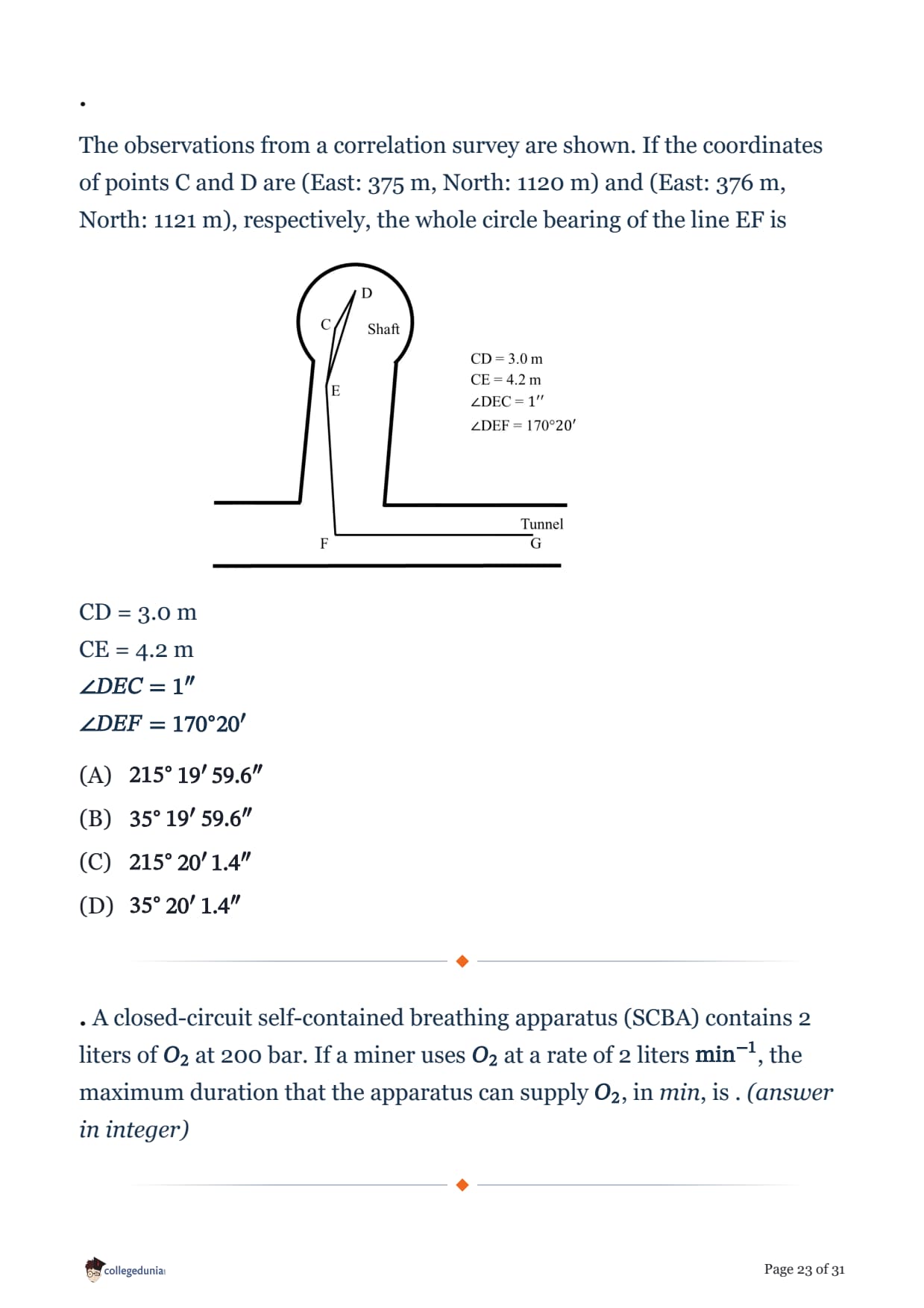
The observations from a correlation survey are shown. If the coordinates of points C and D are (East: 375 m, North: 1120 m) and (East: 376 m, North: 1121 m), respectively, the whole circle bearing of the line EF is

CD = 3.0 m
CE = 4.2 m
\( \angle DEC = 1'' \)
\( \angle DEF = 170^{\circ} 20' \)
A closed-circuit self-contained breathing apparatus (SCBA) contains 2 liters of \(O_2\) at 200 bar. If a miner uses \(O_2\) at a rate of 2 liters \(\text{min}^{-1}\), the maximum duration that the apparatus can supply \(O_2\), in min, is . (answer in integer)
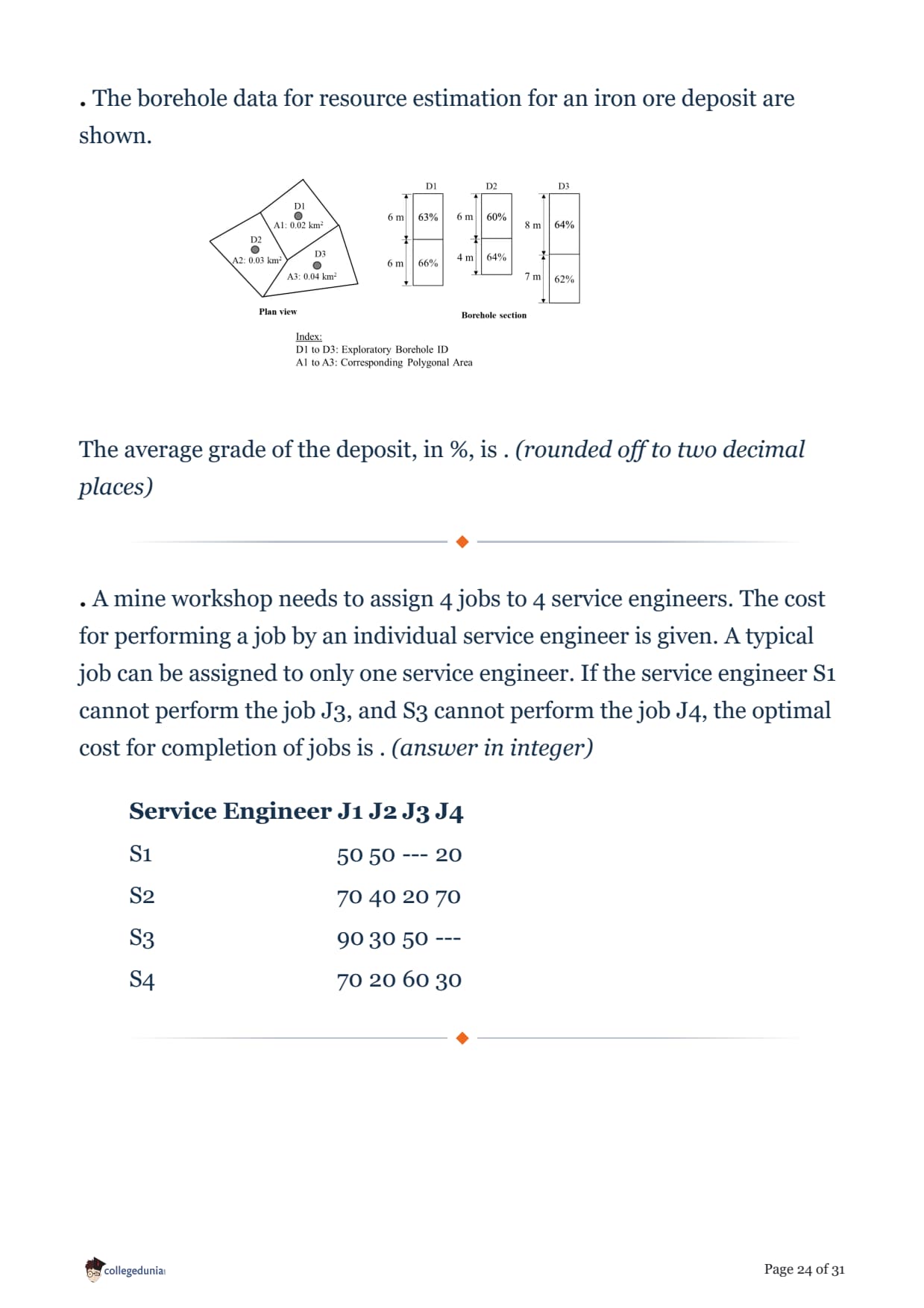
The borehole data for resource estimation for an iron ore deposit are shown.

The average grade of the deposit, in %, is . (rounded off to two decimal places)
A mine workshop needs to assign 4 jobs to 4 service engineers. The cost for performing a job by an individual service engineer is given. A typical job can be assigned to only one service engineer. If the service engineer S1 cannot perform the job J3, and S3 cannot perform the job J4, the optimal cost for completion of jobs is . (answer in integer)
| Service Engineer | J1 | J2 | J3 | J4 |
|---|---|---|---|---|
| S1 | 50 | 50 | --- | 20 |
| S2 | 70 | 40 | 20 | 70 |
| S3 | 90 | 30 | 50 | --- |
| S4 | 70 | 20 | 60 | 30 |
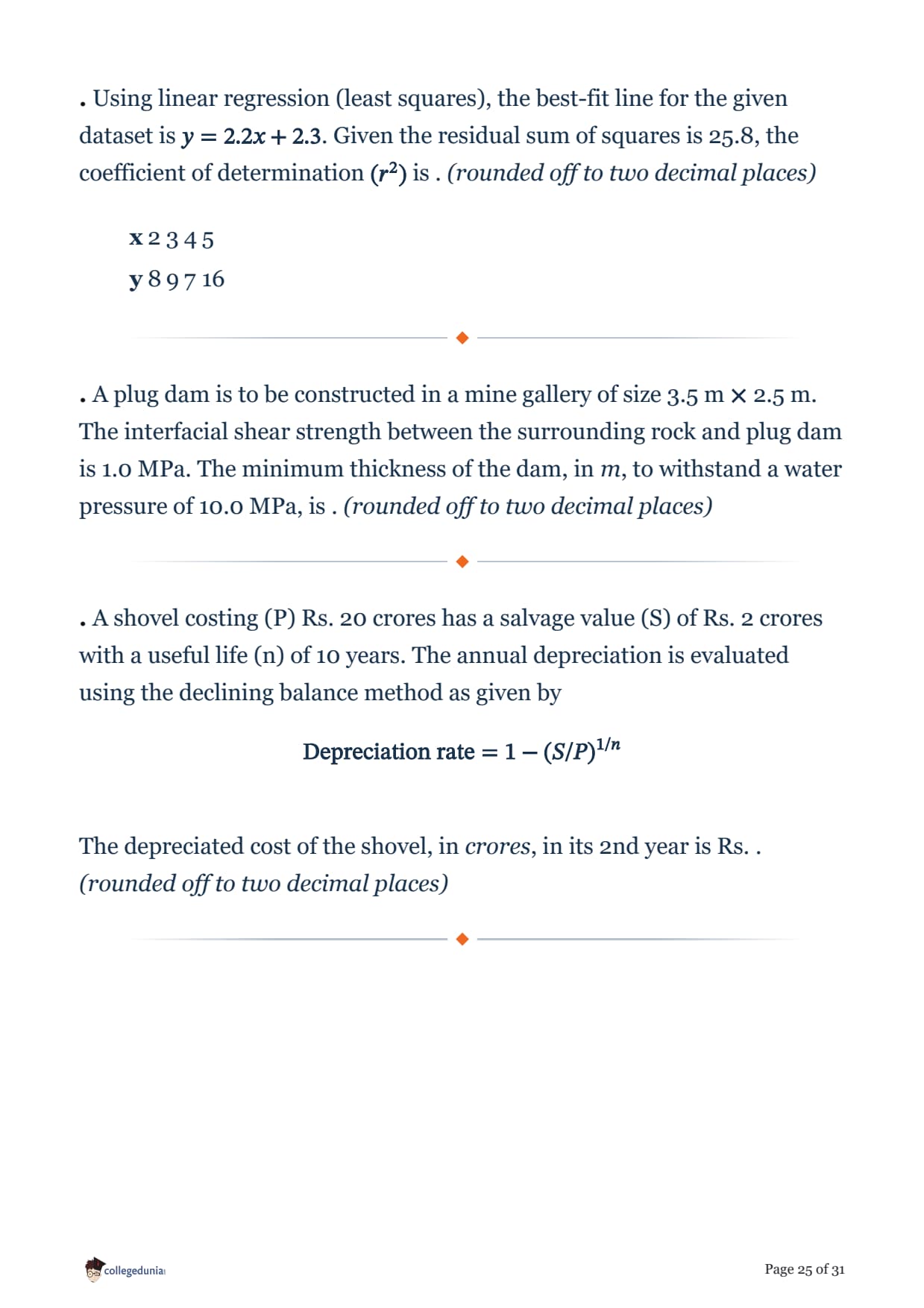
Using linear regression (least squares), the best-fit line for the given dataset is \(y = 2.2x + 2.3\). Given the residual sum of squares is 25.8, the coefficient of determination \((r^2)\) is . (rounded off to two decimal places)
| x | 2 | 3 | 4 | 5 |
|---|---|---|---|---|
| y | 8 | 9 | 7 | 16 |
A plug dam is to be constructed in a mine gallery of size 3.5 m \(\times\) 2.5 m. The interfacial shear strength between the surrounding rock and plug dam is 1.0 MPa. The minimum thickness of the dam, in m, to withstand a water pressure of 10.0 MPa, is . (rounded off to two decimal places)
A shovel costing (P) Rs. 20 crores has a salvage value (S) of Rs. 2 crores with a useful life (n) of 10 years. The annual depreciation is evaluated using the declining balance method as given by
\[ \text{Depreciation rate} = 1 - (S/P)^{1/n} \]
The depreciated cost of the shovel, in crores, in its 2nd year is Rs. . (rounded off to two decimal places)
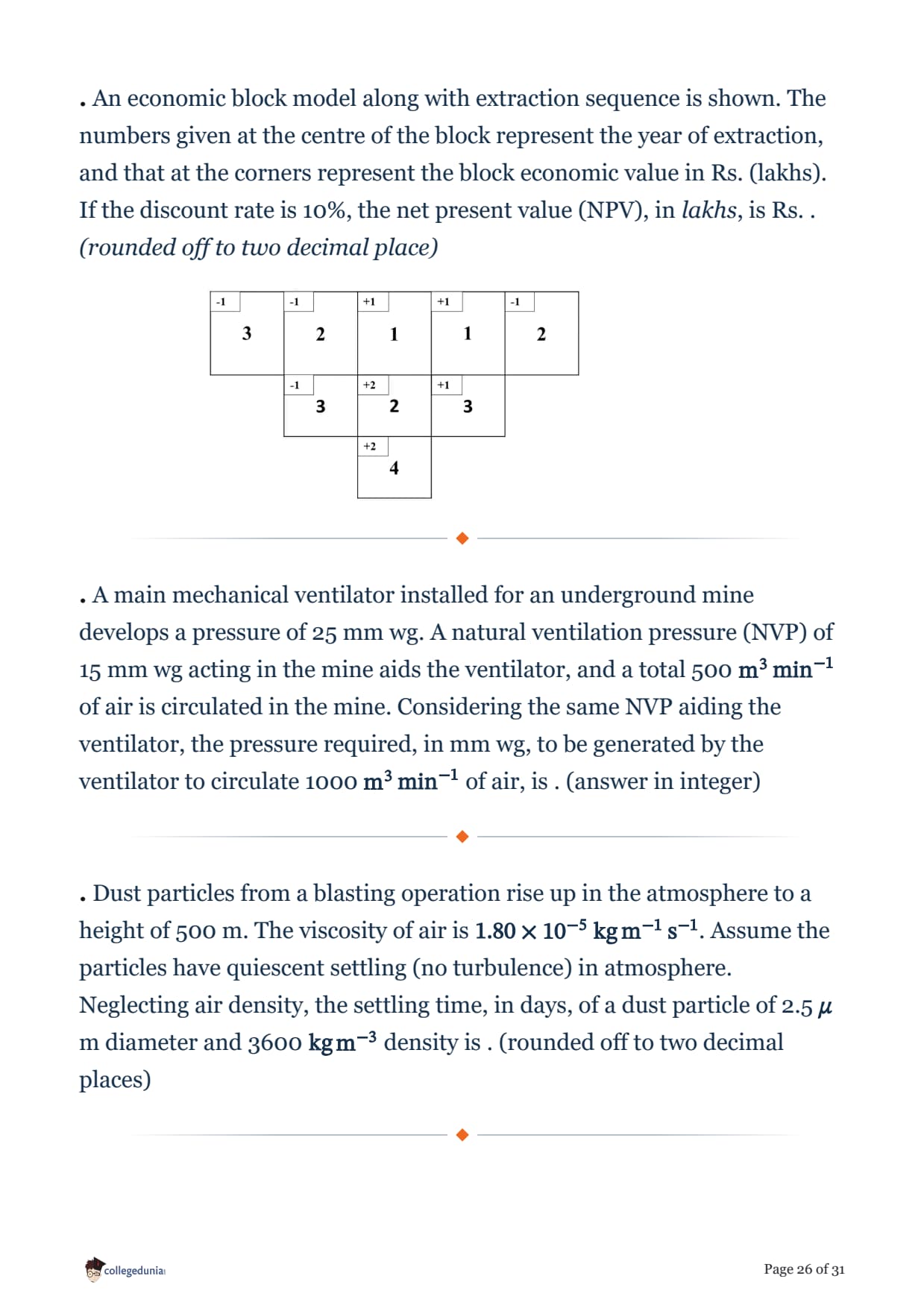
An economic block model along with extraction sequence is shown. The numbers given at the centre of the block represent the year of extraction, and that at the corners represent the block economic value in Rs. (lakhs). If the discount rate is 10%, the net present value (NPV), in lakhs, is Rs. . (rounded off to two decimal place)

A main mechanical ventilator installed for an underground mine develops a pressure of 25 mm wg. A natural ventilation pressure (NVP) of 15 mm wg acting in the mine aids the ventilator, and a total 500 \( \text{m}^3\,\text{min}^{-1} \) of air is circulated in the mine. Considering the same NVP aiding the ventilator, the pressure required, in mm wg, to be generated by the ventilator to circulate 1000 \( \text{m}^3\,\text{min}^{-1} \) of air, is . (answer in integer)
Dust particles from a blasting operation rise up in the atmosphere to a height of 500 m. The viscosity of air is \( 1.80 \times 10^{-5}\ \text{kg}\,\text{m}^{-1}\,\text{s}^{-1} \). Assume the particles have quiescent settling (no turbulence) in atmosphere. Neglecting air density, the settling time, in days, of a dust particle of 2.5 \(\mu\)m diameter and 3600 \( \text{kg}\,\text{m}^{-3} \) density is . (rounded off to two decimal places)
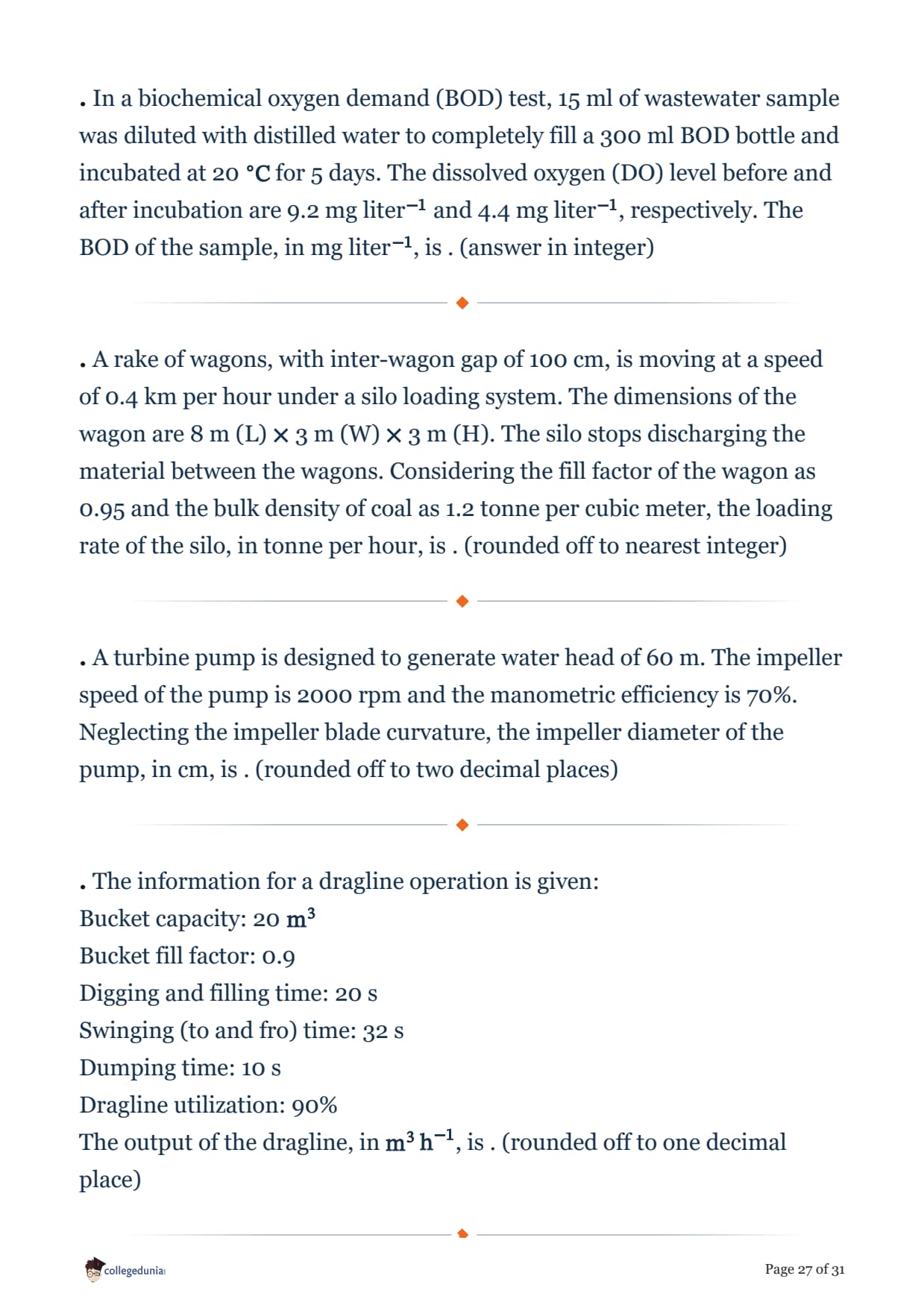
In a biochemical oxygen demand (BOD) test, 15 ml of wastewater sample was diluted with distilled water to completely fill a 300 ml BOD bottle and incubated at 20 \(^{\circ}\text{C}\) for 5 days. The dissolved oxygen (DO) level before and after incubation are 9.2 mg liter\(^{-1}\) and 4.4 mg liter\(^{-1}\), respectively. The BOD of the sample, in mg liter\(^{-1}\), is . (answer in integer)
A rake of wagons, with inter-wagon gap of 100 cm, is moving at a speed of 0.4 km per hour under a silo loading system. The dimensions of the wagon are 8 m (L) \(\times\) 3 m (W) \(\times\) 3 m (H). The silo stops discharging the material between the wagons. Considering the fill factor of the wagon as 0.95 and the bulk density of coal as 1.2 tonne per cubic meter, the loading rate of the silo, in tonne per hour, is . (rounded off to nearest integer)
A turbine pump is designed to generate water head of 60 m. The impeller speed of the pump is 2000 rpm and the manometric efficiency is 70%. Neglecting the impeller blade curvature, the impeller diameter of the pump, in cm, is . (rounded off to two decimal places)
The information for a dragline operation is given:
Bucket capacity: 20 \( \text{m}^3 \)
Bucket fill factor: 0.9
Digging and filling time: 20 s
Swinging (to and fro) time: 32 s
Dumping time: 10 s
Dragline utilization: 90%
The output of the dragline, in \( \text{m}^3\,\text{h}^{-1} \), is . (rounded off to one decimal place)
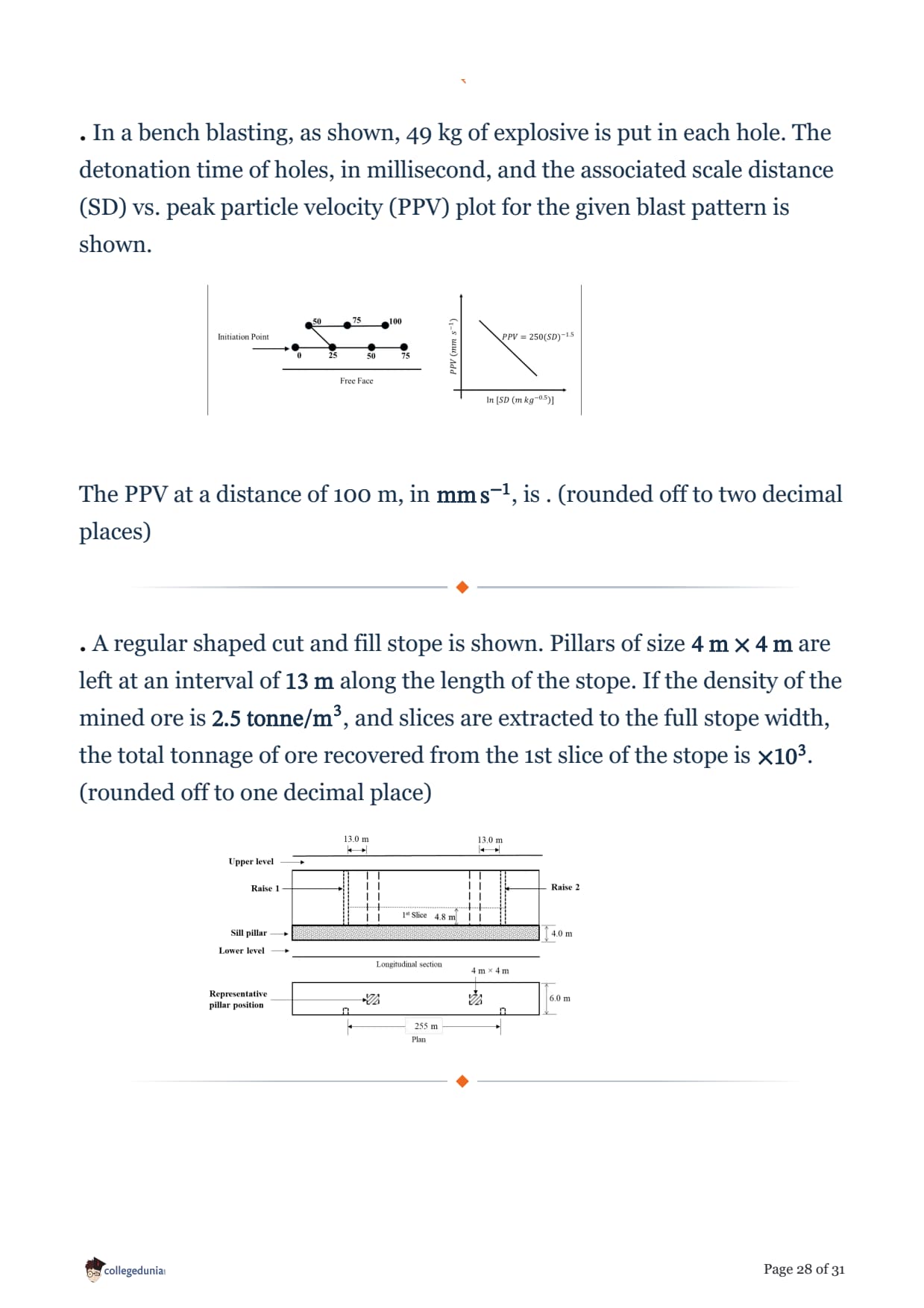
In a bench blasting, as shown, 49 kg of explosive is put in each hole. The detonation time of holes, in millisecond, and the associated scale distance (SD) vs. peak particle velocity (PPV) plot for the given blast pattern is shown.

The PPV at a distance of 100 m, in \( \text{mm}\,\text{s}^{-1} \), is . (rounded off to two decimal places)
A regular shaped cut and fill stope is shown. Pillars of size \(4\ \text{m} \times 4\ \text{m}\) are left at an interval of \(13\ \text{m}\) along the length of the stope. If the density of the mined ore is \(2.5\ \text{tonne/m}^3\), and slices are extracted to the full stope width, the total tonnage of ore recovered from the 1st slice of the stope is \(\times 10^3\). (rounded off to one decimal place)

A coal seam of \(2.4\ \text{m}\) thickness is mined with a DERD shearer at a cutting speed of \(0.6\ \text{km/h}\). The web depth of the cut is \(0.5\ \text{m}\). The average cross-sectional area of coal on the AFC during transportation is \(0.24\ \text{m}^2\). For the evacuation of cut coal from the face with 10% spillage, the required minimum velocity of the AFC, in \(m\ s^{-1}\), is . (rounded off to two decimal places)
A bord and pillar panel has 24 developed pillars of size \(40\ \text{m} \times 40\ \text{m}\) (centre to centre) under extraction. The following information is given:
Gallery width = \(4\ \text{m}\)
Extraction height = \(3\ \text{m}\)
Extraction ratio during depillaring = 80%
Specific gravity of coal = 1.4
Incubation period = 6 months
Average working days per month = 25
In order to extract the panel within the incubation period, the minimum rate of production, in tonne per day, is . (rounded off to one decimal place)
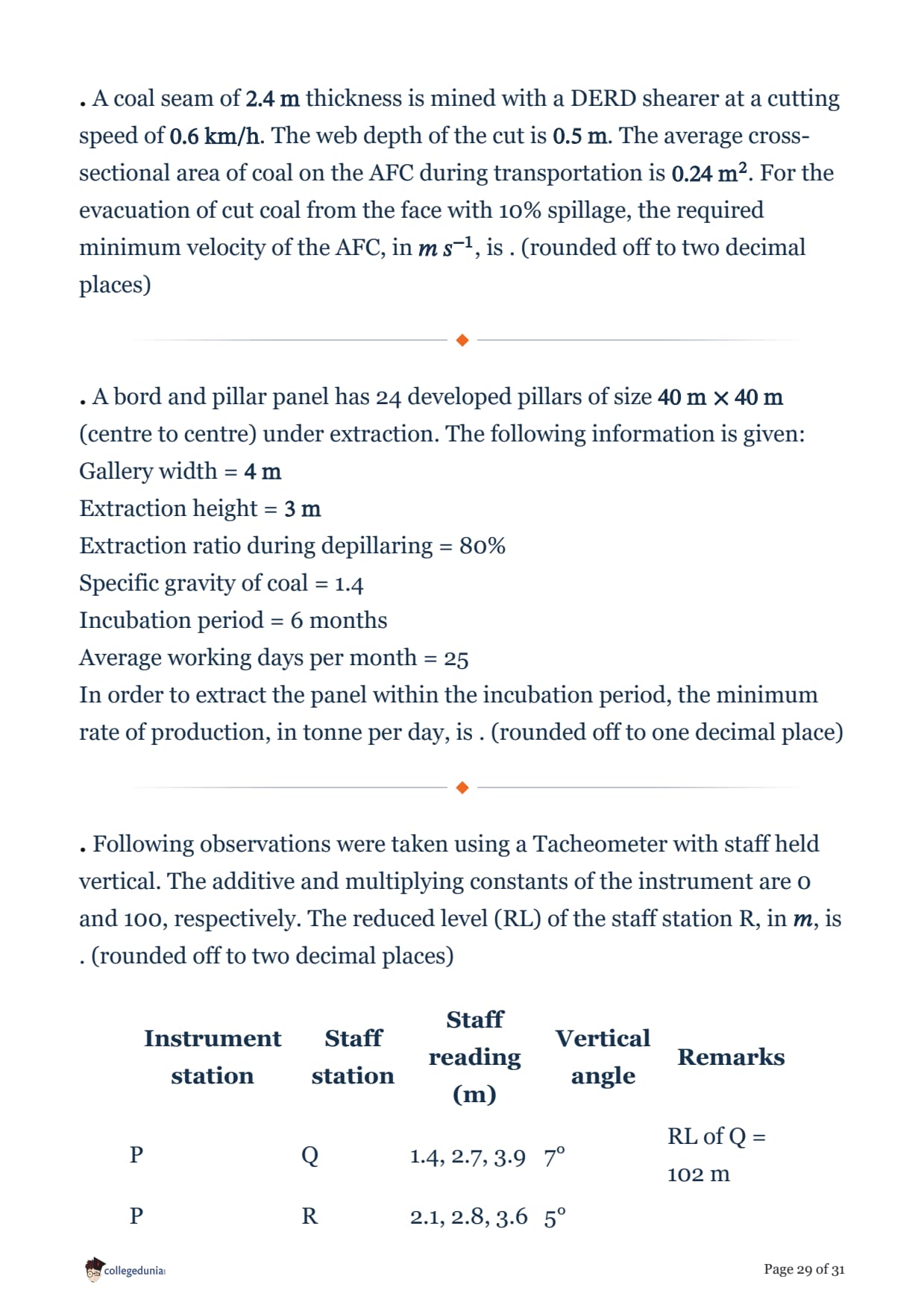
Following observations were taken using a Tacheometer with staff held vertical. The additive and multiplying constants of the instrument are 0 and 100, respectively. The reduced level (RL) of the staff station R, in \(m\), is . (rounded off to two decimal places)
| Instrument station | Staff station | Staff reading (m) | Vertical angle | Remarks |
|---|---|---|---|---|
| P | Q | 1.4, 2.7, 3.9 | 7° | RL of Q = 102 m |
| P | R | 2.1, 2.8, 3.6 | 5° |
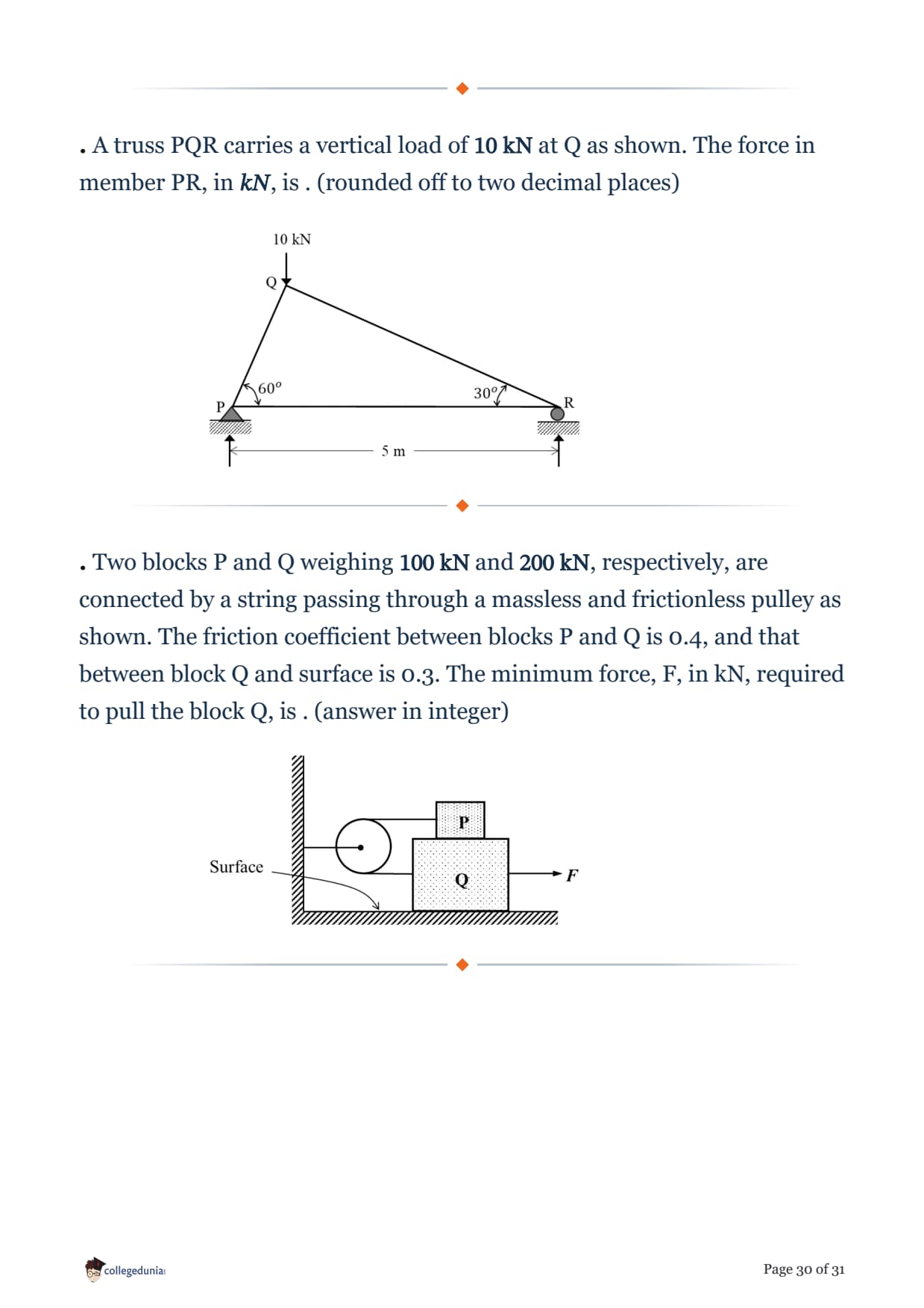
A truss PQR carries a vertical load of \(10\ \text{kN}\) at Q as shown. The force in member PR, in \(kN\), is . (rounded off to two decimal places)

Two blocks P and Q weighing \(100\ \text{kN}\) and \(200\ \text{kN}\), respectively, are connected by a string passing through a massless and frictionless pulley as shown. The friction coefficient between blocks P and Q is 0.4, and that between block Q and surface is 0.3. The minimum force, F, in kN, required to pull the block Q, is . (answer in integer)

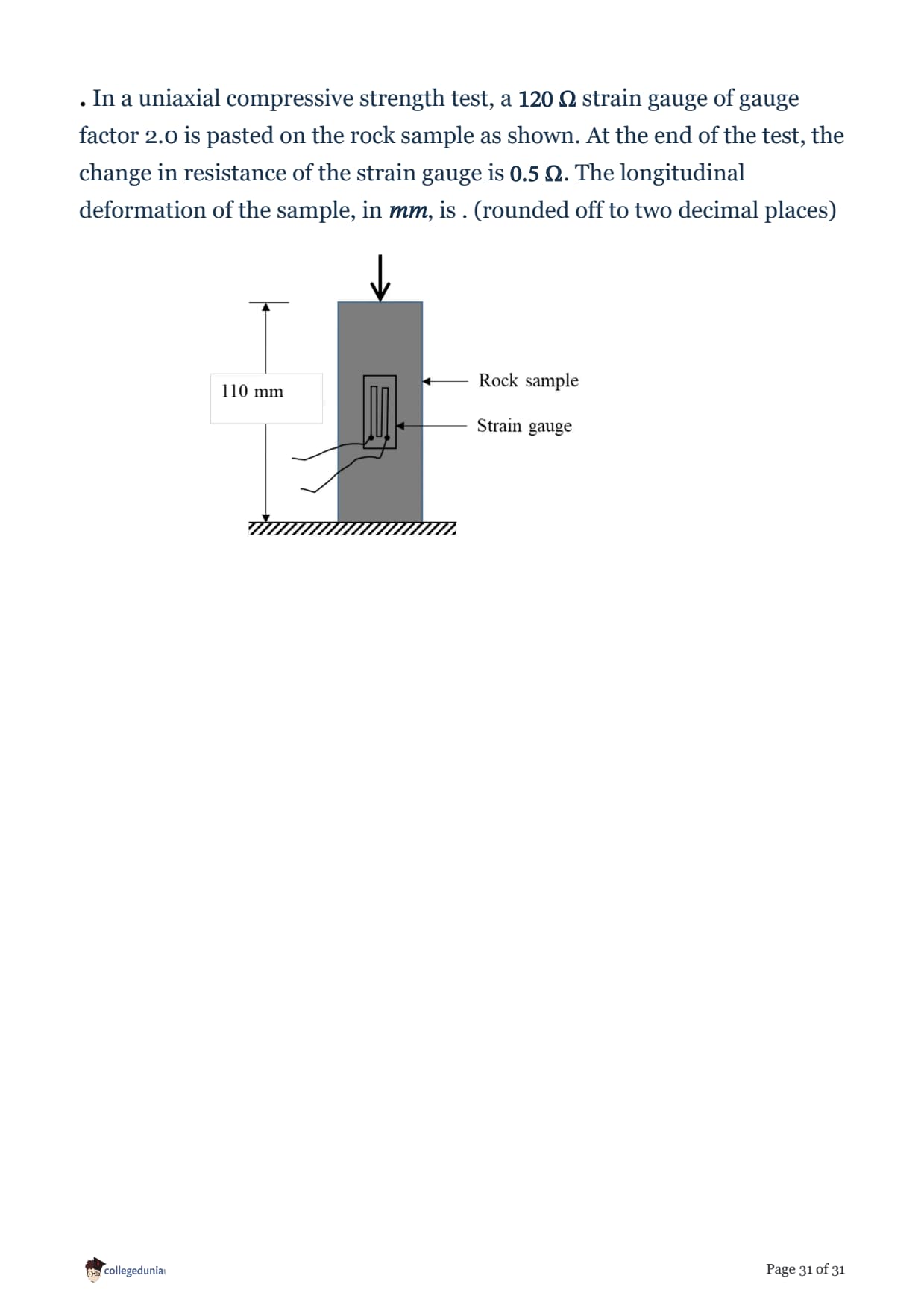
In a uniaxial compressive strength test, a \(120\ \Omega\) strain gauge of gauge factor 2.0 is pasted on the rock sample as shown. At the end of the test, the change in resistance of the strain gauge is \(0.5\ \Omega\). The longitudinal deformation of the sample, in \(mm\), is . (rounded off to two decimal places)

GATE 2026 Mining Engineering Exam Pattern and Marking Scheme Explained
As per the IIT Guwahati question paper on the official website (gate2026.iitg.ac.in), the MN paper runs General Aptitude first and then the Engineering Mathematics plus Mining Engineering core in a single 3-hour computer-based slot.
- Total questions: 65 questions for 100 marks
- Section split: General Aptitude 10 questions for 15 marks, Engineering Mathematics and the Mining core 55 questions for 85 marks
- Duration: 180 minutes, forenoon session from 9:30 AM to 12:30 PM on 7 February 2026
- Marking scheme: 1-mark and 2-mark questions, with 1/3 mark cut for a wrong 1-mark MCQ and 2/3 mark cut for a wrong 2-mark MCQ
- Question types: 37 MCQ, 27 NAT and 1 MSQ, and neither the NAT nor the MSQ carried negative marking
Subject Areas Covered in the GATE 2026 Mining Engineering Question Paper
The 55 core questions were drawn from six areas, and with 27 of the 65 questions set as NAT the paper leaned hard on calculation rather than recall.
- Engineering Mathematics: the standard calculus, linear algebra, differential equations and probability block that feeds the numerical questions
- Mining Geology, Mine Development and Surveying: deposit description, development openings and survey computation
- Geomechanics and Ground Control: rock and rock mass behaviour, stress around openings, and support design
- Mining Methods and Machinery: surface and underground methods, excavation, loading, hauling and material handling
- Surface Environment, Mine Ventilation and Underground Hazards: airflow and ventilation networks, mine gases, fires and inundation
- Mineral Economics, Mine Planning and Systems Engineering: reserve and cost estimation, scheduling, and operations research on mine systems
GATE 2026 Mining Engineering Question Paper Analysis Video
Source: MINING GYAN
How to Use the GATE 2026 Mining Engineering Question Paper for Practice
Students who sat this paper rated it moderate to tough, so solve it once under exam conditions before you open the solution PDF.
- Attempt all 65 questions in one 180-minute sitting, keeping General Aptitude to about 15 minutes so the 85 marks of core work get the rest
- Since the 27 NAT questions carry no negative marking, mark every one of them in your practice attempt and see how many you actually convert
- Check the 37 MCQs against the solution PDF and count what a 1/3 and 2/3 penalty would have cost you, then decide which guesses were worth it
- Rework ventilation, geomechanics and mine planning numericals step by step, because that is where the long calculations sit
GATE 2026 Mining Engineering Question Paper FAQs
Ques. Was the GATE 2026 Mining Engineering paper tough?
Ans. It was widely rated moderate to tough. With 27 of the 65 questions set as NAT, the paper needed steady numerical work rather than option elimination, and the time pressure came from the calculation load in the 85-mark core section.
Ques. What is the exam pattern and marking scheme for GATE Mining Engineering 2026?
Ans. The MN paper has 65 questions for 100 marks in 180 minutes, split as General Aptitude 10 questions for 15 marks and Engineering Mathematics plus the Mining core 55 questions for 85 marks. Questions are worth 1 or 2 marks each.
Ques. Was there negative marking in GATE 2026 Mining Engineering?
Ans. Only on the MCQs. A wrong 1-mark MCQ cost 1/3 mark and a wrong 2-mark MCQ cost 2/3 mark. The 27 NAT questions and the single MSQ had no negative marking, so leaving those blank gained you nothing.
Ques. How many numerical answer type questions were there in GATE 2026 MN?
Ans. There were 27 NAT questions, alongside 37 MCQs and 1 MSQ. That makes NAT more than 40 percent of the paper, which is why calculator speed and unit handling decided so many marks.
Ques. Which subjects were asked in the GATE 2026 Mining Engineering question paper?
Ans. The paper covered Engineering Mathematics; Mining Geology, Mine Development and Surveying; Geomechanics and Ground Control; Mining Methods and Machinery; Surface Environment, Mine Ventilation and Underground Hazards; and Mineral Economics, Mine Planning and Systems Engineering, plus the 10-question General Aptitude block.
Ques. Where can I download the GATE 2026 Mining Engineering question paper with solutions PDF for free?
Ans. Use the Download PDF and Check Solutions links in the table above on Collegedunia for the free question paper and the full solved paper. The official question paper and answer key are on the IIT Guwahati site at gate2026.iitg.ac.in.



Comments