




The GATE 2026 Physics (PH) question paper is now available with detailed solutions for free download. GATE 2026 PH was conducted by IIT Guwahati on February 7, 2026, from 2:30 PM to 5:30 PM, as a single-session paper of 65 questions in 3 hours.
| GATE 2026 Physics (PH) Question Paper with Solutions | Download PDF | Check Solutions |
GATE 2026 Physics Questions with Solutions
"He often _____ the numbers. False claims are not going to help. Honesty _____ trust", said the manager.
Choose the option with the correct order of words to fill the blanks.
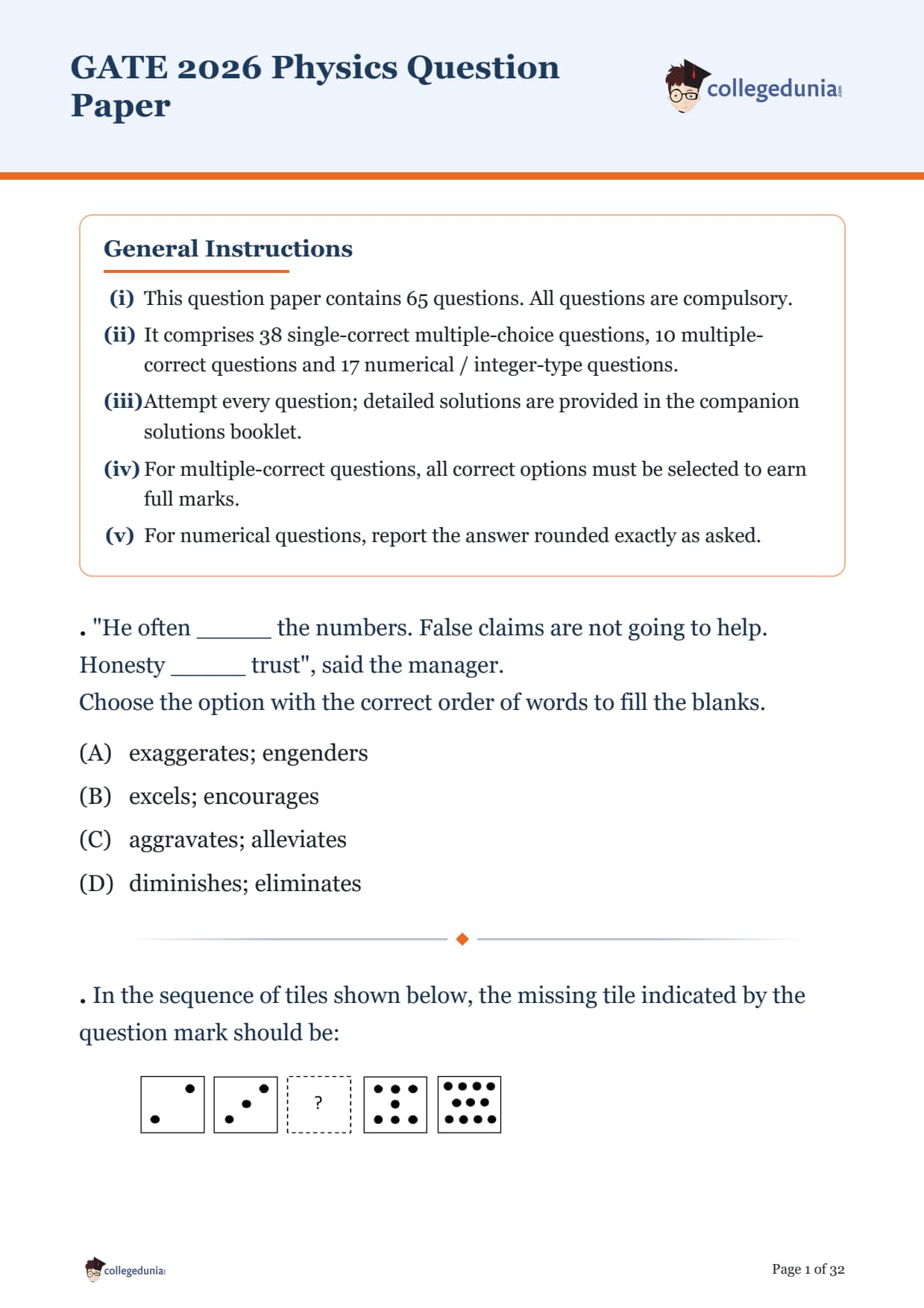
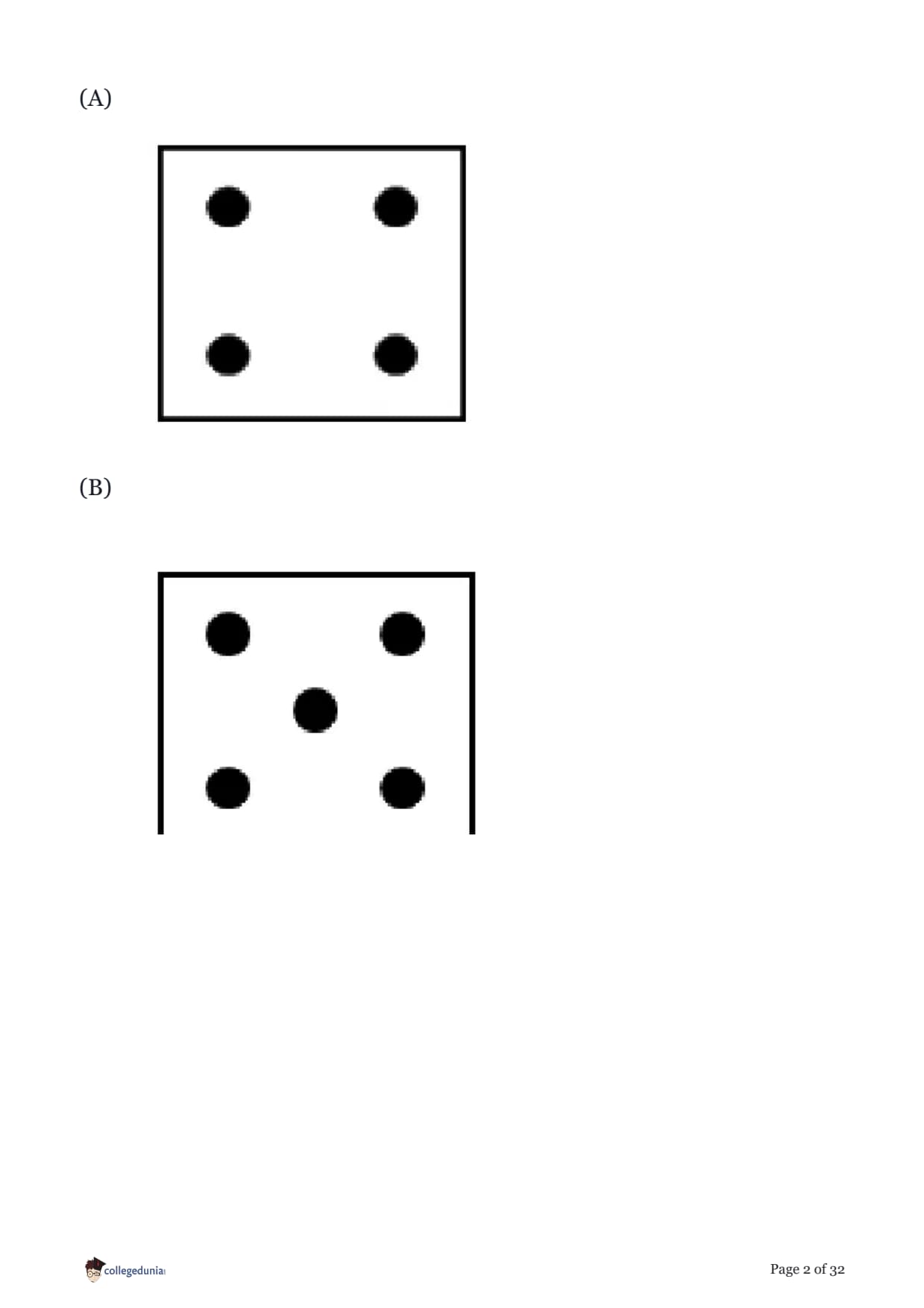
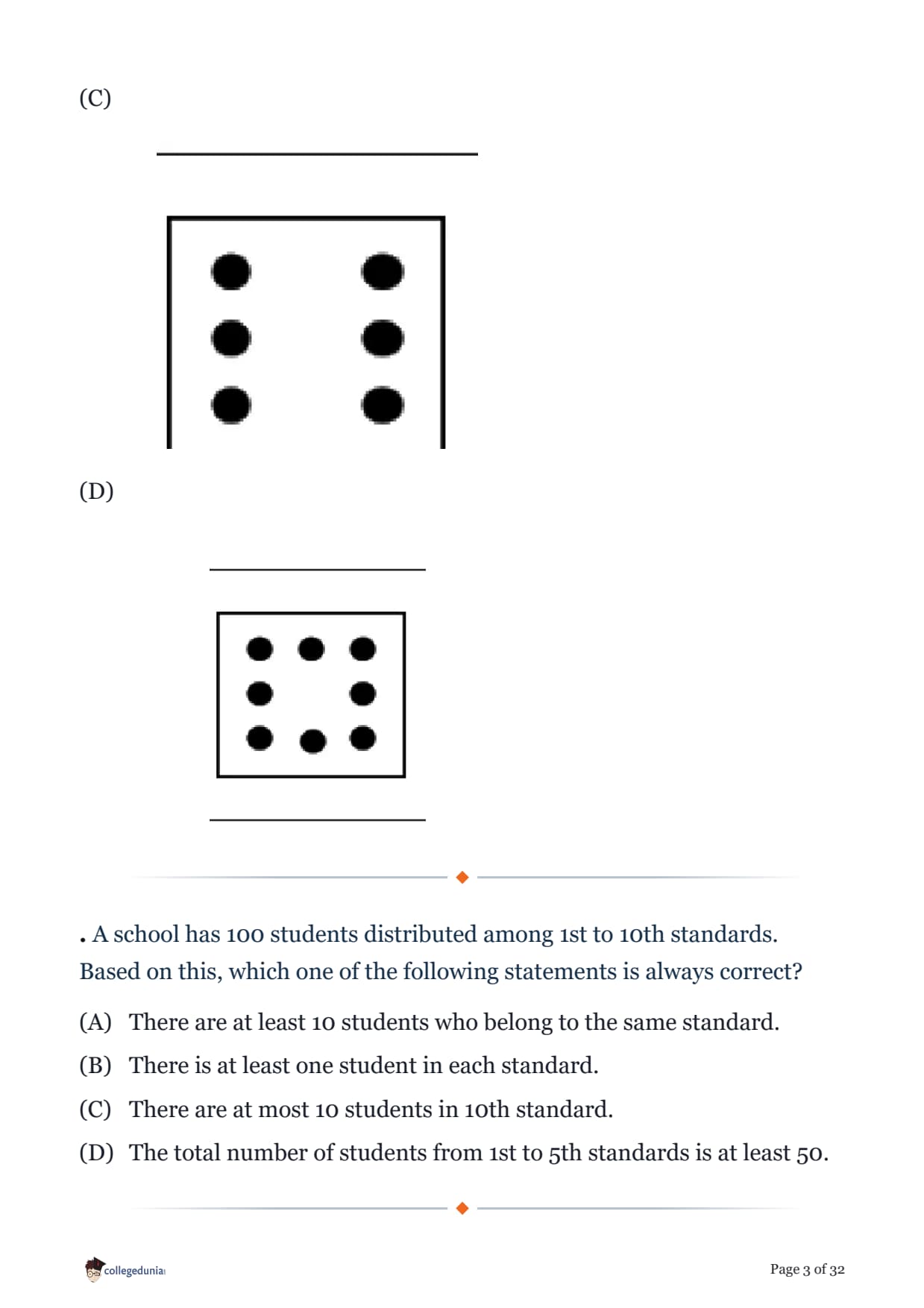
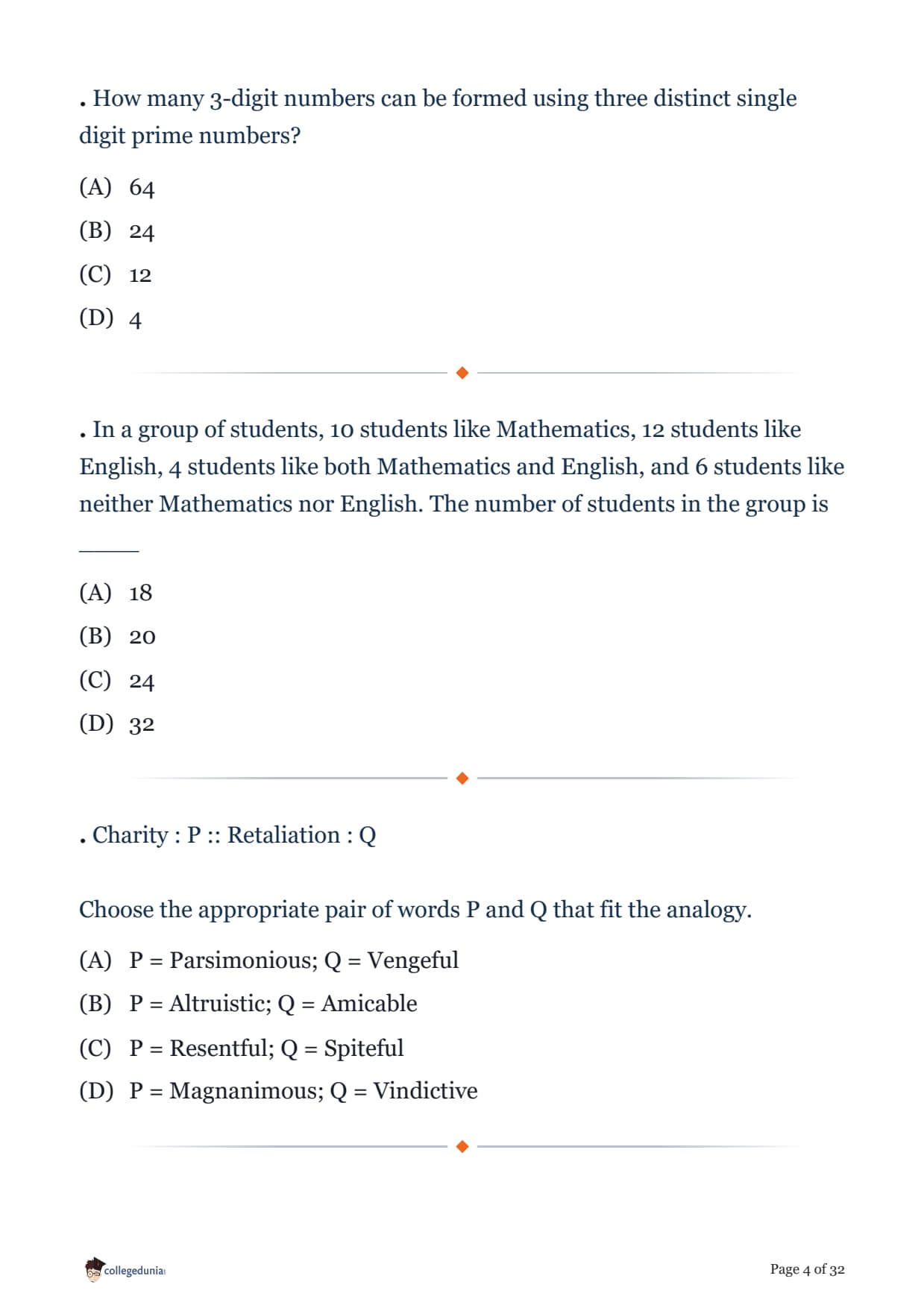
In the sequence of tiles shown below, the missing tile indicated by the question mark should be:

- (A)
![]()
- (B)
![]()
- (C)
![]()
- (D)
![]()


A school has 100 students distributed among 1st to 10th standards.
Based on this, which one of the following statements is always correct?
How many 3-digit numbers can be formed using three distinct single digit prime numbers?
In a group of students, 10 students like Mathematics, 12 students like English, 4 students like both Mathematics and English, and 6 students like neither Mathematics nor English. The number of students in the group is ____
Charity : P :: Retaliation : Q
Choose the appropriate pair of words P and Q that fit the analogy.
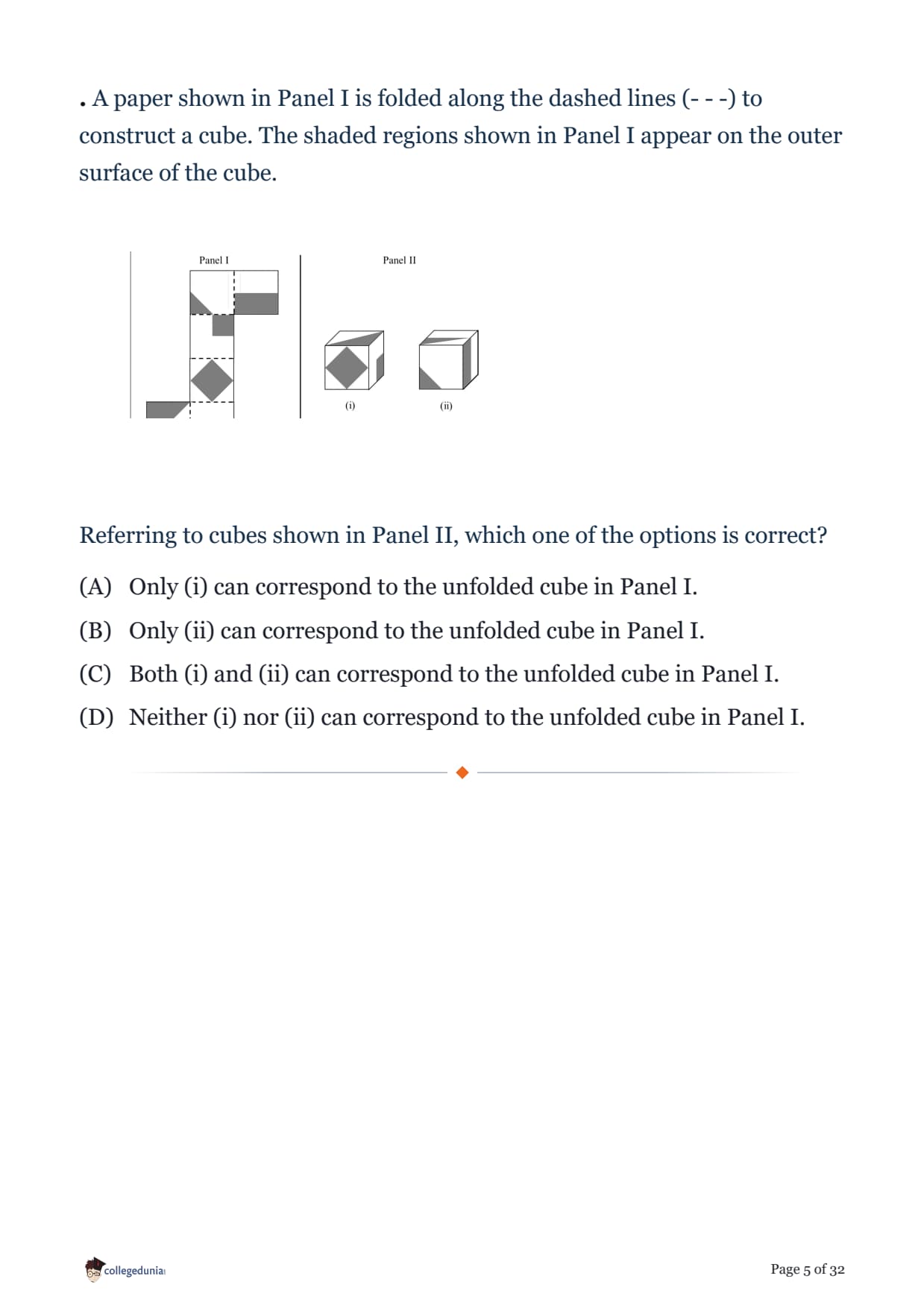
A paper shown in Panel I is folded along the dashed lines (- - -) to construct a cube. The shaded regions shown in Panel I appear on the outer surface of the cube.

Referring to cubes shown in Panel II, which one of the options is correct?
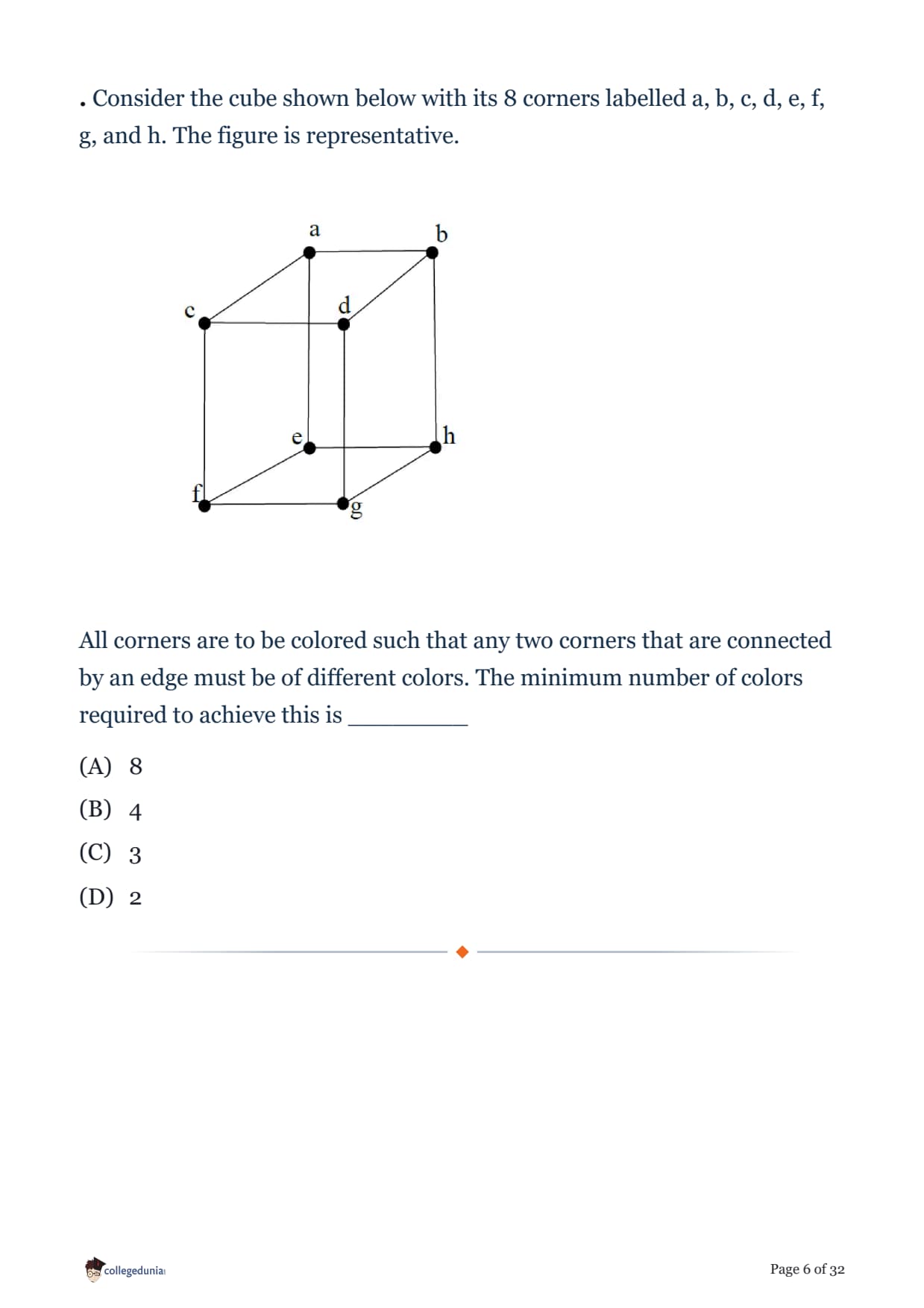
Consider the cube shown below with its 8 corners labelled a, b, c, d, e, f, g, and h. The figure is representative.

All corners are to be colored such that any two corners that are connected by an edge must be of different colors. The minimum number of colors required to achieve this is ________
Four hills H1, H2, H3, and H4 are present in an area. The following observations are made about them:
i. Neither H2 nor H3 is the easternmost hill.
ii. Neither H2 nor H3 is the westernmost hill.
iii. Neither the easternmost hill nor the westernmost hill is the southernmost hill.
iv. Two hills are located to the west of H2.
v. The southernmost hill has at least two hills to its east.
The southernmost hill is ________.
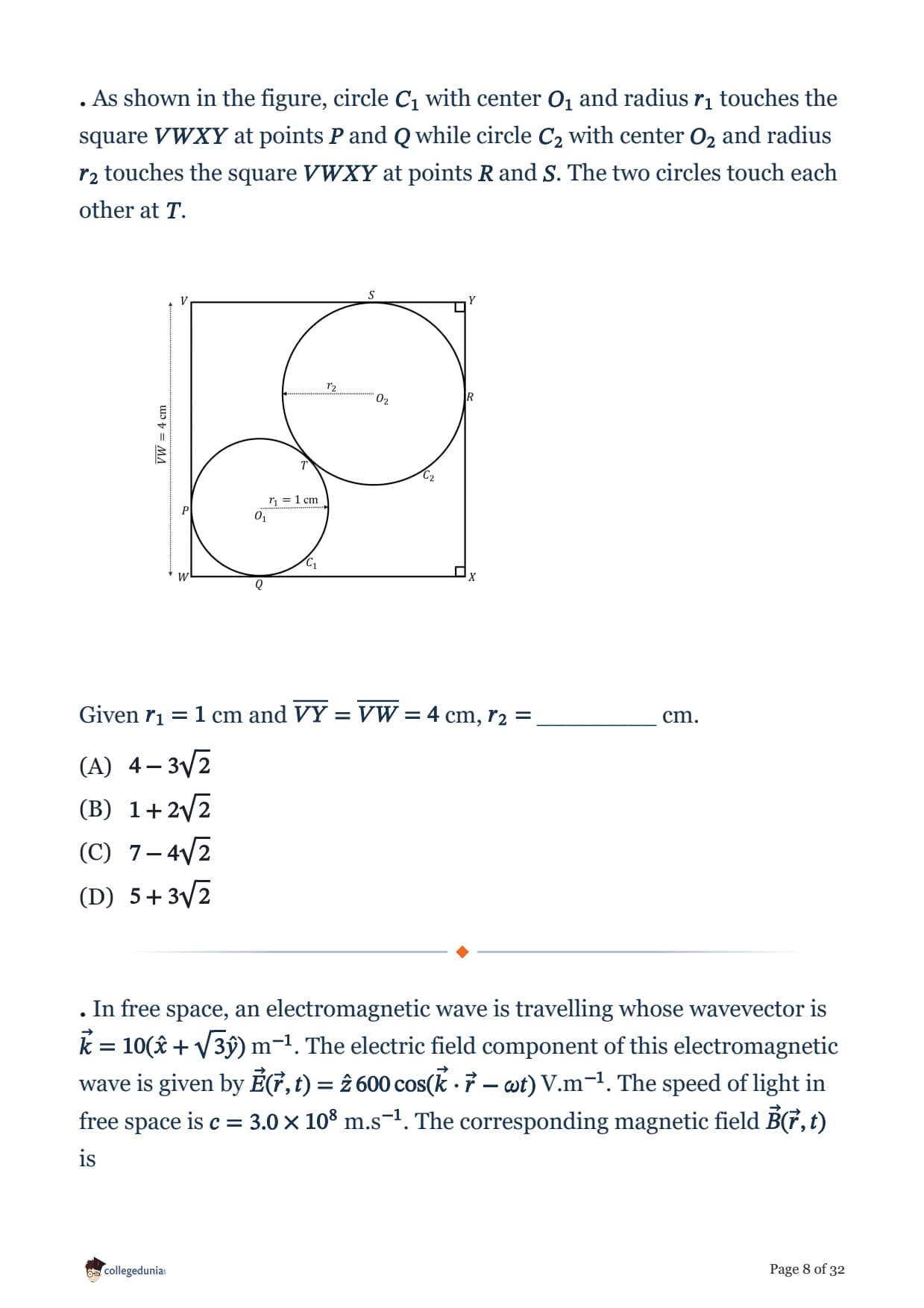
As shown in the figure, circle \(C_1\) with center \(O_1\) and radius \(r_1\) touches the square \(VWXY\) at points \(P\) and \(Q\) while circle \(C_2\) with center \(O_2\) and radius \(r_2\) touches the square \(VWXY\) at points \(R\) and \(S\). The two circles touch each other at \(T\).

Given \(r_1 = 1\) cm and \(\overline{VY} = \overline{VW} = 4\) cm, \(r_2 =\) ________ cm.
In free space, an electromagnetic wave is travelling whose wavevector is \(\vec{k} = 10(\hat{x} + \sqrt{3}\hat{y})\) m\(^{-1}\). The electric field component of this electromagnetic wave is given by \(\vec{E}(\vec{r},t) = \hat{z}\, 600\cos(\vec{k}\cdot\vec{r} - \omega t)\) V.m\(^{-1}\). The speed of light in free space is \(c = 3.0 \times 10^{8}\) m.s\(^{-1}\). The corresponding magnetic field \(\vec{B}(\vec{r},t)\) is
An infinitely large non-conducting thin sheet in the \(xy\) plane (\(z=0\)) carries a uniform surface charge density \(\sigma = 17.70\times10^{-12}\) C.m\(^{-2}\). The electric field in the region \(z < 0\) is \(\vec{E}_2 = \hat{x}+2\hat{y}+3\hat{z}\). Then, the electric field \(\vec{E}_1\) in the region \(z > 0\) will be (\(\epsilon_0 = 8.85\times10^{-12}\) C\(^2\).N\(^{-1}\).m\(^{-2}\))
Consider an operator \(\hat{A}\) which is not Hermitian. Find the possible values of \(c\) and \(d\) such that the operator \((c\hat{A} - d\hat{A}^{\dagger})\) is Hermitian.
For a scalar field \(\psi(\vec{r})\) and a vector field \(\vec{A}(\vec{r})\), \(\nabla\times(\vec{A}\,\psi)\) is equivalent to the expression
Which of the following options is correct for transformation of electric field \(\vec{E}\) and magnetic field \(\vec{B}\) under time reversal, i.e., \(t \to -t\)?
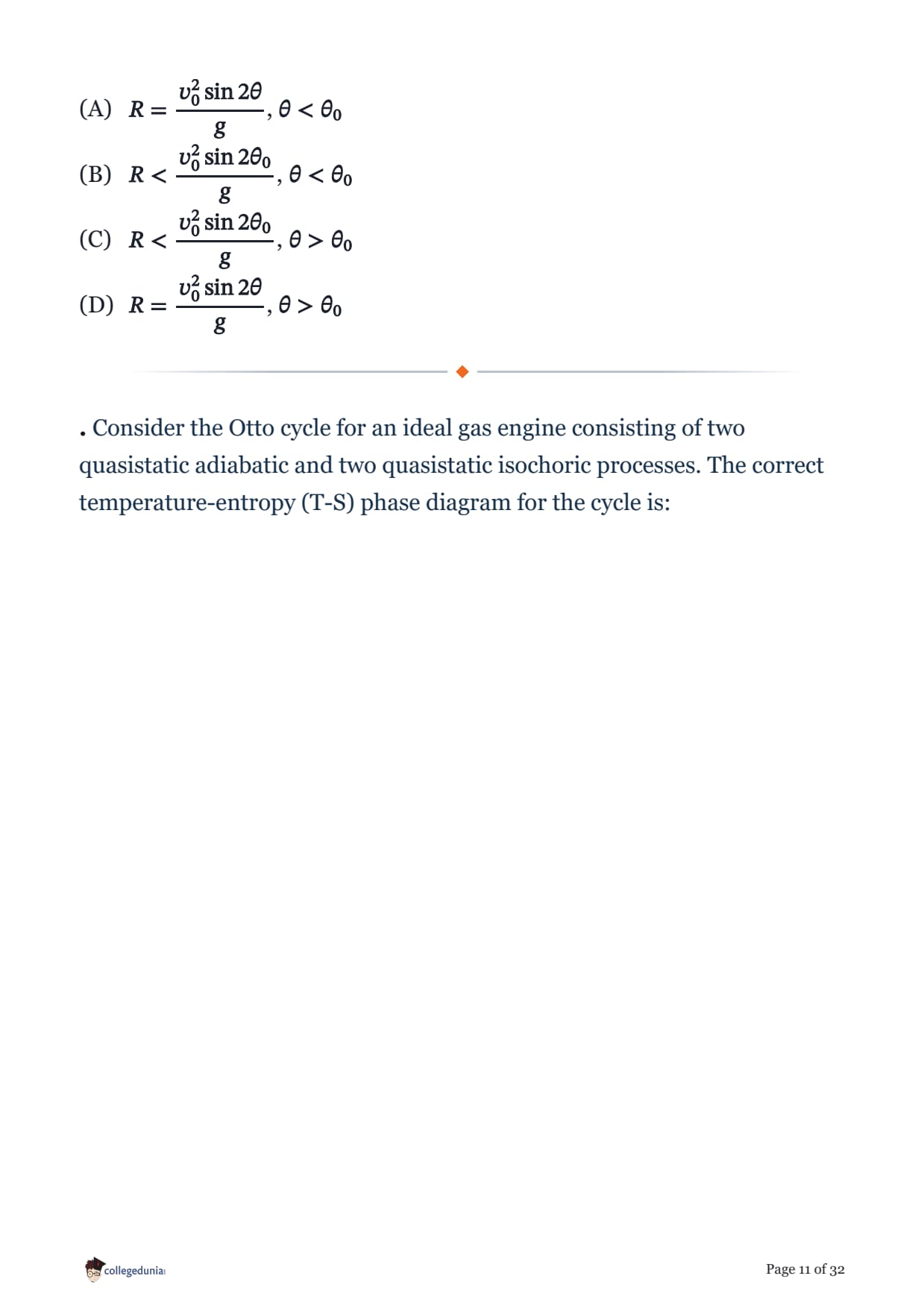
On a horizontal plane, a projectile of mass \(m\) is launched from the ground with speed \(v_0\) at an angle \(\theta_0\) with the horizontal. In addition to the gravitational force (\(mg\)), it also experiences a drag force \(\vec{F}_{drag} = -\gamma \vec{v}\), where \(\vec{v}\) is its velocity and \(\gamma\) is a constant. It hits the ground at a distance \(R\) from the point of launch with its velocity making an angle \(\theta\) with the horizontal, as shown schematically in the figure below.

Then which of the following options is correct?
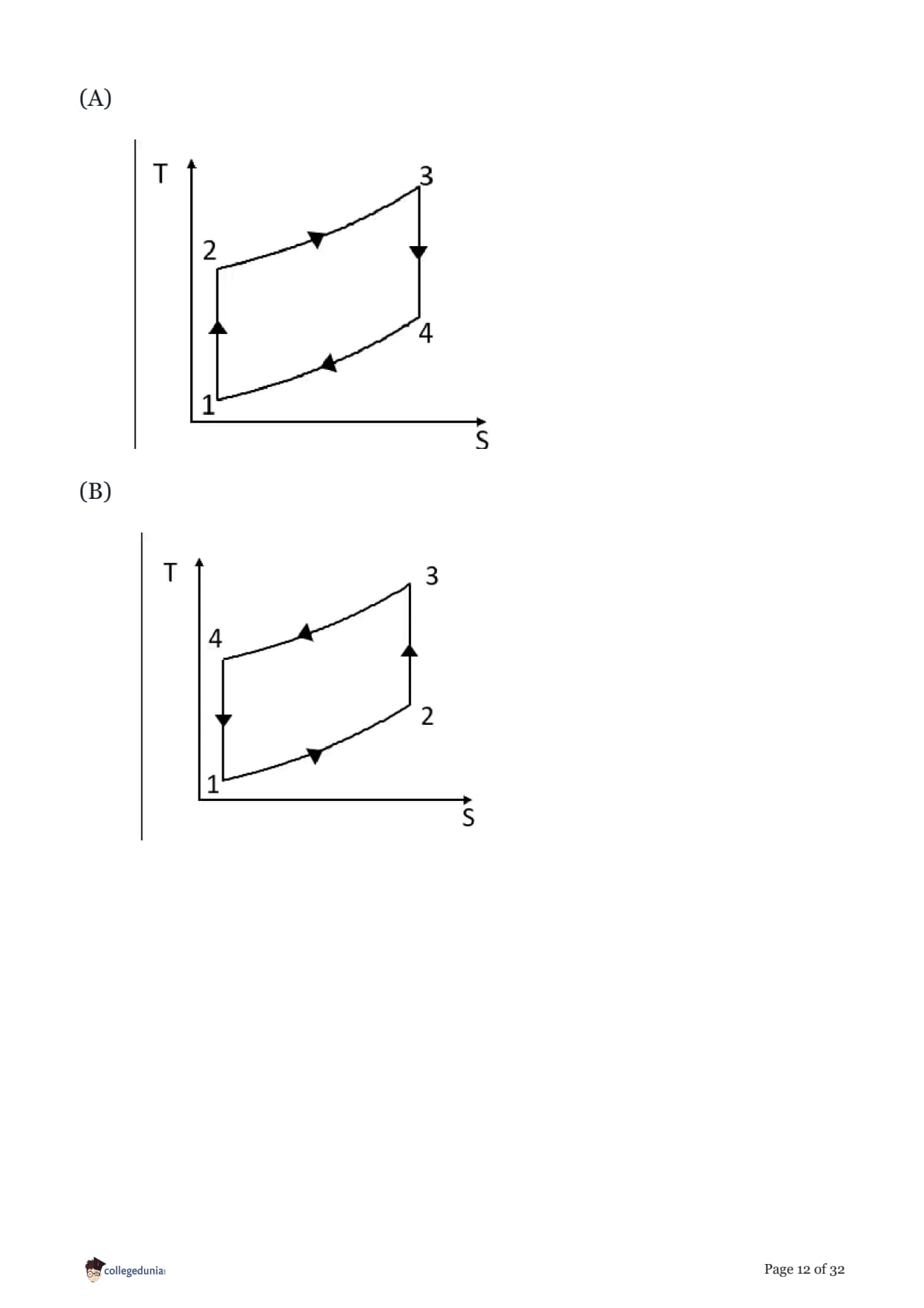
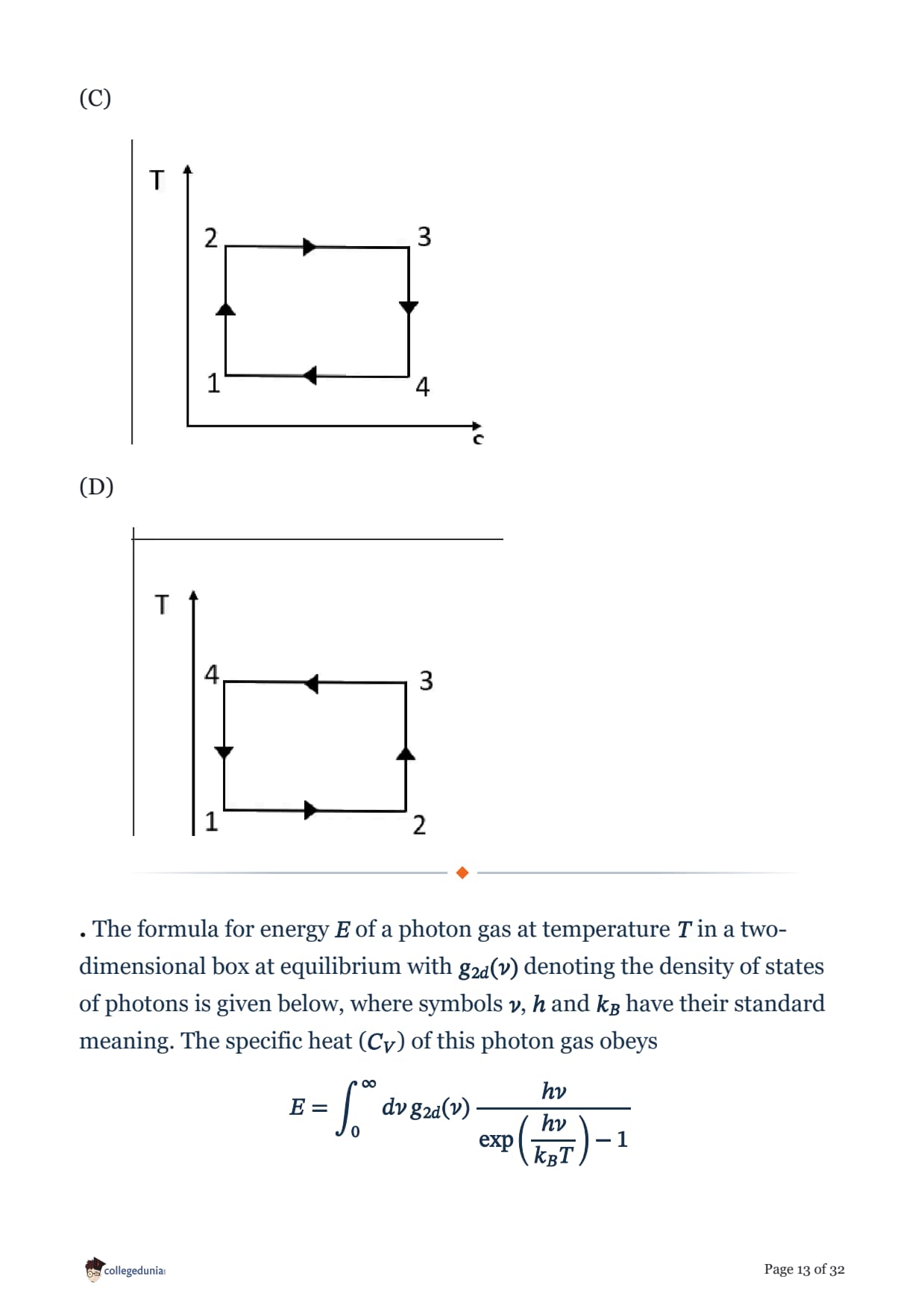
Consider the Otto cycle for an ideal gas engine consisting of two quasistatic adiabatic and two quasistatic isochoric processes. The correct temperature-entropy (T-S) phase diagram for the cycle is:
- (A)
![]()
- (B)
![]()
- (C)
![]()
- (D)
![]()


The formula for energy \(E\) of a photon gas at temperature \(T\) in a two-dimensional box at equilibrium with \(g_{2d}(\nu)\) denoting the density of states of photons is given below, where symbols \(\nu\), \(h\) and \(k_B\) have their standard meaning. The specific heat (\(C_V\)) of this photon gas obeys
\[ E = \int_0^{\infty} d\nu \, g_{2d}(\nu) \, \frac{h\nu}{\exp\left(\dfrac{h\nu}{k_B T}\right) - 1} \]
For the electric field of an electromagnetic wave given below, which of the following statements is correct?
\[ \vec{E} = \hat{x}\, E_0 \cos(\omega t) + \hat{y}\, 2E_0 \cos\left(\omega t + \frac{\pi}{2}\right) \]
A gas of non-interacting \(^4\text{He}\) atoms (of mass \(m\)) is in a three-dimensional trap whose energy levels can be approximated by those of a harmonic oscillator potential \(V(x,y,z) = \dfrac{1}{2} m \omega^2 (x^2+y^2+z^2)\). The chemical potential of the gas at \(T=0\) K is
Given \( |v_1\rangle = \dfrac{1}{\sqrt{2}}\begin{pmatrix} 1 \\ i \end{pmatrix} \) and \( |v_2\rangle = \dfrac{1}{\sqrt{2}}\begin{pmatrix} 1 \\ -i \end{pmatrix} \), the tensor product \( |v_1\rangle \otimes |v_2\rangle \) is
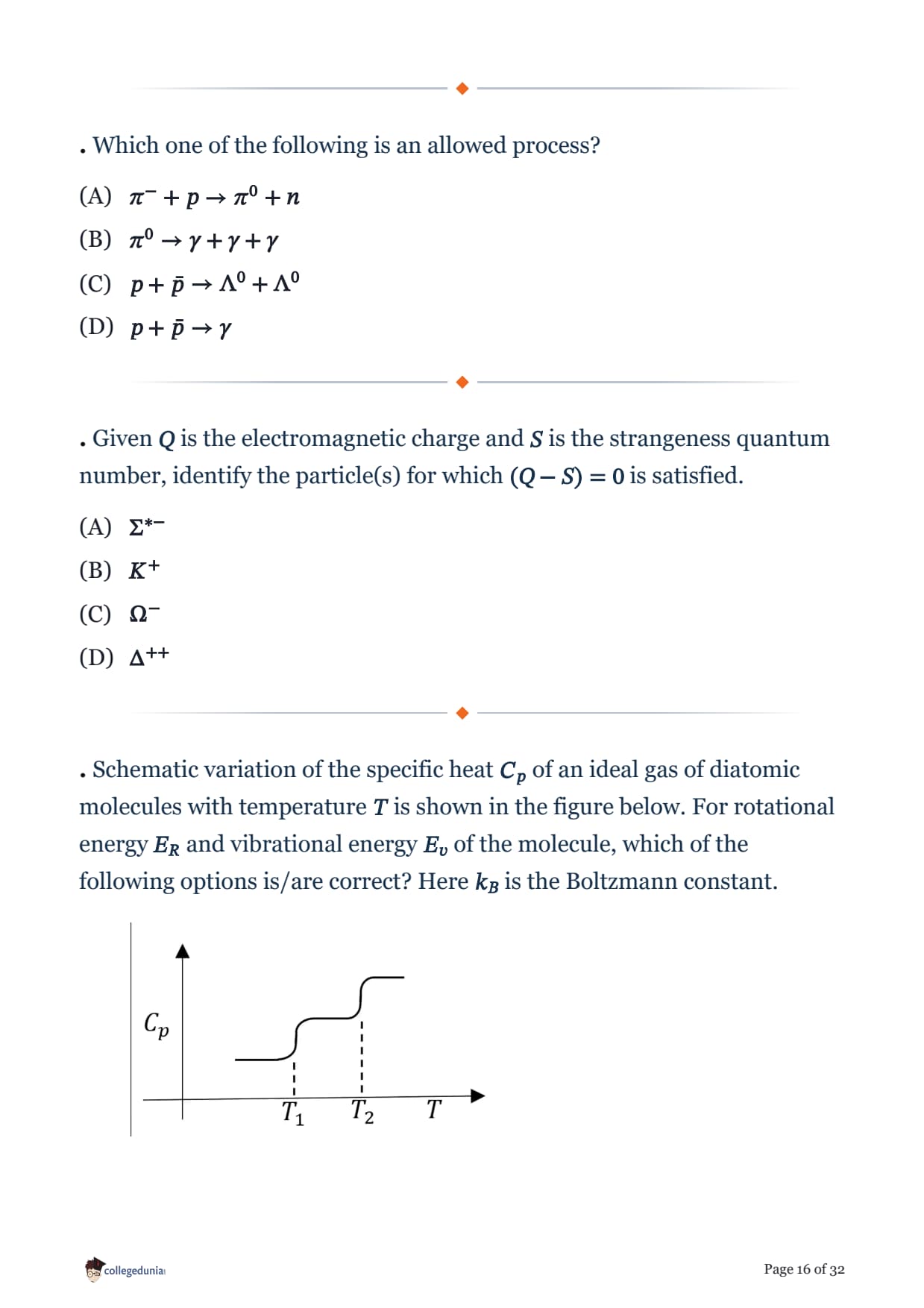
Sketch of a two-dimensional vector field \(\vec{V}\) is shown below. Here, length and arrow head of the arrows denote magnitude and direction of the vector field, respectively.

Which of the following statements is correct for \( \nabla \times \vec{V} \)?
Which one of the following is an allowed process?
Given \(Q\) is the electromagnetic charge and \(S\) is the strangeness quantum number, identify the particle(s) for which \((Q - S) = 0\) is satisfied.
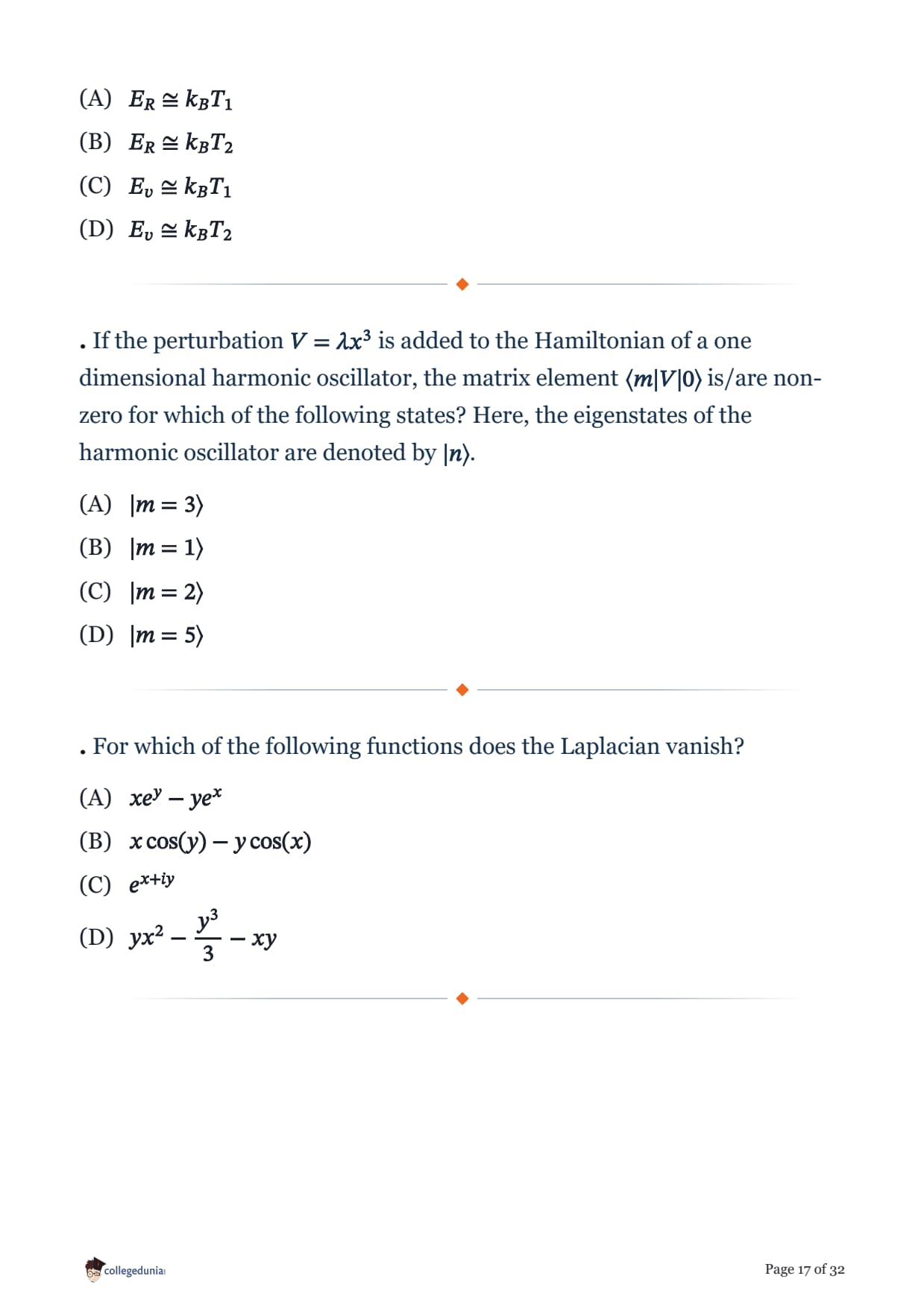
Schematic variation of the specific heat \(C_p\) of an ideal gas of diatomic molecules with temperature \(T\) is shown in the figure below. For rotational energy \(E_R\) and vibrational energy \(E_v\) of the molecule, which of the following options is/are correct? Here \(k_B\) is the Boltzmann constant.

If the perturbation \(V = \lambda x^3\) is added to the Hamiltonian of a one dimensional harmonic oscillator, the matrix element \(\langle m|V|0\rangle\) is/are non-zero for which of the following states? Here, the eigenstates of the harmonic oscillator are denoted by \(|n\rangle\).
For which of the following functions does the Laplacian vanish?
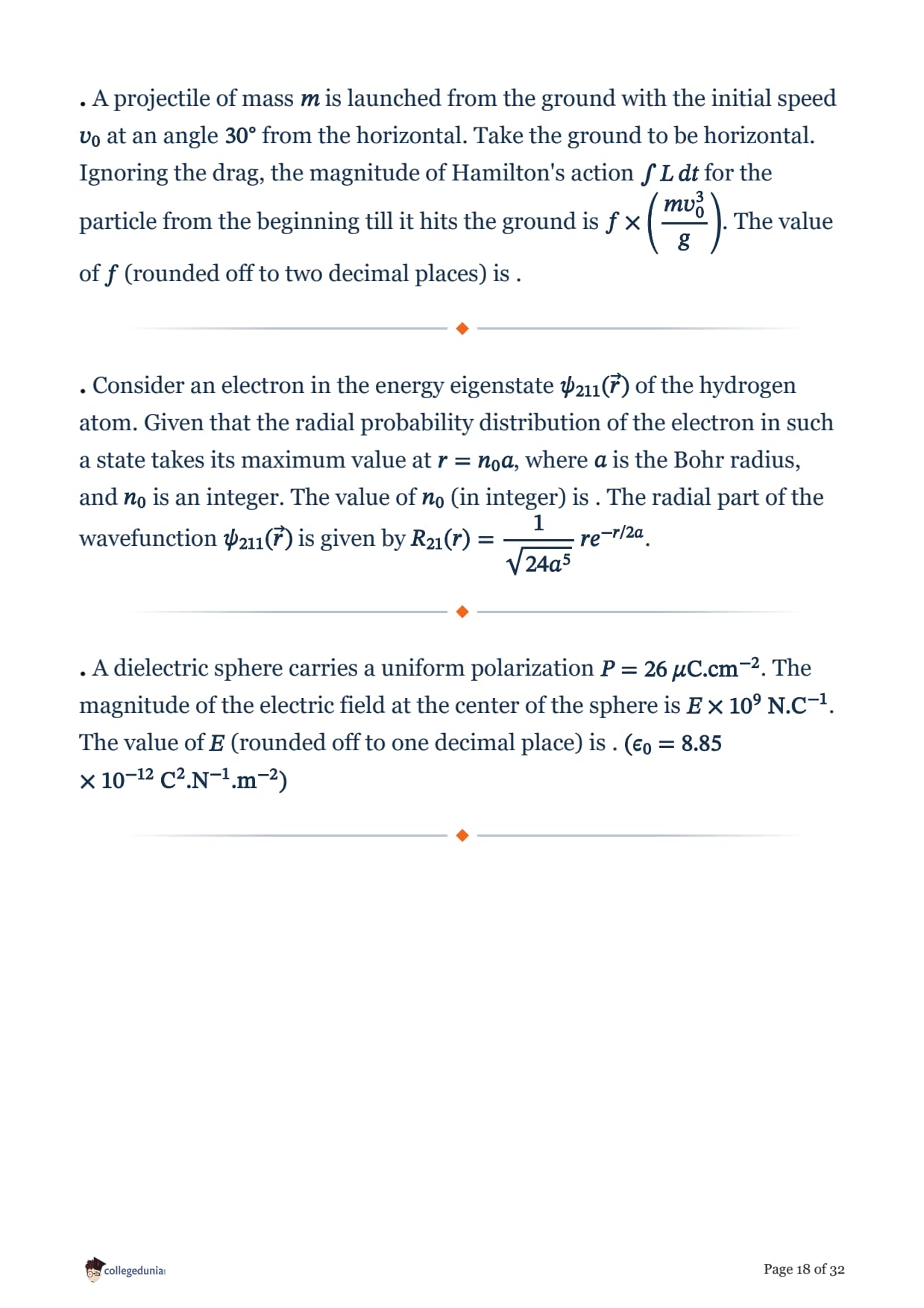
A projectile of mass \(m\) is launched from the ground with the initial speed \(v_0\) at an angle \(30^{\circ}\) from the horizontal. Take the ground to be horizontal. Ignoring the drag, the magnitude of Hamilton's action \(\int L\,dt\) for the particle from the beginning till it hits the ground is \(f \times \left(\dfrac{mv_0^{3}}{g}\right)\). The value of \(f\) (rounded off to two decimal places) is .
Consider an electron in the energy eigenstate \(\psi_{211}(\vec{r})\) of the hydrogen atom. Given that the radial probability distribution of the electron in such a state takes its maximum value at \(r = n_0 a\), where \(a\) is the Bohr radius, and \(n_0\) is an integer. The value of \(n_0\) (in integer) is . The radial part of the wavefunction \(\psi_{211}(\vec{r})\) is given by \(R_{21}(r) = \dfrac{1}{\sqrt{24a^{5}}}\,re^{-r/2a}\).
A dielectric sphere carries a uniform polarization \(P = 26\ \mu\text{C}.\text{cm}^{-2}\). The magnitude of the electric field at the center of the sphere is \(E \times 10^{9}\ \text{N}.\text{C}^{-1}\). The value of \(E\) (rounded off to one decimal place) is . \((\epsilon_0 = 8.85 \times 10^{-12}\ \text{C}^{2}.\text{N}^{-1}.\text{m}^{-2})\)
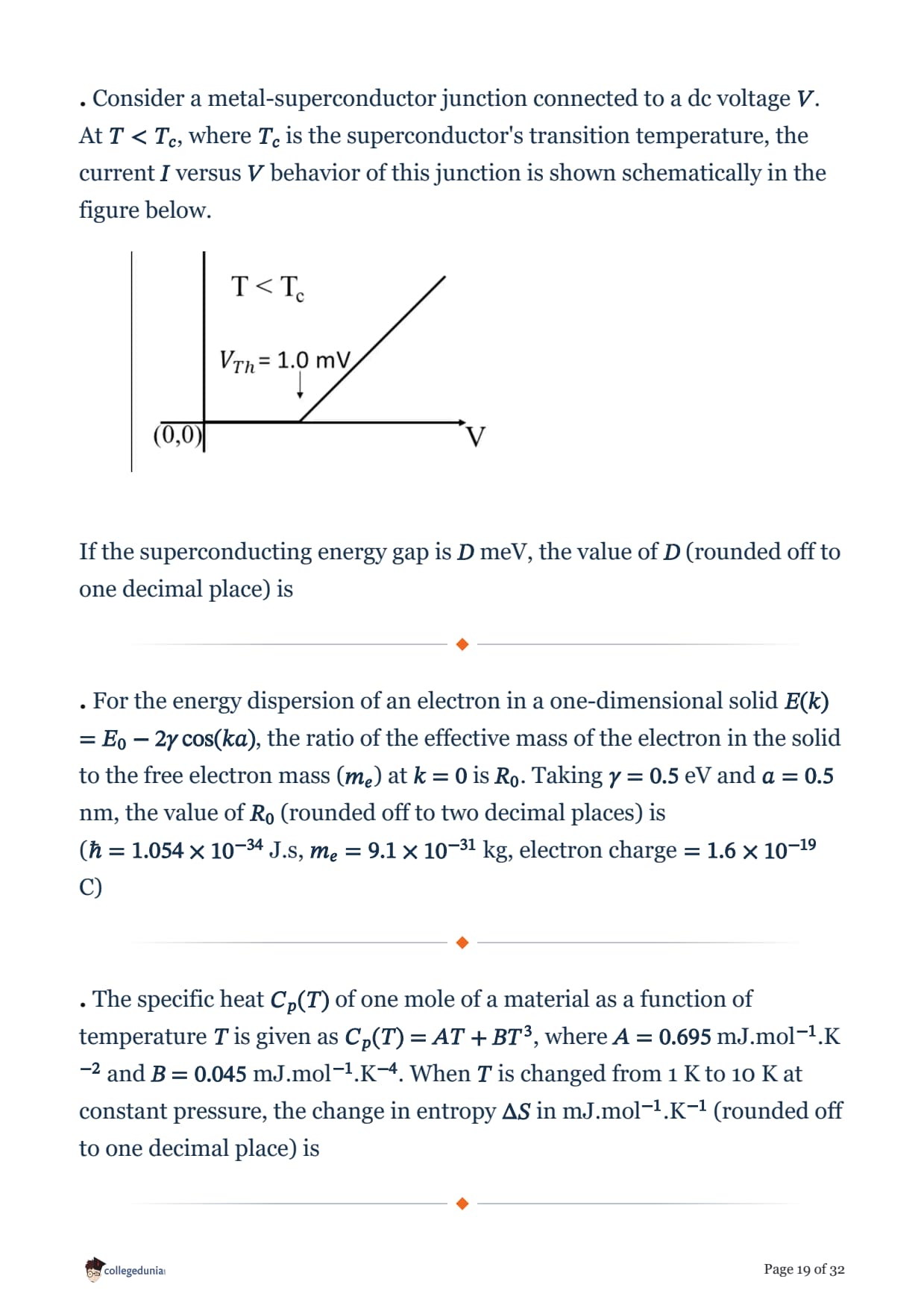
Consider a metal-superconductor junction connected to a dc voltage \(V\). At \(T < T_c\), where \(T_c\) is the superconductor's transition temperature, the current \(I\) versus \(V\) behavior of this junction is shown schematically in the figure below.

If the superconducting energy gap is \(D\) meV, the value of \(D\) (rounded off to one decimal place) is
For the energy dispersion of an electron in a one-dimensional solid \(E(k) = E_0 - 2\gamma \cos(ka)\), the ratio of the effective mass of the electron in the solid to the free electron mass (\(m_e\)) at \(k = 0\) is \(R_0\). Taking \(\gamma = 0.5\) eV and \(a = 0.5\) nm, the value of \(R_0\) (rounded off to two decimal places) is
(\(\hbar = 1.054 \times 10^{-34}\) J.s, \(m_e = 9.1 \times 10^{-31}\) kg, electron charge \(= 1.6 \times 10^{-19}\) C)
The specific heat \(C_p(T)\) of one mole of a material as a function of temperature \(T\) is given as \(C_p(T) = AT + BT^3\), where \(A = 0.695\) mJ.mol\(^{-1}\).K\(^{-2}\) and \(B = 0.045\) mJ.mol\(^{-1}\).K\(^{-4}\). When \(T\) is changed from 1 K to 10 K at constant pressure, the change in entropy \(\Delta S\) in mJ.mol\(^{-1}\).K\(^{-1}\) (rounded off to one decimal place) is
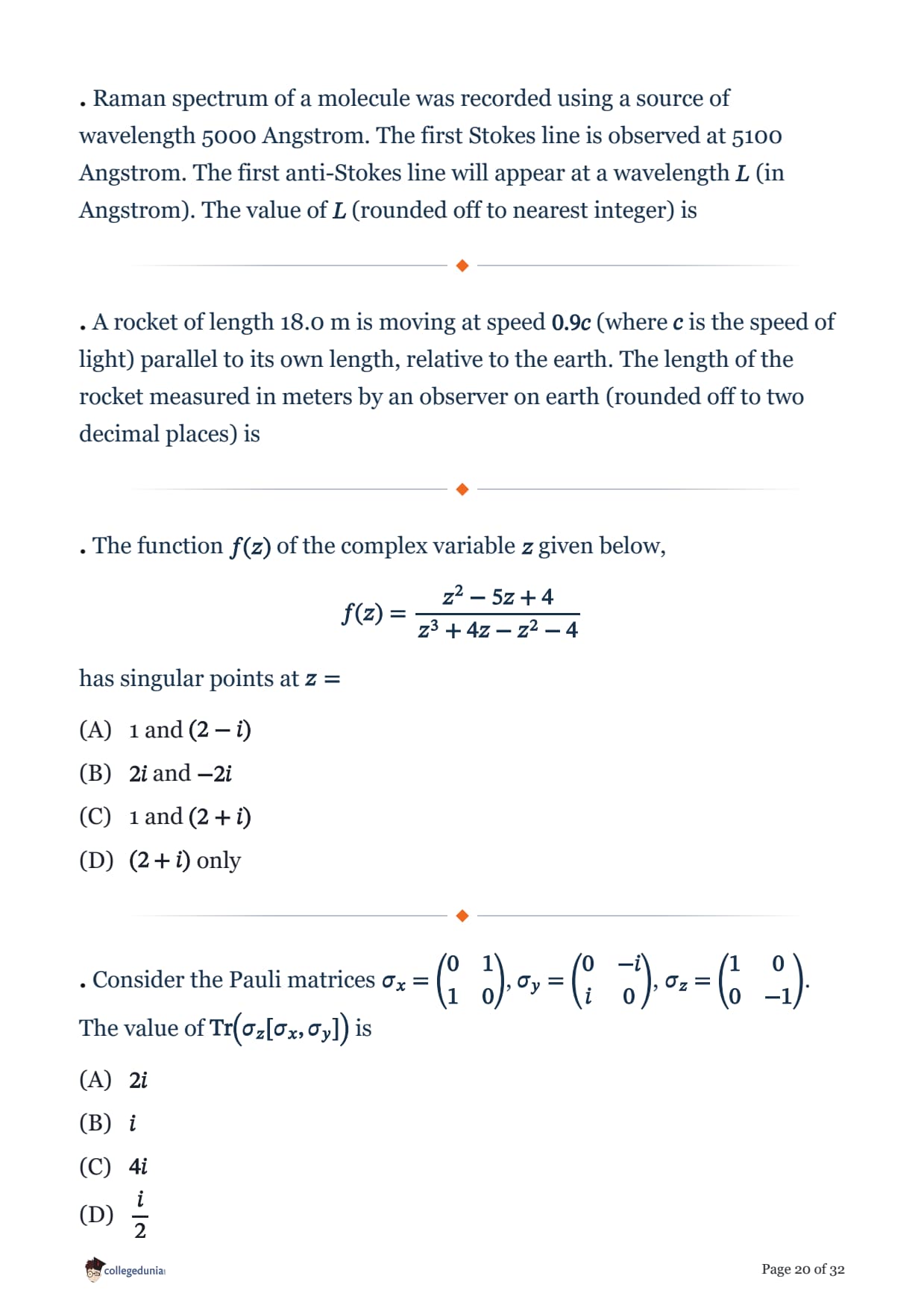
Raman spectrum of a molecule was recorded using a source of wavelength 5000 Angstrom. The first Stokes line is observed at 5100 Angstrom. The first anti-Stokes line will appear at a wavelength \(L\) (in Angstrom). The value of \(L\) (rounded off to nearest integer) is
A rocket of length 18.0 m is moving at speed \(0.9c\) (where \(c\) is the speed of light) parallel to its own length, relative to the earth. The length of the rocket measured in meters by an observer on earth (rounded off to two decimal places) is
The function \(f(z)\) of the complex variable \(z\) given below,\[ f(z) = \dfrac{z^{2} - 5z + 4}{z^{3} + 4z - z^{2} - 4} \]has singular points at \(z =\)
Consider the Pauli matrices \(\sigma_x = \begin{pmatrix} 0 & 1 \\ 1 & 0 \end{pmatrix}\), \(\sigma_y = \begin{pmatrix} 0 & -i \\ i & 0 \end{pmatrix}\), \(\sigma_z = \begin{pmatrix} 1 & 0 \\ 0 & -1 \end{pmatrix}\).
The value of \(\text{Tr}\big(\sigma_z [\sigma_x, \sigma_y]\big)\) is
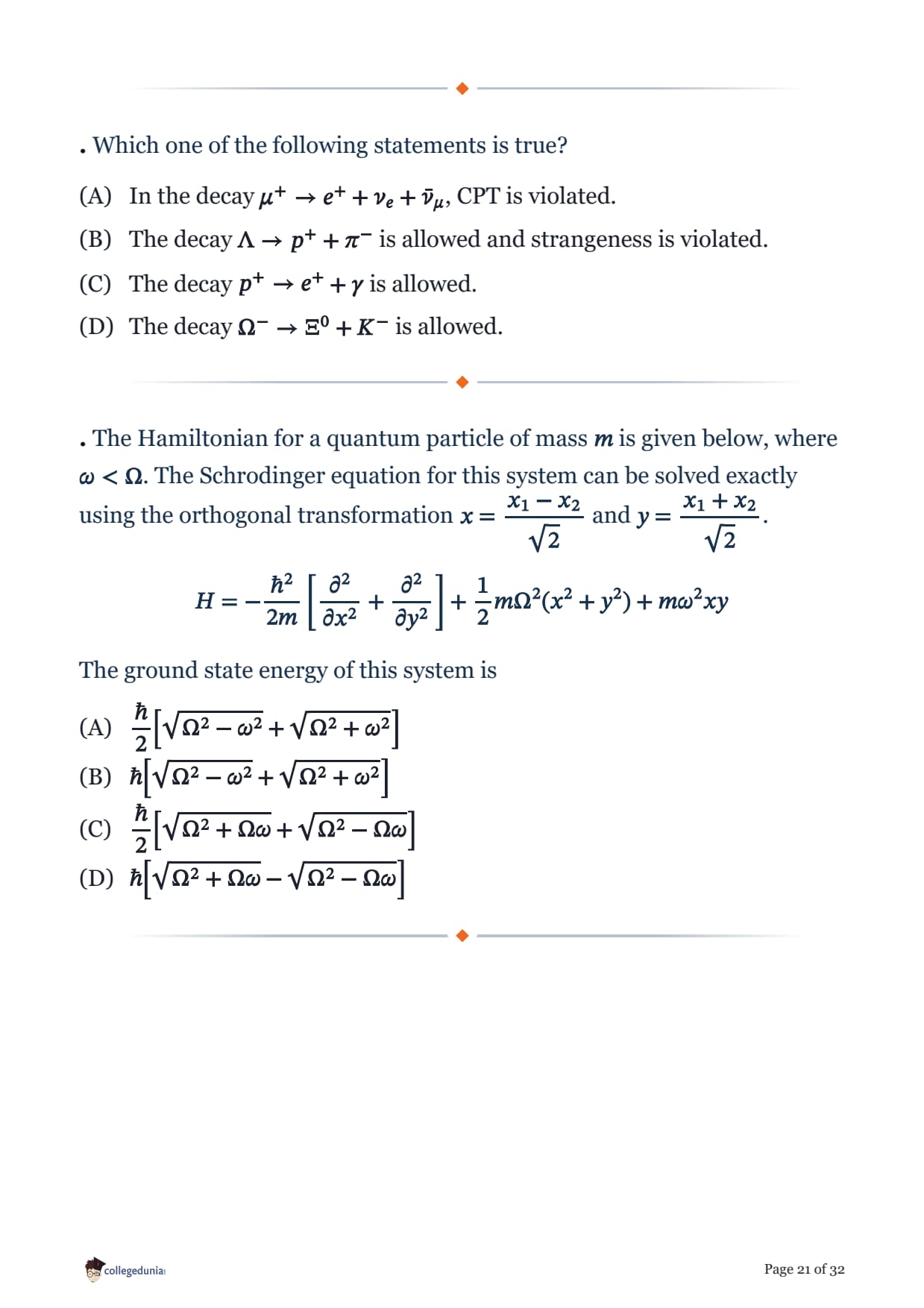
Which one of the following statements is true?
The Hamiltonian for a quantum particle of mass \(m\) is given below, where \(\omega < \Omega\). The Schrodinger equation for this system can be solved exactly using the orthogonal transformation \(x = \dfrac{x_1 - x_2}{\sqrt2}\) and \(y = \dfrac{x_1+x_2}{\sqrt2}\).
\[ H = -\dfrac{\hbar^2}{2m}\left[\dfrac{\partial^2}{\partial x^2} + \dfrac{\partial^2}{\partial y^2}\right] + \dfrac12 m\Omega^2(x^2+y^2) + m\omega^2 xy \]The ground state energy of this system is
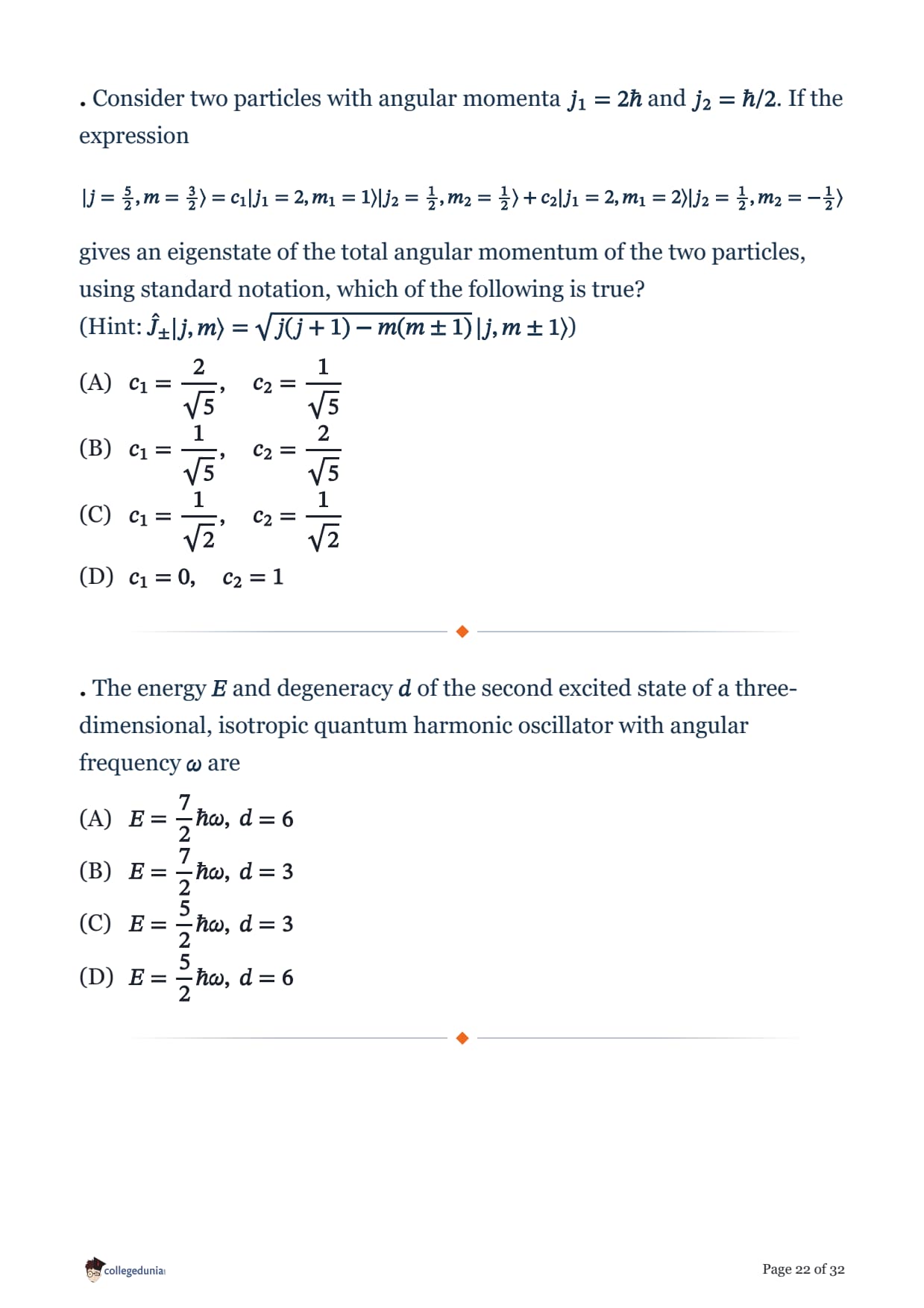
Consider two particles with angular momenta \(j_1 = 2\hbar\) and \(j_2 = \hbar/2\). If the expression
\[ |j=\tfrac52, m=\tfrac32\rangle = c_1|j_1=2,m_1=1\rangle|j_2=\tfrac12,m_2=\tfrac12\rangle + c_2|j_1=2,m_1=2\rangle|j_2=\tfrac12,m_2=-\tfrac12\rangle \]gives an eigenstate of the total angular momentum of the two particles, using standard notation, which of the following is true?
(Hint: \(\hat J_{\pm}|j,m\rangle = \sqrt{j(j+1)-m(m\pm1)}\,|j,m\pm1\rangle\))
The energy \(E\) and degeneracy \(d\) of the second excited state of a three-dimensional, isotropic quantum harmonic oscillator with angular frequency \(\omega\) are
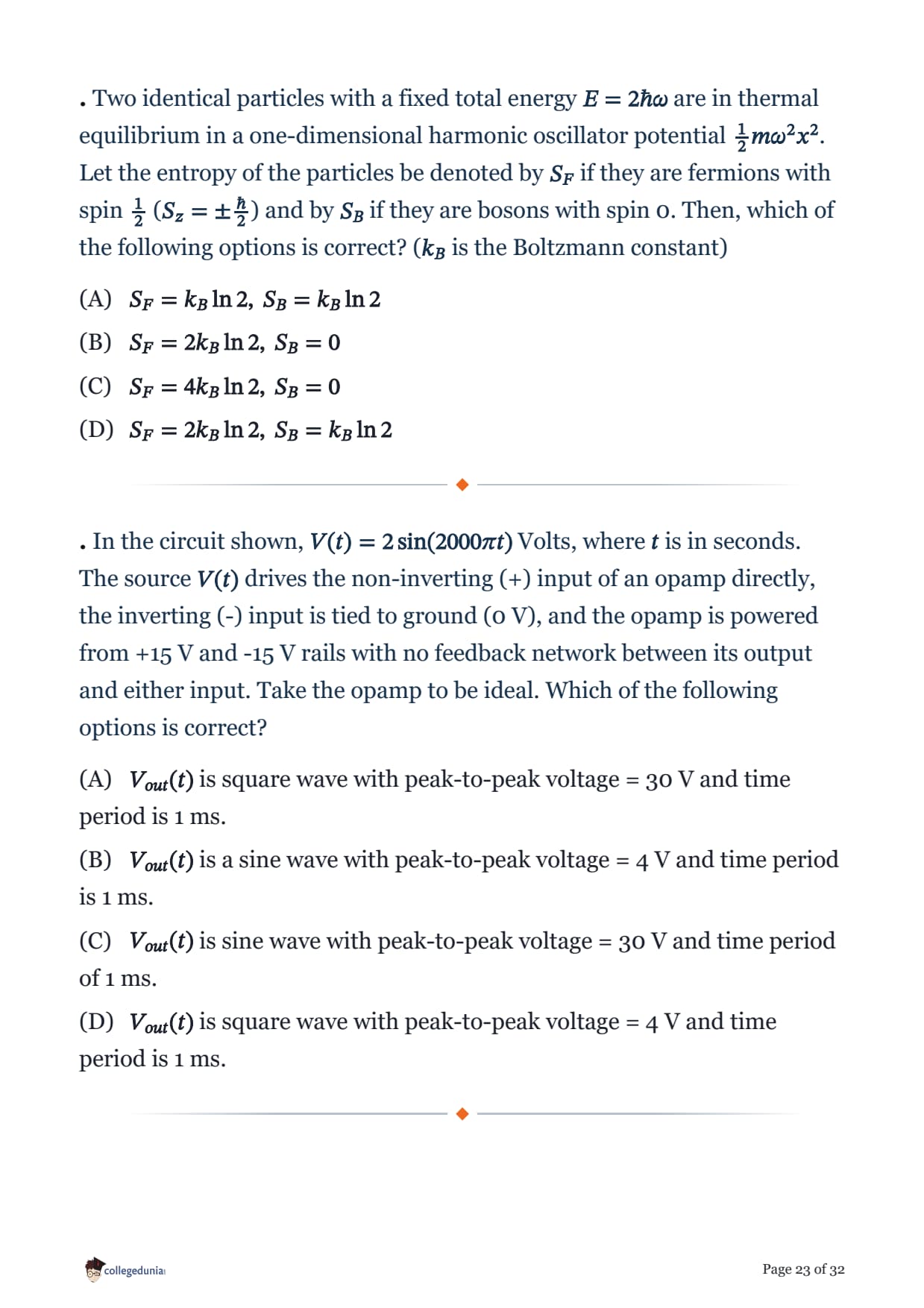
Two identical particles with a fixed total energy \(E = 2\hbar\omega\) are in thermal equilibrium in a one-dimensional harmonic oscillator potential \(\frac{1}{2}m\omega^2x^2\). Let the entropy of the particles be denoted by \(S_F\) if they are fermions with spin \(\frac{1}{2}\) (\(S_z = \pm\frac{\hbar}{2}\)) and by \(S_B\) if they are bosons with spin 0. Then, which of the following options is correct? (\(k_B\) is the Boltzmann constant)
In the circuit shown, \(V(t) = 2\sin(2000\pi t)\) Volts, where \(t\) is in seconds. The source \(V(t)\) drives the non-inverting (+) input of an opamp directly, the inverting (-) input is tied to ground (0 V), and the opamp is powered from +15 V and -15 V rails with no feedback network between its output and either input. Take the opamp to be ideal. Which of the following options is correct?

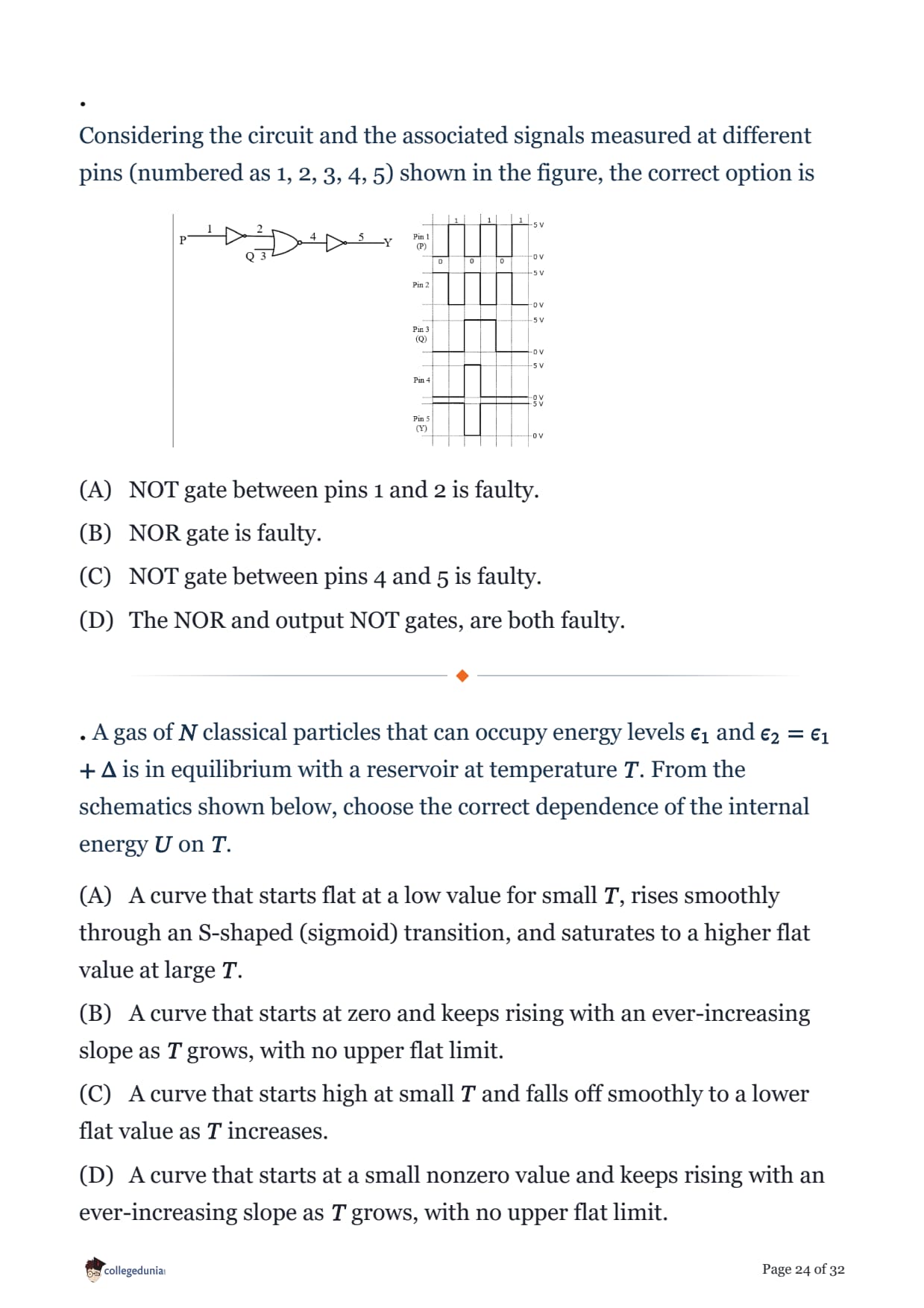
A gas of \(N\) classical particles that can occupy energy levels \(\epsilon_1\) and \(\epsilon_2 = \epsilon_1+\Delta\) is in equilibrium with a reservoir at temperature \(T\). From the schematics shown below, choose the correct dependence of the internal energy \(U\) on \(T\).
The Lagrangian \(L_0 = \frac{1}{2}m\dot{q}^2 - \frac{1}{2}m\omega^2q^2\) with the generalized coordinate \(q\) is transformed to \(L = L_0 + \alpha \frac{df(q)}{dt}\). Consider the following statements:
(i) Expression for the canonical momentum does not change.
(ii) The equation of motion does not change.
Which of the following options is correct for the above statements?
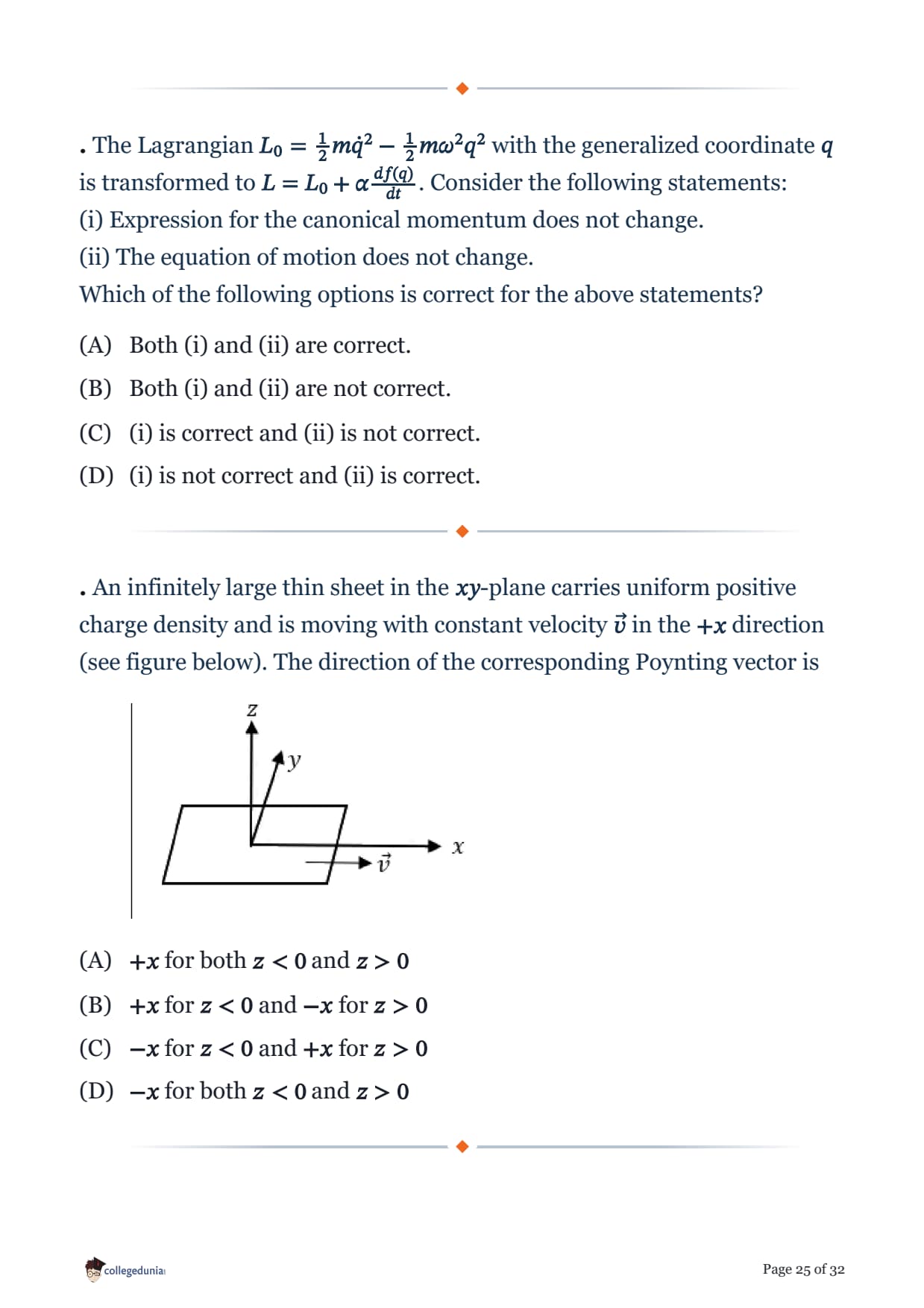
An infinitely large thin sheet in the \(xy\)-plane carries uniform positive charge density and is moving with constant velocity \(\vec{v}\) in the \(+x\) direction (see figure below). The direction of the corresponding Poynting vector is

A positive point charge is fixed at the origin. At some distance from it on the \(x\) axis, a point dipole is kept pointing in the \(+y\) direction. The force on the dipole is
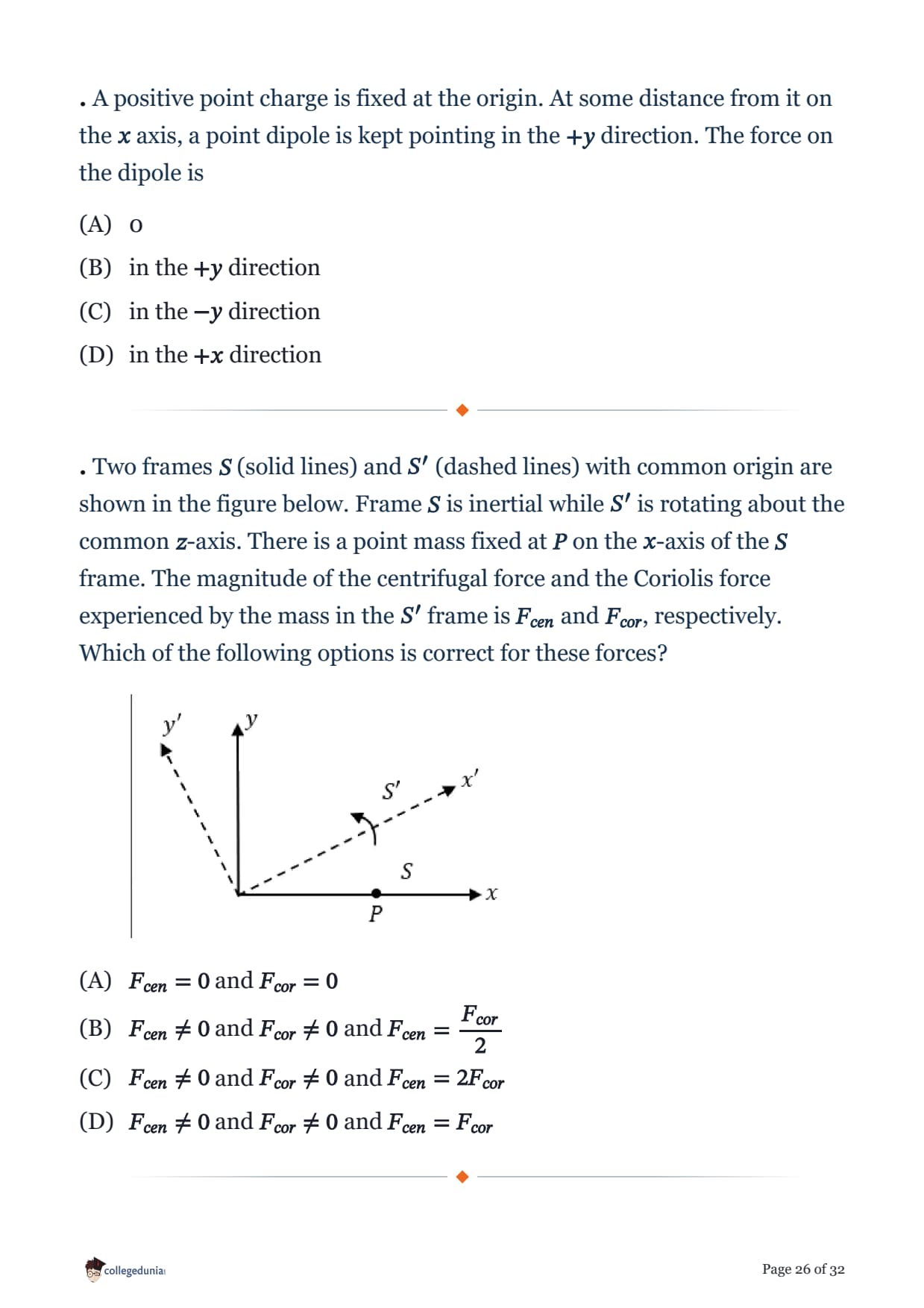
Two frames \(S\) (solid lines) and \(S'\) (dashed lines) with common origin are shown in the figure below. Frame \(S\) is inertial while \(S'\) is rotating about the common \(z\)-axis. There is a point mass fixed at \(P\) on the \(x\)-axis of the \(S\) frame. The magnitude of the centrifugal force and the Coriolis force experienced by the mass in the \(S'\) frame is \(F_{cen}\) and \(F_{cor}\), respectively. Which of the following options is correct for these forces?

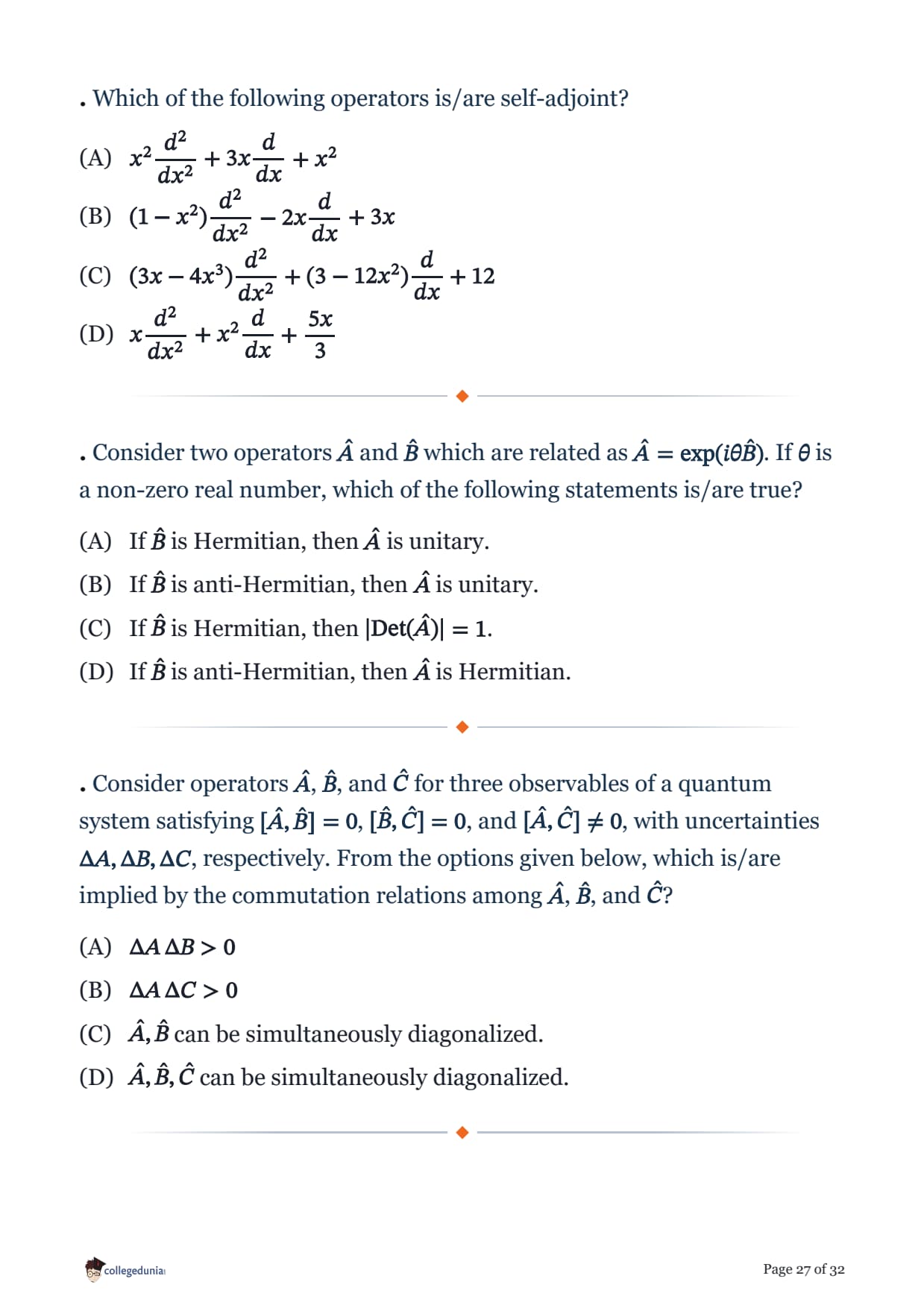
Which of the following operators is/are self-adjoint?
Consider two operators \(\hat{A}\) and \(\hat{B}\) which are related as \(\hat{A} = \exp(i\theta \hat{B})\). If \(\theta\) is a non-zero real number, which of the following statements is/are true?
Consider operators \(\hat{A}\), \(\hat{B}\), and \(\hat{C}\) for three observables of a quantum system satisfying \([\hat{A},\hat{B}] = 0\), \([\hat{B},\hat{C}] = 0\), and \([\hat{A},\hat{C}] \neq 0\), with uncertainties \(\Delta A, \Delta B, \Delta C\), respectively. From the options given below, which is/are implied by the commutation relations among \(\hat{A}\), \(\hat{B}\), and \(\hat{C}\)?
Consider the distribution of outcomes generated by \(N\) (\(N \gg 1\)) independent throws of (i) a coin or (ii) a six-sided dice. A coin (dice) is unbiased if both (all) its sides have equal probability to show up in a throw; it is biased otherwise. For the cases (i) and (ii) above, which of the following statements is/are true?
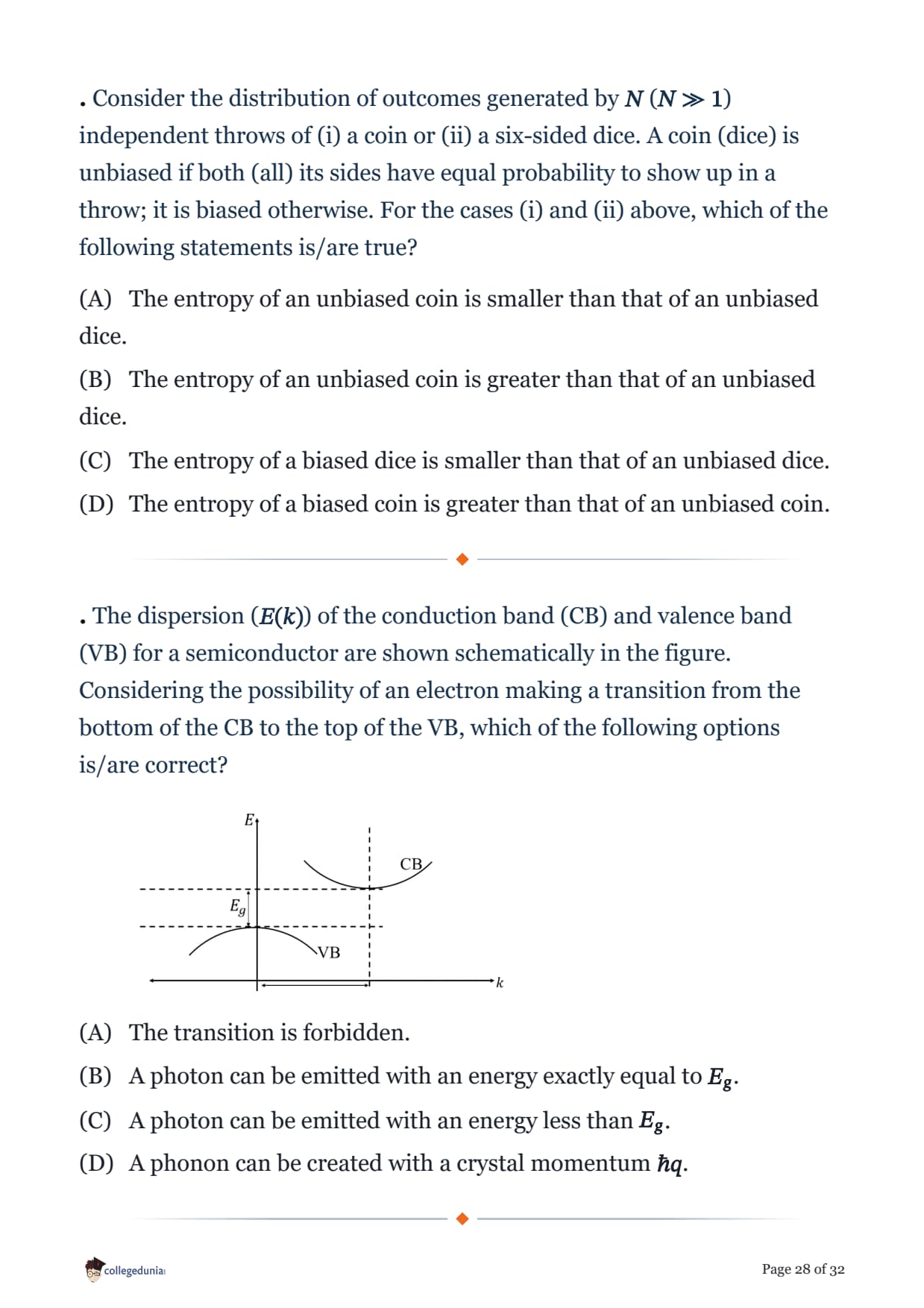
The dispersion (\(E(k)\)) of the conduction band (CB) and valence band (VB) for a semiconductor are shown schematically in the figure. Considering the possibility of an electron making a transition from the bottom of the CB to the top of the VB, which of the following options is/are correct?

A symmetric rigid body has moment of inertia \(I_1, I_2, I_3\) about its principal axes 1, 2, and 3, respectively, with \(I_1 = I_3 = I_\perp\) and \(I_2 \neq I_\perp\). It is rotating in space with no torque on it so that its angular momentum \(\vec{L}\) is constant. Let \(\omega_1, \omega_2, \omega_3\) be the components of its angular velocity along the principal axes 1, 2, and 3, respectively. Which of the following quantities is/are constant during the motion of this rigid body?
An alpha particle moves towards a fixed nucleus carrying charge \(Ze\), with initial speed \(v_0\) and impact parameter \(b\). Starting from a large distance from the nucleus, its distance of closest approach is \(r_m\) and its speed there is \(v_m\). Then which of the following options is correct?
Consider a particle of mass \(m = 9.0 \times 10^{-5}\) kg and charge \(q = 3.0 \times 10^{-4}\) C in a uniform electromagnetic field \(\vec{E} = 2\,\hat{x}\) V.m\(^{-1}\), \(\vec{B} = 3\,\hat{z}\) V.m\(^{-2}\).s. The particle is released from the coordinates \((0, 5\text{ m}, 0)\) at time \(t = 0\). Starting from initial speed zero, it comes back to the \(y\)-axis for the first time at time \(t\). The value of \(t\) in seconds (rounded off to two decimal places) is ______
An atom has two energy levels with energy difference 2.2 eV between them. A gas of these atoms has \(8 \times 10^{20}\) atoms in the upper state and \(5 \times 10^{20}\) atoms in the lower state. Ignoring spontaneous emission, the maximum possible energy released by this gas of atoms by stimulated emission is \(E\) Joules. The value of \(E\) (rounded off to one decimal place) is ______ \((e = 1.6\times10^{-19}\text{ C})\)
The Hamiltonian of two interacting spin-1/2 particles is \(H = \dfrac{A}{\hbar^2}\vec{S}_1\cdot\vec{S}_2\), where \(\vec{S}_1\) and \(\vec{S}_2\) are the spin angular momenta of particles 1 and 2, respectively. Here, \(A = 10.56\) eV. The energy in eV required to induce an excitation from the ground state to the excited state (rounded off to two decimal places) is ______
The output signal (current \(I_d\)) of a reversed biased (with a voltage \(V_b\)) photodiode, on which light is incident, is fed to an amplifier (see figure). The output voltage is digitized by a 10 bit Analogue to Digital convertor (ADC) which has a reference voltage of 5 V. The smallest current which can be measured by the circuit in nano-Amperes (rounded off to one decimal place) is ______

A capacitor is made of two circular metal plates of radius 1 m, separated by a distance \(d = 1\text{ mm}\). The space between the plates is filled with a dielectric of permittivity \(\epsilon_r = 5\). The capacitor is connected to a voltage \(V = 10\sin(2\pi \times 10^6 \times t)\) volts, where \(t\) is in seconds. The maximum value of the magnetic field between the plates, at a radial distance \(r = 0.5\text{ m}\) from the centre, is \(B \times 10^{-6}\text{ T}\). The value of \(B\) (rounded off to two decimal places) is ______.
(Speed of light in vacuum \(c = 3 \times 10^8\text{ m.s}^{-1}\))
Rotational spectrum of a diatomic molecule consists of lines of equal spacing with an interval of \(20.0\text{ cm}^{-1}\). Its moment of inertia is found to be \(I_0 \times 10^{-47}\text{ kg.m}^2\), the value of \(I_0\) (rounded off to one decimal place) is ______.
(\(h = 6.6 \times 10^{-34}\text{ J.s}\), speed of light in vacuum \(c = 3 \times 10^8\text{ m.s}^{-1}\))
Copper has an electron number density of \(8.3 \times 10^{28}\text{ m}^{-3}\). Its Fermi energy in eV (rounded off to one decimal place) is ______.
(\(\hbar = 1.06 \times 10^{-34}\text{ J.s}\), mass of electron \(m_e = 9.10\times 10^{-31}\text{ kg}\), charge of electron \(= 1.60\times 10^{-19}\text{ C}\))
Two 1 kg blocks are connected to two massless springs of spring constants \(8\text{ N.m}^{-1}\) and \(4\text{ N.m}^{-1}\). The system is kept on a frictionless horizontal floor with one end of a spring attached to a wall (see figure below). They are performing oscillatory motion along the x-axis with the normal mode frequencies \(\omega_H\) and \(\omega_L\) (\(\omega_H > \omega_L\)). The ratio \(\dfrac{\omega_H}{\omega_L}\) (rounded off to two decimal places) is ______

A 15 cm long scale is held horizontally with one of its ends on the edge of a 1 m high table and the other end resting on one's index finger. As the finger is removed (see figure below), the scale starts rotating about its end on the table. After 0.1 s, during which it has rotated by a negligibly small angle but has gained a rotational speed, it leaves the table and falls vertically towards the ground. When its centre of mass has fallen by 0.5 m, it has rotated by an angle \(\theta\). The value of \(\theta\) in degrees (rounded off to one decimal place) is ______
(\(g = 9.8\text{ m.s}^{-2}\))

GATE 2026 Physics Exam Pattern and Marking Scheme Explained
As per the master question papers and answer keys published on the official IIT Guwahati portal (gate2026.iitg.ac.in), GATE 2026 PH followed the standard single-session GATE format.
- Total questions: 65 (10 General Aptitude + 55 Engineering Mathematics and Core Physics)
- Duration: 3 hours
- Total marks: 100 (15 for General Aptitude, 85 for the core section)
- Marking scheme: 1/3 negative marking on 1-mark MCQs, 2/3 negative marking on 2-mark MCQs, no negative marking on MSQ or NAT questions
- Question types: Single-answer MCQ, Multiple-Select Questions (MSQ), and Numerical Answer Type (NAT)
- Calculator: only the on-screen virtual scientific calculator built into the exam interface - no physical calculator of any kind is allowed inside the hall
High-Weightage Topics in GATE 2026 Physics PH to Focus On First
Working through the full solved paper shows Quantum Mechanics and Classical Mechanics carried the most marks this year, with the calculation-heavy NAT questions in Thermodynamics eating up the most time.
- Quantum Mechanics: about 16 of the 85 core marks, spread across operators, angular momentum coupling, and the quantum harmonic oscillator
- Classical Mechanics: about 13 marks, including a Lagrangian question and a coupled-oscillator normal-modes problem
- Electromagnetism: about 11 marks, with a Poynting-vector question and a moving-charged-sheet field problem that tripped up students who skipped the sign check
- Thermodynamics and Statistical Physics: about 11 marks, mostly NAT questions needing 3-4 steps of calculation each
- Solid State Physics, Nuclear and Particle Physics, and Electronics: 6 marks each, testing single concepts rather than long derivations
GATE 2026 Physics PH Question Paper Analysis Video
Source: CSIR NET & GATE Updates
How to Use the GATE Physics Question Paper for Practice
Treat this as a full 3-hour mock before you look at a single solution.
- Attempt all 65 questions under exam time first, marking the ones you guessed
- Check your answers against the solution PDF and re-derive every NAT question you got wrong by more than the rounding tolerance
- Redo the Quantum Mechanics and Classical Mechanics sets a second time since they carry the most marks
- Time yourself separately on the Thermodynamics NAT questions - they are usually where students lose the most minutes
GATE Physics Good Attempts and Qualifying Score Benchmark
- Students who scored well in past PH papers typically attempted 40-42 questions with high accuracy rather than rushing all 65
- Expected GATE 2026 Physics qualifying marks are around 26-32 for General category, 23-29 for OBC-NCL/EWS, and 17-21 for SC/ST, out of 100
- A score of 50 and above is considered a strong attempt, and anything past 65 is an excellent one
GATE 2026 Physics PH Question Paper FAQs
Ques. Was GATE 2026 Physics PH tough compared to past years?
Ans. Students rated GATE 2026 PH moderate to difficult. The MSQ questions in Solid State Physics and Electronics needed careful conceptual checking, and the NAT questions in Thermodynamics took several steps of calculation each, which is where most students lost time.
Ques. How many questions should I attempt to qualify GATE Physics?
Ans. Past PH toppers usually attempted around 40-42 of the 65 questions with high accuracy rather than trying all of them. Expected qualifying marks for GATE 2026 PH are about 26-32 for General category, 23-29 for OBC-NCL/EWS, and 17-21 for SC/ST, out of 100.
Ques. Which topics had the highest weightage in GATE 2026 Physics?
Ans. Quantum Mechanics (about 16 marks) and Classical Mechanics (about 13 marks) carried the most weight this year, followed by Electromagnetism and Thermodynamics and Statistical Physics at around 11 marks each.
Ques. Are GATE Physics questions repeated from previous years?
Ans. The exact numbers change every year, but the same core concepts - quantum operators, Lagrangian mechanics, Maxwell's equations, and statistical distributions - come back in a new form almost every session, so solving past PH papers still helps.
Ques. Can I use a calculator in the GATE Physics exam?
Ans. Only the on-screen virtual scientific calculator built into the exam software is allowed. No physical calculator, scientific or otherwise, can be brought into the exam hall.
Ques. Where can I download the GATE 2026 Physics PH question paper with solutions PDF for free?
Ans. The table above on this page has the free question paper and solutions PDF for GATE 2026 PH. The official master question paper and answer key are published by IIT Guwahati at gate2026.iitg.ac.in.



Comments