




Manipulator Kinematics, Jacobians and Singularities is the chain of methods that puts a robot arm's gripper at an exact point in space, and it is the backbone of the robot modelling section.
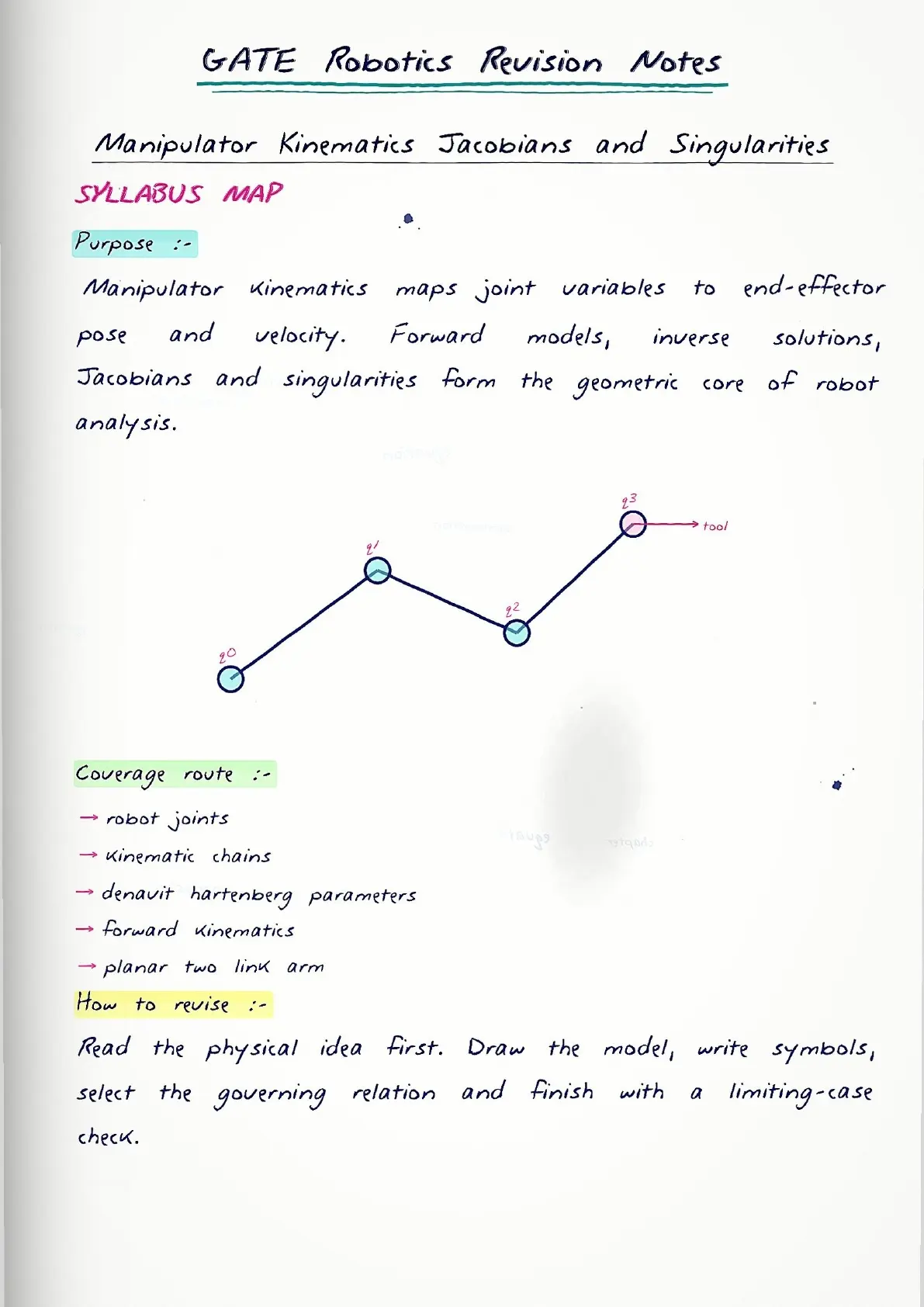
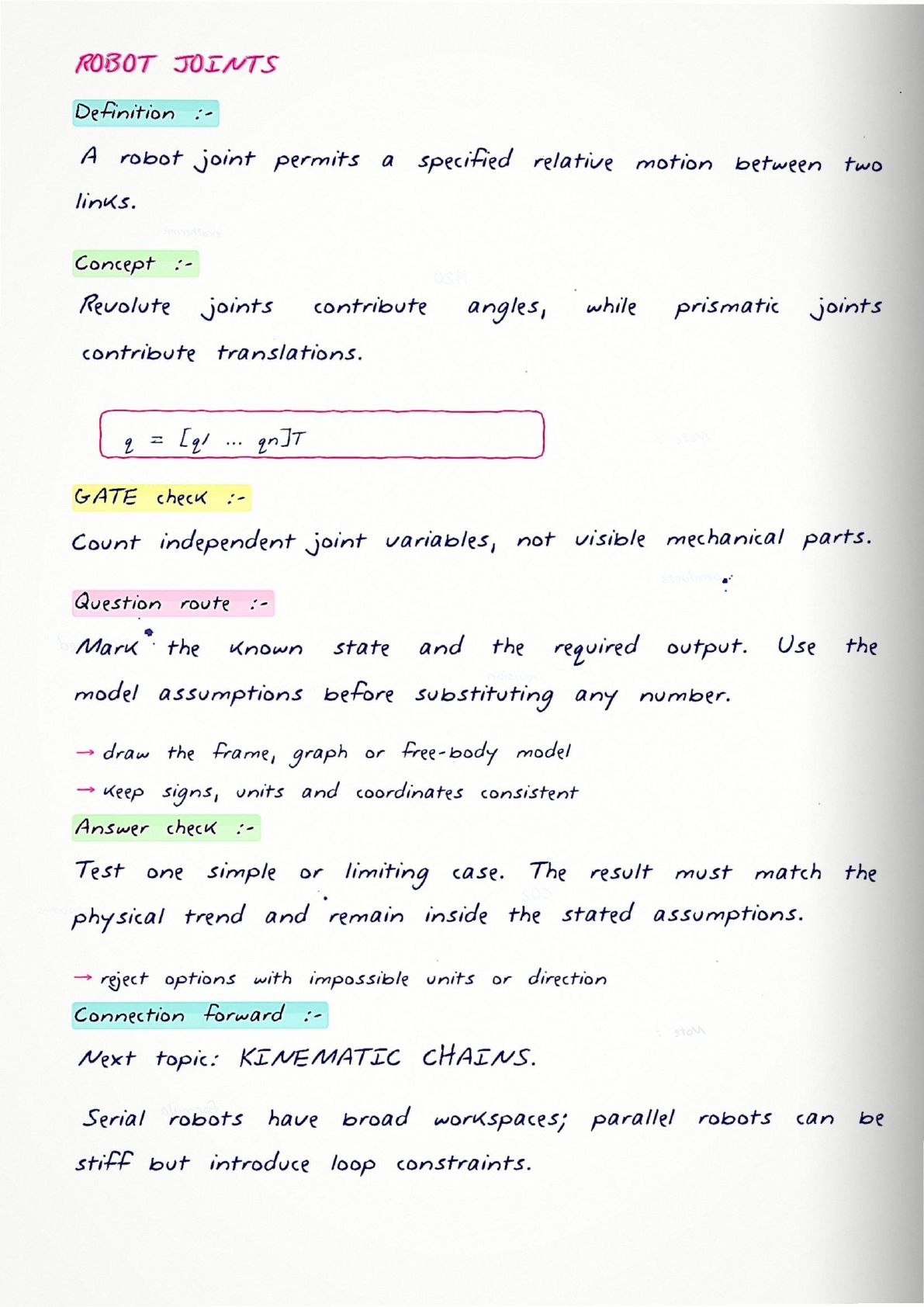
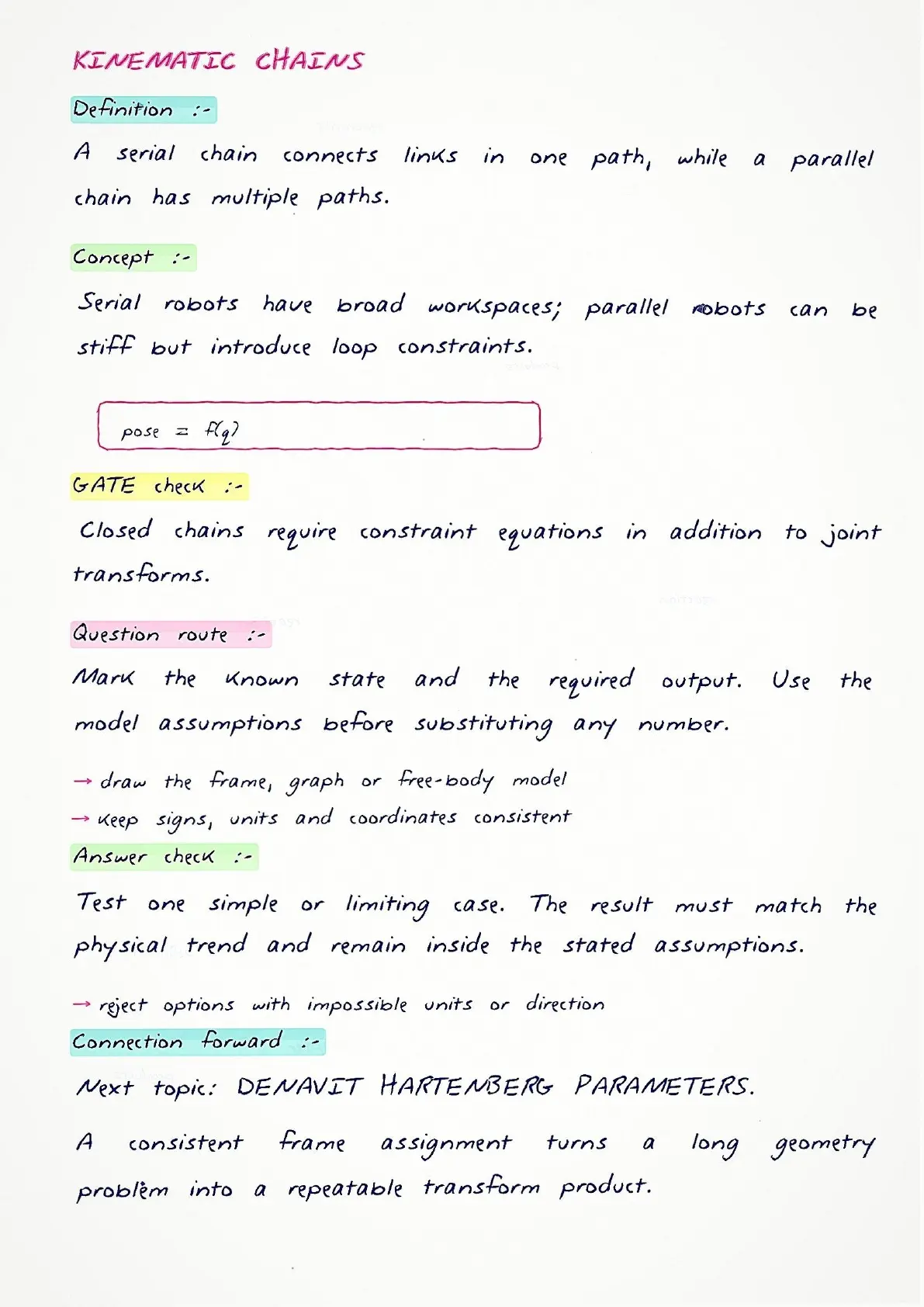
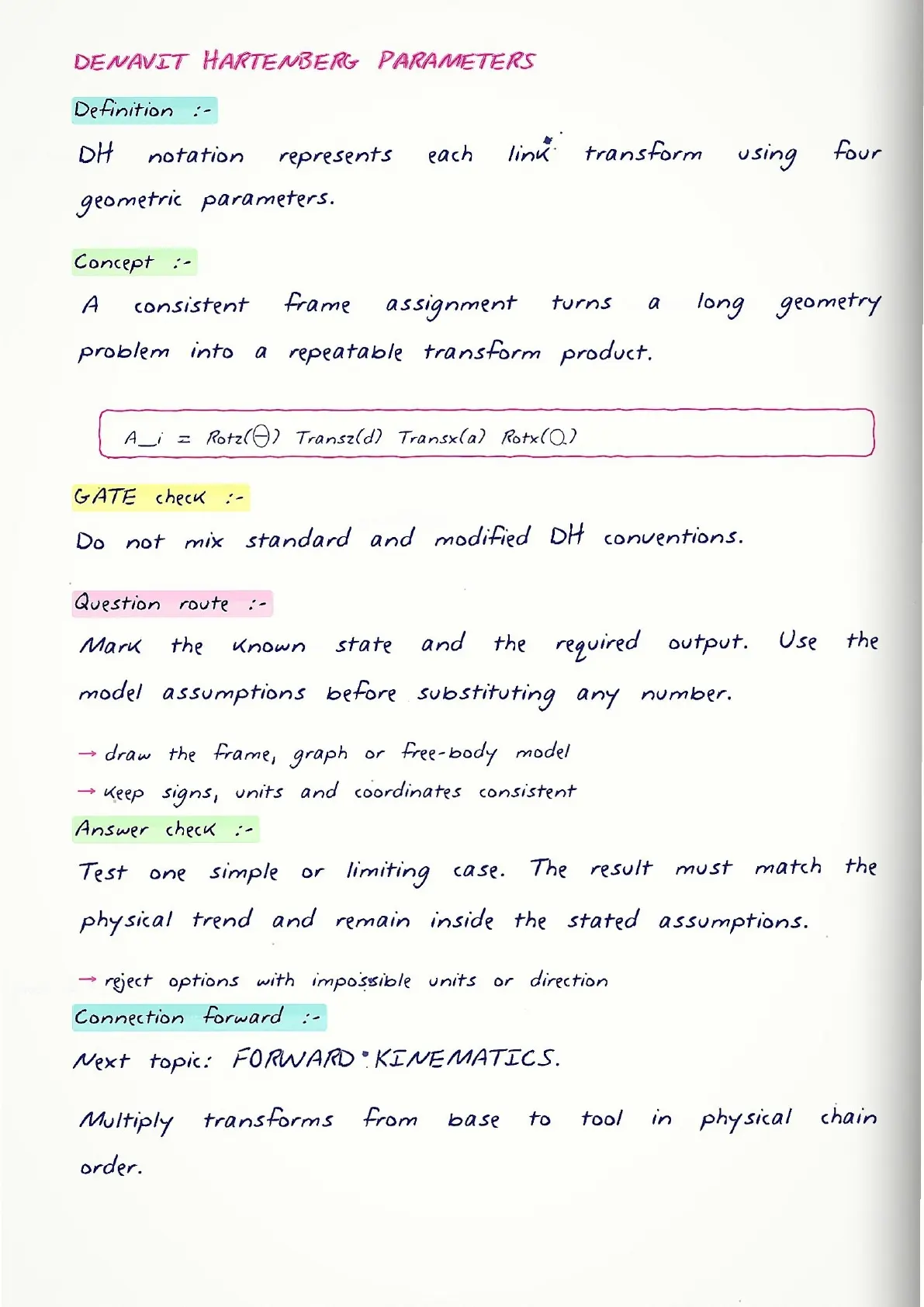
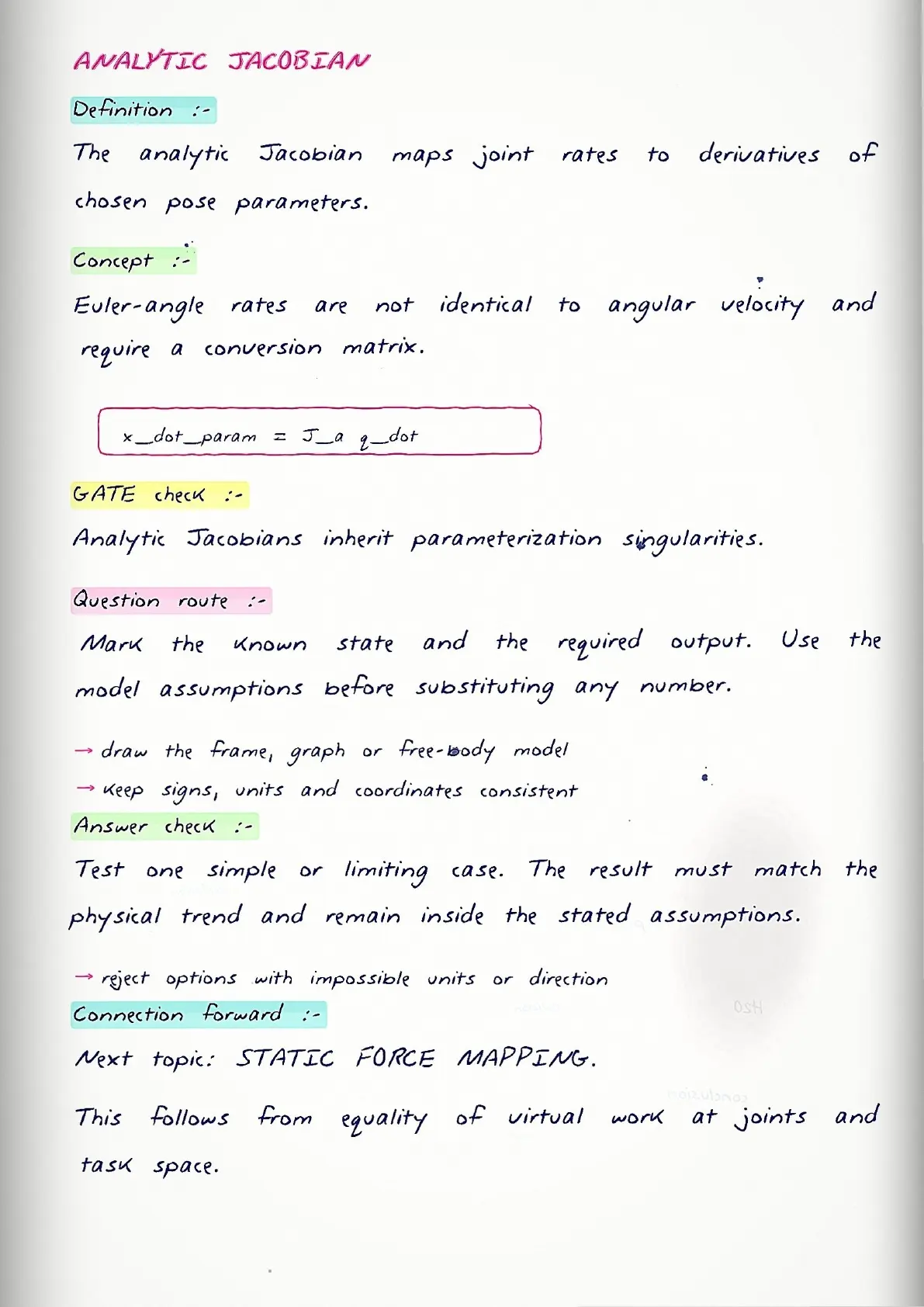
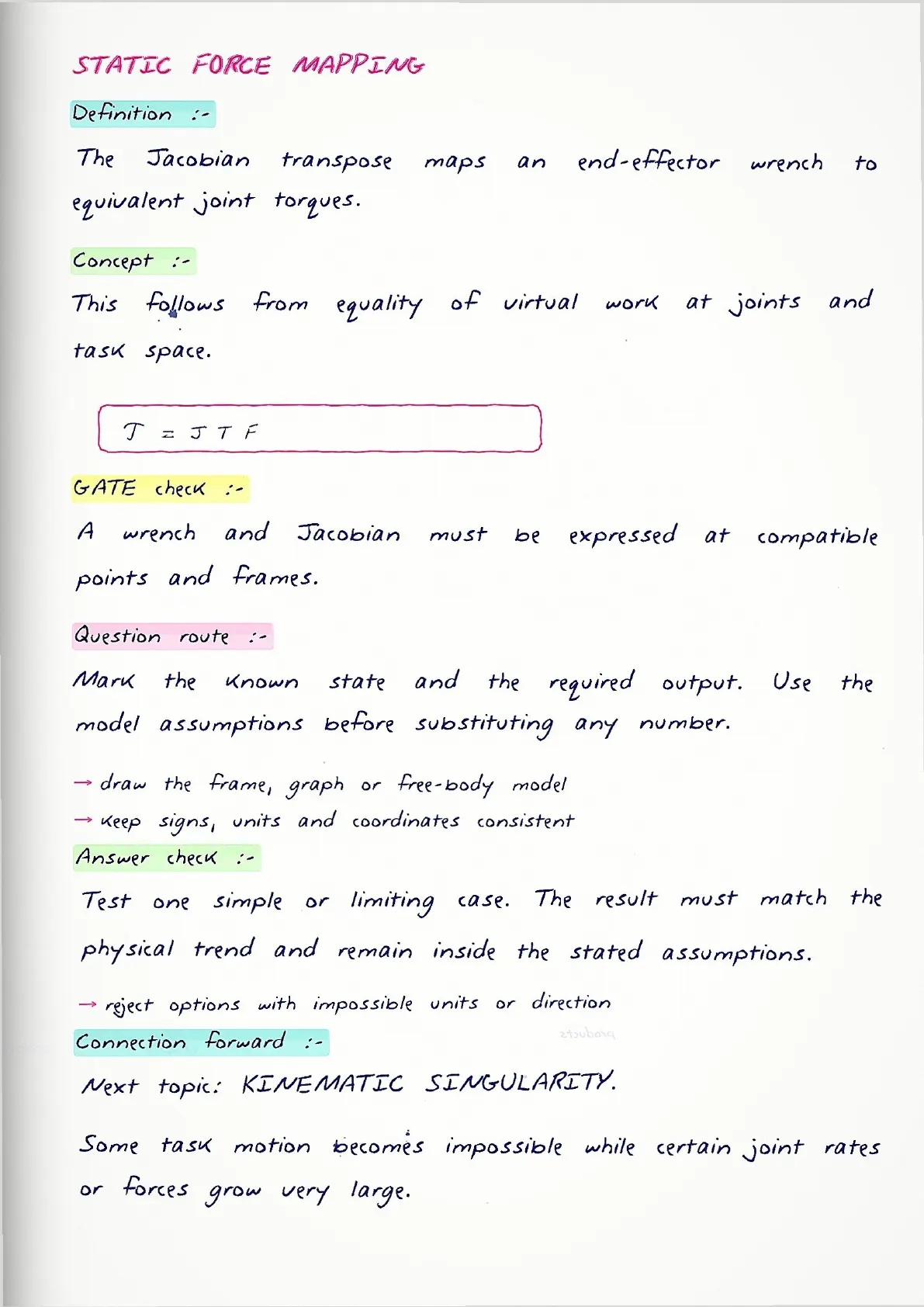
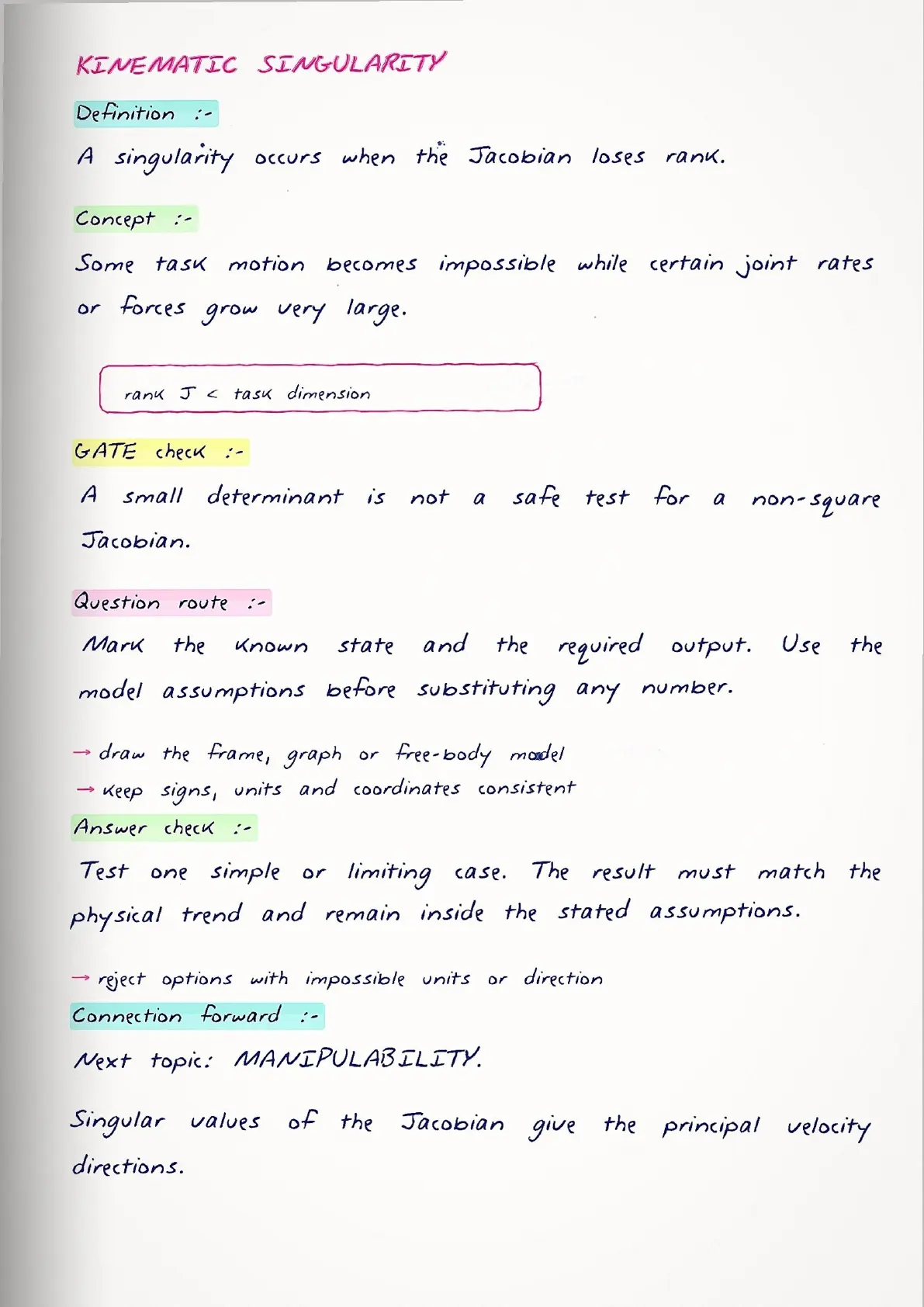
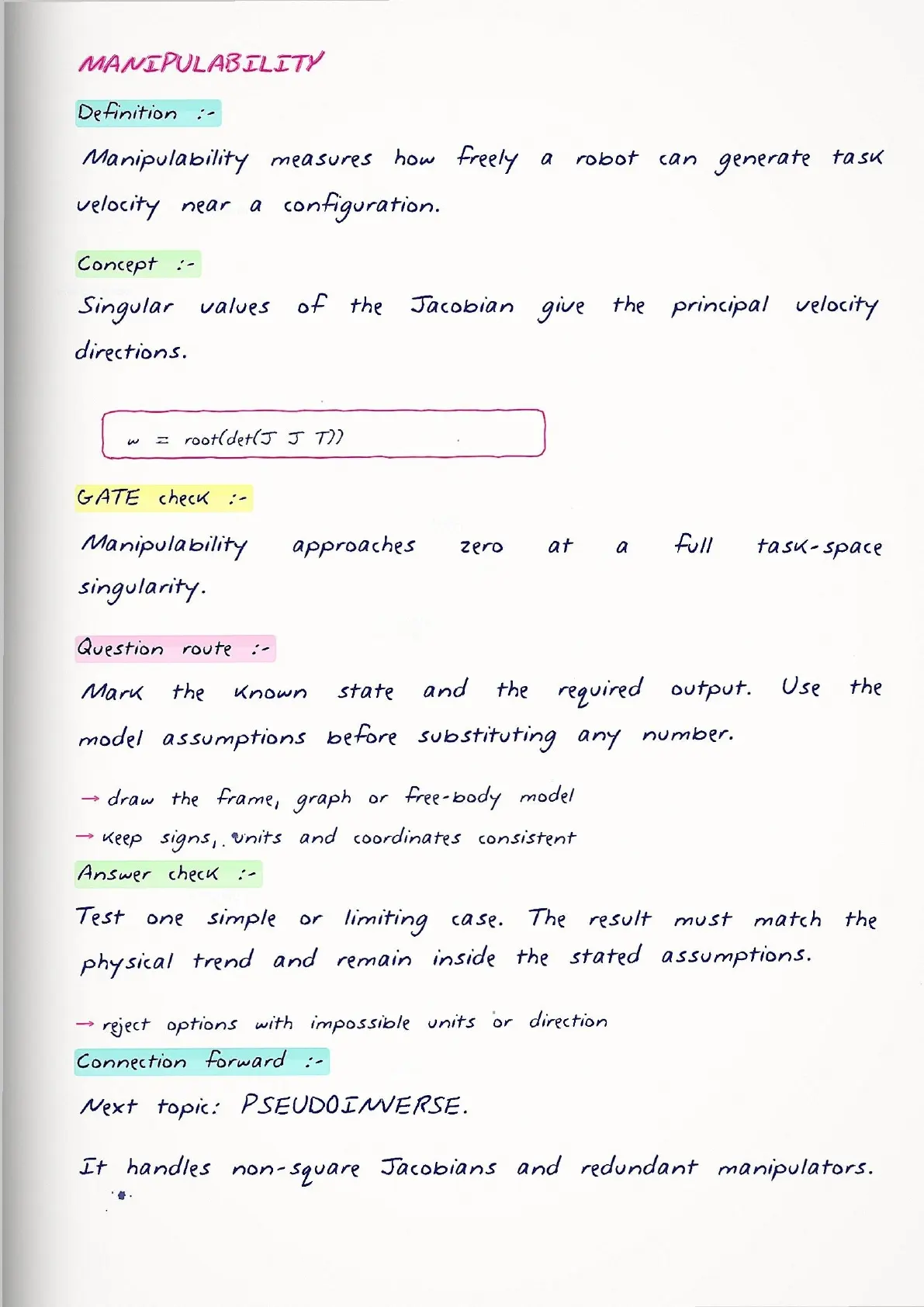
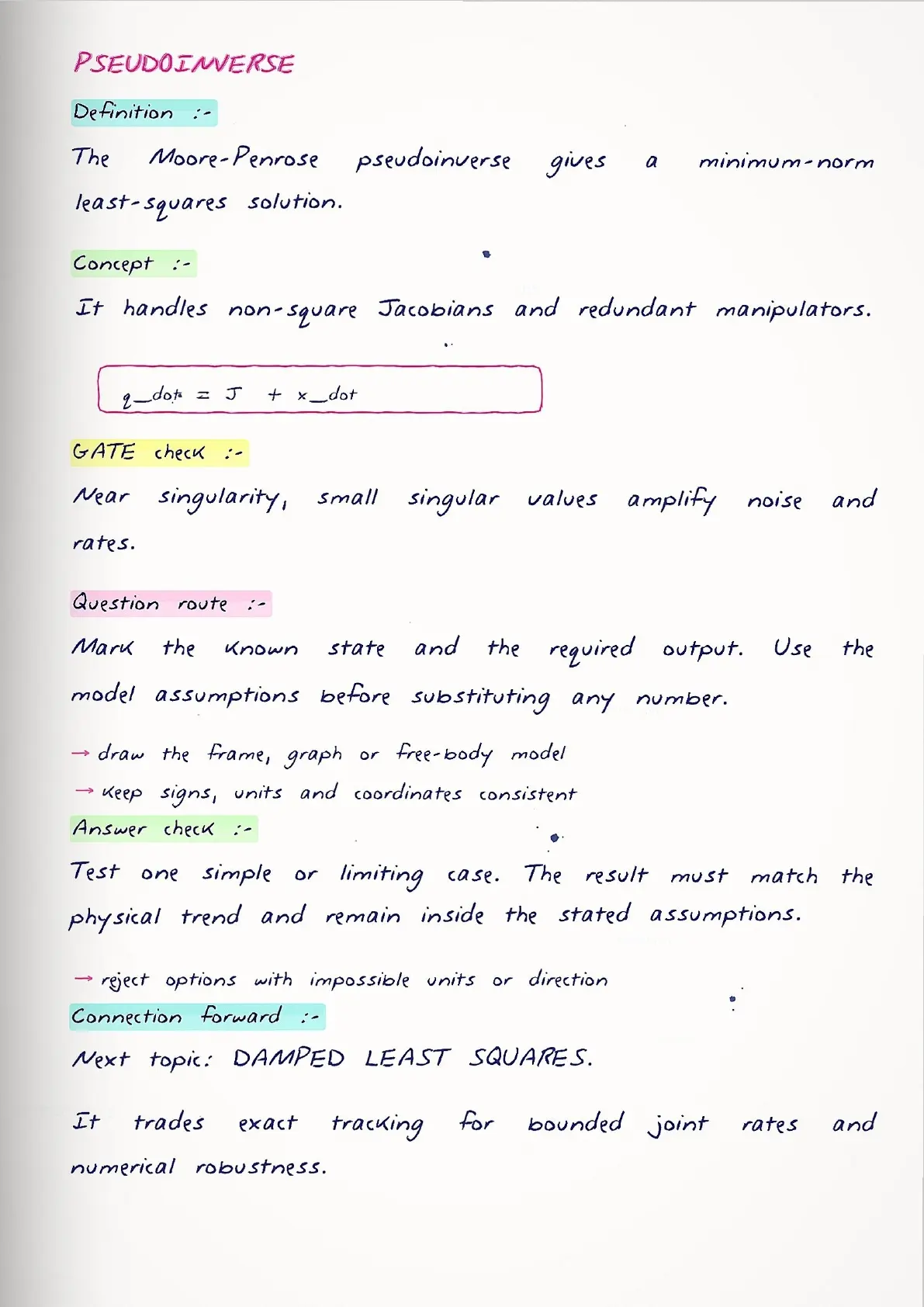
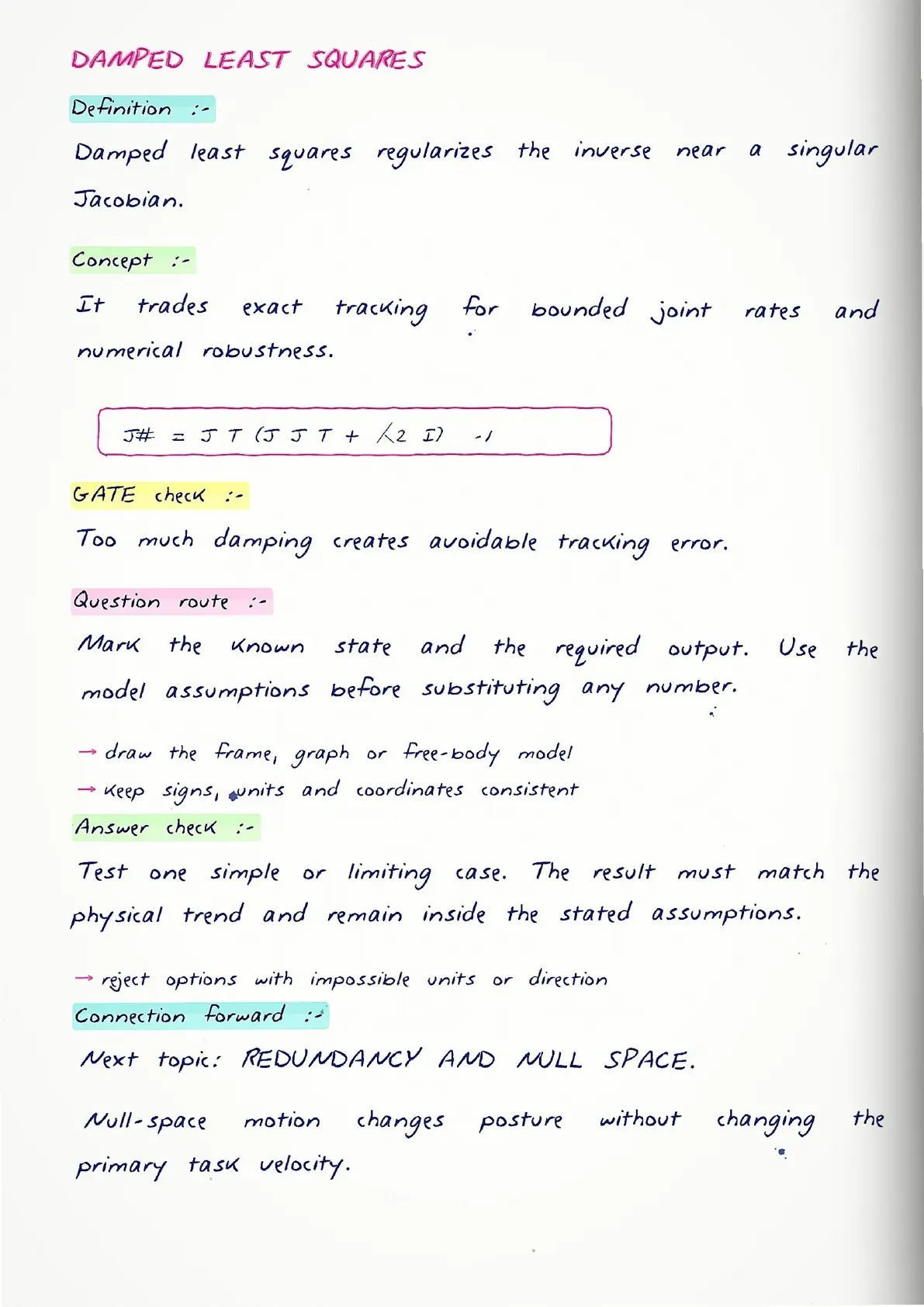
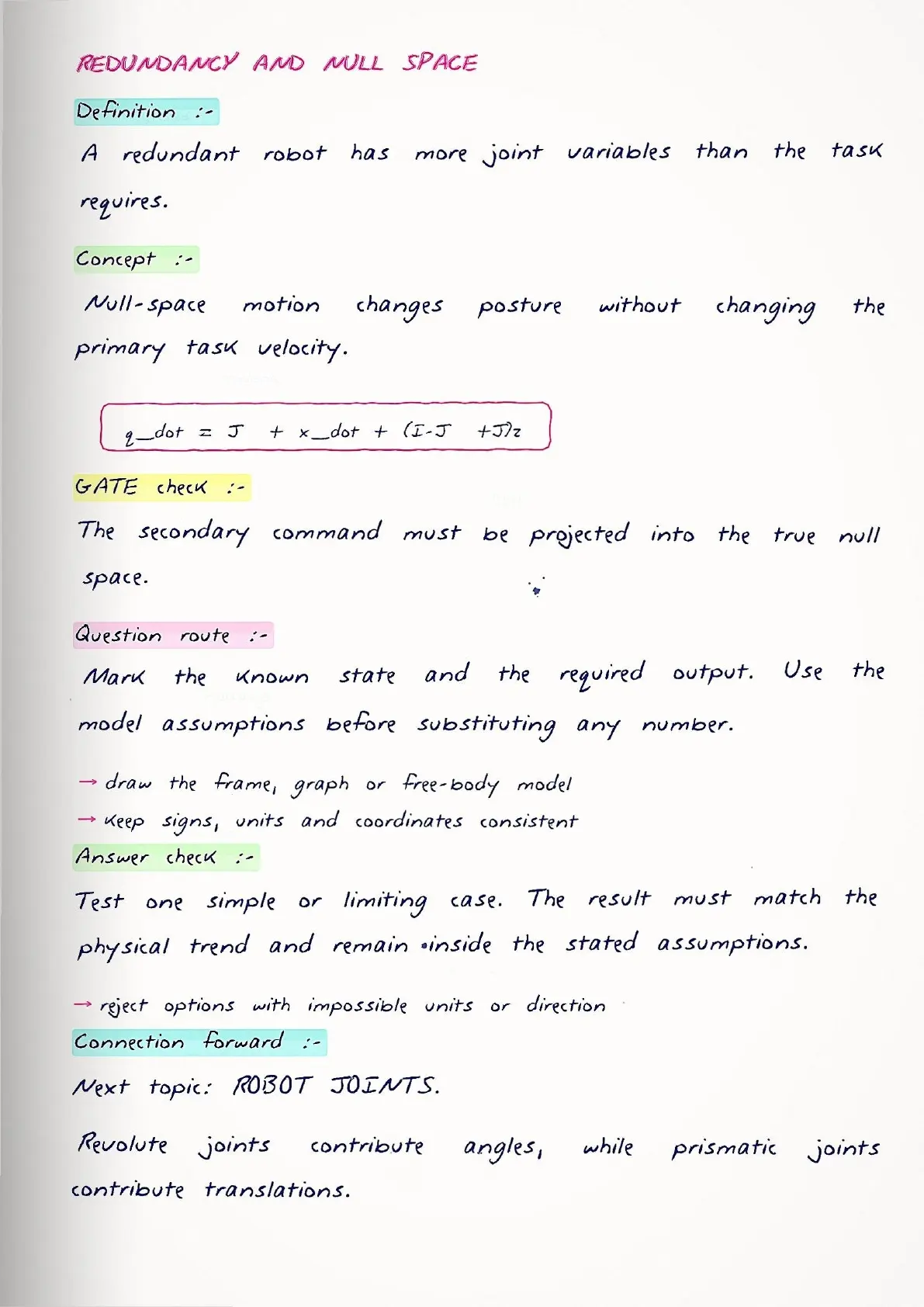
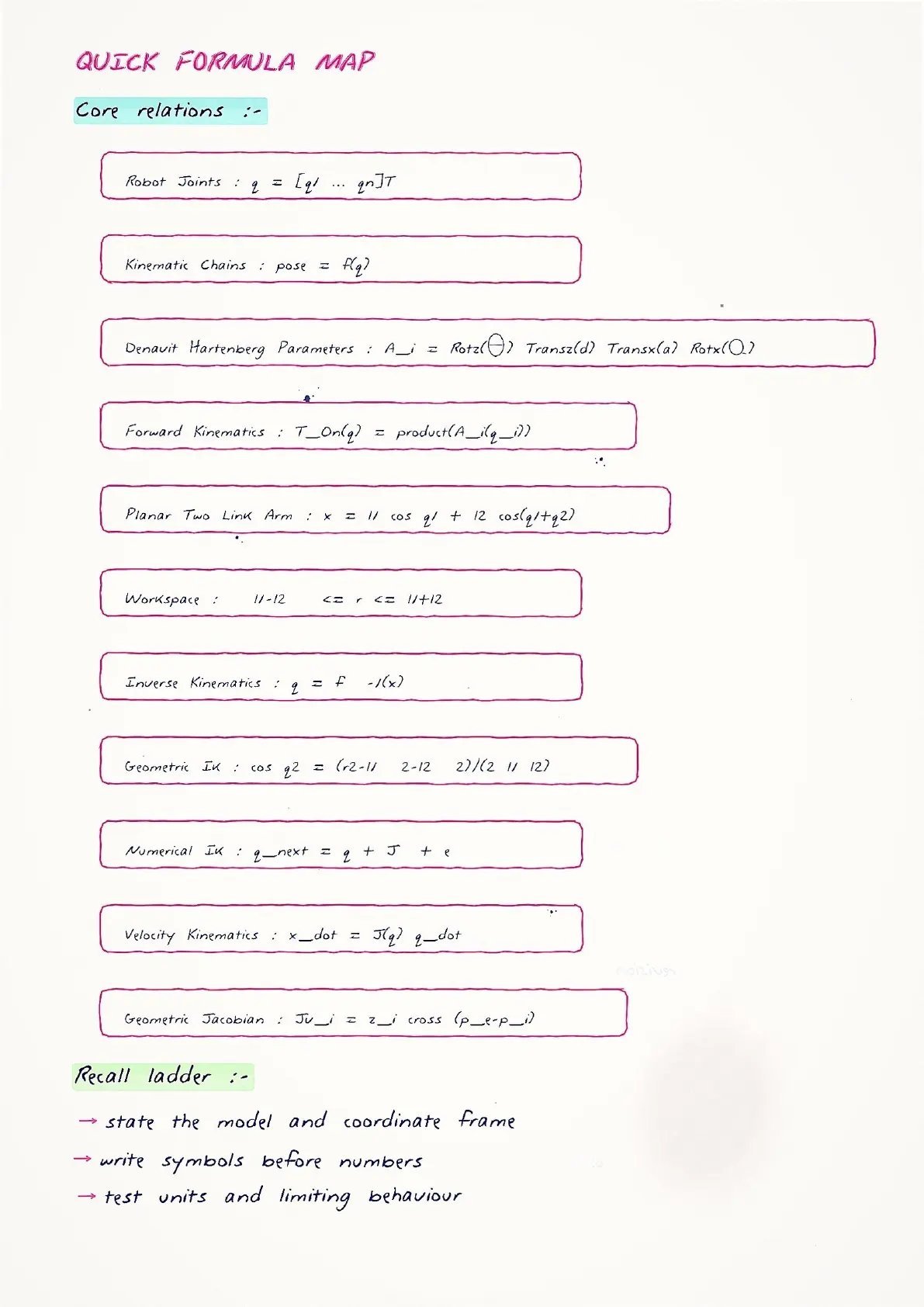
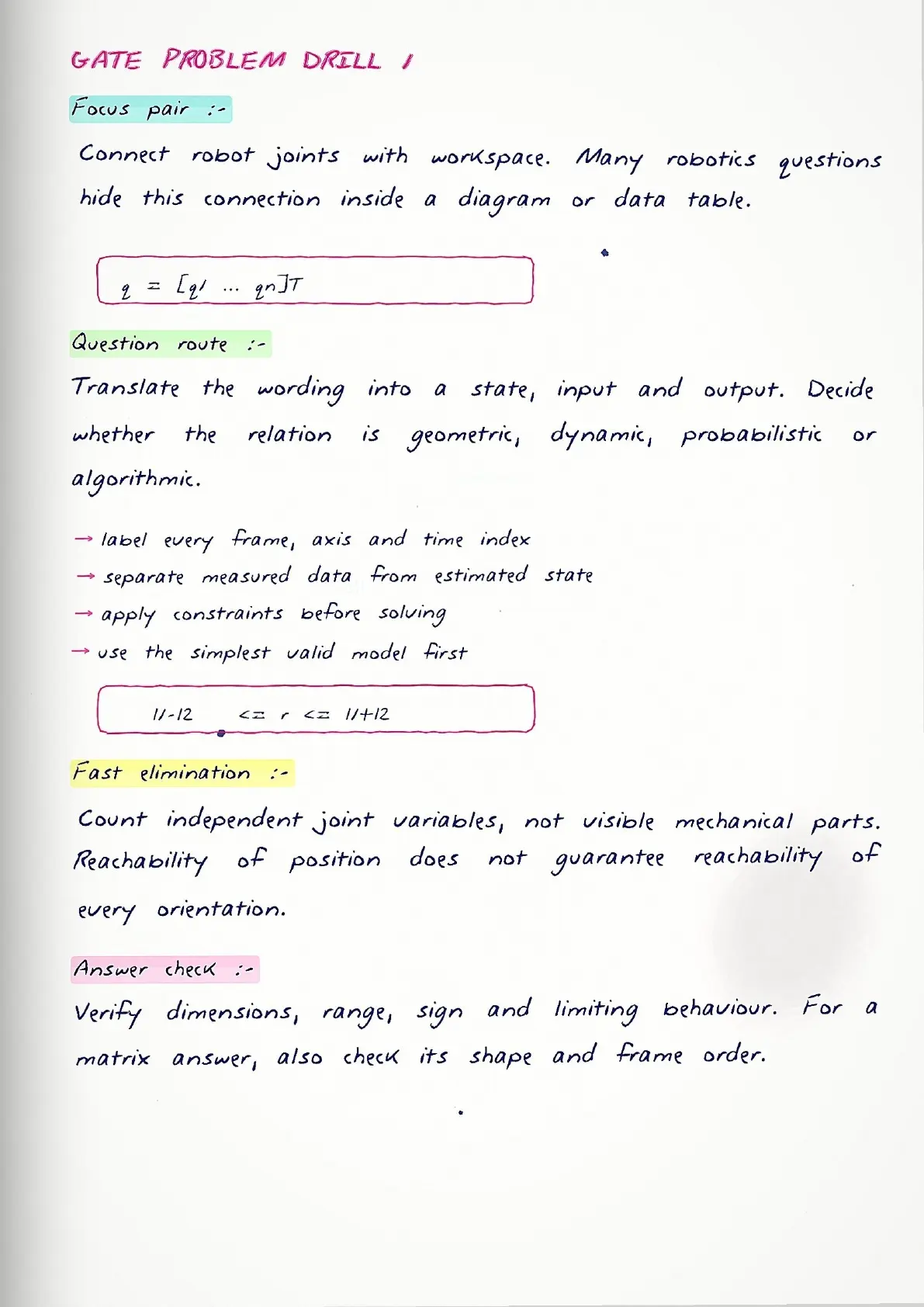
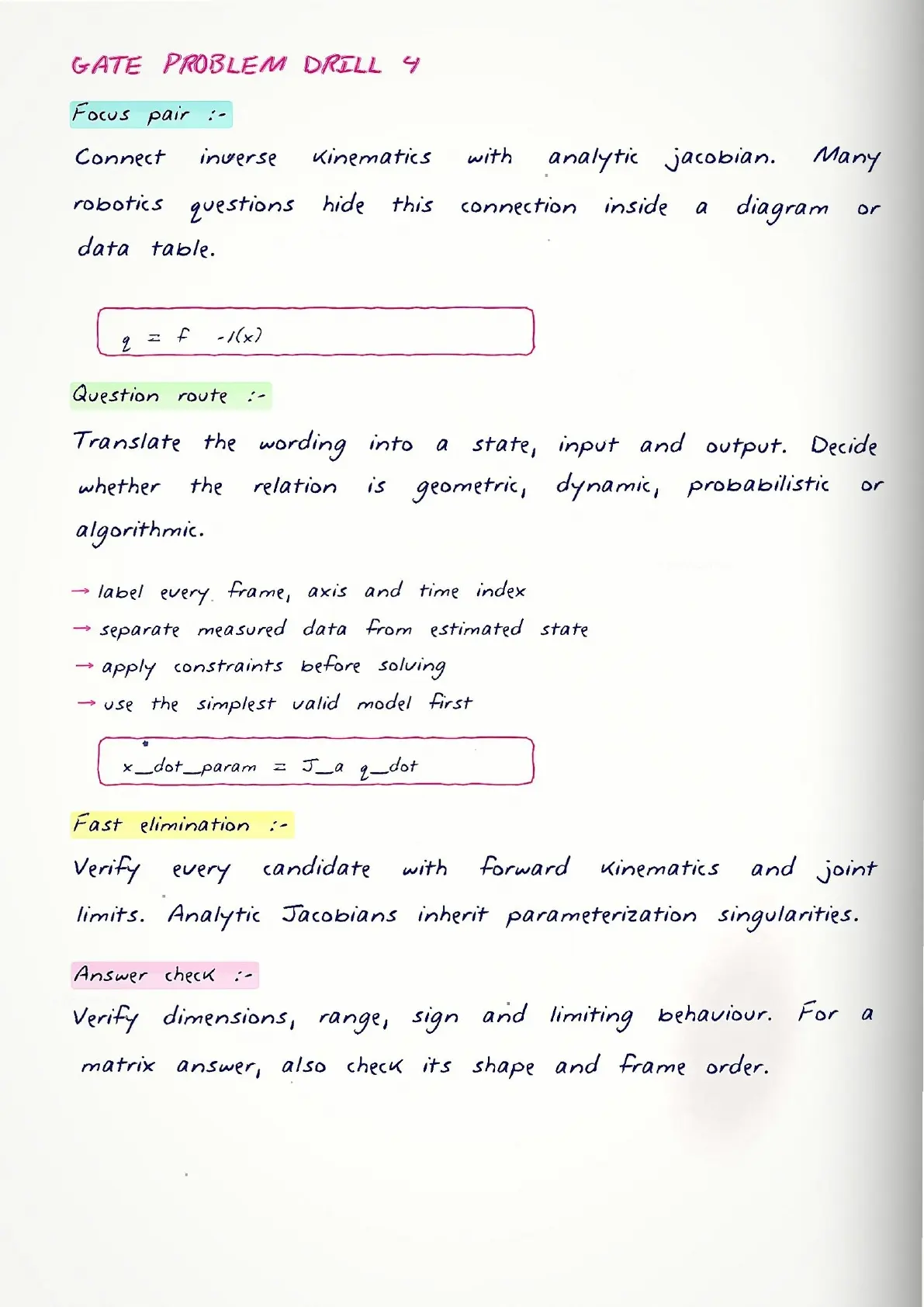
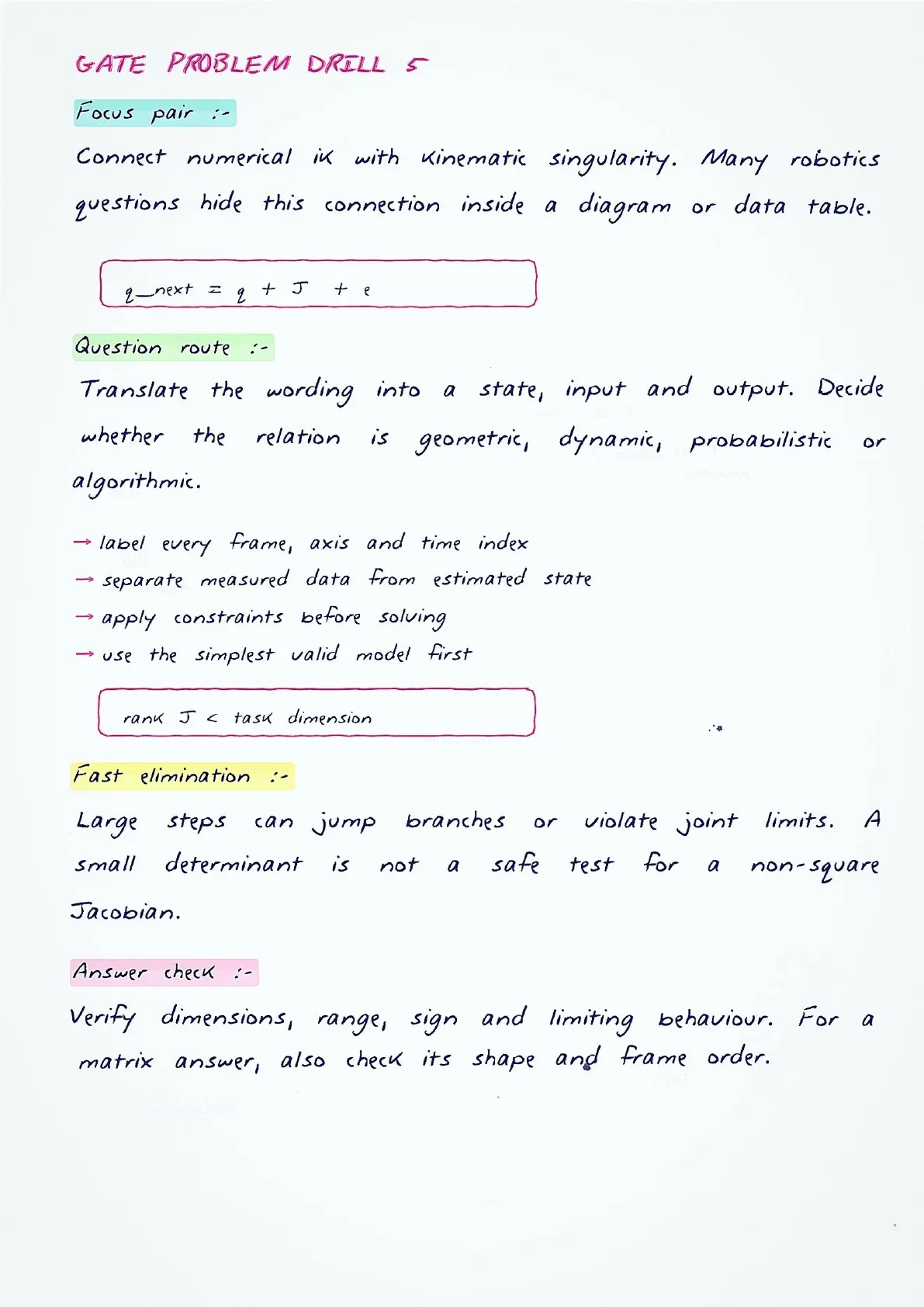
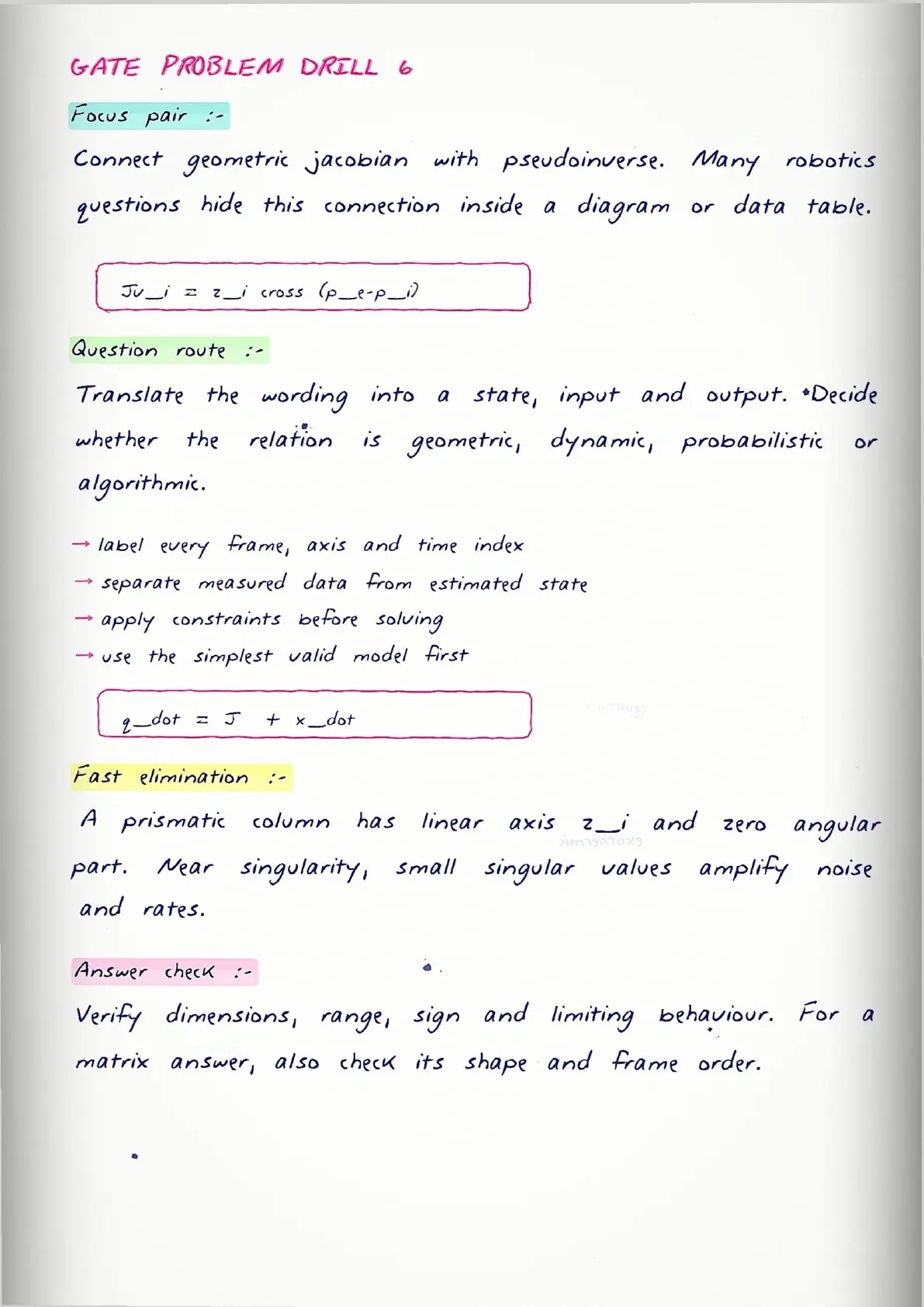
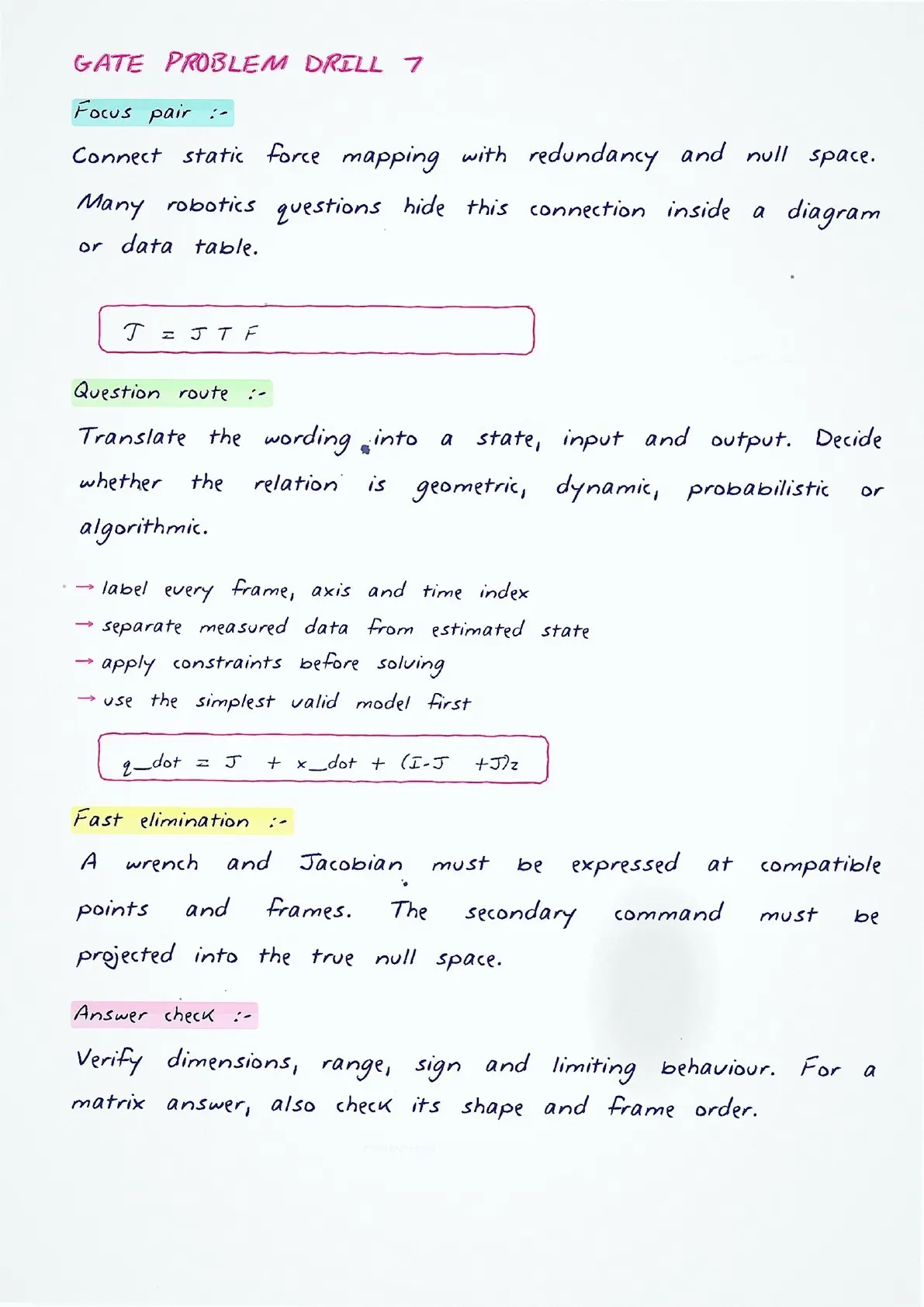
These handwritten notes follow the chain from the first coordinate frame to the moment the arm loses control near a singular pose. The linear algebra behind it overlaps directly with the Engineering Mathematics tested across GATE ME, EE, and EC papers.
The Modelling Chain at a Glance
Before the details, the notes lay out the whole route so students can see how each step feeds the next:
- Frames placed on every joint.
- Forward kinematics turning joint angles into a gripper pose.
- The Jacobian relating joint speeds to gripper speed.
- The same Jacobian showing where the arm goes singular.
Read once, the chain gives every later page a place to hang.
Step One: Pinning Frames with the DH Convention
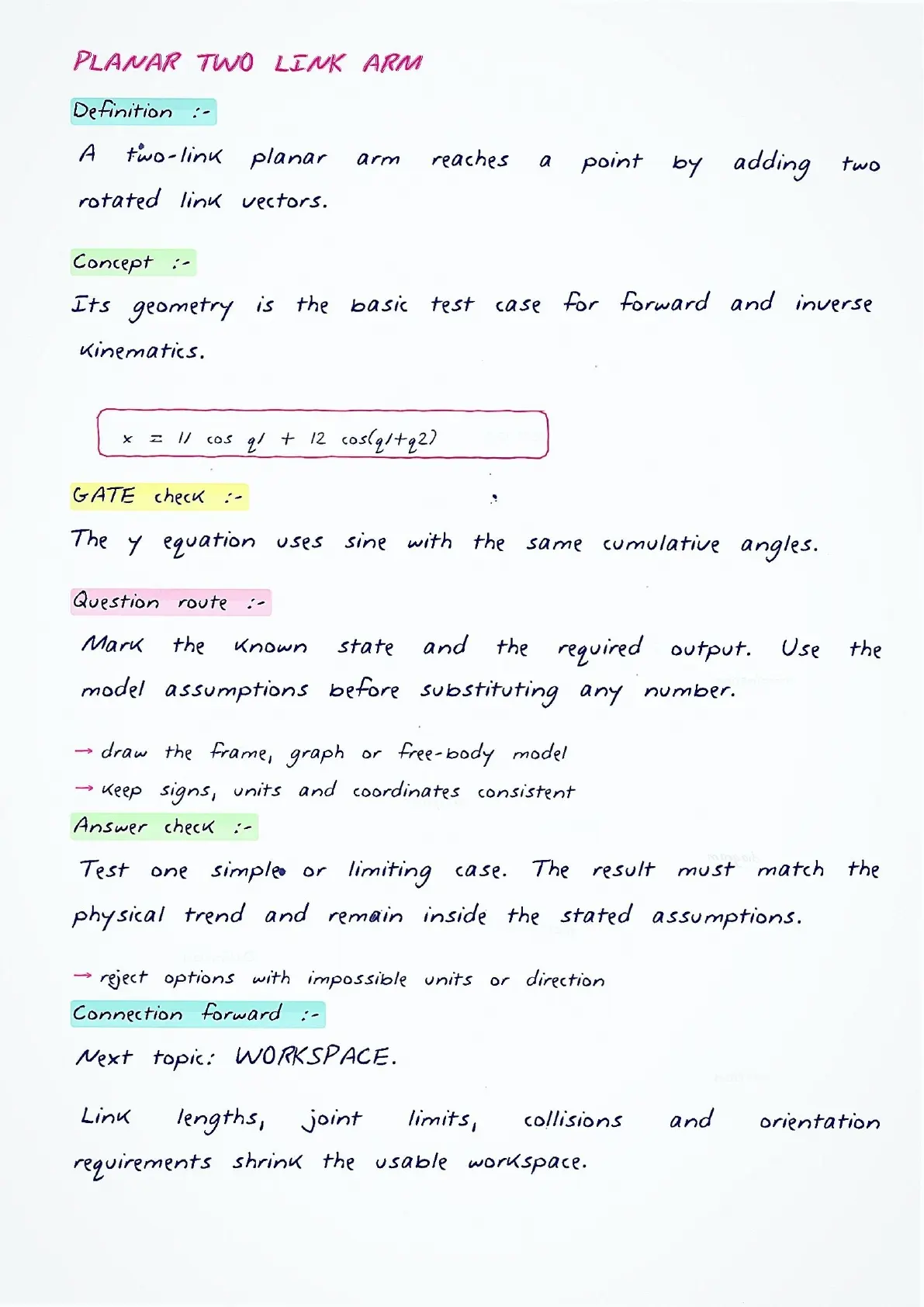
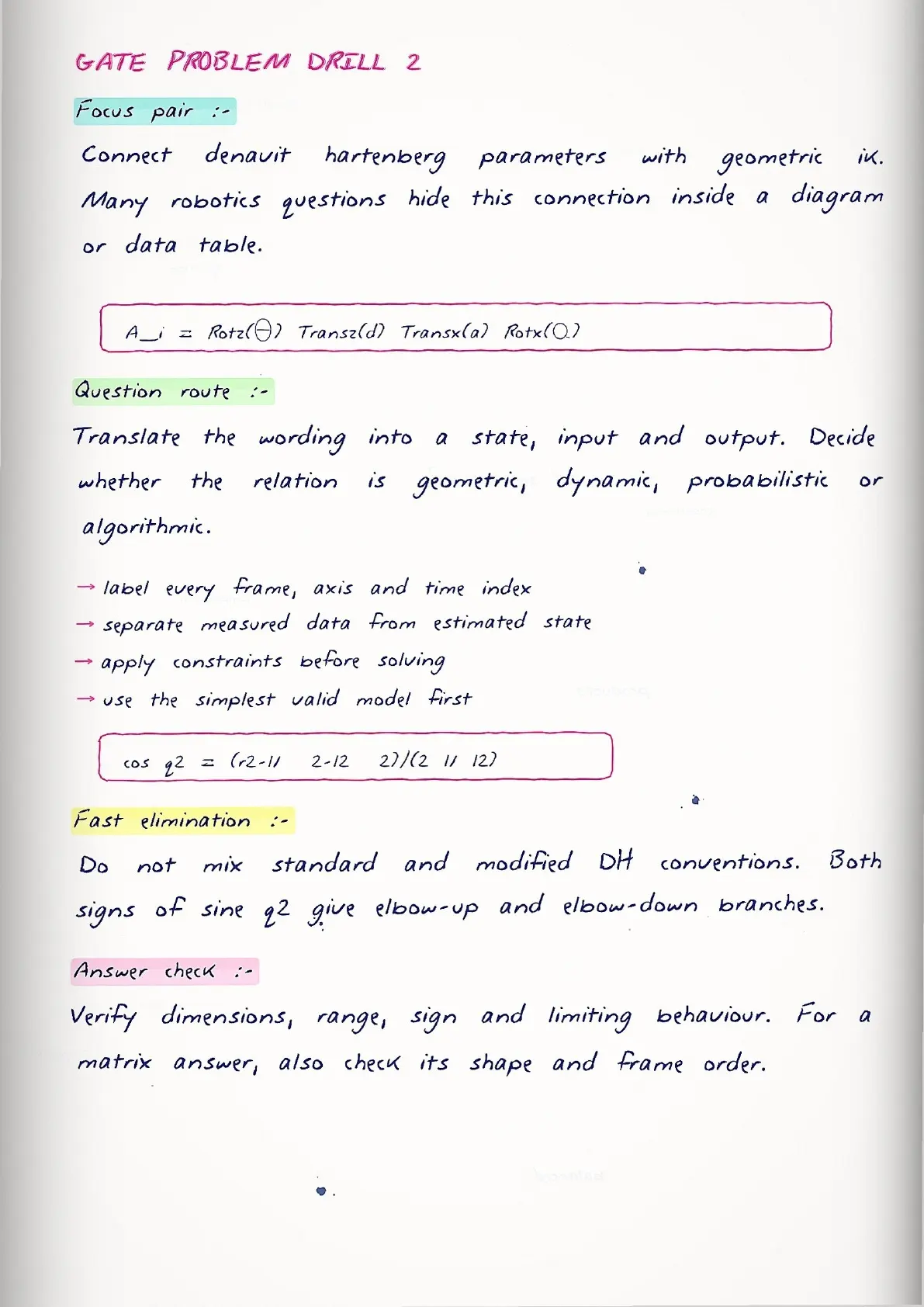
The chain starts by attaching a coordinate frame to each link. The notes teach the Denavit Hartenberg convention, the standard recipe for doing this with just four numbers per joint: link length, link twist, link offset, and joint angle.
Students see clean sketches of a two link and a three link arm with each parameter marked, so the rule stops being abstract. Getting these frames right is the whole foundation, because every later step reads from them.
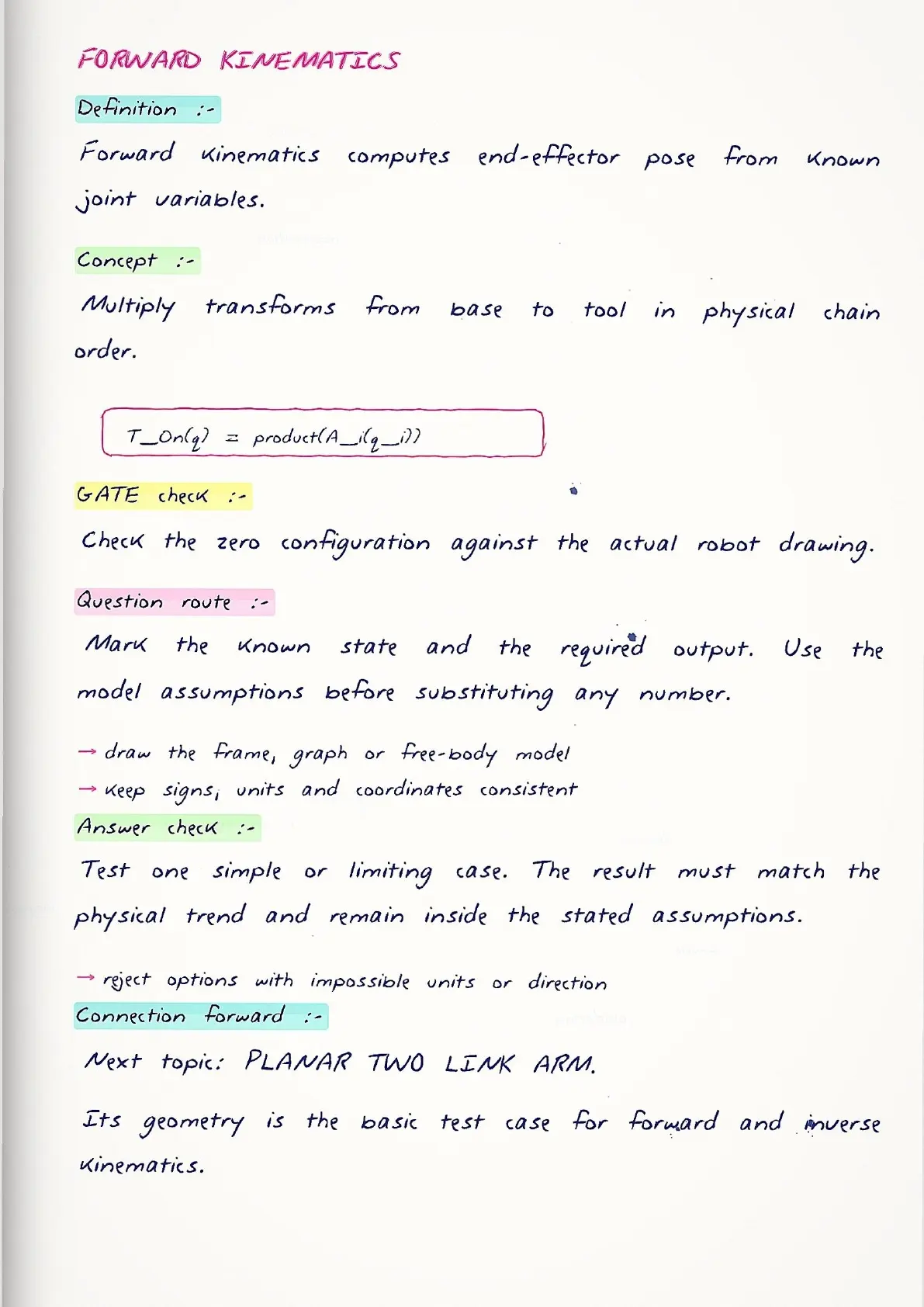
Step Two: Forward Kinematics to the Gripper
With frames in place, the notes chain the per joint transformation matrices together to reach the tool. Multiply them in order and you get the pose of the gripper as a function of the joint angles, position and orientation both.
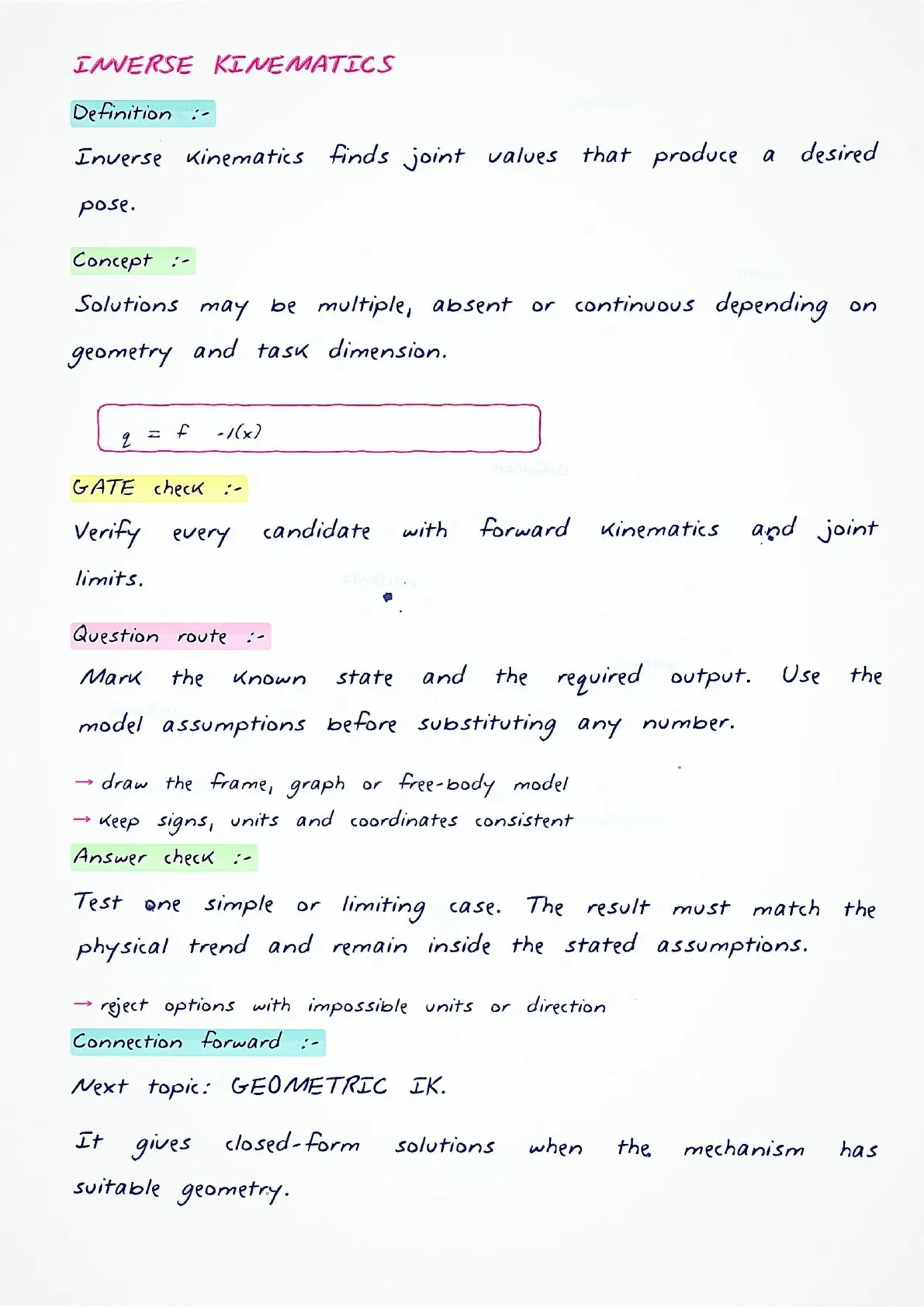
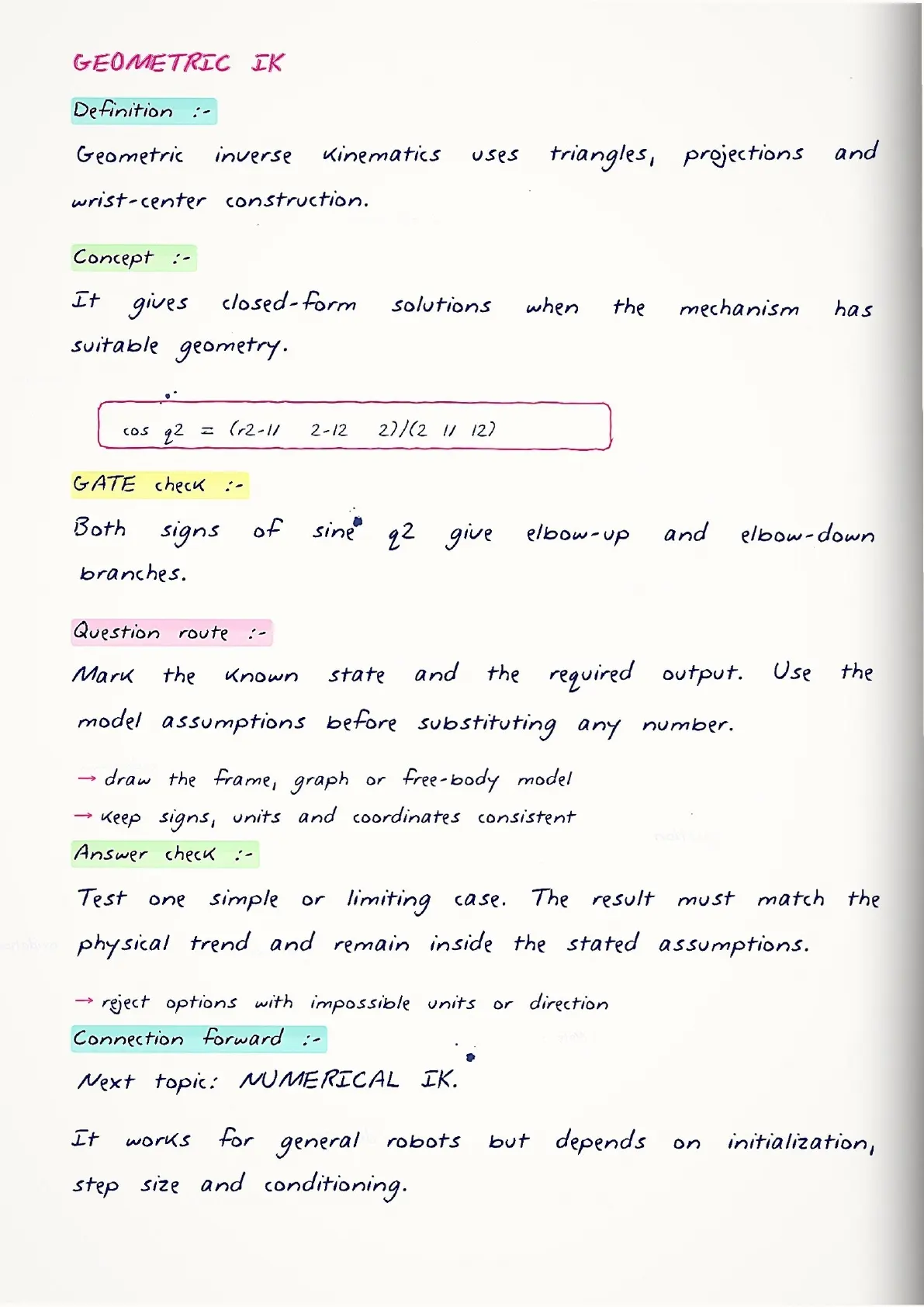
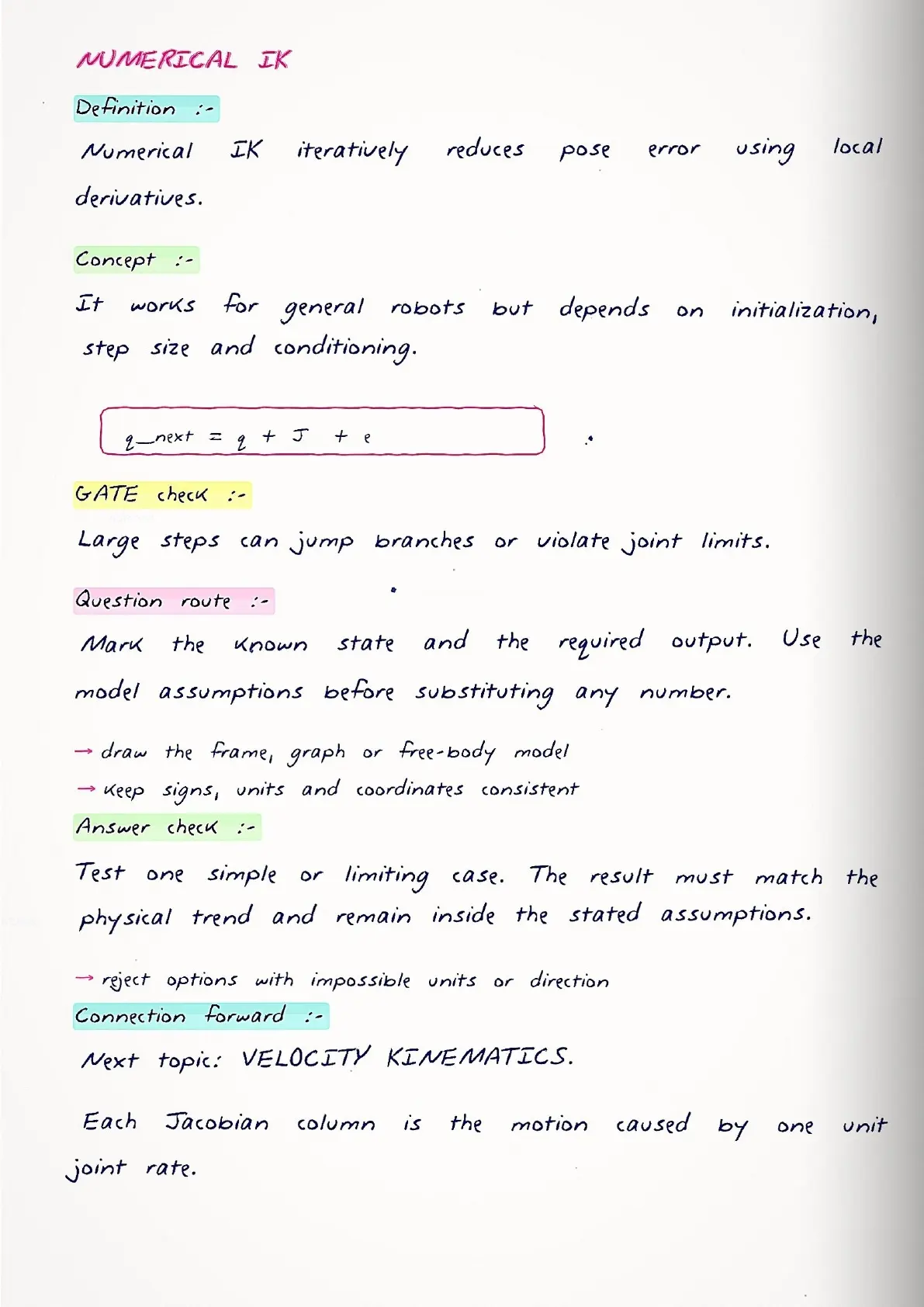
The pages stress the direction of travel, from joint space to task space, and note that it is always unique. Students also meet the harder reverse question, inverse kinematics, and see why an arm can often reach the same point through several joint settings.
Step Three: The Jacobian Links the Velocities
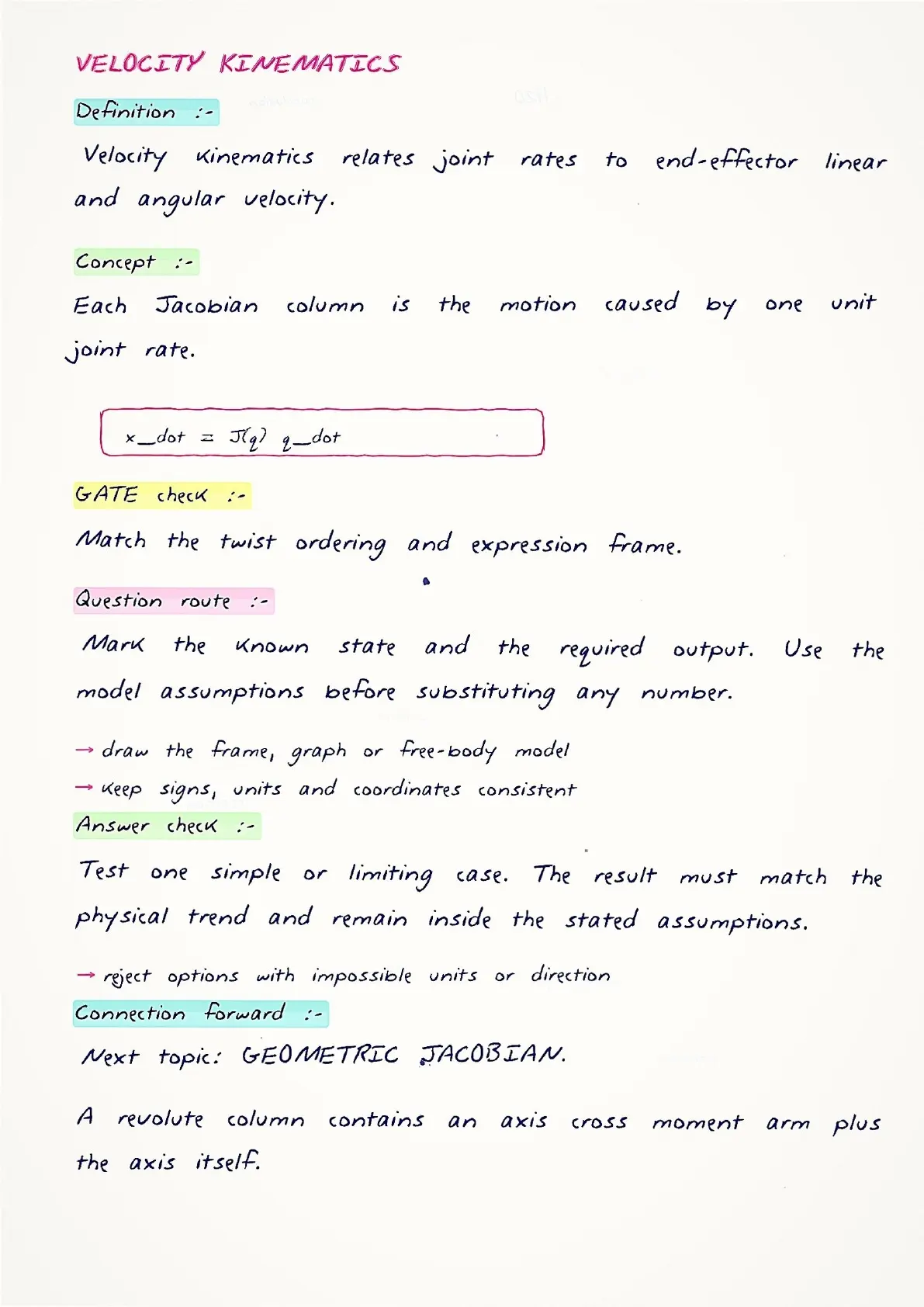
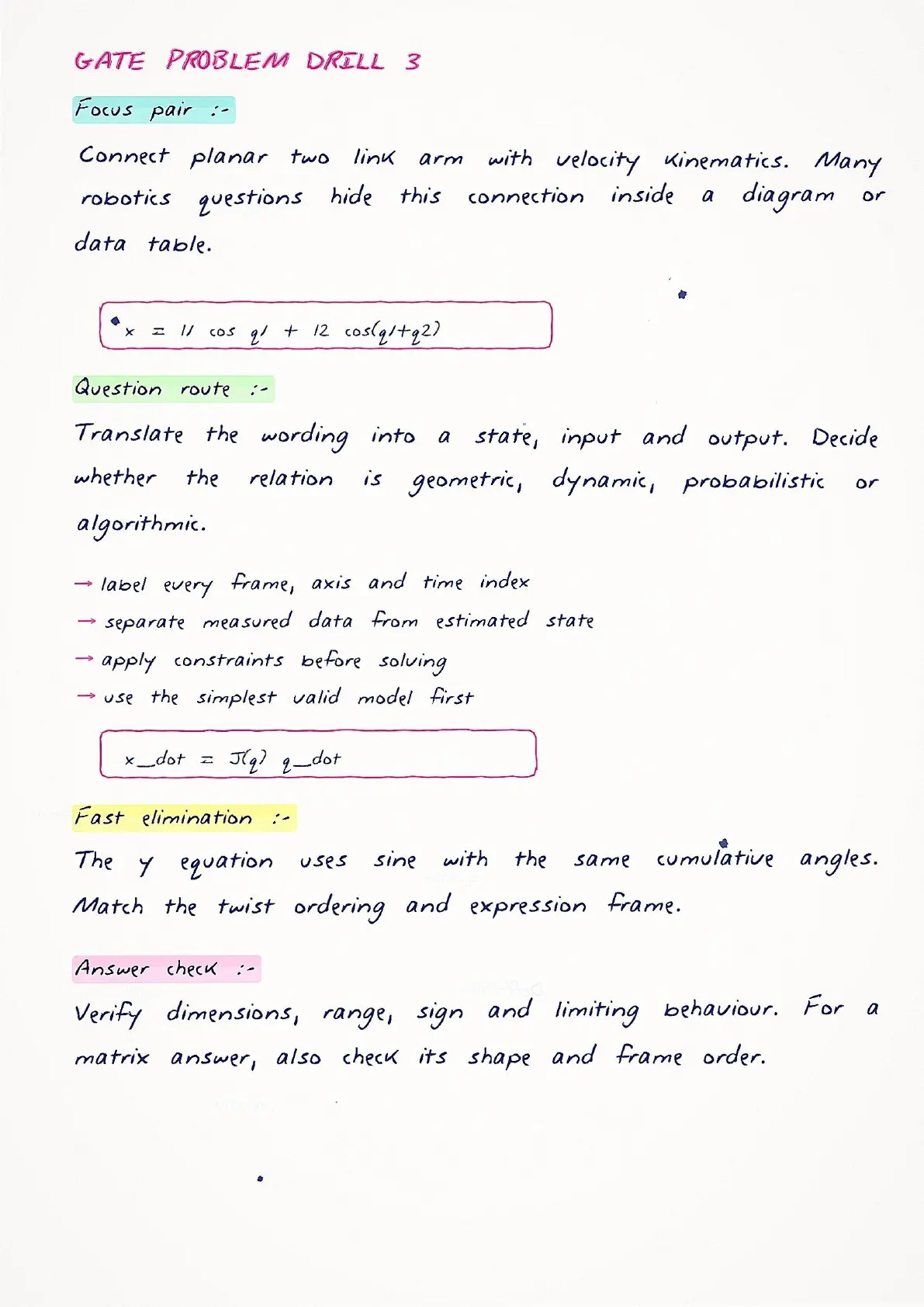
Now the notes move from position to motion. The Jacobian is the matrix that turns joint velocities into the linear and angular velocity of the gripper.
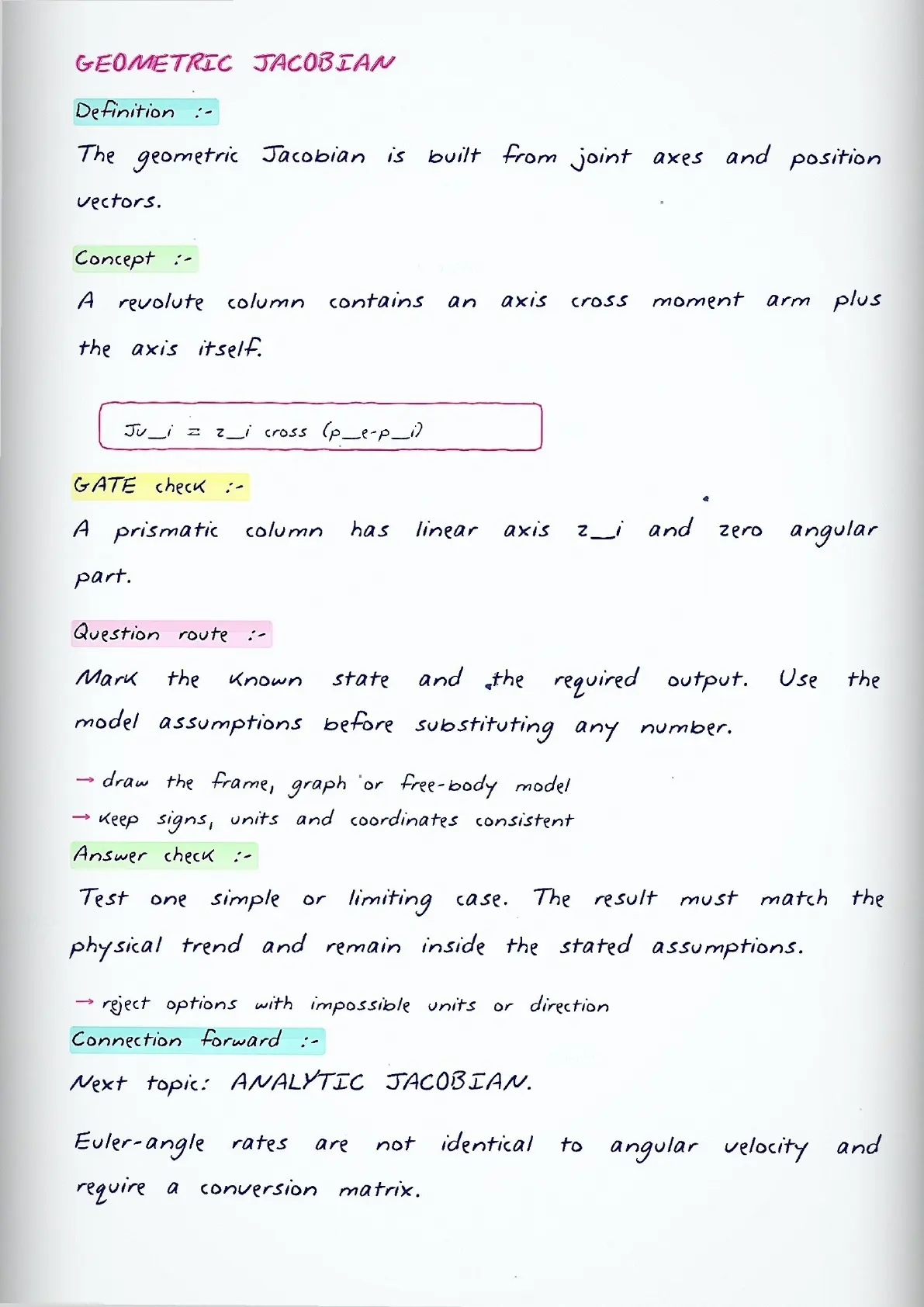
Students see it built column by column, one per joint, and learn to read the top rows as linear velocity and the bottom rows as angular velocity.
The same matrix also runs backwards to link forces at the gripper to torques at the joints, which is why it returns in force control. This is the hinge of the whole chain.
Step Four: Reading Singularities Off the Jacobian
The chain ends where the Jacobian breaks down. A singularity is a pose where the Jacobian loses rank, its determinant drops to zero, and the arm can no longer move its gripper in some direction no matter how the joints spin.
The notes show the classic cases, a fully stretched arm and aligned wrist axes, and explain why joint speeds can blow up nearby. Spotting these poses early is a skill examiners test often, so the pages drill setting the determinant to zero and solving for the joint angles.
Watch the Singularity Idea in Motion
Source: Northwestern Robotics (https://www.youtube.com/@NorthwesternRobotics)
This short lecture shows singular configurations on a real manipulator, which makes the last page of the chain far easier to picture during revision.
Where Students Slip Up
A few errors repeat every year, and the notes call them out:
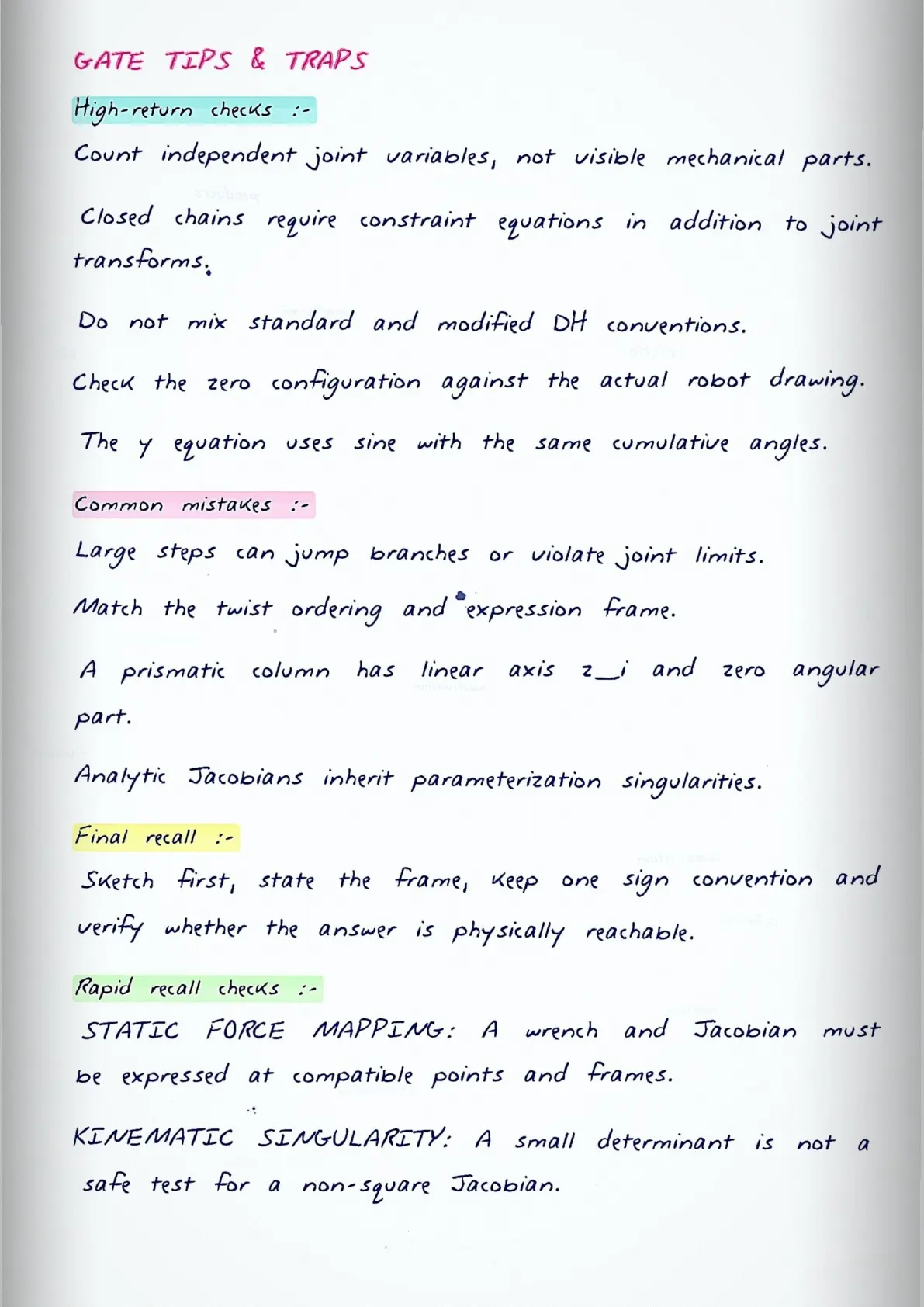
- Mixing up the link twist and joint angle when filling the DH table.
- Forgetting that inverse kinematics can have several answers.
- Confusing a loss of rank with the matrix simply being non square.
- Reading the Jacobian rows in the wrong order.
Each trap is flagged plainly so it does not cost marks under time pressure.
Drilling the Chain in Your Final Weeks
Because the notes follow one clear sequence, students can revise them as a chain rather than a pile of formulas.
A good last week rhythm is to rebuild a DH table from memory on day one, derive a forward kinematics product on day two, assemble a Jacobian on day three, and hunt for singularities on day four.
Redraw each sketch without looking, and the whole arm model will come back fast in the exam.
Manipulator Kinematics, Jacobians and Singularities FAQs
Ques. What order do these notes follow?
Ans. They follow a single chain, frames with the DH convention, then forward kinematics, then the Jacobian, and finally singularities, so each topic builds on the one before it.
Ques. What exactly is a singularity?
Ans. It is a joint configuration where the Jacobian loses rank and its determinant becomes zero, so the arm cannot move its gripper in some direction and joint speeds can grow very large nearby.
Ques. Do the notes cover inverse kinematics?
Ans. Yes. They introduce inverse kinematics alongside forward kinematics and explain why an arm can reach the same point through more than one set of joint angles.
Ques. How does this help with GATE?
Ans. There is no separate Robotics paper, but the matrix algebra, transformations, and determinants used here overlap with the Engineering Mathematics tested in GATE ME, EE, and EC.
Ques. How long is the set?
Ans. The notes run to 28 pages, sequenced step by step so students can drill the modelling chain in a few short sittings.



Comments