




The GATE 2026 Production and Industrial Engineering (PI) question paper is now available with detailed solutions for free download. GATE 2026 PI was conducted by IIT Guwahati on February 14, 2026, in the Forenoon session (9:30 AM to 12:30 PM), and the paper carried 65 questions worth 100 marks in 3 hours.
| GATE 2026 Production and Industrial Engineering Question Paper with Solutions | Download PDF | Check Solutions |
GATE 2026 PI Questions with Solutions
'The shopkeeper sells lemons.'
In this sentence, the word 'lemons' is the ________.
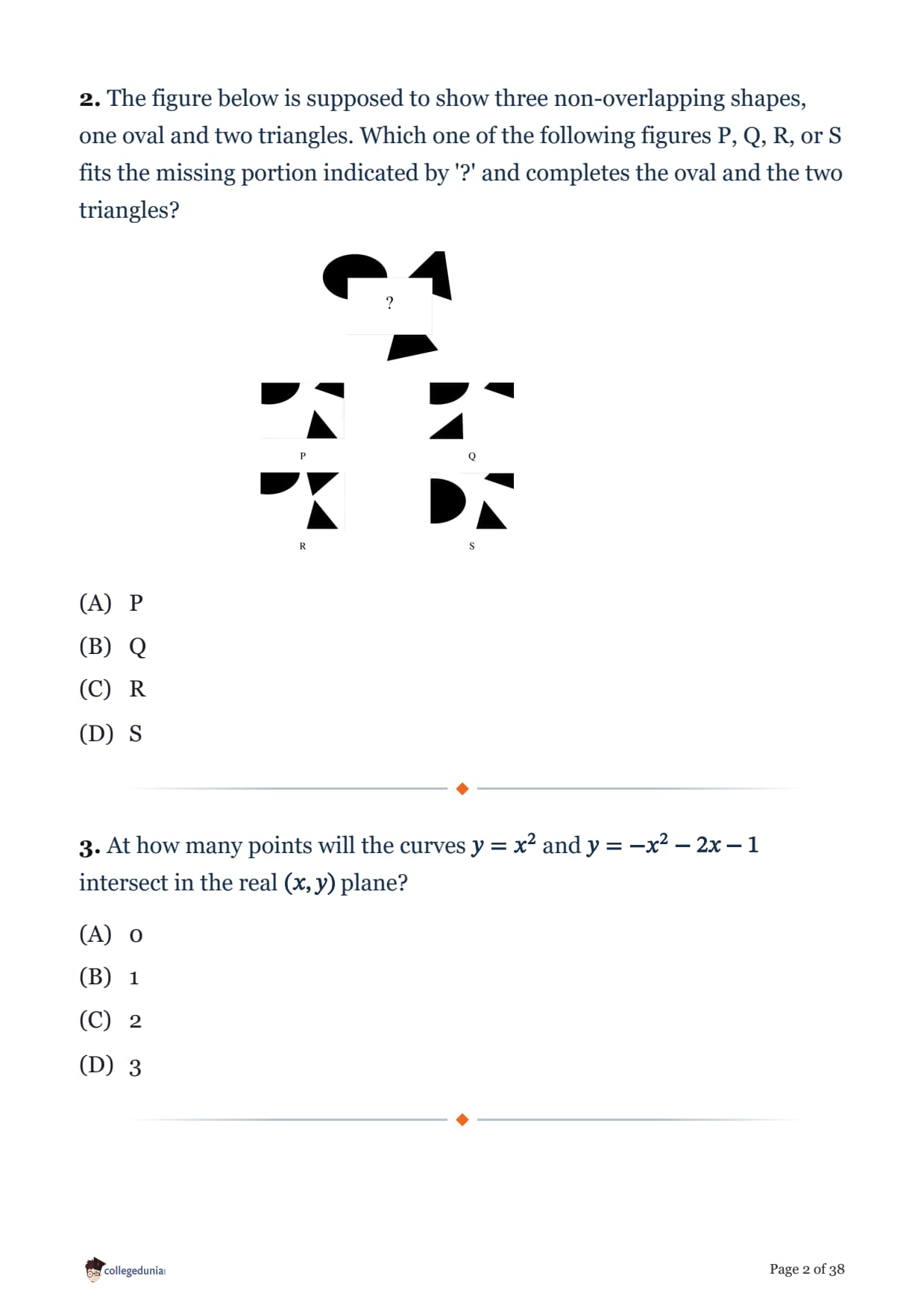
The figure below is supposed to show three non-overlapping shapes, one oval and two triangles. Which one of the following figures P, Q, R, or S fits the missing portion indicated by '?' and completes the oval and the two triangles?

At how many points will the curves \( y = x^2 \) and \( y = -x^2 - 2x - 1 \) intersect in the real \( (x, y) \) plane?
'If Anish had scored hundred runs in today's match, he would have been made the captain of his team. He would have then become the youngest captain in his team's history. Unfortunately, he got out without scoring any runs. Hence, there won't be any change in the captaincy for now.'
Based on the paragraph above, which one of the following statements is true?
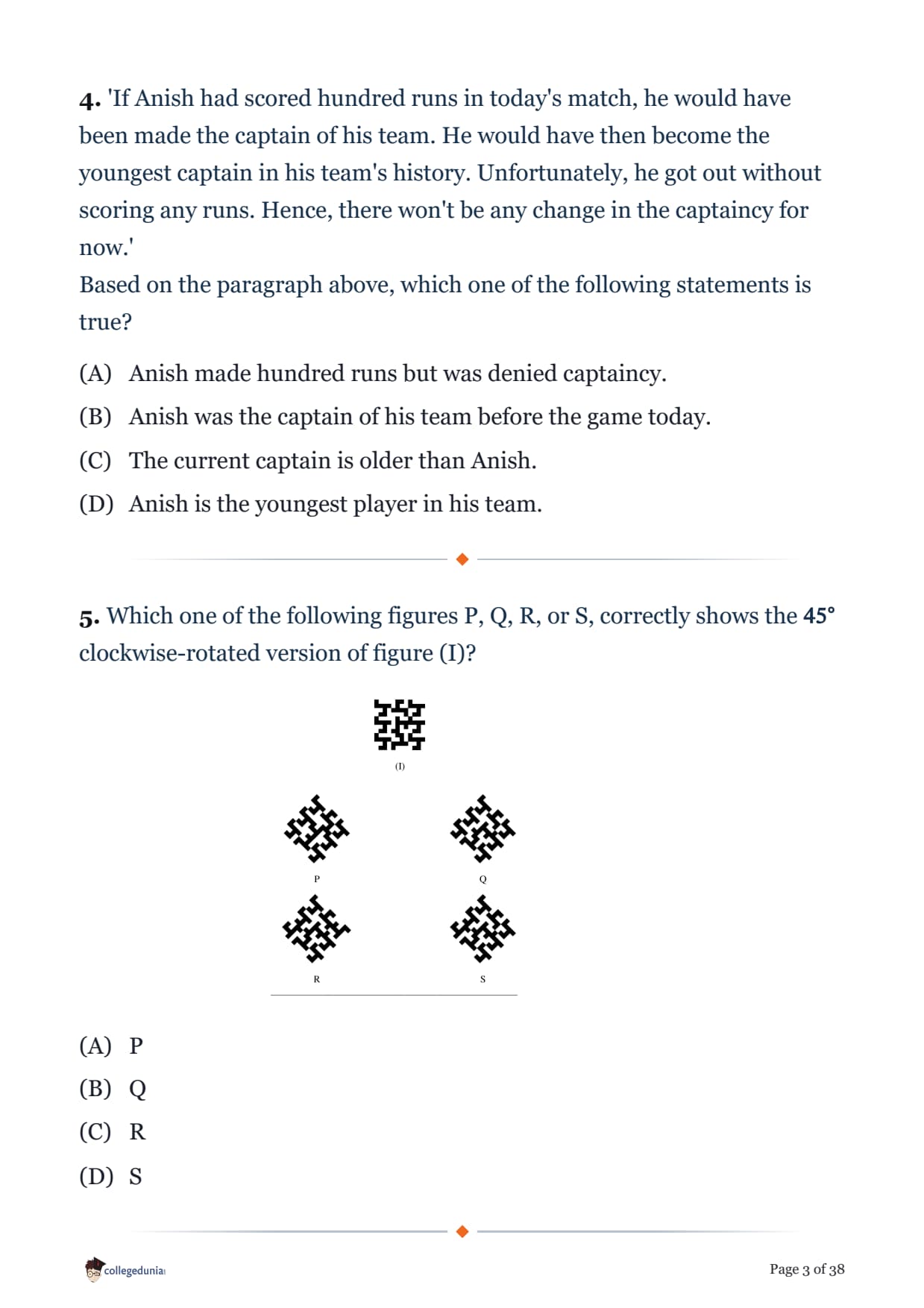
Which one of the following figures P, Q, R, or S, correctly shows the \( 45^\circ \) clockwise-rotated version of figure (I)?

Match the words in Column I with their synonyms in Column II.
| Column I | Column II |
|---|---|
| (i) Lonely | (p) Verbatim |
| (ii) Literal | (q) Solitary |
| (iii) Lousy | (r) Deadly |
| (iv) Lethal | (s) Terrible |
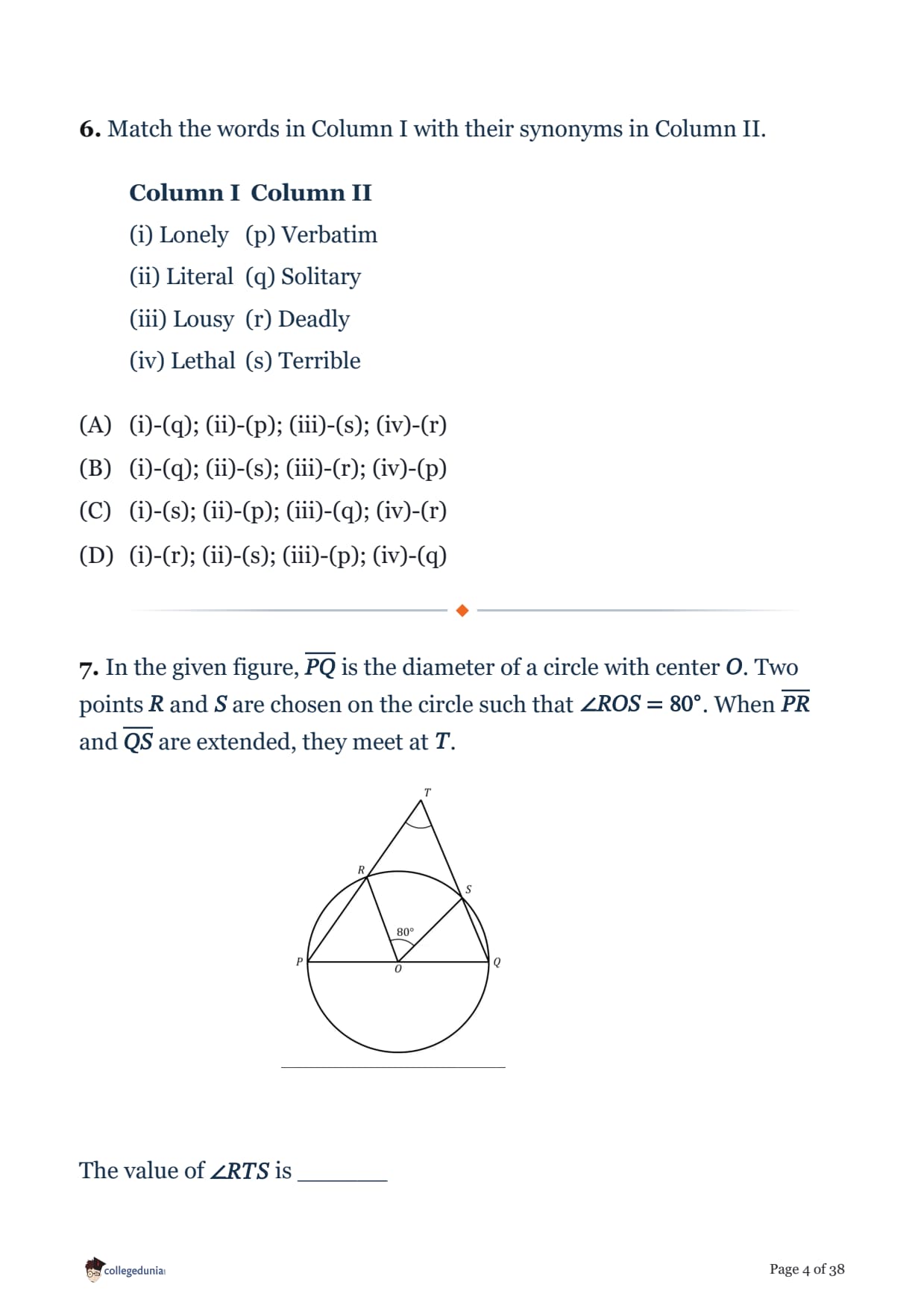
In the given figure, \(\overline{PQ}\) is the diameter of a circle with center \(O\). Two points \(R\) and \(S\) are chosen on the circle such that \(\angle ROS = 80^\circ\). When \(\overline{PR}\) and \(\overline{QS}\) are extended, they meet at \(T\).

The value of \(\angle RTS\) is ______
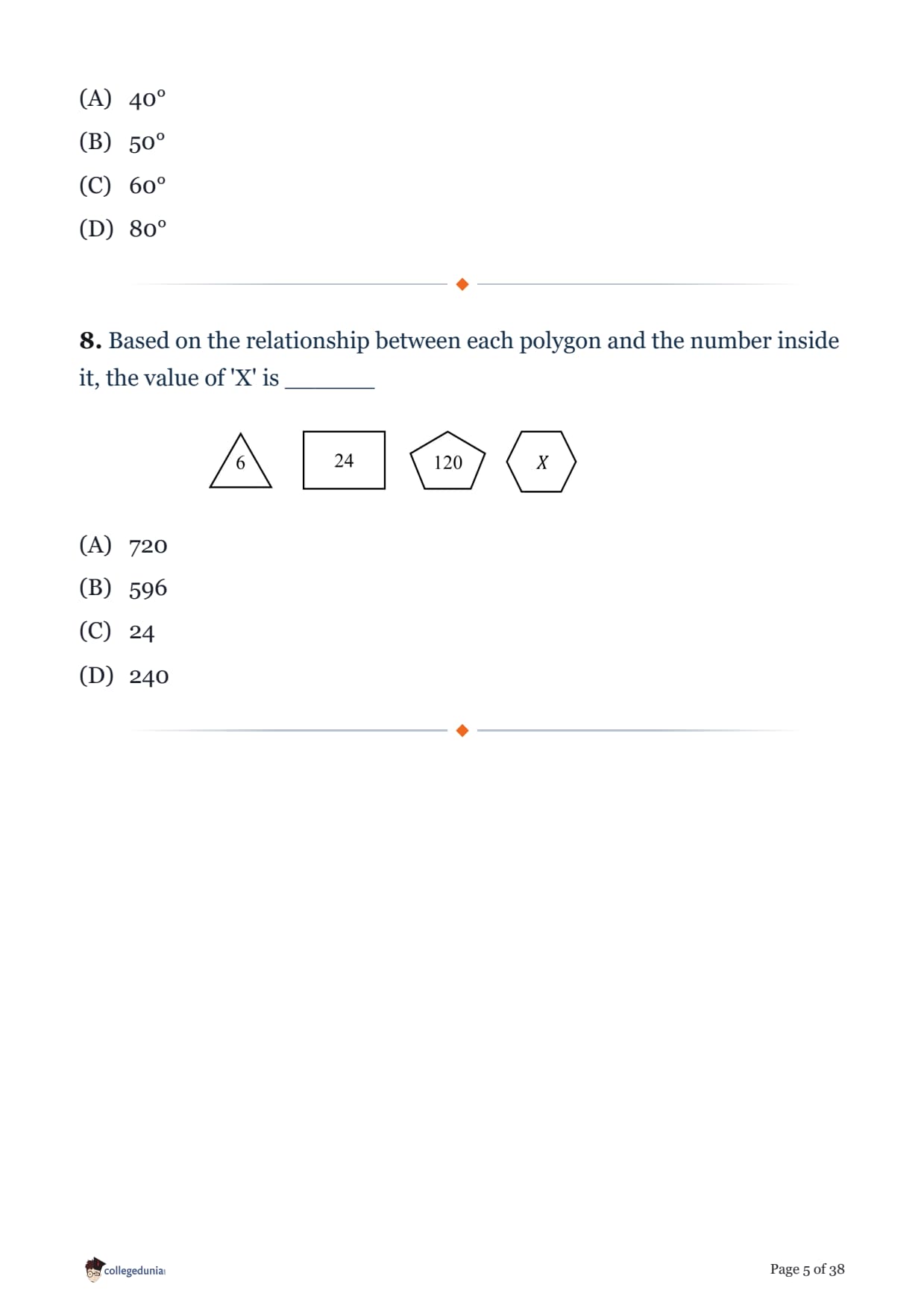
Based on the relationship between each polygon and the number inside it, the value of 'X' is ______

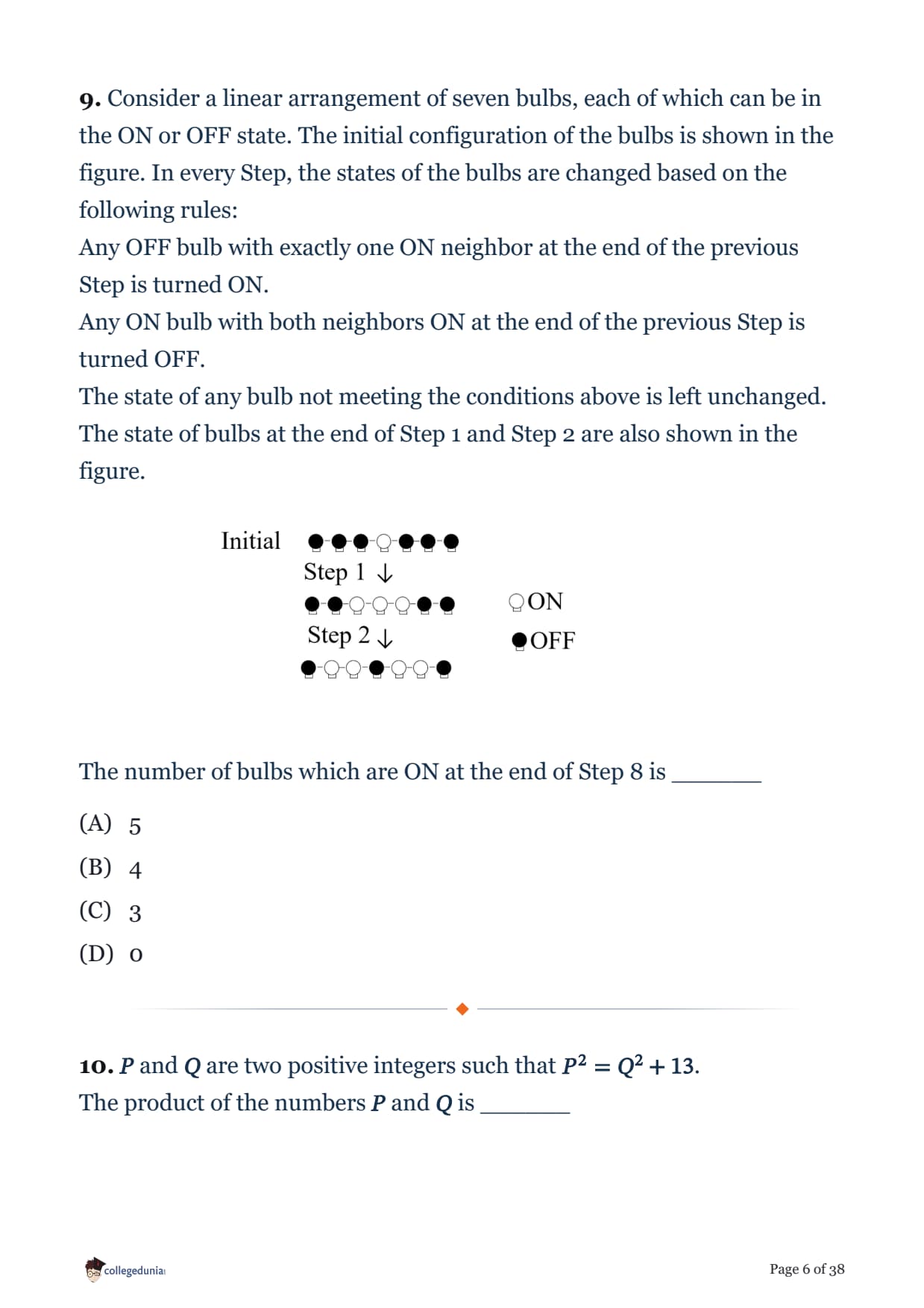
Consider a linear arrangement of seven bulbs, each of which can be in the ON or OFF state. The initial configuration of the bulbs is shown in the figure. In every Step, the states of the bulbs are changed based on the following rules:
Any OFF bulb with exactly one ON neighbor at the end of the previous Step is turned ON.
Any ON bulb with both neighbors ON at the end of the previous Step is turned OFF.
The state of any bulb not meeting the conditions above is left unchanged.
The state of bulbs at the end of Step 1 and Step 2 are also shown in the figure.

The number of bulbs which are ON at the end of Step 8 is ______
\(P\) and \(Q\) are two positive integers such that \(P^2 = Q^2 + 13\).
The product of the numbers \(P\) and \(Q\) is ______
Which ONE of the following steps is NOT a part of product concept selection?
Which ONE of the following is FALSE with respect to filler material used in brazing?
An arc welding process is being carried out with a power source of 6 kW to weld two similar metals. The total energy loss is 50%, the area of cross-section of the weld is \( 10 \ mm^2 \), and the specific energy needed to melt the metal is \( 15 \ J/mm^3 \).
The speed of welding is ______ mm/s.
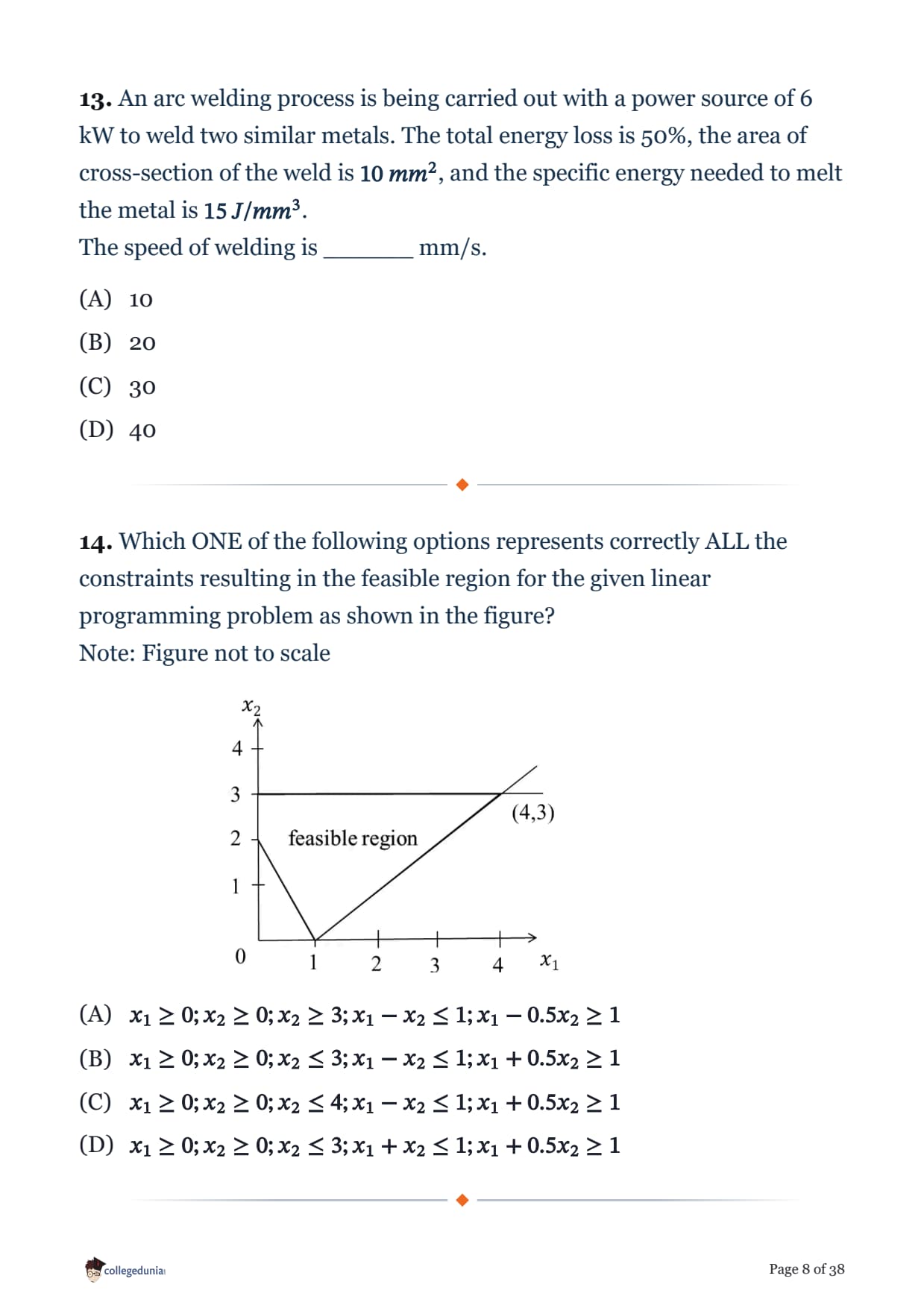
Which ONE of the following options represents correctly ALL the constraints resulting in the feasible region for the given linear programming problem as shown in the figure?
Note: Figure not to scale

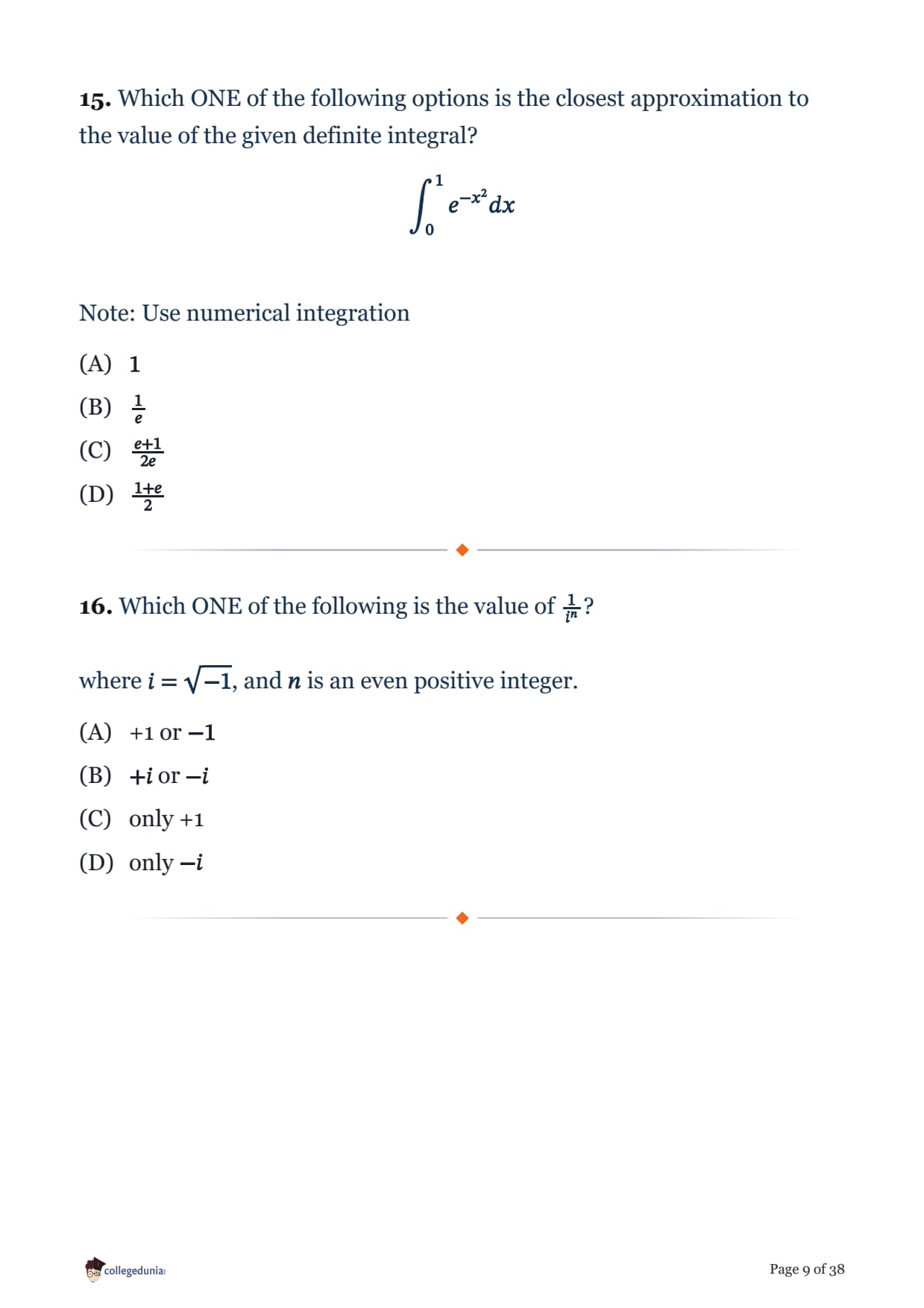
Which ONE of the following options is the closest approximation to the value of the given definite integral?
\[ \int_0^1 e^{-x^2} dx \]
Note: Use numerical integration
Which ONE of the following is the value of \( \frac{1}{i^n} \)?
where \( i = \sqrt{-1} \), and \( n \) is an even positive integer.
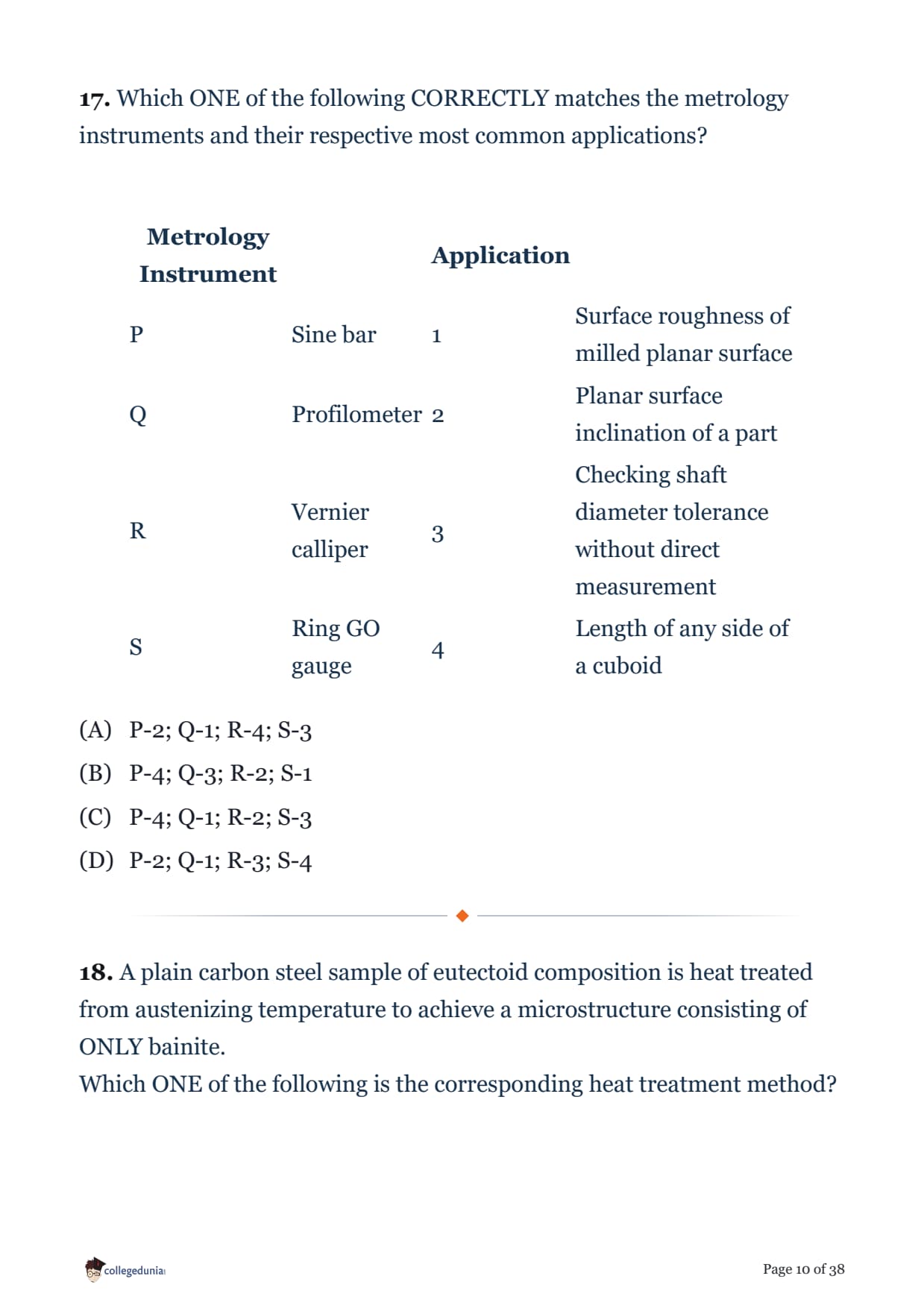
Which ONE of the following CORRECTLY matches the metrology instruments and their respective most common applications?
| Metrology Instrument | Application | ||
|---|---|---|---|
| P | Sine bar | 1 | Surface roughness of milled planar surface |
| Q | Profilometer | 2 | Planar surface inclination of a part |
| R | Vernier calliper | 3 | Checking shaft diameter tolerance without direct measurement |
| S | Ring GO gauge | 4 | Length of any side of a cuboid |
A plain carbon steel sample of eutectoid composition is heat treated from austenizing temperature to achieve a microstructure consisting of ONLY bainite.
Which ONE of the following is the corresponding heat treatment method?
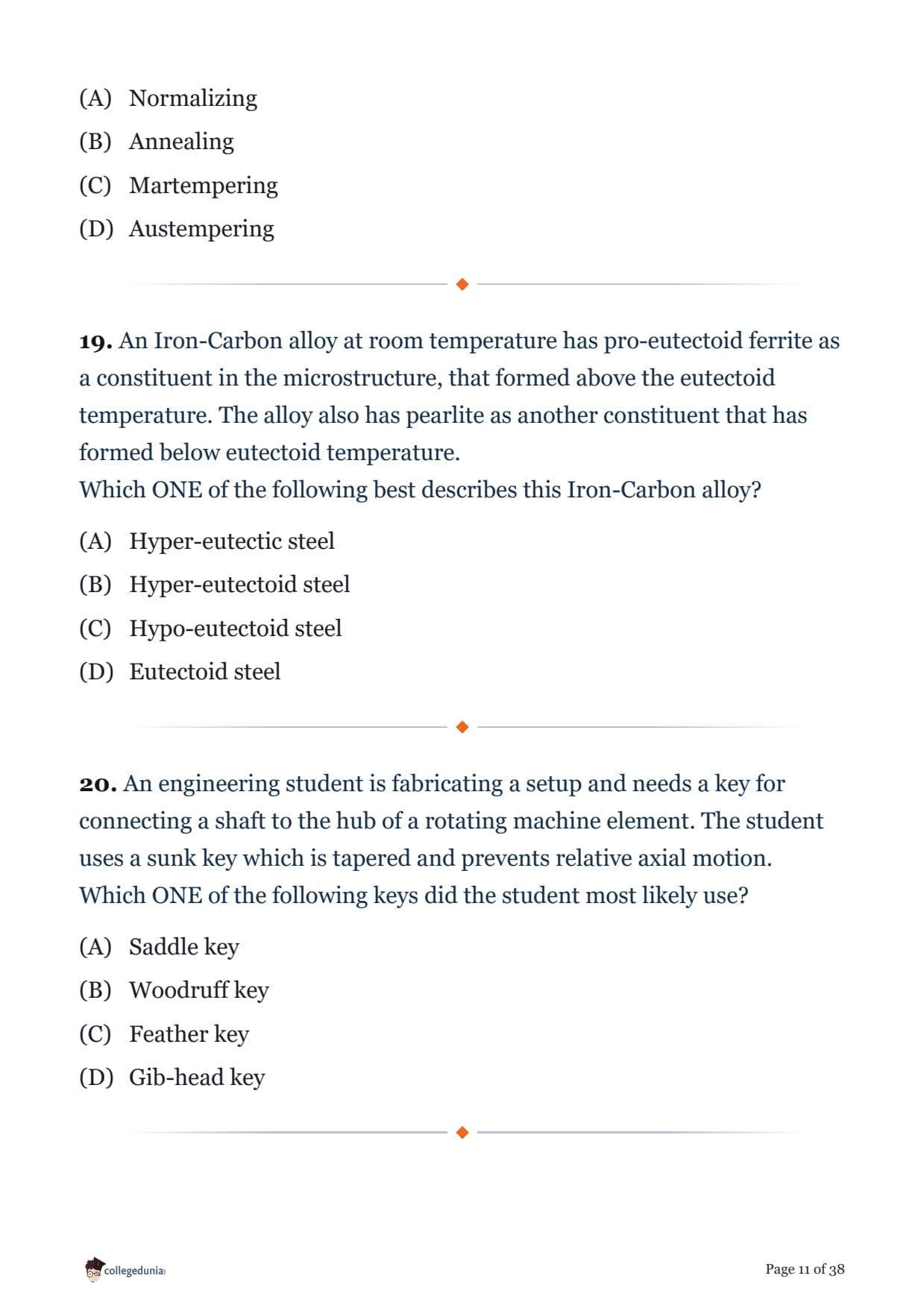
An Iron-Carbon alloy at room temperature has pro-eutectoid ferrite as a constituent in the microstructure, that formed above the eutectoid temperature. The alloy also has pearlite as another constituent that has formed below eutectoid temperature.
Which ONE of the following best describes this Iron-Carbon alloy?
An engineering student is fabricating a setup and needs a key for connecting a shaft to the hub of a rotating machine element. The student uses a sunk key which is tapered and prevents relative axial motion.
Which ONE of the following keys did the student most likely use?
The ratio of hydrostatic stress to volumetric strain is known as ______.
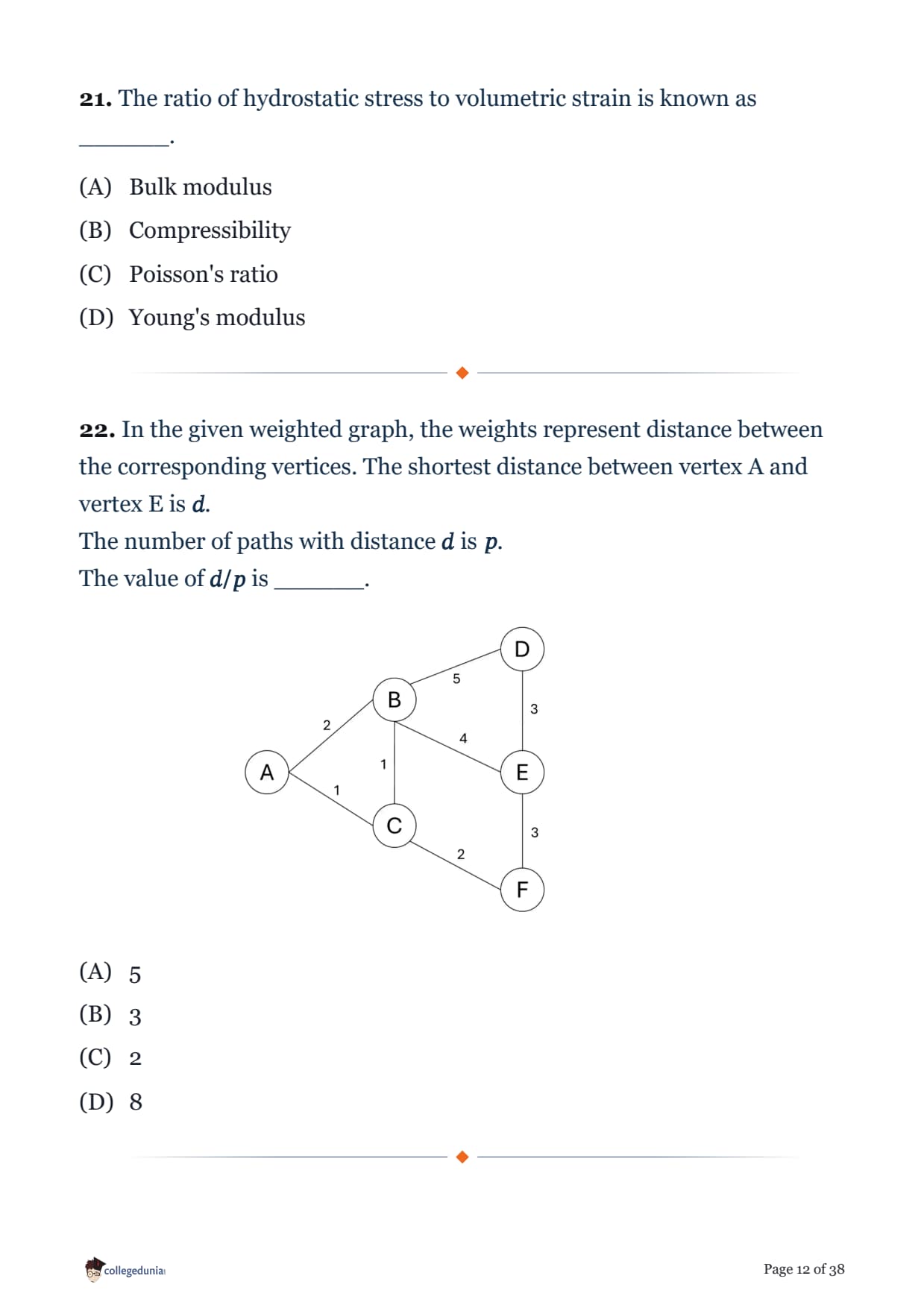
In the given weighted graph, the weights represent distance between the corresponding vertices. The shortest distance between vertex A and vertex E is \( d \).
The number of paths with distance \( d \) is \( p \).
The value of \( d/p \) is ______.

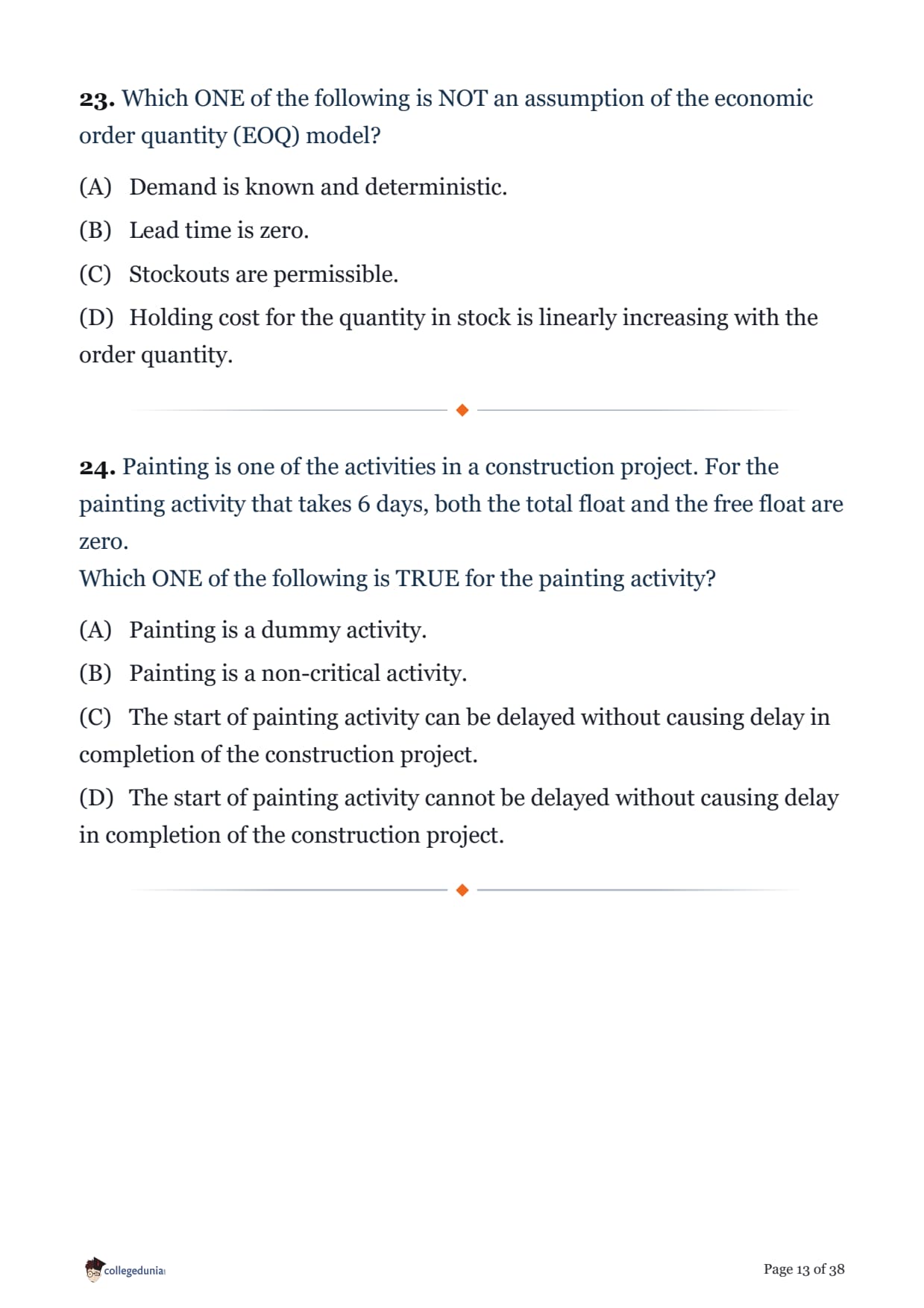
Which ONE of the following is NOT an assumption of the economic order quantity (EOQ) model?
Painting is one of the activities in a construction project. For the painting activity that takes 6 days, both the total float and the free float are zero.
Which ONE of the following is TRUE for the painting activity?
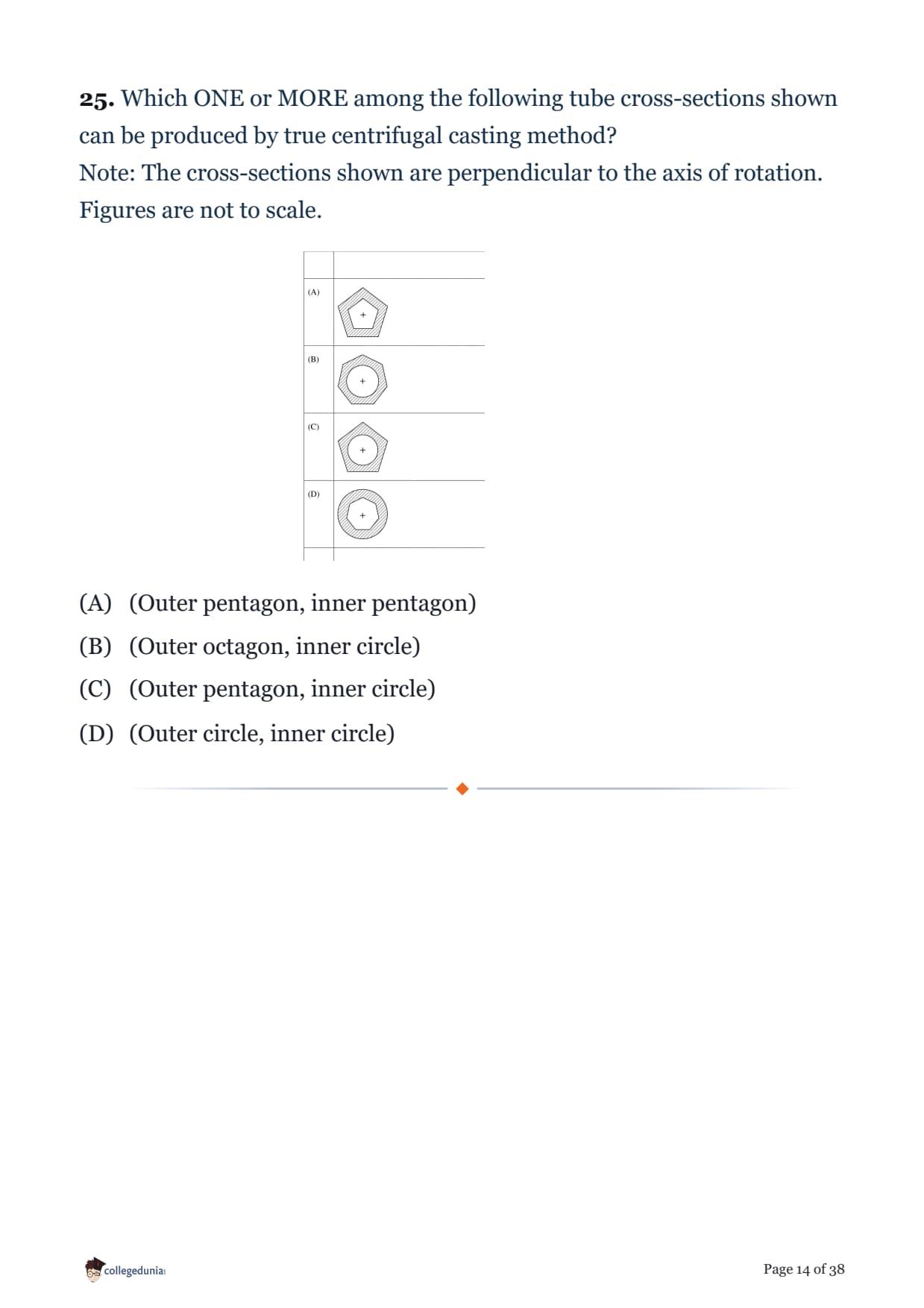
Which ONE or MORE among the following tube cross-sections shown can be produced by true centrifugal casting method?
Note: The cross-sections shown are perpendicular to the axis of rotation. Figures are not to scale.

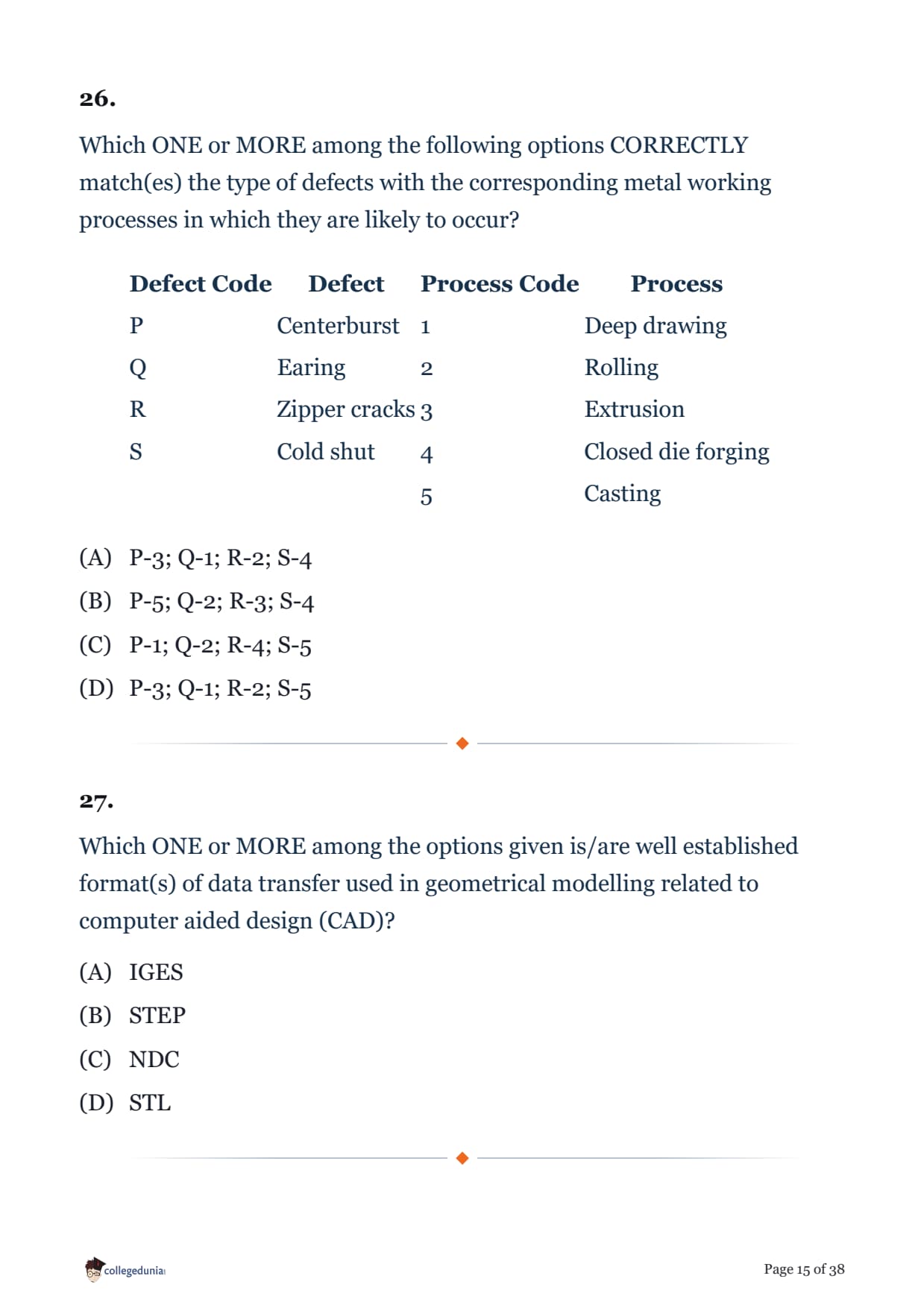
Which ONE or MORE among the following options CORRECTLY match(es) the type of defects with the corresponding metal working processes in which they are likely to occur?
| Defect Code | Defect | Process Code | Process |
|---|---|---|---|
| P | Centerburst | 1 | Deep drawing |
| Q | Earing | 2 | Rolling |
| R | Zipper cracks | 3 | Extrusion |
| S | Cold shut | 4 | Closed die forging |
| 5 | Casting |
Which ONE or MORE among the options given is/are well established format(s) of data transfer used in geometrical modelling related to computer aided design (CAD)?
In statistical analysis of numerical data, which ONE or MORE among the options is/are possible value(s) of correlation coefficient?
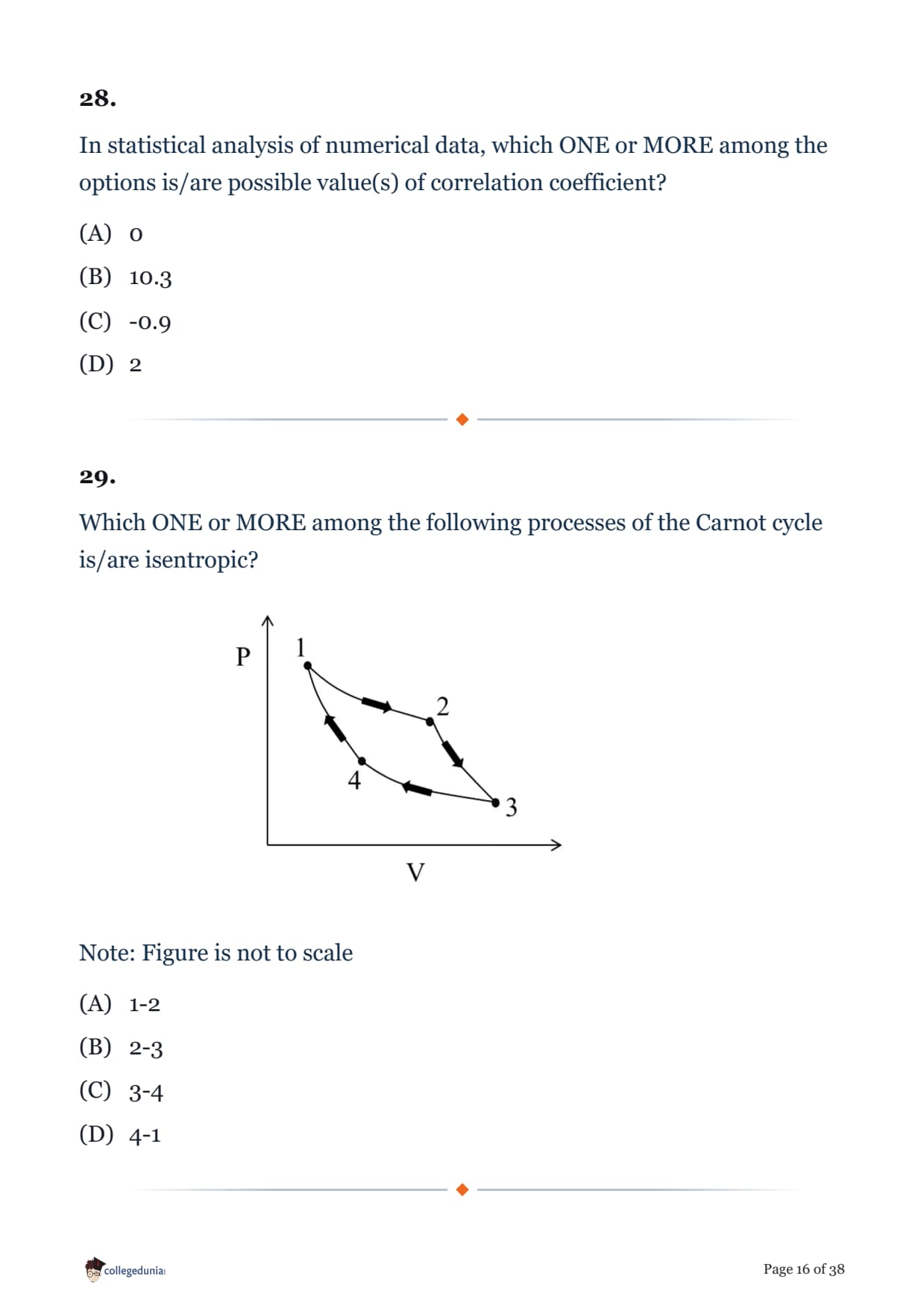
Which ONE or MORE among the following processes of the Carnot cycle is/are isentropic?

Note: Figure is not to scale
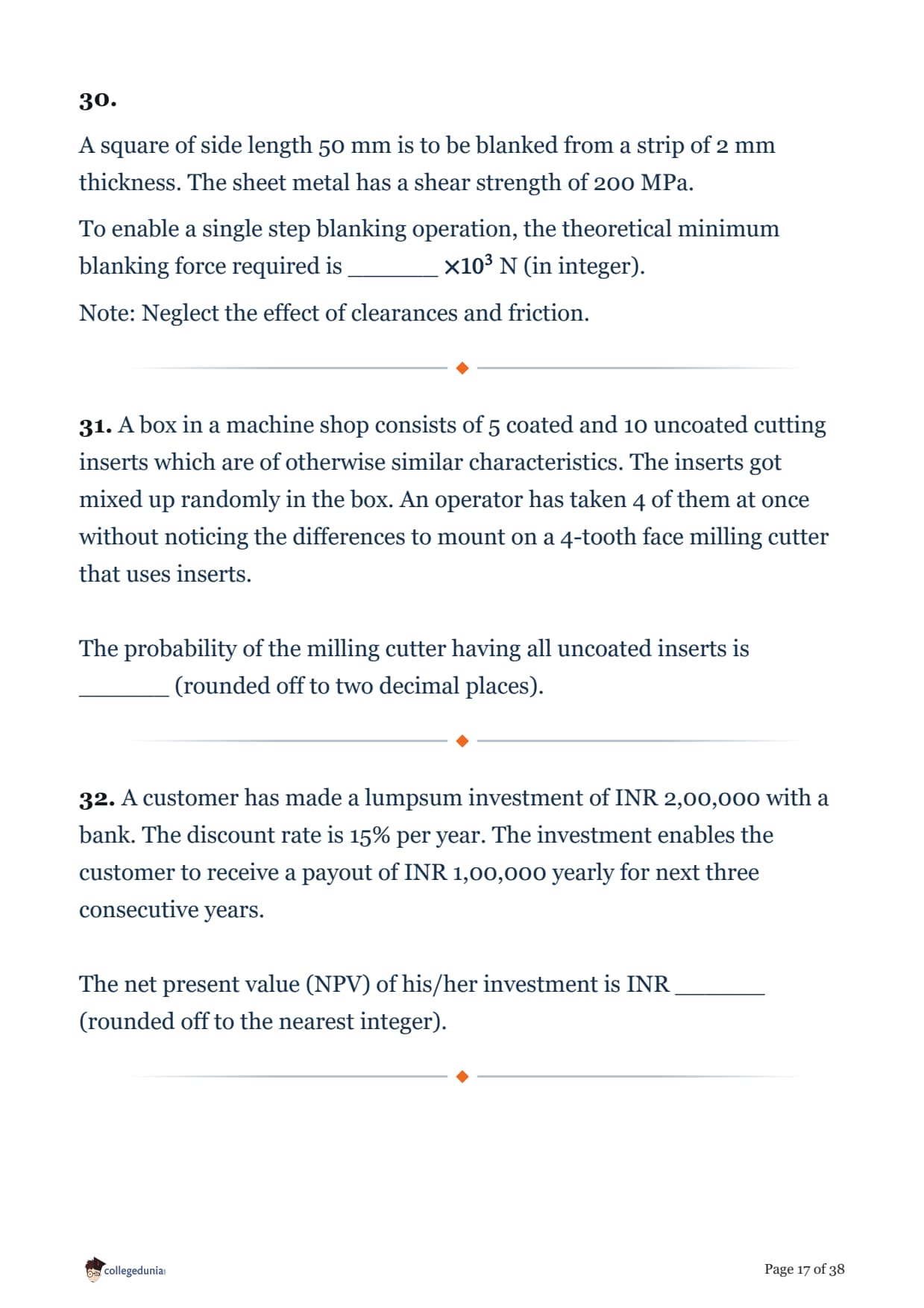
A square of side length 50 mm is to be blanked from a strip of 2 mm thickness. The sheet metal has a shear strength of 200 MPa.
To enable a single step blanking operation, the theoretical minimum blanking force required is ______ \( \times 10^3 \) N (in integer).
Note: Neglect the effect of clearances and friction.
A box in a machine shop consists of 5 coated and 10 uncoated cutting inserts which are of otherwise similar characteristics. The inserts got mixed up randomly in the box. An operator has taken 4 of them at once without noticing the differences to mount on a 4-tooth face milling cutter that uses inserts.
The probability of the milling cutter having all uncoated inserts is ______ (rounded off to two decimal places).
A customer has made a lumpsum investment of INR 2,00,000 with a bank. The discount rate is 15% per year. The investment enables the customer to receive a payout of INR 1,00,000 yearly for next three consecutive years.
The net present value (NPV) of his/her investment is INR ______ (rounded off to the nearest integer).
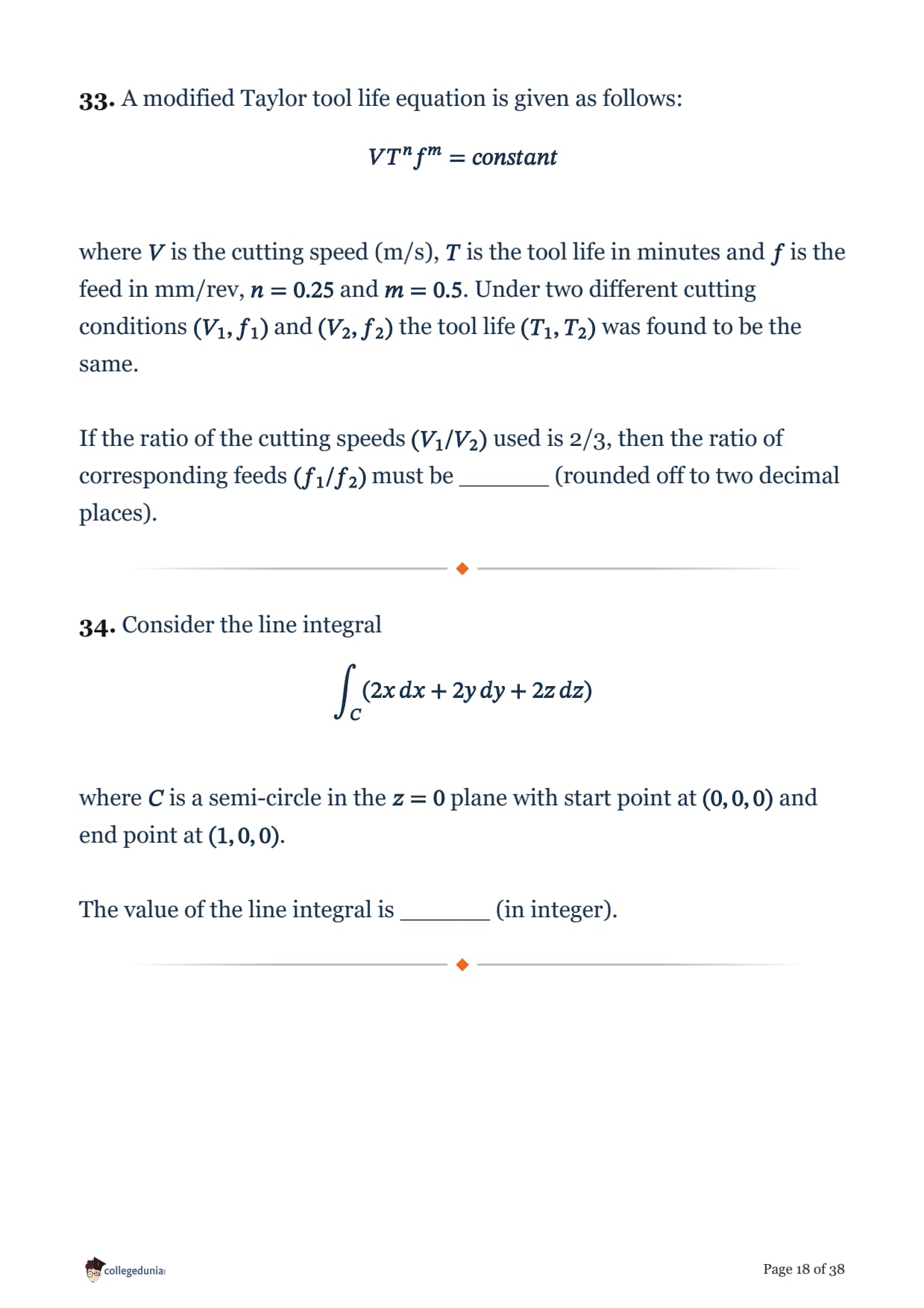
A modified Taylor tool life equation is given as follows:
\[ V T^n f^m = constant \]
where \( V \) is the cutting speed (m/s), \( T \) is the tool life in minutes and \( f \) is the feed in mm/rev, \( n = 0.25 \) and \( m = 0.5 \). Under two different cutting conditions \( (V_1, f_1) \) and \( (V_2, f_2) \) the tool life \( (T_1, T_2) \) was found to be the same.
If the ratio of the cutting speeds \( (V_1/V_2) \) used is 2/3, then the ratio of corresponding feeds \( (f_1/f_2) \) must be ______ (rounded off to two decimal places).
Consider the line integral
\[ \int_C (2x\, dx + 2y\, dy + 2z\, dz) \]
where \( C \) is a semi-circle in the \( z = 0 \) plane with start point at \( (0, 0, 0) \) and end point at \( (1, 0, 0) \).
The value of the line integral is ______ (in integer).
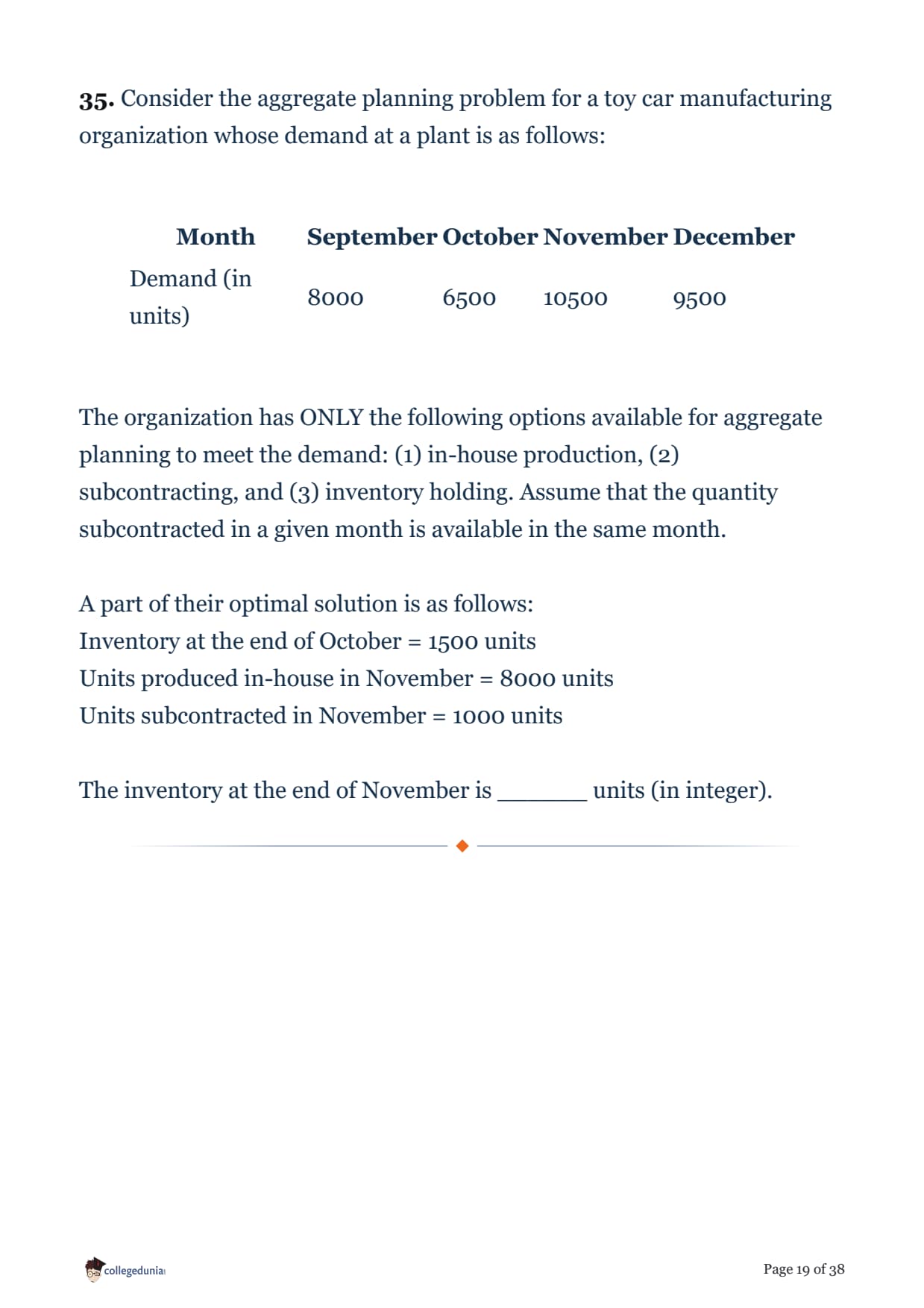
Consider the aggregate planning problem for a toy car manufacturing organization whose demand at a plant is as follows:
| Month | September | October | November | December |
|---|---|---|---|---|
| Demand (in units) | 8000 | 6500 | 10500 | 9500 |
The organization has ONLY the following options available for aggregate planning to meet the demand: (1) in-house production, (2) subcontracting, and (3) inventory holding. Assume that the quantity subcontracted in a given month is available in the same month.
A part of their optimal solution is as follows:
Inventory at the end of October = 1500 units
Units produced in-house in November = 8000 units
Units subcontracted in November = 1000 units
The inventory at the end of November is ______ units (in integer).
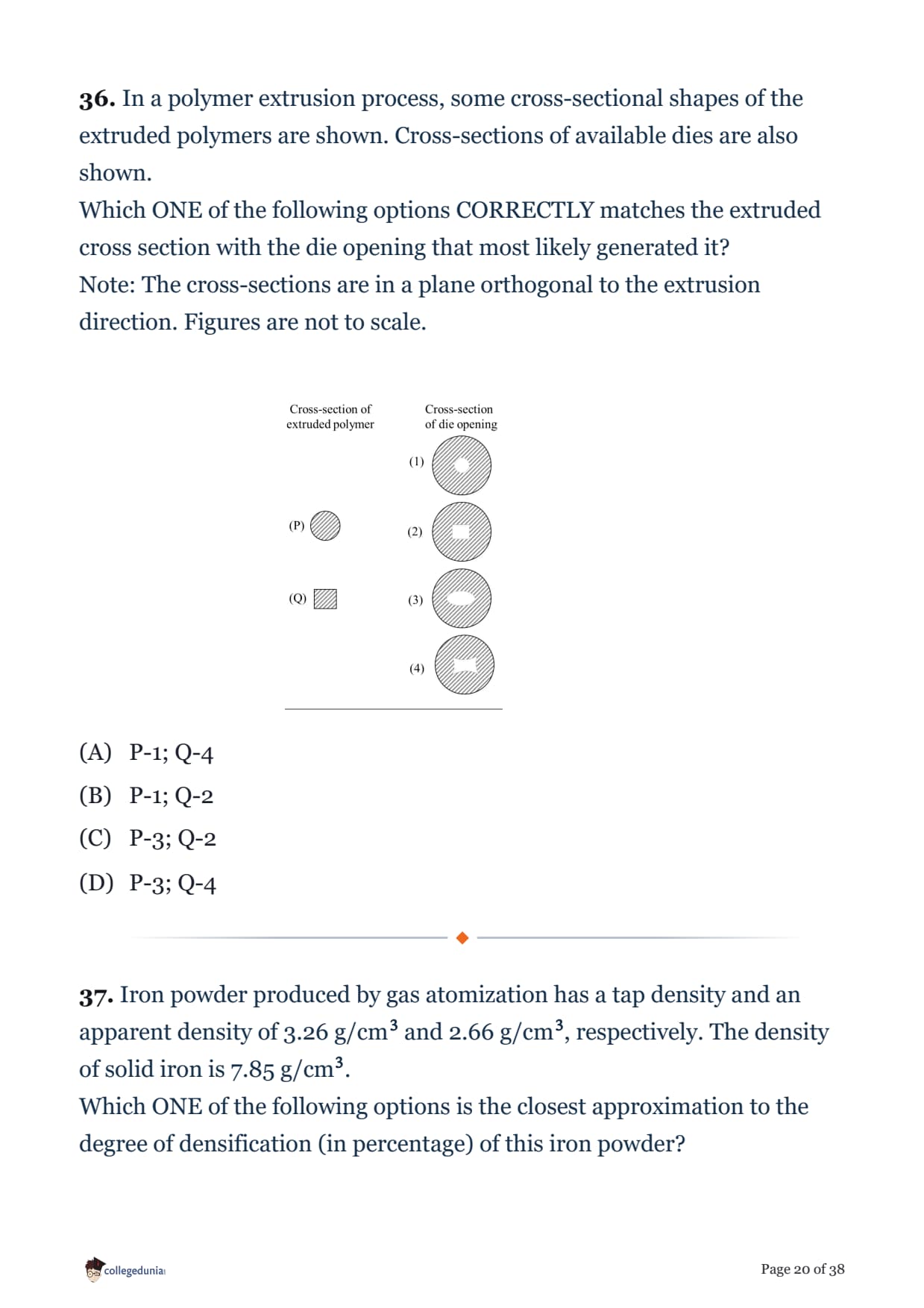
In a polymer extrusion process, some cross-sectional shapes of the extruded polymers are shown. Cross-sections of available dies are also shown.
Which ONE of the following options CORRECTLY matches the extruded cross section with the die opening that most likely generated it?
Note: The cross-sections are in a plane orthogonal to the extrusion direction. Figures are not to scale.

Iron powder produced by gas atomization has a tap density and an apparent density of 3.26 g/cm\(^3\) and 2.66 g/cm\(^3\), respectively. The density of solid iron is 7.85 g/cm\(^3\).
Which ONE of the following options is the closest approximation to the degree of densification (in percentage) of this iron powder?
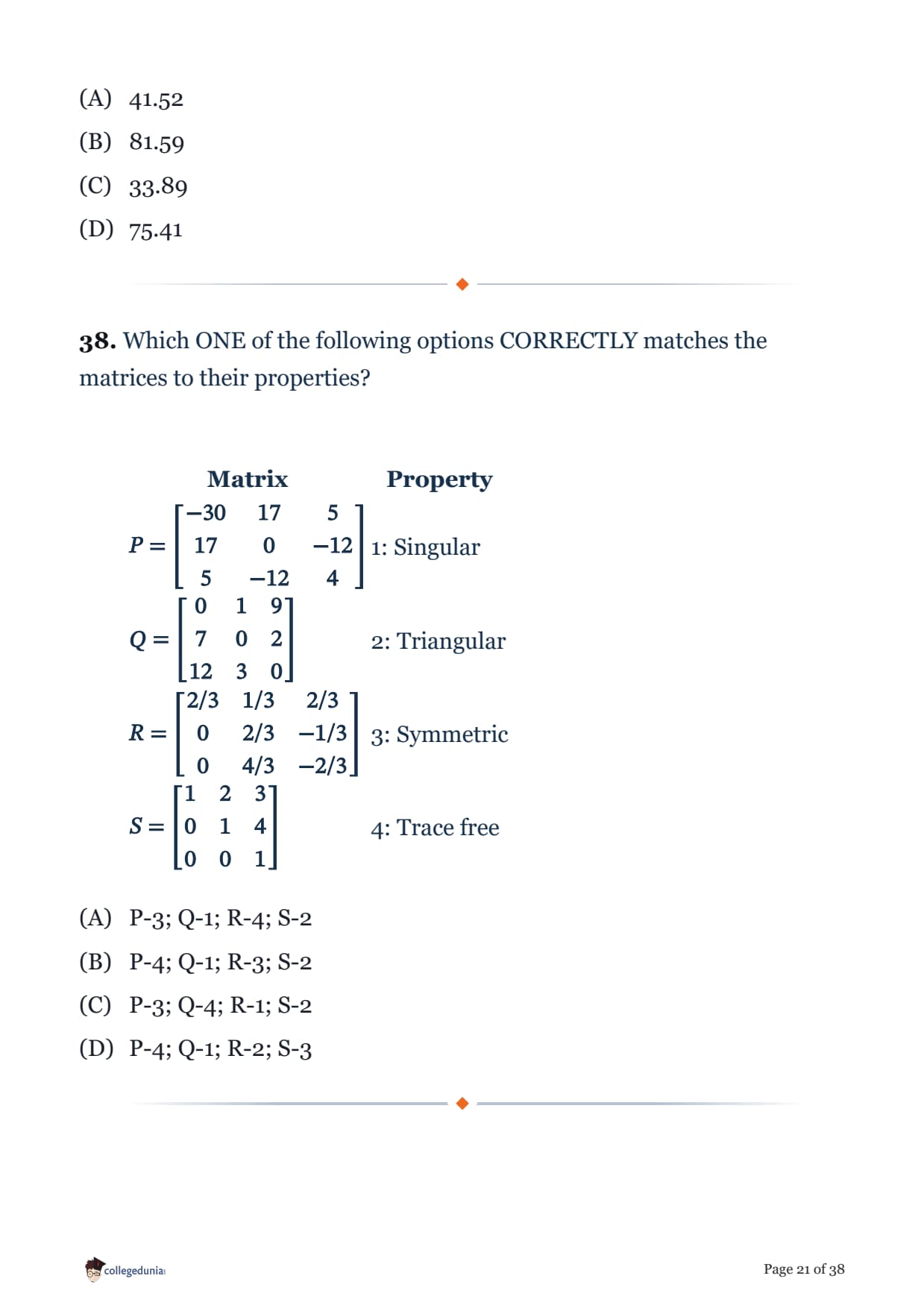
Which ONE of the following options CORRECTLY matches the matrices to their properties?
| Matrix | Property |
|---|---|
| \( P = \begin{bmatrix} -30 & 17 & 5 \\ 17 & 0 & -12 \\ 5 & -12 & 4 \end{bmatrix} \) | 1: Singular |
| \( Q = \begin{bmatrix} 0 & 1 & 9 \\ 7 & 0 & 2 \\ 12 & 3 & 0 \end{bmatrix} \) | 2: Triangular |
| \( R = \begin{bmatrix} 2/3 & 1/3 & 2/3 \\ 0 & 2/3 & -1/3 \\ 0 & 4/3 & -2/3 \end{bmatrix} \) | 3: Symmetric |
| \( S = \begin{bmatrix} 1 & 2 & 3 \\ 0 & 1 & 4 \\ 0 & 0 & 1 \end{bmatrix} \) | 4: Trace free |
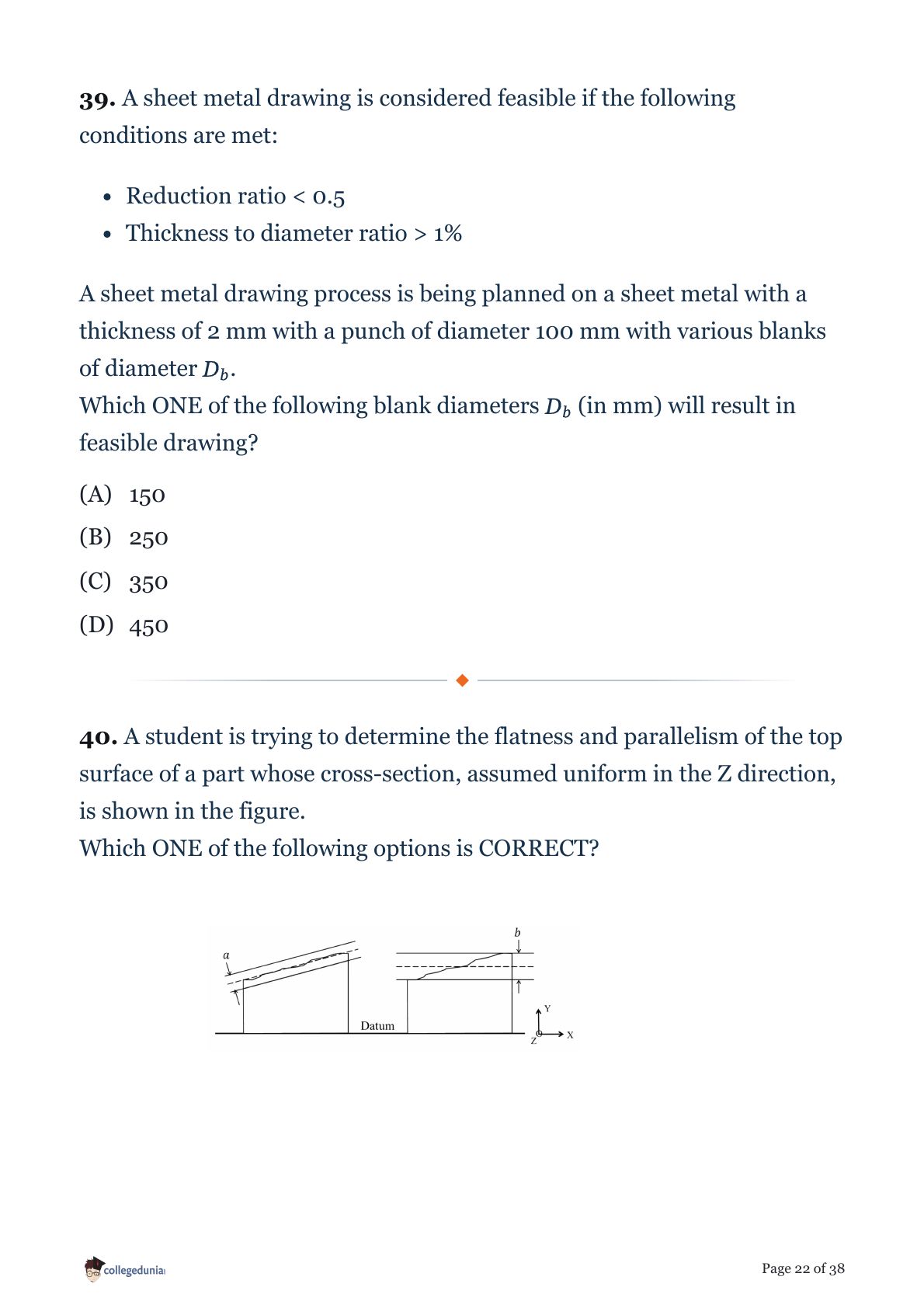
A sheet metal drawing is considered feasible if the following conditions are met:
- Reduction ratio < 0.5
- Thickness to diameter ratio > 1%
Which ONE of the following blank diameters \( D_b \) (in mm) will result in feasible drawing?
A student is trying to determine the flatness and parallelism of the top surface of a part whose cross-section, assumed uniform in the Z direction, is shown in the figure.
Which ONE of the following options is CORRECT?

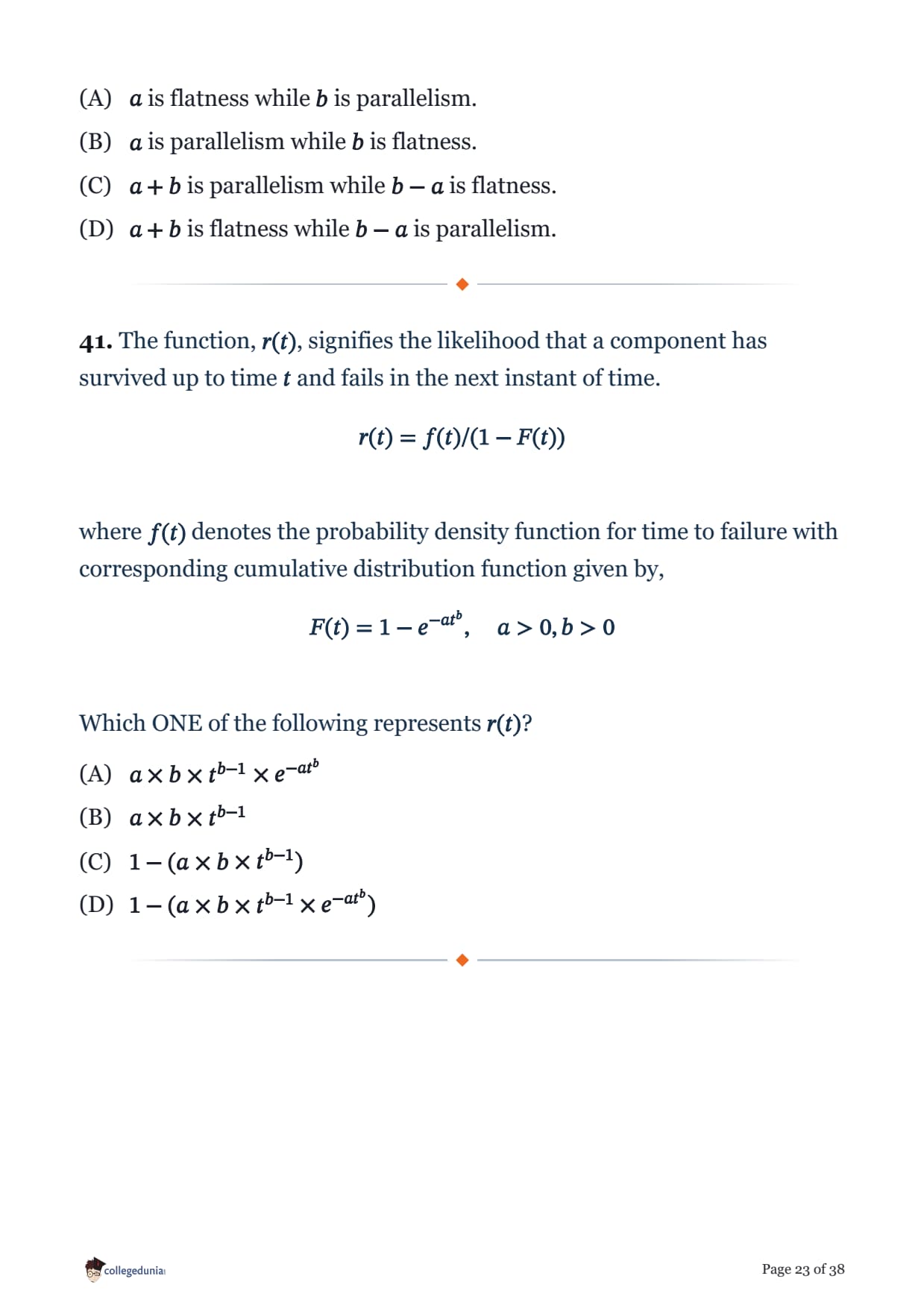
The function, \( r(t) \), signifies the likelihood that a component has survived up to time \( t \) and fails in the next instant of time.
\[ r(t) = f(t) / (1 - F(t)) \]
where \( f(t) \) denotes the probability density function for time to failure with corresponding cumulative distribution function given by,
\[ F(t) = 1 - e^{-at^b}, \quad a > 0, b > 0 \]
Which ONE of the following represents \( r(t) \)?
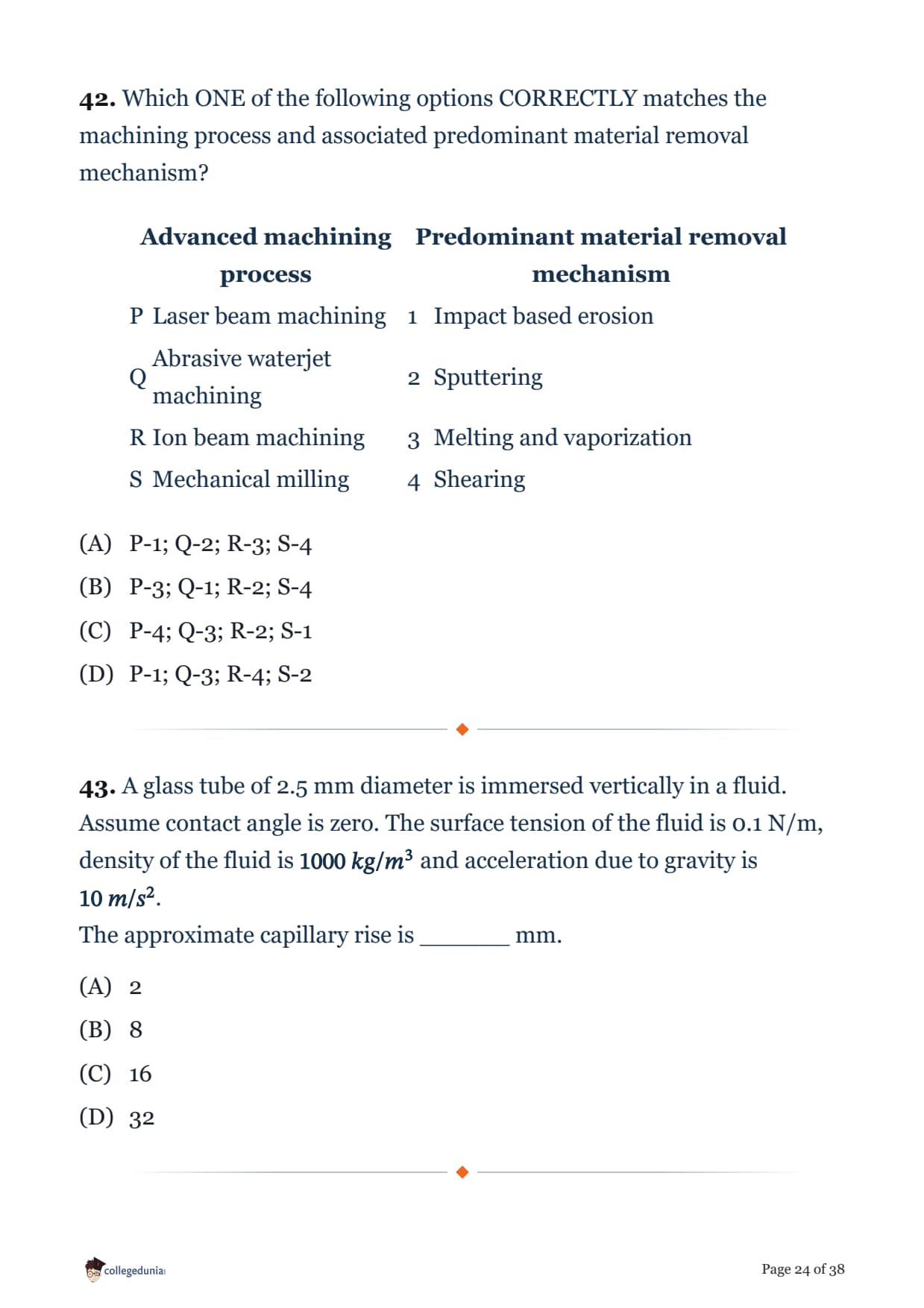
Which ONE of the following options CORRECTLY matches the machining process and associated predominant material removal mechanism?
| Advanced machining process | Predominant material removal mechanism | ||
|---|---|---|---|
| P | Laser beam machining | 1 | Impact based erosion |
| Q | Abrasive waterjet machining | 2 | Sputtering |
| R | Ion beam machining | 3 | Melting and vaporization |
| S | Mechanical milling | 4 | Shearing |
A glass tube of 2.5 mm diameter is immersed vertically in a fluid.
Assume contact angle is zero. The surface tension of the fluid is 0.1 N/m, density of the fluid is \( 1000\ kg/m^3 \) and acceleration due to gravity is \( 10\ m/s^2 \).
The approximate capillary rise is ______ mm.
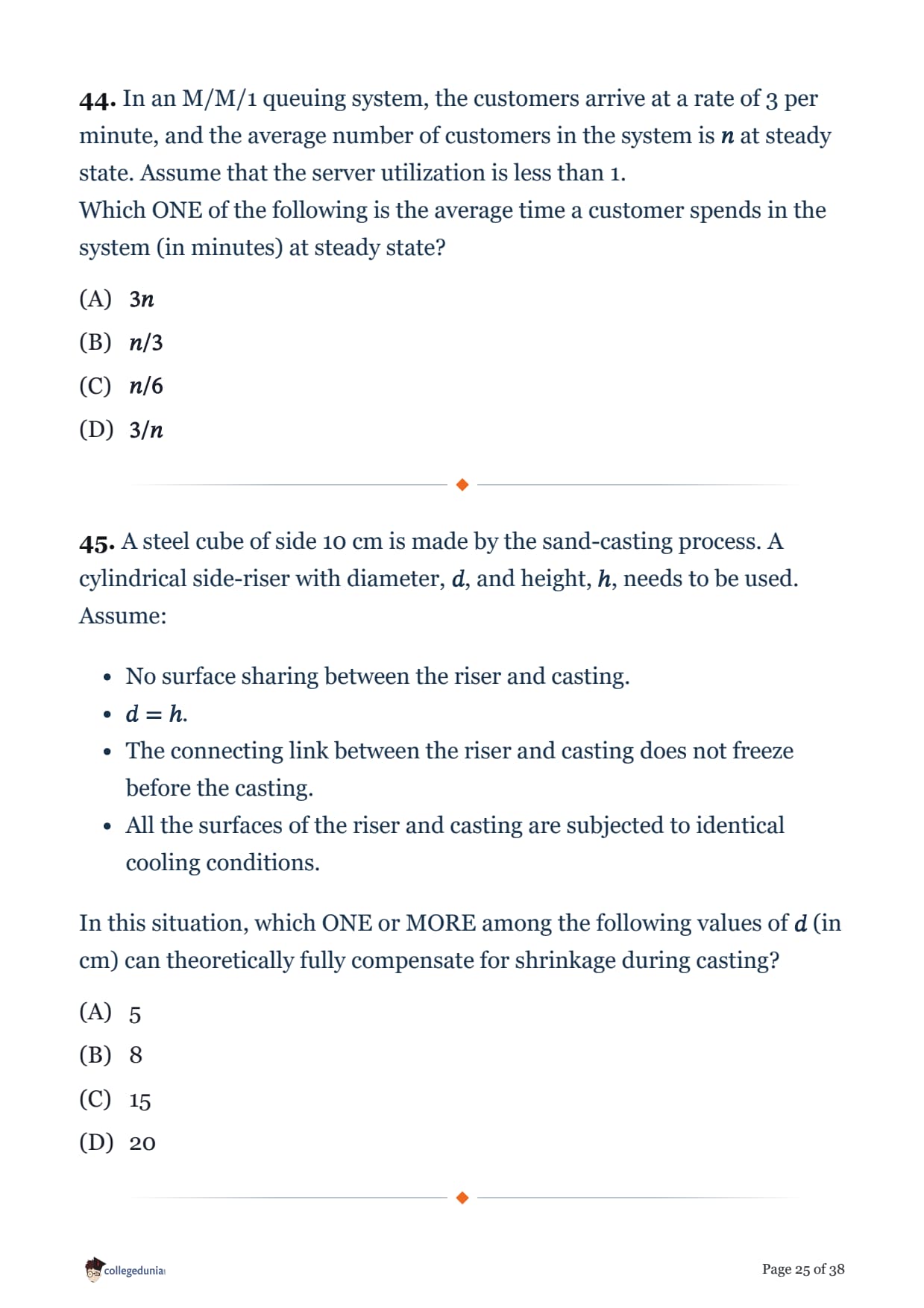
In an M/M/1 queuing system, the customers arrive at a rate of 3 per minute, and the average number of customers in the system is \( n \) at steady state. Assume that the server utilization is less than 1.
Which ONE of the following is the average time a customer spends in the system (in minutes) at steady state?
A steel cube of side 10 cm is made by the sand-casting process. A cylindrical side-riser with diameter, \( d \), and height, \( h \), needs to be used.
Assume:
- No surface sharing between the riser and casting.
- \( d = h \).
- The connecting link between the riser and casting does not freeze before the casting.
- All the surfaces of the riser and casting are subjected to identical cooling conditions.
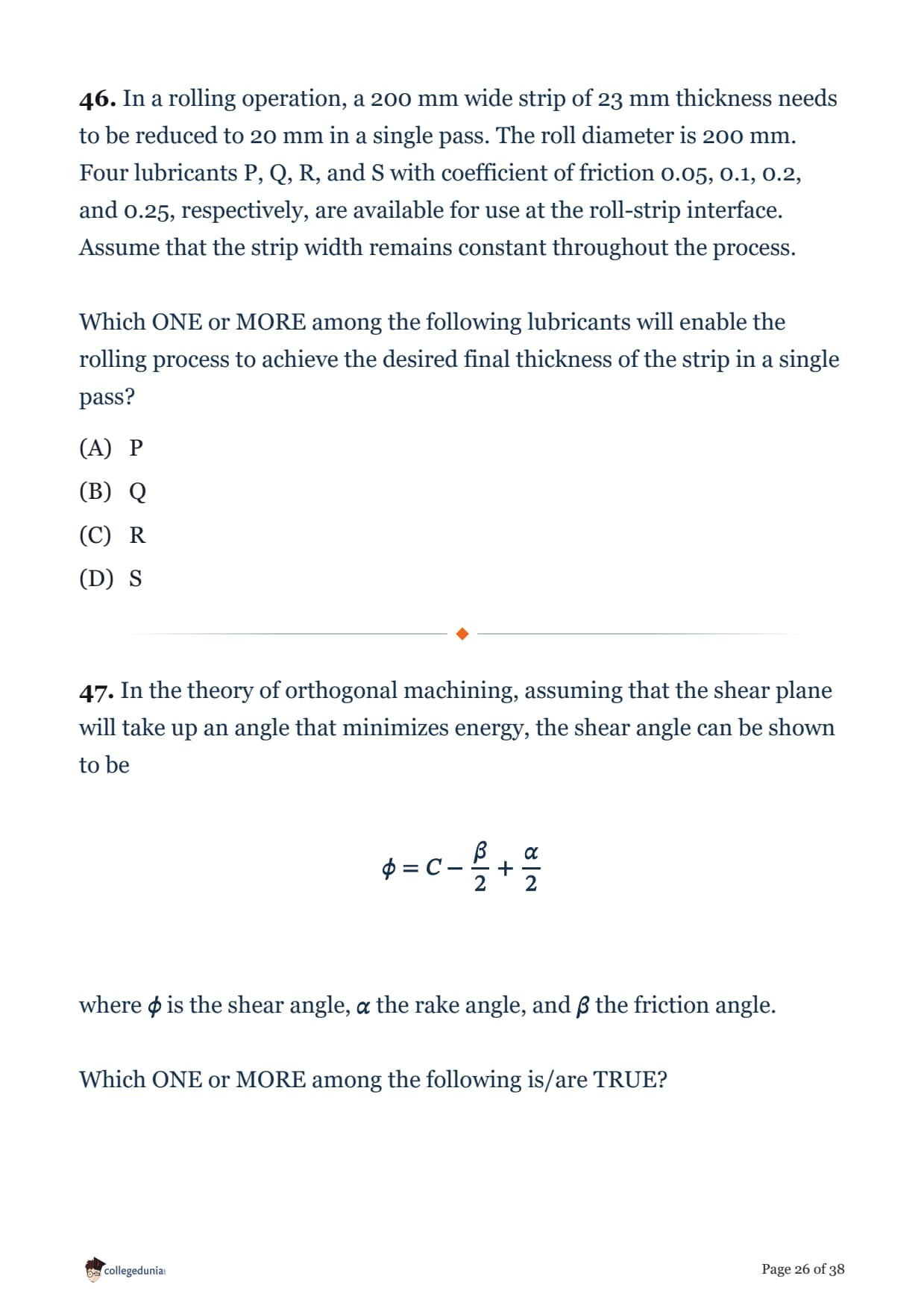
In a rolling operation, a 200 mm wide strip of 23 mm thickness needs to be reduced to 20 mm in a single pass. The roll diameter is 200 mm. Four lubricants P, Q, R, and S with coefficient of friction 0.05, 0.1, 0.2, and 0.25, respectively, are available for use at the roll-strip interface. Assume that the strip width remains constant throughout the process.
Which ONE or MORE among the following lubricants will enable the rolling process to achieve the desired final thickness of the strip in a single pass?
In the theory of orthogonal machining, assuming that the shear plane will take up an angle that minimizes energy, the shear angle can be shown to be
\[ \phi = C - \frac{\beta}{2} + \frac{\alpha}{2} \]
where \( \phi \) is the shear angle, \( \alpha \) the rake angle, and \( \beta \) the friction angle.
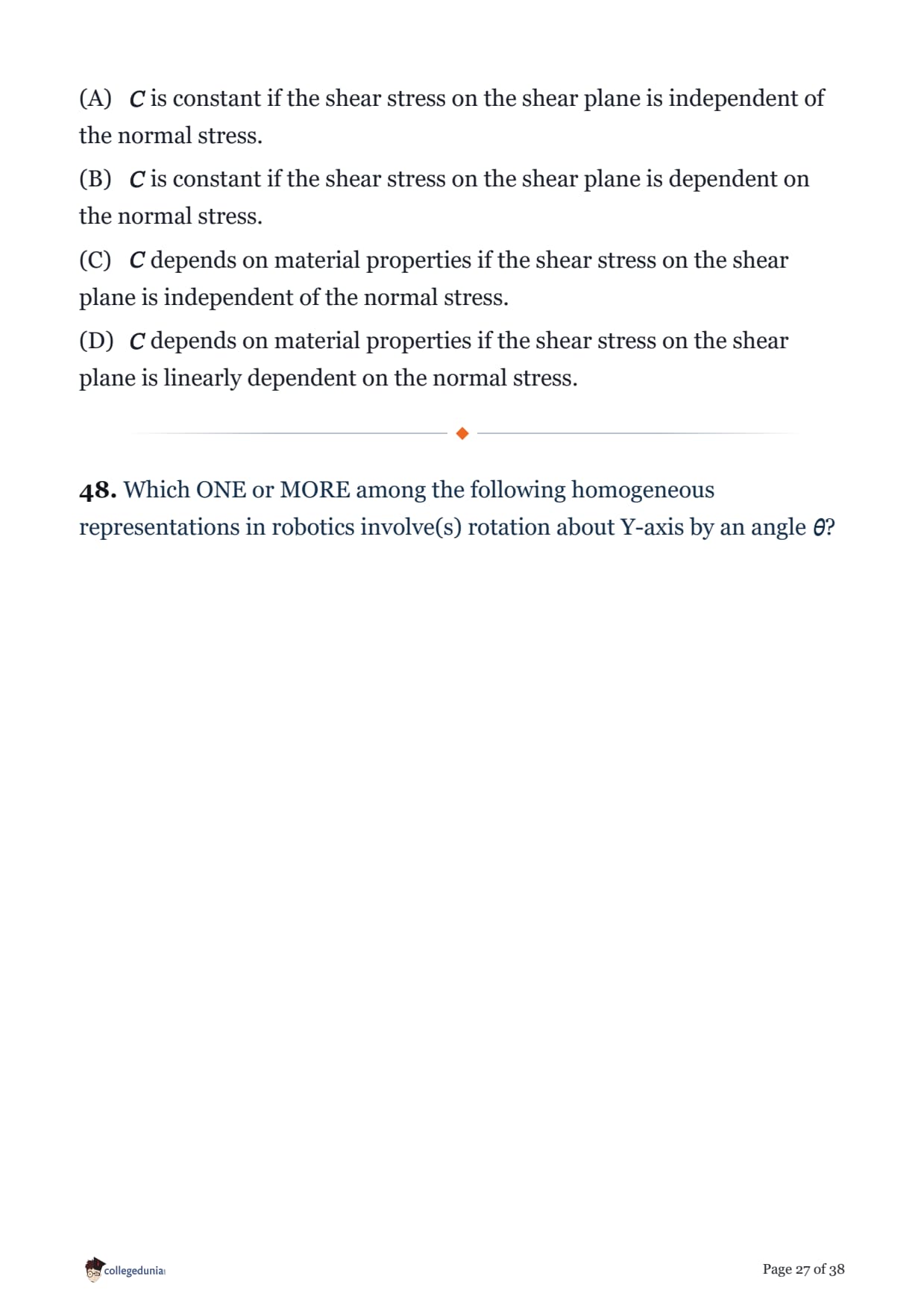
Which ONE or MORE among the following is/are TRUE?
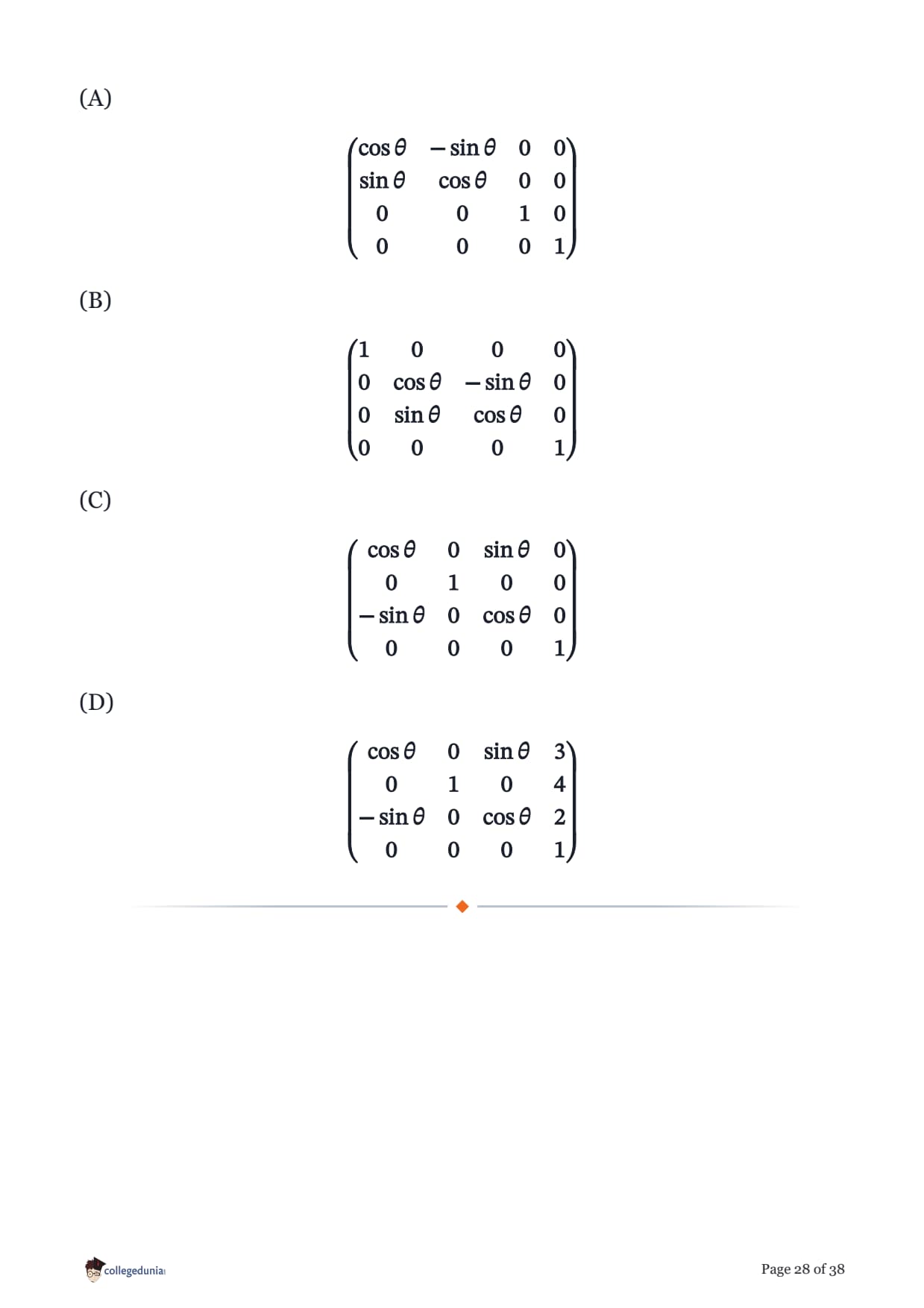
Which ONE or MORE among the following homogeneous representations in robotics involve(s) rotation about Y-axis by an angle \( \theta \)?
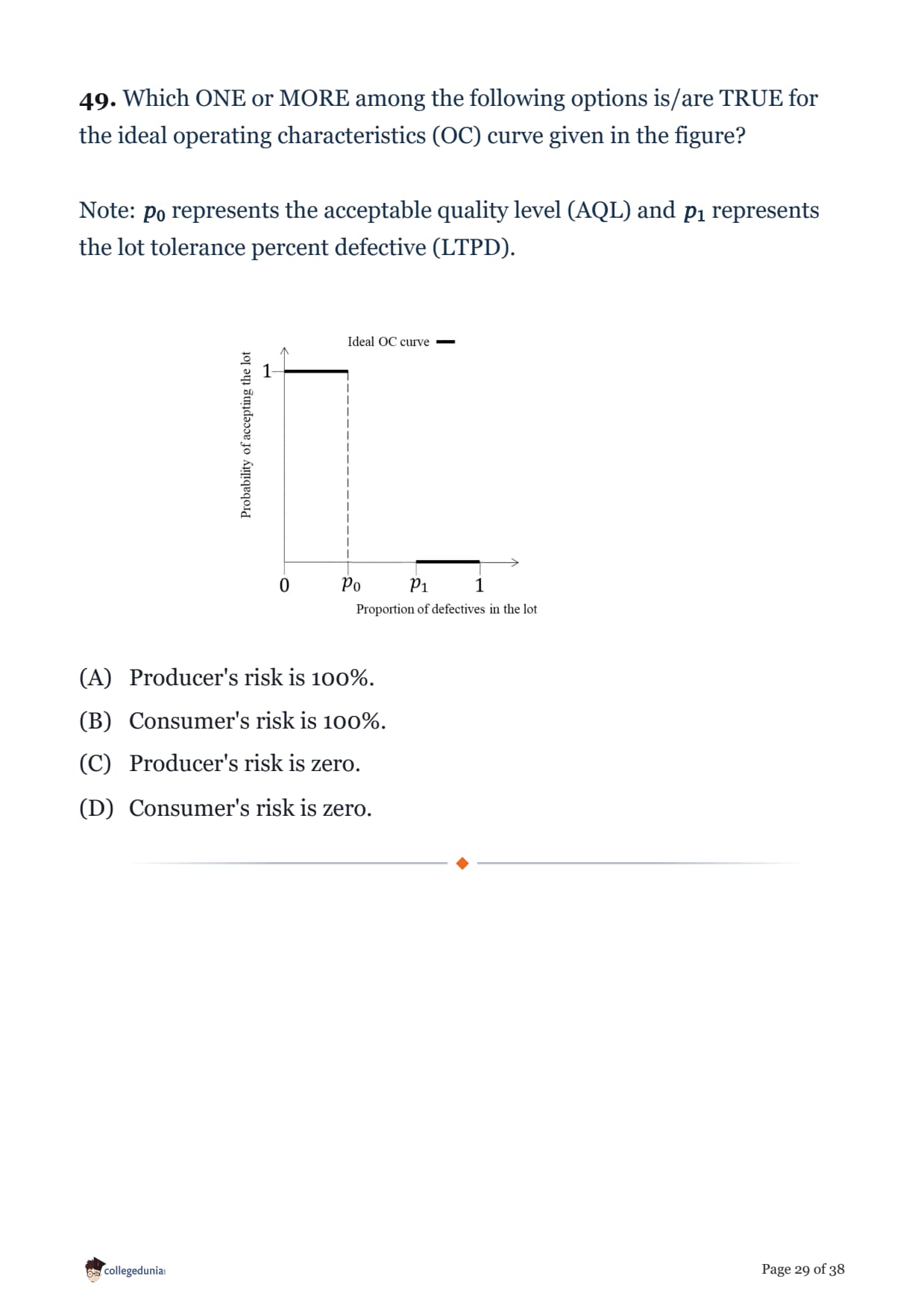
Which ONE or MORE among the following options is/are TRUE for the ideal operating characteristics (OC) curve given in the figure?
Note: \( p_0 \) represents the acceptable quality level (AQL) and \( p_1 \) represents the lot tolerance percent defective (LTPD).

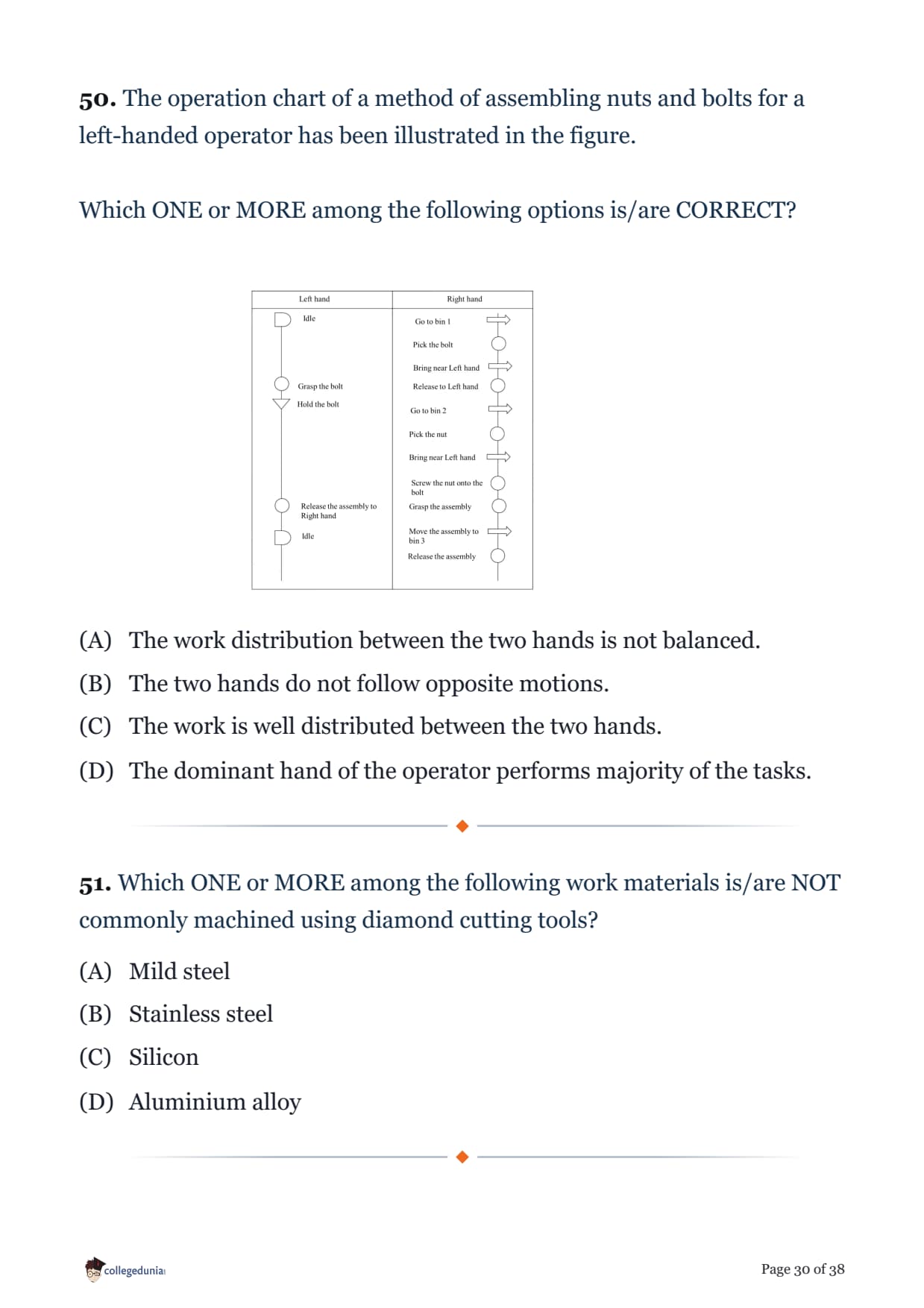
The operation chart of a method of assembling nuts and bolts for a left-handed operator has been illustrated in the figure.
Which ONE or MORE among the following options is/are CORRECT?

Which ONE or MORE among the following work materials is/are NOT commonly machined using diamond cutting tools?
A linear slot is to be milled in a single pass from the point (0, 0) to (180, 180) on XY plane by a CNC machine. The actual velocity along the Y-axis is 5% less than the intended value. The programmed feed rate along the intended slot is 150 mm/min.
The magnitude of the positional error along the Y-axis when the X-coordinate reaches 180 mm, is ______ mm (in integer).
Note: All coordinates are in mm.
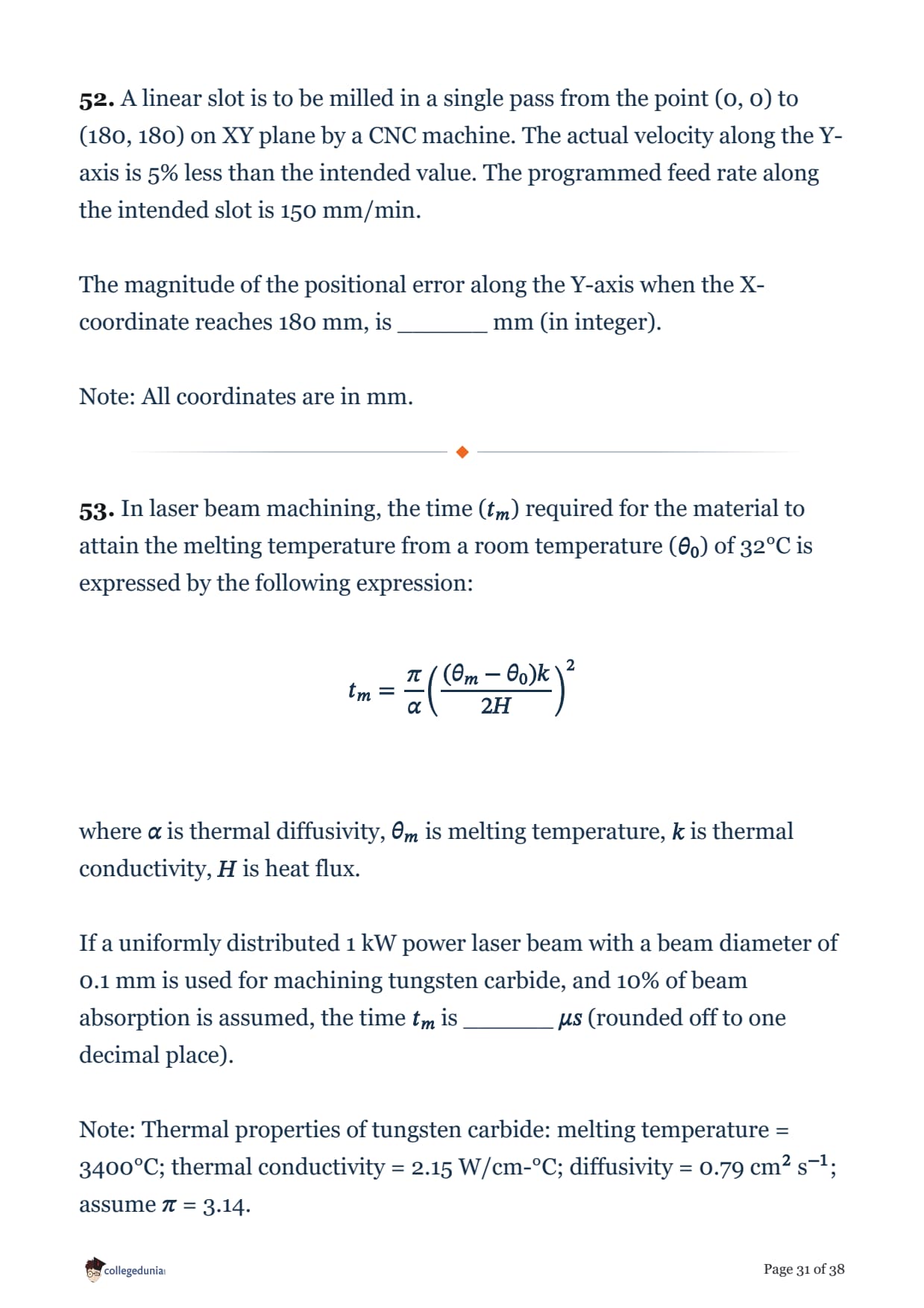
In laser beam machining, the time (\(t_m\)) required for the material to attain the melting temperature from a room temperature (\(\theta_0\)) of 32°C is expressed by the following expression:
\[ t_m = \frac{\pi}{\alpha} \left( \frac{(\theta_m - \theta_0) k}{2H} \right)^2 \]
where \(\alpha\) is thermal diffusivity, \(\theta_m\) is melting temperature, \(k\) is thermal conductivity, \(H\) is heat flux.
If a uniformly distributed 1 kW power laser beam with a beam diameter of 0.1 mm is used for machining tungsten carbide, and 10% of beam absorption is assumed, the time \(t_m\) is ______ \(\mu s\) (rounded off to one decimal place).
Note: Thermal properties of tungsten carbide: melting temperature = 3400°C; thermal conductivity = 2.15 W/cm-°C; diffusivity = 0.79 cm\(^2\) s\(^{-1}\); assume \(\pi\) = 3.14.
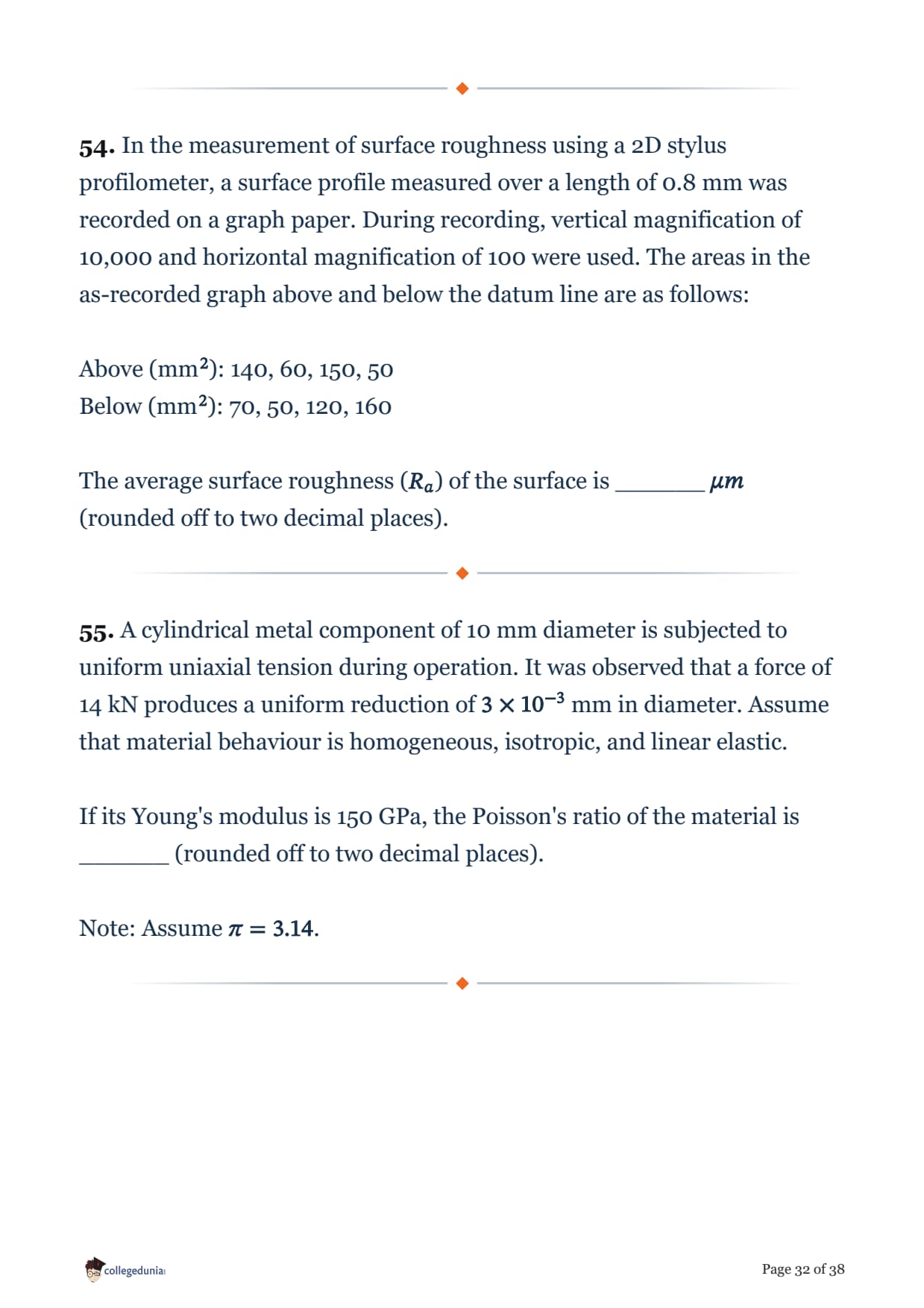
In the measurement of surface roughness using a 2D stylus profilometer, a surface profile measured over a length of 0.8 mm was recorded on a graph paper. During recording, vertical magnification of 10,000 and horizontal magnification of 100 were used. The areas in the as-recorded graph above and below the datum line are as follows:
Above (mm\(^2\)): 140, 60, 150, 50
Below (mm\(^2\)): 70, 50, 120, 160
The average surface roughness (\(R_a\)) of the surface is ______ \(\mu m\) (rounded off to two decimal places).
A cylindrical metal component of 10 mm diameter is subjected to uniform uniaxial tension during operation. It was observed that a force of 14 kN produces a uniform reduction of \(3 \times 10^{-3}\) mm in diameter. Assume that material behaviour is homogeneous, isotropic, and linear elastic.
If its Young's modulus is 150 GPa, the Poisson's ratio of the material is ______ (rounded off to two decimal places).
Note: Assume \(\pi = 3.14\).
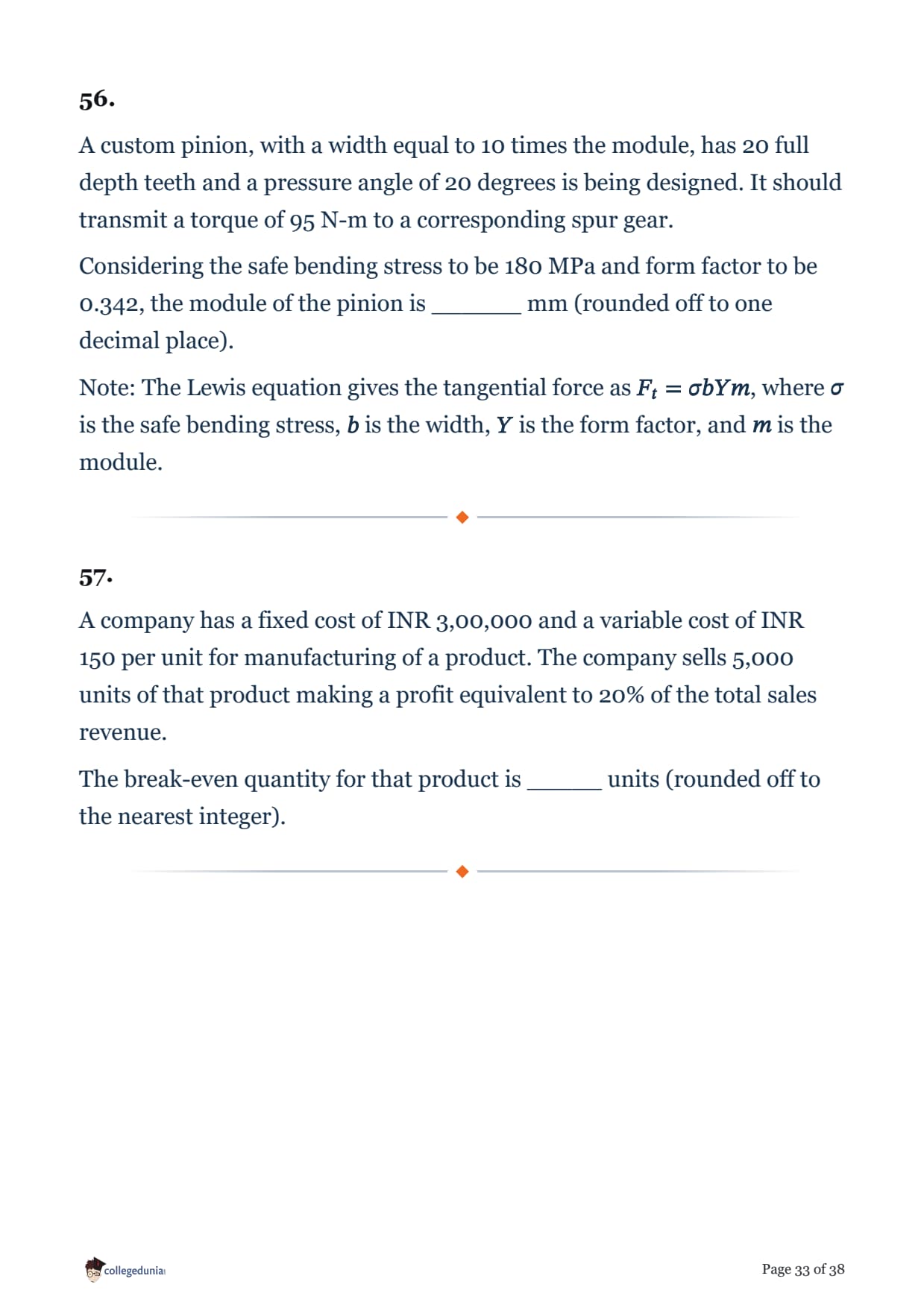
A custom pinion, with a width equal to 10 times the module, has 20 full depth teeth and a pressure angle of 20 degrees is being designed. It should transmit a torque of 95 N-m to a corresponding spur gear.
Considering the safe bending stress to be 180 MPa and form factor to be 0.342, the module of the pinion is ______ mm (rounded off to one decimal place).
Note: The Lewis equation gives the tangential force as \( F_t = \sigma b Y m \), where \( \sigma \) is the safe bending stress, \( b \) is the width, \( Y \) is the form factor, and \( m \) is the module.
A company has a fixed cost of INR 3,00,000 and a variable cost of INR 150 per unit for manufacturing of a product. The company sells 5,000 units of that product making a profit equivalent to 20% of the total sales revenue.
The break-even quantity for that product is _____ units (rounded off to the nearest integer).
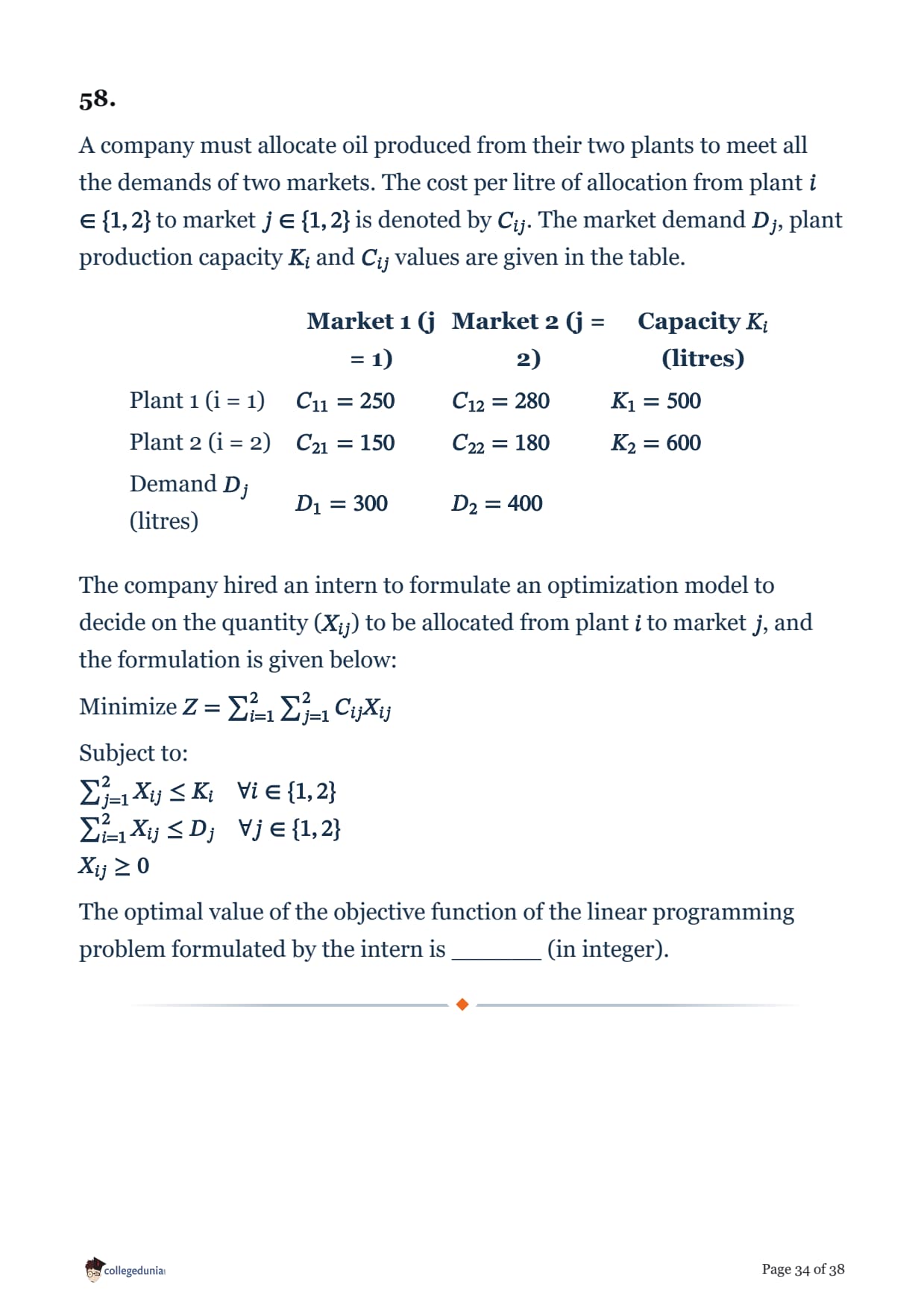
A company must allocate oil produced from their two plants to meet all the demands of two markets. The cost per litre of allocation from plant \( i \in \{1,2\} \) to market \( j \in \{1,2\} \) is denoted by \( C_{ij} \). The market demand \( D_j \), plant production capacity \( K_i \) and \( C_{ij} \) values are given in the table.
| Market 1 (j = 1) | Market 2 (j = 2) | Capacity \( K_i \) (litres) | |
|---|---|---|---|
| Plant 1 (i = 1) | \( C_{11} = 250 \) | \( C_{12} = 280 \) | \( K_1 = 500 \) |
| Plant 2 (i = 2) | \( C_{21} = 150 \) | \( C_{22} = 180 \) | \( K_2 = 600 \) |
| Demand \( D_j \) (litres) | \( D_1 = 300 \) | \( D_2 = 400 \) |
The company hired an intern to formulate an optimization model to decide on the quantity (\( X_{ij} \)) to be allocated from plant \( i \) to market \( j \), and the formulation is given below:
Minimize \( Z = \sum_{i=1}^{2} \sum_{j=1}^{2} C_{ij} X_{ij} \)
Subject to:
\( \sum_{j=1}^{2} X_{ij} \le K_i \quad \forall i \in \{1,2\} \)
\( \sum_{i=1}^{2} X_{ij} \le D_j \quad \forall j \in \{1,2\} \)
\( X_{ij} \ge 0 \)
The optimal value of the objective function of the linear programming problem formulated by the intern is ______ (in integer).
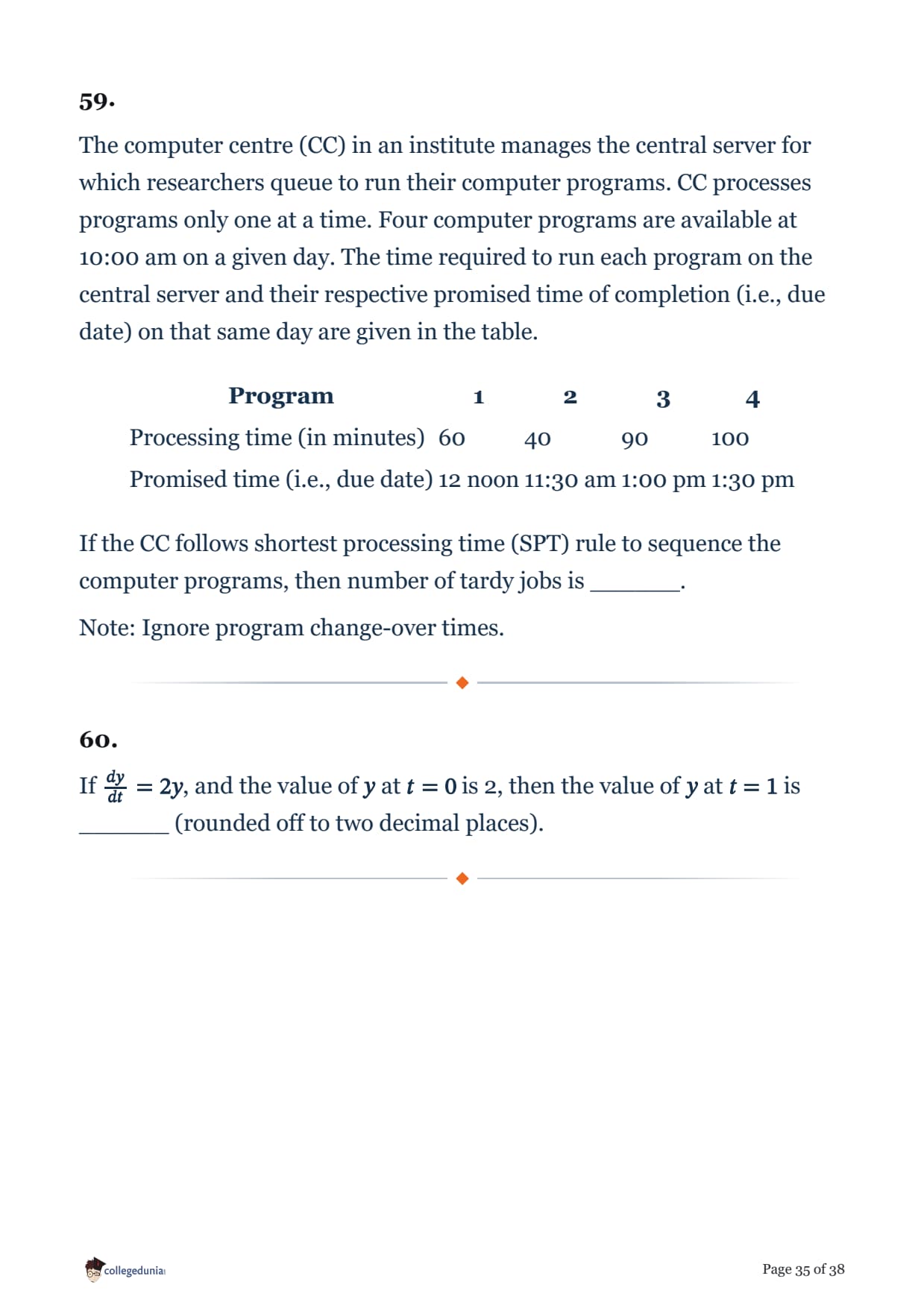
The computer centre (CC) in an institute manages the central server for which researchers queue to run their computer programs. CC processes programs only one at a time. Four computer programs are available at 10:00 am on a given day. The time required to run each program on the central server and their respective promised time of completion (i.e., due date) on that same day are given in the table.
| Program | 1 | 2 | 3 | 4 |
|---|---|---|---|---|
| Processing time (in minutes) | 60 | 40 | 90 | 100 |
| Promised time (i.e., due date) | 12 noon | 11:30 am | 1:00 pm | 1:30 pm |
If the CC follows shortest processing time (SPT) rule to sequence the computer programs, then number of tardy jobs is ______.
Note: Ignore program change-over times.
If \( \frac{dy}{dt} = 2y \), and the value of \( y \) at \( t = 0 \) is 2, then the value of \( y \) at \( t = 1 \) is ______ (rounded off to two decimal places).
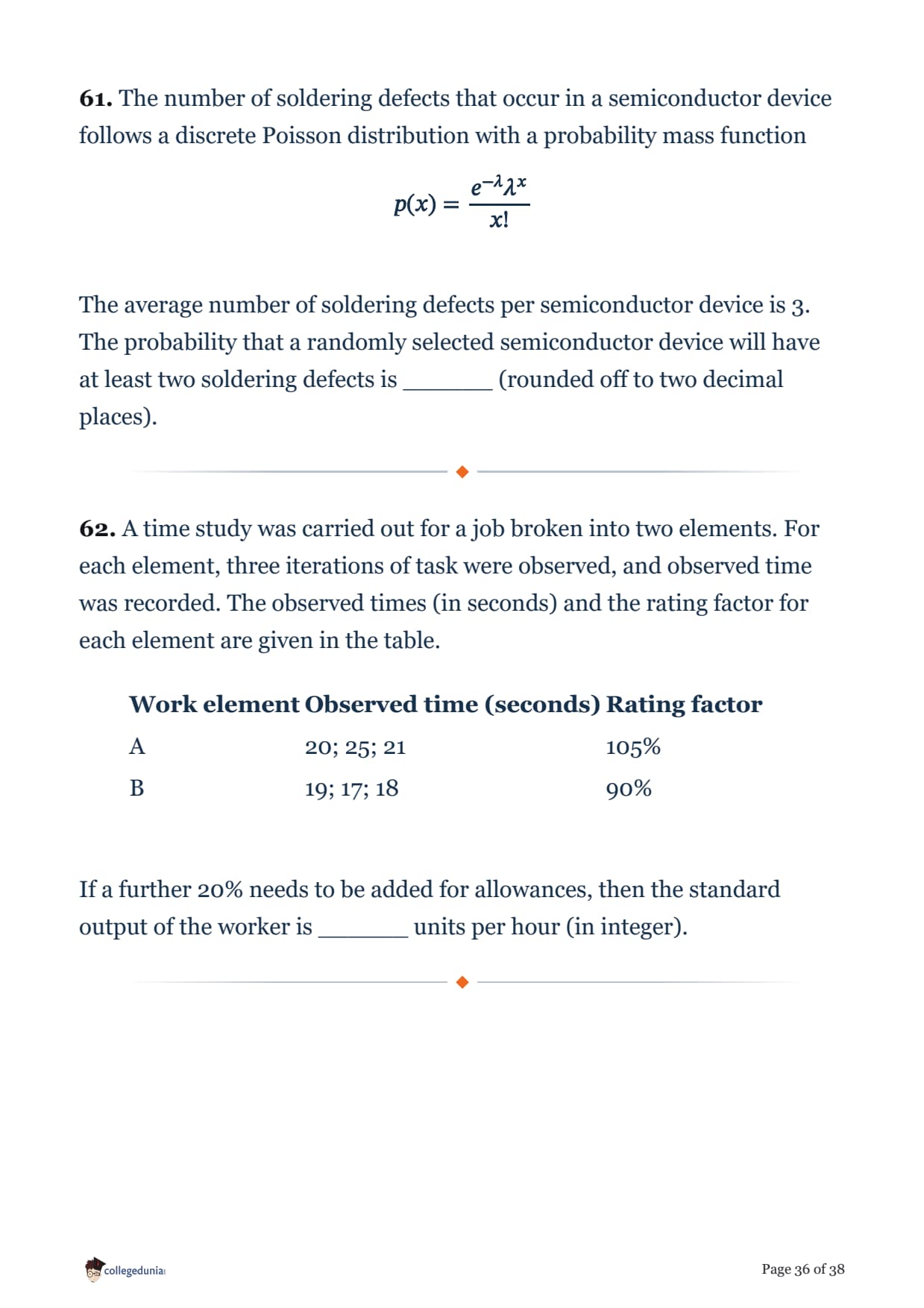
The number of soldering defects that occur in a semiconductor device follows a discrete Poisson distribution with a probability mass function
\[ p(x) = \frac{e^{-\lambda}\lambda^x}{x!} \]
The average number of soldering defects per semiconductor device is 3.
The probability that a randomly selected semiconductor device will have at least two soldering defects is ______ (rounded off to two decimal places).
A time study was carried out for a job broken into two elements. For each element, three iterations of task were observed, and observed time was recorded. The observed times (in seconds) and the rating factor for each element are given in the table.
| Work element | Observed time (seconds) | Rating factor |
|---|---|---|
| A | 20; 25; 21 | 105% |
| B | 19; 17; 18 | 90% |
If a further 20% needs to be added for allowances, then the standard output of the worker is ______ units per hour (in integer).
In a hole-shaft assembly, the following are the dimensions and tolerances (all in mm) provided for the hole and shaft:
Hole: \( 22^{+0.018}_{+0.010} \)
Shaft: \( 22^{+0.075}_{+0.004} \)
The magnitude of the clearance when the shaft is at the minimum material condition and hole is at the maximum material condition is ______ mm (to three decimal places).
Consider an assembly line producing an item through a process involving three activities in the following order: cutting, welding, and polishing. There are three workers available: one is assigned only for cutting, one is assigned only for welding, and one is assigned only for polishing.
The activity time per item is given in the table.
| Activity name | Cutting | Welding | Polishing |
|---|---|---|---|
| Activity time/item (in minutes) | 30 | 40 | 25 |
Assuming that the process is running in steady state, the total number of items coming out of the assembly line in six hours is ______ (in integer).
Note: Assume that workers, items, and machines/tools are available as and when needed.
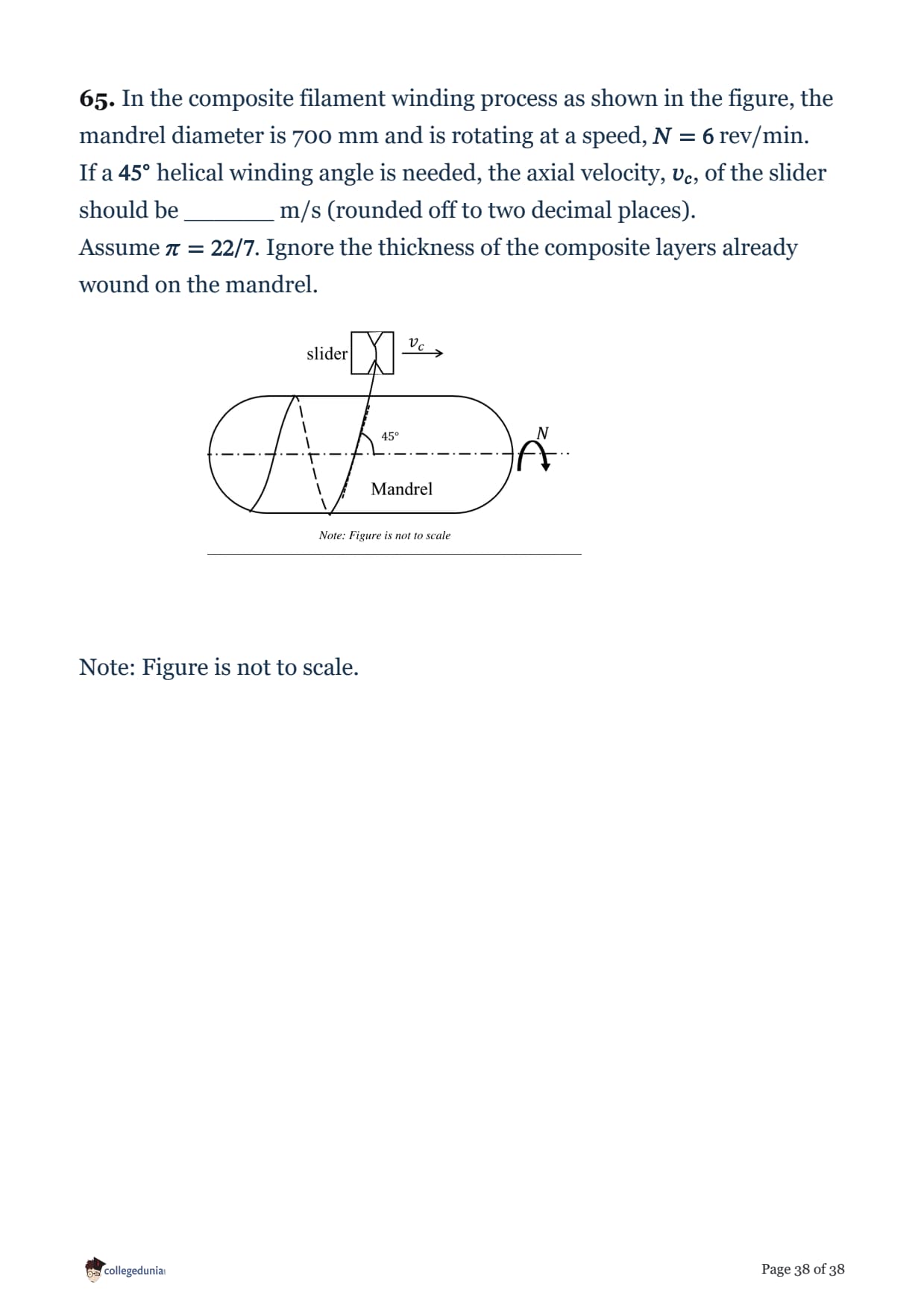
In the composite filament winding process as shown in the figure, the mandrel diameter is 700 mm and is rotating at a speed, \( N = 6 \) rev/min.
If a \( 45^\circ \) helical winding angle is needed, the axial velocity, \( v_c \), of the slider should be ______ m/s (rounded off to two decimal places).
Assume \( \pi = 22/7 \). Ignore the thickness of the composite layers already wound on the mandrel.

Note: Figure is not to scale.
GATE 2026 PI Exam Pattern and Marking Scheme Explained
As per the information bulletin on the official website (gate2026.iitg.ac.in), GATE 2026 PI was a fully computer-based test with an on-screen virtual scientific calculator, no physical calculators allowed.
- Total questions: 65, split across General Aptitude, Engineering Mathematics, and the PI core subject
- Duration: 3 hours
- Total marks: 100 (General Aptitude 15%, Engineering Mathematics 13%, PI core 72%)
- Marking scheme: +1/-1/3 for 1-mark MCQs, +2/-2/3 for 2-mark MCQs, no negative marking on MSQ or NAT questions
- Question types: Single-answer MCQ, Multiple-answer MCQ (MSQ), and Numerical Answer Type (NAT)
High-Weightage Subjects in GATE 2026 PI to Focus On First
Manufacturing Processes and Operations Research carried the most weight in this paper, matching the split seen in past PI papers.
- Manufacturing Processes (casting, welding, metal forming, machining, powder metallurgy) made up close to a third of the core section
- Operations Research and Industrial Engineering (inventory, queuing, sequencing, aggregate planning, project management) formed the next biggest block
- Metrology and Quality Control questions covered surface roughness, limits and fits, and acceptance sampling
- Engineering Mathematics questions leaned on probability, linear algebra, vector calculus, and numerical methods
- Machine Design and Strength of Materials covered keys, gears, and elastic constants
GATE 2026 PI Question Paper Analysis Video
Source: Vanga Therinjikalam
How to Use the GATE PI Question Paper for Practice
Treat this paper as a full-length mock before you touch the solutions PDF.
- Attempt all 65 questions in one 3-hour sitting using only a scientific calculator, just like the real exam
- Mark every question you were unsure about, then compare your answer with the solution PDF, not just the final value
- Redo the Manufacturing Processes and Operations Research questions a second time since they carry the most marks
- Time yourself on the NAT questions separately, since a slow calculation there costs you two other questions
GATE PI Good Attempts and Qualifying Score Benchmark
- 30-35 confident attempts with high accuracy is usually enough to clear the qualifying cutoff
- 40-45 attempts puts you in range for a good PSU or state college call
- 50-60 attempts at 85-90% accuracy is the range that gets you into a top-tier IIT for PI
- A score of 45+ marks is good, 55-65 is very good, and 65+ is considered excellent for this paper
GATE 2026 PI Question Paper FAQs
Ques. How difficult was the GATE 2026 PI question paper?
Ans. GATE 2026 PI was a moderate paper overall, with General Aptitude the easiest section and Manufacturing Processes comfortable for students who had solved past PI papers. The Operations Research and Reliability Engineering questions needed more careful reading of the given data.
Ques. How many questions should I attempt in GATE PI to get a good score?
Ans. Attempting 30-35 questions with high accuracy usually clears the qualifying cutoff, 40-45 attempts is a good target for PSU and state college calls, and 50-60 attempts at 85-90% accuracy is what top IIT admits typically manage.
Ques. Which topics had the highest weightage in GATE 2026 PI?
Ans. Manufacturing Processes and Operations Research together made up the largest share of the core PI section, followed by Metrology and Quality Control, Machine Design, and Engineering Mathematics.
Ques. Are GATE PI questions repeated from previous years?
Ans. The exact numbers change every year, but the concepts repeat closely. Chvorinov's Rule risering problems, Taylor's tool life equation, EOQ assumptions, and queuing theory questions have appeared in some form across multiple past PI papers.
Ques. Is a calculator allowed in the GATE 2026 PI exam?
Ans. No physical calculator is allowed. GATE 2026 was a computer-based test with an on-screen virtual scientific calculator built into the test panel, the same one used for every other GATE paper that year.
Ques. Where can I download the GATE 2026 PI question paper with solutions PDF for free?
Ans. You can download the full question paper and the step-by-step solutions PDF from the table above on this page. The official question paper and answer key are also published on the GATE 2026 website at gate2026.iitg.ac.in.



Comments