




The GATE 2026 Statistics (ST) question paper is now available with detailed solutions for free download. GATE 2026 ST was conducted by IIT Guwahati on February 8, 2026, as a 65-question computer-based test worth 100 marks over 3 hours.
| GATE 2026 Statistics (ST) Question Paper with Solutions | Download PDF | Check Solutions |

GATE 2026 Statistics Questions with Solutions
The antonym of the word protagonist is ________.
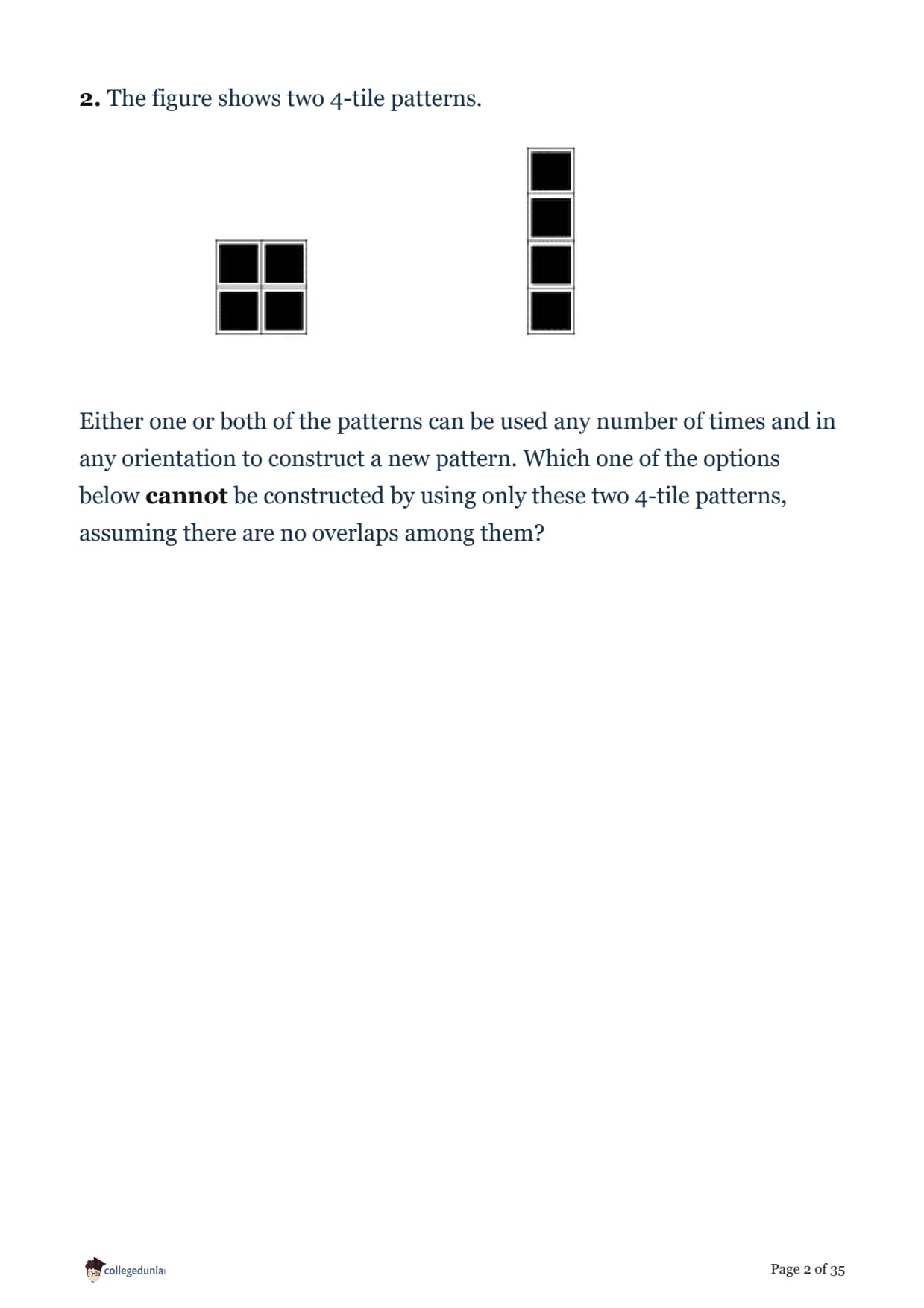
The figure shows two 4-tile patterns.

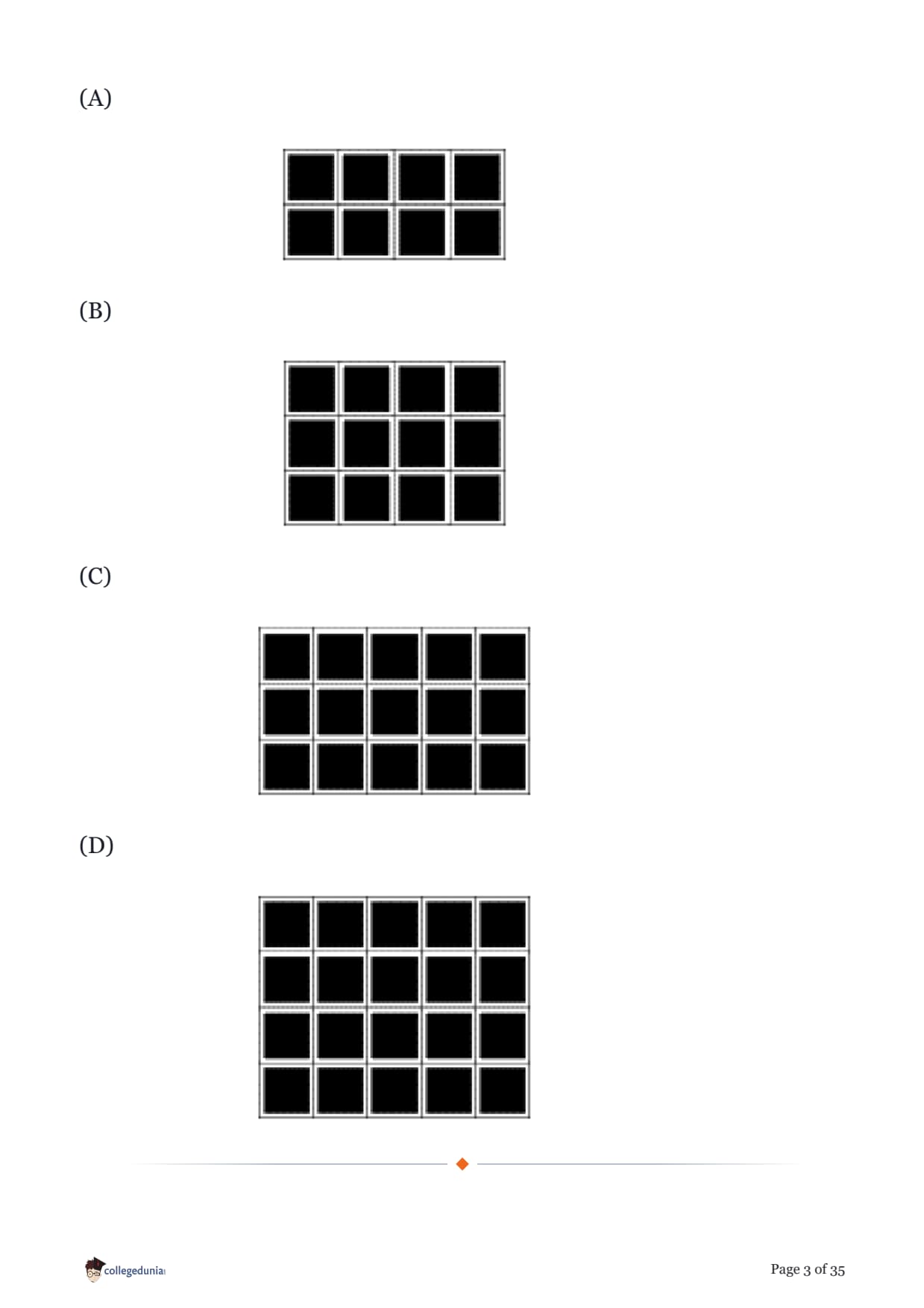
Either one or both of the patterns can be used any number of times and in any orientation to construct a new pattern. Which one of the options below cannot be constructed by using only these two 4-tile patterns, assuming there are no overlaps among them?
- (A)
![]()
- (B)
![]()
- (C)
![]()
- (D)
![]()


Consider a knock-out women's badminton singles tournament where there are no ties. The loser in each game is eliminated from the tournament. Every player plays until she is defeated or remains the last undefeated player. The last undefeated player is declared the winner of the tournament. If there are 64 players in the beginning of the tournament, how many games should be played in total to declare the winner of the tournament?
A student needs to enroll for a minimum of 60 credits. A student cannot enroll for more than 70 credits. The credits are divided amongst project and three distinct sets of courses namely, core courses, specialization courses, and elective courses. It is compulsory for a student to enroll for exactly 15 credits of core courses and exactly 20 credits of project. In addition, a student has to enroll for a minimum of 10 credits of specialization courses. The maximum credits of elective courses that a student can enroll for is ______
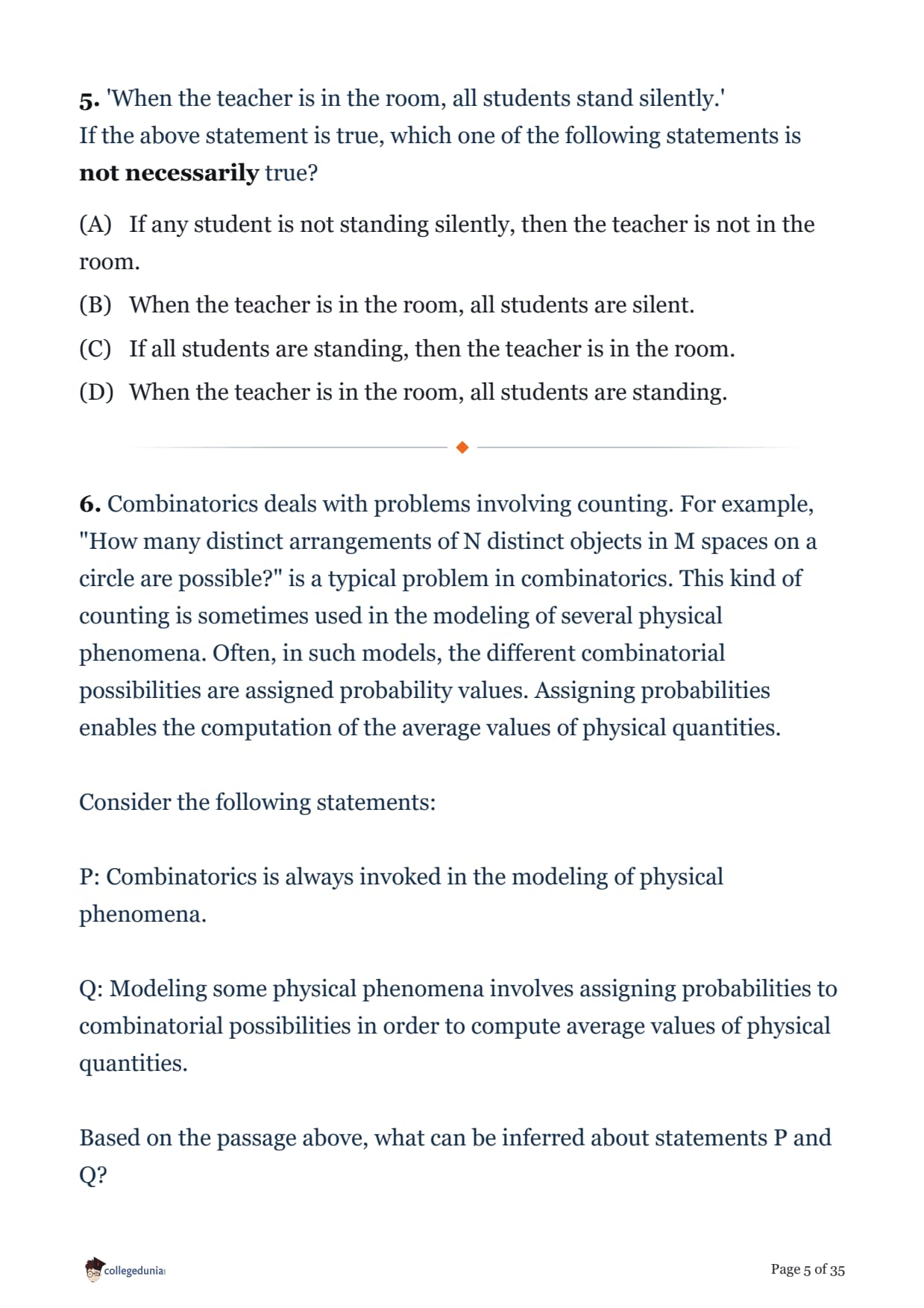
'When the teacher is in the room, all students stand silently.'
If the above statement is true, which one of the following statements is not necessarily true?
Combinatorics deals with problems involving counting. For example, "How many distinct arrangements of N distinct objects in M spaces on a circle are possible?" is a typical problem in combinatorics. This kind of counting is sometimes used in the modeling of several physical phenomena. Often, in such models, the different combinatorial possibilities are assigned probability values. Assigning probabilities enables the computation of the average values of physical quantities.
Consider the following statements:
P: Combinatorics is always invoked in the modeling of physical phenomena.
Q: Modeling some physical phenomena involves assigning probabilities to combinatorial possibilities in order to compute average values of physical quantities.
Based on the passage above, what can be inferred about statements P and Q?
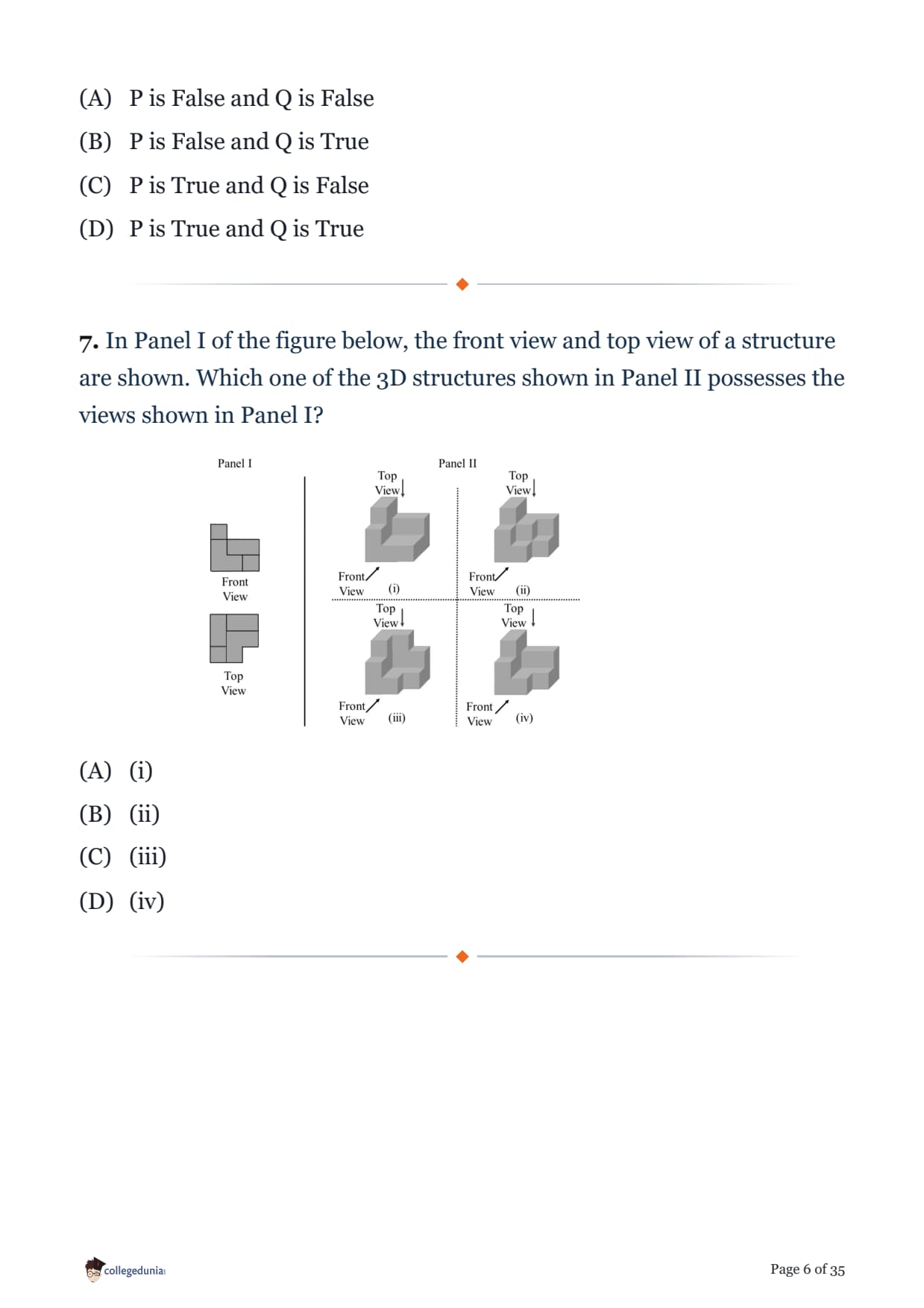
In Panel I of the figure below, the front view and top view of a structure are shown. Which one of the 3D structures shown in Panel II possesses the views shown in Panel I?

For positive real numbers \(S\) and \(K\), the function \(H_K(S)\) is defined as:
\[ H_K(S) = \max(S-K, 0). \]
The max function is defined as:
\[ \max(a,b) = \begin{cases} a, & \text{when } a > b \\ b, & \text{when } a \leq b \end{cases} \]
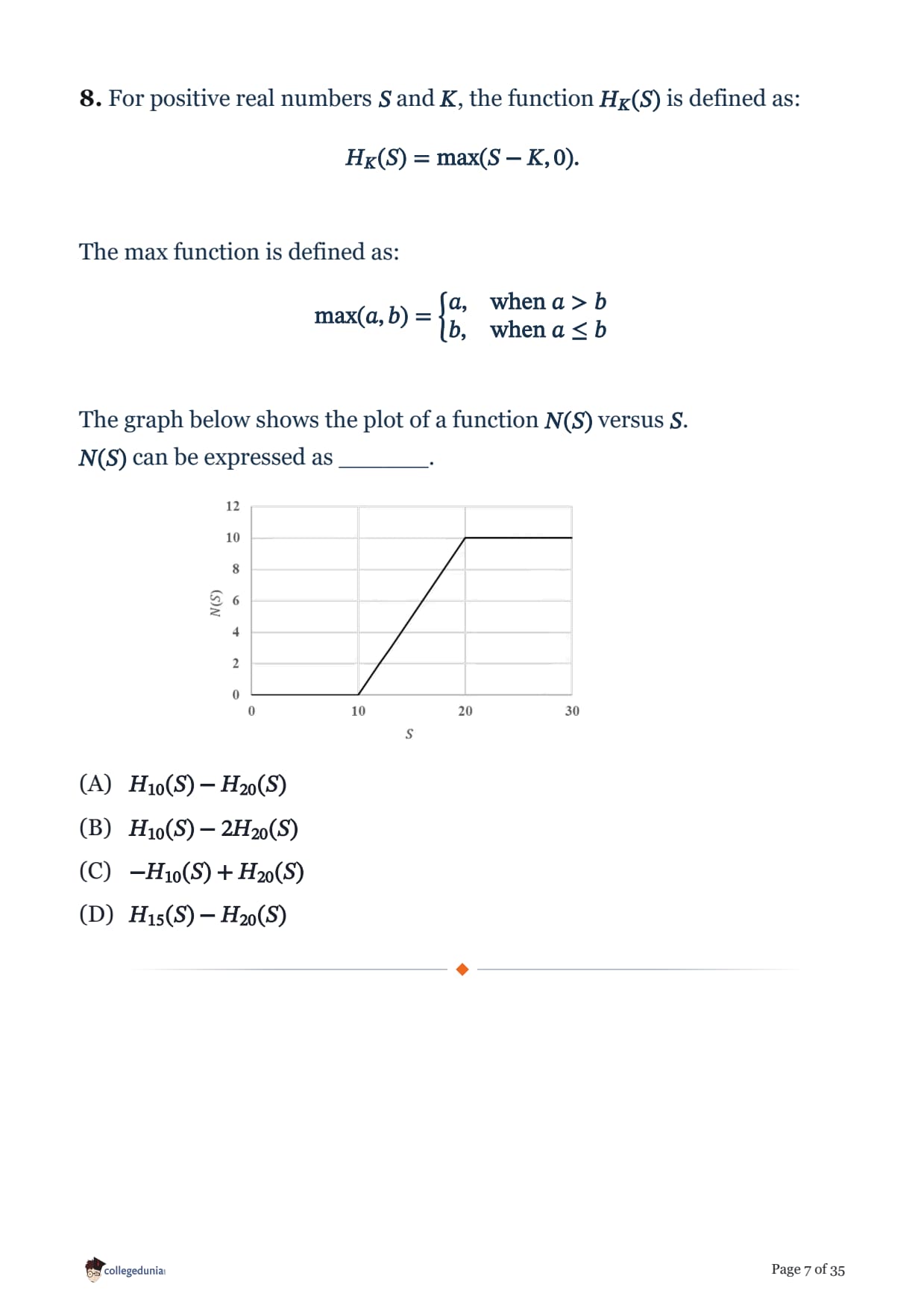
The graph below shows the plot of a function \(N(S)\) versus \(S\).
\(N(S)\) can be expressed as ______.

In the 2020 summer Olympics' Javelin throw finals, Neeraj Chopra exhibited a spectacular performance to win the gold medal. The silver medal was won by Jakub Vadlejch and the bronze medal was won by Vitezlav Vesely. There were six rounds of throws with each athlete having one throw per round. The best of all the throws of each athlete is considered for the medal. Following were the observations about the throws:
(i) The first and second rounds were dominated by Neeraj Chopra with a gold medal performance in his second throw, while the other two athletes did not have any medal winning throws in these rounds.
(ii) The throws in the last round by both Jakub Vadlejch and Vitezlav Vesely were fouls and were not considered for scoring.
(iii) After four rounds, Vitezlav Vesely was in the second position and could not improve upon his best throw in the succeeding rounds.
(iv) In the fourth round, the throw by Jakub Vadlejch was the best in that round.
In which round did Vitezlav Vesely have his best throw?
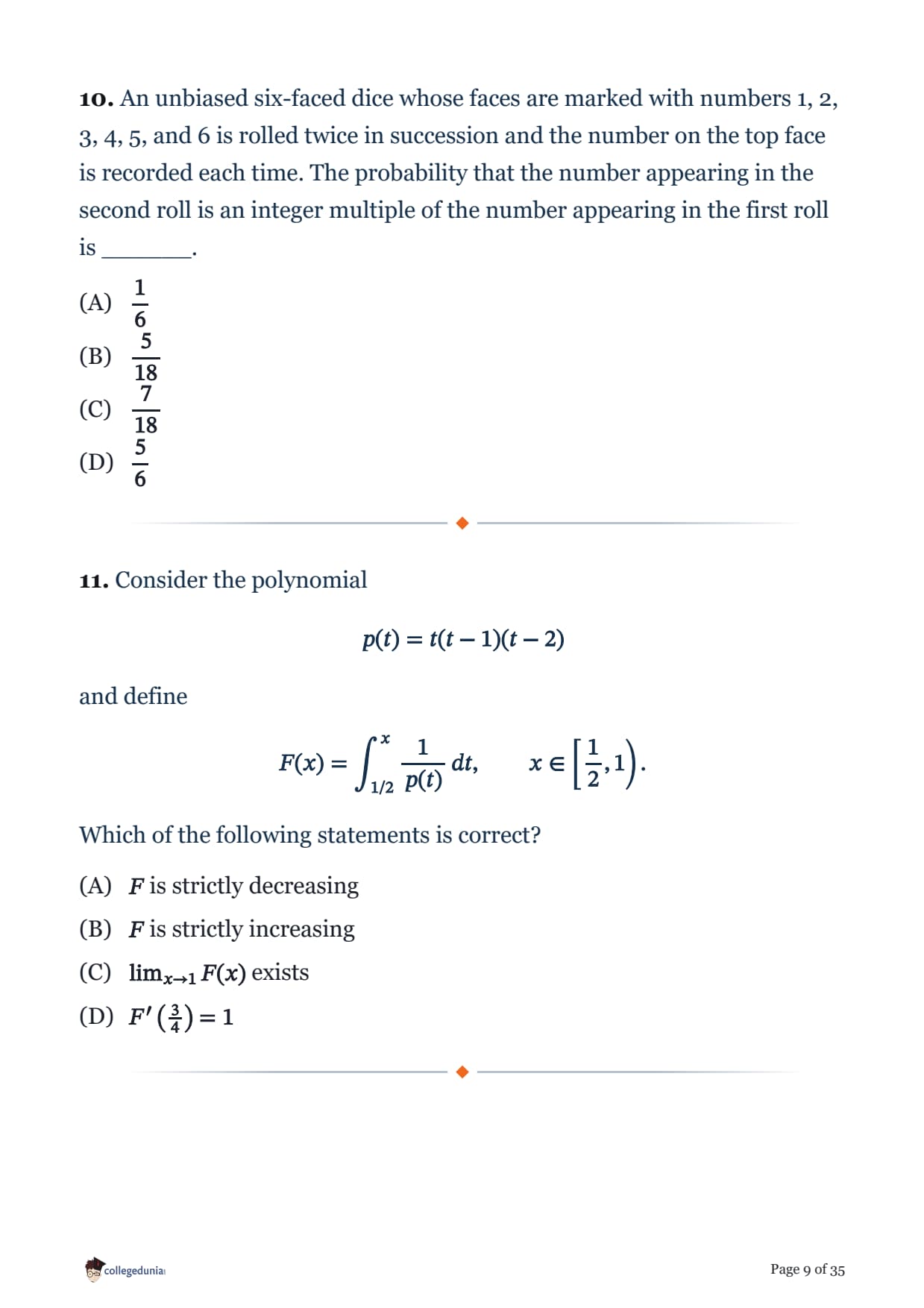
An unbiased six-faced dice whose faces are marked with numbers 1, 2, 3, 4, 5, and 6 is rolled twice in succession and the number on the top face is recorded each time. The probability that the number appearing in the second roll is an integer multiple of the number appearing in the first roll is ______.
Consider the polynomial \[ p(t)=t(t-1)(t-2) \] and define \[ F(x)=\int_{1/2}^{x}\frac{1}{p(t)}\,dt,\qquad x\in\left[\frac{1}{2},1\right). \] Which of the following statements is correct?
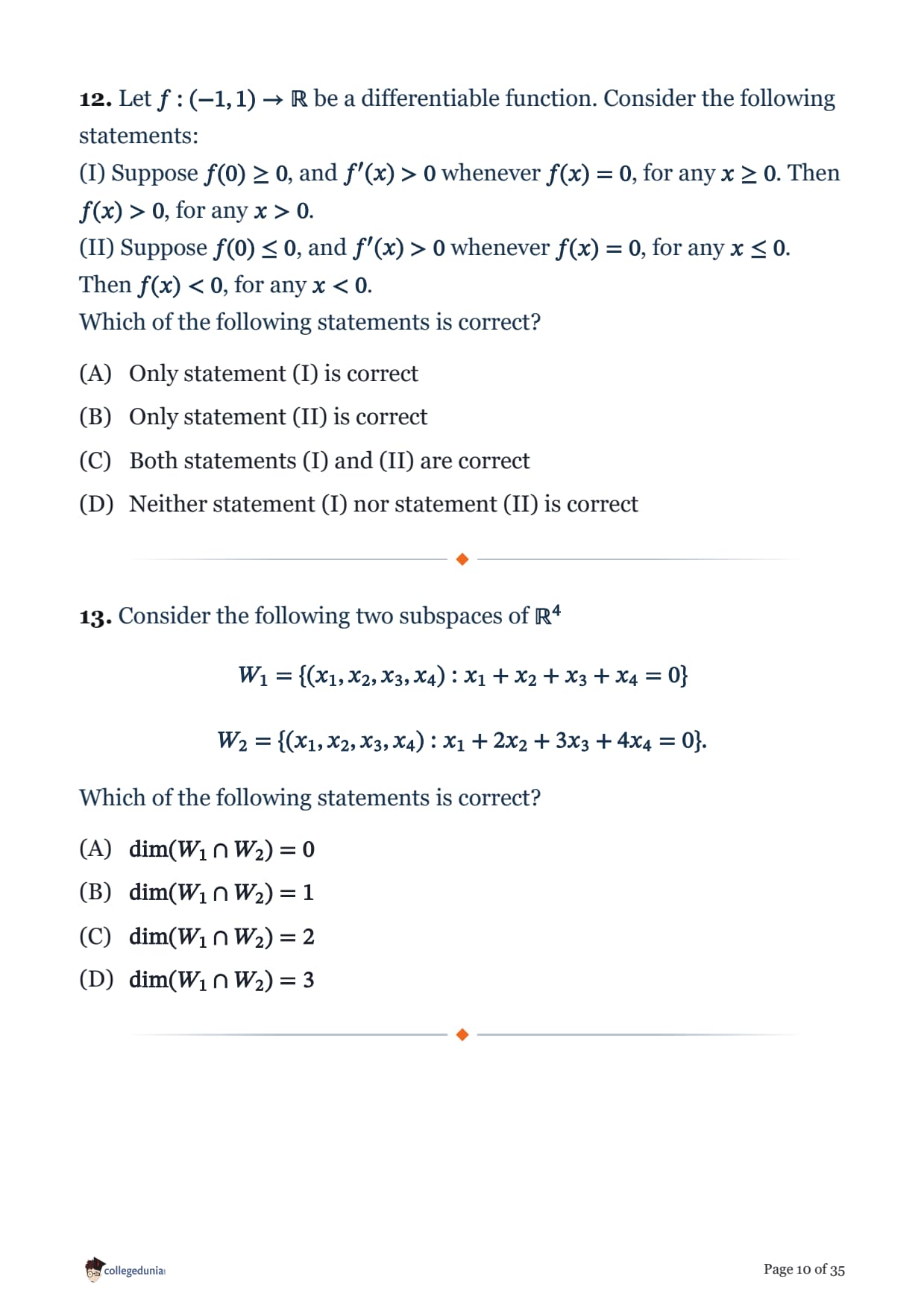
Let \(f:(-1,1)\to\mathbb{R}\) be a differentiable function. Consider the following statements:
(I) Suppose \(f(0)\geq0\), and \(f'(x)>0\) whenever \(f(x)=0\), for any \(x\geq0\). Then \(f(x)>0\), for any \(x>0\).
(II) Suppose \(f(0)\leq0\), and \(f'(x)>0\) whenever \(f(x)=0\), for any \(x\leq0\). Then \(f(x)<0\), for any \(x<0\).
Which of the following statements is correct?
Consider the following two subspaces of \(\mathbb{R}^4\) \[ W_1=\{(x_1,x_2,x_3,x_4):x_1+x_2+x_3+x_4=0\} \] \[ W_2=\{(x_1,x_2,x_3,x_4):x_1+2x_2+3x_3+4x_4=0\}. \] Which of the following statements is correct?
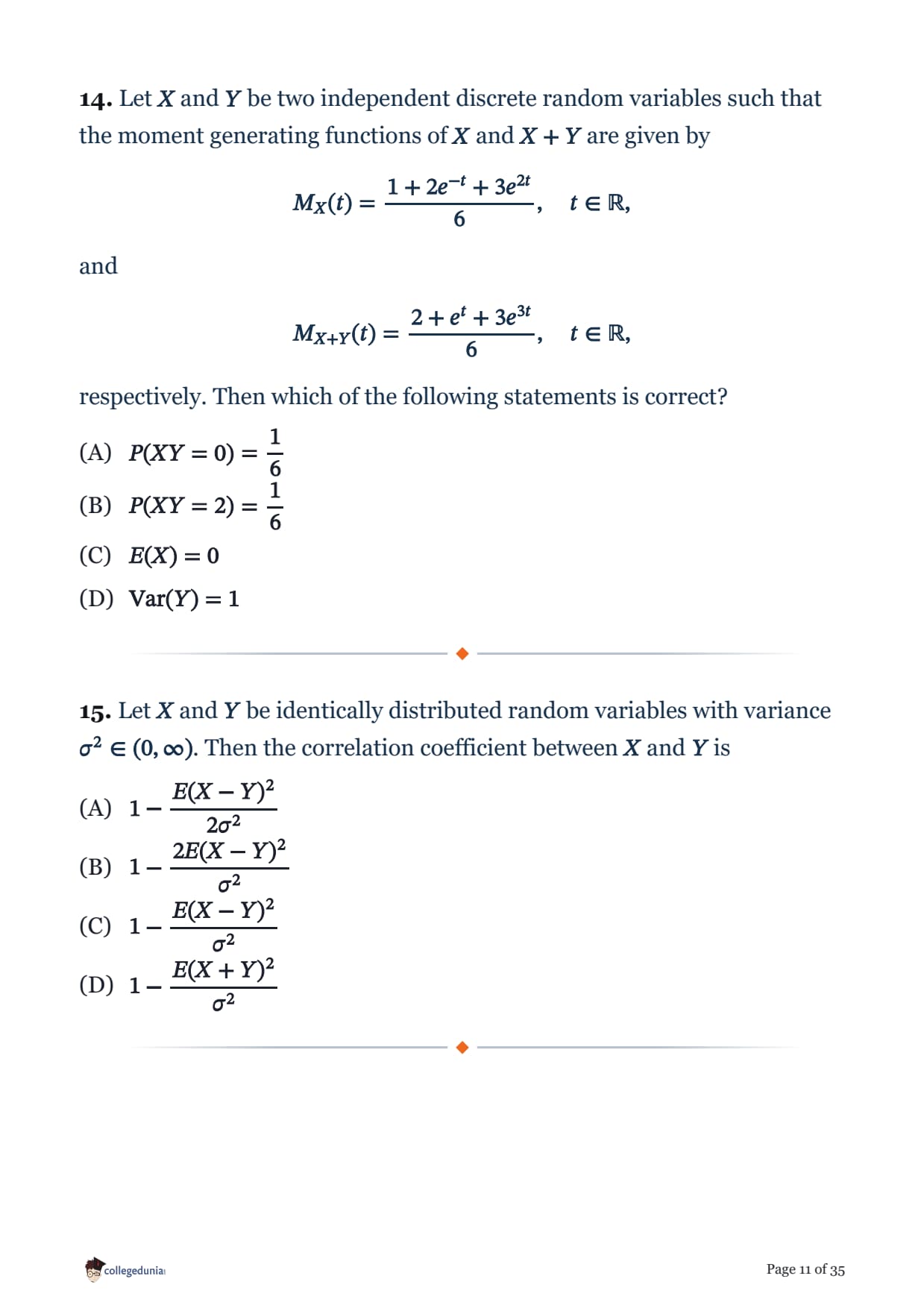
Let \(X\) and \(Y\) be two independent discrete random variables such that the moment generating functions of \(X\) and \(X+Y\) are given by \[ M_X(t)=\frac{1+2e^{-t}+3e^{2t}}{6},\quad t\in\mathbb{R}, \] and \[ M_{X+Y}(t)=\frac{2+e^{t}+3e^{3t}}{6},\quad t\in\mathbb{R}, \] respectively. Then which of the following statements is correct?
Let \(X\) and \(Y\) be identically distributed random variables with variance \(\sigma^2\in(0,\infty)\). Then the correlation coefficient between \(X\) and \(Y\) is
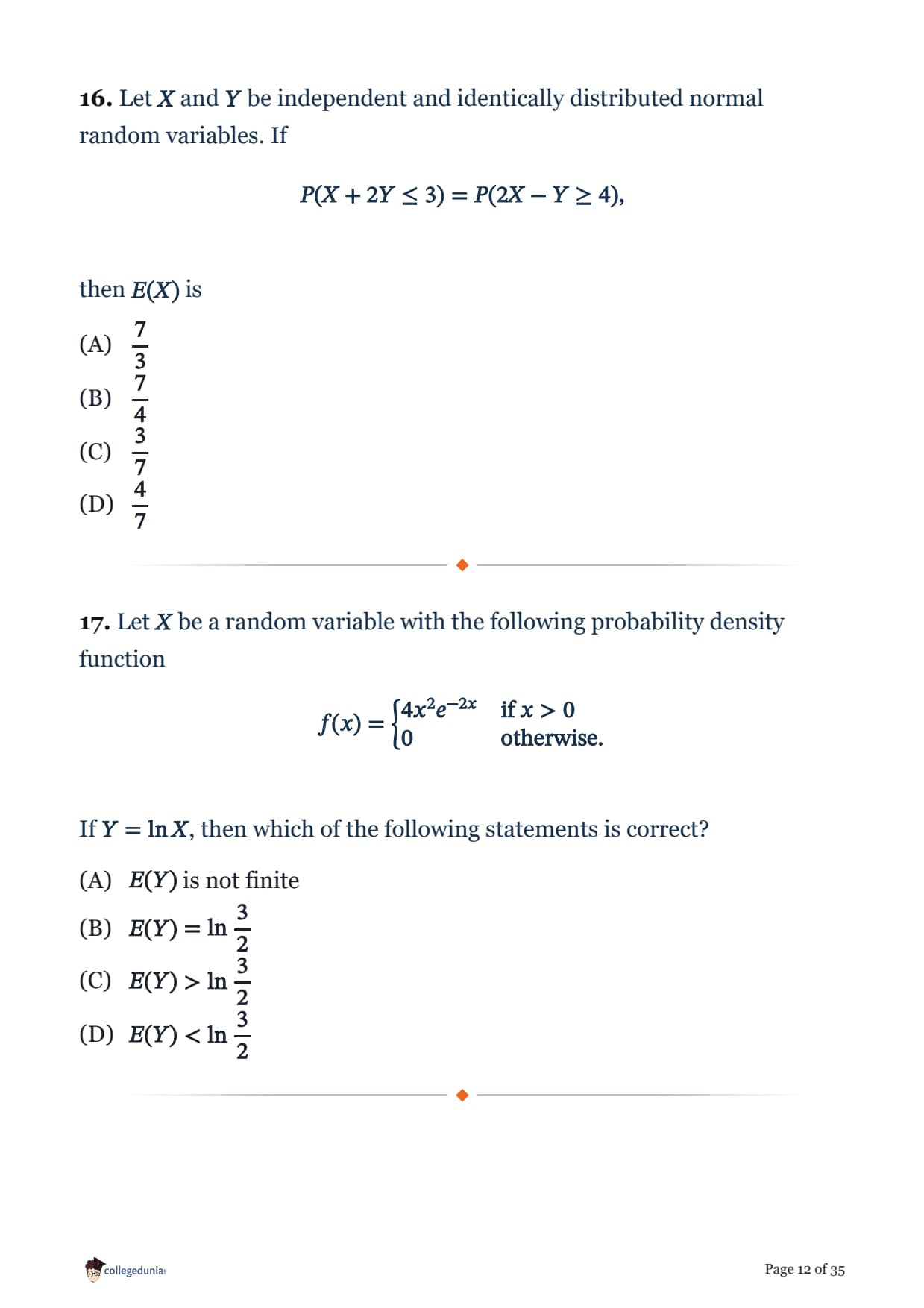
Let \(X\) and \(Y\) be independent and identically distributed normal random variables. If
\[ P(X+2Y\le3)=P(2X-Y\ge4), \]
then \(E(X)\) is
Let \(X\) be a random variable with the following probability density function
\[ f(x)= \begin{cases} 4x^2e^{-2x} & \text{if } x>0 \\ 0 & \text{otherwise.} \end{cases} \]
If \(Y=\ln X\), then which of the following statements is correct?
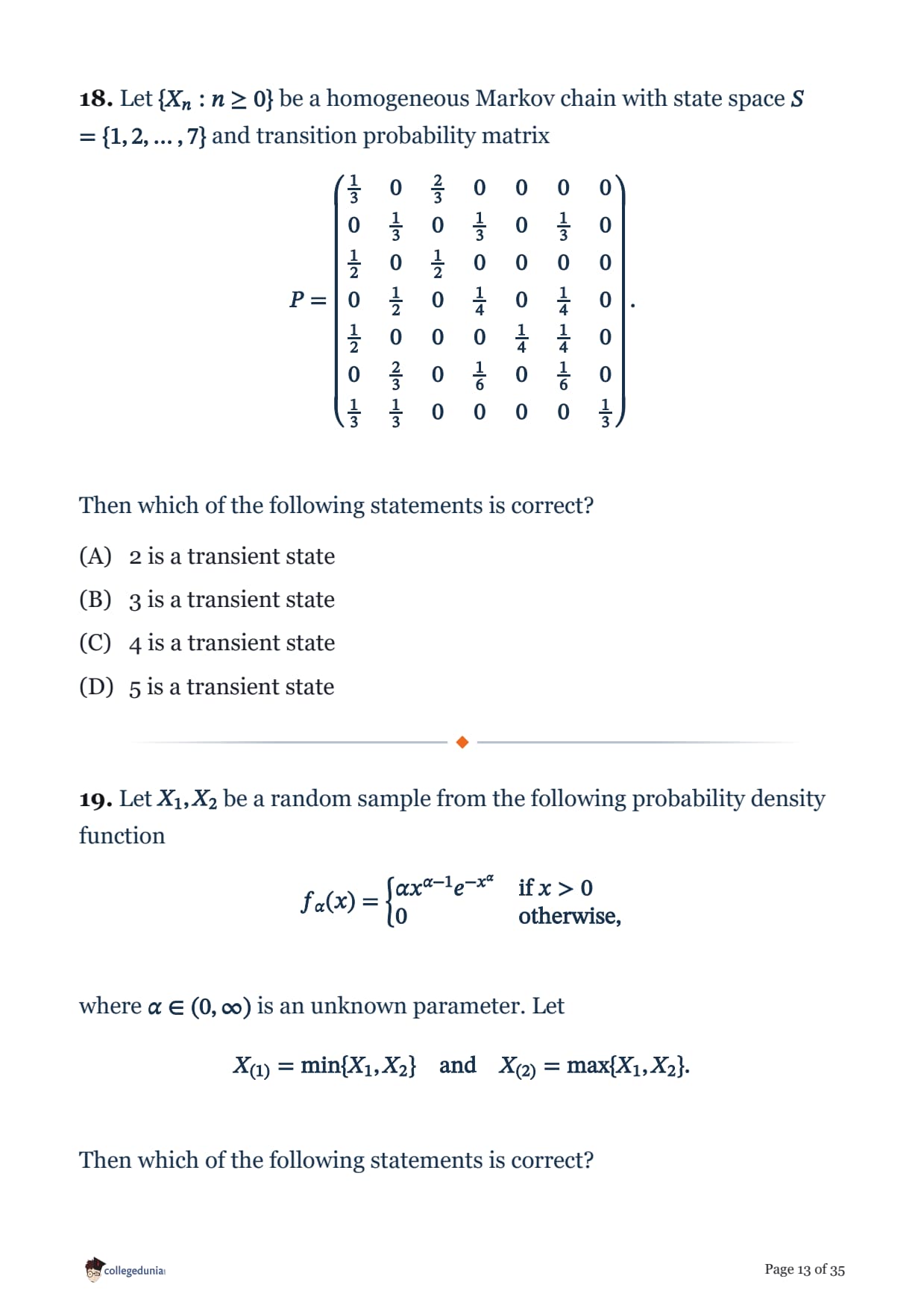
Let \(\{X_n:n\ge0\}\) be a homogeneous Markov chain with state space \(S=\{1,2,\ldots,7\}\) and transition probability matrix
\[ P= \begin{pmatrix} \frac{1}{3} & 0 & \frac{2}{3} & 0 & 0 & 0 & 0 \\ 0 & \frac{1}{3} & 0 & \frac{1}{3} & 0 & \frac{1}{3} & 0 \\ \frac{1}{2} & 0 & \frac{1}{2} & 0 & 0 & 0 & 0 \\ 0 & \frac{1}{2} & 0 & \frac{1}{4} & 0 & \frac{1}{4} & 0 \\ \frac{1}{2} & 0 & 0 & 0 & \frac{1}{4} & \frac{1}{4} & 0 \\ 0 & \frac{2}{3} & 0 & \frac{1}{6} & 0 & \frac{1}{6} & 0 \\ \frac{1}{3} & \frac{1}{3} & 0 & 0 & 0 & 0 & \frac{1}{3} \end{pmatrix}. \]
Then which of the following statements is correct?
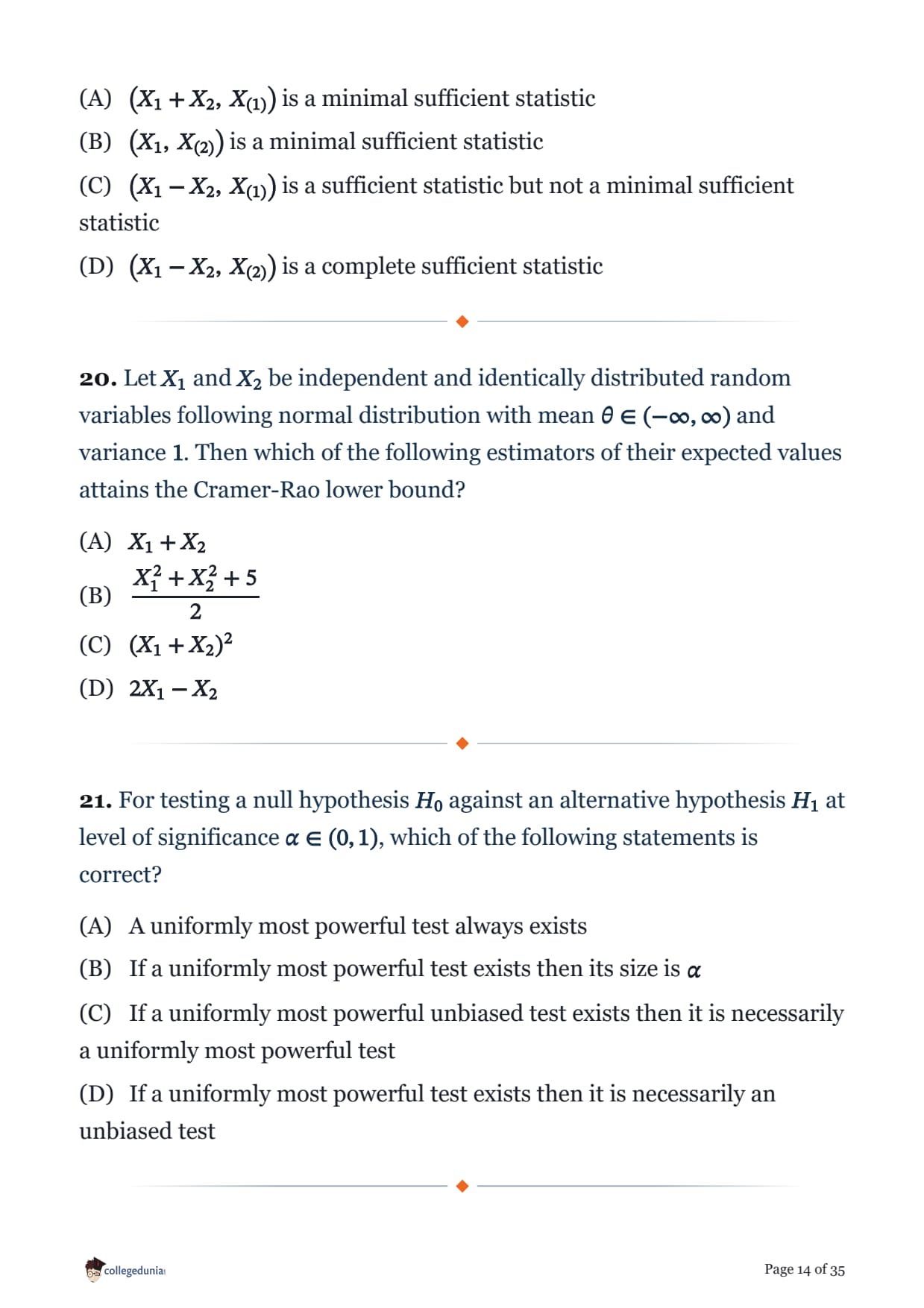
Let \(X_1,X_2\) be a random sample from the following probability density function
\[ f_\alpha(x)= \begin{cases} \alpha x^{\alpha-1}e^{-x^\alpha} & \text{if } x>0 \\ 0 & \text{otherwise,} \end{cases} \]
where \(\alpha\in(0,\infty)\) is an unknown parameter. Let
\[ X_{(1)}=\min\{X_1,X_2\} \quad\text{and}\quad X_{(2)}=\max\{X_1,X_2\}. \]
Then which of the following statements is correct?
Let \(X_1\) and \(X_2\) be independent and identically distributed random variables following normal distribution with mean \(\theta\in(-\infty,\infty)\) and variance \(1\). Then which of the following estimators of their expected values attains the Cramer-Rao lower bound?
For testing a null hypothesis \(H_0\) against an alternative hypothesis \(H_1\) at level of significance \(\alpha \in (0,1)\), which of the following statements is correct?
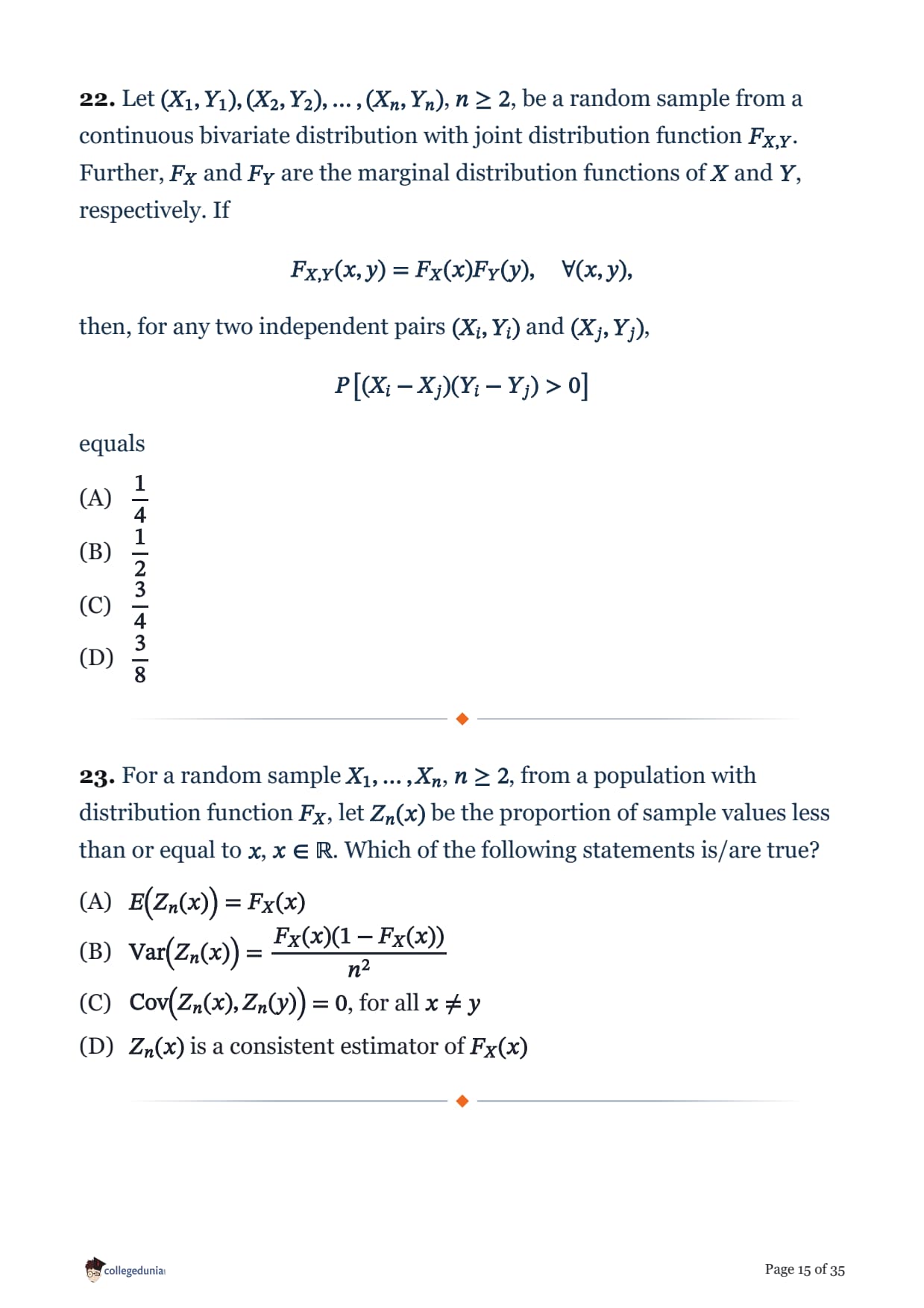
Let \((X_1,Y_1),(X_2,Y_2),\ldots,(X_n,Y_n)\), \(n\geq2\), be a random sample from a continuous bivariate distribution with joint distribution function \(F_{X,Y}\). Further, \(F_X\) and \(F_Y\) are the marginal distribution functions of \(X\) and \(Y\), respectively. If
\[ F_{X,Y}(x,y)=F_X(x)F_Y(y), \quad \forall (x,y), \]then, for any two independent pairs \((X_i,Y_i)\) and \((X_j,Y_j)\),
\[ P\left[(X_i-X_j)(Y_i-Y_j)>0\right] \]equals
For a random sample \(X_1,\ldots,X_n\), \(n\geq2\), from a population with distribution function \(F_X\), let \(Z_n(x)\) be the proportion of sample values less than or equal to \(x\), \(x\in\mathbb{R}\). Which of the following statements is/are true?
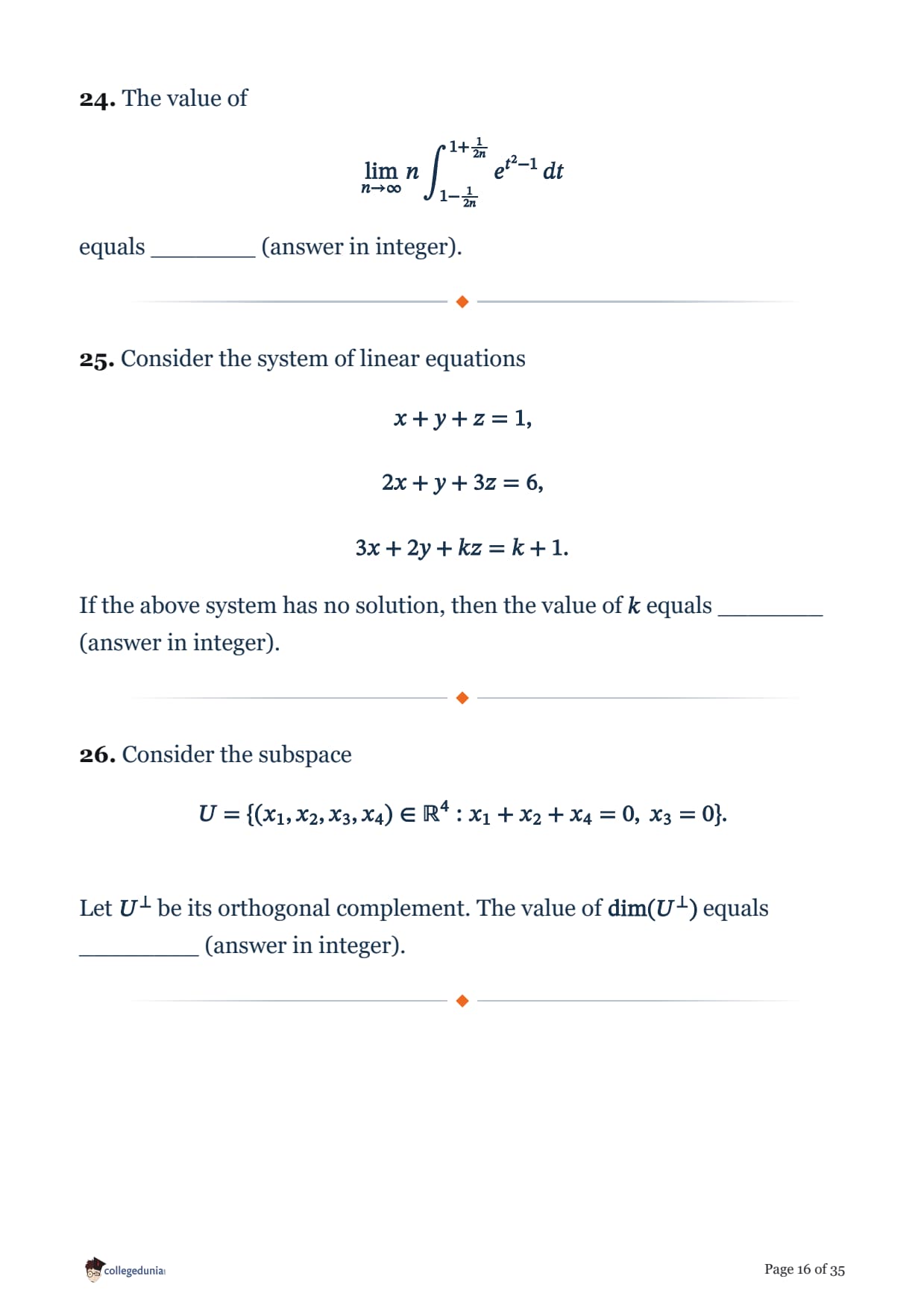
The value of
\[ \lim_{n\to\infty} n\int_{1-\frac{1}{2n}}^{1+\frac{1}{2n}} e^{t^2-1}\,dt \]equals _______ (answer in integer).
Consider the system of linear equations
\[ x+y+z=1, \]\[ 2x+y+3z=6, \]\[ 3x+2y+kz=k+1. \]If the above system has no solution, then the value of \(k\) equals _______ (answer in integer).
Consider the subspace
\[ U = \{(x_1, x_2, x_3, x_4) \in \mathbb{R}^4 : x_1+x_2+x_4=0,\ x_3=0\}. \]
Let \(U^{\perp}\) be its orthogonal complement. The value of \(\dim(U^{\perp})\) equals ________ (answer in integer).
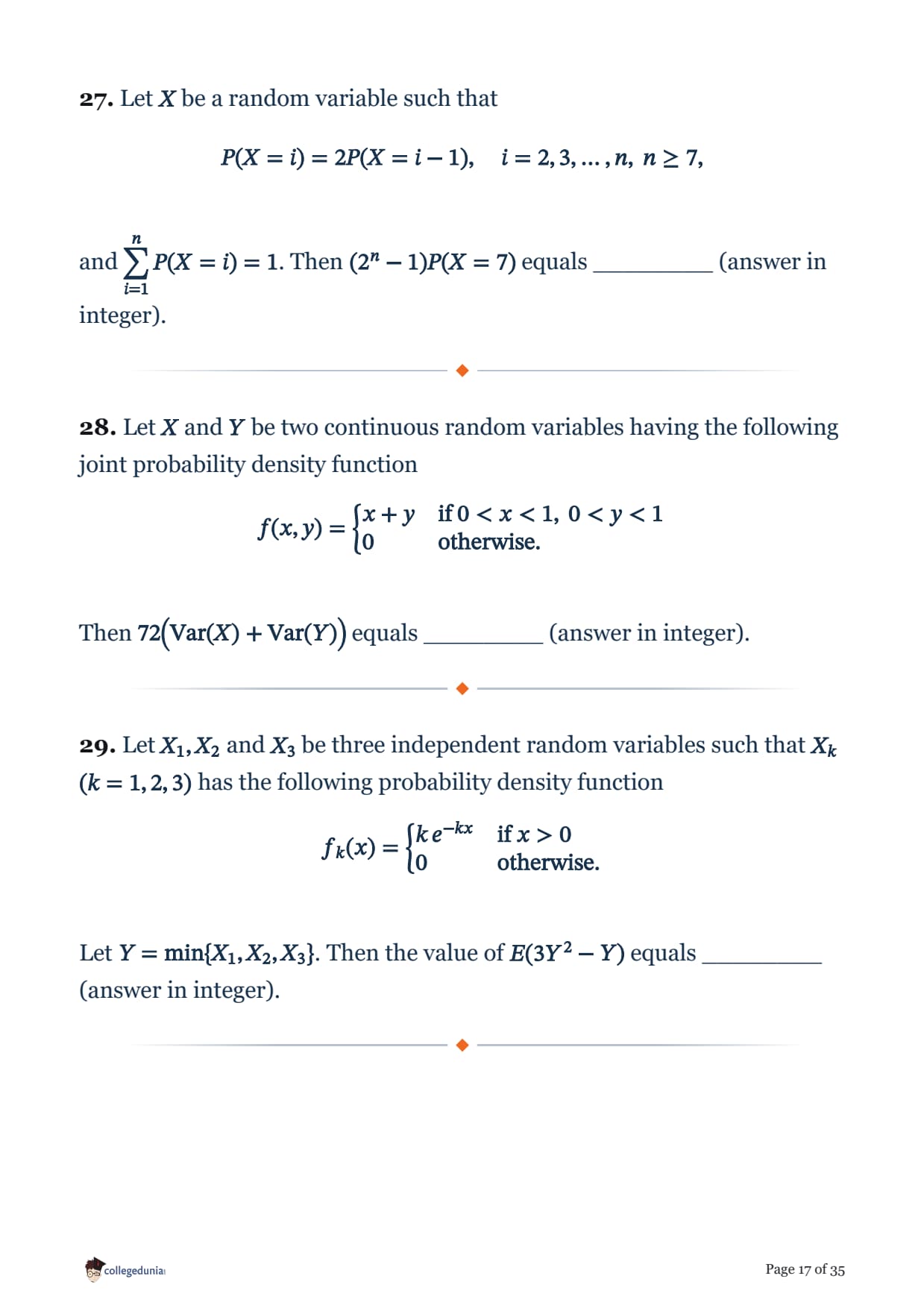
Let \(X\) be a random variable such that
\[ P(X=i)=2P(X=i-1), \quad i=2,3,\ldots,n,\ n\geq7, \]
and \(\displaystyle\sum_{i=1}^{n}P(X=i)=1\). Then \((2^n-1)P(X=7)\) equals ________ (answer in integer).
Let \(X\) and \(Y\) be two continuous random variables having the following joint probability density function
\[ f(x,y)=\begin{cases} x+y & \text{if } 0<x<1,\ 0<y<1 \\ 0 & \text{otherwise}. \end{cases} \]
Then \(72\big(\mathrm{Var}(X)+\mathrm{Var}(Y)\big)\) equals ________ (answer in integer).
Let \(X_1, X_2\) and \(X_3\) be three independent random variables such that \(X_k\) \((k=1,2,3)\) has the following probability density function
\[ f_k(x)=\begin{cases} k\,e^{-kx} & \text{if } x>0 \\ 0 & \text{otherwise}. \end{cases} \]
Let \(Y=\min\{X_1,X_2,X_3\}\). Then the value of \(E(3Y^2-Y)\) equals ________ (answer in integer).
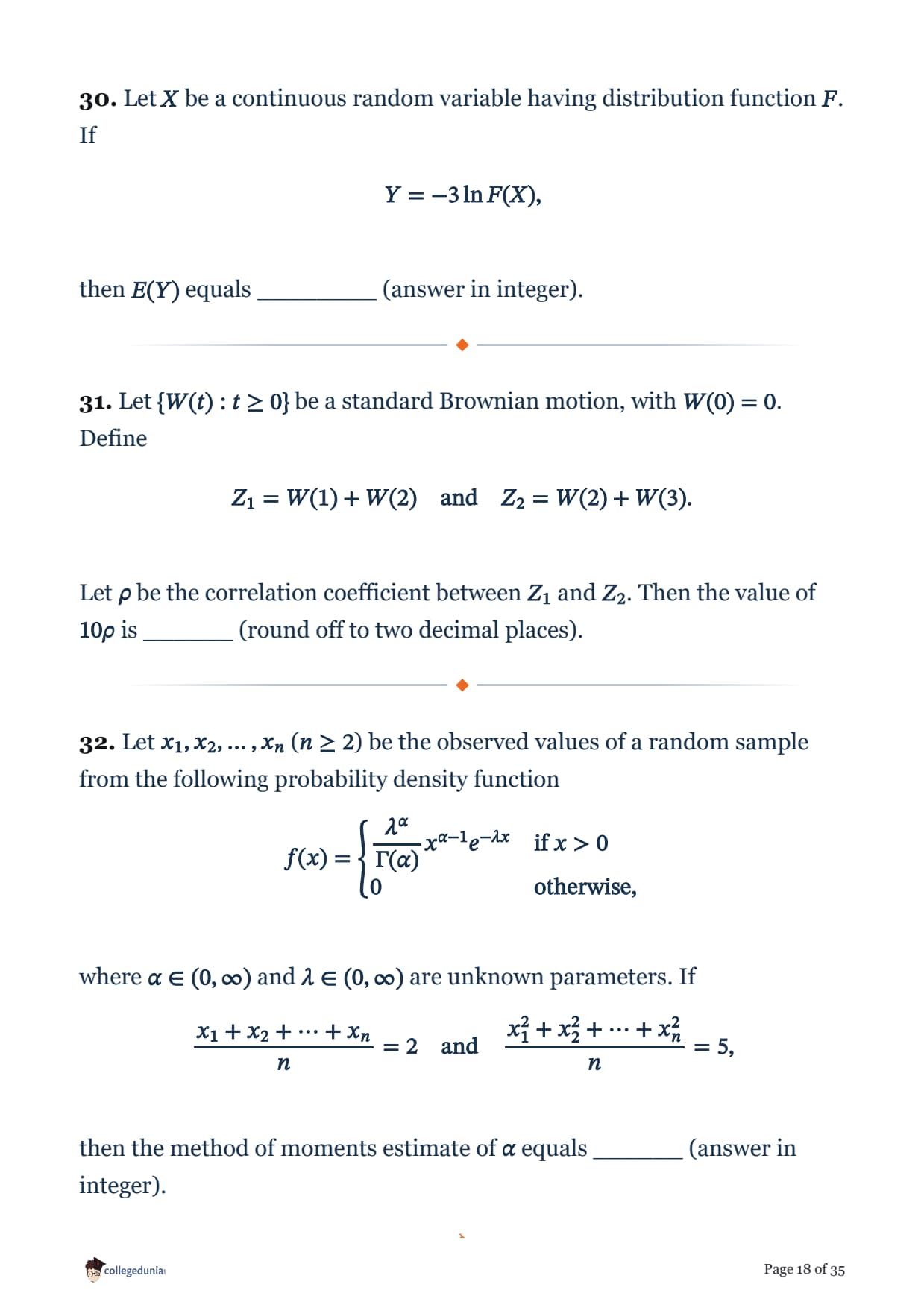
Let \(X\) be a continuous random variable having distribution function \(F\). If
\[ Y=-3\ln F(X), \]
then \(E(Y)\) equals ________ (answer in integer).
Let \(\{W(t):t\ge0\}\) be a standard Brownian motion, with \(W(0)=0\). Define
\[Z_1=W(1)+W(2)\quad\text{and}\quad Z_2=W(2)+W(3).\]
Let \(\rho\) be the correlation coefficient between \(Z_1\) and \(Z_2\). Then the value of \(10\rho\) is ______ (round off to two decimal places).
Let \(x_1,x_2,\ldots,x_n\) (\(n\ge2\)) be the observed values of a random sample from the following probability density function
\[f(x)=\begin{cases}\dfrac{\lambda^{\alpha}}{\Gamma(\alpha)}x^{\alpha-1}e^{-\lambda x} & \text{if } x>0\\0 & \text{otherwise,}\end{cases}\]
where \(\alpha\in(0,\infty)\) and \(\lambda\in(0,\infty)\) are unknown parameters. If
\[\frac{x_1+x_2+\cdots+x_n}{n}=2 \quad\text{and}\quad \frac{x_1^2+x_2^2+\cdots+x_n^2}{n}=5,\]
then the method of moments estimate of \(\alpha\) equals ______ (answer in integer).
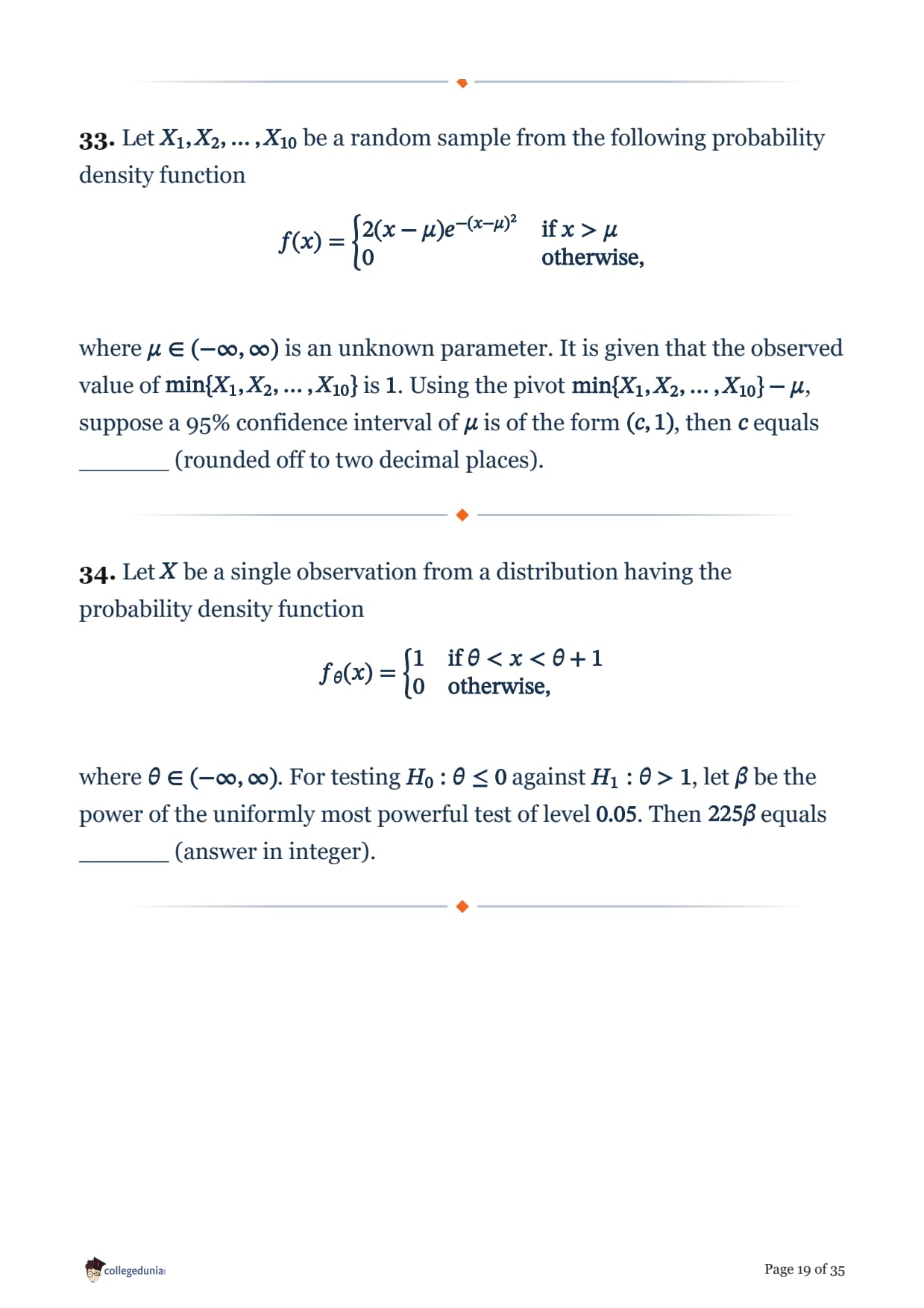
Let \(X_1,X_2,\ldots,X_{10}\) be a random sample from the following probability density function
\[f(x)=\begin{cases}2(x-\mu)e^{-(x-\mu)^2} & \text{if } x>\mu\\0 & \text{otherwise,}\end{cases}\]
where \(\mu\in(-\infty,\infty)\) is an unknown parameter. It is given that the observed value of \(\min\{X_1,X_2,\ldots,X_{10}\}\) is \(1\). Using the pivot \(\min\{X_1,X_2,\ldots,X_{10}\}-\mu\), suppose a 95% confidence interval of \(\mu\) is of the form \((c,1)\), then \(c\) equals ______ (rounded off to two decimal places).
Let \(X\) be a single observation from a distribution having the probability density function
\[f_\theta(x)=\begin{cases}1 & \text{if } \theta<x<\theta+1\\0 & \text{otherwise,}\end{cases}\]
where \(\theta\in(-\infty,\infty)\). For testing \(H_0:\theta\le0\) against \(H_1:\theta>1\), let \(\beta\) be the power of the uniformly most powerful test of level \(0.05\). Then \(225\beta\) equals ______ (answer in integer).
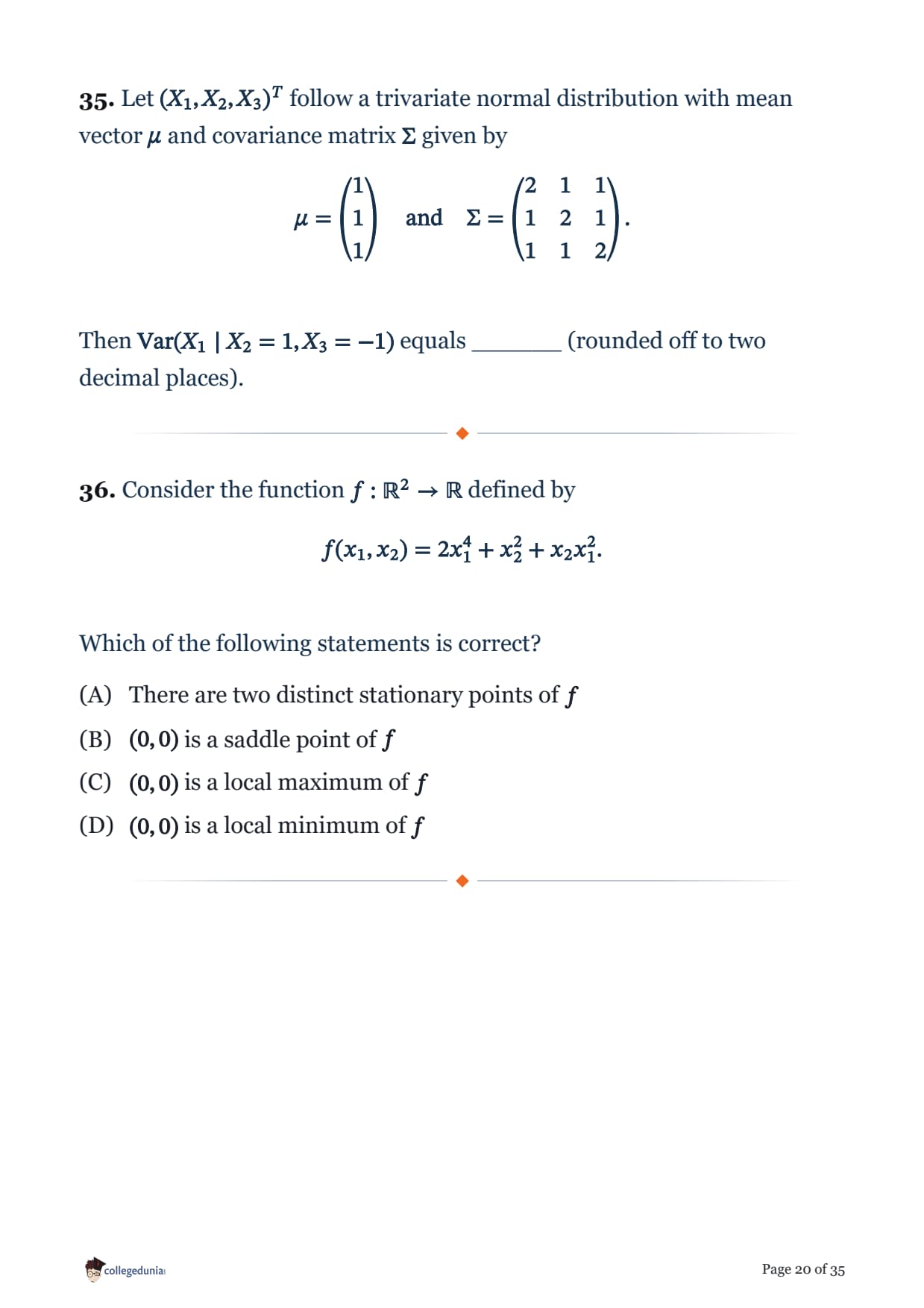
Let \((X_1,X_2,X_3)^T\) follow a trivariate normal distribution with mean vector \(\mu\) and covariance matrix \(\Sigma\) given by
\[\mu=\begin{pmatrix}1\\1\\1\end{pmatrix}\quad\text{and}\quad \Sigma=\begin{pmatrix}2&1&1\\1&2&1\\1&1&2\end{pmatrix}.\]
Then \(\text{Var}(X_1\mid X_2=1,X_3=-1)\) equals ______ (rounded off to two decimal places).
Consider the function \(f:\mathbb{R}^2 \to \mathbb{R}\) defined by
\[
f(x_1,x_2)=2x_1^4+x_2^2+x_2x_1^2.
\]
Which of the following statements is correct?
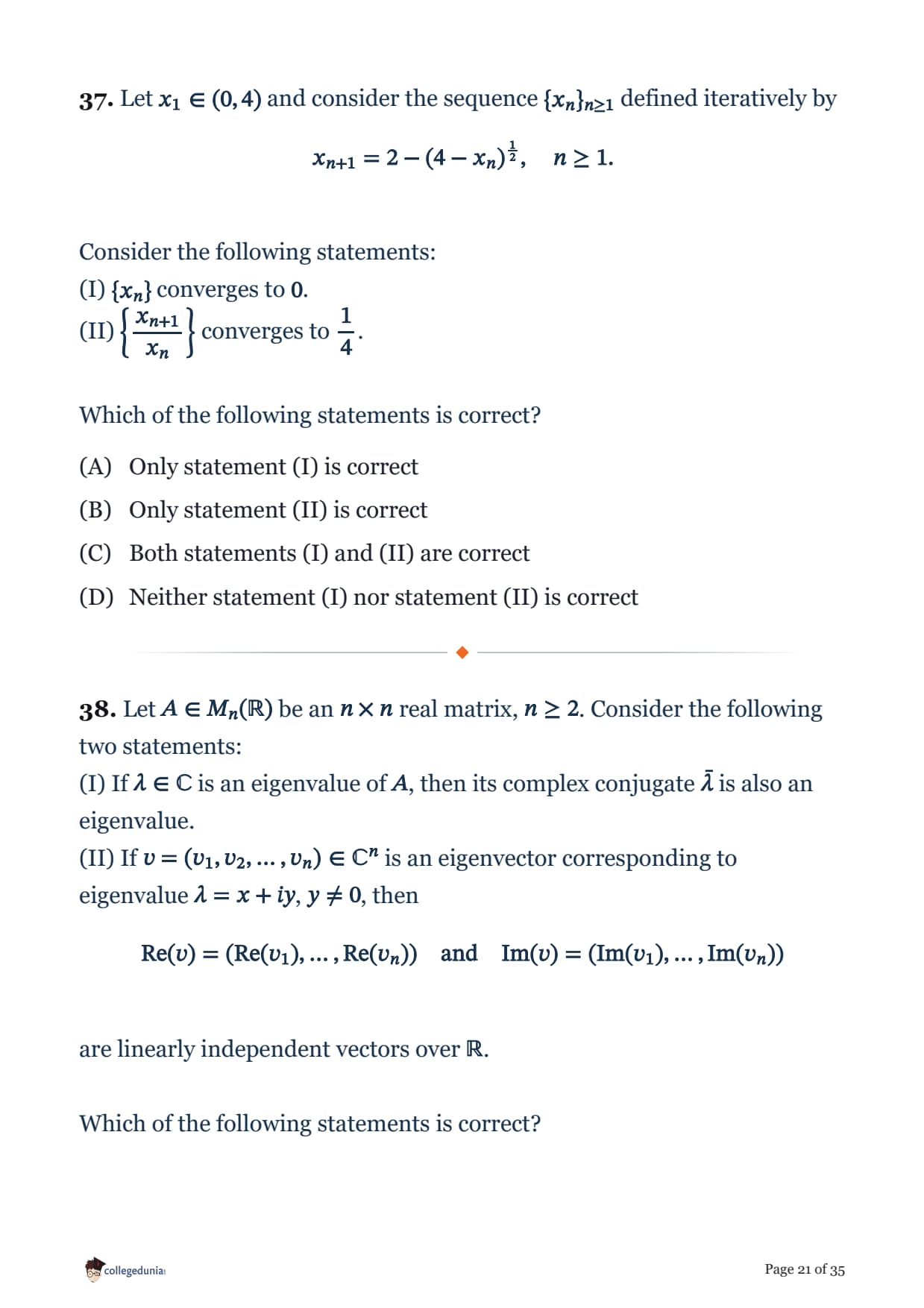
Let \(x_1\in(0,4)\) and consider the sequence \(\{x_n\}_{n\geq1}\) defined iteratively by
\[
x_{n+1}=2-(4-x_n)^{\frac{1}{2}},\quad n\geq1.
\]
Consider the following statements:
(I) \(\{x_n\}\) converges to \(0\).
(II) \(\left\{\dfrac{x_{n+1}}{x_n}\right\}\) converges to \(\dfrac{1}{4}\).
Which of the following statements is correct?
Let \(A\in M_n(\mathbb{R})\) be an \(n\times n\) real matrix, \(n\geq2\). Consider the following two statements:
(I) If \(\lambda\in\mathbb{C}\) is an eigenvalue of \(A\), then its complex conjugate \(\bar\lambda\) is also an eigenvalue.
(II) If \(v=(v_1,v_2,\ldots,v_n)\in\mathbb{C}^n\) is an eigenvector corresponding to eigenvalue \(\lambda=x+iy\), \(y\neq0\), then
\[
\text{Re}(v)=(\text{Re}(v_1),\ldots,\text{Re}(v_n))\quad\text{and}\quad\text{Im}(v)=(\text{Im}(v_1),\ldots,\text{Im}(v_n))
\]
are linearly independent vectors over \(\mathbb{R}\).
Which of the following statements is correct?
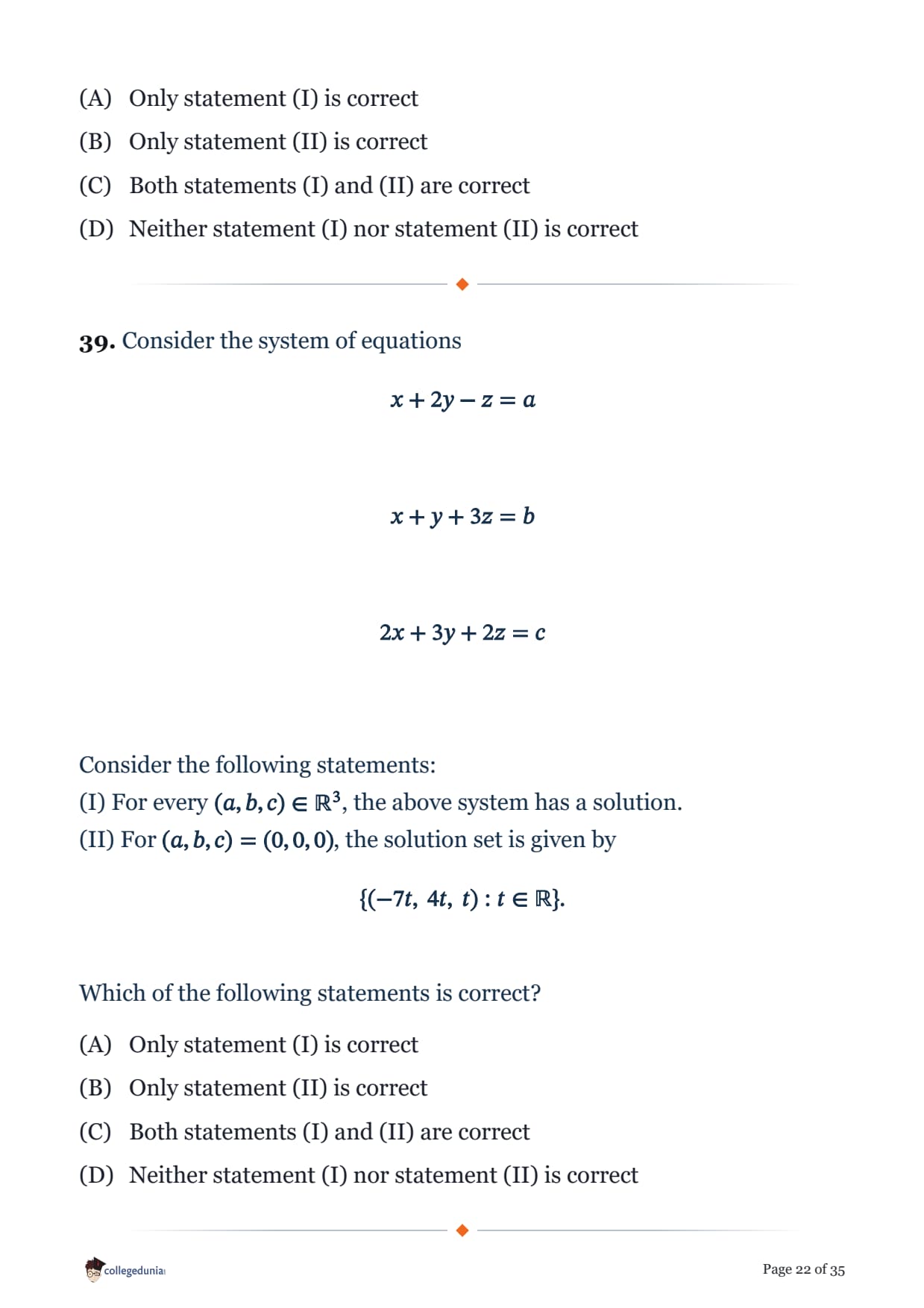
Consider the system of equations
\[
x+2y-z=a
\]
\[
x+y+3z=b
\]
\[
2x+3y+2z=c
\]
Consider the following statements:
(I) For every \((a,b,c)\in\mathbb{R}^3\), the above system has a solution.
(II) For \((a,b,c)=(0,0,0)\), the solution set is given by
\[
\{(-7t,\ 4t,\ t):t\in\mathbb{R}\}.
\]
Which of the following statements is correct?
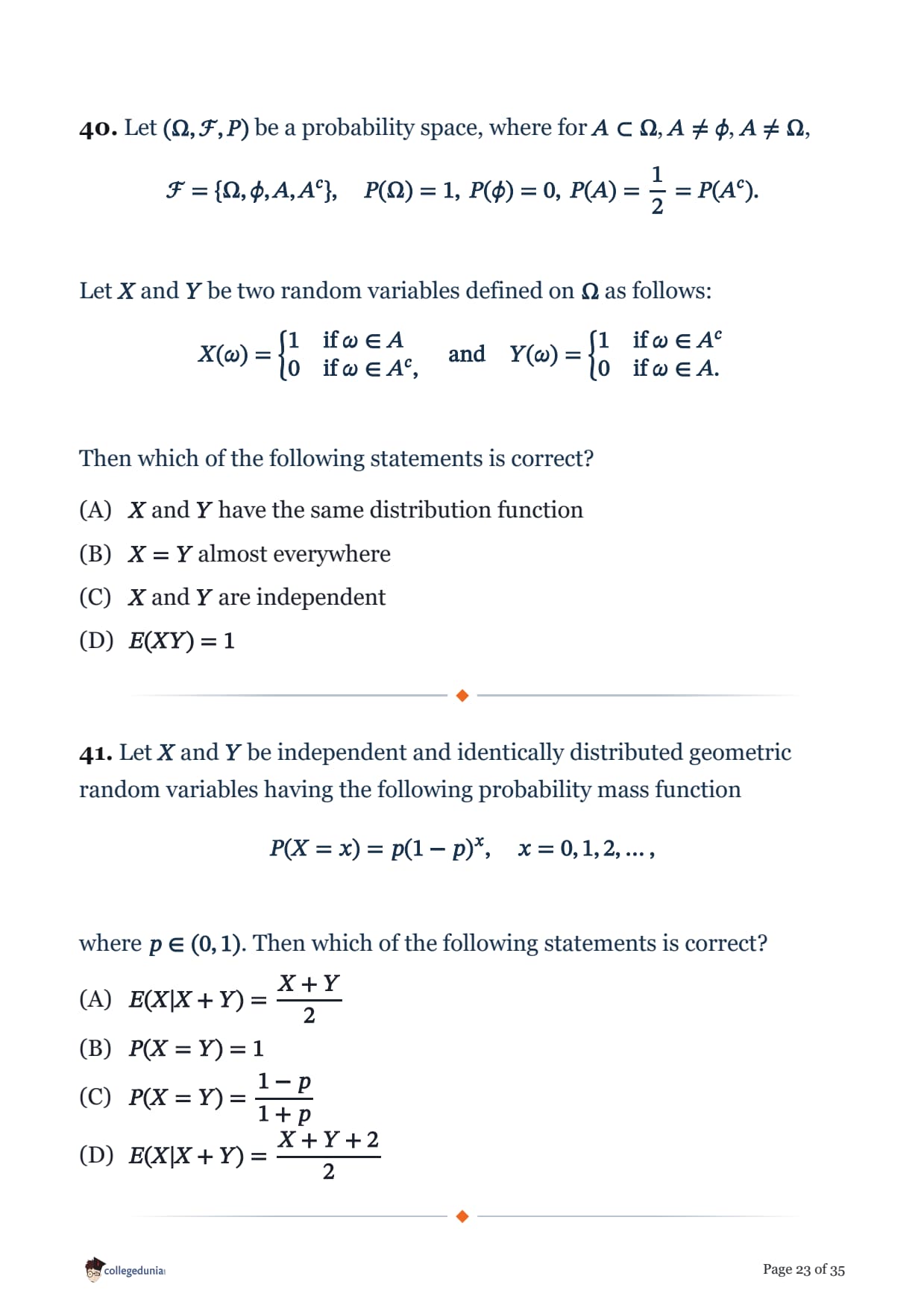
Let \((\Omega,\mathcal F,P)\) be a probability space, where for \(A\subset\Omega\), \(A\neq\phi\), \(A\neq\Omega\),
\[
\mathcal F=\{\Omega,\phi,A,A^c\},\quad P(\Omega)=1,\ P(\phi)=0,\ P(A)=\frac{1}{2}=P(A^c).
\]
Let \(X\) and \(Y\) be two random variables defined on \(\Omega\) as follows:
\[
X(\omega)=\begin{cases}1 & \text{if }\omega\in A\\ 0 & \text{if }\omega\in A^c,\end{cases}
\quad\text{and}\quad
Y(\omega)=\begin{cases}1 & \text{if }\omega\in A^c\\ 0 & \text{if }\omega\in A.\end{cases}
\]
Then which of the following statements is correct?
Let \(X\) and \(Y\) be independent and identically distributed geometric random variables having the following probability mass function
\[ P(X=x)=p(1-p)^x, \quad x=0,1,2,\ldots, \]
where \(p\in(0,1)\). Then which of the following statements is correct?
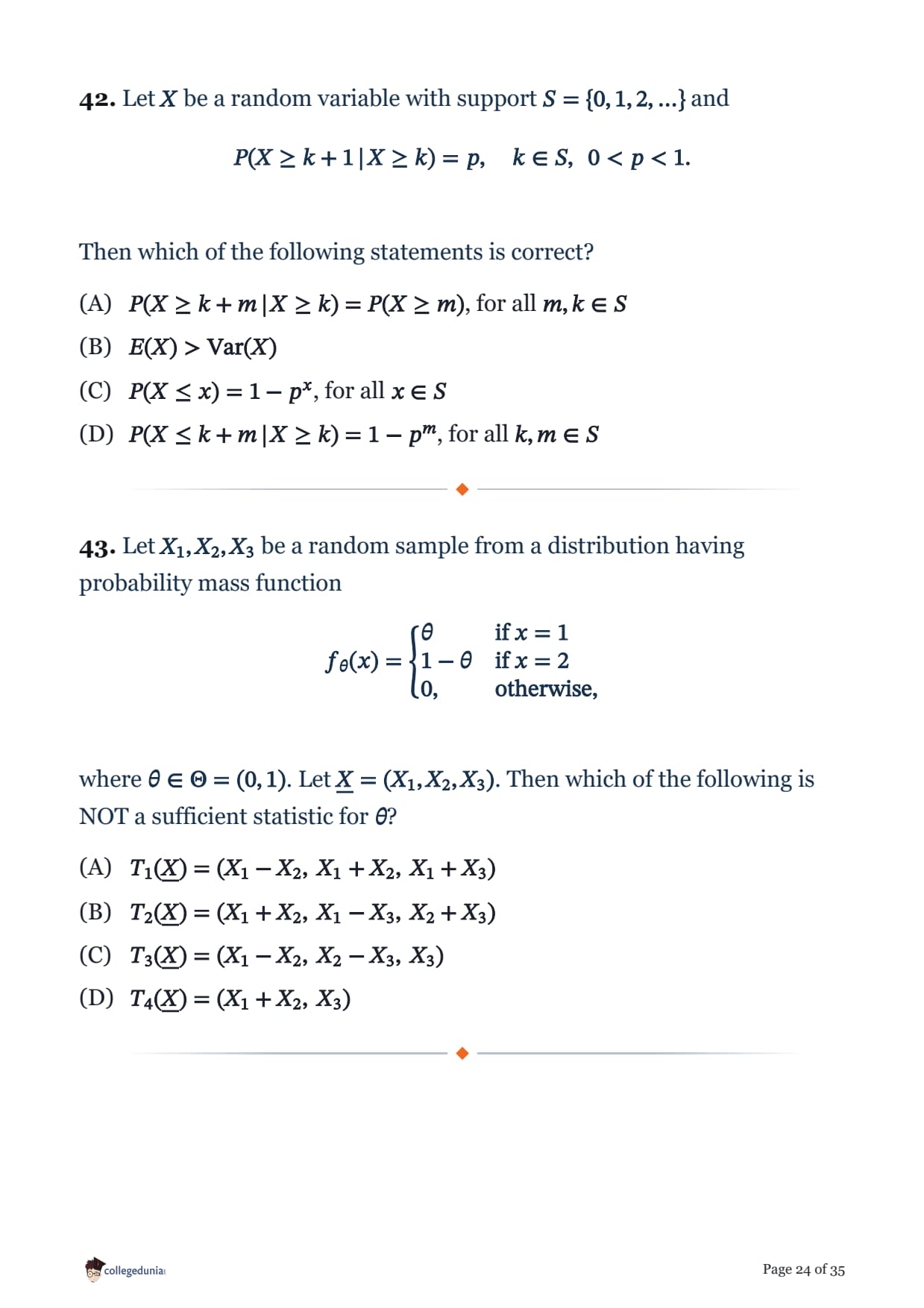
Let \(X\) be a random variable with support \(S=\{0,1,2,\ldots\}\) and
\[ P(X\geq k+1\,|\,X\geq k)=p, \quad k\in S,\ \ 0<p<1. \]
Then which of the following statements is correct?
Let \(X_1,X_2,X_3\) be a random sample from a distribution having probability mass function
\[ f_{\theta}(x)=\begin{cases}\theta & \text{if } x=1\\ 1-\theta & \text{if } x=2\\ 0, & \text{otherwise},\end{cases} \]
where \(\theta\in\Theta=(0,1)\). Let \(\underline{X}=(X_1,X_2,X_3)\). Then which of the following is NOT a sufficient statistic for \(\theta\)?
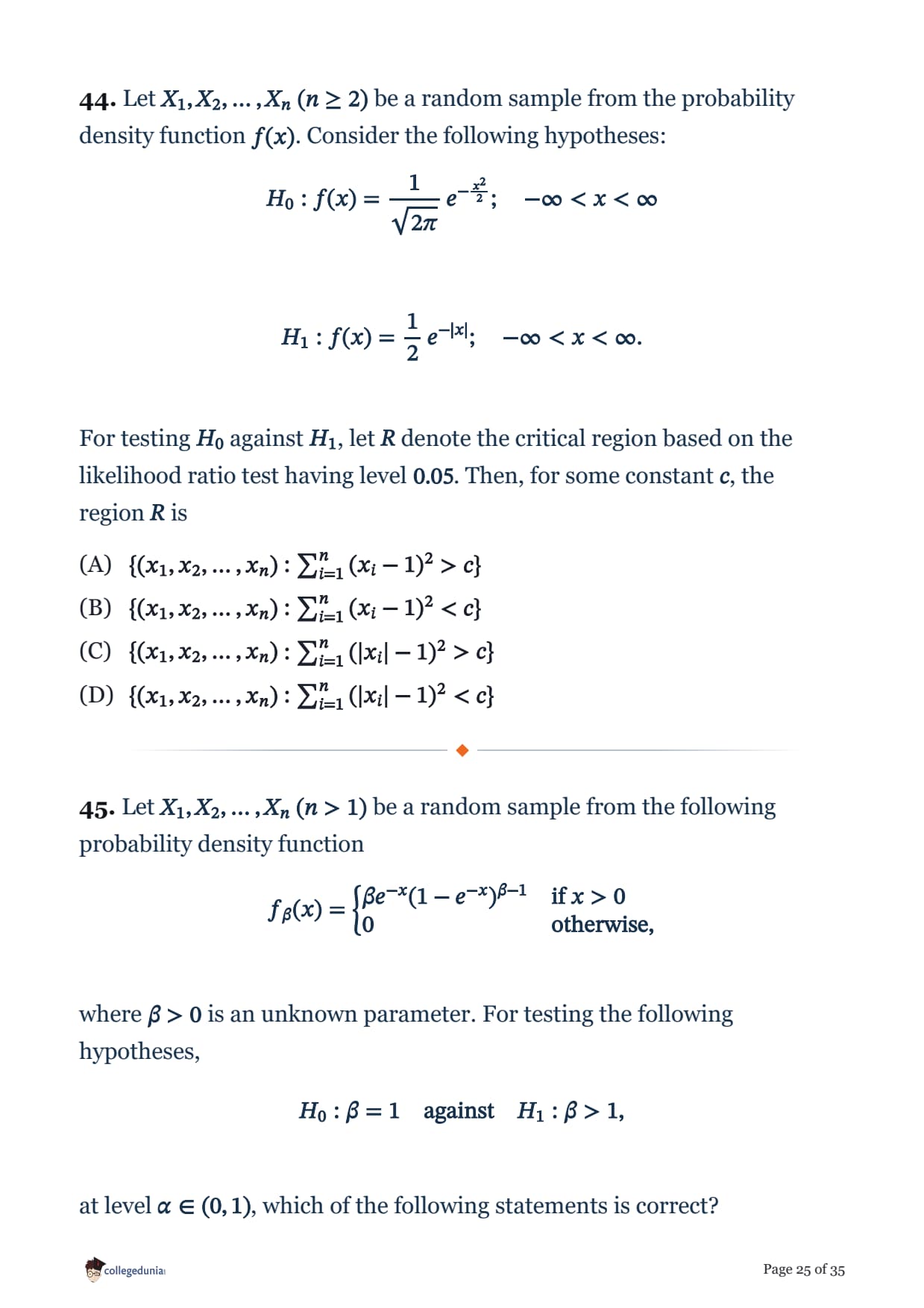
Let \(X_1,X_2,\ldots,X_n\ (n\geq2)\) be a random sample from the probability density function \(f(x)\). Consider the following hypotheses:
\[ H_0: f(x)=\frac{1}{\sqrt{2\pi}}\,e^{-\frac{x^2}{2}};\quad -\infty<x<\infty \]
\[ H_1: f(x)=\frac{1}{2}\,e^{-|x|};\quad -\infty<x<\infty. \]
For testing \(H_0\) against \(H_1\), let \(R\) denote the critical region based on the likelihood ratio test having level \(0.05\). Then, for some constant \(c\), the region \(R\) is
Let \(X_1,X_2,\ldots,X_n\ (n>1)\) be a random sample from the following probability density function
\[ f_{\beta}(x)=\begin{cases}\beta e^{-x}(1-e^{-x})^{\beta-1} & \text{if } x>0\\ 0 & \text{otherwise},\end{cases} \]
where \(\beta>0\) is an unknown parameter. For testing the following hypotheses,
\[ H_0:\beta=1 \quad \text{against} \quad H_1:\beta>1, \]
at level \(\alpha\in(0,1)\), which of the following statements is correct?
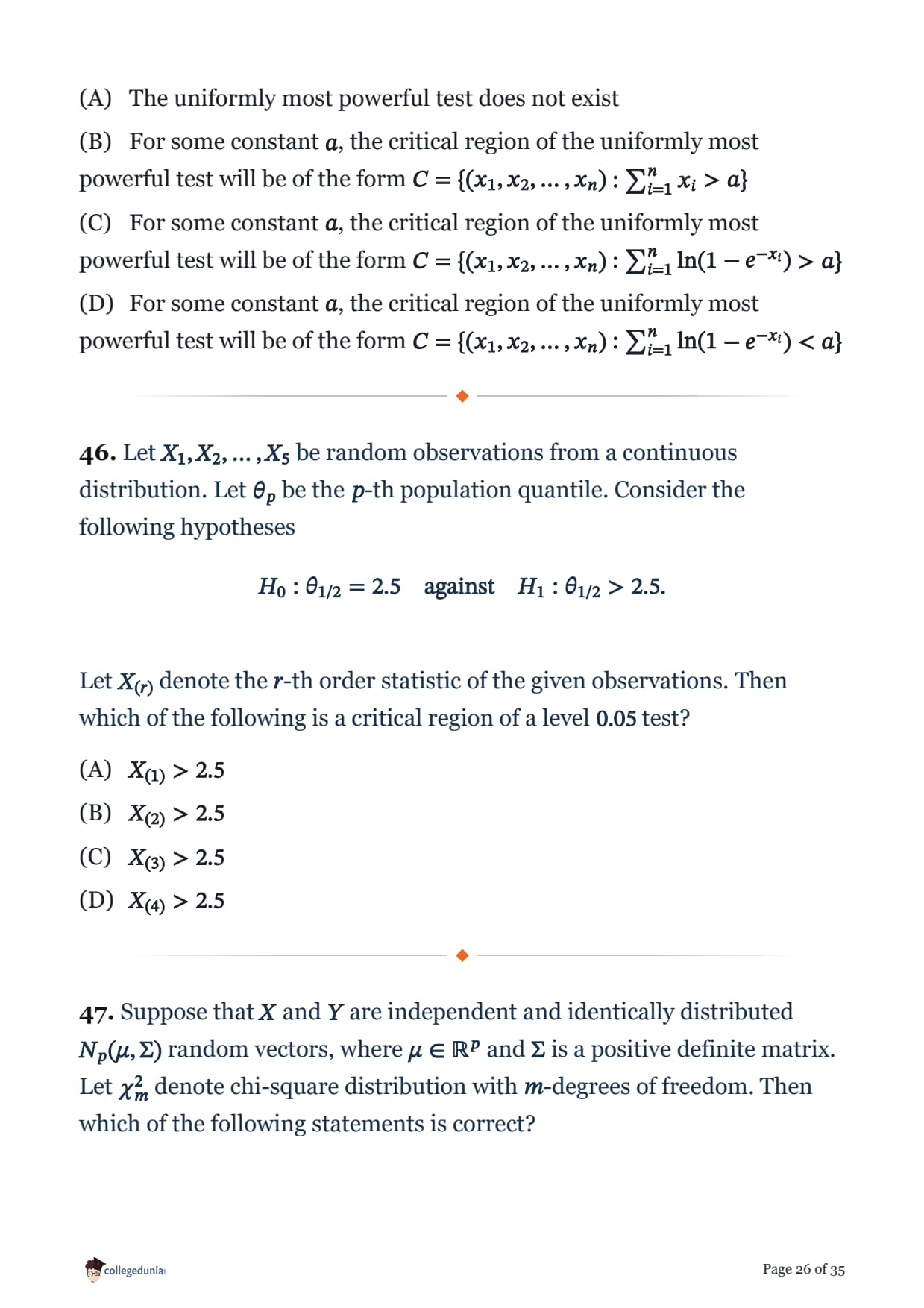
Let \(X_1, X_2, \ldots, X_5\) be random observations from a continuous distribution. Let \(\theta_p\) be the \(p\)-th population quantile. Consider the following hypotheses
\[ H_0:\theta_{1/2}=2.5 \quad \text{against} \quad H_1:\theta_{1/2}>2.5. \]
Let \(X_{(r)}\) denote the \(r\)-th order statistic of the given observations. Then which of the following is a critical region of a level \(0.05\) test?
Suppose that \(X\) and \(Y\) are independent and identically distributed \(N_p(\mu, \Sigma)\) random vectors, where \(\mu \in \mathbb{R}^p\) and \(\Sigma\) is a positive definite matrix. Let \(\chi^2_m\) denote chi-square distribution with \(m\)-degrees of freedom. Then which of the following statements is correct?
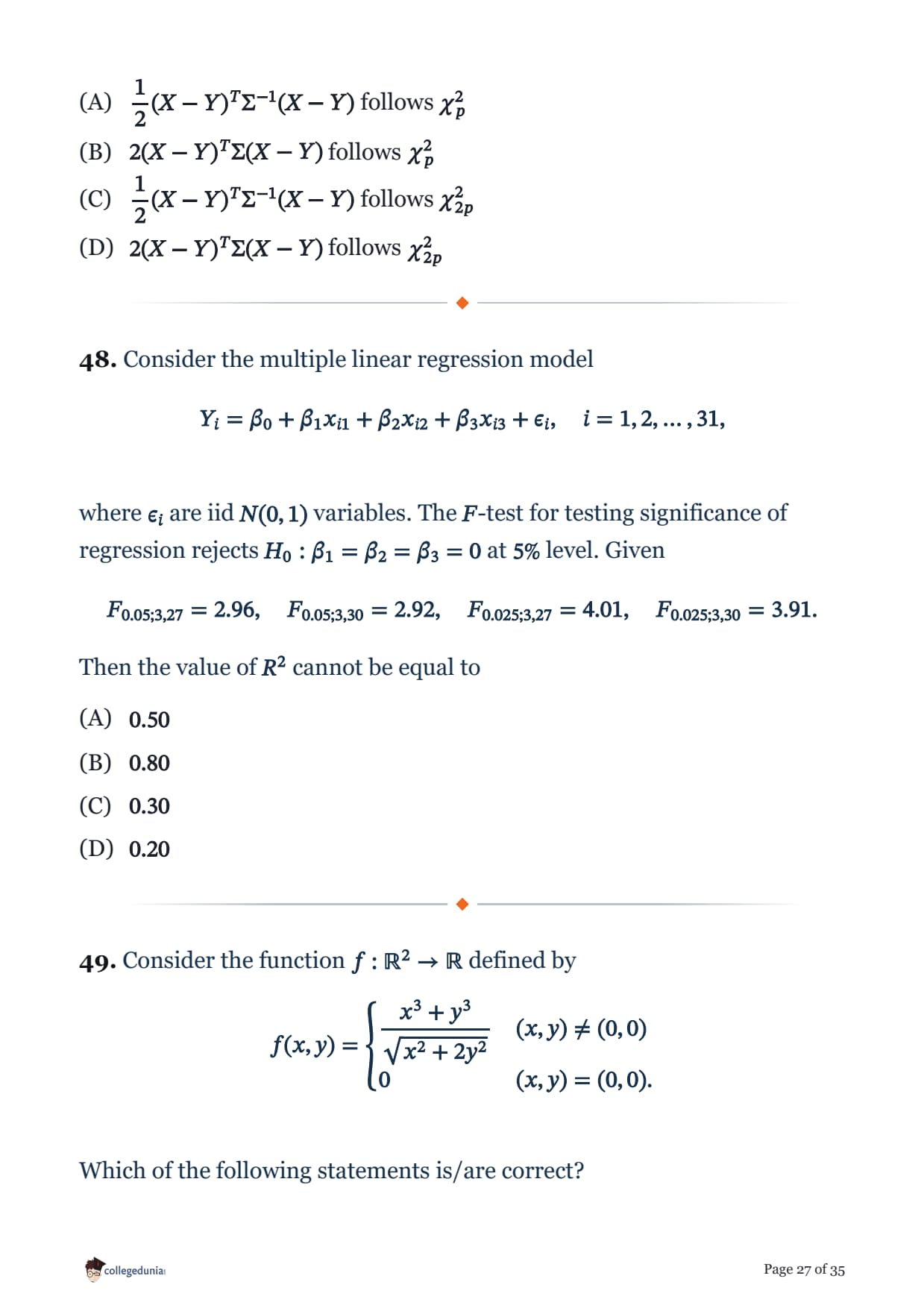
Consider the multiple linear regression model
\[ Y_i = \beta_0+\beta_1 x_{i1}+\beta_2 x_{i2}+\beta_3 x_{i3}+\epsilon_i, \quad i=1,2,\ldots,31, \]
where \(\epsilon_i\) are iid \(N(0,1)\) variables. The \(F\)-test for testing significance of regression rejects \(H_0: \beta_1=\beta_2=\beta_3=0\) at \(5\%\) level. Given \[ F_{0.05;3,27}=2.96,\quad F_{0.05;3,30}=2.92,\quad F_{0.025;3,27}=4.01,\quad F_{0.025;3,30}=3.91. \] Then the value of \(R^2\) cannot be equal to
Consider the function \(f:\mathbb{R}^2\to\mathbb{R}\) defined by
\[ f(x,y)= \begin{cases} \dfrac{x^3+y^3}{\sqrt{x^2+2y^2}} & (x,y)\neq (0,0) \\ 0 & (x,y)=(0,0). \end{cases} \]
Which of the following statements is/are correct?
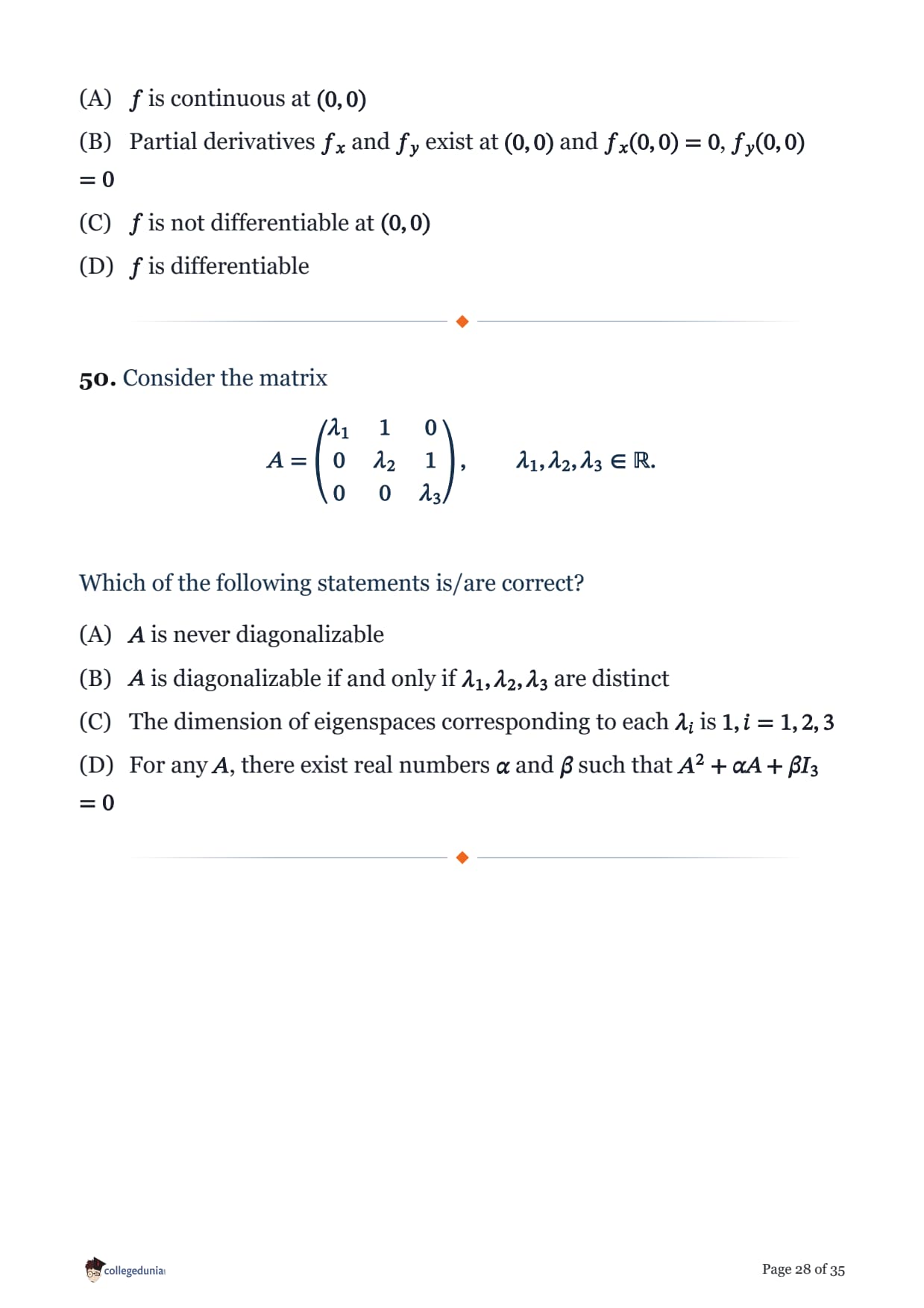
Consider the matrix
\[ A=\begin{pmatrix} \lambda_1 & 1 & 0 \\ 0 & \lambda_2 & 1 \\ 0 & 0 & \lambda_3 \end{pmatrix}, \qquad \lambda_1,\lambda_2,\lambda_3\in\mathbb{R}. \]
Which of the following statements is/are correct?
Consider the real symmetric matrix \(A=(a_{ij})\) given by \[ A=\begin{pmatrix}3 & 1 & 1\\ 1 & 0 & 2\\ 1 & 2 & 0\end{pmatrix}. \] Consider the set \[ S=\left\{x=(x_1,x_2,x_3)\in\mathbb{R}^3 : \sum_{j=1}^{3}\sum_{i=1}^{3}a_{ij}x_ix_j=1\right\}. \] Which of the following statements is/are correct?
Let \(X\) be a discrete random variable with support \(S=\{1,2,3,\ldots\}\) such that \(E(X^2)<\infty\). Let \(F\) be the distribution function of \(X\). Then which of the following statements is/are correct?
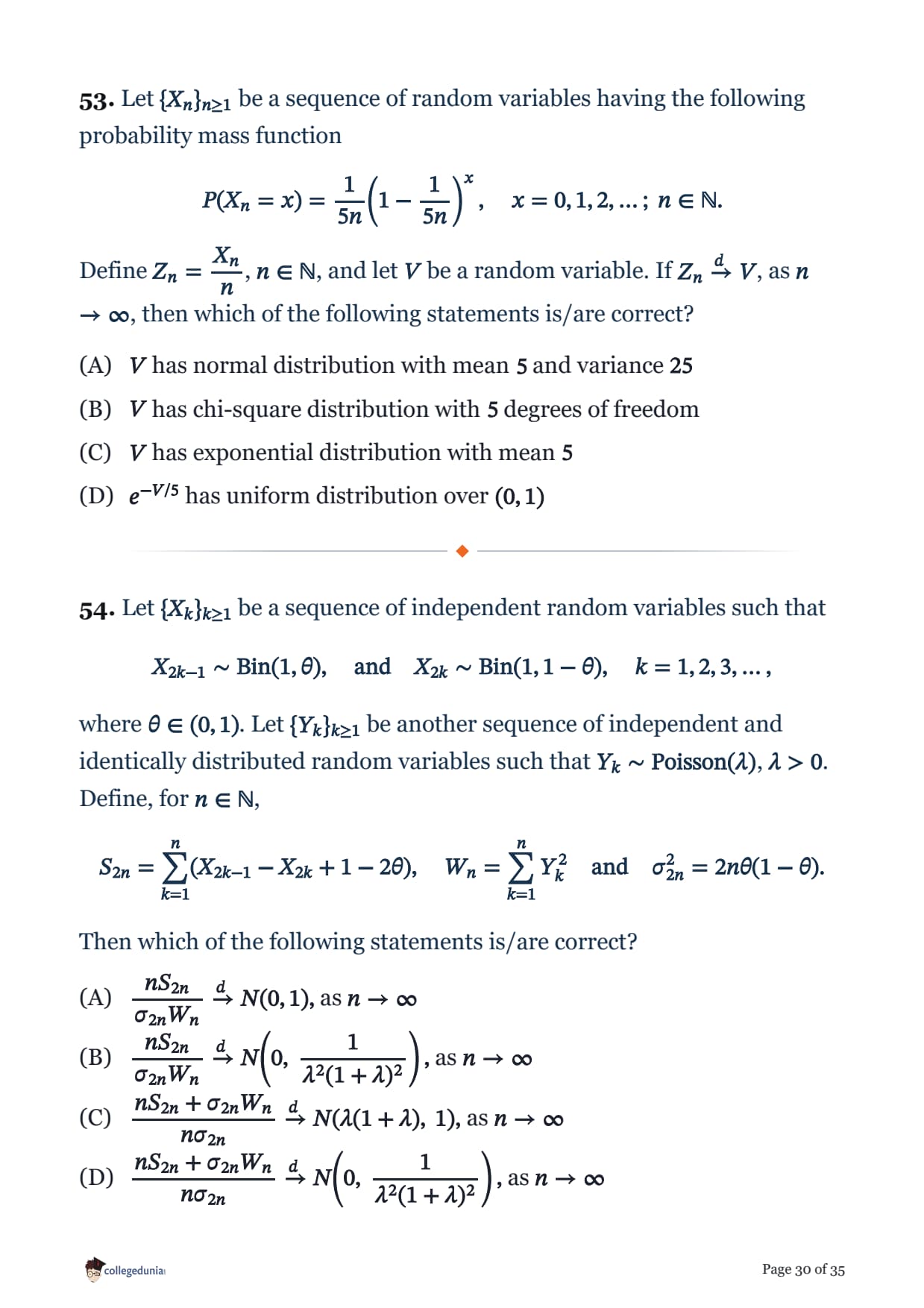
Let \(\{X_n\}_{n\geq1}\) be a sequence of random variables having the following probability mass function \[ P(X_n=x)=\frac{1}{5n}\left(1-\frac{1}{5n}\right)^{x},\quad x=0,1,2,\ldots;\ n\in\mathbb{N}. \] Define \(Z_n=\dfrac{X_n}{n}\), \(n\in\mathbb{N}\), and let \(V\) be a random variable. If \(Z_n\xrightarrow{d}V\), as \(n\to\infty\), then which of the following statements is/are correct?
Let \(\{X_k\}_{k\geq1}\) be a sequence of independent random variables such that \[ X_{2k-1}\sim \text{Bin}(1,\theta),\quad\text{and}\quad X_{2k}\sim \text{Bin}(1,1-\theta),\quad k=1,2,3,\ldots, \] where \(\theta\in(0,1)\). Let \(\{Y_k\}_{k\geq1}\) be another sequence of independent and identically distributed random variables such that \(Y_k\sim\text{Poisson}(\lambda)\), \(\lambda>0\). Define, for \(n\in\mathbb{N}\), \[ S_{2n}=\sum_{k=1}^{n}(X_{2k-1}-X_{2k}+1-2\theta),\quad W_n=\sum_{k=1}^{n}Y_k^2\quad\text{and}\quad \sigma_{2n}^2=2n\theta(1-\theta). \] Then which of the following statements is/are correct?
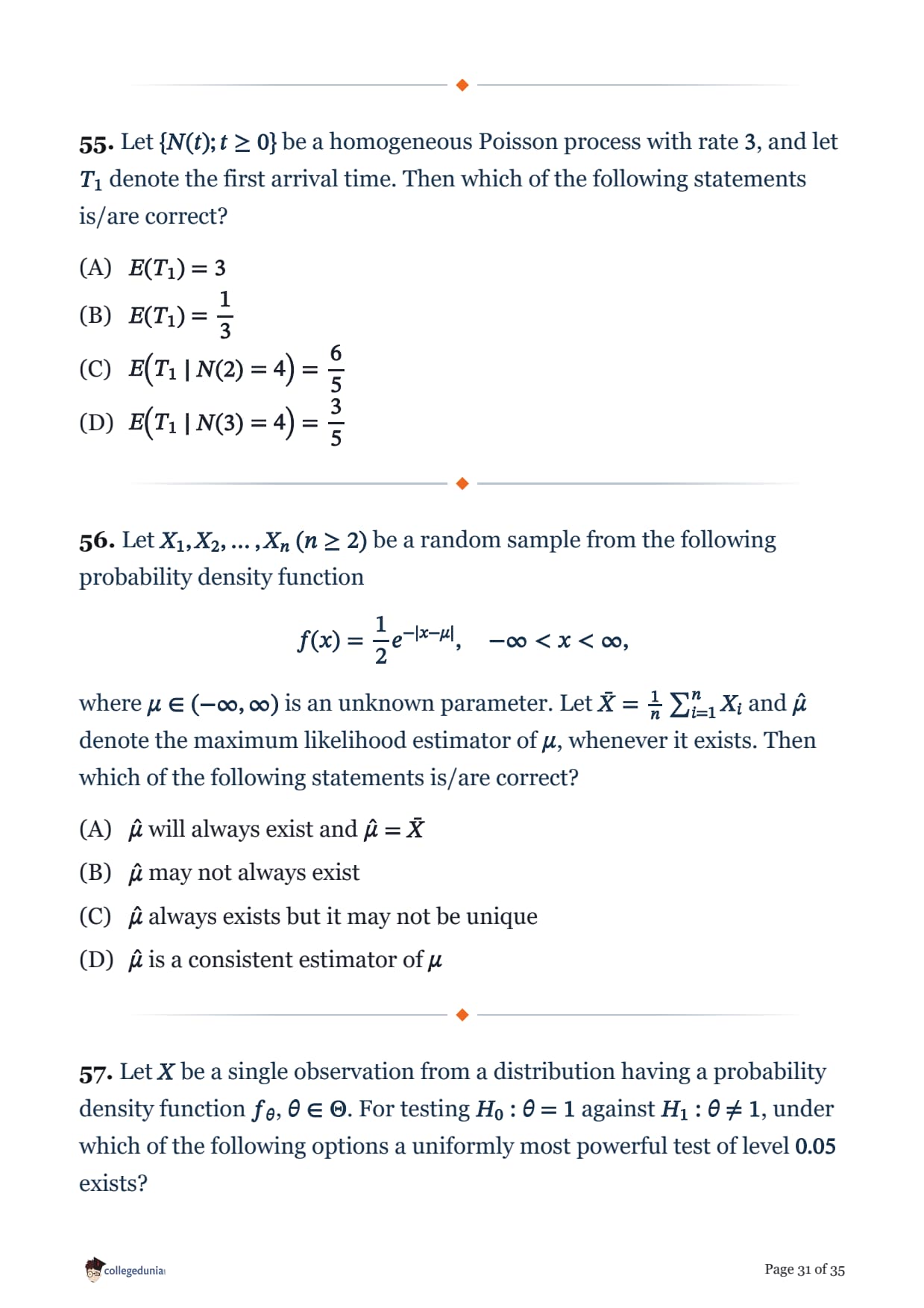
Let \(\{N(t);t\geq0\}\) be a homogeneous Poisson process with rate \(3\), and let \(T_1\) denote the first arrival time. Then which of the following statements is/are correct?
Let \(X_1, X_2, \ldots, X_n\) \((n \geq 2)\) be a random sample from the following probability density function
\[ f(x) = \frac{1}{2} e^{-|x-\mu|}, \quad -\infty < x < \infty, \] where \(\mu \in (-\infty, \infty)\) is an unknown parameter. Let \(\bar{X} = \frac{1}{n}\sum_{i=1}^{n} X_i\) and \(\hat{\mu}\) denote the maximum likelihood estimator of \(\mu\), whenever it exists. Then which of the following statements is/are correct?
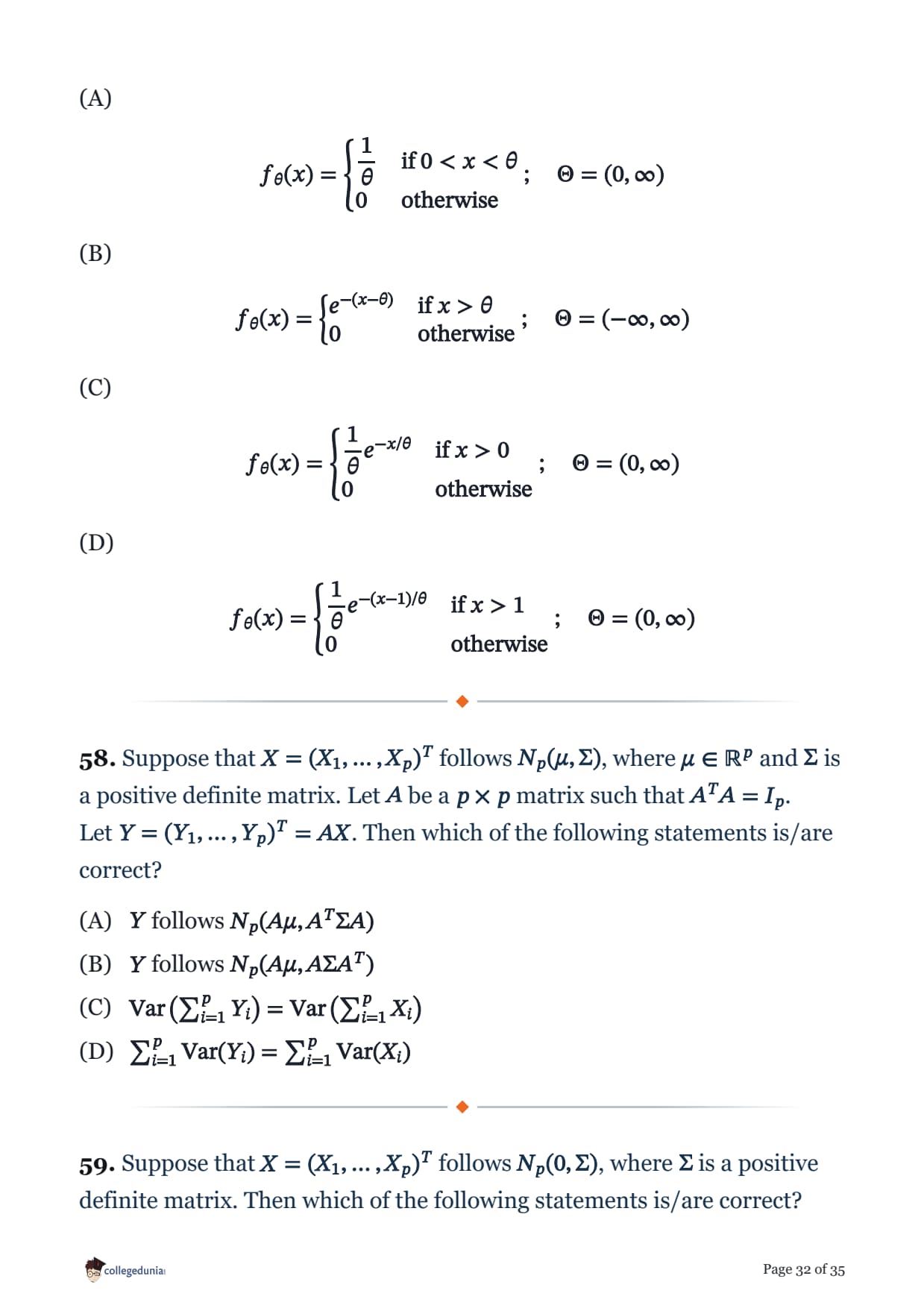
Let \(X\) be a single observation from a distribution having a probability density function \(f_\theta\), \(\theta \in \Theta\). For testing \(H_0: \theta = 1\) against \(H_1: \theta \neq 1\), under which of the following options a uniformly most powerful test of level \(0.05\) exists?
Suppose that \(X = (X_1, \ldots, X_p)^T\) follows \(N_p(\mu, \Sigma)\), where \(\mu \in \mathbb{R}^p\) and \(\Sigma\) is a positive definite matrix. Let \(A\) be a \(p \times p\) matrix such that \(A^T A = I_p\).
Let \(Y = (Y_1, \ldots, Y_p)^T = AX\). Then which of the following statements is/are correct?
Suppose that \(X = (X_1, \ldots, X_p)^T\) follows \(N_p(0, \Sigma)\), where \(\Sigma\) is a positive definite matrix. Then which of the following statements is/are correct?
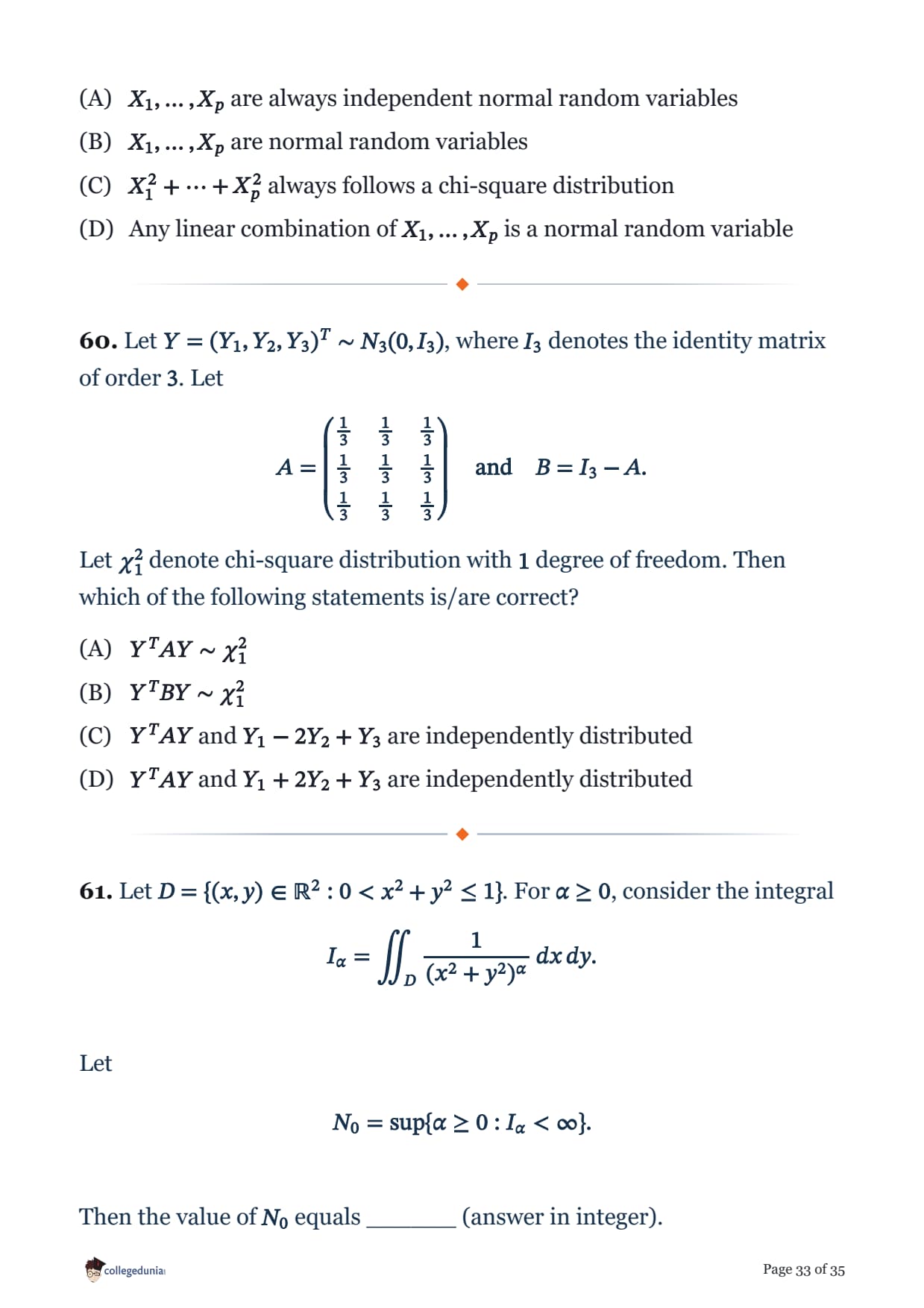
Let \(Y = (Y_1, Y_2, Y_3)^T \sim N_3(0, I_3)\), where \(I_3\) denotes the identity matrix of order \(3\). Let
\[ A = \begin{pmatrix} \frac{1}{3} & \frac{1}{3} & \frac{1}{3} \\ \frac{1}{3} & \frac{1}{3} & \frac{1}{3} \\ \frac{1}{3} & \frac{1}{3} & \frac{1}{3} \end{pmatrix} \quad \text{and} \quad B = I_3 - A. \] Let \(\chi_1^2\) denote chi-square distribution with \(1\) degree of freedom. Then which of the following statements is/are correct?
Let \(D=\{(x,y)\in\mathbb{R}^2:0<x^2+y^2\leq1\}\). For \(\alpha\geq0\), consider the integral
\[
I_\alpha=\iint_D \frac{1}{(x^2+y^2)^\alpha}\,dx\,dy.
\]
Let
\[
N_0=\sup\{\alpha\geq0:I_\alpha<\infty\}.
\]
Then the value of \(N_0\) equals ______ (answer in integer).
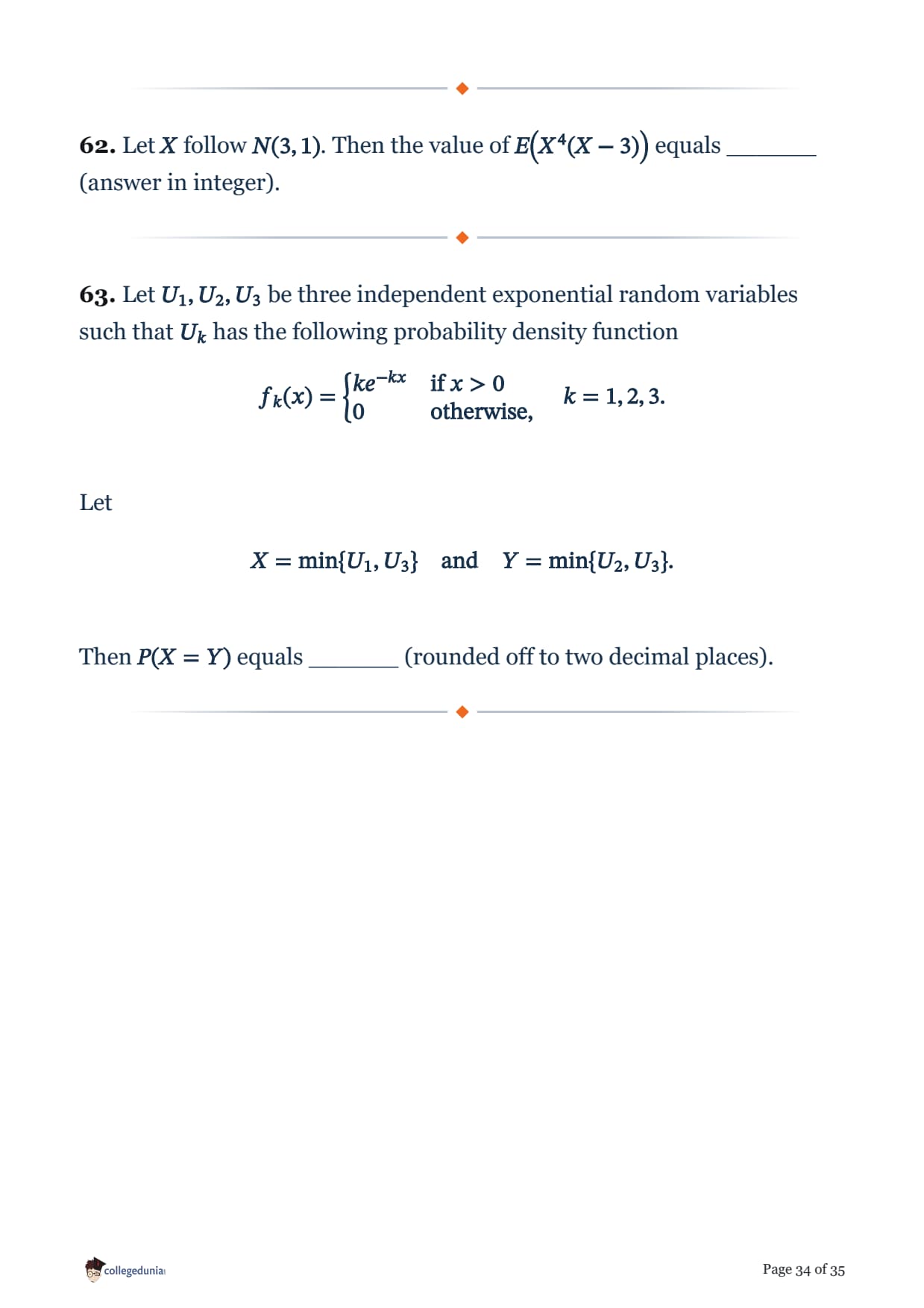
Let \(X\) follow \(N(3,1)\). Then the value of \(E\big(X^4(X-3)\big)\) equals ______ (answer in integer).
Let \(U_1,U_2,U_3\) be three independent exponential random variables such that \(U_k\) has the following probability density function
\[
f_k(x)=\begin{cases}ke^{-kx}&\text{if }x>0\\0&\text{otherwise,}\end{cases}\quad k=1,2,3.
\]
Let
\[
X=\min\{U_1,U_3\}\quad\text{and}\quad Y=\min\{U_2,U_3\}.
\]
Then \(P(X=Y)\) equals ______ (rounded off to two decimal places).
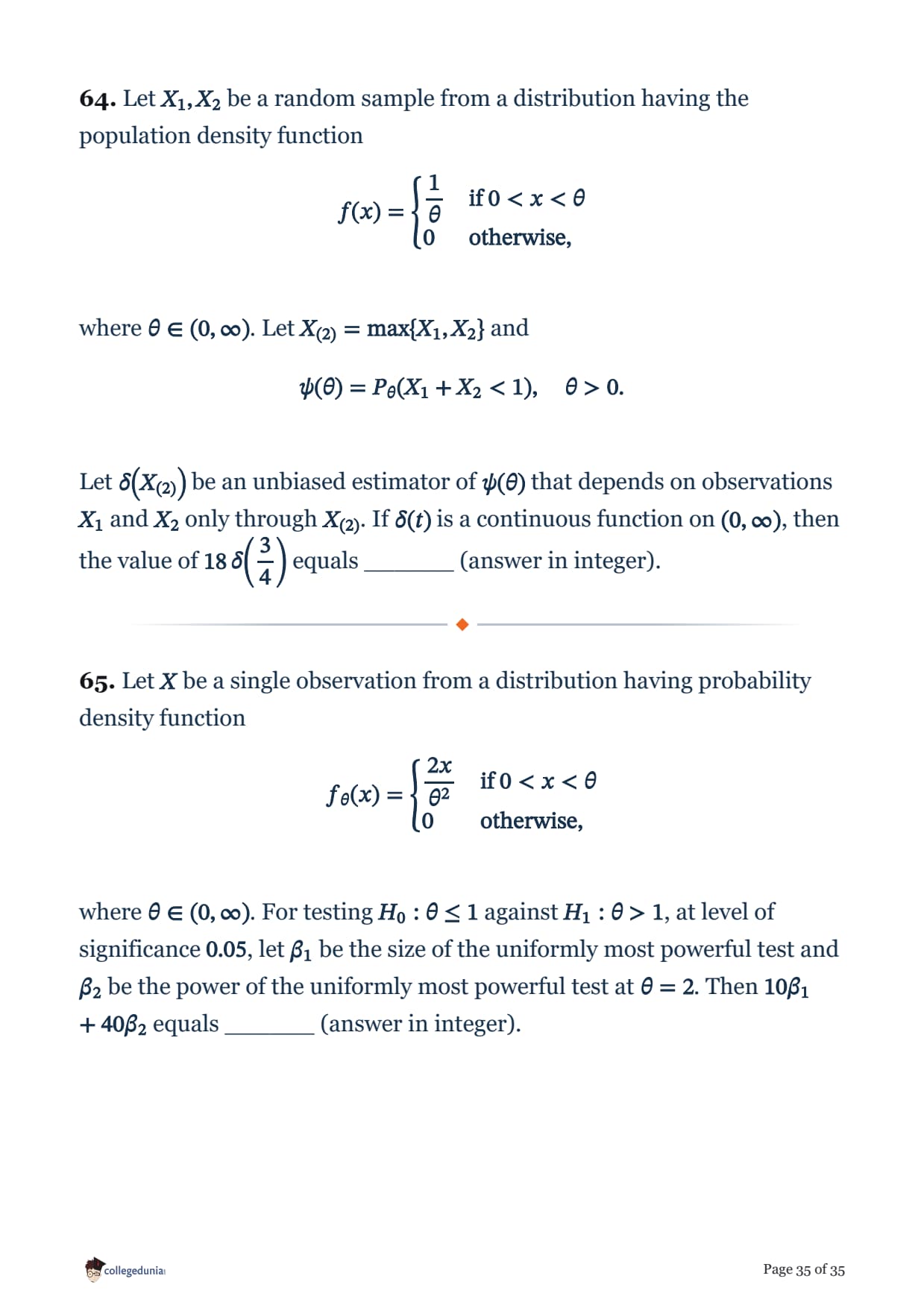
Let \(X_1,X_2\) be a random sample from a distribution having the population density function
\[
f(x)=\begin{cases}\dfrac{1}{\theta}&\text{if }0<x<\theta\\0&\text{otherwise,}\end{cases}
\]
where \(\theta\in(0,\infty)\). Let \(X_{(2)}=\max\{X_1,X_2\}\) and
\[
\psi(\theta)=P_\theta(X_1+X_2<1),\quad\theta>0.
\]
Let \(\delta\big(X_{(2)}\big)\) be an unbiased estimator of \(\psi(\theta)\) that depends on observations \(X_1\) and \(X_2\) only through \(X_{(2)}\). If \(\delta(t)\) is a continuous function on \((0,\infty)\), then the value of \(18\,\delta\!\left(\dfrac{3}{4}\right)\) equals ______ (answer in integer).
Let \(X\) be a single observation from a distribution having probability density function
\[
f_\theta(x)=\begin{cases}\dfrac{2x}{\theta^2}&\text{if }0<x<\theta\\0&\text{otherwise,}\end{cases}
\]
where \(\theta\in(0,\infty)\). For testing \(H_0:\theta\leq1\) against \(H_1:\theta>1\), at level of significance \(0.05\), let \(\beta_1\) be the size of the uniformly most powerful test and \(\beta_2\) be the power of the uniformly most powerful test at \(\theta=2\). Then \(10\beta_1+40\beta_2\) equals ______ (answer in integer).
GATE 2026 Statistics Exam Pattern and Marking Scheme Explained
As per the information bulletin on the official website (gate2026.iitg.ac.in), GATE Statistics is a computer-based test with no separate Engineering Mathematics section, unlike most core engineering papers.
- Total questions: 65, split into 10 General Aptitude questions (15 marks) and 55 Statistics core questions (85 marks)
- Duration: 3 hours
- Total marks: 100
- Marking scheme: -1/3 for a wrong 1-mark MCQ, -2/3 for a wrong 2-mark MCQ, no negative marking on MSQ or NAT
- Question types: MCQ, MSQ (Multiple Select), and NAT (Numerical Answer Type)
High-Weightage Topics in GATE 2026 Statistics to Focus On First
Going question by question through this exact paper, Probability and Estimation carried the most weight, not Linear Algebra or Calculus as many students expect going in.
- Probability: 14 of the 55 core questions, the single biggest block in the paper, ranging from moment generating functions to Brownian motion covariance
- Estimation: 8 questions, including method of moments, sufficient statistics, and Cramer-Rao bound problems
- Calculus: 7 questions on limits, differentiability, and stationary points
- Linear Algebra: 7 questions covering eigenvalues, orthogonal complements, and quadratic forms
- Testing of Hypotheses: 7 questions, several needing the UMP test and Karlin-Rubin monotone likelihood ratio argument
- Multivariate Analysis and Sampling Distributions: 4 questions each, mostly on the multivariate normal and quadratic forms of normal vectors
GATE Statistics Good Attempts and Qualifying Score Benchmark
- The General category qualifying mark moved to 30.4 out of 100 for 2026, up slightly from 30.2 in 2025
- Most Statistics candidates land in the 40-60 mark range, so even 2-3 marks from a single NAT question can shift your rank band
- Since MSQ and NAT carry no negative marking, attempt every NAT question you can set up an equation for, even if you are not fully sure of the final decimal
GATE 2026 Statistics Question Paper Analysis Video
Source: Robert Cruikshank
How to Use the GATE Statistics Question Paper for Practice
Treat this paper as a timed mock before you touch the solutions PDF, since the real exam gives you exactly 3 hours for all 65 questions.
- Attempt General Aptitude first; at 10 questions in roughly 15-18 minutes it is the fastest score in the paper
- Set a hard stop of about 8-9 minutes per NAT question in Estimation and Stochastic Processes, since these need multi-step derivations before you get a number
- Redo every MSQ you got only partially right; MSQ questions this year tested whether you could check all four options individually, not just spot one correct one
- Compare your Probability and Testing of Hypotheses attempts against the solution PDF first, since these two topics alone account for 21 of the 55 core questions
GATE 2026 Statistics Question Paper FAQs
Ques. Was GATE 2026 Statistics tougher than GATE 2025 ST?
Ans. Yes, the Inference and Multivariate Analysis sections were harder this year, and the General category qualifying mark rose slightly to 30.4 from 30.2 in 2025, which matches a marginally tougher paper rather than an easier one.
Ques. Which topics had the highest weightage in GATE 2026 Statistics?
Ans. Probability led with 14 of the 55 core questions, followed by Estimation with 8, and Calculus, Linear Algebra, and Testing of Hypotheses with 7 questions each.
Ques. How many marks are needed to qualify GATE Statistics 2026?
Ans. The General category qualifying mark for GATE 2026 ST is 30.4 out of 100. OBC-NCL and EWS candidates qualify at a lower mark, and SC, ST, and PwD candidates at a lower mark still, as published by IIT Guwahati.
Ques. Are GATE Statistics questions repeated from previous years?
Ans. The exact numbers change every year, but the same core ideas, such as sufficient statistics, UMP tests, and moment generating functions, come back in a new form almost every session, so solving past ST papers still builds the right pattern recognition.
Ques. Is there negative marking for MSQ and NAT questions in GATE Statistics?
Ans. No. Only MCQs carry negative marking, at -1/3 for a 1-mark question and -2/3 for a 2-mark question. MSQ and NAT questions have zero negative marking, so it is safe to attempt any NAT question you can set up.
Ques. Where can I download the GATE 2026 Statistics question paper with solutions PDF for free?
Ans. The complete GATE 2026 ST question paper with step-by-step solutions is available for free download in the table above on this page. The official question paper and answer key are also published on the GATE 2026 website by IIT Guwahati.



Comments