




IIT Madras has released the GATE ME Syllabus 2027 on its official website, gate2027.iitm.ac.in, along with the information brochure on July 20.
The GATE 2027 syllabus has been revised for various papers, including the GATE ME syllabus 2027.
- GATE ME syllabus now includes topics such as control systems, automation, additive manufacturing, PLCs, NDT, and advanced manufacturing.
- A few topics such as Lagrange's equation, Heisler charts, and UTM testing have been removed.
- There are four sections in the GATE ME syllabus 2027, which include Engineering Mathematics, Applied Mechanics and Design, and others.
- The ME paper includes 65 questions worth 100 marks to be attempted in 3 hours.
- The General Aptitude section and the Engineering Mathematics section carry 15 and 13 marks respectively.
- Based on previous years' data, the core Mechanical subjects hold around 70% weightage in the paper.
Candidates can start their GATE ME preparation as there are around 7 months left for the exam, which is scheduled for February.
Also Check:

Key Summary
- IIT Madras will conduct the GATE 2027 exam, as per the rotational policy, in February.
- The GATE ME 2027 syllabus has four sections apart from the general aptitude section.
- The paper carries 100 marks, divided between the General Aptitude and subject parts.
- Topics such as Thermodynamics, Strength of Materials, and Fluid Mechanics carry high weightage.
GATE ME Syllabus 2027: Overview
IIT Madras will be conducting the Graduate Aptitude Test in Engineering (GATE) 2027 on February 6, 7, 13, 14, 20, and 21.
- In the ME paper, your knowledge of Mechanical Engineering at the undergraduate level is being tested.
- The syllabus is split into General Aptitude, Engineering Mathematics, and three core Mechanical sections.
- The GATE paper is conducted as a computer-based test and includes topics such as Fluid Mechanics and Thermal Sciences and Materials, Manufacturing and Industrial Engineering.
- Apart from General Aptitude, the rest of the syllabus is specific to Mechanical Engineering.
The GATE ME paper has been moderate in overall difficulty. In ME, around 10,664 candidates qualified from the 62,015 candidates who appeared in GATE 2025.
Related Links:
GATE ME 2027 Syllabus: What’s New
The GATE ME syllabus now includes topics such as control systems, automation, additive manufacturing, PLCs, NDT, and advanced manufacturing.
- Topics such as high-speed compressible flow, nozzles, boiling & condensation, combustion basics, and pump characteristics have been added to Thermal and Fluid Sciences.
- A few topics such as Lagrange's equation, Heisler charts, and UTM testing have been removed.
| Section | GATE 2026 | GATE 2027 | Change |
|---|---|---|---|
| Engineering Mathematics | Cauchy's integral formula | Cauchy's contour integral formula | Terminology updated |
| Differential equations | Ordinary differential equations | Clarified wording | |
| Engineering Mechanics | Rolling friction | Rolling resistance | Terminology updated |
| Included Lagrange's equation | Lagrange's equation removed | Deleted | |
| Trusses and frames | Plane trusses and frames | Wording updated | |
| Mechanics of Materials | Elastic constants, Poisson's ratio | Elastic constants and their relationships | Expanded |
| Thin cylinders | Thin-walled pressure vessels | Updated terminology | |
| Testing using Universal Testing Machine (UTM) | Mechanical properties (toughness, hardness, impact strength) | Laboratory-testing topic replaced with material properties | |
| — | 2D stress and strain transformation | Added | |
| Vibrations | Single degree-of-freedom systems | Single and two degree-of-freedom systems | Expanded |
| Effect of damping | Damping estimation and effects | Expanded | |
| — | Transmissibility ratio | Added | |
| — | Control systems, PID controller, Transfer function | New topics added | |
| Machine Design | Shafts, gears, bearings, brakes, clutches, springs | Added belt drives | Added |
| Fluid Mechanics | Basics of compressible flow | One-dimensional high-speed compressible flow | Expanded |
| — | Velocity potential | Added | |
| — | Converging and converging-diverging nozzles | Added | |
| Heat Transfer | Included Heisler charts | Heisler charts removed | Deleted |
| — | Boiling and condensation | Added | |
| Thermodynamics | Work and heat calculations | Work, heat, energy and entropy changes | Expanded |
| — | Closed and open system analysis | Added | |
| Applications (Thermal) | Air & gas compressors under Power Engineering | Shifted to Turbomachinery | Reorganized |
| — | Air–Fuel Ratio and Equivalence Ratio | Added | |
| Turbomachinery without pumps | Pumps and pump characteristics | Added | |
| Engineering Materials | Structure and properties of engineering materials | Crystal structure of metals, polymers, composites, ceramics | Expanded |
| Engineering stress-strain diagram | Engineering and true stress-strain diagrams | Expanded | |
| Casting, Forming & Joining | Basic casting processes | Casting defects | Added |
| Powder metallurgy | Applications of powder metallurgy | Expanded | |
| Welding, brazing, soldering | Added solid-state welding | Added | |
| — | Non-destructive testing (NDT) | Added | |
| Machining | Included NC/CNC and CNC programming | NC/CNC shifted to Automation section | Reorganized |
| General tool geometry | ASA and ORS tool geometry | More specific | |
| Additive Manufacturing | Mentioned under CAD/CAM | Separate dedicated section with principles, advantages, limitations and applications | Major expansion |
| Computer Integrated Manufacturing | CAD/CAM and integration tools | Renamed to Computer Aided Manufacturing and Automation | Renamed |
| — | Pneumatic, electro-pneumatic and hydraulic actuators | Added | |
| — | Programmable Logic Controllers (PLC) | Added | |
| — | NC/CNC machines and CNC programming shifted here | Reorganized | |
| Production Planning & Control | Forecasting, APP, Scheduling, MRP, Lean Manufacturing | Added Work Study | Added |
| — | Productivity | Added | |
| — | Six Sigma | Added | |
| Inventory Control in separate section | Merged with PPC | Reorganized | |
| — | Quality and reliability concepts for product lifecycle analysis | Added | |
| Operations Research | Linear Programming, Transportation, Assignment, Network Flow, Queuing, PERT & CPM | No change | Unchanged |
Candidates can check the following video by GATE Wallah to check the revised GATE ME Syllabus 2027.
Also Check:
GATE ME 2027 Exam Pattern and Marks Distribution
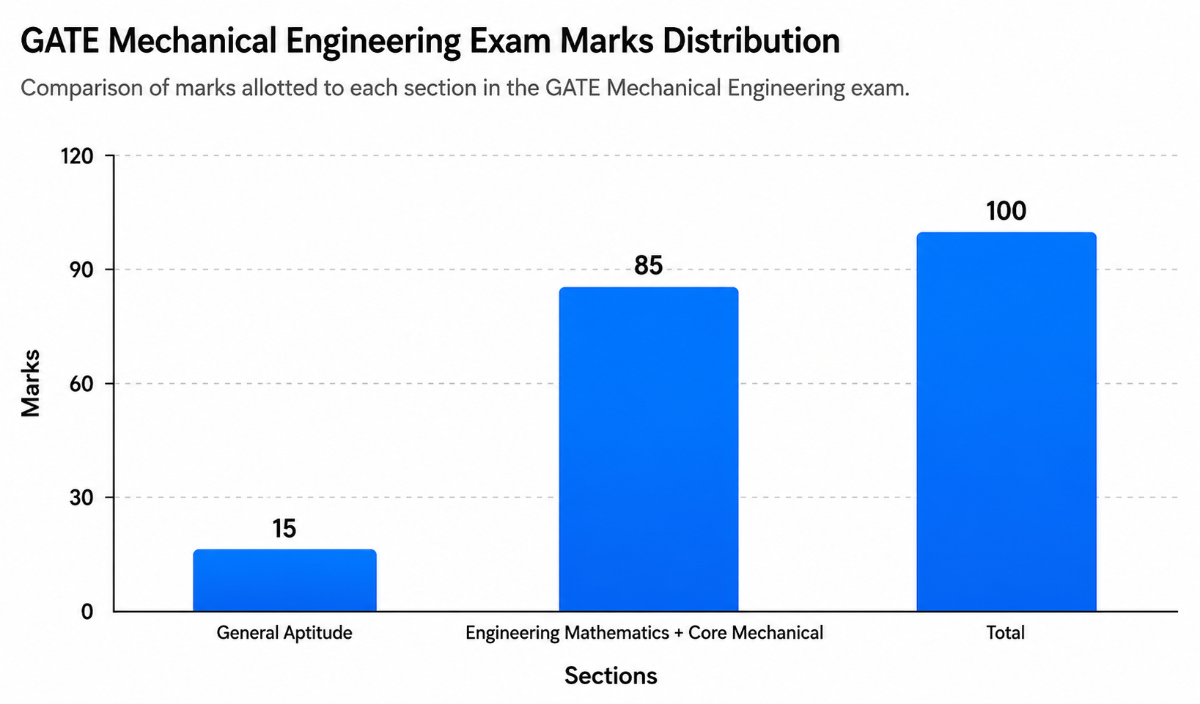
The GATE ME 2027 paper is a computer-based test conducted for a total of 100 marks. The marks are divided across three parts: General Aptitude, Engineering Mathematics, and Core Subject.
- The paper includes three types of questions: MCQ, MSQ, and NAT.
- The MCQ has one correct option, MSQ has one or more correct options, and NAT requires a numerical value.
- The MCQ questions have negative marking, while the MSQ and NAT do not have negative marking.
- As per the marking scheme, for a 1-mark MCQ, you will lose 1/3 mark for a wrong answer, and for a 2-mark MCQ, you will lose 2/3 mark for a wrong answer.
| Section | Marks | Question Types |
|---|---|---|
| General Aptitude | 15 | MCQ, NAT |
| Engineering Mathematics and Core Mechanical | 85 | MCQ, MSQ, NAT |
| Total | 100 |

Source: gate2027.iitm.ac.in
Related Links:
GATE ME Applied Mechanics and Design Syllabus 2027
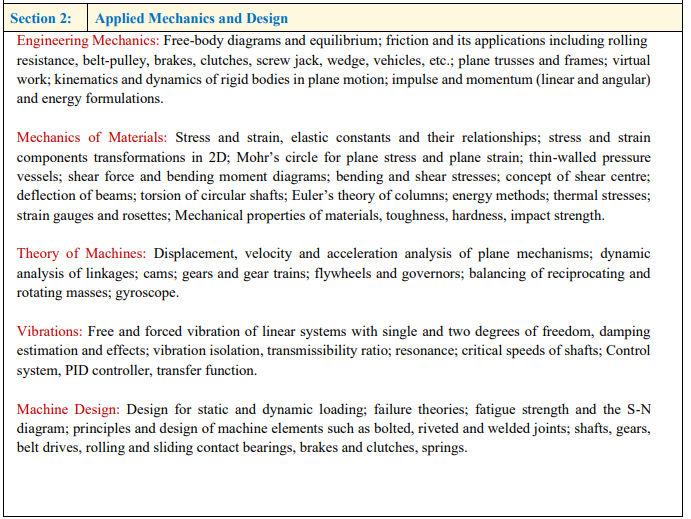
Applied Mechanics and Design covers topics such as mechanics, machines, and machine design. It is one of the highest-scoring core areas. Mechanics of Materials and Machine Design appear almost every year.
| Sub-Subject | Key Topics |
|---|---|
| Engineering Mechanics |
|
| Mechanics of Materials |
|
| Theory of Machines |
|
| Vibrations |
|
| Machine Design |
|
Source: gate2027.iitm.ac.in
Also Check:
GATE ME Fluid Mechanics and Thermal Sciences Syllabus 2027
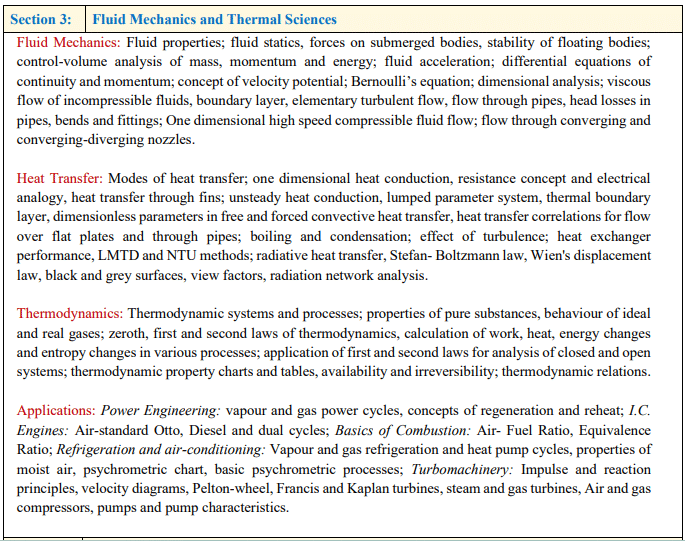
Fluid Mechanics and Thermal Sciences carries high weightage in the ME paper. This section covers fluids, heat, and thermodynamics.
- Candidates should give more focus to Thermodynamics and Fluid Mechanics, as together they decide your GATE ME rank.
| Sub-Subject | Key Topics |
|---|---|
| Fluid Mechanics |
|
| Heat Transfer |
|
| Thermodynamics |
|
| Applications |
|
Source: gate2027.iitm.ac.in
GATE ME Materials, Manufacturing and Industrial Engineering Syllabus 2027
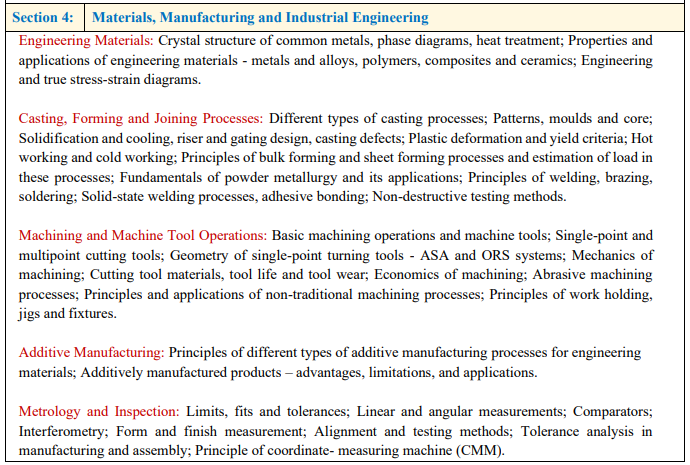
The Materials, Manufacturing and Industrial Engineering section covers topics such as materials, production processes, and industrial engineering. The key topics are provided in the table below:
| Sub-Subject | Key Topics |
|---|---|
| Engineering Materials |
|
| Casting, Forming and Joining Processes |
|
| Machining and Machine Tools |
|
| Additive Manufacturing |
|
| Metrology and Inspection |
|
| Computer Aided Manufacturing and Automation |
|
| Production Planning and Control |
|
| Operations Research |
|
Source: gate2027.iitm.ac.in
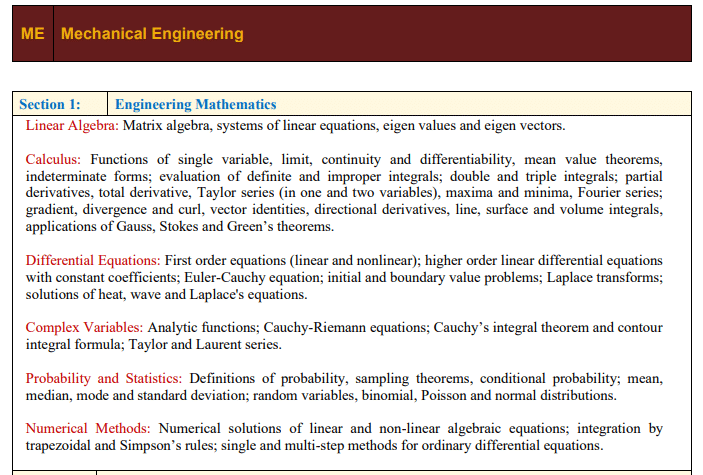
GATE ME Engineering Mathematics Syllabus 2027
The Engineering Mathematics section carries 13 marks in the GATE ME paper. It supports numerical questions across every core subject.
- Engineering Mathematics is a high-yield section, since its methods repeat inside thermodynamics, fluid mechanics, and design questions.
| Unit | Topics Covered |
|---|---|
| Linear Algebra | Matrix algebra, systems of linear equations, eigen values and eigen vectors. |
| Calculus |
|
| Differential Equations |
|
| Complex Variables |
|
| Probability and Statistics |
|
| Numerical Methods |
|
Source: gate2027.iitm.ac.in
Related Links:
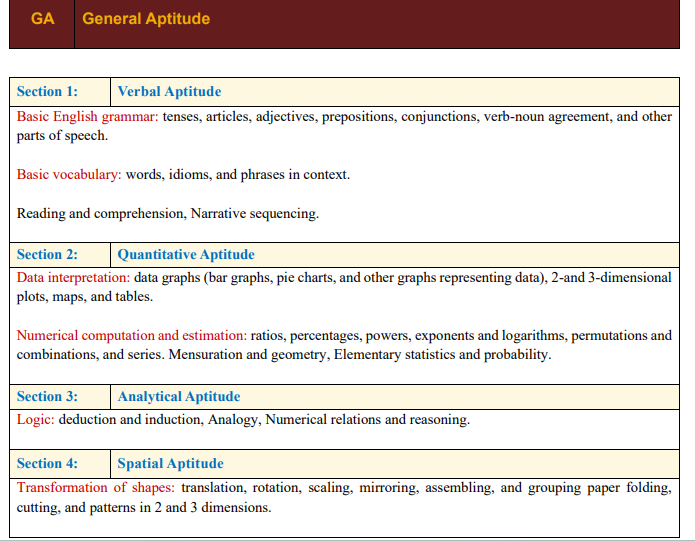
GATE ME General Aptitude Syllabus 2027
The General Aptitude section is common to all the papers and carries 15 marks. The syllabus is divided into four parts:
- Candidates should not ignore the General Aptitude section as it is a scoring area.
| Section | Topics Covered |
|---|---|
| Verbal Aptitude |
|
| Quantitative Aptitude |
|
| Analytical Aptitude | Logic: deduction and induction, Analogy, Numerical relations and reasoning. |
| Spatial Aptitude | Transformation of shapes: translation, rotation, scaling, mirroring, assembling, and grouping paper folding, cutting, and patterns in 2 and 3 dimensions. |
Source: gate2027.iitm.ac.in
GATE ME 2027 Handwritten Notes
The topic-wise GATE ME 2027 handwritten notes are provided in the table below:
| Topic | Notes |
|---|---|
| Strength of Materials | Check Notes |
| Engineering Mathematics | Check Notes |
| Engineering Mechanics | Check Notes |
| Theory of Machines | Check Notes |
| Vibrations | Check Notes |
| Machine Design | Check Notes |
| Fluid Mechanics | Check Notes |
| Thermodynamics and Applications | Check Notes |
| Heat transfer | Check Notes |
| Engineering Materials | Check Notes |
| Manufacturing: Casting, Forming, and Joining | Check Notes |
| Manufacturing: Machining, Machine Tools, and Metrology | Check Notes |
| Industrial Engineering and Operations Research | Check Notes |
| General Aptitude | Check Notes |
GATE ME Syllabus 2027: Subject-Wise Weightage
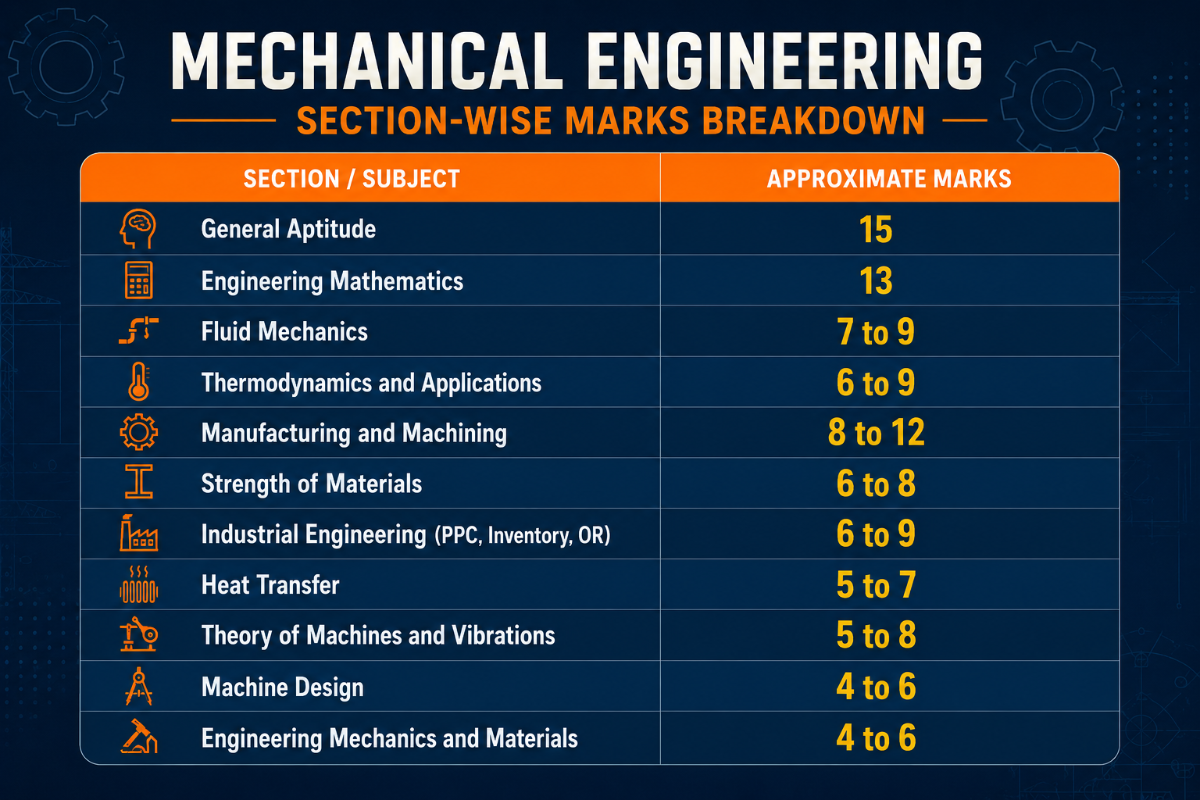
The GATE ME subject-wise weightage is provided below as per the previous year trends from 2022 to 2026. The exact marks can vary each year.
- Fluid Mechanics, Thermodynamics, Manufacturing, and Strength of Materials are the high-yield topics of GATE ME.
| Section / Subject | Approximate Marks |
|---|---|
| General Aptitude | 15 |
| Engineering Mathematics | 13 |
| Fluid Mechanics | 7 to 9 |
| Thermodynamics and Applications | 6 to 9 |
| Manufacturing and Machining | 8 to 12 |
| Strength of Materials | 6 to 8 |
| Industrial Engineering (PPC, Inventory, OR) | 6 to 9 |
| Heat Transfer | 5 to 7 |
| Theory of Machines and Vibrations | 5 to 8 |
| Machine Design | 4 to 6 |
| Engineering Mechanics and Materials | 4 to 6 |
Highest-Weightage Chapters in GATE ME
Candidates should focus on the high-yield topics as these chapters appear in almost every GATE ME paper. The high-yield areas based on the previous years' papers are given below:
- Fluid Mechanics: Bernoulli's equation, boundary layer, pipe flow, and dimensional analysis.
- Thermodynamics: entropy and availability, Rankine cycle, and Brayton cycle.
- Strength of Materials: bending and shear stress, torsion, and Mohr's circle.
- Heat Transfer: conduction, fins, and heat exchangers using LMTD and NTU.
- Manufacturing: metal cutting and tool life, casting, and welding.
- Industrial Engineering: linear programming, PERT and CPM, and inventory models.
- Theory of Machines: gears and gear trains, mechanisms, and vibrations.
Best Books for GATE ME 2027
Candidates are advised to use standard reference books for each subject recommended by toppers and teachers. The GATE ME 2027 best books are provided below:
| Subject | Book | Author |
|---|---|---|
| Engineering Mathematics | Higher Engineering Mathematics | B.S. Grewal |
| Strength of Materials | Strength of Materials | B.C. Punmia |
| Thermodynamics | Engineering Thermodynamics | P.K. Nag |
| Fluid Mechanics | Fluid Mechanics and Hydraulic Machines | R.K. Bansal |
| Heat Transfer | Heat and Mass Transfer | R.C. Sachdeva |
| Theory of Machines | Theory of Machines | S.S. Rattan |
| Machine Design | Design of Machine Elements | V.B. Bhandari |
| Manufacturing | Manufacturing Technology | P.N. Rao |
| Industrial Engineering | Operations Research | Hamdy Taha |
Related Links:
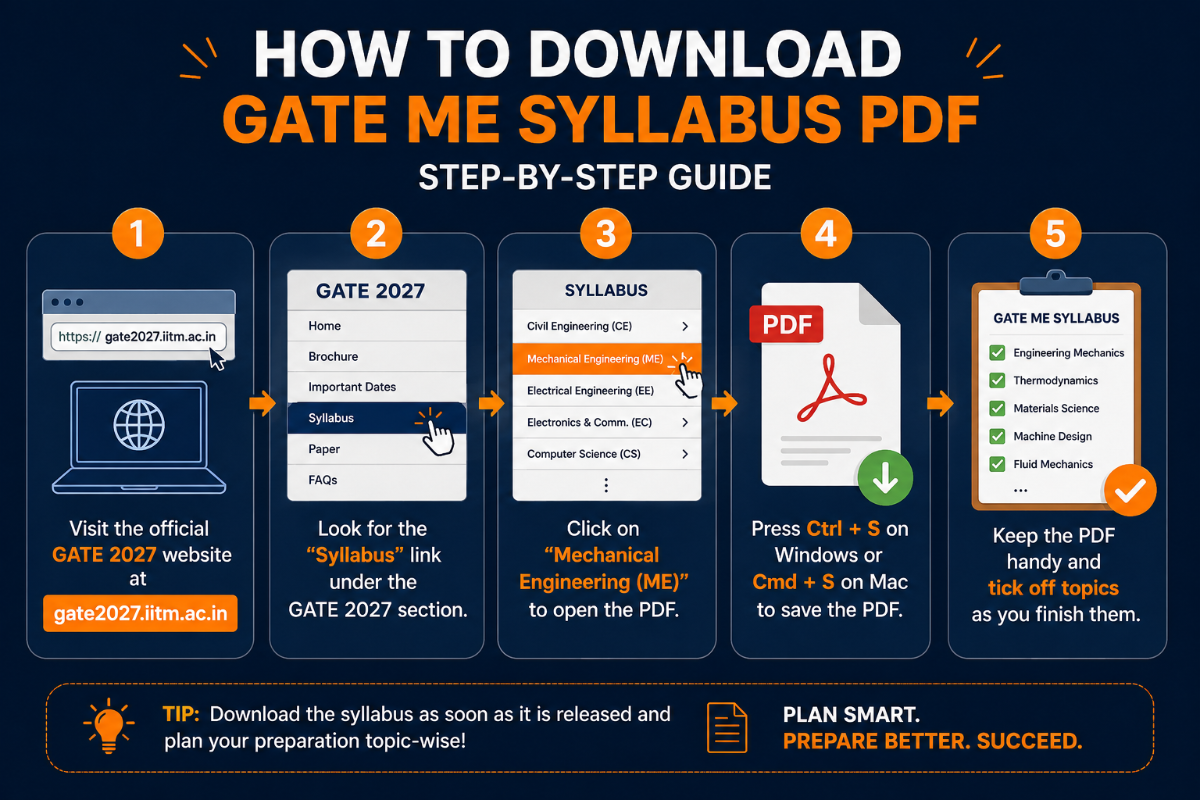
How to Download GATE ME Syllabus 2027 PDF
Follow these steps to download the official GATE ME syllabus 2027 PDF available on the GATE 2027 website, gate2027.iitm.ac.in.
Related Links:
GATE ME Syllabus 2027: Preparation Tips
Candidates can use the given phase-wise preparation plan to strengthen their GATE ME preparation. The plan given below is a detailed 8-month plan:
- The previous year's papers are the most crucial part of candidates' preparation as the question patterns repeat across years.
| Phase | Duration | Subjects to Cover | Focus |
|---|---|---|---|
| Phase 1: Build the Foundation | Weeks 1–5 | Engineering Mathematics, General Aptitude | Build strong fundamentals, formulas, and problem-solving techniques. |
| Phase 2: Core Mechanics | Weeks 6–12 | Engineering Mechanics, Strength of Materials, Theory of Machines | Master concepts, solve topic-wise questions, and practice previous years' papers. |
| Phase 3: Thermal Sciences | Weeks 13–19 | Thermodynamics, Fluid Mechanics, Heat Transfer | Develop numerical ability, revise concepts, and solve PYQs. |
| Phase 4: Design & Manufacturing | Weeks 20–26 | Manufacturing Engineering, Machine Design, Industrial Engineering | Cover high-weightage topics, mixed practice sets, and sectional tests. |
| Phase 5: Revision & Testing | Weeks 27–32 | Complete Syllabus | Solve subject-wise and full-length PYQs, attempt 25–30 full-length mock tests, analyze mistakes, revise formula sheets and short notes, and strengthen weak areas. |
Also Check: GATE ME 2027 Preparation Strategy
GATE ME Syllabus 2027: Sample Paper
The GATE ME sample papers will help candidates in checking their preparation and knowledge and will also help them in widening their knowledge base.
Given below are the GATE ME 2027 sample papers to be attempted by candidates:
| Subject | Sample Paper |
|---|---|
| General Aptitude | Download PDF |
| Core Subjects | Download PDF (Soon) |
GATE ME Syllabus 2027: Previous Year Papers
Given below are the year-wise question papers of GATE ME along with their solutions, which will help candidates know the exam pattern and the difficulty level.
| Year | Question Paper |
|---|---|
| GATE 2026 | Download PDF |
| GATE 2025 | Download PDF |
| GATE 2024 | Download PDF |
| GATE 2023 | Download PDF |
| GATE 2022 | Download PDF |
| GATE 2021 | Download PDF |
| GATE 2020 | Download PDF |
| GATE 2019 | Download PDF |
| GATE 2018 | Download PDF |
| GATE 2017 | Download PDF |
GATE ME Syllabus 2027: FAQs
Ques. Is the GATE ME 2027 syllabus the same as last year?
Ans. No, the ME syllabus has been revised and is not the same as GATE 2026. The GATE ME revised syllabus is provided in this article.
Ques. Who will release the GATE ME 2027 syllabus?
Ans. IIT Madras is the organising institute for GATE 2027. It has released the syllabus along with the information brochure on its official website, gate2027.iitm.ac.in.
Ques. How many sections are in the GATE ME 2027 syllabus?
Ans. The syllabus has four sections: Engineering Mathematics, Applied Mechanics and Design, Fluid Mechanics and Thermal Sciences, and Materials, Manufacturing and Industrial Engineering.
Ques. Which subjects have the highest weightage in GATE ME?
Ans. The topics such as Fluid Mechanics, Thermodynamics, Manufacturing, and Strength of Materials carry high weightage. The Engineering Mathematics section also carries a high value.
Ques. How many marks is the General Aptitude section?
Ans. The General Aptitude section carries 15 marks out of 100 and is common in every GATE paper.
Ques. Where can I download the GATE ME 2027 syllabus PDF?
Ans. You can download the GATE ME 2027 syllabus from the official GATE 2027 website. IIT Madras has released the subject-wise syllabus PDFs.
Ques. Is there negative marking in GATE ME?
Ans. Yes, there is negative marking in the exam, but only for MCQs. MSQ and NAT questions have no negative marking.
Ques. Which are the best books for GATE ME 2027?
Ans. The best books for the GATE ME 2027 as per toppers' recommendations are P.K. Nag for Thermodynamics, R.K. Bansal for Fluid Mechanics, and B.C. Punmia for Strength of Materials.
Ques. How many months are needed to cover the GATE ME syllabus 2027?
Ans. An 8 to 10-month plan works well for most students. However, you can finish your syllabus faster with strong basics and daily practice.
Ques. How much weightage does the core Mechanical part carry?
Ans. The core Mechanical subjects carry around 70% of the paper. The General Aptitude and Engineering Mathematics sections make up the remaining 30%.
Ques. When will GATE 2027 be held?
Ans. IIT Madras has announced the GATE 2027 exam dates. The GATE 2027 will be held on 6, 7, 13, 14, 20 and 21 February 2027.



Comments