




GATE Chemistry Syllabus 2027 will be released by IIT Madras along with the official notification at gate.iitm.ac.in. The GATE CY paper carries 100 marks, including core Chemistry and General Aptitude.
- The GATE Chemistry syllabus 2027 has 3 core sections: Physical, Inorganic, and Organic Chemistry.
- Core Chemistry carries 85 marks, and General Aptitude carries 15 marks.
- The syllabus is expected to stay unchanged from GATE 2026, with no topics added or removed.
- Engineering Mathematics is not part of the GATE 2027 Chemistry syllabus.
- The three core sections carry near-equal weightage of roughly 28 marks each.
Related Articles:
- GATE Exam Pattern 2027
- GATE General Aptitude Handwritten Notes PDF
- GATE Chemistry Previous Year Papers
Key Summary
- GATE Chemistry syllabus 2027 is expected to be the same as the 2026 syllabus.
- The paper code is CY, with 3 core sections and 1 aptitude section.
- Physical, Inorganic and Organic Chemistry each contribute close to one-third of the core marks.
- IIT Madras will publish the official syllabus PDF at gate.iitm.ac.in.
- The syllabus is set at the BSc and MSc Chemistry level, not at the Class 12 level.
- Physical Chemistry drives most of the NAT numericals in the paper.
What is the GATE Chemistry Syllabus 2027?
IIT Madras will conduct GATE 2027 as the organising institute. The Chemistry paper carries the code CY and is one of 30 GATE papers.
- Inorganic Chemistry: Coordination Chemistry and Organometallic Chemistry carry the highest weightage in this section. Questions frequently test concepts like the 18-electron rule, Orgel diagrams, crystal field theory, and catalytic reaction mechanisms.
- Organic Chemistry: Reaction Mechanisms, Pericyclic Reactions, and Named Reagents form the core of the organic syllabus. Most questions focus on reaction pathways, stereochemistry, regioselectivity, and predicting reaction products.
- Physical Chemistry: Quantum Chemistry, Thermodynamics, and Chemical Kinetics are the most important scoring topics. Success in these areas depends on strong conceptual understanding, numerical problem-solving skills, and accurate application of formulas.
| Particular | Detail |
|---|---|
| Exam Name | Graduate Aptitude Test in Engineering (GATE) 2027 |
| Paper Code | CY (Chemistry) |
| Mode | Computer-Based Test (CBT) |
| Duration | 3 hours (180 minutes) |
| Total Questions | 65 |
| Total Marks | 100 (85 core Chemistry + 15 General Aptitude) |
| Question Types | MCQ, MSQ, NAT |
| Allowed Second Paper | CH (Chemical Engineering) or XL (Life Sciences) |
Ques. Is the GATE Chemistry syllabus 2027 the same as 2026?
Ans. The syllabus is expected to remain identical. The 3-section CY structure has been stable across recent cycles. IIT Madras will confirm this with the official notification in August 2026.
Check out the Handwritten Notes for:
GATE Chemistry Syllabus 2027: Important Dates
IIT Madras publishes the syllabus PDF along with the information brochure. The dates below are based on the GATE 2026 cycle.
| Event | Expected Date |
|---|---|
| GATE 2027 Official Website Launch | July 2026 |
| GATE 2027 Notification and Syllabus PDF | August 2026 |
| Registration Begins | August 2026 |
| Last Date Without Late Fee | September 2026 |
| Form Correction Window | November 2026 |
| Admit Card Release | January 2027 |
| GATE 2027 Exam Dates | February 6, 7, 13 and 14, 2027 |
| Answer Key Release | February 2027 |
| GATE 2027 Result | March 2027 |
Ques. How many sections are in the GATE Chemistry syllabus 2027?
Ans. There are 3 core sections plus General Aptitude. The core sections are Physical Chemistry, Inorganic Chemistry and Organic Chemistry.
Also Check:
What’s New in GATE Chemistry Syllabus 2027?
The GATE Chemistry syllabus has stayed stable across recent cycles. IIT Roorkee and IIT Guwahati both published the same 3-section structure with identical topic lists.
- No major syllabus changes are expected for GATE Chemistry (CY) 2027. The core topics and overall syllabus remain the same as in recent years.
- Engineering Mathematics section is not included in the Chemistry paper. The syllabus focuses only on General Aptitude and Core Chemistry.
- Core Chemistry continues to cover the three main areas: Physical Chemistry, Inorganic Chemistry, and Organic Chemistry, with no expected structural changes.
Check Out:
GATE Physical Chemistry Syllabus 2027
Physical Chemistry drives most of the numerical questions in the CY paper. It is also the section that overlaps most with Quantum Mechanics. The approximate weightage of the GATE 2027 Physical Chemistry section is 28-30%.
- Quantum Mechanics: Focus on solving numerical problems involving energy states, wave functions, and normalization, as these are commonly asked in 2-mark NAT questions.
- Group Theory: Practice character tables and symmetry operations, as MSQs often test irreducible representations and molecular symmetry.
- Equilibrium & Thermodynamics: Strengthen concepts like Maxwell relations, Debye–Hückel theory, and partition functions, as these frequently appear in multi-step numerical problems.
| Unit | Topics Covered |
|---|---|
| Structure (Quantum Chemistry) | Postulates of quantum mechanics, operators, time-dependent and time-independent Schrödinger equations, Born interpretation, Dirac bra-ket notation, particle in a box, tunnelling, harmonic oscillator, Hermite polynomials, rigid rotor, hydrogen-like atoms, orbital approximation, Pauli exclusion principle, Slater determinants |
| Approximation Methods | Variation method, secular determinants, first-order perturbation techniques, atomic units |
| Molecular Structure and Bonding | Born-Oppenheimer approximation, valence bond theory, LCAO-MO theory, hybrid orbitals, MOT of homonuclear and heteronuclear diatomics, Huckel approximation |
| Group Theory | Symmetry elements and operations, point groups, character tables, internal coordinates, vibrational modes, symmetry-adapted LCAO |
| Spectroscopy | Atomic spectroscopy, Russell-Saunders coupling, term symbols, selection rules, rotational, vibrational, electronic, and Raman spectroscopy, line broadening, Einstein coefficients, basic NMR principles |
| Equilibrium and Thermodynamics | Laws of thermodynamics, Gibbs-Helmholtz and Maxwell relations, Gibbs-Duhem equation, van't Hoff equation, chemical potential, fugacity and activity, Raoult's and Henry's Law, Debye-Hückel limiting law, Nernst equation, phase rule, Clausius-Clapeyron equation, azeotropes and eutectics, statistical thermodynamics and partition functions |
| Kinetics, Surfaces and Interfaces | Elementary, parallel, opposing, and consecutive reactions, steady state approximation, transition state theory, Eyring equation, enzyme catalysis, kinetic isotope effects, physisorption and chemisorption, Langmuir, Freundlich, and BET isotherms, Langmuir-Hinshelwood mechanism, colloids and micelles |
Ques. Which section has the highest weightage in GATE Chemistry?
Ans. The three core sections are nearly equal at roughly 28 marks each. At the topic level, Reaction Mechanisms from Organic Chemistry is the single highest-weightage area at around 15 to 17%.
Related Link: GATE 2027 Best Books to Prepare
GATE Inorganic Chemistry Syllabus 2027
Inorganic Chemistry is the most theory-heavy of the three sections. Coordination chemistry alone carries a double-digit share of the marks. The approximate weightage of the GATE 2027 Inorganic Chemistry section is 27-29%.
- Transition Elements & Coordination Chemistry: Focus on Jahn–Teller effect, magnetic properties, and coordination compounds, as these topics are frequently tested in MSQs.
- Organometallic Chemistry: Practice the 18-electron rule, electron counting, and catalytic reactions, as they are common in 2-mark conceptual questions.
- Bioinorganic Chemistry & Radioactivity: Learn important metalloenzymes, biological metal ions, and half-life calculations, as these are often asked as direct or numerical questions.
| Unit | Topics Covered |
|---|---|
| Main Group Elements | Hydrides, halides, oxides, oxoacids, nitrides, sulfides, boranes, carboranes, silicones, silicates, boron nitride, borazines, phosphazenes, allotropes of carbon, phosphorus and sulphur, noble gases, interhalogens, Lewis and Bronsted acid-base concepts, HSAB principle |
| Transition Elements | Coordination chemistry, structure and isomerism, VBT, CFT and MOT, crystal field energy level diagrams, CFSE, Jahn-Teller distortion, Orgel and Tanabe-Sugano diagrams, nephelauxetic effect, Racah parameter, charge-transfer spectra, magnetic properties, substitution and redox mechanisms |
| Lanthanides and Actinides | Recovery, periodic properties, spectra and magnetic properties |
| Organometallics | 18-electron rule, metal-alkyl, metal-carbonyl, metal-olefin and metal-carbene complexes, metallocenes, fluxionality, homogeneous catalysis, hydroformylation, metathesis, Fischer-Tropsch reaction, Ziegler-Natta polymerization |
| Radioactivity | Detection of radioactivity, decay processes, half-life, fission and fusion |
| Bioinorganic Chemistry | Sodium and potassium ion transport, oxygen binding and transport, electron transfer reactions, nitrogen fixation, metalloenzymes of Mg, Mo, Fe, Co, Cu and Zn |
| Solids and Instrumental Methods | Crystal systems and lattices, Miller planes, crystal defects, Bragg's law, AX and AX2 structures, spinels, band theory, UV-visible and FTIR spectrophotometry, NMR and ESR, mass spectrometry, atomic absorption, Mossbauer spectroscopy, X-ray crystallography, GC and HPLC, cyclic voltammetry, thermoanalytical methods |
Ques. Where can I download the GATE Chemistry syllabus 2027 PDF?
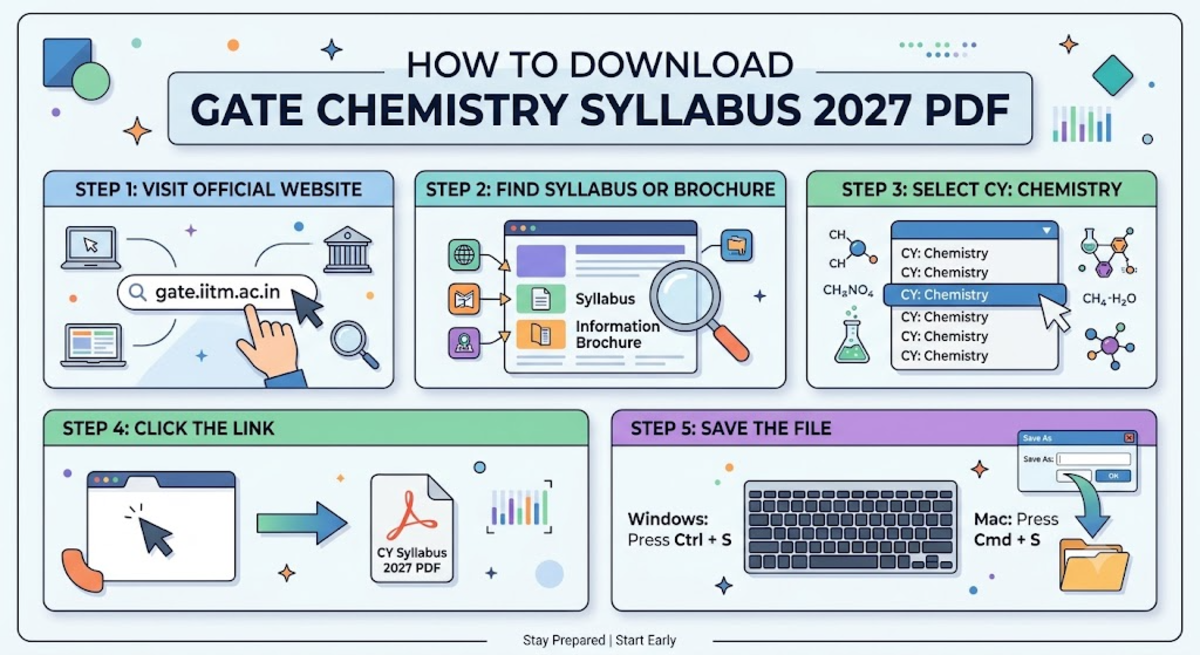
Ans. The official PDF will be available at gate.iitm.ac.in once IIT Madras launches the GATE 2027 website. It is expected in July or August 2026.
Related Article:
GATE Organic Chemistry Syllabus 2027
Organic Chemistry rewards mechanism thinking over memorisation. Reaction Mechanisms is the single highest-weightage topic in the entire CY paper. The approximate weightage of the GATE 2027 Organic Chemistry section is 27-29%.
- Practice reaction intermediates, name reactions, and coupling reactions (Heck, Suzuki, Sonogashira, etc.), as they are frequently tested in 2-mark MCQs and MSQs.
- Pericyclic Reactions & Photochemistry: Master Woodward–Hoffmann rules, FMO theory, and Norrish reactions, as these are predictable and high-scoring topics.
- Stereochemistry & Asymmetric Synthesis: Focus on conformational analysis, topicity, and stereochemical models to solve questions involving 3D molecular structures and product prediction.
| Unit | Topics Covered |
|---|---|
| Stereochemistry | Chirality and symmetry, absolute configuration, multiple stereogenic centres, homotopic, enantiotopic and diastereotopic groups, stereoselective and stereospecific synthesis, conformational analysis, atropisomerism, neighbouring group participation |
| Reaction Mechanisms | Kinetic versus thermodynamic control, Hammond's postulate, Curtin-Hammett principle, isotopic labelling, Hammett and Taft equations, nucleophilic and electrophilic substitution, addition and elimination reactions, carbocations, carbanions, carbenes, nitrenes, arynes, free radicals, molecular rearrangements |
| Organic Synthesis | Reactions of alkenes, alkynes, arenes, alcohols, phenols, aldehydes, ketones, acids, esters, nitriles, halides, amines and amides, Mg, Li, Cu, B, Zn, P, S, Sn and Si reagents, Heck, Suzuki, Stille, Sonogashira, Negishi, Kumada, Hiyama, Tsuji-Trost, olefin metathesis and McMurry couplings, retrosynthetic analysis, green chemistry, umpolung reactivity |
| Asymmetric Synthesis | Resolution including enzymatic, desymmetrization, chiral auxiliaries, organocatalysis, enolate and enamine chemistry, silyl enol ethers, Cram, Prelog and Felkin-Anh models |
| Pericyclic Reactions and Photochemistry | Electrocyclic, cycloaddition and sigmatropic reactions, FMO and PMO treatments, Woodward-Hoffmann rule, photochemistry of alkenes, arenes and carbonyls, di-pi-methane rearrangement, Barton-McCombie reaction, Norrish type-I and type-II cleavage |
| Heterocyclic Compounds | Structure, preparation, properties and reactions of furan, pyrrole, thiophene, pyridine, indole, quinoline and isoquinoline |
| Biomolecules and Experimental Techniques | Mono- and di-saccharides, amino acids, peptide synthesis and structure determination, proteins, nucleic acids, lipids, steroids, terpenoids, carotenoids, alkaloids, polarimetry, TLC, column, HPLC and GC, UV-visible, IR, NMR and mass spectrometry for structure determination |
Source: GATE 2026 Official CY Syllabus, IIT Guwahati
Ques. Which paper can I pair with GATE Chemistry?
Ans. GATE allows two papers per cycle from an approved combination list. Chemistry has commonly been paired with Chemical Engineering (CH) or Life Sciences (XL).
GATE Chemistry 2027 Previous Year Papers
Below is the list of GATE Chemistry Previous year papers along with solutions from 2020 to 2026:
| Year | Question paper | Answer Key |
|---|---|---|
| GATE 2026 Chemistry Question Paper | Download PDF | View Solution |
| GATE 2025 Chemistry Question Paper | Download PDF | Check Solutions |
| GATE 2024 Chemistry Question Paper | Download PDF | Check Solutions |
| GATE Chemistry 2023 Question Paper | Download PDF | Check Solutions |
| GATE Chemistry 2022 Question Paper | Download PDF | Check Solutions |
| GATE Chemistry 2021 Question Paper | Download PDF | Check Solutions |
| GATE Chemistry 2020 Question Paper | Download PDF | Check Solutions |
Related Article: How to Score 60+ in GATE 2027: Paper-Wise Study Plan
GATE Chemistry Syllabus 2027: General Aptitude
General Aptitude is common to all 30 GATE papers. It carries 15 marks across 10 questions:
- Numerical Aptitude: Practice basic calculations, percentages, ratios, and probability to improve speed and reduce dependence on the virtual calculator.
- Spatial Aptitude: Strengthen 2D/3D visualization skills, as they help in both aptitude questions and Chemistry topics like stereochemistry.
- Verbal Aptitude: Prepare reading comprehension, vocabulary, and word-relation questions to score quick and easy marks in the General Aptitude section.
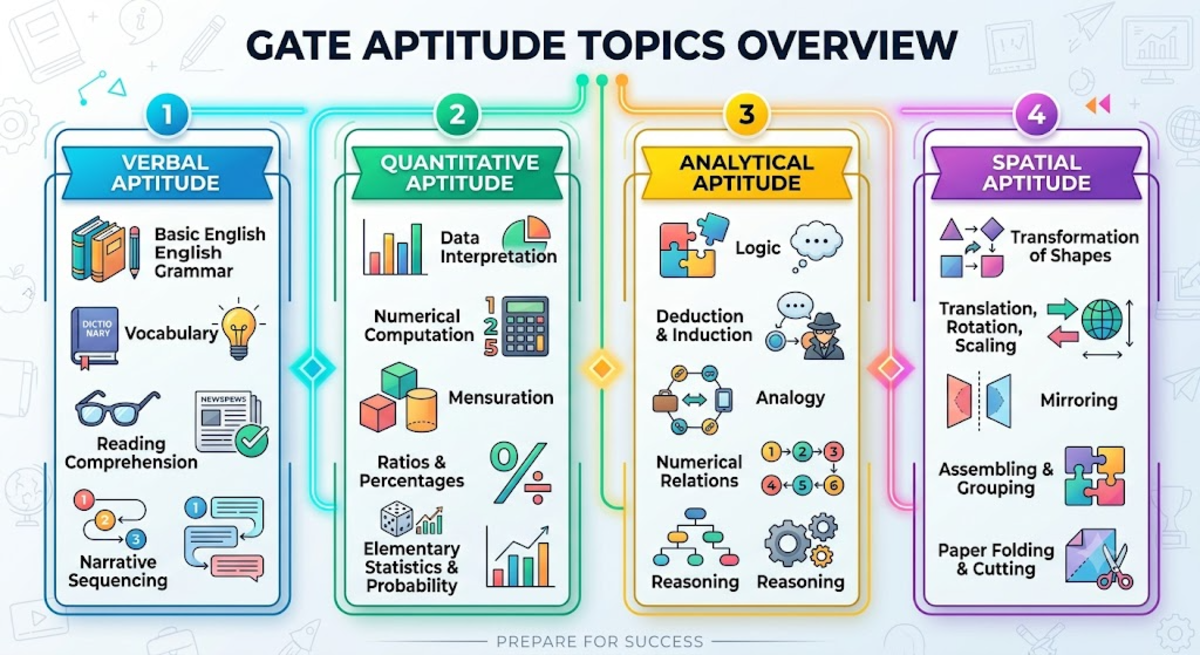
| Area | Topics Covered |
|---|---|
| Verbal Aptitude | Basic English grammar, vocabulary, reading comprehension, narrative sequencing |
| Quantitative Aptitude | Data interpretation, numerical computation, mensuration, ratios, percentages, elementary statistics and probability |
| Analytical Aptitude | Logic, deduction and induction, analogy, numerical relations, reasoning |
| Spatial Aptitude | Transformation of shapes, translation, rotation, scaling, mirroring, assembling and grouping, paper folding and cutting |
Ques. Where do most numerical questions come from in GATE CY?
Ans. Physical Chemistry supplies the bulk of the NAT questions. Chemical Kinetics, Thermodynamics and Quantum Chemistry are the main numerical sources.
Related Link: GATE 2027 Subject-Wise Marks Distribution: Which Paper Carries the Most Weight
GATE Chemistry Syllabus 2027: Topic-Wise Weightage
The weightage below is based on GATE Chemistry papers from the last five years. Actual distribution shifts by 2 to 3 marks each year.
- Physical, Inorganic, and Organic Chemistry carry almost equal weight, so consistent preparation across all three sections is essential.
- Around 17–19 questions are expected from each Chemistry branch.
- The majority of marks come from core Chemistry topics, while General Aptitude contributes an additional 15 marks that can boost the overall score.
| Section | High-Weightage Topics | Questions (Approx) | Marks (Approx) |
|---|---|---|---|
| Physical Chemistry | Chemical Kinetics, Chemical Equilibrium, Quantum Chemistry, Thermodynamics, Group Theory | 17 to 19 | 28 to 30 |
| Inorganic Chemistry | Coordination Chemistry, Main Group Elements, Organometallics, Instrumental Methods | 17 to 19 | 27 to 29 |
| Organic Chemistry | Reaction Mechanisms, Organic Synthesis, Stereochemistry, Pericyclic Reactions | 17 to 19 | 27 to 29 |
| General Aptitude | Verbal, quantitative, analytical, spatial | 10 | 15 |
Ques. How long does it take to cover the full GATE Chemistry syllabus?
Ans. Most students need 8 to 10 months of consistent study. If you start in July 2026, you get roughly 6 months for the syllabus and 2 months for revision.
Check Out: List of Top Engineering Colleges in India Accepting GATE Based on 2026 Ranking
Best Books for GATE Chemistry 2027
Build your preparation around one primary book per subject and use the others only for advanced concepts or revision to avoid unnecessary overlap.
- Physical Chemistry requires the strongest conceptual understanding, so focus on thermodynamics, quantum chemistry, and group theory from books like Peter Atkins & Julio de Paula and Ira N. Levine.
- Organic Chemistry questions are largely mechanism-based, making books that emphasize reaction pathways and stereochemistry particularly valuable.
- For Inorganic Chemistry, Shriver and Atkins, J. D. Lee, and Miessler and Tarr will help build conceptual understanding.
| Section | Book Name | Author / Publisher | Why This Book |
|---|---|---|---|
| Physical Chemistry | Physical Chemistry | Peter Atkins and Julio de Paula | Standard reference for thermodynamics, kinetics and quantum chemistry |
| Physical Chemistry | Quantum Chemistry | Ira N. Levine | Best single source for operators, variation method and perturbation theory |
| Physical Chemistry | Molecular Symmetry and Group Theory | Robert L. Carter | Clear treatment of point groups and character tables |
| Inorganic Chemistry | Inorganic Chemistry | Shriver and Atkins | Covers main group, coordination and organometallic chemistry in GATE depth |
| Inorganic Chemistry | Concise Inorganic Chemistry | J. D. Lee | Reliable for main group elements and periodic trends |
| Inorganic Chemistry | Inorganic Chemistry | Miessler and Tarr | Strong on bonding theories and Tanabe-Sugano diagrams |
| Organic Chemistry | Organic Chemistry | Clayden, Greeves and Warren | Best book for mechanism-first thinking, which GATE rewards |
| Organic Chemistry | Advanced Organic Chemistry | Carey and Sundberg | Depth on reactive intermediates and pericyclic reactions |
| Organic Chemistry | Stereochemistry of Organic Compounds | Ernest L. Eliel | Definitive source for conformational and configurational analysis |
Ques. Is NCERT enough for GATE Chemistry preparation?
Ans. No. GATE Chemistry is set at the BSc and MSc level. You need standard references such as Atkins, Clayden, Shriver and Levine.
Also Check: GATE 2027 Test Papers: Full List of 30 Subjects, Codes and Syllabus Details
How to Download the GATE Chemistry Syllabus 2027 PDF?
Follow these steps to download the official GATE Chemistry syllabus PDF from IIT Madras.
Related Link: GATE 2027 Exam Date: Complete Schedule, Registration, Admit Card & Result Timeline
GATE Chemistry Preparation Tips 2027
Treat All Three Sections as Equal
- Physical, Inorganic and Organic each carry roughly 28 marks. None can be dropped.
- Students often skip Inorganic because it feels like rote learning. That costs 28 marks.
- Allocate study hours by section weightage, not by personal comfort.
- Dropping any one core section caps your maximum score at roughly 72 marks.
Physical Chemistry: Build the Numerical Muscle
- Most NAT questions in the CY paper come from Physical Chemistry.
- Practice Chemical Kinetics and Thermodynamics problems daily. Both are formula-dense.
- Learn Group Theory properly. Character tables are pure scoring questions once mastered.
- Do not memorise quantum chemistry results. Derive them at least once.
Organic Chemistry: Learn Mechanisms, Not Reactions
- Reaction Mechanisms is the highest-weightage topic in the whole paper.
- Draw electron-pushing arrows for every named reaction you study.
- Master the coupling reactions as a single block: Heck, Suzuki, Stille, Negishi and Sonogashira.
- Stereochemistry questions are rewarding, so practise absolute configuration assignment until it is automatic.
Inorganic Chemistry: Anchor on Coordination Chemistry
- Coordination chemistry alone contributes 10 to 12% of the paper.
- Work through CFT, CFSE and Jahn-Teller distortion with worked examples.
- Orgel and Tanabe-Sugano diagrams appear regularly. Do not leave them for the last month.
- Revise the 18-electron rule and organometallic counting weekly.
Use Previous Year Papers as Your Syllabus Filter
- Solve at least 10 years of GATE CY papers under timed conditions.
- Log every wrong answer in an error notebook and revisit it weekly.
- Take a full-length mock test every weekend from October 2026 onwards.
- Reserve the last 30 days entirely for revision and mock tests, not new topics.
Ques. What is the marking scheme for GATE Chemistry 2027?
Ans. The paper has 65 questions worth 100 marks. MCQs carry negative marking of one-third or two-thirds of the question's marks. MSQ and NAT questions carry no negative marking.
Student Preparation Strategy for GATE 2027 Chemistry
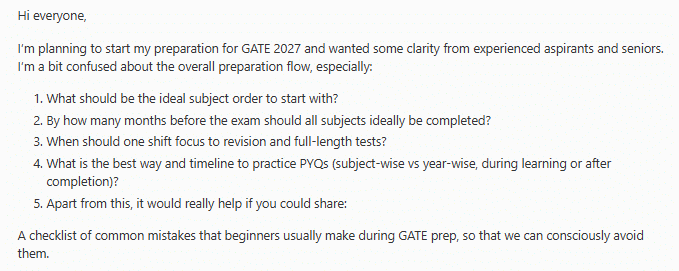
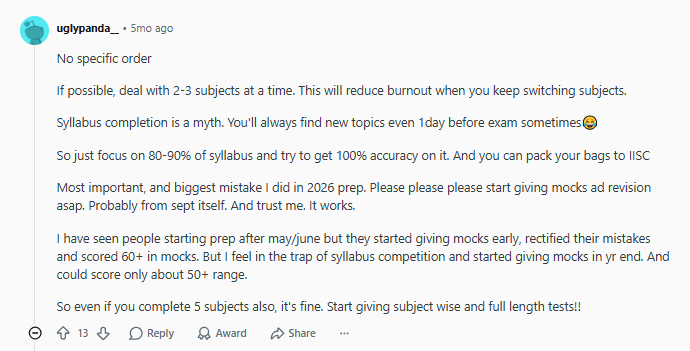
As per the Reddit thread r/Indian_Academia, students discuss the ideal preparation strategy for GATE 2027 aspirants:
- GATE aspirants recommend studying 2–3 subjects simultaneously instead of completing one subject at a time, as it improves retention and reduces burnout.
- A common suggestion is to start mock tests and revision early, even before completing the full syllabus. Regular subject-wise tests help identify weak areas much sooner.
- Many high scorers emphasize that covering 80–90% of the syllabus with strong accuracy is more effective than rushing to finish every topic without sufficient practice.
GATE Chemistry Syllabus 2027: FAQs
Ques. Is Group Theory important for GATE Chemistry?
Ans. Yes. Point groups, character tables and symmetry-adapted orbitals appear almost every year. Many students skip it, which makes it a useful differentiator.
Ques. What is a good score in GATE Chemistry?
Ans. The qualifying cutoff usually sits between 25 and 30 marks. A score above 55 marks generally puts you in contention for M.Sc, M.Tech and PhD admission at the IITs.
Ques. Which section is the easiest to score in GATE Chemistry?
Ans. General Aptitude is generally considered the easiest scoring section. Among the core subjects, candidates often find their strongest branch the most scoring with adequate practice.
Ques. Should I solve previous year papers topic-wise or as full-length tests?
Ans. Start with topic-wise PYQs while learning each subject. After completing most of the syllabus, switch to full-length papers under exam-like conditions to improve speed, accuracy, and time management.



Comments